
Arvada City Zoning Code
CHAPTER 3
USE REGULATIONS
3-1-1-1. - Purpose of article.
The purposes of this Article is:
1.
To set out the permitted, limited, conditional, and prohibited uses for primary uses in each zoning district;
2.
To establish the use-specific standards that apply to limited and conditional land uses;
3.
To establish standards for certain temporary uses;
4.
To establish standards for the business use of the home;
5.
To establish standards applicable to oil and gas operations.
3-1-1-2. - Application of article.
A.
Land Use by Zoning District.Division 3-1-2, Land Use by Zoning District, provides a set of tables that list the uses that are allowed in each zoning district, identifies the type of approval for a proposed use, and provides a cross-reference to applicable use-specific standards.
B.
Use-Specific Standards.Division 3-1-3, Use-Specific Standards for Primary Land Uses, provides standards that are specific to land uses that are set out in Division 3-1-2, Land Use by Zoning District, when the land uses are allowed as limited uses or conditional uses.
C.
Temporary Uses.Division 3-1-4, Temporary Uses, provides standards for the location and conduct of certain temporary land uses.
D.
Business Use of the Home.Division 3-1-5, Business Use of the Home, provides standards for home occupations, and home-based child care uses.
E.
Oil and Gas Operations.Division 3-1-6. Reserved.
3-1-2-1. - Interpretation of land use by zoning district tables.
A.
Generally. The tables set out in this Division describe which land uses are permitted "as-of-right," permitted if certain conditions are met, permitted after public hearing if certain conditions are met, and not allowed in each zoning district. Each listed use is defined in Chapter 11, Measurements, Rules of Construction, and Definitions.
B.
Legend. The following symbols are used in the tables in this Division to identify the types of uses allowed:
1.
"A" means allowed "as-of-right." These uses are subject to administrative review for compliance with the general requirements of this Code.
2.
"L" means "limited use." Limited uses are subject to administrative review for compliance with specific standards that pertain to the use, as well as the general requirements of this Code.
3.
"C" means "conditional use." Conditional uses are subject to public hearing review for compliance with specific standards that pertain to the use, the general standards for all conditional uses, and the general requirements of this Code.
4.
A blank cell means that the use is prohibited in the specified zoning district.
C.
Use-Specific Standards. Regardless of whether a use is classified as allowed by right, allowed as a limited use, or allowed as a conditional use, there may be additional standards applicable to that use. The use-specific standards that would apply are referenced in the right-hand column of the table.
D.
Multiple Uses. In instances where a proposed development will combine more than one listed use, each listed use shall be evaluated independently for compliance with applicable standards.
3-1-2-2. - Residential land use by zoning district.
A.
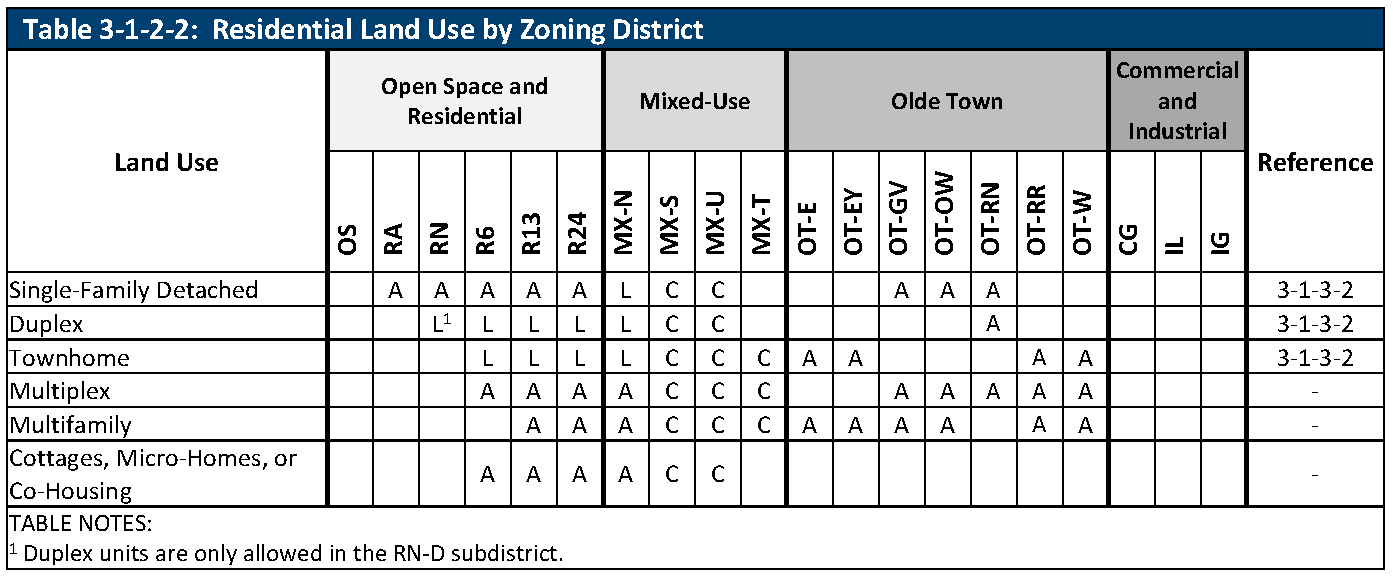
Residential land uses that are allowed in each zoning district are set out in Table 3-1-2-2, Residential Land Use by Zoning District.
3-1-2-3. - Special residential land use by zoning district.
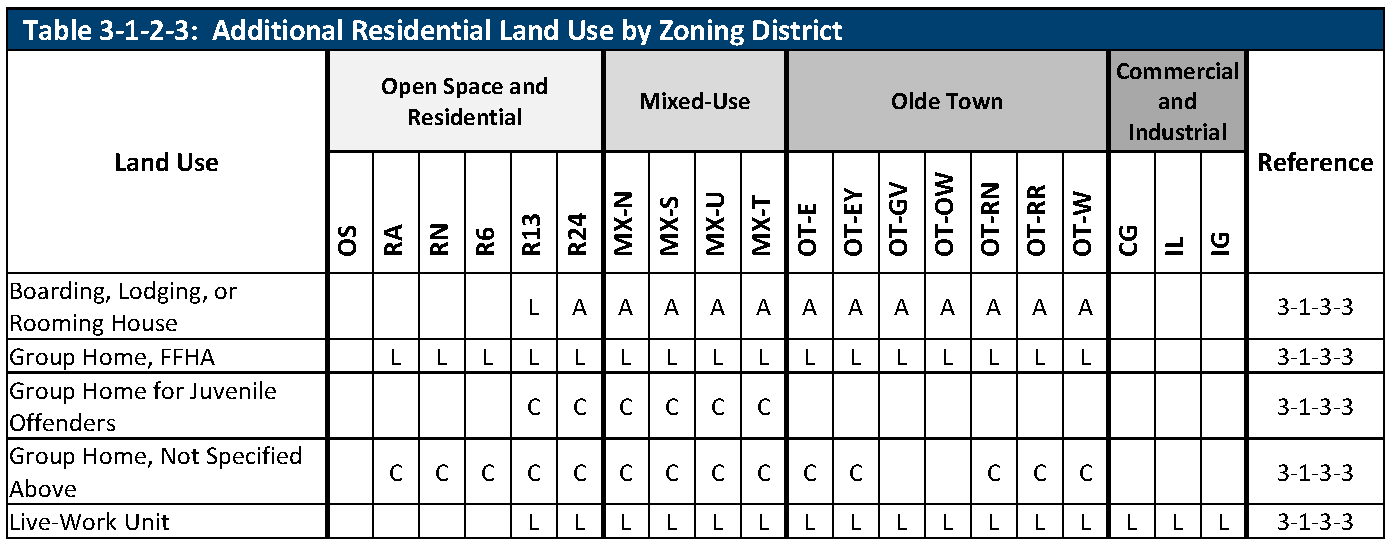
The special residential land uses that are allowed in each zoning district are set out in Table 3-1-2-3 Additional Residential Land Use by Zoning District.
3-1-2-4. - Hospitality, recreation, and entertainment land use by zoning district.
The hospitality, recreation, and entertainment land uses that are allowed in each zoning district are set out in Table 3-1-2-4, Hospitality, Recreation, and Entertainment Land Use by Zoning District.
(Ord. No. 4851, § 2, 7-10-2023; Ord. No. 4905, § 17, 8-19-2025)
3-1-2-5. - Commercial land use by zoning district.
The commercial land uses that are allowed in each zoning district are set out in Table 3-1-2-5, Commercial Land Use by Zoning District.
(Ord. No. 4793, § 2, 3-21-2022; Ord. No. 4851, § 2, 7-10-2023; Ord. No. 4905, § 18, 8-19-2025)
3-1-2-6. - Community, civic, educational, health care, and institutional land use by zoning district.
The community, civic, educational, health care, and institutional land uses that are allowed in each zoning district are set out in Table 3-1-2-6, Community, Civic, Educational, Health Care, and Institutional Land Use by Zoning District.
(Ord. No. 4851, § 2, 7-10-2023)
3-1-2-7. - Industrial, processing, recycling, storage, and disposal land use by zoning district.
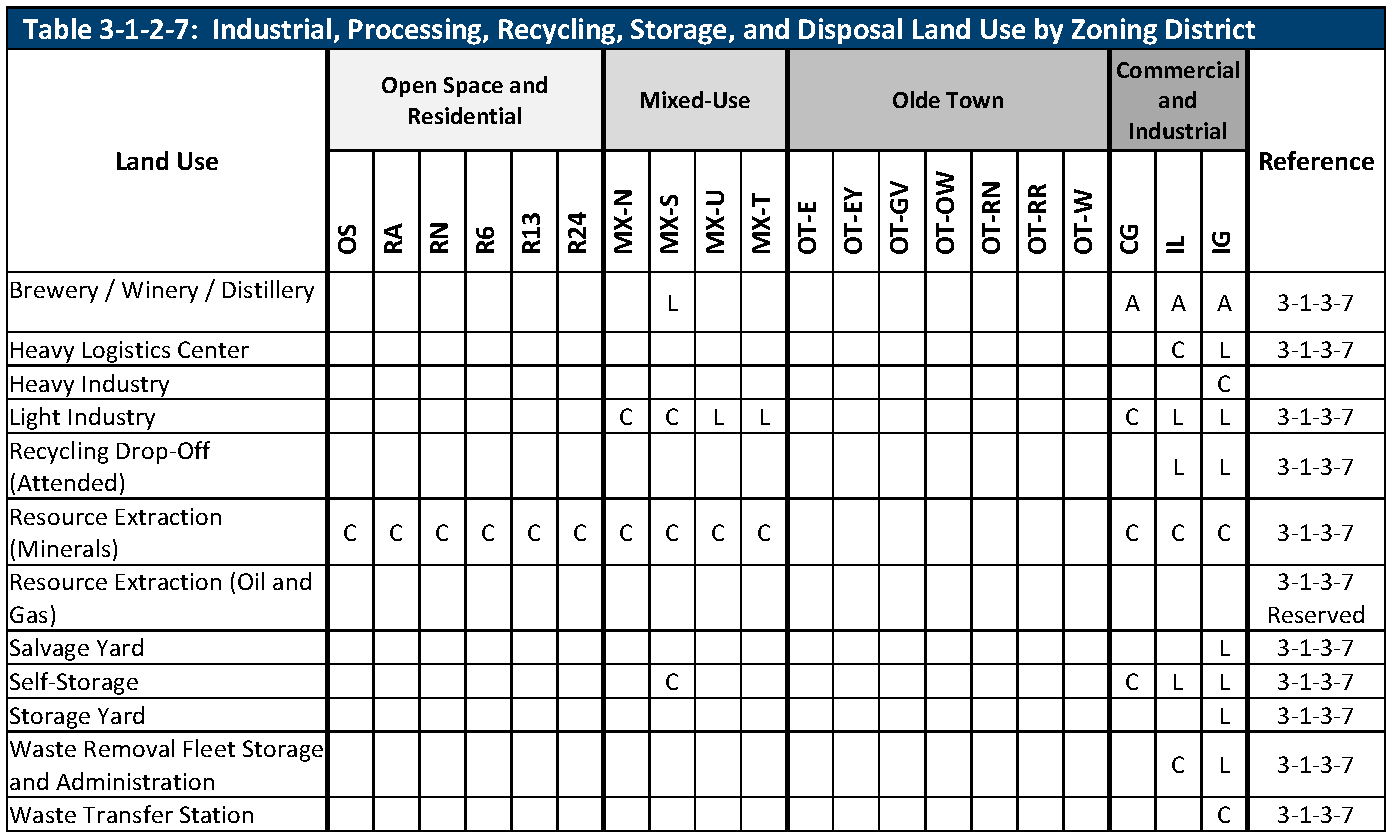
The industrial, processing, recycling, storage, and disposal land uses that are allowed in each zoning district are set out in Table 3-1-2-7, Industrial, Processing, Recycling, Storage, and Disposal Land Use by Zoning District.
3-1-2-8. - Motor vehicle land use by zoning district.
The motor vehicle land uses that are allowed in each zoning district are set out in Table 3-1-2-8, Motor Vehicle Land Use by Zoning District.
(Ord. No. 4905, § 19, 8-19-2025)
3-1-2-9. - Utility and communications land use by zoning district.
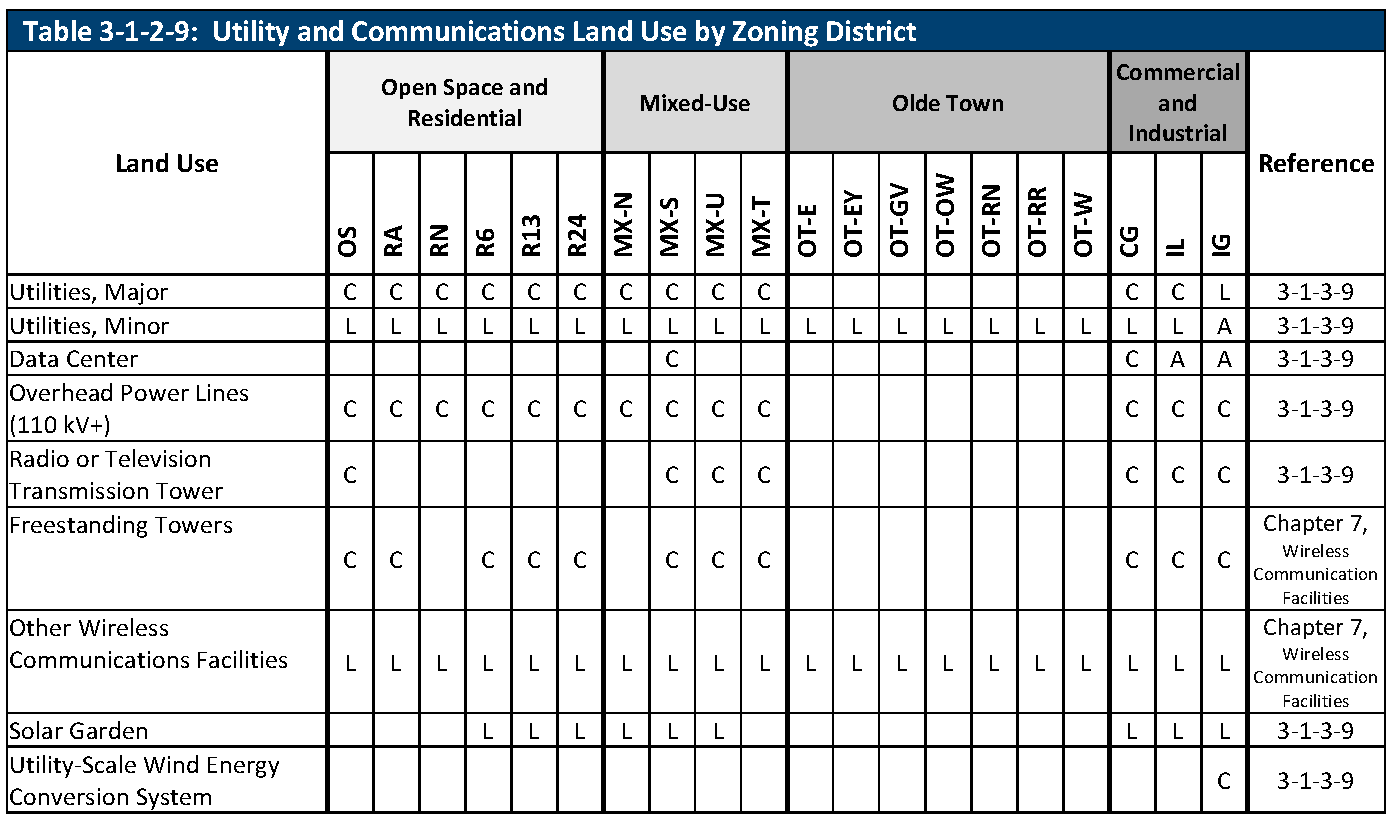
The utility and communications land uses that are allowed in each zoning district are set out in Table 3-1-2-9, Utility and Communications Land Use by Zoning District.
3-1-2-11. - Land uses that are not allowed in any zoning district.
The following land uses are not allowed in any zoning district:
1.
Criminal Detention facilities;
2.
Disposal facilities;
3.
Disposal of radioactive wastes;
4.
Outdoor shooting ranges;
5.
Intensive agriculture; and
6.
Any marijuana use identified in Chapter 53, Article II of the Arvada Municipal Code.
3-1-2-12. - Land uses that are not listed.
A.
Generally.
1.
If a proposed land use is not listed in any Land Use by Zoning District table, then the Director shall determine whether the proposed use is functionally comparable to a use that is listed in the tables. A proposed use is functionally comparable to a use that is allowed if it is reasonably comparable to the use, and with regard to each of the decision criteria enumerated in Subsection B., below, the proposed use has no greater impacts than the use with which it is functionally comparable.
2.
This Section shall not be used to allow land uses that are prohibited by Section 3-1-2-11, Land Uses That Are Not Allowed in Any Zoning District.
B.
Decision Criteria. The following decision criteria shall be evaluated when the Director determines whether a proposed use is functionally comparable to an allowed use:
1.
Whether the proposed use is similar in terms of hours of operation, traffic impacts, environmental impacts, and the potential for adverse impacts on surrounding properties;
2.
Whether the proposed use is typically housed in buildings or structures similar and compatible to those used to house allowed uses in the zoning district; and
3.
Whether the proposed use is consistent with the purpose and intent of the particular zoning district.
C.
Effect of Determination.
1.
If the Director approves an application for a decision pursuant to this Section, then the use is permitted, subject to the same standards and procedures as the use to which it was compared for the purposes of the favorable decision.
2.
If the Director determines that a proposed use is not functionally comparable to a use that is permissible in the table in the zoning district that applies to the subject property, then the proposed use is a prohibited use in that zoning district.
3-1-3-1. - Purpose and application of division.
A.
Purpose. The purpose of this Division is to set out use-specific standards for primary land uses in those zoning districts in which the uses are classified Limited ("L") or Conditional ("C") in the tables of Division 3-1-2, Land Use by Zoning District.
B.
Application.
1.
Section 3-1-3-2, Residential Standards, to Section 3-1-3-10, Agricultural Standards, inclusive, set out the use-specific standards that apply to each land use in zoning districts in which the land use is classified as Limited ("L") or Conditional ("C").
3-1-3-2. - Residential standards.
A.
Single-Family Detached.
1.
In the MX-S and MX-U zoning districts, in order to buffer existing single-family detached dwellings, the single-family detached lot shall only adjoin or be located across a local street from an existing or approved single-family residential subdivision. The lot width that is used for the housing type shall be within 25 percent of the average lot width of the adjoining lots or the lots that are directly across the local street (as applicable) that are developed with single-family detached dwelling units.
2.
In the MX-N district, single-family detached units shall not be adjacent to arterial streets.
B.
Duplex.
1.
Each individual duplex dwelling unit shall have a separate exterior entrance and separate utility meters.
C.
Townhome.
1.
Each individual townhome dwelling unit shall have direct access to a street, alley, or shared open space.
3-1-3-3. - Additional residential standards.
A.
Boarding, Lodging, or Rooming House.
1.
In the R13 zoning district, boarding, lodging, or rooming houses shall have not more than six sleeping rooms.
B.
Group Home.
Generally: Unless otherwise expressly stated, all group homes shall meet the following standards:
1.
The Applicant is licensed by the State of Colorado to operate such facility, or is not required to be licensed. If said license is pending, approval may be conditionally granted, but shall not take effect until licensing becomes final.
2.
The group home will not have an adverse effect on the residential character and quality of life in the particular neighborhood. The Director may not deny development approval for a proposed group home solely on the basis of neighborhood opposition, where no valid and substantive evidence has been offered to show that the proposed group home would have such adverse effect.
3.
Any proposed new structure or structural changes to an existing structure shall be consistent in architectural design and style with the character of the surrounding neighborhood.
4.
The Director shall have the authority to impose reasonable conditions upon the approval which are found necessary to operate the group home in a manner compatible with the neighborhood.
5.
No administrative activities of any private or public organization or agency other than those incidental to operation of the specific group home shall be conducted on the premises.
C.
Group Home, FFHA.
1.
All group homes for developmentally disabled, elderly, or mentally ill persons shall be spaced from each other by the lesser of:
a.
750 feet (linear distance from lot line to lot line); or
b.
A spacing that is such that no two group homes are located on the same block or take access from the same street.
2.
As authorized by 42 USC § 3604(f)(9), no group home for developmentally disabled, elderly, or mentally ill persons shall provide housing to any individual whose tenancy would constitute a direct threat to the health or safety of other individuals or whose tenancy would result in substantial physical danger to the property of others.
3.
If the group home is to be located in an existing building, the building must comply with all applicable requirements of the Building and Fire Codes before the use is established.
4.
The group home shall not include more than one resident who is required to register as a sex offender pursuant to C.R.S. § 18-3-412.5, as amended.
D.
Group Home for Juvenile Offenders.
1.
All group homes for juvenile offenders require a conditional use approval and shall be:
a.
Spaced from each other by at least 750 feet (linear distance from lot line to lot line);
b.
Located on a lot with a lot area that is at least 1,000 sf. per resident; and
c.
Provided with 24-hour on-site supervision and security, approved by the Director and the Chief of Police, with input from the placing agency.
2.
As authorized by 42 U.S.C. § 3604(f)(9), no group home for juvenile offenders shall provide housing to any individual whose tenancy would constitute a direct threat to the health or safety of other individuals or whose tenancy would result in substantial physical danger to the property of others.
3.
If the group home is to be located in an existing building, the building must comply with all applicable requirements of the Building and Fire Codes before the use is established.
4.
The group home shall not include more than one resident who is required to register as a sex offender pursuant to C.R.S. § 18-3-412.5, as amended.
E.
Group Home (Not Specified).
1.
All group homes that do not serve a class or group of residents protected by the Fair Housing Act, shall be allowed only as a conditional use in all zoning districts, provided the number of residents does not exceed 12 persons, including resident supervisory personnel.
2.
Conditional use approval for any group home may be granted for the term of the facility's license, or for such shorter period as the Decision-Making Body shall find appropriate under the circumstances of the individual case, but in no event for a period greater than two years.
3.
If active and continuous operations are not carried on for a period of 12 consecutive months in a group home approved as a conditional use, the group home shall be considered to be abandoned. The use may be reinstated only after obtaining a new conditional use approval.
4.
At the expiration of its term, a conditional use approval for any group home shall automatically renew under the same conditions, including duration, as the original approval, unless the Director or the group home licensing agency has received written complaints concerning the operation of the group home during the term of the conditional use permit. If any such complaint has been received, the application for renewal must be heard by the Decision-Making Body under the same requirements for a new conditional use application.
F.
Live-Work Unit.
1.
All live-work units shall comply with the following standards:
a.
The R13 and R24 residential portion of the live-work unit shall occupy more than 50 percent of the gross floor area.
b.
The nonresidential portion of the live-work unit shall comply with all applicable nonresidential Building and Fire code requirements.
c.
The number of employees shall be limited to the occupants of the residential portion of the live-work unit plus up to two persons not residing in the residential portion.
3-1-3-4. - Hospitality, recreation, and entertainment standards.
A.
Adult Entertainment/Adult Retail Sales.See Arvada City Code, Chapter 22, Article II, "Adult Entertainment Businesses."
B.
Amusement, Outdoor.
1.
In the MX-S or IL zoning district:
a.
The use shall be surrounded by the Option A bufferyard, per Division 4-6-5, Landscape Areas and Bufferyards.
b.
If the use includes field lighting or small engines (e.g., gas-powered go-karts) that are operational after 9:00 p.m. or before 7:00 a.m., it shall be located not less than 600 feet from any RA and RN zoning district boundary.
C.
Bed and Breakfast.
1.
All bed and breakfast establishments shall be subject to the following:
a.
The structure should have architectural significance through an historical style or unique architectural design.
b.
The renovation and use as a bed and breakfast establishment will facilitate the renovation and/or maintenance of the structure.
c.
The renovation and use as a bed and breakfast establishment will contribute to the, character, of the neighborhood.
2.
Building Requirements.
a.
The architectural and historic integrity and arrangement of the existing exterior and interior of the building shall be maintained, and any modifications shall be only as necessary due to:
i.
Building or Fire code requirements; or
ii.
Additions or modifications needed to provide a common guest area (e.g., a dining area or atrium), to enlarge an existing bedroom, or add a bathroom.
b.
No additions are allowed that would increase the existing number of bedrooms.
c.
The building may not be enlarged by more than 25 percent of the existing floor area, and any changes must be compatible with the architectural character of the existing building.
3.
Operations.
a.
Any meal may be provided; however, it shall be served only to guests taking lodging in the facility.
b.
Lodging guests may stay for a maximum of 14 consecutive days in any 30-day period.
4.
Parking.
a.
No more than two parking spaces may be located in the front setback area. Parking in excess of two spaces shall be provided behind the front setback, and must be screened from adjacent residential uses by a six-foot cedar fence or other method approved by the Director upon a determination that it provides a comparable or better screening effect and is consistent with the residential appearance of the bed and breakfast.
b.
On-street parking may be permitted only if it is located adjacent to the property and if it is determined that its use would not be detrimental to the neighborhood.
5.
Signs.
a.
Signs shall be compatible in material and architectural style with the principal building and shall meet the requirements of Section 6-1-2-4, Sign Districts.
D.
Bar/Tavern/Nightclub.
1.
All bars/taverns/nightclubs shall be subject to the following:
a.
If the use is adjacent to a residential use, exterior loudspeakers and noise from the outdoor patio areas and the interior of the building shall not exceed 45 dbA at the property line of the subject property between the hours 9:00 p.m. and 7:00 a.m. There shall be no outdoor entertainment between these hours.
b.
These uses may include the retailing of related goods (i.e., shirts, caps, glasses) as an incidental activity.
c.
When the use is adjacent to a RA, RN or R6 zoning district, a six-foot screening wall or fence must be provided along the common lot line.
2.
In the OT-RN zoning district:
a.
The use is allowed only in the mixed-use building type. See Section 2-1-5-4, Mixed-Use Building Type Lot and Building Form Standards.
b.
If the use adjoins any lot that is used exclusively for residential purposes, loading shall not be allowed between the hours of 9:00 p.m. and 7:00 a.m.
3.
In the CN zoning district:
a.
The use shall only operate between the hours of 7:00 a.m. and 11:00 p.m.
E.
Brew Pub/Distillery Pub/Limited Winery.
1.
All brew pubs/distillery pubs/limited wineries shall be subject to the following:
a.
On-premise consumption or retail sales of commodities produced on-site are required.
b.
The maximum gross floor area for production, bottling, packaging, storing, and other manufacturing related activities shall be 6,000 square feet.
c.
The storage of raw and/or spent materials shall be kept in a fully enclosed structure, building, or container.
d.
If the use is adjacent to a residential use, exterior loudspeakers and noise from the outdoor patio areas and the interior of the building shall not exceed 45 dbA at the property line of the subject property between the hours 9:00 p.m. and 7:00 a.m. There shall be no outdoor entertainment between these hours.
e.
If the use adjoins any lot that is used exclusively for residential purposes, loading shall not be allowed between the hours of 9:00 p.m. and 7:00 a.m.
2.
In the MX-N and OT-RN zoning districts:
a.
The maximum gross floor area for the building shall be 4,000 square feet.
b.
In the OT-RN zoning district, the use is allowed only in the mixed-use building type. See Section 2-1-5-4, Mixed-Use Building Type Lot and Building Form Standards.
3.
In the CN zoning district:
a.
The use shall only operate between the hours of 7:00 a.m. and 11:00 p.m.
F.
Recreation, Outdoor, Other.
1.
In the MX-U, MX-T, and OT zoning districts:
a.
Outdoor recreation uses shall be limited to plazas, sculpture gardens, tot lots, playgrounds, skating rinks, and splash pads.
G.
Restaurant.
1.
Restaurants, General.
a.
If the use adjoins any lot that is used exclusively for residential purposes, loading shall not be allowed between the hours of 9:00 p.m. and 7:00 a.m.
b.
In the CN zoning district:
i.
The use shall only operate between the hours of 6:00 a.m. and 11:00 p.m.
2.
Restaurants, Fast Food.
a.
Trash Management Program. All fast food restaurant uses shall have a trash management program for the daily removal of trash and litter on the site and on any adjacent affected property.
b.
For drive-through facilities, reference Sections 5-1-6-2 Drive-through facilities and 4-5-3-6 Vehicle Stacking.
(Ord. No. 4851, § 2, 7-10-2023)
3-1-3-5. - Commercial standards.
A.
Animal Day Care/Training.
1.
In the MX and CG zoning districts, the use shall be located entirely indoors.
2.
In the IL zoning district, if the use is located within 300 feet of a residential zoning district, no outdoor activities related to the use shall occur between the hours of 9:00 p.m. and 7:00 a.m.
B.
Art Studio/Makerspace. Such use shall not exceed 5,000 square feet unless located within a vertically mixed-use building.
C.
Auction House. All business activities shall be conducted within an entirely enclosed building.
D.
Kennel.
1.
In the RA and IL zoning districts, a kennel facility shall be subject to the following:
a.
Outdoor facilities, including outdoor runs, shall not be located within 150 feet of any adjacent residential zoning district.
b.
If the use is located within 300 feet of residentially zoned property, no outdoor activities related to the use shall occur on the subject property between the hours of 9:00 p.m. and 7:00 a.m.
c.
The parts of a building where animals are boarded shall be fully enclosed and shall be sufficiently insulated so no unreasonable noise or odor can be detected off premises.
2.
All kennels shall be licensed by the City of Arvada pursuant to Article VIII, "Kennel License," of Chapter 14 of the Arvada Code of Ordinances.
3.
A residence for a caretaker is allowed, subject to the requirements of Section 5-1-6-7, Custodial Unit.
E.
Retail Sales and Services, Type 1 and Type 2.
1.
Retail Sales Uses - General. Retail sales uses must take place within a completely enclosed building, except that accessory outdoor display of merchandise, and accessory outdoor customer seating/dining areas are permitted, subject to the following standards:
a.
Outdoor display areas must comply with the minimum street setback requirements of the subject zoning district.
b.
Outdoor display areas may not occupy or use required parking space or drive aisle unless approved by the Director.
c.
Outdoor seasonal temporary sales display requires a temporary use permit.
d.
In the CN zoning district:
1.
The use shall only operate between the hours of 7:00 a.m. and 10:00 p.m.
F.
Retail Sales and Services, Type 2.
1.
Convenience Lending Operations. All convenience lending operations except national banks and those operating as of the effective date of this Code shall comply with the following locational restrictions and standards:
a.
It shall be unlawful to operate or cause to be operated a convenience lending operation within 2,500 feet of another convenience lending operation.
b.
It shall be unlawful to operate or cause to be operated a convenience lending operation within 300 feet of any residentially-zoned property.
c.
The distance between any two such operations shall be measured in a straight line, without regard to intervening structures or objects, from the closest exterior wall of the structure in which each such operation is located, and the distance between a convenience lending operation and a residentially-zoned property shall be measured in a straight line, without regard to intervening structures or objects, from the closest exterior wall of the structure in which the operation is located to the nearest property line of the residentially-zoned property, excluding public street rights-of-way.
2.
Used Merchandise Stores and Donation Centers (retail, used - primarily donated; retail, used - primarily non-donated; used merchandise donation center).
a.
Used merchandise stores that accept donated goods on the premises and used merchandise donation centers shall:
i.
Coordinate delivery and acceptance of donations, during business hours only, either inside the store or center, or outside the store or center as long as donations are moved inside immediately after drop-off;
ii.
Sort and store donations only inside the store or center;
iii.
Patrol the store or center premises as the need arises to remove any donations left outside after hours; and
iv.
Remove donations left outside of the store or center after business hours no later than 7:00 a.m. the next morning.
b.
A used merchandise store shall devote more than 50 percent of its floor area to retail sales.
c.
The arrangement of activities inside a used merchandise store shall be such to preserve a retail character when it is viewed from the outside. Where the building façade includes windows or doors, the areas within the building visible through these openings shall be used for retail sales only.
d.
Used merchandise donation centers shall be limited to a maximum gross floor area of 2,500 square feet and a maximum tenant width of 25 feet.
e.
Donation boxes, trailers, containers, or other structures intended and utilized as an exterior, stand-alone receptacle or depository for the donation of goods are prohibited.
i.
Based upon the generally mobile, temporary, impermanent, and accessory nature thereof, and notwithstanding the provisions of Chapter 9, Nonconformities of this Code, any such box, trailer, container, or structure, or use of such box, trailer, container, or structure, legally established prior to May 12, 2011 shall be permitted to continue in place, but such use, and the lawful status of such structure and use, shall terminate upon the occurrence of any of the following:
a.
Any change in tenancy, ownership, or management of the structure or user thereof;
b.
Any cessation of such use, or absence of such structure from the premises, for a period of 30 days or more;
c.
Any damage or destruction of the structure, by any means, to the extent of more than 50 percent of its structural replacement value prior to such damage or destruction;
d.
Any enlargement or expansion of such structure or use;
e.
Any alteration (beyond that necessary for routine maintenance and repair) or relocation of the structure on the premises, other than that which, in the sole discretion of the Director, is determined appropriate; or
f.
A failure to register the structure or use within the allotted time period, as provided in below.
3.
The owner of any such box, trailer, container, or structure legally established prior to May 12, 2011, and the user thereof (if different than the owner), must have registered such structure or use with the Director prior to December 30, 2011.
G.
Veterinary Office or Clinic.
1.
All veterinary offices or clinics shall be subject to the following requirements:
a.
All facilities, including all treatment rooms, cages, pens, training rooms, and exercise runs, shall be within a completely enclosed, soundproof building.
b.
Short term overnight boarding associated with the medical treatment and post-operative care of animals shall be allowed, provided such boarding is contained within a completely enclosed building.
H.
Workshop.
1.
The use shall not exceed 5,000 square feet unless located within a vertically mixed-use building.
(Ord. No. 4793, § 2, 3-21-2022; Ord. No. 4851, § 2, 7-10-2023; Ord. No. 4905, § 20, 8-19-2025)
3-1-3-6. - Community, civic, educational, health care, and institutional standards.
A.
Ambulance Services.
1.
The use shall not be located within 300 feet of the boundary of a residential zoning district.
B.
Cemetery.
1.
All cemeteries shall be subject to the following requirements:
a.
Crematoriums and alkaline hydrolysis facilities are prohibited.
C.
Crematorium and Alkaline Hydrolysis Facilities.
1.
In the IL and IG zoning districts, the use shall not be located within 300 feet of the boundary of a residential zoning district.
D.
Day Care Center, Adult or Child.
1.
The use shall take access from an arterial or collector street, or if possible from a local street if the subject property is located at the corner of the local street and an arterial or collector street and no single-family detached or duplex residential lots take access from the local street between the intersection and the access point to the subject property.
2.
In the OT-RR zoning district, the maximum building size shall be no more than 2,500 square feet of gross floor area.
E.
Funeral Home/Mortuary.
1.
All funeral homes/mortuaries shall be subject to the following requirements:
a.
The subject property shall take access from an arterial or collector street.
b.
The use shall not include a crematorium.
F.
Place of Assembly.
1.
All places of assembly shall take access from an arterial or collector street, or from a local street if the subject property is located at the corner of the local street and an arterial or collector street.
2.
In the RN, R6, R13 and MX-N, MX-U, MX-T, OT-E, OT-EY, OT-GV, OT-OW, OT-RN and OT-RR zoning districts, the place of assembly building shall not exceed 40,000 square feet.
3-1-3-7. - Industrial, processing, recycling, storage, and disposal standards.
A.
Brewery/Winery/Distillery.
1.
In the MX-S zoning district, storage of products prior to their distribution to wholesale and retail outlets is prohibited.
B.
Heavy Logistic Center Industry.
1.
All buildings shall be a minimum of 300 feet from any residential district.
2.
Landscaping and barriers shall be provided and located such that no part of parked vehicles will extend beyond the yard space or into the setback space from a lot line abutting a residential lot or separated therefrom by a street.
3.
An Option B landscape bufferyard, per Section 4-6-5-3, Bufferyard Options, is required between the use and adjoining right-of-way.
4.
Barriers shall be provided and located such that no part of parked vehicles will extend beyond the yard space or into the setback space from a lot line abutting a residential lot or separated therefrom by a street.
C.
Light Industry.
1.
Bakery.
a.
In the IL and IG zoning districts, no more than 50 percent of the gross floor area of a bakery shall be devoted to retail sales.
2.
Manufacturing, Light Trade and Technical Uses.
a.
In the IL and IG zoning districts, the following shall apply:
i.
Loading and unloading of shipments shall be permitted.
ii.
The land uses inside the building shall preserve a commercial, retail or office character viewed from the outside.
iii.
All industry, manufacturing and production uses shall utilize the best industry standard, maintenance, and control available to maintain the lowest possible measurement of emission of odorous gases.
b.
In the MX-N, MX-S, MX-U, MX-T, and CG zoning districts:
i.
Primary manufacturing, processing, and fabrication uses shall be completely enclosed within a building.
c.
In the MX-N, MX-S, and MX-U zoning districts:
i.
If the use is located within 200 feet of a residential district, the use shall not operate between the hours of 9:00 p.m. and 7:00 a.m.
3.
Office, General Contractor.
a.
Office uses with storage related to construction shall only be permitted in the IL and IG zoning districts, and the following requirement shall apply:
i.
Any outdoor storage area shall be screened with an Option C or D landscape buffer, per Section 4-6-5-3, Bufferyard Options.
4.
Research, Development, and Testing Laboratories.
a.
In the CG, IL and IG zoning districts:
i.
Laboratories shall not contain or utilize toxic or explosive materials.
ii.
All facilities shall be completely enclosed.
5.
Warehousing and Distribution.
a.
In the CG and IL zoning districts, retail sales in conjunction with a permitted warehouse establishment may be allowed subject to the following conditions:
i.
All retail sales shall be conducted within the same structure housing the principal warehouse use, and no outdoor retail sales activity shall be allowed.
ii.
Parking for the retail accessory use shall be provided in accordance with the off-street parking standards for retail uses in Section 4-5-2-2, Parking Requirement Tables.
6.
Wholesale Establishments.
a.
Wholesale establishments with stock may be permitted in the IG zoning district except for the following:
i.
Live animals;
ii.
Commercial explosives;
iii.
Flammable or combustible liquids are permitted provided their use, dispensing, mixing, and storage complies with all the requirements of the currently adopted edition of the applicable Building Code, Fire Code, Plumbing Code, Mechanical Code, and National Electrical Code and all applicable State and Federal laws;
iv.
Flammable gases are permitted provided their use, dispensing, mixing, and storage complies with all of the requirements of the currently adopted edition of the applicable Building Code, Fire Code, Mechanical Code, Plumbing Code, and National Electrical Code, and all applicable State and Federal laws.
b.
Retail sales in conjunction with wholesale establishments may be allowed, provided that:
i.
Not more than 20 percent of floor area or sales volume of any individual user or tenant may be devoted to retail operations. Notwithstanding this 20 percent limitation, furniture and carpet wholesalers may have greater than 20 percent of their floor area or sales volume devoted to retail operations.
ii.
All retail sales shall be conducted within the same structure housing the principal wholesale use, and no outdoor retail sales activity shall be allowed.
iii.
Parking for the retail accessory use shall be provided in accordance with the off-street parking standards for retail uses as set forth in Section 4-5-2-2, Parking Requirement Tables.
D.
Recycling Drop-Off (Attended).
1.
The facility shop shall be located at least 500 feet from a residential zone district. This requirement may be reduced or eliminated by the Director if the Applicant proves that the proposed use, site design, its traffic generation, and other external effects indicates a reduced separation will have no significant effect on the nearby residential zone district.
2.
The use shall comply with the screening and enclosure requirements of Division 5-1-6-3, Outdoor Storage and Outdoor Retail Display.
E.
Resource Extraction (Minerals). The following applies in all zoning districts:
1.
Permitting Requirements.
a.
The Applicant shall be responsible for securing all other permits or approvals required by any other governmental agency that may have jurisdiction over the proposed use.
b.
It shall be unlawful for any person, firm, or other entity to process, crush, blast or similarly treat earth materials on any approved borrow pit site.
c.
In addition to the standards specified in this Section and in Chapter 2, Zoning Districts of this Code, the proposed use shall be evaluated using the applicable standards that the state or federal government use to evaluate a permit request for the specific use. Additionally, all annual or other reports required by another governmental agency shall be simultaneously submitted to the City.
2.
Mining Operations.
a.
Mining equipment, except for reservoir construction equipment, shall be considered mechanical equipment and, in lieu of the screening standards set forth in Article 4-6, Landscaping and Buffering, such equipment shall be subject to the following requirements:
i.
All mining equipment and operation areas shall be screened from sight from adjacent properties or right-of-way by the use of berms or by other equivalent means; and
ii.
All mining equipment shall be located behind building setback lines.
b.
All roadways longer than 100 feet used for ingress and egress from the public roadway to the area of mining operations shall be cleaned and maintained to minimize the fugitive dust which is generated by vehicles.
c.
All mining operations, except for reservoir construction, shall be at least 200 feet from the property line. No open pit mine shall be deeper than 200 feet. No reclaimed open pit mine shall be left deeper than 100 feet.
d.
No finished grade shall exceed slopes of one foot of rise in three feet of horizontal distance. A diverse permanent vegetative cover shall be established on all disturbed areas to achieve erosion control equal to pre-mining levels. The cover shall be predominantly of native species. Disturbed areas shall be kept to a minimum. Reclamation shall commence within one growing season after slopes reach final grade.
e.
Mining, processing, or transporting operations, except for reservoir construction, shall be within the time limits of 7:00 a.m. to 6:00 p.m., with no operations on Sunday. Maintenance operations are not subject to this provision.
f.
The use of explosives is subject to all state and federal standards and restricted to a maximum of five calendar days per year. All blasting shall be conducted in a manner which will not cause a peak particle velocity on any adjacent property which exceeds one-half inch per second. A blast over pressure shall not exceed 130 db peak measured at 6 Hz or lower flat response at the property line.
g.
Quarrying of hard rock aggregate is prohibited.
h.
Sediment caused by accelerated soil erosion shall be removed from runoff water before leaving the site. Runoff shall not be discharged from the site in quantities or at velocities above those occurring before mining.
3.
Exempt Activities. The following burrowing and hauling of earth material may be done without obtaining a conditional use permit from the City:
a.
Minor projects which have cuts or fills each of which is less than five feet in vertical depth at its deepest point measured from the existing ground surface, which include the following:
i.
Less than 50 cubic yards of earth material; or
ii.
The removal of less than 10,000 square feet of vegetation.
b.
Minimum excavation required in connection with a building or other structure authorized by a valid building permit.
c.
Grading work being done pursuant to an approved grading plan in conjunction with an approved recorded plat, development plan or over lot grading plan being done on the same property.
d.
Trenching incidental to the construction and installation of approved underground pipeline, septic tank, disposal lines, electrical or communication facilities, and drilling or excavation for approved wells or fence posts.
e.
Grading or excavation in accordance with plans incorporated in an approved conditional use permit.
f.
Maintenance and cleaning of ditches, lakes, ponds, and water storage reservoirs.
F.
Resource Extraction (Oil and Gas).
1.
Reserved.
G.
Salvage Yard.
1.
The following applies:
a.
Salvage yards shall not be located on property adjacent to any of the following streets:
i.
52nd Avenue;
ii.
60th Avenue;
iii.
Lamar Street; and
iv.
Sheridan Boulevard.
b.
The use shall not be located closer than 25 feet to an adjacent street right-of-way.
c.
The subject property shall be surrounded by an Option C or D buffer, per Section 4-6-5-3, Bufferyard Options.
d.
Best management practices for stormwater quality must be implemented and maintained on-site.
H.
Self-Storage.
1.
The following shall apply to all Self-Storage facilities:
a.
Public access to any storage unit within 150 feet of any residential zoning district or lot containing a residential use in any mixed-use zoning district is not allowed between 10:00 p.m. and 7:00 a.m.
b.
The use is not allowed at the intersection of two arterial streets.
c.
Self-storage facilities are subject to the design standards in Section 5-1-2-8, Industrial, Self-Storage, or Distribution.
2.
In the MX-S and CG zoning districts:
a.
All storage shall be within a building, and access to individual storage units shall be from interior corridors. Storage units with access from the exterior building may be permitted on non-street frontage facades. No outdoor storage of goods or vehicles is allowed.
b.
The use shall be located a minimum of 150 feet from any residential zoning district.
3.
In the IL and IG zoning districts:
a.
The use may have multiple buildings with storage units and/or storage units in free-standing buildings.
b.
Doors to individual storage units shall not be directly accessible from any street frontage.
c.
Individual storage units shall face the interior of the site. This does not apply to storage units within an enclosed structure.
d.
A residence for a caretaker is allowed, subject to the requirements of Section 5-1-6-7, Custodial Unit.
4.
Operation and Activities.
a.
The incidental retail sale of products associated with the business (e.g., boxes, moving supplies) is allowed.
I.
Storage Yard.
1.
In the IG zoning districts:
a.
The use shall not be located closer than 25 feet to an adjacent street right-of-way.
b.
No storage or accumulation of waste products, including paint, stain, oils, grease, or other flammable, toxic, or hazardous materials, or stagnant water, shall be permitted as part of any storage yard use if they exceed the currently adopted fire code requirements. Flammable liquids or gases in excess of 1,000 gallons shall be stored underground.
c.
Suitable containers for rubbish shall be placed on the premises. See Section 5-1-6-5, Trash Collection and Compaction.
d.
There shall be at least one 24 feet access drive that shall be wide enough to accommodate two vehicles side-by-side.
e.
No storage yards shall be located closer than 300 feet from any lot line that abuts a residential zoning district or single-family detached residential uses in unincorporated Jefferson County.
f.
In areas that adjoin a residential use, there is no height limit on the outdoor storage provided that the storage yard is screened from view from the closest point of the adjacent residential structure or right-of-way.
g.
Permitted hours of operation shall be 7:00 a.m. to 7:00 p.m.
h.
There shall be no height restriction for machinery, vehicles, and cranes licensed, leased, and/or titled to a business conducted on the property.
i.
Storage of customer vehicles for a period not to exceed 90 days is exempt from the screening height restrictions.
J.
Waste Removal Fleet Storage and Administration.
1.
In the IL and IG zoning districts:
a.
The use shall not be located closer than 25 feet to an adjacent street right-of-way.
b.
No storage yards shall be located closer than 300 feet from any lot line that abuts a residential zoning district or dwelling unit.
c.
Permitted hours of operation shall be 7:00 a.m. to 7:00 p.m.
K.
Waste Transfer Station.
1.
In the IG zoning district:
a.
The use shall not be located within one-half mile of a residential zoning district.
b.
The subject property shall be surrounded by an Option C buffer, per Section 4-6-5-3, Bufferyard Options.
(Ord. No. 4793, § 2, 3-21-2022; Ord. No. 4905, § 21, 8-19-2025)
3-1-3-8. - Motor vehicle use standards.
A.
Fueling/Service Station.
1.
Fueling/Service Station Requirements.
a.
When permitted:
i.
The use shall be located within 660 feet of an intersection of arterial streets unless it is associated with a retail use (e.g., a grocery store or warehouse club) that is at least 45,000 square feet in floor area.
ii.
No more than two service stations or convenience stores with fuel sales may be located within 660 feet of a single Arterial/Arterial intersection. Where more than two service stations or convenience stores exist at the time of the adoption of this Code, they shall be considered an allowed use.
iii.
Vehicle access to such uses shall be limited to a maximum of one curb cut per street frontage.
iv.
On-site vehicle access and circulation shall be designed so that adjacent residential uses or properties are not disturbed, either by day or night, by the movement of vehicles or the lights from vehicles.
v.
Fueling pump canopies shall comply with the requirements of Subsection 5-1-2-3-C-9, Canopies and Port-Cocheres.
vi.
In the MX-S, MX-U and MX-T zoning districts, options for the site design of the fueling/service station are set out in Subsection 4-3-3-4F, Fueling/Service Station Site Design.
vii.
A service station with a convenience store shall provide adequate space to allow a minimum of three cars to stack in a line for fuel dispensing services without using or obstructing any portion of an adjacent public sidewalk or right-of-way.
2.
Minimum Lot Dimensions.
i.
Minimum lot area: 12,000 square feet.
ii.
Minimum lot width (street frontage): 120 feet.
iii.
Limits on Number of Service Bays and Pump Islands. A service station or convenience store with fuel sales may have a maximum two service bays and two pump islands on a 12,000 square foot lot. One service bay or one pump island may be added for each additional 2,000 square feet of lot area, provided that the total number of service bays shall not exceed five per lot and the number of pump islands shall not exceed five per lot.
3.
Building and Equipment Setbacks and Buffers.
i.
Fuel pumps, pump islands, detached canopies, compressed air connections, and similar equipment, shall be set back a minimum of 40 feet from all street rights-of-way and from all property lines abutting a residential zoning district or a parcel containing residential uses.
ii.
When the service station use abuts a residential zoning district, use, or property, an Option C or D buffer shall be required, per Section 4-6-5-3, Bufferyard Options.
4.
Service Station with Vehicle Repair.
a.
When permitted:
i.
Hydraulic hoists, pits, and all lubrications, greasing, automobile washing, or repairing equipment shall be entirely enclosed within a building. When any such building or portion of a building faces, abuts, or is adjacent to residentially zoned property, the closest, adjacent building wall or face shall consist of a solid blank wall with no openings other than those required by applicable building codes.
ii.
All repair work, vehicle washing, lubrication, and installation of parts and accessories shall be wholly performed within an enclosed building or structure.
iii.
All vehicle parts, dismantled vehicles, and similar materials, and all discarded materials such as tires, cans, and drums, shall be stored within an enclosed building or totally screened from view by a solid, opaque fence. See Division 4-7-2, Fences and Divisional Walls for acceptable fence/wall materials.
iv.
All vehicles awaiting repair shall be stored onsite in approved parking spaces and under no circumstances shall such vehicles be stored outside in an inoperable condition or stored on or obstruct access to a public right-of-way.
B.
Motor Vehicle Repairs and Service, Heavy.
1.
When permitted:
a.
All repair and vehicle storage shall be completely enclosed within a building.
b.
An Option B buffer, per Section 4-6-5-3, Bufferyard Options, is required between the use and adjoining right-of-way.
c.
An Option C or D buffer, per Section 4-6-5-3, Bufferyard Options, is required between the use and any adjoining residential zoning district or MX with residential uses.
d.
Overhead bay doors that face residential zoning districts shall be set back at least 60 feet from the residential zoning district boundary.
e.
The use shall not operate between 7:00 p.m. and 7:00 a.m. if it is located within 300 feet of a residential zoning district, measured from the outside building wall that encloses the use to the zoning district boundary.
C.
Motor Vehicle Repairs and Service, Light.
1.
In the MX-N, MX-S, CG, and IL zoning districts:
a.
All vehicle repair uses shall be conducted within a completely enclosed building.
b.
The use shall not operate between 7:00 p.m. and 7:00 a.m. if it is located within 300 feet of a residential zoning district, measured from the outside building wall that encloses the use to the zoning district boundary.
c.
An Option C or D landscape buffer, per Section 4-6-5-3, Bufferyard Options, is required between the use and any adjoining residential zoning district.
d.
Storage of vehicles on the premises shall not exceed 15 days.
e.
Open storage of wrecked or inoperable cars, discarded tires, auto parts, or similar materials shall be prohibited.
f.
Garage bays shall not face a street.
D.
Motor Vehicle Storage.
1.
In the IL and IG zoning districts;
a.
An Option B landscape buffer, per Section 4-6-5-3, Bufferyard Options, is required between the use and adjoining right-of-way.
b.
An Option C or D landscape buffer, per Section 4-6-5-3, Bufferyard Options, is required between the use and any adjoining residential zoning district.
c.
The use shall be located behind the principal building, unless the stored motor vehicles are inventory that is for sale or for rent.
E.
Motor Vehicle Towing Services.
1.
In the IL and IG zoning district:
a.
An Option C or D landscape buffer, per Section 4-6-5-3, Bufferyard Options, is required between the yard and adjoining right-of-way and any adjoining residential zone district.
b.
Vehicular ingress-egress shall be limited to one point for each side of property abutting any street.
c.
All vehicles and activities not within fully enclosed buildings shall be enclosed by a solid fence or wall at least six feet in height, including point of ingress or egress.
d.
No vehicle repair, maintenance, or body work shall take place.
2.
In the IL zoning district:
a.
The site shall not be more than two acres in size.
F.
Motor Vehicle Wash.
1.
Motor vehicle wash facilities including automotive detail facilities shall comply with the following conditions:
a.
General Requirements.
i.
A motor vehicle wash facility is prohibited at the intersection of two arterial streets, unless it is located in a center occupying at least two acres and containing other commercial establishments occupying at least 12,000 square feet gross floor area.
ii.
The motor vehicle wash facility, including all driveways, entrances and appurtenant structures, must be set back a minimum of 20 feet from any adjacent street. The entire 20-foot setback must be landscaped to provide a buffer from adjacent streets.
iii.
No motor vehicle wash facility shall be located on a corner lot.
b.
Open Bay Motor Vehicle Wash Facility.
i.
No new motor vehicle wash facility may be located within one-half mile of any other existing motor vehicle wash facility having two or more car wash bays within the city limits of Arvada.
c.
Enclosed Motor Vehicle Wash Facility.
i.
All enclosed motor vehicle washing bays must have bay doors. No bay door shall face the adjacent street or an adjacent residential district.
ii.
All enclosed motor vehicle wash facilities must be self-contained, except those services such as drying, polishing or vacuuming which may be performed outdoors. Exterior vacuums must have the machinery located within the main wash building with only vacuum hoses located outside or in a manner as determined by Director.
G.
Parking Lot Surface, Stand-Alone. Where identified as a conditional use, a stand-alone surface parking lot shall be subject to the following requirements:
1.
A stand-alone surface parking lot shall not front an arterial or collector street.
2.
The stand-alone surface parking lot shall meet all the landscaping requirements of Article 4-6, Landscaping and Buffering.
3.
A stand-alone surface parking lot associated with an adjacent primary use shall also comply with the requirements of Section 4-5-3-4, Off-Site Parking.
H.
Parking Garage, Structured. Refer to Section 5-1-6-8.
I.
Vehicle and Vehicle Equipment, Sales or Rentals.
1.
Vehicle Sales and Rentals.
a.
In the MX-S, MX-U, MX-T, CG, and IL zoning districts:
i.
All vehicles used for sales display or inventory must be stored indoors.
ii.
An Option C or D landscape buffer, per Section 4-6-5-3, Bufferyard Options, is required between the use and any adjoining residential zoning district.
iii.
Overhead bay doors that face residential zoning districts shall be set back at least 60 feet from a residential zoning district boundary.
b.
In the MX-T zoning district, only automobile rentals shall be permitted and only in principal hotel and motel uses with surface parking limited to a maximum number of ten parking spaces dedicated to the use.
2.
Vehicle Equipment Sales and Rentals.
a.
In the MX-S, MX-U, MX-T, CG, and IL zoning districts:
i.
An Option C or D landscape buffer, per Section 4-6-5-3, Bufferyard Options, is required between the use and any adjoining residential zoning district.
ii.
Overhead bay doors that face residential zoning districts shall be set back at least 60 feet from the residential zoning district boundary.
(Ord. No. 4793, § 2, 3-21-2022; Ord. No. 4905, §§ 22, 23, 8-19-2025)
3-1-3-9. - Utility and communications standards.
A.
Utilities, Major.
1.
The use shall not be located within 300 feet of the boundary of a residential use, unless it can be demonstrated that no other location is viable.
B.
Utilities, Minor. In the zoning districts where identified as a limited use:
1.
An existing use may continue to operate as a conforming use, except that if above-ground utilities are modified or relocated, they shall be relocated underground unless such relocation is physically not feasible or would damage historic buildings.
C.
Data Center.
1.
The use shall not be located within 300 feet of the boundary of a residential zoning district.
D.
Overhead Power Lines.
1.
New transmission lines that are not located within existing utility easements shall be routed 300 feet away from arterial streets and existing or approved noise-sensitive uses to the maximum extent practicable.
2.
To the extent practicable, new transmission lines shall be located within existing transmission easements or routed outside of the City.
E.
Radio or Television Transmission Tower.
1.
The tower shall, to the extent possible, be designed using camouflage or concealment design techniques (e.g., materials, colors, textures, screening, undergrounding, landscaping, or other design options that will blend the tower to the surrounding natural setting and built environment).
2.
Lighting of towers is not allowed, except as may be required by FAA regulations.
F.
Solar Garden.
1.
Solar Garden shall meet the required height and setback within the respective zoning district.
2.
All solar collector systems shall be in compliance with the Building Code.
3.
Solar collector systems that use concentrator technologies shall incorporate anti-glare measures into the system or shall be placed in areas so that the concentrated solar glare shall not be directed to adjacent residential uses or roadways.
G.
Utility-Scale Wind Energy Conversion System.
1.
The minimum acreage for a utility-scale wind system shall be established based on the setbacks of the turbine(s) and the height of the turbine(s) per Section 5-1-4-4, Renewable Energy Systems.
2.
All turbines located within the same utility-scale wind system shall be of similar tower design, including the type, number of blades, and the direction of blade rotations.
3.
Utility-scale wind systems shall be set back at least one and one-half times the height of the turbine and rotor diameter from the property line and any above ground electrical and telephone lines, and other uninhabitable structures.
3-1-3-10. - Agricultural standards.
A.
Agriculture, General.
1.
In the OS zoning district, agriculture uses, including crop production and livestock grazing are allowed provided no dwelling unit is allowed.
2.
In the RA zoning district, agriculture uses, including crop production and livestock grazing are permitted.
3.
Silos, production facilities and other type of buildings shall be setback a minimum of 75 feet from an adjacent residential use.
B.
Agriculture, Community.
1.
All community gardens shall conform to the following standards:
a.
Hours of operation are limited to the period from dawn to dusk.
b.
No buffer landscape is required between adjacent land uses.
c.
Outdoor lighting is prohibited for crop production.
d.
Permanent structures are permitted for Agriculture, Community uses that are a principal permitted land use, but not an accessory land use.
e.
There shall be no more than three accessory structures allowed, and such structures may not exceed a combined 1,000 square feet total, and shall comply with the applicable development and design standards of the zoning district.
f.
Gardeners shall properly tend to the garden during crop season and prepare planting areas for the winter and off-seasons in a manner that creates positive aesthetics in addition to controlling dust, erosion and run-off. This may include, but is not limited to, removal or tilling of dead plant debris, storing equipment, etc.
g.
The Director may require off-street parking if there is not adequate on-street parking available. Parking areas and access drives shall be surfaced with durable materials, such as concrete, asphalt, and compacted crushed stone and shall be treated to control dust as necessary.
h.
Sales of produce on site shall be limited to those grown on site.
i.
Produce stands may operate for up to a maximum of six months per year. When not in use, temporary produce stand structures must be removed.
j.
Distribution of produce to individuals who own shares in the farm is generally allowed on site. However, the City reserves the right to limit or prohibit on-site distribution if the Director determines that this practice negatively impacts the surrounding neighborhood.
k.
The site must be designed and maintained so that water and fertilizer will not drain onto adjacent property.
2.
Existing agricultural uses may continue as conforming uses.
C.
Greenhouses/Nurseries (with retail sales).
1.
The type and location of any bulk materials to be stored on any site shall be determined at the time of approval of the conditional use approval.
2.
In the CG, IL and IG zoning districts, the retail use shall not occupy more than 5,000 square feet.
3.
Any materials approved for bulk outdoor storage shall not cause a hazard or nuisance to the health, welfare or safety of humans or animals.
4.
Except for plants, outdoor storage areas shall not be located in the front or side setback and shall be set behind the principal building.
D.
Greenhouses/Nurseries (without retail sales).
1.
In the RA, IL and IG zoning districts, except for plants, outdoor storage areas shall not be located in the front or side setback and shall be set behind the principal building.
(Ord. No. 4905, § 24, 8-19-2025)
3-1-4-1. - Purpose and application of division.
A.
Purpose of Division. The purpose of this Division is to set out standards for the temporary use of land in order to ensure that the location and operation of temporary uses does not negatively impact permanent uses, environmental resources, or the safe and efficient operation of transportation networks.
B.
Application of Division. Section 3-1-4-2, Temporary Uses by Zoning District, sets out the zoning districts in which various temporary uses are allowed. If a temporary use is allowed in a particular zoning district, the standards and permit requirements that apply to the use are set out in its corresponding section in this Division. See Section 3-1-4-3, Contractor Offices and Temporary Construction Uses, to Section 3-1-4-13, Other Temporary Uses, inclusive.
C.
Temporary Use Permits. Some temporary uses require a temporary use permit. Temporary use permits are issued as provided in Chapter 8, Development Review Process.
3-1-4-2. - Temporary uses by zoning district.
A.
Generally. The temporary land uses that are allowed in each zoning district are set out in Table 3-1-4-2, Temporary Uses by Zoning District. The "T" indicates that the temporary land use is allowed subject to standards referenced at the end of the row.
(Ord. No. 4905, § 25, 8-19-2025)
3-1-4-3. - Contractor offices and temporary construction uses.
A.
Generally. The use of construction trailers in connection with site construction, or an area used for the temporary storage of building materials and equipment necessary for construction of a permanent use, is allowed as provided in Section 3-1-4-2, Temporary Uses by Zoning District, and the provisions of this Section. This temporary use is authorized by letter from the Director in furtherance of an approved development plan and must meet all building requirements.
B.
Term of Approval.
1.
Commencement of Temporary Use. A temporary construction trailer, or a temporary construction yard, shall be moved, erected, or established on a construction site no earlier than two weeks prior to the date on which construction actually commences.
2.
Expiration of Temporary Use Approval.
a.
The term of a temporary use approval for construction uses shall automatically expire 30 days after completion of construction, or upon cessation of construction for more than 60 days, or one year after issuance, whichever occurs first.
b.
If construction is interrupted and ceases for more than 60 days, excluding weather delays, a construction trailer shall be removed until actual construction commences again.
3.
Extensions. The Director may grant extensions if the Applicant maintains active and continuous construction on the site or within the subdivision.
C.
Siting Requirements.
1.
Setbacks.
a.
A temporary construction trailer, or a temporary construction yard, shall be located on the subject property on which construction is progressing, and shall not be located within 25 feet of any adjoining residential lot that is not part of the subject property.
2.
Clearance. All temporary construction trailers shall have at least ten feet on all sides for clearance.
D.
Operational Standards.
1.
Maintenance. A temporary construction trailer, or a temporary construction yard shall be maintained in good and orderly condition during the time of its use. Construction yards and sites shall be regularly mowed, and weed growth shall be controlled. Trash and rubbish barrels/receptacles shall be provided on-site and trash pick-up and removal shall occur on at least a weekly basis.
2.
Enclosure and Security. Fencing up to six feet in height may be installed within the setbacks for the duration of the temporary use permit.
3.
Dwelling Prohibited. A temporary construction trailer shall be used only as temporary field offices and for storage of incidental equipment and supplies, and shall not be used as any type of dwelling.
4.
Fire Hazards. No flammable materials shall be stored in a temporary construction trailer or construction shed.
E.
Completion of Temporary Use. Upon completion of the temporary use, the site shall be cleaned, all evidence of the use(s) removed, and left in a condition that minimizes adverse impacts to the site itself and to surrounding properties.
F.
City Public Works Projects. With the consent of the property owner, City Public Works projects may use private property in the vicinity of a public works project for the siting of construction trailers.
3-1-4-4. - Farmers markets.
A.
Generally. The standards of this Section apply to farmers markets.
B.
Where Allowed.
1.
Farmers markets are permissible only on property used for:
a.
Commercial land uses that are listed in Section 3-1-2-5, Commercial Land Use by Zoning District;
b.
Places of Assembly;
c.
Schools (any type); or
d.
Public spaces, provided that the area that is used for vending and pedestrian circulation is hard-surfaced.
2.
Farmers markets shall be set back at least ten feet from public streets, unless the farmers market is held on a closed street.
C.
Permit Required. A temporary use special event permit is required for farmers markets that are expected to have more than 100 attendees at any one time, including vendors).
D.
Restrooms. If appropriate to the scale of the event, on-site restroom facilities may be required to serve the expected attendance.
E.
Waste Containers and Litter Control. Adequate waste containers shall be required and that all litter generated by the event shall be removed at no expense to the City. This shall include adjoining public rights-of-way.
F.
Parking. Adequate parking shall be provided on-site or at an alternative location to accommodate the anticipated vehicular traffic.
G.
Signs. All proposed signs shall be specified in the special event permit and shall be in compliance with the Temporary Sign regulations. SeeDivision 6-1-6, Temporary Signs.
3-1-4-5. - Food and retail truck vending.
A.
Generally. Food and retail truck vending is allowed as provided in this Section.
B.
Where Permitted.
1.
Food and retail truck vending is permitted in the following areas and under the following circumstances:
a.
On private property as provided in Section 3-1-4-2, Temporary Uses by Zoning District;
b.
In any park or public space (regardless of zoning district), if approved by the governmental entity exercising ownership or control thereof; and
c.
In a public street right-of-way (regardless of zoning district), subject to the limitations established in Subsection D.2., below.
2.
Notwithstanding any provision herein to the contrary, allowing food and retail truck vending in a park, public space, or public street right-of-way shall be in the sole discretion of the governmental entity exercising ownership or control thereof.
C.
Permit Required. Except as otherwise provided herein, no person may engage in activities of food or retail truck vending without first obtaining a City of Arvada business license and a Food Truck Permit for food vendors or a Retail Vending Truck Permit. The approved temporary use permit shall be permanently displayed to the public in the food handling area of the food truck vending operation or in the retail area of a retail vending truck.
D.
Standards. The following rules and requirements shall apply to all food and retail truck vending:
1.
Hours of Operation. Hours of operation shall be between 6:00 a.m. and 11:00 p.m. unless a different time is specified in the temporary use permit.
2.
Location.
a.
Operations shall not obstruct the visibility of motorists, nor obstruct parking lot circulation or block access to a public street, alley, or sidewalk.
b.
Operations shall be located at least 50 feet from any residential use or mixed-use buildings where residential units are on the first floor as measured from the closest point of the food truck to the nearest property line of the residential unit, except as may otherwise be permitted pursuant to Subsection B.1.c., where permitted above.
c.
Food and retail trucks may operate on private property provided they meet the following requirements:
i.
The operator must obtain prior written permission from the private property owner.
ii.
The food or retail truck must be parked on a paved surface outside of the public right-of-way.
d.
Operations are prohibited on public street rights-of-way, except for the following:
i.
Food and retail truck vending may be allowed in a public street right-of-way closed to vehicular traffic when a Special Event Permit has been issued for a special event requiring such closure.
3.
Refuse.
a.
Operators shall be responsible for the storage and daily disposal of all trash, refuse, and litter. All areas used for food and retail trucks shall be maintained in a safe and clean condition.
b.
Operators shall not cause any liquid wastes used in the operation, with the exception of clean ice melt, to be discharged from the vehicle or structure.
c.
The food and retail trucks shall not be washed on location.
4.
Health Department Certificate.
a.
Operators shall obtain a Health Department Certificate required by the Colorado Department of Public Health and Environment and other state and local agencies to operate a mobile retail food establishment.
(Ord. No. 4793, § 2, 3-21-2022)
3-1-4-6. - Natural disasters and emergencies.
Temporary uses and structures needed as the result of a natural disaster or other health and safety emergencies are allowed for the duration of the emergency. No temporary use permit or other review shall be required.
3-1-4-7. - Produce stands.
A.
Generally. The standards of this Section apply to produce stands. No temporary use permit is required for a produce stand.
B.
Where Allowed. Produce stands are allowed as provided in Section 3-1-4-2, Temporary Uses by Zoning District.
C.
Standards.
1.
Produce stands may operate for up to a maximum of six months per year. When not in use, temporary produce stand structures must be removed.
2.
Hours of operation are limited to the period from dawn to dusk.
3.
Permanent structures are not permitted.
4.
A produce stand may not exceed 50 square feet in size.
5.
A produce stand may not encroach into a public right-of-way or obstruct pedestrian access.
6.
The produce stand shall maintain general practices to keep the stand clean and maintain produce quality.
3-1-4-8. - Special events.
A.
Generally. The standards of this Section apply to special events that are not otherwise specified in this Division.
B.
Permit Required. A temporary use special event permit is required for an event that:
1.
Is expected to have more than 100 attendees at any one time;
2.
Involves amplification (of music or speech) and/or lighting;
3.
Involves temporary structures (other than canopies and tables) or amusement rides; or
4.
Involves traffic control.
C.
Permitted Locations. A special event permit may authorize a special event to be held, in whole or in part, on any of the following properties, or a combination thereof:
1.
Private property (including private streets) in the zoning districts in which special events are allowed, as provided in Section 3-1-4-2, Temporary Uses by Zoning District;
2.
Public property, including public parks owned or maintained by the City or Apex Park and Recreation District, public street rights-of-way, and any other property owned by the City, a special district, or other political subdivision of the State of Colorado (provided that the governmental entity consents to the issuance of the permit).
D.
Term of Approval/Permit. A special event authorized pursuant to this Subsection shall be limited to a maximum duration of 14 days, unless otherwise specifically authorized by the Director.
E.
Restrooms. If appropriate to the scale of the event, on-site restroom facilities may be required to serve the expected attendance.
F.
Waste Containers and Litter Control. Adequate waste containers shall be required and all litter generated by the event shall be removed at no expense to the City. This shall include adjoining public rights-of-way.
G.
Signs. All proposed signs shall be specified in the special event permit and shall be in compliance with the Temporary Sign regulations. SeeDivision 6-1-6, Temporary Signs.
3-1-4-9. - Temporary outdoor sales.
A.
Where Permitted. Temporary outdoor sales are permitted as provided in Section 3-1-4-2, Temporary Uses by Zoning District.
B.
Permit Required. A temporary use permit for temporary outdoor sales is required and shall not exceed a term of 120 days within a calendar year per principal permitted use.
C.
Standards. All temporary outdoor sales activity, excluding motor vehicle sales, shall comply with the following standards:
1.
The Applicant shall provide a plan for storage of any vending cart or motorized vehicle in a permanent structure during hours when the temporary outdoor sales are not operating.
2.
The Applicant shall hold a current City sales tax license.
3.
The location and operation of the temporary sales activity shall not affect access to or circulation within an off-street parking area, or the flow of traffic on public streets.
4.
The area occupied by the temporary sales activity, plus any adjacent clear area required by the Fire Code, shall occupy no more than 20 percent of any required off-street parking spaces or area. In no event shall any such area occupied by the temporary use be greater than 7,500 cumulative square feet. In all cases, the Applicant shall demonstrate there will be adequate parking for the existing uses as well as the temporary outdoor sales.
5.
All trucks or tents and associated parking shall be located on asphalt, concrete, or equivalent surface unless the Applicant demonstrates no adverse effect on drainage, access, landscaping, buffering, or the intent of this Code, as determined by the Director.
6.
Temporary sales shall only be allowed if operated by the owner or lessee of a principal permitted use on the subject property.
D.
Other Required Approvals. The use of a tent for temporary outdoor sales is subject to approval by the Building Department and Fire District.
3-1-4-10. - Temporary real estate sales office including model home.
A.
Where Permitted. Temporary real estate sales offices, including model or show homes, are permitted as provided in Section 3-1-4-2, Temporary Uses by Zoning District, provided that the subject property is approved for residential development or mixed-use development with a residential component.
B.
Commencement of Use. A real estate sales office shall not be moved, erected, or established on a residential development site until the date on or after construction actually commences.
C.
Permit Required.
1.
Term. The term of a temporary use permit for a temporary real estate sales office shall automatically expire 30 days after completion of construction or one year after issuance, whichever occurs first.
2.
Early Expiration. All temporary real estate sales offices shall be removed, and all model/show homes closed for viewing, within 30 days after the sale of the last dwelling unit in the development, even if the temporary use permit is still valid.
3.
Extensions. The Director may grant extensions upon written request if the builder maintains active and continuous construction on the site or within the subdivision.
D.
Setbacks. All temporary real estate sales offices, including model or show homes, shall comply with the building setbacks in the zoning district in which the building or structure is located.
E.
Usage Allowed.
1.
Permitted temporary real estate sales offices shall be used only as temporary field offices and for storage of incidental supplies, and shall not be used as any type of dwelling.
2.
Use of the temporary real estate sales office for sales of residential sites or projects located off-site is prohibited.
F.
Parking.
1.
Except as provided in Subsection F.2., below, a minimum of three off-street parking spaces shall be required for a temporary real estate sales office.
2.
The Director may approve a temporary real estate sales office without off-street parking if the following conditions are met:
a.
There are a minimum of three on-street parking spaces within 75 feet of the temporary real estate office;
b.
There are no residences existing on that portion of the street that would be using the street for parking; and
c.
There would be no anticipated adverse parking or traffic impacts.
3.
An off-street parking area shall be paved if it is adjacent to the model or show home. Reconstituted asphalt may be used for paving in the winter when asphalt plants are closed.
G.
Restoration after Expiration. As appropriate, the site of the temporary real estate sales office use shall be returned to its original condition after completion of use.
3-1-4-11. - Transient merchants and entertainment.
A.
Where Permitted. Transient merchants and entertainment are permitted as provided in Section 3-1-4-2, Temporary Uses by Zoning District.
B.
Permit Required; Exceptions.
1.
Permit Required. Except as otherwise provided herein, no transient merchant or one providing entertainment may engage in any of the following activities without first obtaining a transient merchant license: ambulatory vendor, entertainment with or without vending, or food or personal service vending.
2.
Exceptions. The following are exempt from the temporary use permit requirement that is specific to transient merchants or entertainment, but may require a temporary use permit, or other permit, pursuant to other provisions of this Code, the City Code, or the City Charter:
a.
Sidewalk sales or similarly-described outdoor sales conducted by an existing business adjacent to its retail operation, which are subject to the provisions of Section 3-1-4-9, Temporary Outdoor Sales.
b.
Vending or entertainment for special events that are authorized by the City, which are subject to the provisions of Section 3-1-4-8, Special Events.
c.
Vending or entertainment for recurring organized festivals or events in Olde Town Arvada that are authorized by the City, including, but not limited to, Harvest Festival and Business Improvement District (BID) sponsored events that are approved by the Director.
d.
Sales associated with outdoor seating for restaurants, bars, taverns, nightclubs, brew pubs, distillery pubs, and limited wineries, which are subject to the provisions of this Code.
e.
Vending by any individual or organization of the following items which have been created, written, composed or otherwise produced by the vendor: books, compact discs, paintings, photographs, or any other item that is inherently communicative and has nominal utility apart from its communication.
f.
Vending by any individual of newspapers, leaflets, pamphlets, bumper stickers, or buttons.
C.
Compliance with Regulations. Notwithstanding any exemption from permit requirements, all transient merchants and those providing entertainment shall comply with the time, place, and manner restrictions and standards established in this Section or other applicable laws or regulations.
D.
General Rules Applicable to Transient Merchants and Entertainment. The following rules and standards shall apply to all transient merchants and those providing entertainment, whether vending or entertaining on private property, on the allowed portions of public street rights-of-way, or on public space:
1.
Area of Operations.
a.
If vending or entertainment is to occur on the sidewalk portion of a public street right-of-way, a minimum clearance of five feet shall be maintained by the transient merchant or one providing entertainment.
2.
Prohibited Locations. Transient merchants and those providing entertainment are prohibited from operating in the following locations:
a.
Within any City property, unless approved by the City;
b.
Within 40 feet of any property used for school purposes (elementary to secondary) during school hours, unless written permission is obtained from the entity operating such school;
c.
Within 40 feet of any driveway entrance to a police or fire station;
d.
Within six feet of any other driveway, the pedestrian crosswalk at any intersection, or any designated pedestrian crossing point;
e.
Within ten feet of any handicapped parking space or access ramp;
f.
Within a publicly-owned parking lot or publicly-controlled parking space, or within a privately-owned landscape area or parking lot to the extent that such operation would utilize landscape areas or parking spaces required to meet minimum requirements of this Code, unless the Director, considering the nature and duration of the proposed temporary activity, determines that such parking spaces are not necessary or that the landscape area will not suffer a significant permanent detrimental impact;
g.
Upon any private property without the written approval of the property owner;
h.
In any location other than the vending area specified in the temporary use permit, if applicable; or
i.
In any location for which a temporary use permit has been issued to another, except that a violation of such locational restriction shall carry no penalty so long as the violator, upon being advised of the permit, relocates to a vending area in compliance with this Section.
3.
Prohibited Conduct. Transient merchants and those providing entertainment shall be prohibited from engaging in the following conduct:
a.
Soliciting or conducting business with persons in motor vehicles located on traffic lanes of public streets and highways;
b.
Leaving any vending/performance area without first collecting and properly disposing of all trash and refuse within such area (disposing of trash or refuse, including any byproducts of food preparation such as grease or oil, in City trash receptacles, storm sewers, planters, landscaping, or similar features is specifically prohibited);
c.
Leaving any inventory, equipment, signage, or other items upon City-owned or City-controlled property or upon the public street rights-of-way overnight or at any other time when not engaged in vending or entertainment; or
d.
Utilizing any electrical outlet, water faucet or spigot, or other similar source of utility (including those within a public space) without the express written consent of the owner thereof.
4.
Required Licensing; Compliance with Public Health Regulations.
a.
Transient merchants engaged in food, merchandise, or personal services vending shall be required to obtain a sales and use tax license from the City of Arvada Finance Department prior to engaging in such vending.
b.
Transient merchants engaged in food vending shall comply with all applicable regulations of the Colorado Department of Public Health and Environment and other state and local agencies.
c.
Transient merchants and those providing entertainment shall prominently display on site all required licenses and permits, or photocopies thereof, including temporary use permit, sales and use license, and health permit, as applicable.
E.
Additional Rules Specific to Public Street Rights of Way and Public Space. In addition to all other requirements of this Section, vending and entertainment on the public street rights-of-way or on public space (for the purposes of this Section only, "public space" does not include property owned or controlled by a governmental entity other than the City of Arvada), shall be subject to the following requirements:
1.
Prohibited Locations. Transient merchants and entertainers shall be prohibited from operating in the following locations:
a.
Within the boundaries of any sidewalk less than five feet in width;
b.
Within 15 feet of the main entrance or outdoor patio area to any permanent business establishment, unless written permission is obtained from the establishment's owner;
c.
Within 40 feet of the main entrance or outdoor patio area to any permanent business establishment that sells or offers for sale the same or substantially similar food, merchandise, or personal services as vended by the transient merchant, unless written permission is obtained from the establishment's owner; or
d.
Within 15 feet of the principal public entrance to a public library or other government building.
2.
Prohibited Conduct. Transient merchants and those providing entertainment shall be prohibited from engaging in the following conduct:
a.
Vending weapons or facsimiles of weapons, drug paraphernalia, or obscene materials; or
b.
Entertaining by juggling, casting, throwing, propelling, or otherwise using a burning projectile, knife, or other sharp instrument.
3.
Prohibited Devices and Structures. No coin-operated vending devices shall be permitted in the public street right-of-way, except for boxes for the sale of newspapers.
(Ord. No. 4905, §§ 26, 27, 8-19-2025)
3-1-4-12. - Other temporary uses.
Subject to this Division and the procedures and review criteria set forth in Section 8-3-5-5, Temporary Use Permit, the Director may approve other temporary uses and activities or special events if it is determined that such uses would not jeopardize the health, safety or general welfare, or be injurious or detrimental to properties adjacent to, or in the vicinity of, the proposed location of the activity.
(Ord. No. 4793, § 2, 3-21-2022)
3-1-5-1. - Home occupation.
A.
Generally. Use of dwelling units for home occupation purposes shall conform to the standards of this Section. A home occupation shall be allowed only when it is an accessory use to a residential dwelling unit.
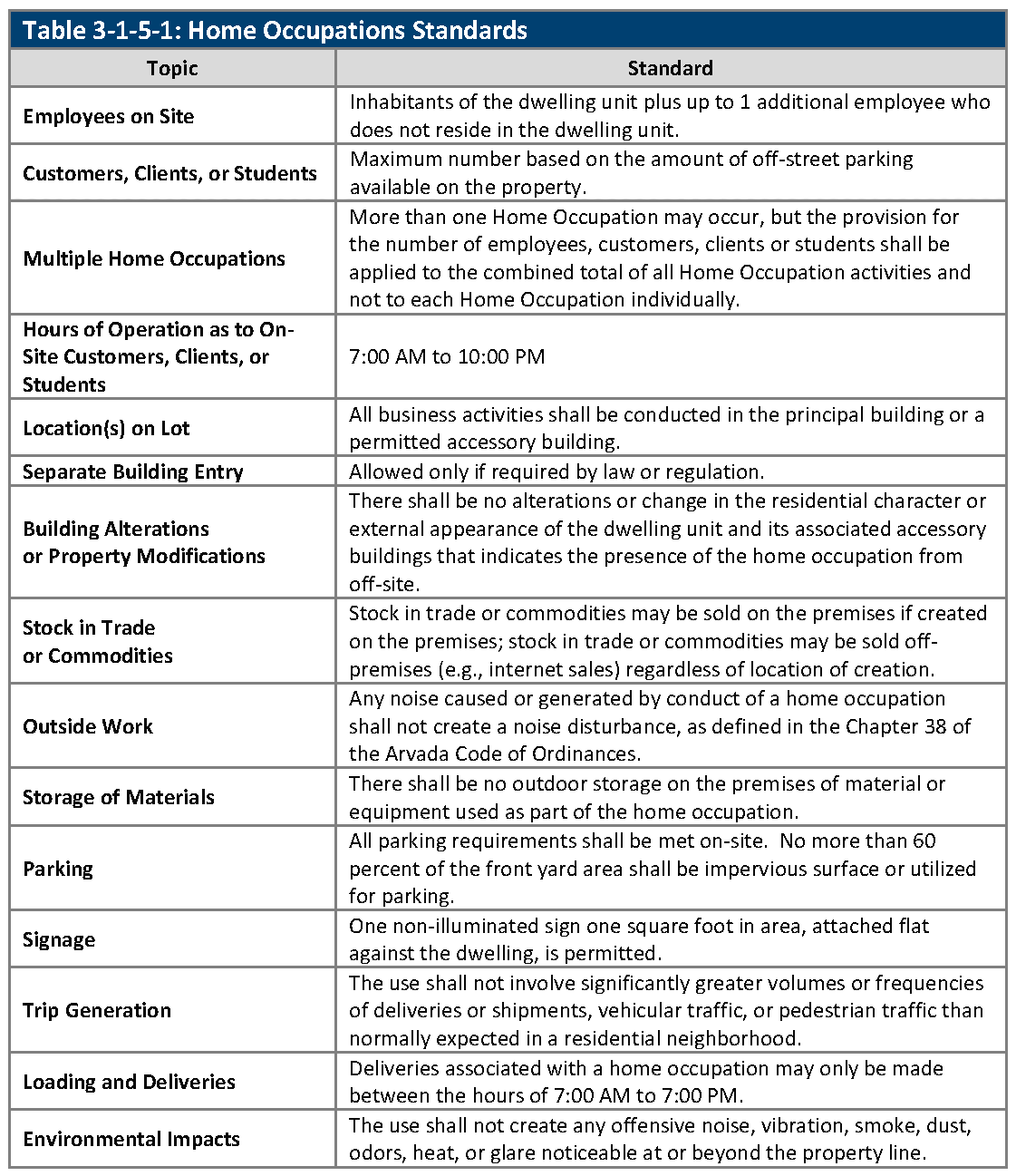
B.
Prohibited Business Uses of the Home. The following uses, regardless of whether they meet the standards of this Section, are not permitted as business uses of the home:
1.
Veterinary offices or clinics, animal hospitals, or kennels;
2.
Equipment rental;
3.
Funeral homes or mortuaries;
4.
Medical or dental clinics;
5.
Repair or painting of automobiles, motorcycles, trailers, boats, or other vehicles;
6.
Repair of large appliances (e.g., stoves, refrigerators, washers, and dryers);
7.
Repair of power equipment or small engines (e.g., lawn mowers, snow blowers, chain saws, string trimmers, generators, etc.);
8.
Restaurants;
9.
Vehicle sales;
10.
Welding or metal fabrication shops;
11.
Dispatching of vehicles to and from the residential premises (e.g., taxi services or towing services); and
12.
On-site retail sales, except incidental retail sales associated with services.
3-1-5-2. - Home child care.
A.
Generally. The standards of this Section apply to the child care uses within dwelling units (hereinafter "home child care uses") that are listed in this Subsection.
1.
Specialized group homes, as defined in Subsection 7.701.2.B., 12 CCR 2509-8, except as provided in Subsection B., below;
2.
Family child care homes, as defined in Subsections 7.707.22.A. and B., 12 CCR 2509-8, and including:
a.
Three under two family child care homes, as defined in Subsection 7.707.22.C., 12 CCR 2509-8;
b.
Family child care homes with infant/toddler licenses, as defined in Subsection 7.707.22.D., 12 CCR 2509-8;
c.
Experienced child care provider, as defined in Subsection 7.707.22.F., 12 CCR 2509-8; and
d.
Large child care homes, as defined in Subsection 7.707.22.E., 12 CCR 2509-8.
B.
Exceptions. The following child care uses are allowed without a permit in all dwelling units, provided that all licenses (if any) that are required by state law (see 12 CCR 2509-8) are obtained prior to establishment of the use, and thereafter maintained:
1.
Specialized group homes that are licensed to provide care for three or more children pursuant to C.R.S. § 26-6-102(10), but that are providing care for three or fewer children who are determined to have a developmental disability by a community centered board or who are diagnosed with a serious emotional disturbance.
2.
Exempt family child care home providers, as defined in C.R.S. § 26-6-102(12);
3.
Foster care homes, as defined in C.R.S. § 26-6-102(14); and
4.
Licensed host family homes, as defined in section 7.701.21., 12 CCR 2509-8.
C.
Standards. In addition to any state regulatory requirements, the following standards apply to the home child care uses that are subject to this Section:
1.
The operator of the home child care use shall reside on the subject property.
2.
The home child care use shall not generate, in excess of levels customarily found in residential neighborhoods, any noise that is noticeable at or beyond the property line of the premises upon which the home child care use is located.
3.
No additional off-street parking shall be created on the subject property for the home child care use.
4.
Commercial vehicles shall not be parked or stored on the subject property.
D.
Maximum Number of Children. The number of children that may be cared for in a home child care use is limited by the applicable state license or statutory definition and not this Code.
3-1-5-3. - Short term rentals.
A.
Short title. This section of the Land Development Code (LDC) may be known as the Short-term Rental or STR ordinance.
B.
Legislative declaration and purpose. The purpose of this section is to authorize the operation and regulation of Short-term Rentals (STRs) as a land use within Arvada. The City Council finds that STRs support a vibrant economy and provide real property owners with significant financial benefits. They influence property values and impact neighborhood character by allowing the business use of dwellings in residential neighborhoods. They also reduce the potential availability of long-term rental housing to support the local economy and community.
The City Council also finds that STRs require services and infrastructure to operate. They require regulation as a distinct land use to ensure the health, safety, and welfare of the community through the application of zoning police powers. This section supports the operation of STRs by balancing the need to preserve neighborhood quality of life with the protection of private property rights. The City Council finds that this ordinance and the establishment of STR Program Rules are necessary to protect the health, safety, and welfare of the public.
This section is intended to ensure the health and safety of STR Occupants while preserving neighborhood character by mitigating the negative impacts of STRs on the neighborhoods where they are located. This section is also intended to ensure that STR operations are conducted lawfully, and that the activities of Marketplace Facilitators are appropriately regulated. Finally, this section is intended to ensure that the City utilizes this and other applicable provisions in the City Code including the LDC to enforce the provisions of this section as appropriate through the exercise of civil and criminal remedies.
C.
Authority. The authority to establish and implement an STR Program is set forth in Section 1-1-1-3 of this LDC.
D.
Applicability. This section applies to any Property located in Arvada that is being offered for Rent as or being used as an STR whether or not it is permitted. STR licenses that are valid at the time this ordinance goes into effect will remain in effect until the date they expire, or are suspended, revoked, or abandoned, whichever occurs first. Nothing in this section precludes the rental of a Dwelling for 30 or more consecutive days.
E.
Definitions. Certain terms used in this STR ordinance are defined in Section 11-3-3-1 of the Land Development Code.
F.
Duties and responsibilities of the Director. The Director shall implement, administer, and enforce this section of the LDC and the STR Program Rules (Rules) as set forth in Section 8-1-1-1 of this LDC.
G.
Permit and business license required.
1.
STR permit. Each Property being offered for Rent, rented, or being used as an STR must have an STR Permit as required under this Section 3-1-5-3. A Permit may be for either a primary or a non-primary residence.
2.
Business license. A Permittee holding an STR Permit must also hold a valid city-issued business license while the STR Permit is in effect. A business license application will be processed and a business license may be issued by the director of finance as set forth in the City Code.
H.
Permit requirements - Generally. An STR Permittee must comply with all the requirements of this Section 3-1-5-3. In addition, the following requirements must be met to hold and maintain an STR Permit:
1.
Natural person. Except as otherwise noted in this Section 3-1-5-3 or in the Rules, a Permit may only be issued in the name of one natural person 18 years of age or older who has an Ownership Interest of 20 percent or more in the Property for which the Permit is issued or who is the named beneficiary of a trust holding the Property to be permitted.
a.
Permits or licenses issued to entities. An entity that holds a Permit or license on May 1, 2026, may continue to hold that Permit for the duration of its term. Should an entity apply to renew a Permit, the entity must designate a natural person to be its Permitee. Should a Permit held by an entity lapse, expire, be abandoned, or be revoked, or should the Property be sold or otherwise transferred, a new Permit issued for that Property must be issued in the name of a natural person.
2.
Limit. No person may hold more than three STR Permits at a time.
3.
Number. Each Permit will be assigned a unique number. The Permit number must be clearly displayed in all advertising and listings of the STR, including but not limited to all digital and print advertising.
4.
Term. Each Permit is valid for one year from the date of issuance. As an example, a Permit issued on March 20 of a year will be valid through March 19 of the following year unless it is suspended, revoked, or abandoned. Each Permit may be renewed annually according to the provisions set forth in this Section 3-1-5-3 and in the Rules.
5.
Non-transferable. A Permit will be issued solely to the Permittee to whom it is issued and only for the Property for which it is issued. A Permit does not run with the Property but is issued to a specific person. A Permit is not transferable or assignable to any other person, entity, address, or location.
a.
Effect of sale or transfer of property rights. If at any time during the term of a Permit, the Permittee sells or otherwise transfers their Ownership Interest in the Property, or if the Permittee's Ownership Interest in the Property falls below 20 percent, the Permit will be deemed terminated and revoked as of the date of the sale or transfer.
6.
Contingent upon compliance. Each Permit is contingent on compliance with this Section 3-1-5-3, with any conditions placed on the Permit by the Director, with the provisions of the Rules, with the city's property maintenance, fire, and other building codes, with the provisions of this LDC, and all other applicable municipal and State laws.
7.
Taxes paid. The Permittee must ensure that all Lodging, sales, and other taxes due as a result of the use of the Property as STR are submitted to the city in a timely manner.
I.
Permit applications - Generally; actions by the Director. STR Permit Applications must be submitted in accordance with this section 3-1-5-3 and the Rules.
1.
Application not accepted. The Director may not accept an incomplete Application. The Director may not accept an Application for a Permit from a person or entity that has, within one year prior to the date of the Application, had any Arvada STR Permit revoked, or who has been found guilty in the municipal court of operating an STR without a Permit, of not posting an STR Permit inside a Property being offered for Rent, rented, or used as an STR, of falsifying, defacing, or altering an STR Permit, of not having a business license while offering an STR for Rent, Renting, or using a Property as an STR, or of non-payment of Lodging, sales, and other taxes as required under this Section 3-1-5-3 and Chapter 98 of the City Code.
2.
Actions by the Director. The Director may issue a Permit, issue it with conditions, or deny it. The Director may issue a permit electronically or may require that a Permit or renewal Permit be issued to the Permittee in person.
J.
Emergency contact. A Permittee must designate an emergency contact (EC) whose responsibilities are set forth in the Rules.
K.
Inspections. By filing an Application, the Applicant is deemed to have consented to inspections of the Property to determine eligibility for a Permit, or for the purpose of determining compliance with all other applicable laws. Inspections may be made as a part of the initial or renewal permitting process and will be made upon reasonable notice. The Director may, at their sole discretion, allow any inspection required or necessitated under this Section 3-1-5-3 to be conducted by a city inspector or by a third party licensed or certified inspector. Nothing in this section may be deemed to affect the ability of a Peace Officer or other first responder to respond to a call for service or other incident at a Property being offered for Rent, rented, or being used as an STR.
L.
Operating requirements. A Permittee must comply with the following operating requirements:
1.
Parking requirement. Any property being offered for Rent, rented, or used as an STR must have one additional on-site parking space.
Exception. If the entire premises are being used or rented as an STR, no additional on-site parking space is required.
2.
Property maintenance requirements. The Permittee must maintain weekly rubbish and garbage removal services for the STR and otherwise comply with all provisions of the International Property Maintenance Code (IPMC) as adopted by Arvada. This includes but is not limited to complying with lawn mowing, weed removal, and snow and ice removal requirements.
3.
Nuisances not allowed. A Permittee may not allow or permit the STR to create a nuisance as that term is defined in Chapter 38 of the City Code.
4.
Limits on overnight occupancy. STRs are limited to a total overnight Occupancy of two Occupants per bedroom plus two additional Occupants; studios are limited to a total overnight Occupancy of three Occupants. Each Permit Application must list the number of bedrooms in the STR unit at its largest configuration. The maximum number of overnight Occupants for an STR must be included in all advertising for that STR.
5.
Property to be rented. A Permittee may rent the entire permitted Property or a bedroom, lock-off, or other portion of the permitted Property.
6.
Maximum nights in operation. No STR may be occupied by Guests or Occupants for more than any 240 days in any 365-day period.
M.
Building and zoning restrictions generally.
1.
Permitted buildings. An STR may be allowed in a primary Dwelling. A Dwelling designated as affordable housing or that is otherwise deed-restricted may not be used as an STR.
2.
Number of STRs per lot. Only one STR Permit may be issued per Lot.
N.
Records.
1.
Permittee. Each Permittee must maintain the following records from the date their Permit was issued. If the Permit is a renewal permit, the Permittee must also maintain these records for one year before the current permit was issued:
a.
Total number of nights the STR was rented to a Guest;
b.
The dates on which the STR was rented to a Guest; and
c.
Other records necessary to comply with the provisions of this section 3-1-5-3.
2.
Marketplace facilitator. Each Marketplace Facilitator must maintain the following information for STR transactions for each Property being offered for Rent on or through their platform in Arvada for five years from the date of the transaction:
a.
The name of the Permittee who offered the STR for Rent;
b.
The address of the STR;
c.
The dates on which the STR was booked by a Guest;
d.
The price paid by the Guest for each STR transaction; and
e.
The STR Permit number.
O.
Fees. Each Applicant may be charged an Application fee, an annual Permit or renewal Permit fee, and other fees as noted in the applicable fees schedule.
P.
Lodging, sales, and other tax payments required. A Permittee must obtain and maintain a City of Arvada business license in addition to an STR Permit and must remit Lodging, sales, and other taxes in accordance with Article V of Chapter 98 of the Arvada City Code.
1.
Financial audits. To ensure ongoing eligibility for an STR Permit, Permittees are subject to audits by the City's finance department as set forth in Article V of Chapter 98 of the Arvada City Code.
Q.
Enforcement. Arvada actively enforces this section and STR Program Rules through inspections, responding to complaints, audits, and permitting activities. Enforcement activities play a vital role in assisting Occupants in supporting neighborhood values and Permittees in complying with applicable laws and the Rules. This Section 3-1-5-3 may be enforced by the Director and by those employees designated as Peace Officers under Section 58-2 of the Arvada City Code. By applying for an STR Permit, the Applicant is deemed to have acknowledged and to understand that both criminal penalties and administrative consequences may flow from the same act or failure to act. Enforcement mechanisms and appeal rights are as set forth in this section and in the Rules.
1.
No warning required. Notwithstanding any other provision of the LDC, and understanding the crucial role enforcement plays in public safety and in maintaining the peaceful enjoyment of the city's neighborhoods, a Peace Officer is not required to issue a warning or similar notice of violation, or a stop work order before issuing a summons and complaint for any of the following violations:
a.
Not having an STR Permit;
b.
Not posting the STR Permit inside the Property;
c.
Falsifying, defacing, or altering an STR Permit;
d.
Not having a business license when offering an STR for Rent, renting, or while using a Property as an STR;
e.
Exceeding overnight Occupancy limits under the STR's Permit;
f.
Allowing or permitting a Large Social Gathering at a Property while it is being rented or used as an STR;
g.
Not having a functioning smoke detector, carbon monoxide detector, or fire extinguisher in or upon the permitted premises;
h.
Not obtaining a building or other permit required under Chapter 18 of the Arvada City Code before beginning the work for which the building permit is required;
i.
Unlawfully removing a Red Tag placard;
j.
Unlawfully entering or occupying a property that has been posted with a Red Tag placard; or
k.
Non-payment of Lodging, sales, and other taxes as required under this Section 3-1-5-3 and Chapter 98 of the City Code.
R.
Unlawful acts - Generally. It shall be unlawful for a Permittee to fail to comply with any requirement or provision of or to engage in any act that is declared to be unlawful under this Section 3-1-5-3.
1.
Advertising. It shall be unlawful for any person or Marketplace Facilitator to knowingly advertise or list an STR without the STR Permit number clearly displayed on the face of the advertisement or listing. In this subsection, the term "advertise" means the act of drawing the public's attention to a Property for the purpose of offering the Property for Rent as or for using it as an STR. The advertisement may be made by or through any platform or medium.
2.
Unlawful to rent or use unpermitted property as an STR. It shall be unlawful for any person, whether a principal or agent, clerk, or employee, either for themself, or for any other person to knowingly Rent, offer for Rent, or use Property as an STR without first obtaining an STR Permit.
3.
Unlawful transactions. It shall be unlawful for any person or Marketplace Facilitator to knowingly advertise or facilitate the rental or use of an unpermitted STR, or to receive payment, directly or indirectly, for renting or allowing the use of an unpermitted STR located in the city.
4.
Minimum rental period. It shall be unlawful for any person or Marketplace Facilitator to knowingly offer a Property for Rent, Rent, or use a Property as an STR for fewer than two consecutive days.
5.
Permit displayed. It shall be unlawful for any person to knowingly Rent, offer for Rent, or use a Property as an STR without affixing a valid STR Permit near the primary entrance to the STR in such a way as to be clearly visible to an ordinarily observant person entering the STR.
6.
Unlawful to alter permit. It shall be unlawful for any person to knowingly falsify, deface, or alter an STR Permit.
7.
Video recording devices prohibited. It shall be unlawful for any person to knowingly Rent, offer for Rent, or use as an STR Property that contains or is equipped with a device that records moving or still images of the inside of the Property. A video recording device that captures only images of outdoor locations upon Property used as an STR, such as a porch, driveway, lawn, garden, patio, or deck is allowed.
a.
This subsection does not prohibit a Guest or Occupant from using a video recording device to record images of the inside of the Property if the recording is made in or from an area they are otherwise allowed to be in, and if the recording is otherwise legal.
b.
This subsection does not prohibit a Peace Officer, fire official, emergency medical responder, city inspector, or other city official from using a video recording device to record images of the inside of the Property while acting within the course and scope of their employment.
c.
This subsection does not prohibit a Permittee or Permittee's agent from using a video recording device to record images of the inside of the Permitted Property if each Guest or Occupant on or within the Property at the time of the recording has been notified of and has consented to the recording before it occurs, or prohibit a Permittee or Permittee's agent from using a video recording device to record images of the inside of the Property when no one is renting it.
8.
Marketplace facilitator - Business license. It shall be unlawful for any person to knowingly broker or facilitate an STR reservation online and receive payment for this service without first obtaining a business license from the city.
9.
Marketplace facilitator - Removal of listing. It shall be unlawful for any person or Marketplace Facilitator to knowingly fail to remove an unpermitted STR from the person's or Marketplace Facilitator's website or other digital platform within seven calendar days of receiving notification from the Director that the STR is not permitted or that the Permit has been suspended or revoked.
10.
Records. It shall be unlawful for any person offering a Property for Rent, renting, or using a Property as an STR to knowingly fail to keep or maintain STR records as required under this Section 3-1-5-3.
S.
Unlawful acts - Business operations.
1.
False statement of fact. It shall be unlawful for any person to knowingly make a false statement of a material fact on an STR Permit Application or renewal Permit Application or in any document accompanying an Application.
2.
Safety requirements. It shall be unlawful for any person to knowingly Rent, offer for Rent, or use Property as an STR if the Property is not equipped with a functioning smoke detector, carbon monoxide detector, and fire extinguisher.
3.
Unlawful to remove red tag placard. It shall be unlawful for any person to knowingly deface or alter a Red Tag placard, or for any person to knowingly remove a Red Tag placard except at the direction of the Director or the chief building official or designee thereof.
4.
Unlawful to enter red tagged property. It shall be unlawful for any person to knowingly enter or occupy any Property, structure, or portion of any Property or structure upon which a Red Tag placard has been posted except for the purpose of repairing or otherwise bringing the Property into compliance with this section 3-1-5-3 or into compliance with any other provision of the City Code, including but not limited to the city's property maintenance, fire, and other building codes.
5.
Compliance with city and state laws. It shall be unlawful for any person to knowingly Rent, offer for Rent, or use a Property that does not comply with all applicable city and state laws as an STR.
6.
Insurance. It shall be unlawful to knowingly Rent, offer for Rent, or use Property as an STR without fire, hazard, and liability insurance within the coverage limits set by the Director.
7.
Business license required. It shall be unlawful for any person to knowingly Rent, offer for Rent, or use Property as an STR without first having obtained a city-issued business license.
8.
Taxation. It shall be unlawful for any person to knowingly Rent, offer for Rent, or use Property as an STR to fail to pay Lodging, sales, and other taxes owed to the City as required under Chapter 98 of this Code.
T.
Unlawful acts - Good neighbor provisions.
1.
Exceeding overnight occupancy. It shall be unlawful for any person including but not limited to a Guest or Occupant to knowingly allow or permit more people to occupy an STR than are allowed as set forth on the STR's Permit.
2.
Unreasonable noise prohibited. It shall be unlawful for any person including a Guest of or Occupant at or upon a Property being rented or used as an STR to knowingly make, allow, or permit unreasonable Noise from or upon the Property or Noise that is otherwise in violation of any provision of Chapter 38 of this Code.
3.
Rubbish and garbage. It shall be unlawful for any person, including but not limited to the Permittee, Guest of, or Occupant at or upon a Property being rented or used as an STR to knowingly fail to dispose of rubbish and garbage at the STR no less often than once per week.
4.
Snow and ice removal. It shall be unlawful for any person, including but not limited to the Permittee, Guest of, or Occupant at or upon a Property being rented or used as an STR to knowingly fail to remove snow and ice from the Property within 24 hours of the end of any snow fall or ice storm as set forth in the International Property Maintenance Code as adopted by the City.
5.
Large social gatherings prohibited. It shall be unlawful for any person, including but not limited to the Permittee, Guest of, or Occupant at or upon a Property being rented or used as an STR to knowingly allow or permit a Large Social Gathering on the Property while the Property is being rented as or used as an STR.
6.
Failure to physically report upon request. It shall be unlawful for the Permittee to knowingly fail to physically report to the STR for which they hold a Permit within one hour of being asked to do so by a Peace Officer, or, if the Permittee if unavailable, for the designated EC to fail to physically report to the STR within one hour of being asked to do so by a Peace Officer.
U.
Criminal penalties; other remedies; concurrent remedies.
1.
Criminal penalty. Except as otherwise noted herein, a violation of this section shall be punished by a fine or imprisonment not to exceed the limits established in section 1-5 of the City Code, except that the penalty for any violation under this section for which there is a counterpart in Chapter 62 or elsewhere in the City Code will be the same as the penalty for the counterpart violation.
2.
Determination of guilt. Guilt may be found as a result of a no contest plea, a plea of guilty, or by conviction in the municipal court.
3.
Minimum fines. A person who is found guilty in the municipal court of offering an unpermitted Property for Rent as an STR, of renting, or of using an unpermitted Property as an STR, of not posting the STR Permit inside the Property, or of falsifying, defacing, or altering an STR Permit shall be fined a minimum of $2,000.00 per violation. A person guilty of a violation of any other provision of this Section 3-1-5-3 shall be fined according to the following minimum fine schedule:
a.
First conviction. Minimum fine of $500.00 per violation.
b.
Second conviction within any 365-day period. Minimum fine of $1,000.00 per violation.
c.
Third or subsequent conviction within any 365-day period. Minimum fine of $2,000.00 per violation.
The operative date for calculating the date of the second or third conviction is the date of the violation for which the person is convicted or pleads guilty or no contest, not the date of the conviction or plea. No portion of these minimum fines may be suspended. A municipal court judge may impose conditions in connection with the minimum penalties set forth herein and may impose a greater sentence including imprisonment based on the facts and circumstances of the case and in accordance with Section 1-5 of the City Code.
4.
Continuing violation. In accordance with Section 1-5 of the City Code, every day any violation of this section continues or is permitted or allowed to continue shall constitute a separate violation.
V.
Other administrative and civil remedies. The Director may institute administrative proceedings against a Permittee, including but not limited to a Permittee who has been found guilty of a violation of this Section 3-1-5-3, as set forth in the Rules. In addition, the city attorney may institute injunctive, abatement, or other appropriate action to prevent, restrain, enjoin, correct, abate, or remove a violation of this Section 3-1-5-3 or any other section of the Code when it occurs.
W.
Concurrent remedies. The initiation of a prosecution in the municipal court for a violation of this section shall not preclude the city from instituting administrative proceedings against a Permittee or from taking other appropriate action to restrain, enjoin, correct, or abate, or remove a violation, or to stop an illegal act or conduct. Enforcement of the provisions of this ordinance may be conducted by a Peace Officer as a criminal matter, by the Director as an administrative matter, and by other city officials as appropriate.
X.
Liens. Until paid, any delinquent charges, assessments, or taxes made or levied by the City pursuant to this section against a Property being offered for Rent as or used as an STR shall, as of recording, be a lien against the property on which the violation has been found to exist. If not paid within 30 calendar days from the date of the statement, the city clerk may certify any unpaid charges, assessments, or taxes to the county treasurer to be collected and paid over by the county treasurer in the same manner as taxes are authorized to be by statute together with a ten percent penalty for costs of collection. Any lien placed against the property pursuant to this section will be recorded with the county clerk and recorder.
(Ord. No. 4793, § 2, 3-21-2022; Ord. No. 4810, § 1, 9-19-2022; Ord. No. 4905, §§ 28, 29, 8-19-2025; Ord. No. 4917, § 1, 2-17-2026)

