
Bedford Township City Zoning Code
ARTICLE XVIII
SCHEDULE OF REGULATIONS
Schedule of Regulations
(Ord. No. 44A-188, § 2, 12-7-99; Ord. No. 44A-193, § 1, 9-19-00; Ord. No. 44A-216, 10-1-02; Ord. No. 44A-228, 12-16-03; Ord. No. 44A-340, §§ 3(a), 3(b), 11-17-20)
400.1800 - Notes to schedule of regulations.
Sec. 1800.
(a)
The minimum lot size in any R District shall be 15,000 square feet where central sewerage facilities are not available. Sections 1801 through 1804 [Sections 400.1801 through 400.1804], allowing flexibility in lot size or density, shall be applicable only where municipal water and sewerage systems are available.
(b)
The setbacks in the schedule of regulations are for single-family residential uses. For permitted two-family residential uses, the front and rear yard setbacks shall be the same as required of a single-family residential use, and the side yard setback shall be at least 25 feet from any single-family residential district, at least ten feet from any other two-family residential parcel, and at least 15 feet from any other property line. For uses permitted other than single-family or two-family residential, the setbacks shall be as required by footnote (g) below, but not less than that required of a single-family house.
(c)
Off-street parking shall be permitted within a front yard.
(d)
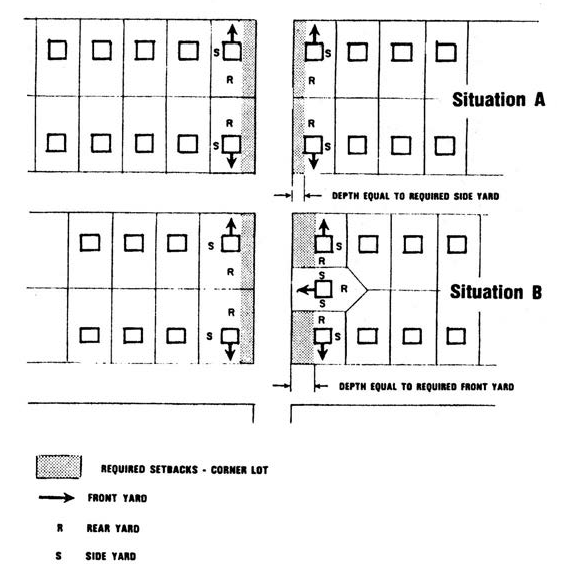
In the case of a side yard or rear yard abutting a road or street the side or rear yard setback shall not be less than the minimum front yard setback that would be required for the road or street abutting the side yard or rear yard if it were the front yard, and all regulations applicable to a front yard shall apply.
(e)
Two dwelling units would require 8,000 square feet of area and 80 feet in width.
(f)
In RM-1 Multiple-Family Districts, the total number of rooms in multiple dwelling structures shall not be more than the area of the parcel in square feet divided by 1,800.
In RM-2 Multiple-Family Districts, the total number of rooms in multiple dwelling structures shall not be more than the area of the parcel in square feet divided by 1,500.
In RME Elderly Housing Districts, the total number of rooms in housing for the elderly shall not be more than the area of the parcel in square feet divided by 1,000 for buildings of 40 feet or less in height and divided by 500 for buildings over 40 feet in height.
For the purpose of computing number of rooms, the following shall control:
Efficiency Apt. Unit—one room
One Bedroom Unit—two rooms
Two Bedroom Unit—three rooms
Three Bedroom Unit—four rooms
Plans presented showing 1, 2, and 3 bedroom units and including a "den", "library" or other extra room shall count such extra room as a bedroom for the purpose of computing density.
Efficiency apartments shall not exceed 15 percent of the total number of units in a multiple-family development, provided however, that this provision shall not apply to housing for the elderly.
The area used for computing density shall be the total site area exclusive of any dedicated public right-of-way of boundary or section line roads. Internal public roads may be included, provided the entire area is under single ownership and control.
(g)
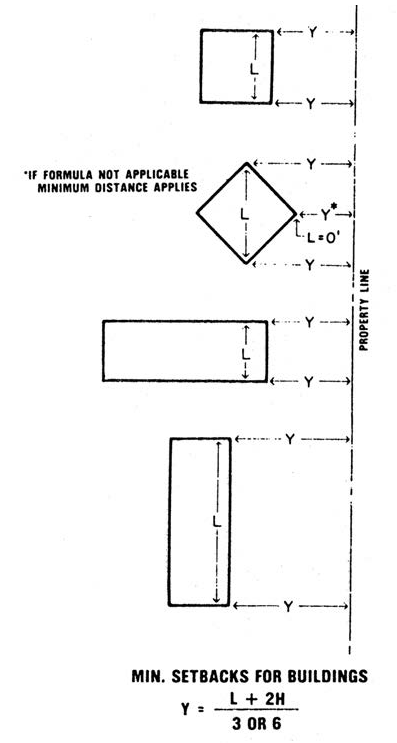
All main buildings shall have a setback of at least 50 feet from any street listed in paragraph (w) of this Section 1800 [Section 400.1800], or single-family residential district, or at least 102 feet from any street listed in paragraph (x) of this Section 1800 [400.1800], or at least 77 feet from any street listed in paragraph (y) of this Section 1800 [Section 400.1800], or at least 60 feet from any street listed in paragraph (z) of this Section (1800) [Section 400.1800]; and shall have a setback of at least 20 feet from any other property line unless exceeded by the following:
(1)
Along those property lines which abut a single-family residential district and which are not separated from the single-family district by a major or secondary thoroughfare or where the abutting single-family residential district is not already developed for a permitted use other than single-family residential, the minimum required yard shall be determined by the following formula:
Y = L + 2H / 3
(2)
In all other instances, the minimum required yard shall be determined by the following formula:
Y = L + 2H / 6
(3)
The symbols used shall be defined as follows:
(4)
Accessory structures shall not be located in the 50 foot, 102 foot, 77 foot or 60 foot setback from a street but may be located within the 20 foot setback, except that when adjacent to a single-family residential district, the formula Y = L + 2H / 3 shall apply to any building or structure with a roof.
(h)
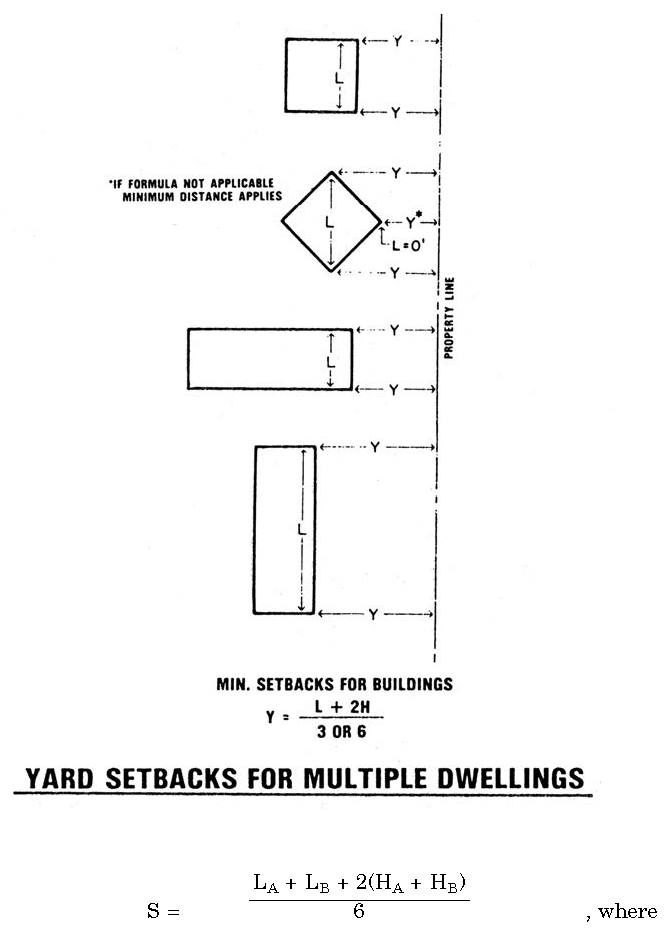
In the RM-1, RM-2 and RME Residential Districts, the minimum distance between any two buildings shall be regulated according to the length and height of such buildings, and in no instance shall this distance be less than 30 feet unless there is a corner to corner relationship in which case the minimum distance shall be 15 feet. The formula regulating the required minimum distance between two buildings in all RM-1 and RM-2 Districts is as follows:
| S | = |  |
| S | = | Required minimum horizontal distance between any wall of building A and any wall of building B or the vertical prolongation of either. |
| L A | = |
Total length of building A.
The total length of building A is the length of that portion or portions of a wall or walls of building A from which, when viewed directly from above, lines drawn perpendicular to building B will intersect any wall of building B. |
| L B | = |
Total length of building B.
The total length of building B is the length of that portion or portions of a wall or walls of building B from which, when viewed directly from above, the lines drawn perpendicular to building B will intersect any wall of building A. |
| H A | = |
Height of building A.
The height of building A at any given level is the height above natural grade level of any portion or portions of a wall or walls along the length of building A. |
| H B | = |
Height of building B.
The height of building B at any given level is the height above natural grade level of any portion or portions of a wall or walls along the length of building B. Natural grade level shall be the mean level of the ground immediately adjoining the portion or portions of the wall or walls along the total length of the building. |
The depth of any court shall not be greater than three times the width. The requirements of this note (h) may be modified by the Planning Commission where the shape of a lot or parcel or other unique or unusual factors applicable to the particular lot or parcel make such requirements unduly burdensome or impractical. No building shall exceed 200 feet in any one dimension without direct access through said building from one side to the other, at ground level.
(i)
The minimum floor area shall be not less than 350 square feet for one bedroom or efficiency units; 550 square feet for two bedroom units; 750 square feet for three bedroom units. Alcoves, halls or patios shall not be considered as a part of the minimum living area. Each unit shall have its own self-contained bathroom facility.
(j)
The front yard setback shall be the amount indicated or 15 percent of the depth of the lot, whichever is greater, but need not exceed 60 feet for any street listed in paragraph (w) of this Section 1800 [Section 400.1800], or 112 feet from any street listed in paragraph (x) of this Section 1800 [Section 400.1800], or 87 feet for any street listed in paragraph (y) of this Section 1800 [Section 400.1800], or 70 feet for any street listed in paragraph (2) of this Section 1800 [Section 400.1800].
(k)
Unless prohibited by the regulations for a specific zoning district, or as otherwise prohibited by this Ordinance, and as may be modified by requirements of the Planning Commission to make parking areas less visible and obtrusive to nearby streets and roads, and residentially zoned properties, parking may be permitted within the required front yard setback provided that an area within the front yard remains as lawn or landscaped area which is equal to at least 50 percent of the area of the required front yard.
(l)
Unless prohibited by the regulations for a specific zoning district, or as otherwise prohibited by this Ordinance, and as may be modified by requirements of the Planning Commission to make parking areas less visible and obtrusive to nearby streets and roads, and residentially zoned properties, parking may be permitted within the required front yard setback provided that an area within the front yard remains as lawn or landscaped area which is equal to at least 20 percent of the area of the required front yard.
(m)
No side yards are required along the interior side lot lines of the District, except as otherwise specified in the Building Code, provided that if walls of structures facing such interior side lot lines contain windows, or other openings, side yards of not less than ten feet shall be provided. Where a lot or parcel borders on a residential district, there shall be provided a setback of not less than 20 feet on the side bordering the residential district.
(n)
All loading and unloading space shall be in accordance with Section 1906.
(o)
No building shall be closer than 75 feet to any adjacent residential district or to any major thoroughfare.
(p)
Off-street parking for visitors, over and above the number of spaces required under Section 1904 [Section 400.1904], may be permitted within the front yard provided that such off-street parking is not located within 20 feet of the front lot line, and provided it does not exceed ten percent of the total number of off-street parking spaces required of the proposed use by this Ordinance.
(q)
No building shall be located closer than 75 feet to the outer perimeter (property line) of such district when said property line abuts any residential district.
(r)
All outdoor storage shall be in accordance with the performance standards of Section 1917, paragraph 3.
[(s)
Reserved.]
[(t)
Reserved.]
[(u)
Reserved.]
[(v)
Reserved.]
(w)
The following roads are enumerated as falling into this category:
(1)
All roads not listed in paragraphs (x), (y) or (z) of this Section 1800 [Section 400.1800].
(x)
The following road is enumerated as falling into this category:
(1)
Telegraph Road (U.S. 24) South of Smith Road only.
(y)
The following roads are enumerated as falling into this category:
(1)
All section line roads
(2)
Summerfield Road
(3)
Beck-Consear (Consear) Road
(4)
Whiteford Center Road
(5)
M-151, Samaria Road
(6)
Lavoy Road
(7)
Dixie Highway (M-125)
(8)
Telegraph Road (U.S. 24) North of Smith Road only.
(z)
The following roads are enumerated as falling into this category:
(1)
Monroe Road
(2)
Clegg Road
(3)
Cloverlane Road
(4)
School Road
(5)
Half Mile Road
(6)
Vienna West Road
(7)
Piehl Road
(8)
Substation Road
(9)
Section Road
(Ord. No. 44A-17, 7-10-79; Ord. No. 44A-35, 5-17-83; Ord. No. 44A-73, 7-19-88; Ord. No. 44A-188, § 2, 12-7-99; Ord. No. 44A-214, 8-20-02; Ord. No. 44A-216, 10-1-02; Ord. No. 44A-228, 12-16-03; Ord. No. 44A-340, § 3(c), 11-17-20)
400.1801 - Averaged lot size.
Sec. 1801. The intent of this Section is to permit the subdivider or developer to vary lot sizes and lot widths so as to average the minimum size of lot per unit as required in Article XVIII, Schedule of Regulations for each One-Family Residential District. If this option is selected, the following conditions shall be met:
1.
In meeting the average minimum lot size, the subdivision shall be so designed as not to create lots having an area of width greater than ten percent below that area or width required in the Schedule of Regulations and shall not create an attendant increase in the number of lots; provided, however, that such lot shall not be less than 60 feet in width and the allowed reduction in width shall not apply to corner lots.
2.
Each final plat submitted as part of a preliminary plat shall average the minimum required for the district in which it is located.
3.
All computations showing lot area and the average resulting through this technique shall be indicated on the print of the preliminary plat.
400.1802 - Subdivision open space plan.
Sec. 1802.
1.
The intent of the Subdivision Open Space Plan is to promote the following objectives:
a.
Provide a more desirable living environment by preserving the natural character of open fields, stands of trees, brooks, hills and similar natural assets.
b.
Encourage developers to use a more creative approach in the development of residential areas.
c.
Encourage a more efficient, aesthetic and desirable use of open area while recognizing a reduction in development costs and allowing the developer to bypass natural obstacles on the site.
d.
Encourage the provision of open space within reasonable distance to all lot development of the subdivision and to further encourage the development of recreational facilities.
2.
Modification to the standards outlined in Article XVIII, Schedule of Regulations may be made in the One-Family Residential Districts when the following conditions are met:
a.
The lot area in R-1, R-2A and R-2B One-Family Residential Districts, which are served by a public sanitary sewer and water system, may be reduced in accordance with the following schedule:
These lot area reductions shall be permitted, provided that the dwelling unit density shall be no greater than if the land area to be subdivided were developed in the minimum square foot lot areas as required for each One-Family District under Article XVIII, Schedule of Regulations. All calculations shall be predicated upon the One-Family Districts having the following gross densities (including roads):
b.
Rear yards may be reduced to 30 feet when such lots border on land dedicated for park, recreation or open space purposes, provided that the width of said dedicated land shall not be less than 100 feet measured at the point at which it abuts the rear yard of the adjacent lot.
c.
Under the provisions of item a. above of this section, for each square foot of land gained within a residential subdivision through the reduction of lot size below the minimum requirements as outlined in Article XVIII, Schedule of Regulations, at least equal amounts of land shall be dedicated to the common use of the lot owners of the subdivision or to the Township in a manner approved by the Township.
d.
The area to be dedicated for subdivision open space purposes shall in no instance be less than two acres in any one block and shall be in a location and shape approved by the Planning Commission.
e.
The land area necessary to meet the minimum requirements of this section may include bodies of water, provided, however, that such water area not comprise more than one-third of the total open space area. All land dedicated shall be so graded and developed as to have natural drainage. The entire area may, however, be located in a flood plain.
f.
This plan, for reduced lot sizes, shall be permitted only if it is mutually agreeable to the Township Board and the proprietor.
g.
This plan for reduced lot sizes, shall be started within six months after having received approval of the final plat and must be completed in a reasonable time. Failure to start within this period shall void all previous approval.
h.
Under this subdivision open space approach, the proprietor shall dedicate sufficient park area so that each final plat meets minimum density requirements, provided, however, that an entire park within a single block shall be dedicated as a whole.
i.
The provisions of Section 1923 [Section 400.1923], Open Space Control, shall be complied with prior to the final approval of the Preliminary Plat.
400.1803 - Open space preservation alternative development.
Sec. 1803.
1.
Purpose. The purpose of this section is to provide an alternative means of development to the landowner on land which is residentially zoned that would create the same number of home sites, but cluster the homes on no more than 50 percent of the land, while leaving the unused land perpetually in an undeveloped state by means of a construction easement, plat dedication, restrictive covenant or other legal means that runs with the land as required by Section 506 of Act 110, Public Acts of 2006, as may be amended (The Michigan Zoning Enabling Act).
These regulations are intended to provide flexibility in certain zoning requirements to preserve the natural features in open space that might be lost through more traditional subdivision development. Only land that is zoned at a density equivalent to two or fewer dwelling units per acre, or, if the land is served by a public sewer system, three or fewer dwelling units per acre, are eligible for application of the provisions of this Section.
2.
Definitions. For purposes of this Section, the following terms shall apply.
A.
Adjusted parcel acreage: Net parcel area, which becomes the buildable site area, after the acreage of all lakes, ponds, streams, property within a 100 year flood plain, and public rights-of-way are deducted.
B.
Density: Equals the number of dwellings units situated on or to be developed on the adjusted acreage parcel. Density of a site shall be based upon the total dwelling unit count achieved from a concept layout plan prepared by the applicant and accepted by the Township showing the subject site as a single-family detached development meeting the design requirements established for the zoning district in which it is located, (Please refer to XVIII, Schedule of Regulations.) Actual density shall also be determined by compliance with all setbacks, parking, open space and other site design requirements. The resulting development yield, determined through such computation shall be distributed throughout not more than 50 percent of the subject site's buildable area. All remaining land area shall perpetually remain in an undeveloped state pursuant to Section 1803.2(c) [Section 400.1803.2(c)] below.
C.
Open Space Preservation Area. Any undeveloped land area within the boundaries of the parcel within an open space residential development, which is designed and intended to conserve on a permanent basis environmental features for the common use or enjoyment of the residents of the development or the public or dedicated to an agricultural use. Such open space may contain accessory structures and improvements appropriate for recreational purposes, as provided by ordinance, such as recreational trails, picnic areas, children's play areas, greenways or lineal parks. Uses ineligible as open space shall include, but are not limited to, the following:
•
Golf courses
•
The area of any street right-of-way proposed to be dedicated to the public
•
Access easements for private roads
•
The required setback surrounding an existing residential structure that is not located on an individual lot or condominium site
•
Parking and loading areas
•
Detention and/or retention area
3.
Eligibility Criteria. In selecting the open space overlay option, the applicant must present a proposal for residential development that meets each of the following:
A.
Open Space. To be eligible for open space overlay option, the proposed development shall contain at least 50 percent of the land area that will remain perpetually in an undeveloped state by means of conservation easement, plat dedication, restricted covenant, or other legal means that runs with the land. By definition, all land remaining after the determination of the 50 percent buildable site area shall be included as part of the open space and shall remain perpetually in an undeveloped state.
B.
Unified Control. The proposed development shall be under single ownership or control such that there is a single person or entity having proprietary responsibility for the full completion of the project. The applicant shall provide sufficient documentation of ownership or control in the form of agreements, contracts, covenants, and/or deed restrictions that indicate that the development will be completed in its entirety as proposed.
C.
Protection From Development in Perpetuity. The applicant shall guarantee to the satisfaction of the Township that all open space preservation areas will remain perpetually in their undeveloped state as required. Further, subdivision open space lands or their use for other than recreation, conservation, or agricultural shall be prohibited.
D.
Density Impact. The proposed type and density use shall not result in an increase in the need for or impact upon public services, facilities, roads, and utilities or have a disproportionate impact upon the subject site and surrounding land, surrounding property owners and occupants, and/or natural environment as would otherwise be permitted in this zoning ordinance.
E.
Community Master Plan. The proposed development shall be consistent with and further the implementation of the Township Master Plan, as may be amended.
4.
Flexibility Allowances.
A.
Subject to the limitations specified below, the Planning Commission may grant specific departure from their requirements of the zoning ordinance for yard setback, lot area and/or width, and bulk standards as part of the approval process to encompass flexibility and creativity consistent with the open space preservation concept, provided such modification results in enhanced buffering from adjacent land uses or public rights-of-way, or further preservation of natural features.
Regulatory modifications are not subject to variance approval by the Zoning Board of Appeals. No part of an open space community plan may be appealed to the Zoning Board of Appeals. Any deviation of an approved plan shall require approval from the Planning Commission. This provision shall not preclude an individual lot or dwelling unit owner from seeking a variance following final approval of an open space community, provided such variance does not involve alterations to open space areas as shown on the approved open space plan.
B.
A plan submitted in connection with the Section shall be subject to the following limitations:
(1)
The minimum floor area for all units constructed under this option shall be at least equal to the minimum floor area requirements for the single-family residential district in which the project is to be constructed.
(2)
The maximum number of units attached shall not exceed two units per building.
(3)
Yard requirements shall be provided under this option as follows:
(a)
Spacing between groups of attached or unattached buildings shall be equal to at least 16 feet measured between the nearest points of adjacent buildings.
(b)
Any side of a building adjacent to a private road right-of-way shall not be nearer to such road than ten feet. Any side of a building adjacent to a public road right-of-way constructed within the open space development shall not be nearer to such road than 30 feet.
(c)
No building shall be located closer than 30 feet to the outer perimeter (property line) of the site, unless that perimeter is located adjacent to a public right-of-way.
(d)
Any side of a building adjacent to a dedicated or future public right-of-way outside of the open space development shall not be nearer to such public right-of-way than 52 feet.
(4)
Community or joined wastewater treatment systems shall be prohibited.
(5)
The maximum height of buildings under this option shall be 35 feet.
(6)
The location of open space preservation areas shall meet the following standards as determined necessary and appropriate by the Planning Commission.
(a)
The open space is provided along a public street right-of-way to provide additional buffering from the traffic and enhance views from the roadway provided the open space along such right-of-way shall generally have a depth of at least 50 feet.
(b)
The open space provides an ecological link to permanent open space in the surrounding contiguous lands and is located to connect open spaces, public parks or bicycle/pedestrian paths throughout the community.
(c)
The open space is designed and located to be contiguous to all or most of the dwelling units. Open access to required open space under the provisions of this section shall be provided.
(d)
All sensitive environmental feature areas, natural features, animal and plant habitats, and/or sites having historic archaeological or cultural value are included in the open space preservation areas and are adequately protected.
(7)
If a private road is planned to serve the development within the Open Space Preservation Plan, it must conform to the following standards:
(a)
All private roads shall be designed and constructed in accordance with the minimum requirements for roads established by the Monroe County Road Commissioner, except as outlined below as optional:
(1)
curb and gutter;
(2)
sidewalks;
(3)
street lighting
(b)
A private road easement acceptable to the Township shall be executed and recorded at the Monroe County Register of Deeds.
(c)
All private road easements shall be a minimum of 66 feet in width and shall include area set aside for the development of utilities.
(d)
All private roads shall have a minimum pavement width of 22 feet and shall provide a minimum apron of four feet on either side of the pavement width.
(e)
Cul-de-sacs shall be discouraged and two separate ingress/egress points to the public road shall be provided when feasible, to protect the public health, safety and welfare.
(f)
All private roads shall be named and approved by the Monroe County Central Dispatch. All private roads shall have appropriate signage that indicates the name of the road as well as a sign posted indicating the road as a "private road".
(g)
All private roads shall be owned and maintained by those parties having an ownership interest in the development.
(h)
A maintenance agreement, which may be included as part of the private road easement, acceptable to the Township shall be executed and recorded at the Monroe County Register of Deeds.
(i)
Private roads shall be built and signed appropriate prior to the construction of residential development on the site.
(j)
All private roads shall be reviewed and approved by the Monroe County Road Commission and the Bedford Township Fire Department before Planning Commission approval.
(k)
If deemed necessary by the Township, a special assessment district and/or association of parcel owners shall be established to provide a mechanism to assess and collect monies to help maintain the private roads.
(8)
Where the proposed development abuts an existing conventional single-family use, an orderly transition shall occur, if sufficient area exists within the parcel to allow it, using one or more of the following techniques:
(a)
Detached single-family dwellings subject to the schedule of regulations;
(b)
Open or recreation space;
(c)
Changes in topography which provide an effective buffer;
(d)
A major or secondary thoroughfare.
(9)
Open space areas shall represent at least 50 percent of the subject site's adjusted parcel acreage.
5.
Plan Review Procedures.
A.
Review by the Planning Commission shall follow the standards, procedures and submittal requirements adopted by the Township for approval of site plans, condominiums, platted subdivisions or land divisions, as may be applicable, and the criteria of Section 1803.6 [Section 400.1803.6], below.
B.
In submitting a proposed layout under this section, the sponsor of the development shall include, along with the project plan, master deed documents, floor plans, topography drawn at two (2) foot intervals, main floor grade elevations relative to the existing topography, all computations relative to acreage and density, and any other details which will assist in reviewing the proposed plan.
C.
In addition, the applicant shall provide the Township with a Statement of Intent, which outlines the rationale for preserving those portions of land within the development as open space.
D.
The Plan shall be reviewed and approved by all outside agencies appropriate to the project, which shall include, but not be limited to the Monroe County Road Commission, Department of Environmental Quality, Monroe County Drain Commission, Monroe County Health Department, etc.
E.
All land not intended to be conveyed to individual dwelling unit owners under this option shall be protected by conservation easements, plat dedications, restrictive covenants, or other legal means which runs with the land and which prohibits their development in perpetuity. Such legal means must be approved by the Township Attorney to assure such unused land remains perpetually in an undeveloped state. The Township may require the inclusion of open space restrictions that prohibit the following:
(1)
Dumping or storing of any materials or refuse.
(2)
Activity that may cause a risk of soil erosion or threaten any living plant material.
(3)
Cutting or removal of live plant material except for removal of dying or diseased vegetation.
(4)
The use of motorized off-road vehicles.
(5)
Cutting, filling or removal of vegetation from wetland areas.
(6)
Use of pesticide, herbicides, or fertilizers within or adjacent to wetlands.
6.
Approval Criteria. Approval of a proposed development shall be predicated upon a positive finding that all of the following criteria have been met:
A.
The design shall promote the goals, objectives, and policies of the Township Master Plan;
B.
Open space areas shall be provided in suitable locations that offer convenient access by residents and adequate screening from nearby dwelling units;
C.
Natural assets, wildlife habitat areas, or sites having historic archaeological or cultural value shall be protected;
D.
Individual lots, buildings, and roadways, and open space areas shall be designed to minimize the alteration of environmental site features;
E.
The design of structures shall be compatible with existing single-family structures located in the general area in terms of architectural style, size, overall floor area, building height and neighboring building orientation.
F.
Clustering of the dwelling units shall occur in a manner which preserves the basic amenities and qualities normally associated with single-family living (such as, but not limited to, privacy, personal open space, and adequate natural lighting and ventilation) while allowing for innovative site layout and open space areas.
(Ord. No. 44A-227, 12-16-03; Ord. No. 44A-252, 3-20-07)

