
Bedford Township City Zoning Code
ARTICLE XIX
400.1900 - Conflicting regulations.
Sec. 1900. Whenever any provision of this Ordinance imposes more stringent requirements, regulations, restrictions or limitations than are imposed or required by the provisions of any other law or ordinance, then the provisions of this Ordinance shall govern. Whenever the provisions of any other law or ordinance impose more stringent requirements than are imposed or required by this Ordinance, then the provisions of such ordinance shall govern.
400.1901 - Scope.
Sec. 1901. No building or structure, or part thereof, shall hereafter be erected, constructed or altered and maintained, and no new use or change shall be made or maintained of any building, structure or land, or part thereof, except in conformity with the provisions of this Ordinance.
400.1902 - Nonconforming lots, nonconforming uses of land, nonconforming structures, and nonconforming uses of structures and premises.
Sec. 1902.
1.
Intent. It is the intent of this Ordinance to permit legal nonconforming lots, structures, or uses to continue until they are removed but not to encourage their survival.
It is recognized that there exists within the districts established by this Ordinance and subsequent amendments, lots, structures, and uses of land and structures which were lawful before this Ordinance was passed or amended which would be prohibited, regulated, or restricted under the terms of this Ordinance or future amendments.
Such uses are declared by this Ordinance to be incompatible with permitted uses in the districts involved. It is further the intent of this Ordinance that nonconforming uses shall not be enlarged upon, expanded or extended, nor be used as grounds for adding other structures or uses prohibited elsewhere in the same district.
A nonconforming use of a structure, a nonconforming use of land, or a nonconforming use of a structure and land shall not be extended or enlarged after passage of this Ordinance by attachment on a building or premises of additional signs intended to be seen from off the premises, or by addition of other uses of a nature which would not be permitted generally in the district involved.
To avoid undue hardship, nothing in this Ordinance shall be deemed to require a change in the plans, construction or designated use of any building on which actual construction was lawfully begun prior to the effective date of adoption or amendment of this Ordinance and upon which actual building construction has been diligently carried on. Actual construction is hereby defined to include the placing of construction materials in permanent position and fastened in a permanent manner; except that where demolition or removal of an existing building has been substantially begun preparatory to rebuilding such demolition or removal shall be deemed to be actual construction, provided that work shall be diligently carried on until completion of the building involved.
2.
Nonconforming lots. In any district in which single-family dwellings are permitted, notwithstanding limitations imposed by other provisions of this Ordinance relating to minimum requirements for area or width, or both, a single-family dwelling and customary accessory buildings may be erected on any single lot or parcel or split portion of lot of record existing at the effective date of adoption of this Ordinance, which is May 5, 1977, where said existing lot or parcel or split portion of lot was lawfully capable of having a single-family dwelling erected thereon under the predecessor to this Ordinance immediately prior to May 5, 1977, the effective date of this Ordinance. This provision shall apply even though such lot or parcel or split portion of lot fails to meet the minimum requirements for area or width, or both, that are generally applicable in the district currently, provided that yard dimensions, frontage, and other requirements not involving area or width, or both, of the lot or parcel or split portion of lot, shall conform to the current regulations for the district in which such lot or parcel or split portion of lot is located. An appeal to vary yard dimensions, frontage, or other requirements not involving area or width, or both, of the lot or parcel or split portion of lot, may be made to the Board of Appeals, which the Board of Appeals may or may not grant, based on the normal standards of review and consideration applicable generally to the Board of Appeals.
3.
Nonconforming uses of land. Where, at the effective date of adoption or amendment of this Ordinance, lawful use of land exists that is made no longer permissible under the terms of this Ordinance as enacted or amended such use may be continued, so long as it remains otherwise lawful, subject to the following provisions:
a.
No such nonconforming use shall be enlarged or increased, nor extended to occupy a greater area of land than was occupied at the effective date of adoption or amendment of this Ordinance;
b.
No such nonconforming use shall be moved in whole or in part to any other portion of the lot or parcel occupied by such use at the effective date of adoption or amendment of this Ordinance;
c.
If such nonconforming use of land ceases for any reason for a period of more than 30 days, any subsequent use of such land shall conform to the regulations specified by this Ordinance for the district in which such land is located.
4.
Nonconforming structures. Where a lawful structure exists at the effective date of adoption or amendment of this Ordinance that could not be built under the terms of this Ordinance by reason of restrictions on area, lot coverage, height, yards, or other characteristics of the structure or its location on the lot, such structure may be continued so long as it remains otherwise lawful, subject to the following provisions:
a.
No such structure may be enlarged or altered in a way which increases its nonconformity. Such structures may be enlarged or altered in a way which does not increase its nonconformity.
b.
Should such structure be destroyed by any means to an extent of more than 60 percent of its replacement costs, exclusive of the foundation, it shall be reconstructed only in conformity with the provisions of this Ordinance.
c.
Should such structure be moved for any reason for any distance whatever, it shall thereafter conform to the regulations for the district in which it is located after it is removed.
5.
Nonconforming uses of structures and land. If a lawful use of a structure, or of structure and land in combination, exists at the effective date of adoption or amendment of this Ordinance, that would not be permitted in the district under the terms of this Ordinance, the lawful use may be continued so long as it remains otherwise lawful, subject to the following provisions:
a.
No existing structure devoted to a use not permitted by this Ordinance in the district in which it is located shall be enlarged, extended, constructed, reconstructed, moved or structurally altered except in changing the use of the structure to a use permitted in the district in which it is located.
b.
Any nonconforming use may be extended throughout any parts of a building which were manifestly arranged or designed for such use, and which existed at the time of adoption or amendment of this Ordinance, but no such use shall be extended to occupy any land outside such building.
c.
If no structural alterations are made, any nonconforming use of a structure, or structure and land in combination, may be changed to another nonconforming use of the same or a more restricted classification provided that the Board of Appeals, either by general rule or by making findings in the specific case, shall find that the proposed use is equally appropriate or more appropriate to the district than the existing nonconforming use. In permitting such change, the Board of Appeals may require conditions and safeguards in accord with the purpose and intent of this Ordinance. Where a nonconforming use of a structure, land, or structure and land in combination is hereafter changed to a more conforming use, it shall not thereafter be changed to a less conforming use.
d.
Any structure or structure and land in combination, in or on which a nonconforming use is superseded by a permitted use, shall thereafter conform to the regulations for the district in which such structure is located, and the nonconforming use may not thereafter be resumed.
e.
When a nonconforming use of a structure, or structures and land in combination, is discontinued or ceases to exist for six consecutive months or for 18 months during any three year period, the structure, or structure and land in combination, shall not thereafter be used except in conformance with the regulations of the district in which it is located. Structures occupied by seasonal uses shall be excepted from this provision.
f.
Where nonconforming use status applies to a structure and land in combination, removal or destruction of the structure shall eliminate the nonconforming status of the land.
6.
Repairs and maintenance. On any building devoted in whole or in part to any nonconforming use, work may be done in any period of 12 consecutive months on ordinary repairs, or on repair or replacement of nonbearing walls, fixtures, wiring, or plumbing to an extent not exceeding 50 percent of the assessed value of the building, provided that the cubic content of the building as it existed at the time of passage or amendment of this Ordinance shall not be increased.
Nothing in this Ordinance shall be deemed to prevent the strengthening or restoring to a safe condition of any building or part thereof declared to be unsafe by any official charged with protecting the public safety, upon order of such official.
7.
Uses under exception provisions not nonconforming uses. Any use for which a special exception is permitted as provided in this Ordinance shall not be deemed a nonconforming use, but shall, without further action, be deemed a conforming use in such district.
8.
Change of tenancy or ownership. There may be a change of tenancy, ownership, or management of any existing nonconforming uses of land, of structures, or of structures and land in combination.
(Ord. No. 44A-189, § 2, 12-21-99)
400.1903 - Accessory buildings.
Sec. 1903. Accessory buildings, except as otherwise permitted in this Ordinance, shall be subject to the following regulations:
1.
For purposes of this Ordinance, temporary bulk storage containers are considered accessory buildings and are regulated hereunder. Temporary bulk storage containers placed on private and/or public property shall comply with the following provisions:
a.
No bulk storage container, storage container, storage device, "pod" (Portable on Demand Storage) or conex container, or similar container shall be placed or maintained by any private and/or public party in or on any Township property, sidewalk, street or road right-of-way.
b.
Temporary bulk storage containers shall not obstruct, impair, or impede the use and enjoyment of adjoining property.
c.
Temporary bulk storage containers may be placed or maintained on a driveway or other suitably paved/graveled area for the purposes of packing/unpacking goods and material(s) of the owner or occupant of the property in preparation for and/or subsequent to moving into or out of the property for not more than a maximum fourteen (14) consecutive days. Fourteen (14) days is calculated from the day of delivery to the site, up to and including the day of removal.
d.
Temporary bulk storage containers shall not be placed/maintained any closer than ten (10) feet from the residential dwelling/accessory structure and five (5) feet from any property line. Such temporary containers shall not exceed a maximum of eight (8) feet in height.
e.
No more than one (1) temporary container may be placed or maintained on a lot/parcel at any given time.
f.
No temporary bulk storage container shall be used to store solid waste, construction debris, demolition debris, recyclable materials, or any other illegal or hazardous material. Upon reasonable notice to the property owner or lessee, Bedford Township representative(s) may inspect the contents of any "Temporary Storage Container" at any reasonable time to ensure that it is not being used to store any prohibited materials.
2.
Temporary accessory buildings and/or structures having a frame constructed of steel/aluminum tubes/pipe/wood/plastic/etc., which have covering consisting of a canvas tarp, polyethylene, plastic/other synthetic materials/fabric, shall not be permitted of any size unless approved by the Board of Zoning Appeals (BZA) prior to the placement. Upon approval from the Board of Zoning Appeals (BZA), the applicant must secure a valid Bedford Township building permit.
3.
Where the accessory building is structurally attached to a main building, it shall be subject to, and must conform with, all regulations of the Bedford Township Zoning Ordinance applicable to the main building.
4.
Accessory buildings shall not be erected in any minimum side yard setback nor in any front yard pursuant to the Schedule of Regulations set forth in Article XVIII of the Bedford Township Zoning Ordinance. The placement of all accessory buildings erected in a rear yard shall conform to the Accessory Building Table requirements set forth in this Article XIX, Section 1903, Subsection 7 of the Bedford Township Zoning Ordinance. Setbacks are measured from nearest point of buildings to the property lines, inclusive of roof overhang.
5.
Accessory buildings shall not occupy more than 25 percent of a required rear yard and the total of all structures shall not exceed 30 percent of the total lot/parcel area.
6.
An accessory building located in an AG Agricultural District may be erected or maintained with a height not to exceed the permitted maximum height for structures in an AG Agricultural District, as set forth in the Schedule of Regulations of Article XVIII of the Bedford Township Zoning Ordinance, provided however, that: (1) the accessory building is located no closer than 25 feet to any property line, (2) is located no closer than 100 feet to an adjacent dwelling situated on an adjacent lot and/or parcel, and (3) is located no closer than 150 feet to the front line of the parcel upon which it is located.
7.
When deemed necessary by the Bedford Township Building Official, and when the type of use is important for determining the type or use of accessory building that may be allowed, the Building Official may require a sworn affidavit by the owner of the property to verify the proposed use of the accessory building as a condition of receiving a permit for the erection or use of an accessory building. For primary use buildings that could be construed to be accessory buildings, such an affidavit may also be required.
8.
When an accessory building is located on a corner lot, the side lot line of which is substantially a continuation of the front lot line of the lot to its rear, said building shall not project beyond the front yard setback required on the lot to the rear of such corner lot. On a corner lot/parcel, the placement of an accessory building shall be behind the actual building line(s). In no instance shall an accessory building be located nearer than 30 feet to a street right-of-way line.
9.
Accessory buildings shall be located out of all easements (drainage, power, or other pertinent easements) while following any and all subdivision or deed restrictions. No accessory buildings in any zoning district can be placed on a vacant lot or parcel.
10.
No accessory building may be erected and/or used in a residential district for uses other than those uses allowed in the residential zoning district in which the accessory building exists. In no case shall an accessory building in a residential zoning district be used for business and/or commercial operation or use.
11.
Accessory buildings shall require a building permit, except where the accessory building is 200 square feet or less, in which case an administrative application shall be required.
12.
The Accessory Building Table set forth below applies to the following zoning districts: R-1 through R-3 One-Family Residential Districts, RT Two Family Residential Districts, RM-1 and RM-2 Multiple-Family Residential Districts, RME Elderly Housing Residential Districts, and AG-1 and AG-2 Agricultural District.
Accessory Building Table
(Ord. No. 44A-27, 11-10-81; Ord. No. 44A-139, 6-20-95; Ord. No. 44A-268, § 1, 10-21-08; Ord. No. 44A-340, § 4(a), 11-17-20; Ord. No. 44A-354, § 1.A, 6-17-25)
400.1904 - Off-street parking requirements.
Sec. 1904. There shall be provided in all districts at the time of erection or enlargement of any main building or structure, automobile off-street parking space and adequate access to all spaces. The number of off-street parking spaces, in conjunction with all land or building uses shall be provided, prior to the issuance of a certificate of occupancy, as hereinafter prescribed.
1.
Off-street parking spaces may be located within a rear yard or within a side yard unless otherwise provided in this Ordinance. Off-street parking shall not be permitted within a minimum front yard setback unless otherwise provided in this Ordinance, provided, however, that parking may be permitted within the front yard setback of a one-family or two-family dwelling unit.
2.
Off-street parking for other than residential use shall be either on the same lot or within 300 feet of the building it is intended to serve, measured from the nearest point of the building to the nearest point of the off-street parking lot. Ownership shall be shown of all lots or parcels intended for use as parking by the applicant.
3.
Required residential off-street parking spaces shall consist of a parking strip, parking bay, driveway, garage, or combination thereof and shall be located on the premises they are intended to serve.
4.
Minimum required off-street parking spaces shall not be replaced by any other use unless and until equal parking facilities approved by the Township Planning Commission are provided elsewhere.
5.
Off-street parking existing at the effective date of this Ordinance, in connection with the operation of an existing building or use shall not be reduced to an amount less than hereinafter required for a similar new building or new use.
6.
Two or more buildings or uses may collectively provide the required off-street parking, and in which case, the required number of parking spaces shall not be less than the sum of the requirements for the several individual uses computed separately. However, if a planned retail (shopping) center is developed; those parking requirements for a planned center, which are outlined herein, may be utilized.
7.
In the instance of dual function of off-street parking spaces where operating hours of buildings do not overlap, the Board of Appeals may grant a special exception.
8.
The storage of merchandise, motor vehicles for sale, trucks, or the repair of vehicles is prohibited.
9.
For those uses not specifically mentioned, the requirements for off-street parking facilities shall be in accord with a use which the Planning Commission considers is similar in type.
10.
When units or measurements determining the number of required parking spaces result in the requirement of a fractional space, any fraction up to and including one-half shall be disregarded and fractions over one-half shall require one parking space.
11.
For the purpose of computing the number of parking spaces required, the definition of Usable Floor Area in Article II, Definitions, Section 201 [Section 400.201] shall govern.
12.
The minimum number of off-street parking spaces by type of use shall be determined in accordance with the following schedule:
(Ord. No. 44A-36, 5-17-83; Ord. No. 44A-55, 8-19-86; Ord. No. 44A-246, 11-15-05; Ord. No. 44A-284, § 9, 5-14-13)
400.1905 - Off-street parking space layout, standards, construction and maintenance.
Sec. 1905. Whenever the off-street parking requirements in Section 1904 [Section 400.1904] above require the building of an off-street parking facility, or where P-1 Vehicular Parking Districts (Article XVII) are provided, such off-street parking lots shall be laid out, constructed and maintained in accordance with the following standards and regulations:
1.
No parking lot shall be constructed unless and until a permit therefor is issued by the Building Inspector. Applications for a permit shall be submitted to the Building Department in such form as may be determined by the Building Inspector and shall be accompanied with two sets of site plans for the development and construction of the parking lot showing that the provisions of this Section will be fully complied with.
2.
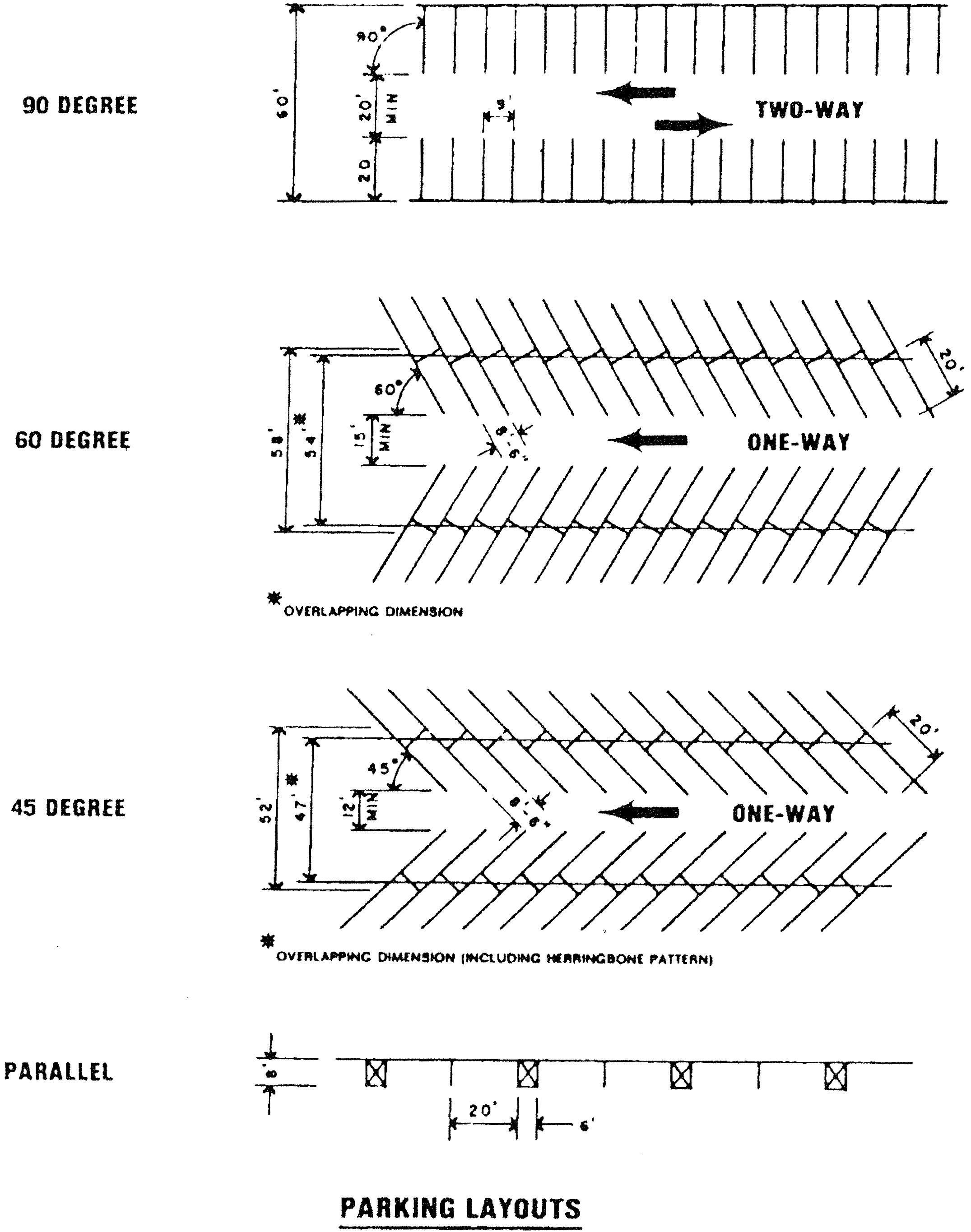
Plans for the layout of off-street parking facilities shall be in accord with the following minimum requirements:
3.
All spaces shall be provided adequate access by means of maneuvering lanes. Backing directly onto a street shall be prohibited.
4.
Adequate ingress and egress to the parking lot by means of clearly limited and defined drives shall be provided for all vehicles. Such drives shall meet the minimum requirements of the Monroe County Road Commission.
Ingress and egress to a parking lot lying in an area zoned for other than single-family residential use shall not be across land zoned for single-family residential use.
5.
All maneuvering lane widths shall permit one-way traffic movement, except that the 90° pattern may permit two-way movement.
6.
Each entrance and exit to and from any off-street parking lot located in an area zoned for other than single-family residential use shall be at least 25 feet distant from adjacent property located in any single-family residential district.
7.
The off-street parking lot shall comply with the provisions of Section 1907 [Section 400.1907] relating to screening and landscaping, and the provisions of Section 1911 [Section 400.1911] relating to walls.
8.
The entire off-street parking lot, including parking spaces and maneuvering lanes, required under this section shall be provided with asphaltic or concrete surfacing in accordance with specifications approved by the Township Board. The parking area shall be surfaced and striped within one year of the date of the occupancy permit is issued.
Off-street parking lots shall be drained so as to dispose of all surface water accumulated in the parking area in such a way as to preclude drainage of water onto adjacent property, public streets or toward buildings.
9.
All lighting used to illuminate any off-street parking area shall be so installed as to be confined within and directed onto the parking area only.
10.
In all cases where a wall extends to an alley which is a means of ingress and egress to an off-street parking area, it shall be permissible to end the wall not more than ten feet from such alley line in order to permit a wider means of access to the parking area.
(Ord. No. 44A-89, 4-4-89)
400.1906 - Off-street loading and unloading.
Sec. 1906. On the same premises with every building, structure, or part thereof erected, occupied or used for manufacturing, storage, warehousing, retail or wholesale commercial, office, hotels/motels, schools, institutional, or other uses similarly involving commerce, manufacturing, institutional or office use where there is a periodic receipt or distribution of materials or merchandise, there shall be provided and maintained on the premises, adequate area for standing, loading and unloading in order to avoid undue interference with parking areas, maneuvering lanes, drives, roads and streets. Such area shall be provided as follows:
1.
Loading/unloading shall be provided for inside a building, structure or part thereof, or in the rear yard or side yard not facing a street (interior side yard), in the following ratio of loading/unloading spaces to gross floor area of the building, structure or part thereof, for the most specific of the following categories:
A.
Professional and Office Districts (PBO and PBO-1), and professional and office uses in other Districts:
B.
Commercial Districts (C-1, C-2 and C-3), and commercial uses in other Districts:
C.
Industrial Districts (I-1, I-2 and I-3) and industrial uses in other Districts:
D.
Institutional, Educational and Assembly uses in Districts other than named above:
E.
Specific Uses in any District notwithstanding that required above:
2.
No loading/unloading area shall be constructed without a building permit being first issued by the Township Building Official, unless it is being constructed as part of a building construction for which the Township Building Official has issued a permit.
3.
All exterior loading/unloading areas must be located adjacent to or as near as reasonably possible to a door providing loading/unloading access to the building or structure, but not blocking the means of pedestrian ingress and egress to the building or structure.
4.
No exterior loading/unloading area shall be located more than 15 feet into a required minimum rear yard setback or side yard setback not facing a street (interior side yard), as measured from the required minimum yard setback line.
5.
The Planning Commission may, where deemed necessary, require a directional sign designating the loading/unloading areas. The directional sign must only be as large as the Planning Commission determines necessary to inform drivers of vehicles as to the location of the loading/unloading area. The Planning Commission may designate the size, location, color, materials and other aspects of the sign, including whether or not it is placed on a wall of the building of structure, or on a pole. The sign may only be used for directional purposes.
6.
Striping on the pavement shall be required to designate the loading/unloading area.
7.
The Planning Commission may, where deemed necessary, require curbs, bumpers, wheelstops and other traffic control devices.
8.
No loading/unloading area shall be constructed or maintained which encourages vehicles backing or otherwise maneuvering directly onto a street or road.
9.
All loading/unloading areas must be provided with asphaltic or concrete surfacing in accordance with specifications designated by the Township of Bedford Development Design Standards Ordinance (Bedford Township Ordinance No. 65), or a similar successor ordinance, or by the Township Planning Commission if no such ordinance exists.
10.
All loading/unloading areas shall be drained so as to dispose of all surface water in a manner which the Monroe County Drain Commissioner's Office specifies, or as the Township Planning Commission dictates, and not in a manner which drains surface water onto adjacent property, streets, roads or toward any building.
11.
All lighting used to illuminate any loading/unloading area shall be so installed as to be confined within and directed onto the loading/unloading area and/or parking area on the same premises.
12.
All loading/unloading areas shall have a minimum of a 16 foot height clearance.
13.
All exterior loading/unloading areas adjacent to a residentially zoned district or residentially used parcel (at the time a permit is requested of the Township Building Official) shall comply with the landscaping/screening/wall requirements the same as for off-street parking areas, as designated in Sections 1907 and 1911, except that the wall shall be 6 feet in height. Notwithstanding the preceding sentence, the Planning Commission may require additional and/or different landscaping/screening/wall requirements if the uses and proximity of the buildings involved are such that require additional or special protection from non-residential noise, activity and views. The Planning Commission may designate the size, location, color, materials and other aspects of the landscaping/screening/wall requirements.
14.
For multi-unit buildings, or more than one building or structure on the same premises, loading/unloading areas shall be the number of loading/unloading spaces computed for the entire multi-unit building, or for all the buildings and structures requiring loading/unloading areas on the same premises, but the loading/unloading spaces must be sufficiently placed, as determined by the Township Planning Commission, so as to provide reasonable access between the loading/unloading areas and each individual unit, or separate building or structure requiring loading/unloading areas.
(Ord. No. 44A-188, § 3, 12-7-99)
400.1907 - Landscaping and screening.
Sec. 1907.
1.
Intent. Landscaping, greenbelts, and screening are necessary for the continued protection and enhancement of all land uses. Landscaping and greenbelts are capable of enhancing the visual image of the Township, preserving natural features, improving property values, and alleviating the impact of noise, traffic, and visual distraction associated with certain uses. Screening is important to protect less-intensive uses from the noise, light, traffic, litter and other impacts of more intensive, non-residential uses. Accordingly, these provisions are intended to set minimum standards for the design and use of landscaping, greenbelts, and screening, and for the protection and enhancement of the Township's environment. These provisions are also intended to encourage creativity on the part of the project owner in the designing and installation of landscape materials. More specifically, the intent of these provisions is to:
a.
Improve the appearance of off-street parking areas, vehicular use areas, and property abutting public and private roads;
b.
Protect and preserve the appearance, character, and value of the neighborhoods which abut non-residential areas, parking areas, and other intensive use areas, thereby protecting the public health, safety and welfare;
c.
Reduce soil erosion and depletion; and
d.
Increase soil water retention, thereby helping to prevent flooding.
Whenever there shall be required in this Ordinance a greenbelt, landscaping, screening (but if walls are required, they are controlled by Section 1911 [Section 400.1911]), or planting, or a site plan controlled by Section 1913 [Section 400.1913], or a plot plan controlled by Section 2102 [Section 400.2102], the following provisions relating to landscaping and/or screening shall be met, and the site plan or plot plan shall show the landscaping and/or screening required:
2.
Scope of application. These requirements shall apply to all uses which require a site plan as required by Section 1913 [Section 400.1913] of the Zoning Ordinance. No site plan shall be approved unless it shows landscaping and screening consistent with the requirements of this Section 1907 [Section 400.1907]. Where landscaping and/or screening is required, a building permit shall not be issued until the required landscape plan is submitted and approved, and a certificate of occupancy shall not be issued unless provisions set forth in this Section 1907 [Section 400.1907] have been met or a performance guarantee has been posted in an amount equal to ten percent of the total cost of installing the landscape material.
3.
Minimum requirements. The requirements of this Section are minimum requirements, and under no circumstances shall they preclude the developer and the Township from agreeing to more extensive landscaping and/or screening.
4.
Design creativity. Creativity in landscape design is encouraged. Landscaping materials should include a variety of plant species to prevent the spread of plant disease. Required trees and shrubs may be planted at uniform intervals, at random, or in groupings, depending on the designer's visual effect. Clustering of trees and shrubs, rather than "formal" designs involving placement of trees and shrubs at uniform intervals is encouraged.
5.
General site requirements. All developed portions of the site shall conform to the following general landscaping standards, except where specific landscape elements, such as a greenbelt, berms, or screening are required:
All permanently undeveloped portions of the site shall be planted with grass, ground cover, shrubbery, crops, other suitable live plant material, or left in a natural state. This planted area shall extend to any abutting street pavement edge and shall also comply with Section 1907.8 [Section 400.1907.8]. Existing plant material on the property may be used. Grass areas in the front yard of all non-residential uses shall be planted with sod or be planted by hydro seeding or seeded with some similar method of quickly producing healthy and permanent grass growth.
6.
Parking lot landscaping. In addition to a required screening, all off-street parking areas, including, but not limited to a Vehicular Parking District, shall also provide landscaping as follows:
a.
Landscaping ratio. Off-street parking areas equal to or greater than 150 spaces shall be provided with interior landscaping in accordance with the following table.
In PBO, PBO-1, C-1, C-2, & C-3 zoning districts:
In R-1 through R-3, RT, RM-1, RM-2, and RME zoning districts:
In any case where the required parking spaces are not less than 250 and not more than 299, a minimum of five landscaping islands totaling no less than 400 square feet shall be provided. For required parking spaces of 300 or more, the five landscaping islands totaling no less than 400 square feet shall be provided, plus for every additional 50 parking spaces or any fraction of 50, a minimum of one landscaping island containing no less than 80 square feet shall be provided. The landscaping islands shall be spaced proportionately throughout the parking area to the extent reasonably possible. The square footage for said landscaping islands shall be considered as being included in the overall interior landscaping requirements in the table above.
In the case of an expansion of an existing parking lot to include additional parking equal to or greater than 150 parking spaces, the interior landscaping requirements of this Section 1907.6a [Section 400.1907.6a] shall apply for those additional parking spaces, but the Planning Commission may modify the parking lot interior landscaping requirements and consider the existing landscaping on site to meet the parking lot interior landscaping requirements.
Whenever possible, parking lot landscaping shall be designed to improve the safety of pedestrian and vehicular traffic, guide traffic movement, and improve the appearance of the parking area.
b.
Other landscaping. Landscaping elsewhere on the parcel can be counted in meeting the parking lot interior landscaping requirements (see Section 1907.19a [Section 400.1907.19a]).
c.
Plantings within parking lots shall comply with the requirements for unobstructed site distance set forth in corner clearance/clear vision zone in Section 1910 [Section 400.1910] . The landscape plan shall indicate the types, sizes, and quantities of plant material proposed for such area.
7.
Screening.
a.
General screening requirements. Unless otherwise specified, wherever an evergreen or landscaped screen is required, evergreen screening shall consist of appropriately spaced plantings which can be reasonably expected to form a complete visual barrier that is at least eight feet above ground level within five years of planting.
b.
Screening of ground level utility substations and mechanical equipment, and refuse containers or dumpsters. Refuse containers or dumpsters for other than one-family or two-family residential uses shall be screened from view from any adjacent property, and from any public or private road or service drive when a residential use or residential district is across from said service drive. The screening shall be high enough to block the view of the refuse container, or ground level mechanical equipment, such as air compressors, pool pumps, transformers, air conditioning units, sprinkler pumps, utility substations and similar equipment and consist of a wall or fence or landscape material. Insofar as practical, said screening shall exceed the vertical height of the equipment being screened by at least six inches within two years of planting. Refuse containers are not required to be screened from view from uses permitted in Section 1301.2 [Section 400.1301.2] through Section 1301.14 [Section 400.1301.14], and Section 1302 [Section 400.1302] of the C-3, General Commercial district.
8.
Landscaping of rights-of-way. Public rights-of-way located adjacent to required landscaped areas and greenbelts shall be planted with sod or other live ground cover, and shall be maintained by the owner or occupant of the adjacent property as if the rights-of-way were part of the required landscaped areas or greenbelts. No plantings except grass or ground cover shall be permitted closer than three feet from the edge of the road pavement.
9.
Maintenance of unobstructed visibility for drivers. No landscaping shall be erected, established, or maintained on any parcel or in any parking lot, which will obstruct the view of drivers. Accordingly, all landscaping shall comply with the provisions concerning corner clearance/clear vision zone in Section 1910 [Section 400.1910].
10.
Potential damage to utilities. In no case shall landscaping material be planted in a way which will interfere with or cause damage to underground or overhead utility lines, public or private roads, or other public facilities. Species of trees whose roots are known to cause damage to public roadways, sewers, or other utilities shall not be planted closer than 15 feet from any such roadways, sewers, or utilities.
11.
Landscaping of divider medians. Where traffic on driveways, maneuvering lanes, private roads, or similar vehicle access ways is separated by a divider median, the median shall be curbed and have a minimum width of 12 feet as measured from the back of curb. A minimum of one deciduous or evergreen tree shall be planted for each 30 lineal feet or portion thereof of median. Trees may be planted at uniform intervals, at random, or in groupings, but in no instance shall the center-to-center distance between the trees exceed 60 feet.
12.
Storm water detention ponds. Detention ponds shall be designed as an integral part of the overall site plan and shall be considered a natural landscape feature having an irregular or curvilinear shape. Maximum slopes and depths of any proposed pond shall conform to the Township of Bedford Development Design Standards Ordinance, Ordinance 65, or any similar successor ordinance, and any other Township engineering specifications. The following standards shall be considered minimum requirements for the landscaping of detention ponds:
a.
Groundcover - The side slopes and bottom of the pond shall be sodded or seeded. If seeding is proposed, a seed mat or seed blanket shall be installed to prevent erosion and seed washing. The Township shall withhold a portion of the required landscape bond until the sides and bottom of the pond have grown in adequately.
b.
General landscaping - All proposed ponds shall be landscaped in accordance with the following standards:
1.
One deciduous shade or evergreen tree and ten shrubs shall be planted for every 100 lineal feet of pond perimeter as measured along the top of bank elevation.
2.
The required trees and shrubs shall be planted in a random pattern or in groupings and placement or required landscaping is not limited to the top of the pond bank.
13.
Specific requirements for office, commercial districts. In addition to the general landscaping requirements set forth above in this Section 1907 [Section 400.1907], all lots or parcels of land located in PBO, PBO-1, C-1, C-2, and C-3 zoning districts shall comply with the following landscaping requirements:
a.
Landscaping adjacent to roads. All front, side, or rear yards adjacent to roads shall be landscaped in accordance with the following standards:
When the use is across from a residential use or residential zoning and the use includes front yard parking, a visual barrier a minimum of 3-feet high consisting of a wall or landscape material or both is required. Landscape material may be planted at uniform intervals, at random, or in groupings. This requirement does not apply to outdoor display areas adjacent to the road such as automobile dealerships.
When the use is across from PBO, PBO-1, C-1, C-2, or C-3 zoning there shall be a minimum of one ornamental tree for every 50 lineal feet or portion thereof of road frontage, plus one shrub for every 20 lineal feet of frontage. Dwarf species of shrubs may be utilized at the rate of 1.5 times the base shrub requirement. For the purpose of computing the length of road frontage, openings for driveways and sidewalks will not be counted. Landscaping may be planted at uniform intervals, at random, or in groupings.
b.
Foundation landscaping. Foundation plantings are required along the road frontage in PBO and PBO-1 zoning districts and is encouraged along the road frontage in C-1, C-2, and C-3 zoning districts.
c.
Landscaping variety. In order to encourage creativity in landscaping and minimize tree loss caused by species-specific disease, a variety of tree species is recommended.
14.
Specific requirements for multiple-family districts and elderly housing. In addition to the general landscaping requirements set forth above in this Section 1907 [Section 400.1907], all lots or parcels of land located in RM-1 and RM-2 Multiple Family Residential Districts and RME Elderly Housing Residential Districts shall comply with the following landscaping requirements:
a.
General site landscaping. A minimum of one deciduous shade or evergreen tree, one ornamental tree, or two shrubs shall be planted per each two dwelling units. Unless otherwise specified, required landscaping elsewhere in the multiple-family development shall not be counted in meeting these requirements for trees.
b.
Protective screening requirements. Protective screening in the form of an obscuring wall, fence, or landscaping shall be required wherever development in a RM-1, RM-2 or RME district abuts directly upon land zoned or used for single family residential purposes. If a wall is to be installed, the requirements of Section 1911 [Section 400.1911] shall be complied with. If a fence is used instead of a wall Section 1912 [Section 400.1912] shall be complied with.
c.
Landscaping adjacent to roads. The front, side, or rear yards adjacent to roads shall be landscaped in accordance with the following standards:
A minimum of one ornamental tree for every 50 lineal feet of frontage, plus one shrub for every ten lineal feet or portion thereof of frontage. Dwarf species of shrubs may be utilized at the rate of 1.5 times the base shrub requirement. For the purpose of computing the length of road frontage, openings for driveways and sidewalks will not be counted. Landscaping may be planted at uniform intervals, at random, or in groupings.
d.
Landscaping variety. In order to encourage creativity in landscaping and minimize tree loss caused by species-specific disease, a variety of tree species are encouraged.
15.
Specific requirements for non-residential uses in residential districts. In addition to the general landscaping requirements set forth in this Section 1907 [Section 400.1907], above, all non-residential uses developed in residential districts shall comply with the following landscaping requirements:
a.
Protective screening requirements. Protective screening in the form of an obscuring wall, fence, or landscaping shall be required wherever a non-residential use in a residential district abuts directly upon land zoned for residential purposes. Walls must comply with the requirements of Section 1911 [Section 400.1911]. Fences must comply with the requirements of Section 400.1912 [Section 400.1912].
b.
Landscaping adjacent to roads. The front, side, or rear yards adjacent to roads shall be landscaped in accordance with the following standards:
A visual barrier a minimum of three-foot high consisting of a wall or landscape material or both. Landscape material may be planted at uniform intervals, at random, or in groupings.
c.
Landscaping variety. In order to encourage creativity in landscaping and minimize tree loss caused by species-specific disease, a variety of tree species is encouraged.
16.
Specific requirements for industrial uses adjacent to land used or zoned for residential uses. In addition to the general landscaping requirements set forth in this Section 1907 [Section 400.1907], above, all industrial uses developed adjacent to land used or zoned for residential purposes shall comply with the following landscaping requirements:
a.
Protective screening requirements. Protective screening in the form of a landscaped berm shall be required wherever an industrial use abuts directly upon land zoned for residential purposes. The berm shall be measured from the natural grade and shall be constructed with slopes no steeper than one foot vertical for each three feet horizontal. The landscape screening shall consist of appropriately spaced plantings which can be reasonably expected to form a complete visual barrier that is at least eight feet above ground level within five years of planting. Existing industrial uses are not required to comply with this section when any additions or expansion of the use is not toward the residential zoned property. Walls must comply with the requirements of Section 1911 [Section 400.1911]. Fences must comply with the requirements of Section 400.1912 [Section 400.1912].
b.
Landscaping adjacent to roads. The front, side, or rear yards adjacent to roads shall be landscaped in accordance with the following standards:
A visual barrier a minimum of three-foot high consisting of a wall or landscape material or both. Landscape material may be planted at uniform intervals, at random, or in groupings.
c.
Landscaping variety. In order to encourage creativity in landscaping and minimize tree loss caused by species-specific disease, a variety of tree species is encouraged.
17.
Standards for landscape material. Unless otherwise specified, all landscape materials shall comply with the following standards:
a.
Non-living plant material. Plastic and other non-living plant materials shall not be considered acceptable to meet the landscaping requirements of this Section 1907 [Section 400.1907].
b.
Plant material specifications. The following specifications shall apply to all plant material proposed in accordance with the landscaping requirements of this Section 1907 [Section 400.1907].
1)
Deciduous shade trees. Deciduous shade trees shall be a minimum of 1½ inches in caliper measured six inches above grade.
2)
Deciduous ornamental trees. Deciduous ornamental trees shall be a minimum of two inches in caliper measured six inches above grade.
3)
Evergreen trees. Evergreen trees, except when used for ornamental application, shall be a minimum of four feet in height from the top of the root ball when planted.
4)
Shrubs. Shrubs shall be a minimum of two feet in height when planted; except upright yew, juniper and arborvitae shall be a minimum of three feet in height. Low growing shrubs shall have a minimum spread of 24 inches when planted. Dwarf shrub species may be used in landscaping adjacent to roads to achieve a specific design goal and shall have a minimum 18 inches height or spread.
5)
Hedges. Hedges shall be planted and maintained so as to form a continuous, unbroken, visual screen within two years after planting, barring unusual growing conditions, such as drought or disease. Hedges shall be a minimum of two feet in height when planted.
6)
Ground cover. Ground cover used in lieu of turf grasses in whole or in part shall be planted in such a manner as to present a finished appearance and reasonably complete coverage after one complete growing season. The Planning Commission may allow an alternative ground cover.
7)
Grass. Grass areas shall be planted using species normally grown as permanent lawns in Monroe County. Grass, sod, and seed shall be clean and free of weeds, pests, and diseases. Grass may be sodded, plugged, sprigged or seeded, except that sod shall be installed in swales or other areas that are subject to erosion, and in the front yard areas of all non-residential uses. When grass is to be established by a method other than complete sodding or seeding, nursery grass seed shall be sown for immediate effect and protection until complete coverage is otherwise achieved. Straw or other mulch shall be used to protect newly seeded areas.
8)
Mulch. Mulch used around trees and shrubs shall be applied at a minimum depth as recommended by the manufacturer or installer. Mulch should be treated with a pre-emergent herbicide, and installed in a manner as to present a finished appearance.
9)
Sod. Grass areas in the front yard of all non-residential uses shall be planted with sod or be planted by hydro seeding or seeded with some similar method of quickly producing healthy and permanent grass growth.
10)
The installation of drought resistant and local plant species is highly encouraged to minimize the need for supplemental irrigation.
18.
Installation and maintenance. The following standards shall be observed where installation and maintenance of landscape materials are required:
a.
Off-season planting requirements. If development is completed during the off-season when plants cannot be installed, installation of required landscaping shall be made in the next planting season, which is defined as April, May and June or September and October.
b.
Maintenance. Landscaping required by this Section 1907 [Section 400.1907] shall be maintained in a healthy, neat, and orderly appearance, free from refuse and debris. All unhealthy and dead plant material shall be replaced immediately unless the season is not appropriate for planting, in which case such plant material shall be replaced at the beginning of the next planting season. All constructed or manufactured landscape elements, such as but not limited to benches, retaining walls, edging, and so forth, shall be maintained in good condition and neat appearance. Rotted, deteriorated, or damaged landscape elements shall be repaired or replaced.
19.
Treatment of existing plant material. The following regulations shall apply to existing plant material:
a.
Consideration of existing elements in the landscape design. In instances where healthy plant material exists on a site prior to its development, the Planning Commission shall permit substitution of such plant material in place of requirements set forth previously in this Section 1907 [Section 400.1907], provided such substitution is in keeping with the spirit and intent of this Section 1907 [Section 400.1907] and the Ordinance in general.
b.
Preservation of existing plant material. Site plans shall show in general detail all trees, which are located on the site.
Existing trees shall be designated "To Be Removed" or "To Be Saved" on the site plan. If existing plant material is labeled "To Be Saved" on the site plan, protective measures should be implemented, such as the placement of fencing or stakes at the drip line around each tree. No vehicle or other construction equipment shall be parked or stored within the drip line of any tree or other plant material intended to be saved.
20.
Modifications to landscape requirements. In consideration of the overall design and impact of a specific landscape plan, and in consideration of the amount of existing plant material to be retained on the site, the Planning Commission may modify the specific requirements outlined herein, provided that any such adjustment is in keeping with the intent of this Section 1907 [Section 400.1907] and this Zoning Ordinance in general. In determining whether a modification is appropriate, the Planning Commission may base its decision on any one or more of the following circumstances which exist in connection with the site:
a.
Topographic features or other unique features of the site create conditions such that strict application of the landscape regulations would result in a less effective landscape design than an alternative landscape design.
b.
Parking, vehicular circulation, or land use are such that required landscaping would not enhance the site or result in the desired aesthetic effect.
c.
The public benefit intended by the landscape regulations could be better achieved with a plan that varies from the strict requirements of this Section 1907.
d.
Landscaping would restrict proper storm water drainage.
Performance guarantee. The Planning Commission may require a bond or other performance guarantee in a form as may be described in this Ordinance and/or similar in nature to that required in the Township Subdivision Regulation Ordinance, currently Bedford Township Ordinance No. 72, specifically Section 5.9 [Section 300.509], or any similar successor ordinance, to guarantee the installation of the landscaping required by this Section 1907 [Section 400.1907]. The bond or other performance guarantee shall be in an amount equal to ten percent of the total cost of materials.
(Ord. No. 44A-89, 4-4-89; Ord. No. 44A-213, 8-20-02; Ord. No. 44A-225, 11-18-03)
400.1908 - Exterior lighting standards.
Sec. 1908.
1.
Purpose. The purpose of this section is to protect the health, safety and welfare of the public by encouraging lighting practices and systems that will minimize glare, light trespass, and light pollution and conserve energy and resources while maintaining nighttime safety, utility, security and productivity, and curtailing the degradation of the nighttime visual environment.
2.
Applicability. The standards in this section shall apply to any light source that is visible from any property line, or beyond, for the site from which the light is emanating. The Building Official or his/her designee may review any building or site to determine compliance with the requirements of this section. Whenever a person is required to obtain a building permit, electrical permit for outdoor lighting or signage, a special land use permit, subdivision approval, or site plan approval from the Township, the applicant shall submit sufficient information to enable the Building Official or his/her designee, and/or Planning Commission to determine whether the proposed lighting will comply with this section.
3.
Definitions. The following words, terms and phrases, when used in this Section, shall have the meanings ascribed to them in this section, except where the context clearly indicates a different meaning:
Area Lighting. Light fixtures such as guard lights located on public or private property that are designed to light spaces including but not limited to parks, parking lots and sales lots.
Average Foot-candles (fc). The level of light measured at an average point of illumination between the brightest and darkest areas. The measurement shall be made at the ground surface.
Axis of Illumination. The midline of the beam emitted by a light fixture.
Beam. The spatial distribution of the emitted light from a light fixture.
Bulb. A source of light.
Candela (cd). The unit of measurement of the intensity of a point source of light (approximately equal to one candle power).
Canopy Structure. Any overhead protective structure which is constructed in such a manner as to allow pedestrians/vehicles to pass under.
Communication Tower. Includes but is not limited to commercial television and radio towers, public utility microwaves, public utility television transmitting towers and personal wireless communication facilities.
Existing Light Fixtures. Outdoor light fixtures already installed at the time this ordinance is adopted.
Spotlight. Any light fixture or lamp that incorporates a reflector or refractor to concentrate the light output into a directional beam.
Foot-candle (fc). The illuminance measured one foot from a one candela source.
Footcandle, Horizontal and Vertical. The illuminance measured by a light meter in those positions. Illuminance may also be measured in other specified positions or directions.
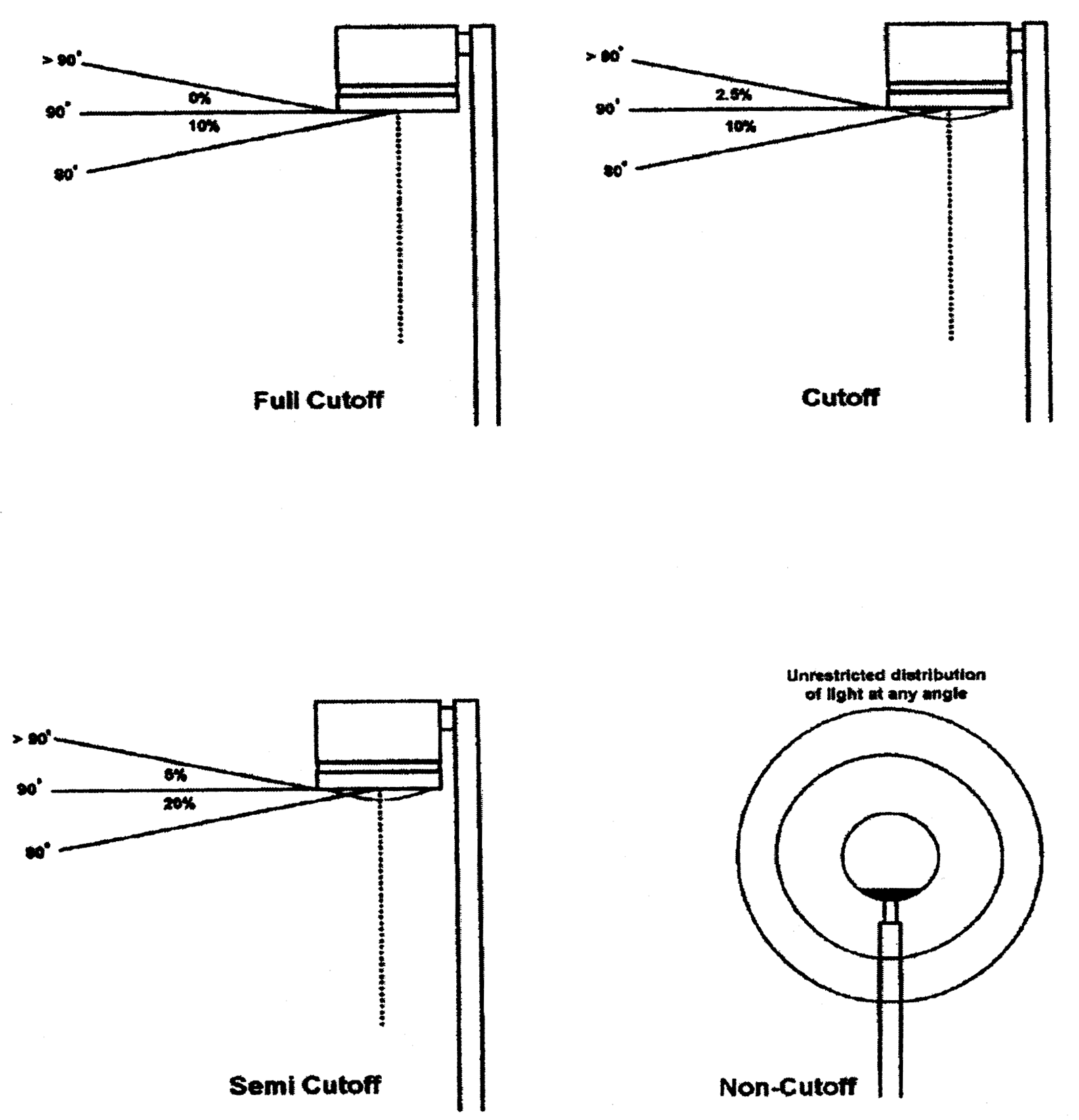
Full Cutoff/Fully Shielded. A shielded light fixture that emits no light above a horizontal plane touching the lowest part of the fixture.
Glare. The sensation produced by luminance within the visual field that is sufficiently greater than the luminance to which the eyes are adapted to cause annoyance, discomfort or loss in visual performance and visibility.
Illuminance. The intensity of light in a specified direction measured at a specified point.
Lamp. The component of the luminaire that produces the actual light, including luminous tube lighting.
Light Fixture. The assembly that holds or contains a lamp or bulb and may include an assembly housing, a mounting bracket or pole socket, a lamp holder, a ballast, a reflector or mirror, and a refractor or lens. A light fixture also includes the assembly for luminous tube and fluorescent lighting.
Light Pollution. Any adverse affect of man-made light. Often used to denote urban sky glow.
Light Trespass. Light emitted by a lighting installation that falls outside the boundaries of the property on which the installation is sited.
Lighting, Public. Outdoor light fixtures located on property owned, leased, or controlled by the Township, including but not limited to streets, highways, alleys, easements, parking lots, parks, playing fields, schools, institutions, meeting places, and all entities completely or partly funded by grants obtained by the Township or its agents from federal, state or private sources.
Lighting, Private. Outdoor light fixtures located on property owned or controlled by individual persons, including but not limited to families, partnerships, corporations, and other entities.
Lumen. The unit of luminous flux, the total amount of light falling uniformly on or passing through an area of 1 square foot, each of which is 1 foot from a 1-candela source, yielding an illuminance of 1 foot candle at that distance (the output of lamps and bulbs is customarily measured in lumens, a common 100 watt incandescent light bulb, for example, having an output less than 1,800 lumens).
Luminaire. A complete lighting unit consisting of a lamp or lamps together with the parts designed to distribute the light, to position and protect the lamps and to connect the lamps to the power supply.
Luminous Tube Lighting. Gas filled tubing which, when subjected to high voltage, becomes luminescent in a color characteristic of the particular gas used, e.g. neon, argon, etc.
Outdoor Light Fixture. Outdoor artificial illuminating devices, outdoor fixtures, lamps and other similar devices, permanently installed or portable, used for flood lighting, general illumination or advertisement.
Shielded Fixture. Outdoor light fixtures shielded or constructed so that light rays emitted by the fixture are projected below the horizontal plane passing through the lowest point on the fixture from which light is emitted, i.e. "shoebox-type" fixtures. A luminaire mounted in a recessed fashion under a canopy or other structure so that the surrounding structure effectively shields the light in the same manner is also considered fully shielded for the purposes of this ordinance.
Sag-lens or drop-lens. A clear or prismatic refracting lens that extends below the lowest opaque portion of a light fixture.
Searchlight. A light fixture having a narrow beam intended to be seen in the sky.
Sports Facilities. Lighting at public and private outdoor sports facilities, including but not limited to playing fields, arenas, tracks and swimming pools.
Wallpack. A floodlight mounted on the wall of a building or other structure.
4.
Submittal Requirements. The following information must be included for all site plan submissions, and where site plan approval is not required, some or all of the items may be required by the Building Official or his/her designee prior to lighting installation:
a.
Location of all freestanding, building-mounted and canopy light fixtures on the site plan and building elevations.
b.
Photometric grid overlaid on the proposed site plan indicating the overall light intensity throughout the site (in foot-candles).
c.
Specifications and details for the type of fixture being proposed including the total lumen output, type of lamp, method of shielding, and fixture height.
d.
Purpose of the fixture. (Safety, security, etc.)
Light Standards
5.
Standards. Unless exempted under Section 1908.6, all lighting must comply with the following standards:
a.
Freestanding Pole or Strung Lighting Requirements - Applicable to Fixtures Over Eight Feet in Height.
1)
Exterior lighting shall be fully shielded and directed downward to prevent off-site glare. The intensity of light within a site shall not exceed ten foot-candles at ground level and at the property line when adjacent to other commercial property, 1.5 foot-candles at ground level at the property line when adjacent to PBO and PBO-1 property, or 0.5 foot-candles at ground level at the property line when adjacent to residentially zoned property. The only exception is with a gas station canopy and automobile dealership lighting, or other permitted outdoor product display areas (see Section 1302.1 [Section 400.1302.1]), where a maximum of 20 foot-candles is permitted within the site, but the above standards shall apply to intensity at the property line when adjacent to commercial, PBO, PBO-1 or residentially zoned property.
2)
As part of site plan review, the Planning Commission may allow for an increased level of lighting above the maximum levels permitted when it determines that the applicant has demonstrated that such lighting is necessary for safety and security purposes.
3)
The Planning Commission may approve decorative light fixtures as an alternative to shielded fixtures when it can be proven that there will be no Light Trespass in excess of 0.5 foot-candles and the proposed fixtures will improve the appearance of the site.
4)
The maximum height of parking lot light fixtures shall be as follows:
Where a commercial use abuts a residential zoning or use, the maximum height of parking lot light fixtures shall be as follows:
5)
The Planning Commission may permit taller or require shorter fixtures only when it is determined that unique conditions exist and where a waiver would:
a)
Reduce the number or size of light fixtures, or
b)
Not adversely impact neighboring properties and permit fixtures in proportion to height and bulk of nearby buildings and other fixtures, or
c)
Meet the current standards consistent with nationally recognized standards such as the Illuminating Engineering Society (IES) as a guideline for all lighting decisions.
b.
Building-and Roof-Mounted Lighting Requirements.
1)
Building-mounted lighting with more than 60 watt bulbs shall be fully shielded and directed downward to prevent off-site glare. The intensity of light shall not exceed ten foot-candles within any site and where property abuts a residentially zoned site a maximum of 0.5 foot-candles at the property line is permitted. The only exception is with a gas station canopy and automobile dealership lighting, where a maximum of 20 foot-candles is permitted within the site but the standards set forth in Section 1908.5.a.1 [Section 400.1908.5.a.1] shall apply to intensity at the property line.
2)
The Planning Commission may approve decorative light fixtures as an alternative to shielded fixtures when it can be proven that there will be no off-site light trespass in excess of 0.5 foot-candles and the proposed fixtures will improve the appearance of the site.
c.
General Lighting Requirements.
1)
The use of laser light sources, search lights or any similar high intensity light for outdoor advertisement or entertainment is permitted only with a permit from the Bedford Township Building Department, and for no more than 14 days per year, per applicant. Periods in excess of 14 days are permitted subject to special approval from the Bedford Township Planning Commission for each location.
2)
Lighting shall not be of a flashing, moving, or intermittent type except for signs that display only time and temperature or other electronic, changeable message signs.
3)
All outdoor lighting in all use districts used to light the general area of a specific site shall be shielded to reduce glare and shall be so arranged as to reflect lights away from all adjacent residential districts or adjacent residences.
4)
All lights used for the illumination of business establishments or for the illumination of business building or areas surrounding them, or for the illumination or display of merchandise or products of business establishments, shall be completely shielded from the view of vehicular traffic using streets abutting such business properties.
d.
Sag-Lens or Drop Lens Fixtures. Sag-lens or drop lens fixtures are prohibited.
e.
Treatment of Existing Lighting. Treatment of existing site lighting in all districts shall be addressed as follows: Whenever an existing use is expanded, the expanded portion of the parking lot shall conform to the requirements of this Section 1908 [Section 400.1908]. Existing exterior lighting fixtures for the existing portion of the parking lot shall be allowed to remain, but the Planning Commission may require a reasonable transition between existing exterior lighting fixtures and new exterior lighting fixtures.
6.
Exemptions. The following are exempt from the lighting requirements of this Section, except that the Building Official/Zoning Administrator may take steps to eliminate the impact of the exempted items when deemed necessary to protect the health, safety and welfare of the public:
a.
Holiday Decorations.
b.
Temporary Lighting.
Temporary lighting that conforms to the requirements of this Section shall be allowed.
(Ord. No. 44A-212, 8-20-02; Ord. No. 44A-226, 11-18-03)
400.1909 - Residential entranceway.
Sec. 1909. In all Residential Districts, so called entranceway structures including but not limited to walls, columns, and gates marking entrances to single-family subdivisions or multiple housing projects may be permitted and may be located in a required yard, except as provided in Section 1910 [Section 400.1910], Corner Clearance, provided that such entranceway structures shall comply to all codes of the Township, and shall be approved by the Building Department and a permit issued. Such structures shall not exceed 12 feet in height and a total area of 240 square feet.
400.1910 - Corner clearance/clear vision zone.
Sec. 1910.
1.
Street Intersection Clearance: No fence, wall, shrubbery, sign, or other obstruction to vision shall be permitted above a height of two feet from the established grade of the abutting streets or roads, within the triangular area of a corner lot or parcel, where two of the lines of the triangle begin at a point of intersection of the abutting street or road right-of-way lines and proceed away from that point 35 feet along each of the intersecting street or road right-of-way lines adjacent to the lot or parcel, and the third line of the triangle connects the far ends of the first two lines 35 feet from the beginning point (intersection) of the first two lines.
2.
Driveway Intersection Clearance: No fence, wall, shrubbery, sign, or other obstruction to vision above a height of 30 inches from the established grade of an intersecting street or road and driveway shall be permitted within the triangular area formed at the intersection of said street or road right-of-way and driveway lines by a straight line drawn between the said street or road right-of-way line and driveway line at a distance along each line of 10 feet from their point of intersection.
(Ord. No. 44A-185, § 2, 6-1-99; Ord. No. 44A-191, § 2, 3-21-00)
400.1911 - Obscuring walls.
Sec. 1911. For those zoning districts and uses listed below there shall be provided and maintained on those sides abutting or adjacent to a residential or agricultural district or use an obscuring wall as required below.
1.
Location. Required walls shall be located immediately inside the lot line except where underground utilities interfere and except in instances where this Ordinance requires conformance with front yard setback lines in abutting Residential or Agricultural Districts. Upon review of the site plan, the Planning Commission may approve an alternate location for the wall or may waive the wall requirement if in specific cases it would not serve the purposes of screening the parking area or use effectively. Required walls may, upon approval of the Board of Appeals, be located on the opposite side of an alley right-of-way from a non-residential zone when agreeable to affected property owners. The continuity of the required wall on a given block will be a major consideration of the Board of Appeals in reviewing such request.
2.
Time of Construction. Wherever construction of an obscuring wall is required adjacent to residentially or agriculturally zoned or used property, the wall must be installed prior to the beginning of site grading and general construction, except where such activity would result in damage to the wall.
3.
Corner Clearance. Obscuring walls shall comply with specifications for maintenance of the corner clearance/clear vision in Section 1910 [Section 400.1910].
4.
Substitution. As a substitute for a required obscuring wall, the Planning Commission may, in its review of the site plan, approve the use of other existing and/or proposed natural or manmade landscape features of adequate size (such as closely spaced evergreens) that would produce substantially the same results in terms of screening, durability, and permanence. The character of adjoining uses and the preferences of adjoining residences or businesses shall be taken into consideration in determining whether any such substitution is appropriate.
5.
Wall Specifications. Required obscuring walls shall comply with the following height requirements, unless otherwise specified in this Ordinance:
Unless replaced with a substitute material approved by the Planning Commission for good cause shown, required walls shall be constructed of masonry material that is architecturally compatible with the materials used on the facade of the principal structure on the site, such as face brick, decorative block, or poured concrete with simulated brick or stone patterns. Concrete block walls with no decorative features are not permitted. Required walls shall be similarly finished on all sides.
(Ord. No. 44A-234, § 1, 8-17-04)
400.1912 - Fences.
Sec. 1912. The installation, erection, alteration, and/or maintenance of a fence shall be in strict compliance with the requirements of this Section. If other requirements of this Ordinance are in conflict with this section, the requirements of this section shall be applied.
1.
General Requirements.
a.
Fence construction shall not require a building permit.
b.
All fences shall be constructed of wood, metal, masonry, molded synthetic material or other similar construction material.
c.
All fences shall be constructed so that all structure members (posts, poles, braces) shall be within the perimeter of the pickets, planks or other facing material.
d.
Fences may be located along a property line; however, no fence may be located within a road right-of-way.
e.
No fence shall occupy the clear vision zone established by Section 1910.
f.
The height of a fence shall be measured from the established grade of the land on which the fence is located. The grading, mounding, or terracing of land shall not be permitted to increase the established grade in conjunction with the installation of a fence.
g.
Fences shall not contain barbed wire, razor wire or similar sharp pointed objects, or electric current or electrical charge, except as specifically provided in this Section.
h.
Fences shall be maintained in good repair and a neat condition. Any fence that endangers life or property, is not in good repair, or is not being maintained in a neat condition shall be deemed a public nuisance.
i.
Chain link fence of any type shall not be a deemed decorative material for the purposes of this Section.
2.
Single-Family and Two-Family Residential Districts (R-1, R-2, R-3, RT).
a.
Fences provided in conjunction with single-family and two-family dwellings shall conform to the following requirements:
1.
Fences within a front yard shall not exceed 3½ feet in height and shall be restricted to decorative fences.
2.
Fences within a side yard or rear yard shall not exceed 6 feet in height and shall not extend beyond the front building line or required front yard setback, whichever is greater.
3.
In the case of a corner lot, fences within a corner side yard shall not exceed 3½ feet in height and shall be restricted to decorative fences.
4.
In the case of a double frontage, fences within the rear yard that faces a road right-of-way and functions as a rear yard shall not exceed 6 feet in height.
3.
Multiple-Family Districts, Elderly Housing Districts, Mobile Home Park Districts (RM-1, RM-2, RME, MHP).
a.
Fences which enclose the perimeter of a multiple- family, elderly housing or mobile home park development shall conform to the following requirements:
1.
Fences within a front yard shall not exceed 4 feet in height and shall be restricted to decorative fences.
2.
Fences within a side or rear yard shall not exceed 6 feet in height.
3.
In the case of a double frontage lot, fences within the rear yard that faces a road right-of-way and functions as a rear yard shall not exceed 6 feet in height.
b.
Privacy fences may be installed in conjunction with individual dwelling units in a multiple-family elderly housing or mobile home park development, provided that the fence does not exceed 6 feet in height.
c.
Fences provided in conjunction with single-family and two-family dwellings shall conform to the requirements for single-family and two-family dwellings in Single-Family and Two-Family Districts (R-1, R-2, R-3, RT).
d.
Fences provided in conjunction with other than single-family or two-family dwellings, or a multiple-family, elderly housing or mobile home park use, shall conform to the following requirements:
1.
Fences within a front yard shall not exceed 4 feet in height and shall be restricted to decorative fences.
2.
Fences within a side or rear yard shall not exceed 6 feet in height.
3.
In the case of a corner lot, fences within a corner side yard shall not exceed 4 feet in height and shall be restricted to decorative fences.
4.
In the case of a double frontage, fences within the rear yard that faces a road right-of-way and functions as a rear yard shall not exceed 6 feet in height.
e.
Fences that may be required to enclose a detention pond shall be decorative fences.
4.
Agricultural Districts (AG).
a.
Fences within a front yard shall not exceed 4 feet in height.
b.
Fences within a side yard or rear yard shall not exceed 6 feet in height and shall not extend beyond the front building line or required front yard setback, whichever is greater.
c.
In the case of a corner lot, fences within a corner side yard shall not exceed 4 feet in height.
d.
Fences containing barbed wire and/or electric current or charge shall be permitted in conjunction with a bona fide agricultural use, stable or kennel.
e.
Fences that may be required to enclose a detention pond shall be decorative fences.
5.
Professional Office and Commercial Districts (PBO, PBO-1, C-1, C-2, C-3).
a.
Fences within a front yard shall not exceed 4 feet in height and shall be restricted to decorative fences.
b.
Fences within a side or rear yard shall not exceed 6 feet in height and shall not extend beyond the front building line or required front yard setback, whichever is greater.
c.
Fences that are visible from a public right-of-way or that may be required to enclose a detention pond shall be restricted to decorative fences.
6.
Industrial Districts (I-1, I-2, I-3).
a.
Fences shall not exceed 8 feet in height regardless of location or use.
b.
Fences that include a barbed cradle wire shall be permitted provided that:
1.
The barbed cradle wire is located on the portion of the fence that is greater than 6 feet in height; and
2.
Barbed cradle wires shall only overhang the property that is intended to be protected.
(Ord. No. 44A-185, § 3, 6-1-99; Ord. No. 44A-198, § 1, 7-17-01)
400.1913 - Site plan review (all districts).
Sec. 1913.
1.
Site plans required. Prior to a new development, or the creation of a use or the erection of a building or other structure, or the addition or deletion to a use, building, or structure, under any of the circumstances cited below, a site plan shall be submitted, in accordance with the requirements of this Section, to the Planning Commission for approval:
a.
Any use, erection, or development for which the submission of a site plan is required by any provision of this Ordinance.
b.
Any use, erection, or development, permitted subject to special conditions or special approval, unless a site plan is specifically not required by any provision of this Ordinance for said use, erection, or development.
c.
Any use, erection, or development in other than an Agricultural, One-Family Residential, or Two-Family Residential District, unless a site plan is specifically not required by any provision of this Ordinance for said use, erection, or development.
d.
All non-residential uses permitted in One-Family Residential Districts such as, but not limited to: cemeteries, places of worship, schools, golf courses, recreational areas, and public facilities.
e.
All uses permitted in Agricultural Districts other than one-family dwellings, farms, agricultural roadside stands, or allowed accessory uses thereto, such as, but not limited to cemeteries, places of worship, schools, golf courses, greenhouses, recreational areas, and public facilities.
f.
Any off-street parking lot, or parking facility in a P-1 Vehicular Parking District, including paving (but not re-paving), or enlargements to existing lots or facilities, except those lots serving uses, erections, or developments not otherwise requiring a site plan.
g.
Any alteration, addition, deletion, expansion, change, or conversion, to an existing development, building, structure, or use that did require or would now require a site plan, which either requires additional off-street parking or constitutes an increase or decrease in size of building, structure, or use area of 1,000 or more square feet or ten percent, whichever is less.
h.
Notwithstanding what is stated in Section 1913.1a—g [Section 400.1913.1a—g] above, Section 1913.6 [400.1913.6] provides for no formal site plan under certain circumstances; and also no site plan shall be required for any alteration, addition, deletion, expansion, change, or conversion, to an existing development, building, structure, or use that did require or would now require a site plan, which does not require additional off-street parking and which does not constitute an increase or decrease in size of building, structure, or use area of 1,000 or more square feet or 10 percent, whichever is less.
2.
Prohibited activities prior to approval. Site plan review and approval as required and set forth in this Section 1913 [Section 400.1913], is necessary prior to the issuance of a building permit or an occupancy permit. No grading, removal of trees or other vegetation, or other site preparation shall occur prior to site plan review and approval. Every site plan submitted to the Planning Commission shall be in accordance with the requirements of this Ordinance.
3.
Screening committee. Either preceding, or upon the filing of any preliminary or combined site plan, prior to any review by the Planning Commission of the preliminary or combined site plan, the applicant shall meet with a Township screening committee comprised of a Township official, the Township Engineer, the Township Planning Consultant, and the Township Planning Coordinator, or any number of them, or others as designated by the Township. The purpose of the screening committee will be to meet with, and help and advise the applicant. In addition, any of the members of the screening committee can suggest an additional meeting of the committee if any site plans or applications are submitted, and are deficient or lacking in some way. In such event, the applicant shall be notified and advised that he shall meet with the screening committee to discuss the deficiencies before the Planning Commission formally reviews the site plan.
4.
Combined preliminary and final site plan. For any site plan, notwithstanding any other provision of this Section 1913 [Section 400.1913], an applicant at his own risk, may combine a preliminary and final site plan into one single submittal, but the Planning Commission shall have the absolute right to treat the first submittal as a preliminary site plan and require a separate final site plan where, in its opinion, the project is too complex for one submittal, or where the first submittal does not meet all of the requirements for both a preliminary and final site plan.
5.
General site plans. A general site plan, when required, not including those uses, erections, or developments listed in Section 1913.6 [Section 400.1913.6], and subject to Section 1913.7 [Section 400.1913.7] for industrial park site plans, shall be submitted in accordance with and contain the following information:
a.
As the first of a two-stage review process, a preliminary site plan shall be submitted to the Township Planning Department, along with all required fees and escrows. The preliminary site plan must be signed by a Michigan registered engineer or architect, who shall also cause his or her professional seal to be impressed on the site plan. All owners of record shall submit a letter designating the registered engineer or architect to act as the owners' agent for submitting the preliminary and final site plan, and all related items. The Planning Commission is authorized to formulate and require completion of a preliminary site plan checklist, which shall correspond to the requirements of this Section 1913 [Section 400.1913], and also an environmental permits checklist, both of which must be signed by the signer or signers of the site plan and submitted with the preliminary site plan. 13 copies of the preliminary site plan shall be required. In addition, within three days of filing with the Township, the Monroe County Road Commission and the Monroe County Drain Commissioner's Office must be provided with three copies each of the preliminary site plan, along with any fees or charges that are due. In certain circumstances, the Environmental Health Division of the Monroe County Health Department, the Michigan Department of Natural Resources, or other County or State agencies may require copies of the preliminary site plan. Copies of the preliminary site plan and any fees or charges required by these County or State agencies must be filed with the appropriate agencies, within one week of filing with the Township. The preliminary site plan shall contain the following information, any of which may be waived if not appropriate, and any of which may require supplementation by the reviewing County or State agencies:
PRELIMINARY SITE PLAN REVIEW
Basic information:
(1)
Township or Municipality.
(2)
Name, address and phone number in full of the applicant and any contact person.
(3)
Date of application, plans, and drawings.
(4)
North arrow.
(5)
General location map.
(6)
Written proof satisfactory to the Township of property ownership, options, liens, submitted with the site plan.
(7)
Property address and parcel number.
(8)
Scale (shall not be greater than) 1″=30′ for three acres or less; (shall not be greater than) 1″=50′ for three acres or more; (For large tracts of land with a minimum of building construction, such as a golf course, this scale may be adjusted by the Township).
(9)
All site plans shall be prepared and submitted on 24″ x 36″ size sheets.
(10)
Name of plan preparer (architect, engineer, etc.) (include address, phone #, Michigan registration #).
Existing site description:
(11)
Size of parcel, total area of site (See specific zoning district requirements and Section 1800 [Section 400.1800] "Schedule of Regulations").
(12)
Location of the following:
(a)
Existing structures and those within 100 feet of the property line of the site;
(b)
Complete topography with a maximum contour interval of two feet, both on the site and beyond the site for a distance of 100 feet;
(c)
Existing natural resources and features including: vegetation, wetlands, soil types, drains and water courses and water bodies with their ordinary high water mark and 100 year flood plain elevations;
(d)
Legal description, property lines and dimensions;
(e)
Existing abutting roads, streets, alleys, right-of-ways, and easements;
Proposed project description:
(13)
Indicate the following:
(a)
Type of development;
(b)
Location, use, and number of structures, units, offices, parking spaces, (including basis for computation), employees, building height, square footage (gross and net), and the like;
(c)
Project completion schedule/development phases;
(d)
Total project area showing the portion of the site to be improved or altered;
Zoning requirements and standards:
(See specific zoning district requirements and Section 1800 [Section 400.1800] "Schedule of Regulations")
(14)
Existing zoning for the site and contiguous parcels.
(15)
Lot line requirements (width, frontage).
(16)
Setback requirements (front yard from both the existing right-of-way line and the centerline of road).
(17)
Lot size requirements, yard requirements.
(18)
Is proposed land use permitted by right, special approval, conditional approval or not permitted? (Approvals must be in place before site plan is reviewed).
(19)
Open space requirements.
(20)
Lot coverage requirements.
(21)
Square footage requirements.
(22)
Floor area ratio.
(23)
Rezoning required? _____ yes or _____ no (Rezoning must be completed before site plan is reviewed).
(24)
Are variances required? _____ yes _____ no (Variances must be obtained before site plan is reviewed).
Utilities:
(25)
Location of existing and proposed electric, natural gas, telephone, railroad, steam, television, and other utility cables, crossing the site, if present, and any easements existing or proposed for said utilities.
(26)
Location of commercial pipelines and agricultural field tile.
(27)
Location of existing and proposed propane gas tanks, electrical transformers, and fire protection devices (type, location, and distance from existing and proposed buildings).
Water and wastewater:
(28)
Location of existing and proposed water wells or lines and sanitary sewer services to include hydrants, clean-outs and shut-off valves properly depicted and conforming with engineering specifications approved by the Township, or its agent, and the Environmental Health Division.
(29)
Adjacent water wells and septic fields (within 100 feet of site) if on-site water wells or waste water disposal facilities are proposed.
(30)
Identify any special water and waste-water needs or uses
(a)
On-site Wastewater Disposal: Yes _____ No _____;
(b)
On-site Water Supply: Yes _____ No _____;
1)
Number of Service Connections _____;
2)
Number of Persons Utilizing System _____;
3)
Well logs included, Yes _____ No _____;
Drainage and watercourses:
(31)
Bench mark elevation including datum, USGS datum or other preapproved equivalent.
(32)
Show location of existing and proposed storm sewer.
(33)
Indicate name of receiving stream.
(34)
Show location of storm water detention basin(s).
Transportation:
A.
Access and circulation:
Proposed:
(35)
Location and dimensions of all proposed fire lanes and emergency vehicle access, streets, alleys, driveways, island dividers, curbs, gutters and right-of-ways (See Section 1914 [Section 400.1914] "Private Roads, Public Roads, Driveways and Frontage").
Complete geometrics including:
(36)
Location and dimensions of all proposed curb cuts, curb radii, throat width, and tapers.
(37)
Location and dimensions of all proposed deceleration, acceleration, bypass lanes, and/or center turn and corner "sight distance" clearances.
(38)
Proposed road, street, right-of-way, or alley names.
B.
Parking:
Proposed:
(See Section 1904 [Section 400.1904] "Off-Street Parking Requirements", Section 1905 [Section 400.1905] "Off-Street Parking Space Layout, Standards Construction and Maintenance", and Section 1906 [Section 400.1906] "Off-Street Loading and Unloading")
(39)
Number of spaces.
(40)
Number of handicapped spaces.
(41)
Dimensions and size of typical space, angle of stalls.
(42)
Width of aisles, size and location of islands.
(43)
Loading and unloading areas.
(44)
Surfacing materials.
Open space:
(45)
Proposed location and amount of greenbelts and open space (See specific zoning district requirements, Section 1800 [Section 400.1800] "Schedule of Regulations", and Section 1923 [Section 400.1800] "Open Space Control").
Fencing/screening/buffering/landscaping:
(46)
Proposed location, size or height, materials or type used (See specific zoning district requirements, Section 1800 [Section 400.1800] "Schedule of Regulations", Section 1907 [Section 400.1907] "Landscaping and Screening", and Section 1911 [Section 400.1911] "Walls").
Signs
(47)
Proposed location, size, type and number of signs including, traffic control and advertising signs (See Section 1922 [Section 400.1922] "Signs").
Lighting:
(48)
Proposed location, type, direction, and shielding of lighting facilities (See Section 1908 [Section 400.1908] "Exterior Lighting").
Other requirements:
(49)
Existing and proposed location and size of refuse storage and solid waste disposal bins (See Section 1907 [Section 400.1907] "Landscaping and Screening").
(50)
Proposed location of outdoor storage areas (See specific zoning district requirements, Section 1800 [Section 400.1800] "Schedule of Regulations", and Section 1917 [Section 400.1917] "Performance Standards").
(51)
Existing, (including those in use, out of service, or abandoned), and proposed storage, loading and disposal areas, including underground and above ground storage tanks, for chemicals, hazardous substances, materials, and wastes, and flammable or combustible materials, salts, and fuels, including the location, amount, and specification thereof, all of which must comply with any federal, state, and Township regulations, including those of the Michigan State Fire Marshall and Michigan Department of Natural Resources, and those specified in the Township Building Code.
(52)
Location of any endangered plant or animal habitants.
(53)
Identification of any significant views from or onto the site.
(54)
Identify any historic structures or amenities.
(55)
Identify and produce any environmental searches, surveys, or studies performed which relate to the site, disclose any known or reported spill, release, or investigation involving contamination of the site, and identify and produce any orders, determinations, rulings, recommendations, approvals, or disapprovals from any governmental unit that relate to the site (See environmental permits checklist provided for in Section 1913.5.a [Section 400.1913.5.a]).
(56)
Anticipated performance guarantees and/or surety bonds customarily required by the Township, and in a form as may be described in this Ordinance and/or similar in nature to those required in the Township of Bedford Subdivision Regulations Ordinance, Bedford Township Ordinance No. 49, Article VI, Section 126.604.1, or any successor subdivision regulation ordinance.
(57)
Such other information as relates to the protection of natural resources, or the public health, safety and general welfare of the persons and property of the Township and future users of the proposed project or project area.
b.
In the process of reviewing the preliminary site plan, the Planning Commission shall consider, among other things, that the following conditions are met:
(1)
That all required information has been provided.
(2)
There is a proposed relationship between major thoroughfares and proposed service drives, driveways and parking areas, so as to preserve the safety and convenience of pedestrian and vehicular traffic.
(3)
The location of buildings, outside storage receptacles, parking areas, screen walls and utility areas is such that the adverse effects of such uses will be minimized for the occupants of that use and surrounding areas.
(4)
It provides for proper development of roads, easements and public utilities and protects the general health, safety, welfare and character of the Township.
(5)
It meets the requirements and standards of, or has been approved by the appropriate Township, County, or State agencies, for grading and surface drainage and for the design and construction of storm sewers, storm water holding facilities, parking lot, driveways, water mains, sanitary sewers and for other improvements.
(6)
Proper access to all portions of the site and all sides of any structure is provided. All structures or groups of structures shall be so arranged as to permit emergency vehicle access by practical means to all sides. Site features such as, but not limited to, trees and other plant materials, fences, retaining walls, berms, outdoor furniture, outdoor structures, and natural and artificial water bodies shall be arranged to permit adequate emergency vehicle access.
(7)
Natural resources will be preserved to the extent reasonably possible in the site design by developing in a manner which will minimize any detrimental effect or destruction of natural features such as lakes, ponds, streams, wetlands, steep slopes, groundwater and woodlands.
(8)
The proposed development will not cause soil erosion or sedimentation.
(9)
Storm water management systems and facilities will preserve the natural drainage characteristics and enhance the aesthetics of the site to the extent reasonably possible, and will not substantially reduce or increase the natural retention or storage capacity of any wetland, water body or water course, or cause alterations which could increase flooding or water pollution on or off site.
(10)
Wastewater treatment systems, including on-site septic systems will be located so as to prevent any potential degradation of surface water or groundwater quality.
(11)
Sites which include storage of hazardous materials or waste, fuels, salt, or chemicals will be designed to prevent spills and discharges of polluting materials to the surface of the ground, groundwater or nearby water bodies.
(12)
The proposed use is in compliance with all Township Ordinances, including the other provisions of this Township of Bedford Zoning Ordinance and the Township of Bedford Development Design Standards Ordinance, and any other applicable laws.
(13)
The location of buildings, parking, drives, landscaping and other improvements on the site is appropriate and consistent with good design standards for the lot size, shape and general location.
(14)
Landscaping, including grass, trees, shrubs and other vegetation is provided to maintain and, where deemed necessary, improve the aesthetic quality of the site and area, consistent with Section 1907 [Section 400.1907] of this Ordinance.
c.
(1)
The Planning Commission shall approve, approve with conditions, disapprove or request
modifications in the preliminary site plan within 30 days of the filing date, so long
as said preliminary site plan is in a condition for proper review. The time limit
may be extended upon a written request by the applicant and approval by the Planning
Commission. The applicant shall attempt to present to the Planning Commission preliminary
site plan findings from the various County and State reviewing agencies before the
Planning Commission reviews the preliminary site plan, but unless
determined otherwise by the Planning Commission, presentation of said findings is not absolutely required for Planning Commission review.
(2)
Approval of the preliminary site plan shall expire after 180 days from the date of approval by the Planning Commission, unless an application for a final site plan is filed with the Township Clerk during that time period.
d.
After approval of the preliminary site plan by the Planning Commission, a final site plan shall be prepared and submitted to the Township Planning Department, along with all required fees and escrows, if not already paid. The final site plan must be signed by a Michigan registered engineer or architect, who shall also cause his or her professional seal to be impressed on the site plan. The Planning Commission is authorized to formulate and require completion of a final site plan checklist to also be submitted with the final site plan, which shall correspond to the requirements of this Section 1913 [Section 400.1913], and which must be signed by the signer or signers of the site plan. Thirteen copies shall be required for the Township. Within three days of filing with the Township, copies of the final site plan and any fees or charges that are due shall be filed with the various County and State reviewing agencies which are involved. No building permits shall be issued for any construction until the Planning Commission has approved the final site plan for the total area to be included in such development. The final site plan shall contain the following information, any of which may be waived if not appropriate:
FINAL SITE PLAN REVIEW
Basic information:
(a)
That information and those requirements on the approved preliminary site plan, in final form.
Existing site description:
(b)
That information and those requirements on the approved preliminary site plan, in final form.
Proposed project description:
(c)
That information and those requirements on the approved preliminary site plan, in final form.
(d)
The location, dimensions, and proposed use or uses of all buildings, structures, and improvements, including, but not limited to, all light standards, covered pedestrian walkways, external appurtenant air conditioning equipment or related and similar appendages.
(e)
Complete topography with a maximum contour interval of two feet, both on the site and beyond for a distance of 100 feet.
(f)
Show proposed finish grade of buildings, improvements, driveways, walkways, parking lots, and lawned areas.
Zoning requirements and standards:
(g)
Building facade elevations drawn to a scale of no less than one quarter inch equals one foot, or to another scale approved by the Planning Commission, of each side of each building to be placed on the property, including roofs, must be included on the final site plan, and, if applicable, be in accordance with Section 1925 [Section 400.1925] of this Ordinance. The elevations must show a colored rendering, and identify or designate materials, shape, scale, texture, design, color, roof design and materials, projections, canopies, awnings, overhangs and outside mechanical and electrical equipment of each building to be placed on the property.
(h)
The total floor area of each building to be placed on the property.
(i)
That information and those requirements on the approved preliminary site plan, in final form.
Utilities:
(j)
That information and those requirements on the approved preliminary site plan, in final form.
Water and wastewater:
(k)
That information and those requirements on the approved preliminary site plan, in final form.
Drainage and watercourses:
(l)
That information and those requirements on the approved preliminary site plan, in final form.
(m)
If necessary, indicate area tributary to individual catch basin or manholes.
(n)
Storm sewer calculation (use method approved by the County Road and Drain Commissions).
(o)
Show storm sewers, indicate top of casting, pipe invert sump elevations. Show size and slope of piping.
(p)
If a storm sewer is the receiving structure, show top of casting and invert elevation, size of pipe and direction of flow (sufficient information to determine capacity of line).
(q)
If required, provide storm detention basin calculation (use method approved by the County Drain and Road Commissions).
(r)
Show detention basin on plan, including dimensions, side slopes, invert, top of bank and maximum capacity of basin and hydraulics, and submit all calculations on preapproved form, provided by reviewing agency.
Transportation:
(s)
That information and those requirements on the approved preliminary site plan, in final form.
A.
Access and circulation:
Proposed:
(t)
Location and dimensions of all proposed bicycle paths and sidewalks.
Complete geometrics including:
(u)
Provide ditch profile, pavement sections, boring and jacking details for road crossing and proposed cover for utilities.
B.
Parking:
Proposed:
(v)
Space for snow storage.
(w)
Barrier free design where appropriate.
Open space:
(x)
That information and those requirements on the approved preliminary site plan, in final form.
Fencing/screening/buffering/landscaping:
(y)
That information and those requirements on the approved preliminary site plan, in final form.
Signs:
(z)
That information and those requirements on the approved preliminary site plan, in final form.
Lighting:
(aa)
That information and those requirements on the approved preliminary site plan, in final form.
Other requirements:
(bb)
That information and those requirements on the approved preliminary site plan, in final form.
(cc)
The location and dimensions of any new easements.
(dd)
The location and type of provisions to comply with applicable barrier-free design requirements.
(ee)
Evidence of all required performance guarantees and/or surety bonds which shall be in a form specified by the Township and which may be described in this Ordinance and/or similar in nature to those required in the Township of Bedford Subdivision Regulations Ordinance, Bedford Township Ordinance No. 49, Article VI, Section 126.604.1 [Section 400.604.1], or any successor subdivision regulation ordinance.
(ff)
For industrial developments, the type and method of disposal of all industrial effluent.
(gg)
If deemed necessary, an analysis of soil test borings conducted by a licensed geologist.
(hh)
Evidence of required final site plan approval and all other required approvals, permits, variances, and special approvals, from the County and State reviewing agencies.
(ii)
Such other information reasonably associated with the protection of natural resources or the public health, safety, and general welfare of the persons and property of the Township, as required during the preliminary site plan review process.
e.
If the portions of the project are to be completed in stages, a detailed statement of staging will be required to be submitted with the application. A less detailed sketch plan of future stages will surface initially, provided no building permit will be issued until said future stage final site plan is approved in accordance with the procedures set forth above.
f.
No application will be accepted unless and until all required documents, information, fees and escrows are submitted to the Township Clerk.
g.
In the process of reviewing the final site plan, the Planning Commission shall consider, among other things, that the same conditions as required for the preliminary site plan, as stated in Section 1913.5b [400.1913.5b] are met.
h.
(1)
The Planning Commission shall approve, approve with conditions, disapprove or request
modifications in the final site plan within 30 days after submittal of the final site
plan to the Township by the applicant, so long as said final site plan is in a condition
for proper review. The time limit may be extended upon a written request by the applicant
and approval by the Planning Commission.
(2)
Approval of the final site plan shall expire unless a building permit is taken out within 180 days of the date of approval of the final site plan. Approval of the final site plan shall lapse unless construction has actually begun on the site in conformance with the approved final site plan within one year after the date of approval of the final site plan.
6.
Formal site plan not required.
(A)
No formal site plan review shall be required, (so long as there is no other development on the site requiring a general site plan, and so long as no variance is needed), but a plot plan submitted to, and a building permit reviewed and approved by the Township Engineer and issued by the Township Building Inspector, along with certain other possible County and State agency approvals, will be required for the following:
(1)
The erection, enlargement or paving, (but not re-paving, which will not require any review), of an off-street parking lot, involving no more than 2,500 square feet in area.
(2)
The conversion of an existing residential building or land use to commercial, where there is no erection of a new building or structure, and nothing more than minor modifications to an existing building, structure, or land, and where no more than 2,500 square feet in area is involved in any erection, enlargement or paving, (but not re-paving, which will not require any review), of an off-street parking lot.
(3)
The conversion of an existing building or land use from one class or type to another class or type authorized in the same zoning district, where there is no erection of a new building or structure, and nothing more than minor modifications to an existing building, structure or land, and where no more than 2,500 square feet in area is involved in any erection, enlargement or paving, (but not re-paving, which will not require any review), of an off-street parking lot.
(B)
In order to obtain a building or occupancy permit, the applicant must submit a plot plan which need not be signed or prepared by an engineer or architect. A written application in the form of a simple letter explaining the proposed development must accompany the plot plan and be signed by all owners of record and developers of the site. Also, an environmental permits checklist, similar to that required under Section 1913.5.a [Section 400.1913.5.a], shall be submitted. The plot plan and letter must detail the following:
(1)
Proposed use of the property.
(2)
Detailed information concerning the off-street parking lot including existing and proposed drainage.
(3)
Proposed walls or greenbelts, if required, to comply with Section 1907 [Section 400.1907] "Landscaping and Screening" and 1911 [Section 400.1911] "Walls"; and existing and proposed location and size of refuse storage and solid waste disposal bins.
(4)
Identify any existing, (including those in use, out of service, or abandoned), and proposed storage, loading and disposal areas, including underground and above ground storage tanks, for chemicals, hazardous substances, materials, and wastes, and flammable or combustible materials, salts, and fuels, including the location, amount, and specification thereof; Location of any endangered plant or animal habitats; Identify any historic structures or amenities; Disclose any known or reported spill, release, or investigation involving contamination of the site. If any of these items exist or have occurred, the applicant must submit a site plan in accordance with Section 1913.5 [Section 400.1913.5].
(5)
Identify and produce any environmental searches, surveys, or studies performed which relate to the site; and identify and produce any orders, determinations, rulings, recommendations, approvals, or disapprovals from any governmental unit that relate to the site (see environmental permits checklist provided for in Section 1913.5.a [Section 400.1913.5.a]). If there have been any findings, determinations, etc., indicating environmental or other problems with the site, the applicant must submit a site plan in accordance with Section 1913.5 [Section 400.1913.5].
(6)
Proposed method of complying with state and federal barrier-free requirements.
(7)
The plot plan can be a simple sketch of the property, but must include all proposed modifications and existing improvements, the parcel identification (address and property card number), size of parcel, dimensions of property lines, existing natural features of the site such as trees, ponds or streams, location of structures not on the property within 15 feet of the property line, and the location and names of abutting roads, streets, rights-of-way and alleys.
(C)
Approval of the proposal by the Monroe County Road Commission or Michigan Department of Transportation, along with the approval of any other County or State agency which may be required, or which the Township Engineer and Township Building Inspector demand, must also be submitted. Any County or State agency may require a full site plan, and if they do, it must be submitted to the Township in accordance with Section 1913.5 [Section 400.1913.5].
(D)
The Township Engineer and Township Building Inspector will review the materials submitted and within two weeks issue requirements for the building permit. Notwithstanding anything in this paragraph to the contrary, if the Township Engineer and Township Building Inspector decide a site plan is necessary, the applicant must submit a site plan in accordance with the other provisions of this Section 1913 [Section 400.1913].
7.
Industrial park site plans. Site plan review required for any proposed development, project, construction or use in the Bedford Park Center Industrial Park shall comply with this paragraph. The Industrial Park site plan shall be reviewed in a one-stage review process, except the applicant has the option to submit a preliminary and final site plan to be reviewed by the Planning Commission separately. The Board or body charged with the duty of enforcing the Declaration of Restrictions, as originally adopted on March 10, 1981, and as were recorded in Liber 853, Page 772, et seq., may also require site plan review.
a.
A site plan containing the information required for a preliminary and final site plan in Section 1913.5 [Section 400.1913.5] shall be submitted to the Planning Commission for its review and approval. The site plan must comply with the requirements of both the Declaration of Restrictions and this Ordinance, but the Planning Commission may waive more restrictive requirements in this Ordinance where the Declaration of Restrictions provides less restrictive requirements.
b.
The review process and effect of Planning Commission action shall be the same as provided for in Section 1913.5 [Section 400.1913.5].
c.
At the time an applicant proposes to submit a site plan for property in the Bedford Park Center Industrial Park, a Township screening committee consisting of a Township official, the Township Engineer, the Township Planning Consultant, and the Township Planning Coordinator, or any number of them, or others as designated by the Township, shall be formed to meet with the applicant and review informally the proposed development or project. The screening committee shall submit to the applicant all of the information required on the site plan or in the Declaration of Restrictions which the Township may have at its disposal. The screening committee will also operate in a manner similar to the screening committee provided for in Section 1913.3 [Section 400.1913.3].
8.
Amendments. If after a preliminary or final site plan has been submitted to the Planning Commission, and whether during or after Planning Commission review, or before, during or after construction, an applicant chooses to submit a new or revised site plan that includes proposals or changes not previously submitted to, reviewed by, or made a condition for approval by the Planning Commission, the new or revised site plan shall be considered an amended site plan. If there is an original site plan on file at the Township, and the proposal for changes are minor in the opinion of the Planning Commission, and if they can be easily incorporated into the original site plan, the Planning Commission can authorize the original site plan to be altered to reflect the proposals or changes and the original site plan shall become the amended site plan. If there is no original site plan on file at the Township, or if the proposals or changes are not minor or cannot be easily incorporated into the original site plan, a revised site plan, or if there was no original site plan, a new site plan, must be submitted in accordance with the same procedures and requirements as for an original site plan, and the revised or new site plan shall become the amended site plan. The Planning Commission, in its discretion, may waive certain requirements for an amended preliminary, final, or combined site plan submitted pursuant to this paragraph.
9.
Land use permit. After final site plan approval has been granted by the Planning Commission, and all conditions of approval have been satisfied, if any, the applicant must seek and obtain a Land Use Permit from the Township Planning and Zoning Department. The applicant must present a copy of the Land Use Permit to the Township Building Department in order to obtain a building, use or occupancy permit.
10.
Pre-construction meeting. After final site plan approval for a general site plan has been granted by the Planning Commission, and all conditions of approval have been satisfied, if any, a pre-construction meeting must be held to include the applicant or the applicant's agents or employees, or both, a representative of the Township Building Department, a representative of the Township Planning Department, any Monroe County agencies who choose to participate, and any other regulating agency that wishes to participate, at which time all matters relating to actual construction in conformance with the approved final site plan shall be reviewed.
11.
Compliance. Any use, erection or development must conform to the approved final site plan. The Township Engineer, Planning Consultant, Planning Coordinator, or other Township designee shall inspect the property and inform the Township Planning Commission as to those projects which have been completed in accordance with the approved final site plan and those projects which have not been completed in accordance with the approved final site plan. One set of as-built mylar plans must be filed with the Township Building Inspector, and reviewed by the Township Engineer, Planning Consultant, Planning Coordinator, or other Township designee, prior to issuance of an occupancy permit or release of performance guarantees. Any site plan approval may be revoked when the project is not completed in conformance with the approved plan, or if the project is not completed within two years. Ten days notice of intention to revoke must be given to the applicant.
12.
Performance guarantees. After a final site plan has been approved, and prior to the issuance of a building permit, the Township Planning Commission may require a bond or other performance guarantee in a form as may be described in this Ordinance and/or similar in nature to those required in the Township of Bedford Subdivision Regulations Ordinance, Bedford Township Ordinance No. 49, Article VI, Section 126.604.1, or any successor subdivision regulation ordinance, for certain improvements to be completed after the issuance of an occupancy permit.
13.
Fees. The Township Board may by resolution or ordinance establish fees for applications, hearings, meetings, screening committee meetings, professional advice, and other phases of the site plan review process.
14.
Certification. Any written submittal of a site plan, written application for submittal or approval of a site plan, written site plan checklist, site plan, plot plan, or any other written submittal, application, plan, or drawing, filed with the Township, which is signed, shall indicate that the person signing is certifying that he or she has reviewed and understands this Section 125.1913 [Section 400.1913], that all of the statements, representations, and drawings being filed have been examined by him or her, that they are accurate and true to the best of his or her information, knowledge and belief, formed after reasonable inquiry, and that the filings represent a true and accurate portrayal of the existing and proposed condition of the site and are in conformity with Section 1913 [Section 400.1913].
(Ord. No. 44A-29, 2-16-82; Ord. No. 44A-43; Ord. No. 44A-89, 4-4-89; Ord. No. 44A-114, 5-4-93; Ord. No. 44A-162, §§ 1, 2, 5-20-97; Ord. No. 44A-284, § 10, 5-14-13)
400.1914 - Private roads, public roads, driveways and frontage.
Sec. 1914.
1.
Roads.
a.
All roads dedicated, deeded, platted, set aside or provided for, after February 5, 1974, must be established as public roads, and certified and accepted by the Monroe County Road Commission or the appropriate State or Federal highway authority before they are opened, used or developed. After February 5, 1974, there shall be no new private roads or extensions of existing private roads, or new public roads not certified and accepted by the Monroe County Road Commission or the appropriate State or Federal highway authority, which are dedicated, deeded, set aside or provided for, or opened, used or developed, in the Township.
b.
All private roads and public roads not certified and accepted by the Monroe County Road Commission, or State of Michigan or Federal Highway Authority, or some other governmental highway authority having jurisdiction, which were actually opened, used and developed as private roads prior to February 5, 1974, and which were servicing more than one dwelling building, farm, office building, commercial building, industrial building, or place of business, and which the Township Board has determined to be sufficient for private road travel with reasonable ease and safety, may remain open, and they may be used, improved, repaired, maintained and developed after February 5, 1974, but they may not be extended without Township Board approval. The roads qualifying and so determined by the Township Board are as follows:
In order to acknowledge these private roads the Township Board may require that a road sign be erected identifying said roads. By acknowledging said private roads, the Township Board does not make any representation as to whether or not any person or entity has lawful access to said roads, or whether or not they have right-of-way and/or easement rights over said roads, or whether or not there is an adequate maintenance agreement in effect for the maintenance of said roads, or whether or not public utilities are available.
c.
All private roads and public roads which were not actually opened, used and developed as roads prior to February 5, 1974, but which may have been dedicated, deeded, platted, set aside or provided for, prior to February 5, 1974, shall not be further dedicated, deeded, platted, set aside or provided for, or opened, used or developed, until after they have been certified and accepted by the Monroe County Road Commission or the appropriate State or Federal highway authority.
d.
In no event shall the Township be considered obligated to improve, repair, maintain or develop a public road, private road, or public road not certified and accepted by the Monroe County Road Commission or the appropriate State or Federal highway authority. This does not mean that a special assessment district could not be set up pursuant to State law to provide for Township improvement, repair, maintenance or development of a private road, or public road not certified and accepted by the Monroe County Road Commission or the appropriate State or Federal highway authority, when said road was opened, used and developed prior to February 5, 1974.
2.
Driveways or private driveways.
a.
A private driveway which is to be used for no more than one principal building or two one-family dwellings, and where no site plan is otherwise required for said principal building or two one-family dwellings, may be set aside and provided for, and opened, used, developed, improved, repaired and maintained, so long as it conforms to this and any other Township Ordinance, building code, regulation, State or Federal law. A private driveway which is to be used for more than one principal building, other than two one-family dwellings, or where a site plan is otherwise required for the building or buildings to be served by the private driveway, may be set aside or provided for, or opened, used and developed, only after review and approval of a final site plan by the Planning Commission, or a final plat by the Township Board, and only if the private driveway provides reasonable and safe access, is open to emergency and service vehicles, and only if it is probable that the private driveway will be maintained and in general serve to promote and protect the public health, safety and general welfare of the inhabitants of the Township. A private driveway requiring prior review and approval by the Planning Commission or the Township Board may be denied for any reason either may deem fit and proper.
b.
In no event shall the Township be considered obligated to improve, repair, maintain or develop a private driveway.
3.
Frontage. A building may only be erected or constructed on a parcel or lot in the Township which has frontage (as defined in Section 201 of Article II of this Ordinance) on those roads or driveways where building permits may be issued as provided for below in subparagraphs a. through d. of this paragraph 3. The width of said frontage shall be equal to or greater than the minimum parcel or lot width required in the zoning district in which said parcel or lot is located, as required in Article XVIII, Schedule of Regulations. Further, the parcel or lot width at all points between the road or authorized driveway upon which frontage exists and the principal building on said parcel or lot shall be equal to or greater than the minimum parcel or lot width required in the zoning district in which said parcel or lot is located, except for a cul-de-sac. For a cul-de-sac, the parcel or lot width at all points between the minimum front yard set-back and the principal building on said parcel or lot shall be equal to or greater than the minimum parcel or lot width required in the zoning district in which said parcel or lot is located, and the parcel or lot width at all points between the road or authorized driveway upon which frontage exists and the minimum front yard set-back shall be no less than 55 feet. Frontage shall not be permitted on the end of a "stub" or "dead-end road or driveway unless prior Township Board of Zoning Appeals authority is granted when unique circumstances are present, which the Township Board of Zoning Appeals may deny for any reason it deems appropriate. The Township Building Inspector shall have the right to demand that the applicant provide a survey by a registered surveyor at the cost of the applicant, prior to the issuance of a building permit, in order to determine whether the frontage requirements are being met. The Township of Bedford shall make the ultimate determination whether frontage requirements have been satisfied pursuant to this Ordinance. A determination that the frontage requirements are met, and a subsequent issuance of a building permit, shall not be considered a representation by the Township that the applicant has lawful access rights, or a right-of-way or easement over a particular road or driveway, or that adequate maintenance agreements are in effect for the maintenance of said road or driveway, or that public utilities are available. The Township Building Inspector may require that the applicant execute an Affidavit representing the applicant's understanding of these matters for private roads. For dwellings, only one One-Family Dwelling may be allowed on a parcel or lot in an Agricultural or One-Family Residential Zoning District, and only one One-Family or Two-Family Dwelling may be allowed on a parcel or lot in a Two-Family Residential Zoning District.
a.
Building permits may be issued for parcels or lots having the required frontage on public roads certified and accepted by the Monroe County Road Commission or the appropriate State or Federal highway authority.
b.
Building permits may be issued for parcels or lots having the required frontage on private roads and public roads not certified and accepted by the Monroe County Road Commission, or State of Michigan or Federal Highway Authority, or some other governmental highway authority, for said roads defined and listed in subparagraph "b" of paragraph 1 of Section 1914 (400.1914) of this Article XIX.
c.
No building permits shall be issued for parcels or lots having the required frontage only on private roads, or on public roads not certified and accepted by the Monroe County Road Commission or the appropriate State or Federal highway authority, when said roads were not actually opened, used, and developed as roads prior to February 5, 1974.
d.
No building permits shall be issued for parcels or lots having the required frontage only on private driveways, unless a final site plan has been approved by the Planning Commission or a final plat has been approved by the Township Board, as the case may be, permitting such building on said private driveway. The Planning Commission or Township Board may deny approval providing for such a building where the required frontage is to be only on a private driveway, for any reason either may deem fit and proper.
(Ord. No. 44A-60, 1-6-87; Ord. No. 44A-160, 10-15-96; Ord. No. 44A-265, 6-17-08; Ord. No. 44A-271, § 1, 6-16-09)
Editor's note— Ord. No. 44A-60, adopted Jan. 16, 1987 repealed former § 1921 [400.1921], relative to private roads, and re-enacted § 1914 [400.1914] to completely replace and consolidate old §§ 1914 and 1921 into a new § 1914 [400.1914]. The provisions of former § 1914 derived from Ord. No. 44, adopted May 5, 1977.
400.1915 - Access to major or secondary thoroughfare.
Sec. 1915. For uses making reference to this Section 1915 [Section 400.1915], vehicular access shall be provided only to an existing or planned major or secondary thoroughfare. Provided, however, that access driveways may be permitted to other than a major or secondary thoroughfare where such access is provided to a street where the property directly across the street between the driveway and the major or secondary thoroughfare is zoned for multiple-family use or any nonresidential uses, is developed with permanent uses other than single-family purposes in the future. This exception shall apply only if the Planning Commission finds that there are special circumstances, which indicate that there will be a substantial improvement in traffic safety by reducing the number of driveways to a thoroughfare.
400.1916 - Minimum requirements for open air uses.
Sec. 1916.
1.
The minimum area of the site shall be 10,000 square feet.
2.
The minimum street frontage shall be 100 feet.
3.
There shall be provided around all sides of the site, except at entrances, exits and along sides of premises enclosed by buildings, a fence or wall five feet in height in order to intercept wind-blown trash and other debris. Where the site abuts any residentially zoned district, the requirements for obscuring walls shall apply as specified for the applicable zoning district or use.
4.
All lighting shall be installed in a manner which will not cause direct illumination on adjacent properties or public thoroughfares.
5.
The storage or display of any materials or products shall not be permitted within the minimum front yard setback.
400.1917 - Performance standards.
Sec. 1917.
1.
Glare, heat and radio-active materials. Glare and heat from arc welding, acetylene torch cutting, or similar processes, shall be performed behind solid, noncombustible walls or frosted glass not less than 15 feet high as measured from the ground level adjacent to the structure concerned. Radio-active materials and wastes shall not be emitted to exceed quantities established as safe by the U.S. Bureau of Standards, when measured at the property line.
2.
Fire and safety hazards. The storage and handling of flammable liquids, liquefied petroleum gases, and explosives shall comply with all State rules and regulations and as established by the Fire Prevention Act, Act 207, P.A. of 1941, as amended. Further, all storage tanks of liquid materials above ground shall be located not less than 150 feet from all property lines and shall be completely surrounded by earth embankments, dikes or other types of retaining wall which will contain the total capacity of all tanks so enclosed. Bulk storage tanks of flammable liquids below ground shall be located not closer to the property line than the greatest depth to the bottom of the buried tank.
3.
Outdoor storage. All storage of building materials, sand, gravel, stone, lumber, equipment and other supplies shall be located within an area not closer than 100 feet from any street right-of-way line. The storage of lumber, coal, coke, fuel or other combustible material shall not be less than 20 feet from any interior lot line, and a roadway shall be provided, graded, surfaced, and maintained from the street to the rear of the property to permit free access of fire trucks at any time. All such open storage shall be screened from all streets and from all adjacent nonindustrial districts by a solid eight foot wall or fence sufficient to serve as a permanent retaining wall, instead of the fence required in Section 1911 [Section 400.1911].
4.
Dust, dirt and fly ash. No persons, firm or corporation shall operate or cause to be operated, maintain or cause to be maintained, any process for any purpose, or furnace or combustion device for the burning of coal or other natural or synthetic fuels, without maintaining and operating, while using said process or furnace or combustion device, recognized and approved equipment, means, method, device or contrivance to reduce the quantity of gas-borne or airborne solids of fumes emitted into the open air, which is operated in conjunction with said process, furnace, or combustion device so that the quantity of gas-borne or airborne solids shall not exceed 0.20 grains per cubic foot of the carrying medium at a temperature of 500 degrees Fahrenheit.
Method of measurement. For the purpose of determining the adequacy of such devices these conditions are to be conformed to when the percentage of excess air in the stack does not exceed 50 percent at full load. The foregoing requirement shall be measured by the A.S.M.E. Test Code for dust-separating apparatus. All other forms of dust and dirt shall be completely eliminated in so far as escape or emission into the open air is concerned. The Building Inspector may require such additional data as is deemed necessary to show that adequate and approved provisions for the prevention and elimination of dust and dirt have been made.
400.1918 - Uses not otherwise included within a specific use district.
Sec. 1918. The following uses may be permitted only by the Township Board upon making application and submitting any reasonable exhibits or information required by the Township Board, and after paying any fees established by the Township Board by resolution or ordinance, and after public hearing, review and approval of the site plan by the Township Board; and after the Township Board has requested and then received a recommendation from the Planning Commission, and if possible a recommendation from the Monroe County Planning Commission and/or its staff; and under such conditions as the Township Board imposes after finding that the use is not injurious to the district and environs, is not contrary to the spirit and purpose of this Ordinance, is not incompatible with already existing uses in the area, will not interfere with the orderly development of the area, would not be detrimental to the safety or convenience of vehicular or pedestrian traffic, will be served adequately by essential public facilities and services, and will be consistent in insuring that the general public health, safety and welfare will not be infringed upon, and will be in compliance with all township, county, state and federal laws and regulations, and which, once approved, shall be deemed to authorize only one specific use, and shall expire and become null and void without further notice or action by the Township Board in any case where the special approval use has not been established within six months after the Township Board's grant of approval thereof or where the special approval uses is discontinued or ceases to exist for six consecutive months or for 18 months during a three year period; and which may be revoked by the Township Board after it finds that any of the requirements of this Ordinance or conditions of approval are not being maintained. Reference to those uses falling specifically within the intent of this Section is as follows:
1.
Outdoor theaters. Because outdoor theaters possess the unique characteristics of being used only after darkness and since they develop a concentration of vehicular traffic in terms of ingress and egress from their parking area, they shall be permitted in I-2 or I-3 Districts only. Outdoor theaters shall further be subject to the following conditions.
a.
The proposed internal design shall receive approval from the Building Inspector and the Township Engineer as to adequacy of drainage, lighting and other technical aspects.
b.
Outdoor theaters shall abut a major thoroughfare and points of ingress and egress shall be available only from such major thoroughfare.
c.
All vehicles, waiting or standing to enter the facility, shall be provided off-street waiting space. No vehicle shall be permitted to wait or stand within a dedicated right-of-way.
d.
The area shall be so laid out as to prevent the movie screen from being viewed from residential areas or adjacent major thoroughfares. All lighting used to illuminate the area shall be so installed as to be confined within, and directed onto, the premises of the outdoor theater site.
2.
Wireless telecommunications towers and antennas. Wireless telecommunications towers and antennas shall be permitted in I-1, I-2 and I-3 Districts, and in AG Districts north of Erie Road, and on Township-owned land, and on land and/or facilities such as water towers owned by the Township or South County Water System, and on existing towers and antennas, and on Bedford Public School property, under the following conditions:
a.
Goals. The goals of this Subsection regulating wireless telecommunications towers and antennas are to:
(1)
Protect residential areas and land uses from potential adverse impacts of towers and antennas;
(2)
Encourage the location of towers and antennas in non-residential areas;
(3)
Minimize the total number of towers throughout the community;
(4)
Strongly encourage the joint use of new and existing tower and antenna sites as a primary option rather than construction of additional single-use towers and antennas;
(5)
Encourage users of towers and antennas to locate them, to the extent possible, in areas where the adverse impact on the community is minimal;
(6)
Encourage users of towers and antennas to configure them in a way that minimizes the adverse visual impact of the towers and antennas through careful design, siting, landscape screening, and innovative camouflaging techniques;
(7)
Enhance the ability of the providers of telecommunications services to provide such services to the community quickly, effectively, and efficiently;
(8)
Consider the safety of communication towers and antennas; and
(9)
Avoid potential damage to adjacent properties from tower and antenna failure through engineering and careful siting of tower and antenna structures.
In furtherance of these goals, the Township Board shall give due consideration to the Township Board's master plan, zoning map, existing land uses, and environmentally sensitive areas in approving sites for the location of towers and antennas.
b.
Definitions. As used in this ordinance, the following terms shall have the meanings set forth below:
(1)
"Alternative tower and antenna structure" means man-made trees, clock towers, bell steeples, light poles and similar alterative-design mounting structures that camouflage or conceal the presence of towers or antennas.
(2)
"Antenna" means any exterior transmitting or receiving device mounted on a tower, building or structure and used in communications that radiate or capture electromagnetic waves, digital signals, analog signals, radio frequencies (excluding radar signals), wireless telecommunications signals or other communication signals.
(3)
"Backhaul network" means the lines that connect a provider's towers/cell sites to one or more cellular telephone switching offices, and/or long distance providers, or the public switched telephone network.
(4)
"FAA" means the Federal Aviation Administration.
(5)
"FCC" means the Federal Communications Commission.
(6)
"Height" means, when referring to a tower or other structure, the distance measured from the finished grade of the parcel to the highest point on the tower, antenna or other structure, including the base pad and any antenna. The finished grade under the tower, antenna or other structure shall accommodate positive drainage.
(7)
"Preexisting towers and preexisting antennas" means any tower or antenna for which a building permit or special approval has been properly issued prior to the effective date of the amending ordinance which adopted these provisions relating to wireless telecommunications towers and antennas in this Section 1918.2 [Subsection 400.1918.2], including permitted towers or antennas that have not yet been constructed so long as such approval is current and not expired.
(8)
"Tower" means any structure that is designed and constructed primarily for the purpose of supporting one or more antennas for telephone, radio and similar communication purposes, including self-supporting lattice towers, guyed towers, or monopole towers. The term includes radio and television transmission towers, microwave towers, common-carrier towers, cellular telephone towers, alternative tower structures, and the like. The term includes the structure and any support thereto.
c.
Applicability.
(1)
New Towers and Antennas. All new towers or antennas in the Township shall be subject to these regulations, except as provided in Subsection 1918.2.c [Subsection 1918.2.c] (2) through (4) below, inclusive.
(2)
Amateur Radio Station Operators/Receive Only Antennas. These regulations in Subsection 1918.2 [Subsection 400.1918.2] shall not govern any tower, or the installation of any antenna, that is under seventy (70) feet in height and is owned and operated by a federally-licensed amateur radio station operator or is used exclusively for receive only antennas.
(3)
Preexisting Towers or Antennas. Preexisting towers and preexisting antennas shall not be required to meet the requirements of this Subsection 1918.2 [Subsection 400.1918.2] other than the requirements of Subsection 1918.2.d [Subsection 400.1918.2.d] (6) and (7).
(4)
AM Array. For purposes of implementing this Subsection 1918.2 [Subsection 400.1918.2], an AM array, consisting of one or more tower units and supporting ground system which functions as one AM broadcasting antenna, shall be considered one tower. Measurements for setbacks and separation distances shall be measured from the outer perimeter of the towers included in the AM array. Additional tower units may be added within the perimeter of the AM array by right.
d.
General Requirements.
(1)
Principal or Accessory Use. Towers and antennas may be considered either principal or accessory uses. A different existing use of an existing structure on the same parcel or lot shall not preclude the installation of a tower or antenna on such lot.
(2)
Parcel/Lot Size. For purposes of determining whether the installation of a tower or antenna complies with district development regulations, including but not limited to setback requirements, lot-coverage requirements, and other such relevant requirements, the dimensions of the entire parcel/lot shall control, even though the towers or antennas may be located on leased parcels within such parcel/lot.
(3)
Inventory of Existing Site. Each applicant for a tower and/or antenna shall provide to the Township Clerk and Township Planning and Zoning Coordinator an inventory of its existing towers, antennas, or sites approved for towers or antennas, that are within the jurisdiction of the Township, including specific information about the location, height, and design of each tower. The Township Clerk and Township Planning and Zoning Coordinator may share such information with other applicants applying for site plan approval, administrative approval or special approval under this Subsection 1918.2, or other organizations seeking to locate antennas within the jurisdiction of the Township, provided, however that the Township Clerk and Township Planning and Zoning Coordinator are not, by sharing such information, in any way representing or warranting that such sites are available or suitable.
(4)
Design. Towers and antennas shall meet the following requirements:
a.
Towers shall either maintain a galvanized steel finish or, subject to any applicable standards of the FAA, be painted a neutral color so as to reduce visual obtrusiveness.
b.
At a tower site, the design of the buildings and related structures shall, to the extent possible, use materials, colors, textures, screening, and landscaping that will blend them into the natural setting and surrounding buildings.
c.
If an antenna is installed on a structure other than a tower, the antenna and supporting electrical and mechanical equipment must be of a neutral color that is identical to, or closely compatible with, the color of the supporting structure so as to make the antenna and related equipment as visually unobtrusive as possible.
(5)
Lighting. Towers and antennas shall not be artificially lighted, unless required by the FAA or other applicable authority. If lighting is required, the lighting alternatives and design chosen must cause the least disturbance to the surrounding views. Such lighting shall not, unless required by the FAA or other applicable authority, include strobe lights, and if a strobe light is required then red shall be preferred over white, and if a white (constant or strobe) light is required, then the lowest approved intensity white must be used.
(6)
State or Federal Requirements. All towers and antennas must meet or exceed current standards and regulations of the FAA, the FCC, and any other agency of the state or federal government with the authority to regulate towers and antennas. If such standards and regulations are changed, then the owners of the towers and antennas governed by this Subsection 1918.2 [Subsection 400.1918.2] shall bring such towers and antennas into compliance with such revised standards and regulations within six months of the effective date of such standards and regulations, unless a different compliance schedule is mandated by the controlling state or federal agency. Failure to bring towers and antennas into compliance with such revised standards and regulations shall constitute grounds for the removal of the tower or antenna at the owner's expense.
(7)
Building Codes, Safety Standards. To ensure the structural integrity of towers and antennas, the owner of a tower or antenna shall ensure that it is maintained in compliance with standards contained in applicable state or local building codes and the applicable standards for towers or antennas that are published by the Electronic Industries Association, as amended from time to time. If, upon inspection, the Township concludes that a tower or antenna fails to comply with such codes and standards and constitutes a danger to persons or property, then upon notice being provided to the owner of the tower or antenna, the owner shall have 30 days to bring such tower or antenna into compliance with such standards. Failure to bring such tower or antenna into compliance within said 30 days shall constitute grounds for the removal of the tower or antenna at the owner's expense.
(8)
Measurement. For purposes of measurement, tower and antenna setbacks and separation distances shall be calculated and applied to facilities located in the Township irrespective of municipal and county jurisdictional boundaries.
(9)
Not Essential Services. Towers and antennas shall be regulated and permitted pursuant to this Subsection and shall not be regulated or permitted as essential services, public utilities, or private utilities, with the express exception of towers and antennas used exclusively for E-911 service.
(10)
Public Notice. For purposes of this Subsection 1918.2 [Subsection 400.1918.2], any request for special approval shall require public notice to all abutting property owners and all property owners of properties that are located within the setbacks established by Subsection 1918.2.d [Subsection 400.1918.2.d] (33)(3), in addition to any notice otherwise required by this Ordinance or law.
(11)
Signs. No signs shall be allowed on a tower or antenna, except as required by this Subsection 1918.2 [Subsection 400.1918.2], and except as required by Federal Law.
(12)
Multiple Antenna/Tower Plan. The Township encourages the users of towers and antennas to submit a single application for approval of multiple towers and/or antenna sites. Applications for approval of multiple sites shall be given priority in the review process.
(13)
Alternatives. Every application for a tower or antenna under this Section 1918.2 [Subsection 400.1918.2] must be accompanied by a complete written narrative showing a demonstrable gap in the applicant's coverage area and that no other reasonable alternative exists to fill the demonstrated coverage gap.
(14)
Compatibility. Every application for a tower or antenna under this Section 1918.2 [Subsection 400.1918.2] must be accompanied by a coverage gap analysis. A full explanation of why any existing antennas or towers can or cannot be utilized must be included in the narrative.
(15)
Engineering Report. All applications for a tower or antenna require an engineer's certificate of the structural integrity of the tower or antenna.
(16)
No Trespass Signs. No Trespass signs of a size, character, color and amount prescribed by the Township Board or other reviewing agency must be placed at the site of a tower or antenna.
(17)
Telephone Number Posted. An emergency telephone number for the responsible person or entity must be posted on or about the site of a tower or antenna. The size, character, color and amount of such posting shall be as prescribed by the Township Board or other reviewing agency.
(18)
Unattended. The site must be unattended except for routine periodic inspection and maintenance.
(19)
ANSI, TIA and Michigan Building Code Requirements. The tower or antenna must comply with the American National Standards Institute ("ANSI"), Telecommunications Industry Association ("TIA") and Michigan Building Code structural standards for steel antenna towers and antenna supporting structures relative to wind loads and ice loads, as may be amended or supplemented from time to time. Reference: ANSI/TIA - 222-G 1, 2 and Michigan Building Code Section 1609 (wind loads).
(20)
Notification as to Owner/Lessees. The current names and addresses of all owners and lessees of any tower or antenna must be provided to the Township at all times.
(21)
Adequate Access Road. An adequate access drive for ingress/egress and emergency vehicles must be provided in accordance with requirements of the Township Board or other reviewing agency.
(22)
Maintenance. The tower, antenna, buildings, equipment, or other structures or items at the site, and the site itself, must be properly maintained in a neat, clean and orderly manner at all times.
(23)
Finished Grade. The finished grade of the site, including the area under the tower or antenna, must not exceed twelve (12) inches more than the grade prior to construction, unless otherwise approved by the Township Engineer and/or building official.
(24)
Screening and Fencing. The actual site of the tower or antenna, including the area where buildings may be located, must be fenced by no less than six foot high security fencing. All buildings must be located within the fenced area. The fence must be equipped with an appropriate anti-climbing device.
(25)
Bond. The Township Board or other reviewing agency may require a bond to insure the construction of the access drive, and/or for other construction requirements, and/or to ensure removal of the tower or antenna.
(26)
Hold Harmless Agreement. Any owner, applicant or user of a tower or antenna must grant in writing a hold harmless agreement acceptable to the Township Attorney holding the Township harmless from liability with respect to the construction and/or use of the tower or antenna.
(27)
No Adverse Drainage. The applicant must demonstrate the drainage of water before and after construction, and provide adequate drainage after construction so as not to adversely affect adjacent lands and/or structures.
(28)
Use by Fire/Police/Public Emergency Users. As a condition to the construction and/or use of all towers and antennas, the owners and users of the towers and antennas shall permit, at no cost, the use of the towers and antennas by public fire, police and emergency users, provided that the structural integrity of the tower will support the public service colocation.
(29)
Length of Approval. Any approval for a tower or antenna shall be for 30 years, unless a lesser period of time is specified by the Township Board or other reviewing agency, which may be specified if it is demonstrated that the useful life of the tower or antenna is likely to be for a lesser period of time. The owner and/or user of the tower or antenna must inform the Township of significant changes in technology which might allow an alternative to the tower or antenna. If an alternative is available the Township Board may reduce the approval period after giving an opportunity to the owner/user to present reasons why said period should not be reduced.
(30)
Removal. Any tower or antenna, and related structures, must be removed if the use of said tower or antenna ceases for six consecutive months or for 18 months during any three year period. All towers and antennas, and related structures, must be removed after the approval time has lapsed. Any requests for extension of the approval time must be made in the form of, and will be dealt with as a new application, and the Township will be under no special obligation to grant the application because of the prior existence of the tower or antenna. The owner and/or user of the tower or antenna shall notify the Township of the requirement for removal of the tower or antenna within 30 days, and shall remove the tower or antenna within 90 days, after the lapse of six months non-use or 18 months non-use during a three year period, or after the approval time granted by the Township or allowed by this Section 1918.2 [Subsection 400.1918.2] has lapsed.
(31)
Approval for Entire Parcel. Any site plan approval, administrative approval or special approval granted under this Subsection 1918.2 [Subsection 400.1918.2] shall be considered for the entire parcel that the tower or antenna is being placed on, regardless of the actual leased area for the tower and antenna. Any restrictions, such as fall zone, shall be applicable for the entire site. As an example, no buildings, structures or uses other than open air uses similar to farming may be constructed and/or used in the required fall zone which might be outside the actual leased area.
(32)
Uses of Tower Restricted. The towers and antennas must be used for the purposes disclosed by the applicant or user, and for no other purpose, unless allowed by this Subsection 1918.2 [Subsection 400.1918.2], without prior approval of the Township Board or other reviewing agency.
(33)
Setbacks. The following setback requirements shall apply to all towers; provided, however, the Township Board, but no other reviewing agency and/or body, may reduce the standard setback requirements if the goals of this Subsection 1918.2 [Subsection 400.1918.2] would be better served thereby:
1.
Tower setback shall be measured from the base of the tower to all adjoining lot lines.
2.
Setback requirements for towers shall be based on a written and sealed certification by a State of Michigan licensed and registered professional engineer regarding the manner in which the proposed tower will fall, and shall be paid for and submitted to the Township by the Applicant. The certification will be utilized in determining the appropriate setbacks to be required.
3.
Towers must be set back a distance equal to at least the height of the tower from any adjoining lot line; provided, however, the Township Board in its sole discretion may vary this requirement upon receipt of written certification, which includes a site plan, signed and sealed by a State of Michigan licensed and registered professional engineer, which establishes based upon current American National Standards Institute ("ANSI"), Telecommunications Industry Association ("TIA") and Michigan Building Code Structural Standards for steel and antenna towers and antenna supporting structures, that the proposed tower will break at a certain point and will fall within the designated fall zone allowed by the Township Board.
4.
Guys and accessory buildings must satisfy the minimum zoning district setback requirements.
(34)
Landscaping. The following requirements shall govern the landscaping surrounding towers and antennas, and their sites; provided, however, that the Township Board may, but is never required to waive such requirements if the goals of this Subsection 1918.2 [Subsection 400.1918.2] would be better served thereby.
a.
The site containing the tower and antenna facilities shall be landscaped with a buffer of plant materials that effectively screens the view of the tower and antenna compound from adjacent property. The standard buffer shall consist of a landscaped strip at least four feet wide outside the fence which is on the perimeter of the compound. The landscaped buffer shall include an evergreen hedge with an ultimate height of at least eight feet and a planted height of at least four feet.
b.
In locations where the visual impact of the tower or antenna would be minimal, the landscaping requirement may be reduced or waived but only by the Township Board and no other reviewing agency.
c.
Existing mature tree growth and natural land forms on the site shall be preserved to the maximum extent possible. In some cases, such as towers sited on large, wooded lots, natural growth around the fenced site area may be a sufficient buffer. The Township Board and/or other reviewing agency shall have control to make such a determination.
(35)
Buildings or Other Equipment Storage.
a.
The equipment cabinets or structures used in association with towers or antennas shall comply with the following:
1.
A cabinet or structure singly, or cabinets or structures collectively shall not contain more than 350 square feet of gross floor area for one user of the tower or antenna, 700 square feet for two users, 1050 square feet for three users and 1400 square feet for four or more users, or be more than 20 feet in height. In addition, the related unmanned equipment structure shall be located on the ground. The size requirements may be modified by the Township Board, but no other reviewing agency, to encourage further collocation or if the Township Board determines the goals of this Subsection 1918.2 [Subsection 400.1918.2] will be better served.
2.
Equipment storage buildings or cabinets shall comply with all applicable building codes.
3.
The cabinet/structure shall be located inside of the security fencing and screening.
e.
Site Plan Submittal.
(1)
For all applications and proposed tower or antenna uses a site plan submittal must be made as follows:
a.
A site plan in conformance with those portions of Section 1913 [Section 400.1913] which the Township Planning Commission and/or Township Board determines necessary and appropriate for an adequate review of a tower/antenna, clearly indicating, in addition to the specific required site plan requirements, the location, type and height of the proposed tower or antenna, on-site land uses and zoning, adjacent land uses and zoning (including when adjacent to other municipalities), Master Plan classification of the site and all properties within the applicable separation distances set forth in Subsection 1918.2 [Subsection 400.1918.2]d(34), adjacent roadways, proposed means of access, setbacks from property lines, elevation drawings of the proposed tower and any other structures, topography, parking, and other information deemed by the Township Planning Commission and/or Township Board to be necessary to assess compliance with this Subsection 1918.2 [Subsection 400.1918.2] and this Ordinance.
b.
Legal description of the parent tract and leased parcel (if applicable).
c.
The setback distance between the proposed tower and the nearest residential unit, platted residentially zoned properties, and unplatted residentially zoned properties, as well as the certification from a Michigan licensed and registered professional engineer regarding the manner in which the proposed tower will fall.
d.
A landscape plan showing specific landscape materials.
e.
Method of fencing, and finished color and, if applicable, the method of camouflage and illumination.
f.
A description of compliance with Subsection 1918.2 [Subsection 400.1918.2]d and all applicable federal, state or local laws.
g.
A statement by the applicant as to whether construction of the tower will accommodate collocation of additional antennas for future users.
h.
A description of the suitability of the use of existing towers, other structures or alternative technology not requiring the use of towers or structures to provide the services to be provided through the use of the proposed new tower.
(2)
An applicant shall submit a non-refundable fee as established by State law to reimburse the Township for the costs of reviewing the application pursuant to applicable law.
(3)
Any information of an engineering nature that the applicant submits, whether civil, mechanical or electrical, shall be certified by a Michigan licensed professional engineer.
f.
Permitted Uses After Site Plan Approval.
(1)
General. The uses listed in this Subsection 1918.2 [Subsection 400.1918.2]f are deemed to be permitted uses and shall not require special approval or any public hearings. A site plan in compliance with Subsection 1918.2[Subsection 400.1918.2]e and compliance with the requirements of Subsection 1918.2 [Subsection 400.1918.2]d will still be required. A site plan must be submitted to the Township Planning Commission for a review, and then on to the Township Board for review and approval.
(2)
Permitted Uses. The following uses are specifically permitted:
a.
Towers or antennas located on property owned, leased, or otherwise controlled by the Township or South County Water System, provided a license or lease authorizing such tower or antenna has been approved by the Township or South County Water System.
b.
Locating a tower or antenna, including the placement of additional buildings or other supporting equipment used in connection with said tower or antenna, in any I-1, 1-2 or I-3 zoning district.
c.
Locating a tower or antenna, including the placement of additional buildings or other supporting equipment used in connection with said tower or antenna, on Bedford public school property.
g.
Administratively Approved Uses.
(1)
General. The following provisions shall govern the issuance of administrative approvals for towers and antennas.
a.
Any two of the Township Supervisor, Clerk and Treasurer, with the guidance and assistance of the Township Planning Department, and Township Building Inspector, may administratively approve the uses listed in this Section. No special approval, site plan review and approval by the Township Planning Commission or Township Board, or any public hearings will be required.
b.
Each applicant for administrative approval shall apply to the Township Planning Department, and provide a site plan in conformance with Subsection 1918.2 [Subsection 400.1918.2]e, along with a non-refundable fee as established by State law to reimburse the Township for the costs of reviewing the application. A supplement to or a modification of any preexisting site plan on file with the Township may satisfy the requirements of submitting a site plan in conformance with Subsection 1918.2 [Subsection 400.1918.2]e. In addition, certain of the requirements for a site plan contained in Subsection 1918.2 [Subsection 400.1918.2]e may be waived if not applicable or unnecessary as determined by the Township Supervisor, Clerk and Treasurer, or any two of them.
c.
The Township Supervisor, Clerk and Treasurer, or any two of them shall review the application for administrative approval and determine if the proposed use complies with State law Subsection 1918 [Subsection 400.1918.2]d.
d.
The Township Supervisor, Clerk and Treasurer, or any two of them shall respond to each such application within sixty (60) days after receiving it by either approving or denying the application. If the Township Supervisor, Clerk and Treasurer, or any two of them fails to respond to the applicant within said sixty (60) days, then the application shall be deemed to be approved.
e.
In connection with any such administrative approval, the Township Supervisor, Clerk and Treasurer, or any two of them may, but is never required, to encourage shared use, administratively waive any zoning district setback requirements or separation distances between towers in Subsection 1918.2 [Subsection 400.1918.2]d(34) by up to fifty percent (50%).
f.
In connection with any such administrative approval, the Township Supervisor, Clerk and Treasurer, or any two of them, may, but is never required, in order to encourage the use of monopoles, administratively allow the reconstruction of an existing tower to monopole construction.
g.
If an administrative approval is denied, the applicant may file a new application for a review by the Township Planning Commission and Township Board in conformance with Subsection 1918.2 [Subsection 400.1918.2]f.
(2)
List of Administratively Approved Uses. The following uses may be approved by the Township Supervisor, Clerk and Treasurer, or any two of them, after conducting an administrative review:
a.
Locating antennas on existing structures or towers consistent with the terms of paragraphs 1 and 2 below.
1.
Antennas on existing structures. Any antenna which is not attached to a tower may be approved by the Township Supervisor, Clerk and Treasurer, or any two of them, as an accessory use to any commercial, industrial, professional, institutional, or multi-family structure of eight or more dwelling units, provided:
a.
The antenna does not extend more than thirty (30) feet above the highest point of the structure;
b.
The antenna complies with all applicable FCC and FAA regulations; and
c.
The antenna complies with all applicable building codes.
2.
Antennas on existing towers. An antenna which is attached to an existing tower may be approved by the Township Supervisor, Clerk and Treasurer, or any two of them, and, to minimize adverse visual impacts associated with the proliferation and clustering of towers, collocation of antennas by more than one carrier on existing towers shall take precedence over the construction of new towers, provided such collocation is accomplished in a manner consistent with the following:
a.
A tower which is modified or reconstructed to accommodate the collocation of an additional antenna shall be of the same tower type as the existing tower, unless the Township Supervisor, Clerk and Treasurer, or any two of them, allows reconstruction as a monopole or otherwise.
b.
Height.
1.
An existing tower may be modified or rebuilt to a taller height, not to exceed twenty (20) feet over the tower's existing height or 10% of its original height, whichever is greater, to accommodate the collocation of an additional antenna.
2.
The height change referred to in subsection 1918.2 [Subsection 400.1918.2]g(2) (a)(2)(b) shall only occur in compliance with Public Act 143.
3.
The additional height referred to in subsection 1918.2 [Subsection 400.1918 .2]g(2)(a)(2)(b) shall not require an additional distance separation as set forth in subsection 1918.2 [Subsection 400.1918.2]d(34). The tower's premodification height shall be used to calculate such distance separations.
c.
Onsite location.
1.
A tower which is being rebuilt to accommodate the collocation of an additional antenna may be moved onsite within fifty (50) feet of its then existing location.
2.
After the tower is rebuilt to accommodate collocation, only one tower may remain on the site.
3.
A relocated onsite tower shall comply in all respects with Subsection 1918.2 [Subsection 400.1918.2]d33.
4.
The onsite relocation of a tower which comes within the setback distances to residential units or residentially zoned lands as established in Subsection 1918.2 [Subsection 400.1918.2]d(33) shall only be permitted when approved by the Township Supervisor, Clerk and Treasurer, or any two of them.
h.
Special Approval For Other Than Permitted or Administratively Approved Uses.
(1)
General. The following provisions shall govern the issuance of special approval for towers or antennas by the Township Board not considered a Permitted Use or Administratively Approved Use:
a.
If the tower or antenna is not a permitted use under Subsection 1918.2 [Subsection 400.1918.2]f or permitted to be approved administratively pursuant to Subsection 1918.2 [Subsection 400.1918.2]g., then a special use approval request shall be required for the construction of a tower or the placement of an antenna.
b.
Applications for special approval under this Subsection 1918.2 [Subsection 400.1918.2]h shall be subject to the procedures and requirements:
1.
After an application for a special land use approval is filed with the Township Planning Commission responsible for approving special land uses, the Township Planning Commission shall determine whether the application is administratively complete. Unless the Township Planning Commission proceeds as provided under subsection 2 below, the application shall be considered to be administratively complete when the Township Planning Commission makes that determination or 14 business days after the Township Planning Commission receives the application, whichever is first.
2.
If, before the expiration of the 14-day period under subsection 1 above, the Township Planning Commission notifies the applicant that the application is not administratively complete, specifying the information necessary to make the application administratively complete, or notifies the applicant that a fee required to accompany the application has not been paid, specifying the amount due, the running of the 14-day period under subsection 1 above is tolled until the applicant submits to the Township Planning Commission the specified information or fee amount due. The notice shall be given in writing or by electronic notification.
3.
The Township Planning Commission shall hold a public hearing for special approval, review the application, and the Township Board shall approve or deny the application not more than 60 days after the application is considered to be administratively complete. If the Township Planning Commission fails to timely approve or deny the application, the application shall be considered approved and the Township Planning Commission shall be considered to have made any determination required for approval.
4.
For applications for wireless communications equipment that does not meet the requirements for wireless communications equipment that is collocated on an existing wireless telecommunications support structure or existing compound, or for a wireless communications support structure, subsections 1 to 3 apply to the special land use approval process, except that the period for approval or denial under subsection 3 is 90 days.
c.
In granting special approval, the Township Board may impose reasonable conditions to the extent the Township Board concludes such conditions are necessary to minimize any adverse effect of the proposed tower or antenna on adjoining properties.
d.
Any information of an engineering nature that the applicant submits, whether civil, mechanical, or electrical, shall be certified by a Michigan licensed and registered professional engineer.
e.
An applicant for special approval shall submit the information described in this Subsection 1918.2 [Subsection 400.1918.2]h, a site plan submittal in conformance with Subsection 1918.2 [Subsection 400.1918.2]e, and a non-refundable fee as established by resolution of the Township Board to reimburse the Township for the actual costs of reviewing the application or, $1,000.00, whichever is less.
(2)
Factors Consolidated in Granting Special Approval for Towers and Antennas. In addition to any standards for consideration of normal special approval applications, the Township Board shall consider the following factors in determining whether to issue special approval, although the Township Board may waive or reduce the burden on the applicant of one or more of these criteria if the Township Board concludes that the goals of this Subsection 1918.2 [Subsection 400.1918.2] are better served thereby:
a.
Height of the proposed tower;
b.
Proximity of the tower to residential structures and residential district boundaries;
c.
Nature of uses on adjacent and nearby properties;
d.
Surrounding topography;
e.
Surrounding tree coverage and foliage;
f.
Design of the tower, with particular reference to design characteristics that have the effect of reducing or eliminating visual obtrusiveness;
g.
Proposed ingress and egress; and
h.
The applicant shall demonstrate through propagation maps that a coverage gap exists.
(i)
Nonconforming Uses.
(1)
Not expansion of nonconforming use. Towers that are constructed, and antennas that are installed, in accordance with the provisions of this Subsection 1918.2 [Subsection 400.1918.2] shall not be deemed to constitute the expansion of a nonconforming use or structure,
(2)
Preexisting towers. Preexisting towers and antennas shall be allowed to continue their usage as they presently exist. Routine maintenance (including replacement with a new tower of like construction and height) shall be permitted on such preexisting towers. New construction other than routine maintenance on a preexisting tower shall comply with the requirements of this Subsection 1918.2 [Subsection 400.1918.2] under a new application.
(3)
Rebuilding damaged or destroyed nonconforming towers or antennas. Bona fide nonconforming towers or antennas that are damaged or destroyed may be rebuilt without having to first obtain site plan approval, administrative approval or special approval and without having to meet the separation requirements specified in Subsection 1918.2 [Subsection 400.1918.2]d. The type, height, and location of the tower onsite shall be of the same type and intensity as the original facility approval. Building permits to rebuild the facility shall comply with the then applicable building codes and shall be obtained within 180 days from the date the facility is damaged or destroyed. If no permit is obtained or if said permit expires, the tower or antenna shall be deemed abandoned.
(j)
Variances. The Township Board, but no other reviewing agency, may waive the requirements of this Subsection 1918.2 [Subsection 400.1918.2] if the goals of this Subsection 1918.2 [Subsection 400.1918.2] would be better served thereby.
3.
Race tracks and drag strips. Race tracks or drag strips may be permitted in an I-3 or AG District provided they are located so as to have access only to a State or Federal Highway or a County Primary Road; provided further, that such use shall be located at least one-half mile away from any residential district. All parking areas, racing areas and access aisles shall be suitably treated to prevent the raising of dust, or collection of surface water, and all premises used for this use shall be kept free of refuse daily. On all sides of the race track or drag strip, including the side abutting the aforementioned roads, a 100 foot setback shall be provided.
An obscuring wall and greenbelt of evergreen or large deciduous trees shall be provided on all sides of the site, with the wall along the property line and the greenbelt within the wall. The Commission may waive the wall requirement along the main access road if it would serve no useful purpose.
4.
Airports.
a.
An airport may be permitted in an AG or I-2 or I-3 zoning district provided that it is not located within one mile of a residential zoning district, except that an airport for emergency helicopter transportation of patients may be permitted in any district other than a residential zoning district if said use is part of a health care facility of hospital.
b.
All airports shall be developed and maintained in accordance with the applicable Federal Aviation Administration Rules and Regulations and the Applicable Michigan Aeronautic Commission Rules and Regulations. The land owner shall obtain any required approval from the FAA, and the Michigan Aeronautics Commission, in addition to receiving approval from the Township Board for a special approval use. The Township Board may withhold or condition special use approval pending the land owner obtaining the required approvals from the FAA and/or the Michigan Aeronautics Commission.
c.
All airports shall be constructed in accordance with the then existing Bedford Township Building Code, adopted currently as part of Ordinance No. 70, as may be amended or which may be adopted in the future by a similar ordinance superseding Ordinance No. 70.
d.
The minimum parcel size and configuration must be adequate to permit an unobstructed glide slope approach and a runway easement of a length prescribed by State and Federal design regulations, including but not limited to title 14 of the Code of Federal Regulations and FAA site plan approval.
e.
The Township Board may condition approval upon, among other factors, the provision of an emergency access road to the landing strip be constructed of either asphalt, concrete or compacted gravel.
5.
Surface mining (including pond construction), and addition, removal and stripping operations. Surface Mining (including pond construction), and addition, removal, and stripping operations shall be permitted only in those districts authorized in, and subject to the provisions of, the Bedford Township Surface Mining Ordinance.
(Ord. No. 44A-65, 9-15-87; Ord. No. 44A-172, § 1, 6-16-98; Ord. No. 44A-217, § 2, 10-15-02; Ord. No. 44A-285, § 1, 5-14-13)
400.1919 - Places of Worship and Schools.
Sec. 1919. Places of Worship and Schools.
1.
No place of worship or school building shall be located on a parcel of land less than one acre in area.
2.
Access to the premises from abutting streets shall be limited to curb breaks or entrance drives which are not located within 300 feet of any intersecting street on the same side of the street.
(Ord. No. 44A-284, § 11, 5-14-13)
Editor's note— Ord. No. 44A-284, § 11, adopted May 14, 2013, amended § 400.1919 to read as set out herein. Former § 400.1919 pertained to churches and schools and was derived from original code.
400.1920 - Storage of Recreational Vehicles, Non-Commercial Trailers and Equipment.
Sec. 1920. The outdoor storage of recreational vehicles, all types of non-commercial trailers and equipment, shall be permitted on a residential lot, provided the entire recreational vehicle, non-commercial trailer and/or equipment shall be parked to the rear of the front building line of the main building, and where no occupancy is allowed in any camper, motorhome, any type of recreational vehicle, or non-commercial trailer while parked on residential or agricultural property. Temporary parking of a recreational vehicle on any street or alley shall be limited to a period not to exceed two hours and subject to any further limitations which may be imposed by traffic or parking regulations or ordinances or the Michigan Vehicle Code. Said vehicles may be parked within a front yard on a temporary basis for a period of time not to exceed 48 consecutive hours with an accumulative total not to exceed 14 days (two weeks) in any one calendar year (January 1 through December 31).
(Ord. No. 44A-305, § 1.A., 8-16-16; Ord. No. 44A-318, § 2, 11-21-17)
400.1921 - Reserved.
Editor's note— Ord. No. 44A-60, adopted Jan. 6, 1987, repealed former § 1921, relative to private roads, and re-enacted § 1914 [400.1914] to completely replace and consolidate old §§ 1914 and 1921 into a new § 1914 [400.1914]. The provisions of former § 1921 derived from Ord. No. 44, adopted May 5, 1977.
400.1922 - Signs.
Sec. 1922.
1.
The following conditions shall apply to all signs constructed, erected, located, or altered in any use district:
a.
The construction, erection, location or alteration of any sign, except as otherwise provided in this Section 1922 [Section 400.1922], shall be regulated by the provisions of this Section 1922 [Section 400.1922] and all applicable codes and ordinances of the Township. All regulated signs shall require a sign application, which must first be approved by the Planning Department as to their conforming to the requirements of the zoning district wherein said sign or signs are to be located and the requirements of this Section 1922 [Section 400.1922], and a building permit. Any request for a site plan or building permit for a sign shall require a written application executed by the owner and user of the sign or sign section or insert, whichever is being applied for, and the owner of the land upon which the sign exists.
b.
If a sign is to be constructed, erected, located or altered as part of a development, construction, erection or use for which a site plan was or should have been submitted to the Planning Commission, the sign shall be shown and described on the site plan, or an amendment or supplement thereto, and the Planning Commission shall regulate the approval for the sign. It shall be conclusively presumed that a sign is to be constructed, erected, located or altered as part of a development, construction, erection or use for which a site plan is required, and therefore shown and described on the site plan, or an amendment or supplement thereto, and regulated by the Planning Commission, if the sign is constructed, erected, located or altered at any time prior to six months after an occupancy permit is first given for the part of the development, construction, erection or use which the sign relates to. At all other times, the Planning Department and not the Planning Commission shall regulate the approval for the sign.
c.
All governmental directional signs required for the purpose of orientation, or governmental or community informational signs, when constructed, erected, located or altered by the Township, county, state or federal government, shall be permitted in all use districts without a building permit or approval by the Township and shall not be regulated by the other provisions of this Section 1922 [Section 400.1922], when placed in the public right-of-way after approval by the County Road Commission or State Highway Department, or federal equivalent, or any similar governmental division or agency in charge of roads. If a governmental directional sign or governmental or community informational sign is placed other than in the public right-of-way, Township approval and a building permit are required, and the sign must conform to the other provisions of this Section 1922 [Section 400.1922] and all applicable codes and ordinances of the Township.
d.
A private directional sign shall be permitted for uses requiring a site plan under this Ordinance, and for other uses when a private directional sign is specifically approved by the Planning Commission in order to protect the public health, safety and general welfare, without a building permit or approval by the Township, and said sign shall not be regulated by the other provisions of this Section 1922 [Section 400.1922], for each exit, entrance, change of direction, parking, handicapped parking, handicapped access and loading/unloading area, so long as each sign which is a freestanding sign does not exceed three feet in height and two square feet in surface display area, and each non-freestanding sign does not exceed two square advertising, but a logo shall be allowed which shall not be a major part of the sign and which shall not detract from the exit, entrance, change of direction, parking, handicapped parking, handicapped access or loading/unloading area being described or referred to.
e.
Every sign must be constructed in accordance with the Township Building Code, and constructed and maintained in a well-kept, repaired, neat, painted, stained, sealed and preserved manner, including all structural parts of the sign, and all signs must be maintained in a structurally safe manner not hazardous to health or property, and must be able to withstand a minimum wind load of 20 pounds per square foot. All permanent signs shall be permanently attached to the ground if freestanding, and to the building if a wall sign. All signs shall relate to the use or uses currently existing on the property where the sign is located (for accessory signs) and to the use or uses currently existing on the property being advertised by the sign (for non-accessory signs). When a use or uses advertised by the sign ceases to exist, and the sign or portion of the sign related to the terminated use is removed, any removal shall be accomplished such that the sign, unless it is completely removed, shall be left in a maintained, attractive, and safe manner as required in this paragraph 1.e of subsection 1.
f.
All sign materials must be designed, and of a type and color, so as to promote an overall unified and aesthetic effect with, and be compatible with the character of the building materials and landscaping of the buildings on the lot or parcel where the sign is located.
g.
Accessory signs shall be permitted in any use district.
h.
Non-accessory signs shall be permitted only in I-2 and I-3 Industrial Districts, except temporary political signs and certain other specific temporary signs as may be allowed in Section 1922.2 [Section 400.1922.2], which shall be permitted in any use district.
i.
Freestanding accessory signs may be located in the required front yard except as otherwise provided herein.
j.
No sign shall be located in, project into, or overhang a public right-of-way, private road or drive, except for permanent identification signs for residential developments, subdivisions or condominiums as permitted by Section 1922.5 [Section 400.1922.5], after approval by the County Road Commission, State Highway Department, or federal equivalent, or some other appropriate entity having control over the public right-of-way, private road or drive, and after approval by the Planning Commission. No sign shall be located in, project into, or overhang any dedicated public easement, detention or retention pond, or drainage ditch.
k.
No sign or portion of a sign shall be permitted above a height of two feet from the established grade of the abutting streets or roads, within the triangular area of a corner lot or parcel, where two of the lines of the triangle begin at the point of intersection of the abutting street or road right-of-way lines and proceed away from that point 35 feet along each of the intersecting street or road right-of-way lines adjacent to the lot or parcel, and the third line of the triangle connects the far ends of the first two lines 35 feet from the beginning point (intersection) of the first two lines.
l.
All freestanding signs shall not exceed the maximum height and surface area specified in this Section 1922 [Section 400.1922], for the use, zoning district and/or type of sign specified. All permanent freestanding signs shall be monument signs. The maximum surface area of a permanent freestanding sign (monument sign) shall apply to the surface advertising space, and there shall be allowed an additional square footage of decorative structure not exceeding the maximum square footage allowed for the sign or 50 square feet, whichever is less. A monument sign shall be a sign where: (1) the bottom of the sign above ground is no less wide than any other part of the sign above ground, and (2) the decorative structure on top of the foundation above ground is made of stone, brick, rock or similar natural decorative material, or made of a similar looking man-made material.
m.
The grade from which the height of a sign shall be measured, and where the bottom of the sign or sign apparatus above ground shall be located, shall be no more than one foot above and no more than one foot below the nearest street or road grade.
n.
The surface area of a sign for purposes of calculating the maximum area a sign may be, shall be measured as a rectangle, whose width is the distance between the two widest points of the sign and whose height is the distance between the highest point and the lowest point of the sign.
o.
Freestanding LED Message Board signs shall be permitted in any zoning district other than residential zoning districts, unless otherwise developed as a non-residential use permitted within a residential zoning district, conditioned upon:
a)
Sign message change at no less than 5 second intervals.
b)
Sign to dim at dusk. When abutting a residential zoning district, the sign must be dimmed and maintain a single message display at dusk.
c)
Sign shall only advertise for the use(s) of the parcel.
d)
A permanent sign insert in addition to the LED sign shall identify the name of the plaza, mall, development, and/or building, if there is such a name, and the address of the lot or parcel.
p.
No sign shall contain visible moving parts.
q.
No sign shall resemble or imitate an official traffic signal or sign, or an authorized private directional sign or governmental directional or informational sign.
r.
No sign shall contain banners, posters, balloons, pennants, ribbons, streamers, spinners or elements creating sound, except when specifically allowed for certain temporary signs in Section 1922.2 [Section 400.1922.2].
s.
Lights contained in or lighting a sign shall not interfere with the vision of pedestrians or drivers of vehicles, and shall not project onto neighboring lots or parcels by more than 5 foot-candles at the property line. All wiring shall be underground.
t.
No sign shall be located in such a fashion as to obstruct vehicular or pedestrian ingress or ingress to the lot or parcel, or to obstruct clear vision.
u.
No sign shall contain glass sheets unless the Building Official has first approved of the use of glass sheets, which must not create an unreasonable risk of injury.
v.
Permanent nonfreestanding signs shall be wall signs, attached to a wall of a building. The sign shall be no higher than, and shall not protrude on or over any part of the roof or supporting structure for the roof other than the wall itself. There shall be no roof signs or other nonfreestanding signs other than wall signs.
w.
All freestanding signs shall be landscaped by stone, mulch, or plantings around the entire perimeter of the base, no less than two feet wide, and said landscaping shall be maintained and a rendering provided with the sign application.
2.
Temporary signs shall be permitted subject to the conditions imposed on each type of sign as indicated below:
a.
General Requirements for all temporary signs:
(1)
No more than one such sign shall be allowed on any lot or parcel unless otherwise stated within section 400.1922.2.
(2)
Such signs are permitted in all zoning districts unless otherwise stated within section 400.1922.2.
(3)
Such signs shall not exceed 32 square feet in area.
(4)
There shall be no such signs on a trailer or vehicle, or on any other portable apparatus, on the lot or parcel. Signs shall be attached to or sitting on the ground, or a wall sign attached to a building on the lot or parcel. Nothing herein should be construed to prevent political signs from being placed on a trailer or vehicle intended as a sign for the trailer or vehicle, and not the lot or parcel.
(5)
The provisions of Section 1922.1 [Section 400.1922.1] shall apply to temporary signs except for paragraphs a, b, c, d, f, l and w of said Section 1922.1 [Section 400.192.12], and provided that a building permit shall not be required, and also provided that the Township Building Code shall not apply except as it may apply to temporary signs.
b.
Real estate signs. Signs advertising real estate for sale, lease or rent are permitted subject to the following regulations:
(1)
Real estate signs shall only be allowed on the lot or parcel that is being advertised for sale, lease or rent.
(2)
Real estate signs shall only be used during the offering for sale, lease or rent, and shall be removed no more than 15 days after the date of sale, lease or rent.
(3)
A real estate sign shall not exceed four feet in height (for a freestanding sign) and five square feet in area for a one-family dwelling or a two-family dwelling unit, and shall not exceed the height and area requirements designated in Section 1922.5 [Section 400.1922.5] below for the zoning district where the sign is located for all other uses.
(4)
A real estate sign may only advertise the real estate for sale, lease or rent, and may not be used for any other purpose.
c.
Agricultural produce signs. Signs are permitted which advertise agricultural produce for sale, subject to the following regulations:
(1)
An agricultural produce sign shall only be located on the same lot or parcel where the agricultural produce sales are taking place as permitted by ordinance.
(2)
An agricultural produce sign shall only advertise agricultural produce which is grown on a lot or parcel owned or leased by the person or persons who are growing or selling the agricultural produce.
(3)
An agricultural produce sign shall not advertise anything other than agricultural produce.
(4)
No such sign shall be permitted where there is any business taking place on the lot or parcel other than growing agricultural produce or another agricultural use, or where there is any other sign on the lot or parcel other than a nameplate authorized by Section 1922.5 [Section 400.1922.5].
(5)
No more than two such signs shall be allowed on any lot or parcel.
(6)
An agricultural produce sign shall be removed during any time other than during the growing season.
d.
Political signs. Signs advertising candidates or soliciting votes in support of or against any proposition or issue at any general, primary, special, school, or any other election shall be subject to the following regulations:
(1)
Each political sign shall be of a size and height which does not exceed the maximum area and height requirements contained in Section 1922.5 [Section 400.1922.5] below for the zoning district where the political sign is located, except that on any lot or parcel where a dwelling unit is located, a political sign shall not exceed 16 square feet in area. There shall be no limit on the number of political signs allowed on a lot or parcel, but the aggregate area of all political signs on any one lot or parcel shall not exceed 80 square feet, notwithstanding what is stated elsewhere in this Section 1922 [Section 400.1922].
(2)
Political signs shall be removed not later than the tenth day following the election at which the candidacy, proposition or issue advertised is decided.
(3)
In no event shall any political sign be erected upon any public lot or parcel, nor shall any political sign be erected upon or attached to any light, telephone or utility pole.
(4)
In no event shall any political sign be erected upon any lot or parcel, whether public or private, which is being used, or which will be used as a polling place.
(5)
A political sign may only advertise candidates or support or opposition for any proposition or issue at any general, primary, special, school or any other election, and may not be used for any other purpose.
e.
Community event and special event commercial signs. Signs which are used only from time to time, such as for occasional religious or school functions, or occasional community, library, park or recreational facility events, or for special event sales or manufacturing events in commercial or industrial zoning districts, are permitted subject to the following regulations:
(1)
Such signs are permitted in all zoning districts, except that special event commercial signs shall not be allowed in any residentially zoned district except on a lot or parcel which contains a mixed use in which the sign shall be displayed for the commercial use only.
(2)
No more than one such sign shall be permitted on the lot or parcel where the event will be held, except each unit located on a lot or parcel consisting of multiple units shall be entitled to one special event commercial sign.
(3)
Community event and special event commercial signs shall be advertised on the LED message board and no other community event or special event commercial signs shall be permitted.
(4)
No such sign shall be permitted anywhere except on the lot or parcel where the event will be held, except community event signs shall also be permitted at certain other locations, such as over streets or roads, or on public property, and for specified times, when approved by the Township Board.
(5)
Such signs shall require a sign application and building permit.
(6)
Such signs on a lot or parcel where the event will be held, shall be permitted for two-week increments, subject to a permit fee of $15 per 2-week increment and shall be removed within 18 hours after the event.
(7)
Such signs may contain banners, posters, balloons, pennants, ribbons or streamers which must be maintained in good repair, but no spinners or elements creating sound. The Planning Department shall regulate such items to ensure that the signs do not unreasonably distract drivers of vehicles or otherwise create an unreasonable hazard to vehicles, persons or property.
f.
Temporary signs pending permanent signs. One sign shall be permitted as a temporary sign pending the erection of an allowable permanent sign, subject to the following regulations:
(1)
Such signs are permitted only in commercial or industrial zoning districts and in residential districts during residential development.
(2)
No such sign shall be permitted anywhere except on the lot or parcel where the permanent sign will be erected, constructed or located.
(3)
Such sign shall not exceed the maximum height or maximum area requirements for a permanent sign for the particular zoning district where the lot or parcel is located, except the area maximum shall not exceed 50 square feet.
(4)
Such sign shall require a sign application to be reviewed and approved by the Planning Department, and should such sign require electrical components, an electrical permit shall be obtained.
(5)
A building permit for the permanent sign shall be obtained and in existence prior to the sign application for the temporary sign being approved.
(6)
Such sign (temporary) shall be permitted only for 60 days or until the permanent sign is created, whichever is the first to occur, but in any event, should an extension be requested, proof of purchase of a permanent sign must be provided to the Planning Department.
g.
Construction signs. Construction signs advertising the development, future occupant, builder, contractor, developer and/or finance company shall be allowed on any lot or parcel, subject to the following regulations:
(1)
A construction sign shall be permitted on a lot or parcel only while construction activity is active and a valid building permit is in existence.
(2)
A construction sign shall only advertise the development, future occupant, builder, contractor, developer or finance company involved with the construction.
(3)
No more than one such sign shall be permitted on the lot or parcel where the construction activity is occurring unless such lot or parcel has dual ingress/egress in which two signs may be permitted, to be located at each ingress/egress.
(4)
No such sign shall be permitted anywhere except on the lot or parcel where the construction activity is occurring.
(5)
Such signs shall be removed no more than ten days after an occupancy permit is given, the building permit lapses or the Building Official determines that construction activity is no longer active, whichever occurs first.
h.
Spotlights and Inflatables. Inflatable signs shall only be allowed as a community event sign or special event commercial sign in accordance with Section 1922.2.e [Section 400.1922.e] Otherwise, there shall be no large inflatables and no spotlights projected into the sky.
3.
Any appeal from a decision of the Planning Department (except as to those matters referred to the Planning Commission as provided for in paragraph b of Section 1922.1 [Section 400.1922.1]), but not Township Board, alleging an error in the law or seeking an interpretation of this Section 1922 [Section 400.1922] shall be to the Board of Zoning Appeals. Only the Board of Zoning Appeals shall have jurisdiction to grant variances from the regulations and standards of this ordinance for signs.
4.
Signs placed by historical societies for commemorative purposes shall not require a building permit nor shall any fee be assessed therefor. Placement, design, type, color, size, height and other features of such signs shall be subject to approval by the Building Official, except if there is a dispute, the Building Official or the applicant may request a review by the Planning Commission, whose decision shall then govern.
5.
In addition to the above, and except for multiple units located in one or more buildings which shall be governed by Section 1922.6 [Section 400.1922.6], the following requirements shall apply to permanent signs in the various zoning districts as follows:
6.
The following shall apply, in lieu of the provisions in Section 1922.5 [Section 400.1922.5] above, to all lots and parcels within a PBO/PBO-1, C-1, C-2, C-3, I-1, I-2, and I-3 District where a lot or parcel consists of multiple units located in one or more buildings:
a.
Each lot or parcel consisting of multiple units shall be entitled to one freestanding accessory sign, not exceeding 50 square feet in area (plus 50 square feet additional for the decorative structure of the monument sign) for PBO/PBO-1, C-1, C-2, C-3, I-1, I-2, I-3, and all other commercial and industrial districts, except lots or parcels exceeding ten acres in a C-2 District shall be entitled to two such freestanding accessory signs, and lots or parcels in an I-2 or I-3 District shall be entitled to two such freestanding accessory signs. All such freestanding accessory signs may be seven feet in height, in addition to one foot of base, for an overall height not to exceed eight feet, for all zoning districts. The freestanding sign shall identify the name of the plaza, mall, development, and/or building, if there is such a name. Not more than 75 percent of the sign (not including the decorative structure of the monument sign), may be used to identify the names of the individual occupants of the units contained in the multiple unit building or buildings. The construction and material used for each sign section or insert shall be of the same or as similar quality as reasonably possible, but each individual sign section or insert may utilize any individual style of lettering, coloring, logo, or other recognition-type display. All freestanding multiple unit signs, including the sign sections or inserts used to identify the names of the individual occupants of the units, shall comply with paragraphs 1.e and 1.f of subsection 1 providing that sign materials must be designed, and of a type and color, so as to promote an overall unified and aesthetic effect with, and be compatible with the character of the building materials and the landscaping of the buildings on the lot or parcel where the sign is located. No such sign, including any sign section or insert, shall be used for advertising, other than names or displays which would serve to identify the name of the individual occupant, and not a product or service offered.
b.
For each unit located on a lot or parcel consisting of multiple units, one sign identifying the name and profession of the occupant in a PBO/PBO-1 District may be attached to the wall of the building, and one sign identifying the name of the business (and profession for professional uses) for all other zoning districts may be attached to the wall of the building, and its height shall be regulated by Section 1922.1.v [Section 400.1922.1.v]. The sign shall not exceed 2½ feet in height and either 50 square feet in area or 80 percent of the width of the unit, whichever is less, for all zoning districts. The sign shall not be used for advertising and may only identify the name of the occupant and profession for PBO/PBO-1, and the name of the business (and profession for professional uses) in all other zoning districts, located therein. The name of the business shall mean the name of the franchise or the business entity, and not merely a brand name. There may be more than one franchise and business entity occupying a unit, (but it cannot be merely co-branding), in which event the name of the business may include all such franchises and business entities. In such event, there may be one or more signs for the unit which cumulatively do not exceed the 2½ feet height, 50 square foot area/80 percent unit width maximums. In addition, for each unit on a lot or parcel consisting of multiple units, there may be placed on or within two feet of an entrance or exit door, the unit number or letter, suite number or letter, or separate address, which shall be on a non-illuminated nameplate not exceeding two square feet in area, mounted flat against the door or adjacent wall.
c.
Each unit located on a lot or parcel consisting of multiple units, shall be entitled to place advertising signs in the window of the individual unit but said advertising signs shall not occupy more than 25% of the available window space.
d.
A lot or parcel consisting of multiple units means a lot or parcel containing one or more buildings which is or are occupied by two or more unrelated entities.
e.
Co-branding, which means multiple brand names being advertised for sale, shall not mean each brand is part of the name of the business. The name of the business means the name of the franchise or business entity, and not merely a brand name.
f.
Notwithstanding the provisions of this Section 1922.6 [Section 400.1922.6], for each unit which contains at least two sides of a building, and where both of such sides of the building have frontage on and face a road or street right-of-way, there may be two wall signs identifying the name, or name and profession for professional uses of the occupant of the unit, and each may be of the maximum size allowed for one sign.
7.
Notwithstanding any other provision of this Ordinance, except for signs described in Section 1922.8 [Section 400.1922.8] below, any sign lawfully existing prior to the effective date of this Section 1922 [Section 400.1922], and which does not comply with all the provisions of this Section 1922 [Section 400.1922], as same may be amended from time to time in the future, shall be considered incompatible with permitted uses and encouraged to be brought into compliance as soon as is reasonably possible and legally permissible, in conformance with the following:
a.
No existing sign shall be replaced with another sign which is not in compliance with this Section 1922 [Section 400.1922].
b.
At such time as when any existing sign shall have its face or faces changed in any way, except for painting and maintenance as defined in the next sentence, or have any change made in the name, words or symbols used, or the message displayed on the sign, unless the sign is designed for periodic changes of message such as for a gasoline service station, real estate office, or the like, the sign shall be made to comply with the provisions of this Section 1922 [Section 400.1922], or it shall immediately become nonconforming and illegal. This provision shall not apply to painting (the same or a different color), or maintenance of the sign, but the name, words, symbols or display shall not be changed to a different name, words, symbols or display, or this provision will apply. Any removal of a sign section or insert on a multiple-unit freestanding sign, or the replacement of a sign section or insert on a multiple-unit sign shall constitute a change. The owner of the lot or parcel which contains the sign shall have the duty to make the sign comply with the provisions of this Section 1922 [Section 400.1922].
c.
No existing sign shall be structurally altered so as to prolong the life of the sign or so as to change the shape, size, type or design of the sign, unless the sign is brought into compliance with this Section 1922 [Section 400.1922].
d.
No existing sign shall be reestablished or used after damage, disrepair, use or destruction unless the sign is brought into compliance with this Section 1922 [Section 400.1922].
e.
Nothing herein shall be construed to prevent normal maintenance of an existing sign.
f.
Any sign in a Planned Unit Development which existed prior to this Section 1922 [Section 400.1922] and which does not comply with this Section 1922 [Section 400.1922] shall be considered nonconforming, incompatible with permitted uses and subject to this Section 1922.7 [Section 400.1922.7].
g.
Existing signs which do not comply with this Section 1922 [Section 400.1922] shall be subject to any future requirement to be brought into compliance prior to any of the occurrences stated in paragraphs a—d of this Section 1922.7 [Section 400.1922.7] above, such as may in the future be found in this Ordinance or any other ordinance of the Township which requires that signs be brought into compliance with this Section 1922 [Section 400.1922] or substantially identical provisions within a certain period of time.
h.
Signs which are unlawful at the time of the adoption of this Section 1922 [Section 400.1922], shall continue to be unlawful to the extent the signs are nonconforming with the provisions of this Section 1922 [Section 400.1922], and shall not, under any circumstance, be considered prior legal nonconforming as a result of the adoption of this Section 1922 [Section 400.1922].
8.
Notwithstanding the provisions of Section 1922.7 [Section 400.1922.7] above in particular, and this Section 1922 [Section 400.1922] in general, a sign placed on a lot or parcel before or after the adoption of this Section 1922 [Section 400.1922], which does not comply with this Section 1922 [Section 400.1922], shall be permitted to advertise a prior legal nonconforming use that was made lawful under Section 1902 [Section 400.1902] of this Ordinance, and which is lawful at the time of the adoption of this Section 1922 [Section 400.1922], so long as the prior legal nonconforming use remains lawful. The sign shall be considered unlawful and must be removed, regardless of whether the sign was placed on the lot or parcel prior to or after the adoption of this Section 1922 [Section 400.1922], at such time as when the prior legal nonconforming use becomes unlawful or lapses. A sign advertising a prior legal nonconforming use placed lawfully on a lot or parcel before the adoption of this Section 1922 [Section 400.1922], may continue to exist even though it does not comply with the conditions below for a sign placed on a lot or parcel after the adoption of this Section 1922 [Section 400.1922], but such pre-existing sign shall be changed to comply with said conditions below if the sign is ever replaced, has its face, words, symbols or message changed, or is structurally altered. A sign advertising a prior legal nonconforming use placed lawfully on a lot or parcel after the adoption of this Section 1922 [Section 400.1922], shall comply with the following conditions:
a.
All requirements and regulations of Section 1922.1 [Section 400.1922.1], Section 1922.3 [Section 400.1922.3] and Section 1922.4 [Section 400.1922.4] shall be complied with and/or shall apply.
b.
The requirements and regulations of Section 1922.5 [Section 400.1922.5] for the zoning district which allows the use most closely related to the prior legal nonconforming use shall be complied with and/or shall apply, except that in R-1 through R-T and AG zoning districts, the sign shall not exceed 32 square feet in area and five feet in height, in addition to one foot of base, for an overall height not to exceed 6 feet.
(Ord. No. 44A-56, 8-19-86; Ord. No. 44A-96, 4-3-90; Ord. No. 44A-147, 11-21-95; Ord. No. 44A-191, § 1, 3-21-00; Ord. No. 44A-205, § 1, 3-19-02; Ord. No. 44A-223, 7-29-03; Ord. No. 44A-230, 3-2-04; Ord. No. 44A-284, § 12, 5-14-13; Ord. No. 44A-348, § 1, 9-19-23)
400.1923 - Open space control.
Sec. 1923. Whenever any section of this Ordinance refers to this Section 1923, the following conditions shall be met with regard to open space:
1.
If the Township Board approves the proposed site plan or plat, it shall instruct the Township Attorney to prepare a contract, setting forth the conditions upon which such approval is based, which contract, after approval by the Township Board, shall be entered into between the Township and the applicant prior to the issuance of a building permit for any construction in accordance with the site plans or plats.
2.
These proposals shall be submitted to the Township Attorney for his review. Site plans or plats submitted under this option shall be accompanied by the following:
a.
The proposed manner of holding title to the open land.
b.
The proposed manner of payment of taxes.
c.
The proposed method of regulating the use of the open land.
d.
The proposed method of maintenance of property and financing thereof.
e.
Any other factor related to the legal or practical problems of ownership, use and maintenance of the open land.
3.
Prior to the approval of a final plat in the instance of a plat and prior to the issuance of a building permit, in the instance of a site plan, an easement shall be recorded with the County Register of Deeds which shall dedicate the open space for park, recreation or open space purposes and restrict the future use of such site to park, recreation or open space.
4.
As a condition of the approval of the site plan or plat by the Township Board, the applicant shall deposit a cash or corporate surety bond in the amount of the estimated cost of the proposed improvements to the open land guaranteeing the completion of such improvement within a time to be set by the Township Board. Actual development of the open space shall be carried out concurrently with the construction of dwelling units.
400.1924 - Home occupations.
Sec. 1924. A Home Occupation will qualify as an accessory use incident to a dwelling unit under the following conditions:
1.
The following are permitted Home Occupations provided they comply with the general conditions of Section 1924.3 [Section 400.1924.3]:
a.
Dress making, sewing, and tailoring;
b.
Painting, sculpturing, and writing;
c.
Telephone answering;
d.
Home crafts, such as model making, rug weaving, lapidary work, ceramics, and cabinet making;
e.
Tutoring, limited to two students at a time;
f.
Home cooking and preserving;
g.
Computer programming;
h.
Typing;
i.
Ironing and laundering;
j.
Income tax assistance and minor bookkeeping;
k.
Instruction in a craft or fine art;
l.
Family day care home registered with, and complying with all regulations of Michigan Department of Social Services, but for no more than six children;
m.
Architectural, drafting, engineering, and similar professional work, but not medical, chiropractic, dental, or optical professional work;
n.
Home sales and distributors such as Avon and Amway, that involve door to door sales of consumer goods sold at retail, but do not include sales at the dwelling unit or any on-site storage of other than minimal inventory;
o.
Catering, so long as no food is served at the dwelling unit where it is prepared.
p.
Gunsmithing, defined as the making or repairing of firearms, but not the storing, keeping, buying or selling of firearms or ammunition, except as an occasional, incidental and minor occurrence as part of gunsmithing.
q.
One registered primary caregiver legally qualified under the Michigan Medical Marihuana Act, Michigan Initiated Law 1 of 2008, to assist only the allowable number of registered qualifying medical marihuana patients who have specified that the registered primary caregiver will be allowed to assist those registered qualifying medical marihuana patients, in accordance with the Michigan Medical Marihuana Act, Michigan Initiated Law 1 of 2008. This home occupation use shall only be permitted for so long as the State of Michigan allows said use, as it presently does under the Michigan Medical Marihuana Act, Michigan Initiated Law 1 of 2008. There shall be allowed only one registered primary caregiver per dwelling unit, and the registered primary caregiver shall be a permanent occupant of the dwelling unit. The registered primary caregiver shall assist no more than the maximum number of registered qualifying medical marihuana patients allowable under Michigan law for one registered primary caregiver. The registered primary caregiver shall possess no more than the maximum amount of usable marihuana, and shall cultivate no more than the maximum amount of marihuana plants, which are allowed by Michigan law for the number of registered qualifying medical marihuana patients being lawfully assisted by the registered primary caregiver. Insofar as marihuana may be an illegal controlled substance under federal and/or state law, nothing in this provision is intended, nor shall it be construed, to grant any immunity from criminal prosecution relating to the registered primary caregiver's activities. The activities of a registered primary caregiver shall at all times and in all circumstances comply with the Michigan Medical Marihuana Act, Michigan Initiated Law 1 of 2008, and the general rules of the Michigan Department of Community Health, as they may be amended from time to time. The allowance of this use shall be subject to any and all other federal, state or local laws and ordinances, such as, but not necessarily limited to, compliance with federal "drug-free school zone" requirements.
2.
Generally, any proposed Home Occupation that is not specifically permitted by Section 1924.1 [Section 400.1924.1] is not allowed. Nevertheless, an applicant may request that a proposed Home Occupation that is not specifically permitted by Section 1924.1 [Section 400.1924.1], but which is similar in nature, be allowed as a use subject to special approval. A special approval use may only be granted according to the following requirements: The proposed Home Occupation use may be permitted only after public hearing, review, and approval of the use and a site plan by the Planning Commission, and under such conditions as the Planning Commission imposes after finding that the use is not injurious to the district and environs; is not contrary to the spirit and purpose of this Ordinance; is not incompatible with already existing uses in the area; would not interfere with orderly development of the area; would not be detrimental to the safety or convenience of vehicular or pedestrian traffic; and complies with the general conditions of Section 1924.3 [Section 400.1924.3]. The site plan need not be a formal site plan complying with Section 1913 [Section 400.1913]. A simple plot plan and letter describing the proposed use, portion of the dwelling devoted to the Home Occupation use, and which shows the lot identification (address and property card number), size of lot, dimensions of lot lines, existing improvements, location of structures on adjacent lots within 100 feet of the lot, abutting roads, streets, and alleys, and the driveway, shall be sufficient.
3.
The following general conditions shall apply to all Home Occupations whether permitted or allowed as a special approval use:
a.
A Home Occupation use shall not change the character of the residential nature of the lot, both in terms of use and appearance.
b.
A Home Occupation use shall not endanger the health, safety, welfare, or enjoyment of any other person in the area, by reason of noise, vibration, glare, fumes, odor, unsanitary or unsightly conditions, fire hazards, or the like, involved in or resulting from such Home Occupation.
c.
A Home Occupation shall not be a nuisance.
d.
A Home Occupation shall not generate sewerage or water use in excess of what is normal in a residential area.
e.
A Home Occupation must be clearly incidental and secondary to the primary use of the dwelling unit for dwelling purposes.
f.
A Home Occupation shall not be located in a dwelling unit in any area zoned other than residential or agricultural, except one registered primary caregiver under the Michigan Medical Marihuana Act, Michigan Initiated Law 1 of 2008, may be located in a dwelling unit in any zoned district where the dwelling unit lawfully exists, and when the registered primary caregiver is a permanent occupant of that dwelling unit.
g.
Only one Home Occupation in a dwelling unit shall be permitted at one time.
h.
No employees shall be permitted, either gratuitously or for compensation of any kind, other than members of the immediate family residing in the dwelling unit.
i.
All activities shall be carried on inside the dwelling unit, and no activities or storage shall be permitted outside the dwelling unit or in an accessory building, except under the Michigan Medical Marihuana Act, Michigan Initiated Law 1 of 2008, a registered primary caregiver who is a permanent occupant of a one-family dwelling, may possess the lawful amount of usable marihuana, and may cultivate and store the lawful amount of marihuana plants, in any enclosed, locked building, on the parcel where the one-family dwelling exists and when the registered primary caregiver is a permanent occupant of that one-family dwelling. An enclosed, locked building shall be any closet, room or other enclosed area, either in the one-family dwelling or in a garage or accessory building on the parcel containing the one-family dwelling, equipped with locks or other security devices that permit access only by the registered primary caregiver who is a permanent occupant of the one-family dwelling.
j.
No article or service sold or offered for sale shall be permitted, except such as is produced by the Home Occupation, except for uses authorized under Section 1924.1n [Section 400.1924.1n].
k.
There shall be no internal or external alterations, additions, or changes to, or special construction features placed in, on, or about the dwelling unit, to accommodate or facilitate the Home Occupation.
l.
For Home Occupations other than a registered primary caregiver under the Michigan Medical Marihuana Act, Michigan Initiated Law 1 of 2008, there shall be no outside display of any kind, and no change in the outside appearance of the dwelling unit or the structure housing the dwelling unit, or other external or visible evidence of the conduct of the Home Occupation, except for one non-illuminated name plate sign containing only the name, address and occupation of the resident of the dwelling unit, not more than two square feet in area, which shall be mounted flat against the wall of the dwelling unit or the structure housing the dwelling unit. For registered primary caregivers under the Michigan Medical Marihuana Act, Michigan Initiated Law 1 of 2008, there shall be no outside display of any kind, and no change in the outside appearance of the dwelling unit or the structure housing the dwelling unit, or on any other building or structure on the premises, and there shall be no other external or visible evidence of the conduct of the registered primary caregiver, and there shall be no name plate sign or other sign.
m.
For Home Occupations other than a registered primary caregiver under the Michigan Medical Marihuana Act, Michigan Initiated Law 1 of 2008, no more than 20% of the floor area of the dwelling unit shall be utilized for such Home Occupation. For registered primary caregivers under the Michigan Medical Marihuana Act, Michigan Initiated Law 1 of 2008, no more than 20% of the floor area of the dwelling unit shall be utilized for such Home Occupation, if said use takes place in the dwelling unit, but if, for a one-family dwelling, it takes place in other than the one-family dwelling, such as if the use takes place in a lawful garage or accessory building, then no such restriction shall apply.
n.
For Home Occupations other than a registered primary caregiver under the Michigan Medical Marihuana Act, Michigan Initiated Law 1 of 2008, no equipment or process shall be used in such Home Occupation which creates noise, vibration, glare, fumes, odors or electrical interference detectible to the normal human senses off the parcel if the Home Occupation is conducted in a one-family dwelling, or outside the dwelling unit if conducted in a dwelling unit that is other than a one-family dwelling. For registered primary caregivers under the Michigan Medical Marihuana Act, Michigan Initiated Law 1 of 2008, no equipment or process shall be used in such Home Occupation which creates noise, vibration, glare, fumes, odors or electrical interference detectible to the normal human senses (1) off the parcel if the Home Occupation is conducted in a one-family dwelling or in a lawful garage or accessory building, or (2) outside the dwelling unit if conducted in a dwelling unit that is other than a one-family dwelling. For all Home Occupations, in the case of electrical interference, no equipment or process shall be used which creates visible or audible interference in any radio or television receivers off the lot, or causes fluctuation in line voltage off the lot.
o.
There shall be no more than two customer vehicles generated by the Home Occupation parking on the lot at any time. There shall be no special business vehicles generated by the Home Occupation permitted on the lot at any time. All parking generated by the Home Occupation must be provided on the lot and off the street or road.
4.
Garage sales, rummage sales, yard sales, and similar activities may be conducted for no longer than three days and no more than twice per calendar year on the same lot, and shall not be considered Home Occupations.
(Ord. No. 44A-105, 12-18-90; Ord. No. 44A-138, 6-20-95; Ord. No. 44A-252, 3-20-07; Ord. No. 44A-278, § 1, 4-5-11)
400.1925 - Building facade elevation requirements.
Sec. 1925. All buildings which require a general site plan pursuant to Section 1913 [400.1923] of this Ordinance, in all Zoning Districts, but not including greenhouses, private stables, private kennels, group day care homes, family day care homes, public stables where the only commercial or public activity involved is the boarding of horses not owned by a person living at the lot or premises where the public stable is located, and commercial kennels, summer housing and migratory labor camps in AG Agricultural Districts, and not including any building other than common area buildings in mobile home parks (manufactured housing communities), shall have the exterior of said buildings meet the following requirements:
Architectural style and creativity, and new building products and techniques are not necessarily to be restricted by this Section.
(Ord. No. 44A-162, § 3, 5-20-97)
400.1926 - Medical marihuana allowances and restrictions.
Sec. 1926. The Michigan Medical Marihuana Act, Michigan Initiated Law 1 of 2008, restricted prosecution for such things as possession, use and cultivation of marihuana by registered primary caregivers and registered qualifying patients. To allow for said uses in the Township of Bedford, the Township has provided in Section 1924 [Section 400.1924], "Home Occupations", of this Ordinance, for lawful activities by one registered primary caregiver per dwelling unit under the Michigan Medical Marihuana Act, Michigan Initiated Law 1 of 2008, to exist as a Home Occupation, subject to various restrictions stated in said Section 1924 [Section 400.1924]. Further, the lawful activities of a registered qualifying patient shall be considered a permitted accessory use to a dwelling unit, so long as all other requirements for the dwelling unit, such as having no more than one family residing in the dwelling unit, are complied with, but said use shall only be permitted for so long as the State of Michigan allows said use, as it presently does under the Michigan Medical Marihuana Act, Michigan Initiated Law 1 of 2008. Other than the activities of a registered qualifying patient as a permitted accessory use to a dwelling unit, and the activities of a registered primary caregiver as a Home Occupation under Section 1924 [Section 400.1924] of this Article XIX of this Ordinance, no other uses of medical marihuana shall be permitted. No economic, manufacturing or commercial enterprise was provided for in the Michigan Medical Marihuana Act, Michigan Initiated Law 1 of 2008, so none are being permitted in the Township of Bedford under this Ordinance. There shall be no medical marihuana dispensaries, no medical marihuana compassion clubs, no medical marihuana grow facilities, no medical marihuana growing cooperatives, no medical marihuana nurseries, no medical marihuana stores, and no other medical marihuana manufacturing, agricultural or commercial activities whatsoever allowed in any zoning district in the Township. Further, any other medical marihuana use that goes beyond one registered primary caregiver per dwelling unit acting as a Home Occupation in accordance with law and in accordance with the regulations under Section 1924 [Section 400.1924] of this Ordinance, or the lawful activities of a registered qualifying patient as a permitted accessory use to a dwelling unit, shall not be permitted, except as may be specifically, clearly and directly allowed under the Michigan Medical Marihuana Act, Michigan Initiated Law 1 of 2008.
(Ord. No. 44A-278, § 2, 4-5-11)
400.1928 - Household Pets.
Sec. 1928.
1.
A household pet or household animal (hereafter referred to as "household pets") is a domesticated animal that is typically found in residential dwellings. Household pets to be permitted shall not typically be disruptive to the residential dwelling and neighboring properties. Common examples of household pets are dogs and cats, and similar animals normally kept as pets. No dangerous animals, or farm animals, or wild animals are allowed as household pets. Household pets shall be permitted as a normal accessory use to a residential dwelling and the property on which the dwelling exists, but there shall be no more than a total of three household pets six months or older at any time, regardless of whether said household pets are kept and maintained within the dwelling, outdoors, or in an accessory structure. The size of the three permitted household pets regulated by this Zoning Ordinance Amendment shall minimally be the size of a domestic cat routinely kept and maintained as a pet in a dwelling and/or on the property where the dwelling exists, but nothing in this Zoning Ordinance Amendment prohibits the size of a permitted household pet from being larger than a domestic cat, such as a large breed dog. This Ordinance does not regulate household pets smaller than the size of a domestic cat routinely kept and maintained as a pet in a dwelling, such as fish in an aquarium, unless it is determined by Bedford Township Ordinance Enforcement Officer(s), Monroe County Health Department Official(s), and/or Monroe County Animal Control Officer(s) that the keeping of household pets smaller than a domestic cat creates a private nuisance, public nuisance, and/or a public health and safety issue and/or violation.
2.
Household pets shall be restrained and not allowed to leave the property where the dwelling exists, except under the control of the pet owner or person designated by the pet owner to be in control of the pet.
3.
Household pets shall be kept in a safe, clean, and sanitary manner, so as not to be a nuisance to neighboring properties.
4.
There shall be no excessive noise, or obnoxious odors, or excessive flies and insects caused as a result of the household pets being kept on the property where the dwelling exists or in the dwelling. There shall be no other unreasonable nuisances caused as a result of the keeping of the household pets.
5.
This provision is intended to apply to all household pets for all residential dwellings and properties where the dwelling exists, in any zoning district in the Township.
(Ord. No. 44A-341, 12-15-20)

