
Blythewood City Zoning Code
DEFINITIONS
Sec. 155.015.- Interpretation.
(A)
The words and phrases used in this chapter shall have their customary and ordinary meanings as defined in a standard dictionary, except for the specific words and phrases as defined in this chapter.
(B)
The present tense includes the past and future tenses. Singular words shall include the plural, and plural words include the singular.
(C)
The word person includes a firm, association, partnership, trust, company, corporation or any other entity.
(D)
The word shall is mandatory, the word may is discretionary.
(E)
The word used or occupied include the words intended, designed or arranged to be used or occupied.
(F)
The word lot includes the words plot or parcel.
(G)
The word structure includes the word building.
(H)
References to SIC codes shall mean those codes assigned to businesses in the latest Standard Industrial Classification Manual published by the Office of Management and Budget. SIC Codes are listed in the tables of uses for each district as an aid in interpretation and determination of those specific uses included in a general class of uses.
(I)
The word contiguous as applied to lots or districts shall be interpreted as meaning sharing a common boundary of ten or more feet in length.
(J)
The phrase on the premises of, as applied to accessory uses or structures shall be interpreted to mean on the same lot or on a contiguous lot in the same ownership.
(Ord. No. 5.202, 11-24-1981)
Sec. 155.016. - Definitions.
For the purpose of this chapter, the following definitions shall apply unless the context clearly indicates or requires a different meaning.
Accessory structure. A structure detached from a principal building located on the same lot and customarily incidental and subordinate to the principal building or use.
Accessory use. A use of land or of a building or portion thereof customarily incidental and subordinate to the principal use of the land or building and located on the same lot with the principal use.
Adult day care center. A facility that provides supervision, therapy and social development activities for impaired adults, licensed according to regulations by DHEC.
Alley. A service roadway providing a secondary means of public access to abutting property and not intended for general traffic circulation.
Alteration. A change in the external architectural features of any historic structure or in the interior of any such structure if the interior feature is specifically included in the historic designation; a change in the landscape features of any historic site or place; or work having an adverse effect upon designated archaeological resources.
Assisted-living services. These services are provided by board-and-care establishments such as adult foster care homes and adult care group homes. Services include daily activity assistance, such as dressing, grooming, bathing, and the like. These establishments may be located in single-family homes and share the house with the care provider's family.
Authority, horticultural/landscape. Any individual or source, licensed, registered, decreed or otherwise acknowledged as capable of providing expert information and reference in horticultural science and/or landscape design and maintenance.
Automobile service station. See SIC Code 5541. Use involving the sale of gasoline, lubricating oils, merchandise such as tires, batteries, auto parts, minor repairs and may include limited sale of groceries or carwashes, but may not include storage of dismantled or wrecked vehicles for parts.
Bar. Premises used primarily for the sale or dispensing of liquor by the drink for on-site consumption and where food may be available for consumption on the premises as accessory to the principal use.
Basement. The volume in a building whose floor to ceiling height is wholly or partially below grade. However, such a volume with more than 50 percent of its perimeter six feet or more above the nearest adjacent grade is a first floor story, not a basement.
Bed and breakfast. An owner-occupied house or portion thereof, where short-term (no more than a week at a time) lodging rooms and meals are provided. No more than six guest rooms can be available for accommodations and breakfast service in an establishment at any one time. Served meals shall be limited to breakfast for paying guests. Activities and functions designed to accommodate guests shall take place within the principal structure.
Berm. Any hill or slope which represents a change of elevation of at least two feet at a slope of between 25 percent and 50 percent and which is covered with an appropriate stabilizing vegetation.
Book and other media store. This retail business offers printed materials such as books, magazines and newspapers and other periodicals, and audio and video recordings on various media.
Buffer. Open spaces, landscaped areas, fences, walls, berms or any combination thereof used to physically separate or screen one use or property from another so as to visually shield or block noise, lights or other nuisances.
Buffer yard. A strip of land, improved by landscaping or fences, or both, designed to mitigate the extent of higher intensity land uses on neighboring lower intensity uses.
Building. Any structure having a roof supported by columns or walls and intended for the shelter, housing or enclosure of any individual, animal, process, equipment, goods or materials of any kind.
Caterer. This retail business provides single event-based food services, including preparation, delivery, presentation, and serving. Food can be prepared at the land use location and then transported via vehicles and equipment to event sites and/or food can be prepared at event sites.
Certificate of appropriateness. Document issued by the board of architectural review, following a prescribed review procedure, certifying that the proposed actions by an applicant are found to be acceptable in terms of the criteria relating to the individual property or historic district.
Change of use. Any use that substantially differs from the previous use of a building or land.
Child care center (13 or more). Child care centers are those required to be registered or licensed or approved by the South Carolina Department of Social Services, and which provide care for 13 or more children at any given time.
Church. Any building or structure, or group of buildings or structures, that by design and construction are primarily intended for conducting organized religious services and associated accessory uses.
Civic building type. A building form appropriate for religious institution, museum, library, government, public safety, community center, public assembly, public and private school and college, hospital, and other civic land uses.
Civic organization. See club, lodge, civic or fraternal organization, fraternity, sorority.
Club, lodge, civic or fraternal organization, fraternity, sorority. An incorporated or unincorporated association for civic, social, cultural, religious, literary, political or like activities, operated for the benefit of its members and not open to the general public.
Commercial building type. A building form appropriate for commercial land uses, especially multi-story mixtures of commercial land uses and multi-story mixtures of commercial and residential land uses.
Concrete masonry unit. A large rectangular brick used in construction and made from cast concrete, such as Portland cement, and aggregate such as sand and fine gravel.
Conditional use. A use permitted in a particular zoning district upon showing that the use in a specified location will comply with all the conditions and standards for the location or operation of the use as specified in the zoning code and authorized by the approving agency.
Congregate living services. Funded through the 1978 Congregate Housing Services Act, many of these establishments serve meals and other services in low-income and federally subsidized housing. Now, many establishments provide these services to other non-subsidized housing facilities. Services include housekeeping, laundry, transportation, recreational programs, and other convenience services.
Container. A storage container and/or portable storage container.
Corner lot. See lot, corner.
Curb cut. The opening along the curb line at which point vehicles may enter or leave the roadway.
Decorative curbing. Parking or storage lot pavement curbing usually constructed of stone or unit masonry and designed to control surface drainage and serve as a barrier to vehicular traffic.
Developed lot. Any lot which has been developed with buildings or other improvements, or for which development approval, such as a final plat approval, a zoning permit or a certificate of occupancy, had been issued before the effective date of this chapter.
Display area on lot. Any unenclosed area used for the display of merchandise.
District. A part, zone or geographic area within which the provisions and regulations of this chapter apply uniformly to each class or kind of structure or land.
Drinking place. See SIC Code 5813. Establishment primarily engaged in retail sale of alcoholic drinks for consumption on premises. Sale of food may account for a substantial portion of receipts.
Drive-thru restaurant. Any eating or drinking establishment which, by its structural design, site characteristics, or manner of food service encourages consumption of food or beverages in automobiles on the premises or upon public streets adjacent thereto.
Dwelling. A structure or portion thereof that is used exclusively for human habitation.
Dwelling, two-family detached. A building on a single lot containing two dwelling units, each of which is totally separated from the other by an unpierced wall extending from ground to roof or an unpierced ceiling and floor extending from exterior wall to exterior wall, except for a common stairwell exterior to both dwelling units. This two-family detached dwelling is not physically attached to any other principal structure.
Dwelling, multi-family. A building containing three or more dwelling units, including units that are located one over the other.
Dwelling, single-family detached. A building containing not more than one dwelling unit, not physically attached to any other principal structure and specifically excluding mobile homes.
Dwelling unit. One or more rooms, designed, occupied or intended for occupancy as a separate living quarter, with cooking, sleeping and sanitary facilities provided within the dwelling unit for the exclusive use of a single family maintaining a household.
Easement. A grant of one or more of the property rights by the property owner to and/or for use by the public, a corporation, or another person or entity.
Eave. The overhanging lower edge of a roof.
Enlargement. An increase in the size of an existing structure or use, including physical size of the property, building, parking and other improvements.
Exterior architectural appearance. Includes architectural character, general composition and general arrangement of the exterior structure, including the kind, color and texture of the building material and type and character of all windows, doors, exterior light fixtures, signs and appurtenant elements, visible from the street or public thoroughfare.
Facade composition. The pattern of building facade elements such as windows, doors, balconies, arcades, and galleries.
Facade materials. The construction materials used to face the exterior of a building facade.
Family. One or more persons occupying a single dwelling unit, provided that unless all members are related by blood or marriage, no family shall contain over three persons, but further provided that domestic servants or required medical personnel employed on the premises may be housed within the single-dwelling unit without being counted as a family or families.
Family child care home (up to six). Family child care homes are those required to be registered or licensed by the South Carolina Department of Social Services, and which provide care for up to six children at any given time within a residence occupied by the operator.
Fence. An artificially constructed barrier of any material or combination of materials erected to enclose, screen or separate areas.
Floor area, gross. The sum of the gross horizontal areas of the several floors of a building from the exterior face of exterior walls, or from the centerline of a wall separating two buildings, but excluding any space where the floor-to-ceiling height is less than six feet.
Footcandle. The unit of illumination when the foot is the unit of length.
Foster homes. Provides substitute family care for a child or children by a family group consisting of a male and female foster parent other than the child's own parents, blood relatives or legal guardian, in return for a monetary remuneration for the care. A foster home must be authorized or licensed by the Richland County Department of Social Services, Alston Wilkes, church sponsored homes, and others to be considered as a foster home under the provisions of this chapter and any unauthorized or unlicenced use shall be prohibited. In no case shall more than two foster children be housed in a single bedroom or room designated for sleeping purposes. There shall be no more than five foster children in a home.
Fraternal organization, fraternity. See club, lodge, civic or fraternal organization, fraternity, sorority.
Freestanding sign. See sign, freestanding.
Frontage building. A building that fronts on, and is adjacent to, a public street without intervening on-site parking areas or on-site vehicle circulation driveways.
Garage. A deck, building or parking structure, or part thereof, used, or intended to be used for the parking and storage of vehicles.
Grading. Any stripping, cutting, filling or stockpiling of earth or land, including the land in its cut or filled condition, to create new grades.
Gross floor area. The sum of the gross horizontal areas of the several floors of a building or structure from the exterior face of exterior walls, or from the centerline of a wall separating two buildings, but excluding any space where the floor-to-ceiling height is less than six feet.
Ground cover. Any plant material which serves to prevent soil erosion by covering large areas of ground, and which does not grow beyond 12 inches in height.
Group child care home (seven to 12). Group child care homes are those required to be licensed by the South Carolina Department of Social Services, and which provide care for seven to 12 children at any given time within a residence occupied by the operator.
Group home (nine or fewer). A home serving nine or fewer mentally or physically handicapped persons, and which provides care on a 24-hour basis and is approved or licensed by a state agency or department or under contract with the agency or department for that purpose. Such a home is construed to be a natural family, equivalent to persons related by blood or marriage (refer to S.C. Code § 6-29-770(E)).
Group home (ten or more). A home serving ten or more mentally or physically handicapped persons, and which provides care on a 24-hour basis and is approved or licensed by a state agency or department or under contract with the agency or department for that purpose.
Group housing development. A single lot of record upon which is erected more than one building containing dwelling units, and all the structures thereon; or a single lot upon which is erected a single structure designed to contain more than four dwelling units on the first floor level thereof or designed to contain more than eight dwelling units throughout; except that high rise apartments are not defined as group housing developments.
Historic property. Any place (including an archaeological site or the location of a significant historical event), building, structure, landscape features, work of art, fixture or similar object that has been individually designated by town council.
Home occupation. An occupation, profession or trade customarily and commonly carried out by an occupant in a dwelling unit as a secondary use which is clearly incidental and subordinate to the residential character of the dwelling unit.
Hotel. See SIC Code 7011. A building in which lodging for pay is offered to public, with or without meals, for transient or permanent guests, including motel or tourist court containing five or more guest rooms.
Intensity of use. The number of dwelling units per acre for a residential development and the amount or degree of activity for commercial and industrial development.
Junk. Any scrap, waste, reclaimable material or debris, whether or not stored, for sale or in the process of being dismantled, destroyed, processed, salvaged, stored, baled, disposed or other use or disposition.
Junk, salvage, scrap or wrecking yards. See SIC Code 5093. Any use involving storage or processing of inoperable, disused, dismantled or wrecked vehicles, equipment or machinery or the storage or processing of scrap metal, waste paper, rags, food processing wastes, construction wastes, industrial wastes, secondhand building materials or other scrap, salvage, waste or junk materials.
Kennel. A commercial establishment in which dogs or domesticated animals are housed, groomed, bred, boarded, trained or sold, all for a fee or compensation.
Life care or continuing care services. This land use comprises church or social welfare organizations running retirement centers. Residents turn over some or all of their assets in exchange for housing, personal care, convenience care, and some health care. Terms used for these establishments are: endowment facilities; founders care facilities; continuing care retirement centers; and the like.
Lot. A designated parcel, tract or area of land established by plat, subdivision or as otherwise permitted by law, to be separately owned, used, developed or built upon.
Lot area. The total area within the lot lines of a lot, excluding any street right-of-way.
Lot, corner. Any lot which is bounded on two or more consecutive sides by road rights-of- way which intersect at an angle of 135 degrees or less.
Lot frontage. The front of an interior lot shall be construed to be the portion nearest the street. For the purpose of determining yard requirements on corner lots and through lots, all sides of a lot adjacent to streets shall be considered frontage and yards shall be provided upon that basis. The phrase street frontage shall be interpreted to have the same meaning as the phrase lot frontage.
Lot, interior. A lot other than a corner lot, with only one frontage on a street.
Lot line. A line of record bounding a lot that divides one lot from another lot or from a public or private street or any other public space.
Lot line, rear. The lot line opposite and most distant from the front lot line. In the case of triangular or otherwise irregularly shaped lots, a line ten feet in length entirely within the lot, parallel to and at a maximum distance from the front lot line.
Lot of record. A lot defined by plat or described by metes and bounds which has been duly recorded with the clerk of the county.
Lot, reverse frontage. A through lot that is not accessible from one of the parallel or nonintersecting streets upon which it fronts.
Lot, through. A lot that fronts upon two parallel streets or that fronts upon two streets that do not intersect at the boundaries of the lot.
Lot width. The distance between straight lines connecting front and rear lot lines at each side of the lot, measured across the rear of the required front yard, provided however, that width between side lot lines at their foremost points (where they intersect with the street line) shall not be less than 80 percent of the required lot width; in the case of lots fronting on a cul-de-sac, the width between side lot lines at their foremost points shall not be less than 20 feet.
Major improvement. Any repair, rehabilitation, reconstruction, addition, or other improvement of a building or structure which, in the aggregate, costs 50 percent or more of the assessed value for property tax purposes (not including land) before the improvement(s). For damaged buildings or structures, the assessed value for property tax purposes (not including land) is that which applied before the damage.
Manufactured home park. A lot providing rented parking space for five or more manufactured homes used for dwelling units, including service buildings and facilities. Manufactured home sale or storage lots for unoccupied units are not manufactured home parks.
Manufactured housing. Factory-built, single-family structures that meet the National Manufactured Home Construction and Safety Standard Act (42 U.S.C. section 5401), commonly known as the HUD Code.
Miniwarehouse. See SIC Code 4225. A building or group of buildings on a fenced, controlled access lot which contain individual locked compartments for storage of personal property.
Mobile home. A structure manufactured prior to June 15, 1976 or manufactured after June 15, 1976 without certification of compliance with HUD standards pursuant to S.C. Code § 40-29-70, which is movable or portable dwelling unit over 30 feet in length constructed to be towed on its own chassis, without permanent foundation, consisting of a single or two or more connected components. The term does not included prefabricated, modular or unitized dwelling on a permanent foundation, travel trailer, camper or similar recreation unit.
Modular building. A structure consisting of two or more prefabricated components designed to be transported to a lot and placed on a permanent foundation, and which is certified by the South Carolina Building Codes Council as conforming to the Southern Building Code standards for site built units. A mobile home, house trailer or manufactured home is not a modular building.
Motel. See SIC Code 7011. A building or buildings in which lodging, with or without meals, is offered to the public for consumption, including a hotel, tourist court or inn.
Multi-family dwelling. See dwelling, multi-family.
Multi-family residential building type. A building form appropriate for multi-family residential, retirement housing services, and rooming house land uses.
Nonconforming. A term applied to lots, structures, uses of land or structures and characteristics or use of land or structures which were lawful before the passage or amendment of this chapter, but which are prohibited by this chapter or which are not in compliance with the requirements of this chapter. For more details, see section 155.055.
Nursing services. Establishments that provide inpatient nursing and rehabilitative services and can accommodate patients for extended care. Outpatient services may also be provided. These establishments have licensed health care staff serving patients and other support staff for continuous personal care services. Convalescent homes, convalescent hospitals, inpatient care hospices, nursing homes, and rest homes with nursing care are a few examples of services these establishments provide. This land use also includes mental retardation services (not licensed hospital care) and care for people with mental illness, substance abuse problems, psychiatric convalescent needs, and the like.
Off-premises sign. Any sign which relates in its subject matter to products, accommodations, services or activities sold or offered elsewhere than upon the premises on which the sign is located, and as further defined in section 155.425 et seq. Also see sign, advertising.
Off-street loading. Designated areas located adjacent to buildings where trucks may load and unload cargo.
Off-street parking. An area adequate for parking an automobile with room for opening doors on both sides, together with properly related access to a public street arranged so that no maneuvering incidental to parking shall not be on any public street and so that an automobile may be parked or unparked therein without moving any other automobile.
Open space. Unless otherwise defined in this chapter, open space is any parcel or area of land or water essentially unimproved and set aside, dedicated, designated or reserved for public or private use or enjoyment or for the use and enjoyment of owners, occupants and their guests of land adjoining or neighboring open space.
Overlay district. A zoning district that encompasses one or more underlying zones and that imposes additional requirements above that required by the underlying zone.
Owner. An individual, firm, association, syndicate, partnership or corporation having sufficient proprietary interest to seek development of land.
Parcel. A contiguous lot or tract of land owned and recorded as the property of the same persons or controlled by a single entity.
Park. An area or facility intended to be used for recreation, exercise, sports or similar activities, or an area intended to enhance the enjoyment of natural features or natural beauty, but specifically excluding commercially operated amusement parks.
Parking area. Any public or private area, under or outside of a building or structure, designed and used for parking motor vehicles including parking lots, garages, private driveways and legally designated areas of public streets.
Parking lot. A public or private open lot for parking motor vehicles as a principal use or as an accessory use to a commercial use.
Permitted use. A use permitted outright by district regulations.
Personal services. Establishments primarily engaged in providing services involving the care of a person or his or her personal goods or apparel. These include the following: laundries; beauty and barber shops; shoe repair; and health clubs.
Planned development district. An area of land, in which a variety of housing types and/or related commercial and industrial facilities are accommodated in a pre-planned environment under more flexible standards, such as lot sizes and setbacks, than those restrictions that would normally apply under these regulations. The procedure for approval of the development contains requirements in addition to those of the standard subdivision, such as building design principles and landscaping plans. See section 155.270 et seq. for more details.
Planning official. The staff person, or their authorized representative, responsible for the preparation and administration of the comprehensive plan; plan implementation ordinances; review and approval of permits required by these ordinances; and staff directions and assistance to the planning commission, zoning board of appeals and board of architectural review.
Plat.
(1)
A map representing a tract of land showing the boundaries and location of individual properties and streets; or
(2)
A map of a subdivision or site plan.
Portable storage container. Any box like container transported by truck or trailer to a desired location for drop off with a storage capacity of more than 216 cubic feet. A commonly accepted name for these storage containers is PODS, an acronym for portable on-demand storage.
Pre-cast concrete panel. An exterior wall panel made of concrete that is poured at a controlled manufacturing facility into a mold of a specific shape, transported to a construction site, and lifted into place.
Principal building facade. Each facade of a building facing a public street or a public park. Also, each facade of a building facing a walkway, driveway, or parking lot available for use by the general public and which has one or more entrances to the main part of the building.
Principal structure or use. A structure or use which is significant or primary rather than accessory.
Prohibited use. A use that is not permitted in a zoning district.
Public frontage. The area between a lot frontage and the edge or curb of the vehicular lanes of an adjacent street.
Public hearing. A meeting announced and advertised in advance and open to the public, with the public given an opportunity to talk and participate.
Public space within a building. Spaces designed for use by the public, such as auditoriums, court rooms, lobbies, entrance halls, etc. These spaces are usually gathering places as opposed to corridors for public use.
Radical structural changes. Any change that alters the historic form of the building, creating a different footprint or elevation from that present at the time of local designation.
Residence. A dwelling.
Restaurant. An establishment where food and drink are prepared, served and consumed primarily within the principal building.
Retail sales. Establishments engaged in selling goods or merchandise to the general public for personal or household consumption and rendering services incidental to the sale of these goods.
Retirement housing services. These establishments offer minimal convenience services but focus on attracting elderly residents so as to provide a social support system among the residents.
Right-of-way. A strip of land acquired by reservation, dedication, forced dedication, prescription or condemnation and intended to be occupied by a road, crosswalk, railroad, electric transmission lines, oil or gas pipeline, water line, sanitary storm sewer and other similar uses.
Road frontage. Any strip of land adjacent to a public road right-of-way.
Rooming house. An establishment, other than a hotel, motel, or bed and breakfast, in which more than three persons who are not members of the owner's immediate family are housed or lodged in rooms used or intended to be used for living and sleeping, but not for cooking or eating purposes, for compensation, with or without meals being provided. Any dwelling in which these accommodations are offered in ten or more rooms shall be considered to be a hotel or motel.
Salvage yard. Same as junk yard.
Satellite dish antenna. A device incorporating a reflective surface that is solid, open mesh or bar configured and is in the shape of a shallow dish, cone, horn or cornucopia. The device shall be used to transmit and/or receive radio or electromagnetic waves between terrestrially and/or orbitally based uses. This definition is meant to include but not be limited to what are commonly referred to as satellite earth stations, television reception only satellite dish antennas and satellite microwave antennas.
Scrap yard. Same as junk yard.
Screen fence or wall. For the purposes of the landscaping requirements, any structure which stands at least six feet high at its lowest point, is between 67 percent and 100 percent opaque, and is designed and constructed as a permanent improvement for the purpose of blocking view.
Screening. A method of visually shielding or obscuring one abutting or nearby structure or use from another by fencing, walls, berms or densely planted vegetation.
Setback line. The same as the depth or width of any required yard. Note that the line defines the distance between any structure and an adjacent lot boundary and is not necessarily the same as the building line, which is the distance between the actual structure and an adjacent lot boundary.
Sexually oriented business. See section 155.330 et seq. for definitions and regulations.
Shopping center. A group of commercial establishments planned, constructed and managed as a total entity, with customer and employee parking provided on-site, provision for goods delivery separated from customer access, aesthetic considerations and protection from the elements, and landscaping and signage in accordance with an approved plan.
Shrub. Any hard-wooded perennial plant of a species which normally reaches a height between 12 inches and eight feet, and which is between 80 percent and 100 percent opaque, at maturity.
Sidewalk clear zone. As part of a street cross-section, the portion of the public frontage kept clear for the movement of pedestrians.
Sidewalk curb zone. As part of a street cross-section, the portion of the public frontage intended for the placement of parking meters, and the opening of doors to load and unload parked vehicles.
Sidewalk facade zone. As part of a street cross-section, the area between the back of the sidewalk clear zone and the maximum building front setback.
Sidewalk landscape zone. As part of a street cross-section, the portion of the public frontage intended for the placement of trees and other plantings, street furniture (e.g. benches, waste receptacles, newspaper boxes, lamp posts, and traffic signs), bicycle racks, and similar elements in a manner that does not obstruct pedestrian access or motorist visibility.
Sidewalk tree zone. The portion of a public frontage intended for the placement of trees and other plantings, street furniture (e.g. benches, waste receptacles, newspaper boxes, lamp posts and traffic signs), bicycle racks and similar elements in a manner that does not obstruct pedestrian access or motorist visibility.
Sign. Any object, device, display or structure, or part thereof, which is used to advertise, identify, display, direct or attract attention to an object, person, institution, organization, business, product, service, event or location by any means, including words, letters, figures, design, symbols, fixtures, colors, illumination or projected images, with certain exceptions as enumerated in section 155.425 et seq.
Sign, advertising. Any sign which relates in its subject matter to products, accommodations, services or activities sold or offered elsewhere than upon the premises on which the sign is located, and as further defined in section 155.425 et seq.
Sign, business. A sign that directs attention to a business or profession conducted, or to a commodity or service sold, offered or manufactured or to an entertainment offered on the premises where the sign is located, and as further defined in section 155.425 et seq.
Sign, directory. A sign listing the tenants or occupants of a building or group of buildings and that may indicate their respective professions or business activities.
Sign, freestanding. A sign which is permanently affixed to the ground and which is not a part of a building or other structure.
Sign, ground ormonument-type. A freestanding sign which extends from the ground or is attached directly to the ground generally for the entire length of its bottom sign face dimension or which has a support which places the bottom of the sign less than 12 inches from the ground.
Sign, nonconforming. Any sign that was legally in existence prior to this chapter and made illegal by this chapter.
Sign, portable. A sign that is not permanent, affixed to a building, structure or the ground.
Sign, pylon. A freestanding sign supported by one or more structures or poles that are placed on, or anchored in, the ground or other surface and otherwise separated from the ground more than 12 inches by air, generally over seven feet in height, and that is independent from any building or other structure.
Site plan. The development plan for one or more lots on which is shown the existing and proposed conditions of the lot, including topography, vegetation, drainage, floodplains, wetlands and waterways; landscaping and open spaces; walkways; means of ingress and egress; circulation; utility services; structures and buildings; signs and lighting; berms, buffers and screening devices; surrounding development; and any other information that reasonably may be required in order that an informed decision can be made by the approving authority.
Solar energy system. A complete design or assembly consisting of a solar energy collector, an energy storage facility (where used), and components for the distribution of transformed energy (to the extent they cannot be used jointly with a conventional energy system). Passive solar energy systems are included in this definition.
Solar sky space. The space between a solar energy collector and the sun that must be free of obstructions that shade the collector to an extent which precludes its cost effective operation.
Solar sky space easement. A right, expressed as an easement, covenant, condition or other property interest in any land or other instrument executed by, or on behalf of any landowner that protects the solar skyspace of an actual, proposed or designated solar energy collector at a described location by forbidding or limiting activities or land uses that interfere with access to solar energy.
Special exception. A use permitted in a particular zoning district upon showing to the board of appeals that the use in a specified location will comply with all the conditions and standards for the location or operation of the use as specified in this chapter and authorized by the board of appeals.
Specialty trade contractors. This land use includes building trades such as plumbing, electrical, mechanical, carpentry, and roofing, as well as building and grounds services for janitorial and interior cleaning, pest control, and landscape maintenance.
Stoop. A small platform of less than 40 square feet, or a staircase leading to the entrance of a house or building. The minimum size is determined by the applicable building code.
Storage container. Any shipping container, cargo container, over-the-road trailer, with or without wheels, storage facility, trash or debris dumpster, or other container or like item, with or without logo or name, with a storage capacity of more than 216 cubic feet (six feet by six feet by six feet).
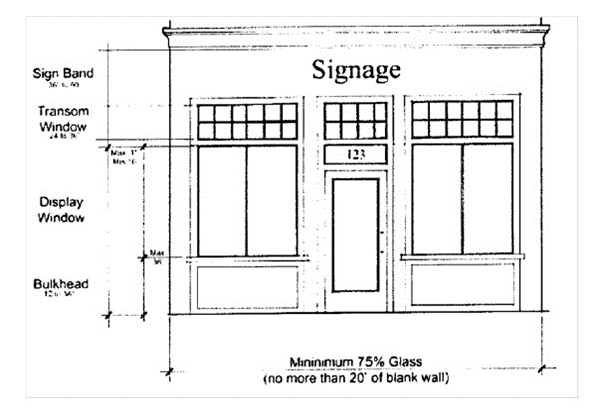
Storefront treatment. An architectural treatment of the sidewalk level of the facade of a commercial building that provides all of the following:
(1)
Habitable building space for a minimum of the first 20 feet in depth behind the facade;
(2)
A glass display window with a non-glass base or knee wall beginning at grade and extending not less than one foot and not more than three feet above grade;
(3)
A glass display window which extends at least 75 percent of the length of the facade;
(4)
A glass display window which rises from the top of the bulkhead or knee wall to a height not less than ten feet and not more than 12 feet above grade;
(5)
A glass display window which affords views into the building interior, or into display cases with a minimum depth of three feet and accessible from the building interior;
(6)
A primary pedestrian entrance which remains unlocked during normal business hours, and which may be recessed not more than seven feet from the exterior facade, even if the exterior facade is located at the maximum building front setback;
(7)
Entrance door(s) with a surface area at least 70 percent glass;
(8)
A glass transom not less than 24 inches and not more than 36 inches tall, located above the glass display window(s) and entrance door(s);
(9)
No more than 20 feet of blank facade wall length without a glass display window or door with glass;
(10)
For glass areas with divided lights, either true divided lights with muntin bars or simulated divided lights with simulated muntin bars on the exterior surfaces of the windows, not between panes of glass;
(11)
A non-glass sign band located above the glass transom, having a minimum height of 36 inches and a maximum height of 60 inches;
(12)
A cornice line above the sign band with a minimum height of eight inches;
(13)
Any sidewalk level interior drop ceiling must be recessed at least 18 inches from the glass display window and have a bulkhead of solid material where it can be seen from outside; and
(14)
A finished floor to ceiling slab height of at least 16 feet.
(15)
Below is an illustration of a storefront treatment:
Story. The volume in a building, other than a basement, between the surface of any floor and the surface of the next floor above. If there is no floor above, the story is the volume between its floor and the ceiling or roof above.
Street. A public thoroughfare designed to provide the principal means of access to abutting property or designed to serve as a roadway for vehicular travel, or both, but excluding alleys.
Structure. Anything constructed or erected, the use of which requires location on the ground, or attachment to something having location on the ground, including for purposes of this chapter, buildings, mobile homes, travel trailers, signs, swimming pools, fences, above ground fuel, propane and storage tanks, and antennae, but excluding from definition as structures minor landscaping features such as ornamental pools, planting boxes, bird baths, paved surfaces, walkways, driveways, recreational equipment, flagpoles and mailboxes.
Structured parking. The provision of vehicle parking in a building involving at least two levels of parking.
Substantial hardship. Hardship, caused by unusual and compelling circumstances, based on one or more of the following:
(1)
The property cannot reasonably be maintained or relocated in the manner dictated by sections 155.535 through 155.545;
(2)
There are no other reasonable means of saving the property from deterioration, or collapse; or
(3)
The property is owned by a nonprofit organization and it is not feasible financially or physically to achieve the charitable purposes of the organization while maintaining the property appropriately.
Thoroughfare. Any major arterial road; one of the principal routes into and through the community.
Travel or camping vehicle. A vehicular portable structure designed as a temporary dwelling for travel or recreational use.
Window lights. The glass or glazing elements of a window.
Yard. A required open space unoccupied and unobstructed by structures except those specifically permitted.
Yard, front. A yard situated between the front building line and the front lot line extending the full width of the lot.
Yard, rear. A yard situated between the rear building line and the rear lot line and extending the full width of the lot.
Yard, side. A yard situated between the side building line and the side lot line and extending for the front yard to the rear yard.
Zone. A specifically delineated area or district within which uniform regulations and requirements govern the use, placement, spacing, and size of land and buildings.
Zoning administrator. The person designated by the town administrator to administer this chapter.
(Ord. No. 5.202, 11-24-1981; Ord. No. 5.304, 7-30-2007; Ord. No. 5.369, 7-28-2009; Ord. No. 10.011, 6-28-2010; Ord. No. 2012.007, 12-17-2012)

