
Blythewood City Zoning Code
LANDSCAPING AND
BUFFER YARDS; TREES
Sec. 155.380.- Intent.
The intent of this subchapter is: to promote the health, safety, and general welfare of the public; to facilitate the creation of a convenient, attractive and harmonious community; to conserve natural resources including adequate air and water; to conserve properties and their values; to preserve the character of an area by preserving and enhancing the scenic quality of the area; and to encourage the appropriate use of the land. More specifically, these landscape requirements are intended to minimize the harmful impact of noise, dust and other debris, motor vehicle headlight glare or other artificial light intrusion, and other objectionable activities or impacts conducted on or created by an adjoining or nearby use or street. Additionally, these landscape requirements are intended: to require the landscaping of certain parking lots in order to reduce the harmful effects of wind and air turbulence, heat and noise; to preserve underground water reservoirs and to permit the return of precipitation to the ground water strata; to act as a natural drainage system and ameliorate storm water drainage problems; to reduce the level of carbon dioxide and return pure oxygen to the atmosphere; to prevent storm erosion; to provide shade; and to enhance the blighted appearance of parking lots. The benefits of landscaping are intended to be achieved in concert with the requirements of the Town of Blythewood Water Quality Design Manual of section 156.04 in chapter 156, Storm Drainage.
(Ord. No. 2014.003, 7-27-2015)
Sec. 155.381. - Provisions.
(A)
The provisions of this subchapter are applicable to: any subdivision plat or group development subject to review and approval by the planning commission under chapter 153, Land Development; all new principal land uses, new principal structures, and/or major improvements subject to chapter 155, Zoning; and manufactured home parks subject to chapter 157, Manufactured Home Parks. Landscape plans demonstrating compliance with this subchapter shall accompany corresponding applications for review and approval when required by the zoning administrator. All reviewing and approving authorities are expected to apply these requirements in a way that takes into account existing vegetation, clearing and grading required to implement development plans, unique lot shapes and other conditions which may be unique to each project. Alternative landscape design solutions may be applied where physical site features inhibit compliance with the requirements of this subchapter or when a unique design achieves the spirit and intent of this subchapter.
(B)
Landscape plans, as required by this subchapter, are to be produced by: a landscape architect licensed by the South Carolina Board of Landscape Architectural Examiners; or a qualified Landscape Designer, as determined by the zoning administrator; or a qualified landscape contractor, as determined by the zoning administrator. Landscape plans shall demonstrate a familiarity with specified material to achieve the intent of this section. All plans shall be submitted on appropriate plan sheets and shall be included in the Civil Construction Drawing package. Landscape plans shall, as well, be produced on title block sheets including the project identification, design firm, contact information, and drawn to a specific scale similar to site plans but not smaller than one inch equals 20 feet. The plan shall be a fully specified and labeled detailed graphic representation of the design, demonstrating knowledge of existing and proposed plant material characteristics and growth habits, and basic landscape design practice. The landscape plans shall also show and label utility easements both overhead and underground or overlay the utility plan with the proposed planting plan image. In no cases shall monoculture planting schemes be accepted.
(Ord. No. 2014.003, 7-27-2015)
Sec. 155.382. - Definitions.
For the purpose of this subchapter, the following definitions shall apply unless the context clearly indicates or requires a different meaning.
Caliper. Standard measure of tree size for trees to be newly planted. The measurement is taken six inches above the ground for trees four inches in diameter or less and 12 inches above the ground for trees over four inches in diameter.
Clear cutting. The removal of all standing trees on a lot or a portion of a lot.
DBH. See Diameter at breast height.
Diameter at breast height. Diameter of a tree measured four½ feet (forestry method) above the ground level on the downhill side for existing trees. Diameter at breast height may appear as the abbreviation "DBH". The diameter shall be measured using a conventional instrument such as a diameter tape or Biltmore Stick.
Drip line. A limiting line established by a series of perpendicular drop points marking the maximum radius of the crown of an existing tree, but not less than six feet from the trunk, whichever is greater; and within which no construction or disturbance shall occur.
Forest management plan. A document or documents prepared or approved by a forester registered in this state that defines a landowner's forest management objectives and describes specific measures to be taken to achieve those objectives. A management plan shall include silvicultural practices, objectives, and measures to achieve them, that relate to a stand or potential stand of trees that may be utilized for timber products, watershed or wildlife protection, recreational uses, or for other purposes.
Forestland. Land supporting a stand or potential stand of trees valuable for timber products, watershed or wildlife protection, recreational uses, or for other purposes.
Forestry activity. Includes, but is not limited to, timber harvest, site preparation, controlled burning, tree planting and replanting, applications of fertilizers, herbicides, and pesticides, weed control, animal damage control, fire control, insect and disease control, forest road construction, and any other generally accepted forestry practices.
Heritage tree. Hardwoods in good health 24 inches DBH or greater and pine trees in good health 30 inches DBH or greater.
Planning commission. The Town of Blythewood Planning Commission established by section 150.01.
Replacement tree. A nursery-grown certified tree, minimum two inches caliper or greater, properly balled, marked with a durable label indicating genus, species and variety, and satisfying the standards established for nursery stock and installation thereof, set forth by the American Association of Nurseryman.
Specimen tree. Hardwoods between 18 inches and 24 inches DBH and in good health and pine trees between 20 inches and 30 inches DBH and in good health.
Subdivision.
(1)
The division of a tract or parcel of land into two or more lots, building sites, or other divisions. The land is divided for sale, lease or building development, whether immediately or in the future. The definition includes all land divisions involving a new street or change in existing streets. It includes re-subdivisions involving the further division or relocation of lot lines of any lot or lots within a previously approved or recorded subdivision. The definition covers the alteration of any streets or the establishment of any new streets within any previously approved or recorded subdivision as well as combinations of lots of record.
(2)
The following exceptions are included within this definition only for the purpose of requiring that the local planning agency be informed and have a record of the subdivisions.
(a)
Combination or recombination of portions of previously platted lots where the total number of lots is not increased and the resultant lots are equal to the regulation standards.
(b)
Dividing land into parcels of five acres or more where no new street is involved. The planning commission must receive plats of these exceptions as information and indicate that fact on the plats.
(c)
Dividing land into no more than four parcels with existing street perimeters to all parcels for the purpose of selling or otherwise transferring ownership where the subdivider provides no site development in association with the sale or transfer of ownership. The planning commission must receive plats of these exceptions as information and indicate that fact on the plats.
(d)
Combining or recombining entire lots of record where no new street or change in existing streets is involved.
TDF. See tree density factor.
Tree. Any self supporting woody plant which reaches a typical mature height of 12 feet or more at maturity and has a typical DBH of four inches or greater.
Tree canopy. The top layer or crown of mature trees.
Tree density factor. A unit of measure used to determine the tree coverage required on a site. tree density factor may appear as the abbreviation "TDF."
(Ord. No. 2014.003, 7-27-2015; Ord. No. 2016.001, 2-22-2016)
Sec. 155.383. - Landscaping and buffering.
(A)
Location. The perimeter landscaping and buffering required by this subchapter shall be located along the outer perimeter of the parcel and shall extend to the parcel boundary line or right-of-way line. Plants comprising the perimeter landscape shall be appropriately spread across the entire width of the landscape area. All required landscaping must be located outside of the recorded and proposed public street rights-of-way. In the TC town center district, all required landscaping must also be located outside of the future rights-of-way of the corresponding street cross-sections, as designated in section 155.182(G); such landscaping may be located adjoining the sidewalk facade zone rather than within the sidewalk facade zone, and, therefore, does not have to be located along the front facade of a frontage building.
(B)
Existing vegetation, fences, walls and berms. The use of existing trees or shrubs to satisfy the perimeter landscaping requirements of this subchapter is strongly encouraged. Existing significant vegetation within the required perimeter landscaped area shall be preserved and credited toward standards for the type of perimeter landscaping required, unless otherwise approved by the town at the time of site plan approval. Existing berms, walls or fences within the perimeter landscaped area but not including chain link fencing, may be used to fulfill the standards for the type of perimeter landscaping required, provided that these elements are healthy and/or in a condition of good repair. Other existing site features within the required perimeter landscaped area which do not otherwise function to meet the standards for the required perimeter landscaping shall be screened from the view of other properties or removed, as determined during review and approval of the site plan. Vegetation in the Invasive/Nuisance Plants to Avoid list of Appendix A does not qualify to meet the landscaping and buffering requirements of this subchapter.
(C)
Installation of new vegetation and other features. If existing significant vegetation and other site features do not fully meet the standards for the type of landscaping required, then additional vegetation and/or site features (including fences and/or walls) shall be planted or installed within the required landscaping area. The use of native species of trees, shrubs, vines, groundcovers and perennials is encouraged in order to make planted areas compatible with existing native habitats. Trees to be planted shall be selected from Appendix A: Preferred Plant Material List or as approved by the zoning administrator or their designee. Vegetation in the "invasive/nuisance plants to avoid" list of Appendix A does not qualify to meet the landscaping and buffering requirements of this subchapter.
(D)
Standards for new planting. All shrubs required to be planted shall be measured at least three gallons in container size and 1½ feet (three feet for Type A screen/buffers) above ground level and shall reach the height required for performance within five years after installation. All trees necessary to be planted to meet the requirements of this subchapter shall be at least eight feet high above ground level and at least two inches in caliper at the time of installation, and shall have an expected mature height of at least 40 feet for shade (canopy) trees and 15 feet for small-maturing trees. The selection of plants, planting methods, minimum height, root ball and container size, number of branches, and width, shall conform with the American Standard for Nursery Stock published by the American Association of Nurserymen for that type of tree or shrub at the time of installation. Groves of trees, as well as isolated islands with single trees, are encouraged. Adequate drainage and mulching shall be provided for planting medians and islands. Each canopy tree shall be provided with a minimum pervious ground area of eight feet by eight feet and should be planted on slopes not to exceed 4:1 horizontal to vertical distance. As much as possible, vegetative material shall be designed and planted in continuous beds.
(E)
Commercial building foundation planting. A continuous plant bed of an average width of four feet and a minimum width of two feet shall be provided along the perimeter of a commercial structure and installed with plant material accordingly. Exceptions are made for access ways, drive-through lanes, building service requirements, and the front facades of frontage buildings within the TC town center district.
(F)
Grading and development within the perimeter landscaping. If grading within a perimeter landscaped area is proposed, slopes of 3:1 or less are encouraged to ensure the proper transition of grades to the adjacent property, to facilitate landscaping, and to accommodate drainage. In no case shall grading, earthen berms, or planting area impede the free flow for positive surface drainage patterns, or direct drainage onto adjacent property, except to comply with a corresponding storm water management permit. The required perimeter landscaping shall not contain vehicular parking areas, storage, utility surface, display, loading surface areas or any other site features that do not function to meet these standards.
(G)
Easements. No vegetative screening or fencing required in this subchapter shall be planted inside utility and drainage easements, excluding overhead easements, without the consent of the zoning administrator and the easement holder. If plantings or fences inside utility or drainage easement areas are allowed, these planting and fences shall be maintained in accordance with the terms of consent and any applicable maintenance provisions of this subchapter. Any tree planted within the right-of-way of overhead utility lines shall be a small-maturing tree of a mature height of no greater than 15 feet.
(H)
Responsibility for installation. Responsibility for installation and maintenance of landscaping and buffering along shared property boundaries shall be divided according to the respective property ownership.
(I)
Zoning change. If the zoning district classification changes for an existing use or parcel at the request of the property owner, then the parcel shall comply with the applicable landscaping requirements of this subchapter or, at a minimum, the intent of this subchapter as prescribed by the zoning administrator. the owner or developer may need to install additional plant material on the parcel in order to meet the intent of this subchapter, especially on developed sites, or to bring the parcel up to the standards for the type of perimeter landscaping which would be required under this subchapter.
(J)
Standards for fences. Fences are permitted only where they are of uniform design, materials and construction. Fences shall supplement the existing and/or required plantings. Fences shall be maintained by the owner. The use of chain link fences in the front yard of commercial buildings or structures is prohibited. The use of chain link fences as buffer yard screening is prohibited. In cases where it is deemed necessary, except along frontage, the fence shall be erected a minimum of five feet inside the perimeter property line and planted with evergreen screening plant material along the outside of the fence.
(K)
Design standards for berms. All berms shall not exceed a slope with maximum rise of one foot to a run of two feet (expressed as a 1:2 ratio or 50 percent slope) and a maximum height of four feet. All berms, regardless of size, shall be stabilized with a ground cover or other suitable vegetation.
(L)
Irrigation. The use of irrigation is encouraged in all landscaping areas as required by this subchapter. Drip irrigation of all woody vegetation is encouraged. In the instance of drought as determined by the appropriate authorities, drip irrigation shall be considered to equate to hand-watering. Irrigation spray heads shall be directed entirely onto pervious, soil or target area surfaces, with no more than incidental spraying of impervious streets, driveways, parking areas, or sidewalks.
(M)
Unlawful cutting of vegetation. No person may remove any vegetation from within any recorded public street right-of-way except in areas approved by the town and/or the South Carolina Department of Transportation.
(N)
Stream and wetland buffers. Land-disturbing activities for construction in, on, or under a lake or natural watercourse shall be planned and conducted to minimize the extent and duration of disturbance of the stream channel or lake bed. Where relocation of a stream is an essential part of the proposed activity, the relocation shall be planned and executed to minimize changes in the stream flow characteristics, except where the developer or landowner demonstrates that the significant alteration of the flow characteristics is justified.
(1)
An undisturbed, natural buffer shall be maintained along each perennial stream within the town's jurisdiction. The average buffer width shall be 50 feet with a minimum width of 20 feet from each side of the stream as measured from the top of the bank.
(2)
No land-disturbing activities shall take place within a stream buffer or delineated wetland area, except for required streets and associated facilities, utility mains and easements, and/or greenways and pedestrian paths. Roads and golf courses may cross a buffer, provided they do not cross at an angle of less than 60 degrees.
(3)
Streams, wetlands and required buffers shall be shown on all site plans submitted for approval and recording.
(Ord. No. 2014.003, 7-27-2015; Ord. No. 2016.001, 2-22-2016)
Sec. 155.384. - Types of landscaping and buffering.
The five types of landscaping and buffering are defined as follows, and shall meet the following performance requirements:
(A)
Type A: Opaque screen/buffer.
(1)
Purpose and definition.
(a)
Type A buffer yards function as an opaque screen from the ground to a height of at least eight feet.
(b)
This type excludes visual contact between uses and creates a strong impression of spatial separation.
(2)
Location and required usage.
(a)
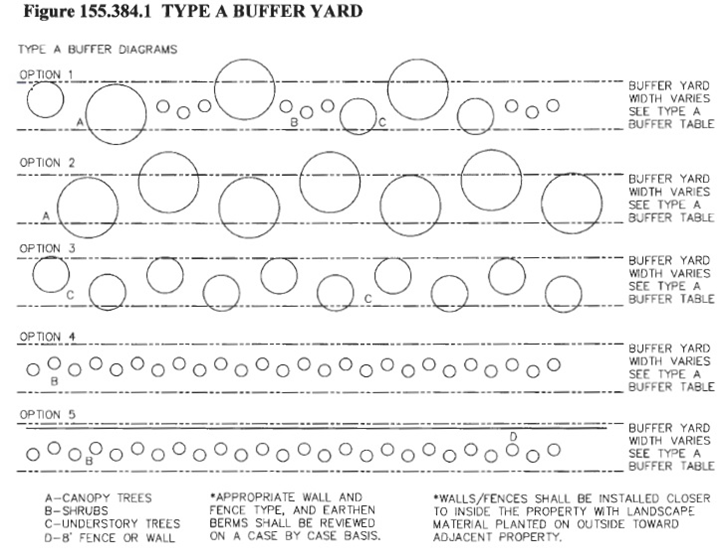
Composition of the Type A landscaping may include a wall, wood fence, landscaped earthen berm, planted vegetation, existing vegetation or any appropriate combination of these elements. (See Figure 155.384.1: Type A Buffer Yard.)
(b)
Intermittent planting of deciduous trees, evergreen trees, canopy trees, understory trees and shrubs shall obtain a height at maturity of no less than 15 feet and have no unobstructed openings wider than ten feet between tree canopies upon maturity.
(c)
Shrub plantings shall have a minimum height of three feet at installation and have only intermittent openings of up to four feet maximum.
(d)
At least 50 percent of the required trees, and at least 75 percent of the required shrubs, shall be evergreen species locally adapted to the area. The requirement for the edge of all yards abutting the Interstate 77 right-of-way shall be that 100 percent of required trees and shrubs shall be evergreen species locally adapted to the area.
(e)
This section does not preclude common walls between buildings on adjacent lots.
(B)
Type B: Semi-opaque screen.
(1)
Purpose and definition. Type B buffers function as a semi-opaque screen from the ground to at least a height of four feet for screening of car lights and glare.
(2)
Location and required usage.
(a)
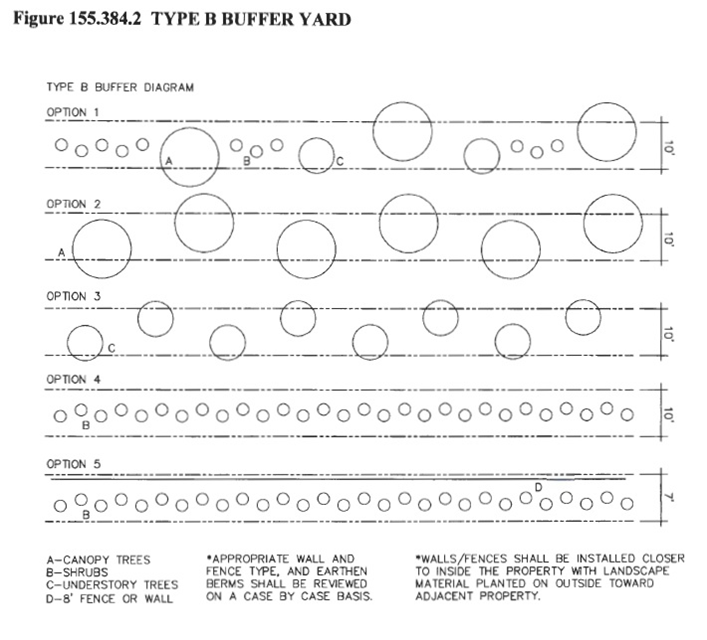
Composition of the Type B landscaping may include a wall, fence, earthen berm, planted vegetation, existing vegetation or any appropriate combination of these elements. Provided that walls or fences or berms are used, shrubs shall be required. (See Figure 155.384.2: Type B Buffer Yard.)
(b)
Intermittent planting of deciduous and evergreen trees shall obtain a height at maturity of no less than 15 feet and have no unobstructed openings wider than 20 feet between canopies upon maturity.
(c)
Shrubbery shall be planted between the tree spaces. Shrub plantings shall have no unobstructed openings wider than four feet and shall obtain a height at maturity of no less than four feet.
(d)
At least 75 percent of the required shrubs shall be evergreen species locally adapted to the area.
(e)
This section does not preclude common walls between buildings on adjacent lots.
(C)
Type C: Commercial, industrial and apartment complex off-street parking areas.
(1)
Purpose and definition.
(a)
Type C buffers function to create an opaque screen between the vehicular circulation routes, and site parking areas on private property and public streets and to serve as visually aesthetic transitions to separate the parking areas from public thoroughfares.
(b)
Interior plantings break up parking areas from large monotonous expanses of pavement into smaller lots.
(2)
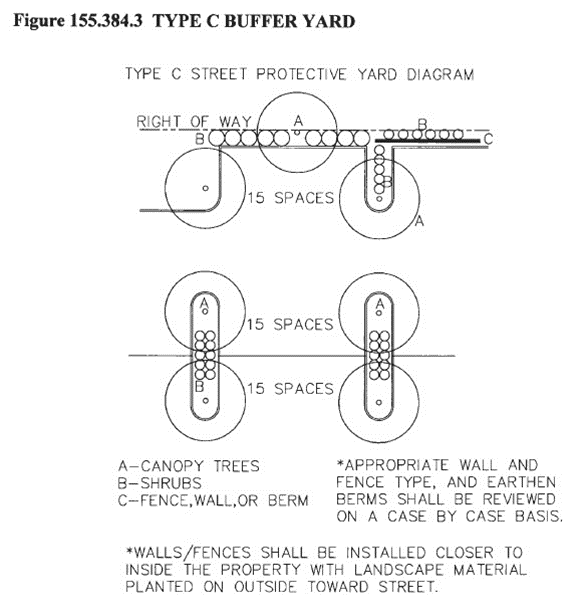
Interior plantings: location and required usage. (See Figure 155.384.3: Type C Buffer Yard.)
(a)
Large parking areas with an unbroken expanse of pavement shall be avoided to the extent practicable by breaking the lot into small sections with internal planting areas (landscape islands) that feature canopy trees planted in grass or other shrub and groundcover massings. Parking areas shall be designed as a series of smaller lots that provide parking space for no more than 30 automobiles for double-sided parking and 15 automobiles for single-sided parking. These smaller parking lots shall be separated by landscape islands which shall be designed in consideration of automobile overhang so as to avoid damage to plantings. Parking lot islands shall have a minimum planting area of 150 square feet for single loaded rows and 300 square feet for double loaded rows. Each row shall terminate in an island or planter containing at least one canopy shade tree and a minimum of five shrubs per tree. In cases where utility conflicts occur, such as overhead or underground lines, the canopy tree may be replaced with an understory or ornamental tree of smaller size upon maturity. The zoning administrator may allow alternate locations on site for required parking area trees and shrubs where utility conflicts occur.
(b)
Canopy (shade) trees, evergreen or deciduous trees of a species with an expected mature height of over 40 feet and an expected crown spread of over 30 feet, shall be planted, or existing trees utilized so that no off-street parking space may be located more than 50 feet from the trunk of a large canopy tree.
(c)
No tree may be planted closer than 3½ feet to the back of a curb or the paved portion of the parking lot.
(3)
Screening for parking areas located adjacent to a public street: location and required usage. (See Figure 155.384.3: Type C Buffer Yard.)
(a)
Screening shall be no less than three feet and no more than four feet high.
(b)
Screening can be composed of:
1.
Masonry walls. Plain concrete block must be rendered with decorative facing such as stucco, brick veneer and the like.
2.
Wood fences. Stockade fences and unpainted fences are not allowed.
3.
Landscaped berms. Berms may incorporate street protective yard (Type E) trees.
4.
Landscape islands. Landscape islands planted with shrubbery with no unobscured openings between shrub plantings or street protective yard (Type E) trees. Shrubs shall be evergreen species locally adapted to the area. Landscape islands and berms shall be designed in consideration of automobile overhang so as to avoid damage to plantings. In no case shall grading, earthen berms, or planting area impede the free flow for positive surface drainage patterns, or direct drainage onto adjacent property, except to comply with a corresponding storm water management permit.
(c)
Parking area screening is required in conjunction with Type E street protection yard landscaping. In the TC town center district, all required landscaping must be located outside of the future rights-of-way of the corresponding street cross-sections, as designated in section 155.182(G); such landscaping may be located adjoining the sidewalk facade zone rather than within the sidewalk facade zone, and, therefore, does not have to be immediately adjacent to the future rights-of-way.
(D)
Type D: Service areas.
(1)
Purpose and definition.
(a)
This type functions as at least a 75 percent opaque screen from the ground to at least one foot higher than the item being screened (including but not limited to garbage collection sites, exposed non-power utility fixtures, power utility substations and exposed metal cabinets over five feet in height).
(b)
However:
1.
The screening shall not be less than six feet in height;
2.
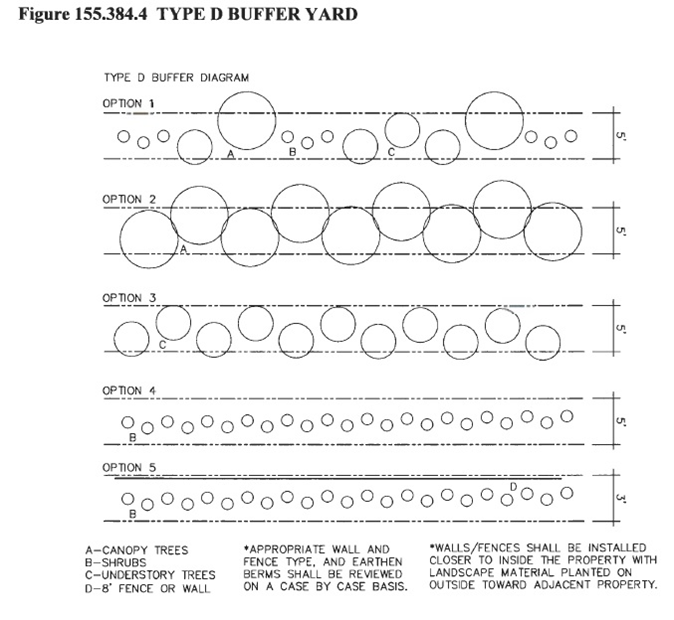
Composition of the Type D landscaping may include a wall, fence, planted vegetation, existing vegetation or any appropriate combination of the elements. (See Figure 155.384.4: Type D Buffer Yard);
3.
Shrub plantings shall have limited unobstructed openings of four feet maximum;
4.
Large trees shall be placed no more than 12 feet apart; and
5.
At least 75 percent of the required shrubs shall be evergreen species locally adapted to the area.
(2)
Location and required usage.
(E)
Type E: Street protective yard.
(1)
Purpose and definition.
(a)
A street protective yard is a landscaped area located parallel and adjacent to a recorded public street right-of-way.
(b)
This area contains plantings of trees and other vegetation designed to provide more pleasing views along streets, reduce the amount of impervious surface and thereby reduce stormwater runoff, provide shade and preserve a remnant of Blythewood's natural vegetative cover.
(2)
Required usage and location.
(a)
All residential, commercial and industrial developments requiring landscaping under section 155.381 must conform with the street protective yard requirements of this subchapter.
(b)
Street protective yards shall be located on private property and not within any street right-of-way. Portions of the property needed for driveways and/ or curb cuts are exempted from street protective yard requirements. No vehicular parking areas, storage, non-vegetated stormwater management, utility surface, display or loading surface areas shall be permitted in this yard. Pedestrian walkways connecting the site structures to sidewalks and/or streets and walls and fences may be located in the street protective yard. In the TC town center district, street protective yards must also be located outside of the future rights-of-way of the corresponding street cross-sections, as designated in section 155.182(G); such landscaping may be located adjoining the sidewalk facade zone rather than within the sidewalk facade zone, and, therefore, does not have to be immediately adjacent to the future rights-of-way or along the front facade of a frontage building.
(3)
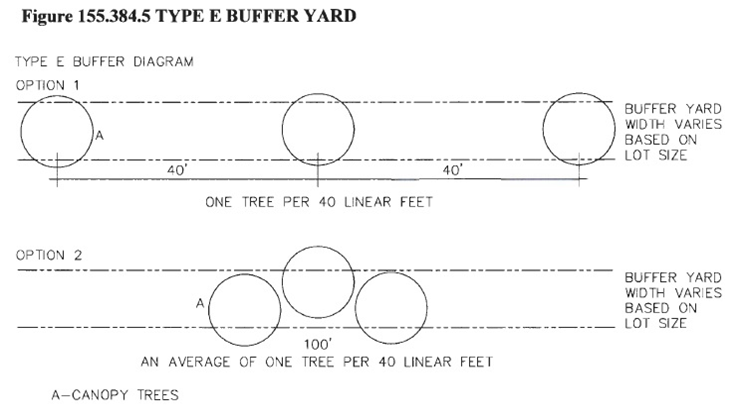
Requirements. (See Figure 155.384.5: Type E Buffer Yard.)
(a)
Tree quantity and spacing. Each street protective yard shall contain at least one canopy (shade) tree, an evergreen or deciduous tree of a species with an expected mature height of over 40 feet and an expected crown spread of over 30 feet, for approximately every 40 linear feet of street protective yard or fracture thereof as measured along the property line abutting the right-of-way. Trees need not be evenly spaced every 40 feet but must average one tree per 40 linear feet of frontage (excluding access). No street protective yard shall contain less than one shade tree. In street protective yards shrubs, groundcover, small-maturing trees and/or turf shall cover at least 75 percent of the street yard area not used for shade trees, driveways, walkways, and walls and fences. (See special requirements for street protective yards for commercial off-street parking areas adjacent to public streets).
(b)
Width of street protective yards.
1.
Street protective yard. No street protective yard shall be less than five feet wide as measured from the recorded public right-of-way abutting the property.
2.
Lots smaller than two acres or with a lot depth of less than 200 feet from the right-of-way. The average street protective yard width shall be ten feet and shall have a minimum width of five feet.
3.
Lots greater than or equal to two acres but less than five acres, or with a lot depth of greater than or equal to 200 feet but less than 400 feet from the right-of-way. The average street protective yard width shall be 15 feet and shall have a minimum width of ten feet.
4.
Lots greater than or equal to five acres. The average street protective yard width shall be 20 feet and shall have a minimum width of 15 feet.
5.
Planned development districts. Any street protective yards requirements within planned development districts (PDD) shall be specified in the individual PDD plan. Otherwise, the standard street protective yard requirements shall apply.
(c)
Zero setback buildings. Type E screening requirements do not preclude zero setback buildings if otherwise permissible under the provisions of this chapter.
(Ord. No. 2014.003, 7-27-2015)
Sec. 155.385. - Time for installation of required landscaping.
(A)
Time limit. All landscaping, including mulching and seeding, shall be completed in accordance with the approved site plan prior to issuance of a certificate of occupancy for the site.
(B)
Extensions. The town may grant extensions to the above time limit under the following conditions:
(1)
Extensions may be granted due to unusual environmental conditions, such as drought, ice, over-saturated soil (deep mud) or inappropriate planting, provided that the developer or property owner provides the town with a surety bond ensuring the installation of the remaining landscape materials;
(2)
Extensions may be granted due to the unavailability of plant species or acceptable plant size as specified on the site plan, provided that the developer or property owner provides the town with a surety bond ensuring the installation of the remaining landscape materials; and
(3)
Extensions may be granted due to circumstances beyond the developer's or property owner's control, such as incomplete third-party construction or utility work to occur in a proposed landscaped area. Extensions may be granted provided that the developer or property owner provides the town with a surety bond ensuring installation of the remaining landscape materials.
(C)
Bonds.
(1)
Any surety bond posted for extensions shall be accompanied by documentation of the estimated cost of the remaining landscaping to be completed. This documentation may be a landscaping contractor's bid or contract, a nurseryman's bill or a similar document.
(2)
The amount of the surety bond shall be 125 percent of the cost of the remaining landscaping. The surety bond shall include material, delivery, taxes, labor and guarantee for the incomplete landscaping.
(3)
The town administrator may authorize release of part of any security posted as the improvements are completed and approved by the town.
(Ord. No. 2014.003, 7-27-2015)
Sec. 155.386. - Maintenance and replacement of damaged vegetation.
(A)
Maintenance responsibility.
(1)
The owners of the property and their agents, heirs or assigns shall be responsible for the installation, preservation and maintenance of all plantings and physical features required by this subchapter in a healthy, growing condition, for replacing them when necessary, and for keeping the area free of refuse and debris.
(2)
All plant materials should be allowed to reach their mature size and maintained at their mature size.
(3)
Any dead, unhealthy, or missing vegetation, or vegetation disfigured by severe pruning, shall be replaced with locally-adapted vegetation which conforms to the standards of this section and to the approved site or subdivision plan. Newly planted landscape vegetation shall be kept alive and well-maintained for a minimum of three years. Any planted trees required to meet the tree density factor (TDF) for the site shall also be the responsibility of the owner/developer for three years. Failure of the vegetation to thrive shall result in replacement of the lost material.
(4)
In the event that any vegetation or physical element functioning to meet the standards of this subchapter is severely damaged due to an unusual weather occurrence or natural catastrophe, the owner shall have one growing season to replace or replant after reconstruction is complete.
(5)
All required landscaped areas shall be free of refuse and debris in accordance with the site or subdivision plan approved by the town, and shall be maintained so as to prevent mulch, straw, dirt or other materials from washing onto streets and sidewalks.
(B)
Fully vegetated natural areas.
(1)
This section shall not apply to fully vegetated natural areas, except where the property owner has damaged or destroyed vegetation in a required landscaped area, or caused vegetation to be damaged or destroyed.
(2)
In no instance will the town be responsible for the maintenance of any vegetation unless the vegetation is located within the public right-of-way of a town maintained street or is located on property owned by the town.
(Ord. No. 2014.003, 7-27-2015)
Sec. 155.387. - Nonconforming landscaping and buffering.
(A)
If there is an expansion to the heated square footage of 25 percent or greater to an existing business, the lot shall fully comply with Type D buffer yard requirements for service areas, and Type E buffer yard requirements for street protective yards.
(B)
Expansions to the parking area or loading areas which increase the total area more than 25 percent shall be required to comply with Type C buffer yard requirements for commercial, industrial, and apartment complex off-street parking areas, and Type D buffer yard requirements for service areas.
(Ord. No. 2014.003, 7-27-2015; Ord. 2019.015, 10-28-2019)
Sec. 155.388. - Tree preservation and replacement.
(A)
The town having found that indiscriminate, uncontrolled and excessive destruction, removal and clear cutting of trees upon lots and tracts of land results in increased drainage control costs, increased soil erosion and sedimentation, decreased fertility of the soil, degradation of water resources, decreased groundwater recharge, increased buildup of atmospheric carbon and increased dust and decreased property values, all of which negatively affect the character of the town.
(B)
The town realizing that the removal of trees adversely affects the health, safety and general welfare of its residents, desires to regulate and control indiscriminate and excessive cutting of trees by preserving the maximum possible number of trees in the course of development of a site, ensuring that the health of trees preserved on a site is maintained throughout the development process, protecting larger, older specimens of trees and encouraging innovative design and grading to promote the preservation of existing trees.
(C)
It is recognized that there is a strong relationship between the preservation of trees in the town and the region's water resources, the development on steep slopes, tree removal, soil disturbance, stormwater management and the general use of land resources. Therefore, the appropriate management of these resources is an important health, safety and general welfare concern. The benefits of tree preservation are intended to be achieved in concert with the requirements of the Town of Blythewood Water Quality Design Manual of section 156.04 in Chapter 156: Storm Drainage.
(Ord. No. 2014.003, 7-27-2015)
Sec. 155.389. - Applicability.
(A)
With the exception of the exemptions set forth in section 155.390 or elsewhere in this subchapter, no tree with a diameter at breast height (DBH) of eight inches or greater shall be cut or otherwise removed from any lands in the town without a tree removal permit. However, no tree that was planted or preserved as part of any approved landscape plan shall be exempt under section 155.390. Special effort shall be made to preserve all specimen trees and heritage trees. No heritage trees will be permitted to be removed without clearly demonstrated justification and proof that alternative design options have been explored to save the tree.
(B)
Financial hardship or project program requirements alone will not constitute justification for removal of heritage trees. All applications to the zoning administrator for approval of a major subdivision, minor subdivision or site plan requiring tree removal shall include an application for a tree removal permit. Any residential, commercial, or industrial lot owner wishing to remove trees upon said lot must comply with section 155.394. The application shall be submitted to the zoning administrator for processing or approval.
(Ord. No. 2014.003, 7-27-2015)
Sec. 155.390. - Exemptions.
The following shall be exempt from this subchapter:
(A)
Commercial nurseries and fruit orchards.
(B)
Christmas tree farms.
(C)
Any tree which is part of a cemetery.
(D)
Trees directed to be removed by municipal, county, state or federal authority pursuant to law.
(E)
Any tree growing on or over a public right-of-way or public land.
(F)
Pruning or removal of trees within the right-or-way by utility companies for maintenance of utility wires or pipelines and the pruning of trees within sight easements.
(G)
Forestry activities on forestland that is:
(1)
Taxed on the basis of its present use value as forestland under S.C. § 12-43-220(d);
(2)
Managed in accordance with a forest management plan;
(3)
Certified under the Sustainable Forestry Initiative, the Forest Stewardship Council, the American Forest Foundations Tree Farm System, or any other nationally recognized forest certification system;
(4)
Subject to a legally binding conservation easement under which the owner limits the right to develop or subdivide the land; or
(5)
Managed and harvested in accordance with the best management practices established by the State Commission of Forestry pursuant to S.C. section 48-36-30.
(H)
Any tree diseased, dying or dead.
(Ord. No. 2014.003, 7-27-2015; Ord. No. 2018.002, 5-29-2018)
Sec. 155.391. - Tree and root protection during development.
(A)
Tree and root protection fencing requirements. During development of property, the owner shall be responsible for the erection of any and all tree and root protection fencing necessary to protect any existing or installed vegetation from damage both during and after construction. All significant vegetation, native ornamental species and perimeter landscaping to be preserved during development shall be protected with a sturdy and visible fence before clearing and grading begins. Tree protection fencing detail and specifications are required on all construction documents. See Appendix C: Sample - Tree Protection Plan for an illustration of a tree protection detail. The existing site conditions will be considered by both applicant and staff in determining the exact location of any tree protection fencing. Generally, the location should be as far as possible from the vegetation in order to preserve soil and root structure. The location of tree protection fencing and method of construction shall be noted on the landscape plan. Tree protection fencing shall remain in place and in good condition until all development activities are completed. The tree protection fence shall be located no less than one foot from the tree trunk for each one inch in tree diameter, with a minimum distance of ten feet required from the edge of the trunk. Tree protection fencing for forest canopy stands is to be located no less than one foot from the tree trunk for each one inch in tree diameter of the trunk line trees identified, with a minimum distance of ten feet required from the edges of the trunks. Tree protection fencing shall be constructed from any material substantial enough to protect the roots, trunk, and crown of the tree, such as two-inch by four-inch wood posts and one-inch by four-inch wood rails, silt fencing or orange safety fencing a minimum of four feet in height on metal or wood posts.
(B)
Soil disturbance, compaction, stock piling of soil or construction materials. No soil disturbance or compaction, stock piling of soil or other construction materials, vehicular traffic, storage of heavy equipment are allowed in the tree and root protection area(s), or within the drip line of trees to be retained.
(C)
Trees. An existing healthy tree with a DBH of eight inches or greater is a valuable natural resource by virtue of age, size and contribution to the environment. These trees should be preserved and protected to the extent practical and feasible on all development sites. All these trees shall be shown on a landscape plan as required by the zoning administrator, and designated for preservation or removal. See Appendix B: Sample - Tree Survey and Appendix C: Sample - Tree Protection Plan for illustrations.
(Ord. No. 2014.003, 7-27-2015; Ord. No. 2016.001, 2-22-2016)
Sec. 155.392. - Timber harvesting.
(A)
Consideration of an application for a building permit, a site disturbance or subdivision plan, or any other approval for development that if implemented would result in a conversion of forestland to nonforest or nonagricultural use may be deferred by the zoning administrator for up to one year after the completion of a timber harvest exempt under section 155.390(G), if the harvest results in the removal of all or substantially all of the trees from the specific area included in the application.
(B)
Consideration of an application for a building permit, a site disturbance or subdivision plan, or any other approval for development that if implemented would result in a conversion of forestland to nonforest or nonagricultural use may be deferred by the zoning administrator for up to five years after the completion of a timber harvest exempt under section 155.390(G), if the harvest results in the removal of all or substantially all of the trees from the specific area included in the application and the harvest is determined by the zoning administrator to be a willful conversion of forestland for development.
(C)
A person whose application for a building permit, a site disturbance or subdivision plan, or any other approval for development is deferred under section 155.392(A) or section 155.392(B) above may appeal the zoning administrator's decision to the board of zoning appeals.
(Ord. No. 2014.003, 7-27-2015)
Sec. 155.393. - Tree removal and protection for major and minor subdivisions and site plans.
Each application to the zoning administrator for approval of a major or minor subdivision or a site plan that requires the removal of trees shall include an application for a tree removal permit. All requirements of this section shall apply to each phase of a development. The application and development proposal shall conform to the following provisions:
(A)
Application form. The application form may be obtained from the zoning administrator and shall include the following information:
(1)
Name and address (street, lot and block) of the owner of the premises and status of legal entity (individual, partnership, corporation of this or any other state, and the like);
(2)
Description of the premises where removal is to take place, including lot and block numbers, street address as assigned;
(3)
Purpose for tree removal (building construction, building addition, street or roadway, driveway, utility easement, recreation area, patio, parking lot, and the like); and
(4)
Such other information as may be deemed necessary in order to effectively consider and decide such application for permit.
(B)
Landscape plan. As required by the zoning administrator, the following information shall be included in a landscape plan submitted with the application for a tree removal permit. The tree survey portion of a landscape plan, such as Appendix B: Sample - Tree Survey, may be prepared by an engineer or surveyor licensed by the South Carolina State Board of Registration for Professional Engineers and Surveyors.
(1)
Base information.
(a)
Location of existing tree canopy lines within the property boundaries. Where clusters of trees exist on the site or are contiguous with adjacent sites, fragmentation of the cluster shall be avoided where possible.
(b)
Upon prior approval of the zoning administrator, a partial tree survey may be deemed sufficient to demonstrate compliance with the required tree density factor calculations of section 155.403 and tree surveys for undeveloped undisturbed single family residential lots may be deferred until their respective applications for building permits.
(c)
Location of individual specimen trees and heritage trees identified by size and species (or hardwood versus pine) beyond the area of development/limit of disturbance. Optionally, include additional individual trees with a DBH of six inches or greater to be preserved for credit under the tree density factor calculations of section 155.403.
(d)
Location of the drip lines of individual trees to be preserved within the area of development/limit of disturbance.
(e)
Location of all required replacement trees, labeled with size and species.
(f)
Clear labeling of the area(s) intended for tree/vegetation removal.
(g)
Tree protection material details and limit of disturbance line.
(h)
Location of existing and proposed buildings/structures.
(i)
All bodies of water and wetlands, including water retention and detention areas.
(j)
Location of all existing driveways and parking areas.
(2)
Design requirements.
(a)
Only those trees necessary to permit the construction of buildings, structures, streets, driveways, infrastructure and other authorized improvements shall be removed. Existing vegetation shall be preserved to the greatest extent feasible.
(b)
The design and implementation of the landscape plan's preserved trees and replacement trees shall achieve the minimum required tree density factor under section 155.403.
(c)
Trees preserved or replaced as part of the landscaping and buffering provisions of this subchapter qualify for credit under the tree density factor calculations of section 155.403.
(d)
The appropriate reviewing authority shall have the option of requiring a conservation easement to protect any or all trees or tree canopy areas to remain on site.
(C)
Site protection.
(1)
Tree protection measures and the limit of disturbance line shown on the landscape plan shall be provided in the field with appropriate fencing or other durable material and verified by the zoning administrator or designee prior to soil disturbance.
(2)
Protective barriers shall not be supported by the plants they are protecting, but shall be self-supporting. Barriers shall be a minimum of four feet high and shall last until construction is complete.
(3)
Chain link fence may be required for tree protection if warranted by site conditions and relative rarity of the plant.
(4)
Fencing used for tree protection shall be firmly secured along the drip line, but shall be no less than ten feet from the edge of the trunk.
(5)
The grade of the land located within the drip line shall not be raised or lowered more than four inches unless compensated by welling or retaining wall methods; and in no event shall welling or retaining wall methods be less than ten feet from the edge of the trunk of a tree.
(6)
No soil stockpiling, storage of building materials, construction equipment or vehicles shall be permitted within the drip line of any remaining trees.
(7)
Any clearing within the drip line of a remaining tree shall be done by hand-operated equipment.
(8)
Where a tree that has been noted for preservation is severely damaged and unable to survive, its equivalent density factor units shall be replaced as provided in section 155.403.
(Ord. No. 2014.003, 7-27-2015; Ord. No. 2016.001, 2-22-2016)
Sec. 155.394. - Tree removal and protection on residential, commercial and industrial lots.
(A)
Applicability. Tree removal on residential, commercial, or industrial lots not associated with land use or development covered by section 155.381 shall be subject to the requirements of this section. No tree with a diameter at breast height (DBH) of eight inches or greater shall be cut or otherwise removed from any such lots without a tree removal permit.
(B)
Exceptions. The owner of a residential lot less than two acres in size, with an existing single-family residential land use, may remove one tree with an eight-inch DBH or greater every two years, without a tree removal permit. The owner of a residential lot two acres or greater in size, with an existing single-family residential land use, may remove five trees with an eight-inch DBH or greater every two years, without a tree removal permit.
(C)
Application form. The application form shall be available from the zoning administrator and shall include the following information:
(1)
Name and address (street and lot and block) of the owner of the premises and status of legal entity (individual, partnership, corporation of this or any other state, and the like);
(2)
Description of the premises where removal is to take place, including lot and block numbers, and street address as assigned;
(3)
Purpose for tree removal (building construction, building addition, street or roadway, driveway, utility easement, recreation area, patio, parking lot, and the like); and
(4)
Such other information as may be deemed necessary in order to effectively consider and determine such application for permit.
(D)
Landscape plan. As required by the zoning administrator, the following information shall be included in a landscape plan submitted with the application for a tree removal permit. The tree survey portion of a landscape plan, such as Appendix B: Sample - Tree Survey, may be prepared by an engineer or surveyor licensed by the South Carolina State Board of Registration for Professional Engineers and Surveyors.
(1)
Base information. Location of individual trees with a DBH equal to or greater than eight inches identified by size and species (or hardwood versus pine) within the area of development/limit of disturbance, and labeled for preservation or removal. Optionally, include additional individual trees with a DBH of six inches or greater to be preserved for credit under the tree density factor calculations of section 155.403. Upon prior approval of the zoning administrator, a partial tree survey may be deemed sufficient to demonstrate compliance with the required tree density factor calculations of section 155.403, and tree surveys for existing individual single-family residential land uses may be waived.
(2)
Design requirement. Trees to be removed shall be only those trees necessary to permit the construction of buildings or building additions, structures, driveways, septic fields, decks, patios, pools, lawn areas, and other authorized improvements. Existing vegetation shall be preserved to the greatest extent feasible.
(E)
Site protection. Site protection measures shall be provided in accordance with section 155.391.
(F)
Tree removal criteria. In addition to the design requirements stated above, the zoning administrator, or designee, may grant a tree removal permit based upon one or more of the following circumstances:
(1)
Where the location of an existing tree provides no other alternative but to place a structure outside the permitted building setbacks.
(2)
Where the location of an existing tree negatively impacts on an existing septic field.
(3)
Where no other alternative exists for the placement of a building, building addition, structure, septic field, driveway, deck, patio, pool, or lawn area for the recreational use by the inhabitants of the building or dwelling, or any other authorized improvements, but in the vicinity of an existing tree.
(4)
Where the location or growth of a tree inhibits the enjoyment of any outdoor pool, patio or deck.
(5)
Where the location, angle or integrity of an existing tree makes it a hazard to structures or human life.
(6)
In the entire aforementioned criteria, the zoning administrator may require justification for removal from an authoritative third-party (e.g. documentation from SCDHEC showing tree root system interference with a septic field).
(G)
Tree replacement. For tree removal permits issued under this section, replacement trees removed shall be provided if necessary to demonstrate compliance with the required tree density factor calculations of section 155.403 with tree density factor credit given for the eligible existing trees.
(Ord. No. 2014.003, 7-27-2015; Ord. No. 2016.001, 2-22-2016)
Sec. 155.395. - Tree replacement and reforestation.
(A)
The required replacement of trees shall occur as provided in section 155.403 unless the zoning administrator approves the following alternative compliance method.
(B)
Alternative compliance method. The intent of this subchapter is, in part, to ensure that a minimum density of trees is maintained on all developed sites. Occasionally, this intent cannot be met because a project site will not bear the required density of trees. Where the zoning administrator determines that site spatial constraints prevent meeting the minimum required tree density factor (TDF) for the parcel, alternative compliance may be achieved by contributing the equivalent monetary value of the surplus required replacement trees to the Town of Blythewood Tree Fund. Expenditures from this fund shall be dedicated to the planting, maintenance, and replacement of trees by the town on public rights-of-way and public property within town limits, and to related professional services such as planning, landscape architectural, forestry, or arboriculture.
(1)
The zoning administrator or their designee must review and approve all requests for alternative compliance. In no instance shall 100 percent of the minimum required tree density factor be met through alternative compliance. As many trees as can reasonably be expected to survive must be planted on the site in question.
(2)
No tree removal permit shall be issued under the alternative compliance method until the zoning administrator has received the corresponding funds for deposit into the Town of Blythewood Tree Fund.
(3)
The equivalent monetary value of the surplus required replacement trees shall be calculated on the basis of the total density factor units for the required replacement trees that are permitted to not be planted on the parcel. Those total density factor units are then converted to the equivalent number of two-inch caliper nursery grade quality, balled and burlapped replacement trees using Table 155.403.B in section 155.403. The corresponding contribution to the Town of Blythewood Tree Fund is the equivalent total materials, labor, and three-year maintenance cost for actually planting those trees, using the unit cost established by town council in the schedule of fees.
(C)
Replacement tree(s) shall be of nursery grade quality, minimum two-inches caliper, balled and burlapped and located on site.
(D)
The type of replacement tree(s) shall be selected from Appendix A, Preferred Plant Material List or as approved by the zoning administrator or their designee.
(E)
The planting of all replacement trees shall be done by or supervised by a person with horticultural training in tree care and planting methods.
(F)
The owner/developer shall keep newly planted replacement trees alive and well-maintained for a minimum of three years. Failure of the trees to thrive shall result in replacement of the lost material.
(Ord. No. 2014.003, 7-27-2015; Ord. No. 2016.001, 2-22-2016)
Sec. 155.396. - Review standards.
In accordance with the design requirements provided in this subchapter, unless otherwise indicated herein, a tree removal permit may only be granted for the following reasons and under the following terms and conditions:
(A)
Where the area proposed for tree removal is to be occupied by:
(1)
A building or other structure;
(2)
A street or roadway:
(3)
A driveway;
(4)
A parking area;
(5)
A patio;
(6)
A swimming pool;
(7)
A recreation area; and
(8)
A power, drainage, sewerage or any other utility line, easement, or right-of-way.
(B)
In areas proposed for tree removals which are not to be occupied by any of the uses or facilities set forth in subsection (A) of this section:
(1)
That the continued presence of such tree or trees is likely to cause danger to persons or property upon the property for which removal is sought, or upon adjoining or nearby property.
(2)
That the area where such tree or trees are located has a cut, depression or fill of land, or the topography of the land is of such a character as to be injurious or dangerous to such tree or trees, or to tree or trees located nearby.
(C)
Upon an express finding by the zoning administrator that the proposed tree removal will not result in or cause, increase or aggravate any or all of the following conditions: impaired growth or development of remaining trees or shrubs on the property of the applicant or upon adjacent property, soil erosion, sedimentation and dust, drainage or sewerage problems, dangerous or hazardous conditions, and depression in the land value of the subject property and properties in the neighboring area.
(D)
The zoning administrator shall have the power to affix reasonable conditions to the granting of the permit for the removal of trees.
(E)
Review by planning commission. If, in the opinion of the zoning administrator, the request for tree removal does not satisfy the above criteria, then the application shall be forwarded to the planning commission for action.
(Ord. No. 2014.003, 7-27-2015)
Sec. 155.397. - Protection of trees.
Whenever an application for tree removal is granted under the terms and conditions of this subchapter, the following protective measures shall be observed:
(A)
No material or temporary soil deposits shall be placed within the drip line of any existing tree to be preserved.
(B)
Except while engaged in tree removal, no equipment shall be operated within ten feet of any tree protected by this subchapter nor shall such equipment be operated at any time in such a manner as to break, tear, bruise, decorticate or otherwise injure any living or dormant tree. Except while engaged in tree removal, all requirements of section 155.393(C) shall be observed.
(Ord. No. 2014.003, 7-27-2015)
Sec. 155.398. - Permit approval.
(A)
For revised removal permit applications, the zoning administrator shall act within 15 days of receipt when feasible.
(B)
Approval by default with regard to major subdivision, minor subdivision and plat applications under chapter 153, shall not be deemed to be a waiver of a tree removal permit.
(Ord. No. 2014.003, 7-27-2015; Ord. No. 2016.001, 2-22-2016)
Sec. 155.399. - Duration of permits.
(A)
Permits granted for the removal of trees under the terms and conditions of this subchapter shall remain in force and effect for the following periods of time, and not thereafter. Once the permit has expired, a new application must be submitted for review and a new permit issued.
(B)
If granted for a lot or parcel of land for which no building permit is required, six months from the date of issuance.
(C)
If granted for a lot or parcel of land for which a building permit is required, but for which no site plan approval is required by the zoning administrator, until expiration of the building permit granted with such tree removal permit attached.
(D)
If granted for a lot or parcel of land for which site plan approval from the zoning administrator is required as a condition precedent to obtaining a building permit, until expiration of the site plan approval, or expiration of the building permit issued after such site plan approval.
(E)
If granted for a lot or parcel of land for which minor subdivision is sought, one year from the date of granting such minor subdivision.
(F)
If granted for a lot or parcel or land for which preliminary approval of a major subdivision is sought, until expiration of such approval.
(Ord. No. 2014.003, 7-27-2015)
Sec. 155.400. - Inspection.
(A)
Prior to taking final action upon any application for tree removal, an inspection of the site shall be made by the planning commission or designee, in those cases where final determination is to be made by that body as to the granting or denial of an application.
(B)
Prior to any tree removal, all trees must be marked and areas to be cleared identified for inspection by a municipal representative.
(C)
The zoning administrator or designee may periodically inspect the site throughout the duration of construction in order to ensure compliance with this subchapter. Such inspection may be made of the site referred to in the application, and of contiguous and adjoining lands, as well as of lands in the vicinity of the application, for the purpose of determining drainage conditions and physical conditions existing thereon.
(Ord. No. 2014.003, 7-27-2015)
Sec. 155.401. - Notice of commencement of tree removal.
(A)
The holder of a tree removal permit shall notify the zoning administrator or designee in writing at least seven business days in advance of when the tree removal activity will commence. E-mail is an acceptable form of written notice.
(B)
The notice shall also include information as to the manner of disposal of the removed trees.
(C)
In the case of approving the removal of dead or diseased trees, the zoning administrator may require a written opinion from a landscape architect licensed by the South Carolina Board of Landscape Architectural Examiners, or a Forester registered by the South Carolina Board of Registration for Foresters, or an Arborist certified by the International Society of Arboriculture. The dead or diseased trees shall not be turned into mulch and applied to the site, but shall be disposed of in a manner so as to not disease other trees on site.
(Ord. No. 2014.003, 7-27-2015)
Sec. 155.402. - Fees.
Review fees for tree removal permits shall be established by town council in the schedule of fees.
(Ord. No. 2014.003, 7-27-2015)
Sec. 155.403. - Required tree density factor (TDF) for the site.
(A)
Purpose and definition. This requirement is designed to encourage the preservation of existing trees and to replenish removed vegetation in the town. The tree density factor (TDF) is a unit of measure used to determine the tree coverage required on a site. Unit measurements are based upon tree size (DBH for existing trees and caliper for replacement trees).
(B)
Requirements.
(1)
Requirements, general. All developments to which this subchapter applies, other than single-family residential subdivisions, shall meet the minimum required tree density factor of 30 units per acre. The TDF is calculated on the basis of each separate parcel within the development perimeter, excluding existing or proposed street rights-of-way. Within each such separate parcel, the acreage covered by water in a pond (including a stormwater management wet pond) or lake may be excluded from the TDF calculation.
(2)
Required TDF for single-family residential subdivisions. The minimum required tree density factor for single-family residential subdivisions shall be 20 units per acre. The TDF is calculated on the basis of each separate parcel within the development perimeter, excluding existing or proposed street rights-of-way. Within each such separate parcel, the acreage covered by water in a pond (including a stormwater management wet pond) or lake may be excluded from the TDF calculation.
(C)
Compliance with minimum required TDF. To demonstrate compliance with the minimum required TDF, the submitted landscape plan must show the following calculations:
(1)
Calculation of TDF credit for trees to be preserved. For each applicable parcel, calculate the TDF credit for all trees designated on the landscape plan to be protected and preserved during and after development. The TDF credit for trees to be preserved is determined by converting the DBH for each individual existing tree to density factor units using Table 155.403.A, and then summing these density factor units for the parcel. See Appendix C Sample - Tree Protection Plan for an example of the TDF credit calculation.
(2)
Calculation of TDF debit for trees to be replaced. Multiply the parcel acreage by the minimum required TDF for the parcel (30 units per acre or 20 units per acre) to derive the total density factor units required. If the TDF credit calculated above is less than the total density factor units required, subtract the TDF credit from the total density factor units required to derive the TDF debit for trees to be replaced. See Appendix C Sample - Tree Protection Plan for an example of the TDF debit calculation.
(3)
Conversion of TDF debit to caliper. The TDF debit for trees to be replaced can be converted back to replacement tree calipers using Table 155.403.B. Choose a combination of replacement tree calipers and quantities whose density factor units add up to equal or exceed the TDF debit. For softwood replacement trees, multiply the density factor units in Table 155.403.B by 0.5; any Palmetto tree shall have a value of 1.0 unit. See Appendix D Sample - Landscape Plan for an example of converting a TDF debit to replacement tree calipers.
(D)
Relocation of trees on development site. Replacement units will be granted for trees relocated on site. Tree relocation is subject to the approval of the zoning administrator. Existing trees may be relocated within a development perimeter as part of an approved landscape plan, and thereby contribute to the TDF credit for the destination parcel. Such relocated trees are subject to the maintenance and replacement requirements of this subchapter for newly planted landscape vegetation.
(E)
Spatial consideration for replacement trees. The spacing of trees planted to meet the minimum required TDF for the parcel must be compatible with spatial limitations and with responsible consideration of potential species size. Where the zoning administrator determines that site spatial constraints prevent meeting the minimum required TDF for the parcel, alternative compliance may be achieved by contributing the equivalent monetary value of the surplus required replacement trees to the Town of Blythewood Tree Fund under section 155.395.
(Ord. No. 2014.003, 7-27-2015; Ord. No. 2016.001, 2-22-2016)

