
Blythewood City Zoning Code
HISTORIC PRESERVATION
Sec. 155.535.- Title; relation to zoning.
(A)
The title of this subchapter shall be the historic preservation ordinance.
(B)
This title is part of the zoning ordinance and is enacted pursuant to the S.C. Code § 6-29-710 and § 6-29-870 et seq.
(Ord. No. 10.013, 5-24-2010)
Sec. 155.536. - Definitions.
For the purpose of this subchapter, the following definitions shall apply unless the context clearly indicates or requires a different meaning.
Alteration. A change in the external architectural features of any historic structure or in the interior of any such structure if the interior feature is specifically included in the historic designation; a change in the landscape features of any historic site or place; or work having an adverse effect upon designated archaeological resources.
Certificate of appropriateness. Document issued by the board of architectural review, following a prescribed review procedure, certifying that the proposed actions by an applicant are found to be acceptable in terms of the criteria relating to the individual property or historic district.
Historic and pre-historic property. Any place (including an archaeological site or the location of a significant historical event), building, structure, landscape feature(s), work of art, fixture or similar object that has been individually designated by town council.
Public space within a building. Spaces designed for use by the public, such as auditoriums, court rooms, lobbies, entrance halls, and the like. These spaces are usually gathering places as opposed to corridors for public use.
Substantial hardship. Hardship, caused by unusual and compelling circumstances, based on one or more of the following:
(1)
The property cannot reasonably be maintained or relocated in the manner dictated by this subchapter;
(2)
There are no other reasonable means of saving the property from deterioration, or collapse; or
(3)
The property is owned by a nonprofit organization and it is not feasible financially or physically to achieve the charitable purposes of the organization while maintaining the property appropriately.
(Ord. No. 10.013, 5-24-2010)
Sec. 155.537. - Board of historic preservation established.
To implement the provisions of this subchapter, there is hereby established a board of historic preservation, hereinafter referred to as the board, to be composed of the same members serving on the existing Blythewood Board of Architectural Review (BAR). The board shall be composed of seven members. The chairperson and vice-chairperson shall be the same persons as those serving on the board of architectural review.
(Ord. No. 10.013, 5-24-2010)
Sec. 155.538. - Powers and duties.
(A)
The responsibility of the board is to promote the purposes and objectives of this subchapter, to review and recommend to town council the designation of individual historic properties. Any desired changes by town council in recommendations of the board shall be returned to the board for reconsideration. Furthermore, the board will review plans and applications, as hereinafter provided, for all construction, renovation or demolition pertaining to or affecting duly designated historic properties. The board shall have the power to approve, approve with modifications or deny approval for such applications in accordance with the prescribed procedures and guidelines.
(B)
The planning commission shall provide its formal comment to the council on ordinance adoption, amendment, and historic property designation.
(Ord. No. 10.013, 5-24-2010)
Sec. 155.539. - Historic property inventory.
The board shall invite and consider recommendations from the Blythewood Historical Society for developing and maintaining this local inventory.
(Ord. No. 10.013, 5-24-2010; Ord. No. 2015.004, 7-27-2015)
Sec. 155.540. - Designation of historic properties.
(A)
Criteria for historic designation.
(1)
The board shall review the local inventory and make recommendations for historic designation(s) to town council based on assigned values addressing the following classification system. The board shall invite and consider recommendations from the Blythewood Historical Society for assigning total value scores under the following classification system:
(a)
Class I. Properties within this class must meet a strict historic definition. The selection will be involuntary. No changes shall be made to these sites without the approval of the board.
(b)
Class II. Within this class the property will have local historic value, and the selection will be involuntary. This class, however, will be much less restrictive. The property owner retains all rights except for demolition or radical structural changes which interfere with the historic character of the property. In the case of demolition or major structural changes, the town will have the right to negotiate with the property owner, seeking a way to preserve the site by relocating the structure, purchasing site at market value or by providing other appropriate incentives. The negotiating period will not exceed 60 days from date of application.
(2)
A property may be designated historic if it (criteria and value scores adapted from the Richland County Conservation Commission):
(a)
Meets the qualifications for listing on the National Register of Historic Places. Value: 10 points
(b)
Meets the qualifications for listing on the State Historical Marker Program. Value: 5 points
(c)
Meets the qualifications for listing on the register of the Richland County Conservation Commission. Value: 3 points
(d)
Is 50 years old or older, is on the original site and has not received recent alteration. Value: 2 points
(e)
Is located in a designated historic district. Value: one point
(f)
Has significant inherent character, interest or value as a part of the development or heritage of the community, state or nation. Value: 4 points
(g)
Is the sight of a significant event in the history of the community, state or nation. Value: 3 points
(h)
Is associated with a person or persons who contributed significantly to the culture and development of the community, state or nation. Value: 3 points
(i)
Exemplifies the culture, political, economic, social, ethnic or historic heritage of the community, state or nation. Value: 2 points
(j)
Individually, or as a collection of resources, embodies distinguishing characteristics of a type, style, period or specimen in architecture or engineering. Value: 2 points
(k)
Is the work of a designer whose work has influenced significantly the development of the community, state or nation. Value: 2 points
(l)
Contains elements of design, materials or craftsmanship which represent a significant innovation. Value: 2 points
(m)
Is part of or related to a square or other distinctive element of community planning. Value: 2 points
(n)
Represents an established and familiar visual feature of the neighborhood or community. Value: 3 points
(o)
Has yielded or may be likely to yield important historical or archaeological information. Value: 5 points
(3)
Additional considerations:
(a)
Property has been recommended by a natural resource agency, county, state or private organization.
(b)
Property has potential for public recreation, i.e. trails, picnic facilities, fishing, birding and the like.
(c)
There is risk of irreversible impact to tract or building.
(d)
Nature resource site: provides opportunity to protect natural systems and connected corridors.
(4)
The relationship of value scores to class selection is:
(a)
Those properties receiving total value scores within the range of 26 to 50 will be in Class I category.
(b)
Those receiving total value scores within the range of 16 to 25 will be in Class II category. Those properties that score 15 or less do not meet the criteria.
(B)
Owner notification. Owners of properties proposed to be designated historic (in Class I or Class II) shall be notified in writing thirty days prior to consideration by town council. Owners may appear before the town council to voice approval or opposition to such designation.
(C)
Identification on town zoning map. All locally designated historic properties shall be clearly shown on the zoning map.
(D)
Opposition to designation.
(1)
Any property owner may object to the decision by the town council to designate his or her property as historic by filing suit against the town before the courts of the state.
(2)
Note: This suit must be based on procedural nonconformities in the designation process or on the misapplication of the criteria for designation as specified in the town's ordinance or under S.C. Code § 6-29-870 not simply on the desire not to be included in the locally designated district. In the case of individual landmarks, the basis for challenging designation is the same.
(E)
Temporary moratorium on permits for demolition or removal of certain structures. In order to protect historic properties while the historic inventory and nominations for historic property status are being prepared, a temporary moratorium on the issuance of permits for demolition and or removal of structures that are 70 years old or older shall be observed. This moratorium shall be in place for 120 days or until the first group of nominations for historic property designation shall have been acted upon by the town council, whichever comes first. This moratorium shall not apply in cases where the public health or welfare may require immediate demolition or removal. Economic interests shall not, under this section, constitute a cause for immediate demolition or removal.
(Ord. No. 10.013, 5-24-2010; Ord. No. 2015.004, 7-27-2015)
Sec. 155.541. - Jurisdiction of the board of architectural review.
The jurisdiction of the board is within the municipal boundaries of the town. The jurisdiction of the board for the recommendation of properties to be designated historic is the town limits. The jurisdiction of the board for the review of proposed alteration to exteriors of buildings, new construction, demolition, or possible relocation of the individual properties is limited to those properties that have been designated by the town council as historic.
(Ord. No. 10.013, 5-24-2010)
Sec. 155.542. - Nominations to the national register of historic places.
The board may conduct first review and evaluation of all proposed nominations for the National Register of Historic Places for properties that are within its jurisdiction, prior to consideration by the state board of review. The board may send their recommendations to the state historic preservation office for consideration at the meeting of the state board of review. The board shall not nominate properties directly to the National Register; only the state board of review shall have this final review authority unless expressly authorized by federal statute.
(Ord. No. 10.013, 5-24-2010)
Sec. 155.543. - Certificate of appropriateness.
(A)
General.
(1)
A certificate of appropriateness is required, for Class I or Class II, before a building permit can be issued for the demolition, new construction, exterior alteration, relocation, modification or addition to a designated historic property. Any building permit not issued in conformity with this subchapter shall be considered void.
(2)
Application for a certificate of appropriateness must be signed by the owner or his or her authorized representative and the form must be signed by the chairman or vice-chairman of the board stating its approval, denial, or approval with conditions and the reasons for the decision.
(B)
Required procedure. An application for a certificate of appropriateness shall be obtained from Blythewood Zoning Administrator and when completed, filed with the appropriate administrative official as designated by the board.
(C)
Time limits. Applications for a certificate of appropriateness shall be considered by the board at its next regular meeting, provided they have been filed at least 14 calendar days before the regularly scheduled meeting of board. If the board fails to take action upon any application within 45 days after the complete application is received, the application shall be considered approved, except in cases where the board has postponed an application to demolish a structure under the provisions contained in this subchapter.
(D)
Board action on application. The board shall review the application, using the design guidelines appearing in section 155.544 to make findings of fact to decide whether or not the applicant's plans are appropriate. The decision of the board, along with the reasons for each decision, will be recorded in the minutes and will be available upon request as a public reference for preservation procedures. The property owner shall be provided with a written notification of the decision of the board.
(E)
Contents of application. The board shall, in its rules of procedure, require data as are reasonable and necessary to determine the nature of the application. An application shall not be considered complete until all the required data have been submitted.
(F)
Notification of affected property owners. Prior to the issuance of an approval or denial of a certificate of appropriateness, the board shall inform the owners of any property likely to be materially affected by the application, and shall give the applicant and such owners an opportunity to be heard.
(G)
Submission of a new application. If the board determines that a certificate of appropriateness should be denied, a new application affecting the same property may be submitted only if substantial change, as determined by the zoning administrator, is made in the plans for the proposed work.
(H)
Maintenance, repair, and interior projects. Nothing in this document shall be construed to prevent the ordinary maintenance or repair of any exterior architectural feature of structures designated as historic when that repair does not involve a change in design, material, color, or outer appearance of the structure. The board shall not consider the interior arrangements or alterations to the interior of a building unless the interior of a public building or the public space of a private building is specifically described and designated as historic. The board shall authorize the zoning administrator to approve minor projects involving repairs and ordinary maintenance that do not alter design, materials, color or the outer appearance of a structure or interior projects not subject to design review.
(I)
Fines and penalties. The violation of this subchapter shall be charged as a criminal misdemeanor under the general provisions of the town. Additionally, any violation of this subchapter shall be deemed a general violation of the town zoning ordinance and be subject to the penalties set forth in section 155.999. The owner or tenant of any building, structure, premises or part thereof, and any architect, surveyor, builder, engineer, contractor, agent or other person, who commits, participates in, assists in or maintains such violation may each be found guilty of a separate offense and suffer the penalties in this section or any section of this Code incorporated herein by reference.
(J)
Substantial hardship.
(1)
In the event a certificate of appropriateness is denied, the property owner may apply for an exemption based on the substantial hardship of maintaining the property according to the design guidelines for historic properties. Substantial hardship is to be considered by the commission where one or more of the following unusual and compelling circumstances exist:
(a)
The property cannot reasonably be maintained in the manner dictated by the subchapter;
(b)
There are no other reasonable means of saving the property from deterioration, or collapse; or
(c)
The property is owned by a nonprofit organization and it is not feasible financially or physically to achieve the charitable purposes of the organization while maintaining the property appropriately.
(2)
The owner may be required to submit documents to show that he or she cannot comply with the design guidelines and earn a reasonable rate of return on his investment in the property. Information required may include:
(a)
Costs of the proposed development with and without modification needed to comply with the design guidelines as determined by the board;
(b)
Structural report and/or a feasibility report;
(c)
Market value of the property in its present condition and after completion of the proposed project;
(d)
Cost of the property, date purchased, relationship, if any, between seller and buyer, terms of financing;
(e)
For the past two years, annual gross income from the property with operating and maintenance expenses, depreciation, and annual cash flow before and after debt service during that time; and
(f)
Other information considered necessary by the board to determine whether or not the property may yield a reasonable return.
(K)
Demolition. If the board denies a request to demolish a historic building, the board shall work closely with the owner to find an appropriate use for the property, to help find a buyer or to obtain funding for rehabilitation, including low interest loans or grants. The board shall inform the community concerning the threat to the building, it value as part of the fabric of the community and, through publicity and contacts with civic groups, seek to provide assistance in preserving the property.
(Ord. No. 10.013, 5-24-2010)
Sec. 155.544. - Design guidelines.
(A)
Intent. It is the intent of this subchapter to ensure, insofar as possible, that properties designated as historic shall be in harmony with the architectural and historical character of the town. In granting a certificate of appropriateness, the board shall take into account the architectural and historical significance of the structure under consideration and the exterior form and appearance of any proposed additions or modifications to that structure as well as the effect of such change or additions upon other structures in the vicinity.
(B)
The Secretary of the Interior's standards for rehabilitation.
(1)
When considering an application for a certificate of appropriateness for new construction, alteration, repair, or restoration, the board shall use the Secretary of the Interior's standards for rehabilitation as guidelines in making its decisions. In addition, the board may adopt more specific guidelines for local historic districts and local historic buildings. These guidelines serve as the basis for determining the approval, approval with modifications, or denial of an application.
(2)
The Secretary's standards for rehabilitation are:
(a)
A property will be used as it was historically or be given a new use that requires minimal change to its distinctive materials, features, spaces, and spatial relationships.
(b)
The historic character of a property shall be retained and preserved. The removal of distinctive materials or alteration of features, spaces, and spatial relationships that characterize a property will be avoided.
(c)
Each property will be recognized as a physical record of its time, place, and use. Changes that create a false sense of historical development, such as adding conjectural features or elements from other buildings, will not be undertaken.
(d)
Changes to a property that have acquired historic significance in their own right will be retained and preserved.
(e)
Distinctive materials, features, finishes, and construction techniques or examples of craftsmanship that characterize a property will be preserved.
(f)
Deteriorated historic features will be repaired rather than replaced. Where the severity of deterioration requires replacement of a distinctive feature, the new feature will match the old in design, color, texture, and, where possible, materials. Replacement of missing features will be substantiated by documentary and physical evidence.
(g)
Chemical or physical treatments, if appropriate, will be undertaken using the gentlest means possible. Treatments that cause damage to historic materials will not be used.
(h)
Archeological resources will be protected and preserved in place. If such resources must be disturbed, mitigation measures will be undertaken.
(i)
New additions, exterior alterations, or related new construction will not destroy historic materials, features, and spatial relationships that characterize the property. The new work will be differentiated from the old and will be compatible with the historic materials, features, size, scale, and proportion, and massing to protect the integrity of the property and its environment.
(j)
New additions and adjacent or related new construction will be undertaken in such a manner that, if removed in the future, the essential form and integrity of the historic property and its environment would be unimpaired.
(C)
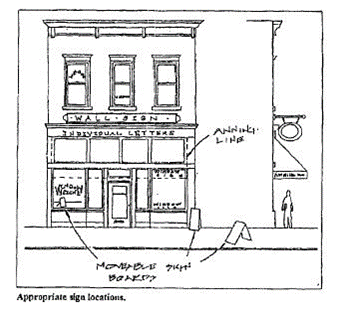
Signs. Some regulation is necessary to maintain the character of historic sites and to protect the town's historic resources; however, it should complement, not hinder the area's economic viability. All signs erected or installed on or around an historic property must comply with the minimum sign requirements of the existing section 155.430 and must be approved by the board of architectural review. In addition, the following criteria must be met:
(1)
Size and scale. Signs should be an appropriate size not to dominate the historic resource with which they are associated. Freestanding signs may not exceed 32 square feet or six feet in height.
(2)
Lighting for signs. Lighted signs are permitted under the following circumstances:
(a)
They are of the same architectural style and character of the era of the property.
(b)
The placement of the sign is in keeping with the era of the property.
(c)
Lighting for signs should be concealed.
(d)
Light fixtures for signs should not be readily visible from the street or sidewalk.
(e)
Internally lit signs are prohibited.
(3)
Placement. Signs should be placed in such a way that they do not obscure original designs of detailing, and should be placed in locations that would traditionally have been used for signage. Freestanding signs should be placed so they do not impede the flow of traffic or disrupt the existing streetscape:
(a)
It is recommended that all signs should be confined to the flat surface of the building.
(b)
Wall signs may be painted or attached directly to the face of the building.
(c)
Wall signs should be placed at traditional locations such as above transoms, on cornice fascia boards, or below cornices.
(d)
Sign brackets for projecting signs should be located no higher than second floor window sills.
(e)
Awning valences are appropriate locations for signs.
(f)
Neon may be used on the interior of buildings. The application of neon signs to exterior locations is not permitted.
(g)
All wall mounted signs are to compliant with section 155.430.
(4)
Materials. Signs should be constructed of materials that can be expected to remain durable and maintain their appearance for the anticipated life of the sign. Signs should be constructed with materials that are the same or similar to the original construction materials and/or modern materials which mimic the original construction materials. Traditional sign materials should be used.
(a)
The colors of the materials must be similar to the colors of the surrounding structures and be consistent with the colors of the era of the property.
(b)
The use of finished wood, brass letters, carved wood, gold leaf, or glass for signs is appropriate.
(c)
Sign brackets should be of wood or pre-painted or finished metal.
(d)
Materials such as plywood, plastic substrates, and unfinished wood are not permitted.
(e)
Plastic letters and signs are not permitted materials for historic buildings.
(5)
Sign colors. Sign colors should complement overall building colors.
(a)
No more than two or three colors per sign.
(b)
Dark backgrounds with light letters are historically appropriate and should be considered for sign colors.
(6)
Sign lettering. Traditional sign lettering is recommended.
(a)
Letters should not exceed 18 inches in height.
(b)
Serif style letters are appropriate and their use should be encouraged.
(c)
No more than 60 percent of a sign's total area should be occupied by lettering.
(7)
Method of fastening to building. New signage, when attached to the building, should be capable of being mounted and removed without causing damage to the building. Requests for approval should include a description of how the sign will be affixed and removed.
(a)
Materials used to mount signs must reflect the style and characteristic of the era of the property.
(b)
Mounting bolts on masonry buildings should be applied to go through mortar joints rather than the face of the masonry.
(c)
Sign brackets should be or wood or pre-painted or finished metal.
(D)
Lighting of property and grounds. Illumination for the purpose of highlighting the property or prominent feature of the site must meet the following criteria:
(1)
All lighting erected or installed must meet the minimum lighting requirements set forth in the lighting section of the architectural review standards ordinance.
(2)
When attached to the building, fixtures should be capable of being installed or removed without causing damage to the building.
(3)
Fixtures must be of the same style and character of lighting fixtures of the style and era of the site.
(E)
Landscaping. Landscaping materials used at historic sites shall be compatible with the age and style of the site and shall be placed to enhance and not obscure original architectural design or detailing. Existing authentic materials should be left intact to the extent possible. Native and heirloom plants are encouraged (plants that have been grown in this country for 50 years or longer).
(Ord. No. 10.013, 5-24-2010; Ord. No. 2016.005, 10-24-2016)
Sec. 155.545. - Appeals.
Any person may appeal a decision of the board to the Courts of South Carolina pursuant to the S.C. Code § 6-29-900 et seq.
(Ord. No. 10.013, 5-24-2010)

