
Blythewood City Zoning Code
SIGNS
Sec. 155.425.- Statement of purpose and scope.
(A)
The purposes of this subchapter are to promote public safety and to encourage the effective use of signs as a means of communication in the town, to maintain and enhance the aesthetic environment, to minimize the possible adverse effect of signs on nearby public and private property and to enable the fair and consistent enforcement of the subchapter.
(B)
This subchapter:
(1)
Establishes a permit system that allows a variety of signs in commercial and industrial zones and a limited variety of signs in residential zones;
(2)
Allows certain signs that are small and incidental to the principal use of the properties on which they are located without a requirement for permits; and
(3)
Provides for temporary signs in limited circumstances on private property.
(C)
Regulation of placement, installation and maintenance of signs is necessary because the purpose of signs is to draw visual and mental attention, potentially to the detriment of sound driving practices and the safety of the motoring public to which a majority of signs are oriented. Therefore, it is the intent of this subchapter to regulate the size and location of signs so that their purpose can be served without unduly interfering with motorists and causing unsafe conditions. The fact that these signs are intended to command visual contact grants to signs a proportionately greater role than other structures in determining the overall aesthetic quality of the community. The aesthetic impact of signs is an economic fact which may bear heavily upon the enjoyment and value of property; therefore the regulation of the placement, installation and maintenance of signs conserves the value of property and encourages the most appropriate use of land throughout the town by protecting and preserving the desired aesthetic qualities of the town.
(D)
With these purposes in mind, this subchapter authorizes the use of on-premises signs which are:
(1)
Compatible with their surroundings;
(2)
Appropriate to the type of activity to which they pertain;
(3)
Expressive of the identity of the individual proprietors or of the community as a whole; and
(4)
Large enough to convey a message about the owner or occupants of a particular property, the products or services available on the property or the business activities conducted on the property, yet small enough to preserve and protect the natural beauty of the town and limit distractions to motorists.
(Ord. No. 5.321, 1-26-2009; Ord. No. 10.012, 5-24-2010)
Sec. 155.426. - Applicability.
(A)
Except as otherwise provided in this subchapter, this subchapter applies to all signs located within the Town of Blythewood.
(B)
Except as otherwise provided in this subchapter, it shall be unlawful for any person to erect, construct, place, display, repair, structurally alter, enlarge, move or replace any sign or cause the same to be done, without first having obtained a sign permit for the sign from the zoning administrator as required by this subchapter.
(C)
Any sign that is allowed under the provisions of this subchapter may contain a commercial and/or noncommercial message.
(Ord. No. 5.321, 1-26-2009; Ord. No. 10.012, 5-24-2010)
Cross reference— Penalty, see § 155.999.
Sec. 155.427. - Definitions.
For the purpose of this subchapter, the following definitions shall apply unless the context clearly indicates or requires a different meaning.
Banner. A sign of lightweight, plastic or similar material mounted at one or more edges to a pole or other structure. National flags, state and municipal flags, and official flags of businesses, institutions or other organizations are not banners.
Canopy sign. A sign attached to or constructed in or on a canopy.
Changeable copy sign. A sign that is wholly or partially designed so that its copy can be manually, mechanically, or electronically changed or rearranged to display different content.
Civic. Relating to town or community affairs.
Commercial area. All real property within the NO neighborhood office, NC neighborhood commercial, MO multi-neighborhood office, MC multi-neighborhood commercial, TC town center, and CC community commercial zoning districts, within the commercial portions of PD planned development zoning districts, and all permissible commercial uses in the RU rural zoning district.
Copy. Any words, letters, numbers, figures, illustrations, designs, characters, symbols, logos, emblems, or insignia that are used on a sign display surface area.
Electronic changeable copy sign. A changeable copy sign that uses a matrix of illumination elements, such as light emitting diodes (LED), liquid crystal display (LCD), plasma display, individual light bulbs, or other digital or analog electronic media to display or project copy which can be modified by electronic or other processes.
Ground mounted sign or free standing sign. A sign supported by one or more uprights, posts or bases placed upon or affixed in the ground and not attached to any part of a building.
Height. The distance from the top of the curb closest to any portion of the sign, or from the edge of the roadway where no curb exists, to the top of the highest attached component of the sign.
Inconspicuous sign. A sign displayed within the interior of a building which is not visible, audible, or otherwise discernable from the exterior of the building; also, a sign which is not visible, audible, or otherwise discernable from any public right-of-way or beyond the boundaries of the lot or parcel upon which it is located.
Industrial area. All real property within the LI limited industrial, LI-2 limited industrial 2 district, LIRP light industrial research park, and BI basic industrial zoning districts.
Internally illuminated sign. A sign illuminated by a light source internal to the sign enclosure which is externally visible, not directly but only indirectly, through translucent, not transparent, sign face materials.
Luminance. The intensity of light reflected or emitted from a unit area of surface, such as a sign face, measured as nits.
Manual changeable copy sign. A sign or portion thereof which has a reader board for the display of text information in which each alphanumeric character, graphic or symbol is defined by objects, not consisting of an illumination device and may be changed or rearranged manually or mechanically with characters, letters or illustrations that can be changed or rearranged without altering the face or the surface of the sign.
Marquee andawning. A hood or awning of permanent construction without pillars or posts which is supported from a building wall and extends beyond the building, building line or property line.
Marquee sign and awning sign. A sign painted on, attached or hung from a marquee or awning.
Monument sign. A type of ground mounted or free standing sign that has the area between the bottom edge of the sign and the ground substantially filled with a solid architectural material such as wood, brick, stone, masonry, vinyl or hardcoat stucco, but not metallic material such as aluminum. Substantially filled means that at least two-thirds of the width of the sign from edge to edge is so filled.
Multiple occupancy. A building consisting of two or more separate commercial uses, or a lot or lots, plots, portions or parcels of land considered as a unit for two or more separate commercial uses.
Nits. A unit of measure for luminance where one nit equals one candela per square meter (cd/m 2 ).
Nonconforming sign. A sign that does not meet the requirements of this subchapter, but was lawfully in existence on the effective date of this subchapter.
Premises. The lot or lots, plots, portions or parcels of land considered as a unit for a single use or development, whether owned or leased, and not located in a shopping center or multi-use building. For purposes of the location of signs, On premises means a sign located on the same premises as the object, project, place of activity, person, institution or business to which the sign directs attention; off premises means a sign located on a premises different than the premises on which the object, project, place of activity, person, institution or business to which the sign directs attention is located.
Residential area. Real property within all residential zoning districts and permissible residential uses in the NO neighborhood office, NC neighborhood commercial, MO multi-neighborhood office, MC multi-neighborhood commercial, TC town center, and CC community commercial zoning districts, within the residential portions of PD planned development zoning districts, within the RU rural zoning district, and within the RE rural estate zoning district.
Roof sign. A sign installed on the roof of a building or painted on the roof of a building so as to be visible from ground level.
Sandwich board. Any A-frame sign consisting of two boards hinged at the top hanging back to back. Such signs are generally oriented to pedestrians.
Sidewalk sign, shingles and projecting sign. A sign affixed to, and projecting from a wall of a building, supported by the building and not in the same plane as the wall.
Sign. Any device of a medium affixed to or represented directly or indirectly upon a building, structure or land and which directs attention to an object, product, place of activity, person, institution, organization or business. Sign does not include any flag, badge or insignia of any government or government agency, school or religious group or of any civic, charitable, religious, patriotic, fraternal or similar organization, nor any official traffic device. Each display surface shall be considered to be a sign.
Sign area. The entire area within a sign's continuous perimeter, enclosing the extreme limits of a sign display or structure, including any frame, support structure or border, shall constitute the area of a sign. However, for a ground mounted sign, the portion of the sign display or structure between the ground and 24 inches above the ground shall not count against its sign area limit. Further, for a ground mounted sign in the I-77 sign overlay district the portion of the support structure below the bottom of the display area shall not count against its sign area limit. Curved, spherical or any other shaped sign faces are computed on the basis of actual sign surface area. If a sign is attached to an entrance wall or fence, only that portion of that wall or fence onto which the sign face or letters are placed shall be calculated in the sign area.
Single occupancy. A building consisting of one commercial use.
Wall sign. A sign painted on the outside of a building, or attached to, and erected parallel to the face of a building and supported throughout its length by the building.
(Ord. No. 5.321, 1-26-2009; Ord. No. 5.377, 8-31-2009; Ord. No. 10.012, 5-24-2010; Ord. No. 2011.005, 6-27-2011; Ord. No. 2012.008, 8-16-2012; Ord. No. 2012.007, 12-17-2012; Ord. No. 2015.002, 4-27-2015; Ord. No. 2019.006, 7-22-2019)
Sec. 155.428. - Sign requirements.
(A)
Placement.
(1)
Ground mounted signs.
(a)
All ground mounted signs shall be located a minimum of five feet behind the street right-of-way.
(b)
No ground mounted sign greater than five square feet in area shall be located closer than 15 feet to any adjacent lot line.
(c)
A 15-foot side yard setback shall be required if the side lot line abuts a residential district.
(d)
Only one ground mounted sign is allowed per street front, up to a limit of two ground mounted signs per parcel. However, one sign identifying a residential neighborhood may be placed at each entrance to the residential neighborhood. Within the I-77 sign overlay district, the I-77 right-of-way is considered a street front.
(e)
Changeable copy signs.
1.
Changeable copy signs shall only be allowed as ground mounted signs. Further, changeable copy signs shall only be allowed within the architectural overlay district, upon the approval of corresponding Certificates of Appropriateness by the board of architectural review. However, changeable copy signs shall not be allowed within the I-77 sign overlay district portion of the architectural overlay district. the $25,000.00 cost threshold in section 155.316 does not apply to changeable copy signs; therefore, all changeable copy signs, regardless of cost, require corresponding certificates of appropriateness from the board of architectural review.
2.
In addition to the preceding requirements in section 155.428(A)(1)(e) for all changeable copy signs, the placement of electronic changeable copy signs shall be restricted to the digital sign overlay district portion of the architectural overlay district.
(2)
Wall signs.
(a)
No wall sign shall project more than 18 inches from the building wall, nor shall it extend beyond any point of a roof line, parapet or mansard roof.
(b)
One wall sign may be placed on each building wall which front on a public street with special consideration given to historic properties and the method of attachment. Refer to section 155.544(C).
(c)
Signs mounted to or hung from a porch or marquee may be substituted for part or all of the allowable wall signage per premises. These signs, when viewed at front elevations, must not block the view of windows or doors and must be placed in between and not overlap vertical architectural elements. Hung signs shall maintain a minimum of six feet, eight inches clearance between the bottom of the sign and the porch or ground surface.
(3)
Canopy, awning signs and marquee (overhangs).
(a)
Canopy and awning signs may be substituted for part or all of the allowable wall signage per premises.
(b)
Awnings and canopies may have signage on all faces which front on a public street.
(c)
Canopies and awnings may only be illuminated externally.
(4)
Sidewalk signs, shingles or projecting signs.
(a)
Sidewalk signs, shingles or projecting signs may be substituted for part or all of the allowable wall signage per premises.
(b)
A sidewalk sign, shingle or projecting sign shall not project from the building wall to an extent that it obstructs the view of pedestrians, bicyclists or motorists of street intersections or traffic signs, devices or signals. The sign shall be extended no more than six feet from the building to which it is affixed.
(c)
A minimum of seven feet clearance between the bottom of the sign and the sidewalk, pavement or ground surface must be maintained.
(d)
Only one projecting sign is permitted per building frontage; provided, however, that multiple occupancy buildings in commercial or industrial areas may include one projecting sign per tenant in addition to wall signs, and provided that the signs are spaced not closer than 20 feet horizontally/laterally from another projecting sign.
(B)
Area and height.
(1)
Sign area.
(a)
The maximum sizes of signs are as listed in Chart 1 below. For changeable copy signs, no more than 33 percent of the allowed sign area may consist of changeable copy.
(b)
Multi-faced signs surface area:
1.
The area of multi-faced signs is computed by adding together the area of all sign faces visible from one point.
2.
When two identical sign faces are placed back to back, no more than 12 inches apart and supported by the same poles or structure, the sign area shall be computed by the measurement of one of the faces.
3.
In the case of cylindrical signs, signs in the shape of cubes, or other signs which are substantially three-dimensional with respect to their display surfaces, the entire display surface or surfaces are included in computations of area.
(c)
If a sign is attached to an entrance wall or fence, only that portion of that wall or fence onto which the sign face or letters are placed shall be calculated in the sign area. (See Chart 1 below.)
(d)
Wall sign surface area:
1.
In general, the surface area of wall signs should not exceed 20 square feet unless the size of the building is such that a larger sign can be justified. (See Chart 1 below.)
2.
Wall signs shall reflect the proportional and dimensional relationships of the structure. The ratio of window and door openings to wall surface area must be considered. No wall sign or its supporting structure shall cover any window or part of a window. Furthermore, wall signs shall be placed in between and not overlap vertical architectural elements.
3.
For multiple occupancy buildings, wall signs shall reflect the proportional and dimensional relationships of the individual store front.
(e)
The canopy or awning sign surface area shall reflect the proportional and dimensional relationships of the surface area of the portion of the awning or canopy visible from the street level.
(f)
Sidewalk sign surface area:
1.
Shall reflect the proportional and dimensional relationships of the structure.
2.
In general, the surface area of sidewalk signs should not exceed ten square feet unless the size of the building is so that a larger sign can be justified. (See Chart 1 below.)
(2)
Sign height.
(a)
The maximum heights of signs are as in Chart 1 below.
(b)
Except as otherwise provided in this subchapter, the maximum sign height of ground mounted signs is eight feet.
1.
For signs placed on a landscaped berm or raised landscape area, such as a planter or retaining wall, the height of the berm or raised area is included when calculating the height of the size.
2.
The zoning administrator may allow sign heights in excess of eight feet in cases where additional height is required to raise the base of the sign to the mean elevation (street level) of the fronting street where displayed.
(c)
The maximum height of signs identifying residential neighborhoods, located at the entrance to the neighborhood, is six feet.
(C)
Illumination.
(1)
Except as otherwise provided in this subchapter, signs may be illuminated subject to the following conditions:
(a)
All signs shall meet all applicable electrical codes;
(b)
External illumination:
1.
All externally lighted signs shall have their lighting directed in a manner as to illuminate only the face of the sign, and be shielded so no direct illumination is visible elsewhere. No external lighting shall be emitted at an angle higher than 90 degrees from nadir (straight down). See Illustration 1;
Illustration 1: Externally Illuminated Signs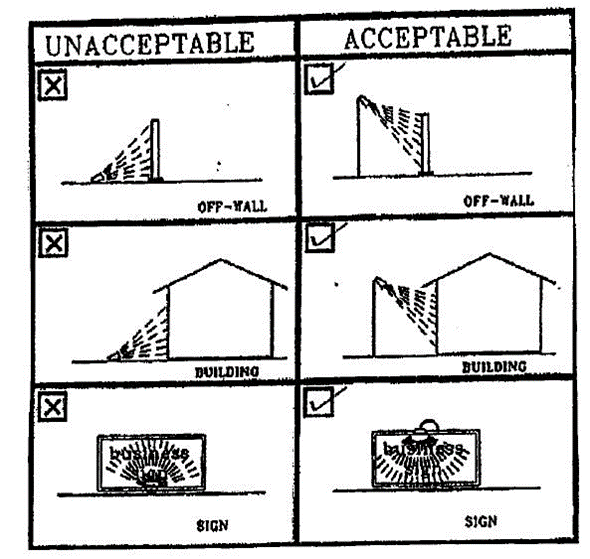
2.
Any illuminated tubing outlining property lines, open sales areas or parking areas is prohibited; and
3.
Illuminated tubing that is attached and integral to an original architectural detail of a building is permitted, if approved by the board of architectural review.
(c)
Internal illumination(not typically allowed for historic properties signage). Each sign face of an internally illuminated sign shall be limited to a luminance of 5,000 nits, as measured at any point on the sign face at maximum brightness, after sunrise and before sunset (as published by the National Weather Service for the location). Each sign face of an internally illuminated sign shall be limited to a luminance of 200 nits, as measured at any point on the sign face at maximum brightness, after sunset and before sunrise (as published by National Weather Service for the location).
(2)
Electronic changeable copy signs.
(a)
The electronic changeable copy portion of an electronic changeable copy sign may only display the printable characters (letters, numbers, punctuation marks, and symbols), and characters of the US-ASCII character set, as are available on a standard alphanumeric computer keyboard. These characters shall be displayed in a single color against a non-illuminated, dark, near-black background. This display must remain static, and shall not scroll, flash, strobe, blink, pulse, fade or illuminate with varying light intensity or changing colors. This display shall not depict motion or animation, or create the illusion of movement. The content and color of this display may, however, change once per hour, with an instantaneous transition.
(b)
Each sign face of an electronic changeable copy sign shall be limited to a luminance of 5,000 nits, as measured at any point on the sign face at maximum brightness, after sunrise and before sunset (as published by the National Weather Service for the location). Each sign face of an electronic changeable copy sign shall be limited to a luminance of 200 nits, as measured at any point on the sign face at maximum brightness, after sunset and before sunrise (as published by the National Weather Service for the location).
(c)
The electronic changeable copy portion of an electronic changeable copy sign must be turned off by 10:00 p.m. or closing time, whichever is later.
(D)
Temporary signs and banners.
(1)
Temporary special event signs and banners for religious, charitable, civic, fraternal or similar non-profit or not-for-profit organizations, events providing a community service or events promoting the community:
(a)
Shall be erected no sooner than 14 days prior and removed no later than two days after the event;
(b)
Shall not exceed 32 square feet;
(c)
Shall not be illuminated;
(d)
Shall be located off the street right-of-way, unless otherwise granted permission for the location by the Town of Blythewood and SCDOT. In no case may any sign impede the view or travel of any motorists or pedestrians or be attached to any structure within the right-of-way (government signs, telephone poles and the like);
(e)
Only one sign oriented per street front per premises shall be allowed. On premises with two or more street fronts, signs shall not be located less than 100 feet apart as measured by using a straight line; and
(f)
The property owner upon whose land the sign is placed shall give written permission for the placement of the signs and will be held responsible for violations.
(2)
Grand opening banners.
(a)
Shall be associated only with the grand opening of a new business, not the change of ownership or management of a continuing business;
(b)
Only permitted one time for a business;
(c)
Only permitted for a 30-day period beginning at the start date indicated on the business license;
(d)
Must be attached to the building and shall not cover any window or part of a window, nor shall it extend beyond any point of a roof line, parapet or mansard roof. The banner shall not be attached to any temporary or permanent pole, or any other structure other than the principal structure; and
(e)
The banner shall be no more than 32 square feet in area.
(E)
Maintenance and upkeep. All signs and all components thereof, including supports, braces, anchors and the like, shall be kept in a good state of repair, in compliance with all building and electrical codes, and in conformance with the requirements of this subchapter.
(Ord. No. 5.321, 1-26-2009; Ord. No. 5.377, 8-31-2009; Ord. No. 10.012, 5-24-2010; Ord. No. 10.029, 10-25-2010; Ord. No. 2011.005, 6-27-2011; Ord. No. 2012.008, 8-16-2012; Ord. No. 2012.007, 12-17-2012)
Cross reference— Penalty, see § 155.999.
Sec. 155.429. - Permits.
(A)
Chart 2. Chart 2 below lists by zoning district the type of signs that may be permitted.
(B)
Exemption. A permit issued by the zoning administrator is required to erect, construct, enlarge, move or replace any sign or cause the same to be done, unless the sign or action is exempt from this requirement under section 155.430.
(C)
Permit application. See section 155.451(c).
(1)
A sketch showing the dimensions and shape of the proposed sign, its proposed location on the lot and any other information required by the zoning administrator to determine conformance with this subchapter, shall be submitted before a permit can be issued.
(2)
One copy of the sketch shall be returned to the applicant with the signed approval or disapproval of the zoning administrator noted on the copy.
(D)
Fee. A fee, in accordance with a fee schedule adopted by the town council, shall be charged for each sign permit issued.
(E)
Appeals of permit decisions. Decisions of the zoning administrator may be appealed to the board of zoning appeals under section 155.466.
(Ord. No. 5.321, 1-26-2009; Ord. No. 5.377, 8-31-2009; Ord. No. 10.012, 5-24-2010; Ord. No. 2011.005, 6-27-2011; Ord. No. 2012.007, 12-17-2012)
Sec. 155.430. - Exempt signs.
The following types of signs are exempt from the permit requirements of section 155.429 and may be placed in any zoning district subject to the provisions of this subchapter. These signs shall otherwise be in conformance with all applicable requirements contained in this subchapter. There shall be no limit as to the number of any signs on any lot, except as herein prescribed. All signs (except government signs) shall be located outside a street right-of-way.
(A)
Signs erected by or on behalf of the city, county, state or federal government identifying streets or public property, conveying public information and directing or regulating pedestrian or vehicular traffic, are exempt from these regulations;
(B)
Memorial signs, plaques or grave markers which are noncommercial in nature erected by or on behalf of local, county, state or federal government;
(C)
Flags, pennants, insignia or religious symbols of any government, non-profit or not-for-profit organization when not displayed in connection with a commercial promotion or as an advertising device. No flag pole shall exceed 30 feet in height. Flags shall not exceed 60 square feet. Limit three per site;
(D)
Integral decorative or architectural features of buildings, as long as the features or works do not contain letters, trademarks, moving parts or lights;
(E)
On-premise directional and traffic flow signs not exceeding four square feet in area apiece and not exceeding the number of ingress and egress points;
(F)
Identification signs for residential uses not exceeding four square feet in area (one only per premises);
(G)
Campaign and election signs provided that:
(1)
Each sign shall not exceed 20 square feet in area;
(2)
All signs may be erected no sooner than 30 days in advance of the election for which they were made;
(3)
All signs shall be removed within seven days after the election for which they were made;
(4)
The property owner upon whose land the sign is placed shall give written permission for the placement of the signs and will be held responsible for violations; and
(5)
No sign shall be placed in any right-of-way, on any telephone pole, street sign and/or street sign pole or on any public property.
(H)
Temporary real estate signs advertising a specific property for sale, lease, rent or development as follows:
(1)
One sign per street frontage advertising real estate ("For Sale", "For Rent", "For Lease" or "For Development") not greater than ten square feet in area in a residential area and 32 square feet in area in commercial and industrial areas may be located on the property being advertised so long as the sign is located behind the street right-of-way line. If the property so advertised lies on a corner lot or double frontage lot, then a second sign may be oriented along the second street so long as the two signs are at least 100 feet apart as measured by the shortest straight line;
(2)
May not be illuminated; and
(3)
Real estate companies must purchase a business license in the Town of Blythewood prior to erecting a real estate sign.
(I)
Temporary construction signs provided that:
(1)
Signs in residential areas shall not exceed ten square feet each;
(2)
Signs in commercial and industrial areas shall not exceed 32 square feet each;
(3)
Only one sign oriented per street front per premises shall be erected. Any two signs located on the same premises shall be located at least 100 feet apart as measured by using a straight line;
(4)
Shall not be illuminated;
(5)
Shall only appear at the construction site;
(6)
A building permit for the construction shall be secured prior to the erection of the sign; and
(7)
The signs shall be removed within seven days after completion of the project.
(J)
One on-premise garage sale sign and a maximum of two off-premise directional signs per garage sale, provided that:
(1)
All signs shall be removed within 24 hours after the garage sale has been terminated;
(2)
Shall not exceed four square feet in area; and
(3)
All signs shall be located off the street right-of-way.
(K)
Window signs provided that:
(1)
The sign surface area is proportional to the building scale and architectural features;
(2)
Does not cover more than 50 percent of the window area; and
(3)
Does not obscure vision at a height between four feet and seven feet above ground level at the window.
(L)
"Warning", "No Trespassing" and similar informational signs no greater than four square feet;
(M)
Signs located within a stadium intended to be read only by persons seated within the stadium;
(N)
Any sign inside a building, not attached to or placed within an external window or piece of glass that is not legible more than three feet beyond the building in which it is located;
(O)
Signs placed on newspaper boxes designed for placement of delivered newspaper to a particular location;
(P)
Historical plaques mounted in accordance with specifications of the United States Secretary of the Interior's Standards for Rehabilitation;
(Q)
Changing or replacing the sign copy on an existing lawful sign is exempt from permit requirements, provided the copy change does not change the nature of the sign as to render the sign in violation of this subchapter. The change in copy due to a change in business does require a permit; and
(R)
Inconspicuous signs.
(S)
One sandwich board sign permitted to an onsite commercial owner/operator only during the hours when the establishment is open. The sign shall not be taller than three feet and/or wider than two feet, with a maximum of two sign faces. The town reserves the right to remove any sign which causes interference with vehicular traffic or pedestrian traffic, or in the event of any emergency situation, or that interferes with any work that is to be performed upon the public sidewalk and/or right-of-way by or on behalf of the town. In all instances, the sign shall be placed on the business lot, at least five feet outside of right-of-way, shall be constructed of a material and weight to ensure general stability and shall not block visibility.
(Ord. No. 5.321, 1-26-2009; Ord. No. 2011.005, 6-27-2011; Ord. No. 2012.008, 8-16-2012; Ord. No. 2019.006, 7-22-2019)
Sec. 155.431. - Prohibited signs.
The following signs are prohibited:
(A)
Any sign which the zoning administrator determines obstructs the view of bicyclists or motorists using any street, approach to any street intersection or which interferes with the effectiveness of or obscures any traffic sign, device or signal;
(B)
Illuminated, highly reflective signs or spot lights which hamper the vision of motorists or bicyclists;
(C)
Any sign located outdoors which interferes with free passage from or obstructs any fire escape, downspout, window, door, stairway, ladder or opening intended as a means of ingress or egress or providing light or air;
(D)
Any sign (other than a government sign), banner or display placed on any curb, sidewalk (except where otherwise permitted in this subchapter), post, pole, hydrant, bridge, tree or other surface located on, over or across any public street or right-of-way, or any banner, placed on stakes on a property, unless otherwise permitted. One decorative banner shall be permitted on a building;
(E)
Any sign located in a way as to intentionally deny an adjoining property owner visual access to an existing sign;
(F)
Flashing signs, signs with flashing or reflective disks, signs with flashing lights or lights of changing degree of intensity or color or signs with electrically scrolled messages;
(G)
Rotating signs, other than on-premise signs with rotating identification names which contain a logo and/or business name on it;
(H)
Roof signs;
(I)
Off premises signs;
(J)
Signs placed on a piece of property without permission of its owners or agent;
(K)
Inflatable signs, including inflated balloons (includes inflatable depicting animals, planes, blimps, castles and the like) having a diameter of greater than two feet;
(L)
Other signs not expressly permitted in this subchapter;
(M)
Any sign whose sign face was initially constructed and designed to be placed and/or transported on wheels, regardless if the sign face is removed from its base and placed on or in the ground so as to otherwise classify the sign as a "freestanding" sign as herein defined;
(N)
Video displays, electronic changeable copy signs and electronic graphic display signs; and
(O)
Signs with no sign copy (i.e., blank signs);
(P)
Any sign (other than a government sign), banner, feather flag, festoon or display placed on any curb, sidewalk post, pole, hydrant, bridge, tree or other surface located on, over or across any public street or right-of-way, or placed on stakes on a property, unless a permitted temporary or grand opening banner.
(Ord. No. 5.321, 1-26-2009; Ord. No. 10.012, 5-24-2010; Ord. No. 2011.005, 6-27-2011; Ord. No. 2012.008, 8-16-2012; Ord. No. 2019.006, 7-22-2019)
Cross reference— Penalty, see § 155.999.
Sec. 155.432. - Nonconforming signs.
(A)
Except as herein provided, nonconforming signs that were otherwise lawful on the effective date of this subchapter may be continued.
(B)
No person may engage in any activity that causes an increase in the extent of nonconformity of a nonconforming sign or causes a previously conforming sign to become nonconforming.
(C)
A nonconforming sign may not be moved or replaced except to bring the sign into complete conformity with this subchapter. Once a nonconforming sign is removed from the premises or otherwise taken down or moved, the sign may only be replaced with a sign which is in conformance with the terms of this subchapter.
(D)
Minor repairs and maintenance of nonconforming signs necessary to keep a nonconforming sign for a particular use in sound condition are permitted so long as the nonconformity is not in any means increased.
(E)
If a nonconforming sign is destroyed by natural causes, or otherwise damaged, it may not thereafter be repaired, reconstructed or replaced except in conformity with all the provisions of this subchapter, and the remnants of the former sign structure shall be cleared from the land. For purposes of this section, a nonconforming sign shall be considered "destroyed" or "damaged" if it receives damage to an extent of more than 50 percent of the sign's replacement value immediately prior to the sign having received the damage, except that after seven years from the date of adoption of this subchapter, a sign is deemed to have zero value remaining.
(F)
All nonconforming signs must be brought into compliance by January 26, 2016, except for existing ground mounted signs in the I-77 sign overlay district. As to the latter classification, such signs must be brought into compliance on or before January 26, 2020.
(G)
The message of a nonconforming multi-tenant identification sign may be changed so long as it does not create any new nonconformity.
(H)
(1)
If a nonconforming on-premise sign which advertises a business, service, commodity, accommodation, attraction or other enterprise or activity that has for a period of at least 30 days not been operated, conducted or offered, that sign shall be deemed abandoned and shall be removed or brought into compliance by the sign owner, property owner or other party having control over the sign within 30 days after the sign is deemed abandoned.
(2)
Notwithstanding the above, if there is an expansion to the heated square footage of an existing business, or a change in use or ownership to an existing building (except multi-tenant buildings), and there were one or more on-premise nonconforming signs which advertised the former or current business or use, any new signs used, and all new sign faces for the new use or business must meet all sign requirements for the underlying district.
(I)
(1)
If a nonconforming sign remains blank for a continuous period of 30 days, that sign shall be deemed abandoned and shall, within 30 days after abandonment, be altered to comply with this subchapter or be removed by the sign owner, owner of the property where the sign is located or other person having control over the sign.
(2)
For purposes of this subchapter, a sign shall be deemed "blank" if:
(a)
It advertises a business, service, commodity, accommodations, attraction or other enterprise or activity that is no longer operating or being offered or conducted;
(b)
The advertising message it displays becomes illegible in whole or substantial part; or
(c)
It does not contain an advertising message. (For these purposes, the terms "Sign For Rent", "Sign For Lease", "Building For Rent", "Building For Lease", "Building for Sale" and the like shall not be deemed to be an advertising message.)
(Ord. No. 5.321, 1-26-2009; Ord. No. 2011.005, 6-27-2011; Ord. No. 2012.008, 8-16-2012
Cross reference— Penalty, § 155.999.
Sec. 155.433. - Removal of signs.
(A)
The zoning administrator shall cause to be removed:
(1)
Any sign which is determined by the zoning administrator as being insecure, in danger of falling or otherwise endangering the public safety, shall be immediately removed by its owner unless it is repaired and made to otherwise comply with the requirements of this subchapter;
(2)
Any sign erected, constructed, altered or displayed without a required sign permit;
(3)
Any sign not conforming to the International Building and Fire Codes; and
(4)
Any sign now or hereafter existing and in conformance with this subchapter which advertises a business no longer conducted, or a product no longer sold shall have the sign copy removed within 30 days after written notification from the zoning administrator, or 60 days after termination of the business or product, whichever comes first.
(B)
Upon adoption of this subchapter, all legal, nonconforming signs within the Town of Blythewood shall comply with section 155.432.
(Ord. No. 5.321, 1-26-2009)
Sec. 155.434. - Appeals and variances.
(A)
Appeals of a decision by the zoning administrator under this subchapter shall be to the board of zoning appeals under section 155.466(A).
(B)
Except as provided in subsection (C) below, variances to the requirements of this subchapter may be granted by the board of zoning appeals under section 155.466(B).
(C)
Certificate of appropriateness decisions by the architectural review board are not eligible for a variance under this section or under section 155.466(B).
(Ord. No. 5.321, 1-26-2009)
Sec. 155.435. - Violations.
Failure to comply with these sign provisions of this chapter shall constitute a violation of this chapter and is subject to the provisions of section 155.999.
(Ord. No. 5.321, 1-26-2009)

