
Brookhaven City Zoning Code
ARTICLE VI
SPECIAL PURPOSE DISTRICTS
DIVISION 7. - ANX, ANNEXATION DISTRICTS[3]
Editor's note— (Ord. No. RZ-2023-06-08, § I, adopted June 28, 2023, set out provisions intended for use as §§ 27-547—27-549. For purposes of classification, and at the editor's discretion, these provisions have been included as §§ 27-540—27-542.
Sec. 27-452. - Purpose.
Like overlay zoning districts, special purpose zoning districts are tools for dealing with unique neighborhoods or settings or accomplishing special planning and zoning goals. Unlike overlay districts, however, special districts are base zoning classifications; they do not "over-lay" other base zoning districts.
(Ord. No. RZ-2018-11-06, § I, Exh. A(27.92), 11-27-2018)
Sec. 27-453. - Establishment.
Special purpose districts may be established, amended or removed only in accordance with the zoning map amendment procedures of article 10, division 2 of this chapter.
(Ord. No. RZ-2018-11-06, § I, Exh. A(27.93), 11-27-2018)
Sec. 27-464. - General.
(a)
The districts. The PR (Peachtree Road) districts are listed in table 6-1. References in this zoning ordinance to "Peachtree Road" districts or "PR" districts are references to these districts.
(b)
Purposes. PR zoning districts are primarily intended to achieve the following purposes:
(1)
Implement the policies and objectives of the comprehensive plan, the Brookhaven-Peachtree LCI plan, Brookhaven City Centre Master plan and the general purposes of this zoning ordinance;
(2)
Promote a dynamic, mixed-use environment of appropriate intensity and scale near the Brookhaven-Oglethorpe University MARTA transit station;
(3)
Promote overall, citywide land use balance;
(4)
Provide for the efficient and effective use of land surrounding the Brookhaven-Oglethorpe University MARTA Transit Station and along Peachtree Road;
(5)
Accommodate and promote a variety of housing types for residents of varying ages, incomes and lifestyle needs;
(6)
Ensure that the design and arrangement of buildings, structures, streets and open spaces contribute to creation of an inviting, walkable, mid-rise, human-scale environment through regulations addressing such features as:
a.
Consistent building setbacks;
b.
Doorways, windows, building projections and building recesses;
c.
Landscaping, lighting and street furniture to provide amenities and define the public realm; and
d.
Building materials that promote a design and appearance compatible with the desired urban village character of the area.
Improve pedestrian safety and comfort;
Maintain and promote community character and appearance; and
Ensure new development provides height and design transitions to R- and RM-zoned areas.
(Ord. No. RZ-2018-11-06, § I, Exh. A(27.94), 11-27-2018; Ord. No. RZ-2023-06-05, § I, 6-28-2023)
Sec. 27-465. - Uses.
(a)
Principal uses. Principal uses are allowed in PR districts in accordance with article VII, division 2 of this chapter.
(b)
Accessory uses. Accessory uses are allowed in PR districts in accordance with article VII, division 2 of this chapter.
(Ord. No. RZ-2018-11-06, § I, Exh. A(27.95), 11-27-2018)
Sec. 27-466. - Allowed building types.
PR district regulations differ by building type. Only the building types identified in table 6-2 and the uses identified in table 7-1 are allowed in PR districts. The final column of table 6-2 indicates the location of regulations that apply to specific building types.
;sz=9q;Table 6-2 Notes
[1] Permitted only on lots that abut R- or RM-zoned lots.
[2] Not permitted on lots with frontage on Dresden Drive. Requires SLUP approval if
located within 150 feet of Peachtree Road right-of-way.
(Ord. No. RZ-2018-11-06, § I, Exh. A(27.96), 11-27-2018)
Sec. 27-467. - Detached house regulations.
Detached houses are subject to the regulations of table 6-3 (see also figure 6-1 and the Peachtree Road Overlay [/PRO] regulations of article V).
| TABLE 6-3 — DETACHED HOUSES | PR-1 | PR-2 | PR-3 | Supplemental | |
|---|---|---|---|---|---|
| a. Lot | |||||
 | Minimum Lot Area (square feet) | 4,000 | 4,000 | 4,000 | |
 | Minimum Lot Width (feet) | 40 | 40 | 40 | |
| b. Siting | |||||
 | Minimum Front Setback (feet) | 30 | 30 | 30 | See Sec. 27-473 |
 | Minimum Interior (non-street) Side Setback (feet) | 3 | 3 | 3 | |
 | Minimum Street Side Setback (feet) | 15 | 15 | 15 | |
 | Minimum Rear Setback (feet) | 30 | 30 | 30 | |
| c. Uses | |||||
 | Allowed Uses in All Stories | single-family uses only | |||
| d. Open Space and Building Coverage | |||||
| Minimum Open Space (% of development site) | None | None | None | ||
| Maximum Building Coverage (% of lot area) | 55 | 55 | 55 | ||
| e. Height | |||||
 | Minimum Height per Story (feet, floor-to-floor) | 9 | 9 | 9 | See Sec. 27-1338 |
| Maximum Height per Story (feet, floor-to-floor) | 14 | 14 | 14 | See Sec. 27-1338 |
 | Maximum Overall Height (stories) | 3 | 3 | 3 | See Sec. 27-1338 |
| f. Facades | |||||
 | Minimum Front Facade Transparency | 15 | 15 | 15 | See Sec. 27-476 |
| Minimum Street-Side Facade Transparency | 5 | 5 | 5 | See Sec. 27-476 | |
| g. Lot Edges | |||||
 | Edge Type Required | Landscape | See Sec. 27-477 | ||
 | Edge Element Required | Porch or Stoop | |||
Figure 6-1. Detached Houses in PR Districts
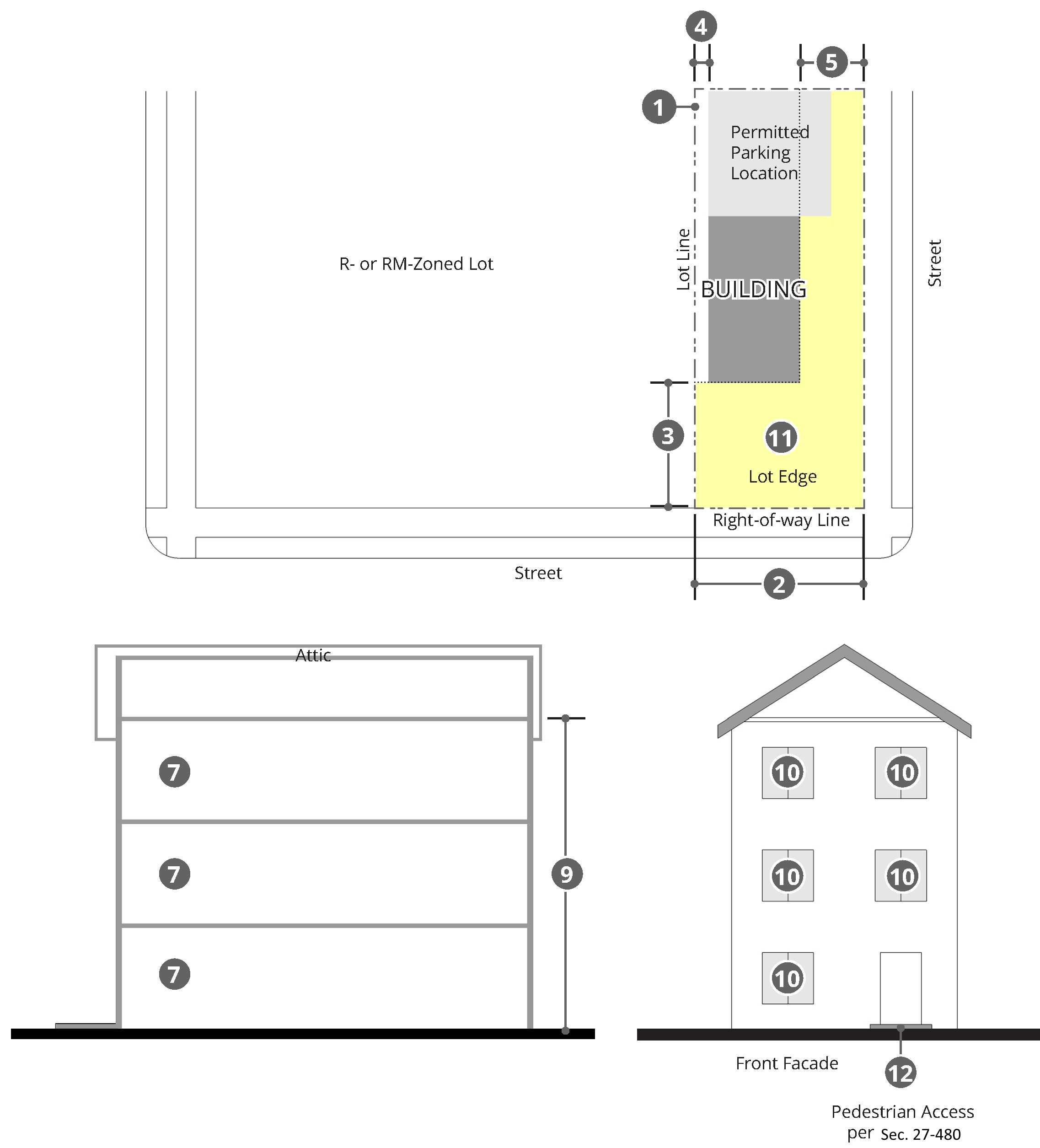
(Ord. No. RZ-2018-11-06, § I, Exh. A(27.97), 11-27-2018)
Sec. 27-468. - Attached house regulations.
Attached houses are subject to the regulations of table 6-4 (see also figure 6-2 and the Peachtree Road Overlay [/PRO] regulations of article V).
| TABLE 6-4 — ATTACHED HOUSES | PR-1 | PR-2 | PR-3 | Supplemental | |
|---|---|---|---|---|---|
| a. Lot | |||||
| Minimum Lot Area (square feet) | None | None | None | |
| Minimum Lot Width (feet) | 20 | 20 | 20 | |
| b. Siting | |||||
| Minimum Front Setback (feet) | 5 | 5 | 5 | See Sec. 27-473 |
| Maximum Front Setback (feet) | 20 | 20 | 20 | See Sec. 27-473 |
| Minimum Building Coverage at/between Min. and Max. Front Setback (%) | 75 | 75 | 75 | ||
| Minimum Interior (non-street) Side Setback (feet) | 0 [1] | 0 [1] | 0 [1] | |
| Minimum Street Side Setback (feet) | 15 | 15 | 15 | |
| Minimum Rear Setback (feet) | 30 | 30 | 30 | |
| c. Uses | |||||
| Allowed Uses in All Stories | single-family uses only | |||
| d. Open Space and Building Coverage | |||||
| Minimum Open Space (% of development site) | |||||
| Site Area less than 1 Acre | 10 | 10 | 10 | See Sec. 27-482 | |
| Site Area 1 Acre or more | 15 | 15 | 15 | ||
| Maximum Building Coverage (% of lot area) | 80 | 80 | 80 | ||
| e. Height | |||||
| Ground-Story Elevation (min/max above sidewalk, ft.) | 0 to 4.5 | 0 to 4.5 | 0 to 4.5 | |
| Minimum Height per Story (feet, floor-to-floor) | 9 | 9 | 9 | See Sec. 27-1338 |
| Maximum Height per Story (feet, floor-to-floor) | 14 | 14 | 14 | See Sec. 27-1338 |
| Maximum Overall Height (stories) | |||||
| Without Bonus | 3 | 3 | 3 | |
| With Public Benefit Bonus | 4 | 4 | 4 | See Sec. 27-474 | |
| f. Facades | |||||
| Minimum Front Facade Transparency | 15 | 15 | 15 | See Sec. 27-476 |
| Minimum Street-Side Facade Transparency | 5 | 5 | 5 | See Sec. 27-476 | |
| g. Lot Edges | |||||
| Edge Type Required | Landscape |
See Sec. 27-477 and Sec. 27-480 | ||
 | Edge Element Required | Porch or Stoop | |||
Table 6-4 Notes
[1] End units subject to minimum 15-foot interior side setback.
Figure 6-2. Attached Houses in PR Districts
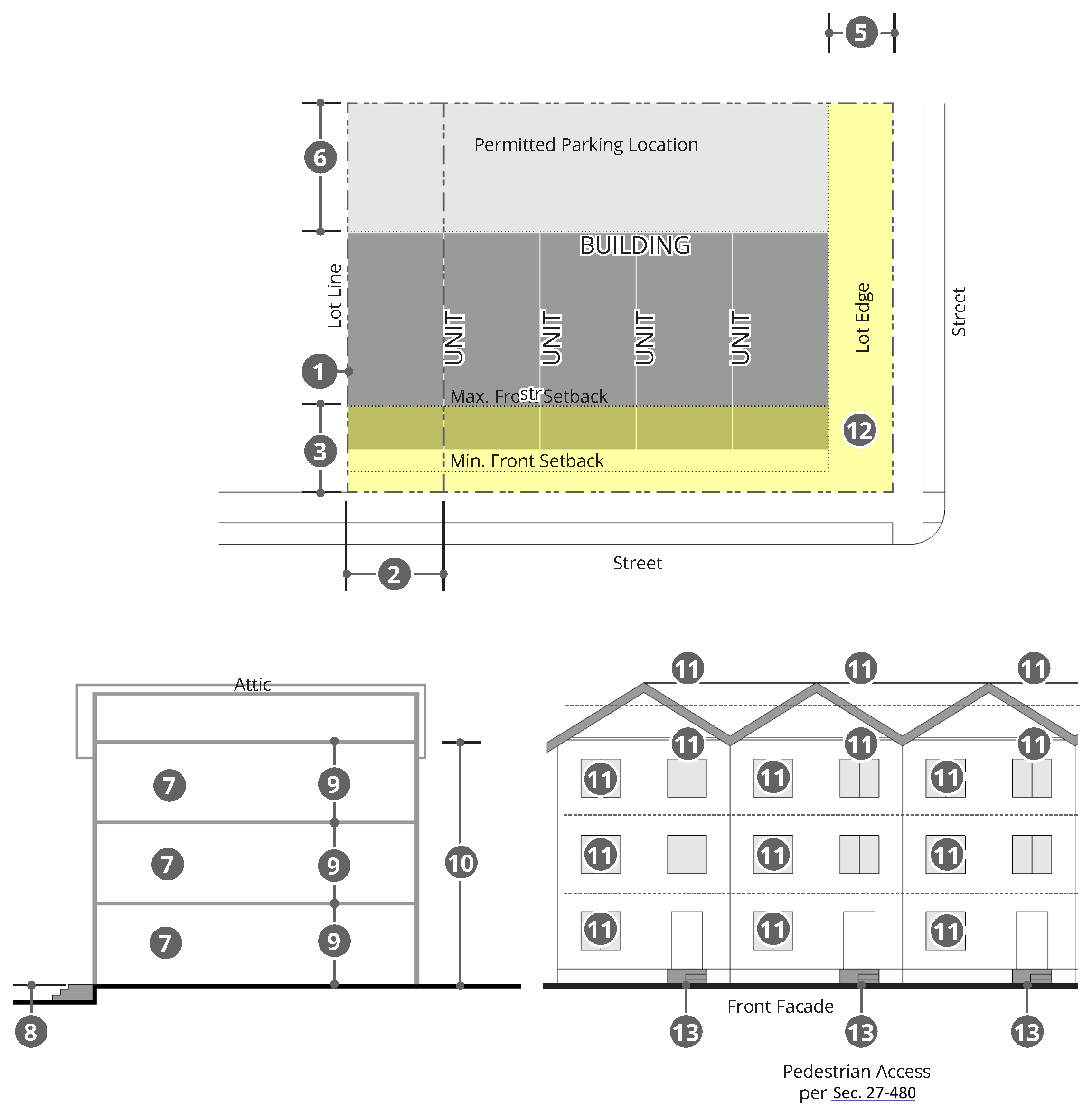
(Ord. No. RZ-2018-11-06, § I, Exh. A(27.98), 11-27-2018)
Sec. 27-469. - Walk-up building regulations.
Walk-up buildings are subject to the regulations of table 6-5 (see also figure 6-3 and the Peachtree Road Overlay [/PRO] regulations of article V).
| TABLE 6-5 — WALK-UP BUILDINGS | PR-1 | PR-2 | PR-3 | Supplemental | |
|---|---|---|---|---|---|
| a. Lot | |||||
| Minimum Lot Area (square feet) | 6,000 | 6,000 | 6,000 | |
| Minimum Lot Width (feet) | 60 | 60 | 60 | |
| b. Siting | |||||
| Minimum Front Setback (feet) | 5 | 5 | 5 | See Sec. 27-473 |
| Maximum Front Setback (feet) | 20 | 20 | 20 | See Sec. 27-473 |
| Minimum Building Coverage at/between Min. and Max. Front Setback (%) | 75 | 75 | 75 | ||
| Minimum Interior (non-street) Side Setback (feet) | 7.5 | 7.5 | 7.5 | |
| Minimum Street Side Setback (feet) | 15 | 15 | 15 | |
| Minimum Rear Setback (feet) | 30 | 30 | 30 | |
| c. Uses | |||||
| Allowed Uses in All Stories | residential uses only; walk-up buildings may not contain more than 30 dwelling units | |||
| d. Open Space and Building Coverage | |||||
| Minimum Open Space (% of development site) | |||||
| Site Area less than 1 Acre | 10 | 10 | 10 | See Sec. 27-482 | |
| Site Area 1 Acre or more | 15 | 15 | 15 | ||
| Maximum Building Coverage (% of lot area) | 75 | 75 | 75 | ||
| e. Height | |||||
| Ground-Story Elevation (min/max above sidewalk, ft.) | 0 to 4.5 | 0 to 4.5 | 0 to 4.5 | |
| Minimum Height per Story (feet, floor-to-floor) | 10 | 10 | 10 | See Sec. 27-1338 |
| Maximum Height per Story (feet, floor-to-floor) | 14 | 14 | 14 | See Sec. 27-1338 |
| Minimum Overall Height (stories) | 2 | 2 | 2 | See Sec. 27-1338 |
| Maximum Overall Height (stories) | ||||
| Without Bonus | 3 | 3 | 3 | ||
| With Public Benefit Bonus | 4 | 4 | 4 | See Sec. 27-474 | |
| f. Facades | |||||
| Minimum Front Facade Transparency | 20 | 20 | 20 | See Sec. 27-476 |
| Minimum Street-Side Facade Transparency | 5 | 5 | 5 | See Sec. 27-476 | |
| g. Lot Edges | |||||
| Edge Type Required | Landscape | See Sec. 27-477 and Sec. 27-480 | ||
 | Edge Element Required | Porch or Stoop | |||
Figure 6-3. Walk-Up Buildings in PR Districts
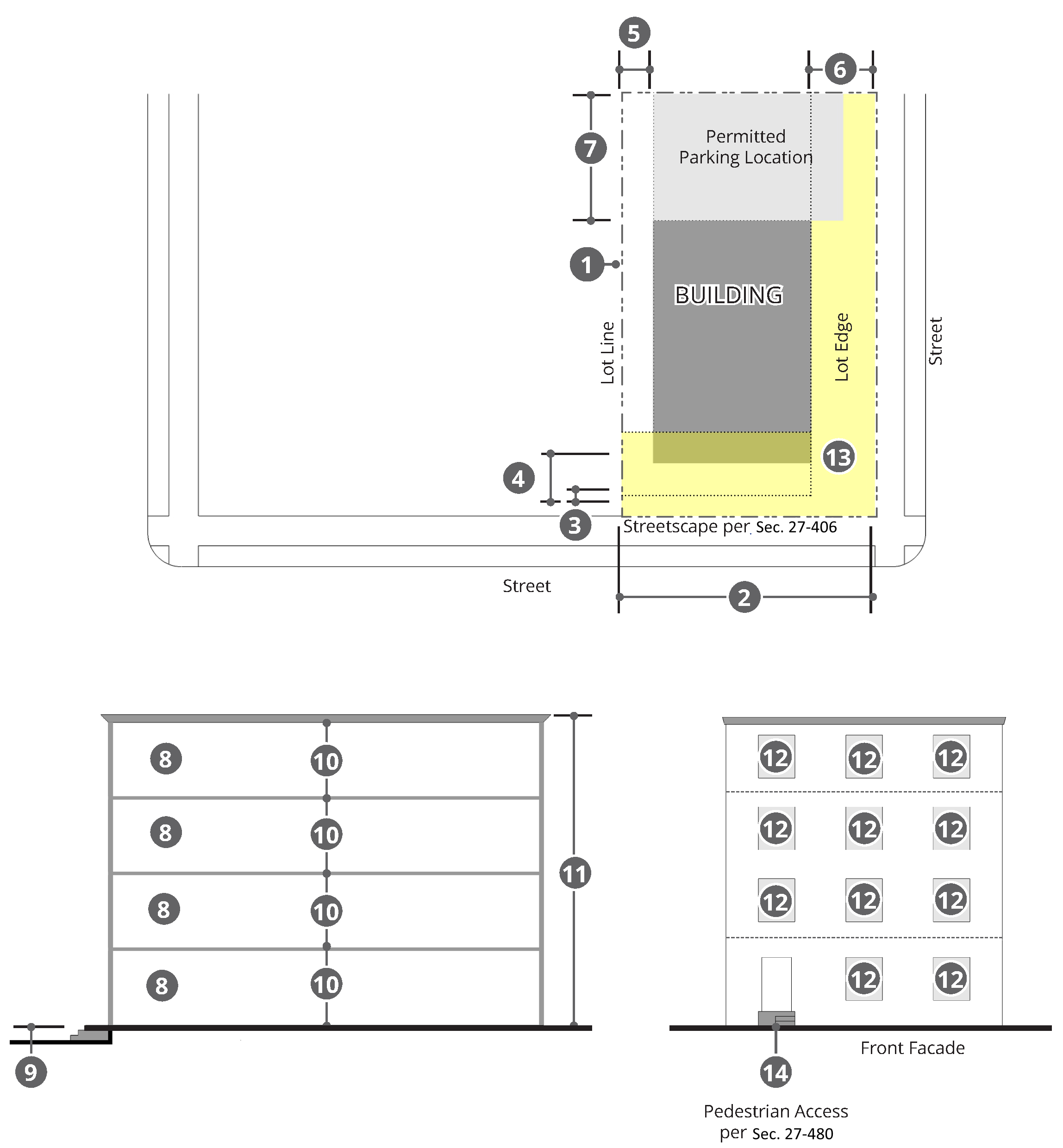
(Ord. No. RZ-2018-11-06, § I, Exh. A(27.99), 11-27-2018)
Sec. 27-470. - Commercial house regulations.
Commercial houses are subject to the regulations of table 6-6 (see also figure 6-4 and the Peachtree Road Overlay [/PRO] regulations of article V).
| TABLE 6-6 — COMMERCIAL HOUSES | PR-1 | PR-2 | PR-3 | Supplemental | |
|---|---|---|---|---|---|
| a. Lot | |||||
| Minimum Lot Area (square feet) | 4,000 | 4,000 | 4,000 | |
| Minimum Lot Width (feet) | 40 | 40 | 40 | |
| b. Siting | |||||
| Minimum Front Setback (feet) | 30 | 30 | 30 | See Sec. 27-473 |
| Minimum Interior (non-street) Side Setback (feet) | 3 | 3 | 3 | |
| Minimum Street Side Setback (feet) | 15 | 15 | 15 | |
| Minimum Rear Setback (feet) | 30 | 30 | 30 | |
| c. Uses | |||||
| Allowed Uses in Ground Story Allowed Uses in Other Stories |
nonresidential uses allowed by Table 7-1
any use allowed by Table 7-1 | |||
| d. Open Space and Building Coverage | |||||
| Minimum Open Space (% of development site) | |||||
| Site Area less than 1 Acre | 10 | 10 | 10 | See Sec. 27-482 | |
| Site Area 1 Acre or more | 15 | 15 | 15 | ||
| Maximum Building Coverage (% of lot area) | 55 | 55 | 55 | ||
| e. Height | |||||
| Ground-Story Elevation (min/max above sidewalk, ft.) | 0 to 3 | 0 to 3 | 0 to 3 | |
| Minimum Height per Story (feet, floor-to-floor) | 9 | 9 | 9 | See Sec. 27-1338 |
| Maximum Height per Story (feet, floor-to-floor) | 14 | 14 | 14 | See Sec. 27-1338 |
| Maximum Overall Height (stories) | 3 | 3 | 3 | See Sec. 27-1338 |
| f. Facades | |||||
| Minimum Front Facade Transparency | 15 | 15 | 15 | See Sec. 27-476 |
| Minimum Street-Side Facade Transparency | 5 | 5 | 5 | See Sec. 27-476 |
| g. Lot Edges | |||||
| Edge Type Required | Landscape or Hardscape |
See Sec. 27-477 and Sec. 27-480 | ||
| Edge Element Required | Porch or Stoop | |||
Figure 6-4. Commercial Houses in PR Districts
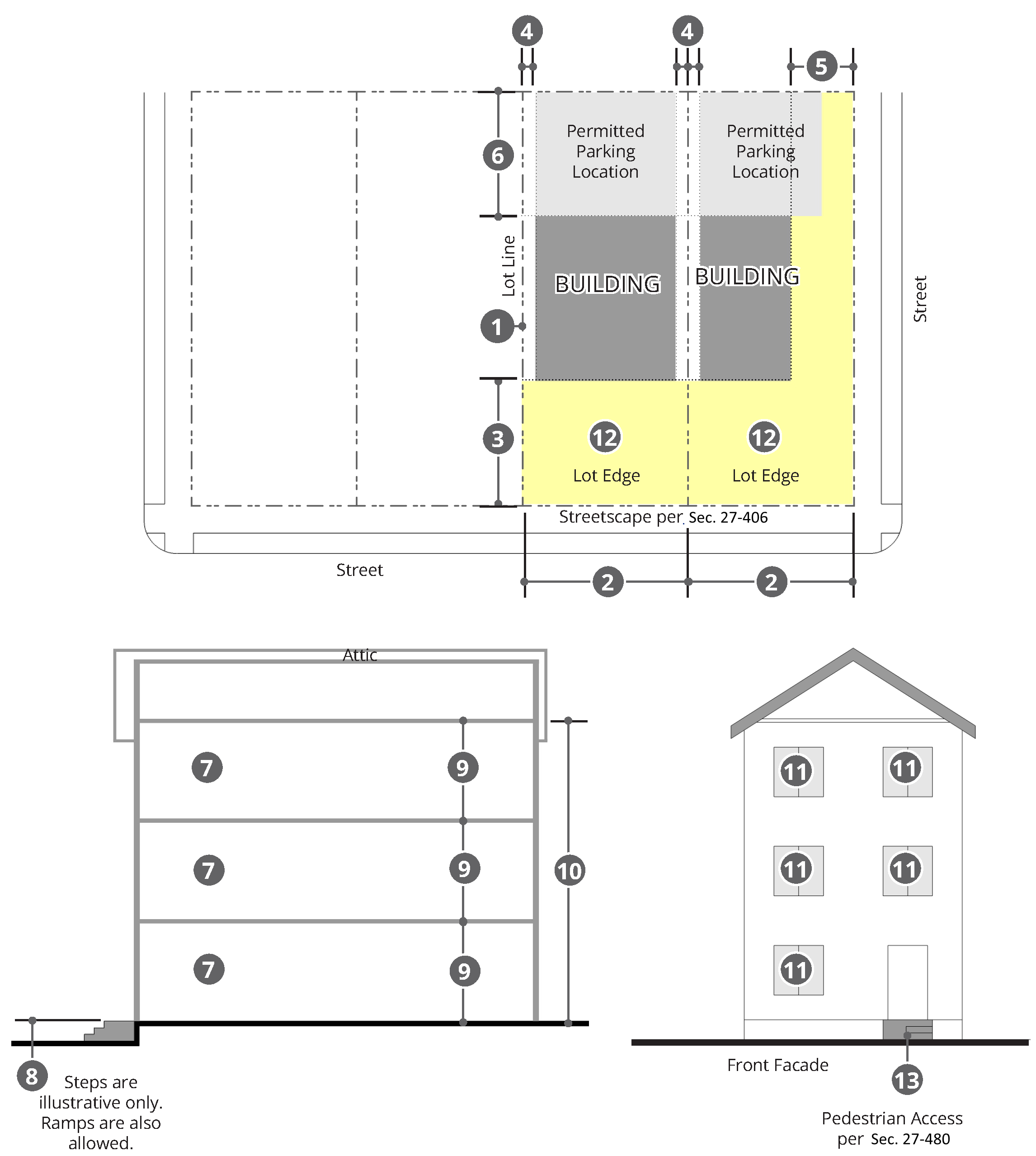
(Ord. No. RZ-2018-11-06, § I, Exh. A(27.100), 11-27-2018)
Sec. 27-471. - Shopfront building regulations.
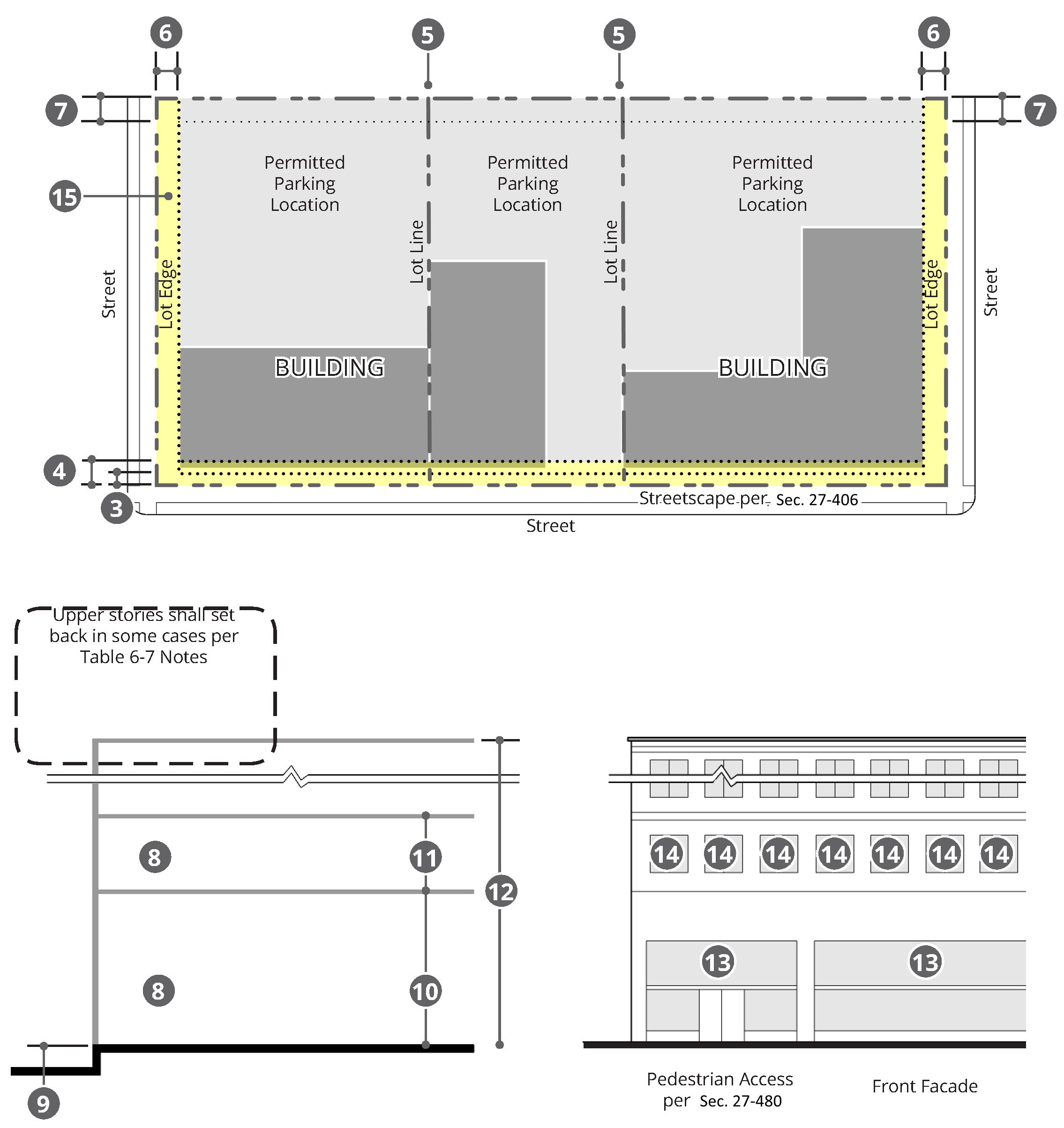
Shopfront buildings are subject to the regulations of table 6-7 (see also figure 6-5 and the Peachtree Road Overlay [/PRO] regulations of article V).
| TABLE 6-7 — SHOPFRONT BUILDINGS | PR-1 | PR-2 | PR-3 | Supplemental | |
|---|---|---|---|---|---|
| a. Lot | |||||
| Minimum Lot Area/Width | None | None | None | ||
| b. Siting | |||||
| Minimum Front Setback (feet) | 5 | 5 | 5 | See Sec. 27-473 |
| Maximum Front Setback (feet) | 10 | 10 | 10 | See Sec. 27-473 |
| Minimum Building Coverage at/between Min. and Max. Front Setback (%) | 80 | 80 | 80 | ||
| Minimum Interior (non-street) Side Setback (feet) | 0 or 5 | 0 or 5 | 0 or 5 | |
| Minimum Street Side Setback (feet) | 10 | 10 | 10 | |
| Minimum Rear Setback (feet) | 10 | 10 | 10 | |
| c. Uses | |||||
| Allowed Uses in Ground Story | nonresidential uses allowed by Table 7-1 | |||
| Allowed Uses in Other Stories | any use allowed by Table 7-1 | ||||
| d. Open Space and Building Coverage | |||||
| Minimum Open Space (% of development site) | |||||
| Site Area less than 1 Acre | 10 | 10 | 10 | See Sec. 27-482 | |
| Site Area 1 Acre or more | 15 | 15 | 15 | ||
| Maximum Building Coverage (% of lot area) | 85 | 85 | 85 | ||
| e. Height | |||||
| Ground-Story Elevation (min/max above sidewalk, ft.) | 0 to 3 | 0 to 3 | 0 to 3 | |
| Minimum Height per Story (feet, floor-to-floor) | |||||
| Ground Story | 14 | 14 | 14 | See Sec. 27-1338 |
| Upper Stories (above first) | 10 | 10 | 10 | ||
| Maximum Height per Story (feet, floor-to-floor) | |||||
| Ground Story | 30 | 30 | 30 | See Sec. 27-1338 |
| Upper Stories (above first) | 14 | 14 | 14 | ||
| Minimum Overall Height (stories) | 2 | 2 | 2 | See Sec. 27-1338 | |
| Maximum Overall Height (stories) [1][2] | |||||
| Without Bonus | 6 | 4 | 3 | |
| With Public Benefit Bonuses | 8 | 6 [3] | 4 | See Sec. 27-474 | |
| With TOD Bonus | 12 | NA | NA | See Sec. 27-475 | |
| f. Facades | |||||
| Minimum Front Facade Transparency | ||||
| Ground Story | 75 | 75 | 75 | See Sec. 27-476 |
| Upper Stories (above first) | 35 | 35 | 35 | ||
| Minimum Street-Side Facade Transparency | |||||
| Ground Story | 40 | 40 | 40 | See Sec. 27-476 | |
| Upper Stories (above first) | 15 | 15 | 15 | ||
| g. Lot Edges | |||||
 | Edge Type Required | Hardscape |
See Sec. 27-477 and Sec. 27-480 | ||
| Edge Element Required | None | ||||
Table 6-7 Notes
[1] On lots with frontage on Apple Valley Road, all portions of buildings above 80
feet in height shall be set back at least 20 feet from the front facade of the building
story immediately below.
[2] All portions of buildings above 60 feet in height shall be set back at least 20
feet from the front facade of the building story immediately below.
[3] Buildings may not exceed 4 stories in height east of Apple Valley Road.
Figure 6-5. Shopfront Buildings in PR Districts
(Ord. No. RZ-2018-11-06, § I, Exh. A(27.101), 11-27-2018)
Sec. 27-472. - General building regulations.
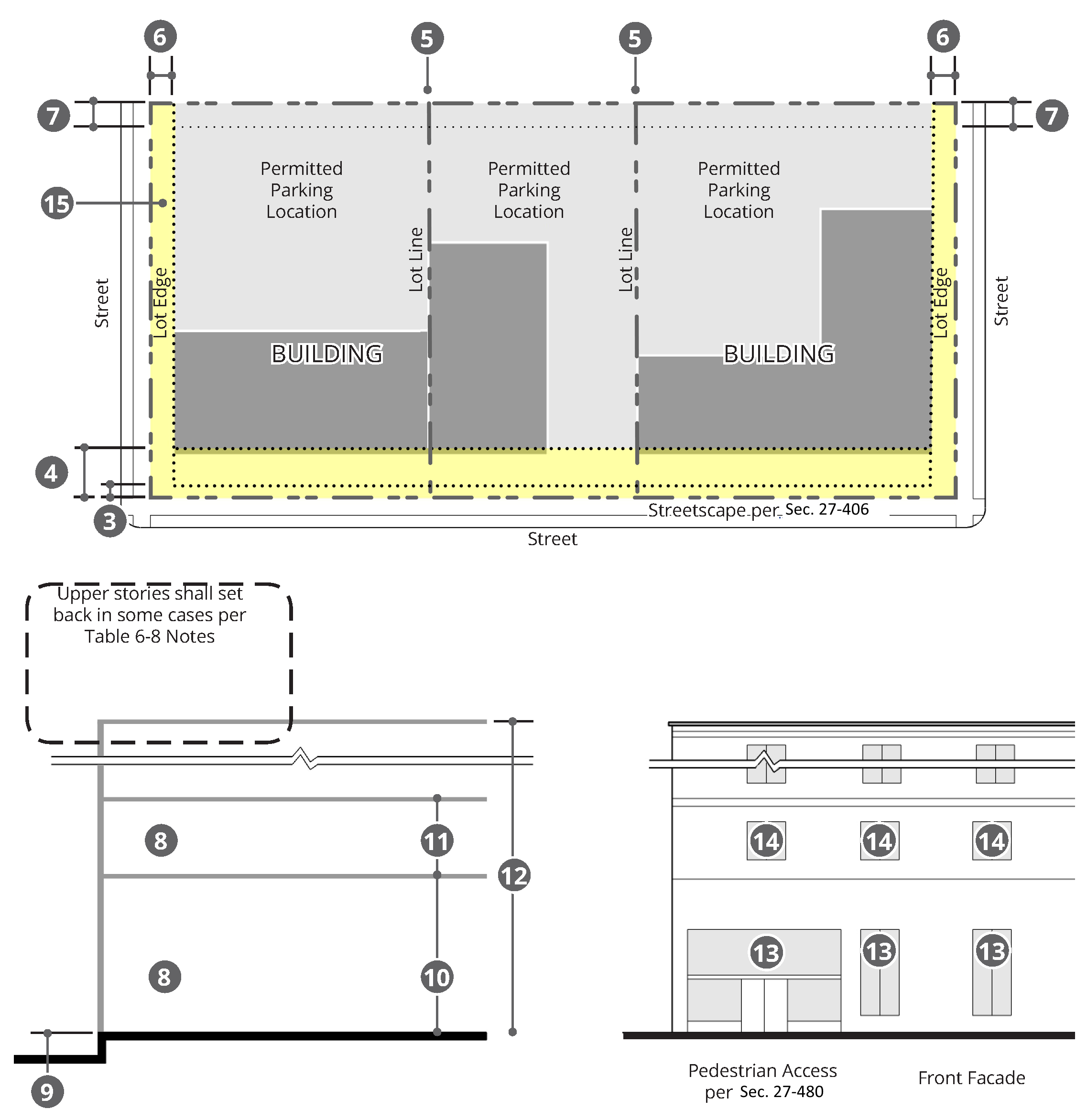
General buildings are subject to the regulations of table 6-8. (See also figure 6-6 and the Peachtree Road Overlay [/PRO] regulations of article V).
| TABLE 6-8 — GENERAL BUILDINGS | PR-1 | PR-2 | PR-3 | Supplemental | |
|---|---|---|---|---|---|
| a. Lot | |||||
| Minimum Lot Area (square feet) | None | None | None | |
| Minimum Lot Width (feet) | None | None | None | |
| b. Siting | |||||
| Minimum Front Setback (feet) | 5 | 5 | 5 | See Sec. 27-473 |
| Maximum Front Setback (feet) | 20 | 20 | 20 | See Sec. 27-473 |
| Minimum Building Coverage at/between Min. and Max. Front Setback (%) | 60 | 60 | 60 | ||
| Minimum Interior (non-street) Side Setback (feet) | 0 or 5 | 0 or 5 | 0 or 5 | |
| Minimum Street Side Setback (feet) | 10 | 10 | 10 | |
| Minimum Rear Setback (feet) | 10 | 10 | 10 | |
| c. Uses | |||||
| All Stories | any use allowed by Table 7-1 [1] | |||
| d. Open Space and Building Coverage | |||||
| Minimum Open Space (% of development site) | |||||
| Site Area less than 1 Acre | 10 | 10 | 10 | See Sec. 27-482 | |
| Site Area 1 Acre or more | 15 | 15 | 15 | ||
| Maximum Building Coverage (% of lot area) | 85 | 85 | 85 | ||
| e. Height | |||||
| Ground-Story Elevation (min/max above sidewalk, ft.) | 0 to 3 | 0 to 3 | 0 to 3 | |
| Minimum Height per Story (feet, floor-to-floor) | ||||
| Ground Story | 14 | 14 | 14 | See Sec. 27-1338 |
| Upper Stories (above first) | 10 | 10 | 10 | ||
| Maximum Height per Story (feet, floor-to-floor) | ||||
| Ground Story | 30 | 30 | 30 | See Sec. 27-1338 |
| Upper Stories (above first) | 14 | 14 | 14 | ||
| Minimum Overall Height (stories) | 2 | 2 | 2 | See Sec. 27-1338 |
| Maximum Overall Height (stories) [2][3] | |||||
| Without Bonus | 6 | 4 | 3 | ||
| With Public Benefit Bonuses | 8 | 6 [4] | 4 | See Sec. 27-474 |
| With TOD Bonus | 12 | NA | NA | See Sec. 27-475 | |
| f. Facades | |||||
| Minimum Front Facade Transparency | ||||
| Ground Story | 25 | 25 | 25 | See Sec. 27-476 |
| Upper Stories (above first) | 15 | 15 | 15 | ||
| Minimum Street-Side Facade Transparency | |||||
| All Stories | 15 | 15 | 15 | See Sec. 27-476 | |
| g. Lot Edges | |||||
| Edge Type Required | Landscape or Hardscape |
See Sec. 27-477 and Sec. 27-480 | ||
| Edge Element Required | None | ||||
Table 6-8 Notes
[1] No less than 25% of ground story floor area shall be occupied by those active
ground-story uses identified in Sec. 27-474; however, where a general building is part of a multi-building development and not
located along a public right-of-way, active ground-story uses shall not be required
and any use allowed by Table 7-1 shall be permitted.
[2] On lots with frontage on Apple Valley Road, all portions of buildings above 80
feet in height shall be set back at least 20 feet from the front facade of the building
story immediately below.
[3] All portions of buildings above 60 feet in height shall be set back at least 20
feet from the front facade of the building story immediately below.
[4] Buildings may not exceed 4 stories in height east of Apple Valley Road.
Figure 6-6. General Buildings in PR Districts
(Ord. No. RZ-2018-11-06, § I, Exh. A(27.102), 11-27-2018; Ord. No. 2019-05-03, § I(Attch.), 5-28-2019; Ord. No. 2020-09-11, § I(Attch.), 9-22-2020)
Sec. 27-473. - Front setbacks.
Minimum and maximum front setbacks within the PR districts are measured from the inner edge of the pedestrian zone established by the Peachtree Road Overlay district (/PRO) regulations of article V, division 3. The maximum front setback regulations are not intended to prohibit placement of open space between buildings and streets. When open space is located between a building and the street, the open space shall comply with the applicable regulations of section 27-482 and any maximum setback is measured from the perimeter of the open space area.
(Ord. No. RZ-2018-11-06, § I, Exh. A(27.103), 11-27-2018)
Sec. 27-474. - Public benefit height bonuses.
Bonus building height is allowed for sites or buildings that provide public benefits in the form of additional open space, workforce housing units or active ground-story uses. Such bonuses are allowed only as expressly identified in section 27-468, section 27-469, section 27-471 and section 27-472, and this section.
(1)
Open space.
a.
Building height bonuses for the provision of additional open space (above minimum required levels) are allowed only on sites with an area of one acre or more.
b.
One story of bonus height is allowed for projects that set-aside at least 20 percent of the site as publicly accessible open space meeting all applicable regulations of section 27-482.
(2)
Workforce housing.
a.
Building height bonuses for the provision of workforce housing are allowed for attached houses, walk-up buildings, shopfront buildings and general buildings.
b.
One story of bonus height is allowed for restricting at least 20 percent of housing units on the development site as workforce housing units.
c.
Workforce housing units provided to obtain building height bonuses shall be restricted for occupancy as workforce housing units for at least 20 years.
d.
Deed restrictions or other binding agreements governing the design, location and restricted occupancy of workforce housing units shall be provided in a form approved by the city attorney.
(3)
Active ground-story uses.
a.
Building height bonuses for the provision of active uses on the ground-story of shopfront buildings are allowed only on lots with frontage on Peachtree Road or Apple Valley Road.
b.
One story of bonus height is available for restricting at least 75 percent of the ground story floor area in such buildings to occupancy by one or more of the following uses:
1.
Art gallery;
2.
Commercial service, such as dry cleaning pick-up station, copy shop, electronics/jewelry repair, and shoe repair;
3.
Personal improvement service, such as barbershop, beauty shop, nail salon, day spa, yoga/fitness studio, and dance studio;
4.
Restaurant (except drive-through); or
5.
Retail sales.
c.
In order to count towards meeting the 75 percent minimum, the ground-story floor space shall have a minimum depth of at least 30 feet.
d.
Deed restrictions or other binding agreements governing the design, location and occupancy of ground-story floor space shall be provided and approved by the city attorney.
(Ord. No. RZ-2018-11-06, § I, Exh. A(27.104), 11-27-2018)
Sec. 27-475. - TOD height bonus.
(a)
Special building height bonuses are available within the TOD (transit-oriented development) height bonus area and only as expressly identified in section 27-471 and section 27-472.
(b)
The area eligible for TOD height bonuses is bounded by the centerline of the following streets, provided that TOD height bonuses are prohibited for buildings located within 150 feet of the centerline of Apple Valley Road:
(1)
North Druid Hills Road on the south;
(2)
Peachtree Road on west;
(3)
Dresden Drive on the north; and
(4)
Apple Valley Road on the east.
(c)
TOD building height bonuses require review and approval in accordance with the special land use permit procedures of article 10, division 3 of this chapter.
(d)
All properties for which TOD height bonuses are requested shall comply with the following supplemental regulations:
(1)
At least 25 percent of the subject site shall be publicly accessible open space that complies with section 27-482. Open space provided to meet TOD bonus eligibility requirements may be located outside of the TOD bonus area described in paragraph (b) of this section (section 27-475), provided that they are located west of Apple Valley Road and located on the same site as the building receiving the bonus sites with frontage on Peachtree Road shall include at least one open space that is at least 10,000 square feet in area. Sites with frontage on Apple Valley Road shall include at least one contiguous open space area that is suitable for public gatherings and is at least 40,000 square feet in area. Sites with frontage on both Peachtree Road and Apple Valley Road shall provide both required forms of open space.
(2)
In addition to meeting the open space requirements of paragraph (d)(1) of this section, the proposed development shall also provide at least two of the following features:
a.
Workforce housing units equal to at least 20 percent of the overall number of dwelling units in the project, subject to section 27-474.
b.
At least 40,000 square feet of active ground story uses, subject to section 27-474.
c.
A community meeting facility with a gross floor area of at least 8,000 square feet, which can be in the form of a community center, public meeting room, or public library meeting room that is available for community meetings, easily accessible to the public and with access to public restrooms and a service kitchen to support catered events and convenience food service.
(Ord. No. RZ-2018-11-06, § I, Exh. A(27.105), 11-27-2018)
Sec. 27-476. - Transparency.
Transparency regulations govern the minimum percentage of a street-facing building façade that shall be covered by windows or glazed, transparent elements. In determining compliance with transparency requirements on a building facade, the transparency of each building story shall be calculated separately.
(Ord. No. RZ-2018-11-06, § I, Exh. A(27.106), 11-27-2018)
Sec. 27-477. - Lot edges.
(a)
Description. The term "lot edge" refers to the area of a lot located immediately beyond the back of the required sidewalk between:
(1)
The back of the sidewalk and a principal building;
(2)
The back of the sidewalk and an allowed unenclosed parking lot or parking deck; and
(3)
The back of the sidewalk and an allowed open space area.
(b)
Purpose. The design of lot edges helps define the transition between public and private property and contributes to the overall character of an area, particularly for pedestrians.
(c)
Edge type regulations.
(1)
General. Different lot edge types and elements are required in accordance with the regulations that apply to the different building types allowed in PR districts (see section 27-467, section 27-468, section 27-469, section 27-470, section 27-471 and section 27-472). The following general regulations apply to all lot edge types:
a.
Mechanical equipment and other building service may not be located in the lot edge along the front of the lot.
b.
Lot edges may not be used for vehicles, except for driveway or alley crossing, incidental service, maintenance or emergency actions.
c.
Lot edges may not be counted towards meeting minimum open space requirements except when an open space edge is incorporated into a conforming open space.
(2)
Landscape edge. Landscape edges are subject to the following additional regulations:
a.
Landscaping, such as trees, shrubs, groundcover plants, sod, or annual or perennial vegetation, shall be provided in at least 50 percent of the lot edge area. The area of any stoops or porches is not counted in determining the total lot edge area.
b.
The area of water features, such as pools and fountains, may not be counted towards satisfying minimum landscape area requirements.
c.
The landscape edge may not be used for vehicles, except for incidental service, maintenance or emergency actions.
d.
The landscape edge may not be covered, except by incidental architectural projections such as balconies, awnings, cornices, and similar architectural elements.
e.
Landscape edges greater than five feet in depth shall be planted with at least one tree per 50 linear feet.
(3)
Hardscape edge. Hardscape edges are subject to the following additional regulations:
a.
Hardscape areas improved for pedestrian amenity or aesthetic appeal shall be provided in at least 50 percent of the lot edge area. The area of any stoops or porches is not counted in determining the total lot edge area.
b.
The area of water features, such as pools and fountains, may be counted towards satisfying minimum hardscape area requirements.
c.
Hardscape edges greater than ten feet in depth shall be planted with at least one shade tree per 50 linear feet. Required trees shall comply with the size requirements of section 27-483.
d.
Hardscape edges shall provide at least one bench or similar seating area per 50 linear feet.
e.
Hardscape edges may not be covered, except by incidental architectural projections such as balconies, awnings, cornices, and similar architectural elements or by outdoor dining areas.
(4)
Parking edge. Lot edges that are immediately adjacent to an allowed parking lot are subject to following regulations:
a.
A landscape strip shall be provided in accordance with section 27-483.
b.
At least one point of pedestrian access in the form of paths, walkways, ramps, or stairs shall be provided to connect the public sidewalk to the parking lot.
(5)
Open space edge. Lot edges that are immediately adjacent to an allowed open space are subject to following regulations:
a.
Pedestrian access in the form of paths, walkways, ramps, or stairs shall be provided to connect the adjacent public sidewalk to the open space.
b.
At least one pedestrian access point shall be provided per 100 linear feet.
(d)
Edge elements. Edge elements in the form of porches and stoops are required for detached house, attached house, walk-up and commercial house building types (see section 27-406, section 27-468, section 27-469, and section 27-470). When required, such elements are subject to compliance with the regulations of this subsection.
(1)
Porches. Required porches shall be located along the front facade and comply with the following:
a.
A porch shall be at least six feet in depth, not including steps leading to the porch.
b.
A porch shall have a width of at least 33 percent of the building facade from which it projects.
c.
A porch shall have a roof, but it may not be enclosed other than by screens.
d.
Porches required under these PR district provisions may extend into a required front setback if such extension is at least two feet from all lot lines.
e.
A porch may not encroach into a required sidewalk.
(2)
Stoops. Required stoops shall be located along the front facade and comply with the following:
a.
A stoop may not exceed six feet in depth, not including any steps leading to the stoop.
b.
A stoop may have a cover but may not be enclosed.
c.
Stoops required under these PR district provisions may extend into a required front setback if such extension is at least two feet from all lot lines.
d.
A stoop may not encroach into a required sidewalk.
(Ord. No. RZ-2018-11-06, § I, Exh. A(27.107), 11-27-2018)
Sec. 27-478. - Neighborhood transitions.
(a)
Neighborhood transition buffers.
(1)
Except as provided in paragraph (a)(2) of this section (section 27-478), when a PR-zoned lot abuts any R- or RM-zoned lot, a neighborhood transition buffer shall be maintained on the PR-zoned lot to help ensure effective buffering and visual screening between the districts. The required buffer shall have a width of at least 30 feet or a width equal to 15 percent of the depth of the subject lot, whichever is greater.
a.
The required neighborhood transition buffer shall be left undisturbed, and may not be paved or otherwise covered with impervious surfaces.
b.
Neighborhood transition buffers may not be used for parking, loading, storage or any other use, except that the community development director is authorized to permit the placement of utilities within neighborhood transition buffer areas when the applicant shows that it is impractical to place such utilities outside required buffers.
c.
Trees may not be removed from required neighborhood transition buffer areas unless such trees are dead or diseased, as determined by the city arborist. The community development director is authorized to require the installation of new trees, and landscape screening material, including plants and fences, when determined to be necessary to provide an effective visual screen.
(2)
When a lot occupied solely by detached houses or attached houses is allowed in lieu of a neighborhood transition buffer, it is exempt from the neighborhood transition buffer requirements of paragraph (a)(1) of this section (section 27-478).
(b)
Neighborhood transition height plane.
(1)
All PR-zoned lots that abut R- or RM-zoned lots or that are separated from R- or RM-zoned lots solely by street or railroad right-of-way are subject to the neighborhood transition height plane requirements of this subsection (section 27-478(b)).
(2)
The neighborhood transition height plane begins 45 feet above ground level at the common lot line between the PR- and R- or RM-zoned lot and extends inward (towards the PR-zoned lot) for a horizontal distance of 75 feet and then angles upward at a 45 degree angle. When a street or railroad right-of-way separates the PR- and R- or RM-zoned lots, the neighborhood transition height plane measurement begins 45 feet above ground level at the lot line of the R- or RM-zoned lots (on the opposite side of the right-of-way from the PR-zoned lot).
(3)
No building or portion of building may protrude above the neighborhood transition height plane established in this subsection (section 27-478(b)).
(Ord. No. RZ-2018-11-06, § I, Exh. A(27.108), 11-27-2018)
Sec. 27-479. - Building design and plan review.
(a)
Applicability. The building design regulations of this section apply to all allowed building types except detached houses, unless otherwise expressly stated.
(b)
Purposes. The building design regulations of this section are intended to improve the physical and aesthetic quality of buildings, activate the pedestrian environment and maintain and protect the character of PR districts.
(c)
Exterior wall finish materials.
(2)
The following exterior wall finish materials shall be used on at least 80 percent of the first four stories of any building facade visible from a public street, not including building foundations, non-glass window components, and doors:
a.
Brick, including full-depth and half-depth masonry brick, but not simulated brick veneers; or
b.
Stone, including unpainted natural stone, unpainted cast stone having the appearance of natural stone, and unpainted terracotta.
(2)
The following exterior wall finish materials shall be used on at least 80 percent of the first four stories of any building facade that is not visible from a public street, not including building foundations, non-glass window components, and doors:
a.
Building materials allowed on facades visible from public streets;
b.
Wood, including natural wood or cement-based artificial wood siding; or
c.
Shingles, including wood or cement-based shakes and shingles.
(3)
The exterior wall finish material regulations of paragraphs (c)(1) and (c)(2) of this section (section 27-479) also apply to buildings more than four stories in height, except that glass and metal curtain wall systems are allowed to be used on all building stories above the fourth story.
(4)
Building materials other than those expressly identified in paragraphs (c)(1), (c)(2) and (c)(3) of this section (section 27-479) may be used on up to 20 percent of any exterior building facade, calculated on the basis of each individual building facade.
(d)
Vertical delineation of building stories. The first one or two stories of every shopfront and general building shall be delineated from the stories above through the use of cornice lines, horizontal shadow lines, fenestration and other forms of architectural detailing.
(e)
Building articulation and massing.
(1)
In order to avoid large expanses of flat (one-dimensional) exterior walls along sidewalks, building facades over 50 feet in length along a street, including abutting attached house dwelling units, shall incorporate wall projections or recesses a minimum of 12 inches in depth. The combined length of such recesses and projections shall constitute at least 20 percent of the total façade length along the public street.
(2)
Building roof lines along street-facing facades shall change at least once every 200 feet of facade length. This change shall occur for a minimum length of 20 feet and be accomplished through at least one of the following:
a.
A change of roof parapet wall height and material;
b.
A change in roof cornice design;
c.
A change in the number of stories;
d.
A change in roof shape.
(3)
Street-facing building facades may not exceed 300 feet in length along any single street.
(f)
Plan review.
(1)
The community development director is expressly authorized to delegate plan and design reviews for any project within a PR district to design professionals retained by the city to provide design review assistance.
(2)
The costs of any third-party plan reviews shall be borne by the applicant.
(3)
If the project requires review or approval by the board of appeals, planning commission or city council (e.g., as part of a rezoning, SLUP, variance, etc.,), the findings and recommendations from the plan review shall be forwarded to the applicable review and decision making body for consideration before the time of their recommendation or decision.
(Ord. No. RZ-2018-11-06, § I, Exh. A(27.109), 11-27-2018; Ord. No. 2019-05-04, § I(Attch.), 5-28-2019)
Sec. 27-480. - Pedestrian access.
(a)
Buildings abutting lot edges. All buildings that abut a lot edge (see section 27-477) are subject to the following regulations:
(1)
All building types and individual ground-story commercial establishments shall provide a pedestrian entrance along the lot edge that provides both ingress and egress, operable to residents or customers. This requirement expressly applies to individual dwelling units with an attached house building.
(2)
Additional entrances off another street, an open space, or internal parking area are also permitted.
(3)
If a building abuts a lot edge along more than one public street, the required pedestrian entrance shall face the street with the highest classification, as follows (from highest to lowest):
a.
Primary streets: Peachtree Road and Apple Valley Road;
b.
Secondary streets: Dresden Drive, North Druid Hills Road, Hermance Drive, Ashford-Dunwoody Road, Lanier Drive, Osborne Drive, Brookhaven Place; and
c.
Tertiary streets: new and existing streets not classified as primary or secondary.
(4)
All required entrances shall provide safe and convenient pedestrian pathways from the adjacent public sidewalk. Pathways that exclusively serve individual residential units shall have a minimum width of three feet. All other pathways shall have a minimum width of five feet.
(b)
Buildings not abutting lot edges. All buildings that do not abut a lot edge are subject to the following regulations:
(1)
Buildings and individual ground-story commercial establishments shall provide safe and convenient pedestrian pathway from their required pedestrian entrance to a public sidewalk. This requirement expressly applies to individual dwelling units with an attached house building.
(2)
Pathways that exclusively serve individual residential units shall have a minimum width of three feet. All other pathways shall have a minimum width of five feet.
(3)
The total combined length of the pedestrian pathway from the entrance to the sidewalk may not exceed 150 percent of the straight line distance from the entrance to the closest public sidewalk, except where an intervening rail line, stream or similar physical barrier exists.
(Ord. No. RZ-2018-11-06, § I, Exh. A(27.110), 11-27-2018)
Sec. 27-481. - Parking.
(a)
General. The parking and access regulations of article VIII apply in PR districts unless otherwise expressly stated in this division (article VI, division 2).
(b)
Parking location.
(1)
Access to off-street parking spaces serving attached houses shall come from alleys or shared driveways located in street side or rear yard. Access to off-street parking spaces serving all other building types shall come from alleys or driveways.
(2)
Off-street parking may not be located between a public street and a principal building's front facade. On lots with more than one street frontage, the front of the lot is deemed to be the side of the lot with frontage on the street with the highest classification, as follows (from highest to lowest):
a.
Primary streets: Peachtree Road and Apple Valley Road;
b.
Secondary streets: Dresden Drive, North Druid Hills Road, Hermance Drive, Ashford-Dunwoody Road, Lanier Drive, Osborne Drive, Brookhaven Place; and
c.
Tertiary streets: New streets and existing streets not classified as primary or secondary.
(3)
Off-street parking spaces located within the ground-story of any building, including a parking deck, may not be located within 20 feet of any street-facing building facade that abuts a lot edge. This provision does not apply to the street-side facade of detached houses or attached houses.
(4)
Wheel stops shall be provided in parking spaces located adjacent to pedestrian zones.
(c)
Design.
(1)
Parking decks. All upper stories of a parking deck visible from a public street are subject to the building design regulations of section 27-479.
(2)
Parking deck lighting. Light fixtures that are directly visible from the exterior of a parking deck shall either be directed upward or shielded so that the light source is not visible from outside the parking deck.
(Ord. No. RZ-2018-11-06, § I, Exh. A(27.111), 11-27-2018; Ord. No. 2019-05-03, § I(Attch.), 5-28-2019)
Sec. 27-482. - Open space.
(a)
Applicability. On-site open space shall be provided for development sites except those developed exclusively with single-family detached dwellings.
(b)
Minimum open space ratio. The minimum amount of on-site open space required is based on the size of the lot on which the use is located, as follows:
(1)
On development sites with an area of less than one acre, at least percent of the development site shall be open space; and
(2)
On development sites with an area of one acre or more, at least 15 percent of the development site shall be open space.
(c)
General regulations. The general regulations of this subsection apply to open space provided to meet minimum open space ratios and to open space provided to obtain a public benefit or TOD height bonus.
(1)
Areas counted to meet the open space regulations of this section (section 27-482) and to qualify for public benefit height bonuses (see section 27-474) shall be provided in the form of amenity spaces, plazas, pocket parks or parks that comply with the applicable regulations of this section. Street rights-of-way, parking lots, outdoor dining areas, neighborhood transition buffers, landscape strips and other areas that do not comply with applicable open space regulations may not be counted toward satisfying minimum or bonus open space ratios.
(2)
No buildings may be located in open spaces unless expressly stated in this section.
(3)
Unless otherwise expressly stated in this section, open spaces shall be open to general public access during daylight hours and shall be directly accessible from a public sidewalk.
(4)
Open spaces shall be at-grade, unless otherwise expressly stated in this section.
(5)
No individual open space may traverse a street or rail right-of-way unless located on a bridge over such right-of-way that conforms to the minimum dimensional requirements of the subject open space type.
(6)
When a building or individual ground-story commercial establishment adjoins an open space, pedestrian access (both ingress and egress), operable to residents or customers, shall be provided.
(7)
Stormwater management practices, such as normally dry storage and retention facilities or ponds that retain water, may be integrated into open spaces, subject to the following:
a.
Stormwater features in open space shall be designed by a qualified professional as formal or natural amenities with additional uses other than stormwater management, such as an amphitheater, sports field, or a pond or pool as part of the landscape design. It is strongly encouraged to consider eco-art landscape design principles for the design of these features.
b.
Stormwater features may not be fenced or enclosed by retaining walls over 30 inches in height.
(8)
Trees used to satisfy minimum open space requirements shall:
a.
Be at least three and one-half inches in caliper size (measured 12 inches above the ground);
b.
Be at least 16 feet in height at time of planting, with a minimum mature height of 30 feet;
c.
Be spaced at least 25 feet on-center; and
d.
Limbed up to a height of at least eight feet.
(9)
All open space requirements shall be fully met before issuance of a certificate of occupancy for the development.
(10)
Covenants or other legal arrangements shall specify ownership of all open spaces, the method of and responsibility for maintenance, taxes and insurance, compulsory membership and assessment provisions, and shall be incorporated into legal instruments sufficient to ensure that the open space requirements of this section are maintained. Such arrangements shall be in a form approved by the city attorney.
(d)
Open space types.
(1)
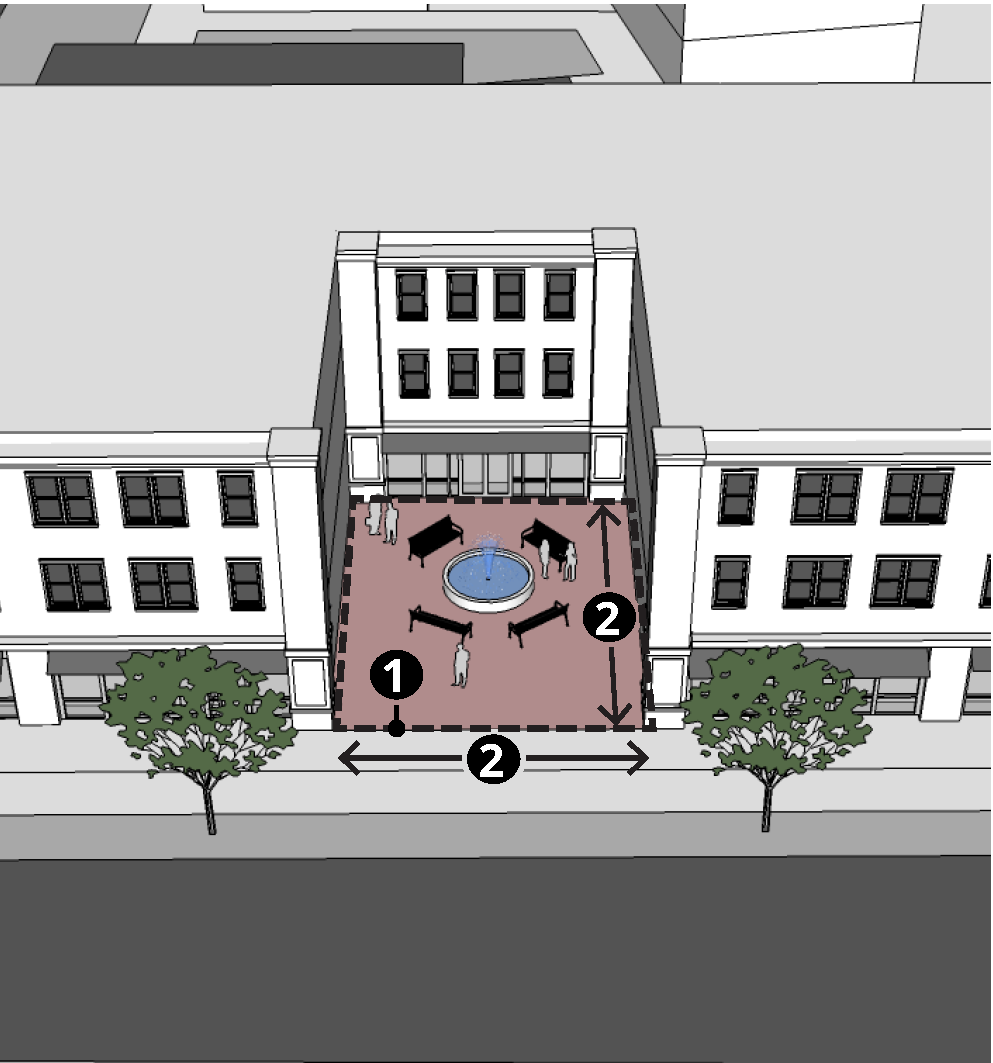
Amenity space. The amenity space open space type is intended to provide small covered or uncovered, unenclosed, outdoor areas. Amenity spaces are limited to at-grade hardscape or landscape areas improved for pedestrian enjoyment; rooftop decks; patios and porches; balconies; or yards, lawns, and gardens. Interior or exterior stairs or elevators may provide access to rooftop decks, patios, porches, and balconies. They are further subject to compliance with the criteria of table 6-9.
| TABLE 6-9 — AMENITY SPACE CRITERIA | ||
 | ||
| Criteria/Requirements | ||
 | Minimum Area (sq. ft.) | 100 |
| Maximum Area (sq. ft.) | 4,356 |
 | Minimum Dimension (ft.) | 10 |
| Min. Perimeter Length (% of open space perimeter) | ||
| Abutting Public Streets | None | |
| Abutting Buildings or Public Streets | None | |
| Maximum Coverage (% of open space area) | ||
| Impervious Surfaces | 100 | |
| Water Feature or Stormwater Features | 50 | |
| Minimum Tree Planting (or Preservation) | ||
| Minimum Seating | None | |
(2)
Plaza. The plaza open space type is intended to provide an open space, available for civic purposes and commercial activities. A plaza shall be spatially defined by buildings or streets at its edges. Plazas are subject to the regulations of table 6-10.
TABLE 6-10 — PLAZA CRITERIA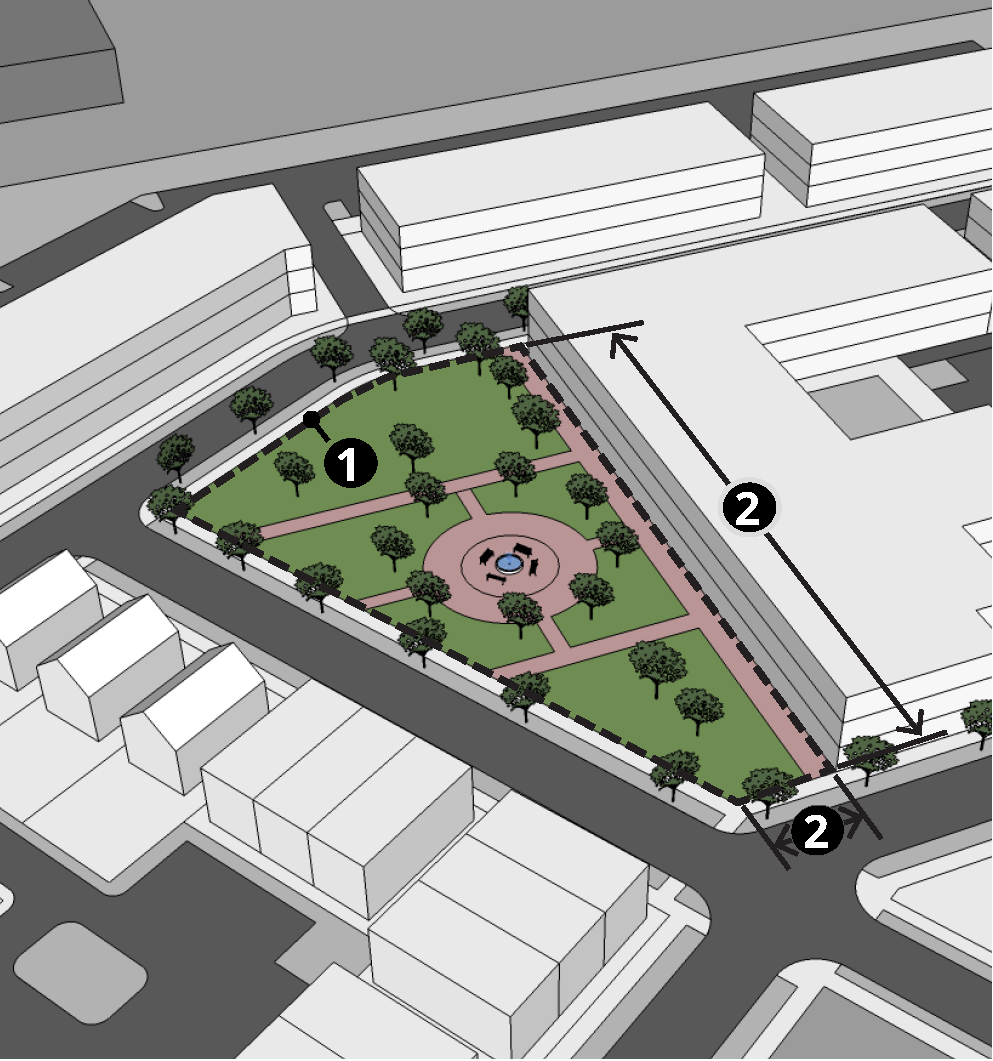 | ||
| Criteria/Requirements | ||
| Minimum Area (sq. ft.) | 4,356 |
| Maximum Area (sq. ft.) | 43,560 |
| Minimum Dimension (ft.) | 60 |
| Min. Perimeter Length (% of open space perimeter) | ||
| Abutting Public Streets | 25 | |
| Abutting Buildings or Public Streets | 75 | |
| Maximum Coverage (% of open space area) | ||
| Impervious Surfaces | 30 | |
| Water Feature or Stormwater Features | 50 | |
| Minimum Number of Trees (per 10,000 sq. ft.) | 4 | |
| Minimum Seating (per 1,000 sq. ft.) | 4 | |
(3)
Pocket park. The pocket park open space type is intended to provide an open space for unstructured recreation. A pocket park may be spatially defined by buildings or streets at its edges. Pocket parks are subject to the regulations of table 6-11.
TABLE 6-11 — POCKET PARK CRITERIA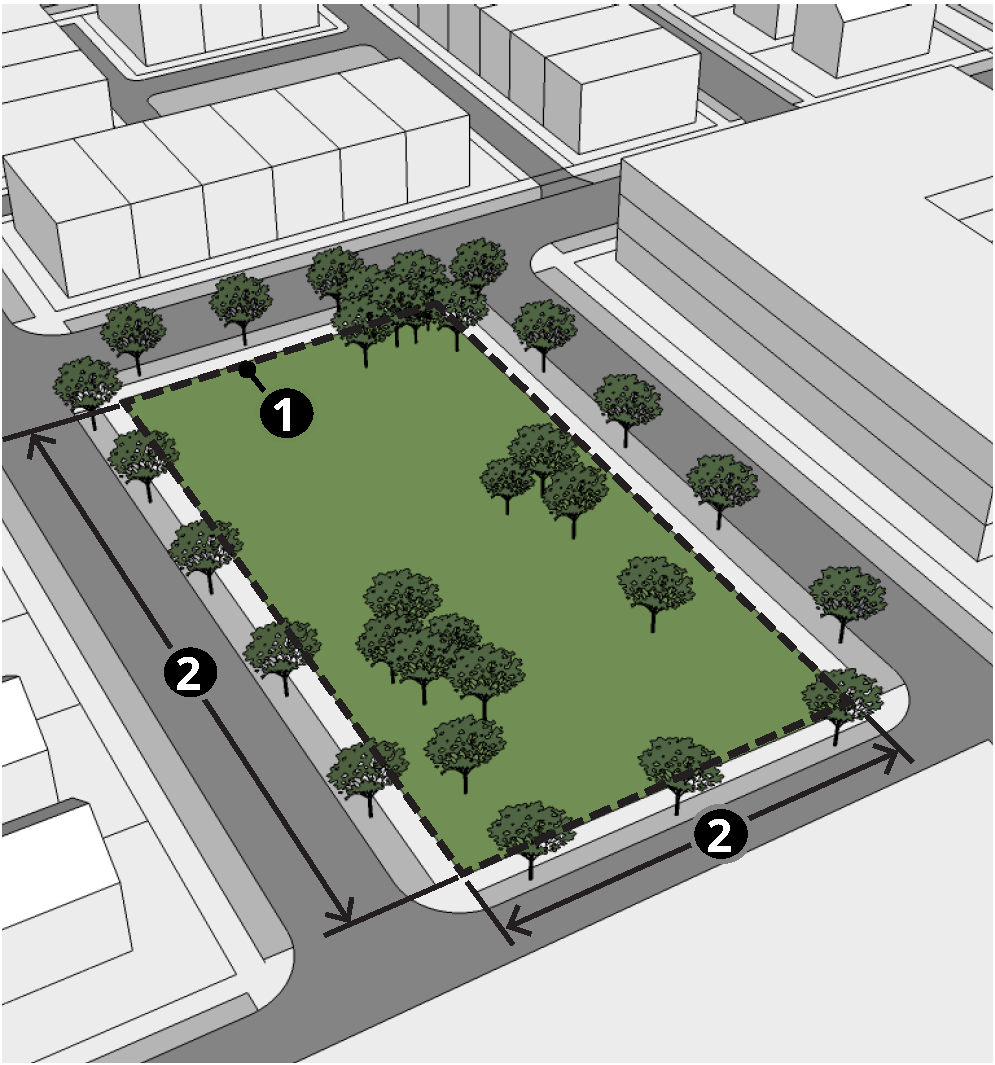 | ||
| Criteria/Requirements | ||
| Minimum Area (sq. ft.) | 4,356 |
| Maximum Area (sq. ft.) | 21,780 |
| Minimum Dimension (ft.) | 60 |
| Min. Perimeter Length (% of open space perimeter) | ||
| Abutting Public Streets | 25 | |
| Abutting Buildings or Public Streets | 50 | |
| Maximum Coverage (% of open space area) | ||
| Impervious Surfaces | 25 | |
| Water Feature or Stormwater Features | 30 | |
| Minimum Number of Trees (per 10,000 sq. ft.) | 4 | |
| Minimum Seating (per 1,000 sq. ft.) | 4 | |
(4)
Park. The park open space type is intended to provide an open space available for structured or unstructured recreation. A park may be independent of surrounding buildings at its edges. Parks are subject to the regulations of table 6-12.
TABLE 6-12 — PARK CRITERIA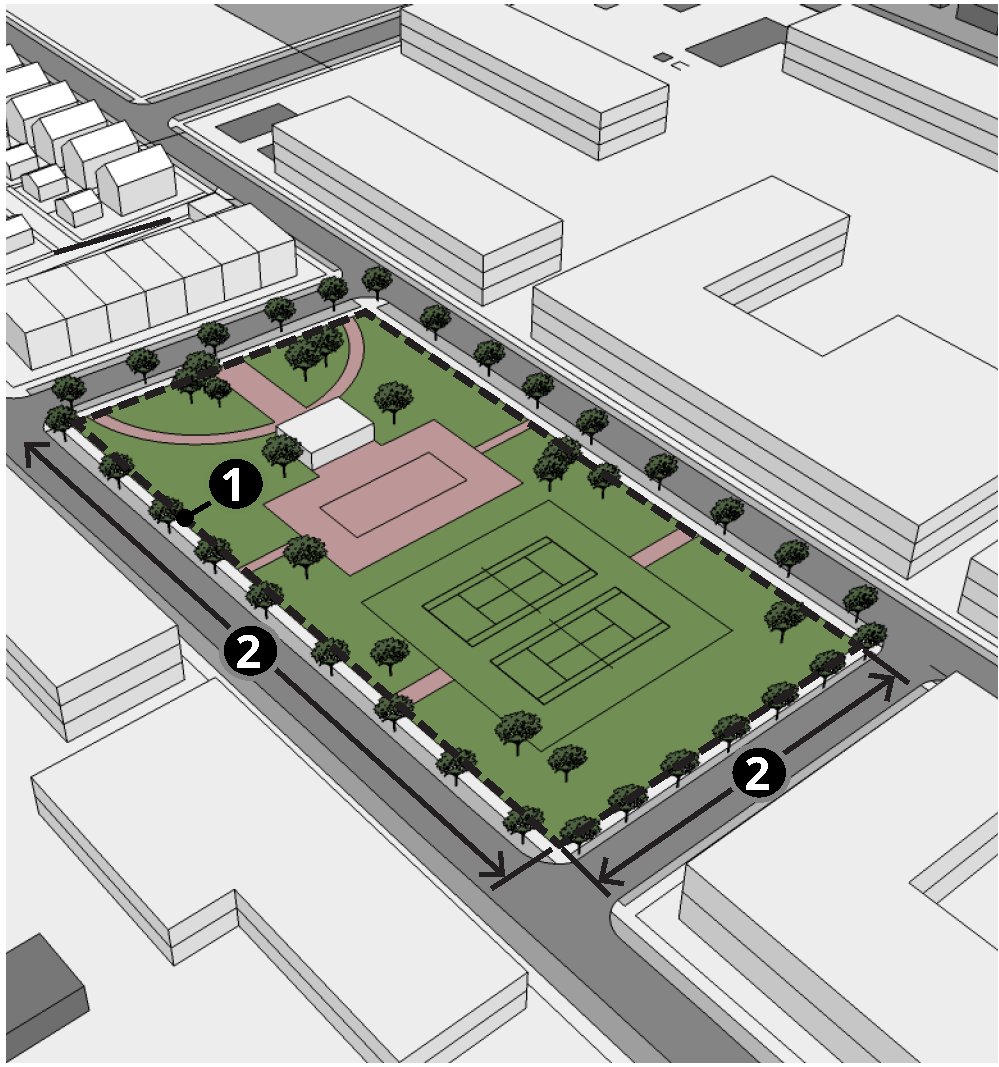 | ||
| Criteria/Requirements | ||
| Minimum Area (sq. ft.) | 21,780 |
| Maximum Area (sq. ft.) | None |
| Minimum Dimension (ft.) | 80 |
| Min. Perimeter Length (% of open space perimeter) | ||
| Abutting Public Streets | 25 | |
| Abutting Buildings or Public Streets | None | |
| Maximum Coverage (% of open space area) | ||
| Impervious Surfaces | 25 | |
| Water Feature or Stormwater Features | 30 | |
| Minimum Number of Trees (per 10,000 sq. ft.) | 0.5 | |
| Minimum Seating (per 1,000 sq. ft.) | 0.5 | |
(Ord. No. RZ-2018-11-06, § I, Exh. A(27.112), 11-27-2018; Ord. No. 2022-05-03, § I, 5-24-2022; Ord. No. 2025-04-01, 1(Attch.), 4-22-2025)
Sec. 27-483. - Landscaping and screening.
See article IX, division 1.
Sec. 27-484. - Signs.
(a)
Signs are allowed in PR districts in accordance with the regulations of chapter 21 except as modified by the sign regulations of this section.
(b)
Sidewalk signs are permitted within PR districts. For the purpose of administering the provisions of this section, a "sidewalk sign" is defined as A-frame or easel-style sign placed on the sidewalk near the entrance to a business establishment. Sidewalk signs are subject to the following regulations:
(1)
A maximum of one sidewalk sign is allowed per use.
(2)
Sidewalk signs may not exceed three feet in height.
(3)
Sidewalk signs may not exceed six square feet in area per sign face.
(4)
Sidewalk signs shall be constructed or fabricated of wood or metal.
(5)
Sidewalk signs shall be located within 15 feet of a main building entrance in a manner that allows a clear, unobstructed sidewalk width of 36 inches or a distance that complies with ADA requirements, whichever is greater.
(6)
All sidewalk signs shall be removed from the sidewalk upon cessation of business hours each day and stored indoors.
(7)
Sidewalk signs may not be illuminated or contain neon.
(8)
Evidence of neglect or dilapidation of any sidewalk sign constitutes cause for immediate removal.
(9)
Sidewalk signs do not require a sign permit or authorization sticker.
(Ord. No. RZ-2018-11-06, § I, Exh. A(27.114), 11-27-2018)
Sec. 27-495. - Purpose.
(a)
General. The MPD, Master Planned Development district is intended to accommodate development that may be difficult if not impossible to carry out under otherwise applicable zoning district regulations. Examples of the types of development that may benefit from the MPD zoning tool include the following:
(1)
Enhanced protection of natural resources. Developments that offer enhanced protection of natural resources and sensitive environmental features, including streams, water bodies, floodplains, wetlands, steep slopes, woodlands and native plant communities.
(2)
Traditional urban development. Developments characterized by lot configurations, street patterns, streetscapes, and neighborhood amenities commonly found in urban neighborhoods created before the 1950s.
(3)
Mixed-use development. Developments that contain a complementary mix of residential and nonresidential uses.
(4)
Mixed housing development. Residential developments containing a mix of housing types geared toward different age groups, income levels and lifestyle preferences.
(b)
Specific objectives. Different types of MPDs will promote different planning goals. In general, however, MPDs are intended to promote the following objectives:
(1)
Flexibility and creativity in responding to changing social, economic, and market conditions and that results in greater public benefits than could be achieved using conventional zoning and development regulations;
(2)
Implementation and consistency with the city's adopted plans and policies;
(3)
Efficient and economical provision of public facilities and services;
(4)
Sustainable, long-term communities that provide economic opportunity and environmental and social equity for residents;
(5)
Variety in housing types and sizes to accommodate households of all ages, sizes, incomes, and lifestyle choices;
(6)
Compact, mixed-use development patterns where residential, commercial, civic, and open spaces are located in close proximity to one another;
(7)
A coordinated transportation system that includes an inter-connected hierarchy of appropriately designed improvements for motorized and nonmotorized transportation;
(8)
Compatibility of buildings and other improvements as determined by their arrangement, massing, form, character, and landscaping to establish a high-quality livable environment;
(9)
The incorporation of open space amenities and natural resource features into the development design;
(10)
Low-impact development (LID) practices; and
(11)
Attractive, high-quality landscaping, lighting, architecture, and signage that reflects the unique character of the development.
(Ord. No. RZ-2018-11-06, § I, Exh. A(27.115), 11-27-2018)
Sec. 27-496. - Review and approval procedure.
MPDs shall be reviewed and approved in accordance with the procedures of article X, division 4.
(Ord. No. RZ-2018-11-06, § I, Exh. A(27.116), 11-27-2018)
Sec. 27-497. - Application thresholds.
(a)
No MPD rezoning application or development plan application may be accepted or any site that includes less than two continuous acres of land area.
(b)
Each MPD application shall include a written explanation from the applicant describing the community benefits of the proposed development and how the proposed development provides greater benefits to the city than would a development carried out in accordance with otherwise applicable zoning ordinance regulations.
(c)
No MPD rezoning application or development plan application may be accepted unless the applicant agrees in writing to achieve one or more of the following minimum public benefit thresholds:
(1)
Restricting at least 20 percent of housing units on the development site as workforce housing units for a period of at least 20 years;
(2)
Setting aside publicly accessible open space that complies with the open space regulations of section 27-482.
(3)
Setting aside at least 15 percent of the development site to protect sensitive natural resources, not counting areas otherwise required to be preserved by other applicable regulations.
(4)
Achieving LEED for Neighborhood Development (LEED ND)) certification or a city-approved equivalent certification for communities or neighborhoods.
(Ord. No. RZ-2018-11-06, § I, Exh. A(27.117), 11-27-2018)
Sec. 27-498. - Use regulations and lot and building regulations.
The use regulations and lot and building regulations that apply within an MPD zoning district shall be established at the time of preliminary development plan approval by the city council. All such regulations, including residential densities and nonresidential intensities, shall be consistent with any approved plans for the area.
(Ord. No. RZ-2018-11-06, § I, Exh. A(27.118), 11-27-2018)
Sec. 27-499. - Other development regulations.
(a)
Unless otherwise expressly approved by the city council at the time of preliminary development plan approval, properties within the MPD district are subject to all other applicable provisions of this zoning ordinance and the city code. The city council is authorized to approve MPDs that deviate from strict compliance with otherwise applicable regulations of this zoning ordinance if they determine that the resulting development provides a greater level of public benefit than would normally be expected for projects developed in strict compliance with this zoning ordinance.
(b)
The MPD district is expressly intended to accommodate the use of alternative standards for public improvements based on the approved development plans. The preliminary development plan shall specify the deviations from the city's infrastructure and development standards for streets, sidewalks, stormwater management, and any other public improvement if deviations from otherwise applicable standards are proposed.
(Ord. No. RZ-2018-11-06, § I, Exh. A(27.119), 11-27-2018)
Sec. 27-500. - Approval criteria.
MPD zoning may be approved only when the city council, after receiving the recommendation of the planning commission, determines that:
(1)
The proposed development cannot be reasonably accommodated by other available regulations of this zoning ordinance;
(2)
The proposed development meets the application thresholds specified in section 27-497; and
(3)
The proposed development MPD would result in a greater benefit to the city as a whole than would development under conventional zoning district regulations.
(Ord. No. RZ-2018-11-06, § I, Exh. A(27.120), 11-27-2018)
Sec. 27-511. - Legacy district status.
(a)
Lands classified in a TND zoning district on the effective date specified in section 27-4 will continue to be classified in the TND district and be subject to all applicable conditions of approval until such lands are rezoned in accordance with the zoning map amendment procedures of article X, division 2 of this chapter.
(b)
No applications to establish new TND zoning districts or to expand the boundaries of existing TND zoning districts may be accepted for processing after the effective date specified in section 27-4.
(Ord. No. RZ-2018-11-06, § I, Exh. A(27.121), 11-27-2018)
Sec. 27-512. - Regulations.
TND-zoned lands are governed by applicable regulations contained in the zoning ordinance in effect immediately before the effective date specified in section 27-4. A copy of these regulations shall be maintained in the office of the community development director and be available for public inspection during regular office hours.
(Ord. No. RZ-2018-11-06, § I, Exh. A(27.122), 11-27-2018)
Sec. 27-523. - Legacy district status.
(a)
Lands classified in an R-CH zoning district on the effective date specified in section 27-4 will continue to be classified in the R-CH district and be subject to all applicable conditions of approval until such lands are rezoned in accordance with the zoning map amendment procedures of article X, division 2 of this chapter.
(b)
No applications to establish new R-CH zoning districts or to expand the boundaries of existing R-CH zoning districts may be accepted for processing after the effective date specified in section 27-4.
(Ord. No. RZ-2018-11-06, § I, Exh. A(27.123), 11-27-2018)
Sec. 27-524. - Regulations.
R-CH-zoned lands are governed by applicable regulations contained in the zoning ordinance in effect immediately before the effective date specified in section 27-4. A copy of these regulations are maintained in the office of the community development director and are available for public inspection during regular office hours.
(Ord. No. RZ-2018-11-06, § I, Exh. A(27.123), 11-27-2018)
Sec. 27-535. - Legacy district status.
(a)
Lands classified in a PC-2 zoning district on the effective date specified in section 27-4 will continue to be classified in the PC-2 district and be subject to all applicable conditions of approval until such lands are rezoned in accordance with the zoning map amendment procedures of article X, division 2 of this chapter.
(b)
No applications to establish new PC-2 zoning districts or to expand the boundaries of existing PC-2 zoning districts may be accepted for processing after the effective date specified in section 27-4.
(Ord. No. RZ-2018-11-06, § I, Exh. A(27.125), 11-27-2018)
Sec. 27-536. - Regulations.
PC-2-zoned lands are governed by applicable regulations contained in the zoning ordinance in effect immediately before the effective date specified in section 27-4. A copy of these regulations are maintained in the office of the community development director and are available for public inspection during regular office hours.
(Ord. No. RZ-2018-11-06, § I, Exh. A(27.126), 11-27-2018)
Sec. 27-540. - Purpose.
(a)
The ANX, Annexation district is intended to achieve the following purposes:
(1)
Accommodate the annexation of properties from DeKalb County into the City of Brookhaven;
(2)
Promote consistency between the existing zoning classification and land use of properties to be annexed and the City of Brookhaven's zoning ordinance;
(3)
Ensure that the annexation and subsequent rezoning places no additional burden on DeKalb County infrastructure and provided services from the annexation of property into the City of Brookhaven;
(4)
Provide that owners of annexed property have the opportunity to become acquainted with zoning ordinances of the City of Brookhaven; and
(5)
Provide that the City of Brookhaven has ample opportunity to add annexed property to the Comprehensive Plan.
(b)
The districts. Upon Annexation of new properties into the City of Brookhaven, all properties will be rezoned to the ANX district.
(Ord. No. RZ-2023-06-08, § I, 6-28-2023)
Sec. 27-541. - Uses.
(a)
Principal uses. Allowed principal uses are allowed in ANX districts in accordance with uses for which that property was zoned in the previous jurisdiction immediately prior to such annexation.
(b)
Accessory uses. Allowed accessory uses are allowed in ANX districts in accordance with uses for which that property was zoned in the previous jurisdiction immediately prior to such annexation.
(c)
Special administrative permits. Uses allowed by the previous jurisdiction with a special administrative permit from the director of planning are subject to approval through the Special Land Use Permit (SLUP) procedures of article 10, division 3 of this chapter.
(d)
Special land use permits. Uses previously allowed by the previous jurisdiction with a special land use permit from the board of commissioners are subject to approval through the special land use permit (SLUP) procedures of article 10, division 3 of this chapter.
(Ord. No. RZ-2023-06-08, § I, 6-28-2023)
Sec. 27-542. - Lot and building regulations.
(a)
Lot and building regulations for all newly annexed properties shall be in accordance with the dimensional requirements as outlined in the zoning ordinance of the previous jurisdiction.
(b)
Zoning ordinance at the time of annexation will be adopted with the annexation ordinance.
(Ord. No. RZ-2023-06-08, § I, 6-28-2023)

