
Brookhaven City Zoning Code
ARTICLE II
RESIDENTIAL DISTRICTS
DIVISION 7. - ACCESSORY DWELLING UNITS (ADUs)[2]
Editor's note— Ord. No. RZ2023-12-10, § I, adopted December 19, 2023, repealed the former div. 7, §§ 27-133, 27-134, and enacted a new div. 7 as set out herein. The former div. 7 pertained to backyard cottages and derived from Ord. No. RZ-2018-11-06, §§ I, Exh. A(27.33), I, Exh. A(27.34), adopted Nov. 27, 2018.
Sec. 27-52. - District list.
The city's residential zoning districts are listed in table 2-1. Whenever this zoning ordinance refers to "residential" zoning districts or "R" zoning districts, it is referring to these districts.
(Ord. No. RZ-2018-11-06, § I, Exh. A(27.22), 11-27-2018)
Sec. 27-53. - District descriptions.
(a)
General. Residential zoning districts are primarily intended to create, maintain and promote a variety of housing opportunities for individual households and to maintain and promote the desired physical character of existing and developing neighborhoods. While the districts primarily accommodate residential uses, some nonresidential uses are also allowed. The various R district are primarily differentiated on the basis of allowed uses, allowed building types and lot and building regulations.
(b)
RS, Single-Dwelling Detached Districts. The RS districts are primarily intended to accommodate detached houses. The number suffix attached to RS district names is a shorthand reference to the minimum lot width required for detached houses.
(c)
RSA, Single-Dwelling Attached Districts. The RSA districts are primarily intended to accommodate attached houses, two-flats and three-flats (also known as "duplexes" and "triplexes," respectively). The number suffix attached to RSA district names is a shorthand reference to the maximum density allowed for attached house developments in the subject district.
(d)
R3, Two- and Three-Unit District. The R3 district is primarily intended to accommodate two-flats and three-flats (also known as "duplexes" and "triplexes," respectively).
(e)
RM, Multi-Unit Districts. The RM districts are primarily intended to accommodate multi-unit residential buildings. The number suffix attached to RM district names is a shorthand reference to the maximum density allowed for multi-unit residential developments.
(Ord. No. RZ-2018-11-06, § I, Exh. A(27.23), 11-27-2018)
Sec. 27-54. - Use regulations.
Uses are allowed in R districts in accordance with the use regulations of article VII.
(Ord. No. RZ-2018-11-06, § I, Exh. A(27.24), 11-27-2018)
Sec. 27-55. - Building types.
(a)
Allowed residential uses shall occupy residential buildings, which are allowed in R districts in accordance with table 2-2.
(b)
Allowed public and civic uses shall occupy civic buildings, which are allowed in R districts, as indicated in table 2-2.
(Ord. No. RZ-2018-11-06, § I, Exh. A(27.25), 11-27-2018; Ord. No. RZ2023-12-10, § I, 12-19-2023)
Sec. 27-56. - Generally applicable regulations.
(a)
Accessory uses and structures. See article 7, division 11 of this chapter.
(b)
Parking. See article VIII.
(c)
Landscaping and screening. See article IX.
(Ord. No. RZ-2018-11-06, § I, Exh. A(27.26), 11-27-2018)
Sec. 27-67. - Lot and building regulations—rs districts.
Detached houses are allowed in all RS districts, subject to compliance with the lot and building regulations of table 2-3 (see also figure 2-1).
| TABLE 2-3 — DETACHED HOUSES IN RS DISTRICTS | ||||||
|---|---|---|---|---|---|---|
| Regulation | RS-100 | RS-85 | RS-75 | RS-60 | RS-50 | |
|
a. Lot
| ||||||
| Minimum Lot Area (square feet) | 15,000 | 12,000 | 10,000 | 8,000 | 6,000 | |
 | Minimum Lot Width & Frontage (feet) | 100[1] | 85[1] | 75[1] | 60[1] | 50[1] |
 | Maximum Impervious Coverage (%) | 35 | 35 | 35 | 35 | 35 |
|
b. Building Siting
| ||||||
|
Minimum Principal Building Setbacks (feet)
| ||||||
 | Front Street | 35[2][3] | 35[2[3] | 30[2][3] | 30[2][3] | 5[4] |
 | Side Street | 25[3] | 25[3] | 20[3] | 7.5[3][4] | 5[4] |
 | Interior Side | 10 | 8.5 | 7.5 | 6 | 5 |
 | Rear | 40 | 40 | 40 | 40 | 30 |
|
Minimum Accessory Building & Accessory Structure Setbacks (feet)
| ||||||
| Front Street |
— — — Permitted behind rear wall plane of the principal dwelling unless otherwise
expressly stated. [7][8]
— — — | |||||
| Side Street | 35 | 35 | 20 | 15[4] | 5[4] |
| Interior Side | 10 | 8.5 | 7.5 | 6 | 5 |
 | Rear | 10[5] | 10[5] | 10[5] | 10[5] | 10[5] |
|
c. Maximum Building Height
| ||||||
 | Principal Building (feet) | 40 | 40 | 40 | 40 | 40 |
| Accessory Building (feet) | 20[6] | 20[6] | 20[6] | 20[6] | 20[6] | |
|
d. Garages
| ||||||
| Garage Configuration | — — — — See Article II, Division 9 — — — — | |||||
[1] Lots fronting on the bulb of a cul-de-sac shall have at least 35 feet of frontage and be at least 50 feet in width.
[2] Average front yard setbacks shall be used for residential infill development. See section 27-1336.
[3] Plus 15 feet if abutting arterial street.
[4] Street-facing garage entries shall be set back at least 20 feet from the back of the sidewalk or back of curb, whichever results in a greater setback.
[5] When rear yard adjoins side yard of abutting lot, accessory structures shall not extend beyond the architectural front wall plane of adjacent house unless enclosed by an opaque fence with a minimum height of six-feet.
[6] Or height of principal building, whichever is less.
[7] Accessory structures may be permitted behind the front wall plane of the principal dwelling when enclosed by an opaque fence with a minimum height of six-feet. An opaque fence screening an accessory building in a non-rear yard shall exceed the height of the accessory building by at least six-inches, up to a maximum fencing height of eight-feet.
[8] Detached garages and Detached Accessory Dwelling Units (DADU) may be permitted behind the front wall plane of the principal dwelling.
Figure 2-1. Detached Houses in RS Districts
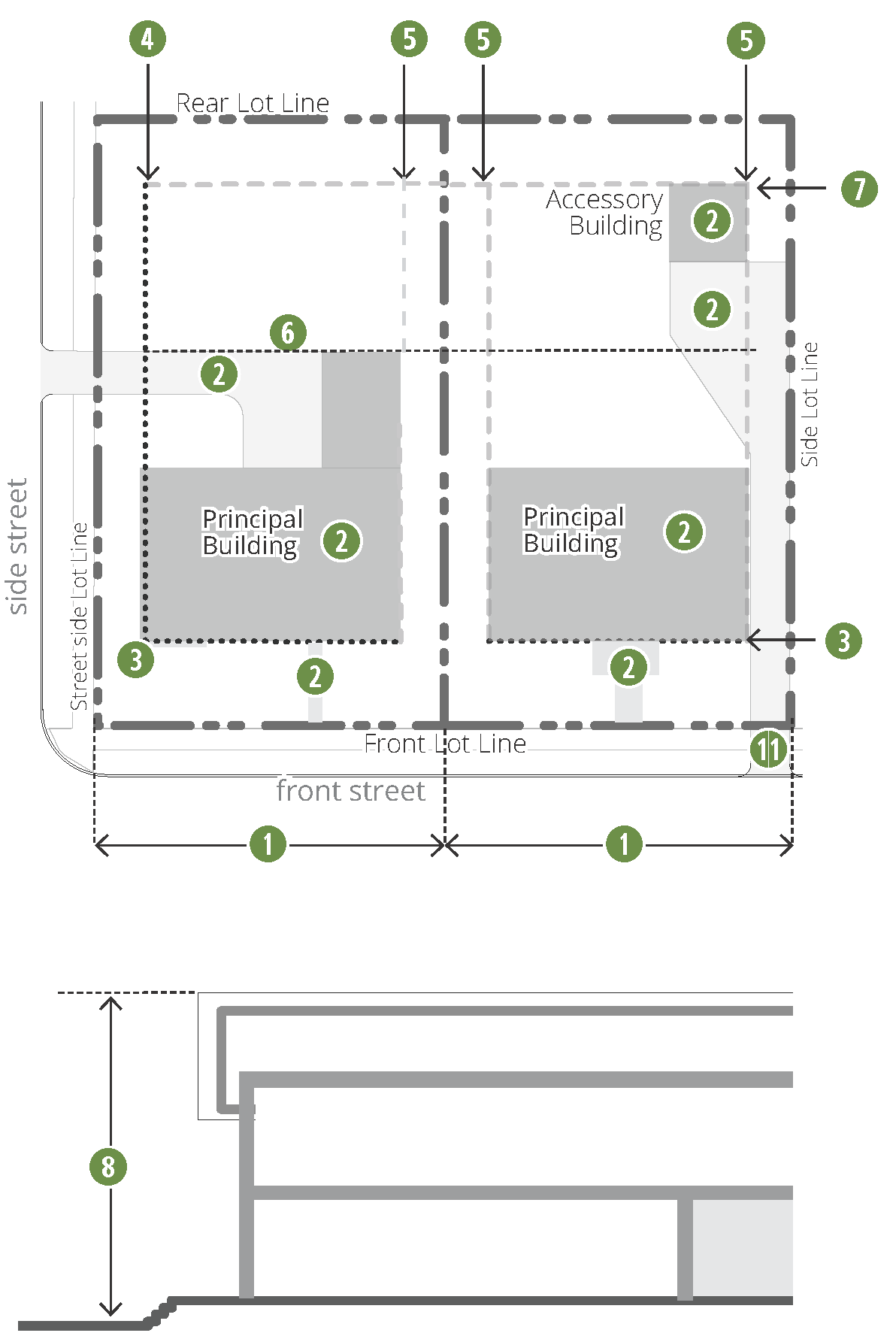
(Ord. No. RZ-2018-11-06, § I, Exh. A(27.27), 11-27-2018; Ord. No. 2019-05-03, § I(Attch.), 5-28-2019; Ord. No. 2021-02-01, § I(Attch.), 2-9-2021; Ord. No. RZ-2023-02-03, § I, 2-28-2023; Ord. No. 2025-04-01, 1(Attch.), 4-22-2025)
Sec. 27-68. - Lot and building regulations—r3, rsa and rm districts.
Detached houses are allowed in all R3, RSA and RM districts, subject to compliance with the lot and building regulations of table 2-4 (see also figure 2-1).
| TABLE 2-4 — DETACHED HOUSES IN RSA AND RM DISTRICTS | |||
|---|---|---|---|
| Regulation | R3 and RSA | RM | |
|
a. Lot
| |||
| Minimum Lot Area (square feet) | 6,000 | 6,000 | |
| Minimum Lot Width & Frontage (feet) | 50[1] | 50[1] |
| Maximum Impervious Coverage (%) | 35 | 35 |
|
b. Building Siting
| |||
| Minimum Principal Building Setbacks (feet) | |||
| Front Street | 5[3][4] | 30[3][4] |
| Side Street | 15[3][4] | 15[3][4] |
| Interior Side | 5 | 7.5 |
| Rear | 30 | 30 |
| Minimum Accessory Building & Accessory Structure Setbacks (feet) | |||
| Front Street | — Permitted behind rear wall plane of the principal dwelling unless otherwise expressly stated. [7][8] — | ||
| Side Street | 15[3][4] | 15[3][4] |
| Interior Side | 5 | 7.5 |
| Rear | 10[5] | 10[5] |
|
c. Maximum Building Height
| |||
| Principal Building (feet) | 40 | 40 |
| Accessory Building (feet) | 20[6] | 20[6] | |
|
d. Garages
| |||
| Garage Configuration | — — See Article II, Division 9 — — | ||
[1] Lots fronting on the bulb of a cul-de-sac shall have at least 35 feet of frontage and be at least 50 feet in width.
[2] Average front yard setbacks shall be used for residential infill development. See section 27-1336.
[3] Plus 15 feet if abutting arterial street.
[4] Street-facing garage entries shall be set back at least 20 feet from the back of the sidewalk or back of curb, whichever results in a greater setback.
[5] When rear yard adjoins side yard of abutting lot, accessory structures shall not extend beyond the architectural front wall plane of adjacent house unless enclosed by an opaque fence with a minimum height of six-feet.
[6] Or height of principal building, whichever is less.
[7] Accessory structures may be permitted behind the front wall plane of the principal dwelling when enclosed by an opaque fence with a minimum height of six-feet. An opaque fence screening an accessory building in a non-rear yard shall exceed the height of the accessory building by at least six-inches, up to a maximum fencing height of eight-feet.
[8] Detached garages and Detached Accessory Dwelling Units (DADU) may be permitted behind the front wall plane of the principal dwelling.
Figure 2-2. Detached Houses in RSA and RM Districts
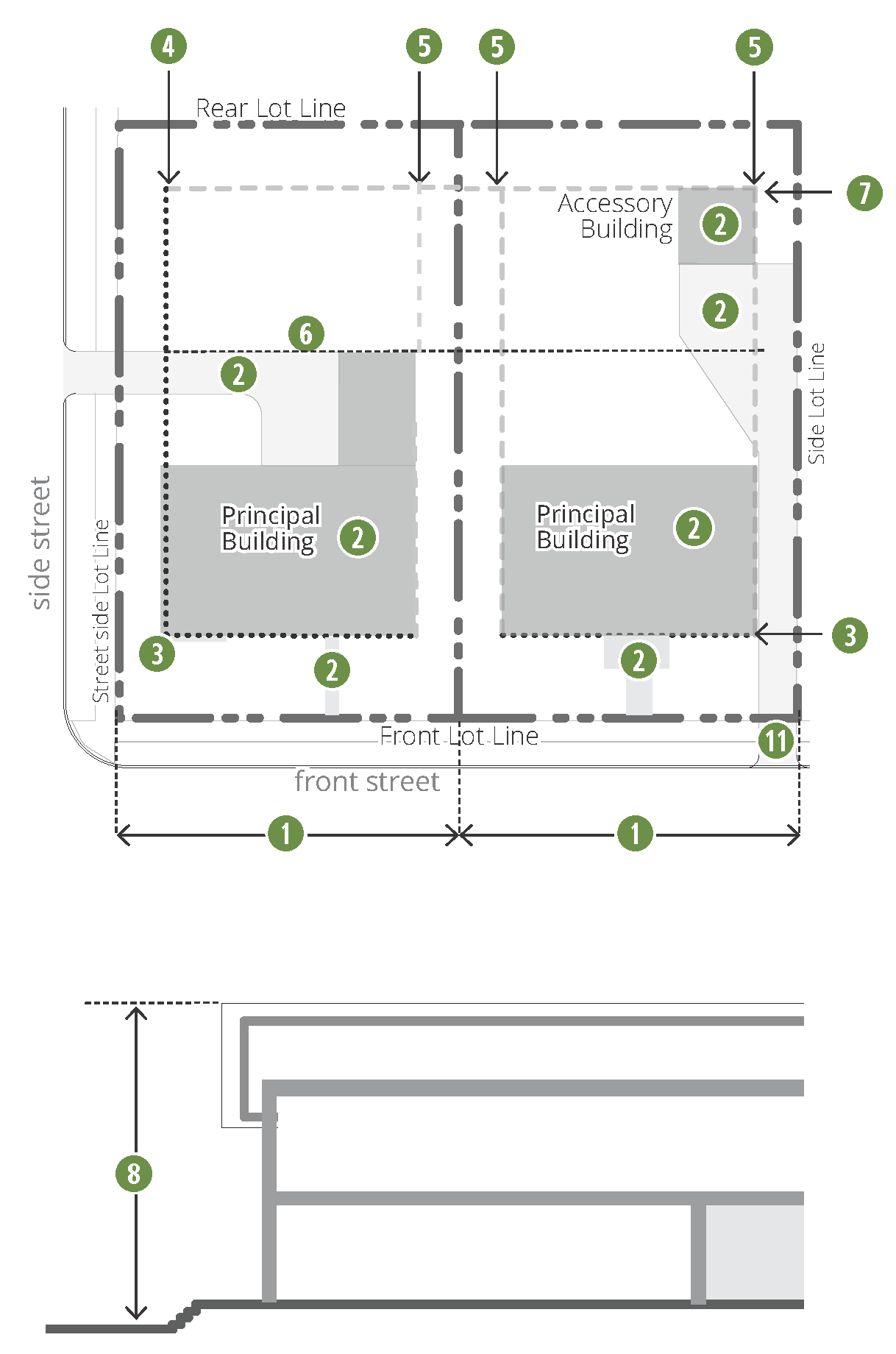
(Ord. No. RZ-2018-11-06, § I, Exh. A(27.28), 11-27-2018; Ord. No. 2019-05-03, § I(Attch.), 5-28-2019; Ord. No. 2021-02-01, § I(Attch.), 2-9-2021; Ord. No. RZ-2023-02-03, § I, 2-28-2023; Ord. No. 2025-04-01, 1(Attch.), 4-22-2025)
Sec. 27-79. - Lot and building regulations—rsa and rm districts.
Attached houses are allowed in all RSA and RM districts, subject to compliance with the lot and building regulations of table 2-5 (see also figure 2-3).
| TABLE 2-5 — ATTACHED HOUSES IN RSA AND RM DISTRICTS | ||||
|---|---|---|---|---|
| Regulation | RSA-5 | RSA-8 | RSA-18 and RM | |
|
a. Site/Lot
| ||||
| Minimum Site Area (square feet) | 6,000 | 6,000 | 6,000 | |
| Minimum Site Width & Street Frontage (feet) | 100 | 80 | 60 |
| Minimum Lot Width (feet) | 20 | 18 | 16[5] | |
| Maximum Impervious Coverage (%) | 50 | 50 | 80 |
| Maximum Density (dwelling units per acre) | 5 | 8 | 18 | |
|
b. Building Siting
| ||||
| Minimum Principal Building Setbacks (feet) | ||||
| Front Street | 5[1] | 5[1] | 5[1] |
| Side Street | 15[1] | 15[1] | 15[1] |
| Interior Side (applies to end units only) | 7.5 | 7.5 | 7.5 |
| Rear | 30 | 30 | 30 |
| Maximum Building Width (no. of units) | 8 | 8 | RSA = 8 / RM = 12 |
| Minimum Accessory Building & Accessory Structure Setbacks (feet) | ||||
| Front Street | — — Permitted in rear yard only — — | |||
| Side Street | 15[1] | 15[1] | 15[1] |
| Interior Side | 10 | 10 | 5 |
| Rear | 10[2] | 10[2] | 10[2] | |
|
c. Maximum Building Height
| ||||
 | Principal Building (feet) | 40 | 40 |
RSA = 40 or 52 [see note 4]
RM = 40 |
| Accessory Building (feet) | 20[3] | 20[3] | 20[3] | |
|
d. Street Facades
| ||||
|
e. Parking and Garages
| ||||
 | Surface Parking Location | — — Permitted in rear yard only — — | ||
| Garage Configuration | — — See Article II, Division 9 — — | |||
|
f. Transition Buffers (See Article IX, Division 2)
| ||||
| Minimum Buffer Depth Abutting RS-Zoned Lot (feet) | 20 | 20 | 20 | |
[1] Street-facing garage entries shall be set back at least 20 feet from the back of the sidewalk or back of curb, whichever results in a greater setback.
[2] Minimum 25-foot rear setback required for accessory buildings when rear yard adjoins side yard of abutting lot.
[3] Or height of principal building, whichever is less.
[4] Maximum height for RSA-18 is 52 feet, except for buildings or portions of buildings within 100 feet of RS-100, RS- 85, RS-75, RS-60, RS-50, R-3 and detached units within the RSA districts which shall have a maximum height of 40 feet. The distance is measured from the common property line without an intervening public street.
[5] The mean width of all attached units within a development shall be equal to or greater than 18-feet.
Figure 2-3. Attached Houses in RSA-8, RS-18 and RM Districts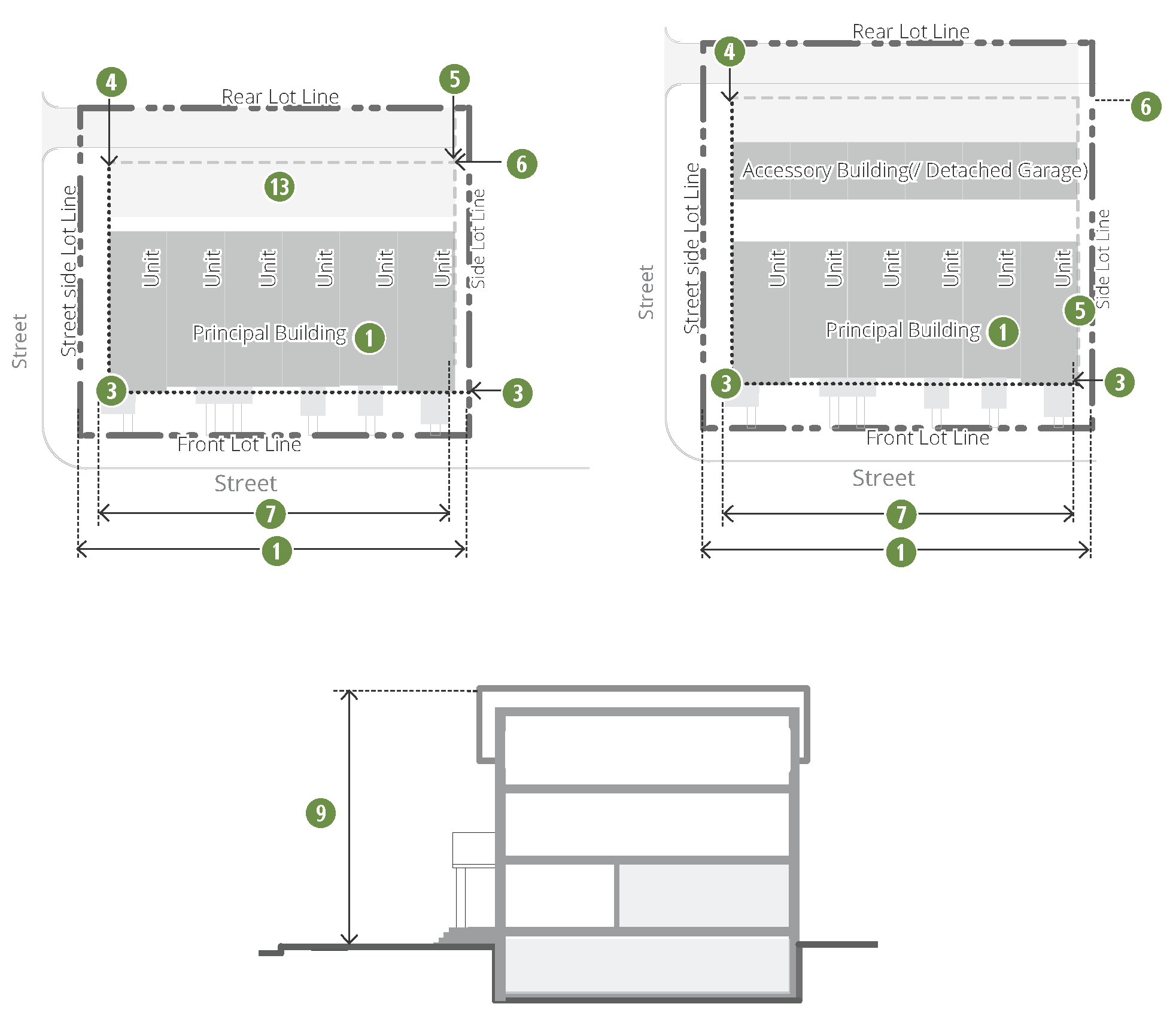
(Ord. No. RZ-2018-11-06, § I, Exh. A(27.29), 11-27-2018; Ord. No. 2019-05-03, § I(Attch.), 5-28-2019; Ord. No. RZ2023-12-09, § I, 12-19-2023; Ord. No. 2025-04-01, 1(Attch.), 4-22-2025)
Sec. 27-90. - Lot and building regulations—R3, RSA and RM Districts.
Two-flats and three-flats are allowed in all R3, RSA and RM districts, subject to compliance with the lot and building regulations of table 2-6 (see also figure 2-4).
| TABLE 2-6 — TWO-FLATS AND THREE-FLATS IN RSA AND RM DISTRICTS | ||||
|---|---|---|---|---|
| Regulation | R3 | RSA | RM | |
|
a. Lot
| ||||
| Minimum Lot Area (square feet) | 10,000 | 8,000 | 6,000 | |
| Minimum Site Width & Street Frontage (feet) | 85 | 60 | 60 |
| Maximum Impervious Coverage (%) | 35 | 35 | 35 |
| b. Building Siting | ||||
| Minimum Principal Building Setbacks (feet) | ||||
| Front Street | 30[1] | 30[1] | 30[1] |
| Side Street | 15[1] | 15[1] | 15[1][2] |
| Interior Side | 8.5 | 8.5 | 7.5 |
| Rear | 40 | 40 | 30 |
| Minimum Accessory Building & Accessory Structure Setbacks (feet) | ||||
| Front Street | — — Permitted in rear yard only — — | |||
| Side Street | 20 | 20 | 15[3] |
| Interior Side | 10 | 10 | 10 |
| Rear | 10[3] | 10[3] | 10[3] |
| c. Maximum Building Height | ||||
| Principal Building (feet) | 40 | 40 | 40 |
| Accessory Building (feet) | 20[4] | 20[4] | 20[4] | |
| d. Street Facades | ||||
| Street-facing Entrance | |||
| Minimum Number | — — — — 1 per building — — — — | |||
| e. Parking and Garages | ||||
| Surface Parking Location | — — Permitted in rear yard only — — | |||
| Garage Configuration | — — See Article II, Division 9 — — | |||
[1] Plus 15 feet if abutting arterial street.
[2] ;hg;Street-facing garage entries shall be set back at least 20 feet from the back
of the sidewalk or from the street right-of-way, whichever results in a greater setback.
[3] ;hg;Minimum 25-foot rear setback required for accessory buildings when rear yard
adjoins side yard of abutting lot.
[4] ;hg;Or height of principal building, whichever is less.
Figure 2-4. Two-Flats and Three-Flats in RSA and RM Districts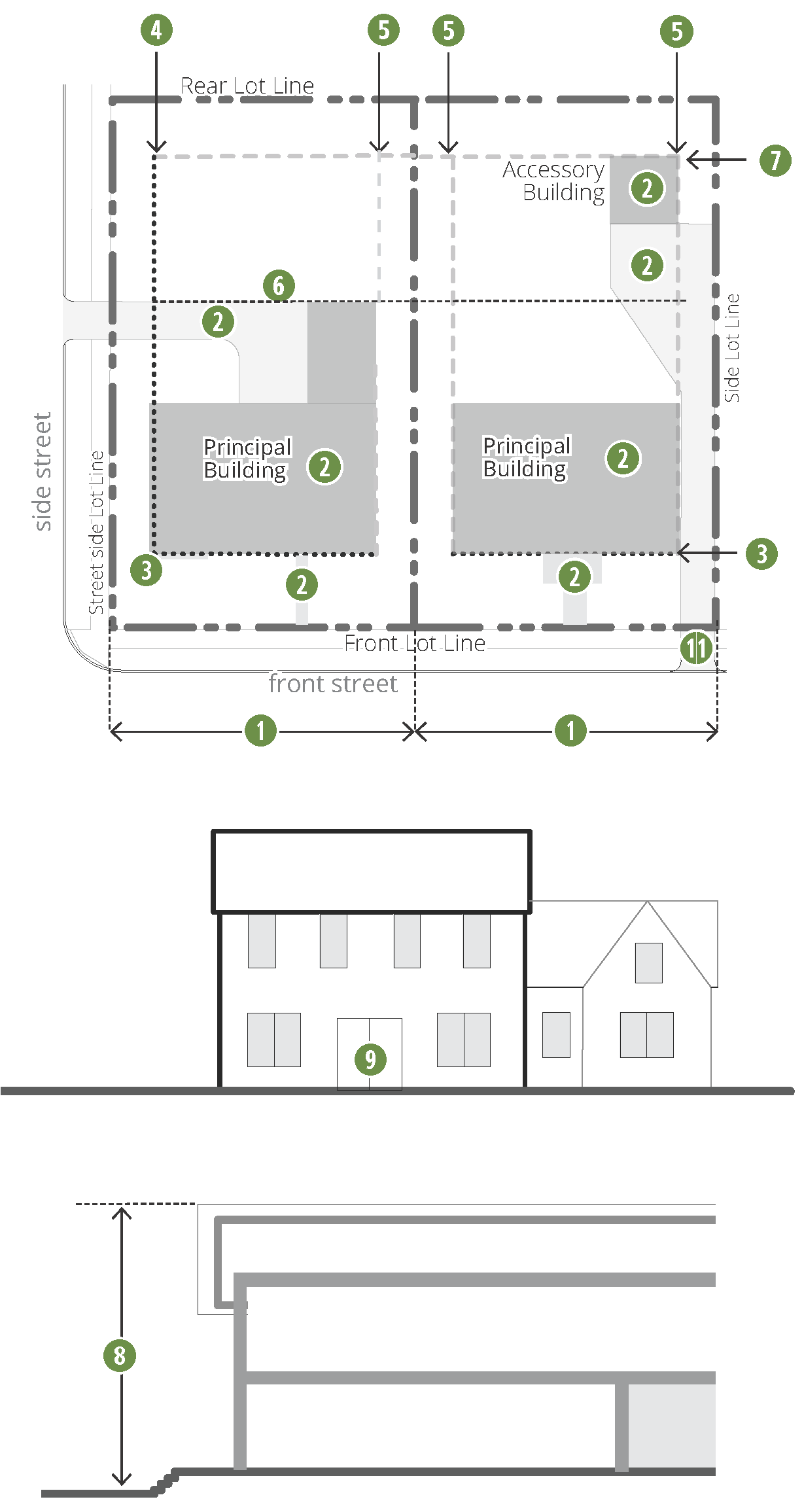
(Ord. No. RZ-2018-11-06, § I, Exh. A(27.30), 11-27-2018; Ord. No. 2019-05-03, § I(Attch.), 5-28-2019)
Sec. 27-101. - Lot and building regulations—RM Districts.
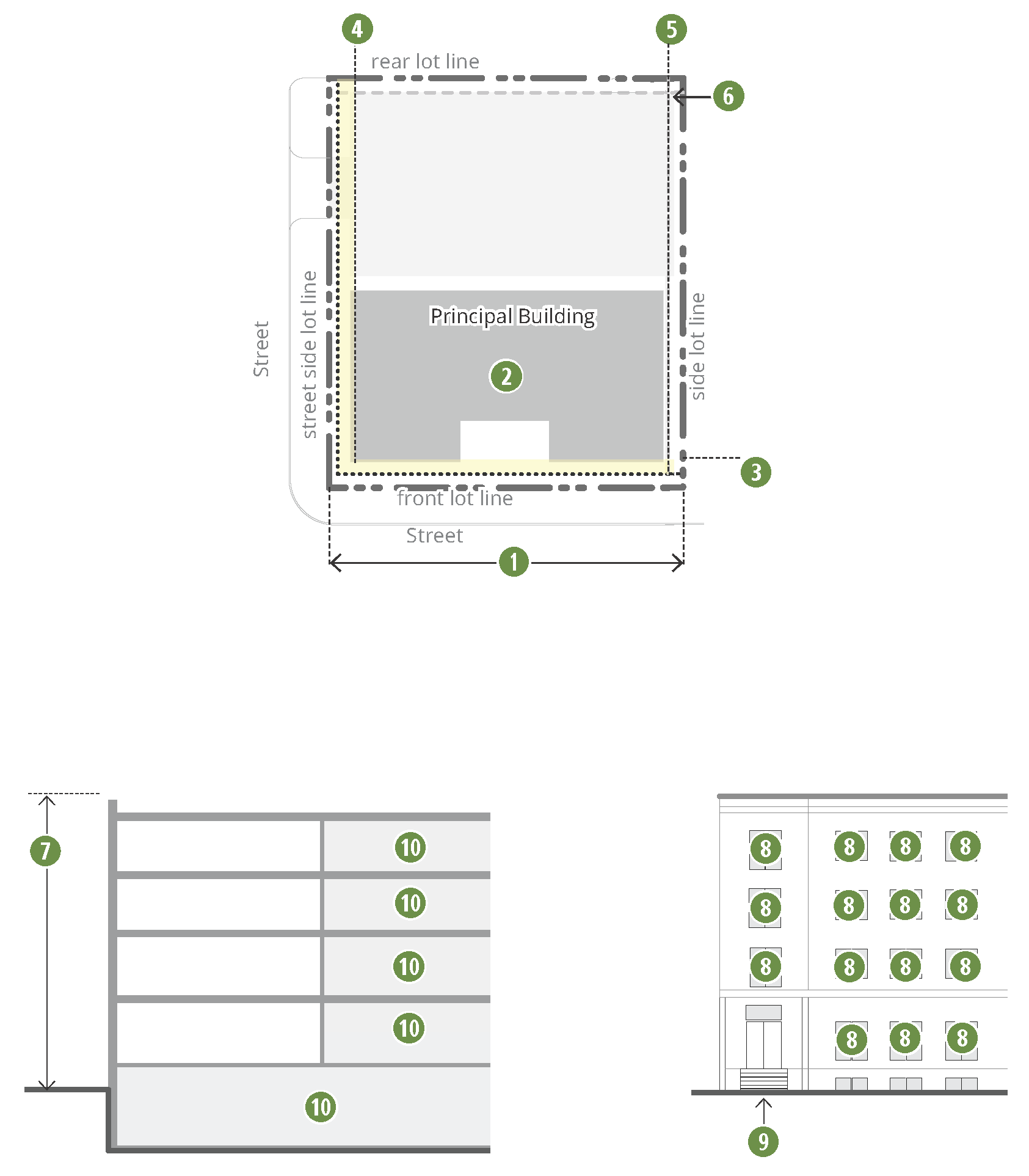
Multi-unit residential buildings (four or more dwelling units) are allowed in all RM districts, subject to compliance with the lot and building regulations of table 2-7 (see also figure 2-5).
| TABLE 2-7 — MULTI-UNIT RESIDENTIAL BUILDINGS IN RM DISTRICTS | |||||
|---|---|---|---|---|---|
| Regulation | RM-14 | RM-18 | RM-30 | RM-40 | |
| a. Lot | |||||
| Minimum Lot Area (square feet) | 15,000 | 15,000 | 15,000 | 15,000 | |
| Minimum Lot Area per Unit (square feet) | 3,000 | 2,400 | 1,450 | 1,075 | |
| Minimum Lot Width & Street Frontage (feet) | 100 | 100 | 100 | 100 |
| Maximum Impervious Coverage (%) | 35 | 35 | 65 | 65 |
| Maximum Density (dwelling units per acre) | 14 | 18 | 30 | 40 | |
| Minimum Outdoor Recreation/Play Area (%) | 5% | 5% | 5% | 5% | |
| b. Building Siting | |||||
| Minimum Principal Building Setbacks (feet) | |||||
| Front Street | 30 | 30 | 30 | 30 |
| Side Street | 15[1] | 15[1] | 15[1] | 15[1] |
| Interior Side | 7.5 | 7.5 | 7.5 | 7.5 |
| Rear | 30 | 30 | 30 | 30 |
| Minimum Accessory Building & Accessory Structure Setbacks (feet) | |||||
| Front Street | — — — Permitted in rear yard only — — — | ||||
| Side Street | 15[2] | 15[2] | 15[2] | 15[2] |
| Interior Side | 10 | 10 | 10 | 10 |
| Rear | 10[3] | 10[3] | 10[3] | 10[3] |
| c. Maximum Building Height | |||||
| Principal Building (stories) | 4 | 4 | 5 | 5 |
| Accessory Building (feet) | 20[4] | 20[4] | 20[4] | 20[4] | |
| d. Street Facades | |||||
| Minimum Front Facade Transparency (%) | 20 | 20 | 20 | 20 |
| Min. Street Side Facade Transparency (%) | 10 | 10 | 10 | 10 | |
| Street-facing Entrance | ||||
| Minimum Number | — — — — 1 per front facade — — — — | ||||
| e. Parking and Garages | |||||
 | In-Building Parking Location | Permitted anywhere below grade and in above-grade floors if located at least 20 feet from front facade | |||
| Surface Parking Location | Permitted in rear yard and side yard (behind principal building setback) | ||||
| f. Transition Buffers (See Article IX, Division 2) | |||||
| Minimum Buffer Depth Abutting RS-Zoned Lot (ft.) | 50 | 50 | 50 | 50 | |
[1] Plus 15 feet if abutting arterial street.
[2] ;hg;Street-facing garage entries shall be set back at least 20 feet from the back
of the sidewalk or from the street right-of-way, whichever results in a greater setback.
[3] ;hg;Minimum 25-foot rear setback required for accessory buildings when rear yard
adjoins side yard of abutting lot.
[4] ;hg;Or height of principal building, whichever is less.
Figure 2-5. Multi-Unit Buildings in RM Districts
(Ord. No. RZ-2018-11-06, § I, Exh. A(27.31), 11-27-2018; Ord. No. 2019-05-03, § I(Attch.), 5-28-2019)
Sec. 27-112. - Lot and building regulations—RSA and RM Districts.
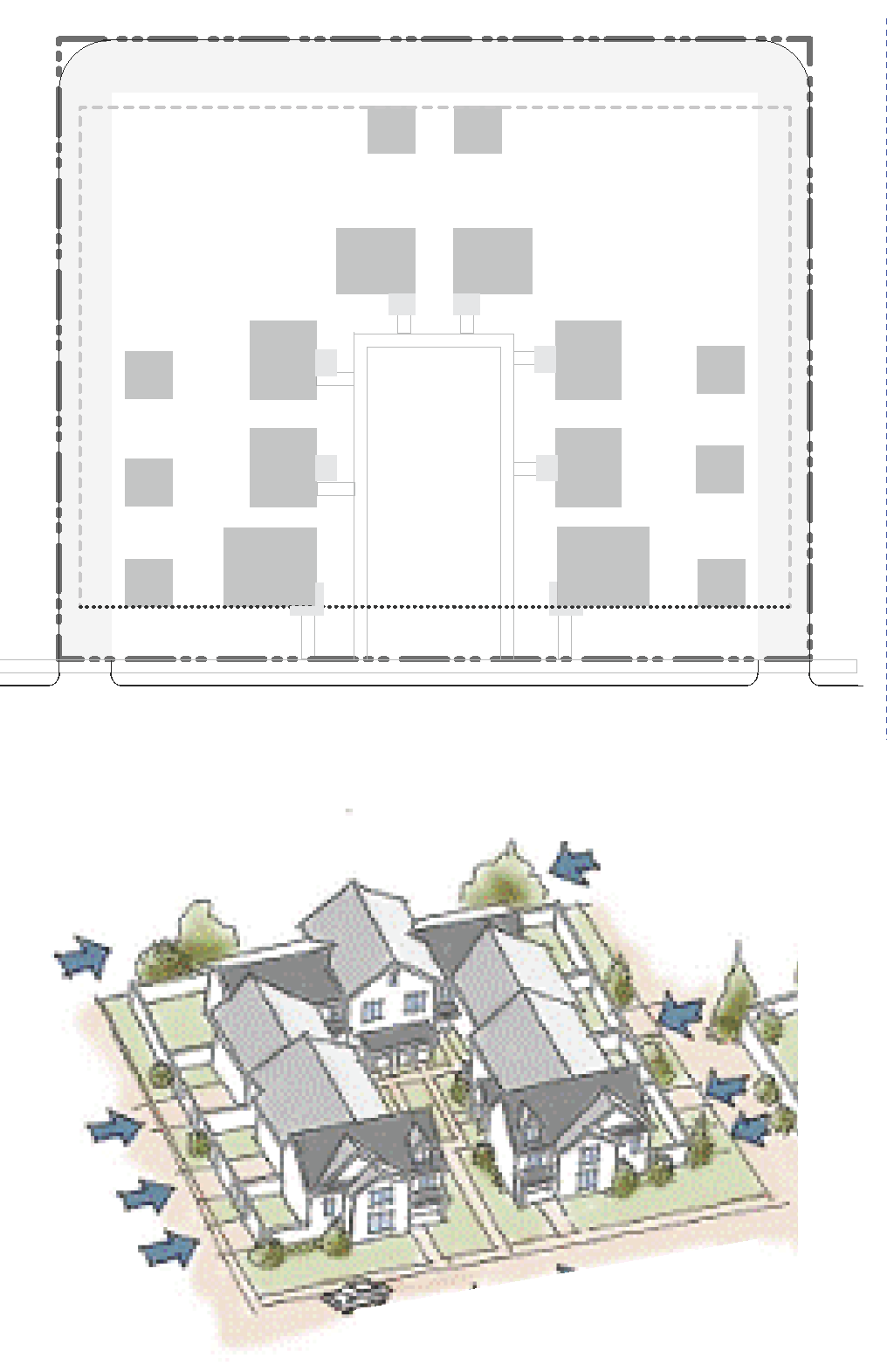
Courtyard housing is allowed in all RSA and RM districts, subject to compliance with the lot and building regulations of table 2-8 (see also figure 2-6).
| TABLE 2-8 — BUNGALOW COURTS IN RSA AND RM DISTRICTS | |||
|---|---|---|---|
| Regulation | RSA | RM | |
| a. Site/Lot | |||
| Minimum Site Area (square feet) | 15,000 | 15,000 | |
| Minimum Site Area per Unit (square feet) | 3,000 | 2,500 | |
| Minimum Site Width & Street Frontage (feet) | 150 | 150 |
| Minimum Site Depth | 150 | 150 | |
| Minimum Lot Area | 1,200 | 1,200 | |
| Maximum Impervious Coverage (%) | 65 | 65 |
| Minimum Courtyard Area (sq. ft. per unit) | 500 | 500 | |
| b. Building Siting | |||
| Minimum Principal Building Setbacks (feet) | |||
| Front Street | 15 | 15 |
| Side Street | 15 | 15 |
| Interior Side | 5 | 5 |
| Rear | 15 | 15 |
| Minimum Accessory Building & Accessory Structure Setbacks (feet) | |||
| Front Street | — Permitted in rear yard only — | ||
| Side Street | 15 | 15 |
| Interior Side | 5 | 5 |
| Rear | 15 | 15 |
| c. Maximum Building Height | |||
| Principal Building (feet) | 25 | 30 |
| Accessory Building (feet) | 18[1] | 20[1] | |
| d. Street Facades | |||
| Street-facing Entrance | ||
| Minimum Number | 1 per front facade of all units adjacent to street | ||
| e. Parking Location | |||
| Courtyard | — — — Not allowed — — — | ||
| Front or Side Street Yard | — — — Not allowed — — — | ||
| Regulation | RSA | RM | |
| Interior Side Yard | — — — Allowed — — — | ||
| Rear Yard | — — — Allowed — — — | ||
[1] Or height of principal building, whichever is less.
Figure 2-6. Courtyard housing in RSA and RM Districts
(Ord. No. RZ-2018-11-06, § I, Exh. A(27.32), 11-27-2018; Ord. No. 2019-05-03, § I(Attch.), 5-28-2019)
Sec. 27-133. - In general.
(a)
Where allowed. ADUs are allowed only on lots occupied by a detached house. ADUs must be secondary and subordinate to the principal dwelling unit of the subject property.
(b)
Zoning district regulations. ADUs are subject to all applicable regulations of the zoning district in which they are located, unless otherwise expressly stated in this chapter.
(c)
Number. No more than one DADU and one AADU is permitted on a single lot.
(d)
Size. The total square footage of all ADUs on a single lot cannot exceed 50 percent of the gross floor area of the principal dwelling unit, or 1,000 square feet, whichever is less.
(e)
Number of residents. The total number of residents that reside on the subject property may not exceed the number permitted for a single household.
(f)
Parking. No additional parking is required for an ADU. Any provided parking is subject to the same regulations that apply to the principal dwelling unit.
(g)
Owner occupancy and rental. At least one of the dwelling units on a lot occupied by an ADU shall be occupied by an owner with at least a 50 percent interest in the subject property. The owner shall occupy either the principal dwelling unit or the ADU as their permanent residence for a majority of the time each calendar year, and at no time receive rent for the owner-occupied unit. ADUs may not be rented for periods of less than 90 consecutive days. Application for a building permit for an ADU must include a sworn, notarized statement from the property owner stating that the owner will occupy one of the dwelling units on the premises, except for bona fide temporary absences.
(h)
Home occupation. No business activity is permitted in the accessory dwelling unit unless it meets the requirements of a home occupation.
(i)
Impervious coverage. To help implement the affordable housing initiatives recommended in the comprehensive plan, residential properties with a detached ADU shall be eligible for an increased as-of-right impervious coverage bonus of five percent of the total lot area. DADUs eligible for this credit must have a bedroom, full kitchen facilities, and bathroom.
(j)
Nonconforming lots and structures.
(1)
ADUs may be constructed on a nonconforming lot with a detached single-family house subject to compliance with all applicable setback and building regulations (e.g., coverage, height, floor area, etc.).
(2)
Non-conforming and enclosed accessory structures that exist on the effective date specified, December 19, 2023, but that do not comply with the regulations of this article may be converted to an ADU so long as the modification does not result in the structure exceeding the extent of noncompliance with the regulations of this article (article 2 of chapter 27).
(Ord. No. RZ2023-12-10, § I, 12-19-2023)
Sec. 27-134. - Attached accessory dwelling units (AADUS).
(a)
Description. Attached accessory dwelling units (AADUs), formerly referred to as secondary suites, are contained wholly within the principal dwelling unit on the property (i.e., detached house).
(b)
Applicability. All AADUs are subject to compliance with the regulations of this section.
(c)
Creation. AADUs may be created by:
(1)
Converting existing floor area within the interior of a detached house (e.g., attic or basement) to an accessory dwelling unit;
(2)
Adding floor area to an existing detached house to accommodate an accessory dwelling unit; or
(3)
Constructing a new detached house that includes an accessory dwelling unit within the principal building.
(d)
Location of entrances. Only one entrance to a detached house containing an AADU may be located on a facade that faces a street, unless the detached house had an additional street-facing entrance before the AADU was created.
(Ord. No. RZ2023-12-10, § I, 12-19-2023)
Sec. 27-135. - Detached accessory dwelling units (DADUS).
(a)
Description. Detached accessory dwelling units (DADUs) are free standing structures that are entirely separated from the principal dwelling unit on the property (i.e., detached house).
(b)
Applicability. All DADUs are subject to compliance with the regulations of this section and with the lot and building regulations of table 2-9.
| TABLE 2-9 — DETACHED ACCESSORY DWELLING UNITS IN R DISTRICTS | ||||
|---|---|---|---|---|
| Regulation | RS | R3 and RSA | RM | |
| a. Building Siting | ||||
| Minimum Building Setbacks (feet) | ||||
| Front Street | — — — Permitted behind front wall plane of principal dwelling — — — | |||
| Side Street | 20 | 15[1] | 15[1] |
| Interior Side | 10 | 10 | 10 |
| Rear | 10[2] | 10[2] | 10[2] |
| Separation from Principal Buildings | 10 | 10 | 10 | |
| c. Building Size | ||||
| Maximum Building Height (feet) | 24/2 story[3] | 24/2 story[3] | 24/2 story[3] | |
| Maximum Floor Area (square feet)Tc>50% of the floor area of the principal residential structure | 50% of the floor area of the principal residential structure | 50% of the floor area of the principal residential structure | ||
[1] Plus 15 feet if abutting arterial street.
[2] ;hg;Minimum 20-foot rear setback required for accessory buildings when rear yard
adjoins side yard of abutting lot.
[3] ;hg;Or height and number of stories of principal building, whichever is less.
(Ord. No. RZ2023-12-10, § I, 12-19-2023)
Sec. 27-145. - Lot and building regulations—R Districts.
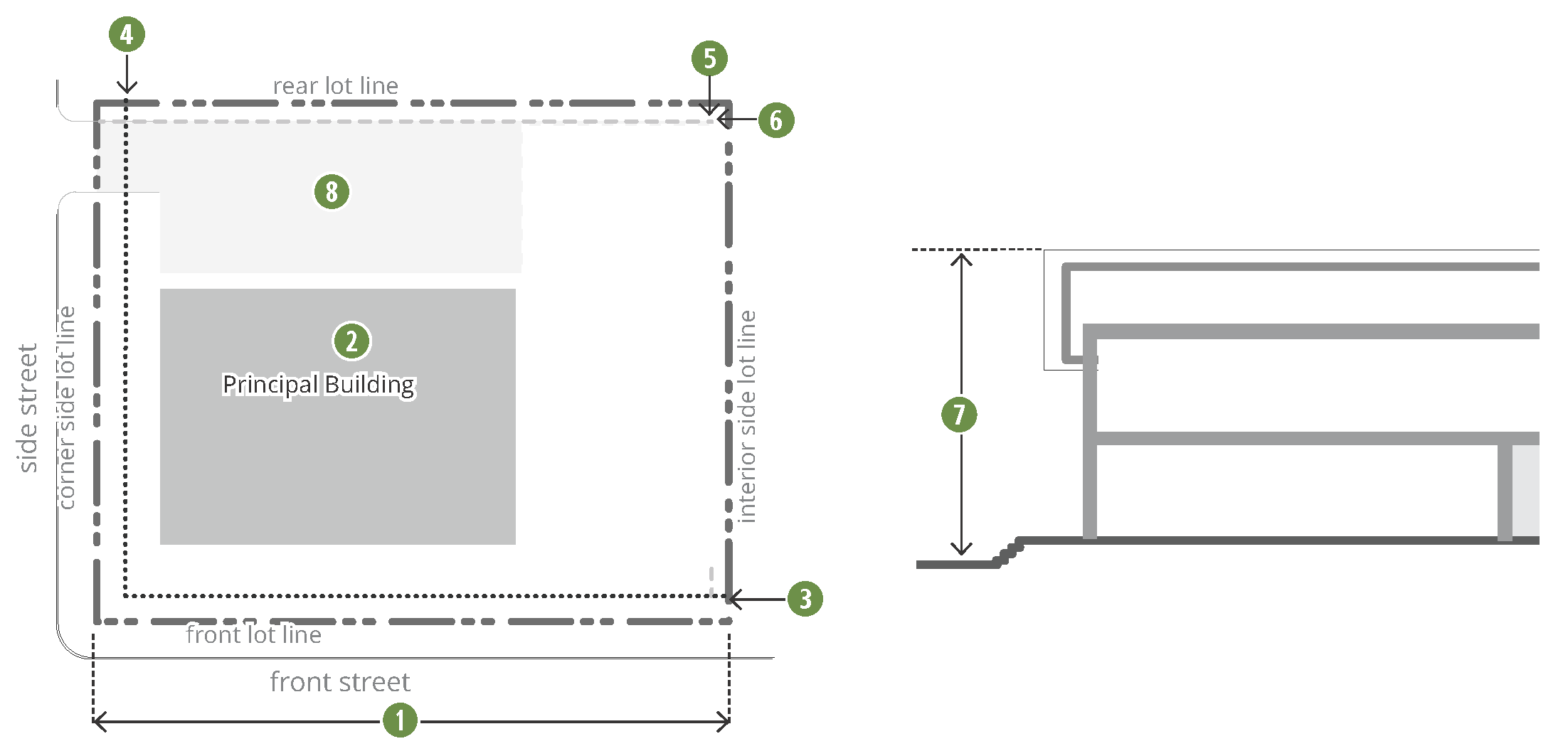
Civic buildings, which may be occupied only by allowed public and civic uses, are allowed in all R districts, subject to compliance with the lot and building regulations of Table 2-10 (see also Figure 2-7).
| TABLE 2-10 — CIVIC BUILDINGS IN R DISTRICTS | ||||
|---|---|---|---|---|
| Regulation | RS | R3 and RSA | RM | |
| a. Lot | ||||
| Minimum Lot Area (square feet) | 10,000 | 10,000 | 10,000 | |
| Minimum Lot Width & Frontage (feet) | 75 | 75 | 75 |
| Maximum Impervious Coverage (%) | 45 | 45 | 45 |
| b. Building Siting | ||||
| Minimum Principal Building Setbacks (feet) | ||||
| Front Street | 35[1] | 30[2] | 30[2] |
| Side Street | 35[1] | 20[3] | 20[3] |
| Interior Side | 10 | 10 | 10 |
| Rear | 40 | 40 | 40 |
| Minimum Accessory Building & Accessory Structure Setbacks (feet) | ||||
| Front Street | — — Permitted in rear yard only — — | |||
| Side Street | 35[1] | 20[3] | 20[3] |
| Interior Side | 10 | 10 | 10 |
| Rear | 10[4] | 10[4] | 10[4] |
| c. Maximum Building Height | ||||
| Principal Building (feet) | 40 | 40 | 45 |
| Accessory Building (feet) | 20[5] | 20[5] | 20[5] | |
| d. Parking | ||||
| Surface Parking Location | Permitted in rear yard and side yard (behind principal building setback); see also landscaping and screening regulations of Article IX. | ||
[1] Plus 15 feet if abutting arterial street.
[2] ;hg;Plus 20 feet if abutting arterial street.
[3] ;hg;Plus 30 feet if abutting arterial street.
[4] ;hg;Minimum 25-foot rear setback required for accessory buildings when rear yard
adjoins side yard of abutting lot.
[5] ;hg;Or height of principal building, whichever is less.
Figure 2-7. Civic Buildings in RS Districts
(Ord. No. RZ-2018-11-06, § I, Exh. A(27.35), 11-27-2018; Ord. No. 2019-05-03, § I(Attch.), 5-28-2019)
Sec. 27-156. - Applicability.
The regulations of this section apply to garages on lots occupied by detached houses, attached houses or two-flats. The regulations also apply to carports.
(Ord. No. RZ-2018-11-06, § I, Exh. A(27.36), 11-27-2018)
Sec. 27-157. - Detached houses and two-flats.
(a)
Garage configurations allowed. Garages for detached houses and two-flats may be rear-loaded, side-loaded or front-loaded, in accordance with the regulations of this section.
(b)
Rear-loaded garages. Rear-loaded garages may be attached or detached, with the vehicle entrance generally oriented to the rear of the lot. Rear-loaded detached garages shall be set back at least three feet from the alley right-of-way.
(c)
Side-loaded garages. Side-loaded garages may be attached or detached, with the vehicle entrance generally oriented perpendicular to the front wall plane of the principal building. Side-loaded garages may be accessed by a driveway leading from a side street or from the front street. Vehicle entrances to all side street-loaded garages shall be setback at least 20 feet from the back of the sidewalk or back of curb, whichever results in a greater setback.
(d)
Front-loaded garages. Vehicle entrances to all front-loaded garages shall be setback at least 20 feet from back of the sidewalk or back of curb, whichever results in a greater setback. Front-loaded garages that exceed 50 percent of the width of the dwelling unit shall not have garage doors that are wider than 13 feet.
(Ord. No. RZ-2018-11-06, § I, Exh. A(27.37), 11-27-2018; Ord. No. 2019-05-03, § I(Attch.), 5-28-2019; Ord. No. 2019-11-03, § I(Attch.), 11-26-19; Ord. No. 2025-04-01, 1(Attch.), 4-22-2025)
Sec. 27-158. - Attached houses.
(a)
Garage configurations allowed. Garages for attached houses on lots abutting arterial streets shall be rear-loaded, in accordance with the regulations of this section. Garages for attached houses on lots abutting non-arterial streets may be rear-loaded, side-loaded or front-loaded, in accordance with the regulations of this section.
(b)
Rear-loaded garages. Rear-loaded garages may be attached or detached, with the vehicle entrance generally oriented to the rear of the lot. Rear-loaded detached garages shall be set back at least three feet from the alley right-of-way.
(c)
Front- and side street-loaded garages.
(1)
Front-loaded garage entrances shall be recessed at least 12 inches behind the front wall plane of the principal building or be located beneath a second-story building that projects at least 12 inches forward of the garage entrance.
(2)
Front-loaded garages that exceed 50 percent of the width of the dwelling unit shall not have garage doors that are wider than 13 feet.
(3)
Vehicle entrances to all front and side street-loaded garages shall be setback at least 20 feet from the back of the sidewalk or back of curb, whichever results in a greater setback.
(4)
When garages are paired (abutting), driveways shall be combined and centered on the property line between attached house dwelling units. Driveways serving front-or side street-loaded attached house garages from a public street shall be designed to ensure at least 25 feet of uninterrupted curb length between single or paired driveways. Driveways serving attached house garages from internal roadways of a townhome development shall be exempt from this requirement.
(Ord. No. RZ-2018-11-06, § I, Exh. A(27.38), 11-27-2018; Ord. No. 2019-05-03, § I(Attch.), 5-28-2019; Ord. No. 2019-11-03, § I(Attch.), 11-26-2019; Ord. No. 2025-04-01, 1(Attch.), 4-22-2025)
Sec. 27-159. - Exceptions.
Garages and carports that exist on the effective date specified in section 27-4 but that do not comply with the regulations of this division (division 9 of this article), may be modified, reconstructed or replaced as long as the modification, reconstruction or replacement does not result in the garage or carport exceeding the extent of noncompliance with the garage regulations of this division (division 9 of this article).
(Ord. No. RZ-2018-11-06, § I, Exh. A(27.39), 11-27-2018; Ord. No. 2019-05-03, § I(Attch.), 5-28-2019)

