
Brookhaven City Zoning Code
ARTICLE IX
LANDSCAPING AND SITE FEATURES
Sec. 27-924. - Purpose.
The landscaping and screening regulations of this division are intended to advance the general purposes of this zoning ordinance and to help:
(1)
Maintain and enhance the city's appearance;
(2)
Maintain and improve air quality;
(3)
Protect surface water quality and reduce the negative impacts of stormwater run-off by reducing impervious surface area and providing vegetated areas that filter and retain greater amounts of stormwater on site;
(4)
Moderate heat by providing shade;
(5)
Encourage preservation and replacement of existing trees and landscaping; and
(6)
Encourage low-impact development practices.
(Ord. No. RZ-2018-11-06, § I, Exh. A(27.254), 11-27-2018)
Sec. 27-925. - Parking lot perimeter landscape.
(a)
The parking lot perimeter landscape regulations of this section are intended to help mitigate the visual and operational impacts of parking lots when such areas are adjacent to public streets or residential zoning districts.
(b)
Unless otherwise expressly stated, the parking lot perimeter landscape regulations of this section apply to the construction or expansion of any parking area except those on lots occupied by residential buildings containing fewer than four dwelling units.
(c)
Parking lots subject to these regulations shall be screened from view of public streets using buildings, landscaping or a combination of buildings and landscaping. Landscaping provided to meet this requirement shall include comply with one of the following options:
(1)
A landscape strip at least eight feet in width containing shrubs planted to provide a solid visual screen at least three feet in height at the end of the first growing season, with the remainder of the landscape strip covered with groundcover plants or annual or perennial vegetation; or
(2)
A landscape strip at least four feet in width containing a solid masonry wall at least three feet in height, with the remainder of the landscape strip covered with groundcover plants, sod or annual or perennial vegetation.
(d)
Overstory trees shall be provided within required parking lot perimeter landscape strips at the rate of one tree per 40 feet of parking lot frontage adjacent to a street or sidewalk.
(e)
Parking lots shall be screened from view of abutting R-zoned lots using buildings or one of the following options:
(1)
An opaque fence at least six feet in height and at least one tree per 25 linear feet of fence;
(2)
A masonry wall with a minimum height of six feet;
(3)
A row of evergreen shrubs shall be planted at [a] distance of 25 feet apart from center with a minimum height of four feet at the time of planting. Shrubs to be planted between the required overstory permieter trees and also at a five-foot spacing from all overstory trees. No invasive species as defined per section 14-50 may be used to meet any of the landscape requirements.
(Ord. No. RZ-2018-11-06, § I, Exh. A(27.255), 11-27-2018; Ord. No. RZ-2022-12-03, § I, 12-13-2022)
Sec. 27-926. - Interior parking lot landscape.
(a)
The interior parking lot landscaping regulations of this section are intended to help mitigate the visual and stormwater runoff impacts of parking lots and provide shade for parked vehicles and pedestrians.
(b)
Unless otherwise expressly stated, the parking lot interior landscape regulations of this section apply to the construction or expansion of any parking area containing more than 20 motor vehicle parking spaces. In the case of a parking lot expansion triggering compliance with these regulations, the minimum requirements for landscape area and plant material are calculated solely on the expanded area.
(c)
Parking lots subject to these interior parking lot landscape regulations shall include at least 35 square feet of landscape area per motor vehicle parking space within the parking lot. When at least 50 percent of interior parking lot landscape area consists of depressed bioretention areas used for stormwater management, the minimum interior parking lot landscape requirement is reduced from 35 square feet per parking space to 25 square feet per parking space. To receive this bioretention credit, the ponding area shall be at least six inches and not more than 18 inches in depth and planted with native wildflowers/forbs, grasses, shrubs or other appropriate plant material.
(d)
Plant material shall be provided within the interior of parking lots in accordance with table 9-1.
(f)
Interior parking lot landscaping shall be reasonably distributed throughout the parking lot and provided in landscape islands or medians that comply with all of the following requirements:
(1)
They shall be at least seven feet wide, as measured from the back of the curb;
(2)
They shall include at least one shade tree per island and be covered with ground cover plants or mulch;
(3)
They shall be protected by curbs or other barriers, which may include breaks or inlets to allow stormwater runoff to enter the landscape island; and
(4)
They shall be located so that every parking space is within 50 feet of a tree.
(5)
Parking rows that end abutting a paved driving surface shall have a landscape terminal island (end cap) at that end of the parking row. All other parking lot landscape islands shall be located to comply with all applicable regulations of this section.
(g)
The community development director is expressly authorized to approve landscape plans that do not provide terminal islands at the end of each parking row or that otherwise provide for reduced dispersal of interior parking lot landscape areas when proposed landscape planting areas are combined to form functional bioretention areas or to preserve existing trees and vegetation.
(Ord. No. RZ-2018-11-06, § I, Exh. A(27.256), 11-27-2018)
Sec. 27-927. - Parking garages.
A landscape strip at least six feet in width shall be provided around the immediate perimeter of all parking garages, except along sides required to be lined by habitable floor space. Such required landscape strips shall contain at least one tree and ten shrubs per 50 linear feet, with the remainder of the landscape strip covered with groundcover plants, sod or annual or perennial vegetation (See also the parking garage design regulations of section 27-842). Shrubs must be planted/located a minimum of five feet away from overstory trees.
(Ord. No. RZ-2018-11-06, § I, Exh. A(27.257), 11-27-2018; Ord. No. RZ-2022-12-03, § I, 12-13-2022)
Sec. 27-928. - Outdoor storage and service area screening.
(a)
Refuse and recycling collection areas.
(1)
Refuse and recycling collection areas shall be located to minimize their visibility from public streets and R-zoned lots.
(2)
Refuse and recycling receptacles (dumpsters) with a capacity of 1.5 cubic yards or more shall be screened with a masonry wall at least six feet and no more than eight feet in height on three sides. The service opening shall have a metal gate and be oriented away from public rights-of-way and R-zoned lots.
(3)
Refuse and recycling collection enclosure gates may not open into or obstruct fire lanes.
(4)
Refuse and recycling collection areas shall not be located in required landscape areas, required buffers, required parking areas, or required loading areas.
(5)
Refuse and recycling collection areas shall not be located within ten feet of sensitive site features including, but not limited to, state waters stream, stream buffers, storm water management facilities, tree critical root zones, etc.
(6)
Refuse and recycling collection areas shall not be designed and/or located in such a way as to encourage transfer or discharge of litter, debris, fats, greases, and oils into sensitive site features.
(b)
Other storage and service areas.
(1)
All other outdoor storage areas, service areas and mechanical equipment shall be screened from view from streets and R-zoned lots with buildings, landscaping, masonry walls or decorative fences.
(2)
Required decorative fences and masonry walls shall be brick, stone, wrought-iron or wood.
(Ord. No. RZ-2018-11-06, § I, Exh. A(27.258), 11-27-2018; Ord. No. 2020-11-09, § I, 11-24-2020)
Sec. 27-929. - Plant and landscape material.
(a)
Deciduous trees used to satisfy the landscaping and screening regulations of this division shall have a minimum caliper size of 2.5 inches at time of planting. Evergreen trees shall have minimum height of six feet at time of planting.
(b)
Shrubs used to satisfy the landscaping and screening regulations of this division shall have a minimum container size of three gallons.
(c)
Ground cover plants or landscape material shall consist of shrubs, pine straw mulch, or other similar landscape material.
(d)
Preserved trees will be credited toward satisfying the tree planting requirements of this zoning ordinance on the following basis:
(1)
Preserved trees three inches or more in diameter at breast height (DBH) up to six inches DBH will be credited as three trees.
(2)
Preserved trees larger than six inches DBH, up to 12 inches DBH will be credited as four trees;
(3)
Preserved trees that are more than 12 inches DBH up to 24 inches DBH will be credited as five trees; and
(4)
Preserved trees that are more than 24 inches DBH will be credited as ten trees.
(Ord. No. RZ-2018-11-06, § I, Exh. A(27.259), 11-27-2018)
Sec. 27-930. - Maintenance.
(a)
Required landscaping and screening shall be continuously maintained, including necessary watering; weeding; pruning; pest control; litter and debris clean-up; and replacement of dead, diseased or damaged plant material.
(b)
Failure to comply with an approved landscaping plan, including failure to maintain required landscaping and screening and failure to replace dead, dis-eased or damaged landscaping, constitutes a violation of this zoning ordinance and is subject to penalties and enforcement under article XI, division 3 of this chapter.
(Ord. No. RZ-2018-11-06, § I, Exh. A(27.260), 11-27-2018)
Sec. 27-931. - Alternative compliance.
(a)
To accommodate creativity in landscape and screening design and to allow for flexibility in addressing atypical, site-specific development/redevelopment challenges, the community development director is authorized to approve alternative compliance landscape plans prepared by an landscape architect licensed to practice in the State of Georgia. In order to approve such alternative compliance landscape plans, the community development director shall determine that creative, alternative landscape plans will provide an equal or better means of meeting the intent of the landscaping and screening regulations of this division or that one or more of the following conditions or opportunities are present:
(1)
The site has space limitations or an unusual shape that makes strict compliance with the regulations of this division impossible or impractical;
(2)
Physical conditions on or adjacent to the site such as topography, soils, vegetation or existing structures or utilities are such that strict compliance is impossible, impractical or of no value in terms of advancing the general purposes of this division; or
(3)
Safety considerations such as intersection visibility, utility locations, etc., make alternative compliance necessary.
(Ord. No. RZ-2018-11-06, § I, Exh. A(27.261), 11-27-2018)
Sec. 27-942. - Applicability.
When a lot occupied by an attached house or multi-unit residential building abuts any RS-zoned lot, a transition buffer shall be provided on the subject lot to help ensure effective buffering and visual screening of the attached house or multi-unit residential development. These provisions do not apply in PR districts; PR districts include their own regulations governing neighborhood transitions (see section 27-478).
(Ord. No. RZ-2018-11-06, § I, Exh. A(27.262), 11-27-2018)
Sec. 27-943. - Regulations.
(a)
Required transition buffers.
(1)
Shall comply with the minimum buffer depth requirement established for the subject building type and be left undisturbed expect as expressly stated in this section;
(2)
May not be paved or otherwise covered with impervious surfaces; and
(3)
May not be used for parking, loading, storage, stormwater detention or any other use, except that the community development director is authorized to permit the placement of utilities within neighborhood transition buffer areas when the applicant shows that it is impractical to place such utilities outside required transition buffers.
(b)
Trees and existing vegetation may not be removed from required transition buffer areas unless such trees are dead or diseased, as determined by the city arborist. The community development director is authorized to require the installation of new trees and plants when necessary to provide buffering and visual screening that is equivalent to that provided by the buffer before the dead or diseased trees were removed.
(c)
The natural topography of the land within required transition buffer areas shall be preserved except that a slope easement may be cleared and graded when approved by the community development director to prevent soil erosion. Such easements may not cover more than 20 percent of the required transition buffer area and shall be immediately replanted upon completion of easement improvements. Such work shall be conducted to avoid disturbance of the soil within the dripline of trees within the transition buffer zone.
(d)
The community development director is authorized to require the installation of new trees, and landscape screening material, including plants and fences, when determined to be necessary to provide an effective visual screen and sound buffer within transition buffer areas.
(e)
Any grading or construction adjacent to the transition buffer shall be avoid disturbance of or encroachment upon the transition buffer.
(f)
Access shall be provided as required for utilities and to ensure adequacy of fire protection services.
(Ord. No. RZ-2018-11-06, § I, Exh. A(27.263), 11-27-2018)
Sec. 27-953. - Permit required.
Walls, fences, and retaining walls must be permitted by the community development department prior to installation. To receive a permit, the applicant must submit a complete application to the community development department. For walls and fences, upon receipt of a completed, compliant application, the community development department shall issue the applicant a permit on the day of receipt of the completed application at no cost to the property owner. For retaining walls, the applicable fee shall be that which is listed in the community development department fee schedule as adopted by the city council. Permits shall only be issued for walls, fences, and retaining walls that conform to the provisions of this section.
(Ord. No. 2019-05-03, § I(Attch.), 5-28-2019)
Sec. 27-954. - Height.
(a)
Fences and masonry walls may not exceed four feet in height when located in the front yard or eight feet in height when located in any other (non-front) yard. Gates may be up to six feet in height in front yards.
(b)
Gates providing vehicle access shall be set back at least ten feet from the right-of-way or 20 feet from back of curb, whichever results in a greater setback.
(c)
Fences and masonry walls over three feet in height shall include a column or decorative element at least every eight linear feet (measured horizontally) to provide architectural variations and eliminate large expanses of blank area.
(d)
Masonry wall and fence heights are measured from finished grade at the base of the fence or masonry wall to the highest point of the fence or wall.
(e)
Fence and masonry wall columns, posts and ornaments are permitted to exceed maximum allowed fence and wall heights by up to two feet.
(Ord. No. RZ-2018-11-06, § I, Exh. A(27.264), 11-27-2018)
Sec. 27-955. - Fence materials and design.
(a)
Chain link fences are prohibited in street yard areas of all lots.
(b)
The finished side of all fences shall face the abutting property and public right-of-way.
(c)
Fences on R-zoned lots may not include barbed wire, spikes, or similar devices, or an electric charge.
(Ord. No. RZ-2018-11-06, § I, Exh. A(27.265), 11-27-2018; Ord. No. 2019-05-03, § I(Attch.), 5-28-2019)
Sec. 27-956. - Required fences and walls.
When this zoning ordinance or a condition of zoning approval requires a masonry wall or fence to be constructed, the wall or fence shall be in place before issuance of a certificate of occupancy for the principal structure.
(Ord. No. RZ-2018-11-06, § I, Exh. A(27.266), 11-27-2018)
Sec. 27-957. - Retaining walls.
(a)
The minimum setback of a retaining walls less than four-feet in height on a lots with a single family detached dwelling shall not be less than the vertical height of the wall face at any point along the wall. The minimum setback of a retaining wall equal to or greater than four-feet in height shall be four-feet, or 50% of the required side building setback, whichever results in a greater setback. This retaining wall setback regulation does not apply to window wells.
(1)
The board of appeals is authorized to grant a variance to this setback regulations. If the board determines that exceptional topographical restrictions exist on the lot in context with the adjoining property that were not created by the applicant or owner.
(2)
In addition to the materials otherwise required to be submitted with a variance application, applicants for retaining wall setback variances shall submit a certified field run site plan or a topographical map certified by an engineer or landscape architect with the application for a variance.
(b)
Retaining walls on RS-zoned lots may not exceed four feet in height.
(1)
The community development director is authorized to grant an administrative variance allowing retaining walls of up to six feet in height in RS districts if the director determines that exceptional topographical restrictions exist on the lot in context with the adjoining property that were not created by the applicant or owner.
(2)
The board of appeals is authorized to grant a variance allowing retaining walls of up to eight feet in height in RS districts if the board determines that exceptional topographical restrictions exist on the lot in context with the adjoining property that were not created by the applicant or owner.
(3)
In addition to the materials otherwise required to be submitted with a variance application, the applicant for all retaining wall height variances shall submit a certified field run site plan or a topographical map certified by an engineer or landscape architect with the application for a variance.
(c)
The maximum height of a retaining wall in zoning districts other that RS districts may not exceed the horizontal distance between the face of the retaining wall and the property line of a lot containing a residential use.
(d)
Retaining walls may not be located within transition buffers.
(e)
Lawfully established existing retaining walls that are nonconforming as to the standards of this section may be repaired and replaced as long as the repair or replacement does not result in an increase in the height of the retaining wall that is replaced and does not increase the footprint of the existing retaining wall by more than ten percent.
(Ord. No. RZ-2018-11-06, § I, Exh. A(27.267), 11-27-2018; Ord. No. 2019-05-03, § I(Attch.), 5-28-2019; Ord. No. 2019-05-04, § I(Attch.), 5-28-2019; Ord. No. 2025-04-01, 1(Attch.), 4-22-2025)
Sec. 27-958. - Wing walls.
Wing walls may not exceed 12 feet in height or the height of the foundation wall to which it is attached, whichever results in a lower wing wall height. Wing walls shall not encroach into the required building setback.
(Ord. No. RZ-2018-11-06, § I, Exh. A(27.268), 11-27-2018; Ord. No. 2019-05-03, § I(Attch.), 5-28-2019)
Sec. 27-959. - Intersection visibility.
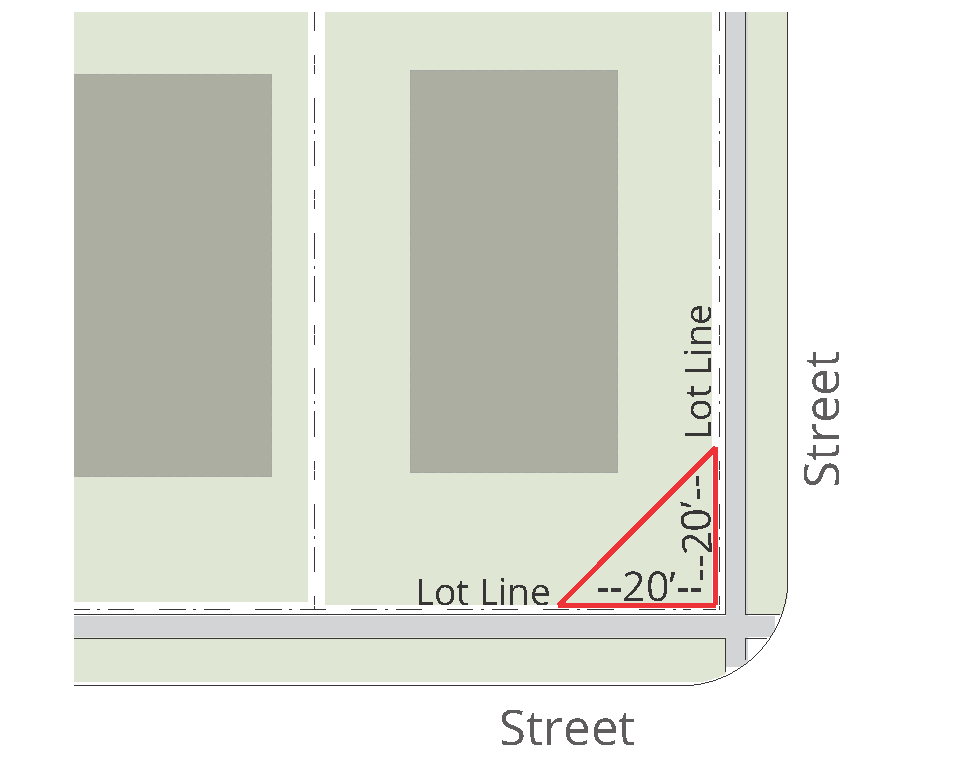
Fences, masonry walls and other visual obstructions over three feet in height may not be placed or maintained on corner lots within the triangular formed by two lines that begin at the point of intersection of the street right-of-way lines and extend for a distance of 20 feet along each intersecting street right-of-way line and a third connecting line that forms the triangle (see figure 9-1).
Figure 9-1. Intersection Visibility
(Ord. No. RZ-2018-11-06, § I, Exh. A(27.269), 11-27-2018)
Sec. 27-980. - Purposes.
The outdoor lighting regulations of this division are intended to help ensure adequate lighting for motorized and nonmotorized travelers; provide for the efficient use of energy; and reduce the impacts of nuisance lighting and glare on nearby areas.
(Ord. No. RZ-2018-11-06, § I, Exh. A(27.270), 11-27-2018)
Sec. 27-981. - Applicability and exemptions.
The outdoor lighting regulations of subsections 27-982 and 27-983 apply to all outdoor lighting except for:
(1)
Outdoor lighting on lots occupied by residential buildings containing fewer than four dwelling units;
(2)
Public street lights;
(3)
Airport runway and aviation safety lights required by the FAA (e.g., warning lights on radio, communication and navigation towers);
(4)
Spotlighting of official government flags, provided that spotlighting is contained within the area of the flag;
(5)
Outdoor lighting used exclusively for and during public recreational activities, sporting events at stadiums and ball fields or other outdoor public spaces or venues;
(6)
Outdoor lighting used for emergency equipment and work conducted in the interest of law enforcement or for public health, safety or welfare;
(7)
Outdoor lighting in association with special events approved by the city council;
(8)
Lighting fixtures with a light output of no more than 1,000 lumens; and
(9)
Temporary holiday light displays.
(Ord. No. RZ-2018-11-06, § I, Exh. A(27.271), 11-27-2018; Ord. No. 2019-11-03, § I(Attch.), 11-26-2019)
Sec. 27-982. - General regulations.
All outdoor lighting shall comply with the following general regulations:
(1)
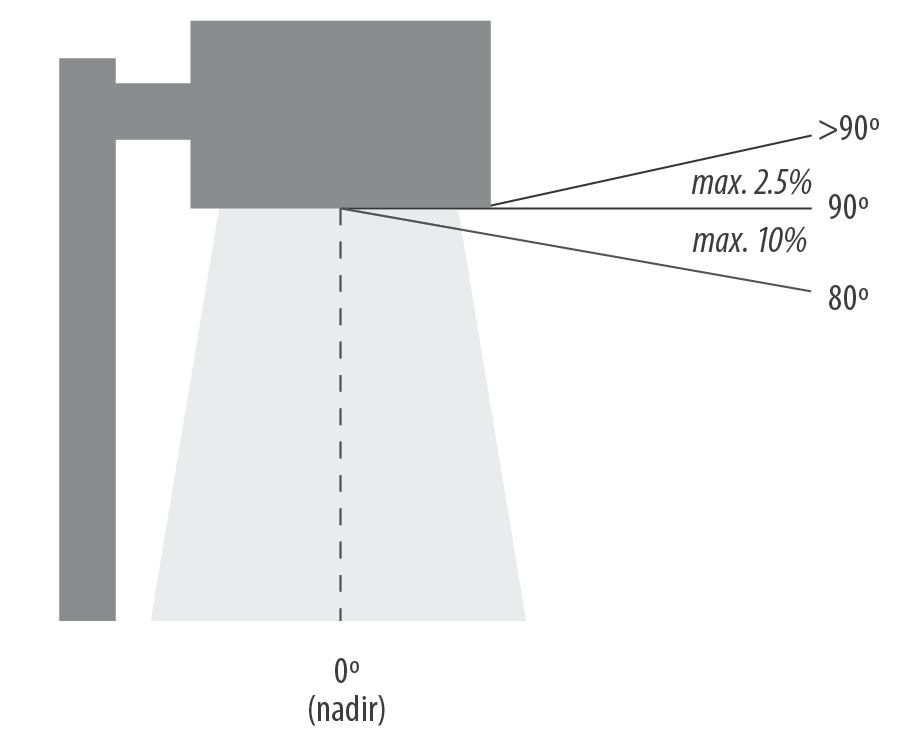
Canopy-mounted lights. Recessed fixtures shall be used in all under-canopy lighting. No lamps, reflectors, refractors or focusing or diffusing may extend below the underside of the canopy surface.
Figure 9-2. Shielded Light Fixtures
(2)
Arrangement and shielding.
a.
Lighting shall be installed to direct light away from abutting lots that are not under common ownership or control with the lot on which the lights are located. Shielding shall be provided to ensure that the light-producing element is not visible from abutting property, measured five feet above grade.
b.
Light-producing elements shall be concealed or shielded with cutoffs so that no more than 2.5 percent of the light emitted directly from the lamp or indirectly from the fixture is projected at an angle of more than 90 degrees above nadir and no more than ten percent of the light emitted directly from the lamp or indirectly from the fixture is projected at an angle of more than 80 degrees above nadir.
(3)
Light trespass. Light trespass along the lot line of the subject property may not exceed 0.5 foot-candles when abutting an R-zoned lot and may not exceed 3.0 foot-candles when abutting any other zoning district or public right-of-way. Maximum illumination levels are measured five feet above grade or from the top of any fence or masonry wall along the property line.
(Ord. No. RZ-2018-11-06, § I, Exh. A(27.272), 11-27-2018)
Sec. 27-983. - Lighting plans.
(a)
General. Outdoor lighting plans demonstrating compliance with applicable regulations of this division are required with the submittal of a site plan unless no new outdoor lighting is proposed on the site, in which case a note shall be placed on the face of the site plan indicating that no new outdoor lighting will be installed. Applicants have two options for the format of required outdoor lighting plans:
(1)
Submit a lighting plan that complies with the fixture height lighting plan requirements of section 27-983(b); or
(2)
Submit a photometric plan demonstrating that compliance will be achieved using taller fixture heights, in accordance with section 27-983(c).
(b)
Option 1: Fixture height standard lighting plan. Option 1 (Fixture Height Standard Lighting Plans) establishes maximum light fixture heights but does not require submittal of a detailed photometric plan.
(1)
Information required. Fixture height standard lighting plans shall include at least the following:
a.
A scale drawing of the site with all outdoor lighting locations shown;
b.
Fixture specifications, including catalog cut-sheets or generic standards;
c.
Pole type and height of fixture;
d.
Lamp type and size; and
e.
Fixture mounting and orientation.
(2)
Maximum fixture heights. Allowable heights of light fixtures shall be measured from the light-emitting surface to finished grade at the base of the pole. Maximum allowed light fixture heights are based on the (ground-level) horizontal distance between the light fixture and any R zoning district or public right-of-way, as established in table 9-2:
(c)
Option 2: Photometric study. Under option two (photometric study lighting plan) no maximum fixture heights are established, but applicants are required to submit a photometric study in sufficient detail to demonstrate that all applicable outdoor lighting regulations will be met. The photometric study shall include at least the following:
(1)
A scale drawing of the site with all outdoor lighting locations shown;
(2)
Fixture specifications, including catalog cut-sheets or generic standards;
(3)
Lamp type and size;
(4)
Fixture mounting heights, mounting orientation, and tilt angles if applicable; and
(5)
A representative point-by-point illumination array for the site showing property lines and demonstrating compliance with applicable light trespass limits.
(Ord. No. RZ-2018-11-06, § I, Exh. A(27.273), 11-27-2018)
Sec. 27-984. - Adverse effects on adjacent properties.
Lighting in all districts shall be established in such a way that no direct light is cast upon or adversely effects adjacent properties and roadways. This section shall not apply to lighting established by governmental authority within public rights-of-way.
(Ord. No. 2019-11-03, § I(Attch.), 11-26-2019)

