
Brookhaven City Zoning Code
ARTICLE VIII
PARKING AND ACCESS
DIVISION 10. - ACCESSIBLE PARKING[11]
Editor's note— Accessible parking facilities (for persons with disabilities) shall be provided in accordance with Georgia law.
Sec. 27-732. - Purpose.
(a)
The parking regulations of this article are intended to help ensure that off-street parking facilities are provided to meet the basic day-to-day needs of shoppers, employees, visitors and residents while also avoiding the negative impacts that can result from requiring excessive quantities of off-street parking.
(b)
The provisions of this article are also intended to help protect the public health, safety and general welfare by:
(1)
Promoting economically viable and beneficial use of land; and
(2)
Providing flexible methods of responding to the transportation and access demands of various land uses in different areas of the city.
(Ord. No. RZ-2018-11-06, § I, Exh. A(27.202), 11-27-2018)
Sec. 27-733. - Applicability.
(a)
General. Off-street parking shall be provided and maintained in accordance with the provisions of this article. Unless otherwise expressly stated, the regulations apply to all zoning districts and uses.
(b)
New uses and development. The parking regulations of this article apply to all new buildings constructed and all new uses established in all zoning districts.
(c)
Change of use. If a new use of a building or structure requires more off-street parking than the use that most recently occupied the building or structure, the new use shall comply with the parking requirements of this article.
(d)
Enlargements and expansions. The parking regulations of this article apply whenever an existing building or use is enlarged or expanded to include additional dwelling units, floor area, seating capacity or other units of measurement used in establishing off-street parking requirements. Additional spaces are required only to serve the enlarged or expanded area, not the entire building or use. There is no requirement to address parking deficits associated with existing, lawfully established buildings or uses.
(e)
Maintenance. Off-street parking spaces required by this zoning ordinance shall be maintained for the life of the principal use. Off-street parking spaces and parking lots shall be maintained in good repair including, but not limited to, repair of pot holes, maintenance of striping, signage, etc.
(f)
Damage or destruction. When a use that has been damaged or destroyed is re-established, off-street parking or loading facilities shall also be re-established or continued in operation in an amount equal to the number maintained at the time of such damage or destruction. It is not necessary, however, to restore or maintain parking or loading facilities in excess of those required by this zoning ordinance.
(Ord. No. RZ-2018-11-06, § I, Exh. A(27.203), 11-27-2018; Ord. No. 2019-11-03, § I(Attch.), 11-26-2019)
Sec. 27-744. - Minimum requirements.
Unless otherwise expressly stated in this zoning ordinance, off-street motor vehicle parking spaces shall be provided in accordance with the minimum ratios established table 8-1.
Table 8-1 Notes
[1] Reserved.
[2] Unless otherwise required at time of SLUP approval.
[3] Minimum requirement for assembly areas without fixed seating = 20 spaces per 1,000 square feet of floor area.
[4] No parking required for first 1,500 square feet of floor area.
[5] Plus motor vehicle and bicycle spaces required for any retail sales floor area.
[6] Plus 2.5 spaces per 1,000 square feet of sales or office space.
(Ord. No. RZ-2018-11-06, § I, Exh. A(27.204), 11-27-2018; Ord. No. 2024-02-01, § I, 2-27-2024; Ord. No. 2025-04-01, 1(Attch.), 4-22-2025)
Sec. 27-756. - Floor area.
Parking requirements based on floor area shall be calculated on the basis of gross floor area, minus parking and loading areas and areas of a building occupied exclusively by mechanical equipment, utilities and service areas that are not intended for human occupancy (e.g., dumpsters and recycling bins).
(Ord. No. RZ-2018-11-06, § I, Exh. A(27.206), 11-27-2018)
Sec. 27-757. - Multiple uses.
Lots containing more than one use or tenant shall provide parking in an amount equal to the total aggregate number of spaces required for each use or tenant on the lot except when a shared parking arrangement is approved in accordance with section 27-778.
(Ord. No. RZ-2018-11-06, § I, Exh. A(27.207), 11-27-2018)
Sec. 27-758. - Calculations.
In calculating the number of parking spaces required for uses subject to a minimum parking ratio of "x" spaces per 1,000 square feet (KSF), first divide the floor area of the subject use by 1,000 and then multiply the result by "x." If, for example, a minimum parking ratio of 2.5 spaces per 1,000 square feet is applied to a use occupying 1,500 square feet of floor area, the minimum parking requirement for that use is calculated as follows: (1.500 sq. ft. ÷ 1,000) × 2.5 = 1.5 × 2.5 = 3.75, which is rounded up to four spaces. See also the fraction and rounding rules of section 27-1329.
(Ord. No. RZ-2018-11-06, § I, Exh. A(27.208), 11-27-2018)
Sec. 27-759. - Occupancy-based standards.
For the purpose of computing parking requirements based on staff, students, members, residents or occupants, calculations shall be based on the average number of persons working on any single shift, the average enrollment or membership or the area's code-rated capacity, whichever is applicable.
(Ord. No. RZ-2018-11-06, § I, Exh. A(27.209), 11-27-2018)
Sec. 27-760. - Bench seating.
For the purpose of calculating parking requirements based on seating, the building code governs.
(Ord. No. RZ-2018-11-06, § I, Exh. A(27.210), 11-27-2018)
Sec. 27-761. - Unlisted uses.
Upon receiving a development or permit application for a use not specifically listed, the community development director is authorized to apply the off-street parking ratio specified for the listed use that the director deems most similar to the proposed use or establish a parking requirement for the proposed use in accordance with section 27-762.
(Ord. No. RZ-2018-11-06, § I, Exh. A(27.211), 11-27-2018)
Sec. 27-762. - Establishment of other ratios.
(a)
The community development director is authorized to establish required minimum parking ratios for unlisted uses and in those instances where authority to establish the parking requirement is expressly provided.
(b)
Such ratios shall be established on the basis of (1) a similar use/parking determination (as described in section 27-761), (2) on parking data provided by the applicant or (3) other information available to the community development director.
(c)
Parking data and studies provided by applicants shall include estimates of parking demand based on reliable data collected from comparable local uses or on external data from credible research organizations, such as the Urban Land Institute (ULI) and the Institute of Transportation Engineers (ITE). Comparability will be determined by density, scale, bulk, area, type of activity and location. Such parking studies shall document the source of all data used to develop proposed requirements.
(Ord. No. RZ-2018-11-06, § I, Exh. A(27.212), 11-27-2018)
Sec. 27-773. - PR-1 district.
No minimum motor vehicle parking requirements apply in the PR-1 district. Bicycle parking requirements do apply.
(Ord. No. RZ-2018-11-06, § I, Exh. A(27.213), 11-27-2018)
Sec. 27-774. - On-street parking
Nonresidential uses may count on-street parking spaces on public street rights-of-way abutting the subject property towards satisfying off-street motor vehicle parking requirements. One off-street parking space credit may be taken for each 25 linear feet of abutting right-of-way where on-street parking is allowed. Only space on the same side of the street as the subject use may be counted.
(Ord. No. RZ-2018-11-06, § I, Exh. A(27.214), 11-27-2018)
Sec. 27-775. - Car-share and bike-share service.
The following parking credits apply to nonresidential uses that are required to provide ten or more motor vehicle parking spaces and to residential projects that are required to provide 25 or more motor vehicle parking spaces.
(1)
The number of required motor vehicle parking spaces is reduced by four spaces for each parking space that is leased by a city-approved car-share program for use by a car-share vehicle.
(2)
The number of required motor vehicle parking spaces is reduced by two spaces for uses that provide space for a city-approved bike-share program facility with a minimum of eight bicycle parking docks.
(Ord. No. RZ-2018-11-06, § I, Exh. A(27.215), 11-27-2018)
Sec. 27-776. - Electric vehicle charging stations.
In parking garages and parking lots containing more than ten parking spaces, each parking space equipped with public electric vehicle charging equipment is credited as two motor vehicle parking spaces for purposes of satisfying the minimum off-street parking ratios of table 8-1. Said credit shall be limited to a maximum of ten percent of the required parking. To receive credit, each electric vehicle charging station-equipped parking space shall be publicly accessible and be identified by signs.
(Ord. No. RZ-2018-11-06, § I, Exh. A(27.216), 11-27-2018; Ord. No. 2019-07-02, § I(Attch.), 7-23-2019)
Sec. 27-777. - Motorcycle and scooter parking.
In parking lots containing more than ten parking spaces, the provision of motorcycle or scooter parking spaces may be credited toward satisfying the minimum off-street parking ratios of table 8-1 at the rate of one motor vehicle parking space for each two motorcycle or scooter parking spaces. The maximum credit allowed under this provision is two spaces or ten percent of the total minimum motor vehicle parking requirement for the subject property, whichever is greater. To receive credit, each motorcycle and scooter space shall have a concrete surface and minimum dimensions of four feet by eight feet. Areas restricted to motorcycle and scooter parking shall be identified by signs.
(Ord. No. RZ-2018-11-06, § I, Exh. A(27.217), 11-27-2018)
Sec. 27-778. - Shared parking.
(a)
General. Shared parking refers to the practice of two or more users who need parking at different times to agree to make use of the same motor vehicle parking spaces. Shared parking is encouraged as a means of conserving scarce land resources, reducing stormwater runoff, reducing the heat island effect caused by large paved areas and improving community appearance.
(b)
Eligibility. Shared parking facilities are allowed for mixed-use projects and for multiple uses with different times of peak parking demand, subject to approval by the community development director.
(c)
Submittal requirements and methodology.
(1)
Applicants proposing to use shared parking as a means of reducing overall motor vehicle parking requirements shall submit:
a.
The names and addresses of the uses and of the owners or tenants that are sharing the parking;
b.
The location and number of parking spaces that are being shared;
c.
A shared parking analysis;
d.
A legal instrument such as an easement or deed restriction guaranteeing access to the parking for the shared parking users.
(1)
The required shared parking analysis shall be based on the latest edition of the Urban Land Institute (ULI) shared parking model or be prepared by an engineer who is registered in the State of Georgia and who has expertise in parking and transportation.
(2)
The shared parking analysis shall demonstrate that the peak parking demands of the subject uses occur at different times and that the parking area will be large enough for the anticipated demands of both uses.
(d)
Location. Shared parking may be located on-site or off-site. Off-site parking is subject to the regulations of section 27-819.
(Ord. No. RZ-2018-11-06, § I, Exh. A(27.218), 11-27-2018)
Sec. 27-789. - Minimum parking ratios.
Short-term and long-term bicycle parking spaces shall be provided in accordance with the minimum ratios established in table 8-1. Uses for which no bicycle parking ratio is established in table 8-1 are not required to provide off-street bicycle parking. No residential or nonresidential use is required to provide more than 30 short-term bicycle parking spaces.
(Ord. No. RZ-2018-11-06, § I, Exh. A(27.219), 11-27-2018; Ord. No. 2025-02-02, § I, 2-25-2025)
Sec. 27-790. - Floor area used for bike parking.
Areas within a building that are used to provide bicycle parking and comply with the bicycle parking design and location requirements of this section are not counted as floor area for the purpose of calculating motor vehicle parking requirements or Floor Area Ratio (FAR).
(Ord. No. RZ-2018-11-06, § I, Exh. A(27.220), 11-27-2018; Ord. No. 2023-01-05, 1-24-2023; Ord. No. 2025-02-02, § I, 2-25-2025; Ord. No. 2025-04-01, 1(Attch.), 4-22-2025)
Sec. 27-791. - Design and location.
(a)
General. All bicycle parking spaces are subject to the general design and location requirements of this section (section 27-791).
(1)
Bicycle parking spaces shall be illuminated if accessible to users after dark.
(2)
Bicycle parking spaces shall be located to be readily visible by the public or by building users, except in the case of long-term parking spaces located in secure areas accessible only to employees, staff or residents;
(3)
Bicycle parking spaces shall be accessible without climbing stairs, going up or down a slope of more than 12 percent, and via a route on the property that is designed to minimize conflicts with motor vehicles and pedestrians.
(4)
All bike racks shall be located at least three feet in all directions from any obstruction, including other bike racks, walls, doors, posts, columns, and curbs. When installing sidewalk racks, racks shall be placed in line with existing and proposed sidewalk obstructions to maintain a clear line of travel for all sidewalk users.
(5)
All bicycle rack areas on or adjacent to sidewalks, plazas, or other areas in the public realm must include a detectable device for visually impaired pedestrians to detect as an obstacle.
(6)
Nonresidential uses may use up to one required automobile parking space as space for providing bicycle parking.
(7)
All developments providing showering and changing facilities to employees, residents, and other regular building occupants may reduce their required motor vehicle parking requirements by up to ten percent.
(8)
To provide bicycle parking spaces that do not require the lifting of a bicycle, a minimum of 30 percent of required spaces must be in a horizontal rack or on the lower level of a stacked rack with a minimum of one horizontal bicycle parking space.
(9)
All required bicycle parking spaces shall have minimum dimensions of three feet in width by seven feet in length, with a minimum overhead vertical clearance of seven feet. Bicycle racks must be chosen from the most current version of the Association of Pedestrian and Bicycle Professionals' Bicycle Parking Guidelines list of recommended bicycle racks, except as otherwise required.
(10)
Extra-wide bicycle spaces to accommodate a variety of bicycles and accessories (i.e. recumbent bikes, cargo bikes, children bikes, trailers, etc.) shall be provided in conformance with the table below. The table applies to short-term and long-term bicycle parking individually. For example, if five short term spaces and one long-term space are required, at least one out of the five short-term spaces must be extra-wide and the one long-term space must be extra-wide.
a.
All extra-wide bicycle spaces must be a minimum of four feet by ten feet and provided in a horizontal rack on the ground. If the bicycle space is enclosed, a minimum height of five feet shall be required.
b.
Unenclosed accessible bike spaces shall provide an additional 36 inches of in-line clearance.
c.
Extra-wide bicycle spaces shall be posted with signage indicating that the space is reserved for accessible extra-wide bicycles only.
(11)
Electric assist bicycle recharging stations must be provided in conformance with the table below. The table applies to short-term and long-term bicycle parking individually, i.e., If five short term spaces and one long-term space are required, at least one out of the five short term spaces must have recharging station and the one long-term space must have a recharging station.
a.
All electric assist bicycle recharging spaces must be a minimum of three feet by ten feet. If bicycle space is enclosed, a minimum height of five feet shall be required.
b.
All provided electrical assist bicycle recharging stations shall allow for bicycle to be locked to a rack.
c.
At least one of the required recharging stations must be accessible to the horizontal biking space.
d.
Public electric bicycle charging stations shall be posted with signage indicating that the space is reserved for electric bicycle charging purposes only. For purposes of this provision, "charging" means that an electric bicycle is parked at an electric bicycle charging station and is connected to the battery charging station equipment.
e.
Electric bicycle charging stations shall be maintained in all respects, including the functioning of the equipment. A phone number or other contact information shall be provided on the equipment for reporting when it is not functioning or other problems are encountered.
(b)
Long-term bicycle parking. In addition to the general bicycle parking design and location requirements of section 27-791, all required long-term bicycle parking shall meet the following requirements:
(1)
Long-term bicycle parking spaces may not be in dwelling units or on dwelling unit balconies.
(2)
Unless clearly visible from the main building entrance, a sign indicating the location of all long-term bicycle parking spaces shall be prominently displayed near the main entrance to the building or facility, and additional signs shall be provided as necessary to ensure easy way-finding. A "bicycle parking" sign shall also be displayed on or adjacent to any indoor room or area designated for bicycle parking.
(3)
Long-term bicycle parking spaces shall protect the entire bicycle, its components and accessories against theft and inclement weather, including wind-driven rain and snow. Acceptable forms of protection include
a.
Individual bicycle lockers;
b.
Attended parking areas;
c.
Video-monitored parking areas;
d.
Restricted-access parking areas; or
e.
Other comparable arrangements approved by the community development director.
(4)
Except in the case of bicycle lockers with a separate access door for each bike or attended facilities, all long-term bicycle parking spaces shall be designed to allow bicycles to be securely locked to a bicycle rack.
(c)
Short-term bicycle parking. In addition to the general bicycle parking design and location requirements of section 27-791, all required short-term bicycle parking shall meet the following requirements:
(1)
Short-term bicycle parking shall be visible from the main public building entrance and be at least as conveniently located as the most convenient non-ADA motor vehicle parking space serving the subject use. If no motor vehicle parking is provided, short-term bicycle parking spaces shall be located within 50 feet of a building entrance.
(2)
Short-term bicycle parking spaces shall be located on private property unless the community development director approves a location within the public right-of-way.
(Ord. No. RZ-2018-11-06, § I, Exh. A(27.221), 11-27-2018; Ord. No. 2023-01-05, 1-24-2023; Ord. No. 2025-02-02, § I, 2-25-2025; Ord. No. 2025-04-01, 1(Attch.), 4-22-2025)
Sec. 27-802. - Applicability.
An on-site circulation system for pedestrian and non-motorized travel shall be provided in accordance with the regulations of this division. Lots occupied by fewer than four residential dwelling units are not subject to these regulations.
(Ord. No. RZ-2018-11-06, § I, Exh. A(27.222), 11-27-2018)
Sec. 27-803. - Connection to the street.
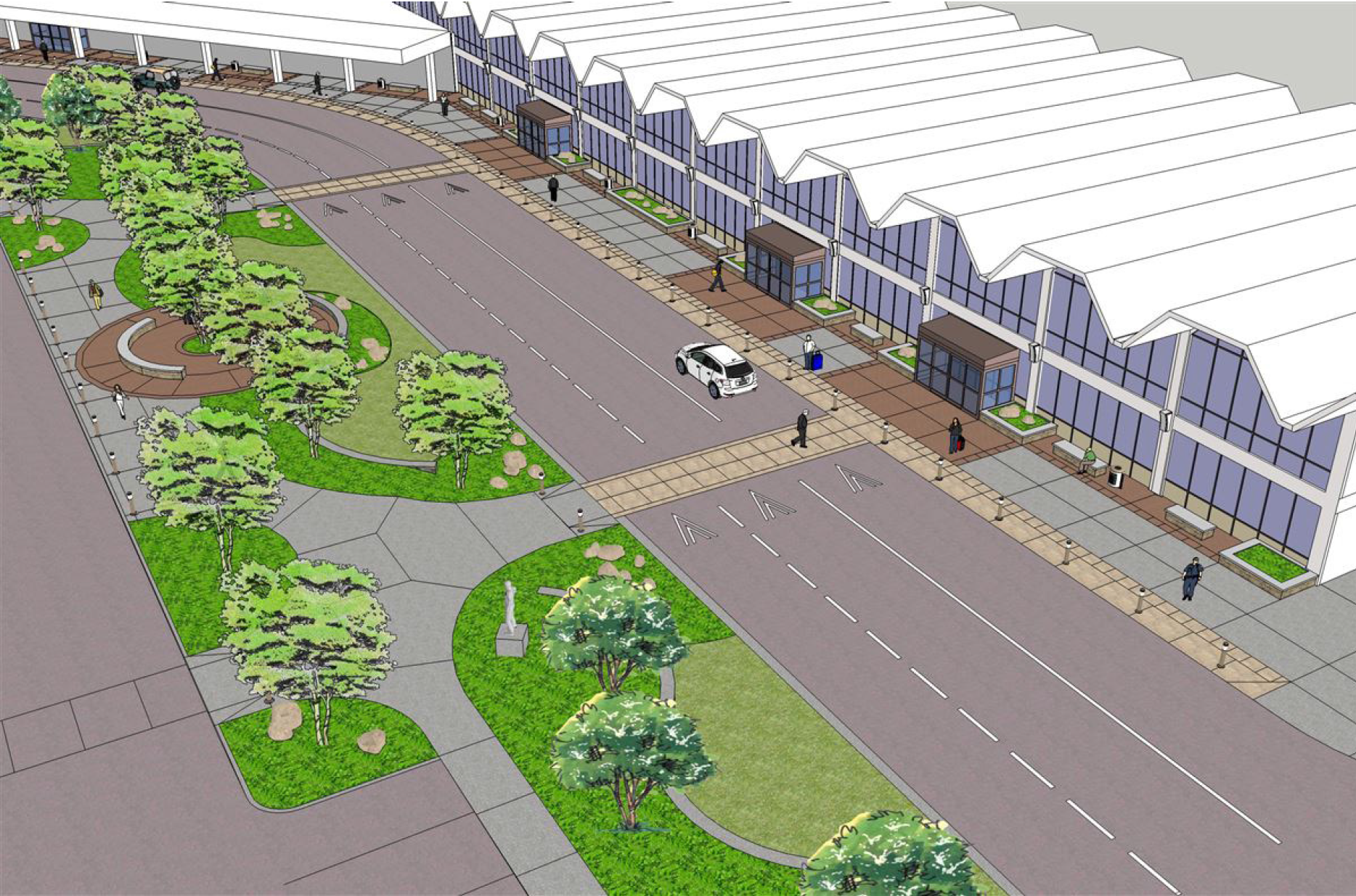
The on-site pedestrian circulation system shall connect all adjacent public rights-of-way to the main building entrance. The connection shall follow a direct route and not involve significant out-of-direction travel for system users.
Figure 8-1. Example of walkway crossing drive-aisle
(Ord. No. RZ-2018-11-06, § I, Exh. A(27.223), 11-27-2018)
Sec. 27-805. - Internal connections.
The on-site pedestrian circulation system shall connect all buildings on the site and provide connections to other areas of the site likely to be used by pedestrians and non-motorized travel, such as parking areas, bicycle parking, open space and recreation areas and similar amenity features.
(Ord. No. RZ-2018-11-06, § I, Exh. A(27.225), 11-27-2018)
Sec. 27-806. - Design.
Required on-site pedestrian circulation facilities shall be designed and constructed in accordance with the regulations of this section.
(1)
The on-site pedestrian circulation system shall be paved and be at least five feet in width.
(2)
When the on-site pedestrian circulation system crosses drive aisles, it shall be clearly differentiated through the use of elevation changes, different paving material or other equally effective methods of safely accommodating non-motorized travel, as approved by the community development director. Striping alone does not meet this requirement.
(3)
When the on-site pedestrian circulation system is parallel and adjacent to a motor vehicle travel lane, it shall be a raised path at least eight inches above the vehicle travel lane surface or be separated from the vehicle travel lane by a raised curb, bollards, landscaping or another physical barrier. If a raised path is used, the ends of the raised portions shall be equipped with accessible curb ramps.
(4)
The on-site pedestrian circulation system shall be illuminated to ensure that it can be used safely at night by employees, residents, and customers. Lighting shall be at height appropriate to a pedestrian pathway system.
(Ord. No. RZ-2018-11-06, § I, Exh. A(27.226, 11-27-2018)
Sec. 27-817. - General.
Except as otherwise expressly stated in this article, required off-street parking areas shall be located on the same lot as the use they are required to serve.
(Ord. No. RZ-2018-11-06, § I, Exh. A(27.227), 11-27-2018)
Sec. 27-818. - Parking in setbacks and yards.
(a)
Parking is prohibited in front setbacks in RM and O&I districts.
(b)
Parking is prohibited in front yards of single family detached dwellings, except on a driveway, or in a roofed carport or enclosed garage. No more than 35 percent of the total area between the street right-of-way line and the front of a single family detached dwelling may be paved.
(c)
Circular driveways are permitted only on lots with adequate width to ensure that driveway approaches on the subject lot are spaced at least 20 feet apart and that all parts of the driveway are set back at least five feet from side property lines. Circular driveway where permitted, are subject to the driveway coverage limits of this section.
(d)
Ribbon driveways that consist of two wheel tracks with turf or ground cover plantings in the median between wheel tracks are allowed to serve detached houses, attached houses and two-flats. Each wheel track of a ribbon driveway shall be surfaced in compliance with the requirements of this article and be at least two and one-half feet in width. The median area between each wheel track is not counted as impervious area if its is planted and maintained with turf or other ground cover planted within pervious soils.
(Ord. No. RZ-2018-11-06, § I, Exh. A(27.228), 11-27-2018; Ord. No. 2025-04-01, 1(Attch.), 4-22-2025)
Sec. 27-819. - Off-site parking.
(a)
When allowed. The community development director is authorized to allow all or a portion of required off-street parking to be provided off-site, in accordance with the regulations of this section. Required accessible parking spaces (see article VIII, division 10) may not be located off site.
(b)
Location. Off-site parking areas shall be located within a 1,000-foot radius of the use served by such parking, measured between the nearest public entrance door of the use to be served and the outer perimeter of the furthest parking space within the off-site parking lot. The community development director is authorized approve the location of off-site parking areas beyond 1,000 feet from the use served in accordance with the administrative variance procedures of article X, division 8 of this chapter.
(c)
Required zoning. Off-site parking lots are allowed only:
(1)
In zoning districts that permit non-accessory parking;
(2)
In districts that allow the principal use to be served by the off-site parking spaces; or
(3)
When approved in accordance with the special land use permit procedures of article X, division 3 of this chapter.
(d)
Design.
(1)
Off-site parking areas shall comply with applicable layout and design regulations of article VIII, division 8.
(2)
Wheel stops shall be provided in parking spaces located adjacent to pedestrian zones.
(e)
Control of off-site parking area. The property to be occupied by off-site parking spaces shall be under the same ownership as the lot containing the use to be served by the parking. The off-site parking area may be under separate ownership only if a legal instrument such as an easement or deed restriction guaranteeing access to the parking for the shared parking users is provided.
(Ord. No. RZ-2018-11-06, § I, Exh. A(27.229), 11-27-2018; Ord. No. 2019-05-03, § I(Attch.), 5-28-2019)
Sec. 27-820. - Use of off-street parking.
(a)
Required off-street parking spaces are intended to serve residents, tenants, patrons, employees, or guests of the principal use. Required off-street parking areas may be used solely for the temporary parking of licensed motor vehicles in operating condition.
(b)
Required off-street parking spaces may not be used for the storage, display or sale of goods equipment or materials. No motor vehicle repair work of any kind is permitted in a required parking space.
(c)
Required spaces may be used for electric vehicle charging.
(Ord. No. RZ-2018-11-06, § I, Exh. A(27.230), 11-27-2018)
Sec. 27-831. - Applicability.
The parking layout and design regulations of this section apply to all off-street parking lots, whether containing required parking spaces or non-required parking spaces.
(Ord. No. RZ-2018-11-06, § I, Exh. A(27.231), 11-27-2018)
Sec. 27-832. - Chapter 14 requirements.
Each parking space and parking lot, including all internal circulation driveways, shall comply with the requirements of chapter 14, except as otherwise expressly stated.
(Ord. No. RZ-2018-11-06, § I, Exh. A(27.232), 11-27-2018)
Sec. 27-833. - Access drives.
(a)
All off-street parking lots shall have access to a public or private street and be served by a paved access drive.
(b)
All access drive gates shall be set back at least 20 feet from the back of the street curb or ten feet from the right-of-way, which results in a greater setback.
(Ord. No. RZ-2018-11-06, § I, Exh. A(27.233), 11-27-2018)
Sec. 27-834. - Parking stall size.
(a)
Compact spaces. In parking lots containing 20 or more parking spaces up to 40 percent of the spaces may be designated and designed as compact parking spaces. Compact parking spaces shall be at least eight feet in width and 15 feet in depth.
(b)
Standard spaces. All standard (non-compact) parking spaces shall be at least eight and one-half feet in width and 18 feet in depth.
(Ord. No. RZ-2018-11-06, § I, Exh. A(27.234), 11-27-2018)
Sec. 27-835. - Parking lot geometrics.
Parking lots shall comply with the geometric design standards of the Institute of Traffic Engineers (ITE).
(Ord. No. RZ-2018-11-06, § I, Exh. A(27.235), 11-27-2018)
Sec. 27-836. - Tandem and valet parking.
Parking areas shall be designed and constructed to allow unobstructed movement into and out of required parking spaces without interfering with fixed objects or vehicles except in the case of allowed tandem and valet parking, as follows.
(1)
Tandem parking. Tandem parking spaces may be used to satisfy parking requirements for household living (residential) uses if the tandem spaces are assigned to the same dwelling unit.
(2)
Stacked parking. Stacked parking (i.e., requiring one or more vehicles to be moved to obtain access to other parked vehicles) may be used to satisfy minimum off-street parking requirements for nonresidential uses if an attendant is present and able to move and provide access to parked vehicles during all hours of operation.
(Ord. No. RZ-2018-11-06, § I, Exh. A(27.236), 11-27-2018)
Sec. 27-837. - Marking.
In parking areas with more than four parking spaces, the location of each parking space shall be identified by surface markings or other effective means and be maintained so as to be readily visible at all times.
(Ord. No. RZ-2018-11-06, § I, Exh. A(27.237), 11-27-2018)
Sec. 27-838. - Surfacing.
All off-street parking areas and access drives shall be surfaced and maintained with an asphaltic or Portland cement binder concrete or other dustless, all-weather surface approved by the community development director.
(Ord. No. RZ-2018-11-06, § I, Exh. A(27.238), 11-27-2018)
Sec. 27-839. - Vertical clearance.
All required parking spaces shall have overhead vertical clearance of at least seven feet.
(Ord. No. RZ-2018-11-06, § I, Exh. A(27.239), 11-27-2018)
Sec. 27-840. - Lighting.
(a)
All lighting used to illuminate off-street parking areas shall use full-cutoff directional lighting to prevent glare and light spillover onto streets and abutting R-zoned lots.
(b)
The maximum luminance at the property line of an abutting R-zoned lot may not exceed 0.5 footcandles at grade (horizontal) or at five feet above grade (vertical).
(c)
Light standards within parking lots and atop parking garages may not exceed 20 feet in height.
(Ord. No. RZ-2018-11-06, § I, Exh. A(27.240), 11-27-2018)
Sec. 27-841. - Landscaping
See article IX, division 1 of this chapter for landscape regulations.
(Ord. No. RZ-2018-11-06, § I, Exh. A(27.241), 11-27-2018)
Sec. 27-842. - Parking garages.
The following supplemental requirements apply to parking garages:
(1)
Vehicular access.
a.
Vehicular access shall be designed in a manner that minimizes disruption to motorized travel, non-motorized travel and the streetscape.
b.
Vehicular ingress and egress shall be provided from an alley or side (secondary) street. When alley access or side-street access is not possible, then vehicular ingress and egress shall be permitted from the front (primary) street.
c.
Free-flow parking garage entries (i.e., without attendants, gates or ticket-dispensing machines) shall provide at least one off-street vehicle stacking space per entry lane.
d.
Parking garage entries that include automatic ticket-dispensing machines or automatic key readers at entries shall provide at least two off-street vehicle stacking spaces per entry lane.
e.
Parking garage entries that include manual ticket-dispensing machines at entries shall provide at least three off-street vehicle stacking spaces per entry lane.
f.
Required vehicle stacking spaces at entries shall be located so that they do obstruct sidewalks.
(2)
Design.
a.
Ramps and sloping floors shall be located so as not to be visible from the front-street facing side of the parking garage.
b.
In order to de-emphasize the horizontal nature of the parking garage, vertical divisions at least two feet in width and extending the full height of the parking garage structure are required at least every 30 feet (measured horizontally).
c.
Parking structures shall be architecturally compatible with principal buildings on the site, and the building materials used on accessory parking garages shall match or be similar to the building materials used on the principal building.
d.
Parking garages adjacent to the street shall either be lined with habitable/occupiable floor space or incorporate ornamental grillwork, artwork, or similar architectural features.
(3)
Lighting.
a.
Parking garages are subject the lighting regulations of section 27-840.
b.
Lighting on top of parking garages is prohibited between the hours of 11:00 p.m. and sunrise, except that lighting is allowed while the parking facility is open to the public.
c.
Parking garages shall be designed to screen interior garage lights from view of abutting R-zoned lots.
(Ord. No. RZ-2018-11-06, § I, Exh. A(27.242), 11-27-2018)
Sec. 27-853. - Spaces required.
In addition to the parking required for each use, establishments with drive-through facilities shall provide stacking spaces for each drive-through station as indicated in table 8-2.
(Ord. No. RZ-2018-11-06, § I, Exh. A(27.243), 11-27-2018)
Sec. 27-854. - Dimensions.
Each lane of stacking spaces shall be at least nine feet in width and at least 18 feet in length. Stacking lanes shall be delineated with pavement markings.
(Ord. No. RZ-2018-11-06, § I, Exh. A(27.244), 11-27-2018)
Sec. 27-855. - Bypass lane.
Drive-through restaurants shall include a bypass lane adjacent to the required stacking lane. The bypass lane shall have minimum width of ten feet and be designed to allow vehicles to circumvent or leave the stacking lane without waiting for other queuing vehicles to exit.
(Ord. No. RZ-2018-11-06, § I, Exh. A(27.245), 11-27-2018)
Sec. 27-856. - Location and design.
Stacking lanes shall be located on the subject property. They may not be located within required driveways or drive aisles, parking spaces or loading areas and may not interfere with access to parking and ingress and egress from the street. Stacking lanes and drive-through windows may not be located between the principal building and the front street unless approved in accordance with the special land use permit procedures of article X, division 3 of this chapter.
(Ord. No. RZ-2018-11-06, § I, Exh. A(27.246), 11-27-2018)
Sec. 27-857. - Pedestrian access.
The principal pedestrian access to the entrance of the use from a public sidewalk may not cross the drive-through facility stacking lane.
(Ord. No. RZ-2018-11-06, § I, Exh. A(27.247), 11-27-2018)
Sec. 27-858. - Noise.
Speakers associated with drive-through facilities shall not be audible from abutting R-zoned lots. Sound attenuation walls, landscaping or other mitigation measures may be required to ensure that the facility will not have adverse noise-related impacts on nearby residential uses.
(Ord. No. RZ-2018-11-06, § I, Exh. A(27.248), 11-27-2018)
Sec. 27-859. - Drive-through and drive-in uses.
Drive-through and drive in uses are allowed only as indicated in table 7-1. See also section 27-685.
(Ord. No. RZ-2018-11-06, § I, Exh. A(27.249), 11-27-2018)
Sec. 27-900. - Commercial motor vehicles.
The parking of commercial motor vehicles (as defined in O.C.G.A § 40-1-1) is prohibited on R-zoned lots. This prohibition does not apply to:
(1)
Law enforcement vehicles;
(2)
Vehicles actively engaged in construction, or contractor services on the subject property;
(3)
Vehicles within a completely enclosed building;
(4)
The temporary parking (12 hours or less) of vehicles for the purpose of loading/unloading; or
(5)
When the subject lot is occupied by an allowed nonresidential use.
(Ord. No. RZ-2018-11-06, § I, Exh. A(27.250), 11-27-2018; Ord. No. 2019-05-03, § I(Attch.), 5-28-2019)
Sec. 27-901. - Recreational vehicles.
(a)
The parking and storage of trailers and recreational vehicles is prohibited outside of an enclosed building in the following areas on R-zoned lots:
(1)
The front or street side yard;
(2)
Within ten feet of an interior side lot line; or
(3)
Within 20 feet of the rear lot line.
(b)
Recreational vehicles and trailers may be parked, for the limited purpose of storage between travel, on unpaved surfaces including gravel or a similar material that prevents the vehicle's or trailer's tires from making direct contact with the earth, soil, sod or mud so long as the unpaved surface prevents tracking of earth, soil, sod or mud onto public streets when the vehicle or trailer is moved from the property.
(c)
Recreational vehicles may not be occupied for human habitation for more than 14 consecutive days while parked in a R zoning district.
(d)
Recreational vehicles and trailers may not be parked on an R-zoned lot that does not contain a permanent dwelling unit or other structure intended for permanent human habitation.
(Ord. No. RZ-2018-11-06, § I, Exh. A(27.251), 11-27-2018)
Sec. 27-912. - General.
All uses that regularly receive materials or merchandise carried by delivery vehicles shall provide off-street loading facilities.
(Ord. No. RZ-2018-11-06, § I, Exh. A(27.252), 11-27-2018)
Sec. 27-913. - Regulations.
(a)
Off-street loading areas shall be designed so that all vehicle maneuvering and loading/unloading operations will occur on private property and not interfere with or create safety hazards for motorized or non-motorized circulation.
(b)
Unenclosed off street loading areas may not be located within 25 feet of any abutting R-zoned properties.
(c)
Loading spaces are prohibited in the front yard area.
(d)
All loading spaces shall be posted with "No Idling" signs.
(e)
All loading areas and access drives shall be surfaced and maintained with an asphaltic or Portland cement binder concrete or other dustless, all-weather surface approved by the city engineer.
(f)
See Division 9-1 for landscape and screening regulations.
(Ord. No. RZ-2018-11-06, § I, Exh. A(27.253), 11-27-2018)

