
Buffalo Grove City Zoning Code
CHAPTER 17
36 - DRIVEWAYS AND OFF-STREET PARKING AND LOADING FACILITIES
Sections:
17.36.010 - Purpose.
The purpose of this Chapter is to alleviate or prevent congestion of the public streets, and so promote the safety and welfare of the public by establishing minimum requirements for the off-street parking and loading and unloading of motor vehicles in accordance with the use to which property is put.
17.36.020 - General provisions—Parking and loading.
A.
Procedure.
1.
An application for a building permit for a new or enlarged building, structure or use shall include a plot plan, drawn to scale and fully dimensioned, showing driveways and parking or loading facilities to be provided in compliance with the requirements of this Title.
2.
Any re-striping, reconstruction, expansion or modification of an existing parking lot or construction of a new parking lot shall require a permit from the Village's Department of Building and Zoning. Application for said permit shall include a site plan drawn at a scale of one-inch equals fifty feet or larger, delineating the size and location of all parking spaces, driveways, sidewalks and curb ramps for accessibility in compliance with this Title. Said site plan shall conform to the applicable specifications of Title 16 and Zoning Ordinance and shall comply with the Illinois Accessibility Code concerning parking spaces and accessibility for persons with disabilities. The permit fee is set forth in Appendix A, Table A-1, Fee Schedule of this Code. Said site plan requirement may be met by the approved Preliminary Plan or other plan of record approved by the Village for a property if the proposed Improvements do not require modifications of parking stalls or other changes to the approved plan.
B.
Only one curb crossing or connection to streets is permitted for a single-family residential lot, except in the R-E, R-1 and R-2 Districts where a maximum of two street connections per lot are permitted.
C.
Existing Parking and Loading Spaces. Accessory off-street parking and loading spaces in existence on the effective date of this Title may not be reduced in number unless already exceeding the requirements of this section for equivalent new construction, in which event said spaces shall not be reduced below the number required herein for such equivalent new construction.
D.
Permissive Parking and Loading Spaces. Nothing in this Title shall prevent the establishment of off-street automobile parking or loading facilities to serve any existing use of land, except that off-street parking areas accessory to existing multiple-family structures cannot be located off the premises containing the main use unless on a lot adjacent thereto.
(Ord. 2004-94 § 8, 2004)
(Ord. No. 2013-07, § 1, 2-4-2013; Ord. No. 2014-43, § 27, 6-16-2014; Ord. No. 2016-057, § 2, 11-7-2016; Ord. No. 2023-157, § 1(Exh. B), 12-4-2023)
17.36.030 - Additional regulations—Parking.
A.
Use of Parking Facilities. Unenclosed, off-street parking facilities accessory to residential use and developed in any residential district in accordance with the requirements of this Chapter shall be used solely for the parking of passenger automobiles owned by occupants of the dwelling structures to which such facilities are accessory or by guests of said occupants, except as permitted in Section 17.36.030H. Under no circumstances shall required parking facilities accessory to residential structures be used for the storage of commercial vehicles or for the parking of automobiles belonging to the employees, owners, tenants, visitors or customers of business or manufacturing establishments, except as permitted in Section 17.36.030H.
B.
Joint Parking Facilities. Off-street parking facilities for separate uses may be provided collectively if the total number of spaces so provided is not less than the sum of the separate requirements for each use. However, dual function parking spaces may be permitted by the Corporate Authorities upon satisfactory evidence that requirements of particular uses do not substantially overlap.
C.
Control of Off-Site Facilities. When required accessory off-street parking facilities are provided elsewhere than on the lot on which the principal use served is located, they shall be in the same possession, either by deed or long-term lease, as the property occupied by such principal use, and the owner shall be bound by covenants filed of record in the office of the County Recorder of Deeds requiring the owner and his or her heirs and assigns to maintain the required number of parking spaces during the existence of said principal use.
D.
Permitted Districts for Accessory Parking. Accessory parking facilities provided elsewhere than on the same zoning lot with the principal use served in accordance with Section 17.36.040 may be located in any zoning district except as follows:
1.
No parking facilities accessory to an apartment use shall be located in the R-E through R-6A district;
2.
No parking facilities accessory to a business or industrial use shall be located in a residential district, except when authorized by the Corporate Authorities as prescribed in Section 17.36.030E;
3.
No parking facilities accessory to an industrial use shall be permitted in a B-1 District.
E.
Non-Residential Parking in Residential Districts. Accessory off-street parking facilities serving nonresidential uses of property may be permitted in an R-8 and R-9 District when authorized by the Corporate Authorities, subject to the following requirements in addition to all other relevant requirements of this Chapter:
1.
The parking lot shall be accessory to and for use in connection with one or more nonresidential establishments located in adjoining districts or in connection with one or more existing professional or institutional office buildings or institutions;
2.
Said parking lot shall be used only in accordance with Section 17.36.030H;
3.
No commercial repair work or service of any kind shall be conducted on said parking lot;
4.
The parking lot may be open from seven o'clock a.m. to nine o'clock p.m. and shall be closed at all other times, provided, however, that when supervised by one or more full-time attendants, the parking lot may be kept open until midnight;
5.
Each entrance to said parking lot shall be at least twenty feet distant from any adjacent property located in any residential district, except where ingress and egress to the parking lot is provided from a public alley or public-way separating the residential areas from the proposed parking lot.
F.
Design and Maintenance.
1.
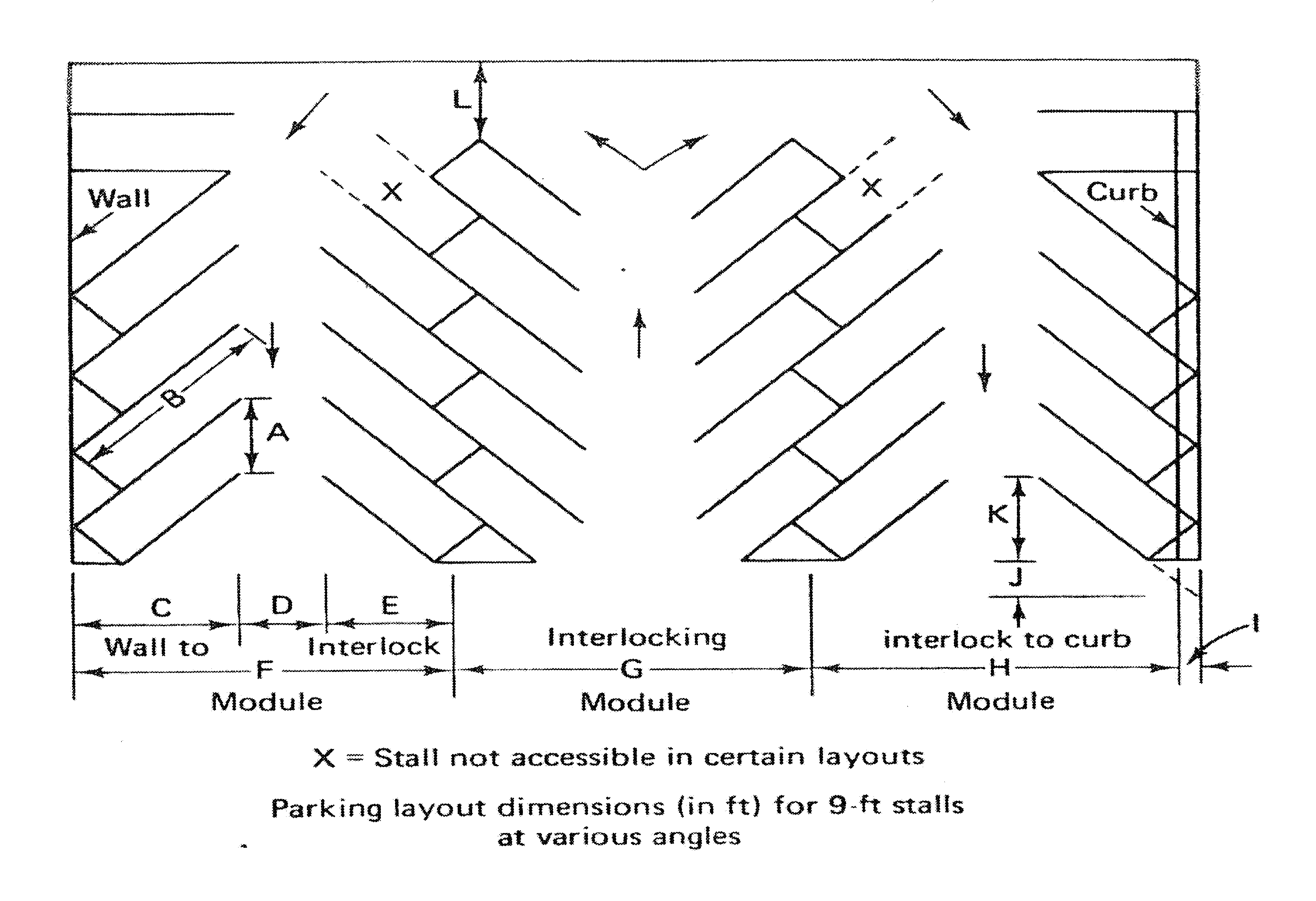
Parking space—Description. Parking spaces shall be designed in accordance with the parking dimensions in Figure 17.36-1 and shall be used for the storage or parking of passenger automobiles or commercial vehicles under one and one-half tons capacity.
2.
Measurement of Space. When determination of the number of required off-street parking spaces results in a requirement of a fractional space, any fraction shall be interpreted as one parking space.
3.
Open and Enclosed Spaces. Parking areas may be open or enclosed except that when parking facilities accessory to a multiple dwelling are located in a residential or B-1 or B-2 District elsewhere than on the same zoning lot with the principal use served, such parking facilities shall be open to the sky.
4.
Access. Parking facilities shall be designed with appropriate means of vehicular ingress and egress to a street or alley in such a manner as will least interfere with the movement of traffic. Driveways shall not obstruct, damage or harm any tree, fire hydrant, street light or other Village approved structure located within the parkway. Hard surfaces such as pavement, concrete or brick shall not be permitted within the drip line of any parkway tree at the time of installation, as determined by the Village Engineer. Driveways serving detached single-family residences shall also comply with the following standards:
a.
A maximum of forty percent of the required front yard area may be covered by approved paved and impervious surfaces including driveways and walkways. The required front yard area shall be used for said coverage calculation for all lots, including lots where the garage and driveway are located in a corner side yard,
b.
For residences with an attached one-car or two-car garage, a maximum driveway width of twenty-four feet at the sidewalk in or adjacent to the public parkway shall be permitted subject to the limitations of Subsection 4.a.
c.
For residences with an attached three-car or larger garage, a maximum driveway width of twenty-seven feet at the sidewalk in or adjacent to the public parkway shall be permitted,
d.
For residences in the Residential Estate, R-1 and R-2 Districts that have two street connections as allowed pursuant to Section 17.36.020(B), the width of the driveways at the sidewalk in or adjacent to the public parkway shall be a maximum of eighteen feet,
e.
In cases where there is no sidewalk at the front of a lot, said maximum driveway widths as described in subsections (b), (c) and (d) shall be computed at the front property line,
f.
For driveways with widths greater than the width at the apron as allowed by subsections (b), (c) and (d), the driveway shall be tapered at a rate not greater than one-foot in width for every one-foot in length to meet within one-foot of the driveway apron in or adjacent to the public parkway,
g.
For residences with a detached garage in the rear yard, a driveway and apron may be a maximum width of eighteen feet in any portion of the required front yard
h.
The design of vehicular ingress and egress driveways from residences other than detached single-family residences and from all other districts shall have widths as measured from edge of pavement to edge of pavement or in the case of the existence of a channelizing median, from edge of pavement to edge of median or point of intersection of median edge, extended to the property line; each as measured at the property line of at least twelve feet; but not greater than twenty-four feet for one-way driveways and at least twenty-four feet, but not greater than thirty-five feet, for two-way driveways. A divided entrance separating entering and exiting driveway lanes shall be separated by a curbed median, with a width of not less than six feet and not exceeding ten feet. Entering and exiting driveways of a divided entrance shall each be considered separate one-way driveways for the purpose of determining width requirements.
5.
Required setbacks.
a.
No parking space nor portion thereof established on a zoning lot without a building shall be located closer to any street line than the established building line on adjacent properties nor closer than the front yard setback required for the district in which the parking lot is located.
b.
Any impervious surface proposed to be constructed within five feet of the property line or within any easement shall be subject to the review and approval of the Village Engineer.
6.
Lighting. Any lighting used to illuminate an off-street parking area shall be so arranged as to reflect the light away from adjoining properties.
7.
All parking lots, including new facilities or modifications to existing facilities, shall provide parking spaces and accessibility for persons with disabilities in compliance with the Illinois Accessibility Code. In addition to applicable state requirements, the location of parking spaces, accessibility routes and curb ramps are subject to Village approval.
G.
Location of Parking Areas. Off-street automobile parking facilities shall be located as hereinafter specified; where a distance is specified, such distance shall be linear distance measured from the nearest point of the parking area to the nearest entrance of the building that said parking area is required to serve.
PARKING DIMENSIONS
Figure 17.36-1
1.
For one and two-family dwellings, on the same lot with the building they are required to serve.
2.
For three and four-family dwellings not over two stories in height, on the same lot or parcel of land as the building they are required to serve.
3.
For apartment houses containing four or more dwelling units on the same lot or parcel of land as the building they are required to serve, or on a separate lot or parcel of land not more than three hundred feet from the nearest entrance to the main building being served, provided the lot or parcel of land selected for the parking facilities is located in an apartment district or a less restricted district.
4.
For rooming houses, lodging houses, clubs, hospitals, sanitariums, orphanages, homes for the aged, convalescent homes, dormitories, sorority and fraternity houses, and other similar uses, the off-street parking facilities required shall be on the same lot or parcel of land as the main building or buildings being served or upon properties contiguous to the zoning lot upon which is located the building or buildings they are intended to serve.
5.
For uses other than those specified above, off-street parking facilities shall be provided on the same lot or parcel of land as the main building being served, or on a separate lot or parcel of land not over one thousand feet from the entrance of the main building, measured from the nearest point of the parking area, provided the separate lot or parcel of land intended for the parking facilities is located in a Business or Office/Industrial District or in an R-8 or R-9 District subject to the requirements of Section 17.36 030.E.
H.
Parking in Residential Districts. The following restrictions and regulations shall apply to parking and storage on private property in all residential districts.
1.
Commercial Vehicles. One commercial vehicle up to the following size including appurtenances and attachments per zoned residential lot shall be permitted:
Length: Eighteen feet
Width: Eight feet
Height: Seven feet
No parking of any commercial vehicle shall be allowed on Village streets except for delivery or service.
2.
Definition of Recreational Vehicle (RV): Vehicles or trailers for recreational or non-commercial uses that can be driven, towed, sailed, or hauled. This includes, but is not limited to, those vehicles commonly referred to as RVs, such as motor homes and travel trailers, as well as any snowmobiles, pull campers, all-terrain vehicles ATV), tent trailers, special purpose trailers, cargo trailers, horse trailers, utility trailers used for hauling, or other similar vehicle; water-oriented vehicles and their trailers including, but not limited to, power boats, cruisers, jet skis, fishing/hunting boats, pontoon boats, personal watercrafts (PWC), as well as, row boats, sail boats, and other non-motorized watercraft. A recreational vehicle(s) such as an ATV, PWC or boat on a trailer shall constitute one recreational vehicle.
3.
Parking or Storage of Recreational Vehicles.
a.
General Regulations.
(i)
Recreational vehicles of any size and any number can be parked in a fully enclosed garage unless such parking specifically prohibited elsewhere in the Code.
(ii)
No more than one recreational [vehicle] may be parked outside on any residential lot.
(iii)
Recreational vehicles that are parked outside shall conform to the following regulations:
•
Recreational vehicles shall be within size regulations of: Thirty feet in length, ten feet in height, and eight feet in width.
•
Recreational vehicles shall not have their wheels removed or be affixed to the ground.
•
Recreational vehicles shall be parked on an approved hard surface (i.e. concrete, asphalt, pavers, or other similar materials resulting in a dust free surface).
•
Recreational vehicles shall not encroach into the right-of-way or over the public sidewalk.
•
Recreational vehicles shall be operable and moved at least once in any calendar year.
•
Recreational vehicles parked on any property shall not create a line or sight obstruction that would impair pedestrian and/or vehicular traffic.
(iv)
Parked recreational vehicles should not be used for living, sleeping, or other purposes or as accessory structures.
(v)
Recreational vehicles that are being repaired, in an inoperative condition, or not licensed, may be parked outside on a temporary basis (no more than forty-eight hours), otherwise they are to be in an enclosed garage.
b.
Location.
(i)
From May 15 to September 30 of the same calendar year, one recreational vehicle may be parked within the front yard building setback line of the driveway only. At all other times (between October 1 of each calendar year and May 14 of the following year), a recreational vehicle may be parked within the front yard building setback line on the driveway, on a temporary basis, for no more than a total of fifteen days per calendar year for the purpose of loading, unloading, cleaning and maintenance.
(ii)
During anytime of the calendar year, a recreational vehicle can be parked in the interior side yard of a residentially zoned lot provided that it is effectively screened from the public view and is not parked within the required side yard setback of the zoning district. Adequate screening (fencing or landscaping) shall be a minimum of five feet in height is installed and properly maintained.
(iii)
During anytime of the calendar year, a recreational vehicle can be parked in the rear yard of a residentially zoned lot provided that it is effectively screened from the public view and it meets the required rear yard setback of the zoning district. Adequate screening (fencing or landscaping) shall be a minimum of five feet in height is installed and properly maintained.
(iv)
A recreational vehicle shall not be located in the corner side yard setback, except if parked on a driveway in accordance to Section 17.36.030.H.3.b(i).
(v)
Any property not complying with any portion of the regulations set forth in Subsection H.2 and H.3, shall require a variation pursuant to the terms established in Chapter 17.52 of the Buffalo Grove Zoning Ordinance.
4.
Multiple-Family Districts (R-7, R-8, and R-9).
a.
In multiple-family districts (R-7, R-8, and R-9) the requirements of Subsections 17.36.030.H.2 and H.3 shall apply where a driveway is present on the zoned lot.
b.
In multiple-family districts (R-7, R-8, and R-9) where no driveway is present and where common parking areas are provided, then the number of recreational vehicles shall not exceed the number of units on the zoning lot. In all other respects, the requirements of Subsections 17.36.030.H.2 and H.3, hereof shall be applicable.
c.
Parking of recreational vehicles shall be in a designated area separate from general parking.
(Ord. No. 2009-19, §§ 1, 2, 4-6-2009; Ord. No. 2014-43, § 28, 6-16-2014; Ord. No. 2017-003, § 2, 2-27-2017; Ord. No. 2018-007, § 2, 2-26-2018)
17.36.040 - Schedule of parking requirements.
A.
Schedule of Requirements. Requirements governing the number of off-street parking and off-street loading facilities in relation to the use of property are established hereinafter in sections of this Title, The parking and loading requirements for any use not specified herein shall be the same as for a similar specified use as determined by Sections 17.36.040 and 17.36.050.
B.
Floor Area. The term "floor area" as employed herein in the case of office, merchandising or service types of use shall mean the gross floor space of a building or structure.
C.
Residential Uses.
1.
Dwelling, detached: 2.0 spaces per dwelling unit.
2.
Dwelling, semi-detached and attached: 2.0 spaces per dwelling unit.
3.
Dwelling, two-family and multiple-family: 1.7 spaces per dwelling unit.
4.
Apartment for senior citizens (fifty-five years of age and older): 1.0 space per dwelling unit plus 1.0 space per employee.
5.
Dormitory: 5.0 spaces per one thousand square feet of floor area.
6.
Convent, rectory: 2.0 spaces per one thousand square feet of floor area.
7.
Convalescent home, nursing home: 1.0 parking space for every four beds, plus one for each vehicle used in the conduct of the enterprise.
D.
Manufacture and Industrial Uses. 2.0 spaces per every three employees.
E.
Transportation, Communication and Utilities.
1.
Airport, bus terminal, heliport, railroad passenger terminal: spaces as required after review by the Planning and Zoning Commission plus additional parking for retail service uses.
2.
Air freight terminal, newspaper distribution facility, railroad freight terminal: 2.0 spaces per every three employees.
3.
Microwave relay towers, radar installations and towers, radio and television stations and towers, parking garage, parking lot: 1.0 space per employee.
4.
Telegraph office, telephone operator and business office: 4.0 spaces per one thousand square feet of floor area.
5.
Public and private utilities installation: 2.0 spaces per every three employees.
6.
Auto graveyards, dumps, junk yards, sanitary landfill: 2.0 spaces per each employee.
7.
Cartage and express facilities, motor freight terminal: 2.0 spaces per each three employees.
F.
Retail and Wholesale Trade.
1.
General commercial/retail (individual businesses): 1.0 space per two hundred fifty square feet of floor area.
2.
Shopping Centers: 1.0 space per two hundred twenty square feet of floor area. In a case where a major tenant is of a nature that would require a significant deviation from this standard, the parking requirement for that individual use shall be used.
3.
Eating and drinking establishments: 1.0 space per one hundred square feet of floor area. Establishments with a drive-thru window shall provide a minimum of ten stacking spaces per window.
4.
Household appliance stores, furniture stores, motor vehicle sales: 2.0 spaces per one thousand square feet of floor area.
G.
Services and Institutions.
1.
Business and professional offices: 1.0 space per every three hundred square feet of floor area.
2.
Bank, savings and loans, and financial institutions: 1.0 space per every two hundred fifty square feet of floor area.
Drive-in establishments shall provide six stacking spaces per teller or customer service area.
3.
Auto laundry: 1.0 space per employee.
4.
Hotel, motel: 1.0 space per each dwelling unit plus one space per each employee plus additional parking spaces for the retail/service/entertainment areas.
5.
Animal kennel and hospitals: 4.0 spaces per every one thousand square feet of floor area.
6.
Health or medical institutions or sanitarium: 1.5 spaces per every one thousand square feet of floor area.
7.
Dental and medical clinic or office: 5.0 spaces per every one thousand square feet of floor area.
8.
Funeral parlor: 4.0 spaces per one thousand square feet of floor area.
9.
Day care center, child care center, nursery school, pre-school: 2.0 spaces per every one thousand square feet of floor area.
10.
Boarding school, elementary school, junior high school: 1.0 space per employee.
11.
Senior high school: 1.0 space per employee plus 1.0 space per every six students based on rated design capacity.
12.
College, junior college, university: 1.0 space per every two employees plus 1.0 space per each four students based on rated design capacity.
13.
Business school, commercial school, trade school, vocational school: 1.0 space per employee plus 1.0 space per student based on rated design capacity.
14.
Dance school, music school, vocal school: 1.0 space per employee plus 1.0 space per every three students based on rated design capacity.
15.
Governmental services: 4.0 spaces per one thousand square feet of floor area.
16.
Chapel, church, synagogue, temple: 1.0 space per three seats based on rated design capacity.
17.
Philanthropic and charitable institutions, religious retreat: 1.0 space per one thousand square feet of floor area.
H.
Cultural Uses, Entertainment and Sports.
1.
Art gallery, historic site, library, museum: 2.0 spaces per one thousand square feet of floor area.
2.
Community center, convention hall, exhibition hall, meeting hall, recreation building: 1.0 space per one thousand square feet of floor area.
3.
Amphitheater, auditorium fairgrounds, fieldhouse: 1.0 space per four seats.
4.
Theater: 1.0 space per 2.5 seats.
5.
Amusement park, miniature golf, kiddie park: 3.0 spaces per one thousand square feet of floor area plus 3.0 spaces per one thousand square feet of land area.
6.
Billiard hall, bowling alley, pool hail, skating rink: 10.0 spaces per one thousand square feet of floor area.
7.
Golf course, full size: 60.0 spaces per nine holes (regular golf).
8.
Camping grounds, outdoor rifle, trap, skeet shooting range: 1.0 space per two thousand square feet of land area.
9.
Athletic field, public parks and playgrounds, tennis courts club: 1.0 space per five thousand square feet of land area.
10.
Public swimming pool: 1.0 space per five thousand square feet of land area plus 1.0 space per seventy-five square feet of water area.
(Ord. No. 2014-43, § 29, 6-16-2014)
17.36.050 - Off-street loading and unloading facilities.
In all districts where property uses include the loading and unloading of materials or merchandise from vehicles, off-street loading and unloading facilities shall be provided in accordance with the following requirements:
A.
For hotels or apartment-hotel buildings wherein there are contained exhibition halls, convention halls, auditoriums, office facilities or retail shops, one off-street loading and unloading space for the first forty thousand square feet of gross floor area, plus one additional off-street loading space for each one hundred fifty thousand square feet of gross floor area or fraction thereof in excess of forty thousand square feet.
B.
For hospitals or sanitariums containing forty thousand to one hundred thousand square feet of gross floor area, one off-street loading and unloading space, plus one additional such space for each additional one hundred thousand square feet of gross floor area or fraction thereof in excess of one hundred thousand square feet.
C.
For buildings containing bowling lanes, taverns, restaurants or any retail shops and having ten thousand to one hundred thousand square feet of gross floor area, one off-street loading and unloading space, plus one additional such space for each additional one hundred thousand square feet of gross floor area or fraction thereof in excess of one hundred thousand square feet.
D.
For banks, business or professional offices, or public administration buildings containing forty thousand to one hundred thousand square feet of gross floor area, one off-street loading and unloading space, plus one additional such space for each additional one hundred thousand square feet of gross floor area or fraction thereof in excess of one hundred thousand square feet.
E.
For buildings containing furniture and appliance stores, motor vehicle sales, wholesale stores, household equipment or machinery sales and having eight thousand to twenty-five thousand square feet of gross floor area, one off-street loading and unloading space, plus one additional space for each additional twenty-five thousand square feet of gross floor area or fraction thereof in excess of twenty-five thousand square feet.
F.
For buildings containing manufacturing uses; research and testing laboratories; laundry and dry-cleaning establishments; printing, binding, publishing and issuing of newspapers, periodicals, books and other reading matter; warehouse and storage facilities; engraving shops; assembly of materials and products, processing and distribution of materials and products; and other similar uses having more than ten thousand square feet of gross floor area, exclusive of basement area, and less than forty thousand square feet of gross floor area, one off-street loading and unloading space, plus one additional such space for each additional sixty thousand square feet of gross floor area in excess of forty thousand square feet.
G.
Loading Space Design—Description. An off-street loading space shall be a hard surfaced area of land, open or enclosed, other than a street or a public-way, used principally for the standing loading or unloading of motor trucks, tractors and trailers so as to avoid undue interference with the public use of streets and alleys. A required loading space shall be not less than ten feet in width, twenty-five feet in length, and fourteen feet in height, exclusive of access aisles and maneuvering space.
H.
Loading Space Location. No permitted or required loading space shall be closer than fifty feet to any property in a residential district unless completely enclosed by building walls, or a uniform solid fence or wall, or any combination thereof not less than six feet in height. No permitted or required loading space shall be located within twenty-five feet of the nearest point of intersection of any two streets.

