
Buffalo Grove City Zoning Code
CHAPTER 17
12 - DEFINITIONS
17.12.005 - Accessory building or structure.
A.
An "accessory building or structure" is one which:
1.
Is subordinate to and serves a principal building or principal use;
2.
Is subordinate in area, extent or purpose to the principal building or principal use served;
3.
Contributes to the comfort, convenience, or necessity of occupants of the principal building or principal use served; and
4.
Is located on the same zoning lot as the principal building or principal use served with the single exception of such accessory off-street parking facilities as are permitted to locate elsewhere than on the same zoning lot with the building or use served.
B.
An "accessory structure" includes, but is not limited to, the following:
1.
A child's playhouse, garden house and private greenhouse;
2.
A garage, shed or building for domestic storage;
3.
Storage of merchandise normally carried in stock on the same lot with any retail service or business use, unless such storage is excluded by the district regulations;
4.
Storage of goods used in or produced by manufacturing activities, on the same lot or parcel of ground with such activities, unless storage is excluded by the district regulations;
5.
Off-street motor vehicle parking areas, and loading and unloading facilities;
6.
Carports;
7.
Public utility communication, electric, gas, water, and sewer lines, their supports, and incidental equipment;
8.
Solar energy collectors for the purpose of providing energy for heating and/or cooling whether as part of a structure or incidental to a group of structures in the nearby vicinity;
9.
Swimming pools.
C.
No accessory buildings shall be used for residential living quarters.
17.12.006 - Accessory use.
A use which is customarily and exclusively incidental to the principal building or use which it serves and which (with the single exception of such off-street parking spaces as are permitted to be located elsewhere) is located on the same zoning lot as the principal building or use.
17.12.010 - Acreage.
Any tract or parcel of land having an area of one acre or more which has not been subdivided by metes and bounds or platted.
17.12.012 - Acreage, net.
The area of the lot excluding any adjacent existing or future public road right-of-way.
17.12.013 - Adult entertainment establishment.
An adult oriented commercial establishment licensed or subject to licensing as an adult entertainment establishment pursuant to Chapter 5.70 of the Village of Buffalo Grove Municipal Code, including but not necessarily limited to adult cabarets, adult stores and adult theaters.
(Ord. 2004-58 § 2, 2004)
17.12.015 - Agriculture.
"Agriculture" is the use of land for agricultural purposes, including, farming, dairying, pasturage, apiculture, horticulture, floriculture, viticulture, and animal and poultry husbandry, and the necessary accessory uses for packing, treating or storing the produce; provided, however, that the operation of any such accessory uses shall be secondary to that of the normal agricultural activities.
Agriculture shall not include the commercial feeding of garbage or offal to swine or other animals, the commercial feeding of animals on open lots where no feed is raised on the premises, or the commercial feeding of poultry broilers or laboratory animals such as mice, rabbits, rats, etc.
17.12.020 - Airport or aircraft landing field.
Any landing area, runway or other facility (including heliports) designed, used or intended to be used, either publicly or privately, by any person or persons for the landing and taking off of aircraft, including all necessary taxiways, aircraft storage and tiedown areas, hangars, and other necessary buildings and open spaces.
17.12.025 - Alley.
A public way, not more than thirty feet wide, which affords only a secondary means of access to abutting property.
17.12.027 - Alternative tower structure.
Structures including, but not limited to, clock towers, bell steeples, light poles and other alternative design structures that camouflage or conceal the visibility of antennas or towers.
(Ord. 2004-100 § 1 (part), 2004)
17.12.028 - Antenna.
Any structure designed for the purpose of collecting or transmitting electromagnetic waves for telephonic, radio, data, Internet or other communications, including appurtenant equipment attached to a tower or building for the purpose of providing personal wireless services, including cellular, paging, low power mobile radio and personal communications services, telecommunications services and their attendant base stations.
(Ord. 2004-100 § 1 (part), 2004)
17.12.029 - Antenna support structure.
Any building, pole, mast, tower, tripod or other structure which supports or is a component of the overall structure supporting antenna.
(Ord. 2004-100 § 1 (part), 2004)
17.12.030 - Apartment.
A room or suite of rooms in a multiple-family structure which is arranged, designed, used or intended to be used as a single housekeeping unit. Complete kitchen, bath, and toilet facilities, permanently installed, must always be included for each apartment.
17.12.035 - Apartment house.
See Dwelling, multiple-family.
17.12.040 - Automobile laundry.
A building or portion thereof containing one or more bays for washing one or more motor vehicles at one time, using automatic production-line methods with a chain conveyor, blower, steam-cleaning device, or other mechanical devices; or providing space, water and equipment for the handwashing of autos, whether by the customer or the operator.
17.12.045 - Automobile repair, major.
Engine rebuilding or major reconditioning of worn or damaged motor vehicles or trailers; collision service, including body, frame, fender straightening or repair, or overall painting of vehicles.
17.12.050 - Automobile repair, minor.
Incidental repairs, replacement of parts, and motor service to automobiles, but not including any operation specified under "Automobile repair, major."
17.12.055 - Automobile service station.
A place where motor fuels stored only in underground tanks, kerosene, lubricating oil or grease for operation of automobiles are offered for sale directly to the public on the premises, and including minor accessories and services for automobiles; but not including major automobile repairs; and including washing of automobiles where no chain conveyor, blower, or steam-cleaning device is employed. When the dispensing, sale or offering for sale of motor fuels or oil is incidental to the conduct of a public garage, the premises shall be classified as a public garage. Automobile service stations shall not include sale or storage of junkers as defined herein.
17.12.060 - Automobile wash.
See Car wash.
17.12.065 - Automobile wrecking yard.
Any place where two or more motor vehicles not in running condition, or parts thereof, are stored in the open and are not being restored to operation, or any land, building or structure used for wrecking or storing of such motor vehicle or parts thereof, and including any used farm vehicles or farm machinery, or parts thereof, stored in the open and not being restored to operating condition; and including the commercial salvaging of any other goods, articles or merchandise.
17.12.070 - Awning.
A roof-like cover, temporary in nature, which projects from the wall of a building.
17.12.075 - Basement.
A story having part but not more than one-half its height below grade. A basement shall be counted as a story for purpose of height regulation.
17.12.080 - Basement, liveable.
A basement, as defined in this Title, which has been provided with an outside entranceway; water closet and lavatory enclosed in a separate room; and a glass area occupying a minimum of ten percent of the outside wall space above grade with one-half of said glass area being adaptable for ventilation.
17.12.085 - Boarding house.
A building other than a hotel or restaurant where meals are provided as compensation to three or more persons, but not more than twenty, who are not members of the keeper's family.
17.12.090 - Block.
A tract of land bounded by streets or, in lieu of a street or streets, by public parks, cemeteries, railroad rights-of-way, bulkhead lines, or shorelines of waterways or a corporate boundary line of the Village.
17.12.095 - Building.
Any structure with substantial walls and roof securely affixed to the land and entirely separated on all sides from any other structure by space or by walls in which there are no communicating doors, windows or openings; and which is designed or intended for the shelter, enclosure or protection of persons, animals or chattels. Any structure with interior areas not normally accessible for human use, such as gas holders, oil tanks, water tanks, grain elevators, coal bunkers, oil cracking towers and other similar structures, are not considered as buildings.
17.12.100 - Buildable area.
The space remaining on a zoning lot after the minimum open space requirements of this Title have been complied with.
17.12.105 - Building height.
The vertical distance measured from the established grade of the building to the highest point of a building, excluding chimneys, antennas and other appurtenances.
17.12.110 - Building, principal.
A nonaccessory building in which is conducted the main use of the zoning lot on which it is situated.
17.12.115 - Building, setback line.
A line parallel to the street line at a distance from it, regulated by the front yard requirements set forth in this Title.
17.12.120 - Bulk.
The term used to describe the size and mutual relationships of buildings and other structures as to size, height, coverage, shape, location of exterior walls in relation to lot lines, to the center lines of streets, to other walls of the same building, and to other buildings or structures, and to all open spaces relating to the building or structure.
17.12.125 - Car wash.
A building or portion thereof containing one or more bays for washing not more than one motor vehicle at one time using automatic production-line methods with a chain conveyor, blower, steam-cleaning device, or other mechanical devices; or providing space, water and equipment for the handwashing of autos, whether by the customer or the operator.
17.12.130 - Cartage, local.
Pickup and delivery of parcels, packages and freight by motor truck within and not exceeding fifteen miles of the Village.
17.12.135 - Cellar.
That portion of a building having more than one-half of its floor to clear ceiling height below lot grade. A cellar is not included in computing the number of stories for the purpose of height measurement.
17.12.137 - Cellular telephone facility.
A cell site housing telephone transmission equipment together with necessary antennas, which site is part of a distribution system for mobile telephones (licensed by the Federal Communications Commission (FCC) of the United States of America) controlled from a central mobile telephone switching office and which may include a support structure or tower upon which may be mounted necessary antennas and equipment and an unmanned telephone transmission equipment shelter in which necessary telephone equipment may be housed.
(Ord. 2004-100 § 1 (part), 2004)
17.12.140 - Child care centers.
Day care centers which receive pre-school or school-age children, or both, for short term or extended hours of care, or out of school hours, and which provide essential personal care, protection, supervision, training and programs to meet the needs of the children served.
17.12.141 - Child day care homes.
A family home, operated by a full-time resident of the home, which receives more than three children up to a maximum of eight children for less than twenty-four hours per day. There shall be no more than twelve children in any twenty-four hour day, and no more than eight children at any one time. The maximum number of children includes the family's natural or adopted children and all other persons under the age of fourteen.
(Ord. No. 2010-16, § 1, 3-8-2010)
17.12.145 - Clinic or medical health center.
An establishment where patients are admitted for special study and treatment by two or more licensed physicians and their professional associates, practicing medicine together.
17.12.150 - Club or lodge, private.
An association of persons who are bona fide members paying annual dues, which owns, hires or leases a building or portion thereof.
17.12.152 - Collocation.
The use of a tower or structure by more than one provider of telecommunications services.
(Ord. 2004-100 § 1 (part), 2004)
17.12.155 - Commercial vehicle.
Any vehicle other than a passenger vehicle operated for the transportation of persons or property in the furtherance of any commercial or industrial enterprise, for-hire or not-for-hire, not including, however, a recreational vehicle not being used commercially.
17.12.157 - Connector.
A connector between buildings or structures used exclusively as a walkway, passageway or conveyance way. A connector shall not be used for habitable space, including storage, office space or other use inconsistent with such passageway.
17.12.160 - Corner lot.
See Lot, corner.
17.12.165 - Corporate Authorities.
The President and Board of Trustees of the Village of Buffalo Grove then holding office.
17.12.170 - Court.
An open unoccupied space other than a required yard on the same lot with a building which is totally or partially enclosed by a building or buildings and completely open to the sky.
17.12.175 - Court, inner.
A court enclosed on all sides by exterior walls of a building or by exterior walls and lot lines on which walls are allowable.
17.12.180 - Court, outer.
A court enclosed on not more than three sides by exterior walls of a building or by exterior walls and lot lines on which walls are allowable, with one side or end open to a street, driveway, alley, or yard.
17.12.185 - Coverage, lot.
See Lot coverage.
17.12.190 - Curb level.
See Grade.
17.12.192 - Developed parcel.
"Developed parcel" means one or more properties or lots upon which significant site improvement, such as utility installations, paving and in many instances, the construction of one or more structures has occurred. Developed Parcel shall include, but is not limited to a shopping center. It shall additionally mean all private property within two hundred feet of an existing building.
(Ord. No. 2013-8, § 1, 2-4-2013)
17.12.193 - Disability.
Disability means any person whose disability:
A.
Is attributable to mental, intellectual or physical impairments or a combination of mental, intellectual or physical impairments;
B.
Is likely to continue for a significant amount of time or indefinitely;
C.
Results in functional limitations in three or more of the following areas of major life activities:
1.
Self care;
2.
Receptive or expressive language;
3.
Learning;
4.
Mobility;
5.
Self direction;
6.
Capacity for independent living;
7.
Economic self-sufficiency; and
D.
Reflects the person's need for a combination and sequence of special interdisciplinary or generic care, treatment or other services which are of life-long or extended duration.
17.12.195 - District.
A section or sections of the Village for which the regulations governing the use of buildings and premises or the height of buildings or the size of yards, for intensity of use, are uniform.
17.12.197 - Drive-through service facility.
A business establishment that provides products or services to occupants in motor vehicles rather than within a building, but not including the dispensing of fuels at an automobile service station. Said facility is accessory to the principal use on a business property and does not involve the consumption of products in a motor vehicle on the property. A drive-through service facility shall be incorporated as an integral part of the site development and building design, and shall include safe and efficient vehicular ingress, egress and queuing.
(Ord. 2004-80 § 1, 2004)
17.12.200 - Driveway.
The paved area located between the curb of the roadway in the public street and the open or enclosed parking area located behind the front line of the dwelling unit.
17.12.205 - Dwelling.
A building or portion thereof, but not including a house trailer or mobile home, designed or used exclusively for residential occupancy, including one-family dwelling units, two-family dwelling units, and multiple-family dwelling units, but not including hotels, boarding houses or lodging houses.
17.12.210 - Dwelling, attached (group, row, or townhouse).
A dwelling unit joined to two or more other dwelling units by a party wall.
17.12.215 - Dwelling, detached.
A dwelling unit entirely surrounded by open space, said open space being on the same zoning lot as the building.
17.12.220 - Dwelling group.
Two or more one-family, two-family, or multi-family dwellings, or boarding or lodging houses, located on one zoning lot but not including tourist courts or motels.
17.12.225 - Dwelling, multiple-family.
A building or portion thereof, designed or altered for occupancy by three or more families living independently of each other.
17.12.230 - Dwelling, one-family.
A building designed exclusively for use and occupancy by one family.
17.12.235 - Dwelling, semi-detached.
A dwelling unit joined to one other dwelling unit by a party wall.
17.12.240 - Dwelling, two-family.
A building designed or altered to provide dwelling units for occupancy by two families.
17.12.245 - Dwelling unit.
One or more rooms which are arranged, designed or used as living quarters for a family, or for a family-community residence as a single housekeeping unit. A dwelling unit includes bathroom and kitchen facilities in addition to sleeping and living areas.
17.12.247 - FAA.
The U.S. Federal Aviation Administration.
17.12.250 - Family.
One or more persons related by blood, adoption or marriage, living and cooking together as a single housekeeping unit, exclusive of household servants. A number of persons but not exceeding two living and cooking together as a single housekeeping unit though not related by blood, adoption, or marriage shall be deemed to constitute a family.
17.12.252 - Family community residence.
A single dwelling unit occupied on a relatively permanent basis in a family-like environment by a group of no more than six unrelated persons with disabilities, plus professional support staff provided by a sponsoring agency, either living with the residents on a twenty-four hour basis or present whenever residents with disabilities are present at the dwelling, in compliance with the zoning regulations for the district in which the site is located. A family community residence does not include a residence which serves persons as an alternative to incarceration for a criminal offense, or persons whose primary reason for placement is substance abuse or alcohol abuse or for treatment of a communicable disease.
17.12.253 - Family entertainment center.
A facility wholly enclosed in a building providing a variety of amusement and recreation activities to the general public. Activities include a principal recreational use, such as, but not limited to, bowling, appealing to a broad range of age groups. Accessory activities may include amusement devices, batting cages, laser tag, party rooms, business and social events, pool/billiard tables, other similar amusement and recreational activities, retail sales, and the service of food and alcohol (pursuant to applicable Village regulations). Dance parties (organized recreation open to the public where the primary activity is dancing) may be allowed as an accessory activity.
(Ord. 2004-100 § 1 (part), 2004; Ord. 2002-27 § 1, 2002)
(Ord. No. 2010-9, § 1, 2-22-2010; Ord. No. 2023-157, § 1(Exh. B), 12-4-2023)
17.12.254 - FCC.
The U.S. Federal Communications Commission.
(Ord. 2004-100 § 1 (part), 2004)
17.12.255 - Filling station.
See Automobile service station.
17.12.260 - Floor area ratio.
The floor area of the building or buildings on that zoning lot divided by the net area of such zoning lot. The "floor area ratio" requirements, as set forth under each zoning district, shall determine the maximum floor area allowable for the building or buildings (gross floor space of both principal and accessory buildings) in direct ratio to the net area of the zoning lot. The "floor area" of a building is defined as total gross floor space. Any space devoted to off-street parking or loading shall not be included in the floor area.
17.12.265 - Frontage.
All the property on one side of a street between two intersecting streets (crossing or terminating) measured along the line of the street, or if the street is dead-ended, then all of the property abutting on one side between an intersecting street and the dead-end of the street.
17.12.270 - Grade.
The average level of the finished surface of the ground adjacent to the exterior walls of the building or structure.
17.12.275 - Gross floor space.
The sum of the gross horizontal areas of all the floors, including basement, in a building, which areas shall be measured from the exterior faces of the exterior walls or from the centerline of walls separating buildings, as the case may be.
17.12.280 - Guest house.
A detached accessory building, located on the same premises with the principal building, for use by temporary guests of the occupants of the premises. Such quarters shall have no kitchen facilities and shall not be rented or otherwise used as a separate dwelling.
17.12.283 - Health club.
A recreational facility containing athletic or physical conditioning equipment, racquet courts, and/or a swimming pool, which is operated on a private membership basis and restricted to use by members and their guests.
(Ord. No. 2016-008, § 2, 2-22-2016)
17.12.285 - Home occupations.
A.
General. A home occupation shall be defined as a gainful occupation or profession customarily carried on by an occupant of a dwelling unit as a use which is clearly incidental to the use of the dwelling unit for residential purposes.
B.
Standards for Home Occupations. In addition to all of the standards applicable to the district in which it is located, any home occupation shall comply with the following standards:
1.
Every home occupation shall be carried on entirely within the principal building and only by members of the family occupying the premises. Where child day care is provided, an outdoor play area is permitted. Outdoor play shall be in the rear yard only and shall be supervised. Children will not leave the day care provider's property unless supervised by an adult;
2.
No article shall be sold or offered for sale on the premises;
3.
No wholesale, jobbing or retail business shall be permitted unless it is conducted entirely by mail and/or telephone and does not involve the receipt, sale, shipment, delivery or storage of merchandise on or from the premises;
4.
No mechanical or electrical equipment shall be installed or maintained other than such as is customarily incidental to domestic use;
5.
All vehicles and all supplies used in the home occupation must be contained within an enclosed building and all vehicles must be garaged when not being used in the occupation;
6.
There shall be no exterior display, no exterior signs (except as allowed by the sign regulations for the district in which such home occupation is located), no exterior storage of materials, and no other exterior indication of the home occupation or variation from the residential character of the principal building;
7.
No home occupation shall be operated in such a manner as to cause offensive noise, vibration, smoke or other particulate matter, heat, humidity, glare, electronic interference or odors, or otherwise constitute a nuisance or safety hazard to the occupants of nearby properties;
8.
No alteration of the principal building shall be made which changes the character thereof as a dwelling.
C.
Home Occupations Prohibited. Clinics, doctors' offices, hospitals, barber shops, beauty parlors, dress shops, millinery shops, tearooms, restaurants, tourist homes, animal hospitals, real estate offices, manufacturing businesses, repair shops of any kind, and child care centers or nursing homes where care is provided for more than three persons other than family members.
17.12.290 - Hospital or sanitarium.
An institution devoted primarily to the maintenance and operation of facilities for the diagnosis, treatment or care for not less than twenty-four hours in any week of three or more nonrelated individuals suffering from illness, disease, injury, deformity or other abnormal physical conditions. The term "hospital" as used in this Title does not apply to institutions operating solely for treatment of insane persons, drug addicts, liquor addicts, or other types of cases necessitating restraint of patients, and the term "hospital" shall not include convalescent, nursing, shelter or boarding homes.
17.12.295 - Hotel or motel.
A building in which more than five rooms or suites are reserved to provide living and sleeping accommodations for temporary guests.
17.12.298 - Inter-track wagering location.
A facility licensed by the State of Illinois to conduct off-track betting operations.
(Ord. No. 2009-25, § 1, 5-4-2009)
17.12.300 - Junk yard.
Any lot or premises or portion thereof where waste, scrap metal, paper, rags or similar materials are brought, sold, exchanged, stored, baled, packed, disassembled or handled, including auto and building wrecking yards, but excluding similar uses taking place entirely within a completely enclosed building.
17.12.305 - Junker.
An automobile, truck or other motor vehicle which has been damaged to such an extent that it cannot be operated under its own power and will require major repairs before being made useable or such a vehicle which does not comply with State or Village vehicle laws or ordinances.
17.12.315 - Laboratory, commercial.
A place devoted to experimental study such as testing and analyzing. Manufacturing, assembly, or packaging of products is not included within this definition.
17.12.316 - Landscape waste.
Any accumulation of grass or shrubbery cuttings, leaves, tree limbs, or other materials accumulated as the result of the care of lawns, shrubbery, vines, or trees.
(Ord. 2008-30 § 1 (part), 2008).
17.12.317 - Landscape waste transfer station.
An open air site or facility that: (i) accepts landscape waste, and no other waste, for temporary storage or consolidation and further transfer to another site, facility, or vehicle; (ii) is used for the outdoor and indoor storage, transfer and retail sale of compost, mulch, stone, nursery stock, supplies and related landscape material (but not including building material sales); and (iii) is permitted and operated in accordance with all applicable laws, including without limitation Illinois Environmental Protection Agency (IEPA) requirements.
(Ord. 2008-30 § 1 (part), 2008).
17.12.320 - Loading and unloading space, off-street.
An open hard-surfaced area of land other than a street or public way, the principal use of which is for the standing, loading and unloading of motor trucks, tractors, and trailers to avoid undue interference with the public use of streets and alleys.
17.12.325 - Lodging or rooming house.
A building where lodging only is provided to three or more, but not more than twenty persons.
17.12.330 - Lot.
The word "lot" when used alone shall mean a zoning lot unless the context of this Title clearly indicates otherwise.
17.12.335 - Lot, corner.
A parcel of land situated at the intersection of two or more streets or adjoining a curved street at the end of a block.
17.12.340 - Lot coverage.
The area of a zoning lot occupied by the principal building or buildings and accessory buildings.
17.12.345 - Lot depth.
The average horizontal distance between the front and rear lot lines.
17.12.350 - Lot, interior.
A lot other than a corner lot.
17.12.355 - Lot line, front.
That boundary of a lot which is along a street right-of-way. For land-locked or partially land-locked land, the front lot line is that lot line that faces the access to the lot.
17.12.360 - Lot line, interior.
A side lot line common with another lot.
17.12.365 - Lot line, rear.
The rear lot line is the lot line or lot lines most nearly parallel to and most remote from the front lot line. Lot lines other than front or rear lot lines are side lot lines. If the rear lot line is less than ten feet in length, or if the lot forms a point at the rear, the rear lot line shall be deemed to be a line ten feet in length within the lot, parallel to and at the maximum distance from the front lot line (see Figure 17.12-1). If the rear lot line is more than ten feet in length and the lot also forms a point in the rear, then the rear yard is measured from said line.
17.12.370 - Lot of record.
A lot which is a part of a subdivision, the map of which has been recorded in the office of the County Recorder of Deeds; or a parcel of land, the deed to which was recorded in the office of the Recorder of Deeds.
17.12.375 - Lot, through.
A lot having frontage on two parallel or approximately parallel streets, and which is not a corner lot.
17.12.380 - Lot width.
The horizontal distance between the side lot lines measured at right angles to the lot depth at the established front building line.
17.12.385 - Lot, zoning.
See Zoning lot.
17.12.390 - Manufacture.
The making of anything by an agency or process.
17.12.395 - Marquee or canopy.
A rooflike structure of a permanent nature which projects from the wall of a building.
17.12.396 - Massage establishment.
Any establishment having a fixed place of business where any person, firm, association, or corporation engages in, or carries on, or permits to be engaged in or carried on any of the activities of the practice of massage.
(Ord. No. 2016-008, § 2, 2-22-2016)
17.12.397 - Medical cannabis cultivation center.
A facility operated by an organization or business that is registered by the Illinois Department of Agriculture to perform necessary activities to provide only registered medical cannabis dispensing organizations with usable medical cannabis.
(Ord. No. 2014-5, § 1, 1-6-2014)
17.12.399 - Medical cannabis dispensing organization or dispensing organization or dispensary organization.
A facility operated by an organization or business that is registered by the Illinois Department of Financial and Professional Regulation to acquire medical cannabis from a registered cultivation center for the purpose of dispensing cannabis, paraphernalia or related supplies and educational materials to registered qualifying patients.
(Ord. No. 2014-5, § 1, 1-6-2014)
17.12.400 - Motor freight terminal, private.
A building in which freight, brought to said building by motor truck, is assembled and sorted for routing in intrastate and/or interstate shipment by motor truck.
17.12.403 - Negative use restrictions.
"Negative use restrictions" are restrictive covenants or other restrictions that are recorded against real property that is zoned in any B zoning district that prohibit or have the economic or practical effect of prohibiting the use of such real property for grocery store or drug store purposes after a grocery store or drug store owner or operator has terminated operations at the site, which negative use restrictions are in conflict with, and purport to limit, the uses that would otherwise be permitted under the zoning ordinance.
(Ord. No. 2015-34, § 2, 5-18-2015)
17.12.404 - Nonacademic schools, classes and instruction.
All non-public commercial uses that focus on the training and practice of particular skills including:
1.
handicrafts, arts and crafts;
2.
business;
3.
trades, metalworks, woodworks, glassworks;
4.
gymnastics;
5.
boxing;
6.
martial arts, karate, judo, tae kwon do;
7.
yoga, Pilates;
8.
cooking, baking and culinary arts;
9.
sewing, crafting, needlework, scrapbooking;
10.
music, dance, acting;
(Ord. No. 2016-008, § 2, 2-22-2016)
17.12.405 - Nonconforming building or structure.
A building or structure which lawfully existed prior to the enactment of this Title, and which is maintained after the effective date of the Title, although it does not comply with the regulations of this Title.
17.12.410 - Nonconforming use.
A use which lawfully existed prior to the enactment of this Title and which is maintained after the effective date of the Title, although it does not comply with the use restrictions applicable to the area in which it is located.
17.12.415 - Nursing home or rest home.
A facility for the care of the aged or infirm, or a place of rest for those suffering bodily disorders, but not including facilities for the treatment of sickness or injuries or for surgical care.
17.12.420 - Octave band.
A means of dividing the range of sound frequencies into octaves in order to classify sound according to pitch.
17.12.425 - Parking area, private.
A hard-surfaced area other than a street, driveway or public way, designed, arranged and made available for the storage of private passenger automobiles, recreational vehicles and commercial vehicles of occupants of the building or buildings for which the parking area is developed and is accessory.
17.12.430 - Parking area, public.
A hard-surfaced area other than a street or public way intended to be used for the storage of passenger automobiles and commercial vehicles under one and one-half tons capacity, and available to the public, whether for compensation, free, or as an accommodation to clients or customers.
17.12.435 - Parking area, underground.
A story or part of a story designed, arranged and made available for storage of private passenger automobiles and commercial vehicles under one and one-half tons capacity, of occupants of the building under which the parking is developed. An underground parking area is counted as a story if one-half or less of its height is below grade.
17.12.438 - Parking lot maintenance.
Improvements intended to maintain a parking lot surface in safe and usable condition, including resurfacing, resealing and minor pavement patching.
(Ord. 2004-94 § 6, 2004)
17.12.440 - Parking space, automobile.
Space within a public or private parking area for the storage of one passenger automobile or commercial vehicle under one and one-half tons capacity.
17.12.445 - Passive solar energy.
A solar energy system that uses natural and architectural components to collect and store solar energy without using any external mechanical power.
17.12.447 - Personal wireless service and personal wireless telecommunications facility.
As used in this Title, "personal wireless service" and "personal wireless telecommunications facility" shall have the same definition as that contained in Title 47, United States Code, Section 332(c)(7)(C) and may include commercial wireless telecommunications services.
(Ord. 2004-100 § 1 (part), 2004)
17.12.449 - Pet resort.
A for-profit indoor establishment which contains three or more of the following facilities or services for dogs, cats, and other common household pets: boarding, day care, play park, swimming pool, grooming and limited veterinary services, not including surgery. Common household pets shall include small mammals such as rabbits, hamsters and gerbils, but not reptiles.
(Ord. No. 2012-34, § 1, 8-6-2012)
17.12.455 - Planned unit development.
A tract of land developed as a unit, which includes two or more principal buildings, and which is at least four acres in area, except for planned unit developments operated by a municipal corporation which shall be at least two acres in area, and industrial planned unit developments which shall be at least ten acres in area.
17.12.460 - Porch.
A roofed-over structure, projecting out from the wall or walls of a main structure and commonly open to the weather in part.
17.12.465 - Porch, open.
A level plane or platform which is located abutting one or more faces of the principal structure and which is constructed more than four feet in height above the average level of the adjoining ground.
17.12.467 - Preschool/Elementary School.
A public, private or parochial institution for preschool and up to and including grade 8, which offers instruction in any of the branches of learning and study as taught in the public schools pursuant to the Illinois State Board of Education.
(Ord. No. 2016-008, § 2, 2-22-2016)
17.12.470 - Public utility.
Any person, firm, corporation or municipal department duly authorized to furnish to the public electricity, gas, steam, telephone, telegraph, cable television, transportation or water.
17.12.475 - Public utility facilities.
Poles, towers, wires, cables, conduits, vaults, laterals, transformers, pedestals, switchgear and other similar transmission or distribution equipment of a Public Utility.
17.12.480 - Public way.
A thoroughfare for travel or transportation from place to place which is accessible to the public.
17.12.485 - Railroad right-of-way.
A strip of land with or intended for tracks and auxiliary facilities for track operation, but not including depots, loading platforms, stations, train sheds, warehouses, car shops, car yards, locomotive shops, or water towers.
17.12.487 - Parking lot reconstruction.
Installation of new pavement, including removal or replacement of existing pavement, and including modifications to drainage, lighting and landscaping.
(Ord. 2004-94 § 7, 2004)
17.12.490 - Recreational vehicles.
Every vehicle or boat originally designed or permanently converted and primarily used for living quarters, recreation, or for human habitation and not used as a commercial vehicle to include, but not by way of limitation, the following:
A.
Boat—any vessel that is used for water travel and/or pleasure. A boat mounted on a trailer shall be considered one vehicle;
B.
Boat Trailer—a vehicular structure without its own motive power, designed to transport a recreational vessel for recreational and vacation use and which is eligible to be licensed or registered and insured for highway use; to include, but not by way of limitation, a motorcycle trailer and snowmobile trailer;
C.
Camper Trailer—a folding or collapsible vehicular structure without its own power, designed as temporary living quarters for travel, camping, recreation and vacation use;
D.
Travel Trailer—a vehicular, portable structure built on a chassis, designed to be used as a temporary dwelling for travel, recreational or vacation use;
E.
Truck Camper—a structure designed primarily to be mounted on a pickup or truck chassis and with sufficient equipment to render it suitable for use as a temporary dwelling for travel, recreational or vacation uses. Shall include truck when so mounted;
F.
Motorized Home—a portable dwelling designed and constructed as an integral part of a self-propelled vehicle;
G.
Van—a general term applied to a noncommercial motor vehicle licensed by the State of Illinois as a recreational vehicle.
17.12.495 - Ringelmann number.
The number of the area on the Ringelmann Chart published and used by the U.S. Bureau of Mines that coincides most nearly with the visual density of emission or the light-obscuring capacity of smoke.
17.12.498 - Room, unfinished.
A partitioned part of the inside of a building in which all construction has not been completed.
17.12.499 - Sanitary landfill.
A method of disposing of refuse on land without creating nuisances or hazards to the public health or safety by confining refuse to the smallest practical area and compacting it to the smallest practical volume by employing power equipment, and covering it with a layer of compacted earth or suitable cover material at the conclusion of each day's operation.
17.12.500 - Setback line, building.
See Building setback line.
17.12.505 - Shopping center.
A group of architecturally unified commercial establishments built on a site which is planned, developed and managed as an operating unit related in its location, size and type of shops to the trade area that the unit serves. The unit provides on-site parking in definite relationship to the total size of the stores.
17.12.510 - Sign(s).
Any identification, description, illustration or illuminated device which is visible from any public place or is located on private property and exposed to the public and which directs attention to a product, service, place, activity, person, institution, business or solicitation, including any permanently installed or situated merchandise or any emblem, painting, banner, pennant, placard or temporary sign designed to advertise, identify or convey information, with the exception of national flags. For the purpose of removal, signs shall also include all sign structures.
17.12.515 - Smoke units.
The number obtained by multiplying the smoke density in Ringelmann numbers by the time of emission in minutes. For the purpose of this chart, Ringelmann density reading is made at least once every minute during the period of observation; each reading is then multiplied by the time in minutes during which it is observed, and the various products are added together to give the total number of "smoke units" observed during the total period under observation.
17.12.520 - Special use.
Any use of land or buildings, or both, described and permitted herein, subject to the provisions of Chapter 17.28.
17.12.525 - Story.
That portion of a building included between the surface of any floor and the surface of the floor next above it, or if there be no floor above it, then the space between the floor and the ceiling next above it. Any portion of a story exceeding fourteen feet in height shall be considered as an additional story for each fourteen feet or fraction thereof.
17.12.530 - Story, half.
A half-story is that portion of a building under a gable, hip or mansard roof, the wall plates of which, on at least two opposite exterior walls, are not more than four and one-half feet above the finished floor of such story. In the case of one-family dwellings, two-family dwellings, and multiple-family dwellings less than three stories in height, a half story in a sloping roof shall not be counted as a story for the purpose of this Title. In the case of multiple-family dwellings three or more stories in height, a half story shall be counted as one story.
17.12.535 - Street.
The width of the right-of-way or easement, whether public or private, and shall not be considered as the width of pavement or other improvement on the right-of-way.
17.12.540 - Street line.
A dividing line between a lot, tract or parcel of land and a contiguous street.
17.12.545 - Structure.
Anything built, constructed or placed which requires location in or on the ground or is attached to something having a location on the ground.
17.12.550 - Structural alterations.
Any change other than incidental repairs which would prolong the life of the supporting members of a building or structure, such as bearing walls, columns, beams or girders.
17.12.553 - Swimming pool (Public).
Any artificial basin of water which has been modified, improved, constructed or installed for the purpose of public swimming, and includes pools for community use, pools at apartments having five or more units, clubs, camps, health clubs, schools, institutions, park and recreational areas, motels, hotels and other commercial establishments.
(Ord. No. 2016-008, § 2, 2-22-2016)
17.12.555 - Tavern.
A building where liquors are sold to be consumed on the premises.
17.12.560 - Terrace, open.
A level plane or platform which is located abutting one or more faces of the principal structure and which is constructed not more than four feet in height above the average level of the adjoining ground.
17.12.565 - Title.
Reference to "Title" herein shall be construed as the zoning ordinance.
17.12.567 - Tower (including, but not by way of limitation, self-supporting lattice towers, guy-wire towers or monopole towers).
Any structure that is designed and constructed primarily for the purpose of supporting one or more antennas. The term encompasses personal wireless service facilities, radio and television transmission towers, microwave towers, common carrier towers, cellular telephone towers, personal communications service towers, alternative tower structures and the like.
(Ord. 2004-100 § 1 (part), 2004)
17.12.568 - Tower height.
The vertical distance measured from the established grade of the tower to the highest point of the tower, or the top of an antenna or any other appurtenances.
(Ord. 2004-100 § 1 (part), 2004)
17.12.570 - Trailer camp.
Any premises occupied or designed to accommodate one or more families living in an automobile house trailer or mobile home, or the parking of one or more trailers for business or storage purposes.
17.12.575 - Use.
The purpose for which land or a building thereon is designed, arranged or intended, or for which it is occupied or maintained, let or leased.
17.12.580 - Variation (variance).
A device which grants a property owner relief from certain provisions of this Title when, because of the particular physical surroundings, shape or topographical condition of the property, compliance would result in a particular hardship upon the owner, as distinguished from a mere inconvenience or a desire for additional economic gain.
17.12.585 - Village.
The Village of Buffalo Grove.
17.12.588 - Tobacco shops.
A premises where tobacco products, e-cigarettes and "alternative nicotine products" as defined under 720 Illinois Compiled Statutes 675/1.5(a), as amended from time to time, and equipment are sold at retail. Sampling of tobacco products, electronic cigarettes and v alternative nicotine products are prohibited on the premises. Sometimes referred to as e-cigarette/vape stores.
(Ord. No. 2016-018, § 5, 3-21-2016)
17.12.590 - Wind energy conversion system.
Any device, such as wind charger, wind turbine or windmill, that converts wind power to another form of energy such as electricity or heat.
17.12.595 - Yard.
An open space on the same zoning lot with a principal building or group of buildings, which is unoccupied and unobstructed from its lowest level upward, except as otherwise permitted in this Title, and which extends along a lot line and at right angles thereto to a depth or width specified in the yard regulations for the district in which the zoning lot is located.
17.12.600 - Yard, front.
A yard extending across the full width of the zoning lot and lying between the front line of the lot and the closest point of a building.
17.12.605 - Yard, rear.
A yard extending across the full width of the zoning lot and lying between the rear line of the lot and the nearest line of the principal building, which is unobstructed and unoccupied from its lowest level upward except as otherwise permitted in this Title.
17.12.610 - Yard, side.
That part of the yard lying between the nearest line of the principal building and a side lot line, and extending from the required front yard (or from the front lot line, if there is no required front yard) to the required rear yard which is unoccupied and unobstructed from its lowest level upward except as otherwise permitted in this Title.
17.12.615 - Zoning administrator.
The Building Commissioner or designee.
(Ord. No. 2008-82, § 1, 12-15-2008; Ord. No. 2014-43, § 19, 6-16-2014)
17.12.620 - Zoning lot.
The basic development unit—an area with fixed boundaries, used or intended to be used by one building and its accessory building or buildings unless otherwise specified in this Title. A "zoning lot" must meet the requirements of the zoning district in which it is located.
17.12.625 - Zoning maps.
The map or maps incorporated into this Title as part hereof, designating zoning districts.
Figure 17.12-1
LOT LINES AND YARDS
(Typical R-5)
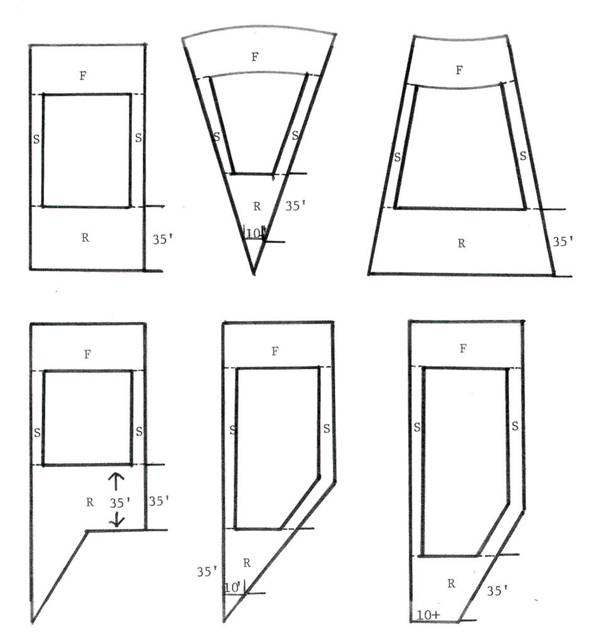
F = FRONT YARD
S = SIDE YARD
R = REAR YARD

