


Butte County Unincorporated
City Zoning Code
City Zoning Code
Division 10
Signs
24-98 - Purpose.
This article establishes regulations relating to the permitted type, size, height, placement, and design of signs. The intent of these regulations is to:
A.
Support economically viable businesses serving County residents, workers and visitors;
B.
Preserve and enhance the scenic qualities of rural and open space areas;
C.
Promote high quality design and attractive communities within urban areas;
D.
Minimize hazards to pedestrians and motorists caused by distracting sign displays; and
E.
Provide standards for signs that safeguard life, health, property, and the public welfare.
(Ord. No. 4062, § 1, 9-10-13)
24-99 - Applicability.
The standards in this article apply to signs within all zones.
(Ord. No. 4062, § 1, 9-10-13)
24-100 - Definitions.
A.
Awning Sign. A sign incorporated into, attached to, or painted on an awning.
B.
Banner Sign. A sign made of fabric, cloth or any other non-rigid material.
C.
Community Identification Sign. A sign that identifies or announces entry into a city, neighborhood, or unincorporated community within Butte County.
D.
Farm Sign. A sign identifying a farm or ranch, including an agricultural processing business.
E.
Farm Trail Sign. A sign identifying an agricultural use, farm trail or tour route, including wineries and tasting rooms, olive oil manufacturing and tasting, and other agritourism destinations, which offer on-site product sales, educational programs, and other services in order to promote and market local agricultural operations in the county.
F.
Freestanding Sign. A sign fixed in an upright position on the ground not attached to a structure other than a framework, pole, or device that is erected primarily to support the sign. Excludes Monument signs.
G.
Freestanding Sign, Digital. A sign fixed in an upright position on the ground not attached to a structure other than a framework, pole, or device that is erected primarily to support the sign that uses digital display technology as a means of changing sign images. Excludes Monument signs.
H.
Freeway Sign. An on-site sign that advertises a business providing a service primarily for the freeway-motoring public, such as gas, food, or lodging.
I.
Monument Sign. An independent, freestanding structure supported on the ground having a solid base as opposed to being supported by poles or open braces.
J.
Monument Sign, Digital. An independent, freestanding structure supported on the ground having a solid base as opposed to being supported by poles or open braces that uses digital-display technology as a means of changing sign images.
K.
Off-Site Sign. A sign identifying a use, facility, service, or product which is not located, sold, or manufactured on the same premises as the sign or which identifies a use, service, or product by a brand name which, although sold or manufactured on the premises, does not constitute the principal item for sale or manufactured on the premises (aka as a billboard sign).
L.
Off-Site Sign, Digital. An off-site sign as defined above that uses digital-display technology as a means of changing sign images.
M.
Projecting Sign. A sign attached to a building wall and extending away from the wall more than twelve (12) inches, generally at a right angle to the building wall.
N.
Sign. Any device, structure or fixture designed or used to attract attention to an object, person, institution, business, product, service, event, or location by any means, including words, letters, figures, designs, symbols, fixtures, colors, illumination, or projected images.
O.
Temporary Sign. A sign intended to be displayed for a limited period of time and capable of being viewed from a public right-of-way, parking area or neighboring property.
P.
Wall Sign. A sign which is attached to or painted on the exterior wall of a structure with the display surface of the sign approximately parallel to the building wall. Wall signs include any interior sign which faces a window exposed to public view and is located within five (5) feet of the window.
Q.
Window Sign. A sign posted, painted, placed, or affixed in or on a window exposed to public view.
(Ord. No. 4062, § 1, 9-10-13; Ord. No. 4091, § 1, 1-27-15; Ord. No. 4161, § 1(Att. A), 5-7-19)
24-101 - Signs allowed without permits.
A.
Types of Signs. The following signs are allowed without a permit and do not count towards the allowable area or number of signs on a site.
1.
A sign no greater than eight (8) square feet that is consistent with all applicable standards in this article.
2.
Temporary signs. See Section 24-108 (Temporary Signs).
3.
Directional signs.
4.
On-site directional or informational signs that provide information for the convenience or safety of the public, with a maximum area of five (5) square feet. This type of sign includes directional signs in parking lots, signs listing hours of business, and signs identifying the locations of telephones or restrooms.
5.
Official flags of any municipality, state, nation, or fraternal or religious organization, if the pole height is twenty-five (25) feet or less and the flag's longest dimension is twenty-five (25) percent or less of the pole's length.
6.
One (1) commemorative plaque that is cut into a permanent building material or made of a noncombustible material, with a maximum area of sixteen (16) square feet.
7.
One (1) construction sign, with a maximum area of thirty-two (32) square feet.
8.
One (1) professional name plate, with a maximum area of sixteen (16) square feet.
9.
One (1) bulletin board on the premises of a meeting facility or public building, with a maximum area of twelve (12) square feet.
10.
One (1) garage sale sign at the residence where the garage sale is taking place, with a maximum area of sixteen (16) square feet.
11.
Signs within a building, or on the premises of a building, that are not visible from a public street.
12.
Murals on the exterior of a building that do not advertise a product, business, or service.
13.
Temporary exterior decorations and banners that are associated with a seasonal, cultural, religious, or national holidays, and that are not used to advertise a product, business, or service.
14.
Signs that are required by local, State, or federal law or by court order.
15.
Signs that are posted or required by a government agency, or a public utility or service, or private road signs installed in accordance with County standards that are essential to protect the public health, safety, and welfare, including official signs for traffic control, official public notices, and warnings of potential hazards.
16.
On-site signs used by businesses providing directional information for access, circulation, and transportation.
B.
Changes to Sign Face. Changes to a sign face that do not structurally alter the sign or its size are allowed without a permit.
(Ord. No. 4062, § 1, 9-10-13)
24-102 - Permit requirements.
A.
Administrative Permit Required. All signs not specifically identified in Section 24-101 (Signs Allowed Without Permits) require Zoning Administrator approval of an Administrative Permit, except as noted in subsection C, D and E below.
B.
Submittal Requirements. An Administrative Permit application for a sign shall include all information and materials required by Article 29 (Administrative Permits). A conditional use permit or minor use permit application for a sign shall include all information and materials required by Article 31 (Conditional Use and Minor Use Permits). Applications shall also include:
1.
The name and address of the property owner and the sign contractor;
2.
Site plans showing the location of the proposed sign;
3.
Scale drawings showing the sign design and materials;
4.
An inventory of the location, sign area, and sign type of all existing signs on the site, excluding signs that are allowed without a permit; and
5.
Any additional information required by the Zoning Administrator to verify compliance with this article.
C.
Zones Abutting Residential Zones. A Conditional Use Permit shall be required for any freestanding, freeway, or off-site sign proposed on any Commercial, Mixed-Use, or Industrial zone that abuts a residential zone.
D.
Off-Site Sign, Digital. A minor use permit shall be required for any off-site digital sign.
E.
Freeway Signs, Agriculture Zones. A Minor Use Permit shall be required for any Freeway sign in an Agriculture Zone.
(Ord. No. 4062, § 1, 9-10-13; Ord. No. 4091, § 1, 1-27-15; Ord. No. 4132, § 1(Att. A), 9-12-17)
24-103 - Prohibited signs.
The following signs shall be prohibited:
A.
Signs that identify a use, facility, or service which is not located on the parcel or premise where the sign is located, except for temporary real estate signs consistent with Section 24-108 (Temporary Signs) and off-site billboards in industrial zones and the General Commercial zone consistent with Section 24-105 (Types of Signs Allowed by Zone).
B.
Any sign that projects above the building wall or roof to which it is affixed.
C.
Signs that have become a public nuisance due to inadequate maintenance, dilapidation, or abandonment.
D.
Signs that obstruct a door, window, fire escape, or other required access way.
E.
Signs that encroach into any right-of-way or easement, means of ingress or egress, or path of travel, except as specifically allowed by this article.
F.
Signs containing obscene matter.
G.
Signs that were unlawfully installed, erected, or maintained.
H.
Signs that include any part that appears to flash, blink, move, change color, or change intensity, excluding approved digital signs, standard barber poles, time and temperature signs that are located in commercial and industrial zones, and community identification signs.
I.
Signs that emit sound.
J.
Signs that interfere with visibility for drivers at an intersection, public right-of-way, or driveway.
K.
Signs adversely affecting traffic control or safety.
L.
Signs located on public property, excluding official signs that are posted or required by a government agency, public utility, or public service.
M.
Signs attached to a tree.
N.
Signs that have less horizontal or vertical clearance from overhead utilities than required by State agencies.
(Ord. No. 4062, § 1, 9-10-13; Ord. No. 4091, § 1, 1-27-15; Ord. No. 4161, § 1(Att. A), 5-7-19)
24-104 - General standards.
A.
Measurement of Sign Area.
1.
The area of each face of a sign is measured as the area of the smallest rectangle or circle that encloses all of the words, characters, images, and symbols on the sign face, and also includes any border or frame around any information and any background color on the sign face.
2.
The area of a sign that has two (2) parallel and back-to-back faces is counted only once. For such a sign, the area shall be measured as the area of the largest face.
3.
The area of a three (3) dimensional sign is measured as the area of the smallest rectangle that encloses the projection of that sign onto a vertical plane.
4.
Structural elements that are clearly incidental to the display of a sign and that do not include advertising are not counted as part of a sign's area.
B.
Maintenance. Signs shall be maintained in a state of good repair at all times. Damage to signs, including cracked sign faces, frayed or weathered fabric, and broken lighting, shall be repaired.
C.
Illumination. All signs may be illuminated from an internal or external light source. Illuminated signs in residential zones shall comply with the provisions of Article III, Division 4 (Outdoor Lighting). Signs with individual, three (3) dimensional letters may also use rear "halo" illumination for each letter.
D.
Setbacks. Freestanding, monument, freeway, and off-site signs taller than forty-two (42) inches shall not be located within fifteen (15) feet of any parcel line adjacent to a residential zone or within fourteen (14) feet of any intersection, driveway or alley, or obstruct adequate and safe sight distance for vehicles as determined by the Director of Public Works, unless it can be certified by a Registered Civil Engineer that the sign will not obstruct adequate and safe sight distances. There shall be no setback requirements for all other types of signs. No sign shall be placed within any road right-of-way.
E.
Removal. If an establishment ceases to operate for a period of two (2) years, all signs and their structures associated with the establishment shall be removed. Blank, broken, abandoned, or unused signs on a parcel not used by the existing business shall be removed, unless a plan for use is presented and approved by the Zoning Administrator.
F.
Content Neutrality. It is the County's policy to regulate signs in a constitutional manner that is content neutral.
G.
Traffic Safety. No sign shall restrict safe sight distances for vehicles on any public or private road as approved by the Director of Public Works.
(Ord. No. 4062, § 1, 9-10-13)
24-105 - Types of signs allowed by zone.
A.
Residential Zones.
1.
A dwelling unit may display one (1) wall or window sign, in conjunction with a Home Occupation (Section 24-162).
2.
A multiple-family residential development that contains at least four (4) dwelling units may include one (1) entrance or freestanding sign, with a maximum area of ten (10) square feet, and one (1) window, awning, or canopy sign, with a maximum area of five (5) square feet.
3.
For residential subdivisions of fifteen (15) or more units, a maximum of two (2) monument or freestanding signs may be displayed at each entrance to the subdivision. Each sign shall have a maximum area of eighteen (18) square feet and a maximum height of six (6) feet. The signs shall be located on privately-owned parcels, and a requirement for permanent maintenance by a homeowners' association or similar entity shall be recorded on the parcels.
B.
Commercial, Mixed Use, and Public Zones.
1.
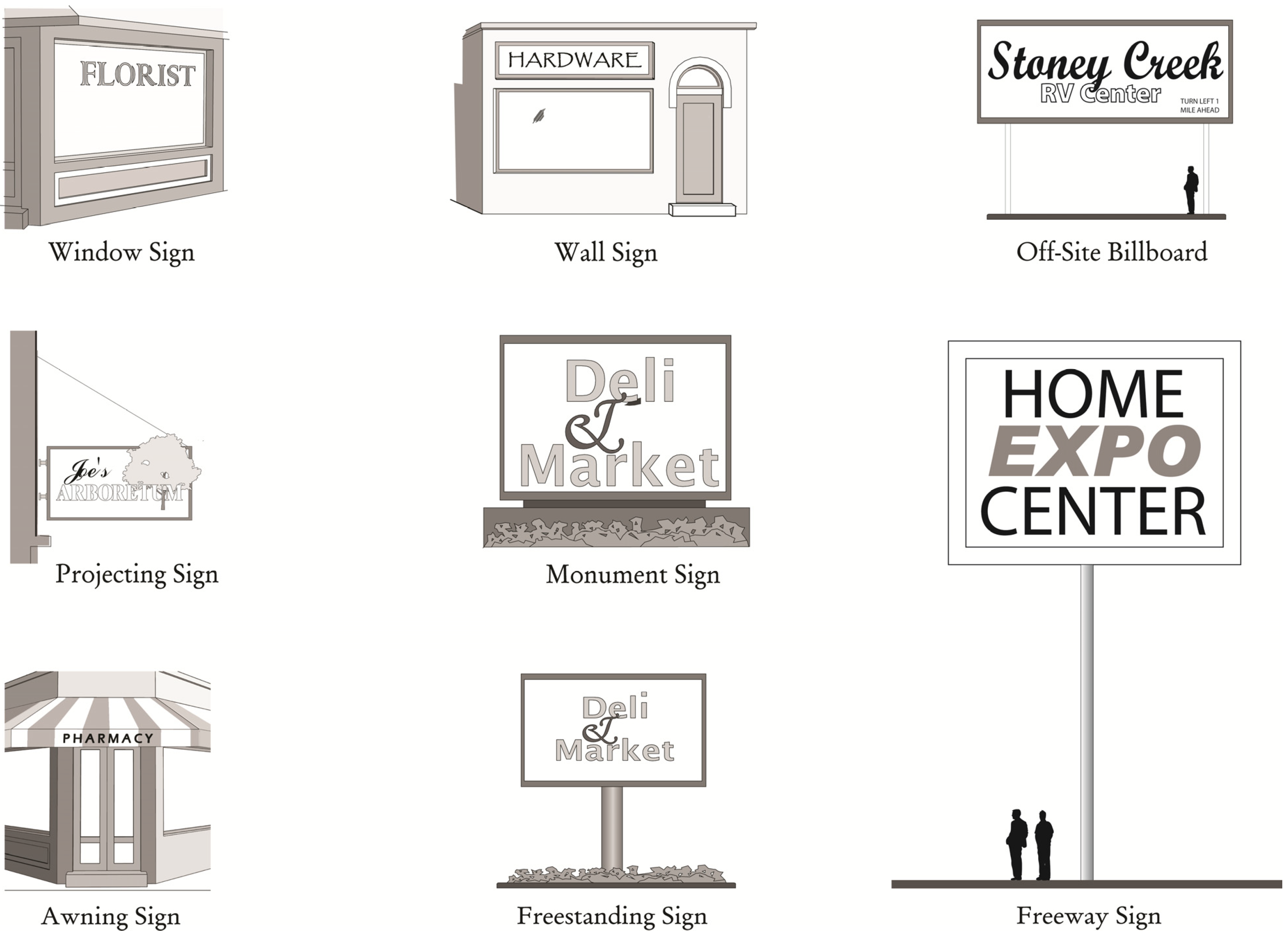
In all commercial and mixed use zones, signs shall be permitted as specified in Table 24-105-1 (Allowed Signs in Commercial, Mixed Use, and Public Zones). Types of signs are illustrated in Figure 24-105-1 (Sign Types).
[1]
Off-site signs shall be located a minimum distance of five hundred (500) feet from another off-site sign on the same side of street that is four (4) lanes (two (2) lanes in each direction) and three hundred (300) feet between signs on streets or roads that are two (2) lanes (one (1) lane in each direction).
[2]
Thirty-five (35) feet for two-lane roads (one (1) lane in each direction)
[3]
Off-site signs are permitted in the General Commercial zoning district only.
[4]
Prohibited in Mixed Use zones.
2.
Signs associated with a residential use or parcel within a commercial or mixed use zone shall comply with Subsection A (Residential Zones) above.
C.
Industrial Zones. In all industrial zones and the Airport (AIR) zone, signs are permitted as specified in Table 24-105-2 (Allowed Signs in Industrial and Airport (AIR) Zones).
FIGURE 24-105-1 SIGN TYPES
Notes:
[1]
Off-site signs shall be located a minimum distance of five hundred (500) feet from another off-site sign on the same side of street that is four (4) lanes (two (2) lanes in each direction) and three hundred (300) feet between signs on streets or roads that are two (2) lanes (one (1) lane in each direction).
[2]
Off-site signs are permitted in industrial zoning districts only.
[3]
Thirty-five (35) feet for two-lane roads (one (1) lane in each direction).
[4]
Freestanding signs, digital, and monument signs, digital are subject to a minor use permit in the Airport Zone.
D.
Agriculture and Natural Resource Zones.
1.
In all agriculture and natural resource zones, signs shall be permitted as specified in Table 24-105-3 (Allowed Signs in Agriculture and Natural Resource Zones).
Notes:
[1]
Allowed only in the Agriculture zone.
2.
The maximum total area for all signs on an agricultural parcel shall be 1-square-foot per lineal foot of building frontage, or two hundred (200) square feet, whichever is less.
3.
Signs associated with a residential use or parcel within an agriculture zone shall comply with Subsection A (Residential Zones) above.
E.
Planned Development (PD) and Research Business Park (RBP) Zone. Signage within Planned Development (PD) and Research Business Park (RBP) zones shall comply with the standards and specifications contained within an approved Master Sign Program.
(Ord. No. 4062, § 1, 9-10-13; Ord. No. 4091, § 1, 1-27-15; Ord. No. 4161, § 1(Att. A), 5-7-19)
24-106 - Standards for specific types of signs.
A.
Freeway Signs. Freeway signs shall be permitted only if all of the following criteria are met:
1.
The sign is located on the same parcel as the business being advertised;
2.
The sign is located on a parcel that is located a maximum distance of eight hundred (800) feet from the centerline of State Route 99 and/or State Route 70 at its closest point; and
3.
The sign advertises a business that provides a service primarily for the freeway-motoring public, such as gas, food, or lodging.
B.
Awning Signs. Awning signs that are suspended beneath an awning shall provide at least eight (8) feet of clearance above the ground, shall not extend more than five (5) feet into the public right-of-way, and shall provide a minimum two (2) foot horizontal clearance from the street curb face. See Figure 24-106-1 (Awning Signs).
C.
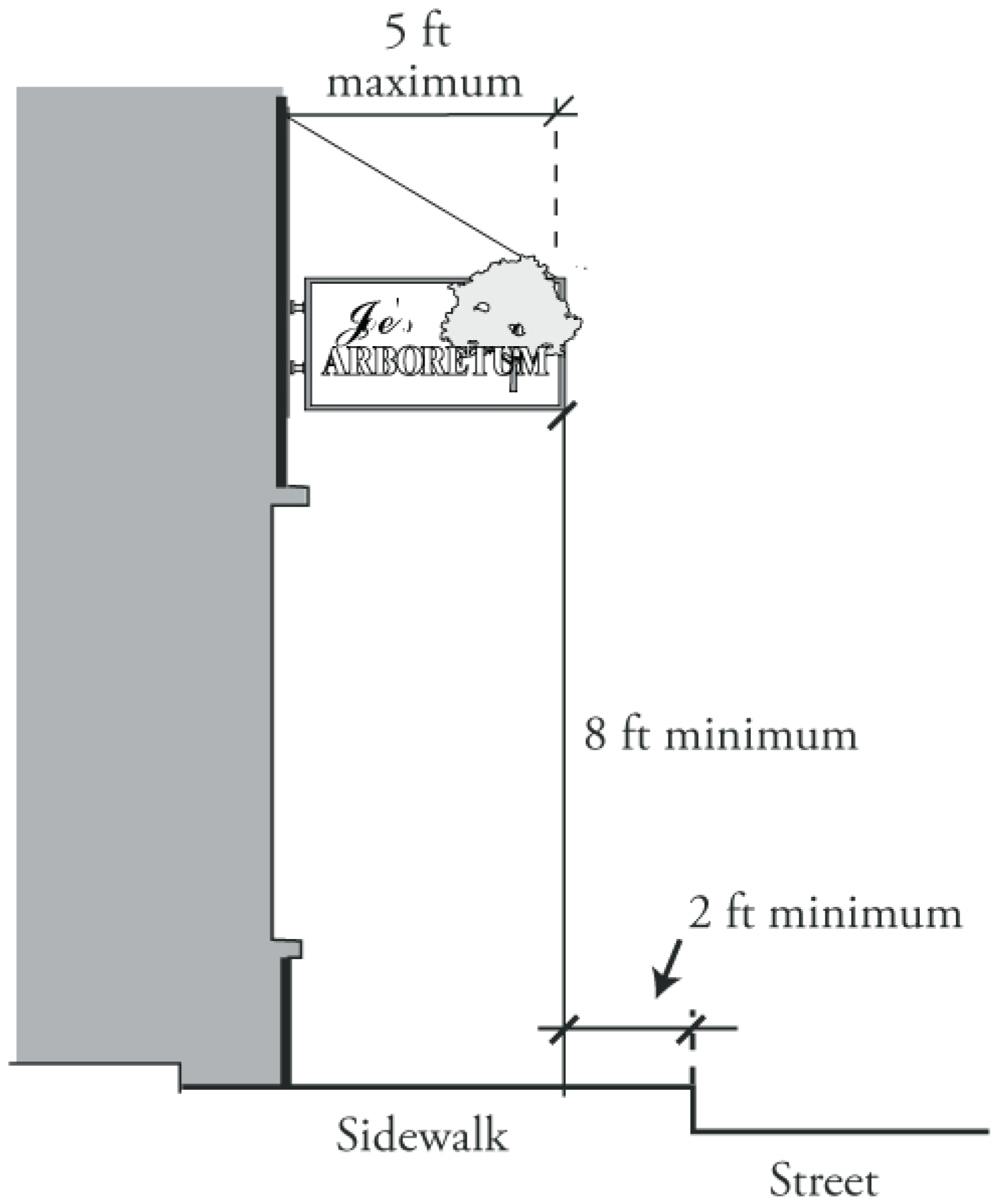
Projecting Signs. Projecting signs shall provide at least eight (8) feet of clearance above the ground, shall not extend more than five (5) feet into the public right-of-way, and shall provide a minimum two (2) foot horizontal clearance from the street curb face. See Figure 24-106-2 (Projecting Signs).
FIGURE 24-106-1 AWNING SIGNS
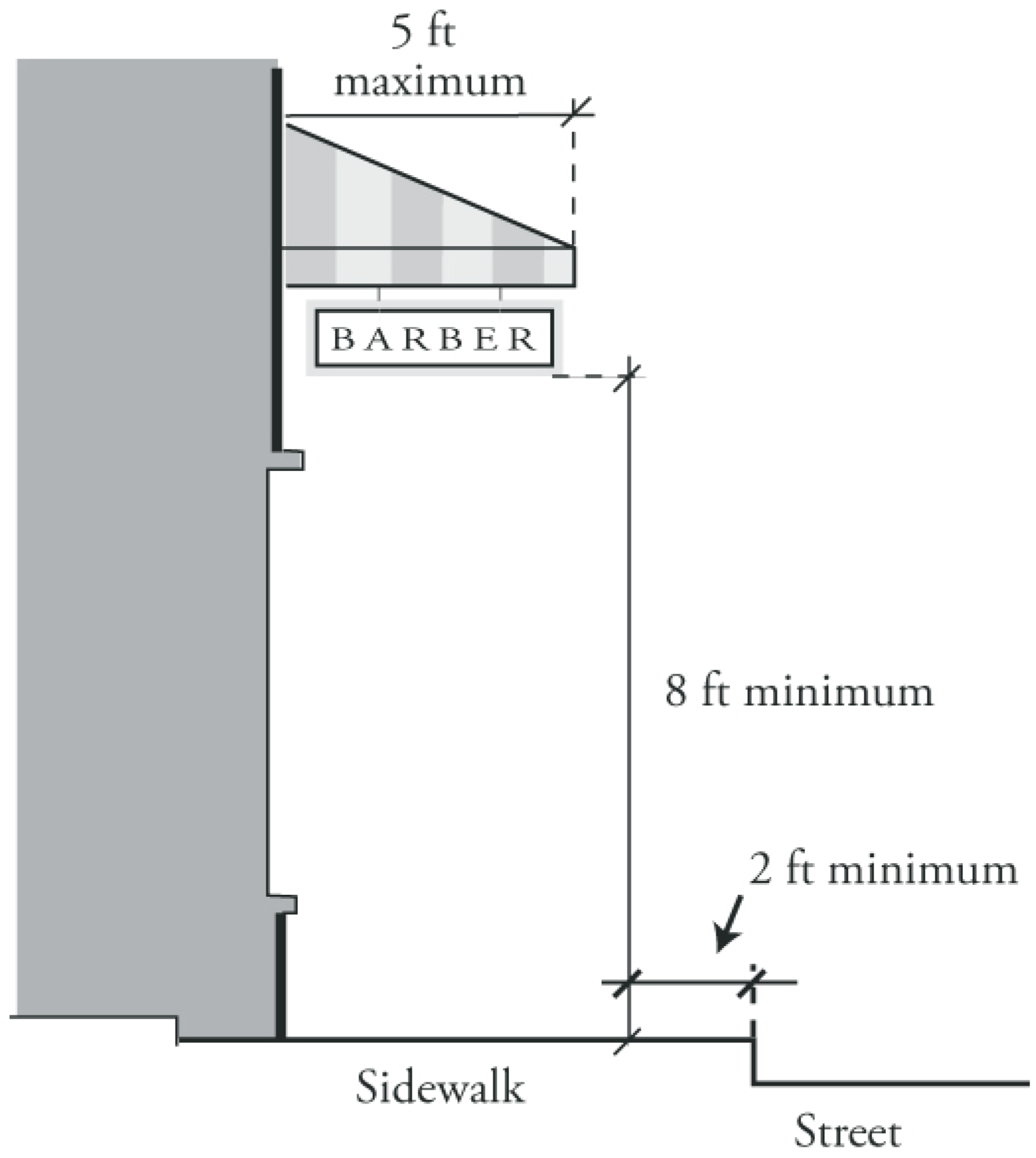
FIGURE 24-106-2 PROJECTING SIGNS
D.
Window Signs. Window signs shall not cover more than twenty-five (25) percent of any window. If a window has multiple panes, the window's total area shall be measured as the framed area of all panes.
E.
Digital Signs, Off-Site, Freestanding, and Monument. Off-site, freestanding, and monument digital signs shall be permitted only if all of the following criteria are met:
1.
All digital display faces must be oriented primarily for viewing from the adjacent roadway.
2.
The sign may only present a series of still images, each of which is displayed for at least eight (8) seconds. The still images may not move or present the appearance of motion and may not use flashing, scintillating, blinking, or traveling lights or any other means not providing constant illumination. Transition between one (1) still image and the next shall not include any interval of black or blank screen time.
3.
The light emitted from the sign shall not be of an intensity or brilliance as to cause direct illumination of an adjacent residential area, impair the vision of any driver, or interfere with any driver's operation of a motor vehicle. The following standards for lighting are required for all digital signs:
a.
The sign shall contain an automatic dimmer and a photo cell sensor to adjust the luminance intensity or brilliance in accordance with these standards.
b.
The sign shall not operate at an intensity or brilliance that will exceed three-tenths (0.3) footcandles above ambient light (as measured using a footcandle meter at a distance of two hundred fifty (250) feet from the sign face).
c.
The sign shall not operate at an intensity or brilliance that will exceed one-tenth (0.1) footcandles above ambient light as measured using a footcandle meter in any adjacent residential zone.
(Ord. No. 4062, § 1, 9-10-13; Ord. No. 4091, § 1, 1-27-15; Ord. No. 4161, § 1(Att. A), 5-7-19)
24-107 - Master sign program.
A.
Purpose. The purpose of these Master Sign Program provisions is to provide a coordinated approach to signage for multi-tenant commercial developments.
B.
Applicability.
1.
A Master Sign Program shall be prepared for multi-family use with more than one (1) permanent sign proposed, and any non-residential development with six (6) or more tenants.
2.
A Master Sign Program shall be required for any proposed development project within a Planned Development (PD) and Research Business Park (RBP) zone.
C.
Permit Required. A Master Sign Program shall require the approval of an Administrative Permit.
D.
Application. An Administrative Permit application for a Master Sign Program shall include all information and materials specified in Section 24-102 (Permit Requirements). In addition, an application shall include a written statement identifying how the proposal will modify any of the regulations or standards of this article, if applicable, and explaining how these modifications would contribute to a superior project design than would otherwise result from the standards contained in this article.
E.
Design Standards.
1.
A Master Sign Program may deviate from standards contained in this article relating to permitted sign height, number of signs, sign area, and type of sign.
2.
Master Sign Programs shall feature a unified and coordinated approach to the materials, color, size, type, placement, and general design of signs proposed for a project or property.
F.
Effect of Master Sign Program.
1.
All subsequent signs proposed for a development or property subject to an approved Master Sign Program shall comply with the standards and specifications included in the Master Sign Program.
2.
Approval of a Master Sign Program shall supersede the regulations of this article. Any aspect of the proposed signs not addressed by the Master Sign Program shall be in compliance with this article.
(Ord. No. 4062, § 1, 9-10-13)
24-108 - Temporary signs.
Temporary signs that comply with the following standards shall be permitted without an Administrative Permit.
A.
Real Estate Signs, On-Site.
1.
Residential properties.
a.
One (1) sign no more than six (6) square feet in area and six (6) feet in height shall be permitted on an individual parcel.
b.
Two (2) temporary signs no more than thirty-two (32) square feet in area and six (6) feet in height shall be permitted for residential subdivisions with four (4) or more parcels with less than fifty (50) percent of parcels sold.
2.
Non-residential properties. One (1) sign no more than thirty-two (32) square feet in area and six (6) feet in height shall be permitted for each street frontage.
3.
All temporary on-site real estate signs shall be removed seven (7) days after property is no longer offered for lease, rent, or sale.
B.
Real Estate Signs, Off-Site
1.
Portable "open house" A-frame real estate signs shall be no more than three (3) feet in height and six (6) square feet in area. Signs shall be prohibited within the public right-of-way and shall remain in place for a maximum duration of forty-eight (48) hours.
2.
Non-portable real estate, subdivision, or development signs secured in place at a specific off-site location shall be no more than thirty-two (32) square feet in area and six (6) feet in height. Signs may be displayed for a maximum duration of two (2) years or the duration of development activity, whichever is less. No more than two (2) signs may be displayed for a single property, subdivision, or development project.
C.
Political Signs.
1.
Signs shall be installed no earlier than ninety (90) days prior to the election and removed no later than seven (7) days following the election.
2.
Signs shall be prohibited within the public right-of-way.
D.
Special Events.
1.
Temporary signs for special functions, such as sales and grand openings, shall be allowed only in non-residential zones.
2.
One (1) sign no more than twenty-four (24) square feet in area and twelve (12) feet in height as measured from the top of the sign to the ground below it shall be permitted for each street frontage.
3.
Signs may be displayed for a maximum duration of fourteen (14) consecutive days at a frequency of no greater than once each calendar quarter.
E.
Business Identification.
1.
Temporary business identification signs, either freestanding or mounted on a building, may be permitted prior to installation of permanent signs for a newly established business.
2.
One (1) sign no more than twenty-four (24) square feet in area and twelve (12) feet in height as measured from the top of the sign to the ground below it shall be permitted for each street frontage.
3.
Signs may be displayed for a maximum duration of ninety (90) consecutive days.
(Ord. No. 4062, § 1, 9-10-13)
24-109 - Nonconforming signs.
A.
Any sign that does not comply with the requirements of this article but which was constructed, operated, and maintained in compliance with all previous regulations, shall be regarded as a legal nonconforming use.
B.
A nonconforming sign that has been abandoned, or whose advertised use has ceased to function for a period of one hundred eighty (180) days or more, shall be brought into conformity or removed.
C.
The following requirements apply to the reconstruction of a legal nonconforming sign.
1.
Reconstruction of a legal nonconforming sign that has been demolished or destroyed shall begin within one-year and shall be completed within three (3) years.
2.
The reconstructed sign shall not exceed the original structure in regards to maximum height, size, encroachment into setbacks, and other property characteristics as determined by the Zoning Administrator.
3.
Non-conforming standard off-site signs may be converted to off-site digital signs with the approval of a minor use permit.
4.
The Zoning Administrator may approve an extension of two (2) additional years to complete reconstruction of the demolished sign.
5.
If reconstruction is not completed by the specified time limit, the property shall be deemed abandoned.
D.
The following exceptions apply to the above requirements for nonconforming signs:
1.
A sign that is part of a designated historic resource may be deemed nonconforming only if at least one (1) of the following conditions applies:
a.
The sign does not contribute to the historic significance of the historic landmark.
b.
The sign poses an immediate threat to public safety. If the sign is deemed nonconforming solely because it threatens public safety, it shall be repaired or modified, if possible, rather than removed.
(Ord. No. 4062, § 1, 9-10-13; Ord. No. 4091, § 1, 1-27-15)