


Butte County Unincorporated
City Zoning Code
City Zoning Code
Division 7
Agricultural Buffers
24-81 - Purpose.
This article establishes a means to conserve and stabilize agricultural land uses in order to protect agricultural lands from encroachment and conversion to residential uses. This article advances this purpose by:
A.
Requiring residential development to provide land use transitions, setbacks, and buffers between residential development and agricultural uses, in order to reduce interference and conflict;
B.
Creating development and performance standards designed to protect agricultural uses from residential encroachment conflicts; and
C.
Providing a clear delineation between long-term agricultural production lands and residential areas.
(Ord. No. 4062, § 1, 9-10-13; Ord. No. 4105, § 1, 1-12-16)
24-82 - Applicability.
A.
This article applies to residential structures in all agricultural buffer areas. The agricultural buffer is applied to the following areas of the county:
1.
All lands zoned Agriculture;
2.
Other zones within three hundred (300) feet of the boundary of Agriculture zones; and
3.
Areas inside and within three hundred (300) feet of sphere of influence boundaries for incorporated cities, where the boundary abuts parcels zoned Agriculture.
4.
Areas within three hundred (300) feet of a Williamson Act Contract.
B.
The agricultural buffer requirement shall apply to the parcel where residential development is proposed.
(Ord. No. 4062, § 1, 9-10-13; Ord. No. 4105, § 1, 1-12-16)
24-83 - Agricultural buffer setbacks.
A.
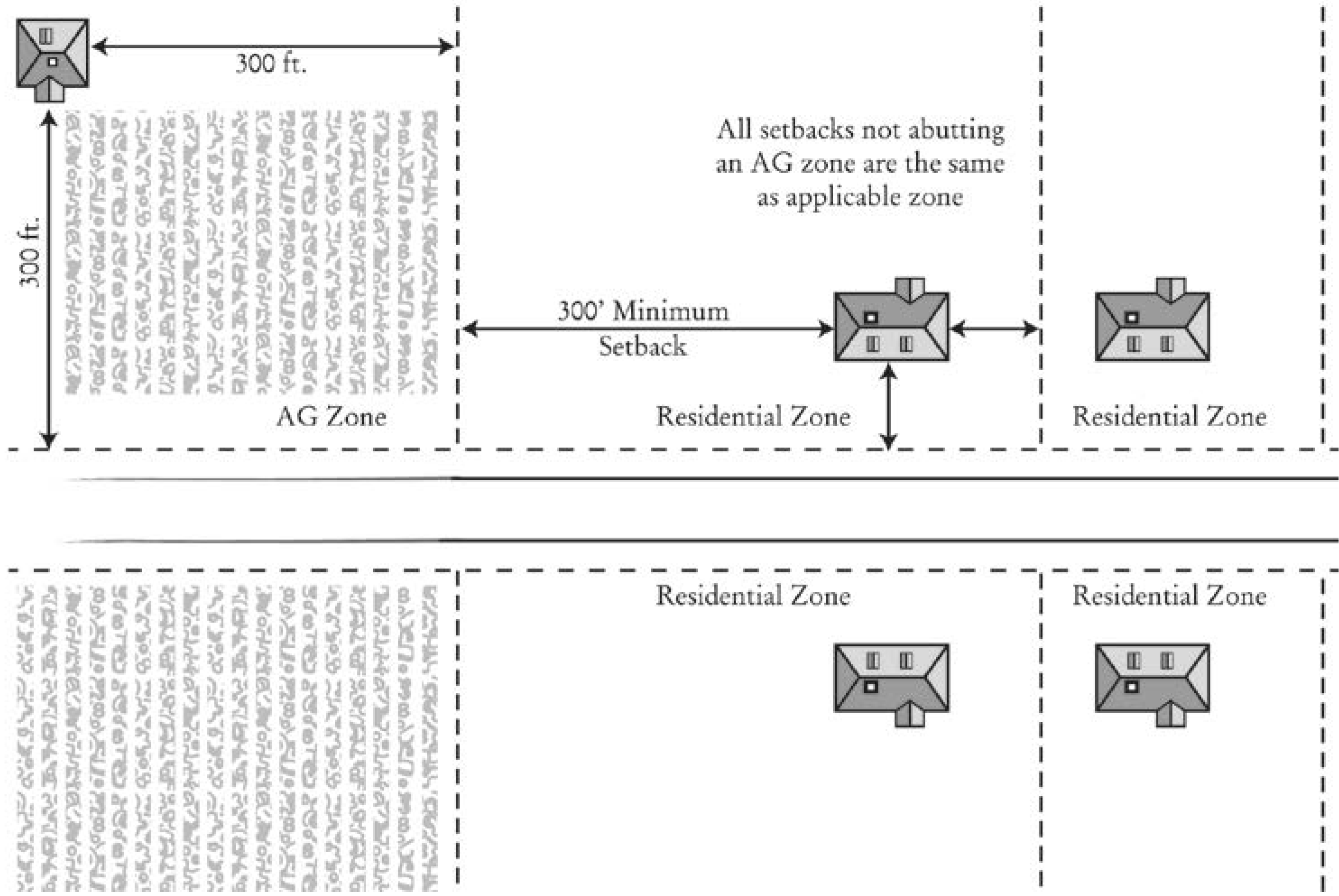
As shown in Figure 24-83-1 (Agricultural Buffer Setbacks), the setback distance for dwellings within an agricultural buffer area shall be three hundred (300) feet from any property line that abuts Agriculture zones. This distance may be adjusted for ministerial permits based upon the Agricultural Buffer Guidelines as adopted by the Board of Supervisors on December 16, 2008 (and as amended) or an Unusual Circumstance Review in Section 24-84 (Exceptions to Agricultural Buffer Setback).
B.
If an agricultural buffer setback is shown on a recorded map, but the Agriculture zone and Williamson Act contract (or either one of them individually where only one applied) that the buffer setback was designed to protect is no longer in effect, the agricultural buffer setback may be reduced as follows: if there is an orchard or a vineyard on the previously Agriculturally zoned parcel and/or on the parcel previously subject to a Williamson Act contract, Section 24-56.1 shall apply if the adjacent agricultural use is not removed; or in all other instances, the agricultural buffer setback shown on the map, shall no longer be enforced.
FIGURE 24-83-1 AGRICULTURAL BUFFER SETBACKS
(Ord. No. 4062, § 1, 9-10-13; Ord. No. 4105, § 1, 1-12-16; Ord. No. 4209, § 2(Exh. A), 10-26-21)
24-84 - Exceptions to agricultural buffer setback.
A.
Eligibility. Any project applicant for ministerial permits may request an adjustment to the 300-foot agricultural buffer setback requirement through an Unusual Circumstances Review, as described below. Discretionary project applications are not eligible for exceptions.
B.
Review Authority.
1.
A request for Unusual Circumstance Review submitted concurrently with a ministerial permit application shall be reviewed by the Zoning Administrator.
C.
Application Submittal. An application for an Unusual Circumstances Review shall be filed and reviewed in compliance with Article V, Division 1 (Permit Application and Review). The application shall include the information and materials specified in the Department of Development Services Buffer Guidelines for Unusual Circumstances Review applications, together with the fee in compliance with the Planning Fee Schedule. It is the responsibility of the applicant to provide evidence in support of the findings required by Subsection F (Criteria for Decision).
D.
Consultation with Agricultural Commissioner. The Zoning Administrator shall consult with the Agricultural Commissioner prior to taking action on an Unusual Circumstances Review.
E.
Public Hearing. No public notice or hearing is required for Unusual Circumstances Reviews associated with ministerial permits.
F.
Criteria for Decision. The review authority may approve an adjustment to the required setback only if the following findings can be made:
1.
The adjustment will not result in a modification to adjacent agricultural practices.
2.
Unusual circumstances are present on the subject properties or surrounding properties that render the 300-foot setback requirement infeasible or unnecessary. Unusual circumstances include, but are not limited to, parcel size and shape, the location of existing residences, infrastructure and other existing uses, and natural physical features and topography.
3.
The proposed dwelling is placed the greatest distance possible from all property lines abutting an agriculture zone or other location that presents the least detriment to agricultural practices on adjacent properties.
4.
The location of the proposed residence does not interfere with easements, septic systems, or prior conditions of approval applicable to the subject property.
G.
Buffer Guidelines. Agricultural Buffer Guidelines as adopted by the Board of Supervisors on December 16, 2008 (Butte County Resolution #08-166 and as amended) shall be utilized as a guide in evaluating the proper agricultural buffer and in rendering determinations on requested adjustments to the required setback.
H.
Post-Decision Procedures. The procedures and requirements relating to notices of decision, effective dates, permit expiration, permit revocation, and changed plans shall apply to Unusual Circumstance Reviews as provided in Article V, Division 8 (Post-Decision Procedures). The procedures and requirements relating to appeals shall apply to Unusual Circumstances Reviews as provided in Article VI, Division 3 (Appeals and Calls for Review).
I.
Agricultural Worker Housing Center. Within Agriculture zones, Agricultural Worker Housing Centers, as defined under this chapter, shall not be subject to the Agricultural Buffer Setback.
(Ord. No. 4062, § 1, 9-10-13; Ord. No. 4209, § 2(Exh. A), 10-26-21)