
Camas City Zoning Code
CHAPTER 18
25 - MIDDLE HOUSING9
Editor's note—Ord. No. 25-025, § I (Exh. A), adopted December 15, 2025, repealed the former Ch. 18.25, §§ 18.25.010—18.25.060, and enacted a new Ch. 18.25 as set out herein. The former Ch. 18.25 pertained to Rowhouses and derived from Ord. 2515 § 1 (Exh. A (part)), 2008; Ord. 2443 § 3 (Exh. A (part)), 2006; Ord. No. 2612, § I(Exh. A), adopted February 7, 2011 and Ord. No. 2691, § I(Exh. A), adopted January 21, 2014.
18.25.010 - Purpose.
To provide opportunities for middle housing throughout Camas's residential zoning districts that is compatible in scale, form, and character with single-family dwellings. Middle housing includes buildings that contain two or more attached, stacked, or clustered homes including duplexes, triplexes, fourplexes, townhouses, stacked flats, courtyard apartments, and cottage housing.
(Ord. No. 25-025, § I (Exh. A), 12-15-2025)
18.25.020 - Applicability.
The provisions of this chapter shall apply to the development of middle housing in all residential and multifamily zones.
(Ord. No. 25-025, § I (Exh. A), 12-15-2025)
18.25.030 - Unit Density.
The following unit densities apply all lots at least one thousand square feet in size, unless located in a zone permitting higher densities or intensities:
A.
Two units per lot.
B.
Four units per lot on all lots within one-quarter mile walking distance of a major transit stop.
C.
Four units per lot if at least one unit on the lot is affordable housing meeting the following requirements:
1.
The applicant shall commit to renting or selling at least one unit as affordable housing. Dwelling units that qualify as affordable housing shall have costs, including utilities other than telephone, that do not exceed thirty percent of the monthly income of a household whose income does not exceed the following percentages of median household income adjusted for household size, Clark County, as reported by the United States Department of Housing and Urban Development:
a.
Rental housing: Sixty percent.
b.
Owner-occupied housing: Eighty percent.
2.
The units shall be maintained as affordable for a term of at least fifty years, and the property shall satisfy that commitment and all required affordability and income eligibility conditions.
3.
The applicant shall record a covenant or deed restriction that ensures the continuing rental or ownership of units subject to these affordability requirements consistent with the conditions in Chapter 84.14 RCW for a period of no less than fifty years.
4.
The covenant or deed restriction shall address criteria and policies to maintain public benefit if the property is converted to a use other than that which continues to provide for permanently affordable housing.
5.
The units dedicated as affordable housing shall:
a.
Be provided in a range of sizes comparable to other units in the development.
b.
The number of bedrooms in affordable units shall be in the same proportion as the number of bedrooms in units within the entire development.
c.
Generally, be distributed throughout the development and have substantially the same functionality as the other units in the development.
D.
Duplexes, triplexes, fourplexes, townhouses, stacked flats, courtyard apartments, and cottage housing can be used to achieve the allowed unit densities in this section.
E.
Accessory dwelling units are counted towards the unit densities allowed under this section.
(Ord. No. 25-025, § I (Exh. A), 12-15-2025)
18.25.040 - Development and Design Standards.
A.
The density and dimensional standards of Chapter 18.09 apply to middle housing except where this chapter includes standards that are less restrictive.
B.
Cottage Housing.
1.
Cottage size. Cottages shall each have no more than one thousand six hundred square feet of net floor area, excluding attached garages.
2.
Open space. Open space shall be provided equal to a minimum twenty percent of the lot size. This may include common open space, private open space, setbacks, critical areas, and other open space.
3.
Common open space. At least one outdoor common open space is required.
a.
Common open space shall be provided equal to a minimum of two hundred square feet per cottage. Each common open space shall have a minimum dimension of 15 ft on any side.
b.
Common open space shall be bordered by cottages on at least two sides. At least half of cottage units in the development shall abut a common open space and have the primary entrance facing the common open space.
c.
Critical areas and their buffers, parking areas and vehicular areas shall not qualify as common open space.
4.
Entries. All cottages shall feature a roofed porch at least sixty square feet in size with a minimum dimension of five feet on any side facing the street and/or common open space.
5.
Community building. A cottage housing development may include only one community building. A community building shall have no more than two thousand four hundred square feet of net floor area.
C.
Courtyard Apartments.
1.
Common open space. At least one outdoor common open space is required.
a.
Common open space shall be bordered by dwelling units on two or three sides.
b.
Common open space shall be a minimum dimension of fifteen feet on any side.
c.
Parking areas and vehicular areas do not qualify as a common open space.
2.
Entries. Ground-related courtyard apartments shall feature a covered pedestrian entry, such as a covered porch or recessed entry, with minimum weather protection of three feet by three feet, facing the street or common open space.
D.
Townhouses. No more than six attached dwellings are permitted in a row or single group of structures.
E.
Unit articulation. Each attached unit featuring a separate ground level entrance in a multi-unit building facing the street shall include at least one of the following articulation options. Facades separated from the street by a dwelling or located more than one hundred feet from a street are exempt from this standard.
1.
Roofline change or a roof dormer with a minimum of four feet in width.
2.
A balcony a minimum of two feet in depth and four feet in width and accessible from an interior room.
3.
A bay window that extends from the façade a minimum of two feet.
4.
An offset of the façade of a minimum of two feet in depth from the neighboring unit.
5.
A roofed porch at least fifty square feet in size.
F.
Vehicle access, carports, garages, and driveways.
1.
For lots abutting an improved alley that meets the city's standard for width, vehicular access shall be taken from the alley. Lots without access to an improved alley and taking vehicular access from a street shall meet the following standards.
2.
Garages, driveways, and off-street parking areas shall not be located between a building and a street, except when either of the following conditions are met:
a.
The combined width of all garages, driveways, and off-street parking areas does not exceed a total of sixty percent of the length of the street frontage property line. This standard applies to buildings and not individual units; or
b.
The garage, driveway, or off-street parking area is separated from the street property line by a dwelling; or
c.
The garage, driveway, or off-street parking is located more than one hundred feet from a street.
3.
All detached garages and carports shall not protrude beyond the front building façade.
4.
The total width of all driveways shall not exceed sixty-four feet per frontage, as measured at the property line. Individual driveways and shared driveways shall not exceed twenty feet in width.
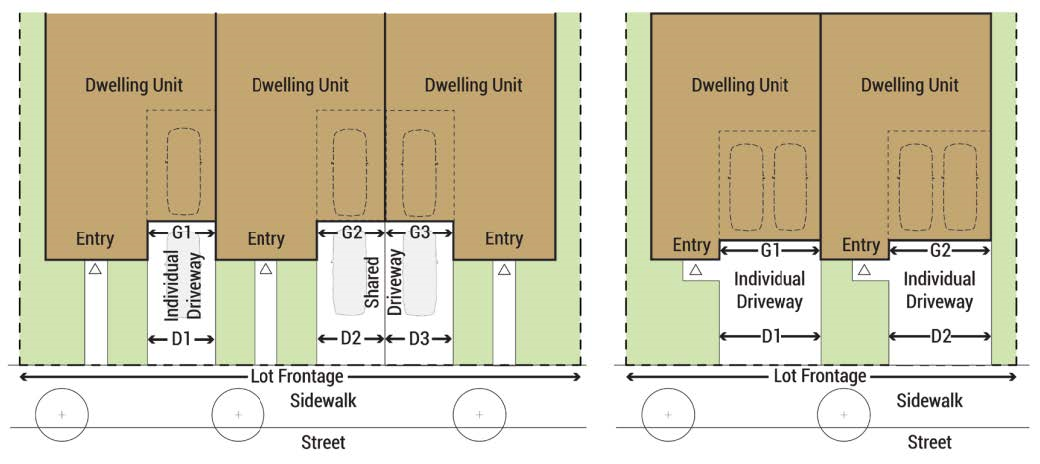
(G1+G2+G3)/Lot Frontage must be no more than 60%
(D1+D2+D3) must not exceed 64 feet per frontage
Individual driveway width (D1) and shared driveway widths (D2+D3) shall not exceed 20 feet
(Ord. No. 25-025, § I (Exh. A), 12-15-2025)
18.25.050 - Parking Standards.
A.
One off-street parking space per unit is required on lots smaller than six thousand square feet, before any zero lot line subdivisions or lot splits.
B.
Two off-street parking spaces per unit is required on lots greater than six thousand square feet before any zero lot line subdivisions or lot splits.
C.
No off-street is required within one-half mile walking distance of a major transit stop.
(Ord. No. 25-025, § I (Exh. A), 12-15-2025)

