
Camas City Zoning Code
CHAPTER 18
26 - FLEXIBLE DEVELOPMENT
18.26.010 - Purpose and intent.
This chapter is optional in all zoning districts except the LI/BP zone. The purpose and intent of this chapter is to promote the public health, safety and general welfare of the citizens of the City of Camas in accordance with state law and the City's Comprehensive Plan; and
A.
To provide for greater flexibility in the development of properties;
B.
To foster the development of land that is arranged, scaled, and designed to be compatible with existing and potential densities;
C.
To promote a growth pattern to efficiently use land;
D.
To promote construction and redevelopment that implements the most current sustainable features;
E.
Retain historical building or other structures to the greatest extent possible; and
F.
To allow for the modification of certain regulations when it can be demonstrated that such modification meets the minimum points for development under this chapter.
G.
To provide for an alternative to CMC Chapter 18.23 - Planned Residential Development (PRD). The city shall review a proposal for either a PRD or a flexible development, not a combination.
(Ord. No. 2628, § I(Exh. A), 10-17-2011)
18.26.030 - Permitted uses.
Only permitted land uses within the underlying zoning classification shall be considered permitted within a flexible development. A use listed as conditional use within the underlying zoning classification may be proposed in combination with a flexible development if submitted concurrently with an application for such use.
(Ord. No. 2628, § I(Exh. A), 10-17-2011)
18.26.040 - Definitions of terms.
For the purposes of this chapter, the flexible development score sheet, the following definitions shall apply in addition to those definitions within Chapter 18.03:
A.
"Building envelope" means the exterior dimensions of a structure. For detached multi-family housing, a suitable size and configuration includes a building envelope capable of siting a twenty-foot by fifty-foot dwelling within the building envelope.
B.
"Double-frontage lot" means a lot, other than a corner lot, having street frontage on two sides. If proposed on streets other than arterials, then both sides of the lot must provide pedestrian access to the sidewalk, and the more intensely traveled street must be the front of the structure. This could require that each frontage provide a gate if fencing is proposed or the installation of stairs if there is a slope.
C.
"Green roof" means a landscaped area on the roof of a structure that provides stormwater benefits. Green roofs may serve dual purposes of stormwater management and as an aesthetic enhancement.
D.
"GFA" means the gross floor area of a structure as measured from the outside surface of the outer building wall for all levels.
E.
"Permeable paving" means that the method and material of paving will allow the movement of water and air through the paving material.
F.
"Energy star/LEED (Leadership in Energy and Environmental Design)" are nationally recognized programs for measuring the amount of overall environmental benefit that is provided in a building versus conventional methods.
G.
"LED lighting" means "light-emitting diode." These lights consume less energy, have a longer useable life, and are smaller in size than other lights with the same amount of lighting output.
H.
"Meandering sidewalks" means that the course of the walkway is winding or curving rather than straight. This design may cost more to develop given that more land may be required for curvature and landscaping.
I.
"Rain gardens" are landscaped areas planted with wild flowers and other native vegetation to soak up rain water, mainly from the roof of a house or other building. The rain garden fills with a few inches of water after a storm and the water slowly filters into the ground rather than running off to a storm drain. Compared to a conventional patch of lawn, a rain garden allows about thirty percent more water to soak into the ground.
J.
"Recreational open space" means lands that are developed for active recreation such as for park and trail use. These lands may contain critical features such as streams, steep slopes or wetlands, however only the unencumbered area of land is used in the score sheet calculations.
K.
"Repurpose structure" means to alter or renovate a building for a different purpose, on a long-term basis in lieu of demolition (e.g., renovating a barn into a restaurant, or a warehouse into a performing arts theatre).
L.
"Solar lighting" is any use of sunlight or sky light for illuminating the interior of a building, or may be defined as the conversion of sunlight to power a fixture.
M.
"Vegetated wall" means a vertical surface designed and planted to be covered at maturity by plants.
N.
"White roof" means a roof with reflective shingles that exceed a 0.15 reflectivity, as established by the Department of Ecology. White roofs increase energy efficiency and lower the heat island effects of new development.
(Ord. No. 2628, § I(Exh. A), 10-17-2011; Ord. No. 2691, § I(Exh. A), 1-21-2014)
18.26.050 - Score sheet adopted.
The city's "Flexible Development Score Sheet" (score sheet) is a required form for this chapter and is adopted by the city by resolution (RES1223, or as amended).
(Ord. No. 2628, § I(Exh. A), 10-17-2011; Ord. No. 2691, § I(Exh. A), 1-21-2014)
18.26.060 - Application requirements for flexible development proposals.
In addition to those items listed in CMC 18.55.110, the following items are required for a complete application for a flexible development. Items may be waived if, in the judgment of the director or designee, the items are not applicable to the particular proposal:
A.
Flexible development score sheet;
B.
Complete and signed SEPA checklist;
C.
A transportation impact study to determine the adequacy of the transportation system to serve the proposed development and to mitigate impacts of the proposal on the surrounding transportation system;
D.
Preliminary stormwater plan and preliminary stormwater technical information report (TIR). The preliminary stormwater TIR is to be prepared in accordance with Ecology's latest edition Stormwater Management Manual for Western Washington (SWMMWW);). If proposed, rain gardens-shall meet the standards of CMC Section 17.19.030.F.6 Storm Drainage Facilities;
E.
Preliminary grading plan;
F.
Site plan drawn to scale and depicting the following:
1.
The existing land uses within the development, and the existing location of all structures (indicate if any structures are to be repurposed);
2.
A list of owners of land adjacent to the proposed development;
3.
The proposed location of all buildings, if commercial or industrial project;
4.
The proposed lot sizes and building envelopes, if subdivision project;
5.
Location of any critical areas, critical area buffers, and significant trees in compliance with CMC Chapter 18.31 and CMC Title 16 Environment;
6.
Location of sidewalks, driveways, street lighting and street trees;
7.
The location of all areas to be conveyed, dedicated, or maintained as public or private streets/tracts;
8.
Provide a plan with the ingress/egress to the development with the proposed traffic circulation, parking areas, pedestrian walkways;
9.
A draft document containing agreements, provisions, and covenants regarding the permanent ownership, maintenance, protection, and use of the development;
G.
A preliminary landscape plan;
H.
Building elevations for each unique type of structure; and
I.
Narrative to describe how the proposed project complies with this chapter in balance with proposed flexible elements, relevant requirements of Camas Land Development and Zoning Codes, and the requirements of Chapter 58.17 RCW, if applicable. The city shall not consider variances to the minimum provisions of this chapter.
(Ord. No. 2628, § I(Exh. A), 10-17-2011; Ord. No. 2691, § I(Exh. A), 1-21-2014; Ord. No. 21-005, § I(Exh. A), 3-15-2021)
18.26.070 - Professional preparation
The applicant for a proposed flexible development shall certify that one or more of the following have been involved with the preparation of the preliminary plan:
A.
An architect or engineer licensed in the State of Washington.
B.
A landscape architect licensed in the State of Washington.
C.
A registered civil engineer or a registered land surveyor licensed in the State of Washington.
(Ord. No. 2628, § I(Exh. A), 10-17-2011)
18.26.080 - Criteria for approval.
A preliminary flexible development plan approval may be authorized by the decision maker if findings are made that the following criteria is satisfied:
A.
The proposal shall meet the purpose and intent of a flexible development as stated in this chapter in balance with development bonuses.
B.
The proposal meets the minimum score per the "flexible development score sheet" based on the particular land use zone.
Residential zones .....0.3
Commercial zones .....0.3
Industrial zones .....0.3
LI/BP Zones .....Not applicable
C.
The proposal is in conformance with the Camas Comprehensive Plan.
(Ord. No. 2628, § I(Exh. A), 10-17-2011)
18.26.090 - Development bonuses.
Upon meeting the minimum standards of a flexible development per the score sheet, the project may be eligible for the following additional flexibility in land development standards:
A.
If proposed to meet the standards of this chapter, then rain gardens are exempt from the thirty-foot setback standard of CMC Section 17.19.030.F.6 Storm Drainage Facilities.
B.
Residential development:
1.
May increase density of residential development in accordance with the Density Transfer Standards of CMC Section 18.09.040 of the underlying zone, or, if a multifamily zone, then standards may reflect those of the MF-18 zone of CMC Section 18.09.050, if landscaping is not sacrificed.
2.
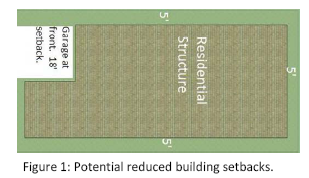
If project scores higher than minimum score, then for standard lots, building setbacks may be reduced to five feet on all sides of the structure with eighteen feet from garages (if driveways are accessed at the front of the lot). Refer to Figure 1.
3.
On corner lots, vision clearance setbacks must be maintained in accordance with CMC Section 17.19.030.D.7 Corner Lots.
4.
Height of buildings may exceed the maximum building height of the zoning district by one story or ten feet, whichever is less.
C.
Commercial/industrial projects.
1.
If project scores higher than a minimum score, then the applicant may reduce the required off-street parking for the GFA by twenty-five percent and participate in the city's Commute Trip Reduction Program.
2.
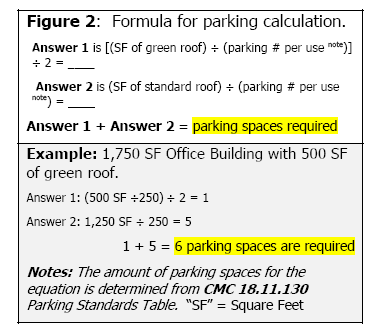
If a green roof is proposed, then the applicant may reduce up to fifty percent of the required off-street parking spaces (calculated on the first level if a multi-story building) for the equivalent square footage of a green roof. Refer to Figure 2 for formula.
(Ord. No. 2628, § I(Exh. A), 10-17-2011; Ord. No. 2691, § I(Exh. A), 1-21-2014; Ord. No. 17-013, § I(Exh. A), 10-2-2017)
18.26.100 - Development assurances.
A.
To assure full performance of the proposed flexible development, the developer shall provide certification from the qualified professional of record that the project element has been built as approved in the decision, prior to receiving an occupancy permit from the Building Department.
B.
Perpetual maintenance covenant.
1.
The applicant shall be required to perform maintenance functions on the flexible development aspects of their approved project in perpetuity to maintain functionality at the current industry standards (e.g. roof gardens or solar panels).
2.
The maintenance covenant in a form acceptable to the city shall be recorded with the Clark County Auditor for each applicable lot or parcel. A copy of the recorded document must be provided to the Building Department prior to receiving an occupancy permit.
3.
The maintenance covenant as described herein shall run with the land and be binding upon the heirs, successors, and assigns of the applicant or owner.
C.
Amount of financial security. The director may require financial security to be provided for certain elements of the project that are not otherwise required to be secured pursuant to CMC Chapter 17.21-Procedures for Public Improvements. The financial security shall be based on one hundred five percent of the cost estimates. Cost estimates of the following shall be submitted to and approved by the director:
1.
Estimated construction cost for green roofs, white roofs, and solar lighting.
2.
Estimated installation costs for landscaping and maintenance for a period of three years post-construction.
(Ord. No. 2628, § I(Exh. A), 10-17-2011)

