
Camas City Zoning Code
CHAPTER 18
37 - BUSINESS PARK13
Editor's note— Ord. No. 2584, § III, adopted May 3, 2010, repealed Ch. 18.37, which pertained to adult entertainment. Subsequently, Ord. No. 2672, § IV(Exh. D), adopted January 22, 2013, enacted provisions designated as a new Ch. 18.37 to read as herein set out. See also the Code Comparative Table and Disposition List.
18.37.010 - Purpose.
The Business Park (BP) district is intended to provide for employment growth in the city by protecting industrial areas for future employment. Design of business park facilities in this district will be "campus-style," with landscaped buffers, and architectural features compatible with, and not offensive to, surrounding uses.
(Ord. No. 2672, § IV(Exh. D), 1-22-2013)
18.37.020 - Permit process.
A.
In addition to the site plan permit requirements of Chapter 18.18 Site Plan, any person desiring to establish or significantly modify a use on land zoned BP shall also address the applicable provisions of this chapter.
B.
Design review is required pursuant to CMC Chapter 18.19 Design Review. The design review committee recommendations shall be based on the architectural design standards specific to this chapter.
(Ord. No. 2672, § IV(Exh. D), 1-22-2013)
18.37.030 - Architectural design standards.
A.
Building height, setbacks and lot coverage shall be as set forth in Section 18.09.030 Table 1.
B.
Parking. Parking shall be provided as per CMC Chapter 18.11 Parking of this title.
C.
Building materials.
a.
A minimum of seventy-five percent of the walls visible to the right-of-way (excluding glass) shall be indigenous such as cedar, wood logs, brick, stone, rusticated block or comparable modular masonry are preferred. New materials that convey the texture, scale, color and finish similar to these natural products will be considered where appropriate. Large blank walls facing the right of way are prohibited.
b.
Secondary materials such as metal siding may be used as accents and may compose twenty-five percent of the walls visible from the right-of-way (excluding glass).
c.
Prefabricated metal buildings or structures are not permitted.
d.
Glare reduction. All glazing must be low-reflective. Given the city's location near airports and within the Pacific Flyway, the use of tinted glass, tilted glass or other bird-friendly glazing methods (See Exhibit 1) are preferred.
Exhibit 1: Tilted glass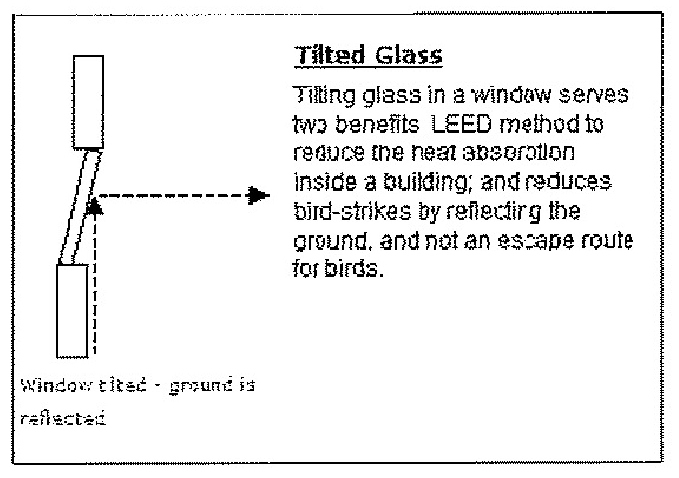
e.
Use muted earth tone colors for building and roof materials.
i.
Bright colors are only appropriate for accents.
ii.
A minimum of seventy-five percent of the exterior walls seen from the public right of way shall have muted tones.
D.
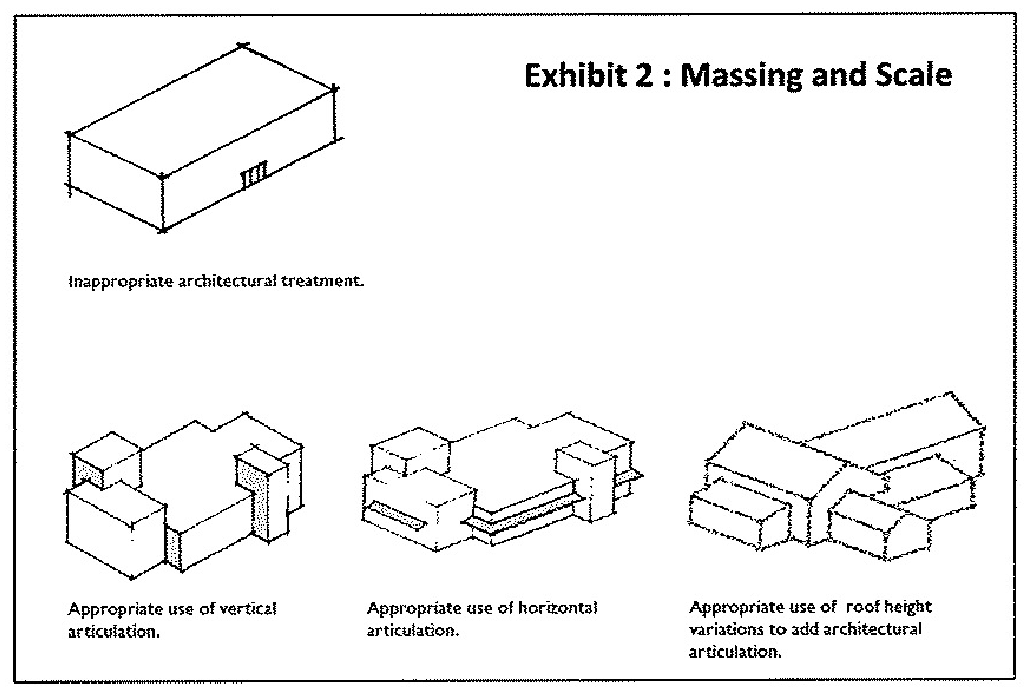
Building massing and scale (See Exhibit 2).
a.
Provide a human scale to the primary entrance.
b.
Express the position of each floor in the external design of the building by changing materials between floors, or use an expression line, or articulate structural elements.
c.
Avoid large panelized products or extensive featureless surfaces.
E.
Roof form. Incorporate at least two of the following features to add architectural articulation:
a.
A flat roof with a parapet that screens rooftop equipment from view;
b.
A cornice or molding to define the top of a parapet;
c.
Overhanging eaves;
d.
Sloping roofs with a minimum pitch of 4:12; and/or
e.
Multiple roof planes.
F.
All vents, flues, or other protrusions through the roof, less than sixteen inches in diameter need not be screened from view, but must be painted or treated to blend with the color of the background. All such vents, flues, or other protrusions through the roof, more than sixteen inches in diameter shall be considered mechanical equipment and shall be screened from view.
G.
Refuse/storage. Refuse areas and service/storage areas are to be located under cover, and/or not visible from the public right-of-way or adjacent properties.
H.
Fencing heights may exceed those specified at CMC Chapter 18.18—Supplemental Development Standards as follows. A wrought-iron fence, vinyl-coated chain link, masonry, stone or a combination, may be up to six feet high along the front property line or within the front yard setback.
I.
Security fencing shall be compatible with landscaping of the entire site. Evergreen plant material will be located adjacent to security fencing, and shall provide a vegetative screen when mature.
J.
Lighting. Lighting shall be directed to the interior of the site, and shielded from adjacent properties. Building lighting is to be concealed and indirect.
(Ord. No. 2672, § IV(Exh. D), 1-22-2013)
18.37.040 - Landscaping standards.
In addition to the landscaping requirements of CMC Chapter 18.13 Landscaping of this title, all proposed development in this zone shall generally comply with the following standards. Variations may be considered by the Design Review Committee and authorized by the approval authority where reasonable factors such as topography or other site constraints will make strict compliance unreasonable.
A.
The entire street frontage will receive landscaping of trees, shrubs, and ground cover plants that will create a unifying effect throughout the area. Tree groupings shall be located for interest and variety. Generally, landscape frontage shall be a minimum of fifteen feet deep. Landscaping buffers shall also be placed along both sides of driveways for their full length.
B.
Curvilinear design is encouraged to create interest and variety.
C.
Native species of plants should be maintained where possible. Landscaping that includes features to attract native wildlife (birds, chipmunks, bees, butterflies, etc.) is encouraged and may offset other landscaping requirements of this chapter. (Refer to the Washington State Department of Fish and Wildlife for guidance at http://wdfw.wa.gov/living/landscaping/)
D.
Foundation planting. Landscaped areas shall be planted and maintained within ten feet of the building, excluding loading dock areas and those areas not within view of the public right of way.
E.
Stormwater management facilities may be incorporated into the required landscape buffers if they are designed in compliance with Chapter 14.02 Stormwater Management.
F.
Permeable paving (where feasible) may count toward a portion of the required landscaping.
G.
Lawns are discouraged in the BP district given that they require a lot of water to stay green and healthy. Lawns, if proposed, must consist of drought-tolerant grasses.
H.
Areas used for storage, loading, etc., which would make landscaping inappropriate or superfluous will not require landscaping. Those areas have their own requirements for screening. Walls and fences that extend out from the main structure for purposes of screening shall also have a minimum of ten feet of landscape strip adjacent to the exterior facing side of the wall.
I.
Large site areas that are intended to remain undeveloped shall be improved with landscape materials that relate to the natural environment and the particular site. Tree clusters, mounding and native undergrowth, combined with employee recreational uses should result in an esthetically pleasing effect.
(Ord. No. 2672, § IV(Exh. D), 1-22-2013)
18.37.050 - Subsequent permits and minor amendments.
A.
Applications for subsequent permits or minor amendments shall be approved only when substantially in conformance with the approved development plan.
B.
The subsequent application shall be considered substantially in conformance with the approved final plan when the proposal:
1.
Is within the scope and intent of the final plan;
2.
Is of a similar size and scale and does not increase environmental impacts from those identified during the initial site plan review decision;
3.
Does not reduce overall acreage identified as dedicated public areas, open space or buffering areas;
4.
Does not propose to modify any development standard of Titles 17 and 18.
C.
A decision as to whether the subsequent application is substantially in conformance with the approved site plan shall be processed as a Type I permit pursuant to Chapter 18.55.
D.
A determination of consistency with the final plan shall not exempt the subsequent application from the necessity of obtaining any other required local, state, federal permits, or compliance with any other applicable requirements.
(Ord. No. 2672, § IV(Exh. D), 1-22-2013)
18.37.060 - Expiration of business park approval.
Site plan approval within the business park zone shall expire and become void unless substantial construction is commenced within five years of the date of approval of the final plan, or within a longer period if specifically authorized in a phasing plan; provided, such time periods shall be tolled during the pendency of any litigation related to the project that prevents the applicant from commencing or completing such construction; and further provided, that prior to the expiration of the approval, an applicant may apply directly to the community development director (director) for one or more extensions not to exceed one year each. The director shall approve such extension or extensions upon a finding of good cause.
(Ord. No. 2672, § IV(Exh. D), 1-22-2013)

