
Camas City Zoning Code
CHAPTER 18
13 - LANDSCAPING
18.13.010 - Purpose.
A.
To establish minimum standards for landscaping in order to provide screening between incompatible land uses, minimize the visual impact of paved areas, provide for shade, and minimize erosion; and
B.
To implement the city's comprehensive plan goals which include preserving natural beauty in the city, and protecting Camas' native landscape and mature tree cover.
(Ord. 2515 § 1 (Exh. A (part)), 2008: Ord. 2443 § 3 (Exh. A (part)), 2006)
(Ord. No. 18-014, § XIII, 9-4-2018)
18.13.020 - Scope.
A.
Unless otherwise exempted, the standards of this chapter shall apply to any site to be developed. All applicable development activities shall be required to prepare a landscape plan and shall be required to meet the minimum tree density herein created.
B.
The standards of this chapter shall apply to the following:
1.
Commercial, industrial, governmental uses, and land divisions;
2.
Redevelopment including change of use when Site Plan Review is applicable (refer to Chapter 18.18 Site Plan Review);
3.
Parking lots with greater than four spaces;
4.
Development that is subject to Design Review (refer to Chapter 18.19 Design Review);
5.
Undeveloped property converting to an allowed use in the zone (e.g. infill lots); and
6.
Conditional uses. The standards for landscaping will be the same as the landscaping standards in commercial zones if conditional use will occur in a residential zone.
(Ord. 2515 § 1 (Exh. A (part)), 2008: Ord. 2443 § 3 (Exh. A (part)), 2006)
(Ord. No. 17-013, § I(Exh. A), 10-2-2017; Ord. No. 18-014, § XIII, 9-4-2018)
18.13.025 - Exemptions.
The following activities are exempt from submittal of a Landscape Tree and Vegetation Plan:
A.
Commercial Nurseries. Removal of trees and vegetation which are being grown to be sold as landscape trees.
B.
Forest Practices Permit. Removal of trees as allowed with a forest practices permit issued by the Washington State Department of Natural Resources. Exemption does not include conversion of forest land to other uses.
C.
Developed Residential Lots. Removal of trees on lots which: (1) are less than twenty-four thousand square feet and are part of a subdivision or short plat; (2) which cannot be further divided in accordance with the underlying zoning district; and (3) trees to be removed are not within shoreline areas or critical areas.
D.
Undeveloped property and developed lots (twenty-four thousand square feet and greater). Removal of up to six trees per acre, up to a total of six trees within any twelve consecutive month period when: (1) the property is intended to remain undeveloped for a period of six years and such intent is recorded in a covenant; (2) if a minimum tree density of thirty tree units per acre is maintained; and (3) the trees to be removed are not within shoreline areas or critical areas. Removal of trees on parcels of less than one acre in size shall be limited in proportion to six trees per acre (e.g. a half acre parcel can remove three trees).
E.
Downtown commercial zone. Downtown commercial zone properties must include properly spaced street trees, and other landscape screening in accordance with downtown design review standards, but are not required to meet tree density minimums.
F.
Minor development. A Landscape, Tree and Vegetation plan is not required for any site disturbance less than five hundred square feet and where no tree will be removed or adjacent tree(s) impacted.
(Ord. No. 18-014, § XIV, 9-4-2018)
18.13.030 - Expansion.
In a case where a site expands, landscaping shall be provided only for the percentage of expansion.
(Ord. 2515 § 1 (Exh. A (part)), 2008: Ord. 2443 § 3 (Exh. A (part)), 2006)
18.13.040 - Procedure for landscape, tree and vegetation plans.
A.
Applicants shall submit a detailed Landscape, Tree and Vegetation Plan with building and site improvement plans. Included in the plans (at a minimum) shall be type, size, and location of plants and materials.
B.
A tree survey must be included for any applicable development proposing to remove trees.
(Ord. 2515 § 1 (Exh. A (part)), 2008: Ord. 2443 § 3 (Exh. A (part)), 2006)
( Ord. No. 18-014, § XIII, 9-4-2018)
18.13.045 - Tree survey.
A.
The applicant must submit a tree survey that is prepared by a certified arborist or professional forester.
B.
A tree survey must contain the following:
1.
Inventory.
a.
Map of the site, with tree locations numbered
b.
Include all significant trees that will be impacted by the proposed development, which may include trees off-site if canopies overhang the subject property. Open space tracts to be set aside for conservation purposes do not need to be included in survey.
c.
Provide the common and scientific name of inventoried trees.
2.
Assessment.
a.
Size. Measure and provide the diameter at breast height (DBH).
b.
Tree protection zone. (Refer to CMC 18.03.050 Environmental Definitions)
c.
Tree health. An overall assessment of the trees structural stability and failure potential based on specific structural features (e.g. decay, conks, co-dominate trunks, abnormal lean) and rated as good, fair or poor.
d.
Recommendation for preservation or removal. The recommendation will consider proposed grading, trenching, paving, fencing and other construction plans.
e.
If hazardous, then an evaluation of hazardous trees will include a numerical value of hazard based on the following: failure potential; size of part most likely to fail; and distance to target (e.g. new residence).
(Ord. No. 18-014, § XIV, 9-4-2018)
18.13.050 - Standards for landscape, tree and vegetation plans.
A.
The property owner shall be responsible for any future damage to a street, curb, or sidewalk caused by landscaping.
B.
Landscaping and trees shall be selected and located to deter sound, filter air contaminants, curtail erosion, minimize stormwater run-off, contribute to living privacy, reduce the visual impacts of large buildings and paved areas, screen, and emphasize or separate outdoor spaces of different uses or character.
C.
Landscape, Tree and Vegetation Plan must include a combination of trees, shrubs, and ground cover to achieve the purposes of this chapter.
1.
Required landscaping shall be comprised of a minimum of sixty percent native vegetation (or adapted to northwest climate), or drought-tolerant vegetation, and fifty percent evergreen.
2.
Deciduous trees shall have straight trunks, be fully branched, have a minimum caliper of two inches, be equivalent to a fifteen-gallon container size, and be adequately staked for planting.
3.
Evergreen trees shall be a minimum of five feet in height, fully branched, and adequately staked for planting.
D.
Street trees will be required as part of the frontage improvements. Species, size and spacing of the trees must be consistent with the Design Standards Manual. Unless otherwise specified, trees must generally be spaced thirty feet apart. Substitute varieties are subject to approval by the City of Camas.
E.
Proposed vegetation cannot be an invasive species as listed within the most current edition of the Clark County Noxious Weed List (e.g. English Ivy cultivars).
F.
Shrubs shall be a minimum of five-gallon pot size. Upright shrubs shall have a minimum height at planting of eighteen inches. Spreading shrubs at planting shall have a minimum width of eighteen inches (smaller shrub sizes may be approved where it is more appropriate within a particular landscape plan).
G.
Ground Cover, defined as living material and not including bark chips or other mulch, shall be from containers of one gallon or larger. Plants shall be planted and spaced in a triangular pattern which will result in eighty percent cover in three years. Lawn cannot be the primary ground cover within required landscape buffers unless approved for stormwater conveyance. Grass species, if used as ground cover, shall be native or drought-tolerant, and appropriate for the use of the area.
H.
Appropriate measures shall be taken, e.g., installation of irrigation system, to assure landscaping success. If plantings fail to survive, it is the responsibility of the property owner to replace them.
I.
Required trees, as they grow, shall be pruned in accordance with the International Society of Arboriculture. The pruned tree will provide at least ten feet of clearance above sidewalks and fourteen feet above street roadway surfaces.
J.
Existing trees may be used as street trees if there will be no damage from the development which will kill or weaken the tree. Sidewalks of variable width and elevation may be utilized to save existing street trees, subject to approval by the city.
K.
Vision clearance hazards shall be prohibited.
L.
Street trees and other required landscaping which dies or is removed, must be replaced within one year of death or removal. Replacement street trees may be an alternative species from the city's recommended tree list, and may be in a different location as approved by the city.
(Ord. 2515 § 1 (Exh. A (part)), 2008: Ord. 2443 § 3 (Exh. A (part)), 2006)
(Ord. No. 2612, § I(Exh. A), 2-7-2011; Ord. No. 2691, § I(Exh. A), 1-21-2014; Ord. No. 17-013, § I(Exh. A), 10-2-2017; Ord. No. 18-014, § XIII, 9-4-2018; Ord. No. 21-005, § I(Exh. A), 3-15-2021)
18.13.051 - Minimum tree density requirement.
A.
Tree Density. A minimum tree density per net acre is required and must be incorporated within the overall landscape plan. The tree density may consist of existing trees, replacement trees or a combination of existing and replacement trees, pursuant to the priority established in Section 18.13.052.
18.13.051 Table 1: Required Tree Density
1 At least fifty percent of minimum tree density shall be achieved through retention of existing trees where the existing tree coverage on the site would allow for this standard to be met. If this standard cannot be met, an arborist report is required to demonstrate that it cannot be met. Replacement trees must be native and/or coniferous species. More information is included in the North Shore Design Manual.
B.
Tree Density Calculation. Specific instructions on how to perform tree density calculations are provided in the Design Standards Manual. "Tree Unit" is a unit of measurement based upon the size of the diameter of the tree measured at the breast height ("dbh"). New trees are given a value of one (1) Tree Unit, as they must be a minimum of 2" dbh when planted. Tree Unit values are summarized in the following Table:
18.13.051 Table 2: Tree Units for Existing Trees
(Ord. No. 18-014, § XIV, 9-4-2018; Ord. No. 23-010, Exh. A, 8-7-2023)
18.13.052 - Tree and native vegetation preservation.
A.
When determining where to retain or plant trees, locations with healthy soils, native understory vegetation, and mature trees shall have priority when there are feasible alternative locations on site for proposed buildings and site improvements to achieve the minimum tree unit density per acre. This may require site redesign. Provided, where necessary, density transfer areas may be used to ensure protection and retention of trees. Residential and mixed-use developments may use density transfer standards when setting aside area outside of critical or natural areas to protect existing trees.
B.
In designing a development project and in meeting the required tree density, the applicant must provide a Landscape, Tree and Vegetation plan that retains healthy, wind firm trees in the following priority:
1.
Trees located within critical area buffers. Trees must be identified within a protected tract.
2.
Significant wildlife habitat, or areas adjacent and buffering habitat.
3.
Significant trees that are greater than 36 inch dbh.
4.
Groves of trees, or other individual healthy trees with the intent to retain must be located in separate tract if part of a land division, or other protective mechanism if other development type,
5.
Trees, that if removed would cause trees on adjacent properties to become hazardous.
C.
Mitigation and Replacement. In areas where there are currently inadequate numbers of existing trees to meet minimum tree density, where the trees are inappropriate for preservation, the soils are poor, or there are significant invasive species, then mitigation shall be required to meet the minimum tree density. The applicant's proposed location for replacement trees or mitigation shall be subject to the city's approval of the Landscape Plan. Replacement trees shall be planted in the following priority:
1.
Onsite.
a.
Within or adjacent to critical area buffers or wildlife habitat areas
b.
Adjacent to stormwater facilities
c.
Landscaping tracts, such as at entrances, traffic islands or other common areas
d.
Removal of invasive species and restorative native vegetation planting equivalent to the area necessary for new tree planting.
2.
City tree fund. When on-site locations are unavailable or infeasible, then the applicant can pay an amount equal to the market value of the replacement trees into the city's tree fund.
(Ord. No. 18-014, § XIV, 9-4-2018; Ord. No. 23-010, Exh. A, 8-7-2023)
18.13.055 - Landscape buffering standards.
A.
Landscape buffers shall be in compliance with the below referenced table:
Table 1—Landscape Buffers
B.
Landscaping and Screening Design Standards.
1.
L1, General Landscaping.
a.
Intent. The L1 standard is intended to be used where distance is the principal means of separating uses or development, and landscaping enhances the area between them. The L1 standard consists principally of groundcover plants; trees and high and low shrubs also are required.
b.
Required Materials. There are two ways to provide trees and shrubs to comply with an L1 standard. Shrubs and trees may be grouped. Groundcover plants, grass lawn, or approved flowers must fully cover the landscaped area not in shrubs and trees.
2.
L2, Low Screen.
a.
The standard is applied where a low level of screening sufficiently reduces the impact of a use or development, or where visibility between areas is more important than a greater visual screen.
b.
Required Materials. The L2 standard requires enough low shrubs to form a continuous screen three feet high and ninety-five percent opaque year-round. In addition, one tree is required per thirty lineal feet of landscaped area, or as appropriate to provide a tree canopy over the landscaped area. Groundcover plants must fully cover the remainder of the landscaped area. A three-foot high masonry wall or fence at an F2 standard may be substituted for shrubs, but the trees and groundcover plants are still required.
3.
L3, High Screen.
a.
The L3 standard provides physical and visual separation between uses or development principally using screening. It is used where such separation is warranted by a proposed development, notwithstanding loss of direct views.
b.
Required Materials. The L3 standard requires enough high shrubs to form a screen six feet high and ninety-five percent opaque year-round. In addition, one tree is required per thirty lineal feet of landscaped area, or as appropriate to provide a tree canopy over the landscaped area. Groundcover plants must fully cover the remainder of the landscaped area. A six-foot high wall or fence that complies with an F1 or F2 standard may be substituted for shrubs, but the trees and groundcover plants are still required. When applied along street lot lines, the screen or wall is to be placed along the interior side of the landscaped area.
4.
Fences.
a.
F1, Partially Sight-Obscuring Fence.
i.
Intent. The F1 fence standard provides partial visual separation. The standard is applied where a proposed use or development has little impact, or where visibility between areas is more important than a total visual screen.
ii.
Required Materials. A fence or wall that complies with the F1 standard shall be six feet high, and at least fifty percent sight-obscuring. Fences may be made of wood, metal, bricks, masonry, or other permanent materials.
b.
F2, Fully Sight-Obscuring Fence.
i.
Intent. The F2 fence standard provides visual separation where complete screening is needed to protect abutting uses, and landscaping alone cannot provide that separation.
ii.
Required Materials. A fence or wall that complies with the F2 standard shall be six feet high, and one hundred percent sight obscuring. Fences may be made of wood, metal, bricks, masonry or other permanent materials.
5.
The applicant may provide landscaping and screening that exceeds the standards in this chapter provided:
a.
A fence or wall (or a combination of a berm and fence or wall), may not exceed a height of six feet above the finished grade at the base of the fence or wall (or at the base of a berm, if combined with one), unless the approval authority finds additional height is necessary to mitigate potential adverse effects of the proposed use, or other uses in the vicinity; and landscaping and screening shall not create vision clearance hazards.
b.
The community development director may approve use of existing vegetation to fulfill landscaping and screening requirements of this chapter, if that existing landscaping provides at least an equivalent level of screening as the standard required for the development in question.
c.
Required landscaping and screening shall be located on the perimeter of a lot or parcel. Required landscaping and screening shall not be located on a public right-of-way or private street easement.
(Ord. No. 17-013, § III(Exh. A), 10-2-2017)
18.13.060 - Parking areas.
A.
Parking areas are to be landscaped at all perimeters.
B.
All parking areas shall provide interior landscaping for shade and visual relief.
C.
Parking lots shall include a minimum ratio of one tree per six parking spaces.
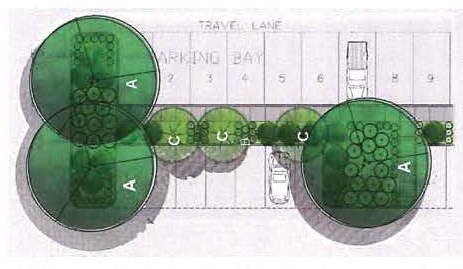
Figure 18.13.060-1 Example of Parking Lot Planter Areas.
In this example, there are three medium-sized trees ("A") for eighteen parking spaces, with ground cover ("B") and shrubs ("C").
D.
Planter strips (medians) and tree wells shall be used within parking areas and around the perimeter to accommodate trees, shrubs and groundcover.
E.
Planter areas for trees must provide a minimum of five hundred cubic feet of soil, and shall provide eight-foot by eight -foot minimum of clear planting space. For other vegetative buffer areas a minimum of a five foot clear width must be provided.
F.
Wheel stops should be used adjacent to tree wells and planter areas to protect landscaping from car overhangs.
G.
Curbed planting areas shall be provided at the end of each parking aisle to protect parked vehicles.
H.
No more than fifteen parking spaces shall be located in a row without a landscaped divider strip (See Figure 18.13.060-1).
(Ord. 2515 § 1 (Exh. A (part)), 2008: Ord. 2443 § 3 (Exh. A (part)), 2006; Ord. No. 18-014, § XIII, 9-4-2018; Ord. No. 19-012, § II(Exh. A), 11-4-2019)
18.13.070 - Assurance device.
In appropriate circumstances, the city may require a reasonable performance of maintenance assurance device, in a form acceptable to the finance department, to assure compliance with the provisions of this chapter and the approved landscaping plan.
(Ord. 2515 § 1 (Exh. A (part)), 2008: Ord. 2443 § 3 (Exh. A (part)), 2006)

