
Campbell City Zoning Code
CHAPTER 21
25 - TWO-UNIT HOUSING DEVELOPMENTS
21.25.010 - Purpose.
This Chapter establishes exceptions from the Zoning Code and provides permit procedures for proposed housing developments allowed by Senate Bill No. 9 (2021), as codified in Government Code Section 65852.21. The provisions of this Chapter shall supersede any other provision to the contrary in the Zoning Code; all other provisions unaffected by this Chapter shall remain in effect. Urban lot splits permitted by Government Code Section 66411.7 are processed pursuant to Chapter 20.14 (Urban Lot Splits).
It is further established that nothing in this Chapter shall be construed as to require the physical construction of two dwelling units that comprise a proposed housing development. However, to ensure that no proposed housing development or urban split would result in a specific, adverse impact upon the public health and safety or the physical environment that cannot be satisfactorily mitigated by feasible methods or measures, all applications submitted under this Chapter shall demonstrate construction, creation, and/or retention of two dwelling units on each parcel in compliance with the objective design, site development, and subdivision standards adopted herein.
(Ord. No. 2286, § 5, 8-16-2022)
21.25.020 - Applicability.
This Chapter is applicable only to voluntary applications for proposed housing developments. Owners of real property or their representatives may continue to exercise rights for property development in conformance with the Zoning Code. Development applications that do not satisfy the definitions for a proposed housing development shall not be subject to this Chapter. It is not the intent of this Chapter to override any lawful use restrictions as may be set forth in Conditions, Covenants, and Restrictions (CC&Rs) of a common interest development.
(Ord. No. 2286, § 5, 8-16-2022)
21.25.030 - Definitions.
In addition to the terms defined by Section 21.72.020 (Definitions of specialized terms and phrases) and Section 21.23.120 (Definitions), the following terms shall have the following meanings as used in this Chapter. Where a conflict may exist, the definitions provided in this section shall prevail over any other definition.
"Acting in concert" means persons, as defined by Section 82047 of the Government Code as that section existed as of January 1, 2022, acting jointly to pursue development of real property whether or not pursuant to a written agreement and irrespective of individual financial interest.
"Addition" means any construction which increases the size of a building in terms of site coverage, height, length, width, or gross floor area.
"Alteration" means any construction or physical change in the arrangement of rooms or the supporting members of a building or change in the relative position of buildings on a site, or substantial change in appearances of any building.
"Building" means any structure having a roof supported by columns or walls and intended for any shelter, housing or enclosure of any individual, animal, process, equipment, goods, use, occupancy, or materials. When any portion of a structure is completely separated from every other portion of the structure by a masonry division or firewall without any window, door or other opening and the masonry division or firewall extends from the ground to the upper surface of the roof at every point, such portion shall be deemed to be a separate building.
"Construction of a new primary dwelling unit" means: (1) the erection or assembly of a new primary dwelling unit; (2) creation of a new primary dwelling unit from the floor area of an existing accessory structure or primary dwelling unit; and (3) the conversion of an existing accessory dwelling unit or junior accessory dwelling unit to a primary dwelling unit.
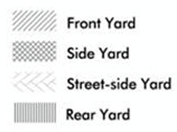
"Elevation," including "front elevation," "side elevation," "street-side elevation", and "rear elevation," means the wall(s) of a building that are oriented towards the front, side, street-side, and rear yards, respectively, formed by the required building setbacks, as illustrated by Figure 1-1, Figure 1-2, and Figure 1-3.
"Entry feature" means a structural element, which leads to a front door.
"Existing non-livable space(s)" and "portions of existing multifamily dwelling structures that are not used as livable space" as referenced in Section 21.23.050 (Special Provisions for Multi-family Residential Properties) and Section 65852.2(e)(1)(C) of the Government Code, respectively, refers to storage rooms, boiler rooms, passageways, attics, basements, garages, carports, and similar spaces that are located within or a part of existing multifamily dwelling structures that received a certificate of occupancy prior to January 1, 2022.
"Existing structure" means a lawfully constructed building that received final building permit clearance prior to January 1, 2022 and which has not been expanded on or after January 1, 2022.
"Lot types" means "corner lot," "interior lot," flag lot," "double frontage lot," "reversed corner lot," and "key lot" as depicted in Figure 1-1 (Lot Types and Yards), below. Also includes a "cul-de-sac lot" that is located along the curved terminus formed by the bulb of a cul-de-sac street, as depicted by Figure 1-2 (Cul-de-Sac Lots) and a "pie-shaped lot" where the side lot lines are approximately radial to the curve of the street upon which it fronts, as depicted in Figure 1-3 (Pie-Shaped Lot). Any other lot type not defined herein shall be considered an "irregular lot."
Figure 1-1 - Lot Types and Yards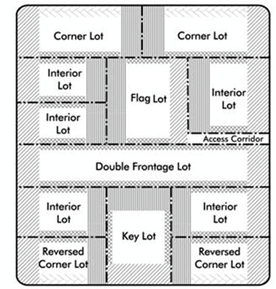
Figure 1-2 - Cul-de-Sac Lots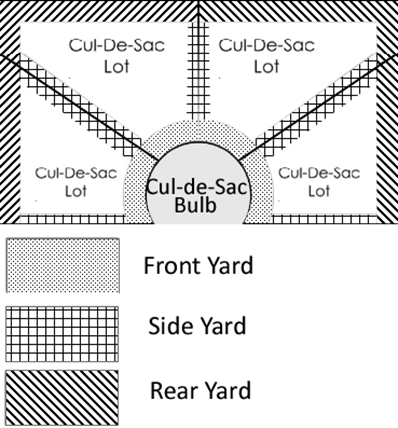
Figure 1-3 - Pie-Shaped Lot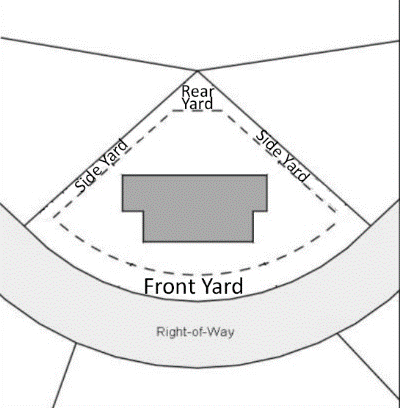
"Natural grade" means the average existing elevation of datum points located at each corner of a proposed primary dwelling unit, measured in feet above mean sea level (AMSL).
"Neighborhood plan" means both the San Tomas Area Neighborhood Plan and the Campbell Village Neighborhood Plan, as applicable.
"Nonconforming zoning condition" means a physical improvement on a property that does not conform with current zoning standards, and subject to Chapter 21.58 (Nonconforming Uses and Structures).
"Parcel" and "legal parcel" mean a single unit of land created by a partition or subdivision which, at the time of creation, complied with all procedural and substantive requirements of any applicable local, state or federal law.
"Proposed housing development" means an application proposing no more than two primary dwelling units on a single parcel located within a single-family residential zone as authorized by Section 65852.21 of the Government Code. This Chapter recognizes the following types of proposed housing developments. Any proposal not satisfying this definition shall not be considered a proposed housing development under this Chapter.
1.
Construction of two new primary dwelling units on either an existing parcel or a new parcel created from an urban lot split.
2.
Construction of one new primary dwelling unit and retention of one existing primary dwelling unit on either an existing parcel or a new parcel created from an urban lot split.
3.
Retention of two lawful nonconforming primary dwelling units where one or both units are subject to a proposed addition or alteration on an existing parcel.
4.
Retention of two existing lawful nonconforming primary dwelling units on a new parcel created from an urban lot split.
5.
Construction of one new primary dwelling unit and one accessory dwelling unit (or junior accessory dwelling unit) on a new parcel created from an urban lot split.
6.
Retention of one existing primary dwelling unit and construction of one accessory dwelling unit (or junior accessory dwelling unit) on a new parcel created from an urban lot split.
"Public transportation" means a high-quality transit corridor, as defined in subdivision (b) of Section 21155 of the Public Resources Code, or a major transit stop, as defined in Section 21064.3 of the Public Resources Code.
"Single-family residential zone" means an R-1 (Single-family) zoning district as specified by Chapter 21.08 (Residential zoning districts).
"Subdivision ordinance" means Title 20 of the Campbell Municipal Code.
"Urban lot split" means a ministerial application for a parcel map to subdivide an existing parcel located within a single-family residential zone into two parcels, as authorized by Section 66411.7 of the Government Code.
"Yards" means the open space formed by the required building setbacks, as illustrated by Figure 1-1, Figure 1-2, and Figure 1-3.
"Zoning code" means Title 21 of the Campbell Municipal Code.
(Ord. No. 2286, § 5, 8-16-2022)
21.25.040 - General eligibility.
A proposed housing development may only be created on parcels satisfying all of the following general requirements:
A.
Zoning District. A parcel that is located within a single-family residential zone.
B.
Historic Property. A parcel that is not listed on the City of Campbell Historic Resource Inventory, as defined by Chapter 21.33 (Historic Preservation).
C.
Legal Parcel. A parcel which has been legally created in compliance with the Subdivision Map Act (Government Code Section 66410 et seq.) and Subdivision Ordinance, as applicable at the time the parcel was created. The city engineer may require a certificate of compliance to verify conformance with this requirement.
D.
Hazardous Waste Site. A parcel that is not identified as a hazardous waste site pursuant to Government Code Section 65962.5 or a hazardous waste site designated by the Department of Toxic Substances Control pursuant to Section 25356 of the Health and Safety Code, unless the State Department of Public Health, State Water Resources Control Board, or Department of Toxic Substances Control has cleared the site for residential use.
E.
Flood Zone. A parcel that is not located within a special flood hazard area subject to inundation by the one percent annual chance flood (one hundred-year flood) on the official maps published by the Federal Emergency Management Agency unless a Letter of Map Revision prepared by the Federal Emergency Management Agency has been issued or if the proposed primary dwelling unit(s) is constructed in compliance with the provisions of Chapter 21.22 (Flood Damage Prevention) as determined by the floodplain administrator.
F.
Earthquake Fault Zone. A parcel that is not located within a delineated earthquake fault zone as determined by the State Geologist on any official maps published by the State Geologist, unless the proposed housing development complies with applicable seismic protection building code standards adopted by the California Building Standards Commission under the California Building Standards Law (Part 2.5 (commencing with Section 18901) of Division 13 of the Health and Safety Code), and by any local building department under Chapter 12.2 (commencing with Section 8875) of Division 1 of Title 2.
G.
Natural Habitat. A parcel that is not recognized by the City as a habitat for protected species identified as candidate, sensitive, or species of special status by state or federal agencies, fully protected species, or species protected by the federal Endangered Species Act of 1973 (16 U.S.C. Section 1531 et seq.), the California Endangered Species Act (Chapter 1.5 (commencing with Section 2050) of Division 3 of the Fish and Game Code), or the Native Plant Protection Act (Chapter 10 (commencing with Section 1900) of Division 2 of the Fish and Game Code).
(Ord. No. 2286, § 5, 8-16-2022)
21.25.050 - Zoning standards.
The following objective zoning standards supersede any other standards to the contrary that may be provided in the Zoning Code or a neighborhood plan, as they pertain to a proposed housing development under Government Code Section 65852.21. Proposed housing developments shall be constructed only in accordance with the following objective zoning standards, except as provided by Section 21.25.100 (Exceptions).
A.
Building Height/Number of Stories. The maximum building height and maximum number of stories shall be as specified by the applicable zoning district and/or a neighborhood plan. Building height shall be measured from finished grade except for properties subject to a neighborhood plan where maximum building height is measured from natural grade.
B.
Floor Area Ratio and Lot Coverage. The maximum floor area ratio and lot coverage shall be as specified by the applicable zoning district and/or a neighborhood plan.
C.
Grading. A change in elevation (AMSL) from natural grade shall be limited to the minimum extent necessary to ensure adequate drainage as demonstrated by a grading and drainage plan prepared by a registered civil engineer.
D.
Minimum Living Area. The minimum living area of a primary dwelling unit shall be 150 square feet, subject to the restrictions specified by Health and Safety Code Section 17958.1.
E.
Parking. One parking stall per primary dwelling unit shall be required, except for proposed housing developments located on parcels within one-half mile walking distance of either a public transportation stop or one block of a car share vehicle operating in accordance with California Vehicle Code Section 22507.1.
Parking stalls may either be uncovered or covered (garage or carport) in compliance with the development standards of the applicable zoning district and/or a neighborhood plan and Chapter 21.28 (Parking and Loading), except that uncovered parking spaces may encroach into a required front or side yard fronting on a public street within an existing or proposed driveway that satisfies the minimum stall dimensions for residential parking spaces (nine feet wide by twenty feet deep).
F.
Private Open Space. Each parcel shall maintain a minimum of seven hundred fifty square feet of private open space per primary dwelling unit, satisfying the requirements of Section 21.08.030, Table 2-3 (General Development Standards - R-1 Zoning District).
G.
Setbacks. Proposed housing developments shall be subject to the setback and building separation requirements specified by Table 1-1 (Setback Requirements), below:
Table 1-1 — Setback Requirements
(Ord. No. 2286, § 5, 8-16-2022)
21.25.060 - Site development standards.
The following site development standards augment those standards provided in Chapter 21.18 (Site Development Standards), Chapter 21.28 (Parking and Loading), and Chapter 21.26 (Landscaping). Proposed housing developments shall be constructed only in accordance with the following site development standards, except as provided by Section 21.25.100 (Exceptions).
A.
Air Conditioning Units. Air conditioning units and similar equipment such as generators, heating, and ventilation equipment shall be ground-mounted, screened from public view, and separated from property lines as required by Section 21.18.020 (Air conditioning units).
B.
Driveways. Driveways shall comply with the requirements of Section 21.28.090 (Driveways and site access), except that the following standards shall apply:
1.
Each driveway shall have a minimum width of eight feet up to a maximum width of eighteen feet;
2.
Each driveway shall be entirely paved with either concrete or pavers. All other surfacing materials, including but not limited to gravel, decomposed granite, and asphalt, are prohibited; and
3.
Only a single driveway curb-cut shall be permitted per parcel designed in accordance with the City's Standard Specifications and Details for Public Works Construction.
C.
Fencing. All new fencing shall comply with the requirements of Section 21.18.060 (Fences, walls, lattice and screens), except that fences shall be permitted up to seven feet in height, with or without lattice, where a six-foot tall fence would otherwise be permitted.
D.
Front Yard Paving. No more than fifty percent of the front-yard setback area shall be paved as specified by Section 21.18.070 (Front yard paving), except to allow a driveway with a width dimension not exceeding eight feet.
E.
Landscaping Requirement. Front and street-side yards shall be irrigated and landscaped with a combination of plantings, including natural turf, ornamental grasses, groundcovers, shrubs, and trees, consistent with Section 21.26.030 (General landscaping requirements for all zoning districts) and the California Model Water Efficient Landscape Ordinance (MWELO), pursuant to Section 21.26.030.F (Water efficient). Properties subject to the San Tomas Area Neighborhood Plan (STANP) shall provide one tree per 1,500 square feet of net lot area.
F.
Lighting. New exterior lighting fixtures shall be down-shielded and oriented away from adjacent properties consistent with Section 21.18.090 (Lighting design standards) and shall not emit more than one-half foot candle of illumination at interior-side or rear property lines.
G.
Stormwater Management. Stormwater runoff from impervious surfaces shall be directed to vegetated areas on the parcel and shall not drain onto adjacent parcels as specified by the Building Code, and as demonstrated by a grading and drainage plan prepared by a registered civil engineer.
H.
Water Meter(s) and Sewer Cleanout(s). New water meters and sewer cleanouts shall be installed on the parcel containing the units they serve. Existing meters and cleanouts located within the public right-of-way shall be relocated onto the parcel upon construction of a new primary dwelling unit.
(Ord. No. 2286, § 5, 8-16-2022)
21.25.070 - Design review standards.
The following objective design review standards apply to construction of new primary dwelling units and to any addition and/or alteration to existing primary dwelling units as part of a proposed housing development, except as provided by Section 21.25.100 (Exceptions). Existing features inconsistent with these standards may remain provided they are not altered or removed.
A.
Balconies/Decks. Rooftop terraces and decks are prohibited. Balconies shall only be permitted on the front elevation of a primary dwelling unit(s).
B.
Building Colors. Each new primary dwelling unit shall incorporate at least two colors (inclusive of trim) but not more than four colors. Paints shall be uniformly applied to wall surfaces and no more than one paint color may be applied per wall (not including the trim color). Additions to existing primary dwelling units shall incorporate the same building colors as the existing structure or otherwise comply with the requirements of this provision.
C.
Columns and Pillars. Exterior columns and/or pillars shall not exceed a height of fourteen feet or the plate height of the first-story, whichever is less.
D.
Finished Floor. The finished floor of the first-story shall not exceed 18-inches in height as measured from finished grade.
E.
Front Entryway. An entry feature framing a front door shall not exceed fourteen-feet in height as measured from finished grade.
F.
Front Doors. Front door openings shall not exceed a width of six feet or a height of nine feet. Front entry doors for duplex units in a side-by-side configuration shall be separated by a distance equal to half the linear length of the structure's front elevation.
G.
Front Porch. Porches shall have a minimum depth of five feet and a minimum width equal to thirty-three percent of the linear width of the front-facing wall.
H.
Front Step-back. Second-story wall(s) that front a public street shall be recessed by five feet from the first-story exterior walls, as measured wall to wall.
I.
Garages. Garages placed on the front elevation of a primary dwelling unit shall not exceed fifty percent of the linear extent of the front elevation.
J.
Garage Conversions. The creation of a primary dwelling unit from the existing space of an attached garage shall include removal of garage doors which shall be replaced with architectural features the same as those of the existing primary dwelling unit, including the same wall cladding, building color(s), and window frames that remove any appearance that the structure was originally a garage.
K.
Plate Height. The plate height of each story for a new primary dwelling unit shall be limited to twelve feet as measured from finished floor. The plate height of an addition to an existing primary dwelling unit shall match the plate height of the existing structure.
L.
Roof Forms. For new primary dwelling units, roofs shall be limited to cross-hipped or hipped and valley forms with a minimum slope of 4:12 and a maximum slope of 8:12. Gabled and dormer elements are allowed, but all other roof forms are prohibited. Additions to existing primary dwelling units shall match the predominant roof form and roof pitch of the existing structure.
M.
Roof Materials. For new primary dwelling units, no more than two roofing materials shall be used, limited to asphalt composite shingles, photovoltaic shingles, standing seam metal, clay tile, concrete tile, and slate shingles. All other roofing materials are prohibited. Additions to existing primary dwelling units shall incorporate the same roofing material as the existing structure or otherwise comply with the requirements of this provision.
N.
Stairways. A dwelling unit located entirely on a second story shall require a separate interior or exterior stairway. Enclosed stairways shall be included in the allowable floor area of the dwelling unit that it serves.
O.
Wall Materials. For new primary dwelling units, no more than two exterior wall materials shall be used, limited to stucco, horizontal or vertical fiber cement siding (in any profile), horizontal or vertical wood siding (in any profile), and horizontal or vertical engineered (composite) wood siding (in any profile). Stacked stone or brick veneer may be used as an accent material, limited to the lower half of the first story. Additions to existing primary dwelling units shall incorporate the same combination materials as the existing structure or otherwise comply with the requirements of this provision.
P.
Windows. All second-story windows less than eight feet from rear and interior-side property lines shall be clerestory with the bottom of the glass at least six feet above the finished floor. All other second-story windows shall be limited to the minimum number and minimum size as necessary for egress purposes as required by the Building Code.
Q.
Utilities. Gas and electric meters and connections to gas and electric meters (i.e. connections to rooftop solar panels) shall be located on side walls adjacent to interior-side property lines.
(Ord. No. 2286, § 5, 8-16-2022)
21.25.080 - General requirements and restrictions.
The following requirements and restrictions apply to all proposed housing developments, inclusive of existing and new primary dwelling units, as applicable:
A.
Accessory Dwelling Units. In addition to the two primary dwelling units comprising a proposed housing development, accessory dwelling units may be allowed in compliance with Chapter 21.23 (Accessory Dwelling Units), except for proposed housing developments located on a new parcel created by an urban lot split which shall be limited to a total of two units as defined by Section 66411.7(j)(2) of the Government Code:
1.
Parcels with two single-family dwellings shall be permitted one accessory dwelling unit and one junior accessory dwelling unit;
2.
Parcels with a duplex structure shall be permitted two detached accessory dwelling units. The accessory dwelling units may be connected to each other in a side-by-side or front-to-back configuration or stacked with one unit located atop of the other unit forming a two-story structure not exceeding the maximum building height specified by Section 21.25.050.A (Building height/number of stories);
3.
Creation of an interior accessory dwelling unit from an existing non-livable space shall only be permitted within an existing multifamily dwelling structure, as herein defined.
B.
Building and Fire Codes. Title 18 and Title 17 of the Campbell Municipal Code, incorporating the Building Code and Fire Code, respectively, apply to all proposed housing developments.
C.
Dwelling Unit Type. The primary dwelling unit(s) comprising a proposed housing development may take the form of detached single-family dwellings, attached townhomes, and/or duplexes. A duplex may consist of two dwelling units in a side-by-side or front-to-back configuration or stacked with one unit located atop of the other unit forming a two-story structure not exceeding the maximum building height specified by Section 21.25.050.A (Building height/number of stories).
D.
Encroachment Permits. Separate encroachment permits for the installation of utilities to serve a proposed housing development shall be required. Applicants shall apply for and pay all necessary fees for utility permits for sanitary sewer, gas, water, electric and all other utility work.
E.
Park Impact Fee. A fee in-lieu of parkland dedication shall be paid in association with the creation of any new dwelling units in compliance with Chapter 13.08 (Park Impact Fees and Park Land Dedication Developments).
F.
Restrictions on Demolition. The proposed housing development shall not require demolition or alteration involving removal of more than twenty-five percent of the existing exterior structural walls, of any of the following types of housing structures:
1.
Housing that is subject to a recorded covenant, ordinance, or law that restricts rents to levels affordable to persons and families of moderate, low, or very low income;
2.
Housing that is subject to any form of rent or price control through a public entity's valid exercise of its police power;
3.
Housing that has been occupied by a tenant in the last three years. This shall be evidenced by claiming of the Homeowners' Exemption on the Santa Clara County assessment roll.
G.
Short-Term Rentals. Leases for durations of less than thirty days, including short-term rentals are prohibited. The community development director shall require recordation of a deed restriction documenting this requirement prior to issuance of a building permit.
H.
Subdivision and Sales. Except for the allowance for an urban lot split provided in Chapter 20.14 (Urban Lot Splits), no subdivision of land or air rights shall be allowed in association with a proposed housing development, including creation of a stock cooperative or similar common interest ownership arrangement. In no instance shall a single primary dwelling unit be sold or otherwise conveyed separate from the other primary dwelling unit.
(Ord. No. 2286, § 5, 8-16-2022; Ord. No. 2299, § 5, 11-7-2023)
21.25.090 - Application process.
Applications for proposed housing developments shall be submitted and processed in compliance with the following requirements:
A.
Application Type. Proposed housing developments shall be reviewed ministerially by the community development director through consideration of a zoning clearance in compliance with Chapter 21.40 (Zoning Clearances). The permitting provisions of Chapter 21.42 (Site and Architectural Review) and by reference any neighborhood plan, shall not be applied.
B.
Application Filing. A zoning clearance application for a proposed housing development, including the required application materials and fees, shall be filed with the community development department in compliance with Chapter 21.38 (Application Filing, Processing and Fees). A zoning clearance application may only be found complete if it satisfies the requirements of this Chapter.
C.
Building Permits. Issuance of a zoning clearance shall be required prior to issuance of building permit(s) for the new and/or modified dwelling units comprising the proposed housing development, consistent with Section 21.56.050 (Issuance of building permits).
D.
Approval Expiration. Approval of a Zoning Clearance shall expire twelve months of after issuance, as specified by Section 21.56.030 (Permit time limits and extensions), except when a proposed housing development is comprised of two dwelling units. Approval of a zoning clearance for creation and/or alteration of two dwelling units shall incorporate two pre-approved phases pursuant to Section 21.56.030.A.3.b (Pre-approved phases), where each phase provides twelve months for the applicant to secure issuance of a building permit for each approved dwelling unit. Failure to secure issuance of a building permit for Phase 1 (first dwelling unit) shall result in the expiration of the zoning clearance. Failure to obtain a building permit for Phase 2 (second dwelling unit) within the successive twelve-month period shall result in the expiration of approval for Phase 2 without effect to Phase 1. Such partial expiration of the zoning clearance shall not preclude application for a new zoning clearance for the second dwelling unit nor result in a violation of this Title. An applicant may request an extension of the permit expiration date to any of the twelve-month approval periods pursuant to Section 21.56.030.C (Extensions of time).
E.
Denial. The community development director may deny a proposed housing development project only if the building official makes a written finding, based upon a preponderance of the evidence, that the proposed housing development would have a specific, adverse impact, as defined and determined in paragraph (2) of subdivision (d) of Section 65589.5 of the Government Code, upon public health and safety or the physical environment and for which there is no feasible method to satisfactorily mitigate or avoid the specific, adverse impact. Expiration of a zoning clearance application following a determination that the application is incomplete pursuant to Section 21.38.040.C (Expiration of application) shall not constitute a denial.
F.
Appeals. As specified by Chapter 21.62 (Appeals), zoning clearances are ministerial and are not subject to an appeal.
(Ord. No. 2286, § 5, 8-16-2022)
21.25.100 - Exceptions.
If any of the zoning, site development, or design review standards provided in this Chapter would have the effect of physically precluding construction of up to two primary dwelling units or physically preclude either of the two primary dwelling units from being at least eight hundred square feet in floor area, the community development director shall grant an exception to the applicable standard(s) to the minimum extent necessary as specified by this section. An exception request shall be explicitly made on the application for a zoning clearance for a proposed housing development.
A.
Determination. Exceptions shall be granted by the community development director according to the following order of priority (ordered from the most preferred to the least preferred) until the physical constraint to a proposed housing development is resolved, provided that if an exception does not remove a physical constraint, the exception shall not be granted.
1.
Elimination of the rear setback (for parcels with a rear property line abutting a non-residentially zoned property or roadway);
2.
Elimination of the interior-side setback (for parcels with a side property line abutting a non-residentially zoned property or street);
3.
Reduction of the street-side setback to five feet;
4.
Reduction of the garage entry setback/minimum driveway depth to twenty feet;
5.
Increase to the maximum floor area ratio (FAR);
6.
Increase to the maximum lot coverage;
7.
Reduction to the minimum required private open space;
8.
Reduction of the front/rear building separation between structures to five-feet;
9.
Reduction or elimination of any other standard not otherwise identified.
B.
Remedy. Where a disagreement with the community development director's application of this section occurs, the procedures for an interpretation provided in Section 21.020.030 (Procedures for interpretations) shall be followed, including the provisions for an appeal.
(Ord. No. 2286, § 5, 8-16-2022)

