
Campbell City Zoning Code
CHAPTER 21
28 - PARKING AND LOADING
21.28.010 - Purpose.
This chapter is intended to ensure that adequate off-street parking and loading spaces are provided for each type of land use in a manner that will ensure their usefulness, support alternative transportation solutions, improve the urban form of the community, and protect the public safety.
(Ord. 2043 § 1(part), 2004).
(Ord. No. 2149, § 1(Exh. A), 6-7-2011)
21.28.020 - Applicability.
Every use and structure, including a change or expansion of a use or structure shall have appropriately maintained parking and loading areas in compliance with the provisions of this chapter. A use shall not be commenced and structures shall not be occupied until improvements required by this chapter are satisfactorily completed.
(Ord. 2043 § 1(part), 2004).
21.28.030 - General parking and loading regulations.
A.
Parking and loading spaces to be permanent. Parking and loading spaces shall be permanently available, marked and maintained for parking or loading purposes for the use they are intended to serve.
B.
Parking and loading to be unrestricted. Owners, lessees, tenants, or persons having control of the operation of a premises for which parking or loading spaces are required by this chapter shall not prevent, prohibit or restrict authorized persons from using these spaces without prior approval of the community development director.
C.
Restriction of parking area use. Required off-street parking, circulation, and access areas shall be used exclusively for the temporary parking and maneuvering of vehicles and shall not be used for the sale, lease, display, repair, or storage of vehicles, trailers, boats, campers, mobile homes, merchandise, or equipment, or for any other use not authorized by the provisions of this code.
D.
Change in use. When there is a change in use that would require additional parking spaces, the spaces shall be provided at the time of the change, in compliance with Subsection 21.28.040.D (Expansion/remodeling of structure, or change in use).
E.
Conformance. Uses that were in existence at the time of adoption of this chapter and that were in conformance with the provisions of this chapter at that time shall not become "nonconforming" solely because the parking spaces provided do not meet the requirements of this chapter. However, if the use is enlarged or changed, parking spaces shall be provided as required in this chapter.
(Ord. 2043 § 1(part), 2004).
(Ord. No. 2149, § 1(Exh. A), 6-7-2011)
21.28.040 - Number of parking spaces required.
A.
Parking requirements by land use. Each land use shall be provided the number of parking spaces required by Table 3-1, (Parking Requirements by Land Use), except nonresidential land uses located within an overlay combining zoning district subject to a master use permit authorized by Section 21.14.030.C (Master use permit).
B.
Expansion/remodeling of structure, or change in use.
1.
Except where a parking modification permit has been granted in compliance with Section 21.28.050, (Parking modification permit) or as provided for in Section 21.10.060.I.3, (Change in use),when the use of a structure changes to a use that requires the same, or fewer, number of parking spaces as the immediately previous use, the number of required parking spaces for the new use shall be the same as the requirement for the previous use, regardless of the number of spaces actually provided by the previous use provided that:
a.
The previous use was legally established; and
b.
No spaces were eliminated by the previous use except as provided for by this Chapter.
2.
When a legally established structure is enlarged or increased in capacity, or when a legally established use is changed to one that requires more off-street parking than the existing or previous use.
a.
Only the number of parking spaces required for the addition needs to be provided; or
b.
The difference in the required number of parking spaces for the new use and the existing use only needs to be provided.
3.
When a structure (or a portion of a structure) is intentionally demolished, any new use or structure shall provide the number of parking spaces required by this chapter.
4.
Additional parking spaces shall not be required for an addition to a structure made solely for the purpose of increasing access for disabled persons.
C.
Uses not listed. Land uses not specifically listed by Subsection A, (Parking requirements by land use), above, shall provide parking as required by the community development director. The community development director shall use the requirements of Table 3-1 as a guide in determining the minimum number of parking spaces to be provided.
D.
Rounding of quantities. When calculating the number of parking spaces required, the parking demand of all uses sharing parking spaces shall first be totaled prior to rounding the resultant number to the nearest whole number.
E.
Company-owned vehicles. The number of parking spaces required by this chapter does not include spaces needed for the parking of company-owned vehicles. Parking spaces to accommodate company-owned vehicles shall be provided in excess of the requirements for a particular land use and shall be screened from view from the public right-of-way.
F.
Electric Vehicle Parking Spaces. Electrical vehicle charging spaces meeting the minimum size requirements of this Chapter shall count as at least one standard parking space and accessible charging spaces with an access aisle shall count as two standard parking spaces.
G.
Electric Vehicle Charging Station (EVCS). Notwithstanding anything in this Chapter to the contrary, the number of required parking spaces for existing uses shall be reduced by the amount necessary to accommodate one or more EVCS if the EVCS and associated equipment interferes with, reduces, eliminates, or in any way impacts the required parking spaces for existing uses.
H.
Accessible Parking and Access. Notwithstanding anything in this Chapter to the contrary, the number of required parking spaces for existing uses shall be reduced by the amount necessary to provide the minimum number and type of accessible parking spaces, and paths of travel, required by the California Building Code (CBC).
I.
Guest Parking Spaces. Where a minimum residential guest parking standard is not otherwise specified by this Chapter, a minimum of one onsite designated guest parking space for every ten onsite parking spaces provided shall be required. As set forth by this section, no additional onsite parking spaces shall be required to satisfy the guest parking requirement, nor shall guest parking be required when found to conflict with the minimum required assigned parking requirement provided in Section 21.28.040.J - Assignment of Parking Spaces.
J.
Assignment of Parking Spaces. Where onsite parking is provided on a property with residential units, parking spaces shall be assigned to onsite uses as follows:
1.
To residential units until a ratio of one assigned parking space per unit is satisfied; then
2.
To non-residential uses until the onsite parking requirements are satisfied; then
3.
As residential guest parking until the ratio specified in Section 21.28.040.I — Guest Parking Spaces has been satisfied.
Table 3-1
Parking Requirements by Land Use
(Ord. 2043 § 1(part), 2004; Ord. No. 2149, § 1(Exh. A), 6-7-2011; Ord. No. 2213, § 20, 11-1-2016; Ord. No. 2216, §§ 11, 12, 12-12-2016; Ord. No. 2293, § 1(Exh. B), 5-2-2023)
21.28.045 - Reductions in the number of parking spaces required.
Reductions in the number of parking spaces required by Table 3-1 may be granted in compliance with this section.
A.
Projects located within one-half mile of public transit. As provided for by Government Code Section 65585, no vehicle parking spaces shall be required for any development project or use that is located within one-half mile of a major transit stop as defined in Section 21155 of the Public Resources Code with the added clarification that bus routes traveling in the same direction, or with the same route id, or with bus stops located more than one hundred fifty feet in distance from one another shall not be considered as major bus routes. A map showing eligible properties and/or areas shall be on file with the Community Development Department.
B.
Motorcycle parking. Developments that provide twenty or more parking spaces may substitute motorcycle parking for up to five spaces or ten percent of required vehicle parking, whichever is less. For every four motorcycle parking spaces provided, the vehicle parking requirement shall be reduced by one space. Motorcycle space dimensions shall be a minimum of four feet by six feet.
C.
Residential and Mixed-use development. Residential and mixed-use development projects with a residential component may reduce the number of parking spaces required by Table 3-1 as follows, provided that a minimum of one bundled (assigned) parking space per residential unit is always maintained:
1.
Shared Parking: Up to fifty percent percent of the guest parking spaces required for the residential component may be counted toward satisfying the parking required for the nonresidential component when provided as shared parking, in compliance with the following standards:
i.
Parking Management Plan. An application for a mixed-use project shall include a parking management plan that provides for the design, duration, oversight, and operation (e.g., hours of use, commercial land-use restrictions etc.) of shared parking spaces, prepared to the satisfaction of the decision-making body.
ii.
Location. Shared parking spaces shall be located in a manner that is accessible and convenient to both the commercial tenant spaces and residential units.
iii.
Signs. Shared parking spaces shall be posted with signs indicating their shared use and any applicable restrictions.
2.
Carshare Parking: A reduction of five residential parking spaces for every carshare parking space provided.
(Ord. No. 2293, § 1(Exh. B), 5-2-2023)
21.28.050 - Parking modification permit.
A reduction in the number of parking spaces required by Table 3-1 for nonresidential uses may be granted by approval of a parking modification permit, in compliance with this section.
A.
Applicability. An application for a parking modification permit shall be required by the community development director in conjunction with an application for a land use permit or zoning clearance whenever a proposed use or structure does not provide the number of parking spaces required by this chapter or when the number of parking spaces for an existing use or building is reduced to a lesser number than required by this chapter, except for a development located within an overlay combining zoning district.
B.
Decision-making authority. The decision-making body for a parking modification permit shall be the decision-making body established for the accompanying land use permit or zoning clearance application, as specified by Chapter 21.38, (Application Filing, Processing, and Fees).
C.
Notice and decision. The notice and decision for a parking modification permit filed in conjunction with an application for a zoning clearance or administrative permit shall be subject to the administrative decision process as prescribed in Chapter 21.71, (Administrative Decision Process). A parking modification permit filed in conjunction with any other land use permit application shall be subject to the public hearing process as prescribed in Chapter 21.64, (Public Hearing).
D.
Application requirements. An application for a parking modification permit shall be filed with the community development department in conjunction with the accompanying land use permit or zoning clearance application in compliance with Chapter 21.38, (Application Filing, Processing and Fees).
E.
Applicant's responsibility. It is the responsibility of the applicant to provide pertinent documentation necessary to establish evidence in support of the findings required by Subsection G, (Determination permit).
F.
Parking demand study. A parking demand study, prepared by a qualified transportation engineer, shall be required as follows, unless otherwise waived by the community development director. At the discretion of the community development director, the study shall be conducted under the direction of the City and paid for in advance by the applicant.
a.
Construction or enlargement of a nonresidential, residential, or mixed-use structure(s) when the number of parking spaces provided is less than ninety percent of that required by this chapter.
b.
A new use in an existing structure where no expansion of floor area is proposed, when the number of parking spaces available to the use is less than ninety percent of that required by this chapter.
G.
Determination on permit. A parking modification permit shall be approved only after the decision-making body makes the following findings for approval:
a.
Due to the unique nature and circumstances of the project, or special development features, the anticipated number of parking spaces necessary to serve the use or structure is less than that required by the applicable off-street parking standard, and would be satisfied by the existing or proposed number of parking spaces, as supported by review of the applicant's documentation and/or a parking demand study prepared by a qualified transportation engineer accepted by the decision-making body;
b.
Conditions of approval have been incorporated into the project to ensure the long-term adequacy of the provided off-street parking; and
c.
Approval of the parking modification permit will further the purpose of this chapter.
H.
Conditions of approval. In approving a parking modification permit, the decision-making body shall incorporate conditions of approval as necessary to ensure the long-term adequacy of off-street parking facilities, including, but not limited to, restrictions on the scope and operational characteristics of proposed use(s), restrictions on future use(s), and provisions for alternative transportation programs or development features that justify the granting of a parking modification permit.
(Ord. 2043 § 1(part), 2004; Ord. No. 2149, § 1(Exh. A), 6-7-2011; Ord. No. 2213, § 21, 11-1-2016; Ord. No. 2293, § 1(Exh. B), 5-2-2023)
21.28.055 - Reserved.
Editor's note— Ord. No. 2293, § 1(Exh. B), adopted May 2, 2023, repealed § 21.28.055, which pertained to mixed-use developments and derived from Ord. No. 2149, § 1(Exh. A), adopted June 7, 2011.
21.28.060 - Disabled parking requirements.
Parking areas shall include parking spaces accessible to the disabled in the following manner:
A.
Fulfilling of requirements. Disabled accessible parking spaces required by this chapter shall count toward fulfilling the parking requirements of this chapter.
B.
Number of spaces, design standards. Parking spaces for the disabled shall be provided in compliance with California Building Codes and other applicable State and Federal Laws.
C.
Reservation of spaces required. Disabled access spaces shall be reserved for use by the disabled throughout the life of the use.
D.
Residential multi-family uses. For each dwelling unit required to be designed to accommodate the physically handicapped or required to be made adaptable for the physically handicapped, the required covered parking shall be designed as required by Part 2, Title 24, California Administrative Code.
E.
Upgrading of markings required. If amendments to State law change standards for the marking, striping, and signing of disabled parking spaces, disabled accessible spaces shall be upgraded in compliance with the new state standards.
(Ord. 2043 § 1 (part), 2004; Ord. No. 2293, § 1(Exh. B), 5-2-2023)
21.28.065 - Reserved.
Editor's note— Ord. No. 2293, § 1(Exh. B), adopted May 2, 2023, repealed § 21.28.065, which pertained to motorcycle parking and derived from Ord. 2043 § 1 (part), adopted 2004; and Ord. No. 2149, § 1(Exh. A), adopted June 7, 2011.
21.28.070 - Bicycle parking.
Short-term and long-term bicycle parking facilities shall be provided in compliance with Part 11, Title 24, California Code of Regulations, as required by Chapter 18.26, (Green Building Standards Code) except that in no case shall less than one bicycle parking space per four residential dwelling units and/or two thousand five hundred square feet of non-residential gross floor area. The decision-making body may require additional bicycle parking beyond this requirement for non-residential uses to further the purpose of this chapter.
(Ord. No. 2149, § 1(Exh. A), 6-7-2011; Ord. No. 2293, § 1(Exh. B), 5-2-2023)
21.28.075 - Clean air and non-emitting vehicle and van pool parking.
Parking for low-emitting, fuel-efficient and van pool vehicles shall be provided in compliance with Chapter 18.26, (Green Building Standards Code).
(Ord. No. 2149, § 1(Exh. A), 6-7-2011; Ord. No. 2293, § 1(Exh. B), 5-2-2023)
21.28.080 - Development standards for off-street parking.
Off-street parking areas shall be designed and constructed in compliance with the following standards:
A.
Location. Off-street parking spaces shall be provided on the same site as the use outside of any public right-of-way, except that the planning commission may approve parking for nonresidential uses on a parcel directly abutting the parcel subject to the recordation of a covenant running with the land recorded by the owner of the parking area guaranteeing that the required parking will be maintained for the life of the use or activity served.
B.
Access to parking areas and parking stalls.
1.
Parking space access. Except for one and two-family dwellings, all parking facilities shall be designed so that no parking space blocks the access to another parking space or driveway, unless otherwise allowed by a development permit. Further, in no case shall a backup distance of less than twenty-five feet be provided to a parking space where access to the parking space is provided at an angle greater than sixty degrees.
2.
On-site maneuverability. Except for one and two-family dwellings, parking areas shall provide suitable on-site maneuvering room so that vehicles do not back out into the street.
3.
Required yards. Parking areas shall not be developed in a required front or side yard fronting on a public street.
4.
Relationship to the public right-of-way. No garage or carport shall be closer than twenty-five feet to a public right-of-way.
5.
Adjacent site access. Applicants for nonresidential uses shall provide shared vehicle and pedestrian access between adjacent nonresidential properties for convenience, safety and efficient circulation, as practical. A joint access agreement guaranteeing the continued availability of the shared access between the properties and running with the land shall be recorded by the owners of the abutting properties, as approved by the community development director.
6.
Guest parking spaces. Guest parking spaces shall be clearly marked for guest parking only and shall be dispersed throughout the development site, except as otherwise allowed by Section 21.28.050.C, (Parking modification permit).
7.
Shared driveways. Nonresidential projects and mixed-use projects shall consolidate driveways to reduce the amount of curb cuts and paving, where possible.
C.
Parking space dimensions.
1.
All parking spaces shall be designed as uni-stall:
a.
Parking spaces shall have a minimum stall width of eight and a half feet and stall length of eighteen feet, except that parallel parking spaces shall have a minimum stall width of eight and a half feet and stall length of twenty-two feet. Parking overhangs may be permitted in compliance with Subsection 21.28.080(G)(7), (Bumper overhang areas).
b.
Parking spaces with dimensions greater than those specified by this section may be created so long as all parking spaces remain uniform is size.
c.
Standard and compact parking spaces in existence prior to July 1, 2011 may be maintained through periodic restriping. However, repaving of parking surfaces shall require restriping in accordance with this chapter, so long as the restriping does not result in a fewer number of parking spaces than currently exist.
D.
Parking diagrams and table. The width of aisles in parking lots and minimum dimensions shall be provided in compliance with this chapter and Table 3-2 and Figure 3-7.
Figure 3-7
Illustration of Parking Dimensions
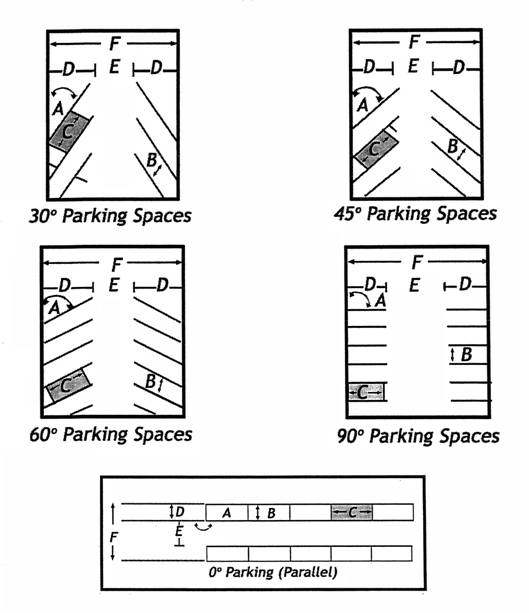
TABLE 3-2
Off-Street Parking Dimensions
* Two-way aisle dimension.
E.
Drive-through windows. For each use that provides drive-through window service to occupants of vehicles, there shall be a queuing lane of not less than twelve feet in width, and providing a queuing length adequate to serve the demand of the use and prevent the blocking of drive aisles and traffic lanes. Upon application for a new land use permit or zoning clearance for a drive-through use, the community development director may require submittal of a vehicle circulation study prepared by a qualified transportation engineer to determine the necessary queuing length to adequately serve the demand of the use. At the discretion of the community development director, the study shall be conducted under the direction of the city and paid for in advance by the applicant.
F.
Lighting. Parking areas shall have lighting capable of providing adequate illumination for security and safety. Lighting standards shall be energy-efficient and in scale with the height and use of the on-site structure(s). All illumination, including security lighting, shall be directed downward, away from adjacent properties and public rights-of-way in compliance with Section 21.16.060, (Outdoor light and glare) of this title.
G.
Landscaping. Parking lot landscaping shall be provided in compliance with Chapter 21.26, (Landscaping Requirements) of this title and the following additional requirements:
1.
Perimeter parking lot landscaping. The minimum dimensions of street frontage and perimeter landscaping shall be provided in compliance with the dimensions outlined in Chapter 21.26, (Landscaping Requirements) of this title.
2.
Interior parking lot landscaping. Where twenty-five or more parking spaces are provided, an interior parking lot landscaped area shall be required, which may include the required frontage and perimeter landscaped areas if adjacent to the parking spaces. Interior landscaped area(s) shall be provided at a rate of twenty square feet of landscaping for each parking space.
3.
Landscape materials. Landscaping materials shall be provided throughout the parking lot area using a combination of trees, shrubs, and ground cover. Drought-tolerant landscape materials shall be emphasized.
4.
Trees. Where twenty-five or more parking spaces are provided, a minimum of one tree per eight parking spaces, or any fraction thereof, shall be required. Tree spacing shall be provided at a minimum to provide a tree canopy over the parking lot. Parking spaces covered by carports or solar panels shall not be subject to this requirement.
5.
Screening. A combination of landscaping and decorative walls, in compliance with Section 21.18.060, (Fence, walls, lattice and screens) of this title shall be located around parking areas as a visual screen.
6.
Curbing. Areas containing plant materials shall be bordered by a concrete curb at least six inches high and six inches wide. Alternative barrier designs may be approved by the decision-making body.
7.
Bumper overhang areas. To increase the parking lot landscaped area, a maximum of two feet of the parking stall depth may be landscaped with low-growth, hearty materials in lieu of paving or the walkway may be increased, allowing a two-foot bumper overhang while maintaining the required parking dimensions. Bumper overhang areas shall not encroach into required walkways, required landscape areas, or right-of-way.
H.
Striping and identification.
1.
Vehicular. Parking spaces shall be clearly outlined with four-inch wide lines painted on the surface of the parking facility. Circulation aisles, approach lanes, and turning areas shall be clearly marked with directional arrows and lines to ensure safe traffic movement.
2.
Disabled. Parking spaces for the disabled shall be striped and marked so as to be clearly identified in compliance with the applicable state standards.
I.
Surfacing.
1.
Motorcycle and vehicular. Parking spaces and maneuvering areas shall be paved and permanently maintained with asphalt, concrete, or other all-weather surfacing approved by the community development director. Grass block cells are not allowed.
2.
Hollywood drives. Hollywood drives shall be allowed for one and two-family residential driveways.
3.
Overflow parking areas. Pervious paving materials shall be used for overflow parking areas to the extent possible.
J.
Pedestrian walkways. Nonresidential developments shall provide separate walkways through the parking lot that connect on-site buildings and public sidewalks, to the greatest extent feasible.
K.
Drainage.
1.
Surface water from parking lots shall not drain over sidewalks or adjacent parcels.
2.
Parking lots shall be designed in compliance with the storm water quality and quantity standards of the city's best management practices, and shall be approved by the city engineer. To the extent feasible, parking lot designs shall reduce the amount of storm water flow and pollutants from entering the storm drain system.
(Ord. 2043 § 1 (part), 2004; Ord. 2070 § 1 (Exh. A)(part), 2006; Ord. No. 2149, § 1(Exh. A), 6-7-2011; Ord. No. 2293, § 1(Exh. B), 5-2-2023)
21.28.090 - Driveways and site access.
Driveways providing site access shall be from an improved street, alley, or other public and/or private right-of-way, and shall be designed, constructed, and maintained as follows:
A.
Driveway separation. Driveways shall be separated along the street frontage as follows:
1.
Single-family and duplex residential development. Driveways shall be a minimum of five feet from side property lines, unless a shared, single driveway is approved by the community development director. The setback does not include the transition or wing sections on each side of the driveway and does not apply to flag lots.
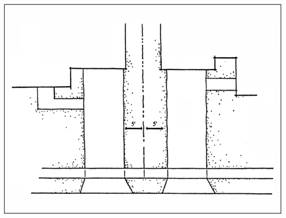
Figure 3-8
Driveway Separation
2.
Multi-family and nonresidential development. Where two or more driveways serve the same or adjacent multi-family or nonresidential development, the centerline of the driveways shall be separated by a minimum of fifty feet. Exceptions to this standard shall be subject to the approval of the city engineer.
B.
Driveway/Drive aisle width and length.
1.
Single-family and two-family uses.
a.
Each single-family dwelling shall provide a minimum eight-foot wide paved driveway/drive aisle continuous from the street or other public right-of-way providing access to the property, garage, or carport.
b.
The minimum length for a driveway shall be twenty-five feet exclusive of any public right-of-way.
2.
Multi-family dwellings, and nonresidential uses. Driveways/drive aisles for all uses, except single-family and two-family uses, shall be governed by Table 3-2 (Off-Street Parking Dimensions) and Figure 3-7 (Illustration of Parking Dimensions) except that in no case shall a one-way driveway/drive aisle be less than ten feet in width and a two way driveway/drive aisles be less than twenty feet in width.
(Ord. 2043 § 1 (part), 2004; Ord. 2070 § 1 (Exh. A)(part), 2006; Ord. No. 2293, § 1(Exh. B), 5-2-2023)
21.28.100 - Design of parking structures.
A.
Architectural character. Parking structures visible from street frontages shall be designed to be compatible with the architectural detailing and quality of adjacent buildings. Long blank walls adjacent to pedestrian sidewalks shall be avoided. Whenever appropriate, retail uses should be integrated into the ground floor of the structure adjacent to the public sidewalk.
B.
Access ramps. Access ramps shall be located within the structure and separate from exterior walls.
(Ord. 2043 § 1 (part), 2004).
21.28.110 - Loading space requirements.
A.
Number of loading spaces required. When onsite parking is provided, at least one off-street loading space shall be provided for apartment buildings and mixed-use development projects with sixteen or more dwelling units, and one additional off-street loading space shall be provided for every one hundred fifty or more dwelling units thereafter. Off-street loading spaces for nonresidential uses shall be the minimum number required to adequately serve the building or use or in amounts as required by the planning commission.
B.
Development standards for loading areas. Loading areas shall be provided in the following manner:
1.
Dimensions. Loading spaces shall be not less than twelve feet in width, twenty-five feet in length, with fourteen feet of vertical clearance.
2.
Lighting. Loading areas shall have lighting capable of providing adequate illumination for security and safety. Lighting sources shall be shielded to prevent light spill beyond the property line. Lighting standards shall be energy-efficient and in scale with the height and use of adjacent structure(s). Lighting shall meet the requirements for light and glare in Section 21.16.060, (Outdoor light and glare).
3.
Loading doors and gates. Loading bays and roll-up doors shall be painted to blend with the exterior structure wall(s) and be located on the rear of the structure only. Bays and doors may be located on the side of a structure, away from a street frontage, where the community development director determines that the bays, doors, and related trucks will be adequately screened from the public right-of-way.
4.
Loading ramps. Plans for loading ramps or truck wells shall be accompanied by a profile drawing showing the ramp, ramp transitions, and overhead clearances.
5.
Location. Loading spaces shall be located and designed as follows:
a.
As near as possible to the main structure and limited to the rear two-thirds of the parcel, if feasible.
b.
Situated to ensure that the loading facility is screened from adjacent streets as much as possible.
c.
Situated to ensure that loading and unloading takes place on-site and in no case within adjacent public rights-of-way or other traffic areas on-site.
d.
Situated to avoid adverse impacts upon neighboring properties.
6.
Screening. Loading areas abutting residentially zoned parcels shall be screened in compliance with Section 21.18.120 (Screening and buffering).
7.
Impacts. All loading areas shall be designed to be sensitive to visual and noise impacts. This may include larger setbacks from adjacent properties, screening walls, substantial landscaping, acoustic materials, equipment usage, and building modifications.
8.
Striping. Loading areas shall be striped white (for passengers or mail) or yellow (for freight) indicating the loading spaces and identifying the spaces for "loading only." The striping shall be permanently maintained by the property owner/tenant in a clear and visible manner at all times.
(Ord. 2043 § 1 (part), 2004; Ord. No. 2293, § 1(Exh. B), 5-2-2023)
21.28.120 - Recreational vehicle parking.
Recreational vehicles may be parked in residential zoning districts only in compliance with the following requirements:
A.
Recreational vehicles shall be parked on private property and shall not be parked on or over a public sidewalk;
B.
Recreational vehicles shall not be parked within the public right-of-way when signage has been posted prohibiting such parking;
C.
Recreational vehicles shall be parked on a paved surface;
D.
Recreation vehicles shall not impede safe entry to or exit from any residential structure and shall not inhibit emergency access to and from any structure; and
E.
Recreational vehicles shall not be used for camping purposes, except in compliance with the provisions of Chapter 6.40 of the Campbell Municipal Code.
(Ord. 2043 § 1 (part), 2004; Ord. No. 2251, § 4, 10-15-2019; Ord. No. 2293, § 1(Exh. B), 5-2-2023)

