
Campbell City Zoning Code
CHAPTER 21
36 - PROVISIONS APPLYING TO SPECIAL USES
21.36.010 - Purpose.
This chapter is intended to include regulations for special, unique, or newly created uses which may be allowed in one, several, or all zoning districts.
(Ord. 2043 § 1(part), 2004).
21.36.020 - Accessory structures.
This section provides standards for accessory structures that are physically detached from, and subordinate to, the main structure on the site. The standards contained in this section pertain to all properties except when otherwise provided for by a development agreement, overlay district, area plan, neighborhood plan, or specific plan.
A.
Living quarters prohibited. An accessory structure shall not include sleeping quarters or kitchen facilities. The number of allowed plumbing fixtures shall be limited to two fixtures and may only include a toilet, sink, hot water heater or washing machine connection. The Community Development Director shall require the recordation of a deed restriction stating that the structure will not be used as a dwelling unit. An accessory dwelling unit may be approved in compliance with Chapter 21.23 (Accessory Dwelling Units).
B.
Allowed accessory structures. Accessory structures, including detached garages and carports, may be allowed in compliance with the following standards:
1.
Accessory structures shall not exceed one story or fourteen feet in height;
2.
Accessory structures shall be located on the rear half of the lot;
3.
Accessory structures shall be located to the rear or side of the main structure. If located to the rear of the main structure, a minimum separation of ten feet shall be required. If located to the side of the main structure, a minimum separation of five feet shall be required. The separation requirements between an accessory dwelling unit and an accessory structure are provided in Chapter 21.23 (Accessory dwelling units);
4.
Accessory structures shall meet all setback requirements for main structures of the applicable zoning district in which they are located;
5.
No accessory structure shall exceed one thousand square feet. If there is more than one accessory structure on a lot, one accessory structure shall be allowed up to 1,000 square feet and every one subsequent to that shall not exceed two hundred square feet;
6.
When there is more than one accessory structure on a lot, there shall be a minimum separation of ten feet between each accessory structure;
7.
An accessory structure shall be considered detached if they do not share a common interior wall with the main structure.
C.
Design criteria. Accessory structures that exceed one hundred twenty square feet in area must be architecturally compatible with the main structure in terms of design, color and materials, as determined by the Community Development Director.
(Ord. 2043 § 1(part), 2004; Ord. No. 2216, § 8, 12-12-2016; Ord. No. 2225, § 13, 8-15-2017; Ord. No. 2252, § 21, 11-19-2019; Ord. No. 2293, § 1(Exh. B), 5-2-2023)
21.36.030 - Arcades.
A.
Purpose. This section provides provisions for the establishment and operation of arcades where they are allowed in compliance with Article 2 (Zoning Districts).
B.
Number of arcades permitted. There shall be authorized to be three arcades for every fifty thousand persons residing within the city limits. If the population exceeds fifty thousand persons, there shall be authorized one additional arcade.
C.
Operational Standards.
1.
Locking or barricading doors. No person shall keep any door or entrance to an area with an arcade locked, barred or barricaded in such manner as to make it difficult of access or ingress to police officers while two or more persons are present in such room, and no person shall visit or resort to any such locked, barred or barricaded room or place protected in any such manner to make it difficult of access or ingress to police when two or more persons are present.
2.
Card tables. No card tables shall be kept, or any card games played or allowed in any facility with an arcade.
3.
Duties of proprietor. It shall be the duty of the proprietor or manager of each arcade or semiarcade to ensure that an adult employee (eighteen years or older) be in charge of the arcade or semiarcade at all times that it is open to the public.
4.
Admittance.
a.
Any establishment which contains an arcade and which has a primary business of the sale of prepared food products and has a secondary or supplemental business of sale for consumption on the premises of alcoholic beverages shall prohibit the playing of any amusement device after ten p.m. by any person under the age of eighteen years.
b.
Arcades located in premises not licensed for the sale of alcoholic beverages shall be closed to the public between the hours of twelve midnight and nine a.m.
c.
Any establishment which contains an arcade and which has a primary business of the sale of alcohol shall prohibit the entry of any person under the age of twenty-one years.
d.
Minors under the age of eighteen years shall not be allowed to remain in or gain entry to a facility with an arcade after ten p.m. unless accompanied by a parent or guardian.
D.
Impounding. Any mechanical amusement device operated or maintained in violation of any law of the state, of any provision of this code, of any conditions upon which a permit or license may be granted, or of any lawful order of the chief of police or such other person who may hereafter be designated is a public nuisance and shall be impounded by the chief of police, and, if any court of competent jurisdiction determines that the device or the use or operation thereof violates or has violated any such laws or ordinances, conditions or orders, the mechanical amusement device shall be confiscated by the chief of police. Likewise, if any such device is placed, operated or maintained to be operated without a current license, the chief of police may immediately cause the same to be impounded and may not release the mechanical amusement device until a new permit has been obtained in the manner provided for in this chapter for obtaining an original permit. Mechanical amusement devices impounded under the provisions of this section shall be held for a period of thirty days, and if not redeemed within such period may be destroyed or otherwise disposed of by the chief of police. Any proceeds obtained from the disposal thereof, together with all moneys thereon, shall be deemed forfeited to the city to compensate it for the impounding of such device.
E.
Gambling, card tables, and games.
1.
Games for value. No person shall permit gambling of any kind or description or playing any amusement device or games whatsoever for money or anything of value within any arcade. Gambling and/or gaming in any business establishment where amusement devices are located will subject the owners of the business establishment, their servants, agents, and employees to prosecution for a misdemeanor, and upon conviction they shall be subject to such fine and imprisonment as provided in this code.
(Ord. No. 2306, §§ 22, 23, 4-16-2024)
21.36.035 - Bingo.
A.
Authority. Pursuant to the authority provided in Section 19(c) of Article IV of the State Constitution and Section 326.5 of the Penal Code, the city establishes the following requirements for the conduct of bingo games by nonprofit charitable organizations within the incorporated area of the city.
B.
Purpose. This section provides provisions for the establishment and operation of bingo activities where they are allowed in compliance with Article 2 (Zoning Districts) and Chapter 21.45 (Temporary Uses).
C.
Operational Standards.
1.
Organizations permitted to conduct bingo games. No person, organization or other legal entity shall be permitted to conduct bingo games in the incorporated area of the city unless such persons, organizations or other legal entities are classified as a mobile home park association, senior citizens' organization, or possess a valid certificate or letter from the franchise tax board and the Internal Revenue Service, stating that they are exempted from the payment of the bank and corporation tax by a section of the Revenue and Taxation Code as follows:
2.
Minors. No minors shall be allowed to participate in any bingo game.
3.
Open to the public. All bingo games shall be open to the public, not just to the members of the organization.
4.
Staffing and operation. A bingo game shall be operated and staffed by members of the organization which organized it. Only an organization authorized to conduct a bingo game pursuant to this Section shall operate such game, or engage in the promotion, supervision, or any other phase of such game.
5.
No profit, wage, or salary. No person or agent of such person shall receive a profit, wage, salary, or other income from any bingo game authorized by this section, except as a bona fide prize(s) received as a participant in such bingo game.
6.
Equipment. All equipment used in the operation of bingo games shall be owned by the organization authorized to conduct such bingo games.
7.
Financial interest. No individual, corporation, partnership, or other legal entity, except the organization authorized by permit and license to conduct a bingo game, shall hold a financial interest in the conduct of such bingo game.
8.
Separate fund. All profits derived from a bingo game shall be kept in a special fund or account and shall not be commingled with any other fund or account.
9.
Records. Each organization conducting a bingo game shall maintain detailed records of all profits, expenditures, prizes, and other expenses associated with the operation of bingo games. Said records shall be retained for such period of time as required by state and federal law and for a period of three years for purposes of this section.
10.
Total value of prizes. The total value of prizes awarded during the conduct of any bingo games shall not exceed two hundred and fifty dollars in cash or kind, based or both for each separate game which is held. The total value of prizes may be increased to account for inflation based on the relative increase in the Consumer Price Index (CPI), as published by the United States Bureau of Labor Statistics, using a base month and year of December 1977.
11.
Physical presence at bingo game required. No person shall be allowed to participate in a bingo game unless such person is physically present at the time and place at which the bingo game is being conducted.
12.
Frequency and Duration. An organization shall not conduct a bingo game for a period exceeding six hours per day, or with a frequency of more than twelve times per year.
13.
Filing of annual report. At the end of each year, each organization conducting bingo games shall file a report made under penalty of perjury with the city clerk indicating the total amount of money received from the operation of the bingo games in the previous year and the total amount paid out in prizes.
D.
Location. An organization authorized to conduct bingo games shall conduct such games only on property owned or leased by it, and which property is used by such organization for an office or for performance of the purposes for which the organization is organized. Nothing in this section shall be construed to require that the property owned or leased by the organization be used or leased exclusively by such organization. No bingo game shall be conducted by any organization or other legal entity on any property owned or controlled by any organization or other legal entity on any property owned or controlled by the city, unless the City Manager or designee has specifically approved the use of city property.
E.
Investigation. The chief of police shall have the authority to obtain criminal history information for each person operating or assisting in the operation of a bingo game.
F.
Compliance with State Law. The provisions of this Section are not intended to conflict with, but shall supplement, all laws of the state relating to lotteries, gaming, and/or gambling.
(Ord. No. 2306, § 24, 4-16-2024)
21.36.040 - Caretaker or employee housing.
This section provides requirements for the establishment of caretaker or employee housing in zoning; districts where they are allowed subject to the standards provided below.
A.
The principal use of the property shall be an approved conforming use.
B.
Caretaker/employee housing shall be occupied by the caretaker/employee, for the purpose of security for the allowed business or for the purpose of 24-hour healthcare, guardian, or other similar attendant services.
C.
The caretaker or employee housing unit shall not exceed 640 square feet in area and the unit shall contain no more than one bedroom.
D.
The architectural design of the housing unit shall integrated into and be compatible with the architectural design of the building.
(Ord. 2043 § 1(part), 2004).
21.36.050 - Reserved.
Editor's note— Ord. No. 2270, § 23, adopted March 16, 2021, repealed § 21.36.050, which pertained to Cargo storage containers and derived from Ord. 2043 § 1 (part), 2004.
21.36.060 - Child care facilities.
This section establishes standards for the provisions of child care facilities in zoning districts where they are allowed in compliance with the provisions of Article 2 (Zoning Districts).
A.
Applicable State law and licensing requirements. Child care facilities shall be in compliance with State law and in a manner that recognizes the needs of child care operators and minimizes the effects on surrounding properties. These standards apply in addition to other provisions of this Zoning Code and requirements imposed by the California Department of Social Services. Licensing by the Department of Social Services is required for child care facilities.
B.
Types. Child care facilities include the following types:
1.
Small family child care homes (eight or fewer children). Allowed within a single-family residence in zoning districts determined by Article 2 (Zoning Districts). Except for a clearance from the fire department, no city land use permits or clearances are required;
2.
Large family child care homes (nine to fourteen children). Allowed within a single-family residence in zoning districts determined by Article 2 (Zoning Districts). Except for a clearance from the fire department, no city land use permits or clearances are required; and
3.
Commercial child care centers (fifteen or more children). Allowed in the zoning districts determined by Article 2 (Zoning Districts), and the standards in Section 21.36.080 (Commercial Child Care Centers), below.
(Ord. 2043 § 1(part), 2004; Ord. No. 2293, § 1(Exh. B), 5-2-2023)
21.36.070 - Reserved.
Editor's note— Ord. No. 2293, § 1(Exh. B), adopted May 2, 2023, repealed § 21.36.070, which pertained to large family child care homes and derived from prior code.
21.36.080 - Commercial child care centers.
The following standards for commercial child care centers shall apply.
A.
Parcel size. The minimum parcel size for a commercial child care center shall be ten thousand square feet.
B.
Play areas. The center shall provide play areas as follows:
1.
Indoor play areas. Indoor play areas shall be in compliance with State requirements requiring thirty-five square feet of unencumbered indoor space per child; and
2.
Outdoor play areas. Outdoor play areas shall be in compliance with State requirements requiring seventy-five square feet of unencumbered outdoor space per child and shall be enclosed by a six-foot high fence or wall.
C.
Hours of operation. Unless approved to operate for twenty-four hours, hours of operation shall be confined to between six a.m. and ten p.m. In no case shall an individual child stay for a continuous period of twenty-four hours or more.
D.
Signs. One sign shall be allowed in compliance with Chapter 21.30 (Signs).
E.
Off-street parking. Off-street parking shall be provided in compliance with Chapter 21.28 (Parking and Loading), plus additional surface area shall be provided that is of sufficient size to accommodate off-street loading/unloading. The area used for parking shall not be used for both parking and as a play area at the same time.
F.
Other requirements. The facilities may also be subject to other requirements (e.g., California Health and Safety Code, the California Administrative Code, State Fire Marshall, and the Uniform Building Code).
G.
Noise.
a.
Regardless of decibel level, and taking into consideration the noise levels generated by children, no noise generated from the commercial child care use shall unreasonably offend the senses or obstruct the free use of neighboring properties so as to unreasonably interfere with the comfortable enjoyment of the adjoining properties.
b.
Mitigation measures may be required to minimize noise impacts (e.g., approved location of outside play areas, the provision of sound attenuation barriers, etc.).
c.
In order to protect residents of adjacent residential dwellings from noise impacts, a facility within a residential zoning district may only operate up to fourteen hours for each day between the hours of six a.m. and eight p.m. and may only conduct outdoor activities between the hours of seven a.m. and seven p.m.
H.
Traditional family environment. The development shall be designed so that normal residential surroundings are preserved and the integrity of the residential neighborhood is preserved.
a.
The facility is the principle residence of the provider and the use is clearly incidental and secondary to the use of the property for residential purposes.
b.
No structural changes are proposed which will alter the character of the single-family residence.
c.
The fact that a home is used as a commercial child care center shall not, in and of itself, be construed to constitute a departure from the integrity of the residential neighborhood.
(Ord. 2043 § 1(part), 2004; Ord. No. 2293, § 1(Exh. B), 5-2-2023)
21.36.085 - Emergency shelters.
A.
Purpose. This section provides provisions for the establishment and operation of emergency shelters where they are allowed in compliance with the provisions of Article 2 (Zoning Districts).
B.
Development Standards: The shelter shall conform to all development standards of the zoning district.
C.
Operational Standards:
1.
Maximum number of beds. The maximum number of beds shall be limited to the number of homeless persons in the City of Campbell based upon the most current homeless count for the City of Campbell at the time a request is made for the establishment of a homeless shelter or fifty beds, whichever is greater. The current homeless count shall be based upon the current Santa Clara County Homeless Census and Survey.
2.
Waiting and intake area. The exterior and/or interior client waiting and intake area shall be sufficient in size to accommodate all persons waiting to be admitted to the facility. If an exterior client waiting and intake area is proposed, it shall be screened from the public right-of-way.
3.
Length of stay. Residents may stay for thirty days. Extensions up to a total of one hundred eighty days may be provided by the on-site manager if no alternative housing is available.
4.
Lighting. The shelter shall have adequate outdoor lighting for security purposes.
5.
Management and Operation Plan. A Management and Operation Plan shall be submitted by the operator of the emergency shelter for review and approval by the Director of Community Development and Chief of Police prior to establishment of the use. The plan shall be approved if it sets forth the following:
a.
The plan specifies that the shelter shall provide twenty-four-hour, professional on-site management;
b.
The plan sets forth management experience of all staff; a procedure for responsiveness to neighborhood issues; transportation services that are provided; client supervision policies; client services provided; and food services provided;
c.
The plan includes a floor plan that demonstrates compliance with the physical standards of this section;
d.
The plan sets forth a security plan that shall be provided as part of the Management and Operation Plan. On-site security patrol and security devices, including security cameras, shall be provided at all times. The location, type and number of security devices shall allow for clear visibility of all exterior and interior portions of the emergency shelter.
e.
The plan sets forth the maximum number of beds and persons to be served by the emergency shelter, the number of parking spaces to be provided, the size and location of the waiting and intake area, the length of stay of residents, the lighting plan, and the security measures and plan, and the policies governing the management and operation of the emergency shelter, in compliance with the provisions of this section.
f.
The operator of the emergency shelter shall submit an annual statement on or before each anniversary of the approval of occupancy of the shelter demonstrating that the facility is operating in compliance with the approved management plan, or shall submit an updated management plan, for review and approval by the Director of Community Development and Chief of Police, in accordance with this subsection, that reflects any changes from the approved version.
(Ord. No. 2182, § 3(Exh. C), 10-7-2014; Ord. No. 2293, § 1(Exh. B), 5-2-2023)
21.36.090 - Garage and private yard sales.
This section provides locational and operational standards for the establishment of garage and private yard sales, in compliance with Article 2 (Zoning Districts), which shall be subject to the following criteria and standards:
A.
No more than five garage and private yard sales are allowed in any calendar year, not including participation in the citywide community garage sale;
B.
No garage and private yard sales can be conducted for more than three consecutive days; and
C.
No garage and private yard sales shall be conducted in the public right-of-way or in the rear or side yard of the property.
(Ord. 2043 § 1(part), 2004).
21.36.095 - Health and fitness centers/studios.
A.
Purpose. This section is designed to provide for and to regulate the establishment of health and fitness center and studio (small and large) uses where they are allowed in compliance with the provisions of Article 2 (Zoning Districts).
B.
Land use permits shall expire no later than five years from the date of approval for health and fitness center and studio (small and large) uses in the LI (Light Industrial) and RD (Research and Development) Zoning Districts. Notwithstanding the time limitations for the conditional use permit, nothing within this section shall prohibit the owner or authorized representative to re-apply for additional time limited approvals.
C.
Development Standards. Except as specifically allowed in this section, the premises on which a health and fitness center or studio (small and large) use is located shall comply with the regulations and restrictions applicable to the zoning district in which it is located.
1.
Parking and Loading. Parking and loading requirements shall be as identified in Chapter 21.28 (Parking and Loading). In addition, an area for the safe and acceptable means of drop-off and pick-up of persons using the health and fitness center use shall be provided.
2.
Circulation. The location of the health and fitness center or studio (small and large) use and the on-site improvements shall provide for safe and efficient vehicular and pedestrian circulation. The decision-making body may require the presence of one or more parking attendants and/or police officers to ensure the safe operation of parking facilities, pedestrian circulation, and traffic circulation on the public right-of-way.
3.
Hours of Operation. The decision-making body through the discretionary review process shall determine the allowable hours of operation of a health and fitness center or studio (small and large) use.
4.
Noise. Regardless of decibel level, and taking into consideration the noise levels generated by health and fitness center and studio (small and large) uses, noise generated from a health and fitness center or studio (small and large) use shall not unreasonably offend the senses or obstruct the free use and comfortable enjoyment of neighboring properties. Mitigation measures may be required to minimize noise impacts (e.g., approved location of parking and loading areas, the provision of sound attenuation barriers, etc.).
5.
Overconcentration. A health and fitness center or studio (small and large) use within the LI (Light Industrial) and RD (Research and Development) Zoning Districts shall not be located within three hundred feet of another existing public assembly, studio (small and large), or health and fitness center use unless the decision-making body grants an exception. The decision-making body, in granting an exception, shall find that the proposed concentration will not be detrimental to the health, safety, peace, morals, comfort, or general welfare of persons residing or working in the neighborhood of the proposed use.
6.
Signs. Signs shall be allowed in compliance with Chapter 21.30 (Signs).
(Ord. 2101 § 1(part), 2008; Ord. No. 2149, § 1(Exh. A), 6-7-2011; Ord. No. 2293, § 1(Exh. B), 5-2-2023)
21.36.100 - Hobby car restoration.
This section provides locational and operational standards for the establishment of hobby car restoration, in compliance with Article 2 (Zoning Districts), which shall be subject to the following criteria and standards:
A.
Hobby car restoration work shall not be conducted in the public right-of-way or in the front, side or rear yard of the property;
B.
Hobby car restoration work shall be conducted within an approved enclosed structure on the property;
C.
Parts, supplies, and equipment shall be stored within an approved enclosed structure on the property;
D.
No more than three vehicles for hobby car restoration may be on the property at any given time;
E.
The owner and/or occupant of the property shall own the vehicles being restored as a hobby;
F.
Fluids shall be disposed of in an approved manner;
G.
Painting shall not be conducted on the property unless approved by the Santa Clara County Fire Department and the Bay Area Air Quality Management District;
H.
Sound, noise, vibrations, pedestrian, or vehicle traffic shall not be in excess of those normal to a residential use; and
I.
Hours of work are limited to 8 a.m. to 9 p.m.
(Ord. 2043 § 1(part), 2004).
21.36.110 - Reserved.
Editor's note— Ord. No. 2306, § 28, adopted April 16, 2024, repealed § 21.36.110, which pertained to liquor stores and derived from Ord. 2043 § 1(part), adopted 2004; Ord. No. 2196, § 13, adopted Feb. 2, 2016; and Ord. No. 2213, § 19, adopted Nov. 1, 2016.
21.36.115 - Reserved.
Editor's note— Ord. No. 2306, § 29, adopted April 16, 2024, repealed § 21.36.115, which pertained to liquor establishments and derived from Ord. No. 2293, § 1(Exh. B), adopted May 2, 2023.
21.36.120 - Live/Work units.
A.
Purpose. This section provides standards for the development of new live/work units and for the reuse of existing commercial and industrial structures to accommodate live/work opportunities. Live/work units are intended to be occupied by business operators who live in the same structure that contains the business activity. A live/work unit is intended to function predominantly as workspace with incidental residential accommodations that meet basic habitability requirements.
B.
Applicability. The provisions of this section shall apply to live/work units where allowed in compliance with Article 2 (Zoning Districts) and the following criteria and standards.
C.
Limitations on use. A live/work unit shall not be established or used in conjunction with any of the following activities:
1.
Vehicle maintenance or repair (e.g., body or mechanical work, including boats and recreational vehicles), vehicle detailing and painting, upholstery, etc.);
2.
Storage of flammable liquids or hazardous materials beyond that normally associated with a residential use;
3.
Other activities or uses, not compatible with residential activities and/or that have the possibility of affecting the health or safety of live/work unit residents, because of dust, glare, heat, noise, noxious gasses, odor, smoke, traffic, vibration, or other impacts, or would be hazardous because of materials, processes, products, or wastes.
D.
Allowable density. One live/work unit shall be allowed for each 2,000 square feet of parcel area.
E.
Development standards.
1.
Floor area requirements. The minimum floor area of a live/work space shall be 1,000 square feet. All floor area other than that reserved for living space shall be reserved and regularly used for working and display space.
2.
Street frontage treatment. Each live/work unit fronting a public street at the ground floor level shall have a pedestrian-oriented frontage that publicly displays the interior of the nonresidential areas of the structure. The first 50 feet of the floor area depth at the street-level frontage shall be limited to display and sales activity.
3.
Access to units. Where more than one live/work unit is proposed within a single structure, each live/work unit shall be separated from other live/work units and other uses in the structure. Access to each unit shall be clearly identified to provide for emergency services.
4.
Integral layout.
a.
The living space within the live/work unit shall be contiguous with, and an integral part of the working/business space, with direct access between the two areas, and not as a separate stand-alone dwelling unit.
b.
The residential component shall not have a separate street address from the business component.
5.
Parking. Each live/work unit shall be provided with at least three off-street parking spaces. The decision making body may modify this requirement for the use of existing structures with limited parking.
F.
Operating standards.
1.
Occupancy. A live/work unit shall be occupied and used only by a business operator, or a household of which at least one member shall be the business operator.
2.
Sale or rental of portions of unit. No portion of a live/work unit may be separately rented or sold.
3.
Notice to occupants. The owner or developer of any structure containing live/work units shall provide written notice to all live/work occupants and users that the surrounding area may be subject to levels of dust, fumes, noise, or other impacts associated with commercial and industrial uses at higher levels than would be expected in more typical residential areas. Noise and other standards shall be those applicable to commercial or industrial properties in the applicable zoning district.
4.
On-premises sales. On-premises sales of goods is limited to those produced within the live/work unit; provided, the retail sales activity shall be incidental to the primary production work within the unit. These provisions shall allow open-studio programs and gallery shows.
5.
Nonresident employees. Up to two persons who do not reside in the live/work unit may work in the unit, unless this employment is prohibited or limited by the decision making body. The employment of any persons who do not reside in the live/work unit shall comply with all applicable Uniform Building Code (UBC) requirements.
G.
Changes in use. After approval, a live/work unit shall not be converted to either entirely residential use or entirely business use unless authorized through conditional use permit approval.
H.
Required findings. The approval of a conditional use permit for a live/work unit shall require that the decision making body first make all of the following findings, in addition to those findings required for conditional use permit approval:
1.
The establishment of live/work units will not conflict with nor inhibit commercial or industrial uses in the area where the project is proposed;
2.
The structure containing live/work units and each live/work unit within the structure has been designed to ensure that they will function predominantly as work spaces with incidental residential accommodations meeting basic habitability requirements in compliance with applicable regulations; and
3.
Any changes proposed to the exterior appearance of an existing structure will be compatible with adjacent commercial or industrial uses where all adjacent land is zoned for commercial or industrial uses.
(Ord. 2043 § 1(part), 2004).
21.36.130 - Reserved.
Editor's note— Ord. No. 2293, § 1(Exh. B), adopted May 2, 2023, repealed § 21.36.130, which pertained to mixed-use development and derived from Ord. 2043 § 1 (part), adopted 2004; and Ord. No. 2149, § 1(Exh. A), adopted June 7, 2011.
21.36.140 - Motor vehicle repair facilities.
This section provides locational and operational standards for the establishment of motor vehicle repair facilities, in compliance with Article 2, (Zoning Districts), which shall be subject to the following criteria and standards.
A.
The motor vehicle repair facility shall provide adequate vehicular circulation to ensure free ingress and egress, and safe and unimpeded on-site circulation.
B.
All work shall be performed within a fully enclosed structure.
C.
Structures shall be sufficiently soundproofed to prevent a disturbance or become a nuisance to the surrounding properties.
D.
Artificial light shall be designed to reflect away from adjoining properties.
E.
Screening and buffering.
1.
A six-foot high solid masonry wall shall be maintained along the exterior boundaries of the motor vehicle repair facility, excluding the front yard setback area, those locations approved for ingress and egress, and areas adjoining a street, other than an alley.
2.
All damaged or wrecked motor vehicles awaiting repair shall be effectively screened from view from any public street or highway, or adjoining properties, by a six-foot high decorative masonry wall or other opaque material approved by the community development director.
F.
Motor vehicles associated with the subject use shall not be parked or stored on a public street or alley.
G.
Motor vehicles shall not be stored at the site for purposes of sale (unless the use is also a vehicle sales lot).
H.
Noise from bells, loudspeakers, public address systems, or tools shall not be audible from residentially zoned or occupied parcels between the hours of seven p.m. and seven a.m. on weekdays and Saturdays, and before ten a.m. and after seven p.m. on Sundays and nationally recognized holidays.
I.
Service bay doors shall not directly face or be viewable from adjoining public rights-of-way or a residential development or zoning district.
J.
Residential uses shall not be allowed on a site containing a motor vehicle repair facility.
K.
Vehicle Identification. Motor vehicle repair facilities established on, or after, the effective date of this Section 21.36.140.K., shall be required to identify vehicles awaiting or undergoing repair with a label on the dash of every vehicle. The size of the label shall be a half letter [sheet of paper] size (5.5 inches by 8.5 inches) or greater.
L.
Vehicle Ledger. Motor vehicle repair facilities established on, or after the effective date of this Section 21.36.140.L., shall be required to keep a ledger of all vehicles under their care, and make the list available to City staff on request. The list shall be used to confirm if vehicles under the care of the operator are parked in the street and/or not appropriately identified on the premises.
(Ord. 2043 § 1 (part), 2004; Ord. 2070 § 1 (Exh. A)(part), 2006; Ord. No. 2293, § 1(Exh. B), 5-2-2023; Ord. No. 2306, § 30, 4-16-2024)
21.36.142 - Offsite alcohol sales.
This section provides provisions for the establishment and operation of facilities with offsite alcohol sales, where they are allowed in compliance with Article 2 (Zoning Districts), except for property located within an overlay/combining zoning district subject to a master use permit authorized by Section 21.14.030.C (Master use permit) and activities authorized by Chapter 21.45 (Temporary Uses):
A.
Location. All facilities with offsite alcohol sales shall meet the following location requirements:
1.
Proximity to sensitive receptors. All facilities with offsite alcohol sales, except grocery stores, shall be separated from a park, playground, or school a minimum distance of three hundred feet as measured between the nearest property lines.
2.
Proximity to other establishments. All facilities with offsite alcohol sales, except grocery stores, shall be a minimum of five hundred feet from another such use, either within or outside the city.
3.
Proximity to payday lenders. All facilities with offsite alcohol sales, except grocery stores, shall be a minimum of five hundred feet from any payday lender, either within or outside the city.
B.
Required findings. The decision-making body shall make the following findings, in addition to any other findings required, prior to the establishment of a facility with onsite alcohol sales:
1.
The establishment will not significantly increase the demand on city services; and
2.
The establishment will be consistent with the Downtown Alcohol Beverage Policy, when applicable.
(Ord. No. 2306, § 25, 4-16-2024)
21.36.144 - Onsite alcohol sales.
This section provides provisions for the establishment and operation of facilities with onsite alcohol sales, where they are allowed in compliance with Article 2 (Zoning Districts), except for property located within an overlay/combining zoning district subject to a master use permit authorized by Section 21.14.030.C (Master use permit) and activities authorized by Chapter 21.45 (Temporary Uses):
A.
Required findings. The decision-making body shall make the following findings, in addition to any other findings required, prior to the establishment of a facility with onsite alcohol sales:
1.
The establishment will not result in an over concentration of another such use in the surrounding area;
2.
The establishment will not significantly increase the demand on city services; and
3.
The establishment will be consistent with the Downtown Alcohol Beverage Policy, when applicable.
(Ord. No. 2306, § 26, 4-16-2024)
21.36.145 - Onsite alcohol sales, ancillary.
This section provides provisions for the establishment and operation of facilities with ancillary onsite alcohol sales, where they are allowed in compliance with Article 2 (Zoning Districts), except for property located within an overlay/combining zoning district subject to a master use permit authorized by Section 21.14.030.C (Master use permit) and activities authorized by Chapter 21.45 (Temporary Uses):
A.
Required findings. The decision-making body shall make the following findings, in addition to any other findings required, prior to the establishment of a facility with ancillary onsite alcohol sales when a permit, other than a zoning clearance, is required by Title 21 (Zoning):
1.
The establishment will not significantly increase the demand on city services; and
2.
The establishment would be consistent with the Downtown Alcohol Beverage Policy, when applicable.
B.
Facility types.
1.
"Full service restaurants" or "Quick service restaurants or cafes," in compliance with Chapter 21.72 (Definitions), when all of the following requirements are satisfied:
a.
The business does not sell alcohol, other than beer and wine, for onsite consumption.
b.
The business does not sell alcohol, of any kind, for offsite consumption.
c.
The business has obtained, and shall maintain in good standing, a Type 41 (On-Sale Beer & Wine - Eating Place) license issued by the California Department of Alcoholic Beverage Control.
d.
The business does not incorporate a separate bar area, defined as a separate area, tables, or a room intended primarily for serving alcoholic beverages.
e.
A full-service menu is available during all hours, and at all locations within the business, where alcohol is served.
(Ord. No. 2306, § 27, 4-16-2024)
21.36.150 - Outdoor seating.
This section provides standards for the provision of outdoor seating/dining areas on private property where they are allowed in compliance with the provisions of Article 2 (Zoning Districts).
A.
Applicability. These provisions are not applicable to outdoor seating in the CBD (Central Business District) zoning district.
B.
General standards.
1.
Buffer. The outdoor seating area shall be surrounded by a fence, landscape planters, or similar appropriate barrier as necessary to buffer the seating area from the adjoining outdoor uses. The fence, landscape planters, or other approved barrier shall be maintained in good appearance, function and vitality.
2.
Noise. Noise generated from an outdoor dining and seating area (e.g., amplified music) shall not unreasonably offend the senses or interfere with the comfortable enjoyment of the adjoining properties and shall comply with the noise standards in Section 21.16.070, (Noise).
3.
Litter control. The permit holder is responsible for picking up litter associated with the outdoor seating or display and shall maintain the area in a clean condition at all times.
4.
Location of seating. Outdoor seating shall be located as indicated in the approved application and accompanying plans and shall not be placed within the area of disabled ramps, driveways, doorways or the public right-of-way.
5.
Quality. Tables, chairs, umbrellas, and other furniture associated with the outdoor seating shall be of a commercial grade and uniform design.
6.
Securing of tables, seating, and associated umbrellas. Tables, chairs, and associated umbrellas shall be secured so as not to be moved by the wind. However, they may not be bolted into the ground or secured to outdoor lights, trees, a building, or other furniture or objects.
7.
Umbrella canopies. The canopies of umbrellas associated with outdoor tables shall provide a minimum vertical clearance of seven feet, unless the umbrella does not extend beyond the outside edge of the table, and shall not extend into walkways.
(Ord. 2043 § 1 (part), 2004; Ord. 2070 § 1 (Exh. A)(part), 2006; Ord. No. 2293, § 1(Exh. B), 5-2-2023)
21.36.160 - Outdoor storage.
This section provides development and operational standards for the establishment of outdoor storage areas, in compliance with Article 2, (Zoning Districts), which shall be subject to the following criteria and standards.
A.
Screening required. Outdoor storage areas shall be entirely enclosed and screened with a solid sight-obscuring wall not less than six feet, or more than eight feet, in height. The enclosure shall be of a type and design approved by the Community Development Director. The wall shall include sight-obscuring gates. The wall and gate(s) shall be landscaped and continuously maintained in good repair.
B.
Height of materials. Material shall not be stored above the height of the screen wall.
C.
Site operations. Site operations in conjunction with outdoor storage, including the loading and unloading of materials and equipment, shall be conducted entirely within a walled area.
D.
Incidental or primary use. Incidental outdoor storage shall be allowed, subject to the above standards. Outdoor storage that is a primary land use shall be subject to the applicable permitting requirements identified in Article 2, (Zoning Districts), and the above standards. Outdoor storage shall not be allowed within fifty feet of a residentially zoned property.
(Ord. 2043 § 1 (part), 2004; Ord. No. 2293, § 1(Exh. B), 5-2-2023)
21.36.170 - Public assembly uses.
A.
Purpose. This section is designed to provide for and to regulate the establishment of public assembly uses where they are allowed in compliance with the provisions of Article 2 (Zoning Districts).
B.
Landuse permits shall expire no later than five years from the date of approval for public assembly uses in the LI (Light Industrial) Zoning District. Notwithstanding the time limitations for the conditional use permit, nothing within this section shall prohibit the owner or authorized representative to re-apply for additional time limited approvals.
C.
Development Standards. Except as specifically allowed in this section, the premises on which a public assembly use is located shall comply with the regulations and restrictions applicable to the zoning district in which it is located.
1.
Location. A public assembly use shall be located on a collector street or arterial street as designated in the city's General Plan.
2.
Parking and Loading. Parking and loading requirements shall be as identified in Chapter 21.28 (Parking and Loading). In addition, an area for the safe and acceptable means of drop-off and pick-up of persons using the public assembly facility shall be provided.
3.
Circulation. The location of the public assembly use and the on-site improvements shall provide for safe and efficient vehicular and pedestrian circulation. The decision-making body may require the presence of one or more parking attendants and/or police officers to ensure the safe operation of parking facilities, pedestrian circulation, and traffic circulation on the public right-of-way.
4.
Hours of Operation. The decision-making body through the discretionary review process shall determine the allowable hours of operation of a public assembly use.
5.
Noise. Regardless of decibel level and taking into consideration the noise levels generated by public assembly uses, noise generated from a public assembly use shall not unreasonably offend the senses or obstruct the free use and comfortable enjoyment of neighboring properties. Mitigation measures may be required to minimize noise impacts (e.g., approved location of parking and loading areas, the provision of sound attenuation barriers, etc.).
6.
Overconcentration. A public assembly use shall not be located within three hundred feet of another existing public assembly use or health and fitness center use unless the decision-making body grants an exception. The decision-making body, in granting an exception, shall find that the proposed concentration will not be detrimental to the health, safety, peace, morals, comfort, or general welfare of persons residing or working in the neighborhood of the proposed use.
7.
Signs. Signs shall be allowed in compliance with Chapter 21.30 (Signs).
(Ord. 2043 § 1(part), 2004; Ord. 2101 § 1(part), 2008; Ord. No. 2293, § 1(Exh. B), 5-2-2023)
21.36.180 - Residential care facilities.
This section provides development and operational standards for the establishment of residential care facilities, in compliance with Article 2 (Zoning Districts) subject to the following criteria and standards.
A.
Purpose. This chapter is intended to regulate residential care facilities with seven or more residents in addition to the caregiver. Residential care facilities serving six or fewer residents, in addition to the caregiver, are allowed in all zoning districts that permit single-family residences and shall not be required to meet any requirement of this section.
B.
Residential Care Facilities Criteria. When the proposed use meets the requirements of this section and all the following criteria, residential care facilities serving seven or more residents in addition to the caregiver may be allowed in compliance with Article 2 (Zoning Districts).
1.
There shall be no other residential care facilities of any size within five hundred feet of the subject property, measured from property boundary line to property boundary line, of another existing residential care facility or a facility for wards of the juvenile court. The Community Development Director may require, as a reasonable condition of approval, that the facility be located farther than five hundred feet from the nearest similar facility, up to a distance of one mile.
2.
Residential occupancy of residential care facilities for the elderly, other than by the caregiver and the immediate family, shall be limited to single persons over sixty years old or to married couples of which one spouse is over sixty years old, who are provided varying levels and intensities of care and supervision and personal care, and who have voluntarily chosen to reside in this type of group housing arrangement.
3.
The proposed use shall be licensed by the State and shall be conducted in a manner that complies with applicable provisions of the California Health and Safety Code for this kind of occupancy. If the State license is suspended or revoked, the conditional use permit may also be suspended or revoked.
4.
Facilities with persons in excess of 60 years of age or with physical disablements shall be specifically designed and adapted to include safety bars and rails in bedrooms and bathrooms, ramps, and other provisions required for elderly or disabled persons by State law or Federal regulations. In addition, facilities shall include a common dining area as well as adequate common living areas and amenities to facilitate program activities.
5.
The use shall be specifically designed and maintained to have a residential appearance as determined by review of the Community Development Director and be compatible with the architectural character of the zoning district. In residential zoning districts, signs and any other "non-residential" features visible from the public right-of-way shall not be allowed.
6.
The facility shall be reviewed annually by the Community Development Director to verify licensing, compliance with State standards, and compliance with the conditional use permit conditions. Community development department staff shall be entitled to enter the premises of the facility to conduct a review.
D.
Density standards. Residential care shall have a total floor area that averages at least three hundred fifty square feet of floor area per resident, excluding parking. Where existing structural constraints preclude meeting this requirement, additional floor area to meet this requirement may be achieved through covered patios and decks.
E.
Revocation of zoning permit. A conditional use permit for a residential care facility may be revoked at any time by the City Council, in compliance with Chapter 21.68. (Revocations and Modifications), provided that the City Council finds that the presence of the facility at its present location has resulted in the surrounding neighborhood sustaining a disproportionate and unreasonable level of vandalism, violence, or other acts of disruption.
F.
Open space requirements.
1.
Residential care facilities shall provide a minimum of one hundred square feet of common outdoor usable open space area per resident and live-in caregiver.
2.
Open space areas to be counted toward the requirements of this section shall have a minimum dimension of not less than ten feet in any direction and be easily accessible to all residents.
3.
Outdoor areas shall be designed to provide amenities and recreational areas compatible with the needs of the residents, including pathways and sitting areas, flower and vegetable gardens, shuffleboard courts, putting greens, and similar active recreation areas.
4.
The proposed improvement of required open space shall be designated on the plans submitted with the application, and shall be considered a part of the conditional use permit.
G.
Off-street parking.
1.
Buildings constructed as residential care facilities serving from seven to fifteen residents shall be required to provide one parking space for each five residents, in addition to one parking space for each live-in caregiver. At least two of the parking spaces shall be covered.
2.
Buildings constructed as residential care facilities serving more than fifteen residents shall be required to provide one parking space for each five residents in addition to one parking space for each caregiver, employee, or doctor on-site at any one time.
3.
Existing single-family residences to be converted into residential care facilities shall maintain required covered parking. Additional parking to meet the requirement of Subsection (1) or (2) above may be enclosed or uncovered.
H.
Development standards.
1.
Residential care facilities shall provide a six-foot high solid fence or decorative block wall along all property lines, except in the front yard. Walls shall provide for safety with controlled points of entry.
2.
Quality of landscaping shall be consistent with that prevailing in the neighborhood and shall be regularly maintained, including providing irrigation.
3.
On-site lighting shall be stationary and shall be directed away from adjacent properties and public rights-of-way.
4.
Outdoor activities shall be conducted only between the hours of seven a.m. and ten p.m.
5.
Indoor furniture shall not be allowed outdoors.
(Ord. 2043 § 1(part), 2004; Ord. No. 2293, § 1(Exh. B), 5-2-2023)
21.36.190 - Satellite dish antennas.
Satellite dish antennas of greater than three feet in diameter may be allowed in any zoning district subject to the following criteria and standards.
A.
Residential zoning districts. Dish antennas to be erected in any residential zoning district shall conform to the following regulations:
1.
Shall not be visible from a public or private street, unless adequately screened by landscaping and/or materials that harmonize with the elements and characteristics of the property;
2.
Shall not be located in any front yard or any yard adjacent to a public or private street;
3.
The maximum height shall be fourteen feet;
4.
Shall be set back from the property line a distance equal to the height of the antenna; and
5.
Shall not be located in parking or driveway areas.
B.
Nonresidential zoning districts. Dish antennas to be erected in any nonresidential zoning district shall conform to the following regulations:
1.
Shall not be located in parking or driveway areas;
2.
Shall not be located in any front yard, yard adjacent to any public or private street, or in any required setback;
3.
Shall not be visible from any public or private street unless adequately screened by landscaping and/or materials that harmonize with the elements and characteristics of the property;
4.
Shall not be higher than the maximum height allowed by the district.
C.
Exceptions. Users of satellite dish antennas may be granted deviations from the regulations of this section as are necessary to ensure that the regulations will not:
1.
Prevent or impose unreasonable limitations on the reception of satellite-delivered signals; or
2.
Impose cost on the users of the antennas that are excessive in light of the purchase and installation cost of the equipment. The deviation allowed by this Subsection may not be any greater than is necessary to achieve the desired results.
D.
Application for approval. Prior to installing a dish antenna regulated by this section, a site plan and elevations shall be submitted for approval of the Community Development Director, along with reasons for any requested deviation from the regulations. If no deviation is requested, the Community Development Director shall review the proposed placement for compliance with this section and approve, disapprove, or modify the proposed placement. A building permit application shall be obtained prior to installation.
(Ord. 2043 § 1(part), 2004; Ord. No. 2293, § 1(Exh. B), 5-2-2023)
21.36.200 - Reserved.
Editor's note— Ord. No. 2216, § 5, adopted Dec. 12, 2016, repealed § 21.36.200, which pertained to secondary dwelling units and derived from Ord. 2043, § 1(part), adopted in 2004.
21.36.205 - Sexually oriented businesses.
Community-wide adverse economic impacts, increased crime, decreased property values, and the deterioration of neighborhoods which can be brought about by the concentration of sexually oriented businesses in close proximity to each other or proximity to other incompatible uses such as schools for minors, churches, parks, and residentially zoned districts or uses. The city council finds that it has been demonstrated in various communities that the concentration of sexually oriented businesses causes an increase in the number of transients in the area, and an increase in crime, and in addition to the effects described above can cause other businesses and residents to move elsewhere. It is, therefore, the purpose of this section to establish reasonable and uniform regulations to prevent the concentration of sexually oriented businesses or their close proximity to incompatible uses, while permitting the location of sexually oriented businesses in certain areas.
A.
Definitions.
1.
Municipal Code. As used herein, the terms and phrases shall have the same meaning as defined in Chapter 5.55 of the Municipal Code.
2.
Establishment of sexually oriented business. As used herein, to "establish" a sexually oriented business shall mean and include any of the following:
a.
The opening or commencement of any sexually oriented business as a new business;
b.
The conversion of an existing business, whether or not a sexually oriented business, to any sexually oriented business defined herein;
c.
The addition of any of the sexually oriented businesses defined herein to any other existing sexually oriented business; or
d.
The relocation of any such sexually oriented business.
B.
Locational requirements. No sexually oriented business shall be established or located in any zone in the city other than the LI (Light Industrial) zoning district, and shall not be within certain distances of certain specified land uses or zones as set forth below:
1.
Required distance from other sexually oriented businesses. No such business shall be established or located within three hundred feet of any other sexually oriented business;
2.
Required distance from other specified uses. No such business shall be established or located within three hundred feet from any existing schools for minors, churches or religious institutions, parks, and residentially zoned districts or uses; and
3.
Measurement of distance. The distances set forth above shall be measured as a radius from the primary entrance of the sexually oriented business to the property lines of the property so zoned or used without regard to intervening structures.
C.
Amortization of nonconforming sexually oriented business uses. Any use of real property lawfully existing on July 1, 2019, which does not conform to the provisions of this section, but which was constructed, operated, and maintained in compliance with all previous regulations, shall be regarded as a nonconforming use which may remain indefinitely in accordance with CMC 21.58 (Nonconforming Uses and Structures) except as provided for by this section.
1.
Abandonment. Notwithstanding the above, any discontinuance or abandonment of the use of any lot or structure as a sexually oriented business for a continuous period of sixty calendar days shall result in a loss of legal nonconforming status of such use without the need for formal revocation by the decision making body.
2.
Annexed property. Any sexually oriented business which was a legal use at the time of annexation of the property and which is located in the city, but which does not conform to the provisions of subsection B of this section, shall be terminated within one year of the date of annexation unless an extension of time has been approved by the planning commission in compliance with the provisions of subsection D of this section.
3.
Any nonconforming sexually oriented business in operation pursuant to this section shall obtain and maintain a sexually oriented business permit, in compliance with Chapter 5.55 of the Campbell Municipal Code.
D.
Extension of time for termination of nonconforming use. The owner or operator of a nonconforming use as described in subsection C of this section, may apply under the provisions of this section to the planning commission for an extension of time within which to terminate the nonconforming use.
1.
Time and manner of application. An application for an extension of time within which to terminate a use made nonconforming by the provisions of subsection C of this section, may be filed by the owner of the real property upon which such use is operated, or by the operator of the use. Such an application must be filed with the community development department at least ninety days but no more than one hundred eighty days prior to the time established in subsection C of this section, for termination of such use.
2.
Content of application and required fees. The application shall state the grounds for requesting an extension of time. The filing fee for such application shall be the same as that for a variance as is set forth in the schedule of fees established by resolution from time to time by the city council.
3.
Hearing procedure. A hearing shall set on the matter before the planning commission for within forty-five days of receipt of the application. All parties involved shall have the right to offer testimonial, documentary and tangible evidence bearing on the issues; may be represented by counsel; and shall have the right to confront and cross-examine witnesses. Any relevant evidence may be admitted that is the sort of evidence upon which reasonable persons are accustomed to rely in the conduct of serious affairs. Any hearing under this section may be continued for a reasonable time for the convenience of a party or a witness. The decision of the planning commission shall be final and subject to judicial review in compliance with Code of Civil Procedure Section 1094.8.
4.
Approval of extension and required findings. An extension under the provisions of this section shall be for a reasonable period of time commensurate with the investment involved, and shall be approved only if the planning commission makes all of the following findings or such other findings as are required by law:
a.
The applicant has made a substantial investment (including but not limited to lease obligations) in the property or structure on or in which the nonconforming use is conducted; such property or structure cannot be readily converted to another use; and such investment was made prior to the effective date of this section;
b.
The applicant will be unable to recoup said investment as of the date established for termination of the use; and
c.
The applicant has made good faith efforts to recoup the investment and to relocate the use to a location in conformance with subsection B of this section.
(Ord. 2043 § 1(part), 2004; Ord. 2106 § 2 (Exh. A), 2008; Ord. No. 2127, § 1, 12-1-2009; Ord. No. 2250, § 17, 9-3-2019; Ord. No. 2293, § 1(Exh. B), 5-2-2023)
Note— Formerly § 21.10.090.
21.36.207 - Single-room occupancy facilities.
This section provides locational and operational standards for the establishment of single-room occupancy facilities, in compliance with Article 2 (Zoning Districts), which shall be subject to the following criteria and standards:
A.
Unit Size. The minimum size of a unit shall be one hundred fifty square feet and the maximum size shall be four hundred square feet.
B.
Bathroom Facilities. A single-room occupancy (SRO) unit is not required to but may contain partial or full bathroom facilities. A partial bathroom facility shall have at least a toilet and sink; a full facility shall have a toilet, sink, and bathtub, shower, or bathtub/shower combination. If a full bathroom facility is not provided, common bathroom facilities shall be provided in accordance with California Building Code for congregate residences with at least one full bathroom per every three units on a floor.
C.
Kitchen. An SRO unit is not required to but may contain partial or full kitchen facilities. For the purposes of this section, a full kitchen includes a sink, a refrigerator, and a stove, range top, or oven and a partial kitchen is missing at least one of these appliances. If a full kitchen is not provided, common kitchen facilities shall be provided with at least one full kitchen per floor.
D.
Closet. Each SRO shall have a separate closet.
E.
Code Compliance. All SRO units shall comply with all requirements of the California Building Code.
(Ord. No. 2293, § 1(Exh. B), 5-2-2023)
21.36.210 - Skateboard ramps.
This section establishes development and operational standards for skateboard ramps in residential zoning districts.
A.
Allowed ramps. Skateboard ramps that are not higher than four feet above finished grade or depressed not more than four feet below finished grade and are neither longer nor wider than four feet are allowed in all residential zones subject to the following criteria and standards.
B.
Standard requirements.
1.
Not more than one skateboard ramp conforming to the provisions of this section shall be allowed on any parcel of land within the city.
2.
Skateboard ramps shall not be located in the public right-of-way.
3.
The skateboard ramp shall be located in the rear yard and not in the front yard or side yard (including a street side yard). In no case shall a skateboard ramp be visible from any public street.
4.
The skateboard ramp surface shall be covered with a smooth material (e.g., masonite to help reduce noise.
5.
Any required building permits shall be obtained prior to construction of a skateboard ramp.
6.
In no case may-noise generated from a skateboard ramp create a nuisance for an adjoining property owner or resident. For purposes of this paragraph, noise levels generated by the ramp and its users in excess of sixty decibels measured on an adjoining residential parcel are considered to be a nuisance.
7.
In no case may a ramp be located closer than ten feet to any property line.
C.
Ramps requiring approval of a conditional use permit. Skateboard ramps that exceed the dimensions specified in Subsection (A) of this section may be allowed subject to the approval of a conditional use permit. Application for a conditional use permit shall comply with the requirements of Chapter 21.46 of this code. Applications for approval of a conditional use permit shall comply with the standards specified in subsection B of this section. In addition, skateboard ramps requiring approval of a conditional use permit shall also comply with the following conditions:
1.
The underside of the skateboard ramp shall be enclosed and include foam or other suitable sound absorbing material.
2.
The setback requirements for ramps requiring approval of a conditional use permit is ten feet from the rear and side property lines. The planning commission may require greater or lesser setbacks for any skateboard ramp if the commission finds that greater or lesser setbacks would adequately protect the surrounding properties from undue disturbance.
D.
Exceptions.
1.
Commercial and industrial areas. Skateboard ramps may be allowed in the commercial and industrial zoning districts of the city in conjunction with a commercial skateboard park, subject to approval of a conditional use permit.
2.
Existing ramps. Skateboard ramps legally existing prior to January 1, 1990, may remain, provided:
a.
A valid building permit was obtained if required by the applicable law; or
b.
A building permit was not required, or the ramp complies with all of the standard requirements outlined in subsection B of this section. If the requirements outlined in subsection B of this section have not been complied with or a building permit has not been obtained, it will be presumed that the ramp is illegal and subject to enforcement powers of the city.
3.
Portable ramps. One portable ramp less than two feet in height and less than four feet in either length or width may be allowed on a residential parcel of land and shall be exempt from the standards outlined in subsection B of this section.
(Ord. 2043 § 1 (part), 2004; Ord. No. 2293, § 1(Exh. B), 5-2-2023)
21.36.220 - Solar energy systems.
This section establishes standards for the provision of solar energy panels in all zoning districts.
A.
The use of solar energy collectors for the purpose of providing energy for heating and/or cooling is allowed within all zone districts, whether as a part of a structure or incidental to a group of structures in the nearby vicinity.
B.
Use of solar energy collectors is subject to the development standards (e.g., height, setback, etc.) applicable to the zoning district where they are located.
C.
Collection devices shall be integrated with the surface to which they are affixed, parallel with the wall or roof to which they are attached, and not projecting from that surface more than is necessary for attachment purposes.
D.
Where the strict application of applicable development standards would prohibit or severely limit solar access, the Community Development Director may approve minimum adjustments to the standards necessary to achieve an adequate level of solar access. The decision to allow a modification to standards shall be based on the following criteria:
1.
Different levels of solar access available with regard to height, setback, and related development standards;
2.
Aesthetics of the specific area and project;
3.
Characteristics of shading due to buildings and trees in determination of necessary solar access plane;
4.
Identification of possible conflicts with development regulations and individual landowner preferences.
(Ord. 2043 § 1 (part), 2004; Ord. No. 2293, § 1(Exh. B), 5-2-2023)
21.36.230 - Reserved.
Editor's note— Ord. No. 2182, § 4, adopted Oct. 7, 2014, repealed § 21.36.230, which pertained to transitional housing and derived from Ord. 2070, § 1 (Exh. A)(part), adopted in 2006; Ord. 2043, § 1 (part), adopted in 2004.
21.36.240 - Towing service and vehicle dismantling.
This section provides locational and operational standards for the establishment of towing and vehicle dismantling service uses, in compliance with Article 2, (Zoning Districts), which shall be subject to the following criteria and standards:
A.
Location. The location of the proposed use shall not be detrimental to the adjoining area and shall not be located within one hundred feet of residentially zoned property.
B.
Storage of vehicles. The storage of wrecked or abandoned vehicles shall be kept at all times within an area completely enclosed by a six-foot high solid wall. Any gate needed to access this area shall be a sight-obscuring gate. There shall be no stacking of wrecked or abandoned vehicles.
C.
Enclosed building. All auto dismantling activities shall be conducted wholly within an enclosed building.
D.
Fire access. Minimum gate opening of twelve feet in width shall be provided and a minimum of twelve feet to be maintained between rows of automobiles to provide room for fire equipment.
E.
Paving required. Storage yard to be paved as required by Chapter 21.28, (Parking and Loading).
(Ord. 2070 § 1 (Exh. A)(part), 2006: Ord. 2043 § 1 (part), 2004).
21.36.243 - Tutoring centers.
This section provides provisions for the operation of 'tutoring centers, large' and 'tutoring centers, small' (hereinafter collectively referred to as 'tutoring centers') where they are allowed in compliance with Article 2, (Zoning Districts):
A.
Operation. Tutoring centers established on or after April 19, 2019 (the effective date of City Council Ordinance No. 2240), regardless of zoning district, shall abide by the following standards:
1.
Appointment only. Instruction shall be provided by appointment only and scheduled at least one-day in advance of the instruction;
2.
Outdoor activities. All instructional activity shall occur within the interior of the tenant space; and
3.
Noise. Sound generated within the tenant space, regardless of decibel level, shall not create unreasonable noise which obstructs the free use of neighboring businesses or residences. Further, doors shall be kept closed at all times instruction is provided.
(Ord. No. 2240, § 3, 3-19-2019; Ord. No. 2293, § 1(Exh. B), 5-2-2023; Ord. No. 2306, § 31, 4-16-2024)
21.36.245 - Collection Containers.
A.
Purpose. The City has experienced a proliferation of Collection Containers and their placement in required parking stalls, required landscaped areas, in residential areas located in many zoning districts of city, often without property owner's permission. The proliferation of these containers in-and-of themselves contribute to visual clutter; and in areas throughout the State, collection containers have contributed blight due to graffiti, and the accumulation of debris and excess items outside of the collection containers.
They can also interfere with the proper collection of data concerning the diversion of waste within the City from landfills. The purpose of these regulations is to promote the health, safety, and/or welfare of the public, and protect the property rights of the owners of parcels on which the collection containers are located, by providing minimum blight- related performance standards for the operation of collection containers, including establishing criteria to ensure that (1) material is not allowed to accumulate outside of the collection containers, (2) the collection containers remain free of graffiti and blight, (3) the collection containers are maintained in safe and sanitary conditions, (4) the collection containers are not placed without the approval of the property owners, (5) contact information is readily available so that the operators can be contacted if there are any blight-related questions or concerns, and that operators properly report information concerning the diversion of materials from landfills. This section regulates the size, number, placement, installation and maintenance of collection containers, as is necessary to accomplish the foregoing purposes.
B.
Definition in Municipal Code. As used herein, the terms and phrases shall have the same meaning as defined in Chapter 21.72.020 of the Municipal Code.
C.
Conflicting Provisions. Where a conflict exists between the regulations or requirements in this section and applicable regulations or requirements contained in other sections of the Campbell Municipal Code, the applicable regulations or requirements of this section shall prevail.
D.
Permit Requirements.
1.
Except as provided in paragraph 2. below, it is unlawful to place, operate, maintain or allow a collection container on any real property unless the property owner and operator of the collection container first obtain an annually renewable permit from the City.
2.
Collection containers that satisfy the following standards are exempt from the permit requirements of this section:
a.
Collection containers that are located within an entirely enclosed and lawfully constructed and permitted building, or that otherwise cannot be seen from outside of the boundaries of the property on which the containers are located, provided that such collection containers satisfy the operational requirements set forth in subsections I. through K.;
b.
Cargo storage containers that are in compliance with Chapter 21.45 (Temporary Uses) of this Code;
c.
Refuse or recycling containers that comply with the provisions of Chapter 6.04 of this Code.
3.
Approval of collection containers on more than one parcel may be sought in a single application.
4.
An application for a collection container shall be processed as ministerial action in accordance with this section. The Community Development Director shall be the decision maker.
E.
Application Requirements. The permit application shall be made on a form provided by the Community Development Department, and shall include:
1.
The signatures of the property owner and the operator of the collection container, acknowledging that they will be equally responsible for compliance with all applicable laws and conditions related to the collection containers for which they are seeking approval;
2.
A non-refundable application fee in an amount set by resolution of the City Council;
3.
The name, address, email, website (if available) and telephone number of the operator of the collection container and property owner on which the collection container is to be located, including twenty-four-hour contact information;
4.
A vicinity map showing (a) the proposed location of the collection containers; and (b) the distance between the site and all existing collection containers owned or controlled by the applicant within five-hundred feet of the proposed location for the collection containers;
5.
Photographs of the location and adjacent properties;
6.
A site plan containing:
a.
Location and dimensions of all parcel boundaries;
b.
Location of all buildings;
c.
Proposed collection container location;
d.
Distance between the proposed collection container and parcel lines buildings; and
e.
Location and dimension of all existing and proposed driveways, garages, carports, parking spaces, maneuvering aisles, pavement and striping/marking;
7.
Elevations showing the appearance, materials, and dimensions of the collection container, including the information required in this section to be placed on the collection container and notice sign;
8.
A description and/or diagram of the proposed locking mechanism of the collection container;
9.
A maintenance plan (including graffiti removal, pick-up schedule, and litter and trash removal on and around the collection container); and
10.
Any other information regarding time, place, and manner of the collection container's operation, placement, and maintenance that is reasonably necessary to evaluate the proposal's consistency with the requirements of this section.
F.
Permit Expiration and Renewal. A permit issued under this section shall expire and become null and void annually on the anniversary of its date of issuance, unless renewed prior to its expiration. An application for renewal must be submitted prior to the expiration of the permit on a form provided by the Community Development Department, and shall include:
1.
The signatures of the property owner and the operator of the collection container, acknowledging that they will be equally responsible for compliance with all applicable laws and conditions related to the collection containers for which they are seeking approval;
2.
A non-refundable application fee in an amount set by resolution of the City Council;
3.
Photographs of the location and adjacent properties taken within ten days of the submittal of the renewal application;
4.
A detailed description of any information that is different from the information submitted on the previous application; and
5.
Any other information regarding time, place, and manner of the collection container's operation, placement, and maintenance that is reasonably necessary to evaluate the proposal's consistency with the requirements of this section.
G.
Decision on Application.
1.
The Community Development Director shall approve or deny an application within sixty days of the receipt of a completed application. If the Community Development Director fails to take action on the application within the required sixty days, the application shall be deemed approved.
2.
The Community Development Director shall approve the application if all of the following are true, otherwise the Director may deny the application:
a.
The applicant has submitted a complete, fully executed and accurate application accompanied by the applicable fee;
b.
The property on which the collection container is to be located has been free of graffiti (as defined in subsection (e) of California Government Code Section 53069.3 or any successor statute) for at least six months prior to the submission of the application;
c.
The property on which the collection container is to be located has been free of any conditions constituting a public nuisance (as defined in Section 6.10.020 of this Code) for at least six months prior to submission of the application;
d.
The applicant is neither currently in violation of, nor has been found in violation of this section or Chapter 6.10 of this Code within one year prior to submission of the application; and
e.
The application will be in compliance with all of the applicable provisions of this section.
3.
The Community Development Director shall mail written notice to the applicant of the Director's decision by First Class United States mail, addressed to the applicant at the address provided on the application. If the application is denied, or approved subject to conditions, the notice shall set forth the reasons for the denial or conditions, as well as the facts supporting the Director's reasons.
4.
The decision of the Community Development Director shall be final, and not subject to administrative appeal.
H.
Revocation. Any permit issued under this section may be revoked or modified as provided in Chapter 21.68 of this Code.
I.
Location of containers.
1.
Large collection containers shall be located in compliance with Article 2, (Zoning Districts).
2.
Small collection containers shall be located in compliance with Article 2, (Zoning Districts).
3.
No collection container shall be located within five-hundred feet from any other collection container, except those described in paragraph (2) of subsection (d) of this section.
4.
No collection container shall be located within three-hundred feet of a residentially zoned parcel.
5.
No collection container shall be located on or within: a. The public right-of-way (including sidewalks); b. Area designated for landscaping;
6.
No collection container shall be located in or block or impede access to any:
a.
Required parking or driveway areas;
b.
Pedestrian routes;
c.
Emergency vehicle routes;
d.
Building ingress and egress;
e.
Required handicapped accessibility routes;
f.
Required easements; or
g.
Trash enclosure areas or access to trash bins or trash enclosures.
h.
Any place that would impede the functioning of exhaust, ventilation, or fire extinguishing systems.
7.
No more than one collection container shall be located on any parcel, except for those described in paragraph (2) of subsection (d) of this section.
8.
No large collection container shall be located within the designated setback space of any parcel.
J.
Physical Attributes.
1.
All collection containers, other than those described in paragraph 2. of subsection D. of this section shall:
a.
Be fabricated of durable and waterproof materials;
b.
Be placed on ground that is paved with a durable concrete surface and secured with appropriate supports, anchorages, or attachments;
c.
Have a tamper-resistant locking mechanism for all collection openings;
d.
Not be electrically or hydraulically powered or otherwise mechanized;
e.
Not be considered a fixture of the site or an improvement to real property.
2.
A small collection container shall be no taller than seven feet above the finished grade of the parcel on which it is located.
3.
Small collection containers shall have the following information conspicuously displayed in at least two-inch type visible from the front on the collection container:
a.
The name, address, twenty-four-hour telephone number, and, if available, the Internet Web address, and email address of the operator of the collection container and the agent for the property owner;
b.
The type of material that may be deposited; and
c.
A notice stating that no material shall be left outside the collection container.
4.
Large collection containers shall have the following information conspicuously displayed in at least four-inch type visible on all sides of the collection container:
a.
The name, address, twenty-four-hour telephone number, and, if available, the Internet Web address, and email address of the operator of the collection container and the agent for the property owner;
b.
The type of material that may be deposited;
c.
A notice stating that no material shall be left outside the collection container; and
d.
A statement that no items may be left for collection unless an attendant is on duty.
K.
Maintenance and Operation.
1.
No overflow collection items, litter, debris or dumped materials shall be allowed to accumulate within twenty feet of any collection container.
2.
Collection containers shall be maintained and in good working order, and free from graffiti, removed or damaged signs and notifications, peeling paint, rust, and broken collection operating mechanisms.
3.
Collection containers shall be serviced not less than weekly between 7:00 a.m. and 7:00 p.m. on weekdays and 10:00 a.m. and 6:00 p.m. on weekends. This servicing includes maintenance of the container, the removal of collected material and abatement of any graffiti, litter, or nuisance condition as defined in Section 6.10.020 of this Code.
4.
The operator shall maintain an active email address and a 24-hour telephone service with recording capability for the public to register complaints.
5.
Any conditions that are in violation of this section must be remedied or abated within forty-eight hours of being reported to the operator or property owner. Notice to the operator shall be provided telephone and/or email at the number or address that is required to be placed on the container pursuant to this Code section. Notice to the property owner shall be effective upon delivery of the notice by First Class United States Mail to the address listed on the last equalized County Assessor's role.
6.
Collection containers cannot be used for the collection of solid waste and/or any hazardous materials except as authorized by Chapter 6.04 of this Code or other applicable law.
7.
The operators of the collection containers shall report all tonnage collected within city limits on a annual basis by June 1st of the following year to the public works department (pursuant to the requirements of Integrated Waste Management Act, (AB 939, Chapter 1095, Statutes of 1989) and the Per Capita Disposal Measurement Act of 2008 (Chapter 343, Statutes of 2008 [Wiggins, SB 1016] and SB 1016, the Per Capita Disposal Measurement System i) in order to properly account for the City of Campbell waste diversion and recycling efforts.
8.
Large collection containers shall have an attendant present at the container at all times that items are being collected.
(Ord. No. 2222, § 8, 5-16-2017, eff. 6-15-2017; Ord. No. 2293, § 1(Exh. B), 5-2-2023)
21.36.250 - Veterinary clinics and animal hospitals.
This section provides development and operational standards for the establishment of veterinary clinics and animal hospitals, in compliance with Article 2, (Zoning Districts), which shall be subject to the following criteria and standards.
A.
Small animals only. Treatment at such clinic shall be confined to small animals, such as dogs, cats, birds, and the like.
B.
Overnight Boarding. All animals shall be treated on an outpatient basis and no overnight Boarding shall be allowed except that three to five animals may be kept overnight on the premises for treatment purposes only, unless otherwise approved by the planning commission.
C.
Noise mitigation. The entire clinic, including treatment rooms, cages or pens shall be maintained with a completely enclosed, soundproof building constructed of materials which will insure that no sound exceeding sixty-five decibels shall be audible on the exterior of the building. The clinic shall also be provided with air-conditioning that is adequate to prevent the necessity of opening doors and windows for ventilation purposes.
D.
Odor mitigation. The clinic shall be designed and operated in a manner so as to guarantee that no objectionable odors or noises shall be produced outside its walls, and provisions for the off-site disposal of all dead animals and of all waste materials shall be made in compliance with county health standards. The removal of waste material and dead animals shall be done so as to guarantee that no obnoxious odor is produced. There shall be no burning or other disposal of dead animals on the premises.
E.
Location. The proposed operation shall be located no closer than fifty feet to any residentially zoned property.
F.
Hours of operation. The planning commission shall have the authority to determine the normal hours of operation for each clinic dependent on location; however, emergency calls after hours shall not be prohibited.
G.
Finding. The planning commission shall find that the use in the proposed location is compatible with other uses in the surrounding area.
H.
Compliance with other regulations. Veterinary clinics and animal hospitals shall comply with other state, county, and city ordinances that pertain to the use or zone where they are conducted.
(Ord. 2043 § 1 (part), 2004).
21.36.260 - Payday Lending Establishments.
This section provides development and operational standards for the establishment of payday lending establishments in compliance with Article 2, (Zoning Districts).
A.
Locational Requirements. Payday lenders shall meet all of the following conditions:
1.
No payday lenders shall be located within a low income census tract, as defined by the area inside San Tomas Expressway and South Winchester Boulevard, from the intersection of San Tomas Expressway and South Winchester Boulevard, north to the city limits.
2.
No payday lenders shall be located within five hundred feet from any off-site alcoholic establishment, except grocery stores, either within or outside the city.
3.
Except as provided in subsection C, in no event shall there be more than three payday lenders within the City.
4.
Payday lenders may be permitted in the following commercial quadrants as indicated in Figure 3-15, upon filing an application for a Conditional Use Permit and satisfying the required findings to support such use. In no event shall there be more than one payday lender in each commercial quadrant.
a.
West Hamilton Avenue, west of San Tomas Expressway;
b.
East Hamilton Avenue, east of South Winchester Boulevard and west of Highway 17;
c.
South Bascom Avenue, north of Dry Creek Road;
d.
Camden Avenue and South Bascom Avenue, south of Camden Avenue;
e.
South Winchester Boulevard, south of Sunnyoaks Avenue.
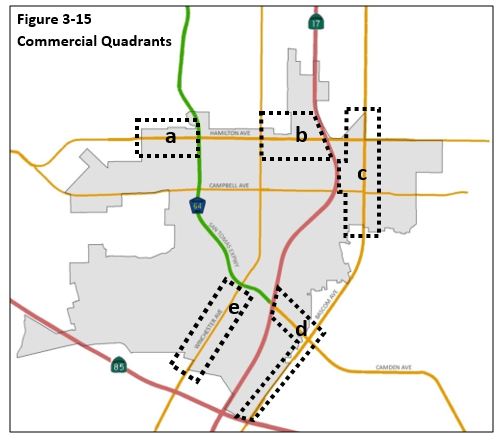
B.
Nonconforming Uses. Any use of real property lawfully existing on the effective date of this section, which does not conform to the provisions of this section, but which was constructed, operated, and maintained in compliance with all previous regulations, shall be regarded as a nonconforming use and may continue in compliance with the regulations of Section 21.58.040. Upon obtaining a Conditional Use Permit, a non-conforming payday lender that was in existence prior to the effective date of this section may relocate at any time into one of the commercial quadrants identified in paragraph 5 of subsection A even if the total number of payday lenders in the City exceeds three.
Notwithstanding the above provision, nonconforming uses shall come into compliance with the operational requirements of subsection C of this section within thirty days of the effective date of the ordinance enacting this section.
C.
Operational Requirements. Payday lenders shall meet all of the following conditions:
1.
Hours of operation must be between the hours of seven a.m. to seven p.m. daily.
2.
No security bars shall be placed on doors or windows.
3.
Notwithstanding any other provision of the Municipal Code, window signs shall not exceed ten percent of the window area per façade.
(Ord. No. 2196, § 14, 2-2-2016; Ord. No. 2293, § 1(Exh. B), 5-2-2023)
21.36.270 - Massage Establishments.
A.
Purpose. The City has broad control over land use regulation of massage establishments in order to manage such establishments in the best interests of the City of Campbell. This Section is designed to provide for and to regulate massage establishment uses where they are allowed in compliance with the provisions of Campbell Municipal Code Article 2 (Zoning Districts) and Chapter 5.48 (Massage Establishments and Therapists).
B.
Conditional Use Permit.
1.
On and after April 5, 2016, a land use permit shall be required for massage establishment uses in compliance with the provisions of Campbell Municipal Code Article 2 (Zoning Districts).
2.
Mandatory Concurrent Application for Massage Establishment Permit. A massage establishment permit, and any renewal thereof, shall be filed with the Chief of Police, pursuant to Section 5.48 (Massage Establishments and Therapists) of the Municipal Code. A land use permit shall not be granted until a massage establishment permit is issued by the Chief of Police.
C.
Overconcentration/Location Requirements.
1.
Reserved.
2.
A massage establishment use shall not be located within three hundred feet of another existing massage establishment use, as measured from the edge of the property line of each property.
3.
Massage Establishments may be permitted in only the following commercial quadrants as indicated in Figure 3, upon filing an application for a land use permit and satisfying the required findings to support such use. In no event shall there be more than two massage establishments in each commercial quadrant.
a.
West Hamilton Avenue and South Winchester Boulevard—west of Winchester Boulevard;
b.
East Hamilton Avenue and South Winchester Boulevard—east of Winchester Boulevard and west of Highway 17;
c.
East Hamilton Avenue, east of Bascom Avenue
d.
Bascom Avenue, north of Dry Creek Road;
e.
Camden Avenue and South Bascom Avenue, south of Curtner Avenue;
f.
South Winchester Boulevard, south of San Tomas Expressway.
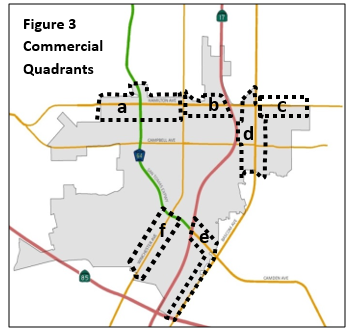
D.
Operational Standards. Except as specifically required in the Massage Establishment Permit issued by the Chief of Police and pursuant to the provisions of Chapter 5.48, all massage establishments shall comply with the regulations and restrictions applicable to the zoning district in which it is located and with the following operating requirements:
1.
Owner/Operator. It shall be unlawful for any operator to own, manage, or operate a massage establishment in or upon any premises within the city without having a current massage establishment permit issued by the Chief of Police pursuant to the provisions of Chapter 5.48;
2.
Hours of Operation. No massage establishment shall be kept open for business and no massage therapist shall administer massages before the hour of seven a.m. or after the hour of ten p.m.;
3.
Window Coverage. No massage business located in a building or structure with exterior windows fronting a public street, highway, walkway, or parking area shall, during business hours, block visibility into the interior reception or waiting area through the use of curtains, closed blinds, tints, or any other material that obstructs, blurs, or unreasonably darkens the view into the premises. For the purpose of this sub-section, there is an irrebuttable presumption that the visibility is impermissibly blocked if more than ten percent of the interior reception or waiting area is not visible from the exterior window.
4.
Nonconforming uses shall come into compliance with the operational standards of this subsection within thirty days of the effective date of the ordinance enacting this Section.
E.
Non-conforming Massage Establishments.
1.
Any use of real property lawfully existing on the effective date of this section, which does not conform to the provisions of this Section, but which was established, operated, and maintained in compliance with all previous regulations, shall be regarded as a nonconforming use and may continue at its existing location in compliance with the regulations of Section 21.58.040.
2.
Discontinued Use. A nonconforming use that is abandoned, discontinued, or has ceased operations for a continuous period of at least twelve months shall not be re-established on the site and further use of the structure or parcel shall comply with all of the regulations of the applicable zoning district and all other applicable provisions of this Zoning Code. Evidence of abandonment shall include, but is not limited to, the actual removal of equipment, furniture, machinery, structures, or other components of the nonconforming use, the turning-off of the previously connected utilities, or where there are no business receipts/records available to provide evidence that the use is in continual operation;
3.
Annexed property. Any massage establishment that is a legal use at the time of annexation of the property into the city, but which does not conform to the provisions of this Section, shall be terminated within one year of the date of annexation.
(Ord. No. 2199, § 2, 4-5-2016; Ord. No. 2293, § 1(Exh. B), 5-2-2023)

