
Campbell City Zoning Code
CHAPTER 21
11 - MIXED-USE DISTRICTS
21.11.010 - Purpose of chapter—Applicability.
A.
Mixed-use zoning districts. This chapter provides regulations applicable to development and new land uses and alterations to existing land uses in the mixed-use zoning districts established by Section 21.04.020, (Zoning districts established). The purpose of this chapter is to achieve the following:
1.
Provide for a convenient and appropriate distribution of uses which broaden the economic/employment base of the city, while ensuring compatible integration with residential uses, in a manner consistent with the general plan;
2.
Increase the number and diversity of housing options available in the city;
3.
Enhance the visual image of the city through good design and appropriate structure placement. Visual quality can also be improved through appropriate and complementary structure scale, which means the relationship of new development to existing structures;
4.
Upgrade the existing function and appearance of designated areas;
6.
Provide adequate space to meet the needs of the uses served, including off-street parking and loading;
7.
Minimize traffic congestion and avoid the overloading of utilities; and
8.
Minimize excessive illumination, noise, odor, smoke, unsightliness, and other objectionable influences.
(Ord. No. 2293, § 1(Exh. B), 5-2-2023)
21.11.020 - Mixed-use zoning districts.
The purpose and zoning district map symbols of mixed-use zoning districts are as follows:
A.
Central Business Mixed-Use
1.
Purpose: The Central Business Mixed-Use zoning district is applied to the heart of the city including and surrounding parts of Campbell Avenue in downtown Campbell, and by reference to the Winchester Boulevard and East Campbell Avenue Master Plan areas. The building forms in this zoning district edge the street and include retail commercial uses (e.g., entertainment, shopping, and services) on the ground floor, with either office or residential uses on the upper floors. The Central Business Mixed-Use zoning district is consistent with the central commercial land use designation of the General Plan. The Central Business Mixed-Use zoning district is specifically created to promote the following objectives in the central business area of Campbell:
i.
To retain and enhance the Downtown area as a unique and economically viable retail and business center serving local and area wide commercial needs;
ii.
To reinforce Campbell Avenue as a pedestrian-orientated retail street;
iii.
To promote ground floor retail use, upper floor commercial and residential uses where appropriate and a suitable mix of uses in the Downtown area;
iv.
To establish development intensities consistent with the scale of the central business area and the amount of parking which can be accommodated within and adjacent to it;
v.
To maintain the pedestrian scale, character, and diversity of a small town business district;
vi.
To improve pedestrian, visual, and vehicular connections between the Downtown and adjacent areas;
vii.
To preserve and enhance significant historic structures within the Downtown area; and
viii.
To ensure that new construction in the Downtown area is of a high architectural design quality while accommodating suitable architectural diversity.
2.
Zoning District Map Symbol: CB-MU
B.
General Commercial/Light Industrial
1.
Purpose: This designation generally consists of commercial uses as provided for by the General Commercial (GC) land use designation and industrial uses as provided for by the Light Industrial (LI) land use designation.
2.
Zoning District Map Symbol: GC/LI
C.
Professional Office/Low-Medium Density Residential
1.
Purpose: This designation generally consists of office uses as provided for by the Professional Office (P-O) land use designation and/or residential uses as provided for by the Low-Medium Density Residential (LMDR) land use designation. This designation is intended to serve as a transitional buffer between the more intense uses located in Downtown, and the surrounding low density residential uses, as well as to facilitate the adaptive reuse of historic buildings.
2.
Zoning District Map Symbol: PO/LMDR
D.
General Commercial Mixed-Use
1.
Purpose: This designation generally consists of residential land uses as provided for by the Medium-High Density Residential (MHDR) land use designation and commercial uses as provided for by the General Commercial (GC) land use designation. Mixed-use residential projects are encouraged within this designation but not required.
2.
Zoning District Map Symbol: GC-MU
E.
Neighborhood Commercial Mixed-Use
1.
Purpose: This designation generally consists of commercial land uses as provided for by the Neighborhood Commercial (NC) land use designation and residential uses as provided for by the Medium Density Residential (MDR) land use designation. Mixed-use residential projects are encouraged within this designation but not required.
2.
Zoning District Map Symbol: NC-MU
F.
Medium-High Density Mixed-Use
1.
Purpose: This designation generally consists of residential uses as provided for by the Medium-High Density Residential (MHDR) land use designation and commercial uses as provided for by the General Commercial (GC) land use designation. Mixed-use residential projects are encouraged within this designation but not required.
2.
Zoning District Map Symbol: MHD-MU
G.
High Density Mixed-Use
1.
Purpose: This designation generally consists of residential uses as provided for by the High Density Residential (HDR) land use designation and commercial uses as provided for by the General Commercial (GC) land use designation. Mixed-use residential projects are encouraged within this designation but not required.
2.
Zoning District Map Symbol: HD-MU
H.
Commercial-Corridor Mixed-Use
1.
Purpose: This designation generally consists of higher- density residential, and mixed-use development that are primarily located along Class I and Class II Arterial Roadways, such as Bascom Avenue, Hamilton Avenue, Winchester Boulevard, and parts of Campbell Avenue. Mixed-use residential projects are strongly encouraged within this designation but are not required.
2.
Zoning District Map Symbol: CC-MU
I.
Transit-Oriented Mixed-Use
1.
Purpose: This designation generally consists of very high density commercial, residential, and mixed-use development within walking distance of high-quality transit service such as light rail. Mixed-use residential projects are strongly encouraged within this designation but are not required.
2.
Zoning District Map Symbol: TO-MU
(Ord. No. 2293, § 1(Exh. B), 5-2-2023)
21.11.030 - Mixed-Use land uses.
The permissibility of land uses in mixed-use districts shall be as specified by Table 2-8 (Land Use Table - Mixed-Use Districts) subject to the operational and locational standards contained in Article 3, except for the Central Business Mixed-Use zoning district which land uses shall be as specified by Section 21.11.060 (Central Business Mixed-Use Zoning District). Where a land use is specified as allowed subject to the approval of an Administrative Conditional Use Permit or Conditional Use Permit in any of the zoning districts referenced, approval of the permit type requiring the highest decision-making body specified shall be required (i.e., Planning Commission is a higher decision-making body than the Community Development Director), in compliance with Chapter 21.46 (Conditional use permits). Further, where a land use is specified as permitted in one of the zoning districts specified and allowed subject to the approval of an Administrative Conditional Use Permit or Conditional Use Permit in any other zoning district specified, approval of a Conditional Use Permit shall be required in accordance with the preceding provision requiring approval of the highest decision-making body specified.
Table 2-8
Land Use Table — Mixed-Use Districts
(1)
In the event of a conflict between a land use identified as allowable, conditionally allowable, or prohibited between the zoning districts specified (i.e., a land use is identified as permitted by one zoning district, but conditionally allowable by another zoning district specified) the following procedures shall be followed:
a.
Residential Uses: Those uses identified by the residential zoning district specified shall be permitted, conditionally allowable, or prohibited within the residential component of the mixed-use project as specified by the land use table of the zoning district specified.
b.
Non-Residential Uses: Those uses identified by any non-residential component of the mixed-use project shall be permitted, conditionally allowable, or prohibited within any non-residential component of the mixed-use project as specified by the land use table of the zoning district specified.
(2)
Live/work units shall be conditionally allowed in all mixed-use zoning districts, except the General Commercial/Light Industrial and Central Business Mixed-Use zoning district, subject to the standards and requirements of Section 21.36.120 (Live/Work units).
(Ord. No. 2293, § 1(Exh. B), 5-2-2023)
21.11.040 - Mixed-Use subdivision standards.
In addition to the permitting procedures and requirements contained in Title 20 (Subdivision and Land Development), the minimum area, width, and frontage of parcels proposed in new subdivisions in mixed-use zoning districts shall be as specified by Table 2-9 (Minimum Parcel Sizes for Newly Created Parcels - Mixed-Use Zoning Districts). Areas of special limitations may also be identified on the zoning map as a number with the number indicating the minimum parcel area for subdivision in thousands of square feet (i.e., 80 = 80,000 sq. ft. minimum).
Table 2-9
Minimum Parcel Sizes for Newly Created Parcels — Mixed-Use Zoning Districts
(1)
Caretaker or employee housing, and emergency shelters as provided for by Chapter 21.36 (Provisions Applying to Special Uses) shall be designed in accordance with the development standards for non-residential uses.
(Ord. No. 2293, § 1(Exh. B), 5-2-2023)
21.11.050 - Mixed-Use development standards.
New land uses and structures, and alterations to existing land uses and structures, shall be designated, constructed, and/or established in compliance with the requirements in Table 2-9 (Minimum Parcel Sizes for Newly Created Parcels - Mixed-Use Zoning Districts) and in Table 2-10 (General Development Standards - Mixed-Use Zoning Districts), in addition to the development standards contained in Article 3 (e.g., landscaping, fences, parking and loading) and Article 4 (e.g., accessory structures).
Table 2-10
General Development Standards - Mixed-Use Zoning Districts)
(1)
Notwithstanding any provision to the contrary, the maximum FAR for a housing development project consisting of three to seven units shall not be less than 1.0, and the maximum FAR of a housing development project consisting of eight to ten units shall not be less than 1.25, when the following conditions are met:
a.
The housing development project consists of at least three, but not more than ten, units.
b.
The housing development project is not located in any of the following:
i.
A property with a single-family zoning or land use designation;
ii.
A historic district property included on the State Historic Resources Inventory, as defined in Section 5020.1 of the Public Resource Code; and
iii.
Within a site that is designated or listed as a city or county landmark or historic property or district.
(2)
Caretaker or employee housing, and emergency shelters as provided for by Chapter 21.36 (Provisions Applying to Special Uses) shall be designed in accordance with the development standards for non-residential uses.
(Ord. No. 2293, § 1(Exh. B), 5-2-2023)
21.11.060 - Central Business Mixed-Use zoning district.
A.
Land uses in the Central Business Mixed-Use zoning district. The permissibility of land uses, whether on the ground floor, an upper floor, or on all floors, as applicable, shall be as specified by Table 2-11 (Land Use Table — Central Business Mixed-Use Zoning District), except for land uses in the Winchester Boulevard and East Campbell Avenue Master Plan areas shall be as specified by Table 2-11a (Land Use Table — Master Plan Areas). Land uses that are listed as (P) are permitted and are approved by issuance of a zoning clearance in compliance with Chapter 21.40 (Zoning clearance). Land uses listed as (AC) may be allowed subject to the approval of an Administrative Conditional Use Permit and land uses listed as (C) may be allowed subject to the approval of a Conditional Use Permit, in compliance with Chapter 21.46 (Conditional use permits). Operational requirements for outdoor merchandise display, outdoor seating, alcohol sales for on-site consumption, and live entertainment are provided further in this chapter.
Table 2-11
Land Use Table — Central Business Mixed-Use Zoning District
(1)
The ground floor of an apartment building shall be limited to commercial tenant space, parking facilities, and a lobby. Residential units, leasing offices, and recreation spaces shall be restricted to upper floors.
(2)
Restricted to structures listed on the Historic Resource Inventory and subject to Chapter 21.33 (Historic Preservation).
(3)
Except as specified by Section 21.11.060.E (Standards for live entertainment in the Central Business Mixed-Use Zoning District), which allows certain pedestrian-oriented activities to incorporate live entertainment without a conditional use permit.
(4)
"Incompatible Activities" means any land use not identified in Table 2-11 (Land Use Table) or that incorporates one or more of the following characteristics, as determined by the community development director in compliance with Section 21.02.020.F (Allowable uses of land).
•
Any use inconsistent with state or federal law;
•
Services offered by a "body art" practitioner as governed by California Health and Safety Code sections 119300—119324 (i.e., tattoo parlors and similar uses);
•
Services offered by a deferred deposit transaction "licensee" as governed by California Financial Code sections 23000—23106 (i.e., payday lenders and similar uses);
•
Services offered by a "check casher" as governed by California Civil Code sections 1789.30—1789.38 (i.e., check cashing and similar uses);
•
Services offered by a "pawnbroker" as governed by California Financial Code sections 21000—21307 (i.e., pawnshops and similar uses);
•
Services, goods, or entertainment offered by a sexually oriented business pursuant to Chapter 5.55;
•
Storage of industrial vehicles;
•
Storage or warehousing of merchandise or products unrelated to on-site retail sales;
•
Outdoor storage of merchandise or products;
•
Assembly, compounding, manufacturing or industrial processing of merchandise or products;
•
Breeding, harboring, raising, or training of animals;
•
Repair, maintenance, or sale of motor vehicles;
•
Service to consumers within a motor vehicle (i.e., drive-through lane, drive-up window, or drive-in service);
•
Smoking or vaping of tobacco products (as defined by Chapter 6.11);
•
Cultivation, processing, sale or dispensing of Cannabis ("marijuana" as defined by Chapter 8.38 and 8.40);
•
All incineration; or
•
Emission of dust, fumes, glare, heat, liquids, noise, odor, smoke, steam, vibrations, or similar disturbance which is obnoxious or offensive or creates a nuisance.
(5)
When clearly ancillary to a pedestrian-oriented activity and meeting the requirements of CMC 21.36.145 B.1.).
(6)
Outdoor seating on private property is subject to the provisions provided in Section 21.36.150 (Outdoor seating).
(7)
Outdoor seating and merchandise display within the public right-of-way are permitted as specified by Section 21.11.060.F.
(8)
"Pedestrian-Oriented Activities" means any land use or combination of land uses that incorporate all of the following characteristics as determined by the community development director in compliance with Section 21.02.020.F (Allowable uses of land). This definition specifically includes retail stores, grocery stores, personal services, full service restaurants, indoor amusement centers, and studios as defined by Chapter 21.72 (Definitions).
•
Provides or offers food, beverages, retail goods, services, instruction, and/or entertainment to the general public;
•
Is open to the general public on a regular basis;
•
Is conducted within the interior of a building, except for outdoor displays and outdoor dining areas as allowed by this Chapter;
•
Maintains a transparent storefront open to the interior of the business and/or onto a merchandise display (when on the ground floor); and
•
Is not otherwise classified as an incompatible activity as defined by this Chapter.
B.
Land uses in the Area/Master Plan areas: The permissibility of land uses in the Winchester Boulevard and East Campbell Avenue Master Plan areas on properties with a General Plan land use designation of Central Business Mixed-Use shall be as specified by Table 2-11a (Land Use Table — Master Plan Areas). Land uses that are listed as (P) are permitted and are approved by issuance of a zoning clearance in compliance with Chapter 21.40 (Zoning clearance). Land uses listed as (AC) may be allowed subject to the approval of an Administrative Conditional Use Permit and land uses listed as (C) may be allowed subject to the approval of a Conditional Use Permit, in compliance with Chapter 21.46 (Conditional use permits). Land uses listed as (X) and those not otherwise listed are prohibited and shall not be allowed.
Table 2-11a
Land Use Table — Master Plan Areas
(1)
See Table 2-11, Note #4 of this Chapter for the definition of "Incompatible activities," excepting as to reference any "land use not identified" in Table 2-11a of this Chapter rather than Table 2-11 of this Chapter.
C.
General development standards. New land uses and structures, and alterations to existing uses or structures shall be designed, constructed, and/or established in compliance with the requirements in Table 2-11b (General Development Standards — Central Business Mixed-Use Zoning District), in addition to the general development standards (e.g., landscaping, parking and loading, etc.) in Article 3 (Development and Operational Standards).
Table 2-11b
General Development Standards — Central Business Mixed-Use Zoning District
(1)
The Planning Commission or City Council may approve an F.A.R. of up to 1.5 for projects without a residential component if it makes all the following findings:
a.
The scale and intensity of the development does not create adverse traffic and parking impacts on the Downtown.
b.
The design, scale, and context of the project are consistent with the goals and objectives established in the Downtown Development Plan.
(2)
The City Council may grant an exception to the otherwise maximum F.A.R. for a property listed on the Historic Resource Inventory by approval of a Zoning Exception, in compliance with Section 21.33.150.B.2 (Zoning Exception).
D.
(Reserved).
E.
Standards for live entertainment in the Central Business Mixed-Use zoning district. Live entertainment, when clearly ancillary to a pedestrian-oriented activity, is permitted without a conditional use permit subject to the following restrictions:
1.
Permitted only for pedestrian-oriented activities that are not already subject to a conditional use permit;
2.
Maximum of four performers;
3.
Hours of nine a.m. to eleven p.m.;
4.
Alcoholic beverage service shall be restricted to a Type 41 (On-Sale Beer and Wine for Bona Fide Public Eating Place) license issued by the Department of Alcoholic Beverage Control, and at no time shall off-site sales be allowed. Full food service shall be available during entertainment;
5.
Ambient noise levels shall allow normal conversation, and may not be audible more than fifty feet from the businesses tenant space. However, in no case may noise from the live entertainment disrupt neighboring businesses;
6.
No cover charge may be imposed;
7.
Areas for dancing and festival seating are not allowed;
8.
If the police department or community development department find that a business is in noncompliance with any of the above conditions, live entertainment shall be prohibited at the site until a live entertainment permit is issued by the City Council subject to the requirements set forth by Section 5.24.010(a) et seq. (Live entertainment) of this Zoning Code;
F.
Standards and permit requirements for outdoor seating and merchandise display within the public right-of-way for a pedestrian-oriented activity. The following standards govern the provision of outdoor seating/dining areas and the outdoor display of merchandise within the public right-of-way (sidewalk) in the Central Business Mixed-Use zoning district. These standards are minimum standards and additional requirements may be added through the discretionary review process.
1.
Permit required. Outdoor seating and merchandise displays may be allowed subject to approval of an outdoor seating and display permit by the community development director. Approval is subject to the standards provided below and any other conditions as may be deemed necessary by the community development director in order to protect the health, safety, and welfare of the city.
2.
Application. Application for an outdoor seating and display permit shall be filed with the community development department. The application shall be accompanied by a plan set, drawn to scale, depicting sidewalk dimensions, the location of seating, tables, umbrellas, and merchandise displays together with other information and exhibits as required by the community development director.
3.
General standards.
a.
A four-foot-wide pedestrian walkway shall be provided at all times along the public sidewalk. This walkway shall provide for pedestrian access to doorways, crosswalks, and along the public sidewalk. No part of the walkway shall be within two feet of the building face or within one foot of the face of curb, and the walkway shall not cross the path of outward-opening doors or windows.
b.
All tables, seats, and displays shall be placed inside at the end of each business day.
c.
Material placed on the sidewalk shall be secured so as not to be moved by the wind. However, tables, seats, or displays may not be bolted into the ground or secured to the streetlights, trees, or other street furniture.
d.
The permit holder is responsible for picking up all litter associated with the outdoor seating or display and shall maintain the area in a clean condition at all times.
4.
Outdoor seating.
a.
Outdoor seating shall be located directly in front of the permit holder's tenant space as set forth in the approved application and accompanying plans.
b.
Tables, seating, or displays shall not be placed within the area of any disabled ramps, driveways, or doorways.
c.
Tables or seating shall not be placed in the street, or on the sidewalk within two feet of the face of curb.
d.
The canopies of umbrellas associated with outdoor tables shall provide a minimum vertical clearance of seven feet, unless the umbrella does not extend beyond the outside edge of the table, and shall not extend past the curb.
e.
Tables, chairs, umbrellas, and other furniture associated with the outdoor seating shall be attractive, made of durable materials, and be maintained in good repair and in a manner to enhance the downtown area.
5.
Outdoor Displays.
a.
Outdoor merchandise displays shall be placed against the building face abutting the permit holder's tenant space and shall be limited to fifty percent of the business frontage.
b.
Tenants on corner lots are permitted displays along one frontage only.
c.
Merchandise shall be attractively displayed on appropriate racks or other similar stands. Displays using card tables, cardboard cartons, plastic milk cases, or plywood boxes are not permitted. Merchandise too large to be placed on a display may be freestanding.
d.
Displayed merchandise shall be the same type of merchandise sold in the existing business at the site.
e.
Displays, including the merchandise placed on them, may not be more than four feet high. The community development director may approve displays greater than four feet if it can be found that the display will not block the visibility of windows of that business.
f.
One sign, not to exceed one square foot, per display is permitted for pricing.
6.
Indemnification/insurance. The permit holder shall indemnity, defend and hold the city, its agents, officers, attorneys, employees, and officials harmless from any and all claims, causes of action, injuries, or damages arising out of any negligent acts on part of the permit holder, its agents, officers, employees, or anyone rendering services on their behalf. This indemnity shall include all reasonable costs and attorney's fees incurred in defending any action covered by this provision.
a.
The permit holder, during the continuance of this permit and at no cost to the city, shall maintain a comprehensive liability policy in the amount of one million dollars and if applicable a worker's compensation liability policy each with a minimum coverage of one hundred thousand dollars.
b.
The policy shall include the city as additional insured and shall apply as primary insurance and shall stipulate that no other insurance effected by the city will be called on to contribute to a loss.
c.
Before the issuance of a permit, the permit holder shall furnish to the city a certificate of insurance, duly authenticated, evidencing maintenance of the insurance required under this permit.
d.
If the insurance policy is canceled, terminated, suspended, or materially changed, the outdoor seating and display permit shall be suspended until the time that compliance with the requirements of this subparagraph has been fully satisfied.
G.
Development review regulations for projects in the Central Business Mixed-Use zoning district.
1.
Purpose. Downtown Campbell possesses a wealth of small-scale commercial buildings that are architecturally exemplary of the variety of historic periods in which they were constructed. These design standards are intended to both promote the conservation and rehabilitation of buildings and to encourage new building and remodeling which is simultaneously in keeping with existing buildings and architecturally exemplary of contemporary design. In this way the architectural history and richness of downtown will be continued and expanded.
Each new building and remodeling project in the downtown shall adhere both in its large- and small-scale parts to the architectural parts or style adopted for the project. Architectural design shall be of high quality, measured against contemporary standards.
2.
Intent. The guidelines below govern building mass; building form and composition; storefronts; materials, colors and finishes; and other elements. They are intended to encourage the relation of specific project aspects to the designated architectural parts or style.
3.
Site and Architectural Review required. Non-residential buildings and structures in the Central Business Mixed-Use zoning district shall conform to the design standards in paragraphs 4—8 below and are subject to approval in compliance with the provisions of Chapter 21.42 (Site and Architectural Review):
4.
Building mass.
a.
Large building facades shall be divided into smaller elements to complement the intimate scale created by the existing small property divisions.
b.
Second floor decks or terraces at the rear of buildings for use by adjacent offices or restaurants should be incorporated whenever practical to add a sense of vitality to the rear building facades.
c.
Roof design shall be consistent with the building's architectural style. Mansard, shed, or residential type roofs are prohibited unless it is demonstrated that such a roof style is structurally or architecturally suitable for the particular project or location.
d.
The existing residential building types of historical significance should retain their character, including features such as landscaped setbacks.
5.
Building form and composition.
a.
Unique and historic building elements such as parapet details and belt courses shall be retained and restored.
b.
Traditional commercial building forms should be incorporated whenever practical.
c.
Open air dining areas facing Campbell Avenue should be employed to the greatest extent practical. The buildings should not be set back from the street, but should contain the dining areas within their architectural framework.
d.
Upper stories in multistory buildings are required to have solid surfaces with vertical rectangular windows, augmented with frames. Glass curtain walls should not be approved unless it is demonstrated that such walls are the only structurally or architecturally suitable form of wall for the particular project or location.
e.
Architecturally exemplary design of high quality shall be employed. Buildings should not be made to look "old time" unless such design would be clearly more appropriate and harmonious with the purpose of this chapter.
f.
Buildings shall incorporate base, cornice, and other elements appropriate to their architectural style.
6.
Storefronts.
a.
First floor frontages shall have an integrated design including display windows, an entry, and signing.
b.
The design of the building storefront shall be consistent with the building's architectural style.
c.
Walls facing pedestrian ways should have elements of visual interest, such as fenestration, displays, signing, or landscaping, unless the effect of such elements would be clearly contrary to the purposes of this chapter. Large areas of blank walls should not be permitted unless it is demonstrated that such blank areas are clearly more appropriate and harmonious than would be the case if elements of visual interest were incorporated.
d.
Buildings facing Campbell Avenue shall have their primary entries along that street.
e.
Entries should be recessed, as they add depth to storefront, and act as transition areas between the street and shop interiors, unless the effects of such entries would be clearly contrary to the purposes of this paragraph.
f.
Doors and windows shall be of clear glass. Unglazed wood doors, screen doors and doors or windows of heavily tinted or reflective glass should not be approved unless it is demonstrated that such doors and windows are the only structurally or architecturally suitable form for the particular project or location.
g.
Storefront windows shall reflect the building's character. For instance, on 1940's and 50's "showcase" buildings, exposed aluminum frame windows are appropriate.
h.
Ground floor offices facing Campbell Avenue are required to maintain the same storefront character as retail spaces.
i.
Awnings on building facades should be employed when appropriate, as they add color, weather protection, and opportunities for signing. As in other architectural elements, the awnings should be designed to reflect the building's geometry.
7.
Materials, colors, and finishes.
a.
Primary facade materials shall be limited to those that are characteristic of the building's architectural style.
b.
Exterior wall finishes shall be smooth and of finished quality, not deliberately rough in an attempt to look antiqued or used.
c.
Primary building colors shall be characteristic of the building's architectural style. Overly bright, garish, or otherwise offensive colors or color combinations are prohibited.
d.
Accent materials such as tile bases shall be carefully chosen to complement the building style and coordinate with adjacent buildings. The use of shingles, lava rock, sheet metal siding, or any other residential or industrial materials should not be approved unless it is demonstrated that such material would be the only structurally or architecturally suitable materials for the project or location.
e.
Painted trim shall coordinate with primary facade colors to add more depth and interest to the buildings.
f.
A coordinated color scheme that responds to the style of the structure shall be developed for each building. The colors of signing, awnings, planters, accent materials, and primary facade colors should all be considered. The number of colors should be limited.
8.
Other elements.
a.
Trash collection and storage areas shall be carefully screened.
b.
Mechanical equipment shall be screened from view. Exhaust louvers shall not be located in the storefront areas.
c.
Colorfully landscaped planters are allowed. These are especially appropriate below second floor windows.
d.
All building maintenance shall be done conscientiously.
H.
Sign regulations for Central Business Mixed-Use zoning district. The following provisions shall apply to the Central Business Mixed-Use zoning district only and shall supersede those listed by Section 21.30.080 (Permanent signs):
1.
Intent. The intent of these regulations is to stimulate creative, good quality signing which will complement the intimate scale and architectural character of the area, and which will complement the architectural style of the building to which the signing is fixed.
2.
Allowable signs. Each business shall be allowed one square foot of sign area for each one linear foot of business frontage. A minimum of twenty square feet is allowed and a maximum of forty square feet is allowed for each business.
3.
Sign materials. Appropriate sign materials include enameled metal, painted wood, cast metal, painted fabric, and similar materials. Plastic signs shall not be approved.
4.
Wall signs. Each business may have one wall sign, except corner businesses, which may have two. This sign shall be located below the top of parapet on single story buildings and below the second floor sill on multistoried buildings. It may be painted directly on a wall, a sign panel attached to a parapet wall, or of individually formed letters attached to a wall.
5.
Awnings. Awnings may be used in lieu of wall signs. An insignia or name may be painted, silk screened or appliquéd onto the awning. Awnings may project five feet into the public right-of-way on Campbell Avenue and shall maintain a minimum clearance of eight feet from the ground. All other streets shall be limited to a two-foot projection and have a minimum clearance of eight feet. Awnings shall be securely attached to buildings and well maintained. No supports or poles may be located in the public right-of-way. Awning forms shall be carefully chosen to complement the architectural style of the building to which they are fixed.
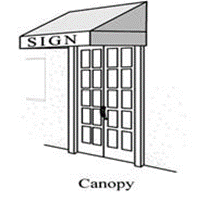
Figure 2-1: Awning
6.
Projecting signs.
a.
In addition to a wall sign or awning sign, a business is allowed one, non-illuminated, double-sided projecting sign. The projecting sign may be a maximum of six square feet and may serve to identify more than one tenant in the building.
b.
Signs may project a maximum of four feet over the public right-of-way with a minimum eight-foot clearance from the ground. Signs shall not project above any roofline or facade of the building.
c.
Projecting signs shaped as symbols depicting the goods or services being sold by the business are encouraged.
d.
Wood signs, that are carved, painted, stained, or feature raised letters and symbols are specifically encouraged.
e.
Sign colors should relate to material or paint scheme of the building. Fluorescent colors are not allowed.
f.
Internally or externally illuminated signs are not allowed, nor are can signs, metal signs, neon signs, or flashing signs.
g.
Projecting signs shall be mounted perpendicular to the street and may be hung from coverings over sidewalks or affixed to the building wall.
(1)
Signs shall be structurally attached to the building with wood, metal brackets, chain, or other similar materials in a manner compatible with the architectural style of the building.
(2)
Fabric signs shall be anchored to the building from both the top and bottom of the sign.
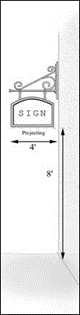
Figure 2-2: Projecting Sign
7.
Lighting. Only external illumination of signs is allowed except for backlit individual letter signs.
I.
Nonconforming uses and structures in the Central Business Mixed-Use zoning district. Nonconforming uses and structures shall be governed by the standards set forth in Chapter 21.58 (Nonconforming Uses and Structures), except that whenever a nonconforming use has been abandoned or discontinued for a continuous period of six months, the nonconforming use shall not be reestablished; and the use of the structure and the site shall comply with the regulations for the Central Business Mixed-Use zoning district. Notwithstanding the foregoing provision, an existing use with a conditional use permit that was issued before September 1, 2020, shall be considered a conforming use for purposes of this section.
(Ord. No. 2293, § 1(Exh. B), 5-2-2023; Ord. No. 2306, §§ 19—21, 4-16-2024)

