
Campbell City Zoning Code
CHAPTER 21
72 - DEFINITIONS
21.72.010 - Purpose.
This chapter provides definitions of terms and phrases used in this Zoning Code that are technical or specialized, or that may not reflect common usage. If any of the definitions in this chapter conflict with definitions in other provisions of the Municipal Code, these definitions shall control for the purposes of this Zoning Code, except those specified by a master use permit authorized by section 21.14.030.C (Master use permit). If a word is not defined in this chapter, or other provisions of the Municipal Code, the most common dictionary definition is presumed to be correct.
(Ord. 2043 § 1 (part), 2004).
(Ord. No. 2213, § 25, 11-1-2016)
21.72.020 - Definitions of specialized terms and phrases.
The following "land use" definitions are in alphabetical order.
A.
DEFINITIONS, "A."
"Accessory structure" means a structure that is physically detached from any other structure and subordinate to, a main building occurring on the same lot and which satisfies the provisions of Section 21.36.020 (Accessory structures). Examples of such structures include sheds, garages, gazebos, arbors, trellises, and pergolas. No structure designed, intended, or used for dwelling purposes, containing a sleeping quarters, or a kitchen, shall be considered an accessory structure. Fences, retaining walls, and garages and carports attached to a dwelling unit, are excluded from this definition.
"Addition" means any construction which increases the size of a building or facility in terms of site coverage, height, length, width, or gross floor area.
"Adult day care facilities" means facilities of any capacity that provide programs for frail elderly and developmentally disabled and/or mentally disabled adults in a day care setting. The establishments shall be licensed by the State of California Department of Social Services.
"Adult day care facilities" means facilities of any capacity that provide programs for frail elderly and developmentally disabled and/or mentally disabled adults in a day care setting. The establishments shall be licensed by the State of California Department of Social Services.
"Alcohol sales, ancillary onsite" or "Ancillary onsite alcohol sales" means a retail activity that involves the selling of alcoholic beverages for consumption on the premises meeting the requirements of one of the facility types identified by Section 21.36.145.B. (Facility types). Retail activities meeting this definition are excluded from the definition of "Alcohol sales, onsite."
"Alcohol sales, offsite" or "Offsite alcohol sales" means a retail activity that involves the selling of alcoholic beverages for consumption off the premises. Retail activities that involve offsite alcohol sales shall comply with the provisions of Section 21.36.142 (Offsite alcohol sales) and may include, but are not limited to, the following land use types:
1.
Breweries;
2.
Convenience markets/stores;
3.
Distilleries;
4.
Grocery stores;
5.
Liquor stores; and
6.
Wineries.
"Alcohol sales, onsite" or "Onsite alcohol sales" means a retail activity that involves the selling of alcoholic beverages for consumption on the premises. Retail activities that involve onsite alcohol consumption shall comply with the provisions of Section 21.36.144 (Onsite alcohol sales) and may include, but are not limited to, the following land use types:
1.
Arcades;
2.
Banquet facilities;
3.
Bars;
4.
Breweries;
5.
Community/cultural/recreational center;
6.
Distilleries;
7.
Golf courses and golf driving ranges;
8.
Indoor amusement/entertainment/recreation centers;
9.
Hotels;
10.
Motels;
11.
Nightclubs;
12.
Outdoor amusement/entertainment/recreation centers;
13.
Public assembly uses;
14.
Restaurants, full service;
15.
Theaters, movie or performing arts; and
16.
Wineries.
Retail activity meeting the definition of "Alcohol sales, ancillary onsite" are excluded from this definition.
"Alley" means a passageway that affords a secondary means of access to abutting property and not intended for general traffic circulation.
"Alteration, structural" means any change in either the supporting members of a building, such as bearing walls, columns, beams and girders, or in the dimensions or configurations of the roof or exterior walls.
"Alternative fuels and recharging facilities" means a commercial facility offering motor vehicle fuels not customarily offered by commercial refueling stations (e.g., LPG) as well as equipment to recharge electric powered vehicles.
"Ambulance service" means a commercial facility where ambulances are stored, and from which ambulances and emergency personnel are dispatched to emergencies.
"Amusement device" means a piece of equipment or a mechanism designed for the purpose of entertaining or creating a game for a person or persons to play. Examples of amusement devices include, but are not limited to, arcade video games, electro-mechanical games, air hockey tables, photo booths, and pinball machines. Merchandiser games (i.e., claw machines) and similar devices where an award is given in exchange for money are not included in this definition.
"Ancillary onsite alcohol sales." See "Alcohol sales, ancillary onsite."
"Ancillary retail uses serving industrial uses" means the retail sales of various products within an industrial area for the purpose of serving the employees and businesses and/or ancillary retail operations associated with an industrial use which occupy no more than twenty-five percent of the uses existing floor area.
"Apartment" means a single structure or complex of multiple structures incorporating five or more living units that are independent of each other with each one having a kitchen and direct access to the outside or to a common hall. Does not include "Rooming and Boarding Houses," "Townhouse," "Condominiums," "Duplex," "Triplex," or "Fourplex."
"Arcades" means establishments providing three or more amusement devices within an indoor amusement and entertainment facility. Two or less amusement devices are not considered a land use separate from the primary use of the site.
"Artisan products, small-scale assembly" means commercial establishments manufacturing and/or assembling small products primarily by hand, including jewelry, ceramics, quilts, and other small glass and metal arts and crafts products.
Assembly Use. (See "Public assembly use").
"Assisted living facilities" means a special combination of housing, supportive services, personalized assistance, and health care designed to respond to the individual needs of those who need help with activities of daily living. A facility with a central or private kitchen, dining, recreational, and other facilities, with separate bedrooms and/or living quarters, where the emphasis of the facility remains residential. The facilities shall be licensed by the State of California Department of Social Services.
"Automated teller machines (ATM's)" means a pedestrian-oriented machine used by bank and financial service patrons for conducting transactions including deposits, withdrawals, and fund transfers, without contact with financial institution personnel. The machines may be located at or within banks, or in other locations, in compliance with this Zoning Code.
B.
DEFINITIONS, "B."
"Banks and financial services" means financial institutions including:
1.
Banks and trust companies;
2.
Credit agencies;
3.
Holding (but not primarily operating) companies;
4.
Lending and thrift institutions;
5.
Other investment companies;
6.
Securities/commodity contract brokers and dealers;
7.
Security and commodity exchanges;
8.
Vehicle finance (equity) leasing agencies.
But "Banks and financial services" does not include "Check cashing or Payday lending.
"Banquet facilities" means a facility or hall available for lease by private parties and engaged in providing single event-based food services (e.g., graduation parties, wedding receptions, business or retirement luncheons, trade shows, etc.) The facility may have equipment and vehicles to transport meals and snacks to events and/or prepare food at an off-premise site. Banquet halls with catering staff are included in this industry. Does not include restaurants ("Restaurants").
"Basement" means a space in a structure that is partly or wholly below grade and where the vertical distance from grade to a finished floor directly above such space is less than or equal to two feet. If the finished floor directly above the space is more than two feet above grade at any point, such space shall be considered a story, and the entire space shall be included in the calculation of gross floor area. As used in this definition, the term "grade" shall mean finished grade adjacent to the exterior walls of the structure. Light wells and exterior stairwells for basements shall meet any required setbacks.
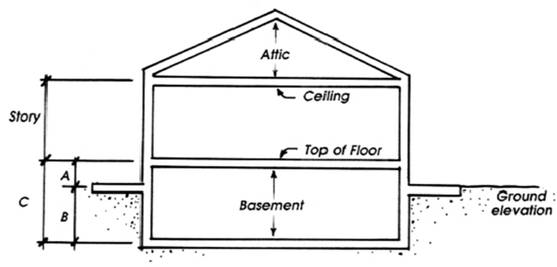
Figure 6-1
Basement
When the vertical distance ("A") is less than or equal to two feet from grade to the finished floor directly above, then the space described by "A" and "B" combined is considered a basement.
"Bay window" means a window or series of windows jutting out from the wall of a building and forming an alcove that does not contain a walkable surface or living area constituting part of a floor.
"Bed and breakfast inn" means a residential structure with one family in permanent residence with up to five bedrooms rented for overnight lodging, where meals may be provided. A bed and breakfast room with more than five guest rooms is considered a hotel or motel. Does not included room rental in a "Boarding house" situation ("rooming and Boarding houses").
"Bedroom" means any habitable area, within a dwelling, with an area not less than seventy square feet, designed as and meeting the standards of a sleeping area as described by California Building Code section 1208.3.
"Beer and wine festivals/walks" means a fair, exhibition, ceremony, art show, program, celebration, or other public assemblage of people for the conduct of a festivity involving the sale and consumption of beer or wine. Beer and wine festivals shall comply with the provisions of Chapter 21.45 (Temporary Uses).
"Bingo" means a game of chance in which prizes are awarded on the basis of designated letters, numbers, or symbols on a card which conform to letters, numbers, or symbols selected at random. Bingo activities are subject to the requirements of Section 21.36.035 (Bingo.)
"Blueprinting shop" means an establishment primarily engaged in reproducing text, technical drawings, architectural plans, maps, or other images by blueprinting, photocopying, or other methods of duplication. This use is included in the definition of "Printing and publishing."
"Bookstore" means a retail establishment primarily engaged in the sale, rental, or other charge-for-use of books, magazines, newspapers, and other printed conveyed information or media, excluding sexually oriented bookstores as defined in Campbell Municipal Code Section 5.55.020 (Definitions).
"Building" means any structure having a roof supported by columns or walls and intended for any shelter, housing or enclosure of any individual, animal, process, equipment, goods, use, occupancy, or materials. When any portion of a structure is completely separated from every other portion of the structure by a masonry division or firewall without any window, door or other opening and the masonry division or firewall extends from the ground to the upper surface of the roof at every point, such portion shall be deemed to be a separate building.
"Building Height" means the vertical distance from the lowest finished grade adjacent to the building to the building's highest roof surface.
"Building wall height" means the vertical distance (to be used for the purpose of determining setbacks) from the finished grade adjacent to the building to the highest point of the roof surface for a flat roof, top of the deck line for a mansard roof, top of the plate height for a hipped roof, and the mean height level between the eave and the ridge for a gabled or gambrel roof.
Hipped Roof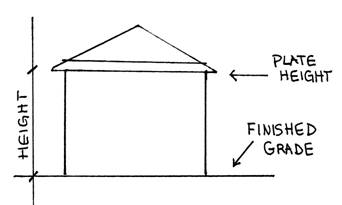
Gabled Roof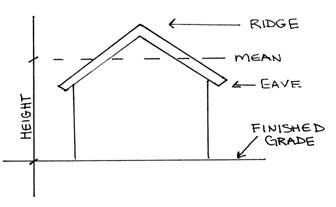
Flat Roof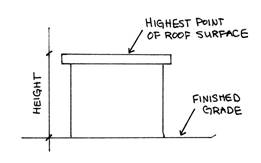
Mansard Roof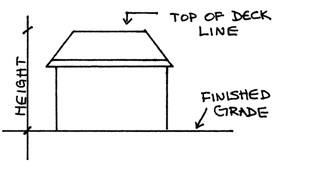
Figure 6-2
Building Wall Height
"Business support services" means establishments primarily within structures, providing other businesses with services including maintenance, repair, and service, testing, rental, etc., also includes:
1.
Business equipment repair services (except vehicle repair);
2.
Commercial art and design (production);
3.
Computer-related services (rental, repair);
4.
Copying and quick printing services;
5.
Equipment rental businesses within structures;
6.
Film processing laboratories;
7.
Heavy equipment repair services where repair occurs on the client site;
8.
Janitorial services;
9.
Mail advertising services (reproduction and shipping);
10.
Other "heavy service" business services;
11.
Outdoor advertising services;
12.
Photo developing/finishing/printing;
13.
Protective services (other than office related);
14.
Rental, repairs and distribution of office or business equipment;
15.
Soils and materials testing laboratories;
16.
Window cleaning.
C.
DEFINITIONS, "C."
Cafe. See "restaurants."
"Caretaker/employee housing" means a structure constructed to residential occupancy standards in compliance with the Uniform Building Code that is accessory to a nonresidential primary use and required for security, or 24-hour care or supervision. Caretaker/employee housing shall comply with the provisions of Section 21.36.040.
"Carport" means an accessory structure or portion of a main structure designed for the shelter or storage of automobiles and having a permanent roof and open on at least two sides.
"Cat Boarding facilities" means the keeping of cats for overnight or extended periods of time for commercial purposes.
"Cat and dog day care facilities" means facilities that provide nonmedical care and supervision of cats and/or dogs for periods of less than twenty-four consecutive hours per day. Does not include overnight stays ("Cat Boarding facilities" or "Dog Boarding facilities").
"Cat and dog grooming facilities" means facilities where cats and dogs are bathed, clipped, or combed for the purpose of enhancing their aesthetic value and/or health and for which a fee is charged. Includes self-service cat- and dog-washing facilities where the customers provide the labor.
"Catering businesses" means a use, independent of a restaurant, which involves the preparation and delivery of food and beverages for off-site consumption.
"Catering businesses," only when ancillary to a restaurant, means an ancillary use to a restaurant, which involves the preparation and delivery of food and beverages for off-site consumption. No additional vehicles or equipment (e.g. outside barbeques) are permitted to be stored on-site.
"Cemeteries" means establishments engaged in subdividing property into cemetery lots and offering burial plots or air space for sale. Also includes animal cemeteries, cinerarium, columbarium, and mausoleum operations.
"Check cashing" means a business that serves only to exchange cash or money orders for checks from a third party.
"Chemical products manufacturing" means manufacturing establishments that produce or use basic chemicals and establishments creating products predominantly by chemical processes. Establishments classified in this major group manufacture three general classes of products: (1) basic chemicals including acids, alkalis, salts, and organic chemicals; (2) chemical products to be used in further manufacture, including dry colors, pigments, plastic materials, and synthetic fibers; and (3) finished chemical products to be used for ultimate consumption including cosmetics, drugs, and soaps; or to be used as materials or supplies in other industries, including explosives, fertilizers, and paints.
"Child day care facilities" means facilities that provide non-medical care and supervision of minor children for periods of less than twenty-four consecutive hours per day. These facilities include the following, all of which are required to be licensed by the California State Department of Social Services:
1.
"Family child day care homes, large" means a day care facility located in a residence where an occupant of the residence provides care and supervision for seven to twelve children. A large family day care home may provide care for two additional children (up to a maximum of fourteen children) in compliance with Section 1597.46 of the Health and Safety Code. Children under the age of ten years who reside in the home count as children served by the day care facility. Large family child day care homes shall comply with the provisions of Section 21.36.060 (Child Care Facilities).
2.
"Family child day care homes, small" means a day care facility located in a single-family residence where an occupant of the residence provides care and supervision for six or fewer children. A small family day care home may provide care for two additional children (up to a maximum of eight children) in compliance with Section 1597.44 of the Health and Safety Code. Children under the age of ten years who reside in the home count as children served by the day care facility. Small family child day care homes shall comply with the provisions of Section 21.36.060 (Child Care Facilities).
3.
"Commercial child day care centers" means a commercial or non-profit child day care facility not operated as a small or large child day care home. Includes infant centers, preschools, sick child centers, and school-age day care facilities. These may be operated in conjunction with a business, school, or religious facility, or as an independent land use. Commercial child day care centers shall comply with the provisions of Section 21.36.080.
"Clothing products manufacturing" means manufacturing establishments producing clothing, and fabricating products by cutting and sewing purchased textile fabrics, and related materials including furs, leather, plastics, and rubberized fabrics. Custom tailors and dressmakers not operating as a factory and not located on the site of a clothing store ("Retail stores, general merchandise") are instead included under "Personal services, general."
"Collection container" means a drop-off box, container, receptacle, trailer or similar facility that accepts textiles, shoes, books and/or other salvageable items of personal property.
"Collection container, small" means a collection container that occupies no more than eighty-four cubic feet.
"Collection container, large" means a collection container that occupies more than eighty-four cubic feet.
"Columbarium, Crematorium, Mausoleum"
"Columbarium" means a structure or building substantially exposed above ground intended to be used for the interment of the cremated remains of a deceased person or animal.
"Mausoleum" means a structure containing aboveground tombs.
"Commercial child day care center." See "Child care facilities."
"Commercial schools" means an establishment providing specialized trade or vocational classes as a part of a certificate or degree granting program, including but not limited to various construction trades, the practice of law, auto mechanics, and real estate licensure.
"Community/cultural/recreational centers" means multi-purpose meeting and recreational facilities typically consisting of one or more meeting or multi-purpose rooms, kitchen, and/or outdoor barbecue facilities, that are available for use by various groups for activities including dances, meetings, parties, receptions, exhibits, etc.
"Community apartment project" means an undivided interest in land coupled with the right to exclusive occupancy of the apartment located on the land.
"Community housing project" means and includes any of the following: a condominium development, a community apartment project, a membership association, or a stock cooperative.
"Common lot" means a parcel of land that is owned and maintained by a homeowners association or other entity responsible for managing and maintaining the shared improvements and facilities within a subdivision. Common lots are governed by a set of rules and regulations, known as the Covenants, Conditions, and Restrictions (CC&Rs), which outline the rights and responsibilities of the homeowners association and individual property owners.
"Condominiums" means a development where undivided interest in common in a portion of real property is coupled with a separate interest in space called a unit, the boundaries of which are described on a recorded final map or parcel map. The area within the boundaries may be filled with air, earth, or water, or any combination thereof, and need not be physically attached to any land except by easements for access and, if necessary, support.
"Conservation or natural resource land" means land that possesses or encompasses conservation or natural resources.
"Conservation of natural resource" means and includes, but is not necessarily limited to ground water, natural vegetation, recharge, soils, special land forms, streams, watersheds, and wildlife habitat as defined below.
"Construction equipment rentals" means retail establishments renting heavy construction equipment, including cranes, earth moving equipment, heavy trucks, etc.
"Contractor's equipment yards" means storage yard operated by, or on behalf of a contractor for storage of large equipment, vehicles, or other materials commonly used in the individual contractor's type of business; storage of scrap materials used for repair and maintenance of contractor's own equipment; and structures for uses including offices and repair facilities.
"Convalescent/rest homes," also known as nursing homes, means these are facilities licensed by the California State Department of Health Services. These facilities house one or more individuals in a single room with bathroom facilities and provide intensive medical and nursing care, including twenty-four hour availability of licensed nursing personnel. Residents are often convalescing from serious illness or surgery and require continuous observation and medical supervision, or will reside in the facility as a long-term resident. Does not include residential care facilities ("Residential Care Facilities") or assisted living facilities ("Assisted Living Facilities").
"Convenience markets/stores" means an establishment that includes the retail sale of shelf stable food, beverages, and small personal convenience items. A minor portion of the food sold onsite may be perishable (e.g., coffee, hotdogs, slushies, snacks) when prepared for immediate consumption (i.e., the sale of raw meat is prohibited). These stores are included in the definition of "Retail stores, general merchandise" and excluded from the definition of "Grocery stores."
"Conversion" means a proposed change in the ownership of a parcel of land, together with the existing attached structures, to a community housing project, regardless of the present or prior use of the land and structures and or whether substantial improvements have been made to the structures.
"Conversion, commercial converted from residence" means a structure or use originally designed, constructed, or intended for residential use that is converted to a commercial use.
"Conversion, industrial converted from residence" means a structure or use originally designed, constructed, or intended for residential use that is converted to an industrial use.
"Covered area" means the total horizontal area within a lot that is covered or partially covered by structures, buildings, beams, slats, or projections when viewed from above. Covered area does not include cornices, eaves, sills, canopies, bay windows, and chimneys cumulatively measuring less than thirty-inches in depth as measured to the outside surface of exterior walls, or any basements, ground level paving, pools, spas and decks, landscape features, or light wells.
"Crematorium" means a location containing properly installed, certified apparatus intended for use in the act of cremation.
D.
DEFINITIONS, "D."
"Dancing and/or live entertainment establishment" means a commercial facility that offers a venue intended to allow patrons to dance and/or listen to live entertainment, as defined by Section 5.24.010(b). Does not include non-commercial expressive activity protected by the United States or California constitutions or the listening of recorded music without a dancing venue.
"Density bonuses" means a density bonus, as defined by California Government Code Section 65915 et seq., is an increased residential density over the maximum density allowed under the General Plan land use diagram which is granted to an owner/developer of a housing project agreeing to construct a prescribed percentage of units to lower income households (e.g., very-low, low-, and/or moderate) or restricted housing types (e.g., senior housing) as set forth by the statute.
"Department store" means a retail store offering a full line of general merchandise items.
"Detached" means any structure that does not have a wall and roof in common with another structure.
"Dog Boarding facilities" means the keeping of dogs for overnight or extended periods of time for commercial purposes. May include ancillary dog grooming for customers.
"Drive-in theater" means a theater providing a large outdoor movie screen where patrons view the movie from the comfort of their private motor vehicles.
"Drive-in/drive-in service" means the act of serving food and beverages by a restaurant to occupants in motor vehicles for on-site consumption.
"Drive-through/drive-up service/drive-up window" means the rendering of services or the selling of food and beverages or other products for consumption or use off-site, to occupants in motor vehicles. Businesses with this type of activity include but are not limited to restaurants, cafes, pharmacies/drug stores, and banks.
"Driveway" means a paved access way leading from a public right-of-way, or from the edge of an easement or property line forming a private street, to a parking lot, drive aisle, parking circulation area, garage, off-street parking space, or loading space.
"Dry cleaning" means an establishment maintained for the pickup and delivery of dry cleaning and/or laundry.
"Duplex" means a residential structure containing two dwelling units designed exclusively for occupancy by two families living independently of each other.
"Dwelling unit" means one or more rooms designed, occupied, or intended for occupancy as separate living quarters, with cooking, sleeping, and sanitary facilities provided within the dwelling unit for the exclusive use of a single family maintaining a household. A dwelling unit may not have more than one kitchen.
E.
DEFINITIONS, "E."
"Electrical transmission line, major" means a public utility transmission line utilized for the transmission of electrical energy for sale to multiple customers (e.g., residential, commercial, industrial, government, etc.) that cannot be installed underground due to technical constraints, safety constraints, or industry standards.
"Electronics and equipment manufacturing" means establishments engaged in manufacturing machinery, apparatus, and supplies for the generation, storage, transmission, transformation, and use of electrical energy, including:
1.
Appliances (e.g., stoves/ovens, refrigerators, freezers, laundry equipment, fans, vacuum cleaners, sewing machines);
2.
Aviation instruments;
3.
Electrical transmission and distribution equipment;
4.
Electronic components and accessories, and semiconductors, integrated circuits, related devices;
5.
Electronic instruments, components and equipment (e.g., calculators and computers);
6.
Electrical welding apparatus;
7.
Lighting and wiring equipment (e.g., lamps and fixtures, wiring devices, vehicle lighting);
8.
Industrial apparatus;
9.
Industrial controls;
10.
Instruments for measurement, testing, analysis and control, associated sensors and accessories;
11.
Miscellaneous electrical machinery, equipment and supplies (e.g., batteries, x-ray apparatus and tubes, electromedical and electrotherapeutic apparatus, electrical equipment for internal combustion engines);
12.
Motors and generators;
13.
Optical instruments and lenses;
14.
Photographic equipment and supplies;
15.
Pre-recorded magnetic tape;
16.
Radio and television receiving equipment (e.g., television and radio sets, phonograph records and surgical, medical and dental instruments, equipment, and supplies);
17.
Surveying and drafting instruments;
18.
Telephone and telegraph apparatus;
19.
Transformers, switch gear and switchboards;
20.
Watches and clocks.
Does not include testing laboratories (soils, materials testing, etc.)
"Emergency shelter" means housing with minimal supportive services for homeless persons that is limited to occupancy of six months or less by a homeless person. No individual or household may be denied emergency shelter because of an inability to pay.
"Entry feature" means a structural element, which leads to an entry door.
"Equipment rental establishments" means service establishments which offer a wide variety of materials and equipment for rent, including business equipment (e.g., computers, copiers, desks, projectors, etc.) and equipment and supplies for parties and other social events (e.g., chairs, fountains, glassware, linens, tables, etc.), all available within an enclosed structure.
F.
DEFINITIONS, "F."
"Family" means an individual or group of persons living together who constitute a bonafide single housekeeping unit in a dwelling unit. "Family" shall not be construed to include a fraternity, sorority, club or other group of persons occupying a hotel, lodging house, or institution of any kind.
"Family child care homes, small and large." See "Child day care facilities."
"Fence" means an artificially constructed barrier of wood, masonry, stone, wire, metal, or other manufactured material or combination of materials erected to enclose, screen, or separate areas that does not contain any horizontal feature.
"Floor area, gross" means the total horizontal floor area in square feet of all stories of all buildings measured to the outside surface of exterior walls. Stairways and elevator shafts shall be included on all floors.
"Floor area ratio" means the ratio of gross floor area to the net lot area. Floor area ratio shall include the floor area of all stories of all buildings and accessory structures and shall be measured to the outside surface of exterior walls. Floor area ratio does not include uninhabitable attic space, basements, below-grade parking, nonresidential or multi-family building area devoted to structured or covered parking (i.e., parking garage, or ancillary utility rooms or elevators serving the parking garage), trash enclosures, unenclosed accessory structures (e.g., trellis), bay windows and covered porches.
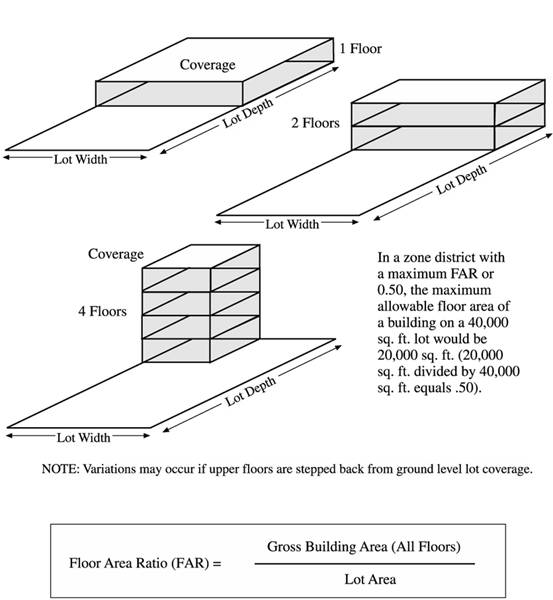
Figure 6-3
Floor Area Ratio
"Food and beverage product manufacturing" means manufacturing establishments producing or processing foods and beverages for human consumption, and certain related products. Includes:
1.
Alcoholic beverages;
2.
Bakeries;
3.
Bottling plants;
4.
Breweries;
5.
Candy, sugar and confectionery products manufacturing;
6.
Catering services separate from stores or restaurants;
7.
Coffee roasting;
8.
Dairy products manufacturing;
9.
Fats and oil product manufacturing;
10.
Fruit and vegetable canning, preserving, related processing;
11.
Grain mill products and by-products;
12.
Meat, poultry, and seafood canning, curing, byproduct processing;
13.
Miscellaneous food item preparation from raw products;
14.
Soft drink production.
Also may include tasting and accessory retail sales of beverages produced on site.
"Fourplex" means a single structure for four living units that are independent of each other with each one having a kitchen and direct access to the outside or to a common hall. Does not include "rooming and Boarding houses."
"Frontage" means all the property fronting on one side of a street between intersecting or intercepting streets, or between a street and a right-of-way, waterway, and/or dead-end street, or city boundary, measured along the street line. An intercepting street shall determine only the boundary of the frontage on the side of the street that it intercepts.
"Furniture/cabinet shops" means manufacturers producing: wood and metal household furniture and appliances; bedsprings and mattresses; all types of office furniture and partitions, lockers, shelving and store furniture; and miscellaneous drapery hardware, window blinds and shades. Also includes wood and cabinet shops, but not sawmills or planing mills, which are instead included under "lumber and wood products."
"Furniture, furnishings, and equipment stores" means retail stores primarily selling: home furnishings including draperies, floor coverings, furniture, glass and chinaware, refrigerators, stoves, other household electrical and gas appliances including televisions and home sound systems and outdoor furniture including lawn furniture, spas, and hot tubs. Also includes the retail sale of office furniture and pianos.
G.
DEFINITIONS, "G."
"Garage, private" means an accessory building or portion of the main building designed for the shelter or storage of automobiles having a permanent roof and enclosed on all sides.
"Garage, public" means a building other than a private garage used for the shelter or storage of automobiles.
"Garage/yard sale, private" means a sale held for the purpose of selling, trading, or otherwise disposing of household furnishings, personal goods, or tangible property of a resident of the premises on which the sale is conducted on a residential property. The annual frequency and maximum number of days for garage sales are regulated by Section 21.36.090 (Garage and Private Yard Sales).
"Garden centers/plant nurseries" means commercial agricultural establishments engaged in the production of ornamental plants and other nursery products, grown under cover or outdoors. Includes stores selling these products, nursery stock, lawn and garden supplies, and commercial scale greenhouses. The sale of houseplants or other nursery products entirely within a building is also included under "retail stores, general merchandise." Home greenhouses are included under "Accessory Uses and Structures."
"Gasoline stations" means a retail business selling gasoline or other motor vehicle fuels, which may also provide very limited motor vehicle repair and maintenance that are incidental to fuel services. Does not include the storage or repair of wrecked or abandoned vehicles, vehicle painting, body or fender work, or the rental of vehicle storage or parking spaces. Includes alternative fuels and recharging facilities which are commercial facilities offering motor vehicle fuels not customarily offered by commercial refueling stations (e.g., LPG) as well as equipment to recharge electric powered vehicles.
"Glass products manufacturing" means manufacturing establishments producing flat glass and other glass products which are blown, pressed, or shaped from glass produced in the same establishment. Also includes large-scale artisan and craftsman type operations producing primarily for the wholesale market.
"Golf courses" means public and private golf courses, with or without country clubs, and accessory facilities and uses including: clubhouses with bar and restaurant, locker and shower facilities; driving ranges (driving ranges separate from golf courses are instead classified under "golf driving ranges"); "pro-shops" for on-site sales of golfing equipment; and golf cart storage and sales facilities. Does not include miniature golf courses ("miniature golf course").
"Golf driving ranges" means public and private facilities providing an opportunity for driving golf balls and practicing one's golf swing. May be a separate stand-alone facility or in conjunction with a golf course.
"Government offices and facilities" means facilities owned or operated by a governmental entity (e.g., city, county, State, or Federal government).
"Grade, finished" means the final elevation of the ground surface after completion of construction on the site.
"Grade, natural" means the elevation of the ground surface in its natural state, prior to any disturbance related to construction on the site.
"Grocery stores" means an establishment which sells perishable food items (e.g., meat, eggs, dairy products, fruits, vegetables, etc.). Grocery stores may also sell household staples and supplies (e.g., soap, matches, paper napkins, etc.); a minor portion of the food sold may be processed on site (e.g., deli or bakery services). Grocery stores include delicatessens and meat markets, but do not include uses meeting the definition of "Convenience markets/stores."
"Gross floor area." See "Floor area, gross."
"Gross lot area." See "Lot area, gross."
"Groundwater recharge facilities" means a public facility or place that is part of or supports the local, regional, or State water distribution, supply, or treatment system and where water is allowed to collect in order to recharge the underground water supply.
H.
DEFINITIONS, "H."
"Half story." See "story, half."
"Handicraft industries, small scale assembly" means manufacturing establishments not classified in another major manufacturing group, including: jewelry, musical instruments, pens, pencils, sporting and athletic goods, toys, and other artists' and office materials; brooms and brushes, buttons, costume novelties, and other miscellaneous small-scale manufacturing industries.
"Hardware store" means a facility of ten thousand or fewer square feet gross floor area, primarily engaged in the retail sale of various basic hardware lines, such as tools, builders' hardware, plumbing and electrical supplies, paint and glass, housewares and household appliances, garden supplies, and cutlery; if a facility is greater than ten thousand square feet, it is a building materials supply store/yard ("building materials stores/yards").
"Hazardous material" means a material that can be harmful to human health and to the environment if handled improperly. A material can be considered hazardous if it exhibits one of the following characteristics:
1.
"Ignitability" means a material that is determined to be flammable under certain conditions.
2.
"Corrosivity" means a material that corrodes metals or has a very high or low pH.
3.
"Reactivity" means a material that readily explodes or undergoes violent reactions.
4.
"Toxicity" means a material that is known to be harmful or fatal when ingested and is known to leach into ground water at certain levels. For example, materials with high levels of arsenic, lead, or mercury.
"Health/fitness centers" means membership based fitness facilities, gymnasiums, athletic clubs, and similar establishments requiring membership for access.
"Historic structure" means a structure listed on the city's historic resources inventory.
"Hobby car restoration" means an activity in which resident owners engage in the restoration or modification of a motor vehicle and in compliance with the provisions of Section 21.36.100 (Hobby Car Restoration).
"Hollywood drive" means a type of driveway that consists of two strips of concrete or similar material leading from the street to an accessory garage or carport. The strips of concrete may be separated by turf or other similar vegetation that can be maintained at a very low height or by mulch, gravel, or similar decorative landscaping material. The strips are spaced approximately the width of a passenger vehicle's tires.
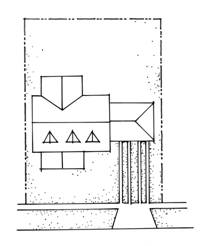
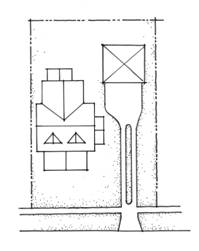
Figure 6-4
Hollywood Drive
"Home occupations" means an accessory business conducted in a residential dwelling unit, only by residents of the unit, in a manner clearly incidental to the residential character of the site and surrounding neighborhood, and in compliance with the provisions of Chapter 21.44 (Home Occupation Permits).
"Hospitals" means an institution, designed within an integrated campus setting for the diagnosis, care, and treatment of human illness, including surgery and primary treatment.
"Hotels" means guest rooms or suites, provided with or without meals or kitchen facilities, rented to the general public for overnight or other temporary lodging (for up to thirty days). Access to the individual guest rooms are generally from an interior hallway. Also includes accessory guest facilities (including accessory retail uses, elevators, indoor athletic facilities, swimming pools, and tennis courts).
"Housing development project" means any project meeting the criteria of Section 65589.5 of the California Government Code, applying under the provisions of the Housing Accountability Act (HAA) or similar law intended to limit the discretionary review authority of the local jurisdiction, with the added clarification that for the purposes of determining whether at least two-thirds of the square footage of a mixed-use development containing residential and non-residential uses is designated for residential use, the gross floor area of any shared areas (e.g., mail rooms, trash rooms, lobbies, elevators) shall be calculated and assigned proportionally to the uses which share the area based on the gross floor area of their non-shared areas. Example: A lobby with one hundred square feet of gross floor area which is shared by residential and nonresidential uses which non-shared areas respectively represent fifty percent of the gross floor area of the project, excepting shared areas, shall be proportionally assigned fifty square feet of area of the shared lobby to each use (i.e., fifty square assigned to the residential component, fifty square feet to the nonresidential component). For the purposes of this code, the definition of a housing development project shall also mean to include projects meeting the above requirements and involving an activity meeting the criteria of a development as provided by Section 65927 of the California Government Code.
I.
DEFINITIONS, "I."
"Indoor amusement/entertainment/recreation centers" means indoor establishments providing amusement/entertainment/recreation services for a fee or admission charge, including: arcades emphasizing coin operated amusements and/or electronic games; bowling alleys; card rooms; dance halls, clubs and ballrooms, and billiard parlors and pool halls, that are principal uses rather than being subordinate to a bar or restaurant; ice skating, and roller skating; skateboard ramps, and trampoline centers. Does not include "sexually oriented businesses" as defined in Campbell Municipal Code Section 5.55.020 (Definitions).
J.
DEFINITIONS, "J."
"Junkyard" means the use of more than one hundred square feet of the area of a lot for the storage of junk, including scrap materials and metals, or wrecked or inoperable vehicles and machinery, whether or not sale of junk is made or proposed.
K.
DEFINITIONS, "K."
"Kitchen facilities" and "kitchen" means a room or area designed for the cooking, preparation, and storage of food. When found in a dwelling unit, a kitchen shall include a free-standing cooking range or built-in cooktop, oven, ventilation, sink, refrigerator, food preparation countertop, and food storage cabinetry.
L.
DEFINITIONS, "L."
"Laboratories" means an establishment providing medical or dental laboratory services; or an establishment providing photographic, analytical, or testing services.
"Landscaping" means the replacement of developed or excavated areas of a parcel of land with landscape.
"Landscape" and "landscaping" means the area(s) of a parcel of land containing living vegetation, consisting of turf, ground cover, shrubs, trees, and combinations thereof meeting the requirements of Chapter 21.26 (Landscaping).
"Land use designation, underlying" or "Underlying land use designation" means the land use designation of a parcel or property as indicated on the City of Campbell General Plan Land Use Map.
"Late night activities" means land use activities operating between the hours of 11:00 p.m. and 6:00 a.m., including, but not limited to, the provision of goods and services to the public and all ancillary activities such as property maintenance, janitorial services, street and parking lot sweeping, deliveries, and similar activities. "Late night activities" do not include the lawful, reasonable and customary use of residential uses or professional offices in a manner that does not interfere with the reasonable use and enjoyment of other properties.
"Laundries/dry cleaning plants" means service establishments engaged primarily in high volume laundry and garment services, including: power laundries (family and commercial), carpet/rug and upholstery cleaners, diaper service, garment pressing and dry cleaning, industrial laundries, and linen supply. Does not include "laundromat, self-service" or "dry cleaning."
"Laundromat, self-service" means an establishment that provides washing, drying, and/or ironing machines for hire to be used by customers on the premises.
"Library" means a public facility for the use, but not sale, or literary, musical, artistic, or reference materials.
"Light rail lines" means permanent light rail tracks that service the Valley Transportation Authority (VTA) light rail system and links Campbell to several other cities in the south bay, including Santa Clara, San Jose and Mountain View.
"Light rail passenger terminals" means passenger terminals that provide rider access to the valley transportation authority (VTA) light rail system and links Campbell to several other cities in the south bay, including Santa Clara, San Jose and Mountain View.
"Limited equity housing cooperative" means as defined in California Health and Safety Code Section 33007.5).
"Liquor stores" means a retail activity that is primarily devoted to the selling of alcoholic beverages, including beer and wine, for consumption off the premises.
"Live/work units" means a structure that is intended to function predominantly as workspace with incidental residential accommodations that meet "basic habitability requirements" means live/work units are intended to be occupied by business operators who live in the same structure that contains the business activity. Live/work units shall comply with the provisions of Section 21.36.120.
"Living Unit" means a room or group of internally connected rooms that have sleeping, cooking, eating and sanitation facilities, but not more than one kitchen, which constitutes an independent living unit.
"Loading area" means an open area, other than a street or alley, used for the loading or unloading of vehicles.
"Loading space" means an off-street space or berth on the same lot with a building, or contiguous to a group of buildings, for the temporary parking of a commercial vehicle while loading or unloading merchandise or materials, and which abuts upon a street or other appropriate means of access.
"Lodging houses" means a structure or a portion of a structure, other than a hotel or motel, where lodging for five or more persons is provided for compensation. Also includes rooming houses ("rooming and Boarding houses").
"Lot" means any land occupied or to be occupied by a building, or unit group of buildings, and accessory buildings together with such yards and/or open spaces and lot area as are required by this Zoning Code, and having its principal frontage upon a street, or a place approved by the decision-making body. The terms lot, plot, and parcel are interchangeable for the purposes of this code.
"Lot, corner" means a lot located at the intersection of two or more streets, where the streets intersect at an interior angle of not more than one hundred seventy-five degrees.
"Lot, cul-de-sac" means a lot at the end of a dead end street.
"Lot, flag" means a lot having access from the building site to a public street by means of a narrow private strip of land that is owned in fee.
"Lot, interior" means a lot other than a corner lot.
"Lot, line(s)" means the line(s) bounding a lot as defined herein, with the following specific classifications and criteria for determining setbacks:
1.
The front lot line means any lot line or combination of lot lines abutting the same side of a street except as follows:
a.
Corner lots. Corner lots shall have one front lot line and one or more street lot lines. The front lot line of a corner lot shall mean the line or combination of lines on the same side of the property abutting the public right of way with the shortest cumulative length and having a combined interior angle of not more than one hundred thirty-five degrees.
b.
Rear lots. The front lot line of a rear lot (i.e., flag lot) shall mean the line or combination of lines on the same side of a property abutting the interior terminus of any access area with the shortest cumulative length and having a combined interior angle of not more than one hundred thirty-five degrees.
c.
Through lots. The front lot line of a through lot shall mean:
i.
For low-density residential, low-medium density residential, medium density residential, and medium-high density residential land uses, the lot line, or combination of lot lines, abutting the same side of a street with the least intensive street classification (i.e., where abutting a residential collector instead of a Class I Arterial); and
ii.
For all other land uses other than low-density residential, low-medium density residential, medium density residential, and medium-high density residential land uses, the lot line, or combination of lot lines, abutting the same side of a street with the most intensive street classification (i.e., Class I Arterial instead of a residential collector) pursuant to the Roadway Network Classifications Diagram of the General Plan (Figure T-1.)
Exception: For any legal residential development or residential project with a planning or building permit application submitted prior to June 2, 2023, the front lot line shall mean the lot line, or combination of lot lines, abutting the same side of the street (or in the case of a flag lot, those lines on the same side of a property abutting the interior terminus of any access area) that will result in the least number of non-conforming development standards for the property.
2.
The side lot line means any lot line or combination of lot lines that is not otherwise defined as a front, rear, or street side lot line.
3.
The street lot line means any line or combination of lines abutting the same side of a public street that is not determined to be a front lot line.
4.
The rear lot line is the line or combination of lines that are most distant and opposite the front lot line and yielding the greatest lot width. On a lot where the side lot lines converge to a point at the rear of the lot (i.e., triangle lot), a line ten feet long within the most parallel to and at a maximum distance from the front lot line, shall be deemed to be the rear lot line for the purpose of determining the rear setback.
"Lot area, pre-dedication" means the total area within the lot lines of a lot, plus that area between the centerline of adjacent public right-of-way and the property lines.
"Lot, reverse corner" means a corner lot in which the rear property line abuts the side property line of an adjoining interior lot (as opposed to the rear property line of another corner lot).
"Lot, through" means a lot having frontage on two parallel or approximately parallel streets.
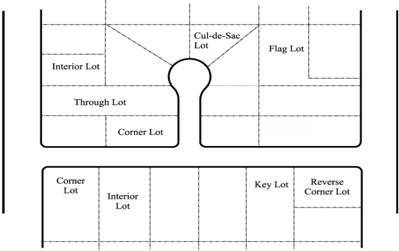
Figure 6-5
Lot Types
"Lot area, net" means the total area within the lot lines of a legal parcel, after any public right-of-way dedication and not including land reserved as public right-of-way.
"Lot area, gross" means the total area within the lot lines of a legal parcel (or contiguous parcels) prior to public right-of-way dedication and not including land reserved as public right-of-way.
"Lot coverage" means the ratio of covered area to net lot area. See definition of "Covered area."
"Lot depth" means the horizontal distance between the front and rear lot lines, measured along the median between the two side lot lines. On a lot where the side lot lines converge to a point at the rear of the parcel (i.e., triangle lot), the rear lot line measurement shall be taken from the point of intersection of side lot lines most distant and opposite the front lot line.
"Lot width" means the horizontal distance between the side lot lines, measured at right angles to the lot depth at a point midway between the front and rear lot lines. On a lot where the side lot lines converge to a point at the rear of the parcel (i.e., triangle lot), a line ten feet long within the parcel, most parallel to and at a maximum distance from the front lot line, shall be deemed to be the rear lot line for the purpose of determining lot width.
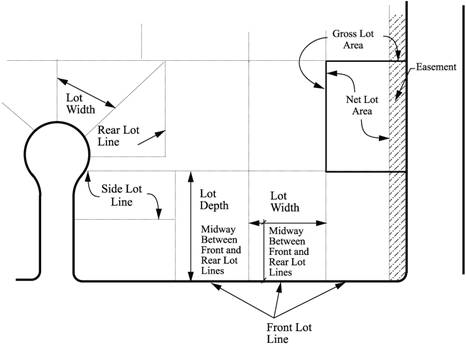
Figure 6-7
Lot Lines and Lot Areas
"Lumber and wood products" means manufacturing, processing, and sales uses involving the milling of forest products to produce rough and finished lumber and other wood materials for use in other manufacturing, craft, or construction processes. Also includes the following processes and products:
1.
Containers, pallets and skids;
2.
Milling operations;
3.
Trusses and structural beams;
4.
Turning and shaping of wood products;
5.
Wholesaling of basic wood products;
6.
Wood product assembly.
"Craft-type shops" are included in "Handcraft Industries and Small-Scale Manufacturing." Other wood and cabinet shops are included under "Furniture/Cabinet Shops." The indoor retail sale of building materials, construction tools and equipment is included under "Building Material Stores/Yards."
M.
DEFINITIONS, "M."
"Machinery manufacturing" means the manufacturing of machinery and equipment for purposes and products including the following:
1.
Construction;
2.
Conveyors;
3.
Die casting;
4.
Dies;
5.
Dredging;
6.
Engines and turbines;
7.
Farm and garden;
8.
Food products manufacturing;
9.
Gear cutting;
10.
Heating, ventilation, air conditioning;
11.
Industrial molds;
12.
Laundry and dry cleaning;
13.
Materials handling;
14.
Mining;
15.
Paper manufacturing;
16.
Passenger and freight elevators;
17.
Pistons;
18.
Printing;
19.
Pumps;
20.
Refrigeration equipment;
21.
Textile manufacturing.
"Main structure" means a structure that accommodates the primary use of the site.
Major Electrical Transmission Line. See "Electrical Transmission Line, Major."
"Manufactured housing" means a housing unit that is either wholly or partially constructed or assembled off the site in compliance with California Health and Safety Code Section 18551, and certified under the National Manufactured Housing Construction and Safety Standards Act of 1974 (42 U.S.C. Sections 5401 et seq.).
"Marine sales" means retail establishments selling and/or renting new and/or used boats, and associated marine equipment (e.g., jet skis, trailers, etc.) Also includes parts sales or service facilities only when part of a dealership selling new marine equipment on the same site.
"Massage establishment" means an establishment having a fixed place of business where any person, firm, association, or corporation practices or otherwise permits massage for compensation. "Massage establishment" shall include any establishment providing off-premises massage services and establishments that offer services such as relaxation, hot tub, towel wraps, baths, health treatments, tanning, or any service where the essential nature of the interaction between the employee and the customer involves a massage.
"Massage therapy" means therapeutic (non-sexual) rubbing or kneading of parts of non-specified anatomical areas of the body to aid circulation or to relax muscles, provided by a licensed professional.
"Medical services, clinics" means facilities primarily engaged in furnishing outpatient medical, mental health, surgical, and other personal health services. These include: medical, dental, and psychiatric offices (counseling services by other than medical doctors or psychiatrists are included under "offices"); outpatient care facilities; emergency room services; and allied health services. Associations or groups primarily engaged in providing medical or other health services to members are included.
"Medical services, extended care" means residential facilities providing nursing and health-related care as a principal use with in-patient beds, including: skilled nursing facilities (facilities allowing care for physically or mentally disabled persons, where care is less than that provided by an acute care facility); extended care facilities; Board and care homes. Long-term personal care facilities that do not emphasize medical treatment are classified in "residential care homes."
"Medical services, laboratories" means facilities primarily engaged in furnishing medical and dental laboratory services.
"Medical stores" means a retail store specializing in the sale of medical equipment and devices that also includes related medical services in an ancillary capacity, such as an eyewear store with an on-site optometrist. This type of retail store is included in the definition of "Retail stores, general merchandise" and excluded from the definition of "Medical services, clinics."
Meeting halls. See "Public assembly uses."
"Membership organization facilities" means permanent, headquarters-type and meeting facilities for organizations operating on a membership basis for the promotion of the interests of the members, including facilities for: business associations, civic and social organizations, labor unions and similar organizations, political organizations, private clubs, professional membership organizations, private clubs, and other membership organizations.
"Metal products fabrication" means the assembly of metal parts, including blacksmith and welding shops, machine shops, sheet metal shops, and boiler shops, that produce metal duct work, cabinets and enclosures, metal doors and gates, tanks, towers, and similar products.
"Miniature golf course" means a theme-oriented recreational facility, typically comprised of nine or eighteen putting greens, each with a "cup" or "hole," where patrons in groups of one to four pay a fee to move in consecutive order from the first hole to the last.
"Mixed-use developments" means a combination of uses in a single building or on a single lot that contain residential and commercial uses that are part of an integrated development project with a significant functional inter-relationship. Residential and commercial uses may be mixed horizontally or vertically provided they are on a single parcel. Mixed-use development shall comply with the provisions of Section 21.36.130.
"Mobile home parks" means any site that is planned and improved to accommodate two or more mobile homes used for residential purposes, or on which two or more mobile home lots are rented, leased, or held out for rent or lease, or were formerly held out for rent or lease and later converted to a subdivision, cooperative, condominium, or other form of resident ownership, to accommodate mobile homes used for residential purposes.
Monastery, Convent, Parsonage, or Nunnery.
"Monastery, convent, or nunnery" means the dwelling units of a religious order or congregation.
"Mortuaries or funeral parlors" means establishments where deceased are prepared for burial or cremation, and funeral services may be conducted. Includes crematoriums, funeral homes, and funeral parlors.
"Most Common Dictionary Definition" means a definition from the Merriam-Webster Dictionary online, or next most common dictionary definition when a term or phrase is not defined.
"Motels" means guest rooms or suites, provided with or without meals or kitchen facilities, rented to the general public for overnight or other temporary lodging (for up to thirty days). Access to the individual guest rooms are generally from an exterior walkway. Also includes accessory guest facilities (including accessory retail uses, elevators, indoor athletic facilities, swimming pools, and tennis courts).
Motor Vehicle Related Land Uses.
1.
"Motor vehicle cleaning, washing, and detailing" means facilities specializing in the cleaning, washing, detailing and polishing of motor vehicles.
2.
"Motor vehicle dismantling" means customarily outdoor establishments primarily engaged in assembling, breaking up, sorting, and the temporary storage and distribution of recyclable or reusable scrap and waste materials, including wreckers engaged in dismantling motor vehicles for scrap and the incidental wholesale or retail sales of parts from vehicles. Includes light and heavy processing facilities for recycling. Does not include: places where these activities are conducted entirely within structures; pawnshops and other secondhand stores; or the sale of operative used cars. Motor vehicle dismantling shall comply with the provisions of Section 21.36.240.
3.
"Motor vehicle leasing" means retail establishments leasing motor vehicles (e.g., automobiles, trucks and vans).
4.
"Motor vehicle oil change facilities" means these facilities are limited to performing only oil changes and very limited incidental maintenance and only on light duty motor vehicles (e.g., automobiles, light duty trucks and vans).
5.
"Motor vehicle painting" means motor vehicle repair facilities dealing with entire vehicles, but only within a completely enclosed and soundproofed structure. These establishments customarily provide towing, collision repair, other body work, and painting services.
6.
"Motor vehicle parking facilities" means and includes short-term commercial garages, parking lots, and structures, except when accessory to a primary use. (All primary uses are considered to include any customer or public use off-street parking required by the Zoning Code.)
7.
"Motor vehicle parts and supplies" means retail stores that sell new motor vehicle parts, tires, and accessories. May also include very limited vehicle maintenance and parts installation connected with the retail sales.
8.
"Motor vehicle renting" means retail establishments renting motor vehicles (e.g., automobiles, trucks, recreational vehicles and vans).
9.
"Motor vehicle repair and maintenance, minor and major" means major vehicle repair facilities deal with the entire vehicle; minor repair facilities generally specialize in limited aspects of repair (e.g., muffler and radiator shops, tire shops.) All repair activities (minor and major) are conducted within a completely enclosed and soundproofed structure. Does not include: motor vehicle dismantling yards which are included under "motor vehicle dismantling." Motor vehicle repair facilities shall comply with the provisions of Section 21.36.140.
10.
"Motor vehicle repair and maintenance, minor only" means minor repair facilities generally specialize in limited aspects of repair (e.g., muffler and radiator shops, oil change shops, smog shops, tire shops, tune up shops, window tinting.) All repair activities are conducted within a completely enclosed and soundproofed structure. Does not include: motor vehicle dismantling yards which are included under "motor vehicle dismantling." Motor vehicle repair facilities shall comply with the provisions of Section 21.36.140.
11.
"Motor vehicle sales" means retail establishments selling new and/or used motor vehicles (e.g., automobiles, trucks, and vans). May also include service and repair shops and the sales of parts and accessories, incidental to vehicle dealerships. Does not include: the sale of auto parts/accessories separate from a vehicle dealership.
12.
Motor vehicle tune-up. See "motor vehicle repair and maintenance, minor only."
13.
Motor vehicle tune-up, limited to light duty only. See "motor vehicle repair and maintenance, minor only;" however, these shops are limited to performing only tune ups and only on light duty motor vehicles (e.g., automobiles, light duty trucks and vans).
14.
Motor vehicle window tinting. See "motor vehicle repair and maintenance, minor only."
"Multi-family dwelling" means an apartment, townhome, or condominium development.
"Museums, public" means public facilities including aquariums, arboretums, art exhibitions, botanical gardens, historic sites and exhibits, museums, and planetariums, which are generally non-commercial in nature.
"Music (recordings) store" means an establishment primarily engaged in retailing new prerecorded audio and video tapes, compact discs (CDs), digital video discs (DVDs), and phonograph records.
N.
DEFINITIONS, "N."
"Nature preserves" means areas intended to remain in a predominately natural or undeveloped state to provide resource protection and possible opportunities for passive recreation and environmental education for present and future generations.
"Nightclubs" means commercial establishments, with or without food service, providing opportunities for dancing, music, and other related forms of entertainment, including cabarets. These establishments may be part of a restaurant, where the food service is subordinate to the dancing and entertainment.
"Nonconforming building" means a building or structure the size, dimensions, or location of which was lawful prior to the adoption, revision, or amendment of this Zoning Code, but which fails by reason of such adoption, revision, or amendment, to conform to the present requirements of this Zoning Code.
"Nonconforming use" means a use or activity which was lawful prior to the adoption, revision, or amendment of this Zoning Code, but which fails, by reason of such adoption, revision or amendment, to conform to the use regulations for the zoning district in which it is located.
"Nonresidential" means a property, use, or building that is not used as a place of residence. Exception: Mixed-use development not meeting the definition of a "Housing development project" are included in this definition. The terms nonresidential and non-residential are interchangeable for the purposes of this code.
"Nontransient" with respect to occupancy of a residential or residentially zoned property means the occupancy of, or the legally binding commitment to occupy a unit by the same natural person for one year or longer.
"Nuisance per se" means an activity that in and of itself is inherently considered to be a nuisance. Examples of activities that are nuisances per se include water pollution by discharge, structures which amount to a fire hazard, noise, air pollution, weeds, rubbish and refuse, junkyards, earth movement, and illegal signs. See "Public Nuisance."
O.
DEFINITIONS, "O."
"Offices, professional" means professional or government offices including:
1.
Administrative;
2.
Accounting, auditing and bookkeeping services;
3.
Advertising agencies;
4.
Architectural, engineering, planning, and surveying services;
5.
Attorneys;
6.
Counseling services;
7.
Court reporting services;
8.
Data processing and computer services;
9.
Detective agencies and similar services;
10.
Educational, scientific and research organizations;
11.
Employment, stenographic, secretarial and word processing services;
12.
Insurance agencies;
13.
Government offices including agency and administrative office facilities;
14.
Management, public relations and consulting services philanthropic enterprises;
15.
Philanthropic enterprises;
16.
Photography and commercial art studios;
17.
Public utilities;
18.
Real estate services;
19.
Travel agencies;
20.
Writers and artists offices outside the home.
Does not include: medical offices, which are allowed under "medical services—clinics," financial institutions, or offices that are incidental and accessory to another business or sales activity that is the principal use" means Incidental offices that are customarily accessory to another use are allowed in any non-residential zoning district as part of an approved principal use.
"Offsite alcohol sales." See "Alcohol sales, offsite."
"Oil change facilities." See "Motor vehicle oil change facilities."
"Onsite alcohol sales." See "Alcohol sales, onsite."
"Open space" means that portion of a lot or property which is required to be open and unobstructed by structures, except as specifically provided by law, from the ground to the sky.
"Open space, required for multiple-family dwelling units" means a private or common space serving multiple-family dwelling units that is specifically designed for recreational use, whether active or passive, and shall not be occupied by driveways, parking spaces, or walkways between structures.
"Open space, usable private" means the area shall exclude the required front setback between the structure and the street property line. The open space area may be occupied by recreation facilities (e.g., deck, patio, playground equipment, porch, swimming pool, etc.) provided it is open on at least two sides and not covered by a roof or canopy.
"Open space land" means any parcel or area of land essentially unimproved in its natural state; devoted to an open space use; and which is designated in the open space element in the General Plan for open space.
"Open space zoning district" means any area of land or water designated O-S (open space) and subject to all of the terms and regulations of this Zoning Code.
"Open space use" means the use of land for:
1.
Containment and structuring of urban development;
2.
Conservation or use of natural resources;
3.
Enjoyment of scenic beauty;
4.
Production of food or fiber;
5.
Protection of man and his artifacts (property, structures, etc.); and
6.
Public recreation.
"Outdoor amusement/entertainment/recreation centers" means facilities for various outdoor participant sports, entertainment, and most types of recreational activities where a fee is charged for use, including: amusement and theme parks; drive-in theaters; golf driving ranges; miniature golf courses (golf courses are included under the definition of "golf courses"); skateboard ramps and parks and water slides; recreation equipment rental (for example, bicycles, roller skates); health and athletic clubs with predominately outdoor facilities; tennis courts, swim and tennis clubs; zoos. May also include commercial facilities customarily associated with the above outdoor commercial recreational uses, (e.g., bars and restaurants [both table service and counter service], and video game arcades.)
"Outdoor retail sales and activities" means permanent outdoor sales and rental establishments including auction yards, flea markets, flower stands, lumber and other material sales yards, newsstands, outdoor facilities for the sale or rental of vehicles/equipment, and other uses where the business is not conducted entirely within an enclosed structure. Does not include the sale of automobiles and recreational vehicles ("motor vehicle sales").
"Outdoor seating" means an outdoor dining area provided by a restaurant for its customers that is furnished with tables, chairs, umbrellas, and other items necessary for the consumption of food and beverages served by the restaurant, either with or without waiter service. Outdoor seating shall comply with the provisions of Section 21.36.150.
"Outdoor storage" means the storage of various materials, including contractors' equipment, outside of a structure other than fencing, either as an accessory or principal use, suitably screened from public view, but not within fifty feet of a residentially zoned parcel. Outdoor storage shall comply with the provisions of Section 21.36.160.
"Owner's Association" means an organization established under State law operated in compliance with adopted covenants, codes, and restrictions (CCR's) or comparable instrument, which collectively represents individuals with fee interest in property within a subdivision, planned development, or condominium.
P.
DEFINITIONS, "P."
"Paper products manufacturing" means the manufacture of paper and paperboard, from both raw and recycled materials, and their conversion into products including boxes, envelopes, paper bags, wallpaper, etc.
"Parking lots/structures, public" means service establishments in the business of storing operative cars, buses, recreational vehicles, trucks, vans, and other motor vehicles for clients. Includes day use commercial garages, parking lots and structures, except when accessory to a primary use. (All primary uses are considered to include any customer or public use off-street parking required by the Zoning Code.) Also includes sites where vehicles are stored for rental or leasing.
"Parking space" means an area off the street or highway for the temporary storage of an automobile or other motor vehicle. A parking space shall not include space needed for driveway or loading area.
"Parks, public" means and includes public parks, play lots, playgrounds, and non-professional/ noncommercial athletic fields, including park and playground equipment, accessory structures, and facilities.
"Parsonage" means the official residence usually provided by a religious institution for its minister, parson, rabbi, etc.
"Payday lender" means a retail business owned or operated by a "licensee" as that term is defined in California Financial Code section 23001(d), as amended from time to time.
"Personal services" means establishments providing non-medical services as a primary use, including:
1.
Barber and beauty shops;
2.
Clothing rental;
3.
Dry cleaning pick-up stores with limited equipment;
4.
Home electronics and small appliance repair;
5.
Laundromats (self-service laundries);
6.
Nail shops;
7.
Shoe repair shops;
8.
Tailors;
9.
Palm and psychic readers.
The term "personal services" does not include massage establishments. The term "personal services" does not include body piercing, tattoo parlors, or any of the other uses listed under "Personal services, limited."
"Personal services, limited" means establishments providing nonmedical services of a very limited and restricted nature as a primary use, including body piercing, and tattoo parlors.
Pet Clinics. See "Veterinary clinics and animal hospitals."
"Pet store" means a retail sales establishment primarily engaged in the sale of domestic animals, such as dogs, cats, fish, birds, and reptiles, excluding exotic animals and farm animals.
"Pharmaceutical manufacturing" means establishments engaged in the production of drugs and related therapeutical products for distribution to clinics, hospitals, medical-related facilities, and pharmacies drug stores.
"Pharmacies/drug stores" means a retail store where a licensed pharmacist prepares prescription medicines for sale, which may also sell over-the-counter medicines, personal care products, and other miscellaneous products.
Pharmacies/Drug Stores, With Drive-Up Service. See (Pharmacies/drug stores;" however these facilities sell their products either through over-the-counter sales or drive-up window service.
"Philanthropic enterprise" means an organization or institution engaged in collecting donations of money, goods, or services in order to provide humanitarian or charitable assistance.
"Philanthropic collection trailer" means a portable trailer that is parked on private property for the purpose of collecting donations of household goods (e.g., clothing, books, toys, furniture, kitchen utensils, bedding, lamps, rugs, etc.) from area residents. An attendant from the sponsoring philanthropic enterprise is usually present at the trailer during prescribed hours to assist donors in placing their donations in the trailer, to dispense tax receipts, and to maintain the cleanliness of the area surrounding the trailer.
"Photocopying" means an establishment (except private mail centers) engaged in providing a range of office support services (except printing services), such as document copying services, facsimile services, word processing services, on-site PC rental services, and office product sales.
"Photography studio/supply shop" means an establishment primarily engaged in providing still, video, or digital portrait photography services. Also an establishment primarily engaged in either retailing new cameras, photographic equipment, and photographic supplies or retailing new cameras and photographic equipment in combination with activities, such as repair services and film developing.
"Plastics and rubber products" means the manufacture of rubber products including: rubber footwear; mechanical rubber goods; heels and soles; flooring; and rubber sundries from natural, synthetic, or reclaimed rubber. Also includes: establishments engaged in molding primary plastics for the trade, and manufacturing miscellaneous finished plastics products; fiberglass manufacturing, and fiberglass application services.
"Primary dwelling unit" means a building that is the principle use of the lot on which it is situated. This definition does not include accessory dwelling units or junior accessory dwelling units as provided for by Chapter 21.23 (Accessory Dwelling Unit), or caretaker or employee housing as provided by Section 21.36.040 (Caretaker or employee housing.).
"Printing and publishing" means establishments engaged in printing by gravure, letterpress, lithography, offset, screen, or other common process, including electrostatic (xerographic) copying and other "quick printing" services; and establishments serving the printing trade including bookbinding, electrotyping, engraving, photoengraving, silk screening, and typesetting. This use also includes establishments that publish books, newspapers, and periodicals; and establishments manufacturing business forms and binding devices. Printing and publishing establishments also include "Blueprinting shops."
"Public assembly uses" means a facility or place where groups of people gather for civic, educational, political, religious, or social purposes. "Public assembly uses" include the following:
1.
Auditoriums;
2.
Conference centers;
3.
Convention and exhibition halls;
4.
Lecture halls;
5.
Meeting halls;
6.
Religious institutions.
Does not include banquet facilities ("Banquet Facilities"), movie theaters, performing arts theaters, or concert halls ("Theaters, Movie or Performing Arts, and Concert Halls"). Also does not include "sexually oriented businesses" as defined in Campbell Municipal Code Section 5.55.020 (Definitions). Public assembly uses shall comply with the provisions of Section 21.36.170.
"Public nuisance" means an act or omission that interferes with the interests of the community or interferes with the public health, safety, and welfare. A public nuisance affects an entire community or neighborhood, or any considerable number of persons at the same time, although the extent of the annoyance or damage inflicted upon individuals may be unequal. California Civil Code Section 3480.
"Public utility structures and service facilities" means fixed-base structures and facilities serving as junction points for transferring utility services from one transmission voltage to another or to local distribution and service voltages. These uses include any of the following facilities that are not exempted from land use permit requirements by Government Code Section 53091:
1.
Corporation and maintenance yards;
2.
Electrical substations and switching stations;
3.
Natural gas regulating and distribution facilities;
4.
Public water system wells, treatment plants and storage;
5.
Service uses/structures;
6.
Telephone switching facilities;
7.
Wastewater treatment plants, settling ponds and disposal fields.
"Public works maintenance facilities and storage yards" means publicly owned or operated structures and open storage yards designed to accommodate motor vehicles, construction equipment, and the storage of materials used by the governmental agency. Also includes enclosed structures designed to warehouse space parts and service the above listed equipment.
R.
DEFINITIONS, "R."
"Radio or television transmitter" means usually a tall, fabricated structural metal tower designed and equipped to receive and transmit radio and television signals.
"Radio station" means a commercial facility that serves as the base-of-operations for an on-air radio broadcasting company. These facilities may also contain administrative offices and equipment of the type and scale customarily associated with wireless telecommunications facilities.
"Recreation land" means any area of land or water suitable for recreational purposes.
"Recreational vehicle" means the same as set forth in California Health and Safety Code section 18010, as that section exists and may be amended and decodified in the future.
"Recycling facilities" means a variety of facilities involved with the collection, sorting, and processing of recyclable materials. A "certified" recycling or processing facility is certified by the California Department of Conservation as meeting the requirements of the California Beverage Container Recycling and Litter Reduction Act of 1986. A recycling facility does not include storage containers located on a residentially, commercially, or industrially designated site used solely for the recycling of material generated on the site.
1.
"Collection facilities (large and small)" means a center where the public may donate, redeem, or sell recyclable materials, which may include the following, where allowed by the applicable zoning district:
a.
Large collection facilities which occupy an area of more than eighty-four cubic feet, including but not limited to large collection containers and/or permanent structures;
b.
Small collection facilities which occupy an area of eighty-four cubic feet or less and may include:
(1)
A mobile unit;
(2)
Bulk reverse vending machines or a grouping of reverse vending machines occupying more than eighty-five cubic feet;
(3)
Kiosk-type units, which may include permanent structures; and
(4)
Small collection container.
c.
Reverse vending machine(s);
2.
"Processing facilities" means a structure or enclosed space used for the collection and processing of recyclable materials for shipment, or to an end-user's specifications, by means of baling, briquetting, cleaning, compacting, crushing, flattening, grinding, mechanical sorting, remanufacturing, and shredding. Processing facilities include the following types:
a.
Light processing facility occupies an area of under forty-five thousand square feet of collection, processing, and storage area, and averages two outbound truck shipments each day. Light processing facilities are limited to baling, briquetting, compacting, crushing, grinding, shredding, and sorting of source separated recyclable materials sufficient to qualify as a certified processing facility. A light processing facility shall not bale, compact, or shred ferrous metals other than food and beverage containers; and
b.
A heavy processing facility is any processing facility other than a light processing facility.
3.
"Recycling or recyclable material" means reusable domestic containers and other materials which can be reconstituted, remanufactured, or reused in an altered form, including glass, metals, paper, and plastic. Recyclable material does not include refuse or hazardous materials.
4.
"Reverse vending machines" means an automated mechanical device which accepts at least one or more types of empty beverage containers and issues a cash refund or a redeemable credit slip with a value not less than the container's redemption value, as determined by State law. These vending machines may accept aluminum cans, glass and plastic bottles, and other containers.
A bulk reverse vending machine is a reverse vending machine that is larger than eighty-five cubic feet, is designed to accept more than one container at a time, and issues a cash refund based on total weight instead of by container.
"Regional Commercial Center" means a group or cluster of retail businesses, offices, and hotel(s) sharing common pedestrian and off-street parking, and which are located on parcel(s) of land having the following characteristics:
1.
Minimum area of twenty acres uninterrupted or undivided by public streets; and
2.
Abutted on at least two sides by public streets that intersect at one corner of the commercial center, and by a freeway on one other side.
May consist of one or more legal parcels tied together by a binding legal agreement providing rights of reciprocal vehicular parking and access, and one or more ownerships.
"Repair and maintenance, consumer products" means service establishments where repair of consumer products is the principal business activity, including: electrical repair shops; furniture repair; television and radio and other appliance repair; reupholstery; and watch, clock and jewelry repair. Does not include shoe repair (included under "Personal services, general"). Does not include heavy equipment repair businesses, which are included under "Business support services."
"Research and development" means indoor facilities for scientific research, and the design, development, and testing of electrical, electronic, magnetic, optical, and mechanical components in advance of product manufacturing, that are not associated with a manufacturing facility on the same site. Includes chemical and biotechnology research and development. Does not include computer software companies, soils and other materials testing laboratories, or medical laboratories.
"Residential care homes, small (serving six or fewer persons)" means a facility licensed by the State of California where care, services, or treatment is provided to persons living in a community residential setting. The facilities are designed for and limited to six or fewer residents and are usually housed in a private residential home setting.
"Residential care homes, large (serving seven or more persons)" means a facility licensed by the State of California where care, services, or treatment is provided to persons living in a community residential setting. The facilities are designed for seven or more residents and are usually housed in a private residential home setting. Residential care homes shall comply with the provisions of Section 21.36.180.
"Residential service facility, small (six or fewer)" means a residential facility serving six or fewer natural persons, other than a residential care facility or single housekeeping unit, where the operator receives compensation for the provision of personal services, in addition to housing including protection, supervision, assistance, guidance, training, therapy, or other nonmedical care.
"Residential service facility, large (seven or more)" means a residential facility serving seven or more natural persons, other than a residential care facility or single housekeeping unit, where the operator receives compensation for the provision of personal services, in addition to housing including protection, supervision, assistance, guidance, training, therapy, or other nonmedical care.
"Residential recreational facilities, private" means playground equipment, swimming pools and spas, tennis and other sport courts, and similar facilities and accessory structures that are operated for the residents of a specific residential development and their invited guests, and are not open to the general public. Does not include these facilities for individual homes, which are defined as "accessory uses and structures."
Restaurants.
1.
Restaurants, drive-through. (See "drive-through/drive-up service/drive-up window").
2.
Restaurants, drive-in. (See "Drive-in/drive-in service").
3.
"Restaurants or cafes, quick service" or "restaurants, fast casual" or "fast casual restaurants" or "quick service restaurants or cafes" means establishments whose primary business is the sale of food and beverages to customers for consumption on-site or off-site. This type of restaurant provides onsite seating and typically includes the following operational characteristics:
•
High turnover rates for eat-in customers (typically less than forty minutes);
•
High percentage of carry-out clientele and/or presence of a dedicated food/beverage pickup area;
•
Very limited or no table service;
•
Does not accept dining reservations;
•
Drink dispensers, condiment bars, and/or trash disposal areas are provided in locations accessible to customers to accommodate self-service;
•
Customers typically order from a menu board or electronic system and pay before receiving food and beverages; and
•
Food and beverages are served with disposal tableware.
4.
"Restaurants, full service" or "Full service restaurants" means establishments whose primary business is the sale of food and beverages to customers for their consumption within the restaurant or restaurant patio area. This type of restaurant provides onsite seating and typically includes the following operational characteristics:
•
Low turnover rates for eat-in customers (typically more than forty minutes);
•
Low percentage of carry-out clientele and/or lack of a dedicated food/beverage pickup area;
•
Provides table service;
•
Accepts dining reservations;
•
Drink dispensers, condiment bars, and/or trash disposal areas are not accessible to customers;
•
Customers typically order from a menu where they are seated and pay after receiving food and beverages; and
•
Food and beverages are served with non-disposal tableware.
"Retail stores, general merchandise" means retail trade establishments selling many lines of merchandise. These stores and lines of merchandise include:
1.
Antiques;
2.
Art stores/ galleries;
3.
Artists' supplies;
4.
Bakeries;
5.
Boat supplies;
6.
Beauty supply;
7.
Bicycles;
8.
Cameras and photographic supplies;
9.
Candy stores;
10.
Clothing and accessories;
11.
Collectibles;
12.
Convenience markets/stores;
13.
Department stores;
14.
Drug and discount stores;
15.
Fabrics and sewing supplies;
16.
Furniture, furnishings, and equipment stores;
17.
Florists and houseplant stores (indoor sales only—outdoor sales are "garden centers/plant nurseries");
18.
Gifts, novelties and souvenirs;
19.
Handcrafted items (stores may include crafting preparations subordinate to retail sales);
20.
Hardware stores;
21.
Hobby materials;
22.
Jewelry;
23.
Luggage and leather goods;
24.
Medical stores;
25.
Music (recordings) stores;
26.
Newsstands;
27.
Pharmacies/drug stores;
28.
Photography studio/supply shops;
29.
Secondhand/thrift stores without onsite acquisition;
30.
Shoes;
31.
Small wares;
32.
Specialty shops;
33.
Sporting goods and equipment;
34.
Stationery;
35.
Toys and games; and
36.
Variety stores.
Retail stores included in this definition may provide limited indoor seating for customer convenience, provided that no more than twelve seats are provided when the tenant space is less than ten thousand gross square-feet in area.
"Rooming and Boarding houses" means houses with individual bedrooms that are rented to between three to five persons for profit, whether or not meals are provided.
Rugs and Upholstery Cleaning. See "Laundries/dry cleaning plants."
S.
DEFINITIONS, "S."
Satellite Television or Personal Internet Broadband Dishes/Antenna. See "wireless telecommunications facilities"; however these facilities shall be less than three feet or two meters in diameter. Satellite television or personal internet broadband dishes/antenna shall comply with the provisions of Section 21.36.190.
"Scenic land" means any area of land or water that possesses scenic qualities suitable for preservation.
"Schools, commercial." See "Commercial schools."
"Schools—K—12, private." See "Schools—K—12, public;" however, these schools are privately owned and operated, and also may include denominational and sectarian, Boarding schools, and military academies.
"Schools—K—12, public" means an institution which offers instructions in the several branches of learning and study required to be taught in the public schools by the State Education Code. Includes elementary, middle, junior high, and high schools serving kindergarten through 12th grade students. Pre-schools and child day care are included under the definitions of "Child day care facilities."
"Secondhand/thrift stores without onsite acquisition" means indoor retail establishments that sell used products, including books, clothing, furniture, and household goods onsite. This type of retail store does not accept products for sale onsite and is included in the definition of "Retail stores, general merchandise" and excluded from the definition of "Secondhand/thrift stores, with onsite acquisition." The sale of cars and other used vehicles is included under "Motor Vehicle Sales."
"Secondhand/thrift stores with onsite acquisition" means indoor retail establishments that acquire and sell used products onsite including books, clothing, furniture, and household goods. Used products may be purchased, received in donation, or placed in care of the store for consignment. The sale of cars and other used vehicles is included under "Motor Vehicle Sales."
"Senior citizen housing" means housing reserved for senior citizens or other qualified residents as defined by California Civil Code Section 51.3 et seq.
"Service bay" means a space within a motor vehicle related land use (herein defined), where a motor vehicle can be located for maintenance or repairs.
"Setback" means the distance by which a structure, parking area, or other development feature must be separated from a lot line. Setbacks from private streets are measured from the edge of the easement. See also "Yard." Figure 6-8 (Setbacks) shows the location of front, side, street side, rear, and interior setbacks.
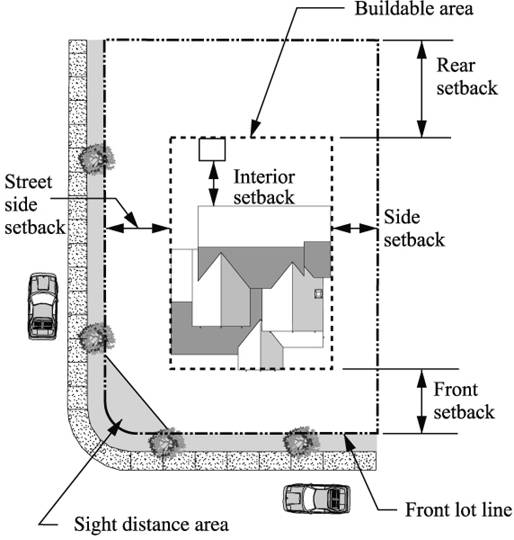
Figure 6-8
Setbacks
"Sexually oriented businesses" has the same meaning as defined in Campbell Municipal Code Section 5.55.020 (Definitions).
"Shopping centers" means a group or cluster of retail businesses and offices sharing common pedestrian and off-street parking, and which are located on parcel(s) of land having the following characteristics:
1.
Minimum area of three acres uninterrupted or undivided by public streets;
2.
Abutted on at least two sides by public streets that intersect at one corner of the shopping center;
3.
May consist of one or more lots tied together by a binding legal agreement providing rights of reciprocal vehicular parking and access, and one or more ownerships;
4.
Combination of commercial and office use with commercial uses to be at least seventy-five percent of gross floor area.
"Short term rental" means use of a residential property for lodging purposes as defined by Government Code Section 19822.4(1).
"Sign" means any structure, device, figure, painting, display, message placard, or other contrivance, or any part thereof, situated outdoors or indoors, which is designed, constructed, intended, or used to advertise, or to provide data or information in the nature of advertising, to direct or attract attention to an object, person, institution, business, service, event, or location by any means, including words, letters, figures, designs, symbols, fixtures, colors, illumination, or projected images.
"Sign shops" means commercial establishments that market and design signs and create banners. Does not include assembly, fabrication, installation, repair, or service of signs.
"Sign manufacturing" means industrial establishments that market, design, assemble, fabricate, install, repair, and service signs of all types, sizes, and materials.
"Single-family dwellings" means a structure designed for and/or occupied exclusively by one family and containing only one kitchen. Also includes factory-built housing (modular housing) units, constructed in compliance with the Uniform Building Code (UBC), and mobile homes/ manufactured housing on permanent foundations. May include the rental of rooms within a dwelling also occupied by the property owner or a primary tenant.
"Single housekeeping units" means a functional equivalent of a traditional family; whose members are a nontransient interactive group of persons jointly occupying a single dwelling unit, including the joint use of common areas in sharing household activities and responsibilities such as meals, chores, and expenses.
"Single Room Occupancy facility" means a residential facility providing dwelling units where each unit has a minimum floor area of one hundred fifty square feet and a maximum floor area of two hundred twenty square feet, and are rented to a one- and/or two-person household. These dwelling units may have kitchen and/or bathroom facilities, and are provided for a weekly or monthly period of time, in exchange for an agreed payment of a fixed amount of money or other compensation based on the period of occupancy.
"Small-lot single-family dwelling" means a single-family dwelling (as defined herein) constructed on a lot of less than six thousand square feet in net lot area, located within the P-D (Planned Development) zoning district.
"Stock cooperative" means a corporation which is formed or availed of primarily for the purpose of holding a title to, either in fee simple or for a term of years, improved real property. All, or substantially all, of the shareholders of the corporation must receive a right of exclusive occupancy in a portion of the real property, title to which is held by the corporation, which right of occupancy is transferable only concurrently with the transfer of the share(s) of stock in the corporation held by the persons having the right of occupancy.
"Storage facilities" means a structure or group of structures containing generally small, individual, compartmentalized stalls or lockers rented as individual storage spaces and characterized by low parking demand. Includes personal-, self-, or mini-storage."
"Story" means that portion of a building included between the surface of any floor and the surface of the floor next above it, or if there is no floor above it, then the space between such floor and the ceiling next above it.
"Story, half" means a story under a gable, hip or gambrel roof, the wall plates of which on at least two opposite exterior walls are not more than four feet above the floor of such story.
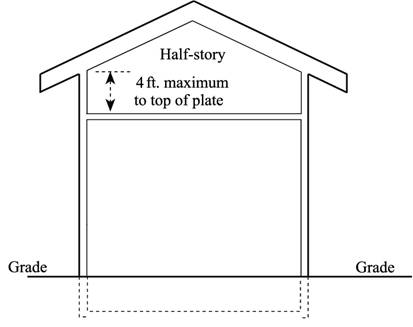
Figure 6-9
Half Story
"Structural alteration" means any change in either the supporting members of a building, such as bearing walls, columns, beams and girders, or in the dimensions or configurations of the roof or exterior walls.
"Structure" means anything constructed or erected, which requires location on the ground or attachment to something having a location on the ground.
"Studios, small" means an establishment that offers instruction to twelve or fewer participants at any one time, involving physical or artistic skills and techniques, including but not limited to dance, music, fitness training, martial arts and fine arts.
"Studios, large" means an establishment that offers instruction to more than twelve participants any one time, involving physical or artistic skills and techniques, including but not limited to dance, music, fitness training, martial arts and fine arts.
"Supportive housing" means housing with no limit on length of stay, that is occupied by the target population, and that is linked to an onsite or offsite service that assists the supportive housing resident in retaining the housing, improving his or her health status, and maximizing his or her ability to live and, when possible, work in the community.
T.
DEFINITIONS, "T."
"Tanning studio" means an establishment that uses artificial lighting systems to produce a tan on an individual's body. This use specifically excludes health and fitness centers ("Health/fitness center").
"Target population" means persons with low incomes who have one or more disabilities, including mental illness, HIV or AIDS, substance abuse, or other chronic health condition, or individuals eligible for services provided pursuant to the Lanterman Developmental Disabilities Services Act (Division 4.5 (commencing with Section 4500) of the Welfare and Institutions Code) and may include, among other populations, adults, emancipated minors, families with children, elderly persons, young adults aging out of the foster care system, individuals exiting from institutional settings, veterans, and homeless people.
"Temporary use" means a land use activity described in Chapter 21.45, whether profit or non-profit, conducted solely on private property for a limited period of time.
"Tennis courts, private" means one or more tennis courts designed and maintained for the sole and exclusive use of the residents/tenants of a specific unit or portion of the site and their invited guests.
"Textile products manufacturing" means manufacturing establishments engaged in performing any of the following operations: Preparation of fiber and subsequent manufacturing of braids, threads, twine cordage, yarn; manufacturing woven fabric and carpets and rugs from yarn; dying and finishing fabric, fiber, yarn, and knit apparel; coating, waterproofing, or otherwise treating fabric; the integrated manufacture of knit apparel and other finished products from yarn; the manufacture of felt goods, lace goods, nonwoven fabrics and miscellaneous textiles; and upholstery manufacturing.
"Theaters, movie or performing arts, and concert halls" means indoor facilities for public assembly and group entertainment, other than sporting events, including public and semi-public auditoriums; civic theaters, and facilities for "live" theater and concerts; motion picture theaters; and similar public assembly uses. Does not include uses categorized as "sexually oriented businesses" as defined in Campbell Municipal Code Section 5.55.020 (Definitions) or as "Public Assembly Uses."
"Towing services" means service establishments where the primary function is the dispatching of tow trucks to motorists in need of a tow to a third location. The facility provides space for the parking of the tow trucks and the private motor vehicles of the tow truck drivers. Also includes administrative offices for the tow truck company and indoor accommodations for servicing (minor maintenance and repair) the tow trucks.
Does not include the short-term storage of towed vehicles ("Motor vehicle parking facilities") or the long-term storage of towed vehicles ("Motor vehicle storage facilities"). Also does not include motor vehicle repair of towed vehicles ("Motor vehicle repair and maintenance, minor and major"). Towing services shall comply with the provisions of Section 21.36.240.
"Townhouse" means a single-family dwelling unit, with a private entrance, which is part of a structure whose dwelling units are attached horizontally in a linear arrangement, and having a totally exposed front and rear wall to be used for access, light, and ventilation.
"Trailer sales" means an open paved area, other than a public street, used for the display, sale, or rental of new or used trailers. Also includes minor incidental repair and service of the trailers displayed or sold on the premises.
"Transit-Oriented Development (TOD)" means a residential or mixed-use development, located within ¼ mile of a light rail passenger terminal (defined herein).
"Transitional housing" means buildings configured as rental housing developments, but operated under program requirements that require the termination of assistance and recirculating of the assisted unit to another eligible program recipient at a predetermined future point in time that shall be no less than six months from the beginning of the assistance.
"Travel agency" means an establishment primarily engaged in acting as an agent in selling travel, tour, and accommodation services to the general public and commercial clients.
"Triplex" means a single structure for three living units that are independent of each other with each one having a kitchen and direct access to the outside or to a common hall. Does not include "Rooming and Boarding Houses."
"Trucking/freight terminals" means this land use consists of transportation establishments furnishing services incidental to air, motor freight, and rail transportation including:
1.
Freight forwarding services;
2.
Freight terminal facilities;
3.
Joint terminal and service facilities;
4.
Packing, crating, inspection and weighing services;
5.
Postal service bulk mailing distribution centers;
6.
Transportation arrangement services;
7.
Trucking facilities, including transfer and storage.
"Tutoring center, small" means an establishment providing instruction to twelve or fewer students at any one time, for personal or professional enrichment, involving scholastic, non-physical pursuits, including but not limited to academics, language instruction, wine appreciation, and computer training.
"Tutoring center, large" means an establishment providing instruction to more than twelve students at any one time, for personal or professional enrichment, involving scholastic, non-physical pursuits, including but not limited to academics, language instruction, wine appreciation, and computer training. Establishments providing instruction as a part of a certificate or degree granting program are included under the definition of "commercial school."
U.
DEFINITIONS, "U."
Universities/colleges, private. See "universities/colleges, public"; however, these universities/colleges are privately owned and operated.
"Universities/colleges, public" means and includes community colleges, public colleges, universities, and technical schools granting associate arts degrees, certificates, undergraduate, and graduate degrees, and requiring for admission at least a high school diploma or equivalent general academic training.
V.
DEFINITIONS, "V."
"Vending machine" means an unattended self-service device that, upon insertion of coin(s) or token(s) or by similar means, dispenses anything of value including food, beverages, goods, wares, merchandise, or services.
"Veterinary clinics and animal hospitals" means office and indoor medical treatment facilities used by veterinarians, including large and small animal veterinary clinics, and animal hospitals. A maximum of five animals may be kept overnight only if they are receiving medical treatment at the clinic/hospital. Veterinary clinics and animal hospitals shall comply with the provisions of Section 21.36.250.
"Video rental store" means an establishment primarily engaged in the retail rental or lease of videotapes, films, CD-ROMs, laser discs, DVDs, electronic games, cassettes, or other electronic media. Sales of videotapes, films, CD-ROMs, laser discs, DVDs, electronic games, cassettes, or other electronic merchandise associated with VCR's, video cameras, DVD players, and electronic games are permitted accessory uses.
W.
DEFINITIONS, "W."
"Warehouse retail stores" means retail stores that emphasize the packaging and sale of products in large quantities or volumes, some at discounted prices, where products are typically displayed in their original shipping containers. Sites and structures are usually large and industrial in character. Patrons may or may not be required to pay membership fees.
Warehousing, wholesaling, and distribution facility, incidental. See "warehousing, wholesaling, and distribution facilities," primary; however, these facilities are only incidental to a manufacturing facility, and serve only as the warehouse for that facility. These incidental facilities do not exceed fifty percent of the total gross floor area of the manufacturing facility that it serves.
Warehousing, wholesaling, and distribution facilities, primary.
1.
Warehousing. Warehouse facilities provide for the storage of furniture, household goods, or other commercial goods of any nature. Also includes cold storage. Does not include: warehouse, storage, or personal or mini-storage facilities offered for rent or lease to the general public. For these see "Storage facilities."
2.
Wholesaling and distribution facilities. Wholesaling and distribution facilities include establishments engaged in selling merchandise to retailers; to industrial, commercial, institutional, farm, or professional business users; or to other wholesalers; or acting as agents or brokers in buying merchandise for or selling merchandise to these persons or companies. Includes the following establishments:
a.
Agents, merchandise or commodity brokers, and commission merchants;
b.
Assemblers, buyers and associations engaged in the cooperative marketing of farm products;
c.
Merchant wholesalers;
d.
Stores primarily selling electrical, plumbing, heating and air conditioning supplies and equipment.
"Wildlife habitat" means any area of land or water valuable or necessary to or suitable for the preservation or enhancement of wildlife resources.
"Width, Public Right-of-Way" means the horizontal width of the area of real property in which the city has a dedicated or acquired right-of-way interest in the real property. It shall include the area on, below or above the present and future streets, alleys, avenues, roads, highways, parkways, bike lanes or boulevards dedicated or acquired as right-of-way.
Wireless Telecommunications Facilities—Non-Stealth. See wireless telecommunications facilities—stealth; however, these facilities do not meet the definition of a stealth facility, defined below.
"Wireless telecommunications facilities—stealth" means a land use facility supporting antennas that sends and/or receives radio frequency signals.
1.
Wireless telecommunications facilities. Wireless telecommunications facilities include antennas and all other types of equipment for the transmission or receipt of these signals; telecommunication towers or similar structures built to support the required equipment; equipment cabinets, Base Transceiver Stations, and other accessory development. Also referred to as a "Telecommunication facility."
"Stealth facility" means any telecommunications facility which is designed to blend into the surrounding environment, and is visually unobtrusive. Examples of stealth facilities may include architecturally screened roof-mounted antennas, facade mounted antennas painted and treated as architectural elements to blend with the existing structure. Also known as "Concealed telecommunications facilities."
Y.
DEFINITIONS, "Y."
"Yard" means an open space, other than a court, on a lot, unoccupied and unobstructed from the ground upward, except as otherwise provided in this Zoning Code.
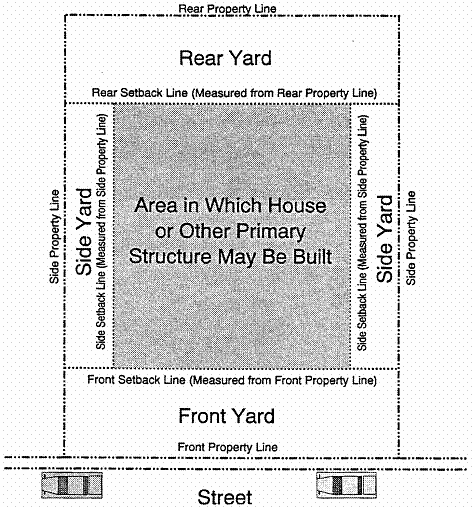
Figure 6-10. Yards
"Yard, front" means a yard extending across the full width of the lot, the depth of which is the minimum horizontal distance between the front lot line and a line parallel thereto to the lot.
"Yard, rear" means a yard extending across the full width of the lot between the most rear main building and the rear lot line; the depth of the required rear yard shall be measured horizontally from the nearest point of the rear lot line toward the nearest part of the main building.
"Yard, side" means a yard between the main building and the side lot line, extending from the front yard, or front lot line where no front yard is required, to the rear yard; the width of the required side yard shall be measured horizontally from the nearest point of the side lot line toward the nearest part of a main building.
"Yard sale." See "garage/yard sales, private."
"Year" means three hundred sixty-five calendar days.
Z.
DEFINITIONS, "Z."
"Zoning district, base" means the zoning district of a parcel or property as indicated on the City of Campbell Zoning Map, in accordance with Campbell Municipal Code Chapter 21.06 (District Boundaries), other than the Overlay/Combining District.
(Ord. 1617 Sl(part), 1986; Ord. 2093 § 1(part), 2007; Ord. 2043 § 1(part), 2004; Ord. No. 2149, § 1(Exh. A), 6-7-2011; Ord. No. 2182, § 5(Exh. D), 10-7-2014; Ord. No. 2196, §§ 15, 16, 2-2-2016; Ord. No. 2199, §§ 3, 4, 4-5-2016; Ord. No. 2213, §§ 26, 27, 11-1-2016; Ord. No. 2216, § 13, 12-12-2016; Ord. No. 2222, §§ 9, 10, 5-16-2017, eff. 6-15-2017; Ord. No. 2250, §§ 18—22, 9-3-2019; Ord. No. 2251, § 5, 10-15-2019; Ord. No. 2252, §§ 17, 18, 11-19-2019; Ord. No. 2266, § 6, 9-1-2020; Ord. No. 2270, §§ 14, 19, 3-16-2021; Ord. No. 2286, § 9, 8-16-2022; Ord. No. 2293, § 1(Exh. B), 5-2-2023; Ord. No. 2305, §§ 8—10, 4-16-2024; Ord. No. 2306, §§ 34—56, 4-16-2024)

