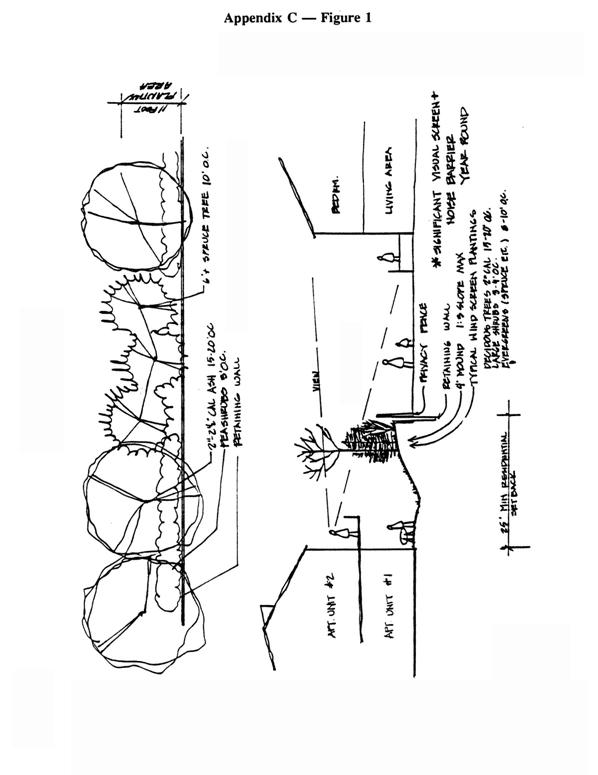
Casper City Zoning Code
Appendix C
BUFFERING
Goal.
To encourage the most appropriate use of land and conserve and protect the privacy and value of adjacent uses.
Objectives.
The buffering alternatives are designed to meet the following objectives:
A.
To provide a smooth transition between adjoining properties;
B.
To encourage developments compatible with existing developments;
C.
To mitigate existing or potential conflicts between differing land uses.
Definition.
Buffering means the use of specific measures including screening, which are designed to separate and protect differing land uses.
Procedures.
Buffering is required by Section 17.12.130 of this title for all multifamily dwellings adjacent to single-family dwellings and for all PUD, commercial, industrial and multifamily developments adjacent to residential developments. Plans detailing buffering measures shall be included in the site plan application which shall be filed and processed according to the provisions of Appendix A of this title. Compliance with approved buffering measures shall be enforced by the enforcement officer.
Buffering Alternatives.
Recognizing that the amount and type of buffering necessary varies with each particular situation, the following alternative measures are designed to provide the flexibility necessary for the maximum mitigation of conflicts between differing land uses:
A.
Screening shall be required between the differing land uses as specified above and shall consist of one of the following:
1.
Screening Alternate 1: Consists of a six-foot solid wood fence or a masonry or concrete wall. Ten percent of the total screening surface may be composed of (a) openings, each having a maximum area of twenty-four square inches, or (b) materials other than masonry or concrete which may contain openings having a maximum dimension of nine inches in width or height;
2.
Screening Alternate 2: Consists of a hedgerow of various evergreen shrubs which will normally grow to a height required to adequately buffer developments. All plants should have a minimum height at the time of planting of one-half of the required screening height;
3.
Screening Alternate 3: Consists of a six-foot solid wood fence or a concrete or masonry wall as specified in Screening Alternate 1, and evergreen trees. Such trees should be a minimum of two inches in trunk diameter, at least five to six feet in height and planted ten to twelve feet on center;
4.
Screening Alternate 4: Consists of landscaped earthen berms of a minimum height as needed to buffer developments. Side slopes of berms should have a minimum of four feet of horizontal distance for each one foot of height. Berms should contain necessary drainage provisions as required by the city;
5.
Screening Alternate 5: Consists of large deciduous or coniferous trees. Such trees should be a minimum of two inches in trunk diameter, fifteen feet in height, and planted fifteen to twenty feet on center;
6.
Screening Alternate 6: Consists of any combination of Alternates 1, 2, 3, 4, or 5 so as to provide screening adequate to buffer developments.
B.
In considering approval of a site plan, assessment of the amount of screening required will be based upon the treatment of height, bulk, and density at the edge of the proposed development. The following criteria should be considered in site design:
1.
Open Space Setbacks. By providing an open space buffer between conflicting land uses, conflicts can often be avoided. The width of the buffer required will depend on the extent of other measures applied. To work effectively, the purpose, use and maintenance of the open space buffer must be clearly defined.
2.
Orientation. The strict spatial proximity between land uses and the apparent or functional proximity can be very different, depending on the orientation of buildings and activities in the two land uses.
The buildings can create an effective buffer if constructed back-to-back, thus orienting views, access, and principal activities away from the other land use. However, a hazardous and unaesthetic "no man's land" must not be created in the process. Some appropriate use must be given to the intervening space.
Alternately, the intervening space can be eliminated altogether if the two buildings share a common back wall. An entire site plan can be oriented so least compatible activities and functions are placed furthest from the common boundary between land uses, and those most compatible, near that boundary.
3.
Architectural Compatibility. In addition to the architectural considerations involved in mitigation through orientation, the materials, colors, scale and prominence of buildings in adjacent land uses can be coordinated so there is a gradual transition from one land use to another, rather than a sharp and displeasing contrast. The architectural compatibility should rise from a total consideration of the function of each land use and the function of the space between them.
4.
Circulation. Streets and parking areas can often serve to reduce certain types of land use conflicts.
5.
One-to-One Ratio. Multifamily units constructed in the required setback can be only one story in height; for each additional ten feet of setback, units may be constructed of one additional story up to the maximum height requirements of a district.
C.
Buffering shall not:
1.
Interfere with the installation, maintenance and repair of any public utilities;
2.
Restrict pedestrian or vehicular access; or
3.
Constitute a traffic hazard.
D.
Examples of buffering techniques are shown on the following pages.