
Centennial City Zoning Code
ARTICLE 12
Nonconformities
Sec. 12-12-101. - Purpose of Article.
A.
Generally. Only a small portion of the land area of the City of Centennial is not developed. As such, the application of new land development regulations to existing development is likely to create circumstances in which existing lot dimensions, development density, land uses, buildings, structures, landscaping, parking areas, or signs do not strictly conform to the requirements of the new regulations. The NC, NI-8, and NI-18 zone districts are intended to minimize nonconformities in established neighborhoods by making existing buildings and lots that were lawfully constructed or created "conforming," as provided in Section 12-2-201, Zoning Districts Established, and Division 3-3, Residential Development Standards. For existing lots or development (including uses, buildings, structures, and signs) that is "legally nonconforming" (as defined herein), this Article sets out equitable rules for whether, when, and how the regulations of this LDC apply.
B.
Conversion of Nonconformities. Generally, nonconforming uses, buildings, structures, and signs are not allowed to be enlarged, expanded, increased, nor be used as grounds for adding other structures or uses now prohibited in the same district. This Article provides standards by which minor nonconforming uses (as defined herein) can be made "conforming" through a public hearing process.
C.
Reduction of Nonconformities. It is the policy of the City to encourage reinvestments in property that increase its value and utility and improve its aesthetics and environmental performance. Since bringing a developed parcel into full compliance with this LDC may involve substantial cost (which could discourage reinvestment), this Article provides a set of thresholds for determining when new construction or modifications to development trigger a requirement for conformity with the various requirements of this LDC.
D.
Unlawful Uses, Buildings, Structures, or Signs. This Article does not allow for the perpetuation of uses, buildings, structures, or signs that were unlawfully established or constructed. Such uses, buildings, structures, or signs are not "legally nonconforming," but instead remain "unlawful," and are subject to all of the provisions of this LDC (including enforcement provisions) and any other applicable law. Likewise, this Article does not legitimize unlawful subdivisions of property that may have occurred before the effective date of this LDC.
(Ord. 2024-O-14 §64)
Sec. 12-12-102. - Application of Article.
A.
Generally. This Article applies to uses, buildings, structures, landscaping, signs, parking, and lots that were lawfully constructed but do not conform to the requirements of this LDC.
B.
Exceptions to Article.
1.
This Article does not apply to lots of record in the NC, NI 8 , and NI 18 zone district, regardless of their size (such lots, and lawfully constructed buildings on them, are "conforming," see Section 12-2-201, Zoning Districts Established). In an NC, NI 8 , or NI 18 zone district, any residential building that is destroyed for any reason may be reconstructed to its original form and extent, regardless of whether that form and extent are in strict compliance with the setback, building coverage, and/or height standards for the district.
2.
All multifamily buildings within the AC zoning district that were lawfully constructed before October 28, 2023 are conforming. In an AC zone district, any residential building that is destroyed for any reason may be reconstructed to its original form and extent, regardless of whether that form and extent are in strict compliance with the setback, building coverage, floor area, and/or height standards for the district. See also Section 12-2-202, Nonconforming Buildings.
3.
This Article also does not apply in specific situations that are specified in Division 1-2, Transitional Provisions, which supersedes this Article to the extent of any conflict.
C.
Types of Nonconformities. There are seven general types of nonconformities: uses, buildings, structures, landscaping, signs, parking, and lots. As to uses, nonconformities may be "major" or "minor." These types are set out in Division 12-2, Types and Classes of Nonconformities. The application of the standards of this Article is based on the type of nonconformity that is being addressed.
D.
General Regulations.Division 12-3, General Regulations, sets out the standards for when nonconforming situations must be made conforming (or more conforming) or, alternatively, terminated or removed. It also sets out the circumstances in which a nonconforming situation may be restored or resumed after damage, destruction, or temporary cessation.
E.
Compliance Thresholds.Division 12-4, Compliance Thresholds, sets out the standards for determining when new construction or modifications to development trigger a requirement for conformity with the various requirements of this LDC.
F.
Conversion of Nonconformities.Division 12-5, Conversion of Nonconformities, sets out how to convert a nonconforming use to a conforming use using a conditional use process. Nonconforming buildings and structures may be made conforming using the variance process set out in Section 12-14-801, Variances.
G.
Effect of Article.
1.
Effect on Existing Development Entitlements. Nothing in this LDC shall be interpreted to require a change in plans, construction, or designated use of any building in which a building permit was lawfully obtained from the City's Building Division prior to the effective date of adoption or amendment of this LDC, provided construction was commenced within sixty (60) days after obtaining said building permit and diligently completed.
2.
Effect on Existing Unlawful Uses, Buildings, Signs, and Structures. Any use, structure and/or parcel of land which was used, erected or maintained in violation of any previous Zoning Regulations shall not be considered as a legal, nonconforming use, structure and/or parcel, and shall be required to comply with all provisions of these Regulations.
(Ord. 2023-O-09 §6Ord. 2024-O-14 §65)
Sec. 12-12-201. - Nonconforming Uses.
A.
Generally. A nonconforming use is a use of land that was lawfully established (i.e., it was allowed and legally authorized, if legal authorization was required) on a parcel or lot before the effective date of this LDC (or amendment hereto), that is no longer allowed after the effective date of this LDC (or amendment hereto). The following uses are legally nonconforming uses:
1.
Uses that were lawfully established but are not currently listed as Permitted, Limited, or Conditional Uses in the district in Division 2-3, Land Use, except that structures that were listed as uses of land prior to the effective date and are now regulated as accessory structures (see Division 3-6, Supplemental Residential Development Standards, and Division 3-8, Supplemental Nonresidential and Mixed-Use Development Standards) are either conforming structures (if they comply with the requirements of this LDC or nonconforming structures (see Section 12-12-203, Nonconforming Structures)
2.
Uses that were lawfully established within a floodplain or floodway, but are no longer permitted in the floodplain or floodway.
3.
Uses as of December 5, 2022 in areas zoned Urban Center (UC) not governed by an approved Regulating Plan that are not permitted in the UC zone district are deemed nonconforming.
B.
Classifications of Nonconforming Uses. There are two types of nonconforming uses: major nonconforming uses and minor nonconforming uses. The classification of the nonconforming use affects whether it can be converted to a conforming use.
1.
Major Nonconforming Uses. Major nonconforming uses are those uses for which the nonconformity generates a nuisance per se or represents such incompatibility with adjacent uses and/or the Comprehensive Plan that public policy favors their elimination from the district if they are discontinued, abandoned, or destroyed. Major nonconforming uses are:
a.
Outdoor storage areas that do not comply with the standards of this LDC.
2.
Minor Nonconforming Uses. All nonconforming uses that are not classified as major nonconforming uses are minor nonconforming uses. Such uses may be converted to conforming uses as provided in Division 12-5, Conversion of Nonconformities.
(Ord. 2022-O-31 §6)
Sec. 12-12-202. - Nonconforming Buildings.
A.
Generally. A nonconforming building is a building that was lawfully constructed prior to the effective date of this LDC (or amendment hereto) that does not conform to the height, setback, building coverage, building scale, spacing, and/or design standards that are applicable to the same type of building in the district in which the building is located. For purposes of cross-reference the following standards may apply:
1.
Design standards, which are set out in Article 4, Form and Design Standards.
2.
Scale standards, which are set out in Section 12-3-703, Nonresidential Scale Standards.
3.
Spacing standards, which are set out in Section 12-2-408, Commercial Uses.
B.
Exceptions.
1.
Exceptions apply in the NC and NI zoning districts (see Section 12-12-102, Application of Article).
2.
Exceptions apply in the AC zoning district (see Section 12-12-102, Application of Article).
(Ord. 2023-O-09 §7)
Sec. 12-12-203. - Nonconforming Structures.
A nonconforming structure is a structure other than a building that was lawfully constructed prior to the effective date of this LDC (or amendment hereto) that does not conform to the standards that are applicable to the same type of structure in the district in which the structure is located. The following are illustrative examples of nonconforming structures:
1.
Fences or garden walls that do not comply with the height, setback, or materials standards of this LDC;
2.
Wireless telecommunications facilities that do not comply with the applicable regulations of this LDC;
3.
Swimming pools that do not comply with the applicable regulations of this LDC;
4.
Structures that are located in floodplains, floodways, or open space areas that do not comply with the applicable regulations of this LDC.
Sec. 12-12-204. - Nonconforming Landscaping.
A.
Generally. Nonconforming landscaping is landscaping (or lack thereof) that does not conform to the landscape area or planting requirements of Article 8, Development Landscaping and Tree Protection (including, but not limited to, Development Landscaping and Bufferyard requirements), or other provisions of this LDC that require the designation of landscape surface areas or the buffering of uses (see, e.g., Division 2-4, Limited and Conditional Use Standards, and Article 3, Development Standards).
B.
Landscape Surface Ratio and Open Space Ratio.
1.
Nonresidential, mixed-use, and multifamily residential parcels that were lawfully developed but do not include the required landscape surface ratio that is required after the effective date of this LDC or amendment hereto are also nonconforming with respect to landscaping.
2.
Residential development of housing types other than multifamily is conforming with respect to landscaping if it was platted prior to the effective date of this LDC, except that all property shall be brought into compliance with the groundcover requirements of Section 12-8-301, Groundcover, within two years of the Effective Date.
(Ord. 2025-O-12 §39)
Sec. 12-12-205. - Nonconforming Signs.
A.
Generally. Any sign located within the City limits on the effective date of this LDC that does not conform to the provisions of Article 6, Signs and Lighting, or, if applicable, Division 2-4, Limited and Conditional Use Standards, or Article 4, Form and Design Standards, is a "legal nonconforming" sign, provided it also meets the following requirements:
1.
The sign was approved by a sign permit on the effective date of this LDC, or amendment hereto, if a permit was required under applicable law, or, if no sign permit was required under applicable law for the sign in question, the sign was in all respects in conformity with the applicable law (including, planned unit development approval documents) immediately prior to the effective date or had legal nonconforming status at such time; and
2.
The sign is a permanent sign.
B.
Existing Signs on Annexed Property. If land is annexed to the City after the effective date of this LDC, any signs that do not conform to the provisions of this LDC at such time shall have legal nonconforming status if:
1.
Under applicable federal, state, and county regulations, the sign was legal in all respects immediately prior to annexation;
2.
The sign is a permanent sign; and
3.
The annexation was not conditioned upon the removal or modification of the sign.
Sec. 12-12-206. - Nonconforming Parking.
Nonconforming parking refers to parking spaces, drive aisles, and loading areas that do not conform to the requirements of this code that are set out in Article 5, Parking and Loading, in terms of their number or dimensions.
Sec. 12-12-207. - Nonconforming Lots.
Nonconforming lots are lots that were lawfully created before the effective date of this LDC or amendments hereto, but which no longer comply with the lot width, lot area, or access requirements of this LDC. All lots within NC and NI districts that were lawfully created before the effective date of this LDC are conforming, regardless of their dimensions. See Section 12-2-201, Zoning Districts Established.
Sec. 12-12-301. - Termination, Restoration, and Removal.
A.
Generally. This Section sets out the standards for when a nonconformity must be terminated or removed, and when it is allowed to be restored after temporary cessation, damage or destruction.
B.
Nonconforming Uses.
1.
If a major nonconforming use is discontinued for a period of six months, for any reason, it shall not be resumed.
2.
If a minor nonconforming use is discontinued for a period of six months, for any reason, it shall not be resumed. However, if an application for conversion of the use is filed pursuant to Division 12-5, Conversion of Nonconformities, before the end of the six month period, the use may be resumed as a conforming use after the period expires if the application is granted.
C.
Nonconforming Buildings, Structures, and Elements of Buildings or Structures.
1.
If a nonconforming building or structure or nonconforming element thereof is damaged or destroyed by any means, or be declared unsafe by the Chief Building Official to an extent that repairs would exceed more than fifty (50) percent of the replacement cost of the building or damaged nonconforming element, the building shall be reconstructed in conformity with the provisions of this LDC.
2.
If a nonconforming building or structure or nonconforming element thereof within the Urban Center (UC) zone district not governed by an approved Regulating Plan is damaged or destroyed by any means, or be declared unsafe by the Chief Building Official to an extent that repairs would exceed more than fifty (50) percent of the replacement cost of the building, it shall be reconstructed in conformity with the provisions of this LDC, to the standards of the General Commercial (CG) zone district, and any applicable Overlay Districts, and the previous use as of December 5, 2022 may be resumed.
3.
If the reconstruction cost and/or area of reconstruction (whichever is less) is less than or equal to fifty (50) percent of the cost of replacement or area of the building, respectively, then the structure may be strengthened or restored to a safe condition provided that:
a.
The original nonconformity is not enlarged, increased, or extended;
b.
Building permits are obtained for repairs within six (6) months of the date the building was damaged or, if no date can be reasonably established for the damage, the date that the Chief Building Official determines that the building is unsafe; and
c.
The construction is commenced within six (6) months after obtaining the required building permits.
D.
Nonconforming Landscaping. Destroyed or removed landscaping shall be replaced with conforming landscaping if the destroyed or removed landscaping:
1.
Did not comply with the requirements of Section 12-8-501, General Requirements, or Section 12-8-601, Planting Locations; or
2.
Is listed in the Prohibited Plants list included in Appendix A, Plant Lists.
E.
Nonconforming Signs or Sign Elements.
1.
A nonconforming sign which has been damaged by fire, wind or other cause in excess of 50 percent of its replacement cost shall not be restored except in conformance with this LDC.
2.
If an element of a sign that causes the sign to be nonconforming is removed, it shall not be replaced, except with a conforming element. For example, if a sign is nonconforming with respect to the items of information limitation, and a tenant panel is removed, then the new tenant panel shall be conforming with respect to its proportional share of items of information (e.g., if a five-panel directory sign has a total of 60 items of information, but only 20 are allowed, then when a single panel is replaced, the new panel may include up to four items of information).
3.
If a nonconforming sign structure does not display any message for a period of 30 days, it shall be removed or brought into conformance with this LDC. For the purposes of this standard, a temporary "sock sign" may be used to display a message while a new sign face is being created.
4.
If a nonconforming sign structure is removed for any reason other than routine repair and maintenance, it shall not be replaced unless the replacement sign conforms to this LDC.
5.
Nonconforming signs that are a danger to the public safety due to damage or wear shall be removed and shall not be replaced unless the replacement sign conforms to this LDC.
(Ord. 2022-O-31 §7)
Sec. 12-12-302. - Changes of Use.
A.
Generally. A nonconforming use shall not be changed to another nonconforming use.
B.
Effect of Change of Use.
1.
A change of use from a nonconforming use to a conforming use shall create an irrebuttable presumption of the owner's intent to discontinue the nonconforming use. After the change in use, the nonconforming use shall not be resumed.
2.
If the use of a portion of a building or property is changed from a nonconforming use to a conforming use, then the use of that portion of the building or property shall not thereafter be changed back to the nonconforming use.
Sec. 12-12-303. - Repairs and Modifications.
A.
Generally. Repairs and modifications to nonconforming buildings, structures and signs are permitted as provided in this Section, except that nonconforming buildings and structures that are located in floodplains are subject to the restrictions of Section 12-12-305, Nonconforming Buildings and Structures in Floodplains, and not this Section.
B.
Repairs and Alterations.
1.
Generally. Routine maintenance of nonconforming buildings, structures, and signs is permitted, including necessary non-structural repairs, paint, and incidental alterations which do not extend or intensify the nonconforming buildings, structures, or signs or materially extend their life (for signs, routine maintenance includes changing the message of the sign by replacing or repainting the sign face). This standard also applies to buildings, structures, and signs that are used by nonconforming uses if they are designed in a way that is not suitable for re-use as a conforming use.
2.
Structural Alterations. Structural alterations to nonconforming buildings, structures, and signs are permitted only if it is demonstrated that the alteration will eliminate the nonconformity or reduce it in accordance with the standards of Division 12-4, Compliance Thresholds.
3.
Buildings Containing Major Nonconforming Uses. No building or structure that contains a major nonconforming use shall be enlarged unless the major nonconforming use is permanently discontinued.
4.
Modification of Nonconforming Static Billboard. Modification of a nonconforming Static Billboard to a nonconforming Digital Billboard shall be permitted subject to the following conditions:
a.
To authorize the modification of a nonconforming Static Billboard to a nonconforming Digital Billboard, a reduction in the total number of nonconforming Static Billboards in the City shall be required by the complete elimination and removal of one (1) nonconforming Static Billboard for each modification of another nonconforming Static Billboard within the City. If the owner or operator of a nonconforming Static Billboard applies to the City for a building permit that requests the City to authorize a modification of a nonconforming Static Billboard to a nonconforming Digital Billboard, the City shall issue an irrevocable, conditional building permit to such owner or operator, and such irrevocable, conditional building permit shall provide that (i) the City has no right to revoke or rescind such building permit and also that (ii) the owner or operator has no right to commence a modification of a nonconforming Static Billboard to a nonconforming Digital Billboard until such owner or operator has completed the elimination and removal of one (1) other nonconforming Static Billboard within the City.
b.
The modification of a nonconforming Static Billboard to a nonconforming Digital Billboard, which modification may include structural alterations to, or the complete removal of, a nonconforming Static Billboard, and the construction and installation of a new nonconforming Digital Billboard, pursuant to this Section does not change the nonconforming status of such sign. Such sign shall remain a nonconforming sign subject to the regulations of Article 12 of the LDC.
c.
The modification of a nonconforming Static Billboard to a nonconforming Digital Billboard, which modification may include structural alterations to, or the complete removal of, a nonconforming Static Billboard, and the construction and installation of a new nonconforming Digital Billboard, pursuant to this Section shall be considered routine repair and maintenance so as not to conflict with Section 12-12-301(E)(4).
d.
Section 12-12-303(B)(2) concerning the structural alteration of a nonconforming sign shall not be applicable to this subsection (4) of this Section.
e.
A new nonconforming Digital Billboard shall not be larger in size than the total size of the nonconforming Static Billboard that is then being modified in accordance with the terms of this Section. A new nonconforming Digital Billboard shall not have more than the same number of sign faces as the nonconforming Static Billboard being modified. The location, angle and position of a new nonconforming Digital Billboard face may vary plus or minus ten percent (10%) from the then current location, angle and position of the nonconforming Static Billboard face that is then being modified or replaced in accordance with the terms of this Section.
f.
Section 12-12-301 (B)(2) concerning the discontinued use of a minor nonconforming use for a period of six months or longer, and Section 12-12-301(E)(3) concerning the failure of a nonconforming sign structure to display any message for a period of 30 days or more, shall not apply during the time period required to complete a modification of a nonconforming Static Billboard to a nonconforming Digital Billboard.
g.
Section 12-12-301(E)(1) concerning the restoration of a nonconforming sign in the event of a casualty shall not be applicable to a nonconforming Digital Billboard, provided that the Digital Billboard be restored to fully operational within ninety (90) days of such casualty.
h.
Section 12-12-302(A) concerning changing a nonconforming use to another nonconforming use shall not be applicable to a modification of a nonconforming Static Billboard to a nonconforming Digital Billboard.
i.
The modification of a nonconforming Static Billboard to a nonconforming Digital Billboard pursuant to this Section shall be subject to the provisions in Section 12-6-307, Digital Billboards. The modification of a nonconforming Static Billboard to a nonconforming Digital Billboard pursuant to this Section shall not be subject to the provisions in Section 12-6-305, Message Centers.
j.
All external lights previously associated with the nonconforming Static Billboard shall be completely removed prior to initial operation of the Digital Billboard. No external lighting shall be permitted with any Digital Billboard.
k.
The City Manager shall be authorized to enter into an agreement with the owner or operator of a nonconforming Digital Billboard which agreement may establish terms and conditions for the removal of a nonconforming Static Billboard and the operation, maintenance, and repair of a nonconforming Digital Billboard to best protect and advance the safety and welfare of the public. Such terms and conditions may include, but not be limited to, provisions concerning the timing of billboard removal and installation, the timing of changes to the billboard message or content, limitations on the lighting and illumination of any display, and the civic use of the nonconforming Digital Billboard to display information on behalf of the City to serve the public interest.
C.
Expansion of Nonconforming Uses.
1.
Major Nonconforming Uses. Major nonconforming uses shall not be expanded, enlarged, extended, increased, or moved to occupy an area of land or building that was not occupied on the effective date of this LDC or any amendment that made the use a major nonconforming use.
2.
Minor Nonconforming Uses. No minor nonconforming use shall be expanded or extended in such a way as to:
a.
Occupy any open space or landscaped area that is required by this LDC;
b.
Exceed building coverage or height limitations of the zoning district in which the use is located;
c.
Occupy any land beyond the boundaries of the property or lot as it existed on the effective date of this LDC; or
d.
Displace any conforming use in the same building or on the same parcel.
(Ord. 2018-O-17 §4)
Sec. 12-12-304. - Nonconforming Lots; Combination and Construction.
A.
Combination of Lots to Increase Conformity.
1.
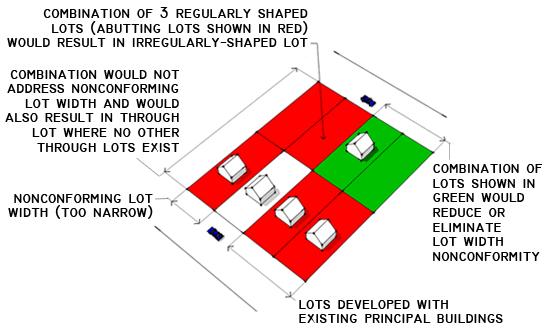
Where a landowner owns several abutting lots that do not conform to the dimensional requirements of the district in which they are located, they shall be combined to create fully conforming lots or, if full conformity is not possible, they shall be combined if the combination will increase the degree of conformity. See Figure 12-12-304, Combination of Nonconforming Lots.
2.
The City will not require the combination of lots pursuant to paragraph A.1., above, if:
a.
The combination of lots would not address the nonconformity (see Figure 12-12-304, Combination of Nonconforming Lots);
b.
Two or more of the lots are developed with principal buildings, and the combination of lots would require that one or more of the buildings be torn down in order to comply with this LDC (see Figure 12-12-304, Combination of Nonconforming Lots);
c.
The combination of lots would materially disrupt the lotting pattern of the street, for example, by creating a through lot mid-block on a street segment that does not include any other through lots (see Figure 12-12-304, Combination of Nonconforming Lots);
d.
The combination of lots would result in regularly shaped lots being combined into a single lot with an irregular shape (see Figure 12-12-304, Combination of Nonconforming Lots); or
e.
The lots are located in the NC or NI district (in which case they are not nonconforming, see Section 12-2-201, Zoning Districts Established).
|
Figure 12-12-304
Combination of Nonconforming Lots |
|---|
 |
B.
Construction on Legal Lots That Do Not Conform to Dimensional Requirements. A legal lot that does not meet district requirements with respect to lot area or lot width may be built upon if:
1.
The lot is a lot of record;
2.
The use is permitted in the district in which the lot is located; and
3.
The lot has sufficient frontage on a public street to provide access that is appropriate for the proposed use.
Sec. 12-12-305. - Nonconforming Buildings and Structures in Floodplains.
It is the intent of the City of Centennial that no new construction of permanent structures be located in the floodplain, and that existing legal nonconforming structures be subject to Section 12-7-304(C), Existing Structures in floodplains.
Sec. 12-12-306. - Nonconforming Parking.
A.
Generally. Nonconforming parking and loading areas are subject to the regulations of this Section.
B.
Number of Parking Spaces.
1.
Building Expansions. If an existing building or use is expanded, additional parking shall be required only in proportion to the new area of the building or use.
2.
Change of Use. If the use of a building changes, resulting in additional demand for parking, then the number of parking spaces provided shall be brought into conformance with the requirements of Article 5, Parking and Loading.
3.
Redevelopment. If an existing building is redeveloped, parking shall be provided as required by Article 5, Parking and Loading.
C.
Size of Parking Spaces and Drive Aisles; Surfacing. Parking spaces and drive aisles shall be sized according to the requirements of Article 5, Parking and Loading, and surfacing shall be provided as required by Section 12-5-402, Surfacing and Maintenance of Off-Street Parking Areas, when so required by Division 12-4, Compliance Thresholds.
Sec. 12-12-307. - Nonconformity with Airport Influence Area Restrictions.
The owner of any nonconforming structure or object of natural growth within an Airport Influence Area shall permit the installation, operation and maintenance thereon of such markers and lights as shall be deemed necessary by the City Council, after consultation with the appropriate airport operator, to indicate to the operators of aircraft in the vicinity of the airport the presence of such nonconforming structures or objects of natural growth.
Sec. 12-12-308. - Nonconformity Created by Public Action.
Any nonconforming structure or land expressly created or caused by a conveyance of privately owned land to a federal, state or local government to serve a public purpose is conforming for the purposes of this LDC, and is not subject to the limitations of this Article. This exemption applies only in cases where private land is obtained by a governmental entity for a public purpose, through condemnation, threat of condemnation or otherwise, which creates a nonconformity in the remainder parcel in terms of setback, lot size, or other standards of this LDC. This exemption does not apply to right-of-way dedication or other public conveyances of land required by the City in the course of subdivision or other routine development plan approvals.
Sec. 12-12-401. - Purpose and Applicability of Division.
A.
Purpose. The purpose of this Division is to encourage reinvestment and the repurpose of existing buildings and development sites. This is achieved by prioritizing improvements that cure immediate non-conforming concerns and to promote the health, safety, and general welfare of the City. The purpose of this Division is not to achieve immediate full compliance with the provisions of the LDC, but to instead strategically prioritize improvements to focus on safe, functional, and aesthetic priorities where they align with the City's long term strategic land use goals.
B.
Applicability. The standards of this Division shall apply when any Type of Improvement that is listed in Table 12-12-402 is proposed. The Type of Improvement determines the Level of Site Compliance Required shown in Table 12-12-402. Proposed modifications to a building or site may fit into one or multiple Types of Site Improvements categories depending on the scope of work, which may require multiple Levels of Site Compliance. If a modification does not require additional compliance, this does not allow the modification to take place that would therefore create a nonconformity.
(Ord. 2025-O-03 §6)
Sec. 12-12-402. - Sliding Scale Compliance Requirements.
Table 12-12-402, Sliding Scale Compliance Requirements, sets out the Types of Improvements to a property that trigger compliance with the regulations set out in this LDC.
(Ord. 2024-O-08 §2; Ord. 2025-O-03 §§7, 8; Ord. 2025-O-06 §18; Ord. 2026-O-07 §16)
Sec. 12-12-501. - Purpose.
Many minor nonconforming uses have existed for a period of time, and some may have only recently become nonconforming. In many instances, minor nonconforming uses are integral parts of the City's fabric, that is, its character and function, so their continuing existence promotes the City's policy objective of protecting its neighborhoods. In these instances, the classification "nonconformity" and resulting restriction on investment may not be what the community desires. As such, the use may be made conforming pursuant to this Division in order to remove the stigma associated with the "nonconforming" designation.
Sec. 12-12-502. - Procedure.
A.
Generally. An owner of a minor nonconforming use may apply for a conditional use permit which has the effect of making the nonconforming use conforming. The criteria for conditional use approval are set out in Section 12-12-503, Criteria for Approval.
B.
Exclusions. This procedure does not apply to nonconforming lots, which may be buildable in accordance with the standards of Section 12-12-304, Nonconforming Lots; Combination and Construction.
Sec. 12-12-503. - Criteria for Approval.
A.
Generally. A conditional use approval may be granted to make a nonconforming use conforming, if, in addition to the criteria for approval of a conditional use set forth in Section 12-14-601, Conditional Use and Temporary Conditional Use Procedures, all of the criteria of this Section are satisfied.
B.
Minimal Nonconformity. The use, as conducted and managed, has minimal nonconformities and has been integrated into the neighborhood's (or district's if it is not in or adjacent to a residential neighborhood) function, as evidenced by the following demonstrations:
1.
The neighborhood residents regularly patronize or are employed at said use (for nonresidential uses in or abutting residential neighborhoods).
2.
Management practices eliminate nuisances such as noise, light, waste materials, unreasonably congested on-street parking, or similar conflicts.
3.
There is no material history of complaints about the use (a history of complaints is justification for denying the conditional use permit, unless the conditions of the permit will eliminate the sources of the complaints).
4.
If the use is nonresidential, it is licensed in accordance with the applicable ordinances of the City of Centennial.
5.
The use has been maintained in good condition and its classification as a nonconformity would be a disincentive for such maintenance.
C.
Conditions. Conditions may be imposed relative to the expansion of bufferyards, landscaping, or other site design provisions, or other limitations necessary to ensure that, as a conforming use, the use will not become a nuisance. Such conditions may relate to the lot, buildings, structures, or operation of the use.
Sec. 12-12-504. - Effect and Annotation.
A.
Generally. Uses that comply with the terms of a conditional use permit issued in accordance with this Division are converted from "legally nonconforming uses" to "conforming uses" by virtue of the issuance of the permit.
B.
Written Approval. Conditional use approvals shall be provided to the applicant in writing and may be recorded by the applicant at the applicant's expense.
C.
Annotation of Official Zoning Map. Upon granting a conditional use permit and the applicant's demonstration of compliance with any conditions placed upon it, the Director shall place an annotation on the Zoning Map that states that the property has a conditional use permit, as well as the permit number and date of approval.

