
Centennial City Zoning Code
ARTICLE 3
Development Standards
Division 3-4. - Traditional Neighborhood Development Standards[2]
Editor's note—Ord. 2024-O-14 §§30—35, adopted October 1, 2024, repealed the former Div. 3-4, §§ 12-3-401—12-3-404, and enacted a new Div. 3-4 as set out herein. The former division pertained to residential neighborhood development standards and derived from the 2010 Land Development Code and Ord. 2022-O-20 §§4—6.
Division 3-5. - Reserved[3]
Editor's note—Ord. 2024-O-14 §36, adopted October 1, 2024, repealed Div. 3-5, §§ 12-3-501—12-3-509, which pertained to housing palette and derived from the 2010 Land Development Code and Ord. 2022-O-20 §7.
Sec. 12-3-101. - Purpose of article.
A.
Generally. Article 2, Districts and Use Standards, sets out which uses are allowed in each district. The purpose of this Article is to:
1.
Set out how much development is allowed on parcels proposed for development in each district, in order to:
a.
Protect and enhance the character of the City by regulating the size and bulk of buildings; and
b.
Maintain the integrity of the City's infrastructure and flood control systems by regulating the density and intensity of development and the amount of land that buildings and impervious surfaces may cover.
2.
Establish the minimum area and dimensions for various types of lots;
3.
Establish the minimum distances that buildings and structures must be set back from property lines or other buildings or structures;
4.
Establish the maximum height of buildings and structures; and
5.
Provide "supplemental standards" which apply to construction of structures or placement of appurtenances that are typically associated with various types of permitted development (e.g., fences, walls, dumpsters, etc.).
B.
Measurements and Calculations. The purpose of Division 3-2, Calculation of Height and Bulk Requirements, is to ensure that all of the measurements and calculations required by this LDC are clear and consistent. The Division provides the methodologies for calculating lot area, lot width, setbacks, height, building coverage, landscape surface ratio, and density.
C.
Residential Development Standards. The purpose of Division 3-3, Residential Development Standards, is to:
1.
Establish general development standards for residential lots in the NC and NI districts, which apply to development of vacant lots, redevelopment of existing buildings, or expansion of existing buildings; and
2.
Establish alternative development standards for residential lots in the NC and NI districts, which apply to expansion or reconfiguration of existing buildings when the expansion or reconfiguration does not comply with the general standards.
D.
Reserved Sections and Divisions.Sections 12-3-402, 12-3-404, and Division 3-5 are held in reserve.
E.
Traditional Neighborhood Development Standards. The purpose of Division 3-4, Traditional Neighborhood Development Standards, is to establish the parameters for development of new traditional neighborhood development. The standards are intended to ensure that the desired character of the zoning district is maintained and to ensure that applicants have the flexibility to design neighborhoods with multiple housing types.
F.
Supplemental Residential Development Standards. The purpose of Division 3-6, Supplemental Residential Development Standards, is to establish standards for the construction of structures and the placement of appurtenances that are typically associated with residential uses and buildings.
G.
Nonresidential and Mixed-Use Development Standards. The purpose of Division 3-7, Nonresidential and Mixed-Use Development Standards, is to establish lot, setback, height, and scale standards for nonresidential and mixed-use development.
H.
Supplemental Nonresidential Development Standards. The purpose of Division 3-8, Supplemental Nonresidential and Mixed-Use Development Standards, is to establish standards for the construction of structures and the placement of appurtenances that are typically associated with nonresidential and mixed-uses and nonresidential and mixed-use buildings.
I.
Airport Influence Area. The purpose of Division 3-9, Airport Influence Area, is to regulate development within the airport influence areas around the Centennial Airport and Buckley Air Force Base to ensure that:
1.
The uses and structures are compatible with expected noise levels;
2.
City residents are protected from potential dangers of aviation operations near the airports; and
3.
The safety of aviation operations is not compromised by development near the airports.
(Ord. 2024-O-14 §19; Ord. 2025-O-12 §4)
Sec. 12-3-102. - Application of article.
A.
Measurements and Calculations. The measurements and calculations of Division 3-2, Calculation of Height and Bulk Requirements, shall be used wherever they are specified in this LDC.
B.
Residential Development Standards. The standards set out in Division 3-3, Residential Development Standards, apply to building expansions, development, and redevelopment of residential units in NC and NI districts. The supplemental standards of Division 3-6, Supplemental Residential Development Standards, also apply to homes within NC and NI districts.
C.
Reserved Divisions.Sections 12-3-402, 12-3-404, and Division 3-5 are held in reserve.
D.
Supplemental Residential Standards. Within residential zoning districts, Division 3-6, Supplemental Residential Development Standards, sets out the standards for:
1.
Structures that are commonly associated with residential development, such as fences, garden walls, accessory buildings (e.g., accessory dwelling units (ADUs), detached garages and storage sheds), decks, balconies, swimming pools, amateur radio antennae, photovoltaic arrays (solar panels), solar water heaters, small wind energy conversion systems (household-scale windmills); and
2.
Certain uses and activities in residential neighborhoods, such as parking of commercial vehicles and recreational vehicles, and garbage containers.
E.
Nonresidential and Mixed-Use Development Standards. The standards set out in Division 3-7, Nonresidential and Mixed-Use Development Standards, apply to nonresidential and mixed-use development. The minimum landscape surface ratio, minimum area of parcels proposed for development, minimum street frontage, and maximum building height for nonresidential and mixed-use buildings in each zoning district are set out in Section 12-3-701, Nonresidential and Mixed-Use Development Standards. Required setbacks and additional setbacks from residential zoning districts are set out in Section 12-3-702, Required Setbacks for Nonresidential and Mixed-Use Development. Section 12-3-703, Nonresidential Scale Standards, sets out standards that limit the scale of nonresidential buildings in certain contexts, to ensure their compatibility with nearby development. These standards supersede other standards with regard to building scale.
F.
Supplemental Nonresidential and Mixed-Use Development Standards. Within nonresidential and mixed-use zoning districts, Division 3-8, Supplemental Nonresidential and Mixed-Use Development Standards, sets out standards for structures, accessory uses, and activities that are common to nonresidential and mixed-use districts.
G.
Airport Influence Area. The regulations of Division 3-9, Airport Influence Area, apply to development that is within the noise impact zones of the Centennial Airport and the Buckley Air Force Base. These regulations restrict uses that would:
1.
Interfere with airport operations;
2.
Be incompatible with airport noise; or
3.
Concentrate people in areas that may be at increased risk of aviation-related accidents.
(Ord. 2024-O-14 §20)
Sec. 12-3-201. - Lot Area.
Lot area is the area within the lot lines. See Figure 12-3-201, Illustrative Lot Area Calculation.
|
Figure 12-3-201
Illustrative Lot Area Calculation | |
|---|---|
| EXAMPLE The example at right is a rectangular lot. Since the area of a rectangle is equal to its length times its width, the lot area is: 65 feet Wide TIMES 125 feet Deep EQUALS 8.125 square feet Lot Area | 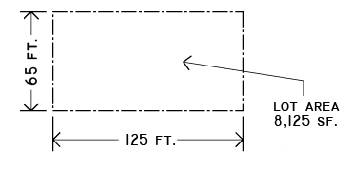 |
Sec. 12-3-202. - Setbacks.
A.
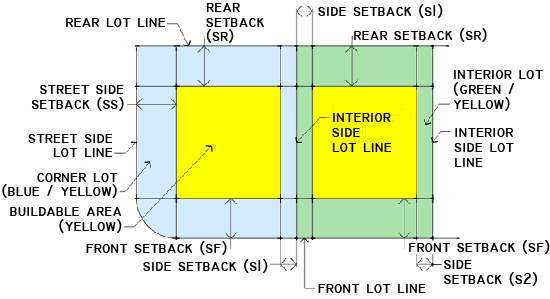
Standard Lots. Setbacks are measured from lot lines towards the center of the lot, as follows:
1.
Front setbacks (abbreviated "SF") are measured from the front lot line. The front lot line is the lot line that abuts the right-of-way from which the lot takes its address. For corner lots with standard curb radii, the front setback is not measured from the curved portion of the lot (however, a portion of this area is included in the required sight triangle, see Section 12-11-208, Sight Triangle Requirements, and the Roadway Design & Construction Standards Manual). For lots without direct frontage on a public or private street, the front lot line shall be the lot line closest and most parallel to the access point or access easement serving the lot. If no clear access exists for a lot, the Director shall determine the front lot line based on the intended orientation of the building and lot context.
2.
Rear setbacks (abbreviated "SR") are measured from the rear lot line. The rear lot line is the lot line that is opposite from the front lot line.
3.
Side setbacks (abbreviated "S1" and "S2") are measured from side lot lines. Side lot lines are lot lines that intersect with front lot lines.
4.
Street side setbacks (abbreviated "SS") are measured from street side lot lines.
|
Figure 12-3-202A
Setbacks on Standard Lots |
|---|
 |
B.
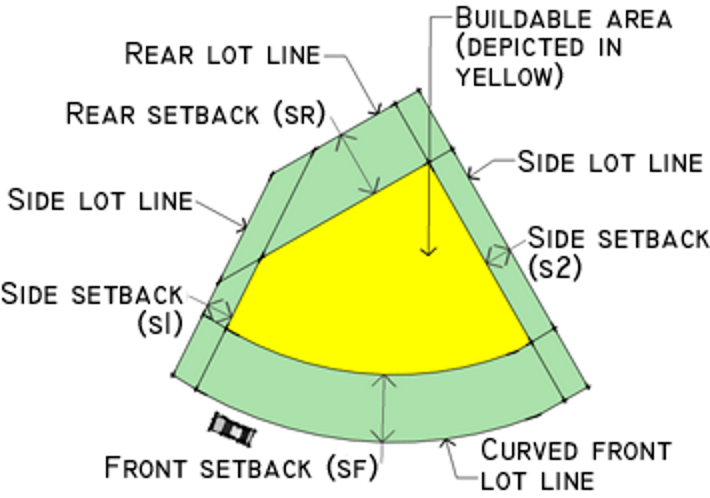
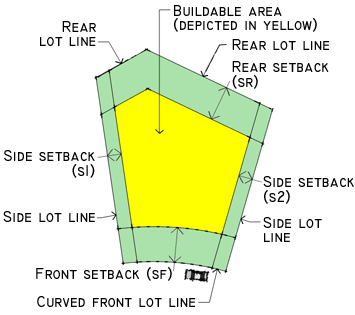
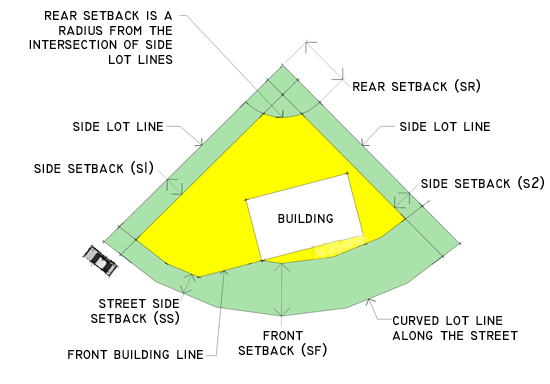
Odd-Shaped Lots. Setbacks are measured from lot lines towards the center of the lot, as follows, and as depicted in Figure 12-3-202B, Setbacks on Odd-Shaped Lots:
1.
Generally, setbacks are measured as set out in subsection A., above.
2.
Where lot lines are curvilinear, setbacks shall be measured as offsets from the curvilinear lot line.
3.
Where there are multiple rear lot lines, the rear setback is measured as offsets from the multiple rear lot lines.
4.
Where there is no rear lot line, the rear setback shall be measured as a radial distance from the intersection of side lot lines at the rear of the lot.
5.
Where the front lot line is an arc, the street side setback area is defined as the area behind the front building line along the arc of the street.
|
Figure 12-3-202B
Setbacks on Odd-Shaped Lots |
|---|
 |
 |
 |
(Ord. 2025-O-06 §6)
Sec. 12-3-203. - Lot Width.
A.
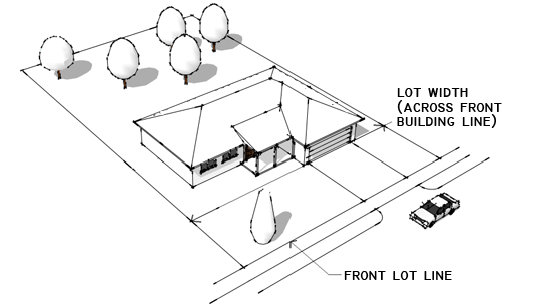
Generally. Lot width is the distance from one side lot line to the opposite side lot line at the front setback line. See Figure 12-3-203A, Measurement of Lot Width; Standard Lots.
|
Figure 12-3-203A
Measurement of Lot Width; Standard Lots |
|---|
| Measurement of Lot Width for Standard Lots (below) |
 |
B.
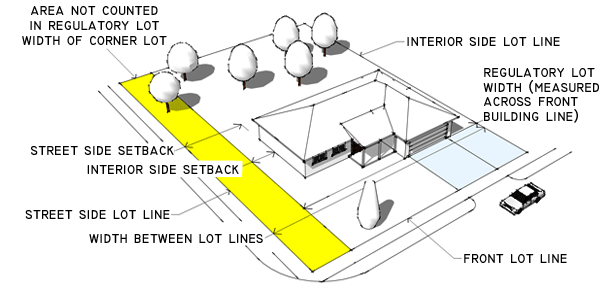
Corner Lots. Lot width (for regulatory purposes) is the distance from the interior side lot line to the street side lot line, measured at the front building line, minus the difference between the required street side setback and the required interior side setback. In simplified terms, regulatory lot width = actual lot width - street side setback + interior side setback. See Figure 12-3-203B, Measurement of Lot Width; Corner Lots.
|
Figure 12-3-203B
Measurement of Lot Width; Corner Lots |
|---|
| Example: If the width between lot lines is 100 feet, the required interior side setback is 5 feet, and the required street side setback is 20 feet, then the regulatory lot width is 100-20+5=85 feet (see below). 1 |
 |
| 1 Setbacks are measured as provided in Section 12-2-202, Setbacks. In this illustration, the required interior side setback is shown measured from the home toward the lot line (instead of vice versa) in order to simplify the illustration of how the difference between the required street side setback and the required interior side setback affect the calculation. |
C.
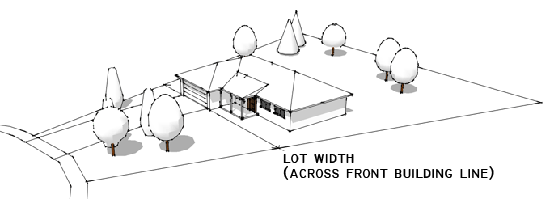
Irregular Lots. Lot width is the distance from one side lot line to the opposite side lot line at the front building line. See Figure 12-3-203C, Measurement of Lot Width; Irregular Lots. Generally, the front building line is the front setback line. However, an alternative front building line may be established on the plat of a subdivision that is more distant than the front setback line from the front lot line. Lot width must be maintained to a depth that is sufficient to accommodate a reasonable building in the context of adjacent and nearby lots.
|
Figure 12-3-203C
Measurement of Lot Width; Irregular Lots |
|---|
 |
Sec. 12-3-204. - Height.
A.
Building Height.
1.
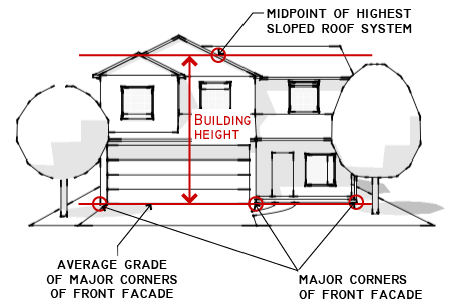
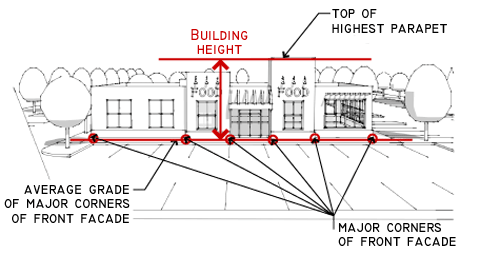
Principal building or structures. Building height is measured from the average existing grade across the front building ("point of measurement"), measured at major corners of the building, to:
a.
The highest midpoint of sloped roof systems; or
b.
The top of the highest parapet of flat roof systems.
|
Figure 12-3-204A.1
Measurement of Building Height (Principal Buildings and Structures) |
|---|
| Illustration of Building Height Measurement for Sloped Roof Systems |
 |
| Illustration of Building Height Measurement for Flat Roof Systems |
 |
2.
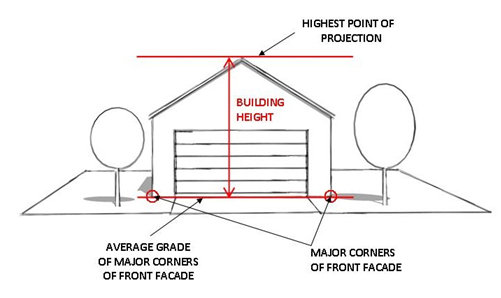
Detached Garages and Accessory Buildings. Building height is measured from the average existing grade across the front building line ("point of measurement"), measured at major corners of the building to the highest point of projection of the roof systems.
|
Figure 12-3-204A.2
Measurement of Building Height (Detached Garages and Accessory Buildings and Structures) |
|---|
| Illustration of Building Height Measurement for Sloped Roof Systems |
 |
B.
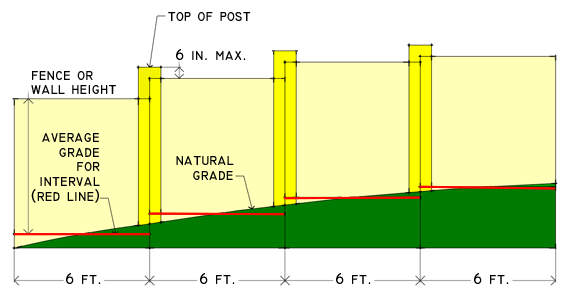
Fences and Garden Walls. The height of fences and garden walls is calculated by measuring the vertical distance from the average finished grade on the outside of the enclosed area (or the side closest to the property line if the fence does not enclose anything) to the top of the fence, at six-foot intervals as appropriate to topography. Fence posts may exceed the height of the highest connected portion of the fence by up to twelve (12) inches.
|
Figure 12-3-204
Fence Height Measurement |
|---|
 |
C.
Other Structures. Structure height is calculated by measuring the vertical distance from the average finished grade around the base of the structure to the highest point on the structure. This measurement applies to:
1.
Structures without roofs; and
2.
Amateur radio antennae, whether mounted on a roof, the ground, or another structure.
D.
Specialized Structures and Building Appurtenances.
1.
Specialized structures and building appurtenances are counted in the calculation of building height, unless all of the following apply:
a.
They project not more than:
i.
Fifteen feet above the highest point on the building for buildings that are two stories in height or higher; or
ii.
Ten feet above the highest point on the building for buildings that are less than two stories in height; and
b.
The projections above maximum building height occupy not more than:
i.
For single-family residential buildings, five percent of the horizontal plane that is covered by the roof; or
ii.
For nonresidential, multifamily, and mixed-use buildings, 10 percent of the horizontal plane that is covered by the roof; and
c.
They are not used for human habitation, commercial, or industrial purposes, except as incidental to the operation of the building.
2.
For the purposes of this subsection, "specialized structures and building appurtenances" means:
a.
Roof structures for the housing of elevators, stairways, tanks, HVAC systems, or similar equipment required to operate and maintain the building;
b.
Architectural towers, steeples, flagpoles, ventilating fans, chimneys, smokestacks;
c.
Skylights, photovoltaic (solar-electric) panels, and solar water heaters; and
d.
Building mounted small wind energy conversion systems.
3.
Satellite dishes and antennae are regulated by Section 12-3-606, Satellite Dishes and Antennae, and not this Section.
Sec. 12-3-205. - Building Coverage and Building Coverage Ratio.
A.
Building Coverage. Building coverage is the total of indoor floor areas taken on a horizontal plane at the main grade level of the principal building and all accessory buildings. It does not include such appurtenances as open porches, terraces, decks, driveways, and steps. All dimensions are measured between the exterior faces of building walls.
B.
Building Coverage Ratio. Building coverage ratio is the percentage of the lot area that is covered by buildings (see subsection A., building coverage, for what qualifies as the lot area that is covered by buildings). See Figure 12-3-205, Building Coverage Ratio Illustration.
| Figure 12-3-205 Building Coverage Ratio Illustration | |
|---|---|
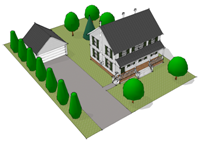
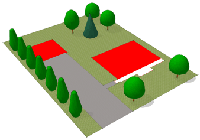
| Example: Pictured below at left is a home with a detached garage on a 10,800 square foot lot
(90 ft. × 120 ft.). At right, pictured in red, are the parts of the home that count
as building coverage. The floorplate of the home is 35 ft. × 40 ft. (1,400 sf.) and
the garage is 24 ft. × 23 ft. (552 sf.), for a total building coverage of 1,952 sf.
(shown in red in the illustration below at right). The open front porch and steps
are not counted (its footprint is shown in white).
The building coverage ratio is: 1,952 sf. DIVIDED BY 10,800 sf., which EQUALS 18% | |
 |  |
Sec. 12-3-206. - Landscape Surface Ratio.
A.
Generally. Landscape surface ratio is used to ensure that a certain percentage of a parcel proposed for development is landscaped.
B.
Landscape Surface Ratio. Landscape surface ratio ("LSR") is the area of designated landscaping on a nonresidential or mixed-use parcel proposed for development divided by the area of the parcel proposed for development. LSR includes bufferyards, parking lot landscaping, foundation plantings, and natural resource protection areas. If the combination of individual landscaping requirements (e.g., protection of natural resources, provision of bufferyards, parking lot landscaping) requires less landscaped area than the LSR, then the LSR applies, and more landscaping is required. If the application of other landscaping standards requires more than the LSR, the greater requirement applies.
(Ord. 2025-O-12 §§5, 6)
Sec. 12-3-207. - Density.
A.
Generally. Density is measured as the number of dwelling units per acre of a parcel proposed for development.
B.
Continuing Care Neighborhoods. The density of continuing care neighborhoods is measured as the number of dwelling units per acre of a parcel proposed for development, with the number of dwelling units counted as the number of dwelling units for independent, ambulatory residents; plus one-half of the number of beds for ambulatory residents who live in congregate facilities; plus one-fourth of the number of beds for residents receiving nursing care.
Sec. 12-3-301. - General standards for residential development.
A.
Generally. This Section sets out the standards for redevelopment, new development, and expansion of existing residential development in the NC and NI districts. If a building or building expansion beyond the existing foundation is proposed in the NC5, NC6, NC9, NC12, or NI district, and it does not comply with one or more of the setback standards of Table 12-3-301A, Residential Lot and Building Standards, then the corresponding setback standards of Section 12-3-302, Alternative Setback Standards for Single-Family Detached Homes; or Section 12-3-303, Alternative Setback Standards for Single Family Attached Homes; or Section 12-3-304, Alternative Setback Standards for Condominium and Alternative Land Ownership Patterns; are applied instead of the standards of this Section. For side setbacks, if a proposed expansion would be set back less than a minimum side setback and/or would make the entire building set back less than the total side setback, then the alternative development standards for the side setback where the expansion is proposed applies. Design Requirements for Residential Development are set out in Article 4, Form and Design Standards.
B.
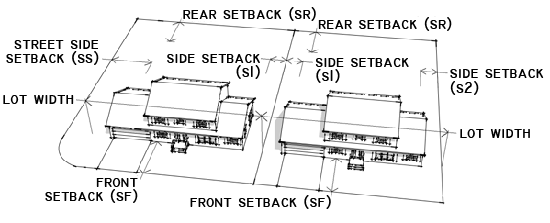
Standards. The lot and building standards for residential development are set out in Table 12-3-301A, Residential Lot and Building Standards. The lot width and setbacks set out in the table are illustrated in Figure 12-3-301, Single-Family Lot Widths and Setbacks, and measured as set out in Section 12-3-201, Lot Area; Section 12-3-203, Lot Width; Section 12-3-202, Setbacks; Section 12-3-204, Height; and Section 12-3-205, Building Coverage and Building Coverage Ratio.
C.
Building Height. The permitted building heights are included in Table 12-3-301A, Residential Lot and Building Standards, with reference to Table 12-3-301B, Neighborhood Infill Subdistricts. Table 12-3-301B identifies the permitted range of building heights within the applicable subdistrict, including maximum heights. The NI subdistricts support a range of building heights to prioritize compatibility, with intervals of five (5) feet in permitted heights (e.g., NI SFD/SFA 35 or NI SFA 45 ).
D.
Dove Valley Residential Overlay District. Properties zoned RU within the Dove Valley Residential Overlay District must implement a Traditional Neighborhood Development (TND) through the NI TND zone district standards. A TND within the Dove Valley Residential Overlay District must provide a minimum of three (3) housing types as set out in Section 12-3-403, Mix of Housing Types, within the NI TND zone district, with a minimum percentage of any one (1) housing type being twenty (20) percent.
E.
Condominiums and Common Maintenance Communities. Where buildings are part of a common maintenance community in which either common open space separates buildings and/or separates lot lines from streets, or all land is owned by a condominium association:
1.
The separation between buildings shall be at least two times the corresponding setback from Table 12-3-301A, Residential Lot and Building Standards.
2.
Setbacks in relation to the street shall be measured as:
i.
The shortest distance from the front elevation of the building to the back of the sidewalk; or
ii.
If no sidewalk is present, the back of the curb; or
iii.
If no sidewalk or curb is present, the edge of pavement; but
iv.
Any such measurement shall not permit buildings to be constructed in public rights-of-way.
3.
The front setback of buildings that face parking lots or internal drives shall be measured as if the parking lot or internal drive pavement is a street.
4.
Building coverage ratio may be measured by dividing the total of all building footprints in the development by the total land area of the development.
F.
Bufferyards. New development and redevelopment shall be configured to provide the bufferyards required by Section 12-8-406, District Boundary Bufferyards.
|
Figure 12-3-301
Single-Family Detached Lot Widths and Setbacks |
|---|
 |
(Ord. 2024-O-14 §§21—23; Ord. 2025-O-12 §7)
Sec. 12-3-302. - Alternative Setback Standards for Single-Family Homes.
A.
Generally. In NC, and NI-8, and NI-18 zone districts, rigid adherence to standardized building setback distances is often not practical. This Section provides an alternative set of standards for development, redevelopment, and expansion of existing buildings (as indicated below) within these three districts when the new construction would encroach into the setbacks that are established by Section 12-3-301, General Standards for Residential Development.
B.
Alternative Building Setback Standards; All Setbacks. Alternative setbacks shall be applied only if it is demonstrated that the standards of the applicable subsection of this Section are met, and:
1.
The proposed construction does not interfere with planned expansion of right-of-way, and if right-of-way expansion is planned, the encroachment is evaluated as if the right-of-way has been expanded;
2.
The proposed construction does not result in interference with a utility easement;
3.
Drainage onto abutting properties or rights-of-way is not significantly altered, and drainage patterns are not substantially changed, when compared to the condition before the proposed development;
4.
The proposed construction does not result in a nonconformity with respect to the building code on either the lot proposed for development or abutting properties;
5.
If the parcel that abuts the improvement is used for residential purposes, the proposed construction is built to building code standards (e.g., fire ratings) that would allow construction of the abutting lot to be built to the same standard along the same setback line;
6.
The proposed construction conforms to building coverage limitations; and
7.
The proposed construction does not reduce the area provided for parking to fewer spaces than are required by Section 12-5-202, Required Off-Street Parking and Loading Spaces.
C.
Alternative Building Setback Standards; Front Setbacks.
1.
New Development; Redevelopment; and Building Expansion. For new development, redevelopment, or building expansion, front setbacks may be reduced from the standards set out in Table 12-3-301A, Residential Lot and Building Standards, if it is demonstrated by the applicant to the City's reasonable satisfaction that:
a.
The proposed front building setback is equal to not more than 10 percent less than the average actual setback of the other homes on the same side of the same block; and
b.
The proposed front setback for an attached or detached garage is equal to the average actual front setback to an attached or detached garage on the same side of the same block.
2.
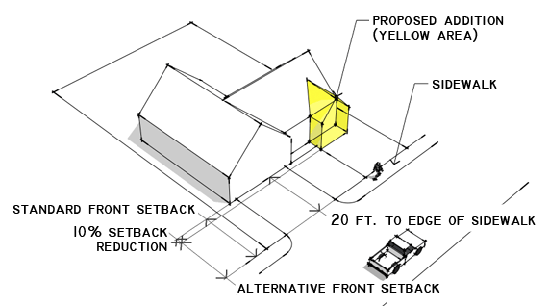
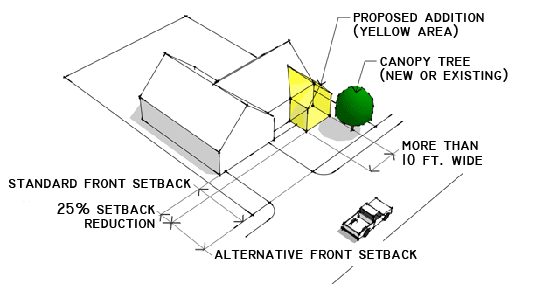
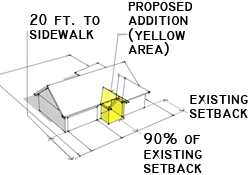
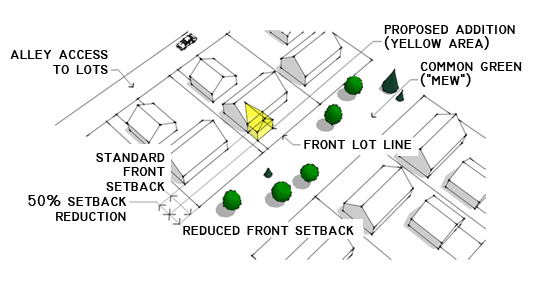
Building Expansion Only. For building expansion only, front setbacks may be reduced from the standards set out in Table 12-3-301A, Residential Lot and Building Standards, if compliance with any of the following options is demonstrated by the applicant to the City's reasonable satisfaction (the options are illustrated in Figure 12-3-302A, Alternative Development Standards for Front Setbacks):
a.
Option #1. The reduction is 10 percent or less of the required front setback, and the encroachment will not reduce the depth of a driveway to:
i.
Less than 20 feet in length to the edge of the sidewalk; or
ii.
Less than 22 feet in length to the edge of pavement if no sidewalk is either provided or planned.
b.
Option #2. The reduction is more than 10 percent of the required front setback, but less than 25 percent of the required front setback, and:
i.
No garage doors that face the street are located in the reduced setback area;
ii.
The improvement is not more than 18 feet in height (measured as provided in Section 12-3-204, Height);
iii.
The proposed construction does not involve the destruction of a healthy, mature tree; and
iv.
If the encroachment is more than 10 feet wide (measured parallel to the front building line), then it is screened from view from the public right-of-way by a canopy tree or evergreen tree.
c.
Option #3. The existing building encroaches upon the setback as of the effective date, and:
i.
The proposed construction does not involve the destruction of a healthy, mature tree;
ii.
The proposed construction will not reduce the depth of a driveway to:
a.
Less than 20 feet in length to the edge of the sidewalk; or
b.
Less than 22 feet in length to the edge of pavement if no sidewalk is either provided or planned; and
iii.
The proposed construction will be set back not less than 90 percent of the setback of the existing building; and
d.
Option #4. The reduction is more than 10 percent of the required front setback, but less than 50 percent of the required front setback, and the subdivision is designed so that the building fronts on an open space tract (also called a "mew") or other permanent open space that is not less than 50 feet wide.
|
Figure 12-3-302A
Alternative Development Standards for Front Setbacks |
|---|
| Option #1 (below) |
 |
| Option #2 (below) Note that the canopy tree is provided because the improvement is more than 10 feet wide. |
 |
| Option #3 (below) |
 |
| Option #4 (below) |
 |
D.
Alternative Building Setback Standards; Interior Side Setbacks.
1.
New Development; Redevelopment; and Building Expansion. For new development, redevelopment, or building expansion, side setbacks may be reduced from the standards set out in Table 12-3-301A, Residential Lot and Building Standards, if it is demonstrated by the applicant to the City's reasonable satisfaction that the proposed side building setback is equal to not more than the average actual side building setback of the other homes on the same side of the same block.
2.
Building Expansion Only. For building expansion only, side setbacks may be reduced from the standards set out in Table 12-3-301A, Residential Lot and Building Standards, up to 40 percent if it is demonstrated by the applicant to the City's reasonable satisfaction that the proposed construction meets all of the following standards:
a.
Limit of Encroachment.
i.
If the lot that abuts the proposed building expansion is used for residential purposes, then:
a.
The building expansion is screened from view from the public street by at least one evergreen tree per story of the building expansion, unless it encroaches into the required side setback less than one foot closer to the lot line than the existing building;
b.
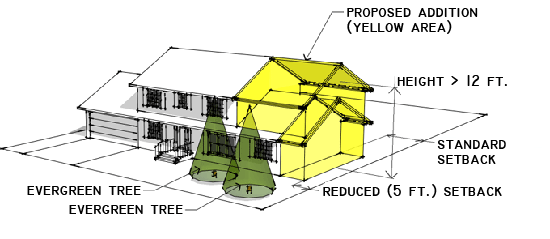
Building expansions that are 12 feet in height (measured from the average grade across the side of the proposed construction facing the abutting lot) or less are set back at least 42 inches from the side lot line (see, e.g., Figure 12-3-302B, Limit of Encroachment, One-Story Addition); and
c.
Building expansions that are more than 12 feet in height (measured from the average grade across the side of the proposed construction facing the abutting lot) are set back at least five feet from the side lot line (see, e.g., Figure 12-3-302B, Limit of Encroachment, Two-Story Addition).
ii.
If the lot that abuts the proposed building expansion is used for nonresidential purposes or permanent open space that is at least 20 feet in width, then the building expansion is set back at least 42 inches from the side lot line.
|
Figure 12-3-302B
Limit of Encroachment |
|---|
| One-Story Addition |
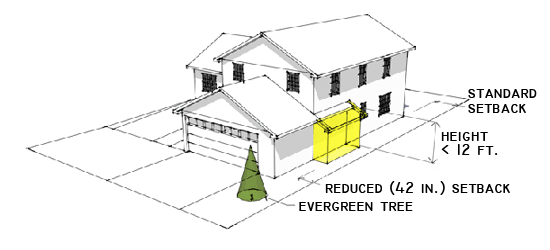 |
| Two-Story Addition |
 |
b.
Horizontal Dimension. The building expansion, combined with the existing building, creates a horizontal dimension of not more than 50 feet without an offset in the building wall of at least two feet.
c.
Windows. The building expansion does not include a window that is located directly across from another window on a residential building that is closer than 20 feet away, unless:
i.
The window is on the first floor and an opaque fence is installed between the two buildings to a height of six feet; or
ii.
The window is not operational and is made of glass block or frosted glass.
E.
Alternative Building Setback Standards; Street Side Setbacks.
1.
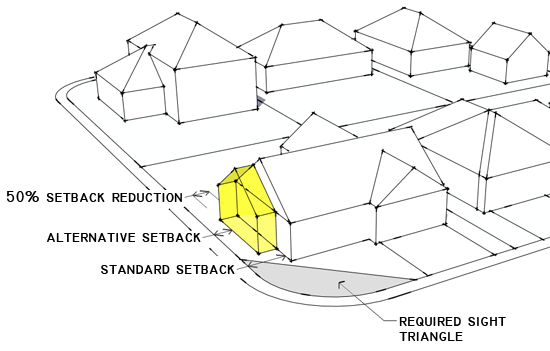
Building Expansion Only; Corners on Double-Loaded Blocks. For building expansions only, on corner lots of double-loaded blocks, street side setbacks may be reduced up to 50 percent if it is demonstrated that:
a.
The building expansion does not encroach on required sight triangles or sight distances as required by Section 12-11-208, Sight Triangle and Sight Distance Requirements;
b.
The portion of the building expansion that encroaches on the street side setback is not more than 15 percent of the floor area of the home; and
c.
No horizontal dimension of the part of the building expansion that encroaches upon the street side setback runs for more than 30 feet unless there is a material offset of at least two feet to break up the apparent mass of the building wall. See Figure 12-3-302C, Alternative Street Side Setbacks; Corners on Double-Loaded Blocks.
|
Figure 12-3-302C
Alternative Street Side Setbacks; Corners on Double-Loaded Blocks |
|---|
 |
2.
Building Expansion Only; Other Corners. For building expansions only, on corners which are not located on double-loaded blocks, the alternative front setback standards of subsection C.2.a., C.2.b., and C.2.c., above may be applied to reduce the street side setback, provided that the expanded area of the building does not interfere with required sight triangles or sight distance as required by Section 12-11-208, Sight Triangle and Sight Distance Requirements.
F.
Alternative Building Setback Standards; Rear Setbacks.
1.
Rear setbacks may be reduced on any lot if it is demonstrated that the proposed rear building setback is equal to not more than 10 percent less than the average actual setback of the other homes on the same side of the same block.
2.
Rear setbacks may be reduced on lots with rear lot lines that abut permanent open space, through lots with fences or walls that screen rear yards from arterials and collectors, according to the following standards:
a.
For construction, or portions of construction, that is 12 feet or less in height (measured from the average grade across the side of the proposed construction facing the rear lot line), the rear setback may be reduced by up to 50 percent if it is demonstrated that:
i.
The proposed construction will not create the appearance of a monolithic building by substantially reducing the articulation of the building as viewed from abutting property, open space, or public rights-of-way; or
ii.
The proposed construction is located behind an opaque fence or garden wall that is at least five feet in height, and one evergreen or canopy tree is planted in the rear yard for each 12 feet of width of the encroaching portion of the proposed construction.
b.
For construction, or portions of construction, that is more than 12 feet in height (measured from the average grade across the side of the proposed construction facing the rear lot line), the rear setback may be reduced up to 30 percent if it is demonstrated that:
i.
The standards of subsection F.2.a., above, are met; and
ii.
The building does not have a three-story expression (e.g., two stories above a walk-out basement.
3.
Rear setbacks may be reduced on lots with rear lot lines that abut alleys according to the following standards:
a.
At least 500 square feet of landscaped area is provided in the rear yard; and
b.
For attached garages, the rear setback may be reduced to 18 feet in the NC6 and NC12 subdistricts if the garage door faces the alley, and to five feet in the NC5, NC6, and NC12 subdistricts if the garage door is perpendicular to the alley.
(Ord. 2024-O-14 §§24—26; Ord. 2024-O-15 §5)
Sec. 12-3-303. - Alternative Standards for Single-Family Attached Homes.
A.
Generally. The standards of this Section apply to the expansion of existing attached single-family home buildings in the NCSFA District beyond the extent of their original foundations or existing building height. Standards for new development, redevelopment, and reconstruction of buildings are provided in Section 12-3-301, General Standards for Residential Development.
1.
Reconstruction. Notwithstanding the standards of this Subsection, any attached single-family building in an NCSFA District may be reconstructed to its original configuration and height, pursuant to Article 12, Nonconformities.
B.
Alternative Standards for Building Height. Building height shall not be increased to more than the greater of:
1.
Ten percent more than the existing height of the building; or
2.
Thirty-five feet.
C.
Alternative Building Setback Standards; All Setbacks. Alternative development standards shall be applied only if it is demonstrated by the applicant to the City's reasonable satisfaction that the standards of the applicable subsection of this Section are met, and:
1.
The proposed construction does not interfere with planned expansion of right-of-way, and if right-of-way expansion is planned, the encroachment is evaluated as if the right-of-way has been expanded;
2.
The proposed construction does not result in interference with a utility easement;
3.
Drainage onto abutting properties, attached or neighboring dwelling units, or rights-of-way is not significantly altered, and drainage patterns are not substantially changed, when compared to the condition before the proposed development;
4.
The proposed construction does not result in a nonconformity with respect to the building code on either the lot proposed for development, abutting properties, or nearby buildings;
5.
If the parcel that abuts the improvement is used for residential purposes, the proposed construction is built to building code standards (e.g., fire ratings) that would allow construction of the abutting lot (or closest building to the improvement) to be built to the same standard with the same distance of encroachment;
6.
The proposed construction does not substantially increase any existing degree of obstruction of the solar access of abutting property, neighboring buildings, or other attached units that are not owned by the applicant;
7.
The proposed construction conforms to building coverage limitations set out in Section 12-3-303, General Standards for Attached Single-Family Homes; and
8.
The proposed construction does not reduce the area provided for parking to fewer spaces than are required by Division 5-2, Parking and Loading Calculations.
D.
Alternative Building Setback Standards; Front Setbacks. Front setbacks may be reduced from the standards set out in Table 12-3-301A, Residential Lot and Building Standards, if compliance with all of the requirements of subsection C., above, and any of the following options is demonstrated by the applicant to the City's reasonable satisfaction:
1.
Option #1. If the existing building does not encroach into the required setback, but the proposed improvement does:
a.
The proposed construction does not involve the destruction of a healthy, mature tree; and
b.
The encroachment will not reduce the depth of a driveway to:
i.
Less than 20 feet in length to the edge of the sidewalk; or
ii.
Less than 22 feet in length to the edge of pavement if no sidewalk is either provided or planned; and
c.
If the encroachment is more than 10 feet wide (measured parallel to the front building line), then it is screened from view from the public right-of-way by a canopy tree or evergreen tree; or
2.
Option #2. If the existing building encroaches upon the required setback as of the effective date, and:
a.
The proposed construction does not involve the destruction of a healthy, mature tree;
b.
The proposed construction will not reduce the depth of a driveway to:
i.
Less than 20 feet in length to the edge of the sidewalk; or
ii.
Less than 22 feet in length to the edge of pavement if no sidewalk is either provided or planned; and
c.
The proposed construction will be set back not less than 85 percent of the setback of the existing building; and
d.
The proposed construction will not create the appearance of a monolithic building frontage by substantially reducing the articulation of the building as viewed from the street; or
3.
Option #3. If the existing building fronts on a mews or other permanent open space that is not less than 50 feet wide, the front setback may be reduced by up to 25 percent.
E.
Alternative Building Setback Standards; Interior Side Setbacks. Interior side setbacks may be reduced from the standards set out in Table 12-3-301A, Residential Lot and Building Standards, if compliance with all of the requirements of subsection C., above, and any of the following options is demonstrated by the applicant to the City's reasonable satisfaction:
1.
Option #1. The proposed interior side setback is equal to not more than the average actual side building setback of comparable attached single-family residential buildings in the same development on the same block; or
2.
Option #2. The proposed interior side setback is not less than 60 percent of the required interior side setback, or three feet, whichever is a larger setback, and:
a.
Limit of Encroachment.
i.
If the lot that abuts the proposed building expansion is used for residential purposes and is not in the same development as the lot proposed for development, then:
a.
Building expansions that are 12 feet in height (measured from the average grade across the side of the proposed construction facing the abutting lot) or less are set back at least 42 inches from the side lot line; and
b.
Building expansions that are more than 12 feet in height (measured from the average grade across the side of the proposed construction facing the abutting lot) are set back at least five feet from the side lot line.
ii.
If the lot that abuts the proposed building expansion is used for nonresidential purposes or permanent open space that is at least 20 feet in width, then the building expansion is set back at least 42 inches from the side lot line.
b.
Horizontal Dimension. The building expansion, combined with the existing building, creates a horizontal dimension of not more than 50 feet without an offset in the building wall of at least three feet.
c.
Windows. The building expansion does not include a window that is located directly across from another window on a residential building that is closer than 20 feet away, unless:
i.
The window is on the first floor and an opaque fence is installed between the two buildings to a height of six feet; or
ii.
The window is not operational and is made of glass block or frosted glass.
F.
Alternative Building Setback Standards; Rear Setbacks. Rear setbacks may be reduced from the standards set out in Table 12-3-301A, Residential Lot and Building Standards, if compliance with all of the requirements of subsection C., above, and any of the following options is demonstrated by the applicant to the City's reasonable satisfaction:
1.
Option #1. Rear setbacks may be reduced on any lot if it is demonstrated that the proposed rear building setback is equal to not more than 10 percent less than the average actual setback of the other attached single-family homes that are located in the same development within 150 feet of the building proposed for expansion; or
2.
Option #2. Rear setbacks may be reduced on lots with rear lot lines that abut permanent open space, and on through lots with fences or walls that screen rear yards from arterials and collectors, according to the following standards:
a.
For construction, or portions of construction, that is 12 feet or less in height (measured from the average grade across the side of the proposed construction facing the rear lot line), the rear setback may be reduced by up to 50 percent if it is demonstrated that there is at least 100 square feet of ground-level landscaped area behind the building with no dimension less than 8 feet, and:
i.
The proposed construction will not create the appearance of a monolithic building by substantially reducing the articulation of the building as viewed from abutting property, open space, or public rights-of-way; or
ii.
The proposed construction is located behind an opaque fence or garden wall that is at least five feet in height, and one evergreen or canopy tree is planted (or retained) in the rear yard for each 12 feet of width of the encroaching portion of the proposed construction; or
b.
For construction, or portions of construction, that is more than 12 feet in height (measured from the average grade across the side of the proposed construction facing the rear lot line), the rear setback may be reduced up to 30 percent if it is demonstrated that the standards of subsection G.2.a., above, are met, and:
i.
The building will not have a three-story expression (e.g., two stories above a walk-out basement) as a result of the proposed construction; or
ii.
A building that has an existing three-story expression will be modified in a way that mitigates the appearance of the three-story mass by substantially articulating the back wall of the building when compared to its existing condition; or
3.
Option #3. Rear setbacks may be reduced on lots with rear lot lines that abut alleys if it is demonstrated by the applicant to the City's reasonable satisfaction that:
a.
The reduction of the rear setback would not reduce the available turning radius from the alley to the garage on the lot proposed for development or any other lot to less than 25 feet; and
b.
The proposed setback does not interfere with the safe use of the alley by blocking sight lines between garages and the paved area of the alley; and
c.
There is at least 100 square feet of ground-level landscaped area being the building with no dimension less than 8 feet.
(Ord. 2024-O-14 §§27, 28)
Sec. 12-3-304. - Alternative Standards for Condominium and Alternative Land Ownership Patterns.
A.
Generally. The standards of Section 12-3-301, General Standards for Residential Development, with respect to lot area, lot width, and setbacks relate to the development of residential buildings on conventional lots that are intended to be owned in fee-simple by the owners of the buildings. However, the standards are not intended to preclude other ownership types, such as condominiums (in which the land is owned in common by the owners of the condominium units), or common maintenance communities (in which fee simple ownership is limited to the land under the building, and, in some cases, a small area around it). The alternative standards of this Section are intended to allow such alternative ownership scenarios, provided that the development could be approved pursuant to this LDC using conventional fee-simple ownership arrangements.
B.
Demonstration of Compliance Required. The proposed pattern of development will be permitted if it is demonstrated by the applicant to the City's reasonable satisfaction that it would comply with the density, open space, and applicable setback requirements of this LDC if it were platted with lots that meet the minimum requirements of Section 12-3-301, General Standards for Residential Development. Compliance shall be demonstrated through an approved Site Plan.
(Ord. 2024-O-14 §29)
Sec. 12-3-401. - Traditional neighborhood development standards.
A.
Generally. Traditional neighborhood developments ("TNDs") are residential or predominately residential developments that are designed and scaled for pedestrian use, with continuous sidewalks, tree-lined streets, pedestrian scaled details, and a neighborhood center for commercial and/or civic activity. Parking areas and garages are not dominant visual features along the public rights-of-way. The standards within this section are applicable to the development of Traditional Neighborhood Development within the Neighborhood Infill - Traditional Neighborhood Development (NI-TND) zone district. Parcels proposed for development which exceed ten (10) acres may utilize the NI-TND zone district.
B.
Mix of Housing Types. The standards for the mix of housing types required with a Traditional Neighborhood Development are set out in Section 12-3-403, Mix of Housing Types.
C.
Site Planning Requirements. The applicant for a Site Plan or Final Plat for a TND shall apply and indicate the location of at least two of the following three subdistricts on the Site Plan or Final Plat:
1.
Neighborhood Center, which is the most intensively developed part of the TND, and which may include mixed-uses as provided in Division 2-3, Land Use.
2.
Neighborhood Residential, which is less intensively developed than the neighborhood center, and which is used for residential and recreational purposes.
3.
Edge Residential, which is used exclusively for single-family detached, open space, and/or outdoor recreation development types.
D.
Nonresidential Development Standards. The standards that are applicable to nonresidential and mixed-use development in the Neighborhood Center subdistrict of a TND are as provided in Division 3-7, Nonresidential and Mixed-Use Development Standards, except that the minimum LSR of the entire Neighborhood Center subdistrict shall be 10 percent, which shall be counted within the OSR calculation for the overall Parcel Proposed for Development as a TND neighborhood type. Nonresidential and mixed-use development within the Neighborhood Center subdistrict shall be designed as provided in Section 12-4-206, Nonresidential and Mixed-Use Buildings in Traditional Neighborhood Developments.
E.
Dove Valley Residential Overlay District. Properties subject to the Dove Valley Residential Overlay must implement a Traditional Neighborhood Development.
F.
Reserved Divisions.Sections 12-3-402 and 12-3-404 are held in Reserve.
(Ord. 2024-O-14 §31)
Sec. 12-3-403. - Mix of housing types.
A.
Generally. All Traditional Neighborhood Developments shall include a mix of housing types to reduce monotony and ensure a diverse mix of housing types and forms.
B.
Housing Types. The following Housing Types, as defined in this LDC, may be used to meet the required Mix of Housing Types as set out in Section 12-3-403(C), Dwelling Unit Mix Requirements:
1.
Single-Family Detached - Front Loaded;
2.
Single Family Detached - Rear/Alley Loaded;
3.
Single Family Detached - Cottage;
4.
Single Family Attached - Duplex Front Loaded;
5.
Single Family Attached - Duplex Rear/Alley Loaded;
6.
Single Family Attached - Townhome Front Loaded;
7.
Single Family Attached - Townhome Rear/Alley Loaded; and
8.
Multifamily.
C.
Dwelling Unit Mix Requirements. A minimum of three (3) Housing Types must be utilized, with a minimum percentage of any type being not less than 20 percent. The minimum percentage shall apply even if more than the minimum number of housing types are provided.
D.
Phasing. When a development is to be phased, the maximum residential development capacity of the entire site shall be used for calculating the required mix. When a Parcel Proposed for Development is to be subdivided and developed over time, the City may impose a mix based on the original parcel size to ensure an adequate mix of housing types.
(Ord. 2024-O-14 §33)
Sec. 12-3-601. - Exceptions to Residential Setback Standards.
A.
Generally. Table 12-3-601, Permitted Projections into Required Setbacks, sets out projections that may be located within required setback areas (between the required setback lines and the lot lines). These exceptions shall not be interpreted to allow obstruction of a required sight triangle or sight distance as required by Section 12-11-208, Sight Triangle and Sight Distance Requirements.
B.
Interpretation of Table 12-3-601, Permitted Projections into Required Setbacks.
1.
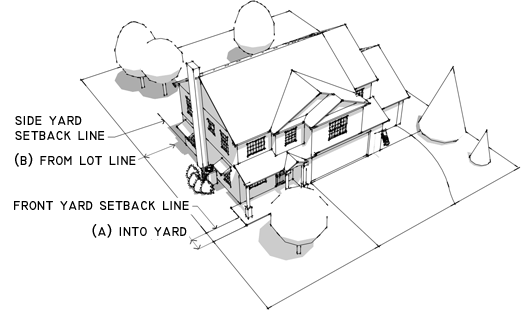
Measurements in the table are taken from the applicable setback line (A); from the lot line (B); or into the right-of-way (C). See Figure 12-3-601, Measurement of Encroachments.
2.
If a measurement is indicated for "(A) From Setback Line Toward Lot Line" and "(B) From Lot Line Toward Lot Interior," then the measurement that results in the larger distance from the lot line to the encroachment controls.
3.
If a measurement is indicated for "(A) From Setback Line Toward Lot Line" and "(C) Into Right-of-Way," then the measurement that allows the smallest encroachment into the right-of-way controls.
|
Figure 12-3-601
Measurement of Encroachments |
|---|
 |
C.
Encroachments Onto Other Abutting Properties or Easements. No projection shall cross:
1.
Into separately owned property, unless a recorded document provides for access to and maintenance of the projection; or
2.
Into utility easements, unless the design of the improvement and a recorded agreement allows access to the utility and allows the utility provider or the City to efficiently remove the encroachment at the property owner's expense.
D.
Right-of-Way Encroachments. Encroachment into the public right-of-way is generally not allowed, but may be permitted if it is demonstrated that the encroachment:
1.
Is attached to a building that is located in a UC district, AC district, or a mixed-use building located in traditional neighborhood development;
2.
Does not encroach on arterial rights-of-way;
3.
Is constructed and situated in a manner that does not obstruct pedestrian or vehicular traffic or constitute a safety hazard (e.g., by blocking a sight triangle or line of sight in the right-of-way);
4.
Is subject to a revocable license to encroach upon the public right-of-way. This license is granted in the sole discretion of the City Manager, or owner of the right-of-way; and
5.
Is, regardless of the permitted encroachment distance specified in Table 12-3-601, Permitted Projections Into Required Setbacks, limited to not closer than the lesser encroachment of:
a.
Two feet to the back of the street curb; or
b.
The inside edge of a tree lawn; or
c.
A distance necessary for the growth of planned or existing street trees.
(Ord. 2021-O-13 §§12, 13; Ord. 2024-O-15 §6)
Sec. 12-3-602. - Fences, Garden Walls, and Hedges.
A.
Generally. The requirements of this Section apply to fences, garden walls, and hedges on residential property.
B.
Height and Setbacks for Fences and Garden Walls. The maximum height and minimum setbacks for fences and garden walls are set out in Table 12-3-602, Maximum Height and Minimum Setbacks for Fences and Garden Walls. Fences and Garden Walls shall not be located within required sight triangles and sight distances as required by Section 12-11-208, Sight Triangle and Sight Distance Requirements.
C.
Fence and Garden Wall Design.
1.
Materials used for Fences and Garden Walls shall be durable, and of a character commonly used in residential applications, including:
a.
Wood, provided that it will be durable because it is: a weather resistant species, split rail design, wood that is treated with U.S. Environmental Protection Agency approved preservatives, or finished (painted or stained and sealed);
b.
Ornamental wrought iron or powder-coated aluminum;
c.
Vinyl;
d.
Composite materials; or
e.
Masonry (brick, finished concrete, split face concrete masonry units, or stone).
2.
Chain link Fences are permitted only in interior side yards and rear yards that are not also street yards.
3.
Barbed wire cradles facing inward toward the property may be placed on top of Fences enclosing neighborhood or regional utility buildings or wherever the Director finds that such are necessary to address a demonstrated security interest.
4.
Welded wire, agricultural Fences, and chicken wire Fences are allowed only in the AG district and in NC districts on lots where such fences exist on the effective date; or on the inside of split rail Fences in interior side, street side, and/or rear yards, provided that it does not exceed the height of the Fence.
5.
The following materials are not allowed as Fence or Garden Wall components: scrap lumber, plywood, tree branches, tree trunks, sheet metal, plastic or fiberglass sheets, barbed wire (except as provided in subsection C.3, above), spikes, nails, or other comparable sharp points, or fabric and/or mesh as a primary fence component.
6.
The Fence, Finished Side shall face out toward any trail, open space, park or adjacent rights-of-way.
D.
Fence Opacity. Fences that are installed in front yards shall be not more than fifty percent (50%) opaque.
E.
Hedges. Hedges shall be planted and maintained so that they do not extend over public rights-of-way or interfere with required sight triangles or sight distances as required by Section 12-11-208, Sight Triangle and Sight Distance Requirements. Hedges in front yards shall not exceed four feet in height.
F.
Exceptions.
1.
Fences, Garden Walls, or hedges, which are specifically required pursuant to Article 8, Development Landscaping and Tree Protection, shall conform to the requirements of that Article.
2.
Fences for outdoor recreation facilities, such as basketball or tennis courts, may be up to twelve (12) feet in height provided they are of chain link construction with non-metallic coating (i.e., vinyl), are located in the side or rear yard in residential zone districts, and are set back twenty-five (25) feet from residential property lines.
3.
Fences for outdoor recreation facilities, such as baseball field back stops and golf course driving range netting may be over twelve (12) feet as determined by the Director.
G.
Maintenance. Fences shall be maintained in good structural condition and upright within twenty (20) degrees of perpendicular to level. The Director shall have the authority to order the Fence owner to repair or remove a Fence, at such owner's expense, that constitutes a public hazard or nuisance by reason of inadequate maintenance, dilapidation, obsolescence, or abandonment.
(Ord. 2021-O-13 §§14, 15; Ord. 2024-O-05 §18; Ord. 2024-O-15 §§7, 8)
Sec. 12-3-603. - Accessory Buildings and Structures.
A.
Generally. The standards of this Section apply to accessory buildings and structures. All accessory buildings are counted in the calculation of building coverage. Additional standards specific to the NC2A zone district are contained in subsection F below.
B.
Timing of Construction. No accessory building or structure shall be constructed unless the principal building has already been constructed or is under construction simultaneously with the accessory building.
C.
Attached Accessory Buildings. Accessory buildings that are structurally attached to a principal building shall conform to all standards that are applicable to the principal building. Covered (but otherwise unenclosed) walkways shall not be considered attachments for the purposes of this subsection.
D.
Detached Garages. Detached garages may be single-story buildings or two-story buildings that include second floor workshop/storage space. Detached garages are subject to the following standards:
1.
Access. Access to detached garages shall be not less than 12 feet wide, and shall be set back as provided in Section 12-3-601, Exceptions to Residential Setback Standards.
2.
Height. Height shall not exceed 17 feet to the peak of the roof.
3.
Footprint. No detached garage shall cover an area that is larger than that covered by the principal building, or 1,200 square feet, whichever is less. Detached garages are also counted in the calculation of building coverage.
4.
Roof-pitch. All detached garages shall be constructed with a minimum 4/12 slope roof-pitch, except in the event the principal structure contains a lesser slope.
5.
Setbacks.
a.
Single-Story Detached Garages. Single-story detached garages may be constructed within building envelopes or in rear yards, provided that the garages are set back five feet from side, street side, and rear property lines and not encroaching into utility easements.
i.
Set back five feet from side, street side, and rear property lines and not encroaching into utility easements; or
ii.
Set back according to lesser setback standards for garages, if they are specifically provided in Division 3-5, Housing Palette, for the type of housing with which the garage is associated.
b.
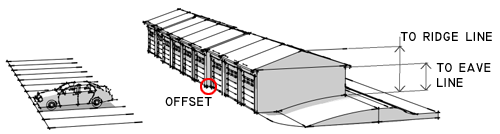
Single-Story Detached Garages as Perimeter Walls. Single-story detached garages may be constructed as perimeter walls of single-family attached and multifamily developments, provided that:
i.
The topography is such that height to the peak of the garage roof, measured from the finished grade at the outside building line of the garage is:
a.
Six feet to the eave line; and
b.
Not more than 10 feet to the highest point on the ridge line of the roof (see Figure 12-3-603A, Perimeter Garage Walls); and
ii.
The perimeter wall is offset at least one foot for every 50 feet in length (see Figure 12-3-603A, Perimeter Garage Walls); and
iii.
If the outside walls of the garages are used as part of a required bufferyard, they are installed on the inside boundary of the bufferyard.
c.
Two-Story Detached Garages. Two-story detached garage buildings may be constructed as an accessory building to single-family detached houses if they are located within the building envelope.
d.
Configuration of Detached Carports and Garages; Single-Family Attached and Multifamily. Detached carports and garages that serve attached single-family dwellings or multifamily dwellings shall neither:
i.
Be located closer than 20 feet to a building setback line on an adjacent lot that is not used for attached single-family dwellings or multifamily dwellings of the same type; nor
ii.
Interfere with building ventilation.
|
Figure 12-3-603A
Perimeter Garage Walls |
|---|
 |
E.
Accessory Buildings or Structures Other than Detached Garages.
1.
Requirements for All Accessory Buildings or Structures Other than Detached Garages.
a.
Footprint. No detached accessory building or buildings shall cover an area that is larger than that covered by the principal building, nor cover more than 25 percent of the required rear yard or 600 square feet, whichever is less, except that:
i.
In the AG district, accessory buildings and structures are permitted as needed to support agricultural uses. Nonagricultural accessory buildings shall conform to the requirements of the RS district, set out in subsection E.1.a.i above.
ii.
In the NC2A district, there shall be no limitation on the footprint of accessory structures, except that the lot shall conform to the maximum building coverage ratio established in Table 12-3-301A, Residential Lot and Building Standards.
2.
Requirements for Sheds that are 120 Square Feet or Smaller and Less than 10 Feet in Height to Peak of Roof. Sheds that are 120 square feet or less in floor area and not more than 10 feet in height to the peak of the roof may be located anywhere in a side or rear yard, provided that:
a.
If they are located closer than two feet to a side or rear lot line, the area between the shed and the lot line is:
i.
The location of an opaque wall or fence that is at least five feet in height; or
ii.
Planted with shrubs that will grow to form a hedge with a height of at least three feet within not more than 18 months of planting; and
b.
They are not located in utility easement unless the property owner provides written permission from the easement holder; and
c.
They do not create nonconformities with respect to the building code on adjacent properties; and
d.
They do not alter or block the flow of stormwater drainage.
3.
Requirements for Accessory Buildings or Structures for the Keeping of Chickens and Permitted Wild Animals.
a.
Height. Height shall not exceed 10 feet to the peak of the roof.
b.
Setbacks.
i.
Front: Behind the principal building.
ii.
Street Side. Equal to the street side setback required for the principal building.
iii.
Interior Side: 10 feet.
iv.
Rear: 10 feet.
4.
Requirements for Accessory Buildings or Structures for Beekeeping.
a.
Permitted Lots. Hive boxes are only permitted on residentially and agriculturally zoned lots with single-family detached dwelling units.
b.
Hive Box Height and Area. Hive boxes and any ground-mounted appurtenances are permitted to be a combined height of up to six (6) feet above ground level and up to ten (10) cubic feet.
c.
Setbacks.
i.
Front: Behind the principal building.
ii.
Street Side. Equal to the street side setback required for the principal building.
iii.
Interior Side: Ten (10) feet.
iv.
Rear: Ten (10) feet.
d.
Hive Boxes. All bee colonies shall be kept in hive boxes with movable combs or frames.
e.
Hive Box Maximums. Maximum hive boxes permitted per residential and agricultural zone lot:
i.
Lots less than one-quarter acre in size: Two (2) hive boxes.
ii.
Lots between one-quarter acre and less than one-half acre in size: Four (4) hive boxes.
iii.
Lots between one-half acre and less than one-acre in size: Six (6) hive boxes.
iv.
Lots between one-acre and less than two-acres in size: Eight (8) hive boxes.
v.
Lots two acres and greater in size: Twelve (12) hive boxes.
vi.
Exception: For lots where all hive boxes are situated at least two hundred fifty (250) feet in any direction from all property lines of the lot, there is no limit as to the maximum hive boxes permitted per residential lot.
5.
Requirements for Other Detached Buildings or Structures.
a.
Height. Height shall not exceed one story or 17 feet, whichever is lower, except that:
i.
In NC2A district, accessory buildings or structures may exceed one story or 17 feet in height if the accessory building or structure meets the principal structure setbacks established in Table 12-3-301A of this LDC.
b.
Setbacks.
i.
Front: Behind the principal building.
ii.
Street Side. Equal to the street side setback required for the principal building.
iii.
Interior Side: 5 feet.
iv.
Rear: 5 feet.
F.
Additional Requirements for NC2A Zone District.
1.
Exceptions to Height, Footprint, Roof-pitch and Setback Standards.
a.
Height. In the NC2A district, detached garages, accessory buildings, and accessory structures may exceed one story or 17 feet in height if the building or structure meets the principal structure setbacks established in Table 12-3-301A of this LDC.
b.
Footprint. In the NC2A district, there shall be no limitation on the footprint of accessory buildings, and structures, except that the lot shall conform to the maximum building coverage ratio established in Table 12-3-301A, Residential Lot and Building Standards.
c.
Roof-pitch. In the NC2A district, accessory buildings and accessory structures do not contain a minimum roof-pitch requirement. This exception does not apply to detached garages.
d.
Setbacks. In the NC2A district, detached garages, accessory buildings, and accessory structures may be constructed between the principal building and front lot line if the building or structure meets the principal structure setbacks established in Table 12-3-301A of this LDC.
2.
ADU Exceptions to Height, Footprint, Roof-pitch and Setback Standards.
a.
Height. In the NC2A district, ADUs may exceed one story or 17 feet in height if the building or structure meets the principal structure setbacks established in Table 12-3-301A of this LDC.
b.
Footprint. In the NC2A district, an ADU shall not have a larger footprint than the principal building. The lot shall conform to the maximum building coverage ratio established in Table 12-3-301A, Residential Lot and Building Standards.
c.
Roof-pitch. In the NC2A district, ADUs do not contain a minimum roof-pitch requirement.
d.
Setbacks. In the NC2A district, ADUs may be constructed between the principal building and front lot line if the building or structure meets the principal structure setbacks established in Table 12-3-301A of this LDC.
G.
Residential Occupancy. Residential occupancy of accessory buildings that are not constructed and approved for residential use is prohibited.
H.
Accessory Dwelling Units.
1.
Purpose. The purpose of this subsection is to: implement the goals and strategies of Centennial NEXT, the City's Comprehensive Plan; promote the efficient use of land; ensure the adequacy of infrastructure required to support ADUs; and preserve the general character of established neighborhoods in Centennial.
2.
Applicability.
a.
ADUs are allowed as shown in Table 12-2-302, Residential, Home, and Institutional Uses.
b.
ADUs are permitted only on a lot containing one single-family detached dwelling. The principal dwelling shall be constructed or, when both are constructed at the same time, the principal dwelling has been issued a building permit for which construction has commenced within one hundred eighty (180) days of permit issuance and/or is making progress toward completion every one hundred eighty (180) days.
c.
Only one ADU shall be permitted per single-family detached dwelling.
d.
ADUs shall be allowed in planned unit developments, except where ADUs are specifically listed as a prohibited use in the approved PUD.
e.
Short-term rentals (STR) are regulated pursuant to Article 9 of the Centennial Municipal Code.
f.
Home-Based Business are regulated pursuant to Section 12-2-404.
3.
Application and Review. A pre-submittal meeting pursuant to Section 12-14-303 shall be required prior to submittal of a building permit application for an ADU. ADUs shall be reviewed and obtain approval through a building permit application and are subject to the building permit referral process.
4.
Structure Requirements and Prohibitions.
a.
All ADUs must be permanent, habitable structures. Temporary structures, such as mobile homes, recreational vehicles, or travel-trailers, shall not be used as an ADU.
b.
All ADUs shall comply with applicable provisions of the Centennial Municipal Code Chapter 18, Building Regulations.
c.
All ADUs shall be connected to utilities as required by the individual utility provider. Electrical utilities shall be either above ground or underground in the same manner as provided for the principal dwelling unit.
d.
Attached ADUs shall be exempt from Section 12-11-305 Fiber Optic Conduits.
e.
Lots containing both a principal dwelling unit and an ADU may not be subdivided so that the ADU occupies a different platted lot than the principal dwelling unit.
f.
An ADU shall not be sold independently of the principal dwelling on the lot.
5.
Size, Density, and Dimensional Requirements.
a.
Size. An ADU shall not exceed fifty percent (50%) of the footprint of the principal dwelling unit or the total size of an attic or basement area (including any internal stairwell providing access) where additional construction that would expand those footprints is not occurring. This measurement shall only include the area designed for habitable use as the ADU. For a Detached ADU, the footprint of a Garage attached to the ADU shall not be considered a habitable use area.
b.
Density. An ADU is accessory to or an extension of the principal dwelling unit, whether the ADU is attached or detached. An ADU shall not be counted as a separate principal dwelling unit for density calculations.
c.
Dimensional Standards.
i.
An ADU shall comply with the setback and maximum building coverage requirements listed for principal dwellings in the applicable zoning district.
ii.
The maximum height of an attached ADU shall comply with the applicable zone district.
iii.
The maximum height of a detached ADU is seventeen (17) feet. The height of an ADU shall be measured by the same methodology as the principal dwelling unit height is measured, as set out in Section 12-3-204, Height.
d.
Design. An ADU shall be designed in a manner that is consistent with the principal dwelling in at least three (3) of the following elements:
i.
Roof pitch and form;
ii.
Soffit and fascia style;
iii.
Exterior wall cladding color, style or material;
iv.
Window style, trim, and orientation;
v.
Exterior door style;
vi.
Architectural features such as but not exclusive of, building recessions or projections, dormers, balconies, porches, columns, and prominent entry features; or
vii.
Color palette.
e.
Entrance. ADUs shall have a separate entrance to the unit, which may be accessed at a separate external location or from inside the entrance to the primary unit (e.g., through a shared foyer or mud room).
f.
Parking. See Table 12-5-202A, Residential Parking and Loading Requirements.
g.
ADUs within the NC2A zone district may utilize exceptions to height, footprint, roof-pitch, and setback standards as set forth in Section 12-3-603 (F), Additional Requirements for NC2A Zone District.
6.
Trash and Recycling. The ADU must provide trash and recycling services. The ADU may share trash and recycling providers with the principal dwelling unit or contract for its own trash and recycling providers separately. Individual garbage containers must be screened from public view in accordance with Section 12-3-608; trash and recycling screening is not required between the principal dwelling unit and the ADU.
7.
Homeowner Associations, Covenants, Conditions, and Restrictions. It is the responsibility of the property owner of record to ensure compliance with any private homeowner association requirements, covenants, conditions, and restrictions for the ADU. The City will not independently verify such compliance.
8.
Registration and Notice.
a.
This subsection 8. applies to any property which includes an ADU and for which the owner of record will not occupy either the principal dwelling unit or the ADU as the owner's primary residence.
b.
Prior to the occupancy of an ADU, the property owner shall register the ADU with the Community Development Department. Registration shall include:
i.
Completion of registration in a form established by the Community Development Department. At a minimum, such form shall require the property owner's name, address, and contact information (both telephone number and electronic mail address). For owners other than an individual (e.g., corporation or trust), the registered owner shall be a person holding a majority interest in the corporation or trust and who will be responsible for ensuring compliance of the ADU with the requirements of this subsection (H).
ii.
Payment of a registration fee set by the Community Development Department sufficient to cover the cost of maintaining a record of the registration and providing notice as required by this subsection.
iii.
A certification by the registered owner that notice was mailed by first-class mail or hand delivered to each owner of record of property immediately adjacent to the lot on which the ADU is located. The notice shall be in a form approved by the Community Development Department and shall inform the notice recipient of the registered owner's name and contact information together with a statement encouraging communication directly with the registered owner concerning issues associated with the ADU.
c.
Annual Registration Renewal. The registered owner shall be required to renew the ADU registration annually with the City and update the registered owner's contact information. Registration renewal shall be in a form approved by the Community Development Department. Renewal shall not be effective until the registered owner submits to the City a certification that the renewal form was mailed via certified mail to each owner of record of property immediately adjacent to the lot on which the ADU is located.
d.
Violation for Failure to Register or Provide Notice. It shall be a violation of the Centennial Municipal Code for any owner of an ADU:
i.
To permit occupancy of the ADU prior to submission of a completed registration to the City as required by this subsection 8.
ii.
To fail to timely renew registration as required by this subsection 8.
iii.
To fail to provide notice as required by this subsection 8.
Each day that a violation of this subsection 8. exists shall be a separate and continuing offense.
(Ord. 2021-O-13 §§16, 17; Ord. 2024-O-03 §§5, 6; Ord. 2024-O-14 §§37—40; Ord. 2025-O-06 §§7, 8)
Sec. 12-3-604. - Decks, Balconies, Patios, and Porches.
A.
Decks and Balconies.
1.
Decks and balconies shall be set back as required by Section 12-3-601, Exceptions to Residential Setback Standards.
2.
No deck shall have a surface that is elevated higher than the level of the second floor of the principal building. Balconies may be located above the second floor.
3.
Balconies and decks that are accessed from upper floors shall not be located on the sides of buildings if:
a.
The outer edge of the balcony or deck is closer than 15 feet to a side lot line; and
b.
The balcony would enhance a direct view into the back yard of single-family detached or single-family attached lot that abuts the lot proposed for development along the side lot line.
B.
Patios.
1.
Patios shall be set back as required by Section 12-3-601, Exceptions to Residential Setback Standards.
2.
Patios may occupy 60 percent of the rear yard, provided that they are designed so that they will not cause additional stormwater runoff onto adjacent properties compared to the conditions that existed prior to the development of the patio.
C.
Enclosed Porches. Enclosed porches are subject to the same requirements as the building to which they are attached.
D.
Open Porches. An open porch may encroach into a front yard as provided in Section 12-3-601, Exceptions to Residential Setback Standards. Additional encroachment is allowed in NC or NI districts if it is demonstrated that:
1.
The open porch will have at least the same front setback as the average front setback of similar existing open porches on the same street on the same side of the block; and
2.
The open porch is designed so that it will not cause additional stormwater runoff onto adjacent properties compared to the conditions that existed prior to the development of the porch.
Sec. 12-3-605. - Swimming Pools and Spas.
A.
Generally. The standards of this Section apply to swimming pools and spas.
B.
Timing of Construction. No residential swimming pool or spa shall be constructed unless:
1.
The principal building has already been constructed, or is under construction simultaneously; or
2.
The structure is an amenity that is provided for the development as a whole, and the development phasing plan allows its construction before the construction of dwelling units.
C.
Setbacks.
1.
Pools and Spas. Setbacks shall be measured from the outside walls of the pool or spa and shall be provided as set out in Table 12-3-605, Swimming Pool and Spa Setbacks.
2.
Portable Spas. Portable spas are not subject to the setback requirements of this subsection.
D.
Access Restrictions. Swimming pools and associated deck area shall be completely enclosed by walls or fencing not less than five feet high. The pool fence shall be set back from lot lines along the front and street sides of the lot as is required for the principal building.
Sec. 12-3-606. - Satellite Dishes and Antennae.
A.
Generally. The standards of this Section apply to satellite dishes and antennae that are typically associated with residential uses. They are not applicable to facilities that are used for commercial purposes or the provision of personal wireless telecommunications services to people who do not reside on the lot on which the dish or antenna is located.
B.
TV Antennae, DTV Antennae, Wireless Cable Antennae, and Satellite Dishes.
1.
The following are permitted if they are attached to a building or mounted on a mast that extends not more than 12 feet above the highest peak of the roof:
a.
TV antennae;
b.
DTV antennae;
c.
Wireless cable antennae; and
d.
Satellite dishes that are one meter or less in diameter.
2.
All cabling must be run internally when feasible, securely attached, and as inconspicuous as practicable.
3.
Masts that are greater than 12 feet above the peak of the roof are permitted if it is demonstrated that:
a.
An adequate signal cannot be obtained at a lower height;
b.
The mast and antenna are lower than overhead power lines, or set back from overhead power lines such that a collapse of the mast will not result in contact with the lines; and
c.
The mast and antenna are designed to withstand a 90 mile per hour sustained wind load.
4.
Satellite dishes that are more than one meter in diameter are permitted if:
a.
They are located on the ground in the rear yard and not visible from ground-level views from public rights-of-way or abutting properties; or
b.
If the dish cannot be located in the rear yard, it is located on the ground within the permitted building envelope on the side of the building and the dish or antenna is fully screened from view from public rights-of-way with:
i.
A masonry wall; or
ii.
An evergreen hedge or shrub and understory trees.
C.
Amateur Radio Antennae. Amateur radio antennae are permitted if the following standards are met:
1.
Height, setbacks, and screening for the antenna structure shall be as provided in Table 12-3-606, Amateur Radio Antennae.
2.
Support structures that are not attached to the antenna structure shall be treated as accessory structures for the purposes of height, setbacks, and screening.
Sec. 12-3-607. - Renewable Energy Systems.
A.
Generally. Renewable energy systems include photovoltaic arrays (solar electric panels), small wind energy conversion systems, and geothermal heating and cooling systems. They do not include the manufacture of renewable combustible fuels (e.g., ethanol or biodiesel).
B.
Interconnect Agreements Required. If a photovoltaic array or small wind energy conversion system is to be interconnected to the electric utility grid, proof of an executed interconnect agreement shall be provided before the system is interconnected. Systems approved pursuant to this Section shall not generate power as a commercial enterprise as defined by the Public Utilities Commission.
C.
Photovoltaic Arrays. Photovoltaic arrays convert sunlight into electricity. The following standards apply to photovoltaic arrays:
1.
Roof-Mounts. Photovoltaic arrays may be roof-mounted on principal and accessory buildings in all districts.
2.
Ground-Mounts. Ground or structure-mounted photovoltaic arrays (not mounted on buildings) shall be set back as if they were detached accessory buildings.
3.
Carports and Covered Walkways. Carports and walkways in multifamily developments may be covered with photovoltaic arrays regardless of their location on the parcel proposed for development.
D.
Small Wind Energy Conversion Systems. Wind energy conversion systems are turbines that convert wind energy into electricity. Small wind energy conversion systems are rated for not more than 20kW of generation capacity. The following standards apply to small wind energy conversion systems:
1.
Setbacks.
a.
Towers that are located on single-family detached, duplex, and multiplex development shall be located behind principal buildings (either in the rear yard or in the building envelope) and set back from the building envelopes of abutting properties one foot for each foot in height. See Figure 12-3-607, Small Wind Turbine Setbacks.
b.
Towers that are located in other types of residential development may be located as set out in subsection D.1.a., above, or in common open space areas if it is demonstrated that:
i.
They are set back at least 100 feet from rights-of-way and residential property lines that are not within the development; or
ii.
Screened from view from outside the development by buildings, topography, and/or landscaping.
|
Figure 12-3-607
Small Wind Turbine Setbacks |
|---|
| In the example below, the tower is set back from the building envelopes of abutting lots. The tower is located in the rear yard of the parcel proposed for development (the applicant's property) and does not have to be set back from its building envelope. |
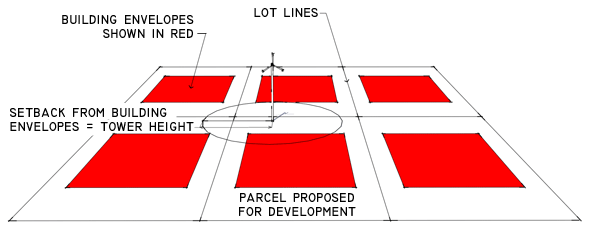 |
2.
Turbine Blade Clearance. The vertical clearance of the blades of tower-mounted horizontal axis turbines shall be not less than 15 feet when the blades are at their lowest point.
3.
Access. Climbing access shall be limited by either:
a.
A six-foot tall fence around the base of the tower with a locking gate; or
b.
A design that does not allow for tower climbing at heights lower than 12 feet.
4.
Noise. Documentation provided by the manufacturer shall demonstrate that noise will not exceed 50 dBA at any property line at peak generation, based on the proposed location of the turbine.
5.
Reflections and Shadows. Turbine blades shall be coated to minimize reflection. Turbines shall be installed in locations that will prevent flickering shadows from being cast into the windows of buildings on nearby properties.
6.
Tower Height and Screening. The maximum height of towers and the required screening for tall towers is set out in Table 12-3-607, Maximum Height of Small Wind Energy Conversion Systems. Tower height shall be measured as follows:
a.
For horizontal axis systems, to the highest point on the rotor blade at its highest point of rotation.
b.
For vertical axis systems, to the highest point of the tower or turbine, whichever is higher.
7.
Durability Requirements. Small wind energy conversion systems that become inoperable shall be repaired or removed within 45 days.
E.
Geothermal Heating and Cooling Systems. Geothermal heating and cooling systems are systems that use buried pipes to exchange heat with the ground, cooling buildings in the summer and warming them in the winter. Closed loop systems (horizontal loop systems and vertical loop systems) are permitted, provided that the loops are set back two feet from property lines. Lake loop systems are permitted if the water body is entirely within the property lines of the parcel proposed for development. Open loop systems are not permitted.
(Ord. 2021-O-13 §18)
Sec. 12-3-608. - Refuse Containers.
A.
Centralized Solid Waste Facilities. Centralized solid waste facilities may be provided for attached residential or multifamily residential uses through the use of dumpsters or common garbage bins located in common areas if it is demonstrated that:
1.
The facilities are located no more than 200 feet (walking distance) from the individual residential units that they are intended to serve;
2.
Access to the facilities is configured to meet the requirements of the refuse service provider;
3.
The areas where dumpsters and/or garbage bins are stored are fully enclosed by an opaque wall constructed of brick, stone, or stucco-finished concrete block, and/or earthen berms, to a height of at least one foot above the top of the dumpster;
4.
The enclosures have:
a.
Service gates which remain closed at all times except when the dumpster or garbage bins are being serviced; and
b.
Separate pedestrian access gates or a pedestrian access opening that screens the dumpster from view. See Figure 12-3-608, Illustrative Trash Enclosures; and
5.
The facilities are located in a side or rear yard of the parcel proposed for development, unless it is not possible to provide service access in such locations; and
6.
If an enclosure must be located in a front yard to meet the requirements of the refuse service provider, it shall be designed and constructed to be consistent and compatible with principal building in terms of materials and architecture.
|
Figure 12-3-608
Illustrative Trash Enclosures |
|---|
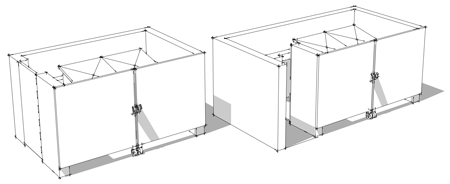 |
B.
Individual Garbage Containers. Individual garbage containers must have a cover and be screened from public view except when placed at the curbside for collection in accordance with Section 7-2-60 of the Municipal Code.
C.
Adequacy of Refuse Containers. The Director shall determine the adequacy of refuse containers and refuse container enclosures based upon the type of use, number of employees/patrons/dwelling units, and the frequency of refuse pickup and may require additional information from the applicant to verify such adequacy.
(Ord. 2021-O-13 §19)
Sec. 12-3-609. - Retaining walls.
A.
Generally. Retaining Walls equal to or above eight (8) feet in height shall be designed to offer visual breaks by use of tiering or horizontal articulation and vertical articulation.
B.
Materials. Materials shall be durable, high-quality materials used for commercial application, including weather-resistant wood species, brick, stone, poured-in-place concrete, concrete block, or other similar materials.
(Ord. 2024-O-05 §19)
Sec. 12-3-701. - Nonresidential and Mixed-Use Development Standards.
A.
Generally. The standards that are applicable to nonresidential and mixed-use development are provided in Table 12-3-701, Nonresidential and Mixed-Use Development Standards. The table includes provisions for minimum landscape surface ratio ("LSR"), maximum building height, minimum lot area and minimum street frontage. Where Division 2-4, Limited and Conditional Use Standards, sets out standards for the LSR, height, lot area, and/or frontage of a proposed use, the standards that are specified in Division 2-4 supersede the standards of this Section.
B.
Standards. The LSR, minimum area of parcels proposed for development, minimum street frontage, and maximum building height shall be as set out in Table 12-3-701, Nonresidential and Mixed-Use Development Standards.
C.
Subdivision of Commercial Developments.
1.
The minimum street frontage and minimum area of parcels proposed for nonresidential and mixed-use development may be waived in the CG, AC, UC, EC-MU, and BP districts with respect to the creation of individual lots within a commercial development if it is demonstrated that:
a.
The area of the principal parcel from which the lot is subdivided complies with the requirements of Table 12-3-701, Nonresidential and Mixed-Use Development Standards, before subdivision;
b.
Appropriate easements are recorded to provide for:
i.
Cross-access between the new lot and the principal parcel; and
ii.
Shared parking between the new lot and the principal parcel, if necessary to comply with the parking requirements of Article 5, Parking and Loading; and
c.
Appropriate covenants are recorded that provide for the required LSR to be maintained in proportion to the principal parcel area before the subdivision, designating the landscaped areas, and providing for their maintenance.
2.
For the purposes of the setback requirements of Section 12-3-702, Required Setbacks for Nonresidential and Mixed-Use Development, lots created pursuant to this subsection C. shall be considered part of the principal parcel. However, buildings shall be spaced at least 20 feet apart.
3.
Lots created pursuant to this subsection are not necessarily entitled to individual access to abutting streets. However, individual access may be provided if it complies with the standards set out in the Roadway Design & Construction Standards Manual.
4.
Lots created pursuant to this subsection are not required to be buffered from principal parcels unless they are in different zoning districts.
(Ord. 2024-O-13 §§33, 34; Ord. 2024-O-14 §41)
Sec. 12-3-702. - Required Setbacks for Nonresidential and Mixed-Use Development.
A.
Generally. The standards of this section apply to nonresidential and vertically mixed-use buildings. If Division 8-4, Bufferyards, requires a bufferyard that is wider than the setback that is required by this Section, then the width of the setback shall be at least the width of the required bufferyard.
B.
Principal Buildings.
1.
Generally. The required setbacks for principal buildings and parking lots are set out in Table 12-3-702, Required Setbacks: Principal Buildings and Parking Lots.
2.
Residential District Setbacks. Residential district setbacks (set out in the last column of Table 12-3-702, Required Setbacks: Principal Buildings and Parking Lots, apply to buildings or outdoor uses (except parking) on parcels that abut property that is located in an RS, RA, RU, NC, or NI district. If the residential district setback is indicated as "NA," then there are no special setback requirements in relation to abutting residential property (i.e., the other columns of the table control).
(Ord. 2024-O-13 §35; Ord. 2024-O-14 §42)
Sec. 12-3-703. - Nonresidential Scale Standards.
A.
Generally. The purpose of the nonresidential scale standards is to ensure that nonresidential buildings that are constructed within residential zoning districts are scaled such that they do not disrupt the fabric of residential neighborhoods. These standards apply only in the RS, RA, RU, NC, and NI zoning districts.
B.
Building Scale. The floor area of nonresidential buildings shall be limited based on the type of street from which primary access is taken, as provided in Table 12-3-703, Nonresidential Building Scale. These standards do not apply to public schools.
C.
Side Street Access. Even if a parcel proposed for development is accessed by a local street, standards applicable to collector or arterial streets may be applied if:
1.
The parcel proposed for development abuts an arterial or collector street;
2.
The access is provided from the first turnout from (or is aligned with the first intersecting street of) a local side street that intersects with the arterial or collector street; and
3.
No residential front yards are located across the local street in the area between the access to the nonresidential parcel and the arterial or collector street. See Figure 12-3-703, Side Street Access.
|
Figure 12-3-703
Side Street Access |
|---|
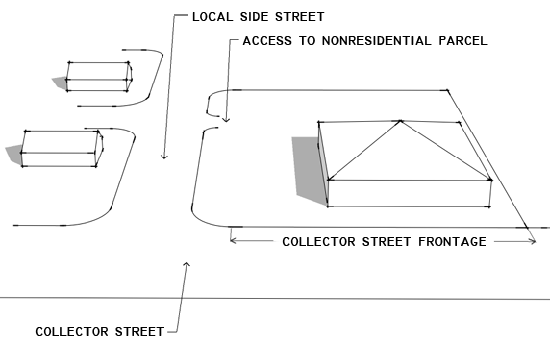 |
Sec. 12-3-801. - Exceptions to Setback Standards.
A.
Generally. Table 12-3-801, Permitted Projections into Required Nonresidential and Mixed-Use Setbacks, sets out projections that may be located outside of required setbacks (between the setback lines and the lot lines).
B.
Interpretation of Table 12-3-801, Permitted Projections into Required Nonresidential and Mixed-Use Setbacks.
1.
Measurements in the table are taken from the applicable setback line (A); from the lot line (B); or into the right-of-way (C). See Figure 12-3-801, Illustrative Measurement of Nonresidential Encroachments.
2.
If a measurement is indicated for "(A) From Setback Line Toward Lot Line" and "(B) From Lot Line Toward Lot Interior," then the measurement that results in the larger distance from the lot line to the encroachment controls.
3.
If a measurement is indicated for "(A) From Setback Line Toward Lot Line" and "(C) Into Right-of-Way," then the measurement that allows the smallest encroachment into the right-of-way controls.
|
Figure 12-3-801
Illustrative Measurement of Nonresidential Encroachments |
|---|
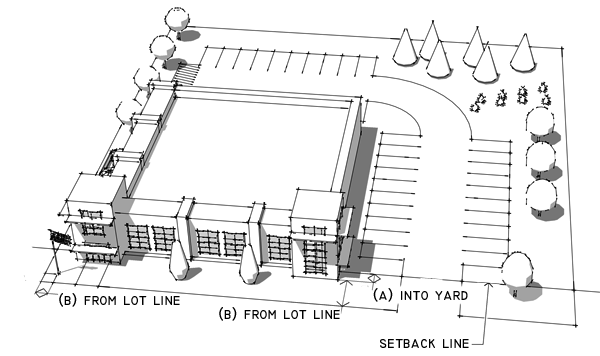 |
C.
Right-of-Way Encroachments. Encroachment into the public right-of-way is generally not allowed, but may be permitted if it is demonstrated that the encroachment:
1.
Is attached to a building that is located in a UC district, AC district, or a mixed-use building located in traditional neighborhood development;
2.
Is, regardless of the permitted encroachment distance specified in Table 12-3-801, Permitted Projections into Required Nonresidential and Mixed-Use Setbacks, limited to not closer than two feet to the back of the street curb or the inside edge of a tree lawn, whichever is less of an encroachment;
3.
Does not encroach on arterial rights-of-way;
4.
Is constructed and situated in a manner that does not obstruct pedestrian or vehicular traffic or constitute a safety hazard; and
5.
Is subject to a revocable license to encroach upon the public right-of-way.
D.
Other Limitations. No projection shall encroach into:
1.
Separately owned property, unless a recorded document provides for access to and maintenance of the projection; or
2.
Utility easements, unless the design of the improvement and a recorded agreement allows access to the utility and allows the utility provider or the City to efficiently remove the encroachment at the property owner's expense.
(Ord. 2021-O-13 §20)
Sec. 12-3-802. - Fences, Garden Walls, and Hedges.
A.
Generally. This section sets out the standards for fences, garden walls, and hedges on nonresidential and mixed-use parcels proposed for development. In some instances, these standards may be superseded by the requirements of Division 8-4, Bufferyards, or other applicable bufferyard requirement (e.g., a limited or conditional use standard), which may require a fence or wall that is taller than the maximum height allowed by this Section.
B.
Height. No fence or garden wall on a parcel used for nonresidential or mixed-use purposes shall exceed the height set out in Table 12-3-802A, Maximum Height of Fences and Garden Walls.
C.
Setbacks. Fences and garden walls on parcels used for nonresidential or mixed-use purposes shall be set back as set out in Table 12-3-802B, Minimum Setbacks for Fences and Garden Walls. Fences and garden walls shall not obstruct required sight triangles or sight distances as required by Section 12-11-208, Sight Triangle and Sight Distance Requirements.
D.
Fence Design. Where used, Fences shall be designed as follows:
1.
Open picket Fences that are located in front yards or street side yards shall be designed such that forty percent (40%) of the face of the Fence is transparent.
2.
Fences in street yards of AC, EC-MU, and UC districts shall be composed of ornamental metal (wrought iron, powder coated aluminum, or comparable quality material), or a combination of masonry (e.g., posts or foundation support) and metal. Such Fences shall be more than 75 percent transparent.
3.
Fences in the OSR and ED district shall be post and rail construction, except where another design is necessary for demonstrated security purposes.
4.
Street and side yard Fences in the BP, CG, EC, AC and UC zone districts shall be limited to four (4) feet in height except where the Fence is: 1) composed of ornamental metal (wrought iron, powder coated aluminum, or comparable quality material), or a combination of masonry (e.g., posts or foundation support) and metal; and 2) at least 75 percent transparent.
E.
Orientation. The Fence, Finished Side shall face out toward neighboring property or adjacent rights-of-way.
F.
Materials.
1.
Materials shall be durable, high-quality materials used for commercial application, including: weather resistant wood species, split rail, wood treated with U.S. Environmental Protection Agency approved preservatives, painted wood, composite materials, ornamental wrought iron or powder-coated aluminum, brick, and stone.
2.
Chain link Fences are permitted, if:
a.
In the AG, CG, EC, or BP districts, the chain link is only used in side and rear yards that are not also street yards, is coated with vinyl or other durable non-metallic coating, and either:
i.
The lot line closest to the Fence is not also a residential district boundary; or
ii.
The Fence is part of a landscaped bufferyard that includes a hedge and/or berm between the fence and the lot line that obscures the Fence, and the Fence is colored to blend in with the vegetation.
b.
In the I district, the chain link Fence is not visible from another zoning district. If chain link is used in the I district, slats shall not be installed on chain link Fences that are located in front yards.
3.
The following are prohibited fencing materials:
a.
Scrap lumber, plywood, sheet metal, plastic, or fiberglass sheets;
b.
Barbed wire, spikes, nails, or other sharp point or instrument on the top or sides of fences;
c.
Welded wire, agricultural fencing, and chicken wire fences are not permitted.
4.
Barbed wire cradles facing inward toward the property may be placed on top of Fences enclosing public utility buildings, industrial properties, or wherever the Director finds that such are necessary to address a demonstrated security interest.
G.
Exceptions.
1.
Fences, Garden Walls, or hedges, which are specifically required pursuant to Article 8, Development Landscaping and Tree Protection, shall conform to the requirements of that Article.
2.
Fences for outdoor recreation facilities, such as basketball or tennis courts, may be up to twelve (12) feet in height provided they are of chain link construction with non-metallic coating (i.e., vinyl), and meet the applicable standards set forth in Section 12-2-409(E), Outdoor Recreation.
3.
Fences for outdoor recreation facilities, such as baseball field back stops and golf course driving range netting may be over twelve (12) feet as determined by the Director.
4.
Unless the Director determines that a deviation from the standards for Fences, Garden Walls, or hedges is necessary to address a demonstrated security interest, all Fences, Garden Walls, or hedges for Protective Care Uses shall comply with the standards set forth in Section 12-3-802.
(Ord. 2021-O-13 §21; Ord. 2022-O-18 §4; Ord. 2024-O-05 §20; Ord. 2024-O-13 §§36—39; Ord. 2024-O-15 §9)
Sec. 12-3-803. - Accessory Buildings and Structures.
A.
Generally. The standards of this Section apply generally to accessory buildings and accessory structures on nonresidential and mixed-use parcels. However, if an accessory building or accessory structure is specifically regulated by another section of this Division (e.g., small wind energy conversion systems), then the requirements of this section do not apply.
B.
No Residential Use. Buildings that are accessory to nonresidential and mixed-use buildings shall not be used for residential purposes.
C.
Maximum Floor Area. The maximum floor area of accessory buildings and the maximum footprint of accessory structures is set out in Table 12-3-803A, Maximum Floor Area of Accessory Buildings/Footprint of Accessory Structures. The maximum footprint of accessory structures noted in Table 12-3-803A shall be inapplicable to those carports or accessory structures which are also used to support photovoltaic arrays.
D.
Required Setbacks. Accessory buildings and accessory structures that are larger than 120 square feet in floor area (or footprint, for structures), or more than 10 feet in height, or both, shall be set back from property lines according to the requirements that are applicable to the principal building. The required setbacks for nonresidential accessory buildings and accessory structures that are 120 square feet or less in floor area (or footprint) and 10 feet or less in height are set out in Table 12-3-803B, Required Setbacks: Nonresidential and Mixed-Use Accessory Buildings and Structures (Buildings that are 120 sf. or Less in Floor Area and Not More than 10 ft. in Height).
(Ord. 2021-O-13 §§22, 23; Ord. 2024-O-13 §§40, 41; Ord. 2024-O-14 §§43—45)
Sec. 12-3-804. - Accessory Structures for the Protection of Vehicle Sales and Rental Inventory.
A.
Applicability. For any Vehicle Sales, Rental or Service uses not in existence (or with a Vested Property Right) as of June 19, 2016, use of Hail Canopies under this Section may be allowed only if specifically approved by City Council as a part of a site plan approval process.
B.
Hail Canopy Defined. A hail canopy shall be defined as an accessory structure consisting of a ridged support system (one or two post cantilevered design) and ridged or flexible canopy constructed for the sole purpose of protecting vehicles from adverse weather conditions and which meets the requirements of this Section.
C.
Generally. This Section is intended to permit the use of Hail Canopies to protect vehicles from adverse weather conditions while such vehicles are held or stored as inventory for retail sale or rental associated with Vehicle Sales, Rental or Service (as such use is defined by the LDC); provided, however, that Hail Canopies are not permitted for use in protection of vehicles while such vehicles are being held or stored for repair or service.
D.
Timing of Construction. No building permit shall be issued for any Hail Canopy unless the principal building for the site has already been constructed or is under construction simultaneously with the Hail Canopy, and the Hail Canopy has received site plan approval in accordance with Section 12-14-602.
E.
Design Standards. Hail Canopies are subject to the following design standards:
1.
Structure Placement. Hail Canopies shall not be placed over the first 25 feet of the paved parking or display area that is generally parallel to the primary street frontage. In addition, Hail Canopies shall meet all required minimum building setbacks for the underlying zone district.
2.
Height. The height of a Hail Canopy shall not exceed 15 feet to the peak of the Hail Canopy, as measured in Section 12-3-204, Height.
3.
Lot Coverage. Hail Canopies shall not be restricted to a maximum overall lot coverage percentage.
4.
Structure Design. Hail Canopies shall be of a cantilevered design with one or two posts.
5.
Structure Durability and Maintenance. Hail Canopies shall be constructed of durable, high-quality materials comparable to and including high density polyethylene mesh (HDPE) or steel. Hail Canopies shall be maintained in a structurally sound, safe, rust-free, and good or better condition. Peeling, dented, or faded materials or finishes, and worn or torn canopies, shall be promptly repaired or replaced within a reasonable time following receipt of written notice from the City.
6.
Cover and Structure Color. Hail Canopies shall only incorporate covers of a solid gray or tan color and tone (Pantone 427 U, 429 U or 7528 U). All support structures shall be solid black. In addition, all Hail Canopies on the same property shall be of the same color and design.
7.
Solar Reflectivity Index. Hail Canopy materials shall maintain a Solar Reflectivity Index (SRI) rating of no more than 40 measured in accordance with professionally accepted practices of the American Society for Testing & Materials (ASTM) or other methodology approved by the Director as reasonably comparable to ASTM-accepted practices.
8.
Signage and Attachments. No signage (either permanent or temporary) shall be attached, mounted to, or permitted on Hail Canopies. In addition, no materials or items shall be permitted to be attached to the Hail Canopy including but not limited to the attachment of lights (except as permitted in subsection 8, Lighting below), panels, flags, balloons, banners or any other device.
9.
Lighting. Hail Canopies shall not cause existing on-site lighting to fail to conform with the existing approved site plan, photometric plan, or the regulations of this LDC. Any lighting integrated within a Hail Canopy shall be designed to direct light in a downcast manner only and shall be installed and maintained in conformance with this LDC.
10.
Landscape Improvements. Any site that installs Hail Canopies, which site is also adjacent to residentially zoned properties, shall provide a 20 percent opacity landscaped bufferyard (within the existing street tree lawn) through a site plan application to screen the site from the residential properties, pursuant to Division 8-4 Bufferyards of this LDC. If existing landscaping is used to meet the bufferyard requirement, the Applicant shall demonstrate, through a site plan application, how the existing landscaping meets the requirements of this LDC.
Sec. 12-3-805. - Renewable Energy Systems.
A.
Generally. Renewable energy systems include photovoltaic arrays (solar electric panels), small wind energy conversion systems, and geothermal heating and cooling systems. They do not include the manufacture of renewable combustible fuels (e.g., ethanol or biodiesel).
B.
Interconnect Agreements Required. If a photovoltaic array or small wind energy conversion system is to be interconnected to the electric utility grid, proof of an executed interconnect agreement shall be provided before the system is interconnected.
C.
Photovoltaic Arrays. Photovoltaic arrays convert sunlight into electricity. The following standards apply to photovoltaic arrays:
1.
Roof-Mounts. Photovoltaic arrays may be roof-mounted on principal and accessory buildings and accessory structures in all districts.
2.
Ground-Mounts. Ground-mounted photovoltaic arrays shall be considered accessory structures for the purposes of determining required setbacks.
3.
Carports and Covered Walkways. Carports and walkways may be covered with photovoltaic arrays regardless of their location on the parcel proposed for development.
D.
Small Wind Energy Conversion Systems. Wind energy conversion systems are turbines that convert wind energy into electricity. In nonresidential and mixed-use developments in nonresidential and mixed-use zoning districts, small wind energy conversion systems are those that are rated for not more than 100kW of combined generation capacity. In residential zoning districts, nonresidential and mixed-use small wind energy conversion systems shall comply with all of the requirements of Section 12-3-607, Renewable Energy Systems, and not this Section. The following standards apply to small wind energy conversion systems for nonresidential and mixed-use development in nonresidential and mixed-use zoning districts:
1.
One hundred feet in height shall be set back from residential properties 1.5 feet for each foot in height.
2.
Turbine Blade Clearance. The vertical clearance of the blades of tower-mounted horizontal axis turbines shall be not less than 15 feet when the blades are at their lowest point.
3.
Access. Climbing access shall be limited by either:
a.
A six-foot tall fence around the base of the tower with a locking gate; or
b.
A design that does not allow for tower climbing at heights lower than 12 feet.
4.
Noise. Documentation provided by the manufacturer shall demonstrate that noise will not exceed 50 dBA at any property line at peak generation, based on the proposed location of the turbine. For mixed-use development, the applicant shall demonstrate that either:
a.
The noise levels at operable windows of residences do not exceed 50 dBA as a result of the turbine; or
b.
The residences are constructed to mitigate the noise to a level that does not exceed 50 dBA.
5.
Reflections and Shadows. Turbine blades shall be coated to minimize reflection. Turbines shall be installed in locations that will prevent flickering shadows from being cast into the windows of buildings on nearby properties.
6.
Tower Height and Screening. The maximum height of towers and the required screening for tall towers is set out in Table 12-3-805, Maximum Height of Small Wind Energy Conversion Systems. Tower height shall be measured as follows:
a.
For horizontal axis systems, to the highest point on the rotor blade at its highest point of rotation.
b.
For vertical axis systems, to the highest point of the tower or turbine, whichever is higher.
7.
Durability Requirements. Small wind energy conversion systems that become inoperable shall be repaired or removed within 45 days.
E.
Geothermal Heating and Cooling Systems. Geothermal heating and cooling systems are systems that use buried pipes to exchange heat with the ground, cooling buildings in the summer and warming them in the winter. Closed loop systems (horizontal loop systems and vertical loop systems) are permitted, provided that the loops are set back two feet from property lines. Lake loop systems are permitted if the water body is entirely within the property lines of the parcel proposed for development. Open loop systems are not permitted.
(Ord. 2024-O-13 §42)
Sec. 12-3-806. - Outdoor Storage.
A.
Generally. Outdoor storage is permitted as an accessory use to buildings in the AG, CG, BP, EC-LI, and I districts, subject to the standards of this Section. Outdoor storage refers to the outside storage of materials or equipment used in production or other course of business, and does not refer to the outdoor display of merchandise (which is subject to Section 12-3-807, Outdoor Display of Merchandise). Outdoor storage areas that exceed the area limitations of this Section are storage yards, which are industrial uses. See Section 12-2-304, Industrial, Agricultural, and Special Uses.
B.
Applicability. Where limited or conditional use standards apply to outdoor storage, the limited or conditional use standards shall apply instead of the standards of this Section. Outdoor storage is prohibited if it is not allowed by the standards of this Section or the limited or conditional use standards applicable to the proposed use.
C.
Prohibitions. Outdoor storage areas shall not be used to dispose of inoperable machines or wastes, store or dispose of hazardous materials, or store or dispose of materials that will create windblown dust or debris or storm water contaminants. Vehicles stored in Outdoor Storage areas shall be operable and for employee use only. Recycled asphalt and recycled concrete are prohibited surfacing materials. Re-milling of a surface may use recycled materials.
D.
Standards by Zoning District.
1.
AG District. Outdoor storage areas for agricultural equipment or materials shall be set back 100 feet from public rights-of-way and properties that have different zoning; or surrounded by an opaque fence that completely screens stored equipment or materials from ground-level views.
2.
CG and BP Districts. Outdoor storage areas are permitted if it is demonstrated that the outdoor storage area:
a.
Is not larger than 10 percent of the floor area of the principal building; and
b.
Is screened in one of the following ways:
i.
Enclosed by a wall that is designed into the principal building's facade and composed of the same materials as the principal building; or
ii.
Located behind the principal building in relation to the closest public right-of-way and enclosed by a wall or opaque fence of sufficient height to completely screen the stored materials from public view. The wall or fence shall be landscaped with a continuous hedge around the periphery, except at points of access. The location of outdoor storage areas may be limited by the application of the fence height and setback standards of Section 12-3-802, Fences, Garden Walls, and Hedges, if the fence heights that are allowed in yard areas are not sufficient to completely screen the stored materials from view.
3.
EC-LI and I District. Outdoor storage areas are permitted if it is demonstrated that the outdoor storage areas are:
a.
Not larger than 15% of the floor area of the principal building;
b.
Located in the buildable area, rear yard, and/or side yard; and
c.
Screened in one of the following ways:
i.
Views from public rights-of-way are completely blocked by the principal building; or
ii.
The area is enclosed by a wall or opaque fence of sufficient height to completely screen the stored materials from public view.
(Ord. 2024-O-13 §§43, 44; Ord. 2025-O-06 §§9, 10)
Sec. 12-3-807. - Outdoor Display of Merchandise.
A.
Generally. This Section sets out the standards that are applicable to permanent outdoor merchandise display areas. Temporary outdoor sales are regulated by Section 12-2-501, Commercial Events. Outdoor storage of items other than merchandise is regulated by Section 12-3-806, Outdoor Storage.
B.
Display Areas that are Attached to Principal Buildings. Outdoor display areas that are attached to a principal building are permitted if it is demonstrated that the display areas are:
1.
Adjacent to a wall of a principal structure, and configured as a walled or decoratively fenced area;
2.
Within the buildable area of the site;
3.
Not located in areas that are required or used for parking or vehicular circulation; and
4.
Not larger than the area set out in Table 12-3-807, Area of Outdoor Display of Merchandise.
C.
Sidewalk Displays. Displays are permitted on sidewalks that abut the principal building if it is demonstrated that:
1.
Merchandise is displayed to a height of eight feet or less;
2.
There is at least five feet of clear width on the sidewalk for use by pedestrian traffic; and
3.
All sidewalk merchandise displays are within 40 feet of an entrance to the principal use, or located in the area defined by the forward projection of the side walls of the use, whichever is a smaller display area.
D.
Vehicle Sales, Rental, and Service. Where outdoor display of vehicles is allowed, vehicles may only be displayed on paved areas of the parcel proposed for development.
E.
Other Displays. Heavy retail (except home centers, warehouse clubs, and superstores), nurseries, and greenhouses, may display merchandise outside within the building envelope of the lot. Display areas shall be indicated on the site plan and shall not interfere with parking and vehicular circulation areas.
Sec. 12-3-808. - Loading, Truck Access, and Solid Waste Collection.
A.
Generally. Loading areas, truck access, and solid waste collection for nonresidential and mixed-uses shall be designed according to the standards of this Section.
B.
Loading and Truck Access. Except as provided in subsections D. or E., loading and truck access facilities shall be:
1.
Located behind principal buildings; and
2.
Screened from view from public rights-of-way by building walls, fences, landscaping, or topography (including berms).
C.
Solid Waste Collection Facilities. Dumpsters or garbage bins may be provided for solid waste collection if it is demonstrated that they are located in trash rooms with bay door service access or:
1.
The facilities are located:
a.
No more than 300 feet from all individual commercial uses that they are intended to serve;
b.
On the same lot as the property they serve, unless otherwise authorized during site plan approval upon written proof of an agreement with an adjacent property owner and demonstration that the facilities will have the capacity to serve both properties; and
c.
Behind a principal building or in a side or rear yard, unless it is not possible to provide service access in such locations; and
2.
Access to the facilities is configured to meet the requirements of the refuse service provider;
3.
The areas where dumpsters and/or garbage bins are stored are fully enclosed by:
a.
An opaque wall that is one foot taller than the refuse container and constructed of the same building materials as the principal building walls (if the building walls are painted, the enclosure shall be painted the same or complimentary color); or
b.
Earthen berms improved with ground cover that are one foot taller than the refuse container and held in place with a retaining wall; and
4.
The enclosures have pedestrian access gates or openings that are configured to conceal the dumpster from view;
5.
The enclosures have truck access gates which remain closed at all times except when the dumpster or garbage bins are being serviced; and
6.
The enclosures are located so that stormwater flows are routed around the enclosure and not through the enclosure.
|
Figure 12-3-808A
Trash Enclosures |
|---|
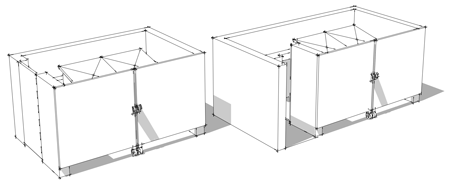 |
7.
The Director shall determine the adequacy of refuse containers and refuse container enclosures based upon the type of use, number of employees/patrons/dwelling units, and the frequency of refuse pickup and may require additional information from the applicant to verify such adequacy.
D.
Service Areas Adjacent to District Boundaries.
1.
Generally, if loading, truck access, or solid waste collection facilities are located between a principal building and property that is used or zoned for residential purposes, or between a principal building and a right-of-way (e.g., on a through lot), then the following additional standards apply:
a.
The loading, truck access, or waste storage area is 100 percent screened by a bufferyard that is at least 10 percent more opaque than required by the district boundary (see Division 8-4, Bufferyards) and contains at least a six-foot tall berm or low maintenance, durable solid fence or wall; or
b.
The loading, truck access, or waste storage area is located under roof as indicated in Figure 12-3-808B, Roof Enclosure. If this option is used, the buffer along the length of the loading shed may be reduced by 10 percent opacity.
2.
Notwithstanding subsection D.1., above, loading, truck access, or solid waste collection facilities that are located between a principal building and property that is used or zoned for residential purposes shall be enclosed as illustrated in Figure 12-3-808B, Roof Enclosure, and shall be landscaped along the length of the enclosure pursuant to the district boundary bufferyard requirement set out in Section 12-8-406, District Boundary Bufferyards, if all of the following conditions are met:
a.
One side of the boundary is zoned BP or CG and the other side is zoned NC or NI;
b.
The parcel proposed for development fronts on Dry Creek Road; and
c.
The parcel proposed for development is at least 1,000 feet deep (measured from the front lot line to the rear lot line).
3.
Subdivision of parcels that meet the criteria of subsection D.2., above, as of November 1, 2009 shall not be used to circumvent the enclosure and landscaping requirements of subsection D.2.
|
Figure 12-3-808B
Roof Enclosure |
|---|
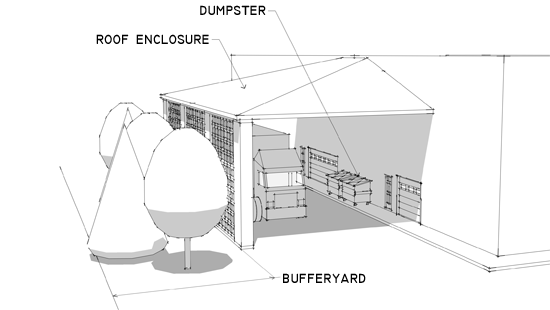 |
E.
Front Loading in the I District. In the I district, truck loading may be in the front yard of the building if it is demonstrated that:
1.
The frontage street is not an arterial; and
2.
The property on the other side of the street is also zoned I.
F.
Loading in UC and AC Districts. In the UC and AC districts:
1.
Uses that are less than 5,000 square feet in area may use over-the-curb loading from local streets or alleys, provided that the loading occurs during off-peak hours and semi-trailer trucks are not used.
2.
Where over-the-curb loading is not used:
a.
Loading areas shall be provided in alleys or service courts that are configured so that their use does not interfere with areas intended for primary pedestrian circulation; or
b.
Where the design does not allow for alley or service court loading, loading areas shall be accessed using bay doors that are integrated into the buildings and designed to appear as building walls. If this option is selected:
i.
Not more than 25 feet of bay door width shall be located on any building wall;
ii.
The bay doors shall be accessed across sidewalks with mountable curbs; and
iii.
The bay doors shall remain closed during hours of peak pedestrian use of the abutting sidewalk.
(Ord. 2021-O-13 §24; Ord. 2024-O-13 §45)
Sec. 12-3-809. - Community Recycling Bins.
A.
Generally. The purpose of this Section is to provide for small-scale collection of recyclable materials by permitting community recycling bins as accessory uses to nonresidential and mixed-use development.
B.
Location. Community recycling bins may be located:
1.
In loading or service areas;
2.
In dumpster enclosures; and
3.
In parking lots, provided that:
a.
They are installed in a manner that prevents unintended movement;
b.
They do not obstruct parking spaces or circulation areas;
c.
They are not located closer than 30 feet to a primary building entrance; and
d.
They are located not less than 30 feet from property lines that abut streets or screened from view from abutting property by an opaque wall or fence.
C.
Construction. Community recycling bins shall be constructed and maintained with durable waterproof and rustproof material.
D.
Instructions and Contact Information. Community recycling bins shall be clearly marked to identify the type of material to be deposited and the identity and phone number of operator.
E.
Maintenance. Community recycling bins shall be maintained in a clean, litter-free condition.
Sec. 12-3-810. - Vending and Reverse Vending Machines.
A.
Generally. Generally, vending machines and reverse vending machines on nonresidential and mixed-use parcels shall be located inside of buildings.
B.
Exceptions. Vending machines and reverse vending machines may be provided outside of building in the following instances:
1.
Donation bins may be placed on nonresidential and mixed-use properties, provided that:
a.
The bin(s) shall be appropriately located so as not to interfere with sight triangles or sight distances as required by Section 12-11-208, Sight Triangle and Sight Distance Requirements, on-site circulation, required setbacks, landscaping, parking, and any other requirements that may have been imposed as part of the site plan approval for the premises, and shall be placed on the concrete surface;
b.
The bin(s) shall be of the type that are enclosed by use of a receiving door and locked so that the contents of the bin(s) may not be accessed by anyone other than those responsible for the retrieval of the contents;
c.
Each bin shall not cover a ground surface area in excess of five feet by five feet, nor be more than six feet in height; and
d.
Each bin must be regularly emptied of its contents so that it does not overflow, resulting in used clothing and materials being strewn about the surround area.
2.
All other vending or reverse vending machines may be placed at transit facilities and outdoor recreation facilities, provided that they:
a.
Are located in a structure that provides cover from rain and snow;
b.
Are set back 30 feet from property lines; and
c.
If internally illuminated, either do not face residential property or are screened from view from residential property by fences, walls, topography, or landscaping.
(Ord. 2024-O-15 §10)
Sec. 12-3-811. - Retaining walls.
A.
Generally. Retaining Walls equal to or above eight (8) feet in height shall be designed to offer visual breaks by use of tiering or horizontal articulation and vertical articulation.
B.
Materials. Materials shall be durable, high-quality materials used for commercial application, including weather-resistant wood species, brick, stone, poured-in-place concrete, concrete block, or other similar materials.
(Ord. 2024-O-05 §21)
Sec. 12-3-812. - Permanent Commercial Outdoor Patio.
A.
Generally. This Section sets out the standards that are applicable to Permanent Commercial Outdoor Patios.
B.
Standards. The following requirements shall be applicable for all new or redeveloped Permanent Commercial Outdoor Patios:
1.
A Permanent Commercial Outdoor Patio must not extend beyond the boundaries of a lawful right to use, control, and maintain property.
2.
A Permanent Commercial Outdoor Patio may encroach into setbacks as set forth in Table 12-3-801, Permitted Projections into Required Nonresidential and Mixed-Use Setbacks.
3.
The Permanent Commercial Outdoor Patio area shall be screened from abutting arterial streets and abutting residential uses according to the requirements below:
a.
Interstate Highways and Arterial Steets: Fence, wall, hedge or other planted or permanent structure at least 3 feet high when the Permanent Commercial Outdoor Patio area is within 20 feet from the arterial street.
b.
Residential Uses: Fence, wall, hedge or other planted or permanent structure at least 6 feet high when the Permanent Commercial Outdoor Patio area is within 150 unobstructed, linear feet from the residential use.
4.
Establishments are required to maintain all areas in and around the Permanent Commercial Outdoor Patio areas in a manner which is clean and free of litter and debris.
5.
ADA pedestrian routes shall be required to the area of the Permanent Outdoor Commercial Patio through building or an outdoor sidewalk connection.
6.
For a Permanent Commercial Outdoor Patio area within 300 unobstructed, linear feet of a residential zoned or used property, live music or amplified noise shall cease at 10:00 p.m. local time. Fences, landscaping, signage, or any other similar object shall not be considered obstructions. Primary buildings and accessory buildings shall be considered obstructions.
(Ord. 2025-O-06 §11)
Sec. 12-3-901. - Purpose and Intent.
A.
Purpose. The Centennial Airport Influence Area ("AIA") is hereby established as an overlay district of the City of Centennial. The purpose of the AIA is to recognize an area that is subject to higher than average avigation noise levels and which area may include possible crash hazards from aviation activities. The AIA is further divided into zones or subareas by this Division for the purpose of regulating properties within the AlA to best protect public health, safety, and welfare. The provisions of this Division overlay or supplement the zoning districts established for the properties within the AIA. To the extent that the provisions of this Division conflict with the provisions of the zoning district for any property within the AIA, the more restrictive provisions shall govern.
B.
Intent.
1.
This Division is intended to balance the benefits of reasonable land development and use of properties within the AIA with the potentially adverse impacts which may occur within certain distances from the Centennial Airport.
2.
This Division is intended to recognize the efforts devoted to protecting the interests of the Centennial Airport and its surrounding areas by other public agencies (e.g., Arapahoe County Public Airport Authority and the Federal Aviation Administration).
3.
This Division is intended to reasonably reduce or minimize exposure of noise sensitive land uses from aircraft noise and the high numbers of aircraft overflights; to minimize risks to public safety from potential aircraft accidents; and to reasonably restrict land uses within the AIA that may be incompatible with airport operations.
Sec. 12-3-902. - Centennial Airport Influence Area, Zones, and Subareas Described.
A.
Boundaries Established. The boundaries of the Centennial AIA, together with the boundaries of zones and subareas of the AIA recognized by this Division, shall be identified and described by the Centennial AIA Map approved by resolution of the City Council.
The boundaries of the Centennial AIA, and the boundaries of each zone and subarea with the AIA, are based in part upon studies, reports, and mapping prepared by public agencies such as the Arapahoe County Public Airport Authority and the Federal Aviation Administration. The studies, reports, and mapping reasonably establish the parameters of airport traffic operations and impacts including actual and estimated noise levels and potential for aircraft related accidents. The studies, reports, and mapping were adopted or accepted by the Arapahoe County Public Airport Authority and the Federal Aviation Administration as accurate and reliable and include the following:
1.
March 1998 "Centennial Airport Land Use Guidelines" prepared by the Arapahoe County Public Airport Authority.
2.
August 2008 "Centennial Airport FAR Part 150 Noise Exposure and Land Use Compatibility Study Program" prepared by Bernard Dunkelberg and Company, BCS International and Urban Environment Associates.
3.
2016 Noise Exposure Map Update to the Centennial Airport FAR Part 150 Noise Exposure and Land Use Compatibility Study Program
The boundaries of the AIA and each zone or subarea recognized by the City of Centennial shall be reviewed and amended by the City either in conjunction with the adoption of updated information by the respective public agencies or based upon other information and studies as determined by City Council.
B.
Interpretation of Boundaries. Where interpretation is needed as to the exact location of a boundary of the AIA or any zone or subarea, the Community Development Director is authorized to make a final administrative determination of the boundary's location on the Centennial AIA Map. A property owner or applicant for development approval affected by the Director's administrative determination may submit to the Director information or evidence supporting the owner or applicant's opinion of the appropriate boundary which information or evidence shall be considered by the Director in reaching the Director's final determination.
C.
Lots Straddling the Boundary of the Airport Influence Area. In the event a legally recognized lot is found by the Community Development Director to straddle the boundary of the AIA, the entire lot shall be deemed to be within the AIA. This provision shall not be applied to prevent or discourage the lawful subdivision of land to remove property from the AlA to avoid straddling the boundary of the AlA.
D.
Lots within More than One Zone or Subarea. In the event a legally recognized lot is determined by the Community Development Director to be located within more than one zone or subarea of the AlA, the entire lot shall be deemed to be within the zone or subarea which most limits or restricts development of the lot. This provision shall not be applied to prevent or discourage the lawful subdivision of land to remove property from a zone or subarea to avoid straddling the boundary between two zones or subareas.
Sec. 12-3-903. - General Regulations and Requirements for Property within the Airport Influence Area.
A.
Avigation Easement Required. All zoning, subdivision, development approval, and issuance of building permits for property within the AIA shall be conditioned upon the grant of an avigation easement by all owner(s) of the property within the AIA subject to zoning, subdivision, development approvals, and building permit. The avigation easement shall:
1.
Be in a form approved by the Community Development Director and the City Attorney;
2.
Permit unobstructed passage of aircraft above the property;
3.
Waive any right or cause of action against the City, aircraft operator, the airport owner and operators arising from noise, vibrations, fumes, dust, fuel particles, and other effects caused by aircraft and airport flight operations;
4.
Run with the land with a perpetual term;
5.
Be subject to release by the City Manager only upon the permanent cessation of operations of the airport or the exclusion of the property from the AIA;
6.
Include language stating, when required by this Division, that the City's noise mitigation construction requirements are required to mitigate the noise to which the property is exposed; and
7.
Be recorded in the office of the Arapahoe County Clerk and Recorder.
B.
No Interference with Airport Operations. No use may be made of land within the AlA that creates electrical interference with radio communication between an Air Traffic Control facility and an aircraft; or to make it difficult for pilots to distinguish between airport lights and other lights; or to cause glare in the eyes of pilots using the airport; or to impair visibility in the vicinity of the airport; or to otherwise endanger the landing, taking off, or maneuvering of aircraft at an airport or in the vicinity of an airport.
C.
Compliance with Federal Regulations. All development within the AlA shall comply with the requirements of 14 C.F.R. Part 77 ("FAR Part 77"). Applicants seeking the rezoning or approval of a development application for property within the AIA shall, if requested by the City at any time prior to rezoning or development approval, submit to the City a report or study prepared by a professional with demonstrated experience in the application of FAR Part 77 which report or study shall summarize the limitations and restrictions imposed by FAR Part 77 on the development of the property. The City's standard note requiring compliance with FAR Part 77 criteria shall be required on all recorded development approvals. Where structures are permitted, the maximum height must comply with the minimum requirements of FAR Part 77 in effect at the time of permit issuance.
Sec. 12-3-904. - Disclosure and Annotation Requirements.
A.
Generally. The requirements of this Section shall apply in all cases where all or a portion of the property subject to application for development approval pursuant to the Land Development Code is located within the Centennial AIA.
B.
Required Annotations on Applications for Development Approval. Applications for development approval for property within the AlA shall depict the boundaries of the AIA and all restricted areas on or in the vicinity of the parcel proposed for development.
C.
Required Annotations on Development Approvals.
1.
Generally. A specific note indicating the reception number of the avigation easement required by Section 12-3-903, General Regulations and Requirements for Property within the Airport Influence Area, shall be required on all development approvals which are processed by the Community Development Department.
2.
Site Plans and Plats. A note in a form approved by the City Attorney shall be included on each site plan and each plat that is subject to this Section, which discloses the existence of the Centennial Noise Mitigation Construction Requirements and states the applicant's and the applicant's successors in interest consent to the requirements and to the City's enforcement of the requirements. A sample form of this disclosure is provided in Appendix B, Forms.
3.
Additional Requirements. The City may also require any of the following annotations or disclosures on site plans or plats:
a.
Excerpts of the regulations of this Division (transcribed or summarized);
b.
Noise disclosure text; or
c.
Other notes that are intended to ensure full and adequate disclosure of the hazards and the development conditions applicable to the parcel proposed for development.
Sec. 12-3-905. - Zones and Subareas within the Centennial Airport Influence Area.
The Centennial AIA shall be divided into the following zones and subareas as depicted on the Centennial AIA Map and the development of property within each zone or subarea shall be restricted as follows:
Sec. 12-3-906. - Noise Mitigation Construction Requirement.
Construction Requirements. Buildings that are required to be constructed in accordance with City noise mitigation construction requirements shall comply with applicable building code requirements for noise mitigation construction, and shall include a central air conditioning and ventilation system, sufficient to enable occupancy of the building without the need for ventilation from open windows or doors. See Article 13 of Chapter 18 of the Centennial Municipal Code for noise mitigation construction requirements.

