
Centennial City Zoning Code
ARTICLE 5
Parking and Loading
Sec. 12-5-101. - Purpose of Article.
A.
Generally. The purpose of this Article is to ensure that:
1.
Adequate off-street motor vehicle and bicycle parking is provided for uses that are permitted by this LDC;
2.
Sufficient motor vehicle parking is provided in nonresidential areas that are near residential neighborhoods, so that the character and quality of life in the residential neighborhoods are protected from overflow parking;
3.
The sharing of off-street parking spaces among uses that have different peak parking demands allows for a reduction in the number of parking spaces that are required to serve mixed-use development;
4.
Adequate loading areas and (where appropriate) stacking areas are provided that do not interfere with the function of other vehicular use areas; and
5.
Vehicular use areas are designed and lighted to promote public safety without creating undue light pollution and glare.
B.
Parking Reductions. In addition to parking requirements that provide for convenience, neighborhood protection, and mobility, this Article provides several ways to reduce the number of parking spaces that are required for development in order to promote the efficient use of land, and reduce the expanse of paved areas.
C.
Residents and Visitors with Disabilities. It is also the purpose of this Article to provide parking and accessible routes for disabled individuals in accordance with the Americans with Disabilities Act Accessibility Guidelines, as may be amended from time to time.
Sec. 12-5-102. - Application of Article.
A.
Generally. This Section describes how the sections of Article 5, Parking and Loading, are applied, and how they relate to other provisions of this LDC.
B.
Number of Required Parking and Loading Spaces. The number of parking and loading spaces that must be provided for a proposed development is calculated as provided in Division 5-2, Parking and Loading Calculations. Section 12-5-201, Calculation of Required Parking Spaces, establishes the methodology for calculating the number of required parking spaces, including measurement of independent variables and application of available credits and reductions that are allowed by Section 12-5-205, Parking Credits and Reductions, and Section 12-5-206, Shared Parking.
C.
Bicycle Parking. Bicycle parking is required as set out in Section 12-5-207, Bicycle Parking.
D.
Stacking Design and Analysis. Drive-through lanes shall comply with the following design and stacking analysis requirements as well as any additional applicable requirements pursuant to the Roadway Design & Constructions Manual:
1.
Design
a.
Businesses that provide drive-through facilities are required to provide spaces for vehicles waiting in line. Required stacking spaces shall be a minimum nine (9) feet wide and twenty (20) feet in length and shall not be counted as required on-site parking spaces. Stacking spaces shall be located to prevent any vehicles from extending onto the public right-of-way, or interfering with any pedestrian circulation, traffic maneuvering, or other parking space areas.
b.
Each drive-through lane shall be a separate lane from the circulation routes and lanes necessary for ingress to, or egress from, the property or access to any off-street parking spaces. Each such lane shall be striped, marked or otherwise distinctively delineated.
c.
The entrance of a drive-through lane shall be located not closer than 25 feet from the right-of-way line of any adjacent public street providing direct access to the lane.
d.
Drive-through ordering systems shall be located to allow a minimum of four (4) cars to queue behind the ordering vehicle to prevent vehicles from stacking in the drive aisle of the parking lot. See Figure 12-4-202A, Illustrative Drive-Through Layout.
e.
If drive-through operations will include in person staff taking customer orders in the drive-through lanes, sufficient, marked walking space shall be provided in an amount of 3 extra feet per lane to promote staff safety.
2.
Stacking analysis
a.
The design of all drive-through lanes shall be subject to the approval of the Community Development Director. Design and approval shall be based upon information contained in a traffic engineering study prepared by an independent traffic engineer licensed by the State of Colorado, or such other study as approved by the Community Development Director, and provided to the City by the developer, at such developer's sole expense, at the time of application for such use.
b.
The final stacking analysis shall be submitted to the Director in writing which shall include recommendations of the length and number of stacking lanes to be associated with the proposed business in order to:
i.
Avoid or mitigate interference with parking spaces and drive aisles associated with the proposed business;
ii.
Avoid or mitigate stacking of vehicles in conflict with entry and exit points of the proposed business; and
iii.
Prevent unauthorized stacking of vehicles onto neighboring businesses, or private or public access lands or roads.
c.
The study required by the provisions of this subsection shall contain and address the following factors:
i.
Nature of the product or service being offered, including peaking characteristics on weekdays and weekends;
ii.
Method by which the order, request, sale or service is processed;
iii.
Time required to serve a typical customer;
iv.
Arrival rate of customers;
v.
Time period over which customers will arrive at stated rate;
vi.
Anticipated length of queuing;
vii.
Discussion of ambient circulation and parking, either proposed or existing;
viii.
Location of storage areas with respect to parking spaces or circulation aisles;
ix.
Discussion of potential blockages due to queue; and
x.
Mitigation measures to address peak stacking demand.
xi.
The study shall include a scale drawing delineating all parking spaces, circulation facilities, driveways and the nearest public street.
xii.
Each such lane shall be designed to prevent circulation congestion, both on-site and on public and private streets and accessways.
xiii.
The study shall include an analysis of at least five comparable uses.
d.
The City may rely upon the stacking analysis or may request additional information or analysis, including, but not limited to: alternative or new data points, or consideration of additional or alternative factors related to comparability or peak demand, as supported by sound engineering principles.
e.
Stacking shall not overflow onto rights-of-way.
f.
Stacking shall not generally overflow onto adjacent properties. To the extent the designated stacking regularly exceeds the lot on which the Drive-Through is situated, the City shall require cross access easements or other form of recorded consent from adjacent or impacted property owners. Stacking mitigation required by the City either at the time of development or during the operation of a drive-through may include, but shall not be limited to, requiring consent for stacking to occur off of the site of the Restaurant, Drive-Through use and dedicated in-person management for overflow stacking onto adjacent lots.
E.
Design of Parking and Loading Areas. The size and configuration of parking and loading spaces shall be as set out in Division 5-3, Parking and Loading Design and the Roadway Design and Construction Standards Manual. Parking and loading areas may also be subject to supplemental nonresidential and mixed-use standards in Division 3-8, Supplemental Nonresidential and Mixed-Use Development Standards.
F.
Surfacing, Use, and Maintenance of Parking and Loading Areas. Standards for the surfacing, use, and maintenance of parking and loading areas are set out in Division 5-4, Use and Maintenance of Parking and Loading Areas. Additional design standards are set out in Division 3-8, Supplemental Nonresidential and Mixed-Use Development Standards. Standards that apply to temporary uses in parking and loading areas are set out in Article 2, Districts and Use Standards.
G.
Truck Routing. Some uses that involve heavy truck traffic require a truck routing plan as part of the application for development approval. The standards for such plans are set out in Division 5-5, Truck Routing Plans.
Sec. 12-5-201. - Calculation of Required Parking Spaces.
A.
Generally. The standards of this Section are used to calculate how many parking spaces are required to serve a proposed development.
B.
Calculations. The number of parking spaces that are required for a development relates to one or more independent variables, such as floor area, seating capacity, projected full time equivalent employees, number and type of dwelling units, and so forth.
1.
Measurements. The independent variables shall be measured as follows:
a.
Floor Area: Where the number of parking spaces in Section 12-5-202, Required Off-Street Parking and Loading Spaces, is calculated based on the gross floor area.
b.
Seats: One seat is equal to:
i.
One fixed seat;
ii.
Two linear feet of bench seating; or
iii.
Fifteen square feet of floor area used for temporary seating.
c.
Capacity:
i.
Seating capacity shall be measured pursuant to the requirements of the applicable fire code.
ii.
Number of beds shall be measured by the design capacity of an Institutional Accommodation or Nursing Home use.
d.
Employees:
i.
"Employees on Maximum Shift" refers to the largest projected number of employees that will be present at the use at one time during normal business operations.
ii.
"FTEs" refers to the total number of full-time equivalent employees who are projected to work at the use.
2.
Calculations. The number of required parking spaces is calculated according to the formulae set out in Section 12-5-202, Required Off-Street Parking and Loading Spaces, and then adjusted as follows:
a.
First, according to the standards of Section 12-5-205, Parking Credits and Reductions, if applicable; and
b.
Second, according to the standards of Section 12-5-206, Shared Parking, if applicable.
3.
Rounding. If the final calculation of the number of required parking spaces includes a fractional space, the number of required parking spaces is rounded up to the nearest whole number, regardless of the fraction.
C.
Multiple Nonresidential Uses. If several nonresidential uses occupy a single parcel or building, the off-street parking and loading requirements shall be the cumulative total for all uses, unless:
1.
The uses are of different categories, such that the standards of Section 12-5-206, Shared Parking, apply; or
2.
The uses are in a center with multiple retail, service, or restaurant tenants, which shall be classified cumulatively as "shopping center" for the purposes of parking requirements. See Section 12-5-202, Required Off-Street Parking and Loading Spaces, subsection C.
D.
Electric Vehicle Parking Spaces. Any parking space reserved for an Electric Vehicle charging shall count toward the parking space requirement.
(Ord. 2023-O-07 §8; Ord. 2024-O-13 §46)
Sec. 12-5-202. - Required Off-Street Parking and Loading Spaces.
A.
Residential Uses. Required off-street parking and loading for residential uses are set out in Table 12-5-202A, Residential Parking and Loading Requirements. Parking requirements for residential and predominately residential neighborhood types (see Section 12-2-302, Residential, Home, and Institutional Uses) are based on the individual uses in the neighborhood. There are no additional parking requirements for home uses unless specified in Division 2-4, Limited and Conditional Use Standards, for the home use that is proposed.
B.
Institutional Uses. Required parking and loading for institutional uses are set out in Table 12-5-202B, Institutional Parking and Loading Requirements.
C.
Commercial Uses. Required parking and loading for commercial uses are set out in Table 12-5-202C, Commercial Parking and Loading Requirements.
D.
Recreation and Amusement Uses. Required parking and loading for recreation and amusement uses are set out in Table 12-5-202D, Recreation and Amusement Parking and Loading Requirements.
E.
Industrial Uses. Required parking and loading for industrial uses are set out in Table 12-5-202E, Industrial Use Parking and Loading Requirements.
F.
Agricultural Uses. Required parking and loading for agricultural uses are set out in Table 12-5-202F, Agricultural Use Parking and Loading Requirements.
G.
Special Uses. Required parking and loading for special uses are set out in Table 12-5-202G, Special Use Parking and Loading Requirements.
(Ord. 2023-O-07 §9; Ord. 2024-O-03 §7; Ord. 2024-O-13 §47; Ord. 2024-O-14 §50; Ord. 2024-O-19 §7)
Sec. 12-5-203. - Required Disabled Parking Spaces.
Generally. All uses subject to this Article 5, Parking and Loading, shall provide accessible vehicle parking in compliance with applicable Building Code and the Americans with Disabilities Act (ADA) standards.
(Ord. 2023-O-07 §§10—12; Ord. 2024-O-05 §26, 27; Ord. 2026-O-07 §§6—9)
Sec. 12-5-204. - Special Studies.
A.
Generally. Some of the uses that are listed in the tables set out in Section 12-5-202, Required Off-Street Parking and Loading Spaces; have nonlinear or widely varying parking demand characteristics. Accordingly, their parking requirements are listed in the table as "special study." Required parking for these uses shall be established by special study according to the standards of this Section. A special study shall also be required for any unlisted land use in Section 12-5-202, Required Off-Street Parking and Loading Spaces. Additionally, the Director is authorized to reduce the parking requirements of any land use through the review and approval of a special study that meets the requirements of subsection B., below.
B.
Requirements.
1.
The special study shall be conducted by a qualified transportation planner or traffic engineer at the applicant's expense. The study is subject to review and approval by the Director as noted below.
a.
A peak parking analysis of at least five comparable uses and documentation regarding the comparability of the referenced uses, including: name, function, location, floor area, parking availability, access to transportation network (including vehicular, bicycle, pedestrian, and transit), use restrictions, and other factors that could affect the parking demand; and
b.
Documentation regarding the comparability of the referenced uses, including: name, function, location, floor area, parking availability, access to transportation network (including vehicular, bicycle, pedestrian, and transit), use restrictions, and other factors that could affect the parking demand.
C.
Approval of Special Study.
1.
The City may rely upon the special study or may request one round of additional information or analysis, including, but not limited to: alternative or new data points, or consideration of additional or alternative factors related to comparability or peak demand, as supported by sound engineering principles.
2.
As a condition of approval of a special study, the City may require that land be reserved or land-banked for additional parking if there is a demonstrably high probability the use could change, resulting in a higher demand for parking.
(Ord. 2021-O-13 §§25, 26)
Sec. 12-5-205. - Parking Credits and Reductions.
A.
Generally. This section sets out credits and permissible reductions in the number of off-street parking spaces that must be provided. Based on the provision of alternative parking or transportation demand management programs that tend to reduce the demand for parking spaces.
B.
On-Street and Public Lot Parking. In the UC and AC districts, and in approved traditional neighborhood developments ("TNDs"), on-street parking and parking in public lots may be credited to particular uses in accordance with the formula: Parking Credit = (Sa × P), where Sa = the area of the applicant's parcel divided by the area of the contiguous zoning district or TND, and P = the total parking that is available on-street and in public lots in the district or TND.
C.
Car Share Programs. For each parking space allocated to a car share program, two parking spaces may be subtracted from the number of parking spaces required by this Division. Car share parking spaces shall be posted as reserved for the car share program. Documentation shall be provided that demonstrates the commitment of the car share program operator to provide vehicles at the site.
D.
Reduction of Parking Requirements by Provision of Bicycle Amenities. The Director may authorize up to a five percent reduction in the number of required off-street parking spaces for development that provides amenities or incentives for bicyclists that are in addition to the provision of outdoor bicycle parking spaces. Examples of accommodations that would qualify for the credit include:
1.
Enclosed bicycle lockers;
2.
Employee shower facilities, lockers, and dressing areas; or
3.
Meaningful financial incentives for employees to bicycle to work.
E.
Reduction of Parking Requirements by Provision of Shuttle Connections to Light Rail Transit.
1.
For office or hospital uses in the UC, AC, or BP districts, the Director may authorize up to a ten percent reduction in the number of required off-street parking spaces for development that provides regular shuttle transit to light rail stations, as follows:
a.
A five percent reduction is allowed for peak-hour shuttle service to the light rail station; and
b.
If peak-hour shuttle service is provided, an additional five percent reduction is allowed for applicants who provide pre-paid transit fares or other suitable financial incentives for their employees as an incentive to use transit for journey to work trips.
2.
Shuttle services that are provided in order to utilize the off-street parking reductions allowed by this subsection shall have a designated loading and unloading area with reasonable access to the principal building.
Sec. 12-5-206. - Shared Parking.
A.
Generally. The City Council recognizes that uses may have different hours of operation and peak parking demand hours. The City desires to encourage the sharing of parking for its potential to reduce impervious surfaces and/or enhance the efficiency of land use. Thus, where a mix of uses creates synergy with respect to the utilization of parking spaces due to differences in peak use, the City may reduce the required number of spaces according to the provisions of this Section.
B.
Shared Parking Table. Shared parking allows a reduction in the total number of required parking spaces when a parcel is occupied by two or more uses which typically do not experience peak parking demands at the same time. When any land or building is used for two or more uses that are listed below, the minimum total number of required parking spaces may be determined by the following procedures:
1.
Multiply the minimum required parking for each individual use, excluding spaces reserved for use by specified individuals or classes of individuals (except car share programs), by the appropriate percentage listed in Table 12-5-206, Shared Parking Table, for each of the designated time periods.
2.
Calculate a sum for all uses for each of the five time periods (columns). The minimum parking requirement is the highest of these sums. Figure 12-5-206, Illustrative Shared Parking Credit Calculation, provides an example of how to use Table 12-5-206, Shared Parking Table to calculate required parking.
Table 12-5-206
Shared Parking Table
3.
In general, the maximum reduction allowed by Table 12-5-206, Shared Parking Table, shall be 25 percent. However, a greater reduction is permitted, provided that:
a.
Sufficient land is set aside for each parking space in excess of the 25 percent reduction that is not constructed, so that the spaces may be constructed at a later date should the Director determine that they are necessary; and
b.
The property owner executes and records a document that guarantees that the spaces will be constructed upon written order of the Director.
C.
Special Shared Parking Study.
1.
As an the alternative to the methodology in Table 12-5-206, Shared Parking Table, an applicant may submit a special study to demonstrate that the parking required to serve mixed uses is less than the cumulative parking requirements for each individual use. The special study shall be conducted by a qualified transportation planner or traffic engineer at the applicant's expense (the Director shall maintain a list of qualifications and/or certifications that are acceptable to the City for this purpose), and shall:
a.
Review peak parking demand periods for the proposed uses during a 24-hour weekday and each weekend day, and shall propose a required number of parking spaces based on the combined peak hour demand for parking.
b.
Provide data on the following:
i.
The sensitivity of the proposed uses to change. For example, a center with no restaurant could have significant changes in parking if a restaurant was added.
ii.
Similar mixes of uses in other areas of the community.
iii.
Degree of variability of parking for individual uses (average, range, and standard deviation).
2.
The City may require a reserved open area if it believes that the risk of parking needs changing over time so warrants. Once the project is occupied and well established, if there is a surplus of parking, the applicant may petition for additional development capacity and parking using the reserved area.
D.
Shared Parking Among Lots Under Different Ownership. When a shared parking reduction is to be applied to uses on several lots under different ownership, the following shall be provided:
1.
A plan that provides for interconnected lots;
2.
Recorded easements that provide, at a minimum, for:
a.
Cross-access among the parking areas and connections to permit parking by the different uses anywhere in the connected properties;
b.
Allocation of maintenance responsibilities;
c.
A pedestrian circulation system that connects uses and parking areas, making it easy and convenient to move between uses; and
d.
A right of enforcement by the City.
Sec. 12-5-207. - Bicycle Parking.
A.
Applicability. Bicycle parking shall be required pursuant to this Section for:
1.
All parcels proposed for development that have parking lots with 15 or more parking spaces; and
2.
All recreation areas within residential and mixed-use development.
B.
Number of Bicycle Parking Spaces.
1.
Surface Parking Lots. One bicycle parking space per 15 parking spaces.
2.
Structured Parking Lots.
a.
Minimum number of bicycle parking spaces: 5
b.
Structures with more than 75 parking spaces: 1 bicycle parking space per 15 parking spaces.
3.
Recreation Areas. The minimum number of bicycle parking spaces for recreation areas is the greater of the requirement set out in subsection B.1., above, or:
a.
Per playground or play field or community swimming pool: 6 bicycle parking spaces
b.
Per tennis court: 1 bicycle parking space
4.
Residential Uses. Bicycle racks are not required for bicycle parking associated with single-family detached and single-family attached uses. Required bicycle parking for such residential uses may be provided in garages, storage rooms and other secure resident accessible areas.
C.
Bicycle Parking Design Standards. Bicycle parking shall be designed as:
1.
Bicycle lockers; or
2.
Bicycle racks with the following characteristics:
a.
The bicycle frame and one wheel can be locked to the rack with a high security, U-shaped lock with both wheels left on the bicycle (designs that only allow one locking point at the wheel are prohibited);
b.
A bicycle that is six feet long can be securely held with its frame supported so that the bicycle cannot be pushed or fall in a manner that will damage the wheel components; and
c.
The racks are securely anchored to a hard surface. See Figure 12-5-207, Illustrative Permitted Bicycle Parking Systems.
|
Figure 12-5-207
Illustrative Permitted Bicycle Parking Systems |
|---|
 |
D.
Bicycle Parking Location Standards.
1.
Short-term bicycle parking must be located within 50 feet of the principal building entrance, at the same grade as the sidewalk or accessible route.
2.
An aisle at least five feet wide shall be provided behind all required bicycle parking to allow room for bicycle maneuvering. Bicycle parking and maneuvering areas may be accessed across sidewalks, but shall not encroach upon required sidewalk areas.
3.
If required bicycle parking is not visible from the street or principal building entrance, a sign shall be posted at the principal building entrance indicating the location of the bicycle parking.
E.
Bicycle Parking Maintenance Standards. The property owner or property owners' association shall maintain bicycle parking. Damaged, rusted, or missing racks shall be repaired or replaced, as appropriate, in order to create a secure parking facility for bicycles in accordance with this Section.
(Ord. 2024-O-14 §51)
Sec. 12-5-301. - Location of Parking Areas.
A.
General Location. All private off-street parking areas created for the use of a building or other use of land shall be placed on the same lot and within the same zoning district as the building or use that they are intended to serve. Public parking facilities are permitted to function and be located independently of land uses that they may serve.
B.
Multi-Family. Unless specifically allowed, parking areas for multi-family housing shall not be located in the front setback. In those instances where parking is allowed in the front setback, a 20 percent opacity bufferyard is required.
Sec. 12-5-302. - Parking Space and Module Standards.
A.
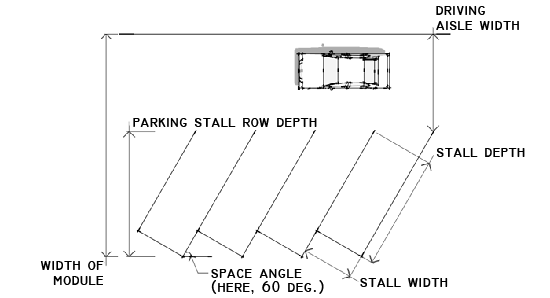
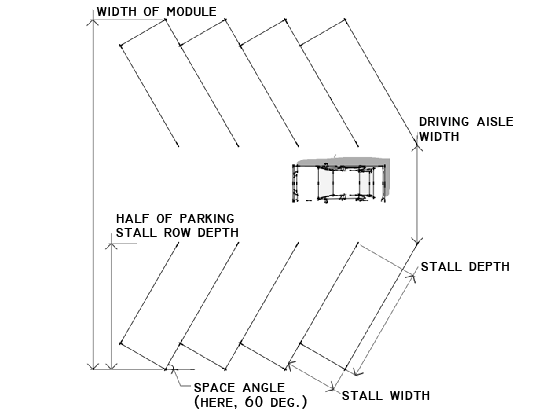
Standard Parking Space Dimensions. Parking spaces, including Electric Vehicle parking spaces, shall have the dimensions set out in Table 12-5-302A, Parking Dimensions. The dimensions that are set out in the table are illustrated in Figure 12-5-302A, Parking Module Standards; One Row and Figure 12-5-302B, Parking Module Standards; Two Rows.
Table 12-5-302A
Parking Dimensions
B.
Vertical Clearance. A vertical clearance of not less than eight feet shall be provided over all parking spaces. Additional clearance shall be provided for larger vans, sport utility vehicles, and light trucks that require such clearance if parking demand from such vehicles is anticipated. All parking garage entrances shall include an overhead bar to alert oversized vehicles regarding clearance.
C.
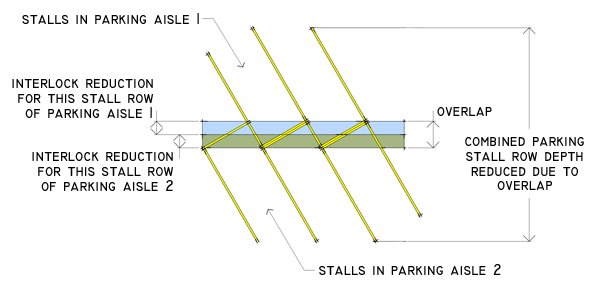
Parking Module Dimensions. Parking modules (the combination of parking spaces and the access aisle) shall be dimensioned as shown in Table 12-5-302B, Parking Module Dimensions. The dimensions that are set out in the table are illustrated in Figure 12-5-302A, Parking Module Standards; One Row and Figure 12-5-302B, Parking Module Standards; Two Rows. The interlock reduction applies to each side of parking rows that interlock with other rows, as illustrated in Figure 12-5-302C, Interlock Reduction.
Table 12-5-302B
Parking Module Dimensions
|
Figure 12-5-302A
Parking Module Standards; One Row |
|---|
 |
|
Figure 12-5-302B
Parking Module Standards; Two Rows |
|---|
| Note that the parking stall row depth in Table 12-5-302, Parking Module Dimensions, is the total depth of both rows of parking. Therefore one row is shown as "Half Parking Stall Row Depth" in the illustration |
 |
|
Figure 12-5-302C
Interlock Reductions |
|---|
| The interlock reduction is available on any side of an angled parking row that interlocks with another angled parking row. |
 |
(Ord. 2023-O-07 §13; Ord. 2026-O-07 §10)
Sec. 12-5-303. - Marking of Parking Spaces and Traffic Control Devices.
A.
Generally. All parking spaces shall be marked and maintained on the pavement and any directional markings/signs shall be installed and maintained as required by the approved parking plan.
B.
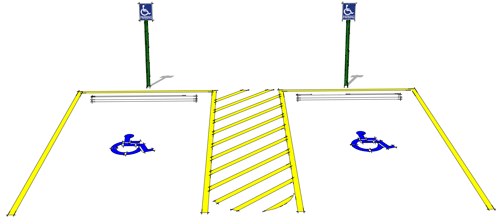
Disabled Parking Spaces. As required by the Americans with Disabilities Act Accessibility Guidelines ("ADAAG"), each disabled parking space shall be marked with a free-standing or wall mounted sign using the standard uniform words and/or symbols that signify the space as parking for the disabled only. In addition, the disabled symbol shall be painted on the pavement within the parking space. See Figure 12-5-303, Illustrative Disabled Parking Spaces. This requirement shall automatically change to conform to amendments to ADAAG after the effective date.
C.
Traffic Control Devices. All traffic control devices (signs, marking and signals) shall conform to Manual on Uniform Traffic Control Devices, latest edition and the Roadway Design & Construction Standards Manual.
|
Figure 12-5-303
Illustrative Disabled Parking Spaces |
|---|
 |
Sec. 12-5-304. - Circulation.
Circulation systems within parcels proposed for development shall provide for continuous traffic flow with efficient, non-conflicting movement throughout the site. Conflicts between areas of significant pedestrian movement and vehicular circulation shall be minimized.
Sec. 12-5-305. - Off-Street Loading.
A.
Generally. All uses shall provide off-street loading as required by Section 12-5-202, Required Off-Street Parking and Loading Spaces. Loading spaces shall be configured as provided in this Section. Design of off-street loading spaces is regulated by Section 12-3-808, Loading, Truck Access, and Solid Waste Collection.
B.
Dimensions.
1.
Minimum width of loading bay (side to side): 12 feet.
2.
Minimum length of loading bay (front to back):
a.
For semi-trailers: 60 feet.
b.
All other loading spaces: 25 feet.
3.
Minimum vertical clearance: 14 feet.
C.
Use of Rights-of-Way. Where off-street loading areas are required, at no time shall any part of a truck or van be allowed to extend into a public right-of-way while the truck or van is being loaded or unloaded.
D.
Maneuvering Space. Adequate off-street truck maneuvering space shall be provided on-site (and not within any public street right-of-way or other public land) so that trucks can maneuver to the docking area.
E.
Location. All loading areas are required to be located on the same lot as the building or lot served by the loading area. Loading areas shall be located such that no part of a truck extends into right-of-way or interferes with parking access while it is loading or unloading.
F.
Fire Exit or Emergency Access. Off-street loading facilities shall be designed so as not to interfere with any fire exits or emergency access facilities to either a building or site.
Sec. 12-5-306. - Electric Vehicle Charging Stations.
A.
Generally. The standards of this Section apply to all Electric Vehicle Charging Stations in the City of Centennial. The intent of this Section is to facilitate and encourage the use of Electric Vehicles, serve public and private mobility needs, accommodate Electric Vehicle technologies, and set minimum standards for Electric Vehicle Charging Stations.
B.
Permitted Locations as a primary use. Electric Vehicle Charging Stations as a primary use as defined by this LDC. The use would require an applicant to follow the development process including, but not limited to, the development approval procedures of Division 14-3, Standardized Development Approval Procedures, and the Limited Use Standards, including requirements from Table 12-2-408, Spacing and Area Requirements for Selected Commercial Uses, for a Gasoline Station when considered a Limited Use, and the Nonresidential Design Standards, including requirements from Sec. 12-4-203, Gasoline Station/Convenience and Vehicle Service/Repair Facilities.
C.
Permitted Locations as an accessory use. Electric Vehicle Charging Stations as an accessory use shall be permitted in all zone districts. Electric Vehicle Charging Stations as an accessory use may be permitted along public rights-of-way where on-street parking is permitted. Such approval shall be considered by the Director of Public Works if the proposal meets the applicable Right-of-Way regulations and the Centennial Roadway Design and Construction Standards Manual.
1.
If the primary use of the parcel is a Residential Use or Institutional Use as defined Table 12-2-302, an Electric Vehicle Charging Station - Private Use shall be permitted as an accessory use. Electric Vehicle Charging Station - Public Use shall not be permitted as an accessory use.
2.
If the primary use of the parcel is not a Residential Use or Institutional Use with a residential component as defined by the LDC, both an Electric Vehicle Charging Station - Private Use and Electric Vehicle Charging Station - Public Use shall be permitted as an accessory use.
3.
A Development Order, as described in Division 14-3, Standardized Development Approval Procedure, shall not be required for Electric Vehicle Charging Stations - Public Use or Electric Vehicle Charging Station - Private Use as an accessory use.
D.
Standards for Electric Vehicle Charging Stations - Non-Residential and Multi-Family Uses.
1.
Parking.
i.
Electric Vehicle Charging Station Parking Spaces may be included as a part of the minimum total required parking spaces required in accordance with Section 12-5-201, Calculation of Required Parking Spaces.
2.
Equipment Standards.
i.
Charging equipment must be affixed to building wall, pedestal, bollards, or other facilities. Charging equipment must be placed at the edge of the electric vehicle parking space in a manner that is easily accessible for the person utilizing the charging equipment. Charging equipment may span two (2) parking spaces to allow use of multiple parking spaces for electric vehicle charging.
ii.
Electric Vehicle Charging Stations shall not be attached to benches, fencing, signage, trash cans, trees, or other similar facilities.
iii.
No charging cords or similar equipment may be placed within the dimensions of a parking space in a manner that would cause the parking space to become unusable.
iv.
When cords and connectors are not in use, retraction devices or locations for storage shall be located sufficiently above the pedestrian surface and the parking lot, to reduce conflicts with pedestrians and vehicle maneuvering.
v.
Any bollards, curbs, wheel stops, or other similar facilities shall not obstruct use of the charging equipment.
vi.
Any trash cans, signage, benches, or other similar facilities shall not obstruct use of the charging equipment.
vii.
Electric Vehicle Charging Station outlets and connector devices shall be no less than thirty-six (36) inches high and no higher than forty-eight (48) inches from the surface where attached. Equipment attached to pedestals, bollards, building walls, or other facilities shall be designed and located so as to not impede pedestrian, bicycle, or vehicular travel, or create trip hazards on sidewalks or bike lanes.
viii.
Support facilities such as, but not limited to, dispensers, switchgears, and other equipment necessary and integral to support an electric vehicle shall be screened on all sides by opaque fencing, landscaping, or walls. Electric Vehicle Charging Stations and connected equipment, such as charging cords, do not need to be screened.
3.
Usage Fees. Electric Vehicle Charging Station operators may collect fees for the use of an Electric Vehicle Charging Station.
4.
Signage.
i.
Signage demonstrating the Electric Vehicle Charging Station's voltage and amperage, the style of the charger's connector or connectors, hours of operation, applicable fees, and safety information related to the Electric Vehicle Charging Station shall be required.
ii.
Each Electric Vehicle Charging Station space shall be posted with signage indicating the space is only for electric vehicle charging purposes. For purposes of this subsection, charging means that an Electric Vehicle is parked at an Electric Vehicle Charging Station and is connected to the charging station equipment. Any restrictions shall be included on the signage.
5.
Parking Space Striping. Unique parking space striping for an electric vehicle parking space may be permitted. The striping may not include more than one (1) logo, or one (1) symbol, centered in the parking space denoting that the parking space is for Electric Vehicle use.
6.
Maintenance. A phone number or other contact information shall be provided on the Electric Vehicle Charging Station equipment for reporting when it is not functioning, or other problems are encountered.
E.
Standards for Electric Vehicle Charging Stations - Single-Family Attached and Single- Family Uses.
1.
Equipment Standards.
i.
Charging equipment must be screened from the public right-of-way through the use of fencing, the principal building, or an accessory structure. Charging equipment may also be placed within an attached garage or a detached accessory structure. If the only charging equipment is a charging cord that connects directly to an electrical outlet, then screening is not required.
ii.
Support facilities such as, but not limited to, dispensers, switchgears, and other support equipment necessary and integral to support an electric vehicle shall be reasonably screened to the City's satisfaction from the public right-of-way and from adjacent properties through the use of fencing, the principal building, or an accessory structure. Support facilities may also be placed within an accessory structure that fully screens the support facilities.
(Ord. 2023-O-07 §14)
Sec. 12-5-401. - Use of Parking and Loading Facilities.
A.
Generally. Required off-street parking spaces shall be available for operable passenger automobiles of the residents, customers, patrons, and employees of the use to which they relate.
B.
Storage.
1.
Parking Spaces and Aisles. Storing materials, boats, campers, recreational vehicles, or inoperable vehicles, or overnight parking trucks or trailers is prohibited in parking areas of multifamily, nonresidential, and mixed-use developments, unless:
a.
The outdoor storage use is permitted in the applicable zoning district and approved for the subject property;
b.
The areas that are set aside for such parking are not counted towards the parking requirements for the use; and
c.
The areas that are set aside for such parking comply with the requirements for outdoor storage (e.g., buffering or screening of outdoor storage areas).
2.
Loading Spaces. The long-term storage of trailers in loading spaces is prohibited. Such spaces shall be available for routine use by delivery vehicles.
C.
Prohibited Use of Parking Areas.
1.
No designated off-street parking facilities shall be used for the repair, display, service, or sales of any good or service unless expressly and specifically approved by the City. However, this paragraph does not apply to single-family detached and single-family attached driveways when they are used for garage sales or for minor repairs to vehicles owned by the resident of the property.
2.
No area required by the City for the use of private off-street parking shall be used by any party as a commercial parking lot.
D.
Blocking of Access Prohibited.
1.
Blocking loading spaces or parking spaces is prohibited.
2.
Loading spaces or parking spaces shall not be designed or located in a manner that blocks access to other loading spaces, parking spaces, driving aisles, fire lanes, ingress or egress points, streets or building entrances. The Director may modify this requirement as it applies to the temporary blocking of parking spaces and driving aisles (but not fire lanes, ingress or egress points, streets or building entrances) for sites less than one (1) acre in area.
3.
Parking, loading, and access areas shall be kept free of permanent or movable structures which block access, of any type (e.g., trash receptacles or compactors).
4.
Parking within or otherwise obstructing a driveway approach or across public sidewalks is prohibited.
(Ord. 2021-O-13 §27)
Sec. 12-5-402. - Surfacing and Maintenance of Off-Street Parking Areas.
A.
Surfacing. Off-street parking areas shall be surfaced as follows:
1.
In general, off-street parking areas shall be graded and surfaced with concrete, bituminous asphalt or other material approved by the Director. Recycled asphalt and recycled concrete are prohibited surfacing materials. Re-milling of a surface may use recycled materials. The surfacing material shall protect against potholes, erosion, and dust.
2.
The Director may permit less durable surfaces (such as grass pavers, crushed stone, or gravel) for off-street parking facilities that serve athletic fields, public or private parks, low-turnover uses, and overflow parking needs, provided that:
a.
The perimeter of such parking areas is defined by bricks, stones, railroad ties, or other similar devices; and
b.
Surfaces with loose materials are set back at least 25 feet from the edge of pavement of the connecting public street.
B.
Maintenance. Off-street parking surfaces shall be kept in good condition and parking space lines or markings shall be kept clearly visible and distinct.
(Ord. 2025-O-06 §16)
Sec. 12-5-403. - Commercial Vehicle Parking Restrictions in Residential Zone Districts.
A.
Generally. Parking of commercial vehicles on residential property shall be limited because it is inconsistent with the nature of that use of property.
B.
Restrictions. No commercial vehicle shall be parked upon any private property in a residential district outside of an enclosed garage except temporarily for such period of time necessary to expeditiously complete rendering services to the property.
C.
Exceptions. This prohibition shall not apply in residential districts zoned agricultural (AG) or neighborhood conservation (NC2a) so long as the commercial vehicle is parked more than fifty (50) feet from any residential structure located on an adjacent property.
Sec. 12-5-501. - Truck Routing Plans.
A.
Generally. Uses that are either specifically identified in Division 2-4, Limited and Conditional Use Standards, or are identified by the Director as involving the use of semi-trailers, dump trucks, trash hauling trucks, or comparable heavy trucks at a frequency of more than ten truck trips per week shall provide a truck routing plan to the City along with other required application materials.
B.
Contents of Truck Routing Plan. The truck routing plan shall include, at a minimum:
1.
The type or class of vehicles that will be used by the proposed land use;
2.
The anticipated frequency of delivery and departures of trucks;
3.
The hours of truck traffic;
4.
A map illustrating the route(s), from an interstate or other regional arterial, of all trucks used by the proposed land use. Such map shall be prepared at a scale of one inch equals 250 feet or other scale approved by the Director; and
5.
A map illustrating the routing and flow of trucks within the parcel proposed for development. Such map shall be prepared at a scale of not greater than one inch equals 50 feet or other scale approved by the Director.

