
Centennial City Zoning Code
ARTICLE 16
Definitions
Sec. 12-16-101. - World Wide Web Links.
Some of the definitions of this Article include links to world wide web sites that provide supporting information ("external links"). The external links were current as of the Effective Date. However, the materials provided in the external links are not part of this LDC. The Director is authorized to maintain and update the external links to provide for public and administrative convenience without further action of the Planning and Zoning Commission or City Council.
Sec. 12-16-102. - Word Usage.
A.
Generally. The rules of this Section shall be observed and applied when interpreting this LDC, except when the context clearly requires otherwise.
B.
Word Usage. Words shall be interpreted as follows:
1.
Unless the context clearly indicates otherwise, words used or defined in one tense or form shall include other tenses or forms.
2.
Unless the context clearly indicates otherwise, words in the singular number shall include the plural number, and words in the plural number shall include the singular number.
3.
The masculine gender shall include the feminine. The feminine gender shall include the masculine.
4.
The words "shall" and "will" are mandatory.
5.
The words "may" and "should" are permissive.
6.
The word "person" includes individuals, partnerships, firms, corporations, associations, trusts, and any other similar entities or combination of individuals.
C.
Statutory and United States Code References.
1.
References to the Colorado Revised Statutes or United States Code shall be interpreted to mean the most current version of the referenced section at the time the reference is applied. If a referenced section is repealed and replaced by another section of the Colorado Revised Statutes or United States Code with comparable subject matter, the replacement section shall control. If a referenced section is repealed and not replaced, the repealed section shall control if it is within the home rule powers of the City to effectuate such result, or the application shall be held for up to 12 weeks for the City to revise this LDC to resolve the reference and establish an appropriate policy.
2.
Where referenced sections authorize the promulgation of administrative rules, references to the Colorado Revised Statutes or United States Code shall be interpreted to include the phrases "and rules promulgated thereunder."
Sec. 12-16-103. - Abbreviations and Acronyms.
Table 12-16-103, Meaning of Abbreviations and Acronyms sets out the meaning of the abbreviations and acronyms used in this LDC.
(Ord. 2023-O-10 §5)
Sec. 12-16-201. - Definitions.
1 to 9
360-Degree Architectural Treatment means the use of similar and compatible building materials, color schemes, relief and details, windows, openings, rooftop screening, landscaping, and other architectural and design features on all sides of a building or site such that all sides of a building or site present a similar appearance as the front or primary entrance of the building.
A
Abutting means having a common property line or district line with an adjacent property.
Access Drive means a private driveway/road, street or right-of-way providing ingress and egress to properties adjacent to a regional thoroughfare, arterial street, or major collector street.
Accessory Building means a building that is subordinate to the principal building, which serves a purpose that is customarily associated with the principal use. Examples of accessory buildings include storage sheds and detached residential garages. The phrase accessory building does not include structured parking.
Accessory dwelling unit (ADU) means a second, subordinate dwelling unit located on the same lot as a principal dwelling unit. The unit includes its own independent living facilities with provisions for sleeping, cooking, and sanitation, and is designed for residential occupancy independent of the principal dwelling unit.
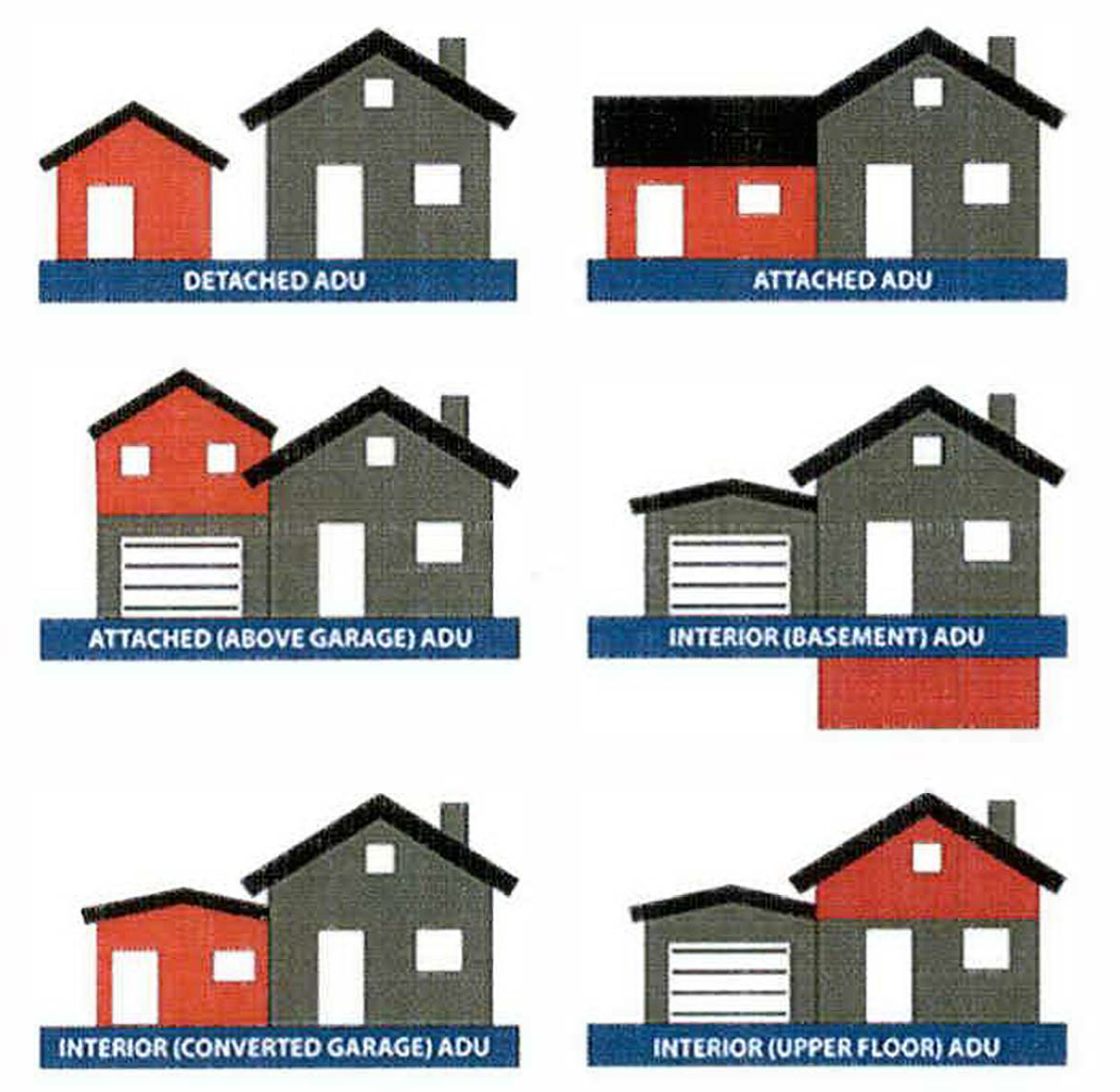
ADU, Attached/Interior means an ADU that is located within (internal) or attached to the principal dwelling. Within the principal dwelling means space such as a finished basement or attic. Attached to the principal dwelling means space such as a converted garage or structural addition.
ADU, Detached means an ADU that is separated from the principal dwelling typically at ground level or above a detached garage or other similar structure.
Accessory Structure means a structure that is subordinate to a principal building or structure, which serves a purpose that is clearly incidental to the principal use of the lot. Examples of accessory structures include gazebos and detached carports. The phrase "accessory structure" does not include fences and garden walls.
Accident Potential Zone (APZ) I means an area beginning at the outer edge of the Buckley Air National Guard Base Clear Zone, three thousand feet (3,000') wide by five thousand feet (5,000') long, in which the potential for aircraft accidents, while being less than the accident potential on the Base environs, is considered measurable enough for the purposes of these Regulations to warrant certain land use restrictions to be placed on lands lying within this Zone.
Accident Potential Zone (APZ) II means an area beginning at the outer edge of the Buckley Air National Guard Base Accident Potential Zone I, three thousand feet (3,000') wide by approximately seven thousand feet (7,000') long together with a triangular-shaped area at the westerly edge of the seven thousand foot (7,000') measurement which is five thousand five hundred feet (5,500') wide at the base by seven thousand three hundred feet (7,300') long, all as depicted in Figure 3-1 of the June 1998 AICUZ, in which the potential for aircraft accidents, while being less than the accident potential of APZ I, is considered measurable enough for the purposes of these Regulations to warrant certain land use restrictions to be placed on lands lying within this Zone
Acre, Gross means an area in any shape containing forty-three thousand five hundred sixty square feet (43,560 sq ft).
Active Uses are commercial uses which generate significant pedestrian traffic and interest at street level including consumer and service-oriented retail and retail displays, commercial and professional offices, hotel uses, and in some cases residential and residential-oriented services.
Addition, as used in Division 7-3, Floodplain Management and Flood Damage Prevention, means any activity expands the enclosed footprint or increases the square footage of an existing structure.
Adjacent/Adjoining Lot or Land means a lot or parcel of land that shares all or part of a common lot line with another lot or parcel of land.
Adjacent Property means property that has a common property line with, or that is separated from a parcel proposed for development by public right-of-way.
Adult Arcade means any commercial establishment or private club where, for any form of consideration, one or more still or motion picture projectors, slide projectors, or similar machines, or other image producing machines, for viewing by five or fewer persons per machine at any one time, are used to regularly show films, motion pictures, video cassettes, slides, or other photographic reproductions or mechanically, electronically, chemically, or digitally reproduced visual materials characterized by an emphasis upon the depiction, display or exhibition of specified sexual activities or specified anatomical areas.
(Ord. 2005-O-28)
Adult Bookstore, Adult Novelty Store, Adult Video Store means a commercial establishment that devotes a significant or substantial portion of its business to any one (1) or more of the following:
1.
The sale, rental or viewing, for any form of consideration, of books, magazines, periodicals or other printed matter or photographs, films, motion pictures, video cassettes, slides or other photographic reproductions or mechanically, electronically, chemically, or digitally reproduced visual materials which are characterized by an emphasis upon the depiction, display or exhibition of specified sexual activities or specified anatomical areas;
2.
The sale or rental of instruments, devices, or paraphernalia which are designed for use or marketed primarily for engaging in specified sexual activities; or
3.
A significant or substantial portion of its business is shown by characteristics including, but not limited to, some or all of the following:
a.
A significant or substantial portion of its stock in trade consists of the items listed in items 1 and/or 2 above; or
b.
A significant or substantial portion of its revenues is derived from the rental or sale of items listed in items 1 and/or 2 above; or
c.
A significant or substantial portion of its floor space, shelf space or storage space is devoted to the items listed in items 1 and/or 2 above; or
d.
A significant or substantial portion of its advertising is devoted to the items listed in items 1 and/or 2 above.
For the purposes of this definition, ""significant or substantial portion" shall be interpreted as any amount more than a de minimis, immaterial or nominal amount or portion of the business' stock in trade, revenues and/or advertising as reasonably determined by the City. As to advertising, a review of the business' online and printed advertising materials may be considered by the City, together with other publicly available information, in applying the definition to a particular business. A commercial establishment may have other principal business purposes that do not involve items 1 and 2 described above and still be categorized as an Adult Bookstore, Adult Novelty Store or Adult Video Store subject to the City's Sexually Oriented Business Regulations set forth in Section 12-2-410. The City shall be authorized in its determination that a particular business does not meet the definition of an Adult Bookstore, Adult Novelty Store, or Adult Video Store to impose reasonable conditions on the business and its operations which will ensure that the business does not later meet the definition of an Adult Bookstore, Adult Novelty Store, or Adult Video Store following the City's determination and the issuance of a business license, permits, or other City approvals.
(Ord. 2005-O-28)
Adult Cabaret means a nightclub, bar, restaurant, concert hall, auditorium, or other commercial establishment or private club which regularly features or presents live adult entertainment.
(Ord. 2005-O-28)
Adult Entertainment means any exhibition, display, activity or dance that involves the appearance or exposure to view of specified anatomical areas.
(Ord. 2005-O-28)
Adult Motel means a hotel, motel or similar commercial establishment which:
1.
Offers accommodations to the public for any form of consideration and provides patrons with closed-circuit television transmissions, films, motion pictures, video cassettes, slides, or other photographic reproductions or mechanically, electronically, chemically, or digitally reproduced visual materials which are characterized by an emphasis upon the depiction, display or exhibition of specified sexual activities or specified anatomical areas; and has a sign visible from the public right-of-way which advertises the availability of this adult type of photographic reproduction; or
2.
Offers a sleeping room for rent for a period of time that is less than ten (10) hours; or
3.
Allows a tenant or occupant of a sleeping room to sub-rent the room for a period of time that is less than ten (10) hours.
(Ord. 2005-O-28)
Adult Motion Picture Theater means a commercial establishment or private club, where for any form of consideration, films, motion pictures, video cassettes, slides or similar photographic reproductions or mechanically, electronically, chemically, or digitally reproduced visual materials are regularly shown characterized by an emphasis upon the depiction, display or exhibition of specified sexual activities or specified anatomical areas. An establishment meeting the definition of an adult arcade is not an adult motion picture theater.
(Ord. 2005-O-28)
Adult Theater means a theater, concert hall, auditorium, or similar commercial establishment which, for any form of consideration, regularly features persons who appear in a state of nudity or live performances which are characterized by exposure of specified anatomical areas or by specified sexual activities.
Advanced Ecologically Engineered Wastewater Treatment System means a wastewater treatment system that uses a combination of settling tanks and constructed wetlands (with microorganisms and wetland plant species) to treat effluent to tertiary and re-use quality standards.
Agricultural Animal/Livestock means a domesticated animal customarily associated with agriculture, including but not limited to cows, sheep, goats, llamas, horses, mules, donkeys, burros, swine, rabbits and fowl.
Agricultural Support and Other Rural Services means uses that support agricultural uses, including:
1.
Farm supply services and feed stores;
2.
Farm equipment dealers; and
3.
Grain storage.
Agriculture means land (with and without farm residences) which is primarily used for the commercial production of field crops for food, fiber, or energy; orchards; viniculture; horticulture; dairying; pasturage; aquaculture, and truck farming. The term "agriculture" also includes the raising or breeding of livestock, cattle, horses, poultry, where there is no more than one animal equivalent unit per acre, and the keeping of bees. The term includes the necessary accessory uses for storing the products and inputs needed to produce them. The term does not include intensive agriculture, nor does it include the accessory use of land for personal gardens or the use of open spaces for raising crops, provided that no mechanized equipment is used for planting, cultivation, or harvest.
Airports means aircraft take-off and landing fields and flight training schools; or airstrips for personal aircraft for the private use of an individual. The term "airport" also includes the term "heliport," which is any area used for the take-off and landing of helicopters that also includes passenger and cargo facilities, fueling, and emergency service facilities.
Airport Influence Area means an area within the City of Centennial, proximate to an airport, which is recognized by the City Council as containing lands which are expected to be significantly affected by noise and/or safety hazards associated with aircraft operations associated with said airport.
Alcoholic Beverage Sales means:
1.
The retail sale of beer, wine, or other alcoholic beverages for on- or off-premises consumption but not to include restaurants as defined and regulated elsewhere in this Code; or
2.
A brewery (with or without on-premises consumption), where:
a.
Annualized production does not exceed 3,200 barrels of beer per year; and
b.
A minimum of 25 percent of production is sold on-site; or
3.
A winery (with or without on-premises consumption), where:
a.
Annualized production does not exceed 5,000 cases of wine per year; and
b.
A minimum of 25 percent of production is sold on-site; or
4.
A distillery (with or without on-premises consumption), where:
a.
Annualized production does not exceed 50,000 proof gallons of spirit per year; and
b.
A minimum of 25 percent of production is sold on-site; or
5.
A beer garden (an open air, roofed or unroofed area adjacent to or accessory to a building or structure where beer and other alcoholic beverages are served or consumed).
Alley means a minor right-of-way, dedicated to public uses, which gives a secondary means of vehicular access to the rear or side of properties otherwise abutting a street, and which may be used for public utility access.
Alternative Rounding means rounding up to the next whole number.
Animal Boarding means the feeding, housing, and exercising of horses not owned by the owner of the property and for which the property owner may receive compensation.
Animal Equivalent Unit means a unit of measurement to compare various animal types based upon equivalent forage needs or waste generation.
Antenna means a metallic apparatus used for sending and/or receiving electromagnetic signals.
Apiary means a structure that is designed to hold honeybee hives. A typical apiary has a capacity of 25 to 40 hives. Note that the number of hives that are allowed in an apiary may be restricted by Section 12-2-420, Residential Agriculture Overlay District.
Approach Zone means an area beginning at the outer edge of the Clear Zone defined by FAA approved Airport Layout Plans; the main purpose being to facilitate the arrival and departure of aircraft utilizing the aviation facility.
Arapahoe Urban Center Sub-Area Plan means the Arapahoe Urban Center Sub-Area Plan, adopted by the Planning and Zoning Commission on October 10, 2007 and ratified by the City Council on October 15, 2007, as may be amended from time to time.
Architectural Details means any projection, relief, cornice, column, change of building material, window, or door opening on any building. The phrase does not include wall textures, such as brick, ribbed concrete, split face concrete block, or siding, nor does it include color changes.
Architectural Metal means metallic materials and components selected and used in construction and design to enhance a Building's aesthetics, structural integrity, and functionality.
Areas and Activities of Special Interest means any area or activity which has been identified in the City Comprehensive Plan as being of special interest because it involves development activities or development areas, or both, which might create a condition incongruent with the planned and orderly use of land and/or the protection of the environment and natural resources in a manner consistent with the constitutional rights or protection of the public health, safety and wellbeing.
Area of State Interest means an area identified by the City Council as warranting State review of land use decision, pursuant to Article 65.1 of Title 24 C.R.S. as amended (House Bill 1041-1974).
Artificial Turf means synthetic materials developed to resemble natural grass.
Assisted Living Facilities means a residential facility, licensed according to the requirements of Sec. 25-27-101, et seq., Colorado Revised Statutes, that makes available to three or more adults not related to the owner of such facility, either directly or indirectly through an agreement with the resident, room and board and at least the following services: Personal services; protective oversight; social care due to impaired capacity to live independently; and regular supervision that is available on a twenty-four-hour basis, but not to the extent that regular twenty-four-hour medical or nursing care is required. The phrase "assisted living facility" does not include any facility licensed in this state as a residential care facility for individuals with developmental disabilities, or any individual residential support services that are excluded from licensure requirements pursuant to rules adopted by DPHE.
Auto Body means the major repair and/or servicing of automobile or motor vehicle, including trailers, recreational vehicles, campers, motor homes, mobile homes, and motorcycles seriously damaged beyond standard maintenance (e.g., major collision repair).
Auto Repair means the repair and/or servicing of automobile or motor vehicle, including trailers, recreational vehicles, campers, motor homes, mobile homes, and motorcycles:
1.
Minor. Repairs consisting of a minor nature, such as: tune up, oil change, chassis lubrication, tire change or repair, wheel alignment, muffler repair or installation that meet the following:
a.
Repairs are made in fully enclosed bays;
b.
Repairs are of a type that is typically completed in less than two hours (e.g., oil changes, brake service, tire rotation and balancing, glass repair, tire replacement, fluid checks and replacement, muffler service, spark plug replacement, and comparable services); and
c.
Vehicles are generally not stored on-site, and on the occasion when overnight storage is necessary, vehicles are stored indoors.
2.
Major. Vehicle repair consisting of assembly or disassembly of engine parts, body parts, transmission, chassis, axles, and/or the process of painting or upholstering and shall be considered a Heavy Industry use.
Awning means a shelter supported from the exterior wall of a building which can be retracted, folded, or collapsed against the face of the supporting building. An awning may be supported by posts. An awning is not a canopy.
B
Ball Diamond means a location permanently designed or intended for use for baseball, softball, kickball, or other similar activity that customarily includes bases spaced to form a diamond. A ball diamond may, but not always, include a backstop, area for player assembly (dugout), and bleachers.
Base Flood or 100-year Flood means a flood having a recurrence interval that has a one-percent chance of being equaled or exceeded during any given year (1-percent-annual-chance flood). The terms "one-hundred-year flood" and "one percent chance flood" are synonymous with the term "100-year flood". The term does not imply that the flood will necessarily happen once every one hundred years.
Base Flood Elevation (BFE) means the elevation shown on a FEMA Flood Insurance Rate Map for Zones AE, AH, AR, AR/A, AR/AE, AR/AH, and AR/AO that indicates the water surface elevation resulting from a flood that has a one percent chance of equaling or exceeding that level in any given year.
Basement, as used in Division 7-3, Floodplain Management and Flood Damage Prevention, means any area of a building having its floor subgrade (below ground level) on all sides.
Bed and Breakfast means a place of lodging that:
1.
Provides five or fewer rooms for short-term rental;
2.
Is the owner's personal residence; and
3.
Is occupied by the owner at the time of room rental.
Bee means any stage of the common domestic honey bee, Apis mellifera species. Bee does not include Africanized bees and hybrids of Africanized bees.
Berm means a mound of earth used for screening, definition of space, noise attenuation and aesthetics in landscaping.
Block means an area of land that is surrounded on all sides by streets or other transportation rights-of-way or by physical barriers such as water bodies or public open spaces. Blocks are normally, but not necessarily, divided into lots.
Boutique Industry see Industry Boutique.
Buckley Air Force Base means the airport in Aurora, Colorado at estimated Latitude 39.7016667/Longitude -104.7516667, which as of the Effective Date is in use by the Colorado Air National Guard, however known, and by whomever used from time to time, so long as the facility is used for take-off and landing of aircraft.
Buffer means a strip of land established to separate and protect one type of land use from another, to screen from objectionable noise, smoke or visual impact, or to provide for future public improvements or additional open space.
Bufferyard means an area used to screen development from streets and adjacent properties.
Buffer Zone means an area that experiences high volumes of aircraft overflights. Residential and other noise sensitive uses are discouraged. However, on a case by case basis, the City Council may consider such uses appropriate, but only when noise mitigation construction standards are applied. Building height must comply with FAR 77 surface criteria, existing or future, whichever is more restrictive.
Building means any structure built for the shelter or enclosure of persons, animals, or property (not including fences), having one or more floors and a roof, and permanently affixed to the ground.
Building Code means the current Building Code utilized by the City of Centennial.
Building Coverage means the total of indoor floor areas taken on a horizontal plane at the main grade level of the principal building and all accessory buildings. It does not include such appurtenances as open porches, terraces, decks, driveways, and steps. All dimensions are measured between the exterior faces of building walls.
Building Envelope means the portion of a lot within applicable setback requirements where building construction will be permitted.
Building Front means one exterior wall of the building typically facing a front line of a lot; or in the event that the primary entrance is located on an exterior wall which is not the front line of the lot, the building front shall be the exterior wall containing the primary entrance to the building.
Building, Main/Primary means a building in which the principal permitted use of the lot on which it is situated is conducted.
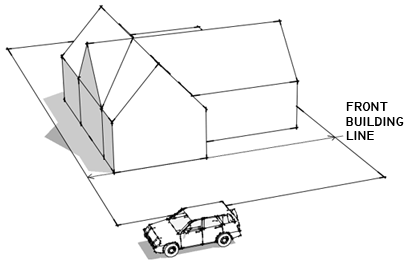
Building Line, Front means a horizontal line across the portion of the primary facade of a building that is closest to the street.
Build-to Zone is applicable to those properties within the Central Arapahoe Road Corridor. The Build-to Zone means the area within 25 feet of the front building setback (e.g., for CG zone district the Build-to Zone would be between 25 feet and 50 feet from the front property line).
| Front Building Line |
|---|
 |
C
Caliper means a method of measuring the diameter of a tree trunk. The measurement is taken six inches above the ground up to and including four-inch caliper size. If the caliper at six inches above the ground exceeds four inches, the caliper is measured at 12 inches above the ground. The measurement is taken according to the methodology set out in the most current edition of the American Standard for Nursery Stock, published by the American Nursery and Landscape Association.
Camouflage and Concealment Design Techniques means measures used in the design and siting of Wireless Communications Facilities with the intent to significantly reduce the visual impacts of such facilities to surrounding uses so that the presence of the Wireless Communications Facility is not readily apparent. A Wireless Communications Facility utilizes Camouflage and Concealment Design Techniques when:
1.
The facility is integrated within, or incorporated on, an architectural feature of an existing structure, such as a tower, clock tower, bell steeple, cupola, penthouse, architectural feature or other similar structure and is not readily apparent;
2.
The facility is integrated within, or incorporated on, vertical infrastructure such as a traffic signal, flag pole, light pole or other similar structure and is not readily apparent; or
3.
The facility uses a design which mimics and is consistent with landscaping features (such as artificial rocks, trees, and other vegetation), maintains authenticity in its application and is not readily apparent.
Candela means a unit of measure defining the intensity of a ray of light at a given angle.
Canopy means a roof-type structure which is permanently affixed to the ground or permanently affixed to a building and typically not enclosed. As accessory structures, these structures would be exempt from the minimum distance requirements between structures. These structures must meet all other minimum yard requirements within the zoning district. When permanently affixed to a building, the canopy structure must be parallel to the ground and may be supported by posts. A canopy is not an awning.
Car Sharing means a model of car rental where people rent cars for short periods of time, often by the hour. The organization renting the cars may be a commercial business, or the users may be organized as a nonprofit company, public agency, cooperative, or ad hoc grouping. Car sharing differs from traditional vehicle rental in the following ways:
1.
Car sharing is not limited by office hours;
2.
Reservation, pickup, and return is all self-service;
3.
Vehicles can be rented by the hour, as well as by the day;
4.
Users are members who have been pre-approved to drive (background driving checks have been performed and a payment mechanism has been established);
5.
Vehicle locations are distributed throughout the service area, and often located for access by public transport;
6.
Insurance and fuel costs are included in the rates; and
7.
Vehicles are not serviced (e.g., cleaning, gasoline fill-up) after each use.
Caretaker's Residence means a dwelling unit or mobile home accessory to a principal use in any one zone district designed and intended for occupancy by a person(s) owning, employed in, or dealing with and responsible for the security and maintenance of the principal use.
Cemetery means any place, including a mausoleum, niche, or crypt, in which there is provided space either below or above the surface of the ground for the interment of the remains of human bodies.
Central Arapahoe Road Corridor is defined by properties along East Arapahoe Road from South Quebec Street to South Parker Road, as depicted in the Central Arapahoe Road Corridor Map (Appendix G).
Channel means the physical confines of a stream or drainageway consisting of a bed and stream banks, existing in a variety of geometries.
Channelization means the artificial creation, enlargement or realignment of a stream channel or drainageway.
Chicken means any member of the species Gallus domesticus, regardless of sex.
Child Care Center means a facility, by whatever name known, that is maintained for the whole or part of a day for the care of five or more children who are 18 years of age or younger and who are not related to the owner, operator, or manager thereof, whether the facility is operated with or without compensation for such care and with or without stated educational purposes. The phrase "child care center" includes, but is not limited to facilities commonly known as:
1.
Day care centers;
2.
School-age child care centers;
3.
Before and after school programs;
4.
Nursery schools;
5.
Kindergartens;
6.
Preschools;
7.
Day camps;
8.
Summer camps;
9.
Centers for developmentally disabled children;
10.
Facilities that give twenty-four-hour care for children;
11.
Facilities for children under the age of six years with stated educational purposes operated in conjunction with a public, private, or parochial college or a private or parochial school, except that the term shall not apply to any kindergarten maintained in connection with a public, private, or parochial elementary school system of at least six grades or operated as a component of a school district's preschool and kindergarten program operated pursuant to article 28 of title 22, C.R.S.
The phrase "child care center" does not include any facility licensed as a family child care home a foster care home.
State Law reference— Title 26, Human Services Code, Section 26-6-102, Definitions, Colorado Revised Statutes.
Church means a building, together with its accessory buildings and uses, where persons regularly assemble for religious worship, and which building, together with its accessory buildings and uses, is maintained and controlled by a religious body organized to sustain public worship. Considered a Place of Public Assembly.
City Council means the City of Centennial's governing body known as the City of Centennial City Council.
City Engineer means that person designated by the City Manager.
City Staff means members of the staff of the Community Development Department who are authorized by the Director to process or decide applications for development approval.
Cluster Development means a type of land use design concentrating development in one or more areas of the project and allowing for a reduction in lot size below minimum requirements when compensating amounts of open space are provided within the proposed project.
Code of Federal Regulations (CFR) means the codification of the general and permanent rules published in the Federal Register by the executive departments and agencies of the Federal Government.
College/University/Vo-Tech means a community college, college, university, vocational / technical school, trade school, language school, business school, training center, beauty school, culinary school, and comparable advanced or continuing education facilities. The phrase does not include music schools, fitness centers, sports instruction, swimming instruction, or martial arts instruction. (See Services, Commercial, Personal and Professional.)
Collocation means the mounting or installation of transmission equipment on an Eligible Support Structure for the purpose of transmitting and/or receiving radio frequency signals for communications purposes.
Colony means a hive and its equipment and appurtenances, including bees, comb, honey, pollen, and brood.
Colorado Noxious Weed List means a list of noxious weeds that is promulgated by the Colorado Department of Agriculture. It is available on the web at: http://www.colorado.gov/cs/Satellite?c=Page&cid=1174084048733&pagename=Agriculture-Main/CDAGLayout.
Commercial Amusement, Indoor means uses that provide commercial amusement indoors (except adult uses), including, but not limited to:
1.
Bowling alleys and pool rooms;
2.
Indoor sports arenas;
3.
Movie theaters and live theaters;
4.
Indoor skating rinks (ice or roller);
5.
Video arcades; and
6.
Shooting arcades.
Commercial Amusement, Outdoor means uses or activities that provide commercial amusement outdoors (except sexually oriented businesses), including, but not limited to:
1.
Outdoor arenas, amphitheaters, or stadiums (including, but not limited to, any type of location or facility designed or used for purposes such as concerts, theatrics, rodeo, racing, or any type or form of sport or entertainment);
2.
Amusement parks or theme parks;
3.
Fairgrounds;
4.
Miniature golf establishments;
5.
Golf driving ranges;
6.
Water slides;
7.
Batting cages; and
8.
Shooting ranges.
Commercial Events include any of the following outdoor events:
1.
Multi-Vendor Markets and Festivals means sales that are conducted by multiple vendors located either on or off-site. An example of a Multi-Vendor Market and Festival would be a collection of Colorado Farms (Farmers' Market) selling their agricultural products or a group of artists selling their art (Art Fair).
2.
Off-Site Vendor Sale means the sale of various goods outdoors by persons who are not employed by the owners or managers of the parcel on which the sale occurs, or tenants of buildings on the parcel on which the sale occurs. An example of an Off-Site Vendor Sale would be a vendor of handmade furniture or textiles from out of state, or the sale of pumpkins and evergreen trees. Off-Site Vendor Sales may also include farm stands, from one proprietor, for the sale of agricultural products such as Pueblo Chilies, Palisade Peaches, and Olathe Sweet Corn.
3.
On-Site Vendor Sale means periodic outdoor sales of goods by a single store owner or occupant, outside their store or within the parking lot of a shopping center. An example of an On-Site Vendor Sale would be a home improvement store selling landscape materials in a location not noted on an approved site plan or a retail sidewalk sale.
4.
Seasonal Outdoor Patio means an area of designated size used for the consumption of food and beverages (alcoholic and non-alcoholic) with seats and/or tables located outdoors on a temporary basis. Seasonal Outdoor Patios are generally accessory to permanent restaurants, breweries, coffee shops, grocery stores, or other food service establishment uses, though may be a standalone temporary use. One or more proprietors may have a patio on the same parcel, such as patios for individual restaurants within a shopping center. This definition does not include an outdoor patio that is noted or shown on an approved site plan. An example of a Seasonal Outdoor Patio is a restaurant with a summer-only patio, or a non-profit organization holding an Oktoberfest event.
Commercial Lodging means places that offer overnight accommodations for short-term rental, including hotels and motels. The phrase "commercial lodging" also includes hotels that offer convention facilities or meeting rooms.
Commercial Retail means commercial and retail uses that do not include regular outside storage or sales. The phrase "commercial retail" includes the following uses as well as uses determined reasonably comparable by the Director:
1.
Clothing and clothing accessory stores;
2.
Commercial art galleries but not a museum;
3.
Electronics and appliance stores;
4.
Food and beverage stores;
5.
Furniture and home furnishings stores;
6.
General merchandise stores;
7.
Hardware stores;
8.
Health and personal care stores;
9.
Paint and wallpaper stores; and
10.
Sporting goods, art supply, hobby, book, and music stores.
Commercial Stables means the stabling, training, feeding of horses, or the provision of riding facilities for the use of anyone other than the resident of the property. Equestrian trails that are constructed as part of the common open space of a subdivision and intended for the exclusive use of residents of the subdivision are not commercial stables.
Commercial Vehicle as used in this LDC shall have the same meaning as the term "commercial vehicle" defined in Section 8-1-30(5) of the Centennial Municipal Code.
Commercial Warehousing and Logistics means indoor warehousing, distribution, or logistics facilities; retail distribution centers; order fulfillment centers; and moving and storage services (including full-service moving and storage and indoor storage of shipping containers). The phrase does not include self-storage; warehousing and distribution that are accessory to a light industrial or heavy industrial facility, and parcel service drop-off locations that are not accessory to a parcel service processing facility.
Community and Neighborhood Events includes any of the following:
1.
Garage Sale means the temporary use of a dwelling unit or residential property to display tangible personal property for sale to the public, where the property that is offered for sale was obtained for the personal use of a resident of the premises. Garage sales are also commonly known as estate sales, yard sales, basement sales, attic sales, and rummage sales.
2.
Public Interest or Special Event means outdoor gatherings, auctions, art sales, block parties, and bake sales for the benefit of the community at-large, or community service or non-profit organizations (both faith-based and secular). These events may also include, but are not limited to, outdoor concerts, auctions, carnivals, circuses, outdoor meetings, and special entertainment at commercial properties. Such uses are often characterized by frequent travel to various communities and high noise levels, regardless of their purpose.
Community Recycling Bin means a dumpster that is provided in a publicly accessible location to collect mixed recyclable materials from residents of surrounding neighborhoods.
Compatibility (or Compatible) means a condition where land uses, structures, developments, or activities can coexist without conflict because negative impacts, if any, have been reasonably and sufficiently mitigated.
Comprehensive Plan means the Comprehensive Plan, adopted sub-area plans, and amendments thereto for the City of Centennial which has been officially adopted to provide development policies for current and long range development within the City and which may include, but not be limited to, the plan for land use, land subdivision, circulation, and community facilities.
Concept Plan means a generalized plan required prior to the subdivision of certain parcels that will guide the orderly future division and development of the parcels, pursuant to the provisions of Section 12-9-206.
Concrete, Mortar and Asphalt Batching Operations/Plant means a site, together with its accessory facilities, where sand, gravel, cement and various petroleum derivatives are compounded to manufacture concrete, mortar and asphalt.
Conditional Letter of Map Revision (CLOMR) means FEMA's comment on a proposed project that would, upon construction, affect the hydrologic or hydraulic characteristics of a stream or other flooding source and thus result in the modification of the existing FEMA regulatory floodplain, floodway, the effective Base Flood Elevations ("BFEs"), and/or the Special Flood Hazard Area ("SFHA"). The letter does not revise an effective Flood Insurance Rate Map (FIRM), it indicates whether the resulting floodplain from the project, if built as proposed would result in a FIRM change. Building permits cannot be issued based on a CLOMR. Once a project has been completed, the City will require that a revision ("LOMR") to the FIRM be submitted to FEMA to reflect the project.
Condominium means a legal form of ownership whereby an owner gains title to an interior air space dwelling unit, together with interest in the common areas and facilities appurtenant to such units.
Congregate Care means a shared residential living environment for six or more people which integrates shelter and service needs of people who are over the age of 60 and who are in good health and can maintain a semi-independent lifestyle. Residents do not require constant supervision or intensive health care as provided by an assisted living facility or nursing home. Congregate care facilities are designed so that some living or dining areas are shared among residents or available to be shared among residents who also have private facilities for their own use (e.g., common dining facility, common living areas, common kitchens).
Consent Agenda means this term signifies that the applications will be scheduled for consideration by the City Council at a Public Meeting without discussion by the City Council unless removed from the Consent Agenda to allow for discussion of the item, as directed by the City Council. Applications that may be scheduled for the Consent Agenda are not subject to Public Hearing requirements, even if removed from the Consent Agenda, but, if removed from the Consent Agenda for discussion by City Council, may be afforded public comment at the discretion of the City Council.
Construction, Temporary Buildings, and Storage means any of the following:
1.
Asphalt or Concrete Plant means a concrete or asphalt batch plant that is assembled on a site for the construction of a particular improvement.
2.
Manufactured Buildings means a manufactured home that is used temporarily as a classroom, dwelling unit, construction office, or storage unit. The phrase includes shipping containers that are 20 feet or more in length, when they are used to store construction materials. The phrase does not include portable on-demand storage units.
3.
Model Homes and On-site Real Estate Offices means a dwelling unit that is used as a model to display the layout and finishes of other dwelling units that are or will be available for sale within a subdivision or condominium development. Sales Office means: a dwelling unit within a subdivision that is used as a sales office; a dwelling unit within a condominium that is used as a sales office; or a modular unit used as a sales office for a subdivision or condominium.
4.
Portable Storage Units are enclosed storage containers that are less than 20 feet in length, which are left at a location for temporary storage on-site, or for filling and moving to another site (which may include an off-site storage facility).
Contiguous means lots are contiguous when at least one boundary line of one lot touches a boundary line or lines of another lot.
Correlated Color Temperature (CCT) means the color temperature of a blackbody which most nearly resembles the appearance of the light source being evaluated.
Corrugated Metal means metal panels and sheets featuring alternating ribs, seams, raised or recessed elements, or repeating patterns of such alternating ribs, seams, or raised elements.
Critical Facilities means structures or related infrastructure, but not the land on which it is situated, as further defined and specified in Rule 6 of the Rules and Regulations for Regulatory Floodplains in Colorado effective January 14, 2011, adopted by the Department of Natural Resources, Colorado Water Conservation Board and adopted herein by reference, that if flooded may result in significant hazards to public health and safety or interrupt essential services and operations for the community at any time before, during and after a flood.
D
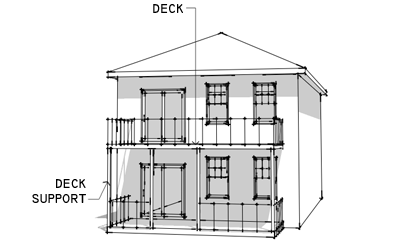
Deck means an exterior floor supported on at least two opposing sides by an adjacent structure, and/or posts, piers or other independent supports.
| Deck |
|---|
 |
Density means the average number of families, persons or dwelling units per unit of land. Density is normally expressed as the number of dwelling units per gross acre.
Developer means any person, firm, partnership, joint venture, limited liability company, association, or corporation who participates as owner, promoter, developer, or agent in the planning, platting, or development of a subdivision or development.
Development as it is used in Divisions 7-2, Use of Designated Open Space and 7-3, Floodplain Management and Flood Damage Prevention, means any man-made change to improved or unimproved real estate, including, but not limited to, buildings or other structures, dredging, filling, grading, paving, excavation, drilling operations, or storage of equipment or materials, channel improvements, channel rehabilitation, channel stability projects, flood control projects and stormwater detention facilities located within the floodplain.
Development Order means any of the orders that authorize development that are enumerated in Section 12-14-203, Administrative Development Orders, and Section 12-14-204, Public Hearing Development Orders.
Development Plan means a plan of development for which public improvements are required, which may include a site plan, conditional use plan, limited use plan, regulating plan, plat, final development plan ("FDP"), use by special review plan, administrative site plan ("ASP"), subdivision development plan ("SDP"), or other applicable land use plan authorized in this LDC or regulations that applied before the effective date.
Diameter at Breast Height (DBH) means a measurement of the size of tree that is equal to the diameter of its trunk, measured four and one-half feet above the adjacent natural grade.
Digital Architectural Scaling Model means a Computer Aided Design (CAD) file containing a three-dimensional rendering of the exterior of a Building.
Digital Billboard means a detached sign measuring 150 square feet or larger (except those signs contemplated in LDC Sections 12-6-402(C)(2) or 12-6-402(C)(3)) which is internally illuminated (not illuminated by a lighting source external to the sign face) and which electronically displays digital content and messages with the capability to remotely change such digital content and messages.
Digital Flood Insurance Rate Map (DFIRM) means a digital version of the Flood Insurance Rate map (FIRM). The DFIRM is also the regulatory floodplain map for FEMA for insurance and floodplain management purposes, same as the FIRM.
Director means the Director of Community Development or designee.
Disposal means facilities for the disposal of non-nuclear waste or fill, or the composting of organic wastes. The term includes landfill and composting facility.
DNL means an A- weighted, day/night 24-hour average sound level, in decibels, obtained after the addition of 10 decibels to sound levels occurring during the night time period from 10 p.m. to 7 a.m., which can be used to assess the amount of exposure to aircraft noise which can be expected at certain locations proximate to an airport. The DNL rating is computed pursuant to FAA standards and procedures and arranged in contours on maps maintained for each airport by the Mapping Division.
1.
65 DNL Noise Zone. Refers to property located within the outside boundary of the 65 DNL noise contour in effect at the time of submittal of an application for land use or subdivision approval.
2.
60 DNL Noise Zone. Refers to property located between the boundary of the 65 DNL noise contour and the 60 DNL noise contour.
3.
55 DNL Noise Zone. Refers to property located between the boundary of the 60 DNL noise contour and the boundary of the 55 DNL noise contour.
Dog Park means a fenced or securely enclosed area designated by the Community Development Director as a location where dogs are permitted to be off leash under the direct supervision of the dog's owner or caregiver for the purpose of general recreation, exercise, or prolonged animal activity. Dog Park may include a Pet Relief Area.
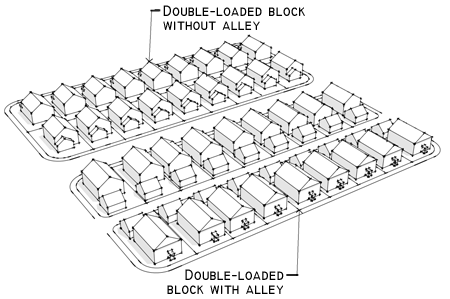
Double-Loaded Block means a block that contains two rows of lots that are arranged back-to-back or separated by an alley, where the two rows face streets that are roughly parallel to each other.
| Double-Loaded Blocks |
|---|
 |
Drainageway, see Channel.
Drip-line means a generally circular line, the circumference of which is determined by the outer reaches of a tree's widest branching points.
Drive-In or Drive-Through Facility means an establishment that by design, physical facilities, service, or packaging procedures encourages or permits customers to receive services, obtain goods, or be entertained while remaining in their motor vehicles.
Driveway means an improved and maintained way providing vehicular access from the public right-of-way to an Off-Street Parking Area, to a Garage structure, to dwellings, or to other uses.
Duplex means a single-family attached unit type that consists of two (2) dwelling units that are attached along a common wall or separated by a floor.
Dwelling Unit means a single unit providing complete independent living facilities for one or more persons, including permanent provisions for living, sleeping, cooking and sanitation.
E
Easement means the right of a person, government agency, or public utility company to use public or private land owned by another for a specific purpose.
Effective Date means the date that this LDC first became effective: September 18, 2011.
Electric Vehicle (or EV) means any vehicle that is licensed and registered for operation on public and private highways, roads, and streets that use electricity for propulsion. "Electric Vehicle" includes: (1) a battery electric vehicle; and (2) a plug-in hybrid electric vehicle. The term "Electric Vehicle" does not include electric bicycles ("E-Bikes").
Electric Vehicle Charging Station means a public or private parking space that is served by battery charging station equipment that has as its primary purpose the transfer of electric energy (by conductive or inductive means) to a battery or other energy storage device in an electric vehicle.
Electric Vehicle Charging Station Infrastructure means conduit/wiring, dispensers, switchgears, and other support equipment necessary and integral to support an electric vehicle and Electric Vehicle Charging Stations.
Electric Vehicle Charging Station - Private Use means an Electric Vehicle Charging Station that is (1) located within privately owned property and restricted access (e.g., private residential property, designated employee parking), or (2) located within privately or publicly owned property and restricted (e.g., for use by a resident/guest/customer use of a primary use only, fleet parking with no access to the general public).
Electric Vehicle Charging Station - Public Use means an Electric Vehicle Charging Station that is (1) located within publicly owned property and publicly available (e.g., Park & Ride parking, public library parking lot, on-street parking) or (2) located within privately owned property and available to visitors of the use (e.g., shopping center parking, Retail Electric Vehicle Charging Station).
Electric Vehicle Parking Space means any marked parking space that identifies the use to be exclusively for the parking of an electric vehicle.
Elevation, Building, when not referring to the position of the building in three-dimensional space, means the principal vertical planes of the building. Buildings typically have four elevations: a front elevation (or front façade), two side elevations, and a rear elevation.
Eligible Facilities Request, as used in Section 12-2-425(H) Eligible Facilities Request, means any request for modification of an Existing Tower or Base Station that does not Substantially Change the physical dimensions of such Tower or Base Station, involving:
1.
Collocation of new Transmission Equipment;
2.
Removal of Transmission Equipment;
3.
Replacement of Transmission Equipment.
Eligible Support Structure as used in Section 12-2-425(H), Eligible Facilities Request, means any Tower or Base Station, provided that it is Existing at the time the Eligible Facilities application is filed with the City.
Encroachment means:
1.
Generally:
a.
A building or structure, or part thereof, that is located:
i.
Between a lot line and the nearest required setback line for the building or structure; or
ii.
In an easement which does not allow for the building or structure; or
b.
A part of a building or structure that crosses a lot line:
i.
Into another lot under separate ownership; or
ii.
Onto a right-of-way.
2.
As referred to in Division 7-3, Floodplain Management and Flood Damage Prevention, an addition to or change to the physical condition of a specified type of flood hazard area that results in the blockage, diversion or displacement of floodwaters.
Equine means a horse, mule, donkey, or burro.
Equivalent Performance Engineering Basis means that, by using engineering calculations or testing, following commonly accepted engineering practices, all components and subsystems will perform to meet health, safety, and functional requirements to the same extent as required for single family housing units generally.
Existing, as used in Section 12-2-425(H), Eligible Facilities Request, means a constructed Tower or base station that was reviewed, approved and lawfully constructed in accordance with all requirements of applicable law as of the time of an Eligible Facilities Request, provided that a Tower that exists as a legal, non-conforming use and was lawfully constructed, is Existing for purposes of Section 12-2-425(H).
Existing Building means a building which existed, or for which a building permit was granted, prior to the effective date.
Explosive and Highly Flammable or Hazardous Materials means materials or liquids which, when ignited, exhibit large scale, rapid and spectacular expansion, outbreak or other upheaval. Hazardous materials are as defined by State Statute.
Extraction means uses that involve extraction of minerals and fossil fuels from the ground, including surface and subsurface mining and quarrying facility.
F
Façade means the exterior walls of a building exposed to public view or that will be viewed by persons not within the building.
Family means one or more persons who are related by blood, marriage, or legal adoption living together as a single household unit; a group of not more than five (5) persons not related by blood, marriage, or adoption, living together as a single household unit; or a family foster home, licensed by the State of Colorado having no more than four (4) foster children shall be considered a "family."
F.A.R. Part 77 means the Federal Aviation Administration regulations pertaining to height and obstruction criteria within prescribed distances from an airport as these Regulations currently exist and as may be amended from time to time. Part 77 Regulations may also affect lands located outside the boundaries of a defined Airport Influence Area.
Family Child Care Home means a facility for child care in a place of residence of a caregiver, which provides less than twenty-four-hour care for children under the age of eighteen years who are not related to the head of such home. "Family child care home" may include infant-toddler child care homes, large child care homes, experienced provider child care homes, and such other types of family child care homes designated by rules promulgated pursuant to Sec. 26-6-106(2)(p), Colorado Revised Statutes.
FEMA means the Federal Emergency Management Agency, the agency responsible for administering the National Flood Insurance Program (NFIP), or successor agency.
Fence means a Structure for the purpose of demarcating a property boundary, for enclosing a property or portion thereof, or for screening, including gates but not including Retaining Walls or Wing Walls. Structures under twenty-four (24) inches in height shall not be considered Fences.
Fence, Finished Side means the polished side of a Fence which is often called the "face" while the unfinished side is called the "back" and contains the horizontal Fence supports (also called stringers) and the in-ground Fence posts.
Fill means a deposit of materials of any kind placed by artificial means.
Five-Hundred (500) Year Flood means a flood having a recurrence interval that has a two-tenths (0.2) percent chance of being equaled or exceeded during any given year (two-tenths (0.2) percent-annual-chance flood). The term does not imply that the flood will necessarily happen once every five hundred years.
Five-Hundred (500) Year Floodplain means the area of land susceptible to being inundated as a result of the occurrence of a five-hundred-year flood
Floatable Materials means any material that is not secured in place or completely enclosed in a structure, so that it could float off site during the occurrence of a flood and potentially cause harm to downstream property owners, or that could cause blockage of the channel or drainageway, a culvert, bridge or other drainage facility. This includes, without limitation, lumber, vehicles, boats, equipment, trash dumpsters, tires, drums or other containers, pieces of metal, plastic or any other item or material likely to float.
Flood or Flooding means a general and temporary condition of partial or complete inundation of normally dry lands areas from:
1.
The overflow of waters from channels, drainageways or reservoir spillways; and/or
2.
The unusual and rapid accumulation or runoff of surface waters from any source.
Flood Control Structure means a physical structure designed and built expressly or partially for the purpose of reducing, redirecting or guiding flood flows along a particular channel or drainageway.
Flood Fringe means that portion of the one-hundred-year floodplain between the floodway boundary and the limits of the base floodplain. Sheet flow areas with flood depths of less than one (1) foot are not considered part of the flood fringe. Sheet flow areas with flood depths between one (1) and three (3) feet, inclusive, are part of the flood fringe.
Flood Hazard Area Delineation (FHAD) means a Flood Hazard Area Delineation Study prepared by the Urban Drainage and Flood Control District (UDFCD) in cooperation with local governments and adopted by each, UDFCD and the CWCB. Once completed, these studies are incorporated into the FEMA FIRM through the LOMC or PMR process and become the effective flood hazard information for the National Flood Insurance Program.
Flood Insurance Rate Map (FIRM) means the official map on which the Federal Emergency Management Agency has delineated the areas of special flood hazard, designated as A Zones, which is applicable to the City of Centennial.
Floodlight means any light fixture with an adjustable mounting system that allows for the aiming of the luminaire, typically used to light a specific object or surface.
Floodplain or Flood-Prone Area as it is used in Divisions 7-2, Use of Designated Open Space and 7-3, Floodplain Management and Flood Damage Prevention means any land area susceptible to being inundated by water from any source (see definition of flooding) during a 100-year flood as defined by FEMA, FHADs, or channels or drainageways with tributary areas that are 130 acres or greater
Floodplain Administrator means the City official designated by title to administer and enforce the floodplain management regulations.
Floodplain Development Permit means the permit required before construction or development begins within any floodplain area as defined by the City (see Floodplain). Floodplain Development Permits are required to ensure that all proposed development projects meet the requirements of the NFIP and the City's Floodplain Management Regulations.
Floodplain Management means the operation of an overall program of corrective and preventive measures for reducing flood damage, including but not limited to emergency preparedness plans, flood control works and floodplain management regulations.
Floodplain Management Regulations means zoning ordinances, subdivision regulations, building codes, health regulations, special purpose ordinances (such as a floodplain ordinance, grading ordinance and erosion control ordinance) and other applications of police power. The term describes such state or local regulations, in any combination thereof, which provide standards for the purpose of flood damage prevention.
Floodproofing means any combination of structural and non-structural additions, changes, or adjustments to property and structures subject to flooding which reduce or eliminate flood damage to real estate or improved real property, water and sanitary facilities, structures and their contents in a flood-prone area. FEMA only recognizes floodproofing as a means for flood management for nonresidential structures.
Floodway means the channel of a river or other drainageway and the adjacent land areas that must be reserved in order to discharge the base flood without cumulatively increasing the water surface elevation more than one-half (0.5) foot.
Floor Area, Gross means all areas located within the outside walls of a building, exclusive of basement area, garage space and porches.
Floor Area Ratio (F.A.R.) means the ratio of building area to land area of a parcel. For example, 21,780 square feet of building area on a one acre parcel of land (43,560 sq. ft.) would equal a 0.5:1 floor area ratio.
Footcandle (fc) means the unit of illuminance equal to one lumen per square foot.
Foster Care Home means a facility that is certified by the Arapahoe County Department of Social Services or a child placement agency for child care in a place of residence of a family or person for the purpose of providing twenty-four-hour family care for a child under the age of eighteen years who is not related to the head of such home, except in the case of relative care. The term includes any foster care home receiving a child for regular twenty-four-hour care and any home receiving a child from any state-operated institution for child care or from any child placement agency, as defined in Title 26, Human Services Code, Section 26-6-102(2), Definitions, Colorado Revised Statutes. The phrase "foster care home" also includes those homes licensed by the Department of Human Services that receive neither moneys from the counties nor children placed by the counties.
Freeboard means the vertical distance, in feet, above the base flood elevation to which development must be elevated, as set forth in the applicable requirements of this LDC.
Front Building Line means a horizontal line across the portion of the primary facade of a building that is closest to the street.
| Front Building Line |
|---|
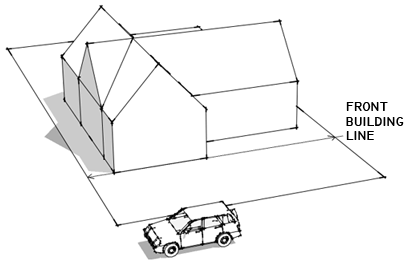 |
Fuel Dispenser means a mechanical device used to convey, or pump, automotive fuel or other petroleum products from a storage tank, regardless of whether said storage tank is above or below grade, into a vehicle or other appropriate container.
Fuel Pump Island means a concrete platform measuring a minimum of six (6) inches in height from the paved surface on which fuel dispensers are located.
Full Cut-Off means a light fixture that allows no direct light emission above a horizontal plane through the light fixture's lowest light-emitting part
Fully Shielded means a light fixture with no light emitting surfaces in sight from normal viewing angles. All full cut-off light fixtures are considered to be fully shielded.
Functional Turf means grass areas that are actively used for specific practical purposes, such as sports fields, playgrounds, stormwater facilities or areas that require a durable surface for foot traffic. Functional Turf may consist of native or non-native grasses.
G
Garage means a building designed to be used for the primary purpose of parking and storage of passenger vehicles. A garage may be attached to a primary dwelling unit or ADU, or detached. If a garage is detached, it is also considered an accessory structure.
Garden Wall, see Fence.
Gasoline Station/Convenience means:
1.
Gasoline service stations (including gasoline service stations that are associated with grocery stores and warehouse clubs);
2.
Gasoline convenience marts (a gasoline service station with a convenience store); or
3.
Any combination of 1 or 2 above.
Geologic Hazard means a geologic phenomenon which is so adverse to past, current or foreseeable construction or land use as to constitute a significant hazard to public health, safety or property. This term includes, but is not limited to, landslide, rockfall, seismic effect, mud flow, ground subsidence, shrink/swell soils and unstable or potentially unstable slopes.
Geothermal Heating and Cooling System means a system of pipes used to heat and cool buildings by exchanging heat with the ground. There are four types of systems:
1.
Vertical loop systems use pipes that are oriented vertically by insertion into a bore hole that extends deep into the ground.
2.
Horizontal loop systems use pipes that are oriented horizontally, installed in trenches that are typically five or more feet deep.
3.
Lake loop systems use pipes that extend into waterbodies, where they exchange heat with the water instead of the ground.
4.
Open loop systems extract groundwater and then discharge it into a drainage ditch or waterbody.
Glare means the sensation produced by luminance within the visual field that are sufficiently greater than the luminance to which the eyes are adapted to cause annoyance, discomfort or loss in visual performance or visibility. The magnitude of the sensation of glare depends on such factors as the size, position and luminance of a source; the number of sources; and the luminance to which the eyes are adapted.
Grade means the average elevation of the area immediately adjacent to a building or structure, excluding berming.
Group Home means a structure which provides residential, non-institutional housing for a group of six or more unrelated individuals or related and unrelated individuals, where physical assistance and/or other supportive services are provided by professional support persons. A group home shall have no more than twelve residents, not including persons providing support services to the residents, except as otherwise provided in this Code. A group home is further defined as Type A or Type B according to its client population.
Group Home, Type A means a group home serving no more than eight (8) handicapped individuals. A Type A group home may be further defined as follows:
1.
Group Home for Developmentally Disabled Persons. A state-licensed group home exclusively for the care of persons with developmental disabilities, as defined and regulated by the Colorado Department of Human Services, Division for Developmental Services, and the Colorado Department of Public Health and Environment.
2.
Group Home for Elderly Persons. A group home of persons sixty (60) years of age or older who do not require medical attention associated with a residential health care facility. Group homes for elderly persons shall be licensed as an assisted living residence or alternative care facility by the Colorado Department of Public Health and Environment.
3.
Group Home for Mentally Ill Persons. A state-licensed group home exclusively for the care of persons with mental illness, as defined and regulated by the Colorado Department of Public Health and Environment.
Group Home, Type B means a group home that does not meet the definition of a Type A group home whose residents are not handicapped or protected under federal or state fair housing legislation. A Type B Group Home shall also include a Type A Group Home which exceeds eight handicapped residents subject to the provision for reasonable accommodation set forth in Section 12-14-901, Reasonable Accommodations for Persons with Disabilities.
H
Handicap means a physical or mental impairment that substantially limits one or more of a person's major life activities (1988 amendments to the Fair Housing Act, 42 U.S.C. §3602[h]).
Hazardous Waste Disposal means any final action to abandon, deposit, inter, or otherwise discard hazardous waste after its use has been achieved or a use is no longer intended or any discharging of hazardous waste into the environment.
Hazardous Waste Disposal Site means all contiguous land, including publicly-owned land, under common ownership which is used for hazardous waste disposal; except that such phrase does not include any site which is in compliance with an approved reclamation plan contained in a permit issued pursuant to Article 32 of Title 34, Colorado Revised Statutes or Article 33 of Title 34, Colorado Revised Statutes.
Heavy Industry see Industry, Heavy.
Heavy Retail means retail and/or service activities that have regular outside service or outside storage areas, exceptionally large floor areas, or partially enclosed structures, as listed below:
1.
Permanent retail operations that are located outside of enclosed buildings, except nurseries;
2.
Home centers;
3.
Lumber and other building materials;
4.
Lawn, garden equipment, and related supplies stores;
5.
Warehouse clubs and super stores;
6.
Recreational equipment rental where the equipment is stored outside;
7.
Heavy truck or recreational vehicle leasing or sales;
8.
Manufactured home sales; and
9.
Industrial or construction equipment leasing or sales.
Helistop means an area used for the take-off and landing of private helicopters for the purpose of picking up and discharging of passengers or cargo. The use of the helistop is restricted to specific users or purposes (e.g., tenants of a corporate park; a hospital trauma center; etc.), and the term does not include facilities for general helicopter aviation use.
Highest Adjacent Grade means the highest natural elevation of the ground surface prior to construction next to the proposed walls of a structure.
Historic Structure as used in Division 7-3, Floodplain Management and Flood Damage Prevention, means any structure that is:
1.
Listed individually in the National Register of Historic Places (a listing maintained by the Department of the Interior) or preliminarily determined by the Secretary of the Interior as meeting the requirements for individual listing on the National Register;
2.
Certified or preliminarily determined by the Secretary of the Interior as contributing to the historical significance of a registered historic district or a district preliminarily determined by the Secretary to qualify as a registered historic district;
3.
Individually listed on a state inventory of historic places in states with historic preservation programs which have been approved by the Secretary of the Interior; or
4.
Individually listed on a local inventory of historic places in communities which historic preservation programs that have been certified either:
a.
An approved state program as determined by the Secretary of the Interior; or
b.
Directly by the Secretary of the Interior in states without approved programs.
Hive/Hive Box means a structure intended for the housing of a bee colony. Hive boxes are permitted to be up to six (6) feet in height and up to ten (10) cubic feet.
Home-Based Business means any business, occupation or activity conducted for financial gain from within a dwelling unit where such use is incidental and accessory to the use of the building as a residence by the person engaged in the home-based business. The phrase "home-based business" does not include the phrases "family child care home" or "respite care facility."
Horizontal Measurement means measurements made with the meter oriented to measure illuminance onto a horizontal surface.
Hospitals/Clinics/Medical Labs means hospitals, walk-in clinics, birthing centers, and medical laboratories, including general medical and surgical hospitals and specialty hospitals. The term "hospitals" does not mean alcoholism or drug rehabilitation facilities, nor does it mean medical offices where patients are generally seen by appointment.
House Side Shield means an element of a luminaire designed and installed to significantly reduce the light output from one side (seen from above) of the luminaire.
Human Scale Design is a set of design principles that relate to the human body and allow us to scale and size buildings in relation to ourselves.
Hydrozone means a grouping of plants based on their water usage (for example, low water use plantings with other low water use plantings; very low water use plantings with very low water use plantings).
I
Illuminance means a measure of how much light is falling onto a surface, typically measured in footcandles.
Immature animal means an agricultural animal or equine no more than 12 months of age that has not been fully weaned.
Impact Vibration means a vibration occurring no more than eight times in a 24-hour period with a minimum separation of one minute.
Impacts means a change in the extent or elevation of the floodplain by development.
Industry, Boutique means small-scale manufacturing of goods typically fabricated or crafted without industrial machinery, including but not limited to, pottery, jewelry, craft furniture or sculpture. Boutique Industry may also include uses defined elsewhere in this LDC but are of such a small scale as to have limited impacts on adjacent uses. Boutique Industry uses:
1.
Do not generate or cause there to be noise, dust, vibration, glare, electromagnetic interference, or odors incompatible with uses allowed within the same zone district and adjacent zone districts;
2.
Do not include outdoor storage; and
3.
Do not exceed 5,000 square feet of floor area.
Industry, Heavy means:
1.
Processing of minerals (except precious and semi-precious stone cutting for jewelry or precision instruments such as lasers or watches), ores, or fossil fuels; or
2.
Primary processing or manufacturing or repair operations not specifically defined elsewhere in this Section, which involve:
a.
An outside storage area that is larger than the area of the first floor of buildings on the same lot;
b.
A material risk of environmental contamination, explosion, or fire;
c.
Perceptible ground vibration;
d.
Excessive noise or dust;
e.
Emission of objectionable odors; or
f.
More than 12 trips by semi-trailer trucks per day; or
3.
Industries that are required to undergo New Source Review under the Federal Clean Air Act, or are subject to construction or operation permits pursuant to the Colorado Stationary Sources Program or Title V of the Federal Clean Air Act.
4.
For illustrative purposes, heavy industrial uses include, but are not limited to:
a.
Coal cleaning plants with thermal dryers; coke oven batteries; carbon black plants (furnace process); petroleum refineries; petroleum storage and transfer units (except retail gasoline stations); and bulk fuel dealers;
b.
Facilities used in the primary or secondary production of metals (e.g., primary zinc, copper, or lead smelters; primary aluminum ore reduction plants; iron and steel mills; sintering plants; secondary metal production plants; and blacksmith shops);
c.
Portland cement plants;
d.
Sawmills and pulp mills;
e.
Incinerators with the capacity to charge more than 250 tons of refuse per day;
f.
Lime plants; phosphate rock processing plants; sulfur recovery plants; and hydrofluoric, sulfuric, or nitric acid plants;
g.
Fossil fuel combustion (boilers or electricity generation) totaling more than 250 million BTUs per hour of heat input;
h.
Fabrication of building materials such as countertops, drywall, and cut stone;
i.
Fabrication of vehicles, manufacturing equipment, durable goods, or pre-fabricated homes or home components;
j.
Auto Repair, Major;
k.
Drycleaner processing plants that use PERC or comparable petrochemical solvents;
l.
Meat or seafood processing plants;
m.
Manufacture of glass products (e.g., window panes, bottles and jars), except hand-blown products;
n.
Manufacture of plastic products (except assembly of parts that are manufactured elsewhere);
o.
Plasma arc welding, cutting, gouging, surfacing, or spraying; gas welding (but not brazing); arc welding with equipment that is rated at more than 200 amps; TIG welding; and other heavy welding procedures (e.g., for structural steel, automotive body, or heavy equipment manufacture or repair);
p.
Hot mix asphalt plants;
q.
Regional wastewater utilities;
r.
Fossil fuel power plants, waste-to-energy plants, and biomass plants that produce more than 100 megawatts of electricity; and
s.
Fossil fuel peaker power plants.
Industry, Light means uses that involve research and development, assembly, compounding, packaging, testing, or treatment of products from previously prepared materials, with limited outside storage and limited external impacts or risks; or wholesale uses. For illustrative purposes, light industry uses include, but are not limited to:
1.
Assembly, testing, or refurbishing of products, instruments, electronics, office and computing machines, and fixtures from pre-manufactured components;
2.
Offices of general contractors, specialty subcontractors, or tradesmen which include:
a.
Bay door access to indoor storage of tools, parts, and materials; or
b.
Parking of commercial vehicles;
3.
Communications facilities, except wireless telecommunications facilities;
4.
Data centers, server farms, telephone exchange buildings, and telecom hotels;
5.
Food production and packaging other than meat and seafood processing and restaurants;
6.
Furniture making or refinishing;
7.
Manufacture of textiles or apparel;
8.
Screen printing of apparel;
9.
Printing and publishing, except copy centers (which are commercial and personal services), and except printing presses that require a Stationary Source permit or Title V permit for air emissions (which are heavy industry);
10.
Commercial Warehousing and Logistics
11.
Wholesale trade, durable and non-durable, except:
a.
Farm products;
b.
Combustible or hazardous materials, and
c.
Wholesale clubs that are open to the public for membership;
12.
Research and development, scientific testing, and product testing;
13.
Disassembly of consumer electronics and/or appliances into component parts, where all operations and storage are within an enclosed building;
14.
Manufacture or compounding of pharmaceutical products, dietary supplements, health and beauty products, and herbal products;
15.
Packaging of products;
16.
Pet Crematoriums;
17.
Advanced manufacturing processes that involve precision machining, additive manufacturing (3D printing), or robotics; and
18.
Aerospace component assembly, testing, and fabrication from pre-manufactured parts, excluding heavy industrial operations such as forging or large-scale metal casting.
Initial Conditions means the condition of the lighting system that is new, typically corresponding to the highest light levels that the system can produce. For existing systems, initial conditions can be considered the condition of the lighting system after all of the fixtures have been cleaned and relamped.
Inoperable vehicle means a vehicle lacking a current valid registration that is displayed on the vehicle or trailer and/or whose operation is not currently possible due to the disassembly of vehicle parts preventing vehicle operation. Inoperable vehicles shall not be permitted on residential properties and/or on the public right-of-way immediately adjacent to said residential property.
Institutional Accommodation means a facility operated by a recognized and established for-profit or non-profit corporation, or government, providing housing combined with common food service, nursing, counseling, health care, or comparable services, but does not include assisted living facility, congregate care, nursing homes, continuing care, or group home. The phrase "institutional accommodation" specifically includes:
1.
In-patient drug, alcohol, and/or substance abuse detox centers and rehabilitation facilities. Such facility may also provide, as a secondary use, out-patient services for the same purpose;
2.
In-patient mental health facilities. Such facility may also provide, as a secondary use, out-patient services for the same purpose; and
3.
Shelters for persons suffering mental or physical abuse, trauma, crisis, or homelessness.
Intensive Agriculture means:
1.
Concentrated animal feeding operations ("CAFOs") of any size, as defined by 40 C.F.R. § 122.23, Concentrated Animal Feeding Operations;
2.
Concentrated aquatic animal production facilities, as defined by 40 C.F.R. § 122.24, Concentrated Aquatic Animal Production Facilities;
3.
Any use where animals are tightly confined in buildings or outdoor pens or pastures with more than one animal equivalent unit per acre, including feedlots, hog farms, and poultry operations; or
4.
Any other agricultural use that is required to obtain a discharge permit under the Federal Clean Water Act because of animal or poultry wastes.
Invasive Plant Species means any plant not native to Colorado that was introduced intentionally or unintentionally and causes, or is likely to cause, harm to the State's environment, native plant communities, public health, or economy, as identified by the Colorado Department of Agriculture Noxious Weed Program or similar recognized authorities.
K
Kennel means any premises where any combination of dogs, cats or other household pets, totaling four (4) or more animals, six (6) months of age or older, are kept, boarded or bred for the intention of profit.
L
Lamp means the replaceable portion of a light fixture that actually produces the light, a 'light bulb'.
Letter of Map Amendment (LOMA) means a letter from FEMA officially amending the effective National Flood Insurance Rate Map, which establishes that a property is not located in a FMA SFHA
Letter of Map Change (LOMC) means all letters of SFHA changes from FEMA including LOMR, LOMR-F, LOMAs and Physical Map Revisions (PMR).
Letter of Map Revision (LOMR) means a letter from FEMA officially revising the effective Flood Insurance Rate Map to show changes in zones, delineation and water surface elevation of floodplains and floodways.
Letter of Map Revision Based on Fill (LOMR-F) means a letter from FEMA stating that a structure or parcel of land that has been elevated by fill outside the existing regulatory floodway, would not be inundated by the base flood.
Levee means a man-made embankment, usually earthen, designed and constructed in the accordance with sound engineering to contain, control or divert the flow of water so as to provide protection from the temporary flooding. For a levee structure to be reflected on the FEMA FIRMs as providing flood protection, the levee structure must meet the requirements set forth in 44 CFR 65.10.
Light Automobile Service/Gas Station means:
1.
Gasoline service stations (including gasoline service stations that are associated with grocery stores and warehouse clubs);
2.
Gasoline convenience marts (a gasoline service station with a convenience store);
3.
Minor Auto Repair
4.
Any combination of 1, 2, or 3, above.
Light Emitting Surface means any surface of a luminaire that changes the direction of the light emitted from a light source through reflection, refraction or diffusion.
Light Fixture/Luminaire means the physical unit that holds a lamp and that may include parts to redirect the light produced by the lamp.
Light Industry see Industry, Light.
Light Pollution means the visual consequence of using light outdoors, resulting from light going directly or being reflected into the sky and then redirected back to an observer (also called sky-glow).
Light Trespass means the light projected onto a property from a light source located on a different property typically in the form of either spill light or glare or both.
Live-Work Unit means a residential use that combines a residential component and a subordinate nonresidential component within the same dwelling unit, suite, building, or parcel. A Live-Work Unit generally retains a residential character but allows for more intense nonresidential uses than would otherwise be permitted as a Home-Based Business.
Logo means a distinctive symbol which identifies a business.
Lot means a parcel of land whose boundaries have been established by a legal instrument such as a recorded deed, court order, or a recorded plat, which is recognized as a separate legal entity for purposes of transfer of title.
1.
Corner: A site bounded by two or more adjacent street lines which have an angle of intersection of not more than 135 degrees.
2.
Cul-de-sac: A site with more than 50 percent frontage on the bulb of a cul-de-sac as illustrated in green below:
| Cul-de-Sac |
|---|
 |
3.
Through: A lot having a frontage on two (2) non intersecting streets as distinguished from a corner lot.
4.
Interior: A lot other than a corner, cul-de-sac, or through lot.
Lot Line means a line, including property line or lease line, dividing one lot from another or from a street or other public place. There are four types of lot lines: front, rear, side, and street:
1.
Front lot line means the lot line that follows the street right-of-way line of the street from which the lot takes access; or, where more than one street yard could safely provide this access, the street from which the address is assigned. For lots without direct frontage on a public or private street, the front lot line shall be the lot line closest and most parallel to the access point or access easement serving the lot. If no clear access exists for a lot, the Director of Community Development shall determine the front lot line based on the intended orientation of the building and lot context.
2.
Rear lot line means the lot line opposite the front lot line.
3.
Side lot line means the lot line that runs generally perpendicular or at angles to the street or any line that is not a front, street, or rear lot line.
4.
Street side lot line means any side lot line that is also a street right-of-way line.
Lots of Record means a developable lot which is part of a subdivision, the map of which has been recorded in the office of the County Clerk and Recorder, or a developable lot described by metes and bounds, the description of which has been recorded in the office of the Clerk and Recorder, and which, at the time of its recording, complied with all applicable laws, ordinances and regulations. Lot of record shall not include outparcels, tracts, or other parcels of land which may not be developed under the current laws, ordinances, and regulations of the City.
Lowest Adjacent Grade (LAG) means the lowest elevation of the natural ground surface touching a structure (including attached garages and decks). LOMA determinations are based on the LAG.
Lowest Floor means the lowest floor of the lowest enclosed area of a structure including any basement or crawlspace. An unfinished or flood resistant enclosure, usable solely for parking of vehicles, building access or storage, in an area other than a basement area, is not considered a structure's lowest floor, provided that such enclosure is not built so as to render the structure in violation of the applicable non-elevation design requirements of Division 7-3, Floodplain Management and Flood Damage Prevention. The lowest floor elevation is the determinate for the flood insurance premium for a building, home or business.
Lumen (lm) means the basic unit of measurement of light.
Luminance means the brightness or the amount of light coming off a surface in a given direction, typically measured in candela per square meter (abbreviated as cd/m2).
M
Major Electrical or Natural Gas Facilities means one or more of the following:
1.
Electrical generating facilities;
2.
Substations used for switching, regulating, transforming, or otherwise modifying the characteristics of electricity;
3.
Transmission lines operated at a nominal voltage of sixty-nine thousand volts or above;
4.
Structures and equipment associated with such electrical generating facilities, substations, or transmission lines; or
5.
Structures and equipment utilized for the local distribution of natural gas service including, but not limited to, compressors, gas mains, and gas laterals.
Major Equipment means, with respect to a home-based business, equipment generally utilized in the operation of a landscape or contractor business that is larger than that typically found in a residence for home use. Examples of such equipment include, but are not limited to, augers, chippers, commercial riding mowers, backhoes, forklifts, and tractor mounted equipment.
Manufactured Home means a structure, transportable in one or more sections, which is built on a permanent chassis and is designed for use with or without a permanent foundation when connected to the required utilities.
Manufactured Home Park or Subdivision means a parcel (or continuous parcels) of land that is/are divided into two (2) or more lots for long-term lease or sale, with infrastructure designed for the installation of manufactured homes.
Median means an area located within a City street which is used to separate the directional flow of traffic, may contain left-turn lanes, and is demarcated by curb and gutter, having painted or thermally applied stripes or other means of distinguishing it from the portion of the roadway utilized for through traffic.
Mixed Use means an area containing two or more principal uses from different use classifications (Residential, Institutional, Commercial, Industrial, or Recreational) or from two or more significantly different use categories within the same use classification (e.g., offices and retail), where compatible land uses are functionally integrated and share public amenities, ingress/egress, pedestrian facilities and amenities, and parking areas that combine to create a walkable place where people may live, work, play, and shop.
Mixed Use Building means one (1) building or groups of buildings designed to encourage a diversity of compatible land uses, which include two or more principal uses from different use classifications or from two or more significantly different use categories, planned as a unified complementary whole, and functionally integrated into a Mixed Use Development including the use of shared pedestrian and vehicular access, and parking areas.
Mixed Use, Horizontal means a type of Mixed Use Development that consists of multiple single-use buildings or a combination of single-use buildings and vertical mixed use structures within a mixed-use development.
Mixed Use, Vertical means a single multi-story building that combines two or more principal uses from different use classifications or two or more significantly different use categories. Typical examples include residential or office uses on the upper levels of buildings, and retail at street level.
Mulch means material (such as decaying leaves, bark, or compost) spread around or over a plant to enrich or insulate the soil to retain water.
Multifamily means a building that contains ten or more dwelling units. These buildings may also be called apartments.
Mural means a type of sign consisting of paint applied directly to the exterior wall of a building. A Mural may also consist of paint applied directly on other architectural elements, such as a beam, column, cornice, fascia, or parapet, that directly interact or abut an exterior wall of a building and is not a sign type included in Table 12-6-401A.
N
National Flood Hazard Layer (NFHL) means the most updated digital version of the Flood Insurance Rate Map (FIRM). The NFHL is also the regulatory floodplain map for FEMA for insurance and floodplain management purposes if it is displayed and used per FEMA's requirements, the same as the FIRM and DFIRM.
Native Plant Species means species historically occurring in Colorado.
Natural Medicine Business means any of the following entities licensed under the Natural Medicine State Licensing Authority and includes a Natural Medicine Healing Center, a Natural Medicine Cultivation Facility, a Natural Medicine Products Manufacturer, a Natural Medicine Testing Facility, or another licensed entity created by the Natural Medicine State Licensing Authority.
Natural Medicine Cultivation Facility means a facility that is licensed by the Natural Medicine State Licensing Authority to cultivate regulated Natural Medicine for transfer and distribution to Natural Medicine Healing Centers, Natural Medicine Product Manufacturers, or other Natural Medicine Cultivation Facilities.
Natural Medicine Healing Center means a facility where an entity is licensed by the Natural Medicine State Licensing Authority that permits a facilitator as defined by the Natural Medicine Regulatory Act, to provide and supervise natural medicine services for a participant as defined by the Natural Medicine Regulatory Act, which includes a participant consuming and experiencing the effects of regulated natural medicine or regulated natural medicine product under the supervision of a facilitator.
Natural Medicine Product Manufacturer means a facility that is licensed to manufacture regulated Natural Medicine Product pursuant to the terms and conditions the Natural Medicine State Licensing Authority.
Natural Medicine Testing Facility means a facility that is licensed by the Natural Medicine State Licensing Authority to perform testing and research on Natural Medicine and Natural Medicine Product.
Neighborhood Activity Center (NAC) means an area of contiguously zoned AC property constituting a Mixed Use Development that provides some combination of integrated goods and services, housing, and employment opportunities within walking or biking distance of residential neighborhoods. A NAC differs from other formulaic, detached commercial developments, where shopping and employment opportunities are not integrated with adjacent residential land uses.
New Construction means development for which the start of construction commenced on or after the 10th day of November, 2013.
No Rise means a calculated rise in flood depth of 0.00 feet as rounded to the nearest hundredth of a foot.
Noise Contour means the line linking together a series of points of equal cumulative noise exposure. Noise contours are developed based upon actual and projected data, including aircraft flight patterns, the number of daily aircraft operations by type of aircraft, noise characteristics of each aircraft, and typical runway usage patterns.
Noise Sensitive Uses means, for purposes of Division 3-9 (Airport Influence Area):
1.
All uses identified in Table 12-2-302 as a Residential Use except a Live-Work Unit which Unit meets the Noise Sensitive Construction Requirements of Article 13 of Chapter 18 of the Centennial Municipal Code;
2.
All uses identified in Table 12-2-302 as Residential and Predominately Residential Mixed-use Neighborhoods or Home Uses;
3.
The following uses identified as Institutional Uses in Table 12-2-302: Assisted Living Facilities, Congregate Care, and Nursing Home. All other Institutional Uses identified in Table 12-2-302 are excluded from the definition of Noise Sensitive Uses; and
4.
All Places of Public Assembly unless all buildings for a Place of Public Assembly meet the Noise Sensitive Construction Requirements of Article 13 of Chapter 18 of the Centennial Municipal Code.
Non-Functional Turf means non-native grass areas maintained mainly for aesthetics, with little to no practical use, such as decorative lawns or grass strips along sidewalks or other transportation corridors.
Nonstructural Development means any use of property that does not involve a structure. Nonstructural development may include, but is not limited to, the construction or installation of or use of a property for parking lots, utilities, detention ponds, fences, trails, pathways, outdoor storage, cultivation of vegetation or placement of fill.
Non-Substantial Improvements means any repair, reconstruction, rehabilitation, addition, or other improvement of a structure, the cost of which is less than fifty (50) percent of the market value of the structure before the start of construction of the improvement. The phrase does not, however, include:
Any project for improvement of a structure to comply with existing state or local health, sanitary, or safety code specifications which are solely necessary to assure safe living conditions.
No-Rise Certification (also known as Engineer's Certification of No Impact) means a record of the results from an engineering analysis to determine whether a project will increase flood heights (any rise over 0.00-ft) or an increase in width or shift to the extents of the floodplain boundary. A No-Rise Certification must be supported by technical data and signed by a registered Colorado Professional Engineer.
Normal Viewing Angles mean the view of the surroundings obtained by eyes located at 5 feet (1.5 m) above grade looking horizontally in any direction.
North American Industrial Classification System (NAICS) is the standard used by Federal statistical agencies in classifying business establishments for the purpose of collecting, analyzing, and publishing statistical data related to the U.S. business economy. As of the effective date of this LDC, NAICS lookup tables were available from the U.S. Census Bureau web site at http://www.census.gov/cgi-bin/sssd/naics/naicsrch?chart=2007.
Nude Model Studio means any place where a person who appears semi-nude, in a state of nudity, or who displays specified anatomical areas, is provided to be observed, sketched, drawn, painted, sculptured, photographed, or similarly depicted by other persons. Nude Model Studio does not include a proprietary school licensed by the State of Colorado or a college, junior college or university supported entirely or in part by public taxation; a private college or university which maintains and operates educational programs in which credits are transferable to a college, junior college, or university supported entirely or partly by taxation; or a business in a structure:
1.
That has no sign visible from the exterior of the structure and no other advertising that indicates a nude or semi-nude person is available for viewing; and
2.
Where in order to participate in a class a student must enroll at least three days in advance of the class; and
3.
Where no more than one nude or semi-nude model is on the premises at any one time.
(Ord. 2005-O-28)
Nudity or State of Nudity means the appearance or display of specified anatomical areas.
(Ord. 2005-O-28)
Nursery or Greenhouse (Wholesale or Retail) means an enterprise that conducts the retail and/or wholesale sale of plants grown on the premises. The terms also include, as an accessory use, the sale of a limited selection of items (e.g., soil, planters, pruners, mulch, lawn or patio furniture, garden accessories, etc., but not power equipment) that are directly related to the care and maintenance of landscapes.
Nursing Home means a residential facility, licensed according to the requirements of Sec. 25-1.5-103, Colorado Revised Statutes, that is maintained primarily for the care and treatment of inpatients under the direction of a physician. The patients in such a facility require supportive, therapeutic, or compensating services and the availability of a licensed nurse for observation or treatment on a twenty-four-hour basis. Nursing care may include but is not limited to terminal care; extensive assistance or therapy in the activities of daily living; continual direction, supervision, or therapy; extensive assistance or therapy for loss of mobility; nursing assessment and services which involve assessment of the total needs of the patient, planning of patient care, and observing, monitoring, and recording the patient's response to treatment; and monitoring, observing, and evaluating the drug regimen. "Nursing home" includes intermediate nursing facilities for the mentally retarded or developmentally disabled.
O
Obstruction means any physical barrier, structure, material or impediment in, along, across or projecting into a watercourse that may alter, impede, retard or change the direction or velocity of the flow of water, or that may, due to its location, have a propensity to snare or collect debris carried by the flow of water or to be carried downstream. Obstruction shall include, but not be limited to, any dam, wall, wharf, embankment, levee, dike, pile, abutment, protection, excavation, channelization, bridge, conduit, culvert, building, wire, fence, rock, gravel, refuse, fill, structure, and vegetation in, along, across or projecting into a watercourse.
OffStreet Parking means a site or portion of a site devoted to the offstreet parking of motor vehicles including parking spaces, aisles, access drives and landscaped areas.
Office means uses in which professional, outpatient medical, or financial services are provided. The term includes:
1.
Accounting, auditing and bookkeeping;
2.
Advertising and graphic design;
3.
Architectural, engineering, and surveying services;
4.
Attorneys and court reporters;
5.
Banks, mortgage companies; and financial services;
6.
Call centers;
7.
Computer programming;
8.
Corporate headquarters;
9.
Counseling services;
10.
Data processing and word processing services;
11.
Detective agencies;
12.
Government offices;
13.
Insurance;
14.
Interior design;
15.
Medical, dental, and chiropractic offices;
16.
Real estate sales;
17.
Research and development that does not include on-site manufacturing;
18.
Retail catalog, internet, and telephone order processing, but not warehousing; and
19.
Virtual office services.
One-Hundred (100) Year Flood. See "Base Flood."
One-Hundred (100) Year Floodplain. See "Floodplain."
Operator means any person, firm, or corporation engaged in or controlling an activity.
Outdoor Commercial Patio, Permanent means a designated outdoor area associated with a commercial establishment intended for customer or employee use.
Outdoor Dining Area, Permanent means an area of designated size used for the consumption of food and beverages (alcoholic and non-alcoholic) with seats and/or tables located outdoors. Permanent Outdoor Dining Areas are generally accessory to permanent restaurants, breweries, coffee shops, grocery stores, or other food service establishment uses, though may be a standalone outdoor-only use. One or more proprietors may have a patio on the same parcel, such as patios for individual restaurants within a shopping center. Permanent Outdoor Dining Areas are noted or shown on an approved site plan and do not require a separate use permit to operate. An example of a Permanent Outdoor Dining Area is a restaurant with a permanent designated patio area that is not also used for another purpose such as vehicle parking, or is an outdoor beer garden.
Outdoor Storage means the storage of any material outside of the principal permitted structure on any parcel, which material is either wholly or partially visible. Outdoor Storage is an accessory use. Where an Outdoor Storage area exceeds the permitted coverage area, the Outdoor Storage area will be considered a Storage Yard.
Outside Plant Construction means utility physical cabling and supporting infrastructure (such as conduit, cabinets, handholes, towers or poles) and associated hardware (such as repeaters) located between a demarcation point in a switching facility and a demarcation point in another switching center or customer premises.
P
Parapet Wall means a low wall or protective railing along the edge of a roof, balcony or terrace.
Parcel Proposed for Development means any legally described parcel of land which is designated by the owner or developer as land to be used or developed as a single unit, or which has been developed as a unit as determined by the Director.
Park means any public or private land available for active or passive recreational, educational, cultural or scenic purposes of a size, location and configuration useable as a park.
Parking (Stand-Alone Lot) and Transit Facilities means:
1.
Parking that is not accessory to a specific use, where a fee is typically charged. A facility that provides both accessory parking for a specific use and regular fee parking for people not connected to the use is also classified as a Parking Facility. This includes small structures intended to shield attendants from the weather.
2.
Terminals used for the ticketing, loading, and unloading of bus or train passengers. Food and beverage sales conducted during normal terminal operations are included as accessory uses.
Parking Structure means a building or structure (public or private) consisting of more than one level (below, at, or above grade), used to store motor vehicles, and may be freestanding or part of a main building.
Passenger Vehicle means a motor vehicle designed to carry ten (10) persons or less including the driver. Passenger Vehicle also includes motor vehicles designed to carry ten (10) persons or less that are constructed either on a truck chassis or with special features for occasional off-road use. Passenger Vehicle is intended to include the vehicles defined as passenger cars and multipurpose passenger vehicles by the National Highway Traffic Safety Administration, but not to include Commercial Vehicles (e.g., moving trucks).
Patio means a hardscaped ground level area, usually (but not necessarily) paved with concrete, that adjoins a home and is designed for use as an area for outdoor lounging, dining, or other comparable leisure activities.
| Patio |
|---|
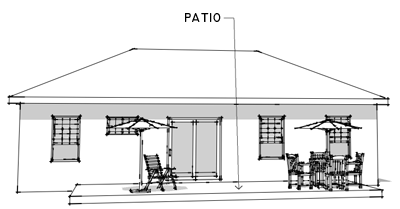 |
Pedestrian Conflict Area Classification includes three classifications of pedestrian night activity levels and examples of facilities or land uses with which they are typically associated:
1.
High Pedestrian Conflict means an area with significant numbers of pedestrians expected to be on the sidewalk or crossing the street during darkness, including but not limited to regional commercial centers, mixed-use activity centers, outdoor commercial amusement, and transit facilities.
2.
Medium Pedestrian Conflict means an area where lesser numbers of pedestrians are on the sidewalk or crossing the street during darkness, including but not limited to office, a place of public assembly, multi-family residential, neighborhood commercial centers, industrial, and transit corridors.
3.
Low Pedestrian Conflict means an area with very low numbers of pedestrians expected to be on the sidewalk or crossing the street during darkness, including but not limited to suburban and/or low-density residential and semi-rural or rural areas.
Pedestrian Walk is the area of the Streetscape that is reserved for pedestrian traffic. The Pedestrian Walk is to remain clear and unobstructed for ease of travel and maintenance.
Person means any individual, partnership, corporation, joint stock association, trustee, receiver, assignee, or personal representative thereof. It also includes any city or state or any subdivision thereof to the extent that the City of Centennial has jurisdiction over their activities that are within the scope of this LDC.
Personal Services see Services, Commercial, Personal and Professional.
Pet means any domesticated animal commonly kept in a household excluding an agricultural animal. Regulated species of pets shall include dogs (Canis familiaris) and cats (Felis catus). Non-regulated species of pets shall be animals that are typically kept indoors in a cage or container, including chinchillas (Chinchilla laniger), domestic rabbits (Oryctolagus cuniculus), guinea pigs (Cavia porcellus), hamsters (Mesocricetus auratus), domestic laboratory mice (Mus domesticus), domestic laboratory rats (Rattus albino strain), Mongolian gerbils (Meriones unguicularus), domestic ferrets (Mustela putoris furo), Central African hedgehogs (Atelerix albiventris), sugar gliders (Petaurus breviceps), canaries, finches, starlings, doves, domesticated parrots, aquarium fish, nonpoisonous amphibians, nonvenomous snakes, nonvenomous invertebrates, and turtles of a species and size which is permissible under Colorado law. The definition of a pet excludes canid and felid hybrids.
Pet Relief Area means a designated indoor or outdoor space solely intended for domesticated animals to relieve themselves, and not intended for general recreation, exercise, or prolonged animal activity. Pet Relief Area is not intended to mean Dog Park.
Pharmacy means a place where medicines are compounded or dispensed and other medical accessory merchandise is displayed or sold.
Phased Improvement means any improvement to a structure that occurs within one (1) year of building permit closeout of any previous construction on that structure. Phased improvements may be intentional or unintentional. Examples of phased improvement include, but are not limited to, incomplete work, multiple permits, consecutive permits, modification of existing permits, and unauthorized work. Changes in ownership do not preclude previous improvements. This applies to the entire structure as a whole, including multi-tenant and multi-unit structures.
Photovoltaic Array (also called PV Arrays or Solar Arrays) means an array of solar cells that convert energy from sunlight directly into electricity.
Physical Map Revision (PMR) means a FEMA action where one or more FIRM map panels are physically revised and republished. A PMR is used to change flood risk zones, floodplain and/or floodway delineations, flood elevations and/or planimetric features.
Pickleball means an activity where participants utilize a racket or paddle to strike and volley a hollow plastic ball over a net. Pickleball may be played indoors or outdoors.
Pickleball Court means any location designed for Pickleball, regardless of whether the court is permanent or temporary, indoors or outdoors, privately or publicly owned or operated or operated with or without compensation. A court is designed for Pickleball where the location includes court lines or markings suitable or customary for formal or organized Pickleball play. A Pickleball Court does not include:
a.
Pickleball played or conducted in an informal or impromptu manner on a surface that is not otherwise a Temporary Outdoor Pickleball Court or a Permanent Outdoor Pickleball Court and which does not bear lines or markings and a net that are suitable or customary for formal or organized Pickleball play.
b.
Reserved.
Pickleball Court, Indoor (also Indoor Pickleball Court) means a Pickleball Court that is completely enclosed within a lawfully erected building with a permanent roof.
Pickleball Court, Outdoor means a Pickleball Court, whether a Permanent Pickleball Court or a Temporary Pickleball Court, which is not completely enclosed within a lawfully erected building with a permanent roof.
Pickleball Court, Permanent (also Permanent Pickleball Court) means a Pickleball Court that bears lines or markings suitable or customary for formal or organized Pickleball play and which are either: (i) permanent in nature (most often painted); or (ii) easily removable (oftentimes by use of tape or chalk) and which all removable lines or markings are not removed from the Pickleball Court on a daily basis.
Pickleball Court, Temporary (also Temporary Pickleball Court) means a Pickleball Court that bears lines or markings suitable or customary for formal or organized Pickleball and which are easily removable (oftentimes made by tape or chalk) and completely removed on a daily basis.
Place of Public Assembly means a place where the people assemble for civic, educational, cultural, or child care purposes. This use includes the following:
1.
Places of worship; theaters; conference centers;
2.
Cultural or arts centers; museums; and aquariums;
3.
Libraries;
4.
Pre-schools;
5.
Elementary, middle, and high schools;
6.
Adult day care; and
7.
Child care centers.
Planning and Zoning Commission means a commission of people that have been appointed by City Council to make recommendations to the City Council on certain public hearing development orders, and approve plans as designated in Division 13-2.
Plant Select® List means a list of plants generated by Plant Select, a cooperative program administered by Denver Botanic Gardens and Colorado State University in concert with horticulturists and nurseries throughout the Rocky Mountain region and beyond. The purpose of Plant Select is to seek out, identify and distribute the best plants for landscapes and gardens from the intermountain region to the high plains. See www. plantselect.org.
Plat means the document, consistent with the exhibit specification in Appendix B, Forms, that is approved as a Standard Subdivision, Minor Subdivision, Replat, Plat or Road Vacation, or Subdivision Exemption.
Police or Fire Stations means police stations or fire stations, including substations of each. The phrase "police or fire stations" does not include training facilities of a different character than the station, such as shooting ranges or fire training centers that conduct live burns.
Porch, Enclosed means a covered entrance to a building or structure which is enclosed by walls or windows. Porches generally project out from the main wall of the building, and may have a separate roof or a roof that is integrated with the building to which it is attached. This definition includes porches that are enclosed by solid walls that are at least 30 inches in height, used in conjunction with or instead of balustrades or railings.
| Enclosed Porch |
|---|
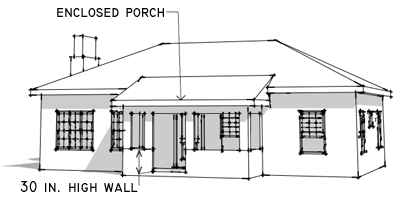 |
Porch, Open means a covered entrance to a building or structure which is not enclosed by walls or windows, but may have columns that support the porch roof and railing. Porches generally project out from the main wall of the building, and may have a separate roof or a roof that is integrated with the building to which it is attached.
| Open Porch |
|---|
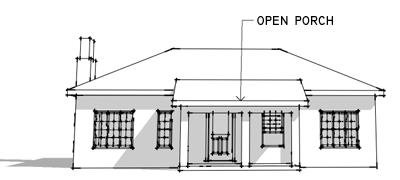 |
Post Office means a facility that contains service windows for mailing packages and letters, post office boxes, offices, vehicle storage areas, and sorting and distribution facilities for mail.
Primary Building Entrance means an entrance to a building open to and most commonly used by the general public. For buildings not open to the general public, the Primary Building Entrance means an entrance open to and most commonly used by building occupants. A building may have more than one (1) Primary Building Entrance if the entrances are similar in access and visibility.
Primary Pedestrian Pathway means a designated path, sidewalk, or way set aside for use by pedestrians intended to create a cohesive and safe walkable network that provides direct and convenient connectivity and access to buildings and other key pedestrian areas to enhance a Neighborhood Activity Center.
Private Amenity Zone is a portion of the Streetscape between the unobstructed Pedestrian Walk (or street) and the building face. This area is reserved for Streetscape Elements that transition between Active Uses within buildings or plazas and the Pedestrian Walk. The Private Amenity Zone may be located within the public right-of-way subject to a license agreement with the City, see Figure 12-4-303A, Streetscape Section.
Private Club means organizations or associations of persons for some common purpose, such as a fraternal, social, educational or recreational purpose, but not including clubs organized primarily for-profit or to render a service which is customarily carried on as a business. Examples of private clubs include (but are not limited to) 4-H Clubs, veterans organizations, Boy Scout and Girl Scout facilities, Elks Lodges, YMCA, YWCA, private community clubhouses, golf clubhouses, and fraternities and sororities that do not include residential facilities. The phrase "private club" does not include organizations with a principal purpose of serving alcoholic beverages to its members or others.
Private Improvement means any improvement required by the development plan which is not deemed by the City to be a public improvement.
Professional Services, Instruction, or Counseling see Services, Commercial, Personal and Professional.
Protective Care means housing where the residents are assigned to the facility and are under the protective care of the county, state, or federal government. This use includes: jails or prisons; work release; psychiatric hospitals; and comparable facilities.
Public Amenity Zone is a portion of the Streetscape between the curb and the unobstructed Pedestrian Walk reserved for Streetscape Elements that serve and enhance the pedestrian experience, see Figure 12-4-303A, Streetscape Section.
Public Hearing means a proceeding before an elected or appointed board, commission or council wherein the governing body takes testimony from the public on an issue to be decided by the governing body.
Public Improvement means any on-site or off-site roadways, water lines, sewer lines, stormwater facilities, open space, landscaping, street lighting, street furniture, traffic control devices, sidewalks, trails, transportation improvements, parking areas and similar infrastructure and related improvements to be constructed and dedicated for public use, or otherwise providing a public benefit and made available for public use by easement, license or other form of agreement.
Public Right-of-way means any land held, owned or otherwise controlled by the City for the specific but not exclusive purpose of vehicular, pedestrian, and/or other form of transportation whether or not such transportation use is actually or presently undertaken on such land.
Public School, for the purposes of Section 12-14-507, means a building or portion of a building used for educational purposes by a school district, a board of cooperative services, the Colorado school for the deaf and blind created and existing pursuant to C.R.S. 22-80-102 (1)(a), or a charter school, including but not limited to school sites, classrooms, libraries and media centers, cafeterias and kitchens, auditoriums, multipurpose rooms, and other multi-use spaces but shall not include telecommunication facilities which are regulated pursuant to this LDC. A "public school" does not include a learning center, as defined in C.R.S. 22-30.7-102 (4), that is not used for any other public school purpose and is not part of a building otherwise owned, or leased in its entirety, by a school district, a board of cooperative services, a charter school, or the Colorado school for the deaf and blind for educational purposes.
Public Space is a place that is open and accessible to the public. Roads, public squares, and parks can be considered to be public space.
Public Utility means a firm, partnership, association, cooperative, company, corporation and governmental agency, and the directors, trustees or receivers thereof, whether elected or appointed, which is engaged in providing railroad, airline, bus, electric, rural electric, telephone, telegraph, communications, gas, gas pipeline carrier, water, sewerage, pipeline, street transportation, sleeping car, express, or private car line facilities and services.
R
Reconstruction means to rebuild a structure without increasing its footprint, when the structure has been:
1.
Partially or completely destroyed by any cause (i.e., fire, wind, flood), or
2.
Partially or completely torn down.
Reconstruction that also meets the definition of redevelopment shall be regulated as redevelopment.
Recreation, Indoor means uses or activities that provide recreation opportunities indoors for the public or residents of a subdivision or development, which are not commercial in nature. Specifically excluded from the definition are health and exercise clubs and commercial amusement uses. The phrase "recreation, indoor" includes:
1.
Community recreation center;
2.
Gymnasium;
3.
Swimming pool; or
4.
Tennis, pickleball, racquetball, or handball court.
Recreation, Outdoor means uses or activities that provide recreation opportunities outdoors for the public (open to the community) or residents of a subdivision or development, which are not commercial in nature (except for golf courses, which may be commercial in nature). The phrase "recreation, outdoor" includes public areas for active or passive recreational activities including, but not limited to:
1.
Jogging, cycling, tot-lots, playing fields, playgrounds, swimming pools, and tennis and pickleball courts;
2.
Golf courses (regardless of public or private ownership or membership);
3.
Arboretums, wildlife sanctuaries, forests, and other natural areas which may be used for walking or hiking; or
4.
Other passive recreation-oriented parks, including picnic areas, and garden plots.
Recreational Facilities means facilities or equipment that are used for private or public recreational or natural resource purposes that have a relatively low flood damage potential and do not involve a structure. This includes, without limitation: bicycle, equestrian or pedestrian trails and paths; benches; ball fields; tennis and basketball courts; interpretive facilities; and golf courses.
Recreational Vehicle means a vehicle which is:
1.
Built on a single chassis;
2.
Four hundred square feet or less when measured at the largest horizontal projections;
3.
Designed to be self-propelled or permanently towable by a light duty truck; and
4.
Designed primarily not for use as a permanent dwelling but as temporary living quarters for recreational, camping, travel, or seasonal use.
Recycling and Salvage means any land or structure used for collection, sorting, aggregation, and re-sale (or transfer) of recyclable materials or for the aggregate storage of inoperable man-made equipment, machinery, scrap, or other used or discarded materials having a total cubic volume of at least 700 cubic feet, for the purposes of recycling, re-using, or re-selling components. The phrase does not include "waste transfer stations," (even if they include a separate space for collection of recyclable materials), and does not include facilities where the materials are actually recycled into raw materials (such uses are typically heavy industry), but does include:
1.
Recycling centers;
2.
Composting facilities;
3.
Vehicle recycling or scrap metal processing; and
4.
Collection, dismantlement, storage, and salvage of inoperable vehicles, boats, trucks, farm vehicles or equipment, or other types of heavy machinery.
Recycling Center means a facility or land use, regardless of name or title, at which recoverable resources, such as newspapers, magazines, glass, metal, plastic materials, tires, grass and leaves, and similar items, except hazardous waste and medical waste are collected, cleaned, sorted, stored, flattened, shredded, dismantled, crushed, bundled, or separated by size, grade, quality, or type, and compacted, baled, or packaged for shipment or delivery for the eventual manufacture of new products.
Redevelopment means any of the following:
1.
The complete demolition of a principal building, followed by the construction of a new building which occupies a different footprint than the original principal building; or
2.
The destruction of a principal building to an extent that is equal to or greater than 50 percent of its assessed value, followed by reconstruction and repurposing of the building for a type of use for which the original building was not designed; or
3.
Expansion of a principal building by more than 50 percent of its floor area.
Reflector means a device used to redirect the light from the source by the process of reflection.
Reflector Lamp (PAR, R, BR, MR lamps) means a lamp specifically designed with a reflector integral to the lamp to direct light in a specific beam pattern.
Regional Improvement means an improvement, facility, network or system that exists, is planned, or is designed, primarily to benefit or to serve more than a single subdivision or development, including the future occupants of a parcel proposed for development. Examples of regional improvements include, but are not limited to: traffic signals; major intersection improvements; utilities; arterial road infrastructure and related facilities; street infrastructure serving public facilities (such as schools, parks, libraries, and government offices); bridges; parks; schools; libraries; and public transportation facilities. Regional improvements do not include funding for operation of services or facilities.
Registered Neighborhood means a property owners' association, homeowners' association, civic association, condominium association, or other organized group with membership that is generally coterminous with one or more neighborhood boundaries, which is registered with the City to review threshold applications for development approval within its notice radius (see Section 12-14-304, Threshold Review) pursuant to the registration process set out in Section 12-13-109, Centennial Council of Neighborhoods and Neighborhood Associations.
Regulating Plan is required for all Urban Center zoned districts as set forth in Section 12-14-902.
Residential Agriculture means the keeping of agricultural animals in a residential zoning district as an accessory use to the principal permitted use in the zoning district.
Respite Care Home means a facility for temporary eldercare or temporary care or supervision of up to four people with developmental disabilities, physical disabilities, or non-violent mental illness, which is provided to relieve the individuals' family or caregiver when they are temporarily unable or unavailable to provide needed care.
Restaurant, Drive-In means a building or structure and adjoining parking area used for the purpose of providing food and/or beverages to the public for consumption while remaining in vehicles parked upon the premises, regardless of whether or not, in addition thereto, seats or other accommodations are provided inside or outside the building or structure for the patrons.
Restaurant, Drive-Through means a building or structure used for the purpose of providing food and/or beverages to the public for delivery or pick-up from a counter or window designed and intended to be used to deliver food and/or beverages to patrons while within vehicles, regardless of whether or not, in addition thereto, seats or other accommodations are provided inside for the patrons. Restaurant, Drive-Through shall not include delivery of food and/or beverages for consumption while remaining in vehicles parked upon the premises (see Restaurant, Drive-In).
Restaurant, Drive-Through Attached means a Restaurant, Drive-Through as defined herein which is attached to a multi-tenant building where at least one other different use or tenant, such as retail or office, occupies the same building. Drive-Through Attached may include a drive-through located at the end of a multi-tenant building or a drive-through located at a midpoint of a building with a continuous roof.
Restaurant, Drive-Through Stand Alone means a Restaurant, Drive-Through as defined herein which is specifically located on an individual, freestanding pad.
Restaurant, No Drive-In or Drive-Through means an establishment that serves prepared meals to customers for consumption on-site or off-site, but does not include drive-in or drive-through facilities (but may include designated parking spaces for "curbside pickup" of food ordered in advance if the curbside pickup is a clearly subordinate function to the restaurant's operations), and includes:
1.
Full-service restaurants;
2.
Limited-service eating facilities; and
3.
Special foodservices.
Restricted Development Area means a racetrack or rectangular shaped pattern beginning at the departure end of a Centennial Airport runway and terminating at the arrival end of the same runway, which provides an average flight path for arriving and departing aircraft.
Retaining Wall means any Structure built, erected or installed for the purposes of retaining or restraining the lateral forces of soil, or for supporting weak and unstable soils.
Reverse Vending Machine means a device that accepts used (empty) recyclable glass, plastic, and/or metal beverage containers, and returns money to the user (the reverse of the typical vending cycle). The term also includes any enclosed receptacle or container made of metal, steel or a similar product and designed or intended for the donation and the temporary storage of clothing or other material.
Rezoning means a revision to the City Zoning Map.
Roof Line means the highest point on any building where an exterior wall encloses indoor floor area, excluding roof area provided for housing or screening of mechanical equipment.
Rooftop Greenhouse means a permanent structure located on a roof and which is primarily made of glass, plastic, fiberglass, or other durable transparent materials, for the agricultural use of year-round raising and harvesting of food crops indoors under controlled temperature, humidity, and odor control settings, and which may include packaging, processing, and shipping. The term does not include open air agriculture production located on a roof.
Runway Protection Zone means an area immediately adjacent to all runway thresholds in which no nonaeronautical structures are normally permitted due to the obstacle clearance requirements of immediately arriving and departing aircraft.
S
Scoreboard means an attached or detached board in a ballpark, sports field, or similar outdoor recreation venues, that shows the score of a sporting contest. When a Scoreboard is detached, it is considered a structure for permitting purposes. A Scoreboard may be internally illuminated and must meet the standards in Section 12-6-304, Illumination of Signs.
Self-Storage Facility means an establishment that offers for rental, lease, or ownership of individual bays that are intended for the storage, warehousing, or safe-keeping of goods or possessions, regardless of the duration of such storage, warehousing, or safe-keeping.
Semi-Nude means the showing of the female breast below a horizontal line across the top of the areola at its highest point or the showing of the male or female buttocks. This definition shall include the entire lower portion of the human female breast, but shall not include any portion of the cleavage of the human female breast, exhibited by a dress, blouse, skirt, leotard, bathing suit or other wearing apparel, provided the areola is not exposed in whole or in part.
(Ord. 2005-O-28)
Services, Used Alone, see Services, Commercial, Personal and Professional.
Services, Commercial, see Services, Commercial, Personal and Professional.
Services, Commercial, Personal and Professional means medical and non-medical services that may be used on a recurring or drop-in basis, may be one-to-one or group interaction between the proprietor or employee and the client. Examples of Services, Commercial, Personal and Professional are:
1.
Health clubs, exercise studios, yoga studios, sports and swimming instruction, mixed martial arts schools, artist studio, music and dance instruction;
2.
Nail salons, beauty and barber shops, skin and hair care, tanning salons, massage and day spas;
3.
Tutoring, tailoring, counseling, accounting, insurance, real estate, finance, law; and
4.
Similar services as determined by the Director.
Services, Personal see Services, Commercial, Personal and Professional.
Services, Professional see Services, Commercial, Personal and Professional.
Setback means a minimum distance that is required from a lot line to a building, structure, or sign, as the context requires. Setbacks are measured as provided in Section 12-3-202, Setbacks.
Sexual Encounter Center means a business or commercial establishment or private club that offers, for the purpose of sexual arousal, pleasure, gratification, or abuse, for any form of consideration, a place where two or more persons may congregate, associate, or consort and observe, view, participate, or engage in specified sexual activities or expose specified anatomical areas.
(Ord. 2005-O-28)
Sexually Oriented Business means an adult arcade, adult bookstore, adult cabaret, adult novelty store, adult video store, nude model studio, adult motel, adult motion picture theater, or sexual encounter center.
Shallow Flooding Areas (AO or AH Zones) means a designated Zone AO or Zone AH on the Flood Insurance Rate Map (FIRM) with a one percent chance or greater annual chance of flooding to an average depth of one to three feet where a clearly defined channel does not exist, where the path of flooding is unpredictable and where velocity flow may be evident. Such flooding is characterized by ponding or sheet flow.
Shielded means a light fixture in which the lamp is not in sight from normal viewing angles. All fully shielded and full cut-off fixtures are considered to be shielded.
Shrub means:
1.
A woody plant of less size than a tree, and usually with several stems from the same root;
2.
Perennial plants that reach at least three feet in height; and
3.
Ornamental grasses that reach at least three feet in height.
Sidewalk means a paved path for pedestrians along the side of a road. Can be attached or detached (separated from the road by a landscaped area).
Sight Triangle means an area of land located at intersections of streets, drives, and other public and/or private ways situated to protect lines of sight for motorists, within which, the height of materials and/or structures is limited.
Sign means any object or device containing letters, figures and/or other means of communication or part thereof, situated outdoors or indoors, of which the effect produced is to advertise, announce, communicate, identify, declare, demonstrate, direct, display, and/or instruct potential users of a use, product and/or service.
Sign, Animated means any sign, or any part thereof which changes physical position by means of movement, rotation or change in illumination to depict movement.
Sign, Arcade means a wall or projecting sign attached to the roof or wall of an arcade and totally within the outside limits of the structural surfaces which are delineating the arcade. This sign is perpendicular to the entry of the building.
Sign, Awning means a sign consisting of information painted on, sewn on, imprinted on, or attached to the surface of an awning.
Sign, Banner means a temporary advertising sign made of a flexible material which is not attached to a permanently mounted backing. A Banner Sign is not a Site Sign.
Sign, Bench means a bench or similar device containing advertising.
Sign, Blade or Shingle means a sign which projects from a vertically oriented wall.
Sign, Canopy means a sign that is located on the roof, fascia, or soffit of a canopy. A canopy sign is not an awning sign.
Sign, City Branding means a sign created by the City to market and reinforce its identity.
Sign, City Wayfinding means a non-regulatory sign created by the City to direct the public to public and private facilities or destinations of interest.
Sign Design Program ("SDP") means a coordinated regulatory plan for the design and placement of signage within a Parcel Proposed for Development. An SDP allows for flexibility and deviations from the strict signage regulations of this LDC that otherwise may not be permitted by the underlying zoning of the Parcel Proposed for Development. An SDP provides details on signage types, numbers, maximum sign area, signable area ratio, materials, and illumination standards, including electronic message centers. The regulations of the SDP replace the signage regulations of the underlying zone district of the Parcel Proposed for Development.
Sign, Directional means any sign on a lot that directs the movement or placement of pedestrian or vehicular traffic with or without reference to, or inclusion of, the name of a product sold or service performed on the lot or in a building, structure or business enterprise occupying the same.
Sign, Drive-Through means a wall or freestanding sign that lists the products and services available at facilities with drive-throughs. A menu board sign is considered a drive-through sign.
Sign, Electronic Message means a sign which exhibits changing and/or illuminated messages.
Sign, Feather means a temporary sign made of a flexible material which tends to be inserted directly into the ground or into a mounting device that sits on the ground, often with a feather-like shape. Other common names for Feather Sign include blade flag, flutter flag, flutter sign, quill flag, sail flag, and tear-drop sign.
Sign, Kiosk means a freestanding sign structure used for posting other signs or information.
Sign, Marquee means any sign made a part of marquee and designed to have changeable copy letters, either manually or electronically.
Sign Message means the thought or idea conveyed or expressed by the words, letters, insignia, figures, designs, fixtures, colors, motion, illumination, sound or projecting images or any combination thereof.
Sign, Monument means a freestanding sign, other than a pole sign, in which the entire bottom is in contact with or close to the ground.
Sign, Neon means a sign consisting of glass tubing, bent to form letters, symbols, or other shapes and illuminated by neon or a similar gas through which an electrical voltage is discharged.
Sign, Off-Premise means a sign advertising a land use, business, product or service not located or available upon the premises whereon the sign is located.
Sign, Parapet means a sign placed upon a low wall or protective railing along the edge of a roof, balcony or terrace.
Sign, Permanent means a sign constructed of durable material and affixed, lettered, attached to or placed upon a fixed, nonmovable, nonportable supporting structure.
Sign, Pole means a sign that is affixed, attached, or erected on a pole that is not itself an integral part of or attached to a building or structure.
Sign, Portable means a sign that is designed to be easily moved from one location to another, and when placed, is neither fastened to a permanent structure or building, nor mounted in the ground. Portable signs include signs mounted on trailers, wheeled carriers, or frames that are designed to be placed onto a surface without being secured to it.
Sign, Projecting means a sign attached to a wall and projecting away from that wall more than twelve (12) inches, but not more than three (3) feet. A projecting sign is not considered a wall sign, primary or wall sign, secondary.
Sign, Pylon means a freestanding sign with a support structure that is required to be enclosed. A pylon sign is considered a monument sign.
Sign, Roof means a sign upon or above the roofline or parapet of the building or structure.
Sign, Sidewalk means a type of portable sign that is intended to be placed on a hard surface, most commonly a sidewalk. These signs include A-frame signs, signs that are suspended from the top member of an A-frame, signs with weighted bases, and comparable signs. See Illustrative Sidewalk Signs, below.
| Illustrative Sidewalk Signs |
|---|
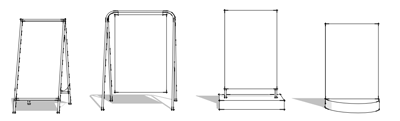 |
Sign, Site means a temporary freestanding sign constructed of vinyl, plastic, wood or metal and designed or intended to be displayed for a short period of time.
Sign, Snipe means an on- or off-premises sign that is tacked, nailed, posted, pasted, glued, or otherwise attached to trees, poles, stakes, fences, or to other objects.
Sign, Sock means a temporary sign constructed of flexible material, designed to fit over a permanent sign face or mount. Sock signs are typically installed while a new permanent sign is being designed and fabricated.
| Sock Sign |
|---|
| The sock sign below is shown is not shown fully installed in order to illustrate how it will cover up the old sign when installation is complete. |
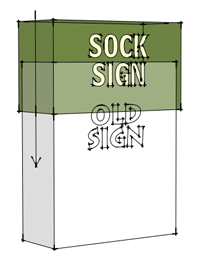 |
Sign Structure means a sign structure shall include, but not be limited to, the supports, uprights, braces, backing, sign board, and framework designed to contain a sign message. Sign structure is not meant to include the message conveyed by the sign.
Sign, Swing means a sign that is suspended from a horizontal support (a swingpost) that is attached to a vertical support mounted in the ground. A swing sign may also include riders. See Illustrative Swing Signs, below
| Illustrative Swing Signs |
|---|
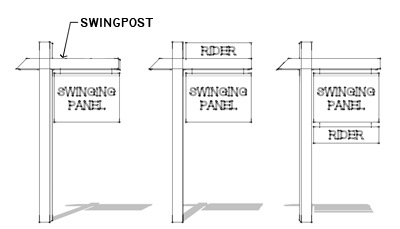 |
Sign, Temporary Fence means a temporary sign attached to a fence.
Sign, Vehicle means a sign attached to or painted on a vehicle parked and visible from the public right-of-way, unless said vehicle is used for transporting people or materials in the normal operations of the business and it is properly parking in a designated parking space. Signs attached to trailers or inoperable vehicles are presumed to be vehicle signs if they are parked in plain view from the right-of-way. Bumper stickers are not vehicle signs.
| Vehicle Sign |
|---|
| In the illustration below, the sign on the pickup truck is not a "vehicle sign," because the pickup truck is operable and properly parked in a parking space. The sign on the delivery truck is a "vehicle sign" because the truck is parked across parking spaces adjacent to the right-of-way, and the intent to use the position of the truck to display the sign is presumed. |
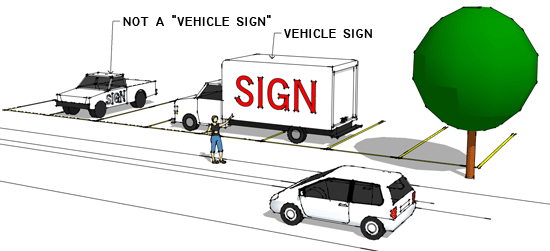 |
Sign, Wall means a sign attached to, painted on, or erected against a wall of a building, whose display surface is parallel to the face of the building, structure, or fence, and whose height does not exceed the height of the wall, structure, or fence to which said sign is attached, painted upon, or against which said sign is erected.
Sign, Window means a sign which is applied or attached to the exterior of a window, or applied to, attached to, or located within one foot (1') of the interior of a window, which can be seen through the window from the exterior of the structure.
Sign Without Backing means any word, letter, emblem, insignia, figure, or similar character or group thereof that is neither backed by, incorporated in, or otherwise made a part of any larger display area.
Sign, Yard means a type of temporary sign that is constructed of paper, vinyl, plastic, wood, metal or other comparable material, that is mounted on a stake or a frame structure (often made from wire) that includes one (1) or more metal tines. A Yard Sign is designed to be displayed for a short period of time.
Single-Family (also called "Single-Family Detached") means a single dwelling unit that is:
1.
Located in an individual building that is constructed on:
a.
An individual lot; or
b.
Land that is designated as a limited common element in a declaration of condominium; and
2.
Separated from each other by outside walls.
Single-Family Attached means a building that contains a minimum of two (2) and a maximum of nine (9) dwelling units that are attached along a common wall or separated by a floor. These buildings may also be called townhomes, row houses, or duplexes.
Single-Family Detached, Cottage means a small single-family detached dwelling unit type that is typically situated on a reduced-size lot that orients outdoor activity within rear, side, or shared yard or patio areas for more efficient use of the site. Cottage homes are typically arranged in a cluster around a green space, with vehicular access generally provided by a shared parking facility.
Site, as used in Section 12-2-425(H), Eligible Facilities Request, means the current boundaries of the leased or owned property surrounding a Tower or Eligible Support Structure and any access or utility easements currently related to the Site. For Towers in the public rights-of-way, a Site is limited to that area comprising the base of the structure and to other Transmission Equipment already deployed on the ground.
Site Specific Development Plan means an approved plan of development or development agreement for which a specific grant of a period of vested development rights has also been approved pursuant to Section 12-14-606, Vested Property Rights. The phrase "site specific development plan" is not a further specification of the phrase "development plan" as defined by this LDC.
Small Wind Energy Conversion System (SWECS) means any mechanism, including blades, rotors, or other moving surfaces, designed for the purpose of converting wind energy into mechanical or electrical power. For the purpose of these Regulations, towers, tower bases, guy wires and any other structures necessary for the installation of a small wind energy conversion system are also included.
Specified Anatomical Areas means and includes any of the following:
1.
Less than completely and opaquely covered human genitals, pubic region, buttocks, anus, or female breasts below a point immediately above the top of the areola; or
2.
Human male genitals in a discernibly turgid state, even if completely and opaquely covered.
(Ord. 2005-O-28)
Specified Criminal Act means any offense which is included in the definition of "unlawful sexual behavior" under Section 16-22-102, C.R.S., Sex Offender-Definitions, or any offense committed in another state that, if committed in the State of Colorado, would constitute an offense involving unlawful sexual behavior, or any offense that has a factual basis of one of the offenses specified in the definition of "unlawful sexual behavior." Specified criminal act also includes any offense involving soliciting for prostitution, prostitution, patronizing a prostitute, pandering, pimping, public indecency, or the distribution or possession of obscene materials.
(Ord. 2005-O-28)
Special Flood Hazard Area (SFHA) means the land subject to one (1) percent or greater change of flooding in any given year, i.e., the 100-year floodplain. It is the land area covered by the floodwaters of the base flood on the Flood Insurance Rate Maps. The SFHA is the area where the National Flood Insurance Program's floodplain management regulations must be enforced and the area where the mandatory purchase of flood insurance applies. The SFHA includes Zones A, AO, AH, AE, A99, AR, AR/AE, AR/AO, AR/AH, and AR/A.
Specified Sexual Activities means and includes any of the following:
1.
The fondling or other intentional touching of human genitals, pubic region, buttocks, anus, or female breasts;
2.
Sex acts, actual or simulated, including intercourse, oral copulation, masturbation, or sodomy;
3.
Flagellation, mutilation or torture for purposes of sexual arousal, gratification, pleasure, or abuse;
4.
Human genitals in a state of sexual stimulation, arousal, or tumescence; or
5.
Excretory functions as part of or in connection with any of the activities set forth in list items 1 through 4 of this definition.
(Ord. 2005-O-28)
Spill Light means a form of light trespass, illuminance projected onto a property from a light source located on a different property.
Start of Construction includes Substantial Improvement, and means the date the building permit or GESC permit was issued. The actual start means the first placement of permanent construction of a structure on a site, such as the pouring of slab or footings, the installation of piles, the construction of columns, or any work beyond the stage of excavation; or the placement of a manufactured home on a foundation. Permanent construction does not include land preparation, such as clearing, grading and filling; nor does it include the installation of streets and/or walkways; nor does it include excavation for basement, footings, piers or foundation or the erection of temporary forms; nor does it include the installation on the property of accessory buildings, such as garages or sheds not occupied as dwelling units or not part of the main structure. For substantial improvement, the actual start of construction means the first alteration of any wall, ceiling, floor or other structural part of a building, whether or not that alternation affects the external dimension of the building.
Static Billboard means a detached sign measuring 150 square feet or larger (except those signs contemplated in LDC Sections 12-6-402(C)(2) or 12-6-402(C)(3)) which displays content and messages that may only be manually or physically changed, which is nondigital, and which does not electronically display digital content and messages with the capability to remotely change such digital content and messages.
Storage Yard means outdoor storage of operable equipment and building or infrastructure construction materials for off-site projects. Storage Yard does not include accessory use outdoor storage areas that are associated with an on-site heavy industrial use. A Storage Yard is a primary use.
Story means that portion of a building included between the upper surface of a floor and the upper surface of the floor or roof next above.
Street means a public or private thoroughfare used, or intended to be used, for passage or travel by motor vehicles. Streets are further classified by the functions they perform.
Street, Arterial means a street designed to carry high volumes of traffic across and through the City and which interconnects with and augments the regional thoroughfare systems to provide service for trips of moderate length and to distribute travel areas smaller than those of regional thoroughfares.
Street, Collector means a street connecting a series of local streets to each other in such a manner that local traffic is collected and distributed to other collector or to arterial streets. Collector streets provide both land access services and local traffic movement within and between residential neighborhoods, commercial areas and industrial areas.
Street Cul-de-Sac means a local street of relatively short length with one open end and the other end terminating in a vehicular turnaround.
Street Frontage means the distance along any boundary line of a lot which is also the boundary line of a public street, road or highway right-of-way; a local or collector street parallel and adjacent to a regional thoroughfare or arterial street providing access to adjacent properties at specified points.
Street, Local means a street primarily intended to serve and provide access to properties abutting the street and not connecting with other streets in such a way as to encourage through traffic.
Streetscape addresses the character of the space between the curb and face of the adjacent buildings, see Figure 12-4-303A, Streetscape Section.
Streetscape Elements are elements placed within Public or Private Amenity Zones that help define street character. Elements may include street trees, tree lawns, street lights, pedestrian lights, traffic signage, benches and other seating, trash receptacles, bike racks, newspaper corrals and condos, kiosks, enhanced paving, public art, planter pots, bollards, bus shelters, awnings, canopies, and umbrellas or other shading devices.
Structure means:
1.
In general, anything constructed or erected, the use of which requires its permanent location on the ground (or its attachment to something having a permanent location on the ground), including but not limited to: garden walls, fences, signs, kiosks, or similar uses. The term "structure" does not include the word "building" unless the context clearly indicates otherwise, or if the word appears in Divisions 7-2, Use of Designated Open Space and 7-3, Floodplain Management and Flood Damage Prevention.
2.
As used in Divisions 7-2, Use of Designated Open Space and 7-3, Floodplain Management and Flood Damage Prevention (only), means a walled and roofed building, including a gas or liquid storage tank that is principally above ground, or manufactured home.
Subdivider means any person who causes:
1.
A parcel of land to be subdivided into two or more lots;
2.
A single lot to be created from two or more lots; or
3.
A modification to the configuration of lots, easements, servitudes, or rights-of-way on an approved plat.
Substantial Change, as used in Section 12-2-425(H), Eligible Facilities Request, means a modification that substantially changes the physical dimensions of an Eligible Support Structure if it meets any of the following criteria:
1.
For Towers located in the public rights-of-way, it increases the height of the structure by more than 10% or more than ten feet, whichever is greater; or it involves adding an appurtenance to the body of the Tower that would protrude from the edge of the Tower by more than six feet; or it involves installation of any new equipment cabinets on the ground if there are no pre-existing ground cabinets associated with the Tower; or it involves installation of ground cabinets that are more than 10% larger in height or overall volume than any other ground cabinets associated with the Tower; or
2.
For Towers not located in the public rights-of-way, it increases the height of the Tower by more than 10% or by the height of one additional antenna array with separation from the nearest existing antenna not to exceed twenty feet, whichever is greater; or it involves adding an appurtenance to the body of the Tower that would protrude from the edge of the Tower more than twenty feet, or more than the width of the Tower at the level of the appurtenance, whichever is greater; or
3.
For Base Stations, it increases the height of the structure by more than 10% or more than ten feet, whichever is greater; or it involves adding an appurtenance to the body of the structure that would protrude from the edge of the structure by more than six feet; or it involves installation of any new equipment cabinets on the ground if there are no pre-existing ground cabinets associated with the structure, or else involves installation of ground cabinets that are more than 10% larger in height or overall volume than any other ground cabinets associated with the structure; or
4.
For any Eligible Support Structure, it involves the installation of more than the standard number of new equipment cabinets for the technology involved, but not to exceed four cabinets; or it entails any excavation or placement outside the existing site; or it impairs the concealment elements of the eligible support structure necessary to qualify as an alternative communication facility; or it does not comply with the original application design elements or conditions of approval, including but not limited to colors, textures, surfaces, scale, character and siting, or any approved amendments thereto, subject to the thresholds established in subsections 1-4 of this definition.
Substantial Damage means damage of any origin sustained by a structure whereby the cost of restoring the structure to its before damaged condition would equal or exceed fifty (50) percent of the market value of the structure just prior to when the damage occurred.
Substantial Improvement means any repair, reconstruction, rehabilitation, addition, or other improvement of a structure, the cost of which equals or exceeds fifty (50) percent of the market value of the structure before the Start of Construction of the improvement. This phrase includes structures which have incurred Substantial Damage, regardless of the actual repair work performed. For the purposes of this definition, substantial improvement is considered to occur when the first alteration of any wall, ceiling, floor, or other structural part of the building commences, whether or not that alteration affects the external dimensions of the structure. "Phased improvements" are calculated cumulatively towards the cost of the improvement. The phrase does not, however, include either:
1.
Any project for improvement of a structure to comply with existing state or local health, sanitary, or safety code specifications which are solely necessary to assure safe living conditions; or
2.
Any alteration of a structure listed on the National Register of Historic Places or a State Inventory of Historic Places; provided that the alteration will not preclude the structure's continued designation as a "historic structure."
Swimming Pool means a water-filled enclosure, permanently constructed or portable, having a depth of more than 18 inches below the level of the surrounding land, or an above-surface pool, having a depth of more than 30 inches, designed, used, and maintained for swimming.
T
Temporary Construction Yard means an area of land utilized for storage of machinery, construction materials, construction office trailer, and other temporary structures associated with the construction/development of a single development project. Temporary asphalt or concrete plants, manufactured buildings, and portable storage units, as defined and regulated in this code, may also be contained within a construction yard, if the standards for each individual temporary use has been met. A temporary construction yard may be located on the same site as the development project or offsite, as regulated by this land development code.
Townhome means a single-family attached unit type that contains a minimum of three (3) and a maximum of nine (9) dwelling units that are attached along a common wall or separated by a floor.
Tract means a parcel platted in a subdivision which is set aside as a restricted tract unsuitable for the development of a building, or for a public or community-wide purpose which shall be shown on the face of the plat. A public or community-wide purpose may include a drainage area, stormwater detention or retention areas, areas for signs, parks, open space, utilities, or land areas reserved for other public facilities. Restricted tracts may include a structure, such as a garden wall, fence, sign, or kiosk, or non-structural development, including utilities, detention ponds, fences, trails, pathways, and landscaping. Except for restricted tracts, a tract is further defined as having been dedicated to the City or a quasi-public agency, or as being owned by a homeowners association for the subdivision in which the tract is located.
Traditional Neighborhood Development means development that consists of a variety of housing types, along with neighborhood supportive nonresidential development, designed so that its internal streets tend to give equal or greater dignity to the pedestrian compared to the automobile.
Trail means a public pathway for the use of pedestrian, non-motorized bicycle, or equestrian uses officially designated on a subdivision plat of record, or the City's Comprehensive Plan. Not a sidewalk.
Transmission Equipment, as used in Section 12-2-425(H), Eligible Facilities Request, means equipment that facilitates transmission for any FCC-licensed or authorized wireless communication service, including, but not limited to, radio transceivers, antennas, coaxial or fiber-optic cable, and regular and backup power supply. The term includes equipment associated with wireless communications services including, but not limited to, private, broadcast, and public safety services, as well as unlicensed wireless services and fixed wireless services such as microwave backhaul.
Transmission Lines means any electric transmission line and appurtenant facilities which emanate from a power plant or a substation and terminate at a substation, which are designed for or capable of, the transmission of electricity at greater than 115 kilovolts.
Turf means continuous plant coverage consisting of non-native grasses or native grasses that have not been hybridized for arid conditions and which, when regularly mowed, form a dense growth of leaf blades and roots.
Turning Radius means the radius (distance from center to edge) measurement of the smallest circle a vehicle can make while turning.
Twenty Four (24) Hour Use means a land use whose hours of operation exceed eighteen (18) consecutive hours in any 24 hour day. A land use seeking hours of operation in excess of eighteen hours in any 24 hour period.
U
Unduly means improperly or unjustly. As used in Section 12-7-202, Use of Special Flood Hazard Areas (SFHA), Flood Fringe, and Floodways, subsection D-1, Performance Standards for Use of Floodplains and Floodways, "unduly" is used to mean that floodplain use shall not improperly or unjustly restrict the capacity of any channels or floodways.
Uniformity means the ratio of two values of the same metric related to the same visual scene. A uniformity ratio is typically maximum-to-minimum or average-to-minimum and is reported as a number corresponding to one, as in 6:1, used with illuminance or luminance measurements.
University Corridor is defined by NACs located along South University Boulevard from the intersection of East Arapahoe Road south to County Line Road, as depicted in the University Corridor Map (Appendix H).
Use, Accessory means a use subordinate to the principal use which serves a purpose customarily incidental to the principal use.
Use, Primary/Principal means the main use located on a parcel.
Use, Temporary means a use which is not a principal use, for a special or seasonal purpose in contemplation of eventual removal.
Utilities, Community means a water or wastewater facility that is designed to provide services to more than one square mile of land area; and the generation of not more than 500kW of electricity using wind energy conversion systems or ground-mounted photovoltaic arrays. The phrase "utilities, community" does not include the production of electricity using fossil, biomass, waste, or nuclear fuels, nor the storage of natural gas.
Utilities, Neighborhood means water or wastewater facility that serves an area of one square mile or less (but not individual water wells or individual sewage disposal systems); utility substations or lift stations; local utility distribution or collection facilities, including electric, gas, telephone, water, sewer, and stormwater; and the generation of not more than 250kW of electricity using wind energy conversion systems or ground-mounted photovoltaic arrays. The phrase "utilities, neighborhood" does not include the production of electricity using fossil, biomass, waste, or nuclear fuels, nor the storage of natural gas.
Utility Footprint means the area within a continuous perimeter with up to eight straight sides that enclose the limits of all structures and equipment associated with a community or neighborhood utility.
Utility Pole means a pole from which utility service lines (e.g., lines for electricity or communications services) are suspended, or through which they are transitioned from above-ground installations to underground installations, and/or to which street lighting, traffic signals, or civil defense speakers are attached. The phrase "utility pole" includes guy wires and all other components that are necessary for the use and structural support of the utility pole.
V
Variance means a variation from the strict application of the requirements of the LDC, granted only in exceptional circumstances, as set out in Division 14-8, Variances, Appeals and Interpretations.
Vehicle Rental means uses that predominately rent automobiles, light trucks, boats, and motorcycles on the premises, where the inventory is stored for any length of time on-site.
Vehicle Sales means uses that predominately sell, purchase or lease automobiles, light trucks, boats, and motorcycles on the premises, where the inventory is stored for any length of time on-site.
Vehicle Service/Repair means uses that predominately perform service on automobiles, light trucks, boats, motorcycles, or other similar vehicles on the premises, where the inventory is stored for any length of time on-site. The phrase includes Auto Repair, Minor, as defined, but does not include Auto Repair, Major, which is defined as Heavy Industry.
Vehicle Wash means any area or business using self-service, in-bay automatic, or conveyor equipment for cleaning and washing motor vehicles, whether as a part of another business operation (e.g., as an accessory use to a Gasoline Station/Convenience Use, a Vehicle Sales Use, a Vehicle Rental Use or a Vehicle Service/Repair Use), or as a standalone operation, of any type, on a commercial basis. The definition includes fleet and municipal in-bay automatic and conveyor vehicle wash facilities.
Vertical Measurement means any measurements taken with the meter oriented perpendicular to horizontal.
Vested Property Right means the right to undertake and complete the development and use of property under the express terms and conditions of a site specific development plan.
Veterinarian (Dogs, Cats, Exotic Pets) means veterinary clinics and hospitals that provide care for small domestic animals. The term does not include large animal and livestock veterinarians, which are classified as agricultural support and other rural services.
Veterinarian (Horses and Other Livestock) means an animal hospital or clinic that provides services for horses and other livestock.
Vibration means rapidly fluctuating motions in which an object moves in equal distances from its initial starting point, so that there generally is no "net" movement.
Violation means the failure of a structure or other development to be fully compliant with Article 7 of the LDC, including the failure to obtain applicable permits, certifications or other evidence of compliance.
W
Waste Transfer Station means the use of land or a facility, regardless of name or title, to unload waste of any kind or type from vehicles, and, with or without intermediate processing such as compaction, sorting, or shredding, subsequently re-load the waste onto other vehicles for delivery to another transfer site, storage site, or disposal site. The phrase "waste transfer station" includes a facility for drop-off of recyclable materials (e.g., waste paper, motor oil, scrap metal, polystyrene foam, porcelain, batteries, electronic components, textiles, plastics, discarded shoes, cardboard, and other discarded household materials), where the materials are sorted, temporarily stored, and then shipped in bulk to other locations for processing. The phrase "waste transfer station" does not include a wastewater treatment facility.
Water Surface Elevation means the height, in relation to the North American Vertical Datum (NAVD) of 1988, of floods of various magnitudes and frequencies in the floodplains of riverine areas.
Wild animal means all species of animals which exist in their natural, unconfined state and are usually not domesticated.
Wing Wall means a non-structural wall that extends from the wall of a building, often used for screening a portion of the side yard of a building. See Illustration, Wing Wall.
| Wing Wall |
|---|
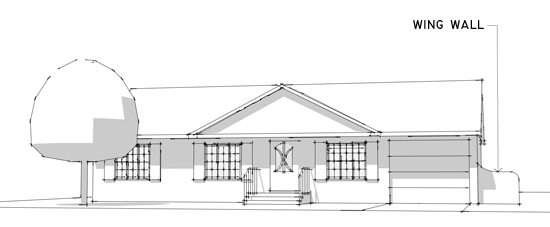 |
Wireless Communications Facility (WCF) means a facility used to provide personal wireless services as defined at 47 U.S.C. Section 332 (c)(7)(C); or wireless information services provided to the public or to such classes of users as to be effectively available directly to the public via licensed or unlicensed frequencies; or wireless utility monitoring and control services. A WCF does not include a facility entirely enclosed within a permitted building where the installation does not require a modification of the exterior of the building; nor does it include a device attached to a building, used for serving that building only and that is otherwise permitted under other provisions of the Code. A WCF includes an antenna or antennas, including without limitation, directional, omni-directional and parabolic antennas, Base Stations, support equipment, and Towers. It does not include the support structure to which the WCF or its components are attached if the use of such structures for WCFs is not the primary use. The term does not include mobile transmitting devices used by wireless service subscribers, such as vehicle or hand held radios/telephones and their associated transmitting Antennas, nor does it include other facilities specifically excluded from the coverage of this LDC. A WCF more specifically includes the following supplemental definitions:
1.
Antenna. An exterior transmitting or receiving device used in communications that radiates or captures CMRS (or similar) signals.
2.
Base Station, as used in Section 12-2-425(G), Eligible Facilities Request, means a structure or equipment at a fixed location that enables FCC-licensed or authorized wireless communications between user equipment and a communications structure. The definition of Base Station does not include or encompass a Tower as defined herein or any equipment associated with a Tower. Base Station includes, without limitation:
a.
Equipment associated with wireless communications services such as private, broadcast, and public safety services, as well as unlicensed wireless services and fixed wireless services such as microwave backhaul that, at the time the relevant application is filed with the City under this section, has been reviewed and approved under the applicable zoning or siting process, or under another State or local regulatory review process, even if the structure was not built for the sole or primary purpose of providing such support.
b.
Radio transceivers, antennas, coaxial or fiber-optic cable, regular and backup power supplies, and comparable equipment, regardless of technological configuration (including Distributed Antenna Systems ("DAS") and small-cell networks) that, at the time the relevant application is filed with the City under this section, has been reviewed and approved under the applicable zoning or siting process, or under another State or local regulatory review process, even if the structure was not built for the sole or primary purpose of providing such support.
The definition of Base Station does not include any structure that, at the time the relevant application is filed with the City under this section, does not support or house equipment described in paragraphs (2)(a)(b).
3.
Commercial Mobile Radio Service (CMRS). Telecommunications services, including cellular telephone, personal communications service (PCS), specialized mobile radio (SMR), enhanced specialized mobile radio (ESMR), paging, wireless Internet access and similar commercial services.
4.
Facility, CMRS. The equipment, physical plant and portion of the property and/or building used to provide CMRS services. This includes but is not limited to cables and wires, conduits, pedestals, antennas, towers, concealed structures, electronic devices, equipment buildings and cabinets, landscaping, fencing and screening and parking areas.
5.
Radio or television tower or transmitter. Non-stealth Freestanding Communications Facilities used to transmit radio and television broadcasts, including: lattice towers, monopole towers, guyed towers, or other freestanding facilities that do not meet the definition of a Stealth Freestanding Communications Facility.
6.
Readily apparent. For purposes of determining whether a wireless communication facility is readily apparent, the phrase means that the facility, in the discretion of the Director, will not be easily recognizable as a Wireless Communications Facility to a reasonable person viewing the facility as a whole and in the context of any adjacent improvements and landscaping from publicly accessible locations. Methods of design and construction that may assist in reducing the visibility of a facility and reaching a conclusion that a facility is not readily apparent include the use of color mimicking surrounding structures and landscaping, minimizing facility size to the greatest extent feasible, integrating the facility into any adjacent or attached improvements, and positioning the facility in a manner that limits the degree to which the facility projects away from any adjacent structures or landscaping. Due to differences in site characteristics, a determination that a particular Wireless Communications Facility will not be readily apparent at one location shall not establish a precedent for the same determination for a facility of the same or similar design or construction at a different location.
7.
Tower. Any structure built for the sole or primary purpose of supporting any FCC-licensed or authorized antennas and their associated facilities, including structures that are constructed for wireless communications services including, but not limited to, private, broadcast, and public safety services, as well as unlicensed wireless services and fixed wireless services such as microwave backhaul, and the associated site.
Works as used in Division 7-3, Floodplain Management and Flood Damage Prevention means structures in engineering (such as bridges, docks, or embankments) intended for watershed protection and similar uses.
Y
Yard means the area between a lot line and a building. Yards are designated by the lot line to which they relate (e.g., an interior side yard is located between the interior side lot line and the building).
Yard, Front means the lot area extending from the front lot line into a lot over the full lot width, to the foundation or the nearest point of projection of the primary structure
Yard, Rear means the lot area extending from the rear lot line into a lot over the full lot width, to the foundation or the nearest point of projection of the primary structure.
Yard, Side means the lot area extending from the side lot line into a lot over the full lot depth; to the foundation or the nearest point of projection of the primary structure.
Z
Zero Lot Line means a situation in which either two adjoining structures on adjacent but separate properties share a common wall or a structure is built up to its property line with no easement or setback requirement.
Zone District means a designation that is applied to a parcel of land reflecting permitted uses and development standards. Some common designations include Neighborhood Conservation (NC) and General Commercial (CG).
Zoning Map refers to the Official Zoning Map, adopted pursuant to Section 12-2-203, Official Zoning Map.
(Ord. 2021-O-13 §51; Ord. 2022-O-17 §2; Ord. 2022-O-21 §§6—8; Ord. 2022-O-22 §3; Ord. 2022-O-32 §4; Ord. 2023-O-07 §15; Ord. 2023-O-10 §§3, 4; Ord. 2023-O-14 §§9, 10; Ord. 2024-O-03 §9; Ord. 2024-O-05 §36; Ord. 2018-O-17 §2; Ord. 2024-O-07 §7; Ord. 2024-O-08 §29; Ord. 2024-O-13 §§61—63; Ord. 2024-O-14 §§72—74; Ord. 2024-O-18 §§14, 15; Ord. 2024-O-19 §8; Ord. 2025-O-06 §28; Ord. 2025-O-12 §40; Ord. 2026-O-07 §20)

