
Centennial City Zoning Code
ARTICLE 2
Districts and Use Standards
Sec. 12-2-101. - Purpose of Article.
A.
Generally. The purpose of this Article is to establish the zoning districts; the permitted, limited, conditional, and prohibited uses in each zoning district; and the additional standards that apply to limited and conditional uses. This Article also provides standards for the approval or conduct of temporary land uses.
B.
Zoning Districts. Zoning districts are established by Division 2-2, Establishment of Zoning Districts.
1.
The zoning districts that are established by this Article are divided into five general categories, which are intended to:
a.
Guide new development according to the City's Comprehensive Plan and sub-area plans;
b.
Respect and reinforce the fabric of the City's stable, established neighborhoods;
c.
Facilitate redevelopment within the City's established neighborhoods in a manner that maintains compatibility while ensuring various housing types can be constructed;
d.
Provide opportunities for commercial and mixed-use development to serve City and regional residents; and
e.
Provide opportunities for development of employment centers.
2.
The five general categories are:
a.
Agriculture;
b.
Residential;
c.
Commercial and Mixed-Use;
d.
Industry and Business; and
e.
Public, Institutional, and Open Space.
C.
Land Use. The purpose of Division 2-3, Land Use, is to set out the uses of land that are permitted in each district in a simplified format. Uses are either permitted as-of-right ("permitted"), permitted subject to compliance with additional standards ("limited"), permitted subject to additional standards and public hearing ("conditional"), or prohibited (not allowed).
D.
Limited and Conditional Use Standards. The purpose of Division 2-4, Limited and Conditional Use Standards, is to provide additional standards to ensure that uses that are listed in Division 2-3, Land Use, as "limited" or "conditional" are compatible with other uses in the district in which they are located.
E.
Temporary Uses. The purpose of Division 2-5, Temporary Uses, is to set out standards for the location and conduct of temporary uses of land, in order to ensure that they do not become a nuisance or safety hazard, or diminish or change the character or function of the area in which they are located.
(Ord. 2024-O-14 §2)
Sec. 12-2-102. - Application of Article.
A.
Establishment of Districts.
1.
Generally.Division 2-2, Establishment of Zoning Districts, establishes the zoning districts in which various uses of land and intensities of development are permitted, and incorporates the official zoning map into the LDC. It also provides rules for interpreting the official zoning map.
2.
Neighborhood Conservation. The neighborhood conservation district is intended to preserve the integrity and character of existing neighborhoods. Unlike conventional zoning districts, in neighborhood conservation districts:
a.
All buildings and structures that were lawfully constructed before the effective date are conforming;
b.
Subdistricts are established based on the typical lot area and typical lot width in the neighborhood. The purpose of the subdistricts is to ensure that standards for building improvements and redevelopment are appropriate to the character of the neighborhood in which the standards are to be applied.
c.
Within the subdistricts:
i.
The minimum lot area and minimum lot width requirements are limitations on the subdivision of existing lots, and do not make the existing lots nonconforming, regardless of their size.
ii.
A maximum lot area is established in some neighborhood conservation subdistricts, in order to prevent the assembly of lots in a manner that would allow the development of buildings that are out of scale with the neighborhood.
iii.
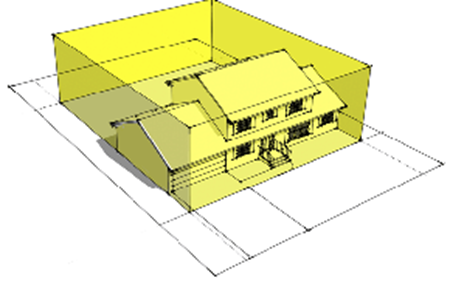
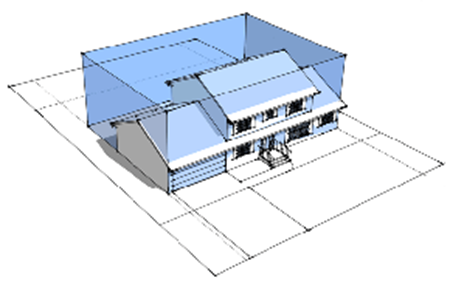
Maximum building coverage is established in order to (in combination with height limitations) ensure that new development is compatible with existing development in terms of building mass, while also ensuring reasonable room for expansion of existing buildings or redevelopment. See Figure 12-2-102, Building Cover Illustration.
| Figure 12-2-102 Building Cover Illustration | |
|---|---|
 |  |
|
EXAMPLE: SETBACK AND HEIGHT ONLY
Pictured above is a typical 2-story home on a 12,000 square foot lot. The footprint of the home is 2,100 square feet. The building cover is 17.5% (2,100/12,000). Assuming setbacks of 25 feet in the front and rear and 10 feet on the sides, this lot has 6,320 square feet of buildable area. If it is all occupied by building, the building cover would be 53% (6,320/12,000) (area pictured in yellow). This would allow a "monster home" to be built on this site. |
EXAMPLE: SETBACK, HEIGHT, AND BUILDING COVERAGE
Pictured above is the same typical 2-story home on the same lot as the illustration at left. Assuming setbacks of 25 feet in the front and rear and 10 feet on the sides, this lot has 6,320 square feet of buildable area. If building cover is limited to 30%, then the potential for a "monster home" on this site is decreased, while there is room left for expansion or redevelopment (area pictured in blue). Within the buildable area, building is allowed anywhere, provided that building cover limits are not exceeded. |
d.
Setback standards apply in a different manner than in conventional zoning districts. In the neighborhood conservation districts, they apply:
i.
To new homes that are built on vacant lots, or on lots where the existing building is torn down; and
ii.
To determine how expansions to existing homes are approved, as follows:
e.
Expansions that are set back in accordance with the setback standards are approved by the issuance of a building permit; and
f.
Expansions of existing homes that are not set back in accordance with the setback standards are reviewed for compliance with alternative development standards before a building permit can be issued.
3.
Neighborhood Infill. The neighborhood infill district is intended to provide for residential development. This may range from additional building coverage allowances within existing neighborhoods to the creation of new residential development to meet new housing needs. The NI subdistricts regulate permitted housing types that allow for transitions and compatibility within and from existing neighborhoods.
B.
Land Use.Division 2-3, Land Use, sets out the uses that are allowed, allowed with additional review ("limited uses" and "conditional uses," see subsection C., below), and not allowed in each zoning district. It also lists uses that are not allowed anywhere in the City and provides a process for determining how a new or unlisted use should be considered.
C.
Limited and Conditional Uses.Division 2-4, Limited and Conditional Use Standards, sets out additional standards for certain uses that, because of their operational characteristics, design issues, and potential to be nuisance, require additional standards to ensure their compatibility with other uses in the same district or on nearby properties in other districts. Limited and conditional uses are defined as follows:
1.
Limited Uses. Limited uses are uses that have impacts that are different in kind or scale from permitted uses in the same district, which are mitigated by the specific standards contained in Division 2-4, Limited and Conditional Use Standards. Applications for approval of limited uses are decided by the Director, who applies these specific standards.
2.
Conditional Uses. Conditional uses have a higher potential for impact than limited and permitted uses, and may or may not be permitted on a particular parcel. Applications for approval of conditional uses are decided by the City Council, which applies the standards in Division 2-4, Limited and Conditional Use Standards, and Section 12-14-601, Conditional Use and Temporary Conditional Use Procedures.
D.
Temporary Uses.Division 2-5, Temporary Uses, sets out the standards for the approval and conduct of temporary land uses.
(Ord. 2024-O-14 §§3, 4)
Sec. 12-2-201. - Zoning Districts Established.
A.
Zoning Districts Established. The City of Centennial is divided into the 17 zoning districts that are established by Table 12-2-201A, Centennial Zoning Districts.
B.
Neighborhood Conservation Subdistricts. The Neighborhood Conservation (NC) district is divided into eight subdistricts, as set out in Table 12-2-201B Neighborhood Conservation Subdistricts. All lots that existed as of the effective date of this LDC are conforming if they are located in any NC subdistrict, regardless of their lot area or lot width. The minimum lot size and minimum lot width that form the basis for the subdistricts are used to control further subdivision or combination. Development standards for the subdistricts are set out in Division 3-3, Residential Development Standards.
C.
Neighborhood Infill Subdistricts. The Neighborhood Infill (NI) district is divided into six subdistricts, as set out in Table 12-2-201C, Neighborhood Infill Subdistricts. All lots that existed as of the effective date of this LDC are conforming if they are located in any NI subdistrict, regardless of their area or lot width. The minimum lot size and minimum lot width that form the basis for the subdistricts are used to control further subdivision or combination. Development standards for the subdistricts are set out in Division 3-3, Residential Development Standards.
D.
Overlay Zoning Districts. Overlay zoning districts are special zoning districts placed over an existing zoning district which identifies special regulations and provisions in addition to those in the underlying zoning district. The establishment of overlay zoning districts requires processing of a text amendment and rezoning of the affected properties.
1.
Residential Agriculture Overlay District. The Residential Agriculture Overlay ("RAO") District is established to allow for certain agricultural animals and accessory structures that have been historically allowed on properties within the RAO District and that are appropriate and compatible with residential uses. The purpose of the RAO District is to prescribe special regulations related to agricultural activities of a noncommercial nature in addition to those regulations in the underlying NC2A zoning district. The RAO District is divided into the following subdistricts:
a.
Agricultural Animal. This RAO subdistrict permits the keeping of agricultural animals for non-commercial purposes subject to the limited use standards of Section 12-2-420, Residential Agriculture, and restricted to certain properties in the NC2A zoning district identified on the Zoning Map as "NC 2A -RAO-AA".
b.
Equine2. This RAO subdistrict permits the keeping of two (2) equine for non-commercial purposes subject to the limited use standards of Section 12-2-420, Residential Agriculture, and restricted to certain properties in the NC 2A zoning district identified on the Zoning Map as "NC 2A -RAO-EQ2".
c.
Equine3. This RAO subdistrict permits the keeping of three (3) equine for non-commercial purposes subject to the limited use standards of Section 12-2-420, Residential Agriculture, and restricted to certain properties in the NC2A zoning district identified on the Zoning Map as "NC 2A -RAO-EQ3".
d.
EquineAR. This RAO subdistrict permits the keeping of equine for non-commercial purposes subject to the limited use standards of Section 12-2-420, Residential Agriculture, and restricted to certain properties in the NC 2A zoning district identified on the Zoning Map as "NC 2A -RAO-EQAR".
2.
Airport Influence Area Overlay District. The AIA Overlay District is established by Division 3-9 of the Land Development Code to recognize an area that is subject to higher than average avigation noise levels and which area may include possible crash hazards from aviation activities. The AIA is further divided into zones or subareas by this Division for the purpose of regulating properties within the AIA to best protect public health, safety, and welfare.
3.
Dove Valley Residential Overlay District. The Dove Valley Residential ("DVR") Overlay District is established to require a diversity of housing types on property within Dove Valley zoned Urban Residential (RU). See Appendix I for map of the area of the DVR Overlay District. The DVR Overlay District is subject to the development standards of Divisions 3-4 and 3-5. The DVR Overlay District requirements shall not be applicable to residential projects that received all necessary final approvals by the City prior to August 1, 2022.
4.
Midtown Centennial Overlay District. The Midtown Centennial Overlay District is established to recognize a unique area of the City, as depicted in Appendix L, that is subject to additional development standards to facilitate high quality development and redevelopment. The Midtown Centennial Overlay District standards are contained in Division 4-6, Midtown Centennial Overlay District.
E.
Business Park and Employment Center Subdistricts.
1.
Business Park Zone District. The Business Park (BP) district is divided into four subdistricts, as set out in Table 12-2-201(E)(1), Business Park Subdistricts. The maximum building heights that form the basis for the subdistricts are used to control new development or redevelopment and major expansions. Development standards for the BP district are set out in Division 3-7, Nonresidential and Mixed-Use Development Standards. As of October 5, 2024, the BP zone district shall not be eligible for initial zoning or rezoning.
2.
Employment Center Zone District. The Employment Center district is divided into 3 subdistricts, as set out in Table 12-2-201A, Centennial Zoning Districts. When denoted as EC in this LDC, all three subdistricts are subject to the LDC provision. When denoted by subdistrict, such as EC-N, only the referenced subdistrict is subject to the LDC provision. Permitted maximum building heights may vary by subdistrict, as noted in Table 12-2-201(E)(2).
F.
Public Rights-of-Way. Public rights-of-way within the City of Centennial shall not be zoned or governed by the zoning districts established in Section 12-2-201(A).
G.
Parcels in RS, RA, and RU.
1.
Existing or New Residential Development or Vacant Parcels. Parcels zoned Suburban Residential (RS), Auto-Urban Residential (RA), or Urban Residential (RU) that consist of existing residential development or vacant land shall utilize the development standards for the NI SFD/SFA 30 zone district pursuant to Table 12-3-301A, Residential Lot and Building Standards.
2.
Existing or New Non-residential or Mixed-Use Development. Parcels zoned RS, RA, or RU that consist of existing non-residential or mixed-use development shall utilize the development standards pursuant to Division 3-7, Nonresidential and Mixed-Use Development Standards.
(Ord. 2022-O-20 §2; Ord. 2022-O-31 §2; Ord. 2024-O-13 §§2—6; Ord. 2024-O-14 §§5—11; Ord. 2025-O-08 §2)
Sec. 12-2-202. - Planned Unit Developments.
Prior to the effective date, a large proportion of the development rights granted in Centennial were in the form of planned unit development approvals that were issued either by the City of Centennial or Arapahoe County. Such approvals shall remain effective as of the effective date of this LDC, regardless of the underlying zoning district assigned, except that a zoning designation of Neighborhood Conservation ("NC") or Neighborhood Infill ("NI") shall extinguish any underlying planned unit development approval (but not private covenants, conditions, and restrictions or subdivision plats). New or amended planned unit developments shall be processed in accordance with Section 12-14-903, Planned Unit Developments.
Sec. 12-2-203. - Official Zoning Map.
A.
Official Zoning Map Adopted. Zoning districts are shown upon the map entitled "Official Zoning Map of the City of Centennial" (referred to hereinafter as "Zoning Map") which is attached hereto and made part of this Land Development Code ("LDC"). At least two copies of the Zoning Map are on file and available for inspection during regular business hours at the Centennial Civic Center.
B.
Force and Effect. The Zoning Map and all notations, references, and other information shown on it are a part of this LDC and have the same force as the LDC.
C.
Status of Official Zoning Map. The Zoning Map that is on file at the Centennial Civic Center shall control in the event of a conflict between the map that is on file and any other reproduction of said map.
D.
Effective Date. The LDC may be adopted before the Official Zoning Map. In such case, the LDC will not become effective until the Official Zoning Map is adopted.
Sec. 12-2-204. - Interpreting the Official Zoning Map.
A.
Generally. The precise location of any zoning district boundary line shown on the Zoning Map shall be defined by the rules of this Section.
B.
Rezoning Ordinance and Zoning Map.
1.
Rezoning ordinances shall be promptly reflected on the Zoning Map.
2.
Conflicts between the district boundaries on the Zoning Map and the zoning for property provided by a duly enacted rezoning ordinance dated after the Effective Date could result from administrative error. In the event of such conflict, the duly enacted rezoning ordinance shall control, and the Zoning Map shall be promptly corrected.
3.
In the event of a conflict between the district boundaries on the Zoning Map and the zoning for property provided by a duly enacted rezoning ordinance adopted before December 31, 2009, the Zoning Map shall control.
C.
Identifiable Features. Where zoning district boundary lines appear to follow identifiable features, their location shall be determined by applying the rules of this subsection in order from 1. to 4.:
1.
Rights-of-Way. Boundary lines shown as following, or approximately following, streets, alleys, railroad tracks, or utility lines shall be construed as following the centerline of the right-of-way. Where streets or alleys on the ground differ from streets or alleys shown on the Zoning Map, the streets or alleys on the ground control.
2.
Property Lines. Boundary lines shown as following, or approximately following, lot lines or other property lines shall be construed as following such lines.
3.
Watercourses. Boundaries shown as following, or approximately following, the centerline of streams or other watercourses shall be construed as following the channel centerline. In the event of a natural change in the location of such streams or other watercourses, the zoning district boundary shall be construed as moving with the channel centerline.
4.
Parallel to Features. Boundaries shown as separated from and parallel, or approximately parallel, to any of the features listed in paragraphs 1. through 3., above, shall be construed to be parallel to such features and at such distances as are shown on the Zoning Map.
D.
Un-Subdivided Land or No Identifiable Feature. On un-subdivided land, or where a district boundary follows no identifiable feature, the location of district boundaries shall be determined by applying the following rules in order from 1. to 3., until the boundaries are known:
1.
Legal Description. The boundary shall be according to the legal description in the ordinance establishing the district boundaries.
2.
Text Dimensions. The boundary shall be located by reference to dimensions shown in text on the Zoning Map, if any.
3.
Map Scale. The boundary shall be located using the map scale appearing on the Zoning Map.
Sec. 12-2-205. - Undesignated or Annexed Land.
A.
Generally. It is the intent of the City Council that all land within the City be zoned.
B.
Apparently Undesignated Land. Therefore, for the purposes of ensuring that all land has a zoning designation, any land that is not assigned a zoning district on the Zoning Map is zoned Agriculture (AG).
C.
Zoning of Annexed Land. The City does not have zoning districts that are comparable to the districts in Arapahoe County. Therefore, the City may process an application for an initial City zoning designation, or may designate a newly annexed property's zoning district upon its own initiative, in conjunction with annexation proceedings. Land that is not zoned otherwise by the City during the annexation process is zoned Agriculture (AG) upon annexation until affirmatively rezoned to another district.
D.
Zoning of Vacated Right-of-Way. Upon vacation of City right-of-way, the land vacated by the City shall automatically assume the zoning designation of the adjacent parcel unless otherwise rezoned by City Council.
(Ord. 2021-O-13 §2)
Sec. 12-2-301. - Use Tables.
A.
Generally.
1.
Sections 12-2-302, Residential, Home, and Institutional Uses, through 12-2-304, Industrial, Agricultural, and Special Uses, contain tables that set out which residential, home, institutional, commercial, amusement, recreation, industrial, agricultural, and special uses are permitted, limited, conditional, and prohibited in each zoning district. Section 12-2-306, Temporary Uses, sets out the same information for temporary uses.
2.
The tables list uses in white and yellow rows, organized by category (orange rows). Zoning districts are arranged in columns. Where rows and columns intersect, a letter indicates if the use is permitted, limited, conditional, or prohibited in the district. The last column, "Additional Standards," refers to the section which provides the standards that apply to limited or conditional uses for districts in which the use is limited or conditional.
B.
Symbols. All the tables use the following symbols:
1.
"P" means that the use is Permitted, subject to the standards that apply to all permitted uses. The use is approved by the Director.
2.
"T" means that the use is Permitted, but only as part of an approved Traditional Neighborhood Development ("TND"). The use is approved by the Director.
3.
"L" means that the use is a Limited Use which is permitted as of right and approved by the Director, subject to:
a.
The standards for permitted uses that are set out in this LDC; and
b.
The applicable standards in Division 2-4, Limited and Conditional Use Standards, for that specific use.
4.
"T/L" means that the use is a Limited Use which is permitted as part of an approved Traditional Neighborhood Development ("TND"), subject to the applicable limited use standards.
5.
"C" means that the use is allowed as a Conditional Use, which is approved by the City Council, subject to:
a.
The standards for permitted uses that are set out in this LDC;
b.
The applicable standards in Division 2-4, Limited and Conditional Use Standards, for that specific use; and
c.
The conditional use standards of Section 12-14-601, Conditional Use and Temporary Conditional Use Procedures, which apply to all conditional uses.
6.
"-" means that the use is Prohibited in the specified zoning district.
C.
Planned Unit Developments.
1.
Uses permitted in the PUD zone district include any combination of commercial, industrial or residential uses permitted by an approved Preliminary Development Plan ("PDP"). Type A Group Homes shall be a principal permitted use when residential uses are a part of the PDP.
Sec. 12-2-302. - Residential, Home, and Institutional Uses.
Table 12-2-302, Residential, Home, and Institutional Uses, sets out which residential, home, and institutional uses are allowed in each zoning district.
(Ord. 2022-O-18 §2; Ord. 2022-O-20 §3; Ord. 2022-O-21 §2; Ord. 2023-O-09 §4; Ord. 2024-O-03 §2; Ord. 2024-O-13 §7; Ord. 2024-O-14 §12)
Sec. 12-2-303. - Commercial, Recreation, and Amusement Uses.
Table 12-2-303, Commercial, Recreation, and Amusement Uses, sets out which commercial, recreation, and amusement uses are allowed in each zoning district.
(Ord. 2022-O-31 §3; Ord. 2023-O-07 §2; Ord. 2023-O-10 §6; Ord. 2024-O-13 §8; Ord. 2024-O-14 §13)
Sec. 12-2-304. - Industrial, Agricultural, and Special Uses.
Table 12-2-304, Industrial, Agricultural, and Special Uses, sets out which industrial, agricultural, and special uses are allowed in each zoning district.
(Ord. 2022-O-32 §3; Ord. 2024-O-13 §9; Ord. 2024-O-14 §14; Ord. 2024-O-19 §3)
Sec. 12-2-305. - Wireless Communications Facilities.
A.
Intent and Purpose. It is the intent and purpose of this Section to establish a regulatory framework in which Wireless Communications Facilities may be constructed or located within the City of Centennial in consideration of the public health, safety and general welfare and without substantial adverse impacts to the visual integrity of the City, its neighborhoods, and its important view corridors. To achieve this objective, these regulations require the use of stealth design through Camouflage and Concealment Design Techniques, with limited exceptions, and encourage the use of Attached Communications Facilities.
B.
Classification of Wireless Communications Facilities.
1.
Attached Wireless Communications Facility. A Wireless Communications Facility is an "Attached Wireless Communications Facility" if it is affixed to an existing permanent structure (including buildings, water tanks, light poles, traffic signals, flag poles and communications towers, but excluding an existing Freestanding Wireless Communication Facility) provided such structure conforms to all applicable regulations, including building and zoning regulations.
2.
Freestanding Wireless Communications Facility. A Wireless Communications Facility is a Freestanding Wireless Communication Facility if it is not an attached communications facility. A Freestanding Wireless Communication Facility is further defined as either a "Stealth Freestanding Wireless Communications Facility" or a "Non-stealth Freestanding Wireless Communications Facility," as follows:
a.
A "Stealth Freestanding Wireless Communications Facility" is a freestanding facility that meets the definition of Camouflage and Concealment Design Techniques.
b.
A "Non-stealth Freestanding Wireless Communications Facility" is a freestanding facility that does not meet the definition of a Stealth Freestanding Wireless Communications Facility.
C.
Approval Authority. Applications for all Wireless Communications Facilities shall be approved by the Director unless a Wireless Communications Facilities Conditional Use is required pursuant to Section 12-14-607, Wireless Communications Facilities Conditional Use Procedures.
D.
Use Table. Subject to the standards of this Section, the Wireless Communications Facility classifications that are permitted in each zoning district are set out in Table 12-2-305, Wireless Communications Facilities. Wireless Communications Facilities located in the public right-of-way are permitted subject to the standards set forth in Section 12-2-425(F), Wireless Communications Facilities in the Public Right-of-Way.
(Ord. 2024-O-13 §10)
Sec. 12-2-306. - Temporary Uses.
Table 12-2-306, Temporary Uses, sets out which temporary uses are allowed in each zoning district.
(Ord. 2021-O-13 §3; Ord. 2024-O-13 §11; Ord. 2024-O-14 §15)
Sec. 12-2-307. - Prohibited Uses in All Districts.
The following uses are prohibited in all zoning districts:
1.
Intensive agriculture.
2.
Disposal facilities involving radioactive materials or the burial of liquid hazardous wastes.
3.
Sale of fireworks.
4.
Outdoor shooting ranges.
5.
Uses that are prohibited by either State or Federal law or have necessary operational characteristics that are prohibited by State or Federal law.
Sec. 12-2-308. - Unlisted Uses.
A.
Generally. If a proposed use is not listed in Section 12-2-302, Residential, Home, and Institutional Uses; Section 12-2-303, Commercial, Recreation, and Amusement Uses; Section 12-2-304, Industrial, Agricultural, and Special Uses; Section 12-2-306, Temporary Uses; or Section 12-2-307, Prohibited Uses in All Districts then the Director shall decide whether the proposed use is either functionally comparable to, or a subcategory of, a permitted, limited, conditional, or prohibited use. The Director shall apply the following criteria to decide how the use will be regulated by this LDC:
1.
A proposed use is a subcategory of a permitted, limited, or conditional use if:
a.
Its North American Industrial Classification System (NAICS) code is a subset of an NAICS code for a permitted, limited, or conditional use; and
b.
With regard to each of the decision criteria enumerated in subsection B., the proposed use's impacts are not materially greater than the permitted, limited, or conditional use with the more general NAICS code.
2.
A proposed use is functionally comparable to a permitted, limited, or conditional use if it is reasonably comparable to the permitted, limited, or conditional use, and with regard to each of the decision criteria enumerated in subsection B., the proposed use has no greater impacts than the permitted, limited, or conditional use with which it is functionally comparable.
B.
Decision Criteria. The following decision criteria shall be evaluated when the Director decides whether a proposed use is a subcategory of, or is functionally comparable to, a permitted, limited, or conditional use:
1.
Parking demand;
2.
Average daily and peak hour trip generation (cars and trucks);
3.
Impervious surface;
4.
Noise;
5.
Lighting;
6.
Dust;
7.
Odors;
8.
Potentially hazardous conditions, such as projectiles leaving the site;
9.
Use and storage of hazardous materials;
10.
Character of buildings and structures;
11.
Character of operation; and
12.
Hours of operation.
C.
Effect of Determination.
1.
If the Director approves an application for a decision pursuant to this Section, then the use is allowed as a permitted, limited, or conditional use, with the same restrictions as the use to which it was compared for the purposes of the favorable decision.
2.
If the Director determines that a proposed use is not a subcategory of, or functionally comparable to, a permitted, limited, or conditional use, then the proposed use is a prohibited use.
Sec. 12-2-401. - Residential limited and conditional use standards.
A.
Generally. The standards of this section apply to residential uses that are specified in Table 12-2-302, Residential, Home, and Institutional Uses, as "L" or "C." These standards are applied in addition to the other applicable standards of this LDC.
B.
Standards. This section establishes the standards that apply to each of the limited and conditional residential uses. They are interpreted as follows:
1.
Use. Use lists the residential use that is a limited or conditional use in the districts listed below.
2.
District. District lists the district in which the standards apply.
3.
Location/Building Type. Location/building type, specifies the location for such uses, including limiting them to existing lots with buildings, or to the upper stories of mixed use buildings. Where the condition is an existing building, improvements and reconstruction are permitted, but no new units are allowed.
4.
Minimum Land Area. Minimum land area the minimum area of the lot or Parcel Proposed for Development upon which the use is proposed to be located.
5.
Maximum Land Area. Maximum land area specifies the maximum area of the lot or Parcel Proposed for Development upon which the use is proposed to be located.
6.
Access Type. Access Type specifies the classification of street from which access to the use must be provided. The existing access to an existing use is allowed in all cases, but if the access that is specified is different, access shall be reconfigured (if and when practicable) when the parcel is substantially improved or redeveloped for the limited or conditional use.
C.
Single-Family Detached. Single-Family Detached dwelling units in Agriculture (AG), General Commercial (CG), Activity Center (AC), and Urban Center (UC) shall meet the following standards.
1.
Location/Building Type/Design. Use permitted on existing single-family lot that is developed with an existing single-family home.
2.
Minimum Land Area. Existing Lot.
3.
Maximum Land Area. Existing Lot.
4.
Vehicular Access Type. Alley, Drive, Parking Lot, or Local Street.
D.
Accessory Dwelling Units (ADUs). Accessory Dwelling Units in General Commercial (CG), Activity Center (AC), and Urban Center (UC) shall meet the following standards.
1.
Location/Building Type/Design. Use permitted on existing single-family lot that is developed with an existing single-family home.
2.
Minimum Land Area. Existing Lot.
3.
Maximum Land Area. Existing Lot.
4.
Vehicular Access Type. Alley, Drive, Parking Lot, or Local Street.
E.
Single-Family Attached. Single-Family Attached dwelling units shall meet the following standards in the applicable zone districts.
1.
Neighborhood Conservation - SFA (NCSFA).
a.
Location/Building Type/Design. Use permitted within district at the same density that existed on the effective date of this LDC.
b.
Minimum Land Area. N/A.
c.
Maximum Land Area. N/A.
d.
Vehicular Access Type. Alley, Drive, Parking Lot, or Local Street.
2.
All NC Subdistricts (except NC SFA ) and Neighborhood Infill 18 (NI 18 ) and Neighborhood Infill 8 (NI 8 ).
a.
Location/Building Type/Design. Existing attached single-family buildings only; redevelopment to Single-Family Attached is allowed with same footprint; height; and density; alternative standards apply to redevelopment with larger footprint. See Article 3, Development Standards.
b.
Minimum Land Area. Existing Lot or Lots.
c.
Maximum Land Area. Existing Lot or Lots.
d.
Vehicular Access Type. Alley, Drive, Parking Lot, or Local Street.
3.
Neighborhood Infill (NI) - All NI Subdistricts except NI18and NI8.
a.
Location/Building Type/Design. See Table 12-3-301A, Residential Lot and Building Standards.
b.
Minimum Land Area. See Table 12-3-301A, Residential Lot and Building Standards.
c.
Maximum Land Area. See Table 12-3-301A, Residential Lot and Building Standards.
d.
Vehicular Access Type. Alley, Drive, Parking Lot, or Local Street.
4.
Activity Center (AC).
a.
Location/Building Type/Design. Single-Family Attached Dwelling Units.
b.
Minimum Land Area. N/A.
c.
Maximum Land Area. The Single-Family Attached Dwelling Unit footprint of residential buildings, including attached garages (but not detached garages or accessory buildings), shall not consist of more than 100 percent of the existing Non-Residential building Gross Floor Area footprint, including any modifications, within a Neighborhood Activity Center (NAC). See also Table 12-2-401A, Neighborhood Activity Center Calculation Scenarios.
d.
Vehicular Access Type. Alley, Drive, Parking Lot, Local Street, or Collector Street.
5.
Urban Center (UC).
a.
Location/Building Type/Design. Townhouse types only.
b.
Minimum Land Area. N/A.
c.
Maximum Land Area. If developed, this housing type shall be used to contribute to the diversity and aesthetic quality of the district (e.g., screening parking structures or providing a rich mix of housing); residential uses, including single-family attached, shall not occupy more than 50 percent of the floor area of Regulating Plan area.
d.
Vehicular Access Type. Alley, Drive, Parking Lot, or Local Street.
F.
Multifamily. Multifamily dwelling units shall meet the following standards in the applicable zone districts.
1.
Neighborhood Conservation (NC).
a.
Location/Building Type/Design. Existing multi-family buildings only; redevelopment to multi-family is allowed with same footprint; height; and density only. Rezoning required for redevelopment with larger footprint and/or building types. See Article 3, Development Standards.
b.
Minimum Land Area. Existing lot or lots.
c.
Maximum Land Area. Existing lot or lots.
d.
Vehicular Access Type. Alley, Drive, Parking Lot, Local Street, Collector Street, or Arterial Street.
2.
Neighborhood Infill (NI).
a.
Location/Building Type/Design. See Table 12-3-301A, Residential Lot and Building Standards.
b.
Minimum Land Area. See Table 12-3-301A, Residential Lot and Building Standards.
c.
Maximum Land Area. See Table 12-3-301A, Residential Lot and Building Standards.
d.
Vehicular Access Type. Alley, Drive, Parking Lot, Local Street, Collector Street, or Arterial Street.
3.
Activity Center (AC).
a.
Location/Building Type/Design. N/A.
b.
Minimum Land Area. N/A.
c.
Maximum Land Area. The Multi-Family Dwelling Unit Gross Floor Area footprint shall not consist of more than 40 percent of the existing Non-Residential building Gross Floor Area footprint, including any modifications, within a Neighborhood Activity Center (NAC). Active Uses, as defined by this LDC, shall consist of a minimum of 50 percent of the Multi-Family Dwelling Unit Gross Floor Area footprint. See also Table 12-2-401A, Neighborhood Activity Center Calculation Scenarios.
d.
Vehicular Access Type. Alley, Drive, Parking Lot, Local Street, Collector Street, or Arterial Street.
4.
Urban Center (UC).
a.
Location/Building Type/Design. Allowed on upper floors of mixed-use buildings or in freestanding multifamily buildings.
b.
Minimum Land Area. N/A.
c.
Maximum Land Area. Residential uses shall not occupy more than 50 percent of the floor area of any Regulating Plan area.
d.
Vehicular Access Type. Alley, Drive, Parking Lot, Local Street, Collector Street, or Arterial Street.
G.
Manufactured Homes less than 24 feet in width or 36 feet in length, or do not meet specifications of CRS 31-23-301(5)(b)(I), outside of manufactured home park or subdivision.
1.
Neighborhood Conservation (NC) and Neighborhood Infill (NI).
a.
Location/Building Type/Design. Minimum roof pitch of 5:12; must be installed on a permanent foundation.
b.
Minimum Land Area. Conforming lot.
c.
Maximum Land Area. As established by subdistrict.
d.
Vehicular Access Type. Alley, Drive, Parking Lot, or Local Street.
H.
Manufactured Homes; 24 feet or more in width and 36 feet or more in length, and meet specifications of CRS 31-23-301(5)(b)(I), outside of manufactured home park or subdivision.
1.
Neighborhood Conservation (NC) and Neighborhood Infill (NI).
a.
Location/Building Type/Design. Must meet or exceed, on an equivalent performance engineering basis, the standards of the building code.
b.
Minimum Land Area. Conforming lot.
c.
Maximum Land Area. As established by subdistrict.
d.
Vehicular Access Type. Alley, Drive, Parking Lot, or Local Street.
I.
Manufactured Home Park or Subdivision. Manufactured home parks and subdivisions shall meet the following standards:
1.
Minimum Area of Parcel Proposed for Development. The minimum area of a manufactured home park or subdivision is five (5) acres.
2.
Maximum Extent of Manufactured Home Park or Subdivision. The maximum extent of a manufactured home park or subdivision is 15 acres.
3.
Vehicular Access Type. Alley, Drive, Parking Lot, or Local Street.
4.
Utilities. All units shall be served with sanitary sewer, water, and electrical power. Such lines shall be placed underground.
5.
Buffer and Landscaping Requirements.
a.
All manufactured home parks and subdivisions shall provide a 35 percent opacity bufferyard along all borders with other uses (including other forms of residential development), unless a more opaque bufferyard is required by Article 8, Development Landscaping and Tree Protection.
b.
All bufferyards shall include a continuous six-foot tall masonry wall, perforated at points of pedestrian and vehicular access.
c.
Landscaping shall be installed in a manner that does not prevent the transport of manufactured homes to or from each lot.
6.
Accessory Uses. Laundry and maintenance buildings are permitted as an accessory use.
7.
Required Annotations. Manufactured home park site plans and manufactured home subdivision plats shall include:
a.
Notes stating that:
i.
Only single-wide, double-wide, or triple-wide manufactured homes are allowed;
ii.
Double-wide manufactured homes shall not be installed on single-wide lots; and
iii.
Triple-wide manufactured homes shall not be installed on single-wide or double-wide lots; and
b.
Annotation on each lot showing the maximum size class (e.g., single-wide, double-wide, or triple-wide) of the manufactured home that may be installed on the lot.
J.
Live-Work Units. Live Work Units shall meet the following standards:
1.
Generally. This Section provides standards for the development of Live-Work Units and for the reuse of existing structures to accommodate these units. A Live-Work Unit is intended to function predominantly as a living space with incidental and subordinate accommodations for nonresidential activities that are permitted within the zone district. Live-Work Units shall be subject to all other general requirements of the City including, but not limited to, nuisances and other applicable provisions of the Centennial Municipal Code.
a.
Areas Precluded from the Development of Live-Work Units. Live-Work Units are prohibited from AC, BP, CG, EC-N, EC-MU, EC-LI, and UC zoned parcels within the area depicted in the Live-Work Unit Exclusion Map (Appendix J). This area preclusion shall be inapplicable to Site Plan entitlements for Live-Work Units approved by the City prior to June 8, 2024, and Site Plan entitlements for Live-Work Units approved by the City prior to June 8, 2024 shall be considered conforming uses.
b.
Maximum Number of Permitted Live-Work Units Within a Development. No more than sixty (60) Live-Work Units shall be permitted as a part of a Parcel Proposed for Development.
2.
Live-Work Units within the EC-N, EC-MU, and BP Zone Districts. Minimum land area or floor area shall be sufficient to develop not less than ten (10) Live-Work Units.
3.
Live-Work Units within other Zone Districts. No minimum land area or floor area is required.
4.
Allowable Land Uses in Nonresidential Component. The land uses permitted within the nonresidential component of a Live-Work Unit are limited to the following:
a.
Alcoholic Beverage Sales;
b.
Commercial Retail;
c.
Office, which also includes Medical Office;
d.
Restaurant; No Drive-In or Drive-Through;
e.
Services, Commercial, Personal and Professional;
f.
Family Child Care Homes as defined by Section 12-2-405; and
g.
Any other proposed activity or use permitted in the zone district, as determined by the Director to be compatible with residential activities and that does not have the possibility of negatively affecting the health or safety of live-work residents, because of the potential for the use to create dust, glare, heat, noise, noxious gasses, odor, smoke, traffic, vibration or other impacts, and would be hazardous because of materials processes, products, or wastes.
5.
Prohibited Land Uses in Nonresidential Component. The land uses prohibited within the nonresidential component of a Live-Work Unit include the following:
a.
Sexually Oriented Businesses;
b.
Natural Medicine Businesses (including Cultivation, Healing Centers, Product Manufacturing, and Testing);
c.
Vehicle Rental, Vehicle Sales, Vehicle Service/Repair, Vehicle Wash, Auto Repair Minor and Major, Auto Body, and Light Automobile Service/Gas Station;
d.
Storage of Explosive and Highly Flammable or Hazardous Materials beyond that normally associated with a residential use;
e.
Welding, machining, or any open flame work; and
f.
Any other proposed activity or use, even if such use falls within Section 12-2-403(C) above, as determined by the Director to be incompatible with residential activities and to have the possibility of negatively affecting the health or safety of live-work residents, because of the potential for the use to create dust, glare, heat, noise, noxious gasses, odor, smoke, traffic, vibration or other impacts and would be hazardous because of materials processes, products, or wastes.
6.
Site Selection and Design.
a.
If Live-Work Unit(s) are proposed in a location where an Adjacent Property is zoned Industrial (I), or other property zoned to allow for Heavy Industrial uses is not separated from the Parcel Proposed for Development by an easement, right-of-way, or permanent open space that is at least fifty (50) feet in width, such as a public street, creek and trail, utility easement, or resource protection area, a forty (40) percent opacity bufferyard as defined in Division 8-4, Bufferyards, shall be required.
b.
Site Mechanical equipment shall be screened and located to the side or rear of structures where not prohibited by the utility or service provider.
c.
On-site shared indoor or outdoor recreational amenities shall be provided for the use of live-work residents, employees, and guests. These spaces shall be centrally located and designed to provide convenient, inviting, and intentional gathering spaces. The amenities may be provided by a public agency or property owners' association. Examples of such spaces include a central plaza or landscaped area with art, shaded outdoor seating or dining areas, rooftop patios, spas/pools, recreation or activity centers, shared cooking or dining areas, water fountains or water features, or other outdoor amenities typical for residential and commercial retail developments. Minimum sizes for the amenity area are as follows.
i.
One (1) to nine (9) Live-Work Units: No amenity area shall be required.
ii.
Ten (10) or more Live-Work Units: one hundred (100) square feet per Live-Work Unit.
7.
Building/Unit Design. Live-Work Units may be within, but not limited to, single-family detached, single-family attached (Single-Family Attached) or Multi-Family building types.
a.
Within Single-Family and Single-Family Attached building types, the residential component of the Live-Work Unit shall be located above, beside, or behind the nonresidential component of the Unit. Entrances to the residential component shall be provided through a separate entrance or through a foyer shared with the nonresidential component.
b.
Within Multi-Family Building types or other similar building types, access to the residential and nonresidential components shall be provided from common access areas, corridors, halls, sidewalk, or a street, and access shall be unique from other residential and nonresidential components or other uses within the building.
c.
If the nonresidential component of the Live-Work Unit is physically detached from residential component of the Live-Work Unit (such as an accessory structure), the residential and nonresidential components of the Live-Work Unit may be separated by interior courtyards or other similar spaces, and the components shall be on the same lot or parcel, and shall not be separately conveyable.
d.
The design of the Live-Work Unit shall include massing and articulation techniques that accentuate the nonresidential portion of the Live-Work Unit and shall feature pedestrian-scaled building details and features. Such strategies shall include variation in materials, textures, styles, and colors, all of which must be unified under a single, thoughtful, and cohesive design theme as reasonably determined by the Director.
e.
The front façade of the nonresidential component of the Live-Work Unit:
i.
Shall feature a primary entrance that directly faces the street, drive, parking area, or pedestrian area that offers convenient and direct access for customers.
ii.
Shall not be used exclusively for storage or warehousing.
iii.
Shall be oriented so the Live-Work Unit is not facing a directly adjacent parking or loading area from which it does not take access.
iv.
Shall not face the portion of a building façade of a directly adjacent structure where the primary purpose is for loading or parking (e.g. the front façade facing a façade that primarily features loading areas and or garage doors).
f.
Not less than fifty (50) percent of the nonresidential component ground level front façade of the Live-Work Unit shall be between three (3) and eight (8) feet above the finished grade and shall be transparent (including window or door openings) to allow pedestrian exposure and direct access to the nonresidential portion of the Live-Work Unit. Transparency must be maintained without interior or exterior obstructions that limit visibility, including, but not limited to, window signs, interior shelving, or window coverings (excluding window shades or blinds) during hours of business operation.
g.
The minimum clear ceiling height for the nonresidential component of the Live-Work Unit shall be nine (9) feet. This requirement shall be inapplicable for a lawfully permitted building that existed prior to the conversion of the building for a Live-Work use.
h.
The area where the nonresidential component is conducted shall be between ten (10) and fifty (50) percent of the gross floor area of the Live-Work Unit.
i.
Building mounted mechanical equipment and vents shall be screened and located to the side or rear of structures where not prohibited by the utility or service provider.
j.
Live-Work Unit Developments containing ten (10) or more Live-Work Units shall utilize Centralized Solid Waste Facilities in accordance with Section 12-3-608.
8.
Parking Design. If parking for the Live-Work Unit is within a reserved parking area or accessory structure (such as a detached or attached garage), those parking spaces shall not be used for storage or other purposes to the extent that it causes the parking spaces to be unusable.
9.
Setbacks and Lot Dimensions. The required setbacks and lot dimensions for the applicable zone district shall control for setbacks along the perimeter of the Parcel Proposed for Development. For Live-Work Unit Developments containing Single-Family and Single-Family Attached building types, setbacks internal (but not along the perimeter of the Parcel Proposed for Development) shall meet the minimum standards set forth in Table 12-2-401B, Single-Family Detached and Attached Lot and Building Standards.
10.
Signage. Live-Work Units:
a.
Attached Signage shall only be permitted on the façade that contains the main entrance of the nonresidential portion of the Live-Work Unit that directly faces a street, drive, parking area, or pedestrian area that customers would directly utilize to access the Live-Work Unit/Development and shall not be permitted to have a Wall Sign - Secondary.
b.
Detached Signage shall be permitted in accordance with the standards for Detached Signs for Residential Uses as noted in Section 12-6-402, Detached Signs.
(Ord. 2022-O-21 §3; Ord. 2023-O-09 §§ 2, 3; Ord. 2024-O-03 §3; Ord. 2024-O-05 §§4, 5; Ord. 2024-O-14 §16, 10-1-2024; Ord. 2024-O-19 §5)
Sec. 12-2-402. - Group Home Standards.
A.
Findings. The City Council finds and determines that the policy of the City is to:
1.
Provide handicapped persons who are protected under federal and state fair housing legislation equal opportunities to live within all residential zone districts within the City;
2.
Disperse the location of group homes throughout the City through reasonable separation requirements;
3.
Comply with the principles, policies and regulations of federal and state fair housing legislation; and
4.
Support and enhance the viability and quality of neighborhoods and residential communities for the benefit of all City residents.
B.
Intent. The intent of these Regulations is to enable Type A group homes to locate in residential communities and to increase opportunities for integration of these homes in residential neighborhoods. For classes or groups of individuals not protected under federal and state fair housing legislation or for Type A group homes exceeding the occupant limit specified in subsection D.2., below, these Regulations are intended to provide a review process whereby the intended use of a group home is evaluated to determine its compatibility with the surrounding land uses and its conformance with applicable criteria of approval as more fully set forth herein.
C.
Requirements for All Group Homes. Unless otherwise expressly stated, a Type A or Type B group home must meet the following minimum requirements:
1.
Licensing. The applicant is or will be licensed by the State of Colorado to operate the facility, or is not required to be licensed.
2.
Separation. No group home may be located within seven hundred fifty feet (750 ft.) of any other group home of the same type (e.g., home for the developmentally disabled spaced from home for the developmentally disabled), as measured by a straight line from the closest point of property line to property line.
3.
Building, Fire and Safety Codes. The proposed occupancy of the group home complies with, or will comply, with the requirements of the currently adopted building, fire and safety codes of the City as well as all applicable requirements of the zone district or planned unit development.
4.
Threats to Public Safety. As authorized by 42 U.S.C. § 3604(f)(9), no group home shall provide housing to any individual whose tenancy would constitute a direct threat to the health or safety of other individuals or whose tenancy would result in substantial physical danger to the property of others.
D.
Type A Group Homes.
1.
Type A group homes shall be deemed a principal permitted use in all residential zone districts subject to the provisions of this Section.
2.
If an applicant for a Type A group home seeks to house more than eight (8) individuals (excluding support personnel), or is denied a reasonable accommodation to increase the number of occupants within the group home pursuant to subsection F., below, it may seek approval for a Type B group home permit in conformance with subsection E., below.
E.
Type B Group Homes.
1.
Generally. In addition to the general requirements for all group homes specified in subsection C., above, a Type B group home shall not locate or operate within the City unless it has received approval by the City in the form of a written permit in conformance with this subsection.
2.
Purpose. The Type B group home review and approval procedure provides a discretionary approval process for group homes with potentially widely varying operating characteristics. The procedure encourages public review, agency referral, and evaluation of a Type B group home's operating characteristics and site development features and is intended to ensure that a proposed group home will not have a significant adverse impact on surrounding uses and neighborhoods within the City.
3.
Pre-Submittal Meeting. An applicant of a Type B group home shall schedule and attend a pre-submittal meeting with appropriate City staff before filing a group home permit application. The purpose of the pre-submittal meeting is to inform the applicant of applicable procedures, submittal requirements and other pertinent matters to assist the applicant in completing an application. Staff opinions offered during a pre-submittal meeting are informational only and do not represent a commitment on behalf of the City regarding the acceptability of the application.
4.
Application Filing.
a.
Applications for a Type B group home shall be submitted on forms provided by the Director in such numbers as required by the Department.
b.
At a minimum, the application must include the following information:
i.
Letter of Intent fully describing the intended use and character of the group home;
ii.
Name of property owner;
iii.
Property address and legal description;
iv.
Evidence of title;
v.
Letter of authorization from property owner if property owner is not the applicant;
vi.
Site plan including the following information:
c.
Legal Description of property;
d.
Location and dimension of existing and proposed structures, gross floor area, square footage of habitable space; and locations of entrances;
e.
Provision for parking;
f.
Graphic description of any proposed physical alterations or additions to the property and/or structures located thereon.
g.
An application shall be considered substantially complete if it is submitted in the required form, including all required submittal information and all items or exhibits specified in this subsection E.4., or requested by the Director during a pre-submittal meeting, and is accompanied by the applicable application fee. Any application that is not accompanied by the required fees shall be deemed incomplete.
h.
If the Director determines that the application is incomplete, the appropriate Department staff shall notify the applicant of that fact and specify the specific ways in which the application is deficient. No further processing of the incomplete application shall occur until the deficiencies are corrected.
5.
Referral Agencies. A Type B group home permit shall be referred in accordance with the requirements of this LDC.
6.
Public Hearing Notice. Notice of Planning and Zoning Commission and City Council public hearings shall be mailed, and posted in accordance with this LDC.
7.
Burden of Proof. The burden of demonstrating that a Type B group home permit application complies with applicable review and approval criteria set forth in this Section is on the applicant. The burden shall not be on the City or other parties to show that the criteria have not been met.
8.
Planning and Zoning Commission Review. Upon acceptance of a complete application and satisfaction of the referral process, the application shall be forwarded to the Planning and Zoning Commission. The Planning and Zoning Commission shall hold a public hearing on the application, and within sixty (60) days from the date of receipt of a complete application, make a recommendation to the City Council based on the approval criteria specified in subsection E.10., below.
9.
City Council Review and Decision. After receiving the recommendation of the Planning and Zoning Commission, the City Council shall consider the group home permit application at a public hearing and at the close of the public hearing, the City Council shall act to approve, approve with conditions, or deny the proposed group home permit application based on the approval criteria specified in subsection E.10., below.
10.
Approval Criteria. A Type B group home permit application may be approved only if the City Council finds that all of the following criteria have been met:
a.
The applicant is or will be licensed by the State of Colorado or other applicable licensing agency to operate the facility, or is not required to be licensed.
b.
The proposed occupancy of the group home complies, or will comply, with the requirements of the currently adopted building, fire and safety codes of the City.
c.
The individuals intended to reside within the group home would not constitute a direct threat to the health or safety of other individuals or would not result in substantial physical danger to the property of others.
d.
The proposed group home is compatible with the character of the surrounding uses and the general architectural designs found in the surrounding neighborhood.
e.
The residents of the group home will not require ongoing or daily medical or psychiatric treatment normally associated with a hospital or medical clinic.
f.
The group home will not contain more than twelve residents, including resident supervisory personnel.
g.
The structure in which the group home operates provides a reasonable allocation of square footage of habitable space consistent with the surrounding residential uses.
h.
There is an adequate amount of on and off-street parking to accommodate the use and needs of the group home and the number of vehicles used by its occupants.
11.
Effect of Permit Approval. A Type B group home permit is issued to a specific operator or organization and shall not be transferable to another individual or party for the same location.
12.
Permit Duration and Renewal. A Type B group home Permit may be granted for the term of the group home's license, or for such shorter period as the City Council shall find appropriate and reasonable under the circumstances of a particular application, but in no event for a period greater than two years. At the expiration of its term, a Type B Group Home permit shall automatically renew under the same conditions, including duration, as the original approval, unless any City department or group home's licensing agency has received written complaints concerning the operation of the group home during the term of the permit. If any such complaint has been received, the application for renewal must be heard by the Planning and Zoning Commission and City Council under the same requirements for a new Type B Group Home permit application.
F.
Reasonable Accommodations. Reasonable accommodations may be available pursuant to Section 12-14-901, Reasonable Accommodations for Persons with Disabilities.
Sec. 12-2-403. - Reserved.
Editor's note— Ord. 2024-O-14 §17, adopted October 1, 2024, repealed § 12-2-403, which pertained to residential neighborhood limited and conditional use standards and derived from Ord. 2022-O-21 §4; Ord. 2024-O-05 §§6—9; and Ord. 2024-O-13 §§12, 13.
Sec. 12-2-404. - Home-Based Business Standards.
A.
Generally.
1.
A home-based business is any business, occupation or activity conducted by a business that is required to obtain and maintain a business license pursuant to Chapter 6, Business Licenses and Regulations of the Centennial Municipal Code from within a residential structure, including accessory structures or buildings, where such use is incidental and accessory to the use of the structure or building as a residence by the person engaged in the home-based business. It is the policy of the City to encourage the use of the home for business purposes that do not negatively affect the character and quality of life in the City's neighborhoods. This Section sets out the standards for the physical features, building character, and operations of home-based businesses to ensure that the uses are compatible with the surrounding neighborhood.
2.
The standards of this Section apply to home-based businesses that are specified in Table 12-2-302, Residential, Home, and Institutional Uses, as "L." These standards are applied in addition to the other applicable standards of this LDC.
B.
General Prohibitions. The general prohibitions of this subsection are to be applied in two steps. First, home-based businesses that are described in subsection B.1. are not allowed. Second, if a home-based business is not listed in subsection B.1., it is allowed if it conforms to all of the requirements of subsection B.2. and B.3, including a home office that is associated with a prohibited home-based business listed in subsection B.1.
1.
Prohibited Home-Based Businesses. The following businesses tend to create a disproportionate impact on residential neighborhoods and tend to create difficulties for code enforcement. Consequently, they are prohibited as home-based businesses. However, a person engaged in a home-based business may have a home office associated with a prohibited home-based business so long as the actual business operations are conducted off-site from the home:
a.
Butchers;
b.
Car wash, other vehicle wash, or detailing;
c.
Dry cleaners;
d.
Funeral homes and mortuaries;
e.
Heavy industry (includes auto salvage);
f.
Kennels;
g.
Landscape or contracting businesses that involve:
i.
Outside storage or outside staging of, or repair to, major equipment; or
ii.
More than one employee reporting to the home.
h.
Large appliance repair;
i.
Light automobile service/Gasoline Station/Convenience/Electric Vehicle Charging Station (Primary Use) (including manufacture and sales of biofuels);
j.
Medical or dental offices (except counseling);
k.
Natural Medicine Businesses;
l.
A Short-term rental, as defined in section 6-9-20 of this Code, operating without a valid license issued pursuant to Article 9 of Chapter 6 of this Code;
m.
Personal services that are provided to more than one client at a time;
n.
Recycling and disposal facilities;
o.
Restaurants;
p.
On-premises retail sales (including pawn shops) except if the retail sales:
i.
Are incidental to the provision of personal or professional services; or
ii.
Do not involve customer visits to the premises (e.g., on-line or telephone sales with parcel deliveries, or brokering); or
iii.
Occur at invitation-only events held indoors, not more than one time per month.
q.
Vehicle sales, rental, and service where vehicles are stored or serviced on-site;
r.
Sexually-oriented businesses;
s.
Veterinary clinics; and
t.
Wholesale business, storage or warehousing.
2.
Physical Features and Building Character. The following are not allowed:
a.
The posting or installation of signs to advertise the business.
b.
Modifications to the principal building that alter its residential character.
c.
Construction of accessory structures that alter the residential character of the lot.
d.
New, separate entrances to the building that provide access only to the area used for the business.
e.
Outdoor storage, except where it is completely contained within an accessory structure that adheres to the standards of this Section of the LDC and Section 12-3-603, Accessory Buildings and Structures.
f.
Outdoor displays.
3.
Business Operations. The following are not allowed:
a.
Pick-up or delivery of products or machinery by commercial vehicles or heavy trucks other than parcel pick-up and delivery services.
b.
Storage of hazardous materials in amounts that are greater than typically stored for home use.
c.
Storage of motor fuels in amounts that are greater than typically stored for home use. Storage of more than five gallons of gasoline or diesel fuel on site, or storage of more than 15 gallons of biodiesel on site, shall be presumed to be in violation of this requirement if related to a home-based business.
d.
Odors that are perceptible from outside of the building in which the home-based business is conducted.
e.
Parking of commercial vehicles in violation of Section 12-5-403.
f.
More than one employee at the home who does not reside in the home.
g.
Parking for more than one employee who does not reside in the home.
h.
Professional services, instruction, or counseling to more than four people at one time.
C.
Registration of Home-Based Businesses. Home-based businesses shall obtain and maintain at all times a valid business license with the City. Within an application for a business license for a home-based business, the licensee shall describe the nature of the home-based business and certify that it will comply with all of the standards of this Section.
D.
Covenants, Conditions, and Restrictions. This section does not override covenants, conditions, and restrictions that may prohibit the business use of the home. However, the City will not research or enforce private covenants. See Section 12-1-303, Effect on Private Restrictions.
(Ord. 2021-O-13 §4; Ord. 2023-O-07 §3; Ord. 2024-O-05 §10; Ord. 2024-O-19 §4; Ord. 2025-O-06 §3)
Sec. 12-2-405. - Family Child Care Homes.
A.
Generally. Family child care homes are permitted pursuant to the standards of this Section in the districts where the use is specified in Section 12-2-302, Residential, Home, and Institutional Uses, as "L." These standards are applied in addition to the other applicable standards of this LDC.
B.
Licensing. Family child care homes shall be licensed in accordance with the applicable rules promulgated by the State Department of Human Services.
C.
Maximum Capacity. The maximum capacity of a family child care home shall be the capacity established by the State Department of Early Childhood.
D.
Physical Features and Building Character. The following are not allowed:
1.
The posting or installation of signs to advertise the business.
2.
Modifications to the principal building that alter its residential character.
3.
Construction of accessory structures that alter the residential character of the lot.
4.
New, separate entrances to the building that are visible from the street that provide access only to the area used for the business.
5.
Outdoor displays.
E.
Business Operations. The following are not allowed:
1.
Parking of commercial vehicles outside of enclosed garages.
2.
More than one employee at the home who does not reside in the home.
F.
Registration of Businesses. Family child care homes shall be registered with the City. The licensee shall describe the nature of the business and certify that it will comply with all of the standards of this Section.
G.
Covenants, Conditions, and Restrictions. This section does not override covenants, conditions, and restrictions that may prohibit the use of the home for family child care. However, the City will not research or enforce private covenants. See Section 12-1-303, Effect on Private Restrictions.
(Ord. 2024-O-05 §11)
Sec. 12-2-406. - Respite Care Homes.
A.
Generally. Respite care homes are permitted pursuant to the standards of this Section in the districts where the use is specified in Table 12-2-302, Residential, Home, and Institutional Uses, as "L." These standards are applied in addition to the other applicable standards of this LDC.
B.
Licensing. Respite care homes shall be licensed in accordance with any applicable rules which may be promulgated by the State of Colorado from time to time, and those who provide care shall be licensed as the State of Colorado may require from time to time.
C.
Maximum Capacity. Respite care homes may provide services to not more than four people simultaneously.
D.
Physical Features and Building Character. Respite care homes shall not involve any of the following:
1.
The posting or installation of signs to advertise the business.
2.
Modifications to the principal building that alter its residential character (modifications to provide access according to Americans with Disabilities Act guidelines are allowed).
3.
Construction of accessory structures that alter the residential character of the lot.
4.
New, separate entrances to the building that provide access only to the area used for the business.
E.
Threats to Public Safety. No respite care home shall provide services to any individual whose tenancy would constitute a direct threat to the health or safety of other individuals, or whose tenancy would result in substantial physical danger to the property of others.
F.
Registration of Businesses. Respite care homes shall be registered with the City Licensing Department. The licensee shall describe the nature of the business and certify that it will comply with all of the standards of this Section.
G.
Covenants, Conditions, and Restrictions. This section does not override covenants, conditions, and restrictions that may prohibit the business use of the home. However, the City will not research or enforce private covenants. See Section 12-1-303, Effect on Private Restrictions.
Sec. 12-2-407. - Institutional Limited and Conditional Use Standards.
A.
Generally. The standards of Table 12-2-407, Institutional Limited and Conditional Use Standards, and the balance of this Section apply to institutional uses that are specified in Table 12-2-302, Residential, Home, and Institutional Uses, as "L" or "C." These standards are applied in addition to the other applicable standards of this LDC.
B.
How to Use Table 12-2-407, Institutional Limited and Conditional Use Standards. The columns in Table 12-2-407, Institutional Limited and Conditional Use Standards establish the standards that apply to each of the limited and conditional institutional uses. They are interpreted as follows:
1.
Use. The first column, use, lists the institutional use to which the standards specified in the same row apply.
2.
District. The second column, district, lists the district in which the standards specified in the same row apply.
3.
Street Frontage. The third column, street frontage, specifies the classification of street that must provide access to the use.
4.
Minimum Land Area. The fourth column, minimum land area, specifies the minimum area of the lot or parcel proposed for development upon which the use is proposed to be located.
5.
Use, Scale, and Design Limitations. The fifth column, use, scale, and design limitations, specifies any limitations on the operation of the use and/or the maximum floor area of the use and/or the physical design of the use.
6.
Spacing from Different Use. The sixth column, spacing from different use, specifies the shortest distance from parcel line to parcel line that is required between the limited or conditional use and specified other uses.
7.
Buffering and Screening. The seventh column, buffering, specifies additional buffering that must be provided around the use.
8.
A dash "-" in a table cell means that the requirement of the column does not apply to the use indicated in the row.
C.
Additional Requirements for Cemeteries. The following additional requirements apply to all cemeteries:
1.
The land that is put to cemetery use shall be dedicated for cemetery use in perpetuity with an appropriate recorded legal document.
2.
All cemeteries that are not owned by a public entity with taxing authority shall be endowment care cemeteries.
3.
Documentation shall be provided to the City at the time of application that demonstrates:
a.
The necessity for the services the applicant seeks to provide, considering present or future public need and convenience, the capacity of existing facilities and their distribution in the region;
b.
The applicant's fitness and ability to perform proposed services; and
c.
Compliance with Title 12, Professions and Occupations, Article 12, Cemeteries, Colorado Revised Statutes.
D.
Additional Requirements for Institutional Accommodation. The following additional requirements apply to all Institutional Accommodation uses:
1.
The applicant is or will be licensed by the State of Colorado or other applicable licensing agency to operate the facility, or is not required to be licensed.
2.
The proposed occupancy of the facility complies with, or will comply with, the requirements of the currently adopted building, fire and safety codes of the City.
3.
The individuals intended to reside within the facility would not constitute a direct threat to the health or safety of other individuals or would not result in substantial physical danger to the property of others.
4.
The proposed facility is compatible with the character of the surrounding uses and the general architectural designs found in the surrounding neighborhood.
5.
The residents of the facility will not require ongoing or daily medical or psychiatric treatment normally associated with a hospital or medical clinic.
6.
The structure in which the facility operates provides a reasonable allocation of square footage of habitable space consistent with the surrounding residential uses, where applicable.
7.
There is adequate on and off-street parking to accommodate the use and needs of the facility and the number of vehicles used by its occupants.
(Ord. 2022-O-18 §3; Ord. 2024-O-13 §§14, 15; Ord. 2024-O-14 §18)
Sec. 12-2-408. - Commercial Uses.
A.
Generally. The standards of this Section apply to commercial uses that are specified in Table 12-2-303, Commercial, Recreation, and Amusement Uses, as "L" or "C." These standards are applied in addition to the other applicable standards of this LDC.
B.
Alcoholic Beverage Sales.
1.
Alcoholic beverage sales uses are permitted in the AC, CG, EC-N, EC-MU, and UC districts if it is demonstrated that:
a.
The alcoholic beverage sales use provides adequate on-site parking. A commercial retail liquor store shall provide parking for a retail land use. A tasting room or beer garden shall provide parking for an alcoholic beverage sales (bar) land use. All other office, manufacturing or storage areas related to the alcoholic beverage sales use shall provide parking for the applicable office, light industry or wholesale area; and
b.
For breweries, wineries and distilleries, on-site production is limited to:
i.
Breweries: 3,200 barrels of beer per year;
ii.
Wineries: 5,000 cases of wine per year; or
iii.
Distilleries: 50,000 proof gallons of spirit per year.
All other breweries, wineries or distilleries with annualized production in excess of the abovementioned levels shall be classified as a light-industry and wholesale land use, and subject to the standards set forth in Section 12-2-415; and
c.
A minimum of 25 percent of production is sold on-site.
2.
Alcoholic beverage sales uses are permitted in the BP, EC-LI, and I districts if it is demonstrated that:
a.
The alcoholic beverage sales use meets all of the criteria in subsection B.1 (above); and
b.
The alcoholic beverage sales use does not propose a commercial retail store that sells liquor or fermented malt beverages (sales intended for off-site consumption), unless the store principally sells items manufactured on-site (e.g., distillery selling spirits at the factory).
C.
Commercial Retail.
1.
Commercial retail is permitted in the BP, EC-LI, EC-N and I districts if it is demonstrated that:
a.
The commercial retail use is subordinate to an institutional, office, light industrial, or industrial use in the same building, building complex, or campus (e.g., hospital gift shop, ground floor coffee shop in an office building); or
b.
The commercial retail use principally sells items that are manufactured on-site (e.g., furniture maker selling furniture at the factory, artisan studio selling art made at studio); or
c.
The commercial retail use is incidental and accessory to another permitted use (e.g., personal care products sold at a salon, hospital pharmacy).
2.
24-hour commercial retail is permitted where indicated in Table 12-2-303, Commercial, Recreation, and Amusement Uses, as a "C," if it is demonstrated that, in addition to the other applicable standards of this Section, lights are dimmed at 11:00 p.m. and the standards of Section 12-14-601C., Conditional Use and Temporary Conditional Use Procedures, are met. The evaluation of subsection C.9., of Section 12-14-601 shall include an evaluation of lighting, noise, and deliveries in addition to other potential disruptive impacts.
D.
Heavy Retail. Heavy retail in the CG and I districts is subject to the requirements of Table 12-2-408, Spacing and Area Requirements for Selected Commercial Uses, and the following requirements:
1.
Industrial (I) District.
a.
Heavy retail is permitted in the I district if it is demonstrated that the use involves the sale of a single category of merchandise and is characterized by one or more of the following:
i.
Outdoor displays that are larger in area than the footprint of the principal building;
ii.
The lease or sale of goods or equipment to businesses that are permitted in the Industrial district; or
iii.
The sale of goods that are manufactured on-site.
b.
The following heavy retail uses are examples of the types of heavy retail that are permitted in the industrial district:
i.
Permanent retail operations that are located outside of enclosed buildings;
ii.
Lumber and other building materials;
iii.
Lawn, garden equipment, and related supplies stores;
iv.
Heavy truck or recreational vehicle leasing or sales;
v.
Manufactured home sales; and
vi.
Industrial or construction equipment leasing or sales.
c.
The following types of heavy retail are not allowed in the Industrial district: warehouse clubs, super stores, and home centers.
2.
General Commercial (CG) District.
a.
Required Access: The premises shall abut and draw access from an arterial or collector street.
b.
The following types of heavy retail are not allowed in the General Commercial District: heavy truck or recreational vehicle leasing or sales; manufactured home sales; industrial equipment leasing or sales; and lumber and other building materials sales if the outdoor storage or display area is larger than 30 percent of the footprint of the principal building.
E.
Kennel. Kennels are permitted in the CG district if it is demonstrated that:
1.
For kennels that are more than 300 feet from property that is zoned or used for residential purposes:
a.
There are no outdoor dog runs on parcels that are less than one acre in area.
b.
Dog runs will be used only during daylight hours.
c.
Fences that enclose dog runs are not less than six feet in height, nor higher than the maximum permitted fence height for the underlying zone district.
2.
For kennels that are within 300 feet of property that is zoned or used for residential purposes:
a.
There are no outdoor dog runs; and
b.
The building is soundproofed such that no noise generated by the use is perceptible from the property line.
F.
Gasoline Station/Convenience/Electric Vehicle Charging Station (Primary Use). The following shall apply to new Gasoline Station/Convenience/Electric Vehicle Charging Station (Primary Use) uses established after April 2, 2017 in the CG, BP, and I districts ("New Gasoline Station/Convenience/Electric Vehicle Charging Station (Primary Use) Uses"):
1.
New Gasoline Station/Convenience Uses/Electric Vehicle Charging Station (Primary Use) in the CG, BP, and I districts are subject to the spacing requirements set out in Table 12-2-408. Spacing and Area Requirements for Selected Commercial Uses, and to the design standards set out in Section 12-4-203, Gasoline Station/Convenience/Electric Vehicle Charging Station (Primary Use) and Vehicle Service/Repair Facilities. In addition, New Gasoline Station/Convenience/Electric Vehicle Charging Station (Primary Use) Uses in the Central Arapahoe Road Corridor are subject to the requirements of Section 12-4-208, Central Arapahoe Road Corridor Design Standards.
G.
Mixed Use. Residential is not a permitted component of mixed use in the CG district.
H.
Office.
1.
Office is permitted in the I district if it is associated with the conduct or administration of another use that is permitted in the district.
2.
Office is a Limited use on vacant parcels in the UC zone district when not governed by an approved Regulating Plan and such development shall comply with all applicable standards of this LDC and the General Commercial (CG) zone district.
I.
Restaurant, No Drive-In or Drive-Through.
1.
Restaurant, No Drive-In or Drive-Through is permitted in the I district if it is demonstrated that the restaurant is intended to serve employees within the I district or an adjacent BP district, and does not have signage that is visible from Arapahoe Road, Jordan Road, Yosemite Street, Broncos Parkway, Parker Road; or Peoria Street.
2.
24-Hour Restaurants without Drive-In or Drive-Through. 24-hour restaurants without drive-in or drive-through facilities are permitted where indicated in Table 12-2-303, Commercial, Recreation, and Amusement Uses, as a "C," if it is demonstrated that, in addition to other applicable standards of this Section, the lights and illuminated signs are dimmed by 50 percent at 11:00 p.m. and the standards of Section 12-14-601C., Conditional Use and Temporary Conditional Use Procedures, are met. The evaluation of subsection C.9., of Section 12-14-601 shall include an evaluation of lighting, noise, and deliveries in addition to other potential disruptive impacts.
J.
Restaurant, Drive-In or Restaurant, Drive-Through.
1.
General Commercial (CG) and Business Park (BP) Districts.
a.
Restaurant, Drive-Through uses are permitted in the CG and BP districts, subject to the requirements of Section 12-4-208, Central Arapahoe Road Corridor Design Standards and the design standards set out in Section 12-4-202, Drive-In or Drive-Through Restaurants. All other Restaurant, Drive-In or Restaurant, Drive-Through uses are subject to the requirements of Section 12-4-202, Restaurant, Drive-In or Restaurant Drive-Through.
b.
In addition, all Restaurant, Drive-In and Restaurant, Drive-Through uses are subject to the requirements of Table 12-2-408, Spacing and Area Requirements for Selected Commercial Uses.
2.
Industrial (I) District.
a.
Restaurant, Drive-Through uses are permitted in the I district, subject to the requirements of Section 12-4-208, Central Arapahoe Road Corridor Design Standards and the design standards set out in Section 12-4-202, Drive-In or Drive-Through Restaurants. All other Restaurant, Drive-In or Restaurant, Drive-Through uses are subject to the requirements of Section 12-4-202, Restaurant, Drive-In or Restaurant Drive-Through.
b.
In addition, all Restaurant, Drive-In and Restaurant, Drive-Through uses are subject to the requirements of Table 12-2-408, Spacing and Area Requirements for Selected Commercial Uses.
c.
Restaurant, Drive-In and Restaurant, Drive-Through uses in the I district are intended to serve employees within the I district or an adjacent BP district and shall not have signage that is visible from East Arapahoe Road, East Broncos Parkway, South Parker Road, South Peoria Street, or South Jordan Road.
3.
Activity Center (AC) District — University Corridor.
a.
Restaurant, Drive-Through uses are permitted in the AC district within the University Corridor as defined by this LDC, subject to the requirements of Section 12-4-202, Restaurant, Drive-In or Restaurant, Drive-Through Section 12-4-210, University Corridor Design Standards, and Division 4-4, Form Standards for AC District.
b.
Restaurant, Drive-Through uses in the AC district within the University Corridor shall meet the requirements of Table 12-2-408, entitled Spacing and Area Requirements for Selected Commercial Uses.
c.
Restaurant, Drive-Through uses in the AC district within the University Corridor shall be limited to one (1) Restaurant, Drive-Through Stand Alone and one (1) Restaurant, Drive-Through Attached for each NAC. In lieu of one (1) Restaurant, Drive-Through Stand Alone, a NAC may alternatively have two (2) Restaurant, Drive-Through Attached. Notwithstanding the above allocations, Restaurant, Drive-Through uses in the AC district within the University Corridor shall be limited to a maximum of seven (7) total Restaurant, Drive-Through uses.
4.
24-Hour Restaurants with Drive-In or Drive-Through. 24-hour restaurants with drive-in or drive-through facilities are permitted where indicated in Table 12-2-303, Commercial, Recreation, and Amusement Uses, as a "C," if it is demonstrated that, in addition to other applicable standards of this Section, all lights and illuminated signs are dimmed by 50 percent at 11:00 p.m. and the standards of Section 12-14-601C., Conditional Use and Temporary Conditional Use Procedures, are met. The evaluation of 12-14-60(C)(9) shall include an evaluation of lighting, noise, and deliveries in addition to other potential disruptive impacts.
K.
Vehicle Sales, Vehicle Rental, and Vehicle Service/Repair Uses.
1.
Existing Vehicle Sales Uses. The following shall apply to a lawfully established and existing automobile or vehicle sales operations located as of April 2, 2017:
a.
Section 12-2-408(K) shall not apply to an increase in the size of the existing operation provided that either:
i.
Such increase in the size of the operation is clearly described or identified within an approved Development Order approved prior to April 2, 2017; or
ii.
Such increase in the size of the operation would not enlarge the overall land area of such existing operation by more than 10 percent and such expansion is approved by amendment of the Development Order, as may be required by the LDC.
b.
Section 12-2-408(K) shall not apply to any Existing Vehicle Sales Uses in a manner that would:
i.
Cause such Existing Vehicle Sales Use to be declared a non-conforming use due to failure to meet the requirements or minimum lot size established in Table 12-2-408, Spacing and Area Requirements for Selected Commercial Uses; or
ii.
Prevent, prohibit, or impair the ability of such existing operation to lawfully expand, enlarge, add, remove, relocate, reconstruct, renovate, or perform any other permitted modification of any existing or any new structure(s) or improvement(s) within the lot of the Existing Vehicle Sales Use as such lot existing on April 2, 2017, or as such lot may be subsequently expanded in accordance with the requirements above.
2.
Newly Established Vehicle Sales Uses. The following shall apply to Vehicle Sales Uses established after April 2, 2017 within the applicable zoning district ("New Vehicle Sales Uses"):
a.
General Commercial (CG).
i.
New Vehicle Sales Uses in the CG district are subject to the requirements of Table 12-2-408, Spacing and Area Requirements for Selected Commercial Uses, and the design standards set out in Section 12-4-207, Nonresidential Design Standards. Associated Vehicle Wash and Vehicle Service/Repair facilities shall comply with the limited or conditional use requirements for Vehicle Wash or Vehicle Service/Repair, as applicable.
b.
Business Park (BP). New Vehicle Sales Uses are permitted if all of the following are demonstrated:
i.
New Vehicle Sales Uses in the BP district are subject to the requirements of Table 12-2-408, Spacing and Area Requirements for Selected Commercial Uses, and the design standards set out in Section 12-4-207, Nonresidential Design Standards;
ii.
Vehicles that are available for sale are kept within an enclosed building or within a parking structure located behind the principal building;
iii.
If a parking structure is used, it is screened from abutting property and public rights-of-way by a 20 percent opacity bufferyard installed next to the parking structure, except at points of access and along areas that are screened by the principal building. The buffer opacity requirement may be combined with the required opacity of a district boundary bufferyard where the parking structure is located within 15 feet of the boundary of the required bufferyard (i.e., if a 30 percent district boundary bufferyard is required and a side of the parking structure is located within 15 feet of the bufferyard, the bufferyard opacity may be increased to 50 percent along the side of the parking structure instead of providing two separate bufferyards).
iv.
Associated Vehicle Wash and Vehicle Service/Repair facilities shall comply with the limited or conditional use requirements for Vehicle Wash or Vehicle Service/Repair, as applicable; and
v.
Parking spaces that are used for storage of vehicle sales inventory are not counted toward the number of required parking spaces.
c.
Industrial (I). New Vehicle Sales Uses are permitted if all of the following are demonstrated:
i.
The use is limited to the sale of vehicles that are manufactured or rebuilt in the district; and
ii.
Associated Vehicle Wash and Vehicle Service/Repair facilities comply with the limited or conditional use requirements for Vehicle Wash and Vehicle Service/Repair, as applicable.
d.
All New Vehicle Sales Uses within the Central Arapahoe Road Corridor are subject to the requirements of Section 12-4-208, Central Arapahoe Road Corridor Design Standards.
3.
Newly Established Vehicle Rental Uses. The following shall apply to Vehicle Rental Uses established after April 2, 2017 within the applicable zoning district ("New Vehicle Rental Uses"):
a.
Activity Center (AC), Employment Center-Mixed Use (EC-MU), and Urban Center (UC). New Vehicle Rental Uses are permitted if it is demonstrated that:
i.
Not more than 15 vehicles are stored in surface parking areas (additional vehicles shall be stored in parking structures);
ii.
Vehicles are not washed or serviced on-site (interior cleaning is permitted); and
iii.
Parking spaces that are used for storage of rental vehicles are not counted toward the number of required parking spaces.
b.
General Commercial (CG). New Vehicle Rental Uses are permitted if it is demonstrated that:
i.
Vehicles available for rent are limited to Passenger Vehicles only;
ii.
Parking spaces that are used for storage of rental vehicles are not counted toward the number of required parking spaces; and
iii.
Associated Vehicle Wash and Vehicle Service/Repair facilities comply with the limited or conditional use requirements for Vehicle Wash and Vehicle Service/Repair, as applicable.
c.
Business Park (BP). New Vehicle Rental Uses are permitted if it is demonstrated that:
i.
Vehicles available for rent are limited to Passenger Vehicles only unless they are kept within a parking structure or enclosed building;
ii.
If a parking structure is used, it is screened from abutting property and public rights-of-way by a 40 percent opacity bufferyard installed next to the parking structure, except at points of access and along areas that are screened by the principal building. The buffer opacity requirement may be combined with the required opacity of a district boundary bufferyard where the parking structure is located within 15 feet of the boundary of the required bufferyard (i.e., if a 30 percent district boundary bufferyard is required and a side of the parking structure is located within 15 feet of the bufferyard, the bufferyard opacity may be increased to 50 percent along the side of the parking structure instead of providing two separate bufferyards);
iii.
Associated Vehicle Wash and Vehicle Service/Repair facilities comply with the limited or conditional use requirements for Vehicle Wash and Vehicle Service/Repair, as applicable; and
iv.
Parking spaces that are used for storage of rental vehicles are not counted toward the number of required parking spaces.
d.
Employment Center - Light Industrial (EC-LI). New Vehicle Rental Uses are permitted if it is demonstrated that:
i.
Associated Vehicle Wash and Vehicle Service/Repair facilities comply with the limited or conditional use requirements for Vehicle Wash and Vehicle Service/Repair, as applicable; and
ii.
Parking spaces that are used for storage of rental vehicles are not counted toward the number of required parking spaces.
e.
Employment Center - Neighborhood (EC-N). New Vehicle Rental Uses are permitted as an Accessory Use if it is demonstrated that:
i.
Not more than 10 vehicles are stored are stored on-site;
ii.
Vehicles stored in surface parking areas are stored behind the principal building;
iii.
Vehicles are not washed or serviced on-site (interior cleaning is permitted); and
iv.
Parking spaces that are used for storage of rental vehicles are not counted toward the number of required parking spaces.
f.
New Vehicle Rental Uses located within the Central Arapahoe Road Corridor are subject to Section 12-4-208, Central Arapahoe Road Corridor Design Standards.
4.
New Vehicle Service/Repair Uses. The following shall apply to all new Vehicle Service/Repair uses established after April 2, 2017 located within the Central Arapahoe Road Corridor ("New Vehicle Service/Repair Uses"):
a.
Vehicles must be washed and/or serviced within an enclosed building;
b.
Parking spaces that are used for storage of service inventory vehicles are not counted toward the number of required parking spaces; and
c.
New Vehicle Service/Repair Uses are subject to Section 12-4-208, Central Arapahoe Road Corridor Design Standards.
L.
Vehicle Wash. The following shall apply to new Vehicle Wash Uses established after April 2, 2017 in the CG, BP, EC-LI, and I districts ("New Vehicle Wash Uses"):
1.
New Vehicle Wash uses in the CG, BP, EC-LI, and I districts are subject to the spacing requirements set out in Table 12-2-408, Spacing and Area Requirements for Selected Commercial Uses, and to the design standards set out in Section 12-4-204, Vehicle Wash Facilities. In addition, New Vehicle Wash Uses in the Central Arapahoe Road Corridor are subject to the requirements of Section 12-4-208, Central Arapahoe Road Corridor Design Standards.
M.
Commercial Lodging. New Commercial Lodging uses shall be permitted within the General Commercial (CG), Activity Center (AC), Urban Center (UC), Business Park (BP), and Employment Center (EC) zoning districts if all of the following are demonstrated:
1.
The parcel proposed for development on which the use is situated is separated a minimum distance of 300 feet as measured in a straight line from lot line to lot line from any property zoned for and occupied as a single-family residential use; and
2.
The use conforms to the non-residential design standards for Commercial Lodging land uses established in Division 4-2, Nonresidential Design Standards.
N.
Spacing and Area Requirements for Selected Commercial Uses.
1.
General Spacing and Area Requirements. The spacing and parcel area requirements for commercial uses that are specified in Table 12-2-408, Spacing and Area Requirements for Selected Commercial Uses shall be as set out in the table, unless the alternative standards of subsection M.2. or M.3. of this Section and the applicable design standards of Division 4-2, Nonresidential Design Standards are met.
2.
Alternative Standards for Commercial Uses. The spacing requirements of Table 12-2-408, Spacing and Area Requirements for Selected Commercial Uses, with the exception of New Vehicle Sales Uses in any zone district and Restaurant, Drive-In or Restaurant, Drive-Through uses in the AC district, may be waived by the Director if it is demonstrated that the use(s) subject to spacing requirements is integrated into a unified, master-planned commercial development that:
a.
Contains at least 50,000 square feet (aggregate) of new and/or redeveloped Gross Floor Area designed, intended, and suitable for commercial retail use;
b.
Includes four or more separate commercial uses that are not Vehicle Wash, Gasoline Station/Convenience, Vehicle Service/Repair, Restaurant, Drive-In or Restaurant, Drive-Through;
c.
Is designed and constructed so that all structures within the development are planned, integrated, compatible, and coordinated using the same or substantially identical:
i.
Exterior building materials and colors;
ii.
Architectural features and style; and
iii.
Lighting and lighting fixtures; and
d.
Will be permanently maintained in a planned, integrated, compatible, and coordinated manner as required by subsection M.2.c., above, through the imposition of covenants, conditions, or restrictions running with the property; and
e.
Demonstrates compliance with applicable design standards set out in Division 4-2, Nonresidential Design Standards.
3.
Alternative Standards for Restaurant, Drive-in or Restaurant, Drive-Through uses. In the area between I-25 and Jordan Road, the spacing requirements of Table 12-2-408, Spacing and Area Requirements for Selected Commercial Uses may be waived for Restaurant, Drive-In and Restaurant, Drive-Through uses if it is demonstrated that:
a.
The use is an expansion of an existing development of a Restaurant, Drive-In or Restaurant, Drive-Through use or a redevelopment (or partial redevelopment) of a Vehicle Sales, Vehicle Rental or Vehicle Service/Repair use;
b.
The Restaurant, Drive-In or Restaurant, Drive-Through use complies with the applicable design standards of Division 4-2, Nonresidential Design Standards;
c.
A 20 percent opacity bufferyard is provided along parcel lines that border Arapahoe Road and Broncos Parkway;
d.
The parcel proposed for development provides pads for at least three Restaurant, Drive-In or Restaurant, Drive-Through uses which are interconnected such that parking areas and circulation aisles are shared among the restaurants; and
e.
Drive-through facilities are arranged so that they do not impede vehicular circulation among the restaurants and at points of ingress and egress to the parcel. See Figure 12-2-408, Illustrative Drive-Through Cluster.
|
Figure 12-2-408
Illustrative Drive-Through Cluster |
|---|
| Illustrative Drive-Through Cluster Plan View (access to arterial at the bottom of the illustration, access to a local or collector street at right; drive-through facilities on the right side of each restaurant, facilitating clockwise traffic movements, and directing such facilities from away from the arterial). |
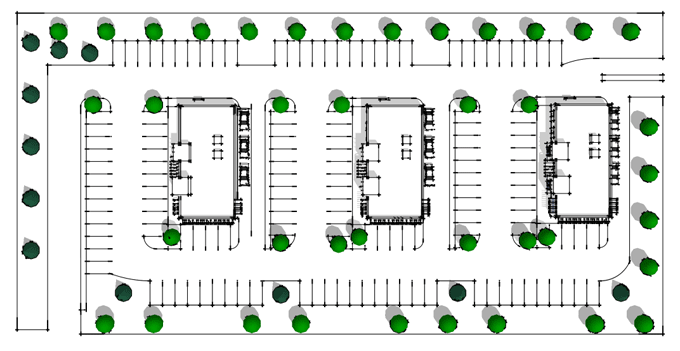 |
| Illustrative Drive-Through Cluster Bird's Eye View |
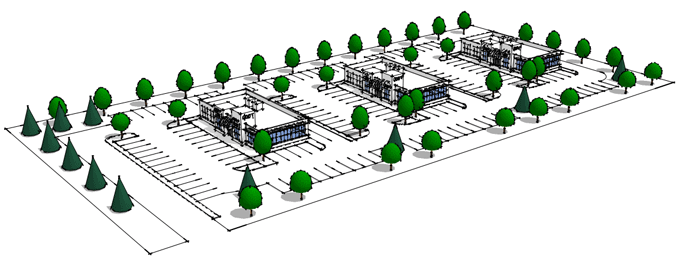 |
(Ord. 2022-O-31 §4; Ord. 2023-O-07 §§4, 5; Ord. 2023-O-09 §5; Ord. 2024-O-13 §§16—21)
Sec. 12-2-409. - Recreation and Amusement Uses.
A.
Generally. The standards of this Section apply to recreation and amusement uses that are specified in Table 12-2-303, Commercial, Recreation, and Amusement Uses, as "L" or "C," except sexually-oriented businesses, which are regulated by Section 12-2-410, Sexually-Oriented Businesses. These standards are applied in addition to the other applicable standards of this LDC.
B.
Commercial Amusement, Indoor. Indoor commercial amusement is permitted as a use of existing buildings in the I district if it is demonstrated that:
1.
The use is separated from existing heavy industrial uses by at least 600 feet; and
2.
There are no parcels within 600 feet that are zoned I and have the potential to be occupied by a heavy industrial use because:
a.
The parcels are developed with buildings or structures that are designed for heavy industrial use; or
b.
The property is vacant and not the subject of an approved and valid development plan for a heavy industrial use.
C.
Commercial Amusement, Outdoor.
1.
CG District. Outdoor commercial amusement is permitted in the CG district if it is demonstrated that the use is located at least 600 feet from property that is used or zoned for residential purposes. Outdoor commercial amusement shall be surrounded by a bufferyard that is a minimum of 40 percent opacity (if Article 8, Development Landscaping and Tree Protection, requires a more opaque bufferyard, the more opaque bufferyard shall be used).
2.
BP and EC-LI District. Outdoor commercial amusement is permitted in the BP and EC-LI districts if it is demonstrated that the use is located at least 600 feet from property that is used or zoned for residential purposes.
3.
OSR District. Outdoor commercial amusement is permitted in the OSR district if it is demonstrated that:
a.
The use is limited to an amphitheater; and
b.
The use is located between I-25 and Parker Road.
D.
Recreation, Indoor.
1.
RS, RA, and RU Districts. Indoor recreation is permitted in the RS, RA, and RU districts, if it is demonstrated that:
a.
Access to the use is limited to residents of the development or neighborhood in which it is located and their invitees; and
b.
The principal building is located at least 100 feet from any residential building, or the use is closed between the hours of 9:30 p.m. and 7:30 a.m.
2.
NC and NI Districts. Indoor recreation is permitted in the NC and NI districts if it is demonstrated that:
a.
The indoor recreation use is an existing use or an adaptive re-use of a place of public assembly; and
b.
Access to the use is limited to residents of the development or neighborhood in which it is located and their invitees, unless the existing use is open to the public at large as of the effective date.
3.
I District. Indoor recreation is permitted as a use of existing buildings in the I district if it is demonstrated that:
a.
The use is separated from existing heavy industrial uses by at least 600 feet; and
b.
There are no parcels within 600 feet that are zoned I and have the potential to be occupied by a heavy industrial use because:
i.
The parcels are developed with buildings or structures that are designed for heavy industrial use; or
ii.
The property is vacant and not the subject of an approved and valid development plan for a heavy industrial use.
4.
ED District. Indoor recreation is permitted as a use of existing buildings in the ED district.
E.
Recreation, Outdoor.
1.
NC and NI District. New outdoor recreation facilities shall be subject to conditional use standards set out in Section 12-14-601, Conditional Use and Temporary Conditional Use Procedures.
2.
CG and EC-N Districts. Outdoor recreation is permitted in the CG and EC-N Districts as an amenity for other permitted uses on the same parcel proposed for development.
3.
AC, EC-MU, and UC District. Outdoor recreation facilities are limited to urban amenities, such as greens, squares, plazas, tot lots, interactive fountains, sculpture gardens, and comparable facilities. Tennis courts and swimming pools shall be limited to use by residents of the district. Ballfields are not allowed.
4.
ED and OSR District. Outdoor recreation is permitted in the ED and OSR Districts; however, the addition of luminaires to an existing facility for the purpose of illuminating ballfields, playing fields, tennis courts, or other similar recreational facilities shall be classified as a major change pursuant to Section 12-14-402, Major Changes, and shall not be eligible for an administrative amendment.
F.
Pickleball, Indoor. An Indoor Pickleball Court is exempt from the requirements of Section 12-2-409G., H., and I. and 12-14-509, however, such court may be subject to other requirements or regulations of the LDC such as regulations applicable to Commercial Amusement, Indoor or Recreation, Indoor.
G.
Pickleball, Outdoor Generally.
1.
Applicability.
a.
This subsection G. applies to both Permanent Outdoor Pickleball Courts and Temporary Outdoor Pickleball Courts.
b.
This subsection G. does not apply to a Temporary Outdoor Pickleball Court or a Permanent Outdoor Pickleball Court that is located greater than 600 feet from a lot or parcel that is residentially zoned or residentially used provided, however, that all other applicable provisions of the LDC and the Centennial Municipal Code shall apply to such court.
2.
Violations. It shall be unlawful and a violation of this Section 12-2-409 for any person:
a.
To establish, construct, develop, redevelop, expand, or to convert any existing facility to an Outdoor Pickleball Court, without an Outdoor Pickleball Court permit when required and issued in accordance with Section 12-2-409 and Section 12-14-509.
b.
To undertake, construct, create, or operate an Outdoor Pickleball Court in a manner that fails to conform to any applicable requirement or standard of this Section 12-2-409, Section 12-14-509, or any condition of approval imposed by the Director on the Outdoor Pickleball Court.
c.
It shall be unlawful for any person to make a Pickleball Court available for use for Pickleball which court is subject to an order of the Director to temporarily cease use, or for a person to engage or participate in Pickleball upon an Outdoor Pickleball Court that is subject to an order of the Director to temporarily cease use.
All violations shall be subject to the general penalty provision of Section 1-4-10 of the Centennial Municipal Code in addition to any other remedies that may be available by law.
3.
Administrative Temporary Order Authorized. The Director may order the temporary cessation of the use of an Outdoor Pickleball Court for Pickleball when the Director determines, based on an investigation and information deemed reasonable by the Director, that the Outdoor Pickleball Court fails to meet applicable requirements of this Section 12-2-409G., H., and I., Section 12-14-509, or the criteria for approval of a permit, including any condition of permit approval. Such order for temporary cessation of use shall extend until such time that the Outdoor Pickleball Court is brought into compliance with the Pickleball Court Permit and the Director rescinds the order for temporary cessation.
4.
Pickleball Noise Standard. An Outdoor Pickleball Court, or any collection of adjacent Outdoor Pickleball Courts, shall not produce noise in excess of 47 decibels measured at the nearest adjacent property lines for properties zoned for residential use or used for residential purposes. Such measurement shall conform to the methodology required by Section 12-2-409G.9.
5.
Hours of Operation. An Outdoor Pickleball Court shall only be made available for use and may only be used for Pickleball between the hours of 8:00 a.m. and 8:00 p.m. It is unlawful to allow the use of or to use an Outdoor Pickleball Court for Pickleball after 8:00 p.m.
6.
Lighting. If the Outdoor Pickleball Court is illuminated pursuant to a City-approved application, all illumination of the court shall be limited to the hours between 8:00 a.m. and 8:00 p.m. It is unlawful to illuminate an Outdoor Pickleball Court after 8:00 p.m.
7.
Variances. Requirements for the creation and operation of Outdoor Pickleball Courts are not eligible for variances pursuant to Section 12-14-801.
8.
Measurements.
1.
For purposes of this Section 12-2-409 and Section 12-14-509, when measuring the distance between an Outdoor Pickleball Court and a residentially zoned or residentially used lot, measurements shall be made as follows:
a.
By the use of a straight line using a two-dimensional scaled drawing without consideration of topography or intervening structures or vegetation; and
b.
Extending the straight line from a point on the exterior pickleball court line that is closest to the residentially used or residentially zoned property to the lot line of the residentially used or residentially zoned property.
2.
For purposes of this Section 12-2-409 and Section 12-14-509, when evaluating or measuring the decibel level of noise in both a Noise Impact Assessment and for purposes of enforcement, the noise evaluation or measurement at a lot line shall be made:
a.
At approximately five (5) feet from the grade level of the nearest lot lines of any adjacent lots zoned for residential use or used for residential purposes and, in addition;
b.
Where the Director finds that there presently exist, or may likely exist in the future, residential structures of two stories or greater height on any adjacent lots zoned for residential use or used for residential purposes, the Director may establish points for measurement at appropriate heights perpendicular to the grade level of the lot lines to best assess noise impacts.
H.
Pickleball, Permanent Outdoor.
1.
Applicability.
a.
This subsection H. applies to a Permanent Outdoor Pickleball Court as defined by Article 16 of this LDC located within 600 feet from a lot or parcel that is residentially zoned or residentially used.
b.
This subsection H. does not apply to a Permanent Outdoor Pickleball Court that is located greater than 600 feet from a lot or parcel that is residentially zoned or residentially used provided, however, that all other applicable provisions of the LDC and the Centennial Municipal Code shall apply to such court.
2.
Application and Permit Required. To be recognized as a lawful Permanent Outdoor Pickleball Court, the court shall require City approval of an application proposing the creation and operation of a pickleball court in accordance with Section 12-14-509, unless such Permanent Outdoor Pickleball Court is granted a limited exception in accordance with Section 12-2-409H.3.
3.
Limited Exception for Pre-Existing Permanent Outdoor Pickleball Court.
a.
Qualifications for Exemption. The Director is authorized to administratively grant a limited exception to the requirement to obtain a permit pursuant to subsection (2) where the owner of a Permanent Outdoor Pickleball Court demonstrates by evidence deemed conclusive to the Director that the court was physically established as a Permanent Outdoor Pickleball Court and was opened and operated when weather permitted prior to March 21, 2023 (Ordinance No. 2023-O-03). Removal of lines or markings used for Permanent Pickleball Courts for purposes other than maintenance may jeopardize the qualification of a Permanent Pickleball Court for a limited exception at the discretion of the City.
b.
Effect of Limited Exception.
i.
A Permanent Outdoor Pickleball Court granted a limited exception may continue the activity of Pickleball on the court provided, however, that the activity and operation of such court shall remain in compliance with the requirements for an Outdoor Pickleball Court set forth in Section 12-2-409G., excluding the locational limitation of Subsections G.4. and H.4.
ii.
No expansion, addition, change, modification or enlargement (other than routine maintenance) of a Permanent Outdoor Pickleball Court granted a limited exception shall be permitted unless an Outdoor Pickleball Court permit is approved by the City in accordance with Sections 12-2-409G. and Section 12-14-509.
4.
Minimum Standards for Permanent Outdoor Pickleball Courts.
a.
Permanent Outdoor Pickleball Courts within 250 feet of Residential Zoning or Uses. Permanent Outdoor Pickleball Courts are not permitted within 250 feet of a lot or parcel that is residentially zoned or residentially used.
b.
Permanent Outdoor Pickleball Courts located between 250 and 600 feet of Residential Zoning or Uses. Permanent Outdoor Pickleball Courts located between 250 feet and 600 feet of a lot or parcel that is residentially zoned or residentially used shall be required to follow the minimum standards of this subsection H. and utilize all mitigation techniques recommended by a Noise Impact Assessment.
c.
Permanent Outdoor Pickleball Courts located more than 600 feet from Property zoned for Residential use or used for a Residential Purpose. Permanent Outdoor Pickleball Courts that are located more than 600 feet from residential zoned property or residentially used property are not required to obtain an Outdoor Pickleball Court Permit or utilize noise mitigation techniques, though mitigation techniques are encouraged as the court will be subject to other provisions of the Centennial Municipal Code including general noise provisions.
5.
Noise Barriers. If a noise barrier is recommended to be installed pursuant to a Noise Impact Assessment to address anticipated or projected noise impact, the barrier shall meet the following minimum standards:
a.
Noise barriers for Permanent Outdoor Pickleball Courts shall be a sound wall, fence cover, or berm.
b.
Noise barriers shall have a minimum Sound Transmission Class (STC) of twenty (20) as defined by the ASTM.
c.
Noise barriers shall not have any perforations that exceed one percent (1%) of the surface area of the noise barrier.
d.
Sections of a noise barrier shall not provide for a space or gap between the bottom of the barrier and the court surface or ground level or between adjacent barrier sections.
e.
Noise barriers shall be a minimum eight (8) feet in vertical height as measured from the court surface or ground level.
I.
Pickleball, Temporary Outdoor.
1.
Applicability. This subsection I. applies to a Temporary Outdoor Pickleball Court as defined by Article 16 of this LDC.
2.
Reserved.
3.
Reserved.
4.
Minimum Standards for Temporary Outdoor Pickleball Courts.
a.
Temporary Outdoor Pickleball Courts within 350 feet of Residential Zoning or Uses. Temporary Outdoor Pickleball Courts are not permitted within 350 feet of a lot or parcel that is residentially zoned or residentially used.
b.
Temporary Outdoor Pickleball Courts located between 350 and 600 feet of Residential Zoning or Uses. Reserved.
c.
Temporary Outdoor Pickleball Courts located more than 600 feet from Property zoned for Residential use or used for a Residential Purpose. Reserved.
(Ord. 2021-O-13 §§5, 6; Ord. 2023-O-10 §§8, 9; Ord. 2024-O-05 §§12—15; Ord. 2024-O-13 §§22, 23)
Sec. 12-2-410. - Sexually Oriented Businesses.
A.
Generally. The standards of this Section apply to sexually oriented business uses that are specified in Table 12-2-303, Commercial, Recreation, and Amusement Uses, as "L." These standards are applied in addition to the other applicable standards of this LDC.
B.
Findings and Intent.
1.
Findings. Based on evidence concerning the adverse secondary effects of sexually oriented businesses on the community presented in land use studies made available to the City Council and on findings incorporated in the cases of the City of Littleton v. Z.J. Gifts, 541 U.S. 774 (2004), City of Erie v. Pap's A.M., 120 S. Ct. 1382 (2000), Barnes v. Glen Theatre, Inc., 501 U.S. 560 (1991), FW/PBS, Inc. v. City of Dallas, 493 U.S. 215 (1990), City of Renton v. Playtime Theatres, Inc., 475 U.S. 41 (1986), Young v. American Mini Theatres, 426 U.S. 50 (1976), Essence, Inc. v. City of Federal Heights, 285 F.3d 1272 (10th Cir. 2002), Z.J. Gifts D-2, L.L.C. v. City of Aurora, 136 F. 3d 683 (10th Cir. 1998), O'Connor v. City and County of Denver, 894 F. 2d 1210 (10th Cir. 1990), City of Colorado Springs v. 2354 Inc., 896 P.2d 272 (Colo. 1995), 7250 Corp. v. Board of County Commissioners for Adams County, 799 P. 2d 917 (Colo. 1990), and Marco Lounge, Inc. v. City of Federal Heights, 625 P.2d 982 (Colo. 1981), and on studies in other communities including, but not limited, to Adams County, Colorado; Dallas, Texas; Denver, Colorado; Garden Grove, California; Whittier, California; Indianapolis, Indiana; St. Paul, Minnesota; Los Angeles, California; Islip, New York; Ellicottville, New York; Las Vegas, Nevada; Rome City, Georgia; Houston, Texas; New York, New York; Oklahoma City, Oklahoma; Phoenix, Arizona; and Tucson, Arizona; and a study prepared by the American Center for Law and Justice dated March 1996; the Centennial City Council finds:
a.
There are a substantial number of sexually oriented businesses in the Denver metropolitan area and these uses require special supervision from public safety agencies and municipal regulation in order to protect the health, safety and welfare of the patrons of such businesses as well as the citizenry;
b.
Regulation of sexually oriented businesses furthers substantial governmental interests and is necessary because, in the absence of such regulation, significant criminal activity, including prostitution, narcotics and liquor law violations, has historically and regularly occurred;
c.
Sexually oriented businesses are frequently used for unlawful and unhealthful sexual activities, including prostitution and sexual liaisons of a casual nature;
d.
The concern over sexually transmitted diseases, including HIV, is a legitimate health concern of the City which demands reasonable regulation of sexually oriented businesses in order to protect the health and well-being of the citizens;
e.
Sexually oriented businesses have a deleterious effect on both neighboring businesses and surrounding residential areas causing an increase in crime and a decrease in property values;
f.
Sexually oriented businesses lend themselves to ancillary unlawful and unhealthy activities that are often uncontrolled by the operators of the establishments;
g.
Some people frequent certain adult theaters, adult arcades and other sexually oriented businesses to engage in sex within the premises of such sexually oriented businesses;
h.
Sexually oriented businesses have serious objectionable characteristics, particularly when they are located in close proximity to each other, thereby contributing to urban blight and downgrading the quality of life in the adjacent area;
i.
City Council recognizes the possible harmful impact on children and minors exposed to the effects of adult businesses that includes those encountered when children walk through or visit in the immediate neighborhood of such businesses;
j.
The City wishes to minimize and control adverse effects and thereby protect the health, safety and welfare of the citizens; preserve the quality of life; preserve the property values and character of surrounding neighborhoods; deter the spread of urban blight and protect the citizens from increased crime; and
k.
It is not the intent of the ordinance codified in this Section to suppress any speech protected by the First Amendment, but to enact content-neutral regulations that address the secondary effects of sexually oriented businesses.
2.
Intent. The intent of this Section is to set reasonable and uniform regulations to prevent the deleterious location and siting of sexually oriented business. These Regulations impose restrictions no greater than necessary to further the City's interest in preventing negative secondary effects attributable to sexually oriented businesses. This Section is to be construed as a regulation of time, place, and manner of the location of these businesses, consistent with the United States and Colorado Constitutions. The provisions of this Section have neither the purpose nor the effect of imposing a limitation or restriction on the content of any communicative materials, including sexually oriented materials. Similarly, it is not the intent nor effect of this Section to restrict or deny access by adults to sexually oriented materials protected by the First Amendment. It is also not the intent of this Section to condone or legitimize the distribution of obscene material or material not protected by the First Amendment.
C.
Location and Siting Requirements.
1.
It is unlawful to operate or cause to be operated a sexually oriented business in any location except as provided in this LDC, as amended from time to time and subject to licensing approval by the City in conformance with Title 6, Business Licenses and Regulations, Article 5, Sexually Oriented Business Licenses, of the Centennial Municipal Code.
2.
Sexually oriented businesses shall be permitted only upon properties zoned Industrial ("I") within the boundaries of the City of Centennial lying between Interstate 25 on the west; Havana Street on the east; Costilla Avenue on the south; and Arapahoe Road on the north. Sexually oriented businesses shall be prohibited on properties zoned under a planned unit development preliminary development plan that expressly or implicitly allows for Industrial uses or uses that are permitted under I-1 or I-2 districts before the Effective Date.
3.
No sexually oriented business shall be located within 1,000 feet of the following:
a.
A school;
b.
A boundary of any residential district or residentially zoned property;
c.
A dwelling unit (single-family, single-family attached, or multifamily);
d.
A publicly designated park owned or controlled by a municipality or special district that is available for use by the general public;
e.
A state-licensed child care center located in the City of Centennial;
f.
A church exceeding a total of 10,000 square feet that routinely and regularly schedules and conducts or provides related activities including, but not limited to, child care and other youth activities, educational classes, concerts, theater or other similar community events, on days of each week other than Sunday; or
g.
Another sexually oriented business.
4.
It is unlawful to cause or permit the operation or maintenance of more than one sexually oriented business in the same building, structure, lot, parcel, or portion thereof regardless of whether such businesses would be owned or operated by the same owner or lessee.
5.
For purposes of this Section, distance requirements between structures and uses specified in this Section shall be measured in accordance with the following:
a.
When a proposed or existing use is housed in a structure or building, the required distance is measured to the closest exterior wall of the structure or building.
b.
When a proposed or existing use is housed within a building also occupied by other uses, such as within a multi-tenant shopping center, the required distance is measured from the closest portion of the building devoted to the proposed or existing use in question.
c.
When a proposed or existing use or activity is not housed in a structure or building (e.g., a park) or such use is a school, the required distance is measured to the closest lot or property line of the lot or parcel containing the use, activity, or school.
d.
The required distance to a residential district or to a residentially zoned property is measured to the closest zoning district boundary, as shown on the official zoning map, or to the closest lot or property line of the specifically zoned property.
e.
The required minimum distance is measured wherever the distance shall be the shortest between the proposed use or activity and existing use or activity, without regard to intervening structures or streets. Except as provided in subsection C.3.e., above, the presence of a city, county or other political subdivision boundary shall be irrelevant for purposes of calculating and applying the distance requirements of this section.
6.
A sexually oriented business lawfully operating is not rendered in violation of this subsection by the subsequent location of a school, child care center, dwelling unit (single or multiple), park, or residential zoning district within 1,000 feet of the sexually oriented business.
D.
Location and Siting Requirement Exceptions. The location and siting requirements of subsection C., above, shall not apply to the following:
1.
Any sexually oriented business expressly described as an approved use in an annexation agreement approved by ordinance of the City of Centennial.
2.
Any sexually oriented business for which a vested property right (within the meaning of Colorado law) was lawfully conferred or established provided that such right remains valid and effective.
E.
Exterior.
1.
It shall be unlawful for the owner or operator of a sexually oriented business to allow exterior portions of the sexually oriented business to be painted any color other than shades of brown, beige, tan or grey. Substitutes may be proposed by the owner or operator which may be accepted by the City upon a determination by the City that such substitute color is compatible with and similar to other neighboring buildings' colors; provided however, the use of high intensity colors, primary colors, metallic colors, black or fluorescent colors is prohibited. This provision shall not apply to any sexually oriented business if the following conditions are met:
a.
The sexually oriented business is a part of a commercial or industrial multi-unit center; and
b.
The exterior portions of each individual unit in the commercial or industrial multi-unit center, including the exterior portions of the sexually oriented business, are painted the same color as one another or are painted in such a way so as to be a component of the overall architectural style or pattern of the commercial multi-unit center.
2.
No merchandise or pictures of the products or entertainment on the premises shall be displayed in window areas or any area where they can be viewed from the exterior of the building.
F.
Signs. In addition to, and notwithstanding anything to the contrary contained in the sign regulations set forth in Article 6 or other regulation of this LDC, sexually oriented business signs shall be limited as follows:
1.
No more than one exterior sign shall be allowed for any sexually oriented business;
2.
No animation shall be permitted on or around any sexually oriented business sign or on the exterior walls or roof of the premises;
3.
No descriptive art, pictures, or designs depicting any activity related to, or inferring the nature of the business shall be allowed on any sexually oriented business sign. Said signs shall contain alphanumeric copy only; and
4.
Only flat wall signs shall be permitted, not exceeding a total of sixty (60) square feet.
Sec. 12-2-411. - Disposal.
A.
Generally. Disposal is allowed as a conditional use in the I district, subject to the requirements of this Section, Section 12-14-601, Conditional Use and Temporary Conditional Use Procedures, and other applicable sections of this LDC. In addition, no disposal sites shall be developed or operated without a certificate of designation, as required by Title 30, Article 20, Part 1, Solid Wastes Disposal Sites and Facilities, Colorado Revised Statutes or Title 25, Article 15, Part 2, Hazardous Waste Disposal Sites, Colorado Revised Statutes, as applicable.
B.
State Review.
1.
Applications for approval of a disposal facility shall be reviewed by the DPHE pursuant to Title 30, Article 20, Part 1, Solid Wastes Disposal Sites and Facilities, Colorado Revised Statutes.
2.
The report and recommendation of DPHE are required prior to the processing of the application by the City.
3.
In addition to the application of the standards of this LDC, no disposal site shall be approved without a recommendation of approval by DPHE.
4.
Technical conditions of approval made by DPHE shall be incorporated into the certificate of designation.
C.
Health Department Review. Applications for approval of a disposal facility shall be reviewed by the Arapahoe County Public Health Department. The Arapahoe County Public Health Department's comments shall be considered in the evaluation of the certificate of designation.
D.
General Evaluation Criteria. No certificate of designation shall be issued unless the facility has a recommendation of approval by the Colorado Department of Public Health and Environment ("DPHE") and the City Council finds that:
1.
There is no exclusive site for solid waste disposal (pursuant to Section 30-20-107, Colorado Revised Statutes) with capacity to serve the City's needs;
2.
There is a demonstrated need for the facility to serve the residents and businesses of the City of Centennial;
3.
The facility conforms to the Comprehensive Plan;
4.
The facility complies with all technical rules promulgated by DPHE;
5.
The financial assurances provided pursuant to Section 30-20-104.5, Colorado Revised Statutes are adequate to serve their purposes; and
6.
The disposal facility would create a net public benefit to the region and the residents and property owners of the City of Centennial, taking into account:
a.
The effect that the solid wastes disposal site and facility will have on the surrounding property, taking into consideration the types of processing to be used, surrounding property uses and values, and wind and climatic conditions;
b.
The convenience and accessibility of the solid wastes disposal site and facility to potential users;
c.
The ability of the applicant to comply with the health standards and operating procedures provided for in Title 30, Article 20, Part 1, Solid Wastes Disposal Sites and Facilities, Colorado Revised Statutes and such rules and regulations as may be prescribed by the department; and
d.
Recommendations by local health departments within five miles of the facility.
E.
Hazardous Waste Disposal Evaluation Criteria. No certificate of designation shall be issued unless the City Council finds all of the following:
1.
DPHE has made a recommendation of approval pursuant to Section 25-15-202(4) (c)(III), Colorado Revised Statutes.
2.
The site would not pose a significant threat to the safety of the public, taking into consideration:
a.
The density of population areas neighboring the site;
b.
The density of population areas adjacent to the portion of the delivery roads within a fifty-mile radius of the site; and
c.
The risk of accidents during the transportation of waste to or at the site.
3.
The applicant has demonstrated a need for the facility by Colorado hazardous waste generators.
4.
The applicant has documented its financial ability to operate the proposed site.
5.
The applicant, taking into account its prior performance record, if any, in the treatment, storage, or disposal of hazardous waste, has documented sufficient reliability, expertise, and competency to operate and manage the proposed facility.
6.
The site conforms to officially adopted land use plans, policies, regulations, and resolutions.
F.
Performance Criteria. Disposal facilities that meet the criteria of subsection D. or E., above, as applicable, shall be designed and located as follows:
1.
The facility shall be spaced at least ¼ mile from Arapahoe Road, and shall be located between I-25 and Parker Road;
2.
The facility shall be surrounded by an 80 percent opacity bufferyard that includes a six-foot tall masonry wall and is composed of not less than 50 percent evergreen trees; and
3.
The facility shall be accessed by a collector street, and trucks shall be routed to avoid local streets (except on collection routes).
G.
Truck Routing Plan. A truck routing plan is required according to the standards of Section 12-5-501, Truck Routing Plans.
H.
Violation Abatement Fund. The applicant shall create a violation abatement fund as set out in Section 12-15-202, Violation Abatement Fund.
(Ord. 2024-O-05 §16; Ord. 2025-O-12 §2)
Sec. 12-2-412. - Waste Transfer Stations and Recycling Centers.
A.
Generally. Waste transfer stations and recycling centers are allowed as a conditional use in the I district, subject to the requirements of this Section, Section 12-14-601, Conditional Use and Temporary Conditional Use Procedures, and other applicable provisions of this LDC.
B.
State Review. The City shall request a technical review of the site and facility documents and operation plan from the DPHE pursuant to 6 CCR 1007-2 § 7.1 for all applications for approval of a waste transfer station.
C.
Location Requirements.
1.
No waste transfer station or recycling center shall be located in any of the following areas:
a.
Within 1,500 feet of the platted right-of-way of Arapahoe Road, Briarwood Avenue, Parker Road, Broncos Parkway, Easter Avenue (between I-25 and South Potomac Street), or Jordan Road (south of Hinsdale Drive).
b.
Closer than 1,760 feet to the following intersections, as measured by a straight line from the center point of the intersection:
i.
Arapahoe Road and any of the following streets: Yosemite Street, Havana Street, Lima Street, Peoria Street, Revere Parkway, Potomac Street, or Jordan Road;
ii.
Parker Road and Broncos Parkway;
iii.
Jordan Road and Broncos Parkway;
iv.
Broncos Parkway and Potomac Street; and
v.
Potomac Street and Briarwood Avenue.
2.
Waste transfer stations and recycling centers shall be located so that truck traffic generated by the station can access an arterial street without need for travel upon a public street within or adjacent to any residentially zoned area or along thoroughfares adjacent to any public park or public recreational area or recreational facility.
D.
Mitigation of Hazards to Aircraft. Waste transfer stations handling putrescible wastes within 10,000 feet of any airport runway end used by turbojet aircraft or within 5,000 feet of any airport runway end used only by piston-type aircraft shall be designed and operated in a manner that will not result in hazards (including bird strike hazards) to aircraft.
E.
Protection of Water Resources and Public Health.
1.
Waste transfer stations and recycling centers shall be located, designed, or operated outside of the special flood hazard area and cannot result in washout of waste or otherwise pose a hazard to human health, wildlife, or contamination of land or water resources.
2.
New waste transfer stations or recycling centers and expansions of such stations or centers shall not be located within or encroach into any floodway, 100-year floodplain, or wetland.
F.
Setbacks. No building or area in which the unloading, storage, processing, or transfer of waste or recyclable materials takes place shall be located within:
1.
Fifty feet of the lot line on which the waste transfer station is located; or
2.
Two hundred feet of:
a.
A lot line of a residentially zoned property;
b.
Any non-residential structure located on property not owned or leased by the owner of the waste transfer station;
c.
Any wetland;
d.
Any water well;
e.
Any natural or artificial pond (including detention or retention pond or facility); natural stream, water way, or water course, or
f.
An artificial drainage way or canal.
G.
Minimum Area of Parcel Proposed for Development. The minimum area of a parcel proposed for development as a waste transfer station or recycling center is four acres.
H.
Design Requirements.
1.
Generally.
a.
For waste transfer stations, the site shall be designed such that all activities associated with waste transfer, such as tipping, sorting, storage, compaction, transfer, reloading, and related activities shall be conducted in a fully enclosed building. No outdoor storage of materials or equipment shall be permitted. Appropriate enclosed office/and plumbed employee restroom facilities shall be provided on-site.
b.
For recycling centers, all materials shall be stored in enclosed bins or other appropriate containers that are weather resistant, rust-proof, and secured at the end of business each day.
c.
Adequate snow storage areas shall be provided within the waste transfer station. Snow storage areas shall be made accessible and available at all times for exclusive use for snow storage from October 1 to April 30.
2.
On-Site Parking and Roads.
a.
The facility shall be designed with sufficient off-street parking and stacking areas to accommodate all employees, visitors, and trucks. Public streets shall not be utilized at any time for parking, stacking, or storage of employee vehicles, visitor vehicles, or trucks.
b.
The facility shall be designed with sufficient drive aisles and parking areas to avoid potential conflicts between facility operations by trucks and passenger vehicles (e.g., for household waste or recyclable material drop-off), and the use of emergency access easements and fire lanes.
c.
The road surface design shall be suitable for heavy vehicles and the road base shall be capable of withstanding all expected loads.
d.
On-site roads shall be passable by loaded collection and transfer vehicles in all weather conditions.
e.
The road system shall be designed to eliminate the need for the backing of truck traffic.
3.
Unloading and Loading Areas.
a.
The unloading area shall be adequate in size and design to facilitate efficient unloading from the collection vehicles and the unobstructed movement of vehicles.
b.
The unloading and loading pavement areas shall be constructed of concrete or asphalt paving material and equipped with adequate drainage structures and systems.
c.
Processing, tipping, sorting, storage, and compaction areas shall be located within an enclosed building.
d.
Provisions shall be made for weighing or measuring all solid waste transferred to the facility.
e.
Sufficient internal storage areas shall be provided for incoming solid waste.
4.
Fencing and Aesthetics.
a.
Waste transfer station and recycling center design shall include an eight foot perimeter fence interrupted only by necessary access and maintenance gates. Fencing shall be constructed of brick, block, stone, or other materials with similar aesthetic and quality characteristics. The use of brick and stone in combination with wood may be permitted where such material use is found by the City as consistent and compatible with other fencing and building materials used within the immediate area. Use of split-face style cinder block shall be permitted if a neutral earth-tone color (no un-textured, common gray cinder block will be permitted).
b.
Gates shall be designed in a manner to balance the aesthetic compatibility of the station fencing materials with station security. Colored metal or wrought iron gates designed to substantially reduce public views into the station are encouraged. Use of chain link materials for gates is prohibited.
c.
Facility layout, building materials, and building design shall, to the greatest extent possible, be planned to present an aesthetically attractive appearance from off-site locations when viewed through gated openings that will remain open during daylight or business hours.
d.
The use of chain link or barbed wire within the station shall be limited to areas not visible from any public right-of-way.
e.
The facility shall be surrounded by a Type C bufferyard that includes a six (6) foot tall masonry wall and is composed of not less than 50 percent evergreen trees. The Director shall be authorized to waive landscaping requirements for areas within the perimeter fencing of the waste transfer station in the event that the Director finds that the waste transfer station integrates landscape buffer areas and significant landscaping amenities along the exterior of the perimeter fencing.
5.
Waste Liquid Collection and Disposal.
a.
All waste transfer stations shall be designed and constructed to include a collection and disposal system that will prevent liquids contained in waste materials and generated by normal operations such as wash-out and cleaning of equipment, trucks, and floors ("waste liquids"), from contaminating the soil, surface water, or ground water.
b.
Tipping, loading, and unloading areas shall be constructed of impervious material and equipped with drains connected to either:
i.
A sanitary sewer system if permitted by the sanitation district or service provider; or
ii.
A corrosion-resistant holding tank. Alternate designs may be used with prior written approval of the City if the applicant can show that the alternate design will prevent waste liquids from contaminating the soil, surface water, and ground water.
I.
Operational Requirements.
1.
Waste Acceptance. Only household waste, commercial, and industrial waste and recyclable materials shall be accepted at any waste transfer station. Only recyclable materials shall be collected at a recycling center. Unless otherwise collected in accordance with a plan approved by the City, no wastes classified as hazardous in accordance with C.R.S. 25-15-101 et seq. shall be knowingly accepted. The operator shall employ a plan for proper identification, control, and disposal of hazardous wastes received by the waste transfer station. No asbestos waste shall be knowingly accepted at a transfer station facility. The operator shall employ a plan for proper identification, control, and disposal of hazardous and asbestos wastes.
2.
All Functions to be Enclosed. All activities associated with processing, such as tipping, sorting, storage, compaction, transfer, reloading, and related activities shall be conducted in a fully enclosed building.
3.
Storage. Adequate storage space for all waste shall be available at the transfer station in a fully enclosed building. No external storage of wastes or storage shall be permitted. Solid wastes shall not remain at the transfer station for more than 72 hours. Any solid waste that is to be kept overnight at the station shall be stored in an impervious enclosed structure.
4.
Overnight Truck Parking. Trucks or vehicles shall not be parked or stored overnight at the waste transfer station unless screened in a manner that will substantially prevent view of stored vehicles from public rights-of-way. Any vehicle maintenance services shall be a secondary and subordinate use of the site and shall be limited to maintenance of vehicles associated with trash delivery and transfer at the waste transfer station. Junked or inoperable vehicles shall not be stored at the waste transfer station.
5.
Emergency Access Required. Emergency access easements and fire lanes shall be maintained at all times in an unobstructed and fully accessible condition.
6.
Supervision of Facility. The waste transfer station or recycling center shall have an on-site operator on duty at all times the facility is open. Such operator shall be licensed and/or certified if licensure or certification is required by state law. Suitable security measures and signage shall be provided to limit unauthorized persons from access to the facility when the station is closed.
7.
Control of Litter, Insects, Odors, and Vectors. The operation of the waste transfer station or recycling center and the storage and handling of all solid waste shall be practiced so as to prevent the attraction, harborage or breeding of wildlife or insects, rodents, and other vectors (e.g., flies, maggots, roaches, rats, mice, and similar vermin) and to eliminate conditions which cause or may potentially cause:
a.
Harm to the public health and the environment;
b.
Congregation of birds;
c.
Safety hazards to individuals and surrounding property; and
d.
Excessive odor problems, unsightliness, and other nuisances.
8.
Facility Maintenance.
a.
Waste transfer stations and recycling centers shall be maintained in a neat and orderly appearance at all times through the control of uncontained waste, trash, and litter. Operators shall cause periodic policing not less than once every day (or more often as needed) of the entire waste transfer station or recycling center site. Operators shall also cause periodic off-site policing and clean-up of waste, trash, and litter along all truck routes described in the Truck Routing Plan within 1,760 feet of the station not less than three times per week (or more often if needed) to ensure a neat and orderly appearance of the public rights-of-way.
b.
Sanitary conditions shall be maintained through the periodic wash-down or other appropriate cleaning method of the transfer station and transfer vehicles. Frequency of cleaning shall be sufficient to prevent odors and other nuisance conditions from developing. All residuals shall be properly disposed of following cleaning operations.
9.
Other Operational Requirements and Prohibitions.
a.
No liquids, other than those used to disinfect, to suppress dust, or to absorb or cover odors from the solid waste, shall be added to the solid waste.
b.
Open burning is prohibited on any waste transfer station site.
c.
Scavenging is prohibited at any waste transfer station or recycling center.
J.
Operations Plan Requirements. The Operations Plan shall describe all activities to be conducted at the waste transfer station and describe programs and requirements to be imposed to ensure compliance with the provisions of this Section. The Operations Plan shall be maintained and be made readily available for reference and inspection at the waste transfer station or recycling center and shall be updated and re-approved by the City of Centennial as necessary to reflect changes in operations. The Operations Plan shall, at a minimum, describe:
1.
How the requirements of this Section will be satisfied;
2.
The schedule of operation including the days and hours that the facility will be open;
3.
Personnel required and their training and responsibilities;
4.
A description of measures that will be taken to identify and control undesirable wastes received that could either contaminate other wastes or pose unusual health hazards and risks to employees, such as infectious medical waste and hazardous wastes;
5.
Equipment provided at the facility and its operation;
6.
Site access control method;
7.
A description of potential safety hazards and the safety equipment and protective gear to be available on site, including but, not limited to, showers, eye wash stations, fire extinguishers, hoses, hard hats, safety goggles, respirators, hearing protection devices, and personal hygiene facilities;
8.
Fire fighting procedures, including availability of water for fire fighting;
9.
A contingency plan outlining the corrective or remedial measures that will be taken if unapproved wastes are delivered to the facility and in the event of odors, surface or ground water contamination, spills, equipment breakdown, and other undesirable conditions such as fires, dust, noise, and vectors;
10.
A truck routing plan according to the requirements of Section 12-5-501, Truck Routing Plans, which shall also describe the process and procedures associated with the delivery and hauling of all wastes processed at the waste transfer station or recycling center; and
11.
Other information as required by the City of Centennial that is appropriate to the facility operating plan.
K.
Violation Abatement Fund. The applicant shall create a violation abatement fund as set out in Section 12-15-202, Violation Abatement Fund.
Ord. 2025-O-12 §3)
Sec. 12-2-413. - Oil and Gas Extraction.
A.
Generally. The purpose of this Section is to recognize the local land use and regulatory authority conferred upon the City by the Colorado Constitution and state law concerning the regulation of local impacts resulting from oil and gas drilling, development, and production, to reasonably facilitate the development of oil and gas resources within the City, and to mitigate potential local impacts between oil and gas drilling, development, and production and existing and planned land uses.
1.
Conflicts with other provisions. Nothing in this Section shall be construed to limit the applicability of other ordinances of the City which are not in conflict with this section. If a conflict occurs between this Section and other regulations, this Section shall govern and supersede.
2.
Definitions Incorporated. Definitions promulgated by the Colorado Oil and Gas Conservation Commission ("COGCC") titled "Rules and Regulations Definitions (100 Series)", as may be amended, are incorporated into this Section for purposes of interpretation.
B.
Applicability of this Section. This Section shall apply to the permitting, construction, erection, maintenance, alteration, repair, accessory equipment, and structures used for or related to the drilling, development, and production of oil and gas resources within the City.
C.
Limited Use. Oil and gas extraction is a limited use in all zone districts in accordance with the standards of this Section and Section 12-2-304.
D.
Application and Local Permitting Process.
1.
Application required. An application for a local oil and gas permit is required to be submitted to the Director for review prior to commencing the use of land for oil and gas drilling, development, or production. Such local application shall be in addition to any other application or approval requirement imposed by the State of Colorado or other governmental agency, such as but not limited to SEMSWA.
2.
Application submittal requirements. An application for a local oil and gas permit shall be filed with the Community Development Department. The application shall include such information as may be required by the Community Development Department which, at a minimum, shall include:
a.
A site plan showing the proposed well location, access from public streets, internal site circulation, parking, landscaping, buffering and screening, fencing, topography, and lighting.
b.
An existing conditions map showing distances from the proposed well and associated production equipment to the nearest structures, existing and proposed roads, and prominent natural landscape features such as streams, ponds, wetlands, and mature trees. Such map shall include all properties within 1500 feet of the boundaries of the lot or parcel on which the oil and gas operations will be conducted.
c.
A Truck Routing Plan prepared in accordance with the standards of Section 12-5-501.
d.
A Traffic Impact Study, if required, in accordance with Section 12-10-202.
e.
A completed application for a Street Access Permit prepared in accordance with the Street Access Code (Article 3 of Chapter 11 of the Municipal Code). An application for a local oil and gas permit shall not constitute a "land development application" for purposes of the Street Access Code.
f.
A designation of, and contact information for, an agent residing within the State of Colorado to receive all City correspondence related to the oil and gas drilling, development, and production. Notice of a change in agent must be submitted by certified mail to the Director within ten (10) days of any change.
g.
Copies of application materials and plans submitted to the COGCC for the proposed oil and gas operation and, where a state permit is issued, all documents evidencing approval by the COGCC of the proposed drilling, development, and production.
E.
Approval Standards.
1.
Approval of an application for a local oil and gas permit. A complete application for a local oil and gas permit for drilling, development, and production shall be approved or approved with conditions by the Director within thirty (30) days of receipt of the application if:
a.
The application is complete and includes all required information for issuance of a local oil and gas permit in accordance with this Section;
b.
Full payment is made of all applicable application fees and charges;
c.
The Truck Routing Plan and Traffic Impact Study evidences that truck routing associated with drilling, development, and production of oil and gas will minimize to the greatest extent possible vehicle trips on streets located within residential zone districts;
d.
The site plan evidences that all vehicles associated with drilling, development, and production of oil and gas will: (1) be staged, loaded and unloaded, stored, and parked within the site used for drilling, development, and production of oil and gas; (2) not be parked at anytime on public streets;
e.
The applicant has applied for and complied with the requirements of the Street Access Code and received approval of a street access permit in accordance with Article 3 of Chapter 11 of the Municipal Code; and
f.
The existing conditions map demonstrates a reasonable effort to avoid or mitigate impacts to streams, ponds, wetlands, and mature trees.
2.
Conditional permit approval authorized. The Director may conditionally approve an application for a local oil and gas permit upon: (1) compliance with the representations contained in the application concerning truck routing, parking, access, and mitigation of impacts on existing conditions; and (2) the later submission to the Director of copies of application materials and plans submitted to the COGCC for the proposed oil and gas operation and, when issued, the submission to the Director of all documents evidencing approval by the COGCC of the proposed operation.
3.
Denial of a local oil and gas permit. An application for an oil and gas permit for a well drilling site or production site shall be denied by the Director if the application fails to comply with the requirements of this Section.
4.
Revocation of a local oil and gas permit. The Director shall revoke a local oil and gas permit if the applicant fails to comply or otherwise violates the terms and conditions of a local oil and gas permit or street access permit.
Sec. 12-2-414. - Heavy Industry.
A.
Generally. Heavy industry is permitted in the I district, subject to the standards of this Section and Section 12-14-601, Conditional Use and Temporary Conditional Use Procedures, and other applicable provisions of this LDC. It is the intent of the City Council to ensure that heavy industries are sited in locations where their impacts on residential neighborhoods and environmental resources (including floodplains) are minimized.
B.
Performance Criteria for Heavy Industries. In addition to the performance standards required of all uses by Division 7-4, Environmental Quality, heavy industries shall not be of types that dispose of hazardous wastes on-site.
C.
Outdoor Storage. Outdoor storage areas shall comply with the standards of Section 12-2-419, Storage Yard.
D.
Major Electrical or Natural Gas Facilities.
1.
Threshold Criteria. Major electrical or natural gas facilities, except those which qualify as community or neighborhood utilities, shall be evaluated to determine the balance of the interest of the City of Centennial with the statewide interest in the location, construction, or improvement of major electrical or natural gas facilities. The City Council shall decide the application based on whether the balance of the following factors weighs in favor of locating the facility in Centennial:
a.
The demonstrated need for the facility;
b.
The extent to which the proposed facility is consistent with the City of Centennial Comprehensive Plan and applicable sub-area plans;
c.
Whether the proposed facility would exacerbate a natural hazard;
d.
How the facility will comply with applicable utility engineering standards, including supply adequacy, system reliability, and public safety standards;
e.
The relative merit of any reasonably available and economically feasible alternatives proposed by the public utility, the power authority, or the City;
f.
The impact that the City's action would have on the customers of the public utility or power authority who reside within and without the boundaries of the jurisdiction of the City;
g.
The impact the proposed facility would have on residents within the City's jurisdiction including, in the case of a right-of-way in which facilities have been placed underground, whether residents have already paid to place such facilities underground; and
h.
The safety of residents within and without the boundaries of the City.
2.
Performance Criteria. Major electrical or natural gas facilities that involve combustible materials and that are found acceptable to the City Council according to the criteria of subsection C.1., above, shall be designed and located as follows:
a.
The facility shall be spaced at least ¼ mile from Arapahoe Road, and shall be located between I-25 and Parker Road;
b.
The facility shall be surrounded by an 80 percent opacity bufferyard; and
c.
The facility shall be accessed by a collector street, and trucks shall be routed to avoid local streets.
E.
Truck Routing Plan. A truck routing plan may be required according to the standards of Section 12-5-501, Truck Routing Plans.
Sec. 12-2-415. - Light industry.
A.
Generally. The standards of this Section apply to light industrial uses in the BP and EC-LI district. These standards are applied in addition to the other applicable standards of this LDC.
B.
Performance Standards for Light Industry. Light industry is permitted in the BP and EC-LI districts if it is demonstrated that:
1.
Related truck traffic is mitigated in the following ways:
a.
The use is spaced at least 500 feet from property that is zoned or used for residential purposes;
b.
A truck routing plan developed according to the standards of Section 12-5-501, Truck Routing Plans, which shall be approved with the application for limited use approval, shows that the trucks will not traverse local or collector streets in residential neighborhoods; and
c.
Loading, unloading, stacking, standing, and parking areas for trucks are buffered by a 30 percent opacity perimeter bufferyard. The perimeter bufferyard is not required if a required district bufferyard or other required bufferyard is already more opaque than 30 percent.
2.
Outside storage areas, if any:
a.
Do not exceed the inside floor area of the use;
b.
Are not used for storage of solid or liquid waste, inoperable machinery or vehicles, or materials that generate dust or attract pests;
c.
Are enclosed by a 20 percent opacity bufferyard that includes a six-foot tall fence or wall; and
d.
Access to outdoor storage areas are designed to minimize ground level views into the storage areas from abutting property and rights-of-way.
3.
The use will not interfere with the use of adjoining property for professional office, research and development, or hospital purposes due to noise, dust, vibration, glare, electromagnetic interference, or odors, if the abutting property is vacant, approved, or in use for one or more of these purposes.
(Ord. 2024-O-13 §24)
Sec. 12-2-416. - Salvage and Composting.
A.
Generally. Recycling and salvage activities are permitted as a limited use in the BP, EC-LI, and I districts, subject to the requirements of this Section, and the other applicable standards of this LDC.
B.
Automotive Salvage. Automotive salvage yards shall be:
1.
Surrounded by an 80 percent opacity bufferyard pursuant to Division 8-4, Bufferyards;
2.
Configured so that inoperable vehicles and other junk are not visible from public rights-of-way; and
3.
Spaced from other districts as follows:
a.
From residential or mixed-use zoning districts: 2,640 feet; and
b.
From commercial zoning districts: 1,320 feet.
C.
Composting Facility. Composting facilities shall be:
1.
Located in enclosed buildings with odor control systems;
2.
Set back at least 200 feet from all property lines;
3.
Surrounded by a 50 percent opacity bufferyard pursuant to Division 8-4, Bufferyards;
4.
Located on a site that is a minimum of five acres in size; and
5.
Spaced from other districts as follows:
a.
From residential or mixed-use zoning districts:
i.
2,640 feet to districts located to the East and South;
ii.
2,000 feet to districts located to the West and North.
b.
From GC zoning districts: 1,320 feet.
D.
Hazardous Waste or Hazardous Materials. No hazardous waste or hazardous materials shall be accepted or deposited at any salvage or composting facility, except as incidental to the salvage operation. Salvage operations shall be conducted to remove hazardous wastes and materials and dispose of them according to state and federal requirements.
E.
Mitigation of Hazards to Aircraft. Composting facilities that are located within 10,000 feet of any airport runway end used by turbojet aircraft or within 5,000 feet of any airport runway end used only by piston-type aircraft shall be designed and operated in a manner that will not result in bird hazard to aircraft.
F.
Truck Routing Plan. A truck routing plan is required according to the standards of Section 12-5-501, Truck Routing Plans.
G.
Violation Abatement Fund. The applicant shall create a violation abatement fund as set out in Section 12-15-202, Violation Abatement Fund.
(Ord. 2024-O-13 §25)
Sec. 12-2-417. - Utilities.
A.
Generally. The standards of this Section apply to community and neighborhood utility facilities in all districts except BP, EC-LI, and I. The standards of Section 12-14-601, Conditional Use and Temporary Conditional Use Procedures, also apply if the use is listed as "C" in Table 12-2-304, Industrial, Agricultural, and Special Uses. These standards are applied in addition to the other applicable standards of this LDC.
B.
Certificates of Convenience and Necessity. No utility facility, plant, or system that requires a certificate of convenience and necessity from the Colorado Public Utilities Commission shall be approved unless such certificate is granted.
C.
Major Electrical or Natural Gas Facilities. New or major expansions to neighborhood utilities also classified as major electrical or natural gas facilities require a conditional use process and shall be evaluated to determine the balance of the interest of the City of Centennial with the statewide interest in the location, construction, or improvement of major electrical or natural gas facilities. The City Council shall decide the application based on whether the balance of the following factors weighs in favor of locating the facility in Centennial:
1.
The demonstrated need for the facility;
2.
The extent to which the proposed facility is consistent with the City of Centennial Comprehensive Plan and applicable sub-area plans;
3.
Whether the proposed facility would exacerbate a natural hazard;
4.
How the facility will comply with applicable utility engineering standards, including supply adequacy, system reliability, and public safety standards;
5.
The relative merit of any reasonably available and economically feasible alternatives proposed by the public utility, the power authority, or the City;
6.
The impact that the City's action would have on the customers of the public utility or power authority who reside within and without the boundaries of the jurisdiction of the City;
7.
The impact the proposed facility would have on residents within the City's jurisdiction including, in the case of a right-of-way in which facilities have been placed underground, whether residents have already paid to place such facilities underground; and
8.
The safety of residents within and without the boundaries of the City.
D.
Utility Lines. Utility lines, except electrical distribution lines, shall be installed underground.
E.
Community and Neighborhood Utilities.
1.
Threshold for Compliance. Compliance with the requirements of this Section shall apply in any of the following scenarios:
a.
New development or redevelopment pursuant to Section 12-12-402, Sliding Scale Compliance Requirements, including expansions of a utility footprint of 50 percent or more; or
b.
Major expansions pursuant to Section 12-12-402, Sliding Scale Compliance Requirements, where a major expansion is defined as the expansion of a utility footprint by 30 to 50 percent.
2.
Agricultural, Open Space and Residential Districts. In the AG, OSR, RS, RA, RU, NC, and NI districts, any above-ground structure that occupies a footprint of greater than 50 square feet shall be screened from view by a 60 percent opacity bufferyard that includes a fence that is not less than six feet in height. Fences may be up to 14 feet in height to ensure that the above-ground structure is adequately screened. In no case shall the fence be taller than one foot higher than the above-ground structure required to be screened.
3.
General Commercial, Business Park, Employment Center - Light Industrial, Industrial and Education, Institutional, and Recreation Districts. In the CG, BP, EC-LI, I, and ED districts, any above-ground structure shall be screened from view by a 40 percent opacity bufferyard that includes a fence that is not less than six feet in height. Fences may be up to 14 feet in height to ensure that the above-ground structure is adequately screened. In no case shall the fence be taller than one foot higher than the above-ground structure required to be screened.
4.
Activity Center, Employment Center - Mixed Use, and Urban Center Districts. In the AC, EC-MU, and UC districts, above-ground structures shall be designed to fit into the urban or auto-urban environment, as applicable, in that:
a.
Masonry walls, rather than fences, shall be used to screen the facility; and
b.
The street faces shall be improved to provide an expansion of the sidewalk areas with landscaping and seating to make the utility a useful part of the streetscape.
5.
Small Structure Standards in All Districts. Structures that are less than 10 feet in height and less than 50 square feet in footprint are exempt from the standards set out in subsections E.2., E.3., and E.4., above. Instead, such structures shall be:
a.
Surrounded by an evergreen hedge that will grow to a height of not less than four feet two years after planting; or
b.
Enclosed in an accessory building that meets the requirements for accessory buildings for the primary use of the parcel proposed for development in the applicable zoning district; or
c.
If located behind the front building line, screened by a wing wall or fence or topography to a degree that is comparable to that which would be achieved through compliance with subsection E.4., above.
6.
Exemptions. The standards of this Subsection do not apply to:
a.
Telecommunication towers, which are subject to Section 12-2-305, Wireless Telecommunications Facilities, and Section 12-2-425, Wireless Telecommunications Facilities (as applicable).
b.
Utility distribution lines, which are permitted subject to the requirements of Subsection C., above.
c.
Advanced ecologically engineered wastewater treatment systems.
7.
Use of the Public Right-of-Way. Utilities are permitted within the public right-of-way subject to administrative approval unless otherwise provided by this Section.
(Ord. 2021-O-13 §§7, 8; Ord. 2024-O-13 §§26, 27; Ord. 2026-O-07 §2)
Sec. 12-2-418. - Reserved.
Editor's note— Ord. 2024-O-13 §28, adopted August 20, 2024, repealed § 12-2-418, which pertained to commercial warehousing and logistics and derived from the 2010 Land Development Code.
Sec. 12-2-419. - Storage Yard.
A.
Generally. Storage yards are permitted in the I district subject to the standards of this Section and the other applicable standards of this LDC.
B.
Location. Storage yards shall not be located on parcels that abut Arapahoe Road, Yosemite Street, Parker Road, Smoky Hill Road, or Jordan Road.
C.
Fencing. Storage yards shall be enclosed by a 10 percent opacity bufferyard that includes a fence to provide security.
D.
Materials.
1.
Liquids, gels, and pastes (e.g., paints, sealers, etc.) shall be stored only in enclosed buildings.
2.
Storage of explosives is not allowed.
3.
Storage of more than 10 gallons of motor fuel is not allowed.
E.
Disposal Prohibited. Storage yards shall not be used to dispose of inoperable machines or wastes. Temporary storage of construction wastes generated by the contractor who operates the storage yard is permitted, provided that:
1.
The materials are not stored for more than 48 hours;
2.
The materials do not generate dust;
3.
The materials do not contain hazardous materials such as lead or asbestos; and
4.
The materials are of types that will not become wind-blown debris.
F.
Property Maintenance. Storage yards shall be maintained in an orderly manner.
Sec. 12-2-420. - Residential Agriculture Overlay District.
A.
Generally. Residential Agriculture is permitted within the Residential Agriculture Overlay District as an accessory use only and subject to the standards of this Section and other applicable standards of the LDC.
B.
Agricultural Animal Subdistrict. The Agricultural Animal RAO subdistrict permits the keeping of agricultural animals for properties in the Residential Agriculture Overlay Agricultural Animal subdistrict as identified on the Zoning Map subject to the following standards:
1.
Agricultural animals shall be permitted at the rate of one (1) animal equivalent unit (AEU) per acre subject to alternative rounding as defined in Article 16 of this LDC except that:
a.
Immature animals shall be excluded from the numerical restriction on agricultural animals; and
b.
An unlimited number of rabbits, chickens, geese, or other small agricultural animals or fowl that are not defined in the animal equivalent unit table set forth in Article 16 and have an average per animal weight of less than 10 pounds, are permitted except that the keeping of roosters over the age of six months shall be prohibited.
2.
Boarding of agricultural animals is permitted subject to the numerical restriction on agricultural animals.
3.
The sale of eggs and products from agricultural animals, including the sale of agricultural animals, is permitted subject to Section 12-2-404, Home-Based Business Standards.
C.
Equine2Subdistrict. The Equine 2 RAO subdistrict permits the keeping of equine on those properties located within the RAO Equine 2 subdistrict as identified on the Zoning Map subject to the following standards:
1.
A maximum of two (2) equine per lot shall be permitted. Up to one (1) immature equine per permitted adult female shall be excluded from the numerical restriction on equine.
2.
Boarding of equine is permitted subject to the numerical restriction on equine.
D.
Equine3Subdistrict. The Equine 3 RAO subdistrict permits the keeping of equine on those properties located within the RAO Equine 3 subdistrict as identified on the Zoning Map subject to the following standards:
1.
A maximum of three (3) equine per lot shall be permitted. Up to one (1) immature equine per permitted adult female shall be excluded from the numerical restriction on equine.
2.
Boarding of equine is permitted subject to the numerical restriction on equine.
E.
Equine AR Subdistrict. The EquineAR RAO subdistrict permits the keeping of equine for those properties located within the Residential Agriculture Overlay EquineAR subdistrict as identified on the Zoning Map subject to the following standards:
1.
Equine shall be permitted at the rate of one (1) equine per acre subject to alternative rounding as defined in Article 16 of the LDC. Immature animals shall be excluded from the numerical restriction on agricultural animals.
2.
Boarding of equine is permitted subject to the numerical restriction on equine.
Sec. 12-2-421. - Airports.
A.
Generally. Airports are permitted in the I district, subject to the standards of this Section and other applicable provisions of this LDC.
B.
Location. The airport use is allowed only in the location of the existing Centennial Airport, and in adjacent areas into which the airport may expand. No other facilities for take-off and landing of fixed-wing aircraft are permitted in the City.
C.
Master Plan and Activity Forecast. The airport shall provide a master plan for its physical expansion and a forecast of aviation activity. The master plan and activity forecast may be approved if it is demonstrated that:
1.
The proposal is designed to minimize the impact on existing residential uses by:
a.
Minimizing the number of existing residences that are brought within the 55 DNL noise zone; and
b.
Ensuring that residential uses do not come within the 65 DNL noise zone unless they are subject to an avigation easement that allows inclusion in this zone; and
2.
The proposal does not materially interfere with the development of nearby property in the City of Centennial for commercial or industrial use due to the location of the safety zones, unless the property is owned by the airport.
D.
Compliance with Federal Standards. The airport shall demonstrate compliance with all other federal regulations applicable to airport expansion or reconfiguration.
Sec. 12-2-422. - Helistop.
A.
Generally. Helistops are permitted in districts where they are specified in Table 12-2-304, Industrial, Agricultural, and Special Uses, as "L" or "C," subject to the standards of this Section and other applicable provisions of this LDC.
B.
Location. The applicant shall demonstrate that the helistop is designed, located, and will be operated such that:
1.
No residential uses are located within an area that will experience helistop noise at levels above 55 DNL; and
2.
No office uses are located within areas that will experience helistop noise at levels above 60 DNL, unless the office uses are on the same property as the helistop.
C.
Exemption from Location Requirements. In the interest of public safety, police stations, fire stations, hospitals, and trauma centers uses may be developed with an accessory helistop.
D.
Existing Airports. No helistop shall be located or operated in a manner that would interfere with the aviation operations of an existing airport.
E.
Compliance with Federal Regulations. The applicant for a helistop shall demonstrate compliance with all federal regulations pertaining to heliport development.
Sec. 12-2-423. - Parking (Stand Alone Lot) and Multimodal Transit Facilities.
A.
Generally. Parking (Stand Alone Lot) and Transit Facilities are permitted in districts where they are specified in Table 12-2-304, Industrial, Agricultural, and Special Uses, as "L," subject to the standards of this Section and other applicable provisions of this LDC. Parking (Stand Alone Lot) is permitted on vacant parcels within the UC zone district not governed by an approved Regulating Plan, subject to the development standards of the General Commercial (CG) zone district and any applicable standards of Article 5, Parking and Loading and Article 8, Development Landscaping and Tree Protection.
B.
Parking Lots.
1.
Design. Parking lots shall be designed in accordance with the requirements of Article 5, Parking and Loading.
2.
Surfacing. Parking lots shall have asphalt or concrete paving for all surfaces used for vehicle parking. Recycled asphalt and recycled concrete are prohibited surfacing materials. Re-milling of a surface may use recycled materials. Alternative paving materials (such as grass pavers) may be used if it is demonstrated that:
a.
The volume of demand for the parking lot will be commensurate with the durability of the materials;
b.
Irrigation, if needed to maintain the materials, will be available;
c.
The materials will not generate windblown dust or allow gravel or debris to be scattered onto adjacent streets (e.g., gravel parking areas are prohibited); and
d.
The materials will provide an environmental benefit that is more favorable than could be provided with asphalt or concrete in terms of:
i.
Microclimate; or
ii.
Stormwater runoff velocities, volumes, or water quality.
C.
Multimodal Transit Facilities.
1.
Operations Plan and Parking Study Required. Operators of multimodal transit facilities shall provide the City with:
a.
An operations plan that shows proposed transit services, including routes and headways; and
b.
A study that estimates the demand for the multimodal facility, including the number of parking spaces needed to meet that demand based on the assumed number of passengers per private vehicle and the number of parking spaces that are needed to provide buffer spaces to ensure adequate circulation during times of peak use.
2.
Parking Lot Design. Parking lots shall be designed in accordance with the requirements of Article 5, Parking and Loading. Structured parking is permitted if:
a.
In relation to streets that serve as boundaries for the zoning district, the parking structure is either:
i.
Wrapped by linear buildings; or
ii.
Buffered from streets with a 20 percent opacity bufferyard; and
b.
In relation to streets within the zoning district, access to the parking structure is not provided on streets where pedestrian activity is focused.
3.
Covered Waiting Areas. Multimodal transit facilities shall provide covered waiting areas for passengers.
4.
Facility Design. In the AC and UC districts, the facility shall be designed as an integrated part of the development within the district, such that:
a.
There are efficient pedestrian connections to other uses in the district;
b.
Parking that is related to the facility does not disrupt the pattern of development within the district by creating a disproportionate expanse of pavement compared to other parking areas within the district; and
c.
Buses are not routed through residential neighborhoods in order to enter or leave the facility.
(Ord. 2022-O-31 §5; Ord. 2025-O-06 §4)
Sec. 12-2-424. - Self-Storage Facilities.
A.
Generally. Self-storage is permitted in districts where they are specified in Table 12-2-304, Industrial, Agricultural, and Special Uses, as "L," subject to the standards of this Section and other applicable provisions of this LDC.
B.
Required Spacing.
1.
General Spacing Standards. Self-storage shall be spaced from rights-of-way, intersections, other self-storage facilities, and residential uses at least the following distances:
a.
From the right-of-way of Arapahoe Road, Parker Road, and Broncos Parkway: 300 feet
b.
From the intersections of Briarwood Avenue and Jordan Road; Parker Road and Broncos Parkway; Easter Avenue and Havana Street; Easter Avenue and Peoria Street; or Potomac Street and Briarwood Avenue: 500 feet
c.
From other self-storage units: 1,000 feet
d.
From residential uses: 300 feet
2.
Alternative Standards. The spacing requirements of subsection B.1., above, may be waived if it is demonstrated that the use is integrated into a unified, master-planned commercial development that:
a.
Contains at least 50,000 square feet of new and fully enclosed floor area designed, intended, and suitable for commercial retail use;
b.
Includes four or more separate commercial retail uses that are not a vehicle wash, convenience store, light automobile service/gas station, or drive-through restaurants;
c.
Is designed and constructed so that all structures within the development are planned, integrated, compatible, and coordinated using the same or substantially identical:
i.
Exterior building materials and colors;
ii.
Architectural features and style; and
iii.
Lighting and lighting fixtures;
d.
Will be permanently maintained in a planned, integrated, compatible, and coordinated manner as required by subsection B.2.c., above through the imposition of covenants, conditions, or restrictions running with the property;
e.
Demonstrates compliance with applicable design standards set out in Division 4-2, Nonresidential Design Standards; and
f.
Phases the construction of the self-storage facility either:
i.
Following issuance of a certificate of occupancy for all other proposed structures within the development; or
ii.
At a time or phase of development identified in a written subdivision improvement agreement (prior to the effective date), public improvement agreement, or development agreement approved by the developer and the City.
C.
Maximum Parcel Size. Parcels proposed for development with self-storage facilities shall not exceed 5 acres in area.
D.
Operational Requirements. Self-storage facilities shall be operated as provided in this subsection. The operator/owner of a self-storage facility shall include all of these requirements in all lease or purchase and sale agreements with tenants.
1.
Climate controlled self-storage facilities are permitted. In no event, however, shall a self-storage facility be refrigerated (maintained at a temperature below 55 degrees Fahrenheit for more than one hour per day).
2.
No unit within a self-storage facility shall contain electrical outlets for use by the tenant.
3.
The self-storage facility shall have a security system that requires the use of cards, keypads, keys or similar security devices that limit access to tenants and to fire, police, and emergency service officials.
4.
Self-storage units shall be used solely for the purpose of storage of goods and possessions and shall not be used for conducting or operating a business, hobby, or any type of activity not related to the storage of personal property.
5.
No self-storage unit shall be used for the storage of explosives, ammunition, hazardous, or flammable materials.
6.
No outdoor storage is permitted on the site of the self-storage facility.
E.
Design Standards. Self-storage facilities shall be designed in accordance with the requirements of Section 12-4-205, Self-Storage Facilities.
Sec. 12-2-425. - Wireless Communications Facilities.
A.
Generally. The standards of this Section apply to Wireless Communications Facilities that are specified in Section 12-2-305, Wireless Communications Facilities, as Limited ("L") or Conditional ("C"). These standards are applied in addition to the other applicable standards of the LDC including, but not limited to, standards related to signage, lighting and landscaping.
B.
Attached Wireless Communications Facilities. Attached Wireless Communications Facilities are permitted in all zoning districts provided they are permanently attached to agricultural, commercial, industrial, institutional, or multifamily buildings and utilize Camouflage and Concealment Design Techniques.
C.
Stealth Freestanding Wireless Communications Facilities.
1.
AG, NC, NI, RA, RS, and RU Districts. Stealth Freestanding Wireless Communications Facilities are permitted in the AG, NC, NI, RA, RS, and RU districts, if the property contains a principal use and such principal use of the property is either a commercial, institutional or multifamily use, or upon a common element or common area owned and maintained by an association established and organized under the Colorado Common Interest Community Act, C.R.S. § 38-33.3-101 et seq. or by some other single-management entity established by the owner(s) of the common element or area.
2.
ED and OSR Districts. Stealth Freestanding Wireless Communications Facilities are permitted in the ED and OSR districts if the facility and any ground-based equipment is restricted to a parking lot, trailhead, or area within a utility easement illustrated on an approved plat or other Development Order.
3.
AC, BP, CG, EC, I, PUD and UC Districts. Stealth Freestanding Wireless Communications Facilities are permitted in the AC, BP, CG, EC, I, PUD and UC districts.
D.
Non-Stealth Freestanding Wireless Communications Facilities. Non-stealth Freestanding Wireless Communications facilities are not permitted unless a Conditional Use is approved by the Planning and Zoning Commission pursuant to Section 12-14-607, Wireless Communications Facilities Conditional Use Procedures.
E.
Design and Landscaping Standards. The following design and landscaping standards apply to all Wireless Communications Facilities as described.
1.
Requirements for All Wireless Communications Facilities, Except for Installations in the Public Right-of-Way.
a.
All Wireless Communications Facilities shall be located and designed to be compatible and blend in with surrounding buildings and existing or planned uses in the area through the use of Camouflage and Concealment Design Techniques.
b.
Stealth and Non-stealth Freestanding Wireless Communications Facilities shall not exceed the maximum height allowed in the zoning district, except for the AG, ED, NC, NI, OSR, RA, RS, and RU zoning districts where the maximum facility height shall be 35 feet, unless a conditional use is obtained pursuant to Section 12-14-607, Wireless Communications Facilities Conditional Use Procedures.
c.
The minimum setback from property lines for Stealth and Non-stealth Freestanding Wireless Communications Facilities shall be one of the following:
i.
The facility height, when the facility is within 250 feet of an existing residential structure;
ii.
The setback applicable to principal structures in the zoning district; or
iii.
An alternative setback, approved by the Director, for Stealth Freestanding Wireless Communications Facilities where the facility replaces or proposes an accessory structure to an established principal use, to include, but not limited to, signs, light poles, and flagpoles, where it is evidenced that the siting and location of the Stealth Freestanding Wireless Communications Facility allows for Camouflage and Concealment Design Techniques to a greater extent than would be achieved by application of the principal structure setback.
d.
Attached Wireless Communications Facilities (roof mounted), including the antenna, support structures and screening, shall not project more than ten (10) feet above the roof line of a building.
e.
Attached Wireless Communications Facilities (façade mounted), including the antenna, support structures and screening, shall not extend above the top of the structure or the parapet wall, or, in the case of a pitched roof, above the fascia.
f.
All ground based equipment must be screened by a solid fence or screen wall six (6) feet in height as measured in Section 12-3-204, Height, and surrounded by a 30-percent opacity bufferyard around the perimeter of the enclosed area pursuant to Division 8-4, Bufferyards. This requirement may be waived by the Director in areas where the City determines buildings or other structures provide a comparable or better screening effect. Existing landscaping within ten (10) feet the perimeter of the enclosed area may be applied towards the minimum planting requirements provided that the plant material meets the requirements of Section 12-8-203, Selection of Plant Material. Reductions in parking may be permitted by the Director, provided that the minimum parking requirements pursuant to Article 5, Parking and Loading, are met.
g.
All ground based equipment shall meet the setbacks applicable to principal structures in the zoning district, unless an alternative setback is established for a Stealth Freestanding Wireless Communications Facility pursuant to this Section.
2.
Requirements for All Wireless Communications Facilities in the Public Right-of-Way. See Section 12-2-425(F), Wireless Communications Facilities in the Public Right-of-Way.
F.
Wireless Communications Facilities in the Public Right-of-Way. Wireless Communications Facilities may be permitted within the public right-of-way, subject to approval of a license agreement executed by the City Manager.
1.
Priority of Attachment. Unless otherwise explicitly set forth within such license agreement, the City shall permit Wireless Communications Facilities in the public right-of-way in the following order of priority of attachment:
a.
On City traffic signal poles or other City-owned poles in the public right-of-way;
b.
On poles that are capable of supporting and approved for municipal lighting purposes by the City, purchased by the licensee with ownership of the lighting and appurtenances, conveyed by the licensee to the City (via bill of sale);
c.
To the extent permitted by, and in conformance with, City regulations and ordinances, on the licensee's proprietary monopoles; or
d.
On third-party poles under the terms of a fully executed pole attachment agreement with the owner of such poles. A licensee pursuant to an executed license agreement with the City for Wireless Communications Facilities in the public right-of-way must show good cause of impracticality to the City before the City may allow for a lower priority of attachment.
2.
Facility Standards. The following standards must be met:
a.
Attachment of facilities on an existing (or replacement) traffic light pole, street light standard, or other vertical infrastructure is encouraged. These facilities may be permitted provided that:
i.
The owner of the vertical infrastructure approves the use;
ii.
The facility meets the definition of Camouflage and Concealment Design Techniques; and
iii.
The facility, either:
A.
Does not exceed the height of the existing infrastructure on which it is mounted by more than ten (10) feet; or
B.
Does not exceed the height limitations of subsection (F)(2)(b), whichever results in a lesser height, unless the facility is attached to existing vertical infrastructure that exceeds the height limitations of subsection (F)(2)(b) and the facility does not exceed the height of the existing infrastructure on which it is mounted by more than five additional (5) feet.
b.
Where a new freestanding facility is proposed (that is not an attachment to an existing facility), a Stealth Freestanding Wireless Communications Facility may be permitted, provided that:
i.
The facility:
A.
Proposes a new structure that is architecturally compatible with the surrounding area through application of Camouflage and Concealment Design Techniques; and
ii.
The facility height is not more than:
A.
30 feet when the facility is within 250 feet of a property zoned AG, ED, NC, NI, RS, RA, and RU, and any other property zoned or predominantly used for residential purposes;
B.
35 feet when the facility is within 250 feet of a property zoned OSR; or
C.
40 feet in all other areas; and
iii.
The facility is separated from all other Freestanding Wireless Communications Facilities within the right-of-way by a distance of at least 600 feet, unless the facility replaces an existing traffic signal, street light pole, or similar structure as determined by the Director; and
iv.
When placed near a residential property, the facility is placed adjacent to the common side yard property line between adjoining residential properties, such that the facility minimizes visual impacts equitably among adjacent properties. In the case of a corner lot, the facility may be placed adjacent to the common side yard property line between adjoining residential properties, or on the corner formed by two intersecting streets. See Figure 12-2-425, Wireless Placement Near Residential Properties.
|
Figure 12-2-425
Wireless Placement Near Residential Properties |
|---|
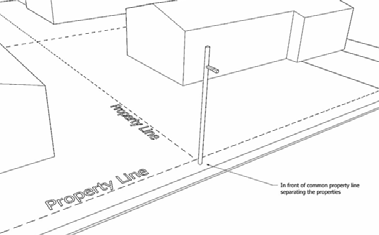 |
| Example: Placed in front of common property line between adjoining residential properties |
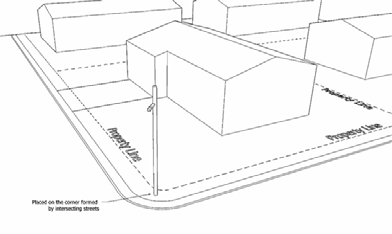 |
| Example: Placed on the corner framed by intersecting streets |
v.
All ground based equipment shall be installed in an underground or partially underground equipment vault (projecting not more than 36 inches above grade), or co-located within a traffic cabinet of a design approved by the Director, unless a conditional use is obtained subject to the conditional use standards set out in Section 12-14-607, Wireless Communications Facilities Conditional Use Procedures.
3.
Non-stealth Freestanding Wireless Communications Facilities. Facilities that exceed the maximum height in subsection (b)(ii) above, and facilities that do not meet the minimum spacing in subsection (b)(iii) above are prohibited unless a conditional use is obtained subject to the conditional use standards set out in Section 12-14-607, Wireless Communications Facilities Conditional Use Procedures.
4.
Timeframe for Review. The Director shall render a decision within 90 days of the date upon which an applicant submits an application which is deemed complete by the Director.
5.
Abandonment. Abandoned or unused Wireless Communications Facilities shall be removed within 180 days from the date of ceasing operations, unless a shorter timeframe is required by the City through approval of a license agreement executed by the City Manager. Failure to remove abandoned or unused Wireless Communications Facilities within the 180 day timeframe may result in City possession or City removal of abandoned or unused Wireless Communications Facilities with such actual costs assessed against the facility owner as identified in the applicable licensee agreement.
6.
Wireless Communications Facilities Courtesy Notice. Applicant shall mail or otherwise deliver a physical Wireless Communications Facilities Courtesy Notice so that the notice is given least three (3) days prior to installation of the Wireless Communication Facility in the public right-of-way to all adjacent property owners within 200 feet. For purposes of this Section, Wireless Communications Facilities Courtesy Notice shall mean a written notification to adjacent property owners of an approved Wireless Communications Facility which shall illustrate or depict the appearance of the facility, set forth when the installation will begin and end, and include the relevant contact information for both the licensee and the party responsible for installation.
G.
Eligible Facilities Request. This section applies to any Eligible Facilities Request for co-location on, or modification to an existing Tower or Base Station that does not Substantially Change the physical dimensions of such Tower or Base Station.
1.
Application and review.
a.
Review Required. No co-location or modification to any existing Tower or Base Station may occur except after a written request from an applicant, reviewed and approved by the Director in accordance with this subsection G.
b.
Type of Review. Upon receipt of an application for an Eligible Facilities request pursuant to this section, the City shall review such application to determine whether the application so qualifies.
c.
Review Criteria. Upon receipt of an application for an Eligible Facilities request pursuant to this Section, the City shall review administratively such application to determine whether the application meets the following criteria for an Eligible Facilities Request:
i.
Does not result in a Substantial Change;
ii.
Does not violate a generally applicable law, regulation or other rule reasonably related to public health and safety and complies with generally applicable building, structural, electrical and safety codes;
iii.
Complies with the original application design elements or conditions of approval, including but not limited to colors, textures, surfaces, scale, character and siting, or any approved amendments thereto, subject to the thresholds established in the definition of Substantial Change; and
iv.
Complies with concealment elements of the Eligible Support Structure necessary to qualify as a stealth facility.
d.
Timeframe for Review. Within 60 days of the date on which an applicant submits a complete application, as determined by the Director, seeking approval under this subsection, the City shall approve the application unless it determines that the application is not covered by this section.
e.
Failure to Act. In the event the City fails to act on a request seeking approval for an Eligible Facilities Request under this section within the timeframe for review (accounting for delays resulting from incomplete submittals), the request shall be deemed granted. Such automatic approval becomes effective only when the applicant notifies the City in writing after the review period has expired (accounting for delays resulting from incomplete submittals) that the application has been deemed granted.
H.
Submittal Requirements. All of the following shall be provided for all proposed Wireless Communications Facilities. All items must be included to be determined to be a complete application by the Director.
1.
Project Statement. A project statement identifying the proposed facility and the communication service to be provided by the proposed facility. The project statement must indicate the facility's capacity for co-location, which is encouraged where co-location will have less visual impact on the surrounding area than another facility.
2.
Proof of Ownership or Lease Rights. The Applicant shall demonstrate that it owns or has lease rights to the subject site (prior to construction).
3.
Photo Simulations. Photo simulations which illustrate "before" and "after" conditions as they relate to installation of the Wireless Communications Facility. Photos should be taken from all adjoining public streets and, when adjacent to residential properties, from the vantage point where the Wireless Communications Facility and equipment will be visible.
4.
Elevation Drawings. Elevation drawings of the facility and any ground based equipment. The drawings should indicate the height, appearance, color, and material proposed for the facility and any ground based equipment.
5.
Plan. A site or rooftop plan which indicates the location and height of all existing and proposed Wireless Communications Facilities, including freestanding facilities, antenna, and ground based equipment. Proposals that include freestanding facilities or ground based equipment shall show all existing and proposed buildings, parking, landscaping, and fencing on the site.
6.
Radio Frequency Emissions. A statement of the expected radio frequency emissions produced by the proposed Wireless Communication Facility in relation to FCC rules. The statement must verify that the Wireless Communication Facility is compliant with the latest FCC rules and regulations.
I.
Other Provisions. The following additional provisions apply to all Wireless Communications Facilities.
1.
Permit Issuance. No permit for a Wireless Communications Facility shall be issued on land subject to Division 14-7, Subdivision Procedures, unless the property is covered by an approved final plat, site plan, final development plan, administrative site plan, or subdivision development plan.
2.
Expiration and Extension.
a.
All Wireless Communications Facilities permits shall expire and be of no further force and effect 180 days following the date of City approval unless, prior to the date of expiration: (1) Construction has been diligently pursued towards completion of the project, or (2) Approval has been extended in accordance with subsection (2)(b) below.
b.
Prior to the expiration of a Wireless Communications Facility permit, one (1) 180 day extension of the permit may be authorized by the Director upon a written request by the Applicant. An extension may be granted if a review of the permit shows that no major changes in the City's development or zoning regulations or in the development pattern of the surrounding properties has occurred, as determined by the Director. If a Wireless Communications Facility permit expires, no further development of the facility may occur until a new permit application is submitted, reviewed and approved in accordance with this LDC, subject to all application and processing fees.
(Ord. 2021-O-13 §§9, 10; Ord. 2024-O-05 §17; Ord. 2024-O-13 §29; Ord. 2025-O-06 §5)
Sec. 12-2-426. - Agriculture.
A.
Generally. Agriculture is permitted as a limited use in the UC and EC-MU zone districts, subject to the requirements of this Section, and the other applicable standards of this LDC.
B.
Location. Agriculture in the UC and EC-MU zone districts shall be located:
1.
In rooftop greenhouses, as defined; and
2.
On the roof of a building that consists of at least one (1) other primary use, for example a building with an office use and rooftop greenhouse(s).
C.
Lighting. Lighting for rooftop greenhouses shall be limited to that which is required for operational and safety purposes so as not to create a nuisance through excessive brightness to abutting properties. Lighting shall comply with the standards set forth in Section 12-6-705, Establishment of Lighting Zones and Requirements.
D.
Height. Rooftop greenhouses shall not exceed maximum building height standards for principal buildings.
E.
Truck Routing Plan. A truck routing plan is required according to the standards of Section 12-5-501, Truck Routing Plans.
(Ord. 2022-O-32 §3; Ord. 2024-O-13 §30)
Sec. 12-2-427. - Natural Medicine Businesses.
A.
Generally. Natural Medicine Businesses, which include Natural Medicine Healing Centers, Natural Medicine Testing Facilities, Natural Medicine Product Manufactures, and Natural Medicine Cultivation Facilities, are permitted as a limited use subject to the requirements of this Section, and the other applicable standards of this LDC.
B.
Natural Medicine Business Overlay District. Natural Medicine Businesses (Healing Centers, Cultivation Facilities, Testing Facilities, Product Manufacturers) shall only be located within the Natural Medicine Business Overlay District as set forth in Appendix K, Natural Medicine Business Overlay District Map.
C.
Spacing Standards Specifically for Natural Medicine Healing Centers. Natural Medicine Healing Centers shall be:
1.
A minimum of one thousand (1,000) feet from a child care center; preschool; elementary, middle, junior, or high school; or, family child care home (residential child care facility). This spacing standard shall be measured from nearest property line of the land used for the uses noted above, to the nearest portion of the building in which Natural Medicine Services are provided, using a route of direct pedestrian access.
2.
A minimum of three hundred (300) feet from another use providing Natural Medicine Services. This spacing standard shall be measured from the portion of the building in which Natural Medicine Services are provided, to the nearest portion of the building in which another use provides Natural Medicine Services (but shall exclude Co-located Natural Medicine Healing Centers); and
3.
A minimum of three hundred (300) feet from a Centennial residential zone district (NC, NI, RA, RS, RU). This spacing standard shall be measured from the portion of the building in which Natural Medicine Services are provided, to the nearest portion of the residential zone district.
D.
Exception for Co-located Natural Medicine Healing Centers. A Natural Medicine Healing Center may be located outside of the boundaries of the Natural Medicine Business Overlay District (Appendix K) and exempted from the standards of Sections 12-2-427(C)(2) and (C)(3) when:
1.
Co-located with a Healthcare Facility; for purposes of this exception, a Healthcare Facility shall be defined as an entity that is licensed, certified or otherwise permitted by law to administer medical treatment (which includes physical and/or mental treatment) in Colorado, including but not limited to a hospital, clinic, hospice entity, counseling office, nursing home, assisted living facility, institutional accommodation, community mental health center, or other type of entity or facility whose purpose and operation predominately provides physical and/or mental healthcare services;
2.
Provided by a Natural Medicine Clinical Facilitator as defined and licensed by the Colorado Department of Regulatory Agencies ("DORA"); and
3.
Permitted by zoning and in compliance with the spacing standard of Section 12-2-427(C)(1).
4.
Co-located Natural Medicine Healing Centers that meet the requirements of (D)1-3 above may also be located within the Natural Medicine Business Overlay District (Appendix K) and exempted from the standards of Sections 12-2-427(C)(2) and (C)(3).
E.
Operations and Storage within Buildings for all Natural Medicine Businesses. All operations and storage associated with a Natural Medicine Businesses except loading and unloading or Natural Medicine Products shall occur within a lawfully constructed and permitted Principal Building. There shall be no business operations (including storage and clinical sessions) outside of an enclosed Principal Building.
F.
Screening and Exterior Impacts for all Natural Medicine Businesses. The operations of a Natural Medicine Business shall not be perceptible from the exterior of the premises by means including, but not limited to:
1.
Common visual observation; or
2.
Odors, smells, fragrances or other olfactory stimulus generated by the cultivation, production, testing possession or processing of Natural Medicine.
G.
Hours of Operation for Natural Medicine Healing Centers. Natural Medicine Healing Centers shall not operate in excess of eighteen (18) consecutive hours in any 24-hour day.
(Ord. 2024-O-19 §6)
Sec. 12-2-501. - Commercial Events.
A.
Generally. Commercial Events include Multi-Vendor Markets and Festivals; On-Site Vendor Sales, Off-Site Vendor Sales, and Seasonal Outdoor Patios. In districts where these uses are indicated as "L" or "T" in Table 12-2-306, Temporary Uses, the standards of this Section apply.
B.
Restrictions.
1.
All Commercial Events shall be set back at least 10 feet from public rights-of-way and 25 feet from lots or parcels used for residential purposes. This requirement does not apply if the Commercial Event lawfully uses public rights-of-way. The above setbacks may be modified by the Director upon the finding that there is sufficient buffering from all neighboring properties and rights-of-way.
2.
On-Site Vendor Sales are allowed only as accessory to Commercial Retail uses, restaurant uses, and service uses.
3.
Multi-Vendor Markets and Festivals, Off-Site Vendor Sales, On-Site Vendor Sales, and Seasonal Outdoor Patios are allowed only:
a.
On parcels that contain or are designated for non-residential uses that are located on an arterial or collector street; or
b.
In mixed use developments, hardscaped public squares and plazas shall be prioritized for booths and pedestrian traffic before other locations on the parcel, such as parking lots or unpaved areas, are considered.
4.
Seasonal Outdoor Patios are only permitted as an accessory to permanent and temporary uses that serve food and beverages for on-site consumption, including but not limited to restaurants, food trucks, breweries, coffee shops, grocery stores, or other food service establishments.
5.
All other Commercial Events shall be located on hardscape areas or improved surfaces. However, Commercial Events may be permissible on grassy or other unimproved surfaces when the Director determines that such location shall not cause any long term detriment to such surface.
6.
Any Commercial Event that serves alcoholic beverages shall obtain and maintain all required State and local liquor licenses.
C.
Access, Circulation, and Parking.
1.
The Commercial Event shall have adequate sight distances for safe vehicular ingress and egress as required by Section 12-11-208, Sight Triangle and Sight Distance Requirements. The Commercial Event shall be served by adequate deceleration or turn lanes, or it shall provide for police control to move traffic in and out of the use. The adjacent street shall have adequate capacity to handle the anticipated additional flow of traffic.
2.
The Commercial Event shall not obstruct safe on-site vehicular and pedestrian circulation, nor obstruct access by emergency service providers.
3.
The applicant shall demonstrate that sufficient on-site parking is available for the event and the permanent use of the parcel on which the Commercial Event is held by noting the location of parking for both the Commercial Event and permanent use of the site. If on-site parking is not available, the applicant must demonstrate how parking will be provided in an adjacent location, or how attendees will safely reach the site.
4.
On-site grass parking areas are allowed for Commercial Events, but only if:
a.
The event ends not later than 8:00 p.m. each day;
b.
The parking area is located at least 30 feet from abutting residential property lines and 10 feet from public rights-of-way; and
c.
Access to the grass parking area is not taken directly from collector or arterial streets without the permission of the Director of Public Works or the applicable road agency.
5.
Seasonal Outdoor Patios shall not obstruct the entrance to any building or sidewalk. If outdoor patio areas are located on a public or private sidewalk in front of a building, a minimum 5-foot wide clear pedestrian travel way shall be maintained on the sidewalk or pathway at all times.
D.
Public Convenience and Litter Control. If appropriate to the type of Commercial Event, adequate on-site restroom facilities may be required to serve the expected attendance at the event. Adequate waste containers shall be required and a written guarantee shall be required that all litter generated by the event shall be removed at no expense to the City. This shall include adjoining public rights-of-way.
E.
Frequency and Duration. The maximum frequency and maximum duration of temporary Commercial Events is set out in Table 12-2-501, Frequency and Duration of Commercial Events. D/Y refers to the maximum number of days per year that a Permittee may hold each type of temporary Commercial Event may be held. For example, if the D/Y for Multi-Vendor Markets and Festivals is 52, the total number of days that Multi-Vendor Markets and Festivals may operate would be 52 days per year. This number is exclusive of other types of temporary Commercial Events with their respective D/Y that may be permitted on the site.
F.
Conditions of Approval. Additional conditions may be imposed if deemed necessary to ensure land use compatibility or minimize potential adverse impacts on neighboring properties, public streets, or the City. These may include, but are not limited to, the following:
1.
Modification or restrictions on hours of operation or duration of the event.
2.
Posting of a performance bond to ensure clean up and removal of equipment, litter and signage.
3.
Arrangements satisfactory to the City for the provision of special or extraordinary services or equipment, such as traffic control or security personnel, or equipment that is needed to ensure safe operation of the use or event. This may also include liability insurance.
4.
The Director's determination of adequate parking requirements following Sections 12-5-204(B) and 12-5-204(C), Special Studies.
5.
The City may refuse to issue a permit if the event is too large to be safe for the site, neighborhood, street, or other infrastructure, or may place limits on attendance to ensure it can be properly managed.
6.
The Director may place limitations on the number of permits allocated to a permittee in order to ensure fair opportunity for other permittees to conduct temporary events at the same location.
G.
Renewal. Renewal of a Commercial Event permit may be requested prior to the expiration date contained in the permit. No Commercial Event may renew its temporary event permit in excess of the maximum days per year (D/Y) as noted in Table 12-2-501.
H.
Waiver. Requirements of temporary uses for Commercial Events as set forth in Section 12-2-501 may be waived by the Director during declared local emergencies subject to a finding that such temporary use: (1) creates a positive economic return to the City including, but not limited to, the generation of taxes and the retention of employees; (2) provides goods, products or services to assist in emergency response; and (3) minimizes any adverse impact or detriment to neighbors adjacent to the temporary use. When requirements of this Section are waived pursuant to the findings set forth herein, the Director may promulgate a program to address temporary uses for Commercial Events falling outside of those explicitly noted herein.
(Ord. 2024-O-13 §31; Ord. 2024-O-15 §3)
Sec. 12-2-502. - Community and Neighborhood Events.
A.
Generally. Community and neighborhood events include garage sales and public interest or special events. In districts where these uses are indicated as "L" or "C" in Table 12-2-306, Temporary Uses, the standards of this Section apply. Individual garage sales do not require a permit, but shall comply with the standards of this Section. Permitted uses of public parks and public open space (e.g., reserved facilities) are not regulated by this Section.
B.
Restrictions. Generally, public interest or special events shall not be held on lots that are used for single-family detached or single-family attached residential purposes. However, with the consent of the property owners, neighborhood garage sales and block parties may include lots used for single-family detached or single-family attached purposes.
C.
Location.
1.
Garage Sales. Merchandise, structures, and displays associated with garage sales shall not be placed in public rights-of-way, including sidewalks.
2.
Public Interest or Special Events. The location of public interest or special events shall be indicated on the temporary use permit.
D.
Access, Circulation, and Parking. The following standards apply to public interest or special events, but not to individual garage sales:
1.
The event shall have adequate sight distances for safe vehicular ingress and egress as required by Section 12-11-208, Sight Triangle and Sight Distance Requirements. The event shall be served by adequate deceleration or turn lanes, or it shall provide for police control to move traffic in and out of the event. The adjacent street shall have adequate capacity to handle the anticipated additional flow of traffic.
2.
For events on public streets, a parking and traffic circulation plan shall be provided that demonstrates:
a.
How traffic that is not related to the event will be alerted and routed around the event;
b.
How property owners will access their property, or written consent of property owners whose access will be limited during the event;
c.
Where vehicles related to the conduct of the event will be parked;
d.
Where vehicles of guests of the event will be parked, and how many spaces will be provided; and
e.
The location of remote parking facilities, if used, and the operational plan for transporting people from the remote parking to the event if the parking is located more than 750 feet from the boundary of the event.
3.
The event shall not obstruct safe vehicular and pedestrian circulation, nor obstruct access by emergency service providers.
4.
On-site grass parking areas are allowed only if:
a.
The on-site grass parking areas are supervised by parking attendants;
b.
The on-site grass parking will be used for not more than two consecutive days;
c.
The parking area is located at least 30 feet from abutting residential property lines and 10 feet from public rights-of-way;
d.
Access to the grass parking area is not taken directly from collector or arterial streets; and
e.
Damage to grass parking areas is repaired and adjacent streets cleaned within one week of the event.
E.
Public Convenience and Litter Control. If appropriate to the type of public interest or special event, adequate on-site restroom facilities may be required to serve the expected attendance at the event. Adequate waste containers shall be required and a written guarantee shall be required that all litter generated by the event shall be removed at no expense to the City. This shall include adjoining public rights-of-way.
F.
Frequency and Duration. The maximum frequency and maximum duration of community and neighborhood events is set out in Table 12-2-502, Frequency and Duration of Community and Neighborhood Events. E/Y refers to the maximum number of events that are allowed per calendar year. D/Y refers to the maximum number of days per year that each type of temporary commercial event may be held. For example, if E/Y is 3 and D/Y is 9, not more than 3 events are allowed per year, totaling not more than 9 days (e.g., three 3-day events, or one 9-day event, or two 1-day events and one 7-day event, etc.).
G.
Signs and Lighting. Signs and lighting shall comply with the requirements of Article 6, Signs and Lighting.
H.
Conditions of Approval. Additional conditions may be imposed if deemed necessary to ensure land use compatibility or minimize potential adverse impacts on neighboring properties, public streets, natural resources, or the City. These may include, but are not limited to, the following:
1.
Modification or restrictions on hours of operation or duration of the event.
2.
Posting of a performance bond to ensure clean up and removal of signage.
3.
Arrangements satisfactory to the City for the provision of special or extraordinary services or equipment, such as traffic control or security personnel, or equipment that is needed to ensure safe operation of the use or event. This may also include liability insurance.
4.
The City may refuse to issue a permit if the event is too large to be safe for the site, neighborhood, street, or other infrastructure, or may place limits on attendance to ensure it can be properly managed.
(Ord. 2024-O-13 §32; Ord. 2024-O-15 §4)
Sec. 12-2-503. - Temporary Construction, Storage, and Refuse Collection Uses.
A.
Generally. Temporary construction and storage uses include temporary asphalt or concrete plants; manufactured buildings; model homes and on-site real estate sales offices; and portable storage units. In districts where these uses are indicated as "L" or "C" in Table 12-2-306, Temporary Uses, the standards of this Section apply.
B.
Location and Operations. The location, hours of use, operational limitations, and duration of temporary construction and storage uses are set out in Table 12-2-503, Temporary Construction, Storage, and Refuse Collection Uses.
C.
Sanitary Facilities. Restroom facilities shall be provided for operators of concrete, mortar, and asphalt batching operations and for users of manufactured buildings (except when used exclusively for storage), model homes, and on-site real estate offices.
D.
Additional Standards Applicable to Concrete, Mortar, and Asphalt Batching Operations. The Director of Public Works shall review all applications for concrete, mortar, and asphalt batching operations for compliance with the following standards and shall make a recommendation to the Director. Where this use is indicated as a conditional use in Table 12-2-306, Temporary Uses, the Director shall refer the Director of Public Works's recommendation to the Planning and Zoning Commission with the staff report and recommendation on the application.
1.
Surety. The applicant shall provide a written agreement and advanced surety in the amount of 125 percent of the estimated site restoration cost to ensure complete site restoration upon the facility's dismantling or revocation of the permit, plus the estimated road restoration/replacement costs along anticipated principal truck routes. This amount shall be approved by the Director of Public Works or designated appointee.
2.
Access. If deemed necessary by the Director of Public Works, the property access shall be controlled by special traffic markings and/or signalization at the applicant's expense. Instances warranting such traffic improvements may include locations at busy intersections or other areas where interference with primary traffic from trucks would be extensive.
3.
Power and Lighting. The Director of Public Works shall approve all electric and lighting facilities.
4.
Noise. Maximum noise levels shall be complied with in accordance with Article 7, Open Space, Floodplain Management, and Environmental Quality.
E.
Extension of Approvals. Approvals may be extended upon demonstration of good cause, appropriate maintenance, extension of any surety, and diligent pursuit of the purposes for which the temporary construction or storage uses were established. All applications for renewal of a temporary use permit issued pursuant to this Section shall be submitted to the Director at least ten working days before the expiration date of the permit.
(Ord. 2021-O-13 §11)

