
Cibolo City Zoning Code
ARTICLE 14
- LOT DESIGN STANDARDS15
Editor's note—Ord. No. 1332, § I(Exh. A), adopted April 27, 2021, amended Art. 14, §§ 14.1—14.4, in effect replacing said article with §§ 14.1—14.4, as set out herein. Formerly, Art. 14 pertained to similar subject matter and derived from Ordinance 1233, adopted April 24, 2018; and Ord. No. 1325, § 2, adopted Jan. 12, 2021.
Section 14.1 - Lot Design Standards (Residential)
Notes:
1
Lots for which an on-site sewage facility is proposed are subject to Title 30, Texas Administrative Code, Chapter 285. The application of Chapter 285 may require larger minimum lot sizes than the City of Cibolo UDC. In such cases, the more restrictive shall apply.
2
Maximum lot coverage is 35%, not to exceed 15,000 square feet.
3
Minimum 18' front yard setback for garage, if not served from rear alley. (Pertains to vested SF-3 lots prior to Feb. 26, 2013.)
4
May be reduced to 15' if parking provided at side or rear of building.
5
The maximum lot coverage for this district shall not restrict the placement of one (1) accessory structure of less than 100 square feet, provided such structure is placed on skids and complies with the requirements of Article 15, and does not interfere with the use of any easement present.
6
Minimum 15 feet between homes, but not less than 5 feet on either side of the common side lot line for lots vested prior to Feb. 26, 2013.
7
Corner lots: Any garage or carport facing the side street must be set back not less than 20 feet.
8
The maximum height pertains only to the height of a home. The height of accessory agricultural structures, such as barns, windmills and silos, is not restricted.
9
A side yard setback of 5.0' feet shall be permitted for any SF-2 and SF-3 lot vested prior to Feb. 26, 2013.
10
Requires two (2) side yards to have a combined total of 15 feet, with a 5' minimum on one side and a 10' minimum on the other side.
11
Reference Appendix B for Height Exhibit.
12
Reference Section 14.3 for supplemental standards involving modified setbacks adjacent to zoning.
13
If the property line abuts a non-buildable lot (900 or open space) equal to or greater than required setback, building setback may be reduced to 5 feet.
(Ord. No. 1364, § 7, 5-24-2022; Ord. No. 1503, § 3, 8-12-2025)
Section 14.2 - Lot Design
A.
Lot sizes and dimensions shall conform to the minimum requirements of the appropriate zoning district. The lot area shall be computed including all easements. Changes in the required lot sizes and dimensions may only be allowed through rezoning or through the granting of a variance by the City Council. No lot shall be approved which does not meet the minimum requirements of the appropriate zoning district.
B.
In residential subdivisions not served by public sewer, the City shall require the developer to cause a percolation test to be made to demonstrate that all requirements of Guadalupe County for private septic systems can be satisfied. In no case will the lot size in such subdivision be less than one acre.
C.
Depth and width of properties to be used for commercial or industrial purposes shall be adequate to provide for the off-street service and parking facilities required by the type of use and development contemplated.
D.
Corner lots for residential development shall have enough width to permit the required building setbacks and proper orientation to both streets. In all single-family residential developments, corner lots shall be required to have a minimum of five (5) feet of additional setback from the adjacent side street.
E.
Where any lot backs up to a railroad right-of-way, regional scale gas line, regional scale electric transmission line, industrial area or any other land use which may have a dangerous effect on residential property, and where no marginal access street or other street is provided at the rear of such lot, an additional depth of twenty-five (25') feet shall be required. Where a lot sides to any of the above, an additional width of fifteen (15') feet shall be required. A planting screen, fence or non-access easement of at least ten (10') feet shall be provided along any lot line abutting any of the situations described in this section. Persons proposing developments that are adjacent to or traversed by major regional gas or electrical lines shall submit plats, construction plans or site plans to the affected utility and obtain a letter stating "no objection" to the proposed development before plats or site plans may be approved by the City.
F.
Residential lots located on a cul-de-sac, or semi-cul-de-sac (commonly referred to as a knuckle) shall comply with the minimum lot width requirement at the required building setback line, with the lot width to be measured as a tangent line that connects the required building setback mark along each side lot line. Said lots shall also have a minimum arc length of thirty (30') feet along the cul-de-sac or knuckle in order to provide adequate driveway width.
G.
Residential lots shall be oriented to take advantage of topography; the best relationship to the overall design of the neighborhood; and to minimize the effects of any surrounding depreciating land uses.
H.
There shall be no residential lots facing directly upon an arterial street. Residential lots located along major collector streets should ideally back up to said streets, with primary access provided by a minor collector or minor street.
I.
Side lot lines shall be as nearly perpendicular as practicable to the street or radial to curved streets, except where a waiver to this rule will provide a better street and lot layout. Every lot shall be provided with adequate access to a public street by direct frontage on such street. Rear and/or side driveway access to major streets shall be prohibited.
J.
Every lot shall be provided with adequate access to a public street, either by direct frontage on such street, or by public access easement approved by the City Council. Rear and/or side driveway access to major arterial or collector streets shall be prohibited.
K.
Minimum front setback lines from all streets shall be shown on all plats and shall conform to requirements of the applicable zoning district or Future Land Use Map designation for lots in the ETJ. The front line setback shall be measured from the point where the public right-of-way ends to the front face to the building, covered porch, covered terrace or attached accessory building.
L.
Double frontage lots are prohibited, except when lots back up to highways, arterial streets or major collector thoroughfares.
M.
All lots shall be numbered consecutively within each block. Lot numbering may be cumulative throughout the subdivision if the numbering continues from block to block in a uniform manner that has been approved on an overall street addressing plat. Lot numbers and address numbers must be approved by the City.
N.
ETJ Lot Standards
Subdivisions outside the City but within the City's extraterritorial jurisdiction (ETJ) are not subject to the zoning requirements of this UDC. Based on the proposed use of property in the ETJ, developers are encouraged to follow the below standards when preparing development plans:
1.
For the Purpose of this UDC, the City is divided into the following nineteen (19), with each corresponding Future Land Use Map classification:
1.
Zoning District SF-1, Estate Residential
a.
Intent - This district is established for large-lot single-family residential housing and agricultural use. It is consistent with a very low density suburban/exurban environment with housing arranged in conventional detached format with a maximum density of one (1) unit per acre. These lots contribute to the semi-rural setting of the City and are protected from incompatible uses. Mobile/manufactured/modular homes are not permitted.
b.
Permitted uses - one (1) dwelling unit per lot, community recreational facilities, and farms.
c.
Specific uses - subject to Site Plan approval, places of worship, schools, and private recreational amenities.
d.
Lot Design Requirements
2.
Zoning District SF-2, Low Density Residential
a.
Intent - This district is established for traditional suburban development of single-family detached dwellings in a low density setting of up to two (2) units per acre. Higher intensity residential development serves as a buffer to protect this area from incompatible and nuisance issues. Mobile/manufactured homes are not permitted.
b.
Permitted uses - one (1) dwelling unit per lot, and community recreational facilities.
c.
Specific uses - subject to Site Plan approval, private recreational amenities, places of worship, schools.
d.
Lot Design Requirements
3.
Zoning District SF-3, Low-Medium Density Residential
a.
Intent - This district is established for traditional suburban development of single-family detached dwellings in a low to medium density setting of up to three (3) units per acre. Higher intensity residential development serves as a buffer to protect this area from incompatible and nuisance issues. Mobile/manufactured homes are not permitted.
b.
Permitted uses - one (1) dwelling unit per lot, and community recreational facilities.
c.
Specific uses - subject to Site Plan approval, private recreational amenities, places of worship, schools.
d.
Lot Design Requirements
4.
Zoning District SF-4, Medium Density Residential
a.
Intent - This district is established for traditional suburban development of single-family detached dwellings in a medium density setting of up to four (4) units per acre. Higher intensity residential development serves as a buffer to protect this area from incompatible and nuisance issues. Mobile/manufactured homes are not permitted.
b.
Permitted uses - one (1) dwelling unit per lot, and community recreational facilities.
c.
Specific uses - subject to Site Plan approval, private recreational amenities, places of worship, schools.
d.
Lot Design Requirements
5.
[Reserved.]
6.
[Reserved.]
7.
Zoning District TF-1, Duplex Residential
a.
Intent - The duplex residential district enables higher density (Up to twelve (12) units per acre) housing types such as duplex/triplex to be developed in closer proximity to collector streets. The district is intended to complement the suburban district and in infill areas of the Town Center, serving as a transitional use between commercial and single family uses. Mobile/manufactured/modular homes are not permitted.
b.
Permitted uses - one (1) duplex or triplex per lot, and community recreational facilities.
c.
Specific uses - subject to Site Plan approval, private recreation amenities, places of worship, schools.
d.
Lot Design Requirements
8.
Zoning District MF-1, Multi-Family Residential
a.
Intent - This district provides for attached, multiple family residential use to a maximum density of 18.0 units per acre, situated with access to an arterial roadway. It is intended to be located near retail and office use to provide convenient service. Its scale is complementary to the Town Center and provides pedestrian access to surrounding service uses. Mobile/manufactured/modular homes are not permitted.
b.
Permitted uses - townhomes, condominiums and apartments not to exceed eighteen (18) dwelling units per acre, and cluster housing not to exceed fifteen (18) units per acre. Mobile/manufactured/modular homes are not permitted.
c.
Specific uses - subject to Site Plan approval, private recreational amenities, places of worship, schools.
d.
Lot Design Requirements
9.
Zoning District MF-2, Multi-Family Residential
a.
Intent - This district provides for attached, multiple family residential use to a maximum density of 24 units per acre, situated with access to a major arterial roadway or highway. It is intended to be located near retail and office use to provide convenient service, and access to regional facilities for its residents.
b.
Permitted uses - townhomes, condominiums and apartments not to exceed twenty-four (24) dwelling units per acre, and cluster housing not to exceed twenty-four (24) units per acre. Mobile/manufactured/modular homes are not permitted.
c.
Specific uses - subject to Site Plan approval, private recreational amenities.
d.
Lot Design Requirements
10.
Zoning District MH-1, Manufactured Home Residential
a.
Intent - The Manufactured Home District is established to provide a single family residential zoning district most appropriate to an established neighborhood that contains predominantly manufactured home residences. This district allows for HUD-Code manufactured homes, modular homes, or other site-built homes on individual lots and provides for a diversity of housing options. Maximum density is limited to 5.5 dwelling units per acre.
b.
Permitted uses - manufactured/modular homes.
c.
Specific uses - subject to Site Plan approval, private recreational amenities.
d.
Lot Design Requirements
11.
Zoning District MH-2, Mobile Home Park
a.
Intent - The MH-2 Mobile Home Park District is intended to provide locations for development of mobile home residence parks. Homes in this district shall be restricted to mobile homes as defined by the U.S. Department of Housing And Urban Development. Maximum density is limited to 12.0 dwelling units per acre.
b.
Permitted uses - mobile homes, as defined by the U.S. Department of Housing And Urban Development
c.
Specific uses - subject to Site Plan approval, private recreational amenities.
d.
Lot Design Requirements
12.
Zoning District C-1, Neighborhood Commercial
a.
Intent - The Neighborhood Commercial district is established to provide for a limited variety of commercial uses and services associated with neighborhood storefront retail, service, financial, and office activities which are compatible and designed in scale with surrounding residential areas. The intent of this District is to provide convenient neighborhood access to commercial services, and minimize undesirable impacts such as noise, traffic and odors through performance standards.
b.
Permitted uses - limited office and retail uses and services which are compatible and designed in scale with surrounding residential areas.
c.
Specific uses - subject to Site Plan approval, limited office, retail and service uses which are compatible and designed in scale with surrounding residential areas.
d.
Lot Design Requirements
13.
Zoning District C-2, Community Retail/Service
a.
Intent - The Community Retail/Service District is established to reinforce and reinvigorate downtown Cibolo's historical traditions and monuments. Town Center preserves the character, pedestrian scale, and architecture of the area surrounding Main Street by providing a limited range of business; creating a central, mixed-use destination environment for local: storefront retail, restaurants, lodging, family entertainment and evening entertainment venues including but not limited to live music, dance halls and bars.
b.
Permitted uses - a mix of retail, office, entertainment, civic, and residential uses
c.
Specific uses - subject to Site Plan approval, office, retail and service uses which are compatible and designed in scale with Old Town Cibolo and a Town Center.
d.
Lot Design Requirements
14.
Zoning District C-2R, Community Retail/Service Restrictive Alcohol Sales
a.
Intent This district allows all uses permitted in the Community Retail/Service District (C-2), except that certain uses involving high-volume sales of alcoholic beverages are prohibited, including liquor sales and bars/micro-breweries, in order to provide a buffer area between more intensive commercial uses permitted in existing commercial zoning districts and other types of zoning districts, especially residential districts, which may be adversely impacted by commercial uses associated with high-volume alcohol sales businesses, including liquor stores, bars, and microbreweries, due to increased traffic, noise, and/or hours of operation caused by such businesses.
b.
Permitted uses - a mix of retail, office, entertainment and civic.
c.
Specific uses - subject to site plan approval, office, retail and service uses which are compatible and designed in scale with Old Town Cibolo and a Town Center.
d.
Lot Design Requirements
15.
Zoning District C-3, General Retail/Office
a.
Intent - The Retail/Office District establishes a broad range of business operations, services and commercial development requiring arterial or collector street access. This district is intended for a variety of office, institutional and indoor retail uses that are designed to make the most efficient use of existing infrastructure and provide for orderly transitions and buffers between districts and uses. This district should facilitate economic development activities that will strengthen neighborhoods; promote the development of targeted industries and provide community balance; provide educational and employment opportunities; and encourage local economic investment for citizens of Cibolo.
b.
Permitted uses - general retail, office and service uses
c.
Specific uses - subject to Site Plan approval, completely enclosed general retail, office and service uses
d.
Lot Design Requirements
16.
Zoning District C-3R, General Retail/Office Restrictive Alcohol Sales
a.
Intent - This district allows all uses permitted in the General Retail/Office District (C-3), except that certain uses involving high-volume sales of alcoholic beverages are prohibited, including liquor sales and bars/micro-breweries, in order to provide a buffer area between more intensive commercial uses permitted in existing commercial zoning districts and other types of zoning districts, especially residential districts, which may be adversely impacted by commercial uses associated with high-volume alcohol sales businesses, including liquor stores, bars, and microbreweries, due to increased traffic, noise, and/or hours of operation caused by such businesses.
b.
Permitted uses - general retail, office and service uses.
c.
Specific uses - subject to Site Plan approval, completely enclosed general retail, office and service uses.
d.
Lot Design Requirements
17.
Zoning District C-4, General Commercial
a.
Intent - The General Commercial district is established to provide for a broad range of commercial uses and activities in high visibility areas to serve the needs of the surrounding region. It is the most intensive commercial zoning district and generally situated along a highway or major roadway due to high traffic requirements.
b.
Permitted uses - Commercial Uses
c.
Specific uses - subject to Site Plan approval, retail, office, service and general commercial uses.
d.
Lot Design Requirements
18.
Zoning District I-1, Light Industrial
a.
Intent - The I-1 district is established to permit most commercial uses, office park, flex-space, and low impact industrial uses which are compatible with surrounding commercial districts. Limited retail and services uses that serve the industrial development zone are also permitted.
b.
Permitted uses - most commercial uses, office park, flex-space, and low impact industrial uses which are compatible with surrounding commercial districts. Limited retail and services uses that serve the industrial development zone are also permitted.
c.
Specific uses - subject to Site Plan approval, most commercial uses, office park, flex-space, and low impact industrial uses which are compatible with surrounding commercial districts. Limited retail and services uses that serve the industrial development zone are also permitted.
d.
Lot Design Requirements
19.
Zoning District I-2, Heavy Industrial
a.
Intent - The I-2 district is established to provide for a broad range of industrial uses. It is the least restrictive industrial zoning district and is intended for the grouping of industrial uses in locations that have adequate and convenient access to major arterials, highways, and rail lines.
b.
Permitted uses - Light and Heavy Industrial Uses
c.
Specific uses - subject to Site Plan approval, light and heavy industry uses provided that the external physical effects thereof are contained within the boundaries of the respective development sites.
d.
Lot Design Requirements
20.
Zoning District PF, Public Facilities
a.
Intent - The Public Facilities District is intended to provide for public, semi-public and institutional facilities within close proximity to various neighborhood and commercial land uses.
b.
Permitted uses - includes parks, green space, schools, governmental uses and other land intended for recreation in the City.
21.
Zoning District Agricultural
Intent - The Agricultural district is intended to serve as an initial temporary zoning designation for newly annexed properties into the City and as a permanent zoning designation for those rural properties of the City that are ideally suited for agricultural purposes. Since single-family residences are permitted in this district, this district is considered to be a very low density residential district. Such acreage contributes to the rural to semi-rural setting of the City and is protected from incompatible uses.
(Ord. No. 1364, § 8, 5-24-2022; Ord. No. 1502, § 2, 8-12-2025)
Section 14.3 - Modified Residential Standards
A.
General Purpose and Descriptions
This Section deals with specific residential products allowed within the Multi-Family Residential zoning districts. Applicable residential products include townhomes, duplex, and condominiums. Although not a multi-family product, patio homes may use the modified standards in this section.
B.
Area regulations
Property and buildings shall conform to the applicable MF-1 or MF-2 zoning with the exceptions of the housing products presented in Section 14.3. In those instances a developer may:
1.
Propose a zero lot line product:
a.
Maximum lot acreage of 20 acres in MF-1 and thirty (30) acres in MF-2;
b.
Minimum lot width to be 40 feet;
c.
Minimum front BSL to be 15 feet;
d.
Minimum side BSL to be 0 on one side and ten (10) feet on other side;
e.
Minimum rear BSL to be ten (10) feet.
For lots with the zero (0) BSL setback, the zero side must:
a.
Have a roof overhang equipped with a gutter that may be extend a maximum of eight (8") inches into a neighboring lot. No other roof overhangs or extensions from a wall may extend into a neighboring lot.
b.
Have storm gutters installed on the closest exterior roofline to an adjacent property if the general slope of the roof falls toward the neighboring lot. Gutters must include returns to direct the water to the lot of origin.
c.
Have the "zero" side designated on the Final Plat. Depict all access, maintenance and use easements on Preliminary and Final Plats.
d.
Have a five (5') foot wide access, maintenance and use easement dedicated on the Final Plat for all lots adjacent to lots with a "zero" side. This easement's purpose is to give the adjoining owner access to maintenance of his/her dwelling.
e.
Not have any windows, doors, ducts, grills, vents or other openings on building walls which are located facing the "zero" side. This requirement impedes exterior walls forming enclosures for courts, patios or similar indentations into the "zero" wall.
2.
[Intentionally omitted.]
C.
The below supplemental standards apply to all Planned Multi-Family Residential
1.
Minimum Front Yard
a.
Adjacent to a townhouse, duplex or a single-family zoning district that allows townhouses, duplexes, or single-family residential, Overlays having or allowing residential or area depicted on the Future Land Use Map (FLUM) for Rural and Neighborhood Residential.
b.
Adjacent to a nonresidential zoning district, multi-family zoning district, or area depicted on the FLUM as a use other than residential.
2.
Minimum Side Yard
a.
Adjacent to a residential zoning district, within an overlay having or allowing residential or any area that is designated Rural and Neighborhood Residential on the FLUM.
b.
Adjacent to a nonresidential zoning district, Multi-Family zoning district, or multi-family development, or area depicted on the FLUM as a use other than residential.
3.
Minimum Rear Yard
a.
Adjacent to a residential zoning district, within an overlay having or allowing residential or any area that is designated Rural and Neighborhood Residential, on the FLUM.
b.
Adjacent to a nonresidential zoning district, Multi-Family zoning district, or multi-family development, or area depicted on the FLUM as a use other than residential.
D.
In order to encourage flexibility, developments with thirty (30) lots or more may provide up to fifteen (15) percent of the total lots with a lot area smaller than the zoning district minimum requirements as shown in the table below, provided the reduced lot sizes have a minimum lot width of sixty (60) feet. This flexibility option is only granted in the below Zoning Districts:
E.
Front Yard Encroachments
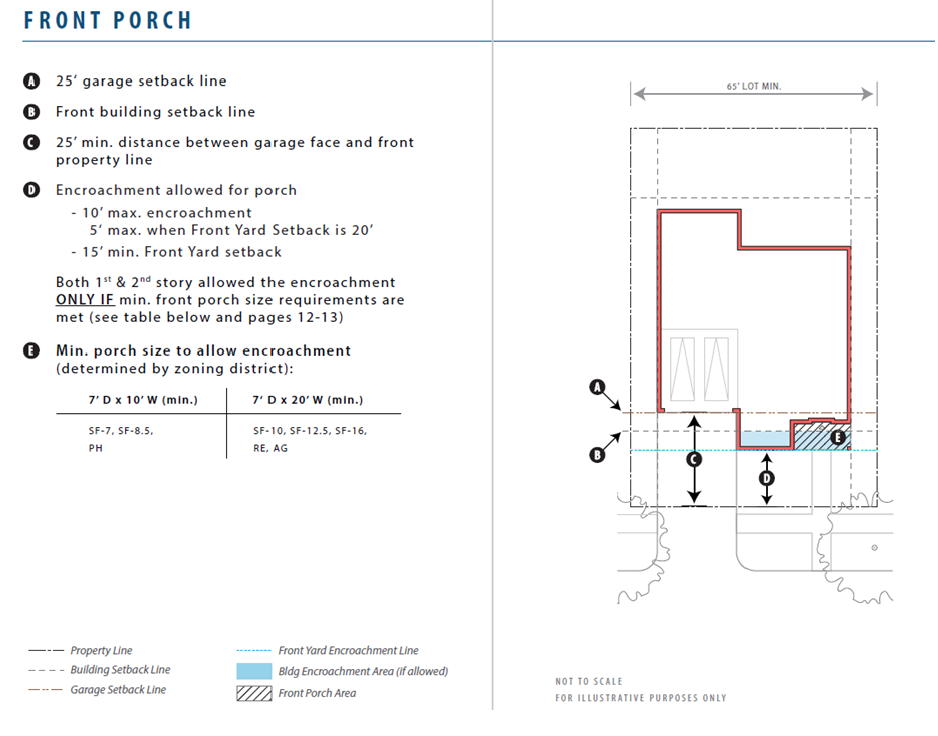
In order to increase flexibility in residential product development, there are two (2) provisions for Front Yard setbacks encroachment:
1)
J-Swing Garage - a ten (10') foot max encroachment to a minimum fifteen (15') foot Front Yard setback. Reference below Exhibit 1.
2)
Front porch - a ten (10') foot max encroachment to a minimum fifteen (15') foot Front Yard setback. Reference below Exhibit 2.
Exhibit 1
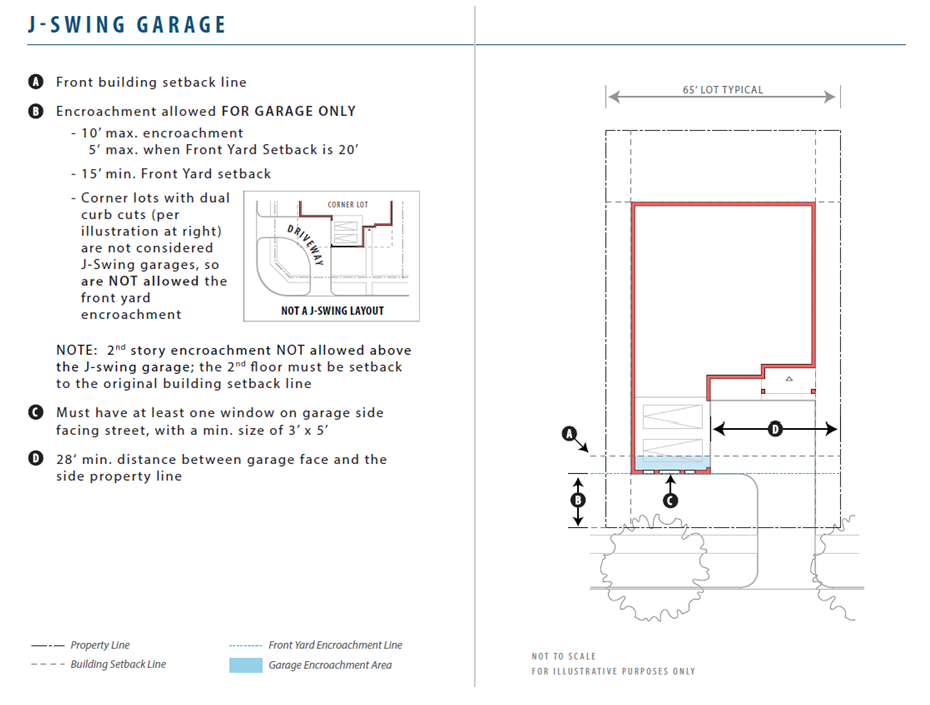
Exhibit 2
Section 14.4 - Lot Design Standards (Commercial)
Notes:
1
May be reduced to 15' if parking provided at side or rear of building.
2
The City Manager or his/her designee may approve a one third setback reduction to side or rear setbacks for any C-3 or C-4 lot(s) abutting the following zoning: C-3, C-4, I-1 or I2 zoning types.
3
If the property line abuts a non-building lot (900 or open space) equal to or greater than required setback, building setback may be reduced to 5 feet.

