
Cibolo City Zoning Code
ARTICLE 17
- LANDSCAPING, BUFFERING and PROTECTED TREES18
Editor's note—Ord. No. 1332, § I(Exh. A), adopted April 27, 2021, amended Art. 17, §§ 17.1, 17.2, in effect replacing said article with §§ 17.1, 17.2 , as set out herein. Formerly, Art. 17 pertained to similar subject matter and derived from Ordinance 1233, adopted April 24, 2018.
Section 17.1 - Landscaping and Buffering
A.
General/Applicability
The Landscaping and Buffering requirements contained in this UDC are adopted pursuant to Texas Local Government Code Section 212 and shall apply to all new non-residential construction, multi-family construction, other than duplex uses, and in limited cases residential within the City and the City Extraterritorial Jurisdiction.
1.
The standards and criteria contained within this subsection are deemed to be minimum standards and shall apply to all new construction or any construction that increases the existing square footage of a structure by more than thirty percent (30%).
2.
The provisions of this section shall be administered and enforced by the City Planner or his/her designee.
3.
The landscape standards in this subsection apply to nonresidential developments, including uses such as schools and churches within a residential zoning district(s).
4.
If at any time after the issuance of a Certificate of Occupancy and/or a Site Development Permit, the approved landscaping is found not to be in conformance with the standards and criteria of this subsection, the City Planner or his/her designee, shall issue written notice to the property owner, citing the violation and describing the action(s) required to comply with this subsection. The owner, tenant or agent shall have thirty (30) days from date of said notice to establish/restore the landscaping as required. If the landscaping is not established or restored within the allotted time, then such person shall be in violation of this UDC.
5.
Only that portion of a lot, tract or parcel being developed shall be required to meet these landscape requirements. Those portions of a lot, tract or parcel to be developed at a later time shall be required to meet the landscape requirements in effect at the time of their development.
6.
Pad site developments: Pad site developments or ground lease developments shall be required to provide landscaping in accordance with the interior landscape requirements herein.
7.
Expansions of Paved Areas: Any expansion or reconfiguration of paved areas shall comply with all requirements herein.
B.
Purpose
The purpose of this section is to establish landscaping and buffering requirements to enhance the community's ecological diversity, environmental quality, beautification and overall human experience of the community. It is the intent of this section to reduce the negative effects of glare, noise, erosion, and sedimentation caused by expanses of impervious and un-vegetated surfaces within the urban environment. It is the intent of this section to preserve and improve the natural and urban environment by recognizing that the use of landscaping elements can contribute to the processes of air purification, oxygen regeneration, groundwater recharge, noise abatement, glare and heat, provision of habitats for wildlife, and enhance the overall beauty of the City and the Extraterritorial Jurisdiction of the City. The intent is to make Cibolo a more sustainable and attractive place in which to live, visit and do business.
C.
Installation and Maintenance
Prior to issuance of a Certificate of Occupancy for any building or structure, all screening and landscaping shall be in place in accordance with the landscape plan approved as part of the Site Plan
1.
The property owner shall be responsible for the maintenance of all landscape areas. The areas shall be maintained so as to present a healthy, neat and orderly appearance at all times.
2.
Should any of the plant materials used in any landscaping required under this section die, the owner of the property shall have ninety (90) days after notification from the City to obtain and install suitable replacement plant material. Synthetic or artificial lawn or plant material shall not be used to satisfy the requirements of this ordinance.
3.
If seasonal weather conditions make it impractical to install landscaping, or replacement landscaping, as required herein, a deferral of the required plant installation may requested for a period not to exceed six (6) months. The applicant shall be required to provide a Letter of Credit, bond, or escrow deposit in an amount sufficient to cover the installation of the required landscape and irrigation requirements, plus a 10% contingency. Such amount shall be evidenced by an itemized bid prepared by a qualified contractor. Upon the failure of the applicant to complete the installation requirements, the City shall have the right to draw upon the letter of credit or escrow. A deferral may not be requested for any required screening fence or wall.
4.
Landscaped areas shall be kept free of trash, litter, weeds, and other material or plants not a part of the landscaping.
5.
All plant material shall be maintained in a healthy and growing condition as is appropriate for the season of the year.
6.
It shall be the duty of any person or persons owning or occupying real property bordering on any street to prune trees next to the street in such manner that they will not obstruct or shade any street lights, obstruct vision of traffic signs, or obstruct the view from any street intersection, pursuant to the City's visibility standards. The minimum clearance of any portion of a tree overhanging a public street right-of-way shall be fourteen (14) feet, and overhanging a public sidewalk shall be eight (8) feet. Landscaping within required sight visibility areas at street intersections and site access driveway shall not exceed a maximum height of two feet (2.0').
7.
All landscape materials shall be installed according to American Nursery and Landscape Association (ANLA) standards.
8.
Irrigation:
a.
All landscaped areas shall be irrigated with an approved automatic underground irrigation system unless the landscaped area has been designed utilizing xeriscaping methods. All irrigation systems shall be designed and sealed in accordance with the Texas Commission on Environmental Quality (TCEQ) and shall be professionally installed. Irrigation shall not be required for undisturbed natural areas or undisturbed existing trees.
b.
Flat spray heads should be utilized under shrubs rather than upward spray heads on risers above shrubs. Lawn spray heads should have low precipitation rates, run for longer periods of time, and water infrequently to promote deep root growth for grasses. Irrigation systems must be equipped with a rain/freeze sensor.
c.
The 20% landscaping requirement for multi-family or nonresidential development may be reduced to 10%, for those developments where 67% of the total required landscaping is devoted to any combination of the following:
i.
Undisturbed natural areas or undisturbed existing trees,
ii.
Xeriscape landscape design,
iii.
Incorporate porous hose, deep pipe, clay pot lid, porous capsule, perforated drain pipe, micro catchment, drip, wick or other comparable alternative irrigation systems for arid climates,
iv.
Utilize reclaimed, recycled, gray water, non-potable surface water, rainwater or alternative water harvesting systems in accordance with Texas Commission on Environmental Quality (TCEQ) standards and the adopted plumbing code, or
d.
In review of landscape plans for compliance with the above criteria to reduce the amount of required landscaping requirement, the City Planner may grant a pro-rata reduction between the required percentage and a reduced percentage. An applicant may appeal the pro-rata credit proposed by the City Planner to the Planning and Zoning Commission for a final determination.
e.
The 10% landscaping requirement for industrial development may be reduced to 7% for those developments where 67% of the total required landscaping is devoted to any combination of criteria listed in Section c above.
9.
Vegetation other than approved grasses or ground cover six inches (6") in height is prohibited in any City right-of-way unless authorized by the City Planner.
D.
Landscaping and Public Rights-of-Way (Residential and Non-Residential)
1.
All unpaved portions of public right-of-way (R.O.W.) must be planted with an approved grass, as classified in Section L below. A maximum of ten percent (10%) of the required interior plant material may be placed within the R.O.W. parkway.
2.
All unpaved portions of public right-of-way (ROW) must be reforested with approved tree species in Section N below. Planting requirements are as follows:
a.
Minimum distance between newly planted trees (sizes defined in Section H below)
Large sized trees: 40 feet;
Medium sized trees: 30 feet; and,
Small sized trees: 20 feet
b.
Minimum distance from any underground utility, water meter boxes, and fire hydrant: 5 feet
c.
Distance from trees to curb, sidewalk, or driveway: Minimum 4 feet.
d.
Planting strips should be a minimum of 8 feet wide.
e.
Minimum distance from buildings and similar structures:
i.
Large size tree: 30 feet;
ii.
Medium size tree: 20 feet; and,
iii.
Small size tree: 10 feet.
f.
Minimum distance from overhead utility lines. Trees cannot be planted under utility lines. In order to avoid future interference of limbs, planting may take place as follows:
i.
Large trees: 30 feet from line;
ii.
Medium trees: 20 feet from line; and
iii.
Small trees: 10 feet from line.
g.
From curb line of an intersection: 25 feet, which is subject to visibility triangles.
h.
Minimum distance from stop or yield signs: 20 feet.
i.
Distance from directional traffic sign: 10 feet.
j.
Distance from streetlights: 25 feet, or 15 feet if narrow growing species is planted.
k.
All trees must have irrigation, either drip or bubblers, as required in this code.
Tree selection shall take into consideration ordinance requirements for height clearances as defined in Section F of the Code. As they grow, trees will need to be pruned to provide pedestrian clearance of at least 8 feet over sidewalks, and vehicular clearance of 14 feet over streets.
Variations from the requirements listed above must be approved by the City Planner or designee.
3.
The City shall have jurisdiction and supervision over all trees and plant materials planted or growing on City property or growing in, upon or over City property. The City, through its subdivision processes, may allow for the designation of medians within public rights-of-way for landscaping, and designate primary landscape installation and maintenance responsibilities to a duly authorized Homeowner or Property Owner Associations. The City reserves the authority to plant, trim, spray, treat, preserve and remove such trees and plant materials to ensure the public safety or preserve the aesthetics of City property, or may require the said duly authorized Homeowner or Property Owner Associations to plant, trim, spray, treat, preserve and remove such trees and plant materials to ensure the public safety or preserve the aesthetics of City property.
E.
The following acts are unlawful:
1.
Damage, cut, carve, transplant or remove any trees on City property;
2.
Attach a rope, nail, advertising poster, sign or other contrivance to any City tree;
3.
Allow any gaseous liquid or solid substance harmful to trees to come into contact with City trees; or
4.
Set or permit any fire to burn when such fire, or the heat from such fire, will injure any portion of a tree on City property.
F.
Affect of Private Property Landscaping on Public Rights-of-Way
1.
It is unlawful for any person owning or occupying real property to maintain or permit trees located on such property in a manner that the trees will obstruct or shade the streetlights, obstruct the passage of pedestrians, obstruct vision of traffic signs or obstruct the view of any street, sidewalk or alley intersection. The minimum clearance of an overhanging portion of a tree shall be:
a.
Eight (8) feet over sidewalks,
b.
Fourteen (14) feet over all streets and alleys, or
c.
Any such clearance as will provide an unobstructed view or passage.
2.
It is unlawful for any person owning or occupying real property to maintain hedges and shrubbery adjacent to public sidewalks or curbs in such a manner that the hedges and/or shrubbery extend more than four (4) inches onto a public sidewalk or curb.
G.
Removal of Landscaping Required
1.
Upon finding that any tree, shrub, hedge or part thereof constitutes a nuisance and immediate danger exists to persons, property or other vegetation as a result of such nuisance, the City shall serve notice on the property owner to remove, trim or prune the tree, shrub or hedge.
2.
The method of service shall be one or more of the following:
a.
By personal delivery of the notice to the property owner;
b.
By leaving the notice with a person of suitable age and discretion on the premises;
c.
By mailing the notice by registered mail to the last known address of the property owner; or
d.
By affixing or posting notice on the front door of any residential, commercial, or other structure located on the property, if the structure is occupied.
3.
The notice shall set forth the time limit for compliance, which shall depend upon the degree of danger created by the tree, shrub or hedge, but shall in no case be longer than ten (10) calendar days. In cases of extreme danger, the Code Enforcement Officer or designee shall have the authority to require immediate compliance.
4.
If the owner of the property does not, within seven (7) days of notice of a violation expiration, have, the tree, shrub or hedge removed, trimmed or pruned, it shall be declared a nuisance, and the City may go upon such property and do or cause to be done the work necessary to obtain compliance with this UDC.
5.
Costs incurred by the City in abating a nuisance under this section, shall be assessed to the property owner. Notice of the costs of abatement shall be served on the property owner. The method of service shall be one or more of the following:
a.
By personal delivery of the notice to the property owner; or
b.
By leaving the notice with a person of suitable age and discretion on the premises; or
c.
By mailing the notice by registered mail to the last known address of the property owner; and
d.
By affixing or posting notice on the front door of any residential, commercial, or other structure located on the property, if the structure is occupied.
6.
The property owner shall have sixty (60) calendar days after receipt of notice to remit full payment of any costs of abatement to the City.
7.
If the property owner or another person with an interest in the property fails to remit full payment for the costs of abatement within sixty (60) calendar days, the City may file a lien against the property upon which the dangerous plant is located. The lien arises and attaches to the property at the time the notice of the lien is recorded and indexed in the office of the county clerk in the county in which the property is located. The notice must contain the name and address of the owner if that information can be determined with a reasonable effort, a legal description of the real property on which the dangerous plant is located, the amount of expenses incurred by the City, and the balance due. The lien is extinguished if the property owner or another person having an interest in the property reimburses the City for the expenses.
8.
A tree, shrub or hedge shall be deemed a nuisance if it or any part of it:
a.
Appears likely to fall on or otherwise harm a pedestrian or vehicle utilizing the streets, alleys, or sidewalks;
b.
In the case of trees, is not pruned to a height of fourteen (14) feet above the street to accommodate vehicles such as garbage trucks, buses and street maintenance trucks;
c.
In the case of trees, is not pruned to a height of eight (8) feet above the sidewalk;
d.
Obstructs a curb, gutter, street or sidewalk;
e.
Interferes with sewers;
f.
Is in dangerous proximity to interfere with public utilities; or
g.
Obstructs or interferes with the view or movement of pedestrian or vehicular traffic.
H.
General Landscaping Requirements
1.
Trees planted shall be a minimum of three inches (3.0") caliper measured at four and a half feet (4.5') above ground level at the time of planting.
2.
All trees shall be planted in a pervious area no less than four (4) feet wide in any direction measured from the center of the tree or ten (10) times the caliper of the tree, whichever is greater. For example, a six (6") inch tree will have a sixty-inch (60") or five-foot (5') radius or a ten-foot (10') diameter. This exceeds the four (4) feet minimum and must be used. Said pervious area shall be covered with mulch to a minimum average thickness of three (3) inches, except for the area within a six (6) inch radius of the tree trunk which shall have no mulch or other material above the root ball in order to prevent or reduce the possibility of bark rot.
3.
No more than 50 percent of the required trees and shrubs shall be of the same species without the approval of the City. Such approval may only be granted in order to achieve a specific design intent of the landscape architect.
4.
Improved soils containing a minimum 20% organic content shall be provided in all required landscape areas in accordance with the following:
a.
Turf areas to a minimum depth of four (4) inches;
b.
Planting beds to a minimum depth of eight (8) inches; and
c.
Tree planting pits shall be 50% excavated soil and 50% prepared soil.
5.
All landscaping shall be separated from vehicular use areas by some form of barrier such as raised concrete curbing, bollards, curb stops, or other suitable permanent alternative.
6.
All landscape beds shall be separated from sod areas by some form of barrier such as steel edging, masonry materials, or another equivalent durable material as approved by the City Planner or designee. No plastic materials shall be allowed. Provided however, the barriers may be designed in such a way to capture, filter, reuse or infiltrate rainwater with the purpose of protecting and conserving water resources.
7.
Landscaping shall not obstruct the view between access drives and parking aisles.
8.
Nothing shall be erected, placed, allowed to grow, or planted so that it impedes vision between the height of three (3) feet and ten (10) feet above the curb within sight visibility so as not to interfere with traffic view or impose a safety hazard.
9.
No artificial plant material may be used in any form to satisfy the requirements of this section.
10.
Berms shall not encroach upon the critical root zones of existing trees.
11.
Any landscaping placed in utility easements shall not be counted towards the minimum landscaping requirements.
12.
At the time of planting, all trees shall have the following minimal caliper measurements:
a.
Large (Shade) trees: three (3) inches
b.
Medium (Shade) trees: two (2) inches
c.
Small/ornamental trees: one (1) inch
13.
The City Planner or designee may allow large trees to be placed closer to a building in order to achieve an urban streetscape.
14.
All trees planted to meet the landscaping standards herein shall be protected trees regardless of size.
15.
Grass areas are encouraged to be planted in species normally grown as permanent lawns in the City, including Bermuda, Buffalo Grass, Zoysia, or other drought-tolerant grass. Grass areas may be sodded, plugged, sprigged or seeded, except in swales or other areas subject to erosion which shall require installation of solid sod. If grass areas are seeded, plugged, sprigged or sodded, the City can consider the issuance of a Temporary Certificate of Occupancy to ensure 100% grass coverage.
16.
Detention areas may use grass hydro seeding; however, contractor is responsible for maintaining all hydro seed areas in a healthy and growing condition and comply with TxDoT Item 164, Seed for Erosion Control (as amended). Seeding material must be replaced with plant material of similar variety should the area be damaged, destroyed or removed.
17.
The use of St. Augustine grass is only permitted where structures or trees provide shade where the grass receives less than five (5) hours of direct sunlight per day.
18.
The use of architectural planters in nonresidential districts is permitted to count toward the fulfillment of landscape requirements subject to approval.
I.
Landscape Installation Required
1.
A minimum of twenty percent (20%) of the total land area of any proposed multifamily or nonresidential development, excluding industrial development, shall be landscaped and shall be comprised of trees, shrubs, sod or other ground cover. In the event of the construction of a phased development, the minimum twenty percent (20%) and ten (10%) requirements shall apply to each phase as it is developed.
2.
For industrial development, a minimum of ten percent (10%) of the total land area shall be landscaped and shall be comprised of trees, shrubs, sod or other ground cover. In the event of the construction of a phased development, the minimum ten percent (10%) requirement shall apply to each phase as it is developed.
3.
Landscaping required to satisfy the 20% and 10% landscaping requirements, or reduced percentage as outlined in Section C.8(c) described above, shall be provided in accordance with the following criteria:
a.
Not less than forty percent (40%) of the total required landscaping shall be located in the designated front yard, with the front yard defined as the area between the front property line and the front of the building. In the case of a corner lot, landscaping may be installed between the exterior side of the building and the corner street. The 40% requirement may be reduced as necessary where a lot abuts residential zoning and must install a buffer yard.
b.
Approved tree species listed in this Article shall be provided at a ratio of nine (9) trees per acre of gross lot area, at a minimum ratio of five (5) approved shade trees for every four (4) approved ornamental, evergreen and palm trees. Existing trees may be counted toward meeting the requirements of this section, provided that measures are taken to ensure that existing trees will survive the site development process.
c.
The use of native and adapted, drought tolerant plants is encouraged to meet the requirements of this section.
d.
Artificial plants or turf shall not be counted towards meeting the requirements of this section.
e.
Parking lots and vehicular use areas shall be landscaped in accordance with the parking lot landscaping criteria described below.
f.
Areas used for parking or vehicle storage that are under, on or within buildings are exempt from the landscaping requirements.
g.
In no case shall the application of the minimum landscaping requirements contained herein, allow the City to require more than the 20% and 10% landscaping lot area requirements for any development that must be devoted to landscaping, except in those instances where public health, safety or general welfare may warrant additional landscaping or buffering. Additional landscaping may be installed at the discretion of a developer but shall not be required by the City unless a special circumstance necessary to ensure public health and safety is documented.
J.
Parking Lot Landscaping
A minimum of ten percent (10%) of the gross parking areas shall be devoted to living landscaping, which includes grass, ground covers, plants, shrubs and trees. Gross parking area is to be measured from the edge of the parking and/or driveway and sidewalks. This landscape area provided to meet this requirement shall be counted toward meeting to overall landscape requirement for the lot.
1.
A minimum of ten percent (10%) of the gross area of parking lots visible to the public right-of-way shall be devoted to living landscaping, which includes grass, ground covers, plants, shrubs and trees. Gross parking area is to be measured from the edge of the parking and/or driveway and sidewalks. Landscaping may be planted at the perimeter of said parking lots, may be clustered, or be distributed into multiple landscaping islands. The below additional criteria shall apply to the interior of parking lots.
2.
For industrial uses, the above ten (10%) percent parking lot requirement shall only apply to customer/employee parking areas and vehicle storage areas visible from public rights-of-way. Required landscaping shall be installed as a screening buffer primarily along the perimeter of industrial lots that adjoin, or face, properties located on lower intensity zoning districts. When industrial development adjoins or faces other properties zoned I-1 or I-2, or a street right-of-way within an industrial park, the 10% landscape requirement shall not be applicable.
3.
The following additional criteria shall apply to the interior of parking lots.
a.
Large trees shall be provided in parking areas. The construction of off-street parking areas requires the planting of one large tree for each 400 square feet or fraction thereof in each island so that there are no more than fifteen (15) contiguous parking spaces between islands, except as otherwise provided herein.
Commercial sites one (1) acre or less in size are exempt from this requirement.
b.
When an off-street parking or vehicular use area abuts a public right-of-way, except a public alley, a perimeter landscape area of at least fifteen (15') feet in depth, or at least five (5') feet in depth if within the Old Town Mixed Use District, shall be maintained between the abutting rights-of-way and the off-street parking or vehicular area. Minimum three (3') foot landscaping buffer shrubs are to screen all off-street parking spaces from the public rights-of-way. Necessary access ways from the public right-of-way shall be permitted through this area.
c.
End islands shall be provided at the terminus of each parking bay. Interrupting islands shall be provided within each parking bay as required herein. End islands and interrupting islands shall have a minimum width of nine (9') feet from face of curb to face of curb by eighteen (18') feet and shall contain a large tree. Head-to-head parking bays shall include two (2) such end islands.
d.
In a ROW of parking immediately adjacent to a perimeter parking lot landscape area, required interrupting islands may be eliminated by planting two (2) additional large trees in the adjacent landscape area for each interrupting island so eliminated.
e.
For any Commercial site five (5) acres or greater, a median island with a minimum width of nine (9') feet, from face of curb to face of curb, shall be required between every fifteen single parking bays and along one (1) primary internal and external access drive.
Medium or large trees shall be planted at a rate of one per each 50 linear feet or fraction thereof. Median island intervals may be expanded in order to preserve existing trees, provided an alternative median location has been approved by the City Planner or designee.
f.
The preservation of existing healthy trees of a protected species, as set forth in the definition of "protected tree" in Sec. 17.2, may be used as credits towards the landscaping required by this subsection. These credits may not be used to replace an end island or median island tree unless the preserved tree is located within the required end island or median island. Each preserved tree is credited towards the adjacent 10, 20, or 30 parking spaces, accordingly:
i.
Each healthy large tree with a diameter of at least four (4") inches but less than eight (8") inches within ten (10') feet of a parking area will be counted as a credit towards one required parking lot tree.
ii.
Each healthy protected large tree with a diameter of eight (8") inches to twenty (20") inches preserved within fifteen (15') feet of a parking area will be counted as a credit towards two (2) required parking lot trees.
iii.
Each healthy protected large tree with a diameter of more than 20 inches preserved within 20 (20') feet of a parking area will be counted as a credit towards three (3) required parking lot trees.
g.
The area within islands and medians shall not include sod or turf grass and shall not include more than fifty (50%) percent decorative groundcover material, unless approved by the City Planner or designee. The remainder of the area shall consist of planting groundcover.
K.
Landscape Plan Required
A landscape plan demonstrating compliance with all landscaping requirements shall be submitted to the City for approval. The landscape plan may be submitted as a part of the site plan.
1.
Qualifications to Prepare Landscape Plans
a.
Standard site plan. Lots greater than or equal to 30,000 square feet (.68 acres). Landscape Plans shall be signed and sealed by a Registered Landscape Architect.
b.
Small project site plan. For lots less than 30,000 square feet (.68 acres). If the plan includes 10 or more trees, the plan shall be signed and sealed by a landscape architect. If the plan includes less than 10 trees, the plan shall be signed and sealed by a landscape architect, professional engineer, landscape design professional, licensed nurseryman, Certified AgriLife Master Gardener, or urban forester.
c.
Irrigation plans shall be prepared and signed by a Licensed Irrigator or Landscape Architect.
d.
The City may reject plans if deemed of insufficient quality or completeness and require that plans be prepared by a Registered Landscape Architect or a Licensed Landscape Contractor.
2.
The landscape plan shall meet the following standards and contain the following information:
a.
Sheet size 24" x 36", or as approved.
b.
Acceptable scale: 1" = 10', 1" = 20', or as approved.
c.
North arrow, graphic and written scale in close proximity.
d.
Appropriate title (i.e. "Landscape Plan")
e.
Title block shall include the project street address, subdivision name, with lot and block numbers, date of plan preparation (and revisions).
f.
Name and address of owner.
g.
Name, address and phone of firm preparing plan.
h.
Property boundaries and dimensions.
i.
Any existing or proposed easements and utilities shown
j.
Width and type of buffer yards labeled on all sides.
k.
Location, caliper size and name of all existing trees with a caliper equal to, or greater than 6-inches, which are to be preserved.
l.
Location, quantity, size and name of all proposed plant materials.
m.
Provide buffer yard and Interior Landscape Calculations.
n.
Visibility triangles shown.
o.
Required design professional seal signed and dated.
p.
Plant list, with the size and spacing of all plants.
q.
Location and footprint of proposed or existing buildings and parking lots.
r.
Any berms delineated with one (1') foot contour intervals.
s.
Any proposed or existing sidewalks.
t.
Location of all existing trees with indication as to those to be preserved.
u.
Location of all landscaping material to be used including paving, benches, screens, fountains, statues, walls/fences or other landscaping features;
v.
Type of watering system and location of watering source, irrigation, sprinkler, or water system, including placement of water sources.
w.
Description of maintenance provisions of the landscaping plan.
x.
Description of how existing trees will be protected during construction.
y.
All General Landscaping Notes listed in Section 17.1(Q) of this Article.
L.
Non-residential and Multi-family Landscape Buffer Requirements
1.
A non-residential or multi-family use adjacent to, or directly facing, a single-family zoning district shall provide a minimum twenty (20') foot landscape buffer adjacent to the property line of the residential use or residentially zoned property.
Landscape buffer trees:
A minimum of one (1) large tree shall be planted for each forty linear feet (40'),
one (1) medium tree every thirty linear feet (30'), one (1) small tree every twenty
(20') linear feet, or any combination thereof, within landscape buffer.
Landscape buffer shrubs:
A minimum of ten (10) shrubs shall be planted for each forty (40') linear feet of
landscape buffer. Buffer shrubs shall be evergreen or similar, a minimum of eighteen
(18") inches in height at time of planting and of a variety that can be expected to
reach four to five (4-5) feet in height within three (3) to five (5) years of initial
planting.
All other areas within the landscape buffer shall be covered with grass or another solid vegetative cover approved at the time of Site Plan approval. The buffer wall standards below shall also be applicable.
2.
A non-residential, non-industrial use that is adjacent to, or facing, a multi-family zoning district shall provide a minimum ten (10') foot landscape buffer adjacent to the property line of the residential use or residentially zoned property. Industrial uses shall be required to install a twenty (20') foot buffer.
Landscape buffer trees:
A minimum of one (1) large tree shall be planted for each forty linear feet (40'),
One (1) medium tree every thirty linear feet (30'), one (1) small tree every twenty
(20') linear feet, or any combination thereof within landscape buffer.
Landscape buffer shrubs:
A minimum of ten (10) shrubs shall be planted for each fifty linear feet (50') of
landscape buffer. Buffer shrubs shall be evergreen or similar, a minimum of eighteen
(18) inches in height at time of planting and of a variety that can be expected to
reach four to five (4-5) feet in height within three (3) to five (5) years of initial
planting.
All other areas within the landscape buffer shall be covered with grass or another solid vegetative cover approved at the time of Site Plan approval. The buffer wall standards below shall also be applicable.
3.
The following standards shall apply when a buffer wall is required:
a.
Fences and walls used as a buffer must have a minimum height of 6 (6') feet but may not exceed 8 (8') feet in height. If a fence is installed on top of a berm, the fence height shall be measured from the grade level of the berm and not from the natural grade. The height restriction shall not apply to decorative or architectural ornamental elements, such as pilasters and pilaster caps.
b.
Fencing and walls shall not be placed within a required Sight Triangle.
c.
Fences and walls must be constructed of high-quality materials, such as decorative block, brick, stone, woodcrete (decorative concrete), faux stone, wrought iron and comparable materials. The use of chain-link fencing, with or without slats, sheet metal, railroad ties or like materials may not be used as a screening wall or fence.
d.
Breaks in the fence or wall may be made to provide pedestrian connections to the perimeter of the site and to adjacent development or to provide a means of access to maintain the buffer wall or required landscaping.
e.
In lieu of a masonry or wood screen, a combination of trees and shrubs and/or an earthen berm, may be installed to satisfy the minimum six (6') foot height. If vegetation is used for screening, vegetation shall be a minimum of six (6') feet tall at the time of planting, shall be evergreen and shall create an opaque barrier immediately at the time of planting. Earthen berms shall be constructed with a maximum 1:3 (one vertical to three horizontal) slope. The entire length of the berm shall be vegetated with dense evergreen plant material. The incorporation of screening mesh, shade cloth or other acceptable screening techniques may also be considered.
4.
The following standards shall apply when water quality ponds/detention ponds are required:
a.
One large or medium tree shall be planted for every forty (40') linear feet or portion thereof around the boundary of the pond.
b.
One small/ornamental tree shall be planted for every thirty (30') linear feet or portion thereof around the boundary of the pond.
c.
Either drip or bubbler irrigation is required for each tree as defined in this code.
5.
Depending upon the height of the items being screened, the distance from the buffer of items being stored, utility easement locations and the proximity of residential lots, staff reserves the flexibility to increase or decrease the above buffering standards based upon site specific circumstances, An applicant may appeal the final decision of the City with respect to this requirement to the Planning and Zoning Commission.
M.
Existing Tree Credits
Credits shall only be granted if the trees are in healthy condition and all requirements of this UDC have been met, as determined by the City Planner or designee at the time of submitting the Landscape Plan. Reference below Section N for all approved trees and plantings.
1.
Existing Tree Credit Calculation
Existing trees which are saved in landscape areas and that can provide protection for at least 75% of the 'Critical Root Zone' will be granted credits toward reducing the required plantings as follows:
a.
Undesirable Trees (Any Size) = 0.5 tree credit
b.
Approved Tree 8 - 19.99-inch Diameter at Breast Height (4.5 feet) = 1.0 Tree Credits
c.
Approved Tree 20 - 23.99-inch Diameter at Breast Height (4.5 feet) = 2.0 Tree Credits
d.
Approved Tree 24-inch Diameter (or higher) at Breast Height (4.5 feet) = 3.0 Tree Credits
Trees are classified as Approved or as Undesirable in Section N.7 below.
N.
Approved Landscaping Plant List
Landscape plans shall incorporate plantings from the approved species listings. Plants species on the undesirable tree list shall not be incorporated into landscape plans. Existing undesirable trees, if retained, shall count as 0.5 (1/2) of a tree credit.
The City Planner or designee is authorized to consider other plant species not included in the approved landscaping plant lists if such plant is appropriate to the South-Central Texas climate and is appropriate within the context of a proposed Landscape Plan.
1.
Approved Shade Trees
* Tree types with asterisk and italics are approved drought tolerant/low maintenance
(xeriscaping) 21.9.7A Approved Shade Trees
2.
Approved Ornamental, Evergreen and Palm Trees
* Tree types with asterisk and italics are approved drought tolerant/low maintenance
(xeriscaping)
3.
Approved Shrubs, Vines, Perennials and Ground Cover
* Shrub, vine, perennial and ground cover types with asterisk and italics are approved
drought tolerant/low maintenance (xeriscaping)Vines, Perennials and Ground Cover
4.
Approved Annuals
5.
Approved Ornamental Grasses
* Grass types with asterisk and italics are approved drought tolerant/low maintenance
(xeriscaping)
6.
Approved Turf Grasses*
* The City will consider additional varieties of turf grass that have summer dormancy characteristics. Summer dormancy is defined as the ability of turf grass to survive without water for a period of sixty (60) consecutive days during the months of May through September.
7.
Undesirable Planting List
O.
Public and Private Schools, Churches, Landscaping Credits
The City recognizes the unique circumstances associated with school and church development and the fact each of these uses may have considerable open space devoted to playgrounds, ball fields, outdoor recreation or areas for future expansion of facilities. For these uses, the City Planner has the discretion to issue landscaping credit toward fulfilling the landscaping requirements of this UDC subject to the following criterion:
1.
Open space is landscaped with approved turf grass designated by this section,
2.
Open space contains recreational facilities, including, but not limited to playgrounds and tennis courts, on pervious or impervious surfaces;
3.
More substantial tree and shrub landscaping is planted along the perimeter of the school or church property lines;
4.
Landscape Plan complies with all Landscape Buffer requirements of this section for protected uses.
The decision of the City Planner may be appealed to the Planning and Zoning Commission.
P.
Variances
The Planning and Zoning Commission shall have the authority to hear requests for variances to the Landscaping and Buffering requirements when the literal enforcement of these requirements would result in creation of an unnecessary hardship or impractical application of the plan considering the physical characteristics of the lot or parcel of land in question. All of the application requirements, variance hardship criteria, legal notice procedures, and application filing fee required for the granting of a zoning variance, as defined in this UDC, shall be applicable.
Q.
Miscellaneous Landscaping Requirements and Landscape Plan General Notes
Below are miscellaneous technical requirements pertaining to the installation and maintenance of required landscaping. The following General Notes stipulating these requirements shall be included on all required Landscape Plans:
1.
Contractor shall stake out tree locations and beds for owner approval prior to installation.
2.
Contractor is responsible for verifying locations of underground utilities prior to construction.
3.
It is the responsibility of the contractor to advise the owner of any condition found on site which prohibits the installation per approved plans.
4.
All shrub and groundcover beds shall have a minimum of two inches of mulch.
5.
Landscape edging shall be located as depicted on landscape plan.
6.
Trees shall be planted at least five (5') feet from any utility line and outside utility/drainage easements. A three (3') foot clear diameter around fire hydrants is required.
7.
To prevent damage to tree trunks, trees may not be placed within three feet (3') of curbing or end of a parking space. Durable wheel stops shall be used in limited space areas.
8.
Any tree planted within five (5') feet of a curb, walk or drive must include an approved rigid, plastic root barrier approved by the City.
9.
Trees overhanging sidewalks and pedestrian areas shall have a clear trunk height of eight (8') feet.
10.
Trees overhanging visibility easements of rights-of-ways shall have a minimum clear trunk height of eight (8') feet.
11.
Trees overhanging public street pavement, drive aisles and fire lanes shall have a minimum clear trunk height of fourteen feet (14').
12.
Trees planted on slopes will have the soil stain at average grade of slope.
13.
No shrubs shall be permitted in a landscape bed less than three (3') feet in width. Such areas shall be covered with grass, groundcover or permanent fixed materials such as pavers.
14.
No trees are not allowed in the City's right-of-way, with the lone exception of residential subdivision entrances. The entrance landscaping plan will be subject to City and utility approval and must be located out of clear sight visibility areas.
15.
In medians landscape material, except for trees, shall not exceed 2'-6" inches in height.
16.
A visibility triangle must be provided at all intersections as required by this UDC (Article 18.14). Shrubs may not exceed 2'-6" in height. Trees will have a minimum clear trunk branching height of eight (8') feet.
17.
Plant materials shall be maintained in a healthy and growing condition and be replaced with plant material of similar variety and size if damaged, destroyed or removed.
18.
Landscape areas shall be kept free of trash, litter and weeds.
19.
All signs and fencing are contingent on the issue of permits and inspections.
20.
Where irrigation systems are approved, over spray on streets and walks is prohibited.
21.
A permit from the Building Inspections Department is required.
(Ord. No. 1423, § 1, 12-12-2023)
Section 17.2 - Protected Tree and Heritage Tree Preservation
Trees have a positive economic effect on the City by enhancing property values, mitigating drainage and flooding issues, improving air quality, helping save energy, and improving health and quality of life, thereby making the City a more attractive place in which to live, visit and do business. The provisions of this section shall apply to all developments, including commercial, industrial, single- and multi-family residential in the corporate limits of the City and the Cibolo ETJ.
A.
Purpose and Intent
The City seeks to: encourage the preservation of mature trees which once removed can be replaced only after generations, preserve protected trees during construction and control the removal of protected trees when necessary. The City intends to achieve the following:
1.
To protect, maintain and manage the City's existing forest resources by providing regulations relating to the cutting, removal or destruction of protected trees;
2.
To encourage a resourceful and prudent approach to urban development of wooded areas;
3.
To minimize tree loss and provide for replacement of trees removed and destroyed resulting from development;
4.
To provide an objective method to evaluate a development's impact on trees and wooded areas and identify whether and how the impact may be reduced;
5.
To provide incentives for creative subdivision and site design which preserve trees while allowing development in wooded areas; and
6.
To provide for the enforcement and administration of tree protection, thereby promoting and protecting the public health, safety and welfare and enhancing the quality of life.
7.
To clearly define protected trees and heritage trees and ways in which their encroachment limits differ.
8.
To clearly define the limitations for encroachment of hazardous activities related to protected trees and heritage trees.
9.
To define the penalties for violation of the encroachment limits for protected trees and heritage trees.
a.
Affectivity
All developments for which a Master Plan has not yet been submitted as of the effective date of this ordinance shall be subject to the requirements for tree protection and replacement specified herein.
b.
Private Property
Property zoned agricultural within the City Limits or appraised for agricultural in the City ETJ and being actively used for agricultural purposes shall be exempt from the requirements specified herein.
c.
Homeowners
The owner of a residence of two acres or less who uses the residence as a homestead shall be exempt from the tree protection and replacement requirements of this ordinance as it pertains to that residential property.
d.
Exceptions
A tree removal permit and tree protection and replacement requirements shall not be required under any of the following circumstances:
i.
Damaged/Diseased Trees: The tree is dead, diseased, damaged beyond the point of recovery, in danger of falling, or endangers the public health, welfare or safety as determined by the City Planner or designee.
ii.
Utility Service Interruption: The tree has disrupted a public utility service due to a tornado, storm, flood or other act of nature. Removal shall be limited to the portion of the tree reasonably necessary to reestablish and maintain reliable utility service.
iii.
Business Interests: The following business ventures shall be exempt from the requirements specified herein as follows:
(1)
Landscape Nursery: All licensed plant or tree nurseries shall be exempt from the tree protection and replacement requirements and from the tree removal permit requirements only in relation to those trees planted and growing on the premises which are so planted and growing for the sale to the general public; or
(2)
Golf Course: Golf courses shall be exempt from the tree protection and replacement requirements and from the tree removal permit requirements for removal of protected trees within areas designated as tee boxes, fairways or greens. All other areas shall be subject to these requirements.
e.
Deferral
The Planning and Zoning Commission may consider a "deferral" request from the requirement to maintain all protected heritage trees when the literal enforcement of this requirement would result in the creation of an unnecessary hardship on impractical application of the plan considering the physical characteristics of the lot or parcel of land in question.
B.
Protected and Heritage Tree Definitions
Contiguous Residential Lots.
Contiguous lots include three or more adjoining lots;
DBH -Diameter-at-breast-height (caliper).
A tree trunk diameter measured in inches at a height of 4.5 feet above the ground.
If a tree splits into multiple trunks below 4.5 feet, the tree shall be measured in
two places, the narrowest point beneath the split and ½ the sum of the calipers of
the trunks immediately above the split. Whichever is the greater measurement is to
be the measurement applied. If there is no single trunk above ground level to measure,
the measurement shall be the sum of the main trunk, plus ½ of all other branches of
the calipers of the various trunks at breast height;
Drip Line.
A vertical line run through the outermost portion of the canopy of a tree and extending
to the ground;
Governmental Entity.
City, Independent School Districts, State and County property; property owned by the
United States of America or other federal agencies. Examples of this would include
City Hall, public parks, Corps of Engineers property, State ROW, library, fire stations,
water tower sites or similar properties;
Mitigation.
Tree replacement with an authorized species;
Multi-Trunk Tree.
Tree with more than one trunk arising at or near the ground;
Protective Fencing.
Snow fencing, chain link fence, barbed wire fence, orange vinyl construction fencing
or other similar fencing with a four foot (4') approximate height;
Pervious.
Water will permeate the surface;
Protected Trees.
Trees belonging to protected residential tree list below and having an 8-inch to 19.99-inch
DBH and not belonging to the undesirable species list per Section 17.1(N)(7);
Champion Trees.
Champion trees are designated by City Council and are on the Champion Tree Registry.
Trees belonging to the Champion designation are heritage trees (20 - 24 DBH) and above.
Heritage Trees.
Trees belonging to protected residential tree list below and having a 20-inch to 24-inch
DBH and not belonging to the undesirable species list per Section 17.1(N)(7);
Critical Root Zone (CRZ).
A circular area being one foot from the tree trunk for each diameter inch of trunk
size.
Root Protection Zone (RPZ).
The area of undisturbed natural soil around a tree defined by a concentric circle
with a radius equal to the distance from the trunk to the outermost portion of the
drip line. As a practical matter, this is the acute portion of the tree's root system.
Approximately ninety percent (90%) of the tree's root mass occurs within the top three
feet of the soil and most of the fine feeder roots which collect moisture and nutrients
are located in the top six inches (6") of the soil. Typically, a tree's root system
extends as much as two to three times the distance from the trunk to the dripline.
Tree Affidavit.
Affirmation by the developer/landowner that there are not heritage or protected trees
in a proposed development or subdivision.
Tree Crown.
Parts of the tree above the trunk including leaves, branches, limbs and scaffold:
the uppermost part of the tree.
Tree Preservation/Removal Permit.
Permit required when heritage/protected trees are to be removed.
C.
Protected Tree Species
American Elm - Ulmus Americana Bald Cypress - Taxodium distichum
Live Oak - Quercus virginiana Shumard red oak- Quercus shumardii
Chinquapin Oak - Quercus muehlenbergii Burr oak- Quercus macrocarpa
Lacey Oak - Quercus glauco ides Pecan- Carya illinoinensis
Chinese pistache - Pistacia chinensis Cedar elm- Ulmus crassifolia
Texas Red bud - Cercis canadensis var texensis Persimmon- Diospyros texana
Monterrey Oak - Quercus polymorpha Texas Mountain Laurel- Sophora secundiflora
Texas Sycamore - Platanus Occidentalis
1.
Designation of heritage trees. All trees of the Protected Tree Species with a 24-inch DBH are hereby designated heritage trees and are protected from removal unless removal requirements are met as outlined in Section E.
2.
Designation of champion trees. All champion trees must be designated by City Council. Champion trees cannot be removed until they receive a removal of designation.
a.
Nomination.
The City Council may consider designating a tree as a champion tree upon the nomination by any person and with the written consent of the property owner.
b.
Designation.
A tree may be designated a champion tree by the City Council upon a finding that it is unique and of importance to the community due to any of the following:
i.
It is an outstanding specimen of a desirable species;
ii.
It is one of the largest or oldest trees in the City; or
iii.
It possesses a distinctive form, size, age, location, and/or historical significance.
c.
Notification.
After City Council approval of a champion tree designation, the City secretary shall notify the property owner in writing of the designation.
d.
Removal of designation.
A written request by the property owner for removal of a champion tree designation may be submitted to the City Planner or designee for consideration by the City Council. After City Council approval of a champion tree designation removal, the City Secretary shall notify the property owner in writing of the designation removal.
D.
Tree Trunk Measurement
1.
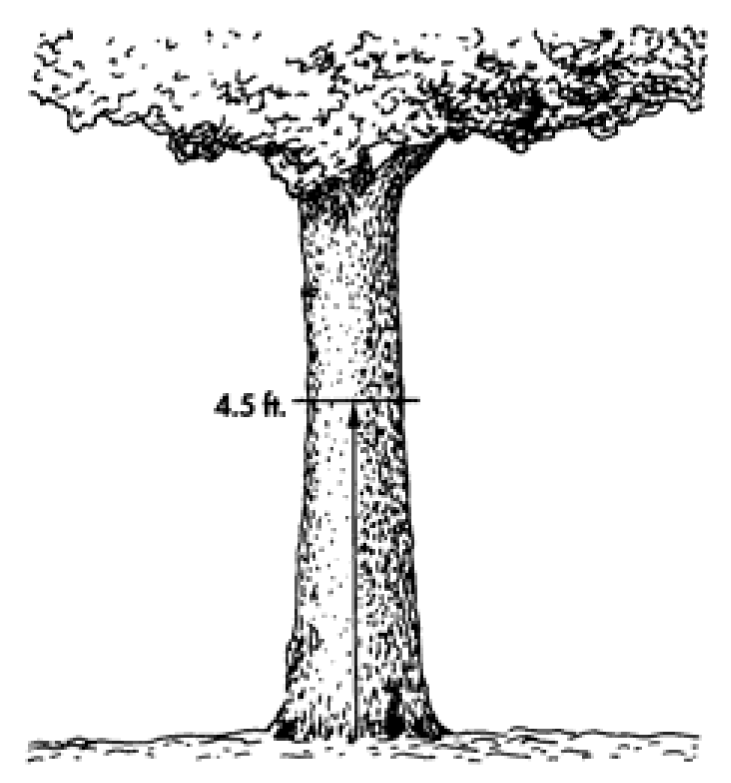
Straight Trunk: Trees with straight, upright trunks should be measured four and a half (4.5) feet above the ground as shown below.
2.
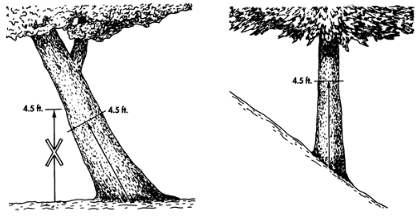
Trunk on an Angle or Slope: The trunk is measured at right angles to the trunk four and a half (4.5) feet along the center of the trunk axis, so the height is the average of the shortest and the longest sides of the trunk, as shown below:
3.
Multi-Trunk Trees
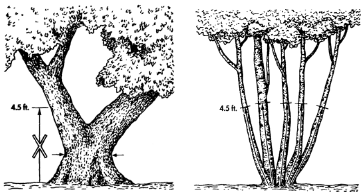
If a tree splits into multiple trunks below 4.5 feet, the tree shall be measured in two places, the narrowest point beneath the split and ½ the sum of the calipers of the trunks immediately above the split. Whichever is the greater measurement is to be the measurement applied. If there is no single trunk above ground level to measure, the measurement shall be the sum of the main trunk, plus ½ of all other branches of the calipers of the various trunks at breast height.
E.
Removal and/or Replacement of Existing Trees
1.
A dead tree is not considered a protected tree and is not subject to the tree removal permit requirements set forth in this section. The process for removal of a dead tree that was previously designated a champion tree by city council or was considered a protected or heritage tree at the time it was alive, is as follows:
a.
For removal of a dead tree that was previously designated a champion tree by the City Council:
i.
A property owner shall request that the Parks Department inspect the tree.
ii.
The Parks Department shall inspect the tree within 15 business days of the request and determine if the tree is dead or alive.
iii.
Upon a determination by the Parks Department that the tree is dead, the Planning and Engineering Director or designee shall approve or deny the removal request.
If the Parks Department determines that the tree is still alive, and the property owner wishes to remove the tree, the owner must comply with the protected tree removal permit process set forth in this section.
b.
For removal of a dead tree that was not previously designated a champion tree by the City Council, but was considered a protected or heritage tree at the time it was alive:
i.
A property owner shall request that the Parks Department inspect the tree.
ii.
The Parks Department shall inspect the tree within 15 business days of the request and determine if the tree is dead or alive.
iii.
Upon a determination by the Parks Department that the tree is dead, the City Planner or designee shall approve or deny the removal request.
If the Parks Department determines that the tree is still alive, and the property owner wishes to remove the tree, the owner must comply with the protected tree removal permit process set forth in this section.
2.
Protected tree removal permit process.
a.
Protected and/or Heritage tree removal permit. This process is reserved for those situations where the subdivision process or site plan process does not apply. Unless the removal is part of the subdivision process or the site plan process, a protected tree shall not be removed without a permit. In all other cases, a permit is required to remove a protected tree. Applications for protected tree removal permits are reviewed by the City Planner or designee.
b.
Tree removal permit application. The application for a protected tree removal permit shall be made by the owner of the property on which the protected tree is located, and shall be accompanied by documentation showing:
i.
The approximate location of the tree;
ii.
The diameter of the tree trunk measured at 4 1/2 feet above grade;
iii.
The approximate drip line of the tree;
iv.
The species and/or common name of the tree;
v.
The approximate size of the lot, tract or parcel on which the tree is located;
vi.
Reason for the proposed removal;
vii.
A tree replacement plan, as outlined in Section E-5 below.
c.
Application review. Upon receipt of the application, the Parks Department shall inspect the subject tree and the City Planner or designee approve or deny the application in accordance with the provisions of this article.
d.
Processing of application. An application for a protected tree removal permit shall be processed within 15 business days from the date the application is received.
e.
Tree protection removal and replacement.
i.
Except as specifically outlined in Section E-5 below, replacement trees shall be required if any protected tree is removed.
ii.
A tree replacement plan shall accompany any tree removal permit application. The tree replacement plan will be reviewed in conjunction with the protected tree removal permit application and will be approved or denied by the City Planner or designee.
3.
Protected and/or Heritage tree removal through the subdivision process. Tree removal requests, tree surveys and tree replacement plans for all projects requiring plat approval shall be submitted in conjunction with the subdivision approval process. An electronic copy of the tree survey list, including mitigation calculations, shall be provided with the application.
a.
Tree Survey.
i.
A tree survey, a tree protection plan, and a tree replacement plan will be reviewed by the City Planner or designee as part of the plat approval and subdivision construction improvement acceptance process. The tree survey shall include all trees in the subdivision and off-site trees whose critical root zones encroach into the subdivision or limits of construction.
ii.
A tree survey will not be required if a land surveyor certifies that there are no protected trees on the proposed subdivision or trees whose critical root zones encroach within the limits of construction.
iii.
A partial tree survey may be permitted if the City Planner or designee determines that the replacement and protection requirements of this article have been met.
iv.
A tree inventory in lieu of a tree survey may be accepted by the City Planner or designee to document trees outside of the limits of construction shown on the subdivision improvement construction plans provided that the critical root zones of said trees do not encroach into the limits of construction.
v.
A request to use a tree inventory or a partial tree survey shall be made in writing to the City Planner or designee in conjunction with the concept plan submittal. The City Planner or designee shall provide written notification approving or disapproving the request within the concept plan review cycle.
b.
Tree removal.
i.
The developer of a subdivision who finds it necessary to remove one or more of the protected trees on the site may remove a limited number of said protected trees without being subject to the tree replacement requirements of Section E-5 below. In order for a subdivision site to qualify under this Section, the City Planner or designee shall first calculate the total number of diameter inches of protected trees on the site. Then the developer may remove protected trees whose total diameters are not more than 30 percent of the diameter inches of all protected trees on the site. Provided however, this Section shall first be applied to the smallest protected tree on the site and then to the remainder of the protected trees in ascending order according to their diameters. If the developer wishes to remove more than 30 percent of the diameter inches of all protected trees on the site, the developer shall comply with the requirements of Section E-5 below for trees in excess of said 30 percent.
ii.
The tree replacement plan pursuant to Section E-5 below will be reviewed in conjunction with the preliminary plat review or subdivision improvement permit review process.
4.
Protected and/or Heritage tree removal through the site development permit process. Tree removal requests, tree surveys, tree protection plans and tree replacement plans for all projects requiring site plan approval, shall be submitted to the City Planner or designee, as part of the site plan application approval process. An electronic copy of the tree survey list, including mitigation calculations, shall be provided with the application.
a.
Tree survey.
1.
A tree survey, tree protection plan, and tree replacement plan shall accompany all site plans submitted in accordance with this code and will be reviewed by the City Planner or designee. The tree survey shall include all trees on the subject site and off-site trees whose critical root zones encroach onto the site or limits of construction.
2.
A tree survey will not be required if a land surveyor certifies that there are no protected trees on the proposed site or within the limits of construction.
3.
A partial tree survey may be permitted if the City Planner or designee determines that the replacement and protection requirements of this article have been met.
4.
A tree inventory in lieu of a tree survey may be accepted by the City Planner or designee to document trees outside the limits of construction provided that the critical root zones of said trees do not encroach into the limits of construction
5.
A request to use a tree inventory or a partial tree survey shall be made in writing to the City Planner or designee in conjunction with the preliminary site plan submittal. The City Planner or designee shall provide written notification approving or disapproving the request within the preliminary site plan review cycle.
b.
Tree removal.
1.
A developer of a project who finds it necessary to remove one or more of the protected trees on the site may remove a limited number of said protected trees without being subject to the tree replacement requirements of Section E-5 below. For a site to qualify under this Section, the City Planner or designee shall first calculate the total number of diameter inches of protected trees on the site. Then the developer may remove protected trees whose total diameters are not more than 30 percent of the diameter inches of all protected trees on the site. Provided however, this Section shall first be applied to protected trees within front setbacks, public street rights-of-way and drainage/utility easements followed by the smallest protected tree on the site and then to the remainder of the protected trees in ascending order according to their diameters.
If the developer wishes to remove more than 30 percent of the diameter inches of all protected trees on the site, the developer shall comply with the requirements of Section E-5 below for trees in excess of said 30 percent.
2.
A tree replacement plan and tree protection plan shall accompany the site development permit application to the City Planner or designee. The tree replacement plan and tree protection plan will be reviewed in conjunction with the site development permit application and will be approved or denied by the City Planner or designee.
3.
When replacement trees are required, replacement shall be in accordance with Section E-5 below.
c.
Reduced parking space requirement for preserving larger protected trees. A property owner who preserves a protected tree having a diameter of fifteen (15") inches or more and who does not disturb more than twenty-five (25%) percent of the said tree's critical root zone shall qualify for a parking space credit as set forth herein. The property owner shall be entitled to reduce parking requirement by one parking space for each 162 square feet of area, or fraction thereof, left undeveloped in order to preserve the protected tree. However, in no case shall the owner receive a reduction in parking spaces in excess of ten percent of the total required parking spaces.
5.
Tree replacement.
a.
Requirements and regulations.
1.
Except as expressly provided herein, when protected trees are removed, tree replacement shall be required.
2.
Replacement trees of the same or similar species as the protected tree to be removed shall be planted as required in the tree replacement schedule in Section I. Each replacement tree shall be a minimum of three inches caliper and a minimum of ten feet in height and five (5) foot spread, when planted. All replacement trees shall comply with generally accepted criteria such as those provided in Section I.
3.
Each replacement tree shall have an underground automatic irrigation system and watering schedule in accordance with the generally accepted methods. Trees listed in Section 17.1(N) as xeriscaping shall be exempt from this requirement.
4.
Each replacement tree shall be planted on the same subdivision or development site from which the tree was removed. In the event that there is not a suitable location for the replacement tree(s) on the same site, as determined and certified by a landscape architect and approved by the City Planner or designee, or if the City Planner or designee determines that replacement trees are unable to survive on the site based on information submitted by the landscape architect, the owner of the site will be allowed to do one of the following if approved by the City Planner or designee:
a.
Make a cash payment into the tree fund in accordance with the tree replacement schedule provided in subsection c below, which shall be used to fund tree plantings or tree replacement on public property; or
b.
Plant trees on public property according to the tree replacement schedule provided in subsection c below, as approved by the City Planner or designee.
c.
Replacement trees required under the subdivision process shall be planted no later than two years from the date of the acceptance letter for the subdivision public improvements, provided that fiscal security is posted in accordance with Section H.
d.
The tree replacement schedule is provided below, and the replacement inches shall be calculated as follows: Total diameter of trees in a single category multiplied by the tree replacement ratio for that category equals the tree replacement required for that category of trees. The tree replacement ratio applies to the diameter of the existing tree to be removed.
Example: If an existing 12-inch tree is removed, 12 inches of tree replacement results or a fee of $1,800.00 shall be paid (12 inches multiplied by $150.00). If an existing 20-inch tree is removed, 40 inches of tree replacement results or a fee of $6,000.00 shall be paid (20 inches multiplied by $300.00).
e.
Except as provided herein, any replacement tree that dies prior to the expiration of two years after a site development or subdivision improvement permit acceptance letter is issued shall be replaced by the developer or owner. This paragraph shall not apply to any replacement trees planted on lots zoned for single-family or two-family uses.
f.
All replacement trees shall be considered protected trees regardless of size.
6.
Tree credits.
a.
See Section 17.1.M.1 for applicable tree replacement credits under this article.
b.
Up to 50 percent of the inches to be replaced may be done through tree credits.
c.
The trees selected for consideration toward the amount of replacement trees required shall be indicated on the tree survey and the tree replacement plan.
d.
The trees shown on the tree survey and the tree replacement plan as the trees proposed for tree credits shall be protected in the same manner as a protected tree.
e.
The City Planner or designee will review the trees proposed for tree credits provided in the tree survey and tree replacement plan and will approve or deny the use of the recommended trees as credits toward the replacement trees required. The review of the City Planner or designee shall be based on the assessed health, structure, habit, disease, or decline of the tree.
7.
Tree removal without replacement.
a.
A protected tree may be removed without replacement, provided approval is granted under Section E-1, and one of the following conditions exists:
1.
The protected tree is damaged by natural causes or is diseased beyond the point of recovery;
2.
The protected tree should be removed as a safety measure because it is in danger of falling;
3.
The protected tree threatens to damage property;
4.
The location of the protected tree prevents reasonable access to the property; or
5.
The location of the protected tree precludes all reasonable and lawful use of the property on which it is located.
b.
Transplanting a protected tree to a suitable location on the same property or off-site shall not require replacement, provided that the owner complies with the generally accepted transplanting methods and posts either a cash deposit or a letter of credit. The letter of credit shall be in a form acceptable to the City attorney, in the amount of 100 percent of the tree replacement fee required by Section E-5. The city may draw on the letter of credit if, within two years of the date of the above-described transplanting, the Parks Department reasonably determines that the tree is dead or is in such a state of decline that it is likely to die. In that event, the cash deposit or the amount drawn on the letter of credit shall be deposited in the tree fund.
F.
Use of Retaining Walls to Preserve Trees
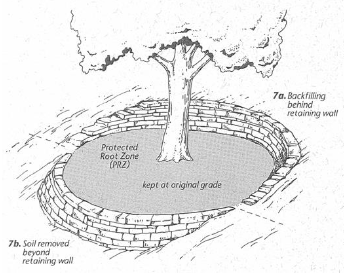
When using retaining wall when natural grade must be raised or lowered, the tree well shall be designed in accordance with the design concepts depicted below:
G.
Tree Protection and Planting
1.
The City of Cibolo Tree Preservation under the UDC is based on the fundamental precepts of sound urban forest management. Proposed development projects are evaluated on a case-by-case (and tree-by-tree) basis, which entails evaluating the existing tree resources on a site, understanding the dynamics of trees and development impacts, and negotiating a solution that results in a development with a balanced mixture of tree species and age. The goal of each review is to assure that, through a combination of preservation and reforestation, a final product is achieved which results in a diversified and sustainable urban forest.
Trees 8 inches in diameter and greater are classified as "protected size" and receive enhanced preservation evaluation. Trees 24" in diameter of specified species are classified as "Heritage Trees." Both protected and Heritage trees require a permit to: remove, impact the CRZ (i.e. utility trench, sidewalk, driveway, irrigation lines, foundation) or remove more than 30% of the canopy.
2.
Tree protection will be installed before any site work is initiated and maintained for the duration of the construction work. Tree protection will consist of the following:
a.
It will consist of fencing (orange mesh or chain link) placed around the CRZ but in no event less than five (5) feet. And;
b.
A 6-inch layer of mulch within the entire available root zone area is required for trees which have any disturbance indicated within any portion of the CRZ.
c.
No vehicles or construction materials/debris will be allowed in the CRZ.
d.
No equipment shall be cleaned, or other liquids deposited within the limits of the drip line of any Heritage/Protected Tree. This includes, but is not limited to, paint, oil, solvents, asphalt, concrete, mortar, or other materials;
e.
No signs, wires, or other attachments, other than those of a protective nature, which have been approved in the Tree Preservation Plan, shall be attached to any Heritage/Protected Tree;
f.
Trespassing or throwing trash into a Protective Fence area is prohibited.
g.
Any damage done to tree crowns or roots will be repaired immediately and any wounds on live oaks will be painted with pruning paint within 60 minutes to prevent oak wilt.
h.
Wells or retaining walls around the CRZ will be used if proposed finished grades will raise or lower the natural CRZ grade by more than 6 inches.
i.
The finished CRZ will be pervious.
j.
For commercial, multifamily and other developments; a minimum of 25% of the total CRZ must be preserved.
k.
For single family residential development of single or contiguous lots (contiguous lots include three or more lots), a minimum of 50% of total CRZ must be preserved.
l.
For individual lots within a subdivision, 45% of total CRZ must be preserved.
m.
Utility and flatwork per the original builder's plan are exempt for up to 45% of the CRZ.
n.
To prevent damage to tree trunks, trees may not be placed within three feet (3') of curbing or end of a parking space. Durable wheel stops shall be used in limited space areas.
3.
A tree removal permit shall be required to remove heritage trees and protected trees. There is a mitigation requirement imposed for the removal of all heritage and/or protected trees.
4.
Residential home builders in the City are required to plant, or preserve, a minimum of two (2) approved trees per dwelling lot. When mature, the species planted will have an average crown greater than 15 feet in diameter. Trees planted or allowed to remain shall have minimum two (2) inch DBH and an overall height of at least right (8) feet when planted. Trees may not be planted in the right of way.
5.
For single family residential developments, each home will have at least two (2) approved trees, each with a minimum two (2") inch DBH minimum. All trees shall be of an approved/authorized species and may be placed either in the front, rear or side yards. No trees may be planted in the ROW.
6.
Site plans should accommodate existing trees by providing islands in parking lots, grading, and landscaping surrounding structures. In commercial, multifamily, and other developments, trees will be added to the landscape, as necessary, to have the equivalent of four (4) inch DBH per fifty (50') feet of street frontage.
Tree Preservation Design Criteria
Critical Root Zone (CRZ):
One foot from the tree trunk for each diameter inch of trunk size. Critical Root Zone (CRZ) Impacts
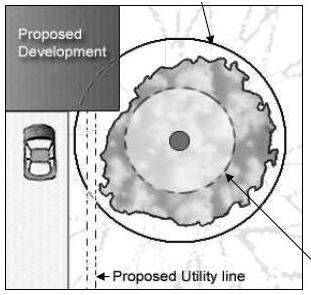
Example: a tree with a 20-inch diameter trunk has a 20-foot CRZ and a 10-foot ½ CRZ.
Tree Preservation Design Criteria
Critical Root Zone (CRZ) Impacts
A tree's root system ranges well beyond the dripline. The CRZ has been established
to set a practical limit beyond which any loss of roots would not have a significant
impact on a tree's survival. Design constraints often dictate that trees slated for
preservation have some encroachment on their critical root zone. Weighing this fact
with what appears to be an acceptable degree of risk to most trees, the following
minimum design criteria (maximum allowable impacts) have been established.
• Reference above to determine minimum CRZ to be preserved at natural grade, with natural ground cover; and
• No cut or fill greater than four (4) inches will be located closer to the tree trunk than the ½ CRZ.
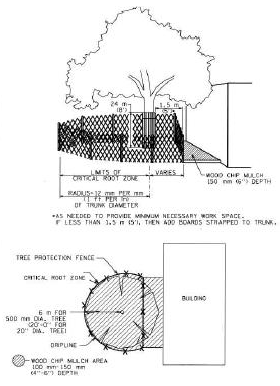
Tree Protection
In order to assure that trees are adequately preserved, tree protection fencing is
required for trees within the limits of construction.
Fencing should protect the entire Critical Root Zone (CRZ) area. Fencing is required
to be chain link mesh or orange mesh at a minimum height of five feet. A 6-inch layer
of mulch within the entire available root zone area is required for trees which have
any disturbance indicated within any portion of the Critical Root Zone.
_____
H.
Conservation Development Buffers
A Conservation Development use adjacent to, or directly facing, a single-family zoning district shall provide a minimum twenty-foot (20') landscape buffer adjacent to the property line of the residential use or residentially zoned property.
Landscape buffer trees:
A minimum of one (1) large tree shall be planted for each forty linear feet (40'),
one (1) medium tree every thirty linear feet (30'), one (1) small tree every twenty
linear feet (20'), or any combination thereof within landscape buffer.
Landscape buffer shrubs:
A minimum of ten (10) shrubs shall be planted for each forty linear feet (40') of
landscape buffer. Buffer shrubs shall be evergreen or similar, a minimum of eighteen
(18) inches in height at time of planting and of a variety that can be expected to
reach four to five (4-5) feet in height within three (3) to five (5) years of initial
planting.
All other areas within the landscape buffer shall be covered with grass or another solid vegetative cover approved at the time of Site Plan approval. The buffer wall standards below shall also be applicable.
I.
Fiscal Security for Trees
1.
Posting of fiscal at subdivision.
The owner must post fiscal security with the City prior to a request for recordation of the final plat or prior to subdivision construction plan acceptance, whichever comes first, if the replacement trees required under the approved tree replacement plan have not been installed and accepted by the City Planner or designee.
2.
Posting of fiscal for phased site plans.
The owner must post fiscal security with the City if the tree replacement plan is to be implemented in phases as part of an approved site plan that is in phases. This fiscal security is intended to apply to those situations where protected trees are removed in one phase of the development and the replacement trees are intended to be planted in a subsequent phase of the development. The fiscal security must be posted prior to final site plan approval.
3.
Amount.
The amount of fiscal security posted by the owner shall equal the estimated cost to complete the approved tree replacement plan. The owner's landscape architect shall provide the City Planner or designee with a sealed opinion of the probable cost for approval.
4.
Time.
The fiscal shall be posted for a two-year time period.
5.
Types.
In a form approved by the City attorney, an owner may post as fiscal security:
a.
Cash;
b.
A performance bond; or
c.
A letter of credit.
6.
Expenditure of fiscal security.
The city may draw on the fiscal security and pay the cost of completing the tree replacement plan approved if it determines that the owner has breached the obligations secured by the fiscal security or the two-year time period for the installation of the replacement trees has expired. The city shall refund the balance of the fiscal security, if any, to the owner. The owner shall be liable for the cost that exceeds the amount of fiscal security, if any, including any costs incurred by the City to draw on the fiscal security.
7.
Return of fiscal security.
The city shall return the fiscal security to the owner when final inspection approval is provided by the City Planner or designee.
J.
Administration and Enforcement
This article will be administered and enforced by the Parks Department and the City Planner or designee.
1.
Administration
a.
The role of the Parks Department is to:
i.
Provide technical advice to the City Planner or designee regarding trees;
ii.
Provide technical advice regarding protected trees and tree replacement plans to the Planning and Zoning Commission through the plat review process;
iii.
Approve or disapprove of the removal of protected trees unrelated to the site plan or subdivision processes; and
iv.
Review and recommend updates to this tree protection and preservation ordinance.
b.
The role of the City Planner or designee is to approve or disapprove protected trees to be preserved, removed, or replaced as part of the site plan and subdivision process.
c.
The role of the Planning and Zoning Commission is to approve or disapprove protected trees to be preserved, removed, or replaced as part of the subdivision process.
2.
Enforcement.
a.
Inspections.
The Parks Department, City Planner or Code Enforcement are hereby authorized to make such inspections and take such actions as may be required to enforce the provisions of this article.
b.
Powers and duties.
The Parks Department, City Planner and/or Code Enforcement shall have the following powers:
i.
To enforce the provisions of this article, file complaints in municipal court against persons who violate any of its provisions.
ii.
To enter any premises for the purpose of inspecting the trees provided for in the tree surveys and tree replacement plans; the protection of trees on the site; the trees being installed; the trees being removed or to perform official duties.
iii.
To ensure compliance with this article where a tree replacement plan has been submitted and approved.
iv.
To issue a stop work order to a person to cease performing any work being done without a requisite permit or otherwise in violation of this article.
c.
Faulty work.
i.
If the installation of replacement trees are found to be of substandard quality, incorrectly or defectively installed or found not to be installed in accordance with the tree replacement plan, the Parks Department or Code Enforcement, as appropriate, shall notify the owner in writing of all the changes that need to be made in order for the work to conform with the tree replacement plan and the provisions of this article.
ii.
If the Parks Department or Code Enforcement, as appropriate, finds that the protected trees on the site were damaged due to construction during the subdivision or site plan process, the Parks Department or Code Enforcement, as appropriate, shall notify the owner in writing identifying the damaged trees and the owner shall replace the damaged trees in accordance with Section E.
iii.
A subdivision plat shall not be recorded, a certificate of occupancy shall not be issued, or fiscal security shall not be released until the Parks Department or Code Enforcement, as appropriate, re-inspects the site and finds that the changes requested have been completed correctly and in accordance with the tree replacement plan and the provisions of this article or the fiscal security posted is paid into the tree fund.
d.
Final inspection.
i.
Upon the completion of all the installation of trees, the owner shall notify the City Planner or designee, as appropriate, that the work is ready for final inspection.
ii.
If faulty work or substandard plant material is found, the owner shall be notified of the necessary changes to be done in accordance with article. If such work is found to be correctly installed and in accordance with the tree replacement plan, the Parks Department or Code Enforcement, as appropriate, shall provide written notification to the appropriate City Planner or designee that the owner has met the requirements of this article.
K.
Exceptions.
1.
During the period of an emergency, such as a tornado, storm, flood or other natural disaster, the requirements of this article may be waived as deemed necessary by the emergency management coordinator or other designee of the City manager. In addition to rights granted by easement, utility service providers, lawfully within the right-of-way, may remove trees during the period of an emergency that are determined by the provider to be a danger to public safety and welfare by interfering with utility service.
2.
The City shall have the right to plant, prune, remove and maintain any protected tree located on a right-of-way, easement, public parkland or any other city-owned property as may be necessary to ensure public safety. The City may remove or cause or order to be removed any protected tree or part thereof which is in an unsafe condition, or which by reason of its nature or location unreasonably interferes with the construction, maintenance or replacement of wastewater lines, water lines, drainage facilities, streets or other public improvements. Before removing a champion or heritage tree for any of the reasons provided above, a city department shall consult with the Parks Department and/or Code Enforcement, as appropriate, to determine whether a champion or heritage tree may be removed, with the final decision being made by the City Manager or designee.
L.
Violations.
Violations of this article shall be punishable by a fine as provided in the Code of Ordinances, and each protected tree that is unlawfully removed or damaged shall constitute a separate offense. Criminal prosecution shall not preclude civil action by the City to recover for the damage or loss of the tree, and the City attorney is hereby authorized, without further authorization from the City Council, to institute and prosecute a lawsuit against any person who unlawfully removes or damages a protected tree, to recover the reasonable value of the tree.
M.
Appeals.
1.
Denial of protected tree removal permit.
If an application for a protected tree removal permit is denied, the applicant may appeal such action to the Zoning Board of Adjustment by filing written notice of such appeal with the City Planner or designee within ten days of notice of the denial of the application by the Parks Department or Code Enforcement, as appropriate. The Board shall have 45 days from the date of the appeal to review said denial. The Board may affirm or reverse the determination of the Parks Department or Code Enforcement. If the board fails to act within 45 days, the appeal shall be automatically granted, and a protected tree removal permit issued.
2.
Denial of tree removal request through the subdivision process.
If a protected tree removal request is denied, the applicant may appeal such action to the City Council by filing written notice of such appeal with the City Planner or designee within ten days of notice of the denial of the application by the Planning and Zoning Commission. The City Council shall have 30 days from the date of the appeal to review said denial. The City Council may affirm or reverse the determination of the planning and zoning commission. If the City Council fails to act within 30 days, the appeal shall be automatically granted and a protected tree removal request approved.
3.
Denial of tree removal request through the site development or subdivision improvement permit process.
If a protected tree removal request is denied, the applicant may appeal such action to the Zoning Board of Adjustment by filing written notice of such appeal with the City Planner or designee within ten days of notice of the denial of the application by the City Planner or designee. The Board shall have 45 days from the date of the appeal to review said denial. The Board may affirm or reverse the determination of the City Planner or designee. If the Board fails to act within 45 days, the appeal shall be automatically granted and a protected tree removal request approved.
N.
Tree Fund
1.
The tree fund shall consist of fees generated as a result of tree replacement requirements as well as general donations for public tree plantings.
a.
Establishment of fund.
A tree fund is hereby established.
b.
Funds to be deposited.
Tree replacement fees for the installation of replacement trees, as provided for in Section E, shall be deposited in the tree fund.
c.
Use of funds.
Expenditures from the tree fund shall be used solely for purchasing and installing trees and associated irrigation on public rights-of-way, public park land or any other city-owned property and for administering the tree fund.

