
Cibolo City Zoning Code
ARTICLE 18
- TRANSPORTATION19
Editor's note—Ord. No. 1332, § I(Exh. A), adopted April 27, 2021, amended Art. 18, §§ 18.1—18.19, in effect replacing said article with §§ 18.1—18.19, as set out herein. Formerly, Art. 18 pertained to similar subject matter and derived from Ordinance 1233, adopted April 24, 2018; and Ord. No. 1324, § 1, adopted Dec. 8, 2020.
Section 18.1 - Public Streets
Streets shall be designated, designed and constructed as necessary to comply with all requirements of the Cibolo Design and Construction Manual and the additional standards contained in this Article.
A.
Street Layout
The arrangement, extent, character, width, grade and location of all streets shall conform to the Future Thoroughfare Plan and the Comprehensive Master Plan. Collector streets shall provide adequate circulation within the neighborhood and yet discourage through traffic. The street layout shall be arranged to achieve the most desirable development of the entire neighborhood unit with appropriate consideration of creeks, drainage channels, wooded areas and other topographical features, which lend themselves to special treatment. Permits must be obtained from TxDOT for driveways and streets accessing any State highway. The proposed location of driveways must comply with all applicable City and State safety requirements.
B.
Relation to Adjoining Streets
Adjoining areas shall be continued and tied into the street layout.
C.
Projection of Streets
When adjoining properties are not yet subdivided, the arrangement of streets shall provide for the proper projection of streets into the adjoining non-subdivided areas and will be required to comply with the neighborhood pattern or conform to the Future Thoroughfare Plan and Future Land Use Map.
D.
Right-of-Way and Pavement Widths
In newly developed subdivisions, right-of-way shall be dedicated by the developer and pavement width constructed in accordance with the Future Thoroughfare Plan, the City Design and Construction Manual and all other requirements of this UDC. The classifications of the streets shall be as determined by the City Engineer and approved by the City Council. The Cibolo Design and Construction Manual provides the requirements for right-of-way and pavement widths, median widths, crown or cross slope and related technical design standards of the City. In construction projects by the City, where the desired right-of-way is not available for the pavement width specified in the Cibolo Design and Construction Manual, the City Engineer will determine the pavement width to be used on the project. Said pavement width must be approved by the City Council.
E.
Responsibilities of the Developer
The subdivider shall pay all design, engineering, labor, and construction costs for transportation related improvements required by this UDC, except to the extent that this section specifically provides for full or partial payment by the City. The provisions of this section shall apply to resubdivisions as well as to subdivisions. Specifically, the developer shall be responsible for the following:
1.
Phasing of development or improvements in order to ensure the provision of adequate public facilities;
2.
Extensions of public facilities and roadways, including any necessary on- and off-site facilities, to connect to existing public facilities;
3.
Providing and/or procuring all necessary property interests, including rights-of-way and easements, for the facilities (whether on-site or off-site);
4.
Providing proof to the City of adequate public facilities;
5.
Making provisions for future expansion of the public facilities as needed to serve future developments, subject to the City s oversize participation policies, if applicable;
6.
Providing for all operations and maintenance of the public facilities, or providing proof that a separate entity will be responsible for the operations and maintenance of the facilities;
7.
Providing all fiscal security required for the construction of the public facilities;
8.
Obtaining approvals from the applicable utility providers other than the City;
9.
Complying with all requirements of the utility providers, including the City and applicable drainage districts; and
10.
Nothing in this chapter shall be construed to require any dedication or construction that is not explicitly required by the standards within this UDC.
F.
Off-Site/Perimeter Road Improvements
Where a subdivision is adjacent to or is served by a collector or arterial street(s) that does not meet the City's minimum standards for roadway construction and/or pavement/right-of-way width, the subdivider shall make the improvements to the substandard collector or arterial street(s) and intersections as are necessary to mitigate traffic impacts generated by the subdivision or related projects. Said improvements shall be established through the completion of a Traffic Impact Analysis that meets the minimum standards specified in this Article. The City may, at its discretion, participate in the costs to oversize the improvements with the subdivider as set out herein and subject to the City's participation policies regarding oversizing improvements.
G.
Findings on Necessity for ROW Dedication, Construction and Easement Dedication
1.
Support for New Development
a)
New development must be supported by adequate levels of public facilities and services, as required and defined herein, and as limited by Section 18.1.E.
b)
It is necessary and desirable to provide for dedication of rights-of-way and easements for capital improvements, as limited by Section 18.1.E herein, to support new development at the earliest stage of the development process.
2.
Essential Nexus
There is an essential nexus between the demand on public facilities systems created by a new development and the requirement to dedicate rights-of-way and easements and to construct capital improvements to offset such impacts.
3.
Developer Obligations; Dedication and Construction of Improvements
The developer shall dedicate all rights-of-way and easements for capital improvements within the rights-of-way or easements for those transportation improvements needed to adequately serve a proposed development consistent with the applicable master facilities plans and construction design standards, as limited in Section 18.1.E, and shall construct said improvements, whether the facilities are located on, adjacent to or outside the boundaries of the property being developed in accordance with this UDC.
4.
Timing of Dedication and Construction
a)
Initial Provision for Dedication or Construction.
The City shall require an initial demonstration that a proposed development shall be adequately served by public facilities and services, as limited in Section 18.1.E, at the time for approval of the first development application that portrays a specific plan of development, including but not limited to a petition for establishing an overlay zoning district; a petition for an annexation agreement or a development agreement; an application for a Land Study, or an application for a Preliminary Plat or Final Plat. As a condition of approval of the development application, the City may require provision for dedication of rights-of-way or easements for, and construction of, capital improvements to serve the proposed development.
b)
Deferral of Obligation.
The obligation to dedicate rights-of-way for or to construct one or more capital improvements to serve a new development may be deferred until approval of a subordinate development permit, or, in the case of a development proposed to be developed in phases, until a subsequent phase of the development, on the sole discretion of the City, upon written request of the property owner, or at the City initiative. As a condition of deferring the obligation, the City may require that the developer enter into a capital improvements agreement pursuant to Article 20 of this UDC, specifying the time for dedication of rights-of-way for or construction of capital improvements serving the development.
c)
Relief from Obligations.
In order to achieve proportionality between the demands created by a proposed development on public facilities and the obligation to provide adequate public facilities, as limited in Section 18.1.E, the City may participate in the costs of public facilities in accordance with this Article or relieve the property owner of some or part of the obligations in response to a petition for relief from a dedication or construction requirements.
5.
Roadway Participation Policies - Improvement of Adjacent (Perimeter) Roads and Utilities
a)
Improvement of Adjacent Substandard Road.
When an area within a proposed plat, whether residential or nonresidential, abuts on one or both sides of an existing substandard road or utility facility, or a planned or future road or utility facility as shown on the City Thoroughfare Plan and/or adopted plans related to water and wastewater, the developer shall be required to improve the road (including appurtenant sidewalks, paths, bikeways, barrier-free ramps, storm drainage facilities, screening and landscaping, median openings, left turn lanes, and water quality or erosion controls) and utility facilities, to bring the facilities to City standards, or to replace them with standard City road or utility facilities at no cost to the City.
b)
Calculation of Cost.
i.
The developer's share of improvements to a substandard perimeter road is the equivalent of one-half of the pavement width of a collector street, per the Cibolo Design and Construction Manual requirements for collector street design, along the entire frontage of the subdivision.
ii.
The developer's share of improvements to a roadway when a subdivision is to be located on both sides of a roadway is the full width of a primary collector street, per the Cibolo Design and Construction Manual requirements for collector street design. The roadway shall be improved by the developer on each side of the road along the entire length of the subdivision, per the Cibolo Design and Construction Manual.
iii.
The City shall participate in the costs of perimeter roads in excess of the developer's fair share obligations and where such costs are not borne by another public entity, and in cases where the application of the standards in this Section result in a disproportional burden on the development, as determined by the City Engineer and approved by the City Council.
6.
Improvements.
All streets bordering subdivisions shall be improved, and/or rights-of-way platted, in accordance with standards prescribed herein. If the subdivider widens existing pavement, the existing pavement shall be cut back a distance required by the City Engineer to assure adequate sub-base and pavement joint before additional paving material is laid on top.
a)
Existing Boundary Streets.
For boundary streets which exist to some degree, for example, by previous partial dedication or prescriptive easement, the following standards shall apply.
i.
For all classifications of such streets, the subdivider must dedicate additional right-of-way to complete the desired street width from the desired roadway centerline to the final edge of right-of-way. Dedication of more than half this additional increment may be required, in some instances, to maximize use of existing roadway and/or ensure a consistent street alignment with a minimum of undesirable curvature.
ii.
For all classifications of such streets, except expressways, the subdivider must pave one-half the additional portion of street right-of-way remaining to be paved, according to the adopted Thoroughfare Plan of the City for improving that street alignment. In no instance, however, shall there be required any more than thirty-three (33') feet of additional paving, nor shall there result any less than a twenty-six (26') foot paved roadway. In lieu of actual street improvement, the subdivider shall have the following options:
(1)
The subdivider shall contribute to the City an amount of money necessary to complete all paving and curbing required. These funds shall be held, and eventually disposed of, in the manner described within Article 20 of this UDC; or
(2)
If the subdivision includes no more than two lots, then the subdivider may execute a Developer Agreement or Public Improvements Agreement which runs with the ownership of the land and which obligates the landowner to pay the City on demand the amount of money necessary to cover the cost of all required public street improvements. The said Agreement shall be on a City designated form, signed by the property owner, notarized, and filed with the official property records of the county in which the property is located.
(3)
If the right-of-way for an expressway lies adjacent to or forms part of the subdivision boundary, no paving improvements shall be required of the subdivider.
b)
New Boundary Streets.
For new boundary streets forming part of the subdivision boundary, the following standards shall apply.
i.
Minor Streets and subcollectors.
Where a minor street or subcollector forms part of the subdivision boundary, the subdivider shall dedicate right-of-way sufficient to make such street conform to requirements of this Division. The subdivider shall also improve such street in conformance with all standards and specifications of the City, including installation of curbs on both sides of the street.
ii.
Other Streets.
Where a proposed thoroughfare (other than a minor street or subcollector) forms part of a subdivision boundary, the subdivider shall dedicate approximately one-half the additional right-of-way necessary to comprise the full street width required by this Division, up to a maximum of one hundred (100') feet. Dedication of more than half this additional increment may be required, in some instances, to maximize the use of existing streets and/or to ensure a consistent street alignment with a minimum of undesirable curvature.
iii.
Partial Boundary Street.
If the right-of-way for an arterial or collector street forms part of the subdivision boundary, the subdivider shall comply with requirements of either one of the following two paragraphs:
(1)
The subdivider shall pave thirty-three (33') feet of the right-of-way in accordance with City standards and specifications.
(2)
The subdivider shall contribute to the City an amount of money equal to that necessary to complete paving and curbing as required by this UDC.
iv.
Expressway.
If the right-of-way for an expressway lies adjacent to or forms part of the subdivision boundary, no paving improvements shall be required of the subdivider.
[Section] 18.2 - Private Streets
A.
Intent and Purpose.
It is the intent of these private street regulations:
1.
To allow private street developments to occur within the city on a limited and restrictive basis;
2.
To provide for private street developments as one type of residential development mechanism to allow the city to continue to be competitive in the development market; and
3.
To provide a broader variety of residential areas to meet the needs of the residents of the city.
B.
General.
1.
There shall be no required minimum or maximum acreage size and/or number of lots within private street developments. However, minimums and maximums will be evaluated on a case-by-case basis through all applicable requirements of this UDC.
2.
The location of each private street development will be subject to the approval of the City Council, through the specific use permit process, on a case-by-case basis, based on, among other matters, the criteria described in this article.
C.
Administrative Procedures.
In order to qualify for consideration for private streets, the applicant must submit a Land Study of the proposed development demonstrating compliance with the criteria set forth below. For private street developments of twenty (20) or fewer lots, a Preliminary Plat of the proposed development may be submitted concurrently with the Land Study.
D.
Private Street Design Standards.
1.
Required.
The design and construction of the infrastructure within a private street subdivision shall conform to the same rules, regulations, standards, and specifications established for public subdivisions and as regulated in the City UDC and Cibolo Design and Construction Manual.
2.
Promulgation.
The City Engineer is hereby authorized to promulgate rules, regulations, standards, and specifications for the design and construction of improvements unique to a private street subdivision in accordance with Article 2 of this UDC.
3.
Amendments.
An amendment may be made from time to time in accordance with Article 3 of this UDC.
4.
Private Street Structures:
a.
Project perimeter fences at project entry access points, entry monuments, and security stations, may be erected within the public utility and storm sewer easement, provided they do not impede the installation, maintenance, repair, or replacement of public utilities and storm sewers within the easement.
b.
Where security stations are a part of a larger, multipurpose structure, only that portion of the structure, which functions as a security station, may encroach the building line adjacent to the private street.
E.
Maintenance.
1.
The property owners' association shall be responsible for periodic inspection and maintenance of all infrastructure except utilities (water, sanitary sewer, storm sewer, gas, cable, phone and electric lines).
2.
The city has no obligation to inspect or maintain a private street.
3.
In the event that the property owners' association fails to make repairs required by the city, the city shall have the right, but not the obligation, to cause the repairs to be completed and collect the cost of the same from the property owners' association for said work.
4.
If the property owners' association fails to maintain access as required in this article, the city may enter the subdivision and remove any gate or device, which is a barrier to access, at the sole expense of the property owners' association.
F.
Guidelines for Development.
The proposed development shall be evaluated with respect to the following guidelines as part of the review and approval process for all private street developments. Subsections 1-3 below are mandatory and shall be required for all private street developments. Subsections 4-7 below are recommended guidelines, the degree to which each is satisfied should be reviewed by Cibolo city staff, the Planning and Zoning Commission, and City Council, as a part of the determination of the merits of any individual proposed private street development.
1.
The area shall be within the corporate limits of the city.
2.
The development plan shall not impede the current or future street circulation needs of the area, especially any needed collector or arterial street route, or adequate access to any adjoining tract.
3.
Area shall not disrupt an existing or proposed city public pedestrian pathway, hike and bike trail or park.
4.
If the area is intended for residential use (may be an existing or proposed residential development), it should be zoned solely as a residential zoning district (that is, a zoning district the stated purpose of which is to provide for primarily residential uses).
5.
The area should be bounded on all sides by natural barriers, manmade barriers such as a greenbelt, hike and bike trail, golf course or park, screening walls, or collector thoroughfares.
6.
Except where substantial existing natural or manmade barriers would render the requirement unreasonable, each such development should have direct access to a two-lane collector street width, unless a lesser width two-lane collector is determined adequate due to an absence of need for on-street parking), in addition to any access to one or more arterial streets that may be proposed. Any private street development of such limited size that it does not require direct collector street access for appropriate traffic service may instead have access to a collector street within the neighborhood by way of another local street.
7.
The proposed private street subdivision should not result in an overconcentration of such developments, to the extent of dominating the neighborhood development pattern.
G.
General Design Requirements.
1.
The private street system must comply with design standards of this UDC. All references in this UDC to "public right-of-way" shall apply to private street lots.
2.
The private street system must provide access for emergency vehicles, public and private utility maintenance and service personnel, the U.S. Postal Service, and government employees in pursuit of their official duties.
3.
The type of gate or controlled access mechanism is subject to the approval of the City Fire Marshal.
H.
Specific Requirements.
1.
Each private street development plat shall contain the following wording on the face of the plat:
"The streets have not been dedicated to the public for public access nor been accepted by the city as public improvements, and the streets shall be maintained by the property owner's association within the subdivision. The streets shall always be open to emergency vehicles, public and private utility service personnel, the U.S. Postal Service and governmental employees in pursuit of their official duties."
2.
For gated communities, the type of gate or controlled access mechanism shall be subject to the approval of the Fire Chief.
3.
Private streets shall be located in a public utility and storm sewer easement. The width of the easement shall be the same as the required right-of-way width for a public street.
4.
Easements.
Private street developments shall provide the following easements:
a.
Public utility and storm sewer easements containing private streets and public utilities;
b.
Additional public utility easements required by public agencies;
c.
Pre-existing easements unaffected by the platting process; and
d.
Such private service easements, including, but not limited to, utilities, fire lanes, street lighting, government vehicle access, mail collection and delivery access, and utility meter reading access, as may be necessary or convenient.
5.
All private street developments shall be required to have a minimum of one point of access to a public street having a right-of-way width of at least 60 feet, unless specifically approved otherwise.
6.
As applicable, impact fees will be required per the requirements of the City.
7.
As applicable, park dedication requirements shall be made per this UDC.
I.
Inspections and City Engineer Approval Required.
1.
All private streets shall be subject to typical City inspections, as required by this UDC for public streets, to ensure that the private street is constructed in accordance with all public street construction requirements, as required by the City Design and Construction Manual.
2.
Upon the completion of private streets, final City Engineer approval shall be required to certify that the private street complies with all requirements of this UDC and the City Design and Construction Manual.
3.
Private streets shall be subject to periodic City inspections to ensure that private streets are being maintained in accordance with City street maintenance requirements. The City Manager, after consultation with the City Engineer, shall have the prerogative to require a repair to any private street to ensure that a private street in maintained in accordance with City street maintenance requirements.
J.
Conversion of an Existing Public Street to a Private Street.
In order to convert an existing public street to a private street, the following criteria will be applicable:
1.
A development application shall be submitted that contains the signatures of all owners of existing lots that would be part of the proposed private street subdivision;
2.
An applicant must purchase installed infrastructure and right-of-way from the City, and establish a reserve fund, as described below, determined to be adequate and sufficient by the City Council. and;
3.
An applicant must conform to all other provisions of this UDC.
K.
Relationship to the City Comprehensive Master Plan.
The following components shall be evaluated when reviewing potential private street developments. This evaluation will aid in logical implementation of the City Comprehensive Master Plan.
1.
Future Land Use Plan. Impact on land uses, their configuration, and function shall be examined as part of each request for a private street development.
2.
Future Thoroughfare Plan. The proposed private street development will be evaluated to assess its impact on the efficiency, convenience and safe functioning and implementation of the Thoroughfare Plan.
L.
Property Owners Association.
1.
Required.
Subdivisions with private streets shall have a property owners' association, the property owners' association shall own and be responsible for the maintenance of private streets and appurtenances. The property owners' association shall provide for the payment of dues and assessments required to maintain the private streets. The property owners' association documents must be acceptable to the City at the time of Final Plat approval. The approved document must be filed for record contemporaneously with the filing of the record plat.
2.
Reserve fund.
The property owners' association documents must establish a reserve fund for the maintenance of private streets and other improvements such as common greenbelts, security station structures and equipment, and other significant property owners' association infrastructure. This reserve fund shall not be commingled with any other property owners' association fund. The balance of the fund shall be equal to the total replacement cost of the private streets and other improvements divided by the average life expectancy of those improvements times the age of the improvements. The life expectancy for a subdivision with concrete streets shall be a minimum of 20 years.
3.
The property owners' association shall have an annual review performed by a certified public accounting firm verifying the amount in the reserve fund. A copy of this review shall be provided to the City.
4.
If the specific use permit is revoked or the private streets converted to public streets, the reserve fund shall become the property of the City.
5.
Membership requirements.
Every owner of a lot within the private street development shall be a member of the property owners' association.
6.
Required disclosures.
The property owners' association documents shall address, but shall not be limited to, the following four subsections:
a)
The property owners' association documents must indicate that the streets within the development are private, owned and maintained by the property owners' association and that the City has no obligation to maintain or reconstruct the private streets;
b)
The property owners' association documents shall include a statement indicating that the City may, but is not obligated to, inspect private streets, and require repairs necessary to ensure that the same are maintained to City standards;
c)
The property owners' association may not be dissolved without the prior written consent of the City;
d)
The Private Street Agreement stipulations shall be included in the property owners' association documents, to increase the opportunity for awareness of mandatory conversion of private streets to public streets.
7.
Assignment of property owners' association lien rights.
The property owners' association declaration shall provide that should the property owners' association fail to carry out its duties as specified in these regulations, the city or its lawful agents shall have the right and ability, after due notice to the property owners' association, to perform the responsibilities of the property owners' association if the property owners' association fails to do so in compliance with any of the provisions of these regulations or of any applicable city codes, regulations or agreements with the City and to assess the property owners' association or the lot owners for all costs incurred by the City in performing said responsibilities if the property owners' association fails to do so, and the City shall further have any and all liens and lien rights granted to the property owners' association to enforce the assessments required by the declaration, and/or to avail itself of any other enforcement actions available to the city pursuant to state or city codes and regulations. No portion of the property owners' association documents pertaining to the maintenance of the private streets may be amended without the written consent of the city.
8.
Services not provided.
The property owners' association documents shall note that certain city services shall not be provided on private streets. Among the services that will not be provided include routine police patrols, enforcement of traffic and parking ordinances, and preparation of accident reports. Depending on the characteristics of the proposed development, other services may not be provided.
9.
Access required.
The property owners' association documents shall contain a provision that requires access to emergency vehicles, utility personnel, the U.S. Postal Service, and governmental employees in pursuit of their official duties.
[Section] 18.3 - Conversion of Private Streets to Public Streets
A.
Voluntary Conversion
The City may, but is not obligated to, accept private streets for public access and maintenance. The procedure must conform to all of the following provisions:
1.
The property owners' association must submit a petition signed by at least 51 percent of its members (or a greater number of signatures if required by the property owners' association document).
2.
All the infrastructure must be in a condition that is acceptable to the city.
3.
All security stations, gates, and other structures not consistent with a public street development must be removed.
4.
All monies in the reserve fund must be delivered to the city.
5.
The subdivision plat shall be submitted to the city as a replat and upon review and approval, shall be filed with the County Recorder to dedicate the streets, public utility easements, storm sewer easements and any other public easements to the city. An ordinance converting the private streets to public streets must be approved by the City Council prior to the filing of said subdivision plat.
6.
The property owners' association documents must be modified and refiled to remove requirements specific to private street subdivisions.
B.
Mandatory Conversion
1.
The City will notify the property owners' association of violations of the private street regulations. Failure to bring the subdivision into compliance with all applicable regulations of this UDC may cause the City to revoke the right to maintain a private street
[Section] 18.4 - Condominium Drives
A.
In order to provide for orderly development and provision of services, the City Manager or their designee may approve the creation of named condominium drives as part of a residential condominium project. These drives are not dedicated city streets and maintenance is solely the responsibility of the property owner.
B.
If the City Manager does not approve the designation of the drives as condominium drives, the applicant may appeal the decision to City Council as part of the plat approval process.
C.
Proposed condominium drives shall be located within access/fire lane/utility easements as determined necessary by the City Engineer and Fire Chief.
D.
Condominium drive names shall be approved by the City Engineer.
[Section] 18.5 - Private Street Exemptions
A.
A private street or road serving only one (1) residence is exempt from construction and maintenance standards for public streets.
B.
The requirements of this section shall not pertain to private streets legally established prior to the effective of this UDC, provided that any such private street maintains its nonconformity and is not proposed to be expanded.
C.
The requirements of this section shall not pertain to legally established private streets that are annexed into the City, provided that any such private street maintains its nonconformity and is not proposed to be expanded.
[Section] 18.6 - Arrangement of Streets Not Designated on the Future Thoroughfare Plan
A.
Streets not shown on the Future Thoroughfare Plan shall be arranged and designed in accordance with the follow standards:
1.
Provide for continuation and appropriate projection of existing streets from or into surrounding areas;
2.
Conform to a neighborhood plan adopted by the City to meet a situation where topographical or other conditions make continuance or conformity to existing streets impractical;
3.
Provide for future access to adjacent lots, tracts or parcels that will likely develop under a similar zoning classification and/or for a similar type of land use; and
4.
Not conflict in any way with existing or proposed driveway openings.
B.
Reserve strips controlling access to streets shall be prohibited except where their control is placed by the City under conditions approved by the City Council through approval of the Final Plat.
C.
Intersecting, undivided streets with intersection offsets of less than 150 feet shall be avoided. Intersecting streets onto a divided roadway must be configured such that the centerline offset will accommodate the appropriate left-turn lanes with required transition and stacking distances as determined by the City Engineer onto each of the two intersecting streets.
D.
Dead-end streets shall be prohibited, except as short stubs projected to be continued in future subdivisions. Temporary all-weather turnarounds approved by the City Engineer and Fire Chief shall be provided on such streets until such time as they are extended. In the case of a dead-end street that will eventually be extended into an adjacent subdivision, no more than one (1) lot per side may front onto the dead-end street stub unless a temporary turn around bulb with an appropriate easement is provided for a turn around. A temporary dead-end street shall not exceed 150 feet in length and the temporary turn-around bulb must be constructed to cul-de-sac standards as described above. A note shall be placed on the final plat clearly labeling any dead-end streets that will at some point be extended into adjacent property and signage shall be placed at the end of the constructed street stub stating that the street will be extended in the future. Said signage shall be shown on the construction plans and shall be of a size and include lettering that must be large enough to be legible by a person with normal vision at a twenty-foot distance.
E.
Cul-de-sac streets shall not exceed 500 feet in length and shall adhere to the following standards
1.
Single-Family and Duplex Residential: Turnaround ROW of not less than 120 feet (120') outside diameter and a paving width of not less than 100 feet outside diameter, measured curb to curb;
2.
Multi-Family Residential: Turnaround ROW of not less than 150 feet (150') outside diameter and a paving width of not less than 130 feet outside diameter, measured curb to curb;
3.
Commercial and Industrial: Turnaround ROW of not less than 200 feet (200') outside diameter and a paving width of not less than 180 feet outside diameter, measured curb to curb;
4.
The paving diameter width in said cul-de-sacs may be modified upon approval of the Fire Chief and City Engineer only upon demonstration of cause and proof that public health and safety would not be compromised.
F.
Single-family residential cul-de-sac street length may be extended up to a maximum length of 1,000 feet, as measured from the centerline of street intersecting the cul-de-sac to the center point of the cul-de-sac turnaround, provided that the number of lots located on the cul-de-sac street does not exceed twenty-five (25) lots.
[Section] 18.7 - Street Design
A.
Alignment.
The alignment of all arterial and collector streets shall conform to the Future Thoroughfare Plan, this UDC and the requirements of the Cibolo Design and Construction Manual. Street alignment shall meet the requirements of the Cibolo Design and Construction Manual and in no case shall street jogs be offset less than 150 feet on centerline, except in the case of two local streets, which may have an off-set of 125 feet on centerline.
B.
Intersections.
All intersections on arterial and collector streets shall be at ninety (90°) degrees, or within five (5°) degrees of that standard. The curb radius at street intersections shall conform to the specifications in the Cibolo Design and Construction Manual. Deviations from this requirement can be considered by City Council when streets are being realigned in order to comply with the Future Thoroughfare Plan or to avoid natural, or man-made features, such as, but not limited to, protected wetlands, bogs, floodplains, a stand of heritage trees, artifact areas, historic buildings or sites, pipelines, easements or existing development.
C.
State Highway Alignment Criteria and Coordination.
Prior to accessing or designing facilities within TxDOT ROW, the engineer of record shall contact the appropriate regulatory agency to determine any special design, construction requirements and/or permitting requirements and shall copy the Director of Engineering on all correspondence with each regulatory agency. Roadway and driveway connections within a TxDOT ROW shall meet the requirements of the TxDOT Area Office and the TxDOT Roadway Design Manual. Driveway permits for drives connecting to TxDOT rights-of-way shall be processed through the Director of Engineering.
D.
Public Access to Subdivisions.
1.
All residential subdivisions shall have a minimum of two (2) locations accessing existing public streets. Access may be provided through the construction of a public street. The extent and location of all accesses is subject to review and approval by the City. The City Council shall not permit "island" subdivisions, lots or streets that would be surrounded by the flood waters.
2.
All subdivisions containing more than thirty (30) lots must have at least two (2) points of vehicular access and must be connected to the City's improved thoroughfare and street system by one or more approach roads of such dimensions and constructed of such standards that are in accordance with the Cibolo Design and Construction Manual for public streets Two (2) points of vehicular access" shall be construed to mean that the subdivision has at least two (2) roads accessing the subdivision from the City's improved thoroughfare/street system. The City Council may, at its discretion and upon a finding that such will not compromise the public safety or impede emergency access, accept a single median-divided entrance from the City's improved thoroughfare/street system provided that the median extends into the subdivision for an unbroken length of at least one hundred and fifty (150') feet to an intersecting interior street that provides at least two (2) routes to the interior of the subdivision. The City Council shall have the discretion to approve a Phasing Plan as a part of a Land Study that specifies where and when a second point of access will be provide and/or to require a Maintenance Bond equal to the cost of proving a second access point to the development.
E.
Access to Principal and Secondary Arterial Streets and Highways
Access to principal and secondary arterial streets should be limited to protect the flow of traffic from the lots. A one (1') foot non-access easement shall be provided along principal and secondary arterial streets and highways when lots have access to another public right-of-way.
F.
Partial or Half Streets and Adjacent Streets
1.
Wherever a half-street has already been provided adjacent to an area proposed to be subdivided, the subdivider of the other remaining portion of the street shall be platted with such subdivision. Where part of a street is being dedicated along a common property line where no roadway currently exists, the first dedication of ROW shall be of an adequate width so that the developer shall be responsible for at least 24 feet of clear pavement width, as considered necessary by the City Engineer. Additional ROW. and easements shall be dedicated as necessary to install signage and to perform grading activities and to conform to the requirements of this UDC, the Future Thoroughfare Plan and the Cibolo Design and Construction Manual, except as may be limited by Section 18.1.G of this Article.
2.
New half streets that do not conform to the Future Thoroughfare Plan, this UDC and Cibolo Design and Construction Manual shall not be platted without the expressed approval of City Council as a part of a Public Improvements Phasing Schedule or proffer a Public Improvements Agreement for impact fee credits to complete road improvements designated on the Future Thoroughfare Plan.
3.
Where a proposed subdivision abuts an existing street, or half street, that does not conform to the UDC, the Future Thoroughfare Plan of Cibolo Design and Construction Manual, the subdivider shall be required to dedicate any additional ½ right-of-way necessary to meet the street width requirement, except as may be limited by Section 18.1.G of this Article. The developer may submit a Public Improvements Phasing Schedule or proffer a Public Improvements Agreement for impact fee credits to complete road improvements designated on the Future Thoroughfare Plan.
4.
Street improvements required by this section shall include right-of-way dedication, paving, curb and guttering, shoulder improvements and sidewalks, as required by this UDC and the Cibolo Design and Construction Manual.
5.
In the event that a street stub is provided to connect to a future phase or a future adjoining development, the City Engineer and City Council may consider a temporary cul-de-sac, alternative turn around design, such as a hammer head, or a Maintenance Bond, as may be appropriate, to provide a temporary turn around or an eventual connection to the adjoining phase or an adjoining development.
G.
Street Signs and Traffic Control Devices
1.
Street signs in new subdivisions; including street name, speed limit, stop and yield signs, etc. shall be paid for by the developer, and shall be provided by and installed according to the Cibolo Design and Construction Manual. Traffic control devices required within the subdivision per an approved Traffic Impact Analysis or as required by this UDC or Cibolo Design and Construction Manual, shall be installed in accordance with the latest revision of the Texas Manual on Uniform Traffic Control Devices for Streets and Highways.
2.
The materials used for street name and street signage, the method of attaching the sign to the post, the details of lettering, painting, and method of installation, as well as the location of the sign at the intersection shall be in accordance with the specifications in the Cibolo Design and Construction Manual.
3.
The criteria and specific design standards for all transportation related improvements shall be as described in this Article and the Cibolo Design and Construction Manual.
4.
Any installation of speed control or traffic calming improvements may be considered by the City Manager and City Council in accordance with accepted traffic engineering practices. City Council shall request recommendations for said improvements by the City Engineer and the Cibolo Police and Fire Chiefs. Any request made to propose the installation of traffic calming improvements must be accompanied by Traffic Impact Analysis completed at the expense of the party requesting traffic calming improvements.
H.
Medians
1.
Medians in road rights-of-way will be considered on a case-by-case basis. The street right-of-way will be engineered to accommodate all emergency and utility vehicles, after coordination by the City Engineer and City Manager. At a minimum, medians shall provide at least twenty-four (24') feet of pavement on each side of the median.
2.
Medians in street ROW shall considered to be traffic control devices. However, should a developer want to install landscaping, walls fountains or any other aesthetic treatment, the plat shall include a general note specifying that the developer or its successors and/or assigns is responsible for the maintenance, repair of all improvement within the median. The maintenance of landscaping installed in a median shall be the responsibility of the developer or a duly authorized Homeowner Association and shall be irrigated and maintained in accordance with all Landscaping requirements contained in this UDC. Median landscaping shall be subject to the approval of a Landscape Plan and the issuance of permits for any electrical, irrigation or structural improvements. The City shall reserve the right to require the developer or its successors and/or assigns, to trim landscaping as necessary to ensure that the right-of-way is clear for traffic. Any islands that are not maintained in accordance with this section may be removed by the City and shall be removed at the expense of the developer or its successors and/or assigns, after due notice and the written recommendation by the City Engineer.
3.
Foliage of hedges, trees, and shrubs located in or encroaching into public right-of-way shall be maintained such that the minimum overhang above a sidewalk shall be eight (8') feet and the minimum overhang above an arterial or collector street shall be fourteen (14') feet.
[Section] 18.8 - Street Names and Street Numbers
Names of new streets shall not duplicate the names of existing streets within the City and its ETJ unless the new street is a continuation of or part of a future continuation of such existing street. Street names shall be chosen to avoid name similarity or confusion. A new street name shall not differ from an existing street name solely by the addition of a different auxiliary designation such as "avenue", "way", "boulevard", etc. Names of all new streets shall be subject to coordination on an area and region wide basis. Street names shall have prior approval of the United States Postal Service, Bexar Metro 911, and the applicable County officials. Street addresses should also be coordinated with present existing addresses.
Proposed street names shall be submitted with a Land Study and Preliminary Plat. When a Final Plat is submitted, the applicant must submit a copy the names selected by the U.S. Postal Service as "approved" street names. The City reserves the right to request a name change prior to plat recordation to avoid name similarity and avoid confusion. The City, in concert with the U.S.P.S. and Bexar Metro 911, will determine street numbers and advise the subdivider as to the street numbers and sequencing.
[Section] 18.9 - Construction Standards
All public and private streets shall be constructed with reference to base, surfacing, curbs, grades, horizontal curves and intersection curve radius in accordance with the standards prescribed in the Cibolo Design and Construction Manual and any other applicable specifications of the City. The City Engineer can consider deviations from the City Construction Standards when a deviate is determined to acceptable and appropriate based on accepted engineering standards and practices and/or appropriate for the specific location based on specific circumstances of any improvement. Any other deviation from a Construction Standard of the City shall require City Council approval.
[Section] 18.10 - Street Drainage
The storm drainage for all local streets shall be designed to a 10-year storm capacity curb face to curb face and to a twenty-five (25) year flood frequency within right-of-way of each local street. All arterial and collector streets designated as such on the Future Thoroughfare Plan shall be designed to a 20-year storm event curb face to curb face and to a twenty-five (25) year flood frequency within right-of-way of each collector and arterial street. Runoff rates shall be computed in all cases based on ultimate development of the entire watershed contributing runoff water to the proposed subdivision, on the basis of concrete lined channels and streets carrying storm water in the contributing area. All necessary storm drainage improvements shall be in accordance with the Cibolo Design and Construction Manual.
[Section] 18.11 - Curb and Gutter
Curbs and gutters shall be installed by the subdivider on both sides of all streets within or forming part of the boundary of the subdivision. Curb and gutter shall be constructed in accordance with the Cibolo Design and Construction Manual. The City Engineer may vary the requirements for construction of curb and gutter or may approve an alternative curb and gutter construction when legitimate professional engineering standards and practices, local conditions, environmental considerations or factors relative to density and stormwater management warrant a deviation.
[Section] 18.12 - Street Lights and Electric Conduit Systems
A.
The primary function of street lighting is to illuminate critical locations along the roadway to improve the maneuverability of traffic at night. In residential areas, streetlights shall be installed at intersections, cul-de-sacs, curves, and mid-block between intersections a maximum of 600 feet where the block length is longer than 900 feet and at the entrance to each development.
B.
Along arterial roadways, streetlights are placed at a spacing of 250 feet. The poles typically are located in the median. Streetlight poles located at the intersection of two arterials shall be installed with a double mast arm or two single mast arm poles at opposite corners of the intersection. Double mast arm poles shall be installed at median openings and alternating single mast arms at all other locations.
C.
On undivided arterial roadways, the poles shall be installed in the parkway with single mast arms placed on alternating sides at 250 feet and two poles at opposite corners at each intersection.
D.
Developers shall furnish satisfactory easements for installation of services to streetlights as required by the City and any applicable electric utility provider.
E.
Streetlight number, type and size shall be determined by the City and any applicable electric utility provider and shall be designed to maximize the light directed toward the ground.
F.
The developer shall pay the cost of purchasing and installing all street lighting equipment and the cost of all street lighting services for a period of two (2) years or until such time as seventy (70%) percent of the buildings for which building permits have been issued are completed, whichever is sooner.
G.
A detailed lighting plan shall be submitted with the Public Infrastructure Improvement Plans for review and approval by the City and any applicable electric utility provider.
H.
Developers will be required to install street lighting at the time of development prior to plat being filed at the Guadalupe County Clerk's office.
I.
Conduit systems shall be installed for future franchise utilities, irrigation, traffic signals, traffic signal communication, and roadway lighting.
J.
Traffic signal conduit and ground boxes for future traffic signals shall be installed at all arterial to arterial intersections and all arterial to major collector intersections. The traffic signal conduit system shall be installed in accordance with the Cibolo Design and Construction Manual.
K.
All divided arterial roadways constructed in the City shall be built with a conduit system in the median. The conduit system will be used for traffic signal communications and street lighting. The traffic signal communication conduit system will be installed in accordance with the Cibolo Design and Construction Manual.
L.
The street lighting conduit system will be installed in accordance with the Cibolo Design and Construction Manual and all requirements of the electric purveyor.
Section 18.13. - Traffic Impact Analysis (TIA)
The purpose of a TIA is to assess the effects of specific development activity on the existing and planned roadway system. It is the intent of this ordinance to make traffic access planning an integral part of the development process. The thoroughfare network for Cibolo is based on operational values of Level of Service D or better as a criterion for design purpose. Level of Service D is the industry standard and balances vehicle movement, impact on neighborhoods, and costs.
A.
Definitions
Background Traffic - Existing traffic not created or associated with traffic generated by the development.
Projected Traffic Volumes - The number of vehicles that are calculated to be present after a project is completed.
Study Area - The boundaries in which the study is conducted.
Traffic Impact Analysis (TIA) - An in-depth analysis of existing and proposed traffic.
Traffic Queue - A line of vehicles stacking in line to make a traffic movement.
Trip Distribution - A percentage estimates trip distribution per turning movement from a development.
Trip Generation Summary - A table summarizing trip generation characteristics of a development for an entire day; including AM and PM peak periods, rates, units and assumptions used to calculate the number of trips.
B.
TIA Requirement
A TIA is required to be submitted for City approval at the time of platting and/or site plan review for those developments that are expected to meet any traffic threshold level of change described below. The City reserves the right to require a TIA for land developments that do not meet the threshold requirements but may impact a sensitive area with traffic issues or may be a known public concern.
1.
More than 76 Peak Hour Trip (PHT) generation
2.
More than 5,000 vehicle trips per day generation
3.
More than 100 acres of property is involved
4.
Any changes or alterations to the Cibolo Future Thoroughfare Plan
5.
Land uses that have unusually high traffic generation, or fleet vehicle, characteristics.
In the event that a land development project, for which a TIA is required under this Section, is not completed within five (5) years from the date of submission of the TIA to the City, the TIA shall expire, and a new TIA shall be required, and the completion of the development project shall be analyzed based on the new TIA. For phased land projects, where the time to build out all phases exceeds five (5) years, an interim phase that occurs prior to the five year (5) expiration of a TIA shall be analyzed based on the existing TIA; however, phases that shall be completed after the five (5) year expiration of a TIA shall be analyzed based on the new TIA.
Note: For the purposes of Texas Local Government Code Chapter 245, a TIA submission to the City is a permit submission and will expire five (5) years after such submission.
3.
TIA Responsibility
The primary responsibility for assessing the traffic impacts associated with a proposed development rests with the applicant. The City serves in a review capacity for this process. Both the City and the developer share responsibility to consider all reasonable solutions in the mitigation of transportation problems identified through the study process. The TIA must be prepared, signed and sealed by a professional engineer registered to practice in Texas, with experience in Transportation Engineering enough to assess traffic impacts.
4.
Compliance with Cibolo Design and Construction Manual
A TIA shall be completed in accordance with all TIA requirements specified in the Cibolo Design and Construction Manual.
5.
TIA Scope Assessment
Prior to the submittal of any TIA, the developer, or the Civil or Traffic Engineer representing the developer, shall meet with the City Engineer, or duly authorized agent, to formally determine the scope of the TIA. The scope of the TIA shall be sufficiently scaled to reflect the traffic impact of the proposed use that is causing the TIA to be submitted and may include pedestrian and bicycle elements depending on the nature and location of the proposed use(s). Once the scope of the TIA is established, the City Engineer, or Engineer's agent, shall formally stipulate said scope in writing. The City Engineer reserves the right to expand, or to contract, the scope of the TIA as additional details about the proposed use(s) causing the TIA to be prepared is ascertained, provided that such an expansion of scope is based on sound generally accepted traffic engineering practices.
6.
TIA Threshold Analysis
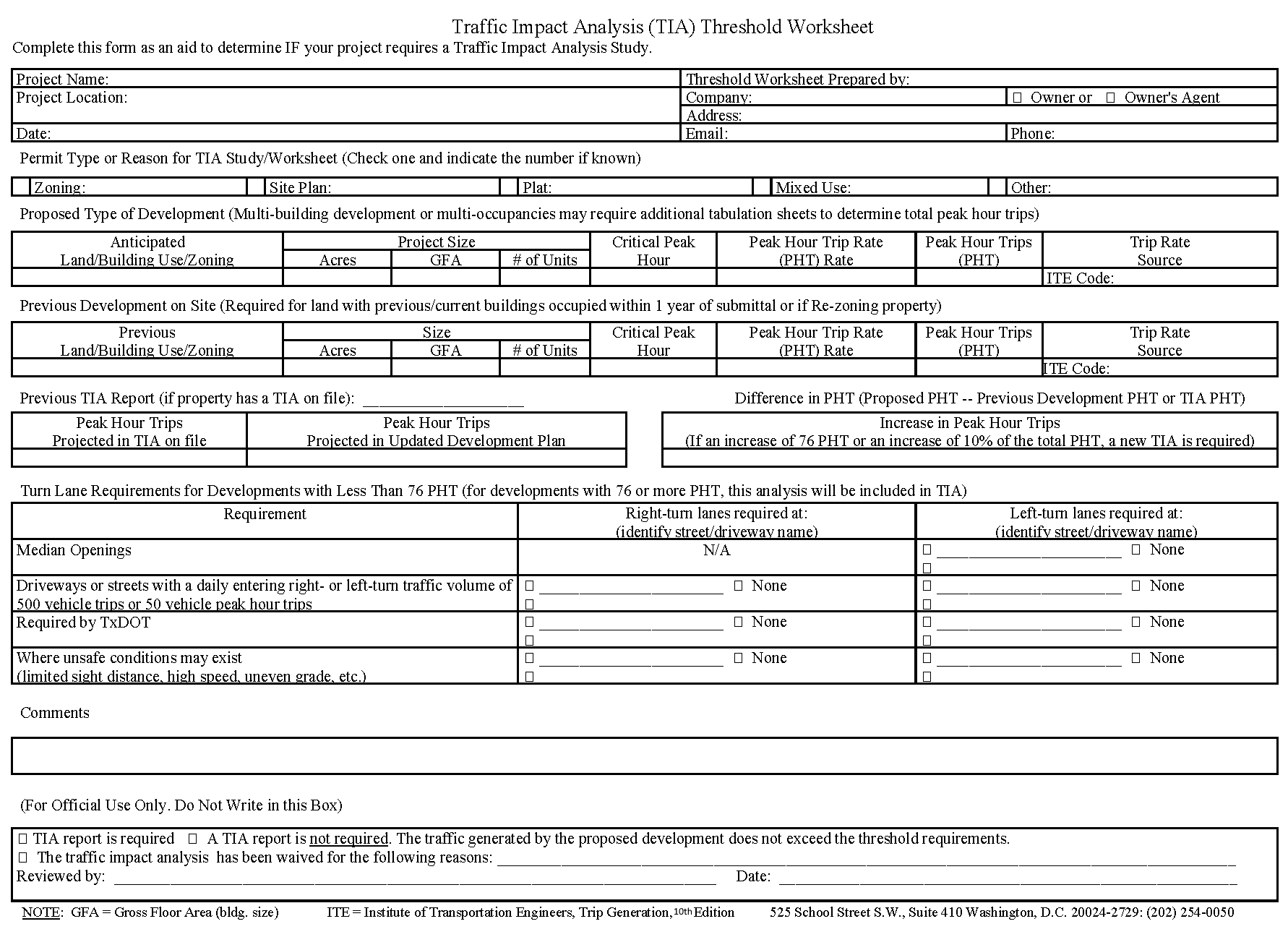
In order to determine when a TIA is required, the TIA Threshold Analysis worksheet listed as Table 18.1 (PG. 299 of this UDC) shall be utilized.
7.
TIA Review
The TIA shall be reviewed by the City Engineer and any other necessary review authorities. Review comments shall be provided to the applicant for response. Response by the applicant shall be in the form of a letter, technical memorandum, or other appropriate document. The applicant shall submit final copies of the TIA to the City Engineer containing all modifications prior to final approval of the application for which the TIA was conducted.
8.
City Assistance in Development
During the course of providing for improvements, the City may cooperate with the developer in the use of its governmental powers to assist in the timely and cost-effective implementation of improvements. Assistance shall not mean financial aid in actual easement acquisition, construction or engineering costs. Specifically, the City may agree to the following forms of assistance:
1.
Assist in the acquisition of necessary right-of-way and easements;
2.
Assist in the relocation of utilities;
3.
Assist in obtaining approvals from applicable County entities;
4.
Assist in obtaining approvals from TxDOT;
5.
Enter into Public Improvement Agreements as consideration in lieu of impact fees; and/or
6.
Assist in securing financial participation for major street improvements from applicable County entities, TxDOT or the Metropolitan Planning Organization.
9.
TIA Revisions
It is recognized that the scope of the developer's plans may change from time to time. The monitoring reports may also demonstrate changes in the area street conditions and travel patterns within and around the City. Periodic updates to the TIA may be required to address these issues and identify changes to the level of service at study intersections and streets. These updates shall address modifications to the magnitude and timing of improvements recommended by the original TIA. Any TIA amendments must be acceptable to the City, and TxDOT, when applicable.
10.
Off-Site Improvements
Based on the results of a TIA, and in those instances where the City believes public safety is at risk, the property owner shall make improvements to off-site collector and arterial streets and intersections necessary to mitigate traffic impacts generated by the development or in conjunction with related developments; with said improvements being roughly proportional to the impact of the proposed development. The City may participate in the costs of oversize improvements with the property owner as set out herein, and subject to the City's cost participation policies on oversized improvements.
11.
Construction Easements
Construction easements, in addition to rights-of-way, may be required when adequate width for streets and/or utilities is not available.
12.
Intersection Improvements and Traffic Control Devices.
Intersection improvements and traffic control devices shall be installed as may be required by the City based on the recommendations of an approved TIA for traffic safety and efficiency. Construction and design standards shall be in accordance with Cibolo Design and Construction Manual.
13.
Mitigation Improvements and Roughly Proportionate Determination
A.
The purpose of the TIA is to identify if any mitigation improvements are necessitated by and attributable to the proposed development. Required mitigation improvements may include the following:
1.
Implementation of the Future Thoroughfare Plan; including right-of-way dedication (right-of-way dedication value shall be determined using the most recent appraisal district land values) and/or construction in accordance with the Cibolo Design and Construction Manual.
2.
Improvements identified by the TIA based on peak hour trip generation data, turn lane assessment and traffic impact analysis.
3.
Other improvements may include, but are not limited to, pavement widening, turn lanes, median islands, access controls, curbs, sidewalks, traffic signalization, traffic signing and pavement markings.
4.
Improvements to the TxDOT right-of-way required by the City, including right-of-way dedication, as approved by TxDOT.
Minimum Areas to be addressed in Roughly Proportionate Determination
B.
For phased development projects, implementation of the mitigation improvements must be completed no later than the completion of the project phase for which the TIA shows it was required. Plats for project phases subsequent to a phase for which a mitigation improvement is required may be approved only if the mitigation improvements are completed or bonded by the developer.
C.
Following the identification of mitigation improvements and any other improvements necessitated by and attributable to the development, the applicant shall utilize the methodology developed and approved by the city to determine if the mitigation improvements identified are roughly proportionate to the impact of the proposed development.
1.
At the conclusion of the TIA, the applicant will summarize all the mitigation improvements identified in the TIA and the approximate total cost of all mitigation improvements including design, engineering and construction. Mitigation improvements that only serve the proposed development (such as site plan related recommendations and right-turn lanes into and out of a development) that provide minimal benefits to the study area roadway network shall not be included in the cost of the mitigation improvements (when compared to the maximum amount of improvements attributable to the proposed development);
2.
The applicant will utilize the approved methodology made available by the City to determine the maximum amount of improvements (measured in dollars) that may be attributable to the proposed development;
3.
The applicant shall then compare the cost of the mitigation improvements to the maximum probable amount of improvements that may be attributable to the development.
a)
If the cost of the mitigation improvements is less than or equal to the maximum amount of improvements that may be attributable to the development, then the mitigation improvements identified in the traffic impact analysis are said to be roughly proportionate to the impact of the development.
b)
If the cost of the mitigation improvements is greater than the maximum amount of improvements that may be attributable to the development, then the mitigation improvements identified in the traffic impact analysis are limited to an amount roughly equal to the maximum amount of improvements that may be attributable to the development;
4.
The methodology utilized by the city shall be as follows. The maximum amount of improvements attributable to a development is roughly proportional to the demand created by a development. This value shall be determined (measured in dollars) by multiplying the following values together:
a)
Intensity of the development (using independent variable identified in the ITE Trip Generation Manual, e.g. number of dwelling units, number of one thousand (1,000) square feet of leasable floor area, etc.);
b)
Number of vehicles—the peak hour trip generation rate for the applicable peak hour (from the most current version of the ITE Trip Generation Manual Information);
c)
Length of the trip—the anticipated trip length to/from the development on the city's thoroughfare network (a minimum value of 1.0 miles and a maximum value of 1.5 miles shall apply); and
d)
Cost per vehicle-mile—the average cost per vehicle-mile for the City to deliver a typical roadway capacity improvement project based upon the current City Engineer estimates. The Average Unit Price List shall be reviewed by the City Engineer on a regular basis to ensure the Average Unit Price List is consistent with current construction costs;
5.
The methodology shall be reviewed by the City Engineer on a regular basis to ensure the methodology is consistent with current construction costs and engineering criteria;
6.
Projects in a valid master development plan where mitigation improvements have been previously constructed at the cost of the applicant shall receive credit for these improvements. The credit for improvements shall be determined using the cost of the improvements at the time they were constructed. This value shall be included with the total cost of the mitigation improvements required to serve the development. The land uses previously constructed or planned for shall also be included in the calculation of the maximum probable amount of improvements that may be attributable to the development;
D.
Limitations on Traffic Impact Mitigation. Limitations on traffic impact mitigation requirements are as follows:
1.
Improvements that have been planned and funded through a capital improvement project that exceed the proposed mitigation measures recommended in the TIA are not required. The capital improvement must be planned to be awarded to a contractor for construction within one (1) year following the completion of the project phase requiring the improvement to be considered as a mitigation improvement.
E.
Exemptions.
The City finds and determines that certain factors, such as interconnected street systems, mixed uses, and the availability of pedestrian facilities, can result in fewer trips than isolated, low-density subdivisions. Certain development patterns produce fewer trips and shorter trips than developments subject to conventional zoning or located on the fringe of the metropolitan area. The City hereby finds that traffic patterns and infrastructure within its urban core are established, and that there is a strong public policy to encourage reinvestment in the City's downtown areas. Further, the City hereby finds that there is a strong public policy to encourage infill development and that there is little opportunity to expand transportation capacity in many infill areas without destroying the City's historic built environment. Accordingly, the Old Town Overlay zoning district is exempt from the provisions of this section.
Section 18.14 - Clear Site Triangle
A.
Generally.
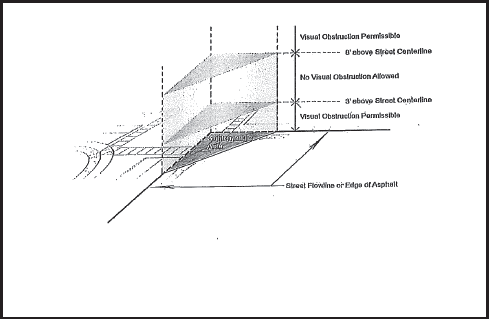
No fence, wall, sign, foliage, berming or other structure or obstruction which will obstruct the driver's view (sight lines) of traffic approaching the intersection shall be placed in the sight triangle. These sight lines shall be unobstructed between a height of three (3') feet and eight (8') feet above the elevation of the street centerline and shall be placed on any corner lot in the areas specified by this subsection or the American Association of State Highway and Transportation Officials (AASHTO) standards; whichever is more stringent.
B.
Requirements.
1.
At the intersection of two public streets, regardless of classification, Distance A and Distance B (refer to Figures 18.1 and 18.2) shall not be less than thirty (30) feet.
2.
Utility cabinets, including traffic signal cabinets, over three (3) feet in height (above the street centerline) are not allowed in a sight triangle.
C.
Exemptions.
1.
Utility poles, traffic control signs or other signs related to public safety, and trees eighteen inches or less in width that are devoid of branches and spaced to minimize visual obstruction are allowed in a sight triangle. Such structures are considered point obstructions and are permitted because a driver can adjust slightly to avoid or see around them.
2.
Subject to approval by the City Engineer, a traffic signal cabinet may be located in a sight triangle only where no other location is feasible due to physical or fiscal constraints, and is located such that the side facing vehicle traffic is less than eighteen inches (18") in width to minimize the sight obstruction.
Figure 18.1 Sight Triangle Requirements for Street Intersections
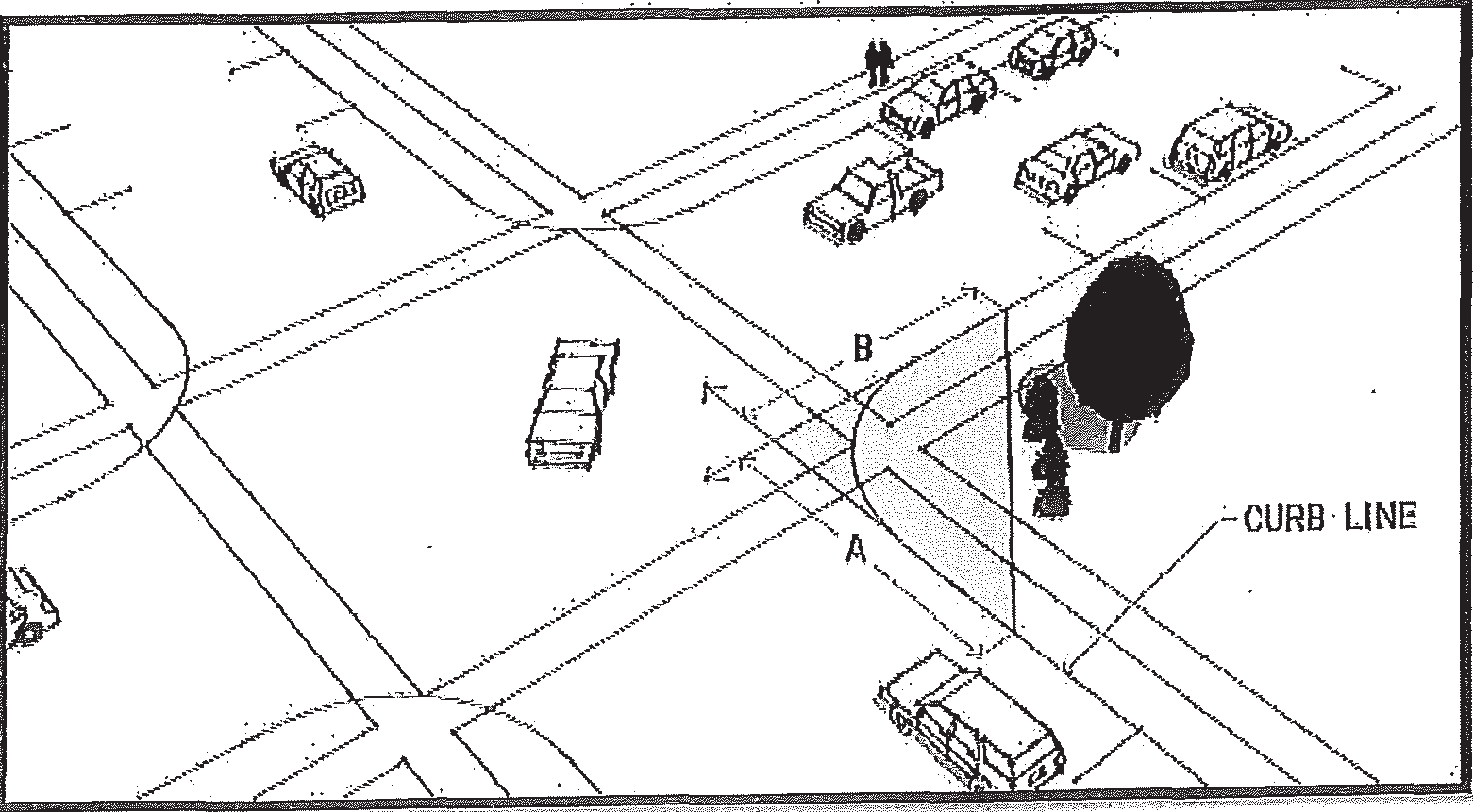
Distance A and Distance B are measured from the point of intersection of lines that extend from either the edge of the curb line or edge of asphalt, whichever is closer to the property, away from the intersection. Only one of the four required street sight triangles are shown above.
Figure 18.2 Sight Triangle Requirements for Street Intersections (Measurement)
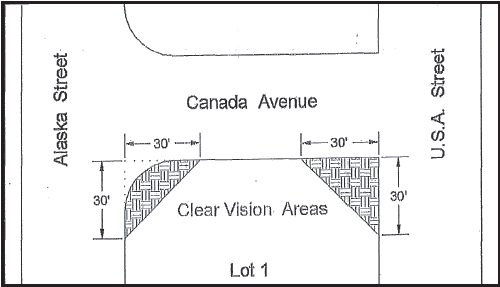
Figure 18.3 Sight Triangle Requirements for Street Intersections (Three Dimensional)
Section 18.15 - Fire Lanes
Fire lanes shall be designated, designed and constructed as necessary to comply with all requirements of the City Fire Code and local amendments.
Section 18.16 - Driveways
Driveways shall be designated, designed and constructed as necessary to comply with all requirements of the Cibolo Design and Construction Manual and the additional standards contained in this Article.
A.
Residential Subdivisions
Direct access onto highways, arterials, and major collectors, as designated by the Future Thoroughfare Plan, shall be prohibited.
In those instances where a corner residential lot that was platted prior to the adoption of this UDC, with frontage on one or more streets designated as a highway, arterial or major collector street by the Future Thoroughfare Plan, driveway access to said lot shall be provide from the lesser street, with the driveway required to be located as far from the street intersection as practical. To maintain public health and safety, the City Engineer may require the installation of an on-site turn-around bay to provide vehicles with an alternative to backing out near street intersections or onto street designated by the Future Thoroughfare Plan.
B.
Non-Residential Subdivisions/Site Plans
1.
Direct access onto highways and arterials as designated on the Future Thoroughfare Plan shall be restricted as follows:
a)
A minimum distance of two hundred and fifty (250') feet must be maintained between driveways, as measured from the edge of pavement to the edge of pavement.
b)
Driveways shall not be located closer than one hundred and fifty (150') feet from a street intersection. Said separation shall be measured from the edge of pavement of the driveway to the property line adjacent to a highway or arterial.
c)
A common access easement and fire lane easement shall be dedicated between adjoining developments whenever practical along highways and arterial streets to facilitate shared access. Said easement shall contain a minimum width of twenty-four (24') feet.
2.
Direct access onto major collector streets designated on the Future Thoroughfare Plan, shall be restricted as follows:
a)
A minimum distance of one hundred and fifty (150') feet must be maintained between driveways. This minimum spacing shall be measured from the edge of pavement to the edge of pavement.
b)
Driveways shall not be located closer than seventy-five (75') feet from a street intersection. Said separation shall be measured from the edge of pavement of the driveway to the property line adjacent to a highway or arterial.
c)
A common access easement and fire lane easement shall be dedicated along the roadways to facilitate shared access.
d)
Driveway access to residential lots from major collector streets shall be limited to the greatest extent practical.
3.
Direct access onto minor collectors shall be restricted as follows:
a)
A minimum distance of one hundred (100') feet must be maintained between driveways. This minimum spacing shall be measured from the edge of pavement to the edge of pavement.
b)
Driveways shall not be located closer than fifty (50') feet from a street intersection. Said separation shall be measured from the edge of pavement of the driveway to the property line adjacent to a highway or arterial.
c)
A common access easement and fire lane easement shall be dedicated along the roadways to facilitate shared access.
d)
Driveway access to residential lots from minor collector streets is permitted but should be limited to greatest extent practical.
4.
Driveway approaches, curbs, gutters, pavements and appurtenances on public property and other facilities to provide access to abutting properties in the City and ETJ in connection with platting or building construction shall be constructed, provided, altered or repaired in accordance with the standards outlined below and the Cibolo Design and Construction Manual.
5.
All driveway approaches shall comply with the following standards.
a.
Sidewalk to Be Removed.
Where a driveway approach is designed to cross an existing sidewalk, the sidewalk included in the driveway approach area shall be removed and reconstructed as a driveway approach unless the City Engineer has determined that the section of sidewalk fully complies with the requirements of this section for driveway approaches. The area across the driveway will be jointed and edged as a sidewalk. The depth and design for the sidewalk will be consistent with the driveway approved design and will be consistent with ADA regulations.
b.
Removal of Curb and Gutter.
Where a driveway approach is to be constructed at a location where a curb and gutter is in place, the curb and gutter shall be removed to the nearest existing construction joint or a new construction joint formed by other methods as may be approved by the City Engineer. The driveway approach shall be constructed in accordance with the Cibolo Design and Construction Manual.
c.
Drainage.
Driveway approaches shall be designed to prevent the entrance of water from the street onto private property, except that a drainage system may be provided within the property to handle water coming from the street. Driveway approaches and related drainage systems shall be constructed in accordance with the Cibolo Design and Construction Manual.
d.
Radius.
Driveway approaches shall be constructed with either flared side slopes or with return curbs having a rolled face disappearing at the sidewalks and joining the street curb with a radius to conform to the Cibolo Design and Construction Manuel. Flared side slopes shall be used whenever a curb return may present an architectural barrier within a pedestrian path. Driveway flares shall not extend in front of the adjacent property. The radius shall continue beyond the sidewalk to the end of the required dimension.
6.
Design Criteria.
Driveway widths shall comply with the criteria listed below in Table 18-4. For commercial and industrial uses that will obtain driveway access from a state highway, driveway widths shall be governed by TxDOT standards and shall not be limited by the requirements of Table 18-4. Commercial and industrial uses on other rights-of-way may be allowed additional driveway width, subject the approval of the City Engineer and the findings of a professional traffic engineer licensed to practice in Texas to accommodate the needs of trucks or other oversized equipment that will utilize the proposed driveway. The Fire Chief shall also have the right to require additional driveway width based on the nature of any proposed use and the need to provide fire protection and emergency access.
Table 18.4
Width of Access
a)
Width of Driveway Approach.
On local streets the width of any driveway approach shall conform to the dimensions as required by the above Table 18.4, and the width shall be as measured along the property line, except that driveway approaches for motor vehicle docks, within a building, shall not exceed sixty feet (60') in width at the property line. The width shall be measured to the centerline of the driveway at the property line where the curb return ends.
b)
Maximum Space to Be Occupied by Driveway Approaches.
Driveway approaches shall not occupy more than seventy percent (70%) of the roadway abutting frontage of the tract of ground devoted to one particular use.
c)
Number of Driveway Approaches Allowed.
On local streets not more than one (1) driveway approach shall be permitted on any parcel of property with a frontage of one hundred (100') feet or less, except that additional openings may be permitted with the approval of the City Engineer for the necessity and convenience of the public. For arterials the distances shall be 300 feet.
d)
Driveway Separation.
When more than one (1) driveway approach is required to serve a parcel of property, the driveway approaches shall be separated by a minimum distance, as measured between the edge of the driveway and the adjacent driveway or street right-of-way, as required by this section. The minimum separation from an arterial or collector intersection shall be 100 feet.
7.
Single-family and two-family developments are exempt from these standards on all local streets.
8.
Where a property at a corner does not have the necessary frontage to accommodate the required spacing from the intersection, or an interior property does not have adequate width to meet the spacing requirements from an existing driveway on an adjacent property, a common access easement with an adjacent property may be utilized to obtain the necessary spacing. Where site limitations preclude such common access easements, or where cooperation of adjacent property owners cannot be obtained, the City Engineer may authorize a non-compliant driveway, which should be spaced as far from the intersection as practical, provided that the applicant can demonstrate that the proposed drive would result in a traffic safety hazard.
9.
Shared Driveways.
Driveway approaches shall be located entirely within the frontage of the premises abutting the work, except that shared driveway access with an adjoining property owner may be permitted provided joint application is made by all interested parties and the requirements of section.
10.
Angle of Driveway Approach.
The angle of the driveway approach with the curb line shall be approximately ninety (90 0 ) degrees for two-way driveways or forty-five (45 0 ) degrees to ninety (90 0 ) degrees for one-way driveways.
11.
Obstruction of Driveway Approaches.
Driveway approaches shall not be constructed or designed so that standing or parked vehicles may obstruct the driveway.
12.
Cross Access and Internal Driveways.
Cross access easements for internal driveways are encouraged to minimize the number of driveway cuts on streets, thereby maintaining street mobility, and to facilitate traffic flow between adjacent lots.
a)
May Be Required.
A cross access easement(s) for an internal driveway(s) may be required between adjacent lots;
b)
Location and Dimension.
The location and dimensions of such easement(s) shall be determined by the City Engineer and may be required to be shown on a plat when appropriate.
Section 18.17 - Sidewalks
Sidewalks shall be designated, designed and constructed as necessary to comply with all requirements of the Cibolo Design and Construction Manual and the additional standards contained in this UDC.
A.
Requirement
Sidewalks shall be required along both sides of all streets throughout the City, except along Interstate Highway 35, along Interstate Highway 10, and within the Old Town Overlay District. All lots, other than those excepted, must provide access to a concrete sidewalk.
B.
Curb Ramps
Curb ramps shall be provided at all street intersections at the time of construction or reconstruction and shall comply with the provisions in the Federal Register 28, CFR part 36 (Americans with Disabilities Act or ADA) and Texas Accessibility Standards as amended from time to time.
ADA compliant access shall also be provided to all group, or community, mailboxes. Group mailboxes shall be positioned to allow access to all boxes in the group mailbox to persons who may be in wheelchairs.
C.
Location and Width
Where sidewalks are required, they shall be installed in accordance with the Cibolo Design and Construction Manual and shall be a minimum of five (5') feet in width in residential areas and six (6') feet in width in commercial areas. Sidewalks shall be placed parallel to the street for the entire frontage(s) of the lot and shall be located a minimum of two (2') feet behind the curb.
D.
Sidewalk Obstructions
Where utility poles, fire plugs or other utility installations occur within the sidewalk width, the walk shall be offset around the obstacle at its full width. If the available right-of-way is insufficient to offset the walk, the City Engineer must approve the solution to the problem. Either additional right-of-way must be dedicated to accommodating the sidewalk or a "Pedestrian and Sidewalk Easement" must be granted of sufficient width and depth to accommodate the sidewalk. In avoiding obstructions, the sidewalk design shall be required to comply with all ADA requirements.
E.
Curbside Landscaping
Landscaping in the section of street right-of-way between the curb and sidewalk shall be limited to those "approved" grasses, groundcovers, annuals or perennials listed in Article 18 of this UDC. The use of mulch as a ground cover is also acceptable. All other plants, decorative gravel or stone, or other structural landscaping elements are acceptable alternatives.
F.
Timing of Construction
Sidewalks shall generally be installed concurrently with the construction of the primary structure on a lot, except on primary or secondary arterials, where they shall be installed concurrently with the street. For new single-family residential development, this requirement may be deferred until the issuance of building permits.
G.
Construction Concurrent with Street Construction
If a street is constructed which has no residential lot access, sidewalks must be installed concurrently with street construction.
H.
Sidewalk Installation Bond
At the time that that Final Acceptance is granted for any subdivision, or any unit or phase of a subdivision, the City shall require the developer to file a Sidewalk Installation Bond equal to valuation of sidewalks that are required to be installed by this UDC but that have not yet been constructed. The City shall release the Sidewalk Installation Bond at such time as all required sidewalks are constructed.
I.
Corner Lot
Where sidewalks are installed on corner lots, sidewalks shall be installed along both street frontages and shall be extended to the curb with handicapped access ramps in accordance with ADA and TAS standards.
J.
Waiver or Deferment of Sidewalk Installation
The City Engineer may recommend that the installation of certain sidewalk sections be deferred to a future date when topographic or other unique conditions exist that may preclude the immediate construction of a sidewalk. In those instances, the City Council may accept the City Engineer recommendation to defer the installation of such a sidewalk to a time deemed more appropriate. If the installation of sidewalks is deferred, the developer shall provide a subdivision improvement agreement guaranteeing the installation of a deferred sidewalk.
K.
Retrofitted and Reconstructed Sidewalks
1.
The policy of the City is that continuous pedestrian sidewalks are important public infrastructure and that sidewalks should ordinarily be installed and maintained on both sides of every block of every City-maintained street, with exception as provided below.
2.
Except as specifically authorized by the City Council, significant projects involving the construction and reconstruction of public sidewalks should be included in the annual Capital Improvement Plan. Funds to construct minor projects and perform general repairs of sidewalks may be allocated in the annual budget process.
3.
Prior to installation of a new sidewalk on any street(s), at least 30 days written notice shall be given to all adjacent property titleholders on both sides of the street and a public meeting scheduled to provide opportunity for public to provide comment regarding installation of sidewalk in the subject location(s). This section does not apply to new developments where sidewalks are installed by the developer to meet UDC requirements.
4.
The City Council may decide by majority vote, based on good reasons including but not limited to the following criteria, to forego installation of sidewalk in a location if:
a)
A majority of the titleholders of properties on the block(s) attest by their signatures on a petition to be received by the City Secretary by the time of the public meeting that they are opposed to the installation of sidewalk on their block. This criterion must be accompanied by at least one of the following circumstances:
i.
There is insufficient existing public right of way or easement available for installation of sidewalk and it is infeasible to either voluntarily acquire the necessary easement or to incorporate part of the existing roadway for the sidewalk [If the curb-to-curb footprint is to change by incorporating part of the existing roadway for the sidewalk addition or with expansion, then City Council's considerations will also take into account the impact on surrounding street traffic patterns; or
ii.
The block(s) are not on a through street (must be accompanied by criterion a. above;
b)
Construction of a sidewalk would present inordinate engineering challenges or costs; and
c)
Construction of a sidewalk would entail the loss of significant tree canopy.
5.
The City shall make every reasonable effort to find creative solutions to problems cited in Section 4 above before deciding to forego installation of sidewalk.
6.
The City shall endeavor to remove or minimize obstacles within new or existing sidewalks to the extent possible without incurring significant additional costs.
7.
The City standard for sidewalk width is five feet and all sidewalks below that width shall ordinarily be reconstructed, where feasible according to criteria described above, to conform to the City standard, with the City Council considering the following exceptions:
a)
Streets in which City Council has previously approved a different width;
b)
Blocks identified by the City Council as having special need or special opportunity for wider sidewalks (e.g., blocks with commercial or other high-traffic frontage or where property owners bear all or part of the cost of installation).
8.
New and reconstructed sidewalks shall comply with all applicable accessibility codes. Every attempt should be made to ensure a buffer between the sidewalk and the curb line of the adjoining street.
9.
Sidewalk construction and reconstruction should be conducted in conjunction with Pavement Management and street resurfacing projects and be coordinated with infrastructure development and rehabilitation projects (i.e. water, sewer, drainage projects) to ensure the projects do not conflict.
10.
Property owners may petition the City Council for installation of sidewalks that exceed those provided for by this policy; however, City Council may require that property owners on the block(s) proposed, if such work is approved, be assessed for the cost of the work. Partial assessment of each property on a block may be required to provide sidewalks were there are unusual costs or difficult engineering requirements. In those instances, the City will agree to pay for its share of the costs: work limited to routine sidewalk construction, but not for other required improvements.
(Ord. No. 1441, § 2(Exh. A), 4-9-2024)
Section 18.18 - Bike Lanes
It is the policy of the City to require bike lanes along all arterial and collector streets designated on the Future Thoroughfare Plan of the City Street sections for collector and arterial streets shall be designed to incorporate bike lanes designed in accordance with the Cibolo Design and Construction Manual.
Section 18.19 - Linear Parks
It is the policy of the City to reserve appropriate spaces that may be interconnected into a linear park network. The City Council may require that any drainage or utility easement that provides a connection or connections to adjoining neighborhoods or an existing or proposed linear park network also be designated as a public access easement for the purpose of providing pedestrian and bicycle access and may request parkland dedication for this purpose in accordance with this UDC. Linear parks, when proposed or where required, must be designed in accordance with the Cibolo Design and Construction Manual.

