
Citrus Heights City Zoning Code
CHAPTER 106
35 - OUTDOOR LIGHTING
Sec. 106.35.010.- Purpose
This Chapter provides requirements for outdoor lighting within the City to:
A.
Promote a safe and pleasant nighttime environment for residents;
B.
Protect and improve safe travel for all modes of transportation;
C.
Prevent nuisances caused by unnecessary light intensity, direct glare, and light trespass;
D.
Protect the ability to view the night sky by restricting unnecessary upward projection of light; and
E.
To promote lighting practices and systems to conserve energy.
Sec. 106.35.020. - Applicability
A.
New outdoor lighting. All outdoor lighting fixtures installed after the effective date of this Chapter on the site of a nonresidential or multi-unit residential use shall comply with the requirements of this Chapter.
B.
Exempt lighting.
1.
All outdoor light fixtures existing and legally installed prior to the effective date of this Chapter are exempt from the requirements of this Chapter; provided that no replacement, structural alteration, or restoration of an outdoor light fixture shall be made unless it thereafter complies with the requirements of this Chapter. The Director may grant an exemption from this conformance standard if:
a.
The use of a conforming outdoor light fixture would have the effect of decreasing the lighting levels to below the minimum illumination levels required by the City, and the additional cost necessary to meet the minimum illumination levels would pose an unreasonable financial burden; and/or
b.
The use a conforming outdoor light fixture would negatively impact the aesthetic quality/architectural design of the property or immediate area by mixing substantially different styles and types of fixtures/poles.
2.
All outdoor light fixtures producing light directly by the combustion of fossil fuels, such as, kerosene lanterns or gas lamps, are exempt from the requirements of this Article.
3.
Temporary lights used for holiday decorations are exempt from the requirements of this Chapter.
4.
All outdoor light fixtures which are luminous tube lighting are exempt from the requirements of this Chapter.
5.
Construction or emergency lighting is exempt, provided such lighting is temporary and is discontinued immediately upon completion of the construction work or abatement of the emergency necessitating said lighting.
6.
Signs of the type constructed of translucent materials and wholly illuminated from within are exempt from the shielding requirement.
C.
Prohibitions. The installation of any new fixture not in conformance with this Chapter is prohibited after the effective date of this Chapter.
1.
No outdoor lighting fixture shall be installed, aimed, or directed to produce light or glare that spills over into neighboring properties or the public right-of-way that exceeds 0.5 footcandles within two feet of the property line of the light source.
2.
No outdoor lighting fixture may be operated in such a manner as to constitute a hazard or danger to persons, or to safe vehicular travel.
3.
Blinking, flashing, moving, revolving, scintillating, flickering, changing intensity, and changing color lights and internally illuminated signs are prohibited, except as allowed by 106.38.080 (Nonconforming Signs).
4.
The installation of new mercury vapor lamps is prohibited.
5.
The use of search lights, laser source lights, or any similar high-intensity light is prohibited except for emergency use by police and fire personnel or at their direction, or for approved temporary lighting under a special event permit issued by the Director.
Sec. 106.35.030. - Definitions
The technical terms and phrases used in this Chapter are defined in Article 8 (Glossary), under "Outdoor Lighting."
Sec. 106.35.040. - General Lighting Design and Development Standards
The following standards apply to all non-exempt outdoor lighting fixtures:
A.
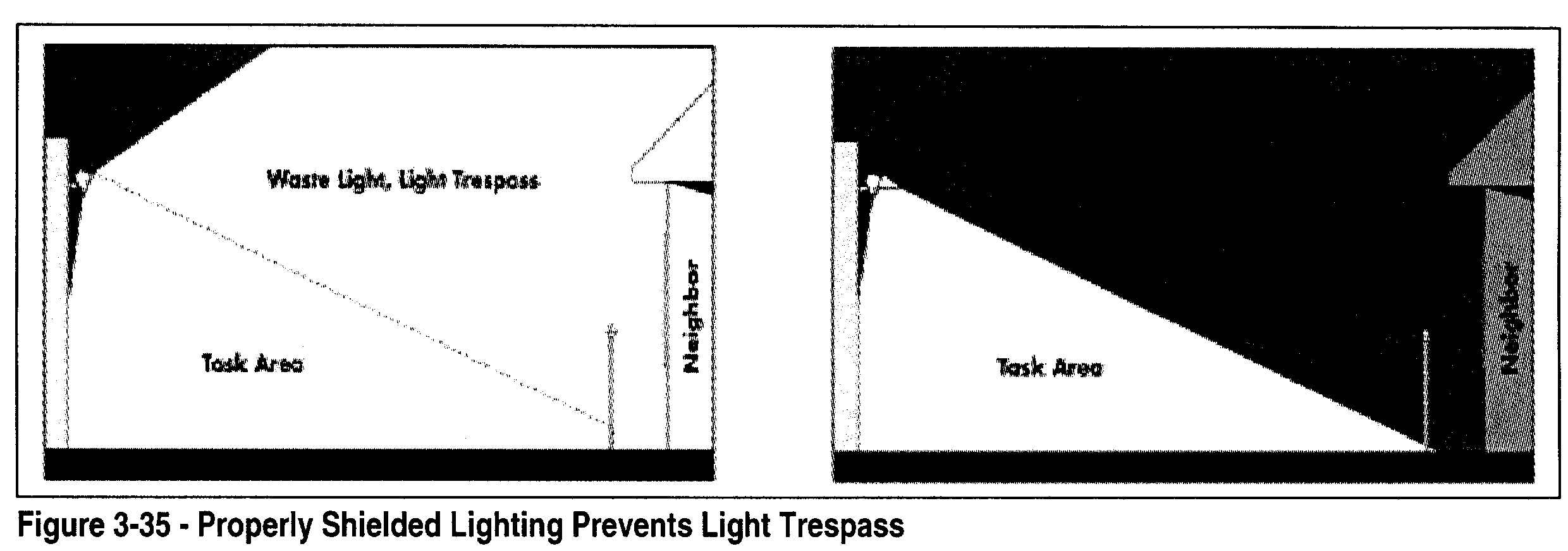
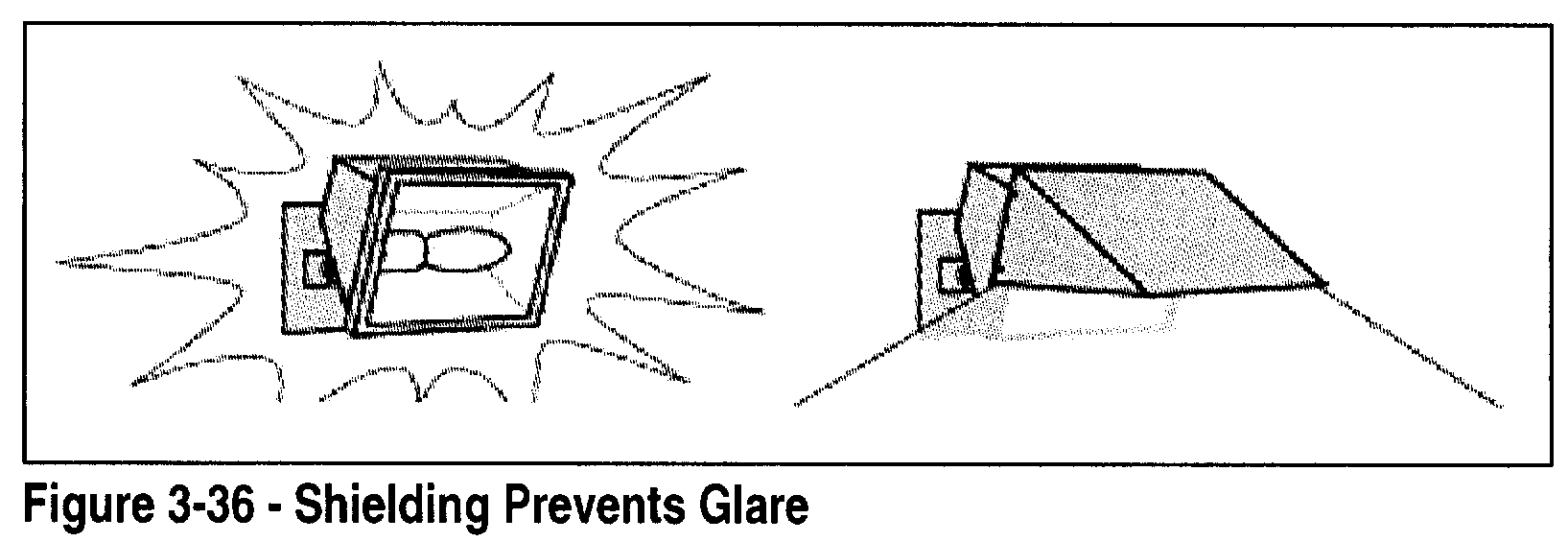
Nuisance prevention. All outdoor lighting fixtures shall be designed, located, installed, aimed downward or toward structures, and maintained in order to prevent glare, light trespass, and light pollution.
B.
Maintenance.
1.
Fixtures and lighting systems shall be maintained in good working order and in a manner that serves the original design intent of the system.
2.
An outdoor lighting fixture may only be aimed against a structure if the light is effectively contained by the structure and glare visible from off-site is minimized, as determined by the Director.
C.
Lighting levels. Outdoor lighting installations shall be designed illuminate at the minimum level necessary for safety and security, and to avoid harsh contrasts in lighting levels between the project site and adjacent properties to the maximum extent feasible.
D.
Lamp types. Light emitting diode (LED). Metal Halide or High Pressure Sodium lamps are preferred for all new commercial and industrial area lighting (parking lot and yard lights) and street lighting installed after the effective date of this Chapter due to good color rendering and good energy efficiency. Low Pressure Sodium lamps may be used for area lighting, but are not preferred due to poor color rendering. Low wattage incandescent or compact fluorescent lamps are preferred for residential lighting.
E.
Fixture types. All new outdoor lighting shall use full cut-off luminaires with the light source downcast and fully shielded with no light emitted above the horizontal plane, with the following exceptions:
1.
Fixtures that have a maximum output of 400 lumens (equivalent to one 40-watt incandescent bulb) or less, regardless of the number of bulbs, may be left unshielded provided that it has an opaque top to prevent the light from shining directly up. However, partial (e.g., obscured glass) or full shielding is preferred to control light output in all situations.
2.
Fixtures that have a maximum output of 1,000 lumens (equivalent to one 60-watt incandescent bulb) or less may be partially shielded using a semi-translucent barrier, provided that the lamp is not visible from off-site, no direct glare is produced, and the fixture has an opaque top to keep light from shining directly up.
3.
Floodlights that do not meet the definition of "full cut-off" may be used if permanently directed downward, if no light is projected above the horizontal plane, and if and fitted with external shielding to prevent glare and off-site light trespass. Unshielded floodlights are prohibited.
F.
Accent lighting. Architectural features may be illuminated by uplighting, provided that the light is effectively contained by the structure, the lamps are low intensity to produce a subtle lighting effect, and no glare or light trespass is produced. For national flags, statues, public art, or other objects of interest that cannot be illuminated with down-lighting, alternate upward lighting may be used in a form accepetable to the satisfaction of the Director provided the alternative confines the illumination to the object of interest.
G.
Alternative designs, materials, and installations. The requirements of this Chapter are not intended to prevent the use of any design, material, or method of installation or operation not specifically prescribed in this Chapter, provided that the Director has approved any alternative. An alternative proposal may be approved if it provides at least approximate equivalence to the applicable specific requirements of this Chapter, or if it is otherwise satisfactory and complies with the intent of this Chapter.
(Ord. No. 2013-011, § 3, 11-14-2013)
Sec. 106.35.050. - Outdoor Lighting Plans
A.
When required. A preliminary outdoor lighting plan shall be submitted as part of each planning permit application (e.g., for Design Review, Use Permit; subdivision approval), and a final lighting plan shall be submitted as part of an application for a building permit for a new structure, or addition of 25 percent or of gross floor area, seating capacity, or parking spaces (either with a single addition or cumulative additions). A final outdoor lighting plan is required for all new outdoor lighting installations on commercial, multi-unit residential project, industrial, and institutional properties. The Director may request outdoor lighting plans from applicants for other types of projects due to project location, size, or proposed use, as necessary.
B.
Plan content. An outdoor lighting plan shall include at least the following:
1.
Manufacturer specification sheets, cut-sheets, or other manufacturer provided information for all proposed outdoor lighting fixtures to show fixture diagrams and light output levels;
2.
The proposed location, mounting height, and aiming point of all outdoor lighting fixtures (a site plan is preferred); and
3.
If building elevations are proposed for illumination, drawings for all relevant building elevations showing the fixtures, the portions of the elevations to be illuminated, the illuminance level of the elevations, and the aiming point for any remote light fixture.
C.
Additional information. If needed to review the proposed outdoor lighting fixture installation, the Director may require additional information following the initial outdoor lighting plan submittal, including a written narrative to demonstrate the objectives of the lighting, photometric data, and other descriptive information on the fixtures, computer generated photometric grid showing footcandle readings every 10 feet within the property or site and 10 feet beyond the property lines (An iso-footcandle contour line style plan may be acceptable), and/or landscaping information to describe potential screening.
D.
Decision on plan. The Director may approve, deny, or require modifications to any outdoor lighting plan in order to meet the purpose of this Chapter.
Sec. 106.35.060. - Signs
All outdoor lighting for commercial signs installed and maintained in compliance with Chapter 106.38 shall comply with this Chapter. Light bulbs or lighting tubes used for sign illumination shall not be readily visible from the vehicular travel lanes, adjacent public rights-of-way, or adjoining properties. The intensity of sign lighting shall not exceed that necessary to illuminate and make legible a sign from the approved location of view, such as pedestrian walkway, adjacent travel way or closest town street.
Sec. 106.35.070. - Outdoor Performance, Sport and Recreation Facilities
A.
Where playing fields or other special activity areas are to be illuminated, lighting fixtures shall be mounted, aimed, and shielded so that their beams fall within the primary playing area and immediate surroundings, and so that no significant off-site light trespass is produced.
B.
The main lighting shall be turned off as soon as possible following the end of an event. Where feasible, a low level lighting system shall be used to facilitate patrons leaving the facility, cleanup, nighttime maintenance, and other closing activities.
Sec. 106.35.080. - Energy Conservation Guidelines
Incorrect installations, poor choice of fixtures, and overlighting can result in unnecessarily high energy costs. The following recommendations are intended to encourage the efficient use of energy for lighting purposes.
A.
All non-essential outdoor commercial and residential lighting is encouraged to be turned off after business hours and/or when not in use.
B.
Where practical, outdoor lighting installations are encouraged to include timers, dimmers, sensors, or photocell controllers that turn the lights off during daylight hours to reduce overall energy consumption and eliminate unnecessary lighting. Sensor activated fixtures should not be triggered by activity off the subject property.
C.
When selecting new outdoor lighting, the full cost of operation over the life of the fixtures should be considered. Substantial annual energy savings may be realized by using quality efficient fixtures.
D.
Indiscriminate and excessive lighting should be avoided. Light should be directed only to where it is needed with appropriate intensity.

