
Citrus Heights City Zoning Code
CHAPTER 106
42 - STANDARDS FOR SPECIFIC LAND USES
Sec. 106.42.010.- Purpose and Applicability
A.
Purpose. This Chapter provides site planning, development, and/or operating standards for certain land uses that are allowed by Article 2 (Zoning Districts and Allowable Land Uses) within individual or multiple zoning districts, and for activities that require special standards to mitigate their potential adverse impacts.
B.
Applicability. The land uses and activities covered by this Chapter shall comply with the provisions of the Sections applicable to the specific use, in addition to all other applicable provisions of this Zoning Code.
1.
Where allowed. The uses that are subject to the standards in this Chapter shall be located only where allowed by Article 2 (Zoning Districts and Allowable Land Uses).
2.
Planning permit requirements. The uses that are subject to the standards in this Chapter shall be authorized by the planning permit required by Article 2 (Zoning Districts and Allowable Land Uses), except where a planning permit requirement is established by this Chapter for a specific use.
3.
Development standards. The standards for specific uses in this Chapter supplement and are required in addition to those in Articles 2 (Zoning Districts and Allowable Land Uses) and 3 (Site Planning and Project Design Standards).
a.
The applicability of the standards in this Chapter to the specific land uses listed is determined by Article 2 (Zoning Districts and Allowable Land Uses).
b.
In the event of any conflict between the requirements of this Chapter and those of Articles 2 (Zoning Districts and Allowable Land Uses) or 3 (Site Planning and Project Design Standards), the requirements of this Chapter shall control.
Sec. 106.42.015. - Accessory Dwelling Units
A.
Purpose. This section is to encourage and allow accessory dwelling units (ADU) and junior accessory dwelling units (JADU) and establish standards in conformance with the state law provisions set forth in California Government Code §§ 66310—66342 ("State ADU law").
1.
Applicability. The lot on which an ADU is located must have an existing or proposed primary unit, duplex or multi-unit dwelling, or such a dwelling may be constructed concurrently with the accessory dwelling unit. Both options are pursuant to the common development standards set forth in subsection 106.42.015(E).
2.
Development Options. An applicant may choose to proceed under subsection B, which sets forth the city's local development option or the applicant may choose to proceed under subsection C, which sets forth an alternative development option, consistent with California Government Code § 66323. The two options may not be combined. Nothing in this chapter shall provide an exception to the requirements of the building code.
B.
City's local development option. The following standards apply under the city's local development option.
1.
Number of units.
a.
A lot developed with a single-unit dwelling may have a maximum of one ADU and one JADU pursuant to subsection 106.42.015 (D). Neither the ADU nor the JADU are included when calculating the density of a parcel.
b.
A lot developed with a multi-unit dwelling will follow California Government Code § 66323 as listed in subsection C.
2.
Location. ADUs are prohibited within the front yard, except as permitted under subsection 106.42.015(E)(1)(c).
3.
Allowed floor area.
a.
Attached ADU: The floor area of an attached ADU shall not exceed 60 percent of the floor area of the existing primary dwelling, up to a maximum of 1,200 square feet. Notwithstanding this limit, an attached ADU shall be permitted a minimum floor area of at least:
(1)
850 square feet for an ADU with zero to one bedroom; or
(2)
1,000 square feet for an ADU with two or more bedrooms, whichever is less.
In no case shall local development standards (such as floor area ratio or lot coverage) be applied to prohibit at least one attached ADU of at least 800 square feet.
b.
Detached ADU: The floor area of a detached ADU shall not exceed 1,200 square feet, regardless of the size of the primary dwelling.
c.
Efficiency unit: Nothing in this section shall be construed to prohibit an "efficiency unit" as defined in Health and Safety Code § 17958.1, with a minimum floor area of 150 square feet.
d.
Calculation of floor area: The floor area is calculated pursuant to subsection 106.42.015(E)(4).
C.
State of California Government Code § 66323 ADU option. The following standards apply under the State of California's Government Code § 66323 ADU option.
1.
Number of units.
a.
For lots with a single-family dwelling, each of the following:
(1)
One interior ADU per lot created through the conversion of space entirely with an existing structure, including accessory structure is allowed. This may include the construction of up to a 150 square foot expansion beyond the same physical dimensions as the existing accessory dwelling structure to accommodate ingress and egress only. An interior accessory dwelling unit must have exterior access and side and rear setbacks sufficient for fire safety.
(2)
One JADU per lot pursuant to subsection 106.42.015 (D).
(3)
One new construction detached ADU with a minimum four-foot side and rear setbacks. The ADU may not exceed a floor area of up to 800 square feet and shall not exceed a maximum height of 18 feet, plus an additional two feet to accommodate roof pitch to align with roof pitch of the primary dwelling unit.
b.
For lots with a multi-unit dwelling, the allowed number of allowed ADUs are listed below. For the purpose of this subsection, a structure with two or more attached dwellings on a single lot is considered a multi-unit dwelling. Multiple detached single-unit dwellings on the same lot are not considered a multi-unit lot.
(1)
Existing multi-unit dwellings may create ADUs from existing areas that are not used as livable space within an existing multi-unit dwelling structure (i.e., storage rooms, boiler rooms, passageways, attics, basements, or garages), provided the spaces meet state building standards for dwellings. The number of ADUs shall not exceed one or 25 percent of the existing multi-unit dwellings, whichever is greater.
(2)
Existing multi-unit dwellings may construct one detached ADU for each existing dwelling unit on the lot, up to a maximum of eight detached ADUs.
(3)
Proposed multi-family units may construct up to two detached ADUs.
(4)
All detached ADUs must comply with the height requirements of subsection 106.42.015(B)(2)(b).
(5)
No maximum floor area limitation shall apply to detached ADUs constructed on a lot with a multi-unit dwelling pursuant to Government Code § 66323, subdivision (a)(4). Lot coverage requirements pursuant to subsection 106.42.015(E)(3) are applicable.
D.
Junior accessory dwelling unit. A JADU is allowed on any lot zoned for single-family dwellings where the primary dwelling is a single-family dwelling on the lot.
1.
Requirements. A unit is considered a JADU provided each of the following standards are met:
a.
The unit is created within the walls of the proposed or existing single-family residence, including attached garages.
b.
The unit does not exceed 500 square feet of interior livable space as defined in subsection 106.42.015 (E)(4)(a).
c.
The unit has at least an efficiency kitchen. The efficiency kitchen shall be removed if the JADU ceases.
d.
The unit has bathroom facilities that are either separate from or shared with the residence in which the unit is contained.
e.
The unit has exterior access separate from the entrance to the dwelling in which it is contained.
2.
Owner-occupancy. Owner-occupancy is not required for a JADU if the owner is a governmental agency, land trust, or housing organization or if the JADU has separate sanitation facilities from the primary dwelling. However, if the JADU shares sanitation facilities with the primary dwelling, either the JADU or the primary dwelling shall be occupied by the owner.
3.
Deed restriction. Prior to the issuance of the building permit, the owner shall show proof of a recorded deed restriction. The deed restriction, which shall run with the land, including the transfer of ownership, will prohibit the following:
a.
The JADU shall not be sold separately from the single dwelling.
b.
The JADU shall be restricted in size and attributes as described in Government Code §§ 66310—66342.
E.
Common development standards. The following development standards apply to all ADUS and JADUs, whether approved under subsection C (city's local option) or subsection D (state law), except where state law expressly precludes application of a local standard.
1.
Setback requirements. An ADU shall comply with the setback requirements of the applicable zoning district except that the interior side and rear yard setbacks may be four feet.
a.
Notwithstanding subsection B.1. above, no setback is required for the conversion of an existing living area or accessory structure to an ADU, including a structure reconstructed in the same location and to the same dimensions as the existing structure.
b.
An ADU may not encroach into or be constructed in any public or private easement such as a utility easement unless the easement holder has provided written permission to construct the ADU in the manner proposed. To establish a rebuttable presumption of compliance with this requirement, the applicant may provide a written declaration under penalty of perjury affirming compliance with this requirement. The declaration shall be in a form acceptable to the city attorney.
c.
Front yard setbacks shall not be applied to an attached or detached ADU if it would prohibit the construction of an ADU that does not exceed 800 square feet with four-foot side and rear yard setbacks.
2.
Height limit. An ADU shall comply with the following height limits.
a.
An attached ADU shall comply with the height limits of the applicable zoning district except where state law allows greater height.
b.
A detached ADU shall not exceed a maximum height of 18 feet, plus an additional two feet to accommodate roof pitch to align with roof pitch of the primary dwelling unit.
c.
Where the accessory dwelling unit is above a detached residential accessory structure, it shall not exceed 25 feet in height.
3.
Lot coverage. An ADU shall comply with the lot coverage requirements of the applicable zoning district. Notwithstanding the foregoing, one ADU per lot that does not exceed 800 square feet in floor area shall be exempt from maximum lot coverage requirements.
a.
In no case shall the application of lot coverage requirements preclude the construction of at least one ADU of up to 800 square feet with minimum four-foot side and rear yard setbacks, in compliance with Government Code § 66323.
4.
Floor area calculation. For the purposes of this chapter, the floor area of an ADU shall be calculated based on the interior livable space of the unit.
a.
Interior livable space is defined as the enclosed area within the ADU measured from the interior surfaces of the exterior walls and includes all areas intended for living, sleeping, cooking, or sanitary purposes. Exterior walls, balconies, patios, garages, carports, and unfinished or non-habitable spaces shall not be included in the calculation of floor area.
5.
Fire sprinklers. Fire sprinklers shall not be required for an ADU or JADU if they are not required for the primary dwelling unit. If fire sprinklers are required for the primary dwelling unit, they may be required for the ADU or JADU.
6.
Changes in occupancy. Creation of an ADU or JADU within an existing structure shall not be considered a change of occupancy under the building code unless the building official determines that a change in occupancy is required to ensure public health and safety.
7.
Off-street parking requirements. Additional off-street parking is not required for an ADU or JADU. When a garage, carport, covered parking structure or uncovered parking space is demolished or converted in conjunction with the construction of an ADU or JADU, no replacement parking shall be required.
8.
Separate entrance required. An attached ADU shall have an entrance separate from the entrance to the primary dwelling.
9.
Window/balcony placement. The following objective standards apply to the development of an ADU:
a.
An ADU that is ten feet or less from a residential unit on an adjacent parcel shall not have second floor windows that directly face windows in the other unit.
b.
A detached ADU located closer than ten feet to a side lot line or 20 feet from a rear lot line shall have no second-floor windows facing the side or rear except obscured glass or clerestory windows, unless the review authority determines that other types of windows will not significantly interfere with the privacy of residents on adjacent parcels.
c.
Any balconies above the ground floor shall not be located within ten feet of a side or rear lot line.
10.
Timing of construction. An ADU may be constructed simultaneously with or after the primary dwelling. An existing dwelling that complies with the development standards for an ADU may be designated as such to allow for the construction of a new primary dwelling on the same lot.
11.
Term of rentals. ADUs or JADUs shall not be rented for periods of 30 consecutive days or less. This provision shall not apply to ADUs lawfully constructed prior to January 1, 2020.
F.
Processing. The city shall process all ADU and JADU applications ministerially within the timelines mandated by Government Code § 66310 et seq. The director may establish administrative policies and submittal requirements, consistent with state law, to facilitate the review and approval of these units.
G.
Legalization of unpermitted units (amnesty). Consistent with California Government Code § 66333, the following provisions apply to the legalization of ADUs or JADUs units constructed without required permits prior to January 1, 2020:
1.
Ministerial approval. The city shall ministerially approve an application for a building permit to legalize an unpermitted ADU or JADU provided the unit meets the health and safety standards set forth in this subsection.
2.
Health and safety standards. The city shall not deny an application for a permit under this subsection unless the building official makes a written finding that the unit is a "substandard building" as defined in California Health and Safety Code § 17920.3.
The unit shall not be required to comply with current building or zoning code requirements that were not in effect at the time of construction, or that would require the unit to be demolished or significantly altered, unless such compliance is necessary to correct a condition that makes the unit a substandard building.
3.
Application process. Prior to application submittal, an owner may request a confidential third-party inspection to identify potential health and safety violations. The city shall maintain a public "ADU amnesty checklist" outlining the specific substandard conditions that must be remedied for permit approval.
4.
Enforcement tolling. The city shall not initiate any enforcement action or impose fines for an unpermitted unit while a permit application is being processed in good faith under this section.
5.
Termination. In accordance with state law, this amnesty pathway shall remain available until January 1, 2030, or as otherwise amended by Government Code § 66333.
(Ord. No. 2017-002, § 3(Exh. A-1), 7-13-2017; Ord. No. 2020-003, § 1(Exh. A), 6-11-2020; Ord. No. 2022-001, § 3(Exh. A), 3-10-2022; Ord. No. 2023-003, § 4(Exh. A), 5-11-2023; Ord. No. 2024-006, § 1(Exh. A), 9-25-2024; Ord. No. 2026-004, § 1(Exh. A), 6-10-2026)
Sec. 106.42.016. - Accessory Educational Use.
A.
Purpose. The purpose of this section is to allow accessory educational and instructional activities within religious assembly facilities. These provisions are intended to support community-serving programs, encourage the shared use of institutional buildings, and ensure that such activities remain incidental and subordinate to the principal religious assembly use.
B.
Applicability. The provisions of this section apply only to religious assembly uses, including churches, synagogues, mosques, temples, and similar places of worship, even where such uses are classified under the meeting facility land use category. The religious assembly use must be legally operating pursuant to an approved use permit or other applicable entitlement.
C.
Standards for accessory educational uses. Educational uses, including private schools, tutoring, and instructional programs, may operate as an accessory use to a permitted religious assembly use, provided that:
1.
The educational use is located within a building occupied by the religious assembly use.
2.
The accessory educational use shall not occupy more than 30 percent of the gross floor area of the buildings on the site. This calculation shall include dedicated classrooms and administrative offices, but shall exclude shared common areas such as sanctuaries, worship halls, hallways, restrooms, and multi-purpose assembly halls.
3.
The educational use is clearly incidental and subordinate to the religious assembly use and shall not function as an independent principal land use.
4.
The accessory educational use shall not conflict with or displace the primary religious assembly activities.
5.
The accessory educational use shall fit within the existing parking capacity of the site.
6.
Accessory educational uses must still comply with all applicable building and fire code requirements for educational occupancy.
7.
The director has the discretion to determine if the intensity of a proposed accessory use (such as noise, hours of operation, or total enrollment) exceeds these standards and may require a minor use permit or use permit.
(Ord. No. 2026-004, § 1(Exh. A), 6-10-2026)
Sec. 106.42.020. - Alcoholic Beverage Sales
A.
Purpose. Establishments that sell or serve alcoholic beverages receive special attention from the city because of their potential to create problems, such as littering, loitering, public intoxication and disturbances. The city shall review all establishments selling alcoholic beverages.
B.
Permit requirements. Each on-sale and off-sale liquor establishment shall require use permit approval, except for:
1.
A bona-fide restaurant;
2.
An on-sale or off-sale establishment that closes no later than 10:00 p.m., Sunday through Thursday and 11:00 p.m., Friday and Saturday; and
3.
Food markets, supermarkets, drugstores, or any other retail establishment in which off-sale of alcoholic beverages constitutes less than 20 percent of total sales. The owner/operator shall submit evidence of total sales to the city finance department, upon request by city officials to verify compliance with this requirement.
C.
Performance and development standards.
1.
Exterior lighting of the parking areas shall be sufficient to ensure a minimum intensity of at least one foot-candle of light throughout the parking surface at all times.
2.
The noise levels generated by the operation of such establishment shall not exceed 60 dBA on adjoining properties zoned for residential purposes and 65 dBA for commercially zoned property.
3.
All establishments shall be required to have a public telephone listing. Exterior public telephones that permit incoming calls may not be located on the premises.
4.
It shall be the responsibility of the applicant licensee to provide all employees with the knowledge and skills that will enable them to comply with their responsibilities under law. The knowledge and skills deemed necessary for responsible alcoholic beverage service shall include the following topics and skills development:
a.
State laws relating to alcoholic beverages, particularly ABC and penal provisions concerning sales to minors and intoxicated persons, driving under the influence, hours of legal operation, and penalties for violations of these laws.
b.
The effects of alcohol on the body, and behavior, including how the effects of alcohol affect the ability to operate a motor vehicle.
c.
Methods for dealing with intoxicated customers and recognizing underage customers.
5.
Off-sale liquor establishments shall provide litter and trash receptacles at convenient locations inside and outside the premises. In addition, those operators of such establishments shall remove trash and debris on a daily basis.
6.
Convenience stores (with or without associated gasoline sales) shall not sell:
a.
Wine in bottles or containers less than 750 ml except for wine based coolers;
b.
Wine coolers, whether made of wine or malt products, in quantities of less than a factory four-pack;
c.
Beer and/or malt beverages not in original factory package;
d.
Beer in single containers less than 32 ounces;
e.
Distilled spirits in containers less than 375 ml; and
f.
Distilled spirits at convenience stores that sell gasoline.
D.
Security measures. Project shall incorporate a variety of security measures that provide safety for employees and patrons of the store.
1.
Window placement and design shall allow for window surveillance by employees of all outside areas from the employees primary work positions. Windows shall be clear of any signs, merchandise, or other materials at all times, between three feet and six feet in height from ground level. No more than 25 percent of the combined total window area may be covered with signage, advertising, etc. as described in the signage regulations section of the Zoning Code.
2.
Building security systems and employee training shall be used to resist crime attempts. The following minimum measures shall be implemented. Alternate security measures may be approved by the chief of police.
a.
Employers shall provide employee training on safety and security, education on alcohol awareness, checking various forms of identification, and detecting and preventing illegal activity;
b.
Store shall have an interior layout that provides visibility for the cashier e.g., low display counters, two-way mirrors, or other methods that would provide visibility including corners or hidden areas;
c.
The cashier station shall be designed to be visible from the parking area. Windows or doors shall not be blocked with posters or signs. Counters shall be maintained free from excess displays to enhance the visibility of the cashier station;
d.
A timed drop safe shall be provided adjacent to the cashier station. Premises shall be posted accordingly;
e.
The installation of height tape next to exit;
f.
A prominently displayed video camera for identifying criminals. The video camera should include a device that records 24 hours of video directly on to a DVD/DVR recorder; and
g.
The owner shall maintain a library of the recorded digital video for a minimum of seven days.
E.
Required signs. Signs shall be posted prohibiting loitering and the consumption of alcoholic beverages in the business or in the parking areas, and any other signs as required by the city.
F.
Optional conditions. Further conditions that may be imposed upon the issuance of a use permit or the issuance of a business license for businesses selling alcoholic beverages. The additional conditions may include:
1.
Special security measures including off-duty police or licensed security guards, robbery and burglar alarm systems;
2.
Limitations on hours of operation; and
3.
Other conditions deemed appropriate in furtherance of the purposes of this chapter.
G.
Violations. If the director or the chief of police or their designees determine there has been a violation of this section or any of the conditions set forth in a use permit issued in compliance with this section, a report of those violations may be presented to the commission for review. The commission may require the annual review of the use permit or revocation of the use permit based on non-compliance. Violations of conditions set forth in a business license shall follow the procedures as provided in the city's Municipal Code Chapter 22 (Businesses).
H.
Non-conforming establishments/improvements. Notwithstanding Chapter 106.70 (Nonconforming Uses, Structures, and Parcels), any on-sale or off-sale liquor establishment lawfully existing prior to the effective date of the ordinance adopting this section and licensed by ABC, shall obtain a use permit when a change in the mode of operation would require a use permit as described in Section 106.42.020.B.
I.
Modification to on-sale or off-sale liquor establishments. Any on-sale or off-sale liquor establishment which becomes lawfully established on or after the effective date of this section and is licensed by the ABC, shall obtain or modify use permit when a change in the mode of operation would require a use permit as described in Section 106.42.020.B.
J.
Bonafide restaurants. A bonafide restaurant that sells alcoholic beverages may only admit persons under the age of 21 during the hours when meal service is available to its patrons.
K.
One-day on-sale licenses. The requirements of this Section shall not apply to applications for one-day licenses in compliance with Business & Professions Code Section 24045.1.
(Ord. No. 2013-006, § 1, 6-13-2013; Ord. No. 2015-005, § 3, 7-9-2015; Ord. No. 2020-004, § 1(Exh. A), 6-11-2020; Ord. No. 2024-006, § 1(Exh. A), 9-25-2024)
Sec. 106.42.030. - Animal Keeping
Where allowed by Article 2 (Zoning Districts and Allowable Land Uses), animal keeping shall comply with the requirements of this Section.
A.
Permit requirement. No planning permit is required for animal keeping in compliance with this Section except as required by this Section.
B.
Minimum site area. Animal keeping shall occur only on a site that complies with the following minimum area requirements, or the minimum lot area requirements of the applicable zoning district, whichever is greater.
1.
Stables. The minimum site area for a private stable shall be 20,000 square feet.
2.
Small animal keeping. The minimum site area for the noncommercial keeping of small animals with a weight less than 75 pounds at maturity, other than pets, as an incidental use, shall be 10,000 square feet.
a.
Exception. Subject to the keeping standards listed in Section 106.42.030.G, up to six hens may be kept on residentially zoned lots less than 10,000 square feet only if the property is developed with a detached single-family residence. Properties 10,000 square feet or larger, or within an RD-1 or RD-2 zoning district are not limited to six. Roosters shall be allowed only on a site of 20,000 square feet or larger, or within an RD-1 or RD-2 zoning district.
3.
Large animal keeping. The minimum site area for the keeping of animals other than those allowed by Subsection B.2 shall be 20,000 square feet.
C.
Setback requirements. Each barn, stable, or other structure used for the housing of animals other than household pets shall be set back as listed below:
1.
Twenty-five feet from the front property line;
2.
Twenty feet from side and rear property lines; and
3.
Twenty feet from any habitable structure on an abutting parcel.
D.
Height limits. No structure for animal keeping or other agricultural use shall exceed one story, except for storage lofts, or more than 16 feet, with plate line not exceeding ten feet.
E.
Maintenance and operational standards. All animal keeping shall comply with all of the following maintenance and operational standards, in addition to the requirements of Municipal Code Chapter 14 (Animals):
1.
Odor and vector control. All animal enclosures, including but not limited to pens, coops, cages and feed areas shall be maintained free from litter, garbage and the accumulation of manure, so as to discourage the proliferation of flies, other disease vectors and offensive odors. Manure shall also not be allowed to accumulate within setback areas. Each site shall be maintained in a neat and sanitary manner.
2.
Containment. All animals shall be effectively contained on the site, and shall not be allowed to run free on any parcel in a separate ownership or in a public right-of-way.
3.
Erosion and sedimentation control. In no case shall an animal keeping operation be managed or maintained so as to produce sedimentation on any public road, adjoining property, or in any drainage channel or other waterway. In the event sedimentation occurs, the keeping of animals outdoors on the site shall be deemed a nuisance and may be subject to abatement.
4.
Noise control. Animal noise shall comply with the city's Animal Care and Regulations Section 8-44.3.
F.
Beekeeping standards. Beekeeping shall comply with the following requirements:
1.
Minimum site area. Beekeeping shall only occur on a site of 20,000 square feet or larger, or within an RD-1 or RD-2 zoning district.
2.
Owner occupancy. A hive owner must be a resident in a dwelling located on the same parcel on which each hive is registered.
3.
Nuisance requirements. The location of each hive and physical set-up arrangement on the property shall comply with the setback requirements in Subsection C. In addition, nuisance behavior by bees may require the hive owner to take remedial actions upon notice by the City, in compliance with Subsection F.5. Failure to comply with specified remedial actions will constitute a violation of this Zoning Code for enforcement purposes.
4.
Public health and safety. Urban beekeeping is allowed only on property that has not been declared a location where bee hives are potentially a hazard to public health and safety, in compliance with Subsection F.5. The procedures of Subsection F.5 may require removal of all bee colonies from the property through no direct fault of the beekeeper but because a health or safety situation has been shown to exist. Once a site has been declared unsafe for urban beekeeping, it shall not be legal to maintain bees on that property until the Director determines that the status has been removed from the property.
5.
Enforcement and revocation. Urban beekeeping privileges may be withdrawn from any property by written notification to the property owner by the Director. Withdrawal must be done with cause; however, the cause need not be the fault of the beekeeper, nor be a factor that is under the control of the beekeeper. The Director may withdraw approval for any condition or combination of circumstances that jeopardizes, endangers or otherwise constitute an actual, potential or perceived menace to public health or safety. Once any property owner has been noticed of withdrawal of privileges to keep bees on a particular property, the privilege may be reestablished only upon written request.
a.
Written documentation over a medical doctor's signature certifying that the medical condition caused by bee stings to a resident in the site vicinity would constitute a higher than normal health hazard will constitute sufficient cause to withdraw the privilege of urban beekeeping from any specific property.
b.
Abnormally aggressive behavior by bees defending their hive beyond the property lines may constitute sufficient cause to withdraw the privilege of urban beekeeping from any specific property.
6.
Performance standards.
a.
There shall be no more than two bee colonies established on the property, except two additional temporary colonies are allowed for hive separation or new swarm establishment purposes. Such temporary colonies shall be removed from the property within two weeks.
b.
Colonies shall be placed in the rear yard of the property and in no case shall the hives be closer than setback requirements in Subsection C.
c.
A permanent fresh water source shall be maintained within 15 feet of the hives.
G.
Small lot hen keeping standards. In addition to the standards listed in [Section] 106.42.030.E, the keeping of hens on lots less than 10,000 square feet shall comply with the standards as listed below:
1.
Containment. Hens shall be kept within a coop from sunset to sunrise. Hens may roam free within a fully fenced rear or side yard area during daylight hours.
2.
Design. The coop shall be designed and constructed such that hens are securely contained. The coop shall be designed with solid walls with openings for ventilation that will prohibit predators yet allow the flow of air.
3.
Height limit. A coop shall have a maximum height of six feet.
4.
Maintenance. The coop shall be maintained in a clean and sanitary condition. All feed and other items associated with hen keeping shall be kept in secured metal containers to minimize contact with rodents.
5.
Noise. Hens shall not produce continuous, excessive noise causing unreasonable disturbance to residents of adjacent properties, pursuant to the standards of the CHMC Section 8-44.3.
6.
Setback requirements. Coops shall be confined to the rear and interior side yard with the minimum setbacks as listed below; greater distances are encouraged where practicable.
a.
Minimum of five feet from side and rear property lines; and
b.
Minimum of 20 feet from any habitable structure on an abutting parcel.
7.
Slaughter. No hen shall be slaughtered on any developed lot used exclusively for residential purposes.
(Ord. No. 2016-007, § 1, 9-8-2016)
Sec. 106.42.040. - Automated Teller Machines (ATMs)
Where allowed by Article 2 (Zoning Districts and Allowable Land Uses), outdoor automated teller machines (ATMs) shall comply with the requirements of this Section.
A.
Location requirements. An outdoor ATM shall be:
1.
Set back from an adjacent street curb by a minimum of eight feet;
2.
Located a minimum of 30 feet from the property line corner of the nearest street intersection;
3.
Located to not eliminate or substantially reduce any existing landscape area;
4.
Located to not result in undue traffic congestion; and
5.
Located in a visible area for patron safety.
B.
Architectural design. All construction and modifications to the exterior of the structure housing an ATM shall be completed in a manner consistent with the architectural design of the structure and in compliance with all applicable City design standards and guidelines.
C.
Parking. An ATM located away from a bank shall be provided a minimum of two off-street parking spaces except where the review authority determines that no parking is necessary because the ATM is to be located in a primarily pedestrian-oriented area.
D.
Trash disposal. Each outdoor ATM shall be provided with a receptacle sufficient in size to accommodate trash and any smoking materials discarded by ATM users.
E.
Lighting. Each outdoor ATM shall be provided with lighting in compliance with Section 106.30.070 (Outdoor Lighting) or State law, whichever is most restrictive.
Sec. 106.42.050. - Condominiums
Where allowed by Article 2 (Zoning Districts and Allowable Land Uses), new condominiums, and condominium conversions shall comply with the requirements of this Section. Condominium conversions shall also comply with the requirements of Section 106.42.060 (Condominium Conversion).
A.
Site planning and building design. A new condominium project that proposes one or more structures containing more than one dwelling unit shall comply with all standards for multi-unit residential projects in Section 106.42.150 (Multi-Unit Dwelling and Group Quarters Projects).
B.
Utilities. Each new and converted condominium unit shall be provided the following utilities:
1.
Gas. Separate gas service where gas is a necessary utility. If this provision places unreasonable economic burden on the applicant, the review authority may approve an alternative.
2.
Electricity. Separate electrical service, with separate meters and disconnects, and ground fault interrupters where ground fault interrupters are required by the Building Code.
3.
Communications access. Each condominium unit shall be provided adequate telecommunications facilities hookups (e.g., television, cable, etc.), as determined by the review authority.
C.
Ownership association. Prior to the City's authorization for occupancy, the applicant for a new condominium project or condominium conversion shall submit to the City Attorney for review and approval a copy of the Covenants, Conditions and Restrictions (CC&Rs) proposed for the project. The CC&Rs shall include a maintenance program and proposed budget by a homeowner's association or other enforceable means to ensure maintenance of common areas, landscaping, private streets, parking areas, and recreational facilities, including features of common area and facilities that can be reasonably expected to require replacement over the life of the project. A cash deposit shall be paid to the City for the City Attorney's review as determined by the Director.
D.
Conversion permit. A multi-unit project that was approved and subdivided as a condominium, where individual units were not sold and were instead rented for two or more years shall require the approval of a condominium conversion in compliance with Section 106.42.060 (Condominium Conversion) prior to sale of any units.
Sec. 106.42.060. - Condominium Conversion
Where allowed by Article 2 (Zoning Districts and Allowable Land Uses), the conversion of existing multi-unit dwellings to condominiums, row houses, townhouses, or stock cooperatives, shall comply with the requirements of this Section, in addition to the applicable requirements of Section 106.42.050 (Condominiums)
A.
Application content. Recognizing that the conversion of existing structures that were previously occupied and constructed as rental units presents unique problems to present tenants and future buyers, the application for a Use Permit for a condominium conversion project shall include the following information in addition to that required by Chapter 106.60.040 (Application Preparation and Filing).
1.
The proposed organizational documents, including the Covenants, Conditions and Restrictions to be recorded in compliance with Civil Code § 1350 et seq. The organizational documents shall provide for:
a.
The management of common areas within the project, and the complex generally; and
b.
A maintenance program and proposed budget.
2.
A property report prepared by a licensed architect or structural/civil engineer. A project constructed within three years or less of the application under this Section that was in complete compliance with the Building Code at the time of construction shall be exempt from the property report requirement.
a.
The report shall describe the condition and estimate the remaining useful life of each of the following elements of each structure situated within the project proposed for conversion: roofs, foundations, exterior paint, insulation, paved surfaces, mechanical systems, electrical systems, plumbing systems, sewage systems, sprinkler systems for landscaping, utility delivery systems, central or community heating and air conditioning systems, fire protection systems including any automatic sprinkler systems, alarm systems, or standpipe systems, structural elements, and drainage systems.
b.
The property report shall indicate the level of sound transmission of the existing floor-to-ceiling and wall-to-wall assemblies for each unit. The report shall explain in non-technical terms, what the sound transmission finding and ratings mean. The report must indicate all measures, if any, the applicant will take to improve sound attenuation between units.
c.
The property report shall list each fixed appliance to be contained in each or any unit offered for sale and shall state whether the appliance is or will be new or used when the unit is first offered for sale. The report shall also state the terms and nature of the warranty offered by the applicant on each such appliance.
3.
A structural pest control report.
4.
A building history report identifying the date of construction of all elements of the project.
5.
A report identifying all characteristics of the building not in compliance with this ordinance or applicable building or housing codes.
6.
A rental history report detailing the size, in square footage, of the building or buildings and each unit; the current or last rental rate and the name and address of each present tenant. This report should determine if the rental complex is identified as affordable housing at risk in the Housing Element. In addition, evidence shall be submitted that tenants have been notified and have acknowledged the applicant's intent to file a request for conversion. The notification process shall be completed within 30 days of the initial filing of an application for a conversion Use Permit.
7.
A report comparing the conversion project's conformity with the current City Zoning Code and standards on design for multi-family properties.
8.
A report on citywide vacancy rate information from a source acceptable to the City.
B.
Owners' association. The developer shall submit to the City Attorney for review and approval a copy of the Covenants, Conditions and Restrictions, which shall include, but shall not be limited to, a maintenance program and proposed budget by a homeowner's association or other enforceable means to ensure maintenance of common areas, landscaping, private streets, parking areas, and recreational facilities. A cash deposit shall be paid to the City for the City Attorney's review as determined by the Director.
C.
Building inspection. After reviewing the property report required by Subsection A above, and after inspecting the structures within the project, the Building Official shall identify and make available to the Commission and Council all items evidenced by the reports or inspections to be in noncompliance with applicable building and housing codes or to be hazardous to the life, health or safety of any occupant of the units within the project or the general public. All the items shall be corrected to the satisfaction of the Building Official, prior to final map approval. An appropriate fee to cover the building inspection costs shall be collected.
D.
Relocation assistance. The applicant shall prepare a relocation plan for City review and approval. Once the relocation plan is approved it shall be provided to each tenant. The relocation plan shall provide, at a minimum, for the following:
1.
Assistance to each eligible tenant in locating comparable housing, including but not limited to providing available reports on comparable housing and transportation, where necessary.
2.
Payment of a relocation fee of three months rent to each tenant who does not choose to stay. A tenant is not entitled to a relocation fee pursuant to this Subsection if the tenant has been lawfully evicted.
3.
A 60-day notice of termination of tenancy for each tenant.
4.
Efforts to minimize disruption of school attendance for existing tenants with K-12 grade school-aged children.
The offer to each eligible tenant of a plan for relocation shall be free of any coercion, intimidation, inducement or promise not herein specified and shall not cause the tenant to vacate in advance of, or prior to, a timetable or schedule for relocation as approved in its application for approval of conversion.
E.
Preconversion protection. From the date of the application for a permit to convert, until relocation takes place or the application is denied or withdrawn, whichever occurs sooner, but in no event for more than two years from the date of application for a permit to convert, no tenant shall be unlawfully evicted and no tenants rent shall be increased:
1.
More frequently than once every 12 months; nor
2.
In an amount greater than the annual increase in the consumer price index for the western region of the United States. This limitation shall not apply if rent increases are expressly provided for in leases or contracts in existence prior to the filing date of the Use Permit.
F.
Development standards.
1.
Upgrading existing units. It is the goal of the City to promote the improvement and upgrading of older housing stock. In seeking to comply with this goal all condominium conversions shall demonstrate, where financially feasible, conformity with the City's current multi-family design guidelines as outlined in the Zoning Ordinance. Efforts to be considered in complying with City design guidelines may include the removal of some existing units in order to provide adequate parking or to provide improved amenities. Applicants shall make improvements and repairs that will ensure the long-term habitability of the conversion.
2.
Limit on annual conversions. The maximum number of units Citywide that can be converted in one year is 250 units unless a single development has in excess of 250 units.
3.
Affordability requirements. 20 percent of the units shall be sold as affordable units to persons and families earning 80 percent or less of median income for Sacramento County as determined by the U. S. Department of Housing and Community Development or other comparable source of the information in the event HUD no longer promulgates this data. Units are deemed affordable units if the sales price results in annual mortgage payments that do not exceed 30 percent of maximum income level of persons and families earning 80 percent or less of median income for Sacramento County.
4.
Utilities.
a.
Gas. Each condominium unit shall have a separate gas service where gas is a necessary utility. If this provision places unreasonable economic burden on the applicant, the appropriate authority may approve an alternative.
b.
Electricity. Each condominium unit shall have a separate electrical service, with separate meters and disconnects, and ground fault interrupters where ground fault interrupters are required by present building codes.
c.
Telephone, internet and cable company access. The telephone, internet and cable companies serving the location under conversion shall have the right to construct and maintain (place, operate, inspect, repair, replace and remove) communication facilities as it may from time-to-time require (including access) in or upon any portion of the common area, including the interior and exterior of the buildings as necessary to maintain communication service within the project. This provision may not be amended or terminated without the consent of the serving company.
d.
Water. Each condominium unit shall have a separate water service with separate meters unless the water district allows an alternative service method.
5.
Maintenance and repair. If the CC&Rs do not require the hiring of a professional management company to deal with maintenance and repairs the applicant shall have an affirmative duty to explain how maintenance of the proposed conversion will be maintained.
G.
Findings required for approval. The Commission shall not approve a Use Permit for a condominium conversion unless it first finds that:
1.
The proposed conversion is consistent with the General Plan and applicable community and specific plans in effect at the time of the Use Permit application and the Zoning Code;
2.
The average rental vacancy rate in multiple family units in the city during the 12 months preceding the filing of the application is five percent or higher. This data shall be obtained using a method or source acceptable to the City; and
3.
The applicant unconditionally provided to each eligible tenant a copy of the relocation plan.
H.
Lapse of Use Permit. If not used for the purpose for which it was granted, an approved Use Permit for condominium conversion shall lapse three years following the date when the permit became effective. Since the regulations related to condominium conversions are unique in that: 1) controlling measures come into place with the filing of the application for the use permit; 2) certain financial obligations related to eligible tenants are imposed; and 3) rental limitations are imposed, a Use Permit shall be deemed in effect if, within three years from the date of approval, a Final Map for subdivision is recorded for all or a portion of the property involved in the Use Permit. The Use Permit will expire 24 months after map recordation if the units are not sold.
I.
Right to terminate conversion. Within three years of the approval of a Use Permit for a condominium conversion, or in compliance with Subsection H above (Lapse of Use Permit), after the Use Permit is in effect, the applicant may elect not to pursue the completion of all or part of the approved conversion. Upon the acceptance of a notice of termination by the review authority, along with evidence that all remaining eligible tenants have been notified in writing, the conditional use permit shall be deemed lapsed and void. Acceptance of the notice of termination shall be an administrative authority of the Director. The acceptance shall be by a written notice of acceptance which may be withheld to such time as the Director is assured that any required tenant obligations incurred during the preconversion process have been satisfied.
J.
Compliance with Permit. If an existing multi-unit dwelling possesses: (1) a final map for a condominium, rowhouse, townhouse, or stock cooperative; and (2) a Use Permit for condominium conversion or a related use permit; the owner of the existing multi-unit dwelling shall demonstrate compliance with the terms and conditions of the permit to the Director prior to sale of any unit. If the Director determines that the permit has lapsed, the permit is defective or invalid, or that the project has not complied with the terms of the applicable permit, the Director may refer the permit to the Review Authority for revocation or modification pursuant to Section 106.64.090 (Permit Revocation or Modification).
Sec. 106.42.070. - Convenience Stores
Where allowed by Article 2 (Zoning Districts and Allowable Land Uses), convenience stores shall comply with the requirements of this Section.
A.
Permit requirement. A convenience store is a permitted use in the zones where a convenience store is identified as allowable by Article 2 (Zoning Districts and Allowable Land Uses), except that a use permit is required if:
1.
The store will be open for business between the hours of 10:00 p.m. and 7:00 a.m., Sunday through Thursday and 11:00 p.m. and 7:00 a.m., Friday and Saturday.
B.
Alcoholic beverage sales. Convenience stores in which alcoholic beverages are sold shall comply with regulations set forth in Section 106.42.020 (Alcoholic Beverage Sales).
C.
Outdoor lighting. Project lighting levels shall be as follows: one foot-candle of minimum maintained illumination per square foot of parking surface during business hours and 0.25 foot-candles of minimum maintained illumination per square foot of surface on any walkway, alcove, passageway, etc., from one-half hour before dusk to one-half hour after dawn. All light fixtures shall be vandal-resistant, and shall also comply with the requirements of Section 106.30.070 (Outdoor Lighting).
D.
Litter removal. Management shall be responsible for the removal of litter from adjacent property and streets that results from this project (with adjacent property owner consent).
E.
Security plan. Project shall incorporate a variety of security measures that provide safety for employees and patrons of the convenience store.
1.
Windows. Window placement and design shall allow for window surveillance by employees of all outside areas from the employees primary work positions. Windows shall be clear of any signs, merchandise, or other materials at all times, between three feet and six feet in height from ground level. No more than 25 percent of the combined total window area may be covered with signage, advertising, etc. as described in the signage regulations section of the zoning code.
2.
Security systems and training. Building security systems and employee training shall be used to resist crime attempts. The following minimum measures shall be implemented. Alternate security measures may be approved by the Chief of Police.
a.
Employers shall provide employee training on safety and security, education on alcohol awareness, checking various forms of identification, and detecting and preventing illegal activity;
b.
Store shall have an interior layout that provides visibility for the cashier e.g., low display counters, two-way mirrors, or other methods that would provide visibility including corners or hidden area;
c.
The cashier station shall be designed to be visible from the parking area. Windows or doors shall not be blocked with posters or signs. Counters shall be maintained free from excess displays to enhance the visibility of the cashier station;
d.
A timed drop safe shall be provided adjacent to the cashier station. Premises shall be posted accordingly;
e.
The installation of height tape next to exit;
f.
A prominently displayed video camera for identifying criminals. The video camera should include a device that records 24 hours of video directly on to a DVD/DVR recorder; and
g.
The owner shall maintain a library of the recorded digital video for a minimum of seven days.
F.
Required signs. Signs shall be posted prohibiting loitering and the consumption of alcoholic beverages in the business or in the parking areas, and any other signs as required by the city.
(Ord. No. 2008-15, § 1, 12-11-2008; Ord. No. 2010-001, § 1, 1-28-2010; Ord. No. 2024-006, § 1(Exh. A), 9-25-2024)
Sec. 106.42.080. - Drive-Through Facilities
Where allowed by Article 2 (Zoning Districts and Allowable Land Uses), drive-through facilities shall comply with the requirements of this Section.
A.
General standards.
1.
Design objectives. A drive-through facility shall be designed and operated to mitigate problems of congestion, excessive pavement, litter, and noise.
2.
Limitation on location. A drive-through facility shall be planned and designed to minimize its visibility from a public right-of-way.
3.
Screening. The drive-through aisle and stacking area shall be screened from the view of the street by a combination of decorative low walls, berming, and landscaping, as determined by the review authority.
B.
On-site circulation standards. A drive-through facility shall be provided internal circulation and traffic control as follows:
1.
Drive-through aisle design.
a.
The entrance and exit of a drive aisle shall both be a minimum of 25 feet from any driveway providing access to the site from a public street.
b.
Each drive aisle shall be designed with a minimum 10-foot interior radius at curves and a minimum 10-foot width.
2.
Stacking area. A clearly identified area shall be provided for vehicles waiting for drive-through service that is separated from other on-site traffic circulation on the site.
a.
Location. A stacking area shall not be located adjacent and parallel to a street or public right-of-way, unless the review authority determines that there is no feasible alternative.
b.
Capacity. A drive-through aisle that provides access to a service window shall be designed to provide the following length of stacking space, measured from the service window to the entry point into the drive-through lane.
(1)
Restaurants. An aisle accessing a food service window (ordering or pickup, whichever occurs first in a drive through aisle) shall be designed to provide at least 120 feet of stacking space.
(2)
Other retail and service businesses. An aisle accessing a retail pick-up or service window for a business other than a restaurant shall be designed to provide at least 80 feet of stacking space.
(3)
Additional stacking area. The review authority may require stacking area in addition to that required by Subsections B.2.b(1) and b(2) where it determines that the proposed use will generate more cus-tomer vehicle traffic than the above requirements will accommodate.
c.
Traffic control. A stacking area shall be separated from other traffic by concrete curbing or landscaping on at least one side of the lane.
3.
Exceptions. The review authority may approve alternatives to the requirements of Subsections B.1 and B.2 where it first finds that the alternate design will, given the characteristics of the site, be equally effective in ensuring on- and off-site pedestrian and vehicular traffic safety and minimizing traffic congestion.
C.
Building design. The review authority shall require that the proposed building:
1.
Incorporate architectural features that clearly identify pedestrian entrances to buildings, and provides safe and convenient pedestrian access to the entrances;
2.
Use upgraded building materials and design as necessary to offset the negative influence of the additional pavement on overall project appearance;
3.
Include a canopy or trellis-like feature over ordering and pick-up windows; and
4.
Include an outdoor seating/plaza area for food consumption.
D.
Landscaping. The review authority shall require on-site landscaping it determines is necessary to offset the extensive pavement devoted to auto use on the site.
E.
Signs. Each entrance to, and exit from a drive-through aisle shall be clearly marked to show the direction of traffic flow by signs and pavement markings or raised curbs.
Sec. 106.42.090. - Emergency Shelters
Where allowed by Article 2 (Zoning Districts and Allowable Land Uses), emergency shelters shall comply with the requirements of this Section.
A.
Permit requirement. An emergency shelter is a permitted use requiring a Zoning Clearance when in compliance with all standards of this Section. Use Permit approval is required for an emergency shelter that does not comply with the standards of this Section.
B.
Location requirements. No emergency shelter shall be located:
1.
Immediately adjacent to any RD-1 through RD-7 zoned property; or
2.
Within 300 feet of another similar program, or 1,000 feet from an elementary school, middle school, high school, public library, or public park.
The distance between an emergency shelter, and the uses and zones described above, shall be measured in a straight line, without regard to intervening structures or objects, from the closest exterior wall of the building or structure, or a portion of the building or structure, in which the emergency shelter is located, to the boundary of the use or zone described above.
C.
Transit accessibility. Emergency shelter facilities must either be located within one-half mile of a designated transit corridor or existing bus route; or, if a facility is not within one-half mile of a transit corridor or bus route, submit evidence to the Director that transportation will be provided between the facility and a transit corridor or bus line.
D.
Facility requirements. Each emergency shelter shall include, at a minimum, the following:
1.
A courtyard or other on-site area for outdoor client congregation, so that clients waiting for services are not required to use the public sidewalk for queuing;
2.
Telephones for use by clients;
3.
On-site personnel during hours of operation when clients are present. The manager's area shall be located near the entry to the facility;
4.
Adequate interior and exterior lighting;
5.
Secure areas for personal property; and
6.
Other facilities as recommended by the Police Department prior to Zoning Clearance approval.
E.
Maximum number of beds. No more than 75 beds shall be provided in any single Emergency Shelter, except:
1.
In response to a disaster; or
2.
As authorized by a Use Permit approved by the Council.
F.
Hours of operation. Facilities shall establish and maintain set hours for client intake/discharge. These hours shall be posted.
(Ord. No. 2008-15, § 1, 12-11-2008)
Sec. 106.42.100. - Home Occupations
Where allowed by Article 2 (Zoning Districts and Allowable Land Uses), a home occupation shall comply with the requirements of this Section.
A.
Purpose. The requirements of this Section are intended to provide reasonable opportunities for employment within the home, while avoiding changes to the residential character of a dwelling that accommodates a home occupation, or the surrounding neighborhood.
B.
Business License required. A home occupation shall comply with the City's Business License requirements.
C.
Limitations on use. The following are examples of business activities that may be approved as home occupations, uses that may be allowed as home occupations under limited circumstances, and uses that are prohibited as home occupations.
1.
Uses allowed as home occupations. The following and other uses determined by the Director to be similar may be approved by the Director in compliance with this Section:
a.
Art and craft work (ceramics, flower arranging, jewelry, painting, photography, sculpture, etc.);
b.
Beauty salon/barber limited to one station, and in compliance with Subsection D.7 (Client/customer visits) below;
c.
Cottage Food Operations;
d.
Direct sale product distribution (Avon, Herbalife, Quixtar, Tupperware, etc.);
e.
Office-only uses, including: an office for an architect, attorney, consultant, counselor, doctor, engineer, insurance agent, planner, real estate agent, tutor, writer; typing, word processing, data processing, electronic commerce;
f.
Personal trainers, licensed massage therapy in compliance with Municipal Code Chapter 22, Article VIII, and physical therapy;
g.
Private lessons, on a part-time basis, providing individual instruction in academic subjects, music, athletics (e.g., swimming), arts, crafts, or similar fields, provided that client/customer visits shall comply with Subsection D.7 (Client/customer visits) below;
h.
Tailors, sewing; and
i.
Home electronics and small appliance repair.
2.
Uses prohibited as home occupations. The following are examples of business activities that are not incidental to or compatible with residential activities, and are, therefore, prohibited as home occupations:
a.
Adult entertainment activities/businesses;
b.
Animal hospitals and boarding facilities;
c.
Automotive and other vehicle repair and service (body or mechanical), painting, storage, or upholstery, or the repair, reconditioning, servicing, or manufacture of any vehicle engine, or of any motor vehicle, including automobiles, boats, motorcycles, or trucks;
d.
Commercial cabinet or furniture making, and similar uses;
e.
Contractor's and other storage yards;
f.
Dismantling, junk, or scrap yards;
g.
Fitness/health facilities, except those allowed under Subsection C.1.e;
h.
Manufacturing activities, except those allowed under Subsections C.1;
i.
Medical clinics and laboratories;
j.
On-site sales other than of artist originals produced on site, except that mail order businesses may be allowed where there is no stock-in-trade on the site;
k.
Personal services as defined in Article 8 (Glossary), except those allowed under Subsection C.1, and all restricted personal services;
l.
Tattooing, branding, body art, including body piercing, or application of permanent cosmetics;
m.
Uses involving explosives or highly combustible or toxic materials, including ammunition reloading;
n.
Welding and machine shop operations; and
o.
Other uses the Director determines to be similar to those above.
D.
Operating standards. Each home occupation shall comply with all of the following standards:
1.
Relationship to primary use. Each home occupation shall be clearly incidental and subordinate to the use of the dwelling and site for residential purposes. The home occupation may be conducted in the primary dwelling or an accessory structure on the subject property provided that the area does not exceed 20 percent or 400 square feet of the habitable floor area of the primary dwelling, whichever is greater. No parking space required for the dwelling shall be used for any home occupation activity.
2.
Employees. A home occupation shall have no more than one employee on-site at any one time, or more than one employee reporting to work in any given day, not including the full-time residents of the dwelling. If needed, the City may request employee verification information from the business owner. Home occupations having more than one employee on-site at any one time is permitted only when authorized through a Minor Use Permit.
3.
Visibility. The use shall not require any exterior modification to the structure not customarily found in a dwelling, nor shall the home occupation activity be visible from a public right-of-way, or from neighboring residential properties.
4.
Off-site effects. There shall be no mechanical equipment or operation used which creates or makes dust, odor, vibration or other effects detectable at the property line. Each home occupation shall comply with the City's noise ordinance.
5.
On-site sales. There shall be no products sold on the premises except artist originals or products individually made to order on the premises. Articles that are not artist originals or individually made to order may be produced on-site, using equipment normally found in a residence, provided that these products shall only be sold off-site.
6.
Traffic, vehicles. The use shall not generate pedestrian or vehicular traffic beyond that which is normal in a residential district nor in any case require the parking of more than two additional vehicles at any one time. No motor vehicle that is used or kept on the premises in conjunction with the home occupation shall exceed two axles or a length of 20 feet. Examples of prohibited vehicles include limousines, taxis, tow trucks, etc.
7.
Client/customer visits. The home occupation shall be operated so as to not require more than two business visitors per hour, not to exceed a total of eight business visitors per day, only between the hours of 9:00 a.m. and 8:00 p.m.; except that in the case of tutoring or instruction (e.g., academic subjects, arts and crafts, music, swimming, etc.), a maximum of four clients are allowed on the site at the same time, subject to the limitations of this Section on the total number of clients per day.
8.
Deliveries. The home occupation shall not involve the use of commercial vehicles for delivery of materials to or from the premises in a manner different from normal residential usage, except for FedEx, UPS, or USPS-type home pick-ups and deliveries.
9.
Hazardous materials. The storage of hazardous materials shall be limited to below the threshold established by the Sacramento County Fire Districts which do not require any special permits or licenses.
10.
Signs. A home occupation shall be limited to a single wall mounted non-illuminated sign, not to exceed one square foot, except for home occupation signs located in the Corridor Overlay General Plan Designation may provide a maximum of ten square feet and may be wall-mounted or freestanding. Home occupation signs shall be limited to display the company name, logo, contact information, hours of operation, services provided or other relevant information. Signs are prohibited from displaying credit card, debit card, or other similar logos and other advertising unrelated to the home occupation.
E.
Conditions. The Director may establish reasonable conditions on the operation [of] any home occupation if necessary to meet the intent of this Section. Conditions shall be attached to the Business License for the home occupation as provided in Municipal Code Section 4.06.090.
(Ord. No. 2008-15, § 1, 12-11-2008; Ord. No. 2008-16, § 1(Exh. A), 1-8-2009; Ord. No. 2010-04, § 1(Exh. A), 10-14-2010; Ord. No. 2013-011, § 3, 11-14-2013; Ord. No. 2020-007, § 1(Exh. A), 9-10-2020)
Sec. 106.42.106. - Reserved
Editor's note— Ord. No. 2016-005, § 1, adopted August 11, 2016, repealed § 106.42.106, which pertained to itinerant vending.
Sec. 106.42.110. - Live/Work and Work/Live
A.
Purpose. This Section provides standards for the development of new live/work and work/live units, and for the reuse of existing commercial and industrial structures to accommodate these units, where allowed by Article 2 (Zoning Districts and Allowable Land Uses).
1.
Live/work and work/live units are intended to be occupied by business operators who live in the same structure that contains the commercial activity or industry.
2.
A live/work unit is intended to function predominantly as living space with incidental accommodations for work-related activities that are beyond the scope of a home occupation.
3.
A work/live unit is intended to function predominantly as work space with incidental residential accommodations that meet basic habitability requirements.
B.
Limitations on use. The nonresidential component of a live/work or work/live project shall be a use allowed within the applicable zone subject to the following additional limitations.
1.
Prohibited uses. A live/work or work/live unit shall not be established or used in conjunction with any of the following activities:
a.
Adult businesses; or
b.
Vehicle maintenance or repair (e.g., body or mechanical work, including boats and recreational vehicles), vehicle detailing and painting, upholstery, etc.).
2.
Live/work unit. A live/work unit shall not be established or used in conjunction with any of the following activities:
a.
Storage of flammable liquids or hazardous materials beyond that normally associated with a residential use;
b.
Welding, machining, or any open flame work;
c.
Any use defined by Article 8 (Glossary) as "Manufacturing - Heavy"; and
d.
Any other activity or use, as determined by the Director to not be compatible with residential activities and/or to have the possibility of affecting the health or safety of live/work unit residents, because of the potential for the use to create dust, glare, heat, noise, noxious gases, odor, smoke, traffic, vibration or other impacts, or would be hazardous because of materials, processes, products, or wastes.
C.
Density. Live/work and work/live units shall comply with the maximum density requirements of the applicable zoning district, except that live/work and work/live units within a zoning district that otherwise does not allow residential uses shall not exceed a density of 20 dwelling units per acre in the BP and LC zoning districts, and 40 dwelling units per acre in the SC and GC zoning districts.
D.
Design standards.
1.
Floor area requirements. The minimum net total floor area of a live/work or work/live space shall be 1,000 square feet. No more than 50 percent of the floor area shall be reserved for living space. All floor area other than that reserved for living space shall be reserved and regularly used for working space.
2.
Separation and access. Each live/work or work/live unit shall be separated from other units and other uses in the structure. Access to each unit shall be provided from common access areas, corridors, or halls; and the access to each unit shall be clearly separate from other live/work or work/live units or other uses within the structure.
3.
Facilities to accommodate commercial or industrial activities. A live/work or work/live unit shall be designed to accommodate commercial or industrial uses as evidenced by the provision of ventilation, interior storage, flooring, and other physical improvements of the type commonly found in exclusively commercial or industrial facilities used for the same work activity.
4.
Integration of living and working space. Areas within a live/work or work/live unit that are designated as living space shall be an integral part of the live/work or work/live unit and not with separate access (or occupied and/or rented separately) from the work space, except that mezzanines and lofts may be used as living space subject to compliance with the other provisions of this Section, and living and working space may be separated by interior courtyards or similar private space. See Figure 4-1.
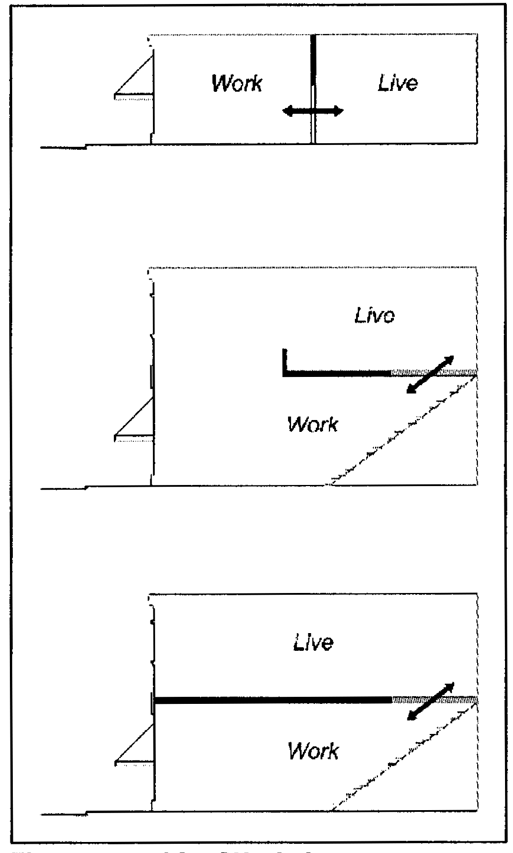
Figure 4-1 Live/Work Arrangement Examples
5.
Mixed occupancy buildings. If a building contains mixed occupancies of live/work or work/live units and other nonresidential uses, occupancies other than live/work or work/live shall meet all applicable requirements for those uses, and proper occupancy separations shall be provided between the live/work or work/live units and other occupancies, as determined by the Building Official.
6.
Parking. Each live/work or work/live unit shall be provided at least two off-street parking spaces. The review authority may modify this requirement for the use of existing structures with limited parking, or may require additional parking based on the nature of the proposed work activities.
E.
Operating requirements.
1.
Occupancy. A live/work or work/live unit shall be occupied and used only by the operator of the business within the unit, or a household of which at least one member shall be the business operator.
2.
Sale or rental of portions of unit. No portion of a live/work or work/live unit may be separately rented or sold as a commercial space for any person not living in the premises or as a residential space for any person not working in the same unit.
3.
Notice to occupants. The owner or developer of any building containing work/live units shall provide written notice to all occupants and users that the surrounding area may be subject to levels of noise, dust, fumes, or other effects associated with commercial and industrial uses at higher levels than would be expected in residential areas. State and Federal health regulations notwithstanding, noise and other standards shall be those applicable to commercial or industrial properties in the applicable zone.
4.
Nonresident employees. Up to two persons who do not reside in the live/work or work/live unit may work in the unit unless this employment is prohibited or limited by the Minor Use Permit or Use Permit. The employment of three or more persons who do not reside in the live/work or work/live unit may be permitted subject to Use Permit approval, based on additional findings that the employment will not adversely affect traffic and parking conditions in the site vicinity. The employment of any persons who do not reside in the live/work or work/live unit shall comply with all applicable Building Code requirements.
5.
Client and customer visits. Client and customer visits to live/work or work/live units are permitted subject to any applicable conditions of the applicable Minor Use Permit or Use Permit, to ensure compatibility with adjacent commercial or industrial uses, or adjacent residentially-zoned areas or uses.
F.
Changes in use. After approval, a live/work or work/live unit shall not be converted to entirely residential use, nor shall the ratio of living space to working space be changed, unless authorized through Minor Use Permit approval. Minor Use Permit approval shall require that the Director first find that the exclusively residential use will not impair the ability of nonresidential uses on and adjacent to the site to continue operating because of potential health or safety concerns or nuisance complaints raised by the exclusively residential use and/or its occupants.
G.
Required findings. The approval of a live/work or work/live unit shall require that the review authority first make all of the following findings, in addition to all findings required for Minor Use Permit or Use Permit approval.
1.
The proposed use of each live/work or work/live unit is a bona fide commercial or industrial activity consistent with Subsection B (Limitations on use) above;
2.
The establishment of live/work or work/live units will not conflict with nor inhibit industrial or commercial uses in the area where the project is proposed;
3.
The building containing live/work or work/live units and each live/work or work/live unit within the building has been designed to ensure that they will function predominantly as work spaces with incidental residential accommodations meeting basic habitability requirements in compliance with applicable regulations; and
4.
Any changes proposed to the exterior appearance of the building will be compatible with adjacent commercial or industrial uses where all adjacent land is zoned for commercial or industrial uses. If there is adjacent residentially-zoned land, the proposed changes to the building will make the commercial or industrial building being converted more compatible with the adjacent residential area.
Sec. 106.42.120. - Marijuana Dispensaries, Deliveries and Businesses
A.
Purpose and intent. This Section identifies that marijuana dispensaries and other businesses, are not permitted uses in any zone of the city, and therefore, such use will not appear as an allowed use anywhere in the city.
B.
Medical marijuana dispensary as a prohibited use. A medical marijuana dispensary, as defined in Section 106.80.20 is prohibited in all zones of the city. No permit or any other applicable license or entitlement for use, nor any business license, shall be approved or issued for the establishment, maintenance or operation of a medical marijuana dispensary.
C.
Commercial medical marijuana businesses as a prohibited use. A commercial medical marijuana business, as defined in Section 106.80.20 is prohibited in all zones of the city. No permit or any other applicable license or entitlement for use, nor any business license, shall be approved or issued for the establishment, maintenance or operation of a commercial medical marijuana business.
D.
Commercial non-medical marijuana businesses as a prohibited use. A commercial non-medical marijuana business, as defined in Section 106.80.20 is prohibited in all zones of the city. No permit or any other applicable license or entitlement for use, nor any business license, shall be approved or issued for the establishment, maintenance or operation of a commercial non-medical marijuana business.
(Ord. No. 2012-004, § 3, 2-25-2012; Ord. No. 2016-008, § 7, 9-22-2016; Ord. No. 2016-009, § 7, 9-22-2016; Ord. No. 2020-01, § 3, 2-13-2020)
Editor's note— Ord. No. 2012-004, § 3, adopted Feb. 25, 2012, repealed the former § 106.42.120 and enacted a new § 106.42.120 as set out herein. The former § 106.42.120 pertained to medical cannabis uses and derived from Ord. No. 2006-02, adopted October 5, 2006.
Sec. 106.42.130. - Mixed Use Projects
This Section provides standards for the design of mixed use projects, where allowed by Article 2 (Zoning Districts and Allowable Land Uses). A mixed use project combines residential and nonresidential uses on the same site, with the residential units typically located above the nonresidential uses (vertical mixed use). Residential units may be allowed at ground level behind street-fronting nonresidential uses (horizontal mixed use) only under the limited circumstances specified by this Section.
A.
Permit requirements and mix of uses. A mixed use project may combine residential uses with any other use allowed in the applicable zoning district by Section 106.26.030 (Commercial and Industrial District Land Uses and Permit Requirements).
1.
A mixed use project is a permitted use subject to a Zoning Clearance where the proposed nonresidential component is identified as a permitted use by Section 106.26.030 (Commercial and Industrial District Land Uses and Permit Requirements), except that Minor Use Permit approval is required where the Director determines that the nonresidential component will generate odors, noise, or involve activities or hours of operation that may cause nuisances for the residential use (e.g., coffee roasting, restaurant, auto-related use, etc.). This permit requirement shall also apply to a replacement nonresidential use after the mixed use project is established.
2.
A mixed use project that is proposed with a nonresidential use that is required by Section 106.26.030 (Commercial and Industrial District Land Uses and Permit Requirements) to have Minor Use Permit or Use Permit approval in the applicable zoning district shall be subject to that permit requirement.
3.
The review authority may restrict or deny a proposed nonresidential use if it determines that the use cannot be operated so as to be compatible with the residential uses on the site.
B.
Design considerations. A mixed use project shall be designed to achieve the following objectives.
1.
The design shall provide for internal compatibility between the residential and nonresidential uses on the site.
2.
Potential glare, noise, odors, traffic, and other potentially significant impacts on residents shall be minimized to allow a compatible mix of residential and nonresidential uses on the same site.
3.
The design shall take into consideration potential impacts on adjacent properties and shall include specific design features to minimize potential impacts.
4.
The design shall ensure that the residential units are of a residential character, and that appropriate privacy between residential units and other uses on the site is provided.
5.
Site planning and building design shall provide for convenient and attractive pedestrian access from the public street into the nonresidential portions of the project, through such means as courtyards, plazas, walkways, and street furniture.
6.
Site planning and building design shall be compatible with and enhance the adjacent and surrounding residential neighborhood in terms of building design, color, exterior materials, landscaping, lighting, roof styles, scale, and signage.
C.
Maximum density. The residential component of a mixed use project shall comply with the maximum density requirements of Section 106.26.040 (Commercial and Industrial District General Development Standards) for the applicable zoning district.
D.
Site layout and project design standards. Each proposed mixed use project shall comply with the property development standards of the applicable zoning district, and the following requirements.
1.
Location of units. Residential units shall not occupy ground floor space within the first 50 feet of floor area measured from each building face adjacent to a primary public street frontage.
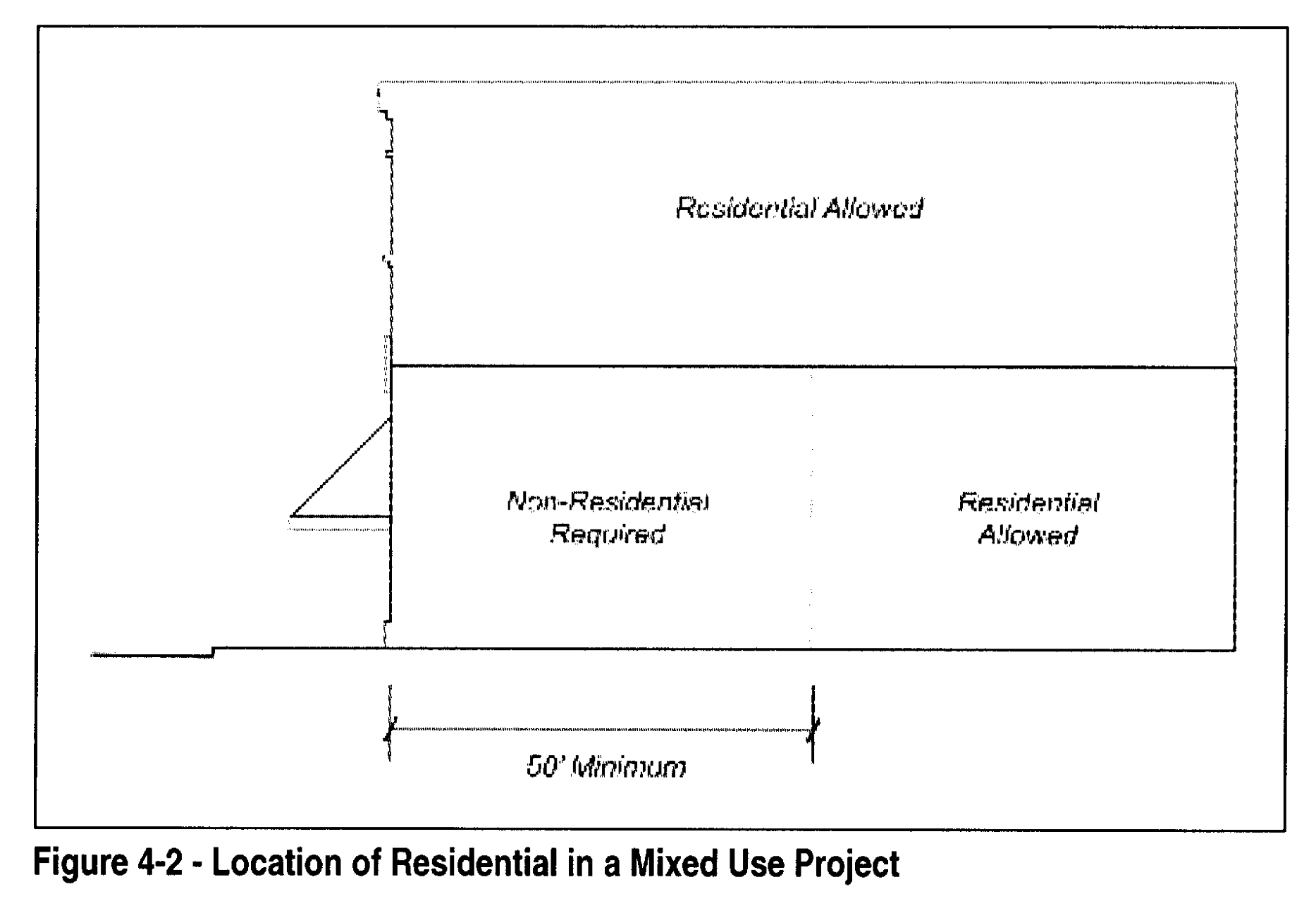
Figure 4-2 Location of Residential in Mixed Use Project
2.
Parking. To encourage the development of residential uses in existing and new commercial areas, shared parking shall be incorporated into mixed use projects in compliance with Section 106.36.070 (Reduction of Parking Requirements).
3.
Loading areas. Commercial loading areas shall be located away from residential units and shall be screened from view from the residential portion of the project to the maximum extent feasible.
4.
Refuse and recycling areas. Areas for the collection and storage of refuse and recyclable materials shall be located on the site in locations that are convenient for both the residential and nonresidential uses.
E.
Performance standards.
1.
Lighting. Lighting for commercial uses shall be appropriately shielded to limit impacts on the residential units.
2.
Noise. Each residential unit shall be designed and constructed to minimize adverse impacts from nonresidential project noise, in compliance with the City's Noise Ordinance.
Sec. 106.42.140. - Mobile Homes and Mobile Home Parks
A.
Mobile homes outside of mobile home parks. A mobile home located outside of a mobile home park shall comply with the architectural standards for single dwellings in Section 106.42.220 (Single Dwellings).
B.
Mobile home park standards. Each mobile home park and structure within a mobile home park shall comply with the following standards.
1.
Setback requirements. Each mobile home, patio or porch cover, awning, garage, storage building, or any other structure or building shall be set back a minimum of five feet from the boundary lines of each mobile home site; except that a storage shed of 100 square feet or less may be located within three feet of the mobile home site boundary. Where a mobile home site adjoins a mobile home park exterior property line, adjacent structures shall be set back from the exterior property line as required by the applicable zoning district.
2.
Landscape areas. Landscaping shall be provided in compliance with Chapter 106.34 (Landscaping Standards).
3.
Recreation area. Recreation areas, landscaped and maintained in a dust free condition, shall be provided as follows:
a.
Family park. 250 square feet of recreational area per mobile home space for the first through 100th space and 200 square feet of recreational area per mobile home space for each space in excess of the 100th space.
b.
Adult park. 200 square feet of recreational area per mobile home space.
4.
Storage area. A mobile home park shall provide one or more storage areas for tenant-owned recreational vehicles, travel trailers, boats and other vehicles. The size, location and screening of said storage areas shall be considered on a project-by-project basis by the review authority, taking into consideration the number of units and type of project.
5.
Streets and access drives. The design of streets and access drives shall comply with applicable State standards for mobile home parks, and requirements established by the Use Permit for the mobile home park.
Sec. 106.42.150. - Multi-Unit Dwelling and Group Quarters Projects
This Section provides standards for the design of multi-unit dwelling and group quarters projects, where allowed by Article 2 (Zoning Districts and Allowable Land Uses). See also the design standards for multi-unit residential development in Section 106.31.030.C (Multi-unit housing and small lot design).
A.
Height limits. Each structure shall be limited to a maximum height of 20 feet and one story when located within 50 feet of an RD1-10 zoning district.
B.
Building separation. Buildings proposed on the site of a multi-unit project shall be located so as to be separated by the following minimum distances. Where two adjacent buildings are of differing height, the separation required for the highest building shall be provided.
C.
Recreation area. Recreation areas, landscaped and maintained in a dust free condition, shall be provided as follows, in addition to required setback areas.
1.
Family project. A multi-unit project without age restrictions on residents shall be designed to provide 250 square feet of recreational area per dwelling unit for the first through 100th units and 200 square feet of recreational area per dwelling unit for each unit in excess of the 100th unit. The review authority may reduce these requirements where necessary to accommodate the minimum density identified for the site by the Housing Element, provided that project design has first incorporated smaller unit sizes.
2.
Senior citizen project. A multi-unit project that is restricted to senior citizens shall be designed to provide 200 square feet of recreational area per unit.
D.
Fence requirements. A six-foot high wrought-iron/tubular steel fence or decorative masonry wall shall be provided and maintained along all interior property lines; a masonry wall is required at a property line adjacent to a single-family residential zone or use. All fences and walls shall also comply with the requirements of Section 106.30.050 (Fences and Walls).
1.
A fence located between a building and a street shall comply with the Section 106.30.060.E (Height limit at street corners), where applicable.
2.
Fence height may be modified where the review authority finds that, due to a significant difference in elevation between parcels, different screening requirements are necessary.
3.
The fence/wall requirement of this Subsection may be waived or modified by the review authority where the adjacent site is developed with a commercial structure with a property line wall, or if the review authority determines that other effective security/screening barriers exist.
No front yard wall or fence is required; if proposed the fence or wall shall be set back a minimum of 20 feet from the front property line, unless another location is authorized through Design Review.
E.
Access drive and parking space location.
1.
Each access drive shall be located at least 10 feet from any dwelling unit, measured in any direction from the edge of the drive (including vertical angle measurement), and no closer than three feet from a fence, patio, trellis, etc.
2.
Parking spaces shall be located at least six feet from any dwelling unit measured in any direction from the edge of parking space (including vertical angle measurement).
3.
Garage doors shall either be four to six feet from the edge of the access drive or 20 or more feet from the access drive. If the driveway to the garage is 20 or more feet in depth, the driveway may be counted as a tandem parking space.
F.
Entrance turnout and project directory. Each project shall be provided a turnout at the primary site entrance with a directory board and building number and addresses. This requirement may be waived by the review authority, based on a recommendation from the Sacramento Metropolitan Fire District, for a project of less than 20 units.
G.
Pedestrian access. Each unit shall be provided direct, convenient, and safe pedestrian connections to common areas within the site and walkways on adjoining public streets or parks.
Sec. 106.42.160. - Outdoor Displays and Sales
A.
Applicability. The provisions of this Section apply to facilities for outdoor display, sales (e.g., garden nurseries, news and flower stands, outdoor vending machines, and similar uses where merchandise is displayed for sale), and outdoor eating areas, where allowed by Article 2 (Zoning Districts and Allowable Land Uses).
B.
Design objectives. Each outdoor display and/or sales area shall be attractively designed to avoid a cluttered appearance on the site.
C.
Temporary outdoor displays and sales. See Section 106.62.030 (Temporary Use Permit), and/or Section 106.42.106 (Itinerant Vending), as applicable.
D.
Permanent outdoor displays and sales. The permanent (in place more than 30 consecutive days) outdoor display and sale of merchandise in conjunction with an existing business occupying a permanent structure on the same site is allowed subject to the following standards.
1.
Location. Displayed merchandise shall occupy a fixed, specifically approved location that does not disrupt the normal function of the site or its circulation, and does not encroach upon required setbacks, driveways, landscaped areas, parking spaces, pedestrian walkways, bicycle lanes, or a public right-of-way. In a zoning district where no setback area is required, an outdoor sales area shall be set back a minimum of 10 feet from adjoining property lines unless otherwise allowed through Use Permit approval.
2.
Maximum area. The area on a site devoted to display area for other than vehicle sales lots, produce stands, and nursery product sales is limited to 20 percent of the building floor area or 12,000 square feet, whichever is less, unless a larger area is authorized through Use Permit approval.
3.
Height limit. Displayed merchandise other than plant materials for sale (e.g., Christmas trees, nursery trees, etc.) shall not exceed a height of six feet above finished grade, unless a greater height is allowed through Use Permit approval.
4.
Hazards. A display shall not obstruct intersection visibility or otherwise create hazards for pedestrian or vehicular traffic.
5.
Screening. The Director may require that outdoor sales and activity areas other than vehicle sales lots, produce stands, and nursery product sales be screened from the view of adjoining public rights-of-way by decorative walls or fencing, or landscaping.
6.
Signs. Additional signs, beyond those normally allowed for the primary use, shall not be provided as a result of the outdoor display and sales area.
E.
News and flower stands.
1.
Location requirements. A permanent news or flower stand shall:
a.
Be located parallel and adjacent to the wall of a structure. A freestanding news or flower stand is allowed only as a roofed kiosk;
b.
Not be located within the public right-of-way, within three feet of a display window of any structure abutting the sidewalk, or so as to interfere with or restrict the reasonable use of the window for display purposes.
2.
Design and construction requirements.
a.
A stand shall be soundly constructed of wood, metal, or other suitable permanent material, and designed in a manner and color to be compatible with the adjacent structures whether the stand is opened or closed. Security doors shall be designed as an integral part of the structure.
b.
Shelving shall not exceed eight feet in height nor two feet in depth.
3.
Maintenance. The news and flower stand shall be maintained in a clean and neat condition and in good repair, at all times.
4.
Signs.
a.
The stands shall not be used for advertising or publicity purposes. Signs shall be for identification only, with size and design in compliance with Chapter 106.38 (Signs).
b.
The owners or operators of the outdoor news or flower stand shall display, in a place readily visible to the public, a telephone number and address where the owners may be reached.
5.
Additional product sales. In addition to the sale of newspapers, magazines, and other periodicals, for newsstands, and flowers and plants, for flower stands, the owners or operators may sell other related accessory products, not to exceed 10 percent of the total merchandise displayed.
F.
Outdoor dining areas.
1.
An outdoor dining area may be allowed accessory and incidental to a restaurant with indoor eating area on the same site; provided that the outdoor eating area shall also comply with the parking requirements of Section 106.36.040 (Number of Parking Spaces Required) for restaurants.
2.
An outdoor eating area within the public right-of-way shall require an encroachment permit, and shall use only City approved furniture and enclosures.
3.
Signs shall comply with Chapter 106.38 (Signs).
G.
Outdoor Vending Machines. The preferred location for vending machines is inside buildings. Vending machines installed outdoors shall meet the following requirements:
1.
Location requirements.
a.
Outdoor vending machines shall be located along the face of a building or against a structure designed to accommodate them.
b.
Outdoor vending machines may be placed in front of a glass or wall storefront provided visibility to the cashier is not obstructed.
c.
No more than a total of 25 percent of a window area may be covered with signage or outdoor vending machines.
d.
A minimum walkway of four (4) feet is required in front of all outdoor vending machines.
e.
Outdoor vending machine shall not be installed in the public right-of-way or immediately adjacent such that it would cause customers to stand in the right-of-way in order to use the machine.
f.
Outdoor vending machines shall be an ancillary use to an approved primary use and may not be located on an unimproved lot.
g.
Outdoor vending machines shall not be placed in a location that will block parking areas or create an unsafe situation.
2.
Number of machines.
a.
Machines are permitted to cover up to a maximum of 10 percent of the length of the primary building frontage, or 20 feet, whichever is less.
3.
Design and construction requirements.
a.
Machine installations shall not have exposed conduits, piping or overhead utility connections.
4.
Maintenance of machines.
a.
All outdoor machines shall be maintained in a clean and attractive condition.
b.
Any graffiti on an outdoor vending machine shall be removed within 24 hours.
c.
If the outdoor machine is removed the area shall be cleaned and restored including the removal of any conduits or other connection hardware.
(Ord. No. 2011-002, § 3, 2-11-2011)
Sec. 106.42.170. - Outdoor Storage
An outdoor storage or work area shall comply with the following requirements, where allowed by Article 2 (Zoning Districts and Allowable Land Uses).
A.
Enclosure and screening required. Outdoor storage areas shall be entirely enclosed by a solid wall or fence as approved by the review authority with a minimum height of six feet and a maximum height of eight feet, unless authorized by Use Permit approval. Fences or walls shall also comply with the requirements of Section 106.30.050 (Fences and Walls).
B.
Maximum height of stored materials. The materials within the storage area shall not be higher than the fence, except where authorized by the Use Permit for the storage area.
C.
Landscaped setback. Where an outdoor storage area abuts a street right-of-way, the required screening wall or fence shall be set back from the right-of-way as required by the applicable zoning district. The setback area shall be landscaped to the approval of the Director, and in compliance with Chapter 106.34 (Landscaping Standards).
Sec. 106.42.180. - Power Transmission Facilities
This Section establishes standards for power transmission facilities, where allowed by Article 2 (Zoning Districts and Allowable Land Uses).
A.
Permit requirement. Electrical transmission lines or substations of the Sacramento Municipal Utility District (SMUD) with less than 100,000-volt capacity are permitted without City review. A facility with greater than 100,000 volts shall require Council approval. Within 60 days of receipt of a proposal from SMUD to locate and construct, the Council shall conduct a public hearing to consider the compliance of such proposal with the provisions of this Code, and shall adopt a resolution approving, approving an alternative, or disapproving the proposed facilities. The resolution shall contain findings concerning:
1.
The consistency of the proposed facilities with the General Plan;
2.
Feasible alternatives to the proposal;
3.
The necessity for, as compared to the impact of, the proposed facilities on the health, convenience, safety and welfare of City residents.
B.
Location requirements - Transmission lines. Electrical transmission lines of 100,000 volts or greater capacity may be located in any zone and shall be located in easements or rights-of-way which permit access for maintenance with minimal disruption to surrounding properties. Preference shall be given to the location of transmission lines in the rank order specified below; every reasonable effort shall be exerted to avoid established residential areas. In the event SMUD determines that it has no alternative but to route a 100,000 volt or greater capacity transmission line through an established residential area, the lines shall be installed underground except when SMUD can demonstrate that it is not feasible to do so. "Feasible" shall be as defined in Government Code § 53096(c).
1.
Within an existing SMUD transmission right-of-way or a right-of-way anticipated for other projects proposed subject to this Code;
2.
Adjacent to railroads or adopted freeway routes;
3.
Along or adjacent to major arterial streets where existing or planned uses are commercial or industrial;
4.
Adjacent to or through existing or planned commercial or industrial uses;
5.
Along major arterial streets with RD-20 or RD-30 zoning;
6.
Through areas where land uses in an adopted plan are predominately commercial, but include some residential uses; or
7.
Through residential areas, including side and rear yards, irrespective of density.
C.
Location requirements - Substations. A substation may be located in any zone, provided that mitigation measures are implemented in compliance with Subsection D below. Preference shall be given to the location of substations in the following rank order:
1.
A site designated for industrial or commercial land uses in an adopted plan;
2.
A site within an undeveloped area designated for residential use in an adopted plan; or
3.
A site designated for residential use in an adopted plan and surrounded by existing residential uses.
for the purposes of this Zoning Code, a substation is any facility with 100,000 volts or greater capacity that either converts electrical energy to a lesser voltage for the purpose of sub-regional or localized distribution, functions as a transition point from overhead to underground electrical transmission lines, or acts as the point of convergence for two or more transmission lines.
D.
Mitigation measures.
1.
Overhead electrical transmission lines of 100,000 volts or greater capacity shall be designed and installed in a manner to minimize adverse visual impacts. When feasible, SMUD shall relocate and combine existing overhead transmission poles and lines with new installations. If feasible, lines shall be placed underground.
2.
Substations shall be designed and constructed to minimize off-site visual and noise impacts. Planted or landscaped setbacks of at least 25 feet shall be provided on all public street frontages.
3.
SMUD proposals to the Council to locate and construct electrical transmission lines and/or substations subject to this Zoning Code shall include a discussion of mitigation measures to be utilized and a plan indicating the specific site treatments to be employed.
4.
Where new or relocated overhead lines abut a public or private street, poles shall not be sited within, or otherwise encroach upon sidewalks or other pedestrian or bicycle pathways.
Sec. 106.42.190. - Recycling Facilities
This Section establishes standards and procedures for the siting and operation of various types and sizes of commercial recycling facilities, where allowed by Article 2 (Zoning Districts and Allowable Land Uses).
A.
Reverse vending machines. Reverse vending machines shall comply with the following standards.
1.
Accessory use only. Each machine shall be installed only as an accessory use to an allowed primary use.
2.
Location requirements. If located outside of a structure, a machine shall not occupy parking spaces required by the primary use.
3.
Signs. Sign area shall not exceed four square feet for each machine, exclusive of operating instructions. The sign area shall be subject to the overall site sign area limitations in Section 106.38.060 (Zoning District Sign Standards).
4.
Lighting. Each machine shall be illuminated to ensure comfortable and safe operation if the machine is accessible between dusk and dawn. All outdoor lighting shall comply with the requirements of Chapter 106.35 (Outdoor Lighting).
B.
Small collection facilities. A small collection facility shall comply with the following standards.
1.
Location requirements. A small collection facility shall:
a.
Not be located within 50 feet of any dwelling; and
b.
Be set back at least 10 feet from any public right-of-way, and not obstruct pedestrian or vehicular circulation.
2.
Maximum size. A small collection facility shall not occupy more than 600 square feet, not including space that would be periodically needed for the removal of materials or exchange of containers.
3.
Appearance of facility. Collection containers and site fencing shall be of a color and design that is compatible and harmonious with the surrounding uses and neighborhoods.
4.
Operating standards for small collection facilities. A small collection facility shall:
a.
Not use power-driven processing equipment, except for reverse vending machines;
b.
Accept only glass, metal, or plastic containers, paper, and reusable items;
c.
Use containers that are constructed with durable waterproof and rustproof materials, secured from unauthorized removal of material, and of a capacity sufficient to accommodate materials collected and the collection schedule; and
d.
Be screened where determined by the review authority to be necessary to limit visibility.
5.
Maintenance standards. Collection receptacles and each small collection facility site shall be maintained as follows:
a.
No receptacle shall obstruct a required parking space or disrupt either automobile or pedestrian traffic to or within the site. Each receptacle shall be located so as not to be detrimental to the appearance of the neighborhood or so as to create a public or private nuisance, as determined by the review authority.
b.
Each receptacle shall be kept clean, well maintained, neatly painted, and in good operating condition.
c.
Each receptacle shall be clearly marked with the name of the nonprofit organization doing the collection, the recycling business sponsoring or collecting the materials, and the local telephone numbers of each.
d.
Each receptacle shall be emptied on a regular basis, but not less than once every two weeks. Materials stored shall not be allowed to overflow the containers. The external stacking or collection of materials outside of collection receptacles is prohibited.
e.
Any litter or spillage shall be immediately removed and cleaned.
f.
Upon termination of the use, all receptacles shall be removed and the site restored to its original condition within 48 hours.
6.
Signs. Non-illuminated signs may be provided as follows:
a.
Identification signs are allowed with a maximum area of 15 percent for each side of the structure or 12 square feet, whichever is greater. In the case of a wheeled facility, the side shall be measured from the ground to the top of the container;
b.
Additional directional signs, consistent with Chapter 106.38 (Signs), may be approved by the Director if found necessary to facilitate traffic circulation, or if the facility is not visible from the public right-of-way.
7.
Parking requirements.
a.
No additional parking space shall be required for customers of a small collection facility located in the established parking lot of the primary use.
b.
Use of parking spaces by the patrons and the attendant shall not reduce available parking spaces below the minimum number required for the primary use unless a parking study, determined to be acceptable by the Director, shows that existing capacity is not fully utilized during the time the recycling facility would be on the site.
Sec. 106.42.200. - Residential Accessory Uses and Structures
This Section provides standards for residential accessory uses and structures, where allowed by Article 2 (Zoning Districts and Allowable Land Uses). These requirements do not apply to accessory dwelling units, which are instead regulated by Section 106.42.015 (Accessory Dwelling Units).
A.
Relationship to primary use. An accessory use and/or structure shall be incidental to the primary residential use of the site, and shall not alter the character of the primary use.
B.
Timing of installation. An accessory structure shall only be constructed concurrent with or after the construction of the primary structure on the same site, unless construction in advance of a primary structure is authorized through Minor Use Permit approval.
C.
Attached structures. An accessory structure attached to the primary structure shall comply with all zoning district requirements applicable to the primary structure, including height limits and site coverage; and shall also comply with any applicable requirements of Subsection E. below, for the specific type of structure.
D.
Detached structures. An accessory structure that is detached from the primary structure shall comply with the following standards, except where Subsection E below, establishes a different requirement for a specific type of accessory structure.
1.
Setback requirements.
a.
Front setback. An accessory structure shall not be located within a required front setback except as may otherwise be provided by Subsection E below.
b.
Side and rear setbacks. An accessory structure shall maintain interior side and rear setbacks of at least five feet; except that the Director may authorize a minimum side and/or rear setback of three feet.
c.
Separation between structures. An accessory structure shall maintain at least a five-foot separation from other accessory structures and the primary dwelling unit.
d.
Double-frontage lot. An accessory structure shall not occupy the front half of a parcel, or either front quarter of a double-frontage lot, unless it is setback at least 75 feet from any street lot line.
e.
Reverse corner lot. On a reverse corner lot that abuts a key lot, no accessory structure shall be located less than 12.5 feet from the street property line. See Figure 4-3.
f.
Garages accessible from an alley. Where an accessory garage is accessible to vehicles from an alley, it shall be located not less than 25 feet from the opposite side of the alley.
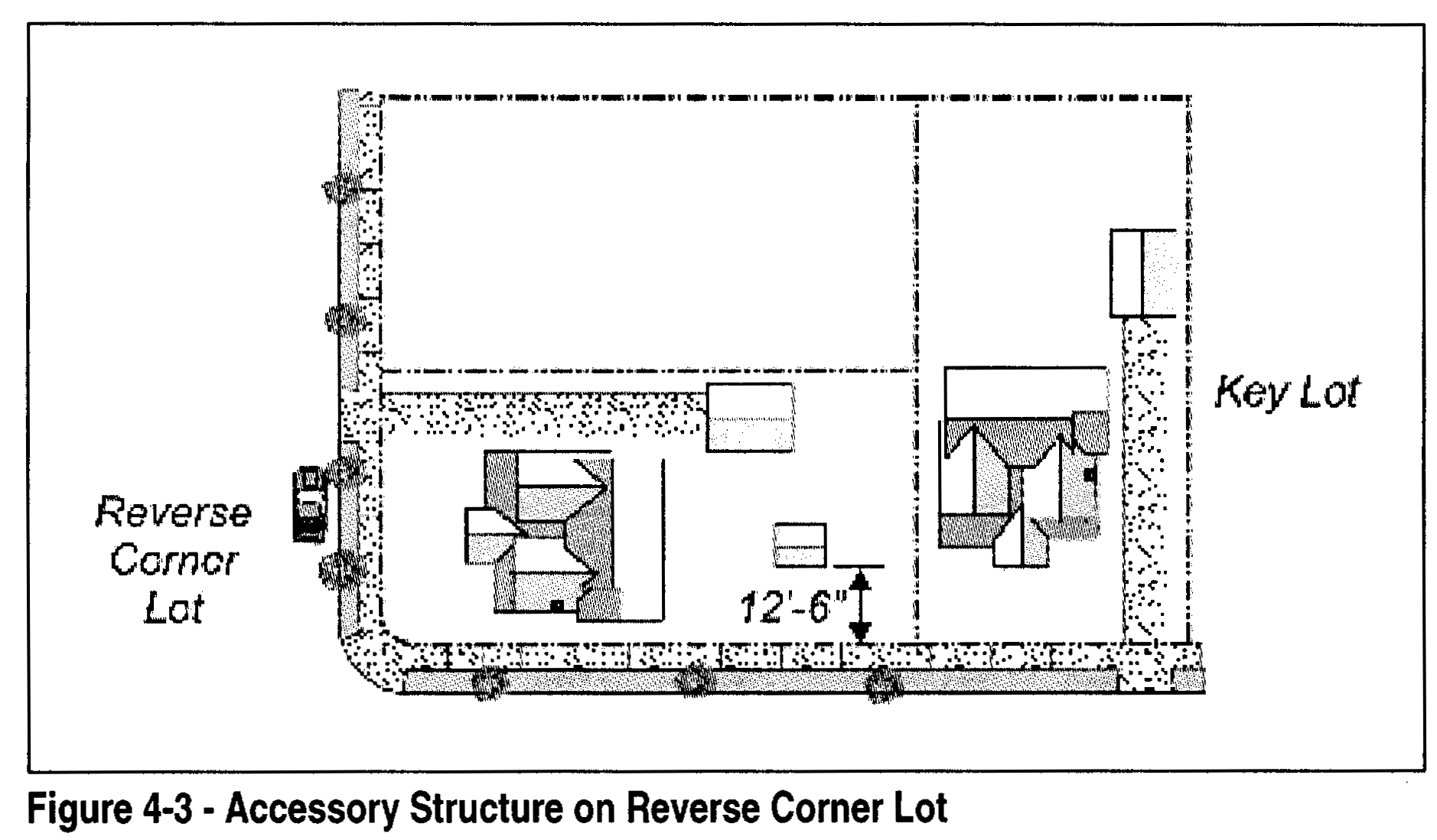
2.
Location. A residential accessory structure may be located between the primary dwelling and a street only with design review approval.
3.
Height limit. An accessory structure shall not exceed a maximum height of 16 feet. An accessory structure with a height greater than 16 feet shall increase the required five foot setback one foot for each foot above 16 feet (i.e., an 18-foot high structure shall be set back seven feet.) An accessory structure that is unable to meet the setback requirement previously described may have a height greater than 16 feet authorized by minor use permit approval.
4.
Lot coverage and size limitations. Residential accessory structures shall be included when calculating lot coverage requirements of Section 106.24.060 (Residential District Site Planning and Building Standards).
a.
The combined square footage of all accessory structures shall not exceed 2,400 square feet unless authorized through Minor Use Permit approval.
E.
Standards for specific accessory uses and structures. The following requirements apply to the specific types of accessory structures listed, in addition to the requirements of Subsection D. above, as applicable.
1.
Patio covers. A patio cover that is attached to or detached from the primary dwelling, and open on at least three sides, may be located within the required rear setback subject to the following:
a.
The five-foot separation from the primary dwelling unit required by Subparagraph D.1.c (Separation between structures), above does not apply;
b.
The structure shall comply with the coverage and size limitations of Subparagraph D.3 (Coverage and size limitations), above; and
c.
No part of a detached patio cover shall be closer than five feet to a rear property line, five feet to interior side, and 12.5 feet to street side property line.
2.
Carports. The five-foot separation from the primary dwelling unit required by Subparagraph D.1.c (Separation between structures), above does not apply to a carport. Design review is required for a carport located between the front property line and the residence.
3.
Swimming pools. A non-commercial swimming pool is an allowed accessory use in any zoning district, provided that no swimming pool shall be located within a required front or side setback, closer than three feet to any property line, or within three feet of a dwelling unit as measured to the surface of the water. No swimming pool shall be located within a utility easement.
4.
Tennis and other recreational courts. Non-commercial outdoor tennis courts and outdoor courts for other sports, including basketball and racquetball, accessory to a residential use shall comply with the following requirements:
a.
Setbacks. No court shall be located within a required setback, or within 10 feet of a property line.
b.
Fencing. Court fencing shall comply with Section 106.30.050 (Fences and Walls).
c.
Lighting. Court lighting shall require Minor Use Permit approval, and shall not exceed a maximum height of 20 feet, measured from the court surface. The lighting shall be directed downward, shall only illuminate the court, and shall not illuminate adjacent property, in compliance with Chapter 106.35 (Outdoor Lighting).
d.
Lot coverage. Tennis and other recreational courts shall be exempt from any lot coverage limitations of the applicable zoning district.
5.
Workshops or studios. An accessory structure intended as a workshop or studio for artwork, crafts, light hand manufacturing, or hobbies, shall be limited to: non-commercial hobbies or amusements; maintenance of the primary structure or setbacks; artistic endeavors, including painting, photography, or sculpture; or for other similar purposes. Any use of an accessory workshop for any commercial activity shall comply with Section 106.42.100 (Home Occupations).
6.
Entryway trellises. A trellis structure may be located over a walkway that extends between a public sidewalk and the front entrance of a single dwelling adjacent to the intersection of the public sidewalk and the on-site walkway, provided that the trellis shall not:
a.
Exceed 10 feet in height;
b.
Be more than 10 feet wide;
c.
Encroach into or over the public sidewalk or public right-of-way; and
d.
Block or impede pedestrian circulation.
Each trellis shall also comply with all applicable Building Code requirements and any Fire Department requirements.
(Ord. No. 2008-15, § 1, 12-11-2008; Ord. No. 2013-011, § 3, 11-14-2013; Ord. No. 2017-002, § 3(Exh. A-1), 7-13-2017; Ord. No. 2023-003, § 4(Exh. A), 5-11-2023; Ord. No. 2024-006, § 1(Exh. A), 9-25-2024)
Sec. 106.42.210. - Second Dwelling Units
This Section establishes standards for second dwelling units, where allowed by Article 2 (Zoning Districts and Allowable Land Uses).
A.
Design Review. All new construction or renovation to the exterior of an existing primary dwelling unit to create a second unit shall require ministerial Design Review in compliance with Section 106.62.040 (Design Review).
B.
Limitation on number of units. No more than one second unit shall be approved on a single parcel.
C.
Relationship to primary use.
1.
Size, style. A second unit shall be incidental and subordinate to the primary single-family residential use of the site in terms of size, location, and appearance, and shall not alter the character of the primary structure. The architectural style, exterior materials, and colors of the second unit shall be compatible with the primary dwelling unit.
2.
Timing of construction. A second unit may be constructed simultaneously with or after the primary dwelling. In addition, an existing dwelling that complies with the design standards for second units in Subsection D. below, may be considered a second unit, and a new primary unit may be constructed which would then be considered the primary dwelling unit.
3.
Lot coverage. A second unit shall comply with lot coverage requirements established for the site by Section 106.42.200 (Residential Accessory Uses and Structures).
D.
Second unit design standards. A second unit shall be designed to comply with the following standards:
1.
Setback requirements. A second unit shall comply with the setback requirements of the applicable zoning district, except that a two-story second unit shall be provided side and rear setbacks that are three feet more than required by the applicable zoning district.
2.
Height limit. A detached second unit shall not exceed a maximum height of 20 feet except when the second dwelling unit is above a detached accessory structure, in which case it shall not exceed 25 feet.
3.
Maximum floor area.
a.
The floor area of a second unit shall not exceed 60 percent of the floor area of the primary dwelling or 1,200 square feet, whichever is less. An attached garage of up to 400 square feet may be included when calculating the floor area of the primary dwelling.
b.
For purposes of computing the floor area of a second unit that is detached from the primary dwelling unit, all enclosed areas accessed from within the second unit shall be included.
c.
An enclosed storage area, or garage of up to 400 square feet, shall not be included when calculating the floor area of the second unit provided that there is no internal doorway or passage between the storage or garage and the second unit.
4.
Number of bedrooms. A second unit shall have a maximum of two bedrooms.
5.
Separate entrance required. An attached second unit shall have an entrance separate from the entrance to the primary dwelling.
6.
Window placement. A second unit that is 15 feet or less from a residential unit on an adjacent parcel shall not have windows that directly face windows in the other unit. A detached second unit located closer than 10 feet to a side lot line or 20 feet from a rear lot line shall have no second floor windows facing the side or rear except obscured glass or clerestory windows, unless the review authority determines that other types of windows will not significantly interfere with the privacy of residents on adjacent parcels.
E.
Off-street parking requirements. A second unit shall be provided a minimum of one off-street parking space per bedroom, in addition to the parking required for the primary dwelling by Chapter 106.36 (Parking and Loading). The parking spaces shall comply with the location and design requirements of Chapter 106.36.
(Ord. No. 2008-15, § 1, 12-11-2008; Ord. No. 2013-011, § 3, 11-14-2013)
Sec. 106.42.220. - Single Dwellings
This Section provides standards for single dwellings, including manufactured homes, where allowed by Article 2 (Zoning Districts and Allowable Land Uses).
A.
Architectural standards. Each single dwelling, including a manufactured home, shall comply with the following architectural requirements:
1.
Exterior siding material shall be high quality wood, stucco, stone or masonry, including wood/stone/masonry veneers. Siding shall extend below the top of the foundation or to the finished ground, whichever is applicable. Low grade wood siding shall be prohibited.
2.
Each roof shall have eave and gable overhangs not less than 12 inches measured from the vertical side of the building.
3.
The exterior roofing surface shall be shingle, shake or tile types of roofing either in natural form or simulated from such materials as metal, plastic or concrete. Specifically excluded are built-up, roll roofs and corrugated, sheet or skin metal or plastic panels.
B.
Facade width. No dwelling shall have a smallest projected facade width of less than 20 feet, not including a garage. For the purposes of this Section "smallest facade width" means the smallest dimension attained by the parallel projection of the outside, insulated, enclosing walls of the building when projected from every direction.
C.
Kitchens. No single dwelling shall have more than one full kitchen.
Sec. 106.42.225. - Small Lot Housing Product Projects
This Section provides standards for the design of single-family detached units or duplexes on individual lots when located within the RD-10 through RD-30, BP, GC, SC, and LC zoning districts. The intent of these standards is to allow smaller lots for housing than would otherwise be allowed or allow the development of detached homes on multi-family lots, development standards for multi-unit housing (apartments) are provided in Section 106.42.150.
A.
Minimum lot area and minimum lot width. The minimum lot area and/or minimum lot width may be determined by the review authority, provided the overall development site complies with the minimum parcel size and that the total number of dwellings is in compliance with the maximum density for the applicable zone.
B.
Building separation. Buildings proposed on the site shall be separated by a minimum of eight feet. Separation for pedestrian oriented stoops, entry features and front porches less than 15 feet in height may be reduced to five feet.
C.
Architectural standards. Each dwelling shall comply with the following architectural requirements:
1.
Exterior siding material shall be high quality wood, stucco, stone or masonry, including wood/stone/masonry veneers. Siding shall extend below the top of the foundation or to the finished ground, whichever is applicable. Low grade wood siding shall be prohibited.
2.
Blank walls are discouraged. All sides of each detached dwelling unit shall provide windows to allow natural lighting into each dwelling. Window placement should consider privacy of adjacent units and private outdoor space.
D.
Semi-private outdoor areas. Each unit shall provide a minimum of 250 square feet of semi-private outdoor area for each unit. The outdoor area shall provide a minimum usable dimension of 10 feet. The review authority may reduce these requirements where necessary to accommodate the minimum density identified for the site by the housing element, provided that project design has first incorporated smaller unit sizes.
E.
Access drive and parking space location.
1.
Each access drive shall be located at least 10 feet from any habitable space and four feet from any portion of a garage or porch, measured in any direction from the edge of the drive (including vertical angle measurement), and no closer than three feet from a fence, patio, trellis, etc.
2.
Parking spaces shall be located at least six feet from any structure measured in any direction from the edge of parking space (including vertical angle measurement).
3.
Garage doors shall either be a minimum of six feet from the edge of the access drive or more than 20 feet from the access drive. If the driveway to the garage is 20 or more feet in depth, the driveway may be counted as a parking space.
4.
A minimum of one guest parking space shall be provided for every dwelling unit. Guest parking may be reduced by the review authority if the review authority finds that based on a parking plan, the site will provide adequate parking for both guests and residents of the site.
5.
A homeowners association or other continuing maintenance and funding mechanism is required to ensure maintenance of all common areas and to enforce parking requirements (including within garages), subject to City review and approval.
F.
Pedestrian access. Each unit shall comply with the following requirements:
1.
Provide direct, convenient, and safe pedestrian connections to common areas within the site and walkways on adjoining public streets or parks.
2.
When multiple units share a common driveway that is lined with individual garages, provide distinguishable pedestrian paths to connect parking areas to articulated individual entries.
3.
Decorative paving and accent landscaping should be utilized to improve pedestrian access.
(Ord. No. 2018-005, § 1(Exh. 1), 10-11-2018; Ord. No. 2023-003, § 4(Exh. A), 5-11-2023)
Editor's note— Ord. No. 2018-005, § 1(Exh. 1), adopted October 11, 2018, set out provisions intended for use as § 106.42.230. For purposes of classification, and at the editor's discretion, these provisions have been included as § 106.42.225.
Sec. 106.42.230. - Smoking Paraphernalia Establishments
A.
Purpose and intent. This Section provided location and land use requirements for smoking paraphernalia establishments within the City, where allowed by Article 2 (Zoning Districts and Allowable Land Uses).
B.
Prohibited locations. No smoking paraphernalia establishment shall be located:
1.
In a residential zone (RD-1 through RD-30, or MH); or
2.
Within 1,000 feet of another smoking paraphernalia establishment, medical cannabis facility, elementary school, middle school, high school, public library, or public park; or
3.
Within 1,000 feet of a youth-oriented establishment characterized by either or both of the following:
a.
The establishment advertises in a manner that identifies the establishment as catering to or providing services primarily intended for minors; or
b.
The individuals who regularly patronize, congregate or assemble at the establishment are predominantly minors. The uses and zones set forth in this Section shall be collectively known as "sensitive uses." The distance between a smoking paraphernalia establishment and a "sensitive use" shall be made in a straight line, without regard to the intervening structures or objects, from the closest exterior wall of the structure or a portion of the structure in which the smoking paraphernalia establishment is located, to the property line of the lot on which the structure or portion of the structure in which the "sensitive use" occurs or is located.
C.
Accessory use. A smoking paraphernalia establishment is not and shall not be approved as an accessory use to any other use permitted by this Zoning Code.
Sec. 106.42.240. - Substance Abuse Treatment Clinics
This Section establishes standards for substance abuse treatment clinics, where allowed by Article 2 (Zoning Districts and Allowable Land Uses).
A.
Limitation on use. A substance abuse treatment clinic is not and shall not be approved as an accessory use to any other use permitted by this Zoning Code.
B.
Location requirements. No substance abuse treatment clinic shall be located:
1.
Immediately adjacent to any residentially zoned property; or
2.
Within 1,000 feet of another substance abuse treatment clinic, elementary school, middle school, high school, public library, or public park; or
3.
Within 1,000 feet of a youth-oriented establishment characterized by either or both of the following:
a.
The establishment advertises in a manner that identifies the establishment as catering to or providing services primarily intended for minors; or
b.
The individuals who regularly patronize, congregate or assemble at the establishment are predominantly minors.
The distance between a substance abuse treatment clinic, and the uses and zones described above, shall be measured in a straight line, without regard to intervening structures or objects, from the closest exterior wall of the building or structure, or a portion of the building or structure, in which the substance abuse treatment clinic is located, to the boundary of the use or zone described above.
C.
Cessation of use. If a permitted substance abuse treatment clinic ceases operations for a period of six consecutive months, the Use Permit shall lapse and shall automatically be deemed null and void, unless the Use Permit provides otherwise.
106.42.250. - Temporary Uses
This Section describes short-term activities that may not comply with normal development standards of the applicable zoning district, but may otherwise be acceptable because of their temporary nature.
A.
Permit requirement. Short-term activities as described below may be authorized through the issuance of a Temporary Use Permit. An application for a Temporary Use Permit shall be filed and processed in compliance with Chapter 106.60 (Permit Application Filing and Processing). It is the responsibility of the applicant to produce evidence supporting the required findings.
B.
Exempt temporary activities. The following temporary activities are allowed without a Temporary Use Permit. Temporary activities that do not fall within the following categories shall comply with Subsection C below.
1.
Agricultural products grown on-site. The sale of agricultural products on the site where product is grown.
2.
City-sponsored events. Special events approved and sponsored by the City.
3.
Construction staging areas—On-site. On-site contractors' staging areas, for an approved construction project. The construction area shall be removed immediately upon completion of the construction project, or the expiration of the Building Permit authorizing the construction project, whichever occurs first.
4.
Deliveries. Delivery activities of any establishment with a fixed place of business, which only delivers its products, services, or goods to a specified address in response to a customer request, order, or invoice previously placed through that fixed place of business.
5.
Door-to-door solicitation. Door-to-door solicitation in a residential area (this provision does not grant permission to solicit where an individual homeowner has posted a notice of "No Solicitation" or similar wording).
6.
Emergency facilities. Emergency public health and safety facilities and activities.
7.
Garage sales. No parcel may have more than three sales per year, and no sale may exceed two consecutive days.
8.
Public park events. Organizations selling goods or merchandise on park property with prior written authorization from the Sunrise Recreation and Park District.
9.
Public property. Activities conducted on public property including parks, schools or property under control of the City.
10.
Sidewalk vending. Vendor shall maintain a valid City business license and comply at all times with all other applicable City and governmental requirements, including the Americans with Disabilities Act (e.g., path of travel requirements).
11.
Special event or sale. Special event or sale that is held within a completely enclosed building and would be permitted under the applicable land use table.
12.
Temporary work trailers. A trailer or mobile home used as a construction office, or a temporary work site for employees of a business, provided that:
a.
The use is authorized by a Building Permit for the trailer, and the Building Permit for the permanent structure;
b.
The use is appropriate because:
(1)
The trailer or mobile home will be in place during the construction of a subdivision, or the construction or remodeling of a permanent commercial or manufacturing structure for a maximum of one year, or upon expiration of the Building Permit for the permanent structure, whichever first occurs; or
(2)
The applicant has demonstrated that the temporary work site is a short-term necessity for a maximum of one year, while a permanent work site is being obtained; and
c.
The trailer is removed prior to final building inspection or the issuance of a certificate of occupancy for the permanent structure.
13.
Vending on demand. Vendor shall maintain a valid City business licenses, County health permit, and comply at all times with all other applicable City and governmental requirements.
C.
Allowed temporary uses. A Temporary Use Permit may authorize the following temporary activities within the specified time limits. Other temporary or short-term activities that do not fall within the categories defined below shall instead comply with the planning permit requirements and development standards that otherwise apply to the property.
1.
Auto and RV sales. The temporary outdoor sales of autos, mobile homes, boats, and RV's may occur on any paved site within a GC, SC, AC, or commercial SPA zone for a period of three consecutive days every three months not to exceed 12 days in a calendar year. The temporary sale may be set up one day prior to the three-day sale and taken down one day following the sale.
2.
Construction staging areas—Off-site. Off-site contractors' staging areas, for an approved construction project subject to the following development standards:
a.
Appearance/safety. The Contractor shall erect and maintain temporary fencing and/or screening as needed to keep the site safe. Perimeter fencing shall be setback a minimum of five feet from the curb/sidewalk or street in the case of no sidewalks, to allow passage by pedestrians. The City may require additional fencing and screening methods depending on location of the temporary construction staging area.
b.
Dust control. The Contractor shall implement and maintain appropriate "Best Management Practices" at the site and along adjacent streets to minimize dust, erosion and sediment in accordance with State and local laws and to the satisfaction of the City.
c.
Noise. All activities shall comply with the City's Noise Ordinance.
d.
Notification. The contractor shall notify in writing all residents within 500 feet of the construction staging area of the activities that will be occurring at the site. The notice shall include a contact name and phone number of a person responsible for the management of the temporary construction staging area.
e.
Permit time limit. A Temporary Use Permit for an off-site construction yard may authorize the yard for up to one year. In the circumstance that a project extends beyond one year, the applicant shall file for a new Temporary Use Permit.
f.
Setbacks. Loose material (dirt, rock, sand, etc.) shall not be stored within 20 feet of a residential building.
g.
Signage. The contractor shall erect and maintain a sign at the entrance to the temporary construction staging area indicating: "Temporary Construction Staging Area," the name of the contractor performing the work, and a 24-hour emergency phone number of a person responsible for the management of the temporary construction staging area.
h.
Vacation of area. Within ten working days of substantial completion of the project, the contractor shall remove all construction materials, equipment, and temporary fencing and apply appropriate permanent erosion control measures to the satisfaction of the City.
3.
Location filming. The temporary use of a specific site for the location filming of commercials, movies, videos, etc., for the time specified by the Director, but not to exceed one year.
4.
Mobile home or travel trailer for night watchman. A mobile home or travel trailer at an existing business, as a temporary residence for a night watchman.
5.
Model homes. A model home or model home complex may be authorized prior to the completion of sales in a residential subdivision.
6.
Temporary real estate sales offices. A temporary real estate sales office may be established within the area of an approved development project, solely for the first sale of homes. An application for a temporary real estate office may be approved for a maximum of one year. An extension may be granted by the Director.
7.
Temporary structures. A temporary classroom, office, or similar structure, including a manufactured or mobile unit, may be approved for a maximum of one year from the date of approval, as an accessory use or as the first phase of a development project. An extension of one year may be granted by the Director. A temporary structure proposed for a longer time period shall comply with all provisions of this Zoning Code applicable to a permanent structure on the same site.
8.
Promotional sale associated with permanent on-site use. An outdoor promotional sale may be permitted for 30 days at a grand opening and for ten days per year thereafter. The promotional sale shall be for the purpose of promoting a use regularly and lawfully in operation on the premise.
9.
Reoccurring community events. Outdoor events similar to a farmer's market, street fair or similar activity that occurs on a regular schedule may be authorized for up to one year. Event coordinator shall file a new Temporary Use Permit annually. Food Vendor Group sites may be authorized up to one time per week not to exceed 16 times within a 12-month period unless a greater frequency is granted by the Planning Commission.
10.
Seasonal sales. Seasonal sales (i.e., Christmas trees, and pumpkins) are permitted for up to 30 days.
11.
Similar temporary activities. A temporary activity that the Director determines is similar to the other activities listed in this Subsection, and compatible with the applicable zoning district and surrounding land uses.
12.
Special events. A single special event held outdoors including carnivals, safety fairs, fundraisers, or other similar activity in any zone may be authorized for no more than ten consecutive days. At the discretion of the Director, the applicant shall be responsible for notifying adjoining property owners of the event.
13.
Storage containers. Storage containers are allowed in commercial zones with the approval of a Temporary Use Permit subject to the following development standards:
a.
Number of containers allowed. One container for the temporary storage of merchandise is allowed. One additional container may be allowed if the user's business exceeds 100,000 square feet of gross floor area.
b.
Multi-tenant sites. For sites with multiple tenants, the City may limit the number of containers within the center or within an area.
c.
Allowable container size. The container may not exceed 40 feet in length or 400 square feet per container.
d.
Permit time limit. No more than one Temporary Use Permit may be allowed per calendar year. At no time shall a container be kept on site for more than 90 consecutive days, except that containers allowed for construction activities may be permitted until such time the construction activities are completed. Temporary storage containers, except containers allowed as construction activities, not removed by the end of the 90-day period may be issued a fine for each day over the allowed 90 days that the container remains on the site, unless an extension is obtained from the Director.
e.
Allowable location. The container shall be placed in the least conspicuous location available. The final location shall be determined by the Director.
(1)
The storage containers shall be placed on a level concrete or asphalt surface at all times.
(2)
Storage containers shall not be stacked on top of another container.
(3)
To the maximum extent possible, the storage containers should not be visible to the motoring public or from residential neighborhoods immediately adjacent to the property where they are located. The containers may be required to be screened by use of temporary fencing or some other method if the containers are visible from public rights-of-way or residences, as determined by the Director.
f.
Other development standards. The storage containers shall be used as an accessory to a primary use, located in an enclosed adjoining building.
(1)
The containers must be maintained in good condition as they were originally approved so as not to become unsightly or a nuisance.
(2)
A storage container shall not remain on a site if the use it is appurtenant to is abandoned.
(3)
No signage whatsoever shall be allowed on containers.
14.
Vending. Vending may be authorized in commercial zones with the approval of a Temporary Use Permit subject to the following standards:
a.
Appearance and storage. The vendor shall maintain the area within which vending activities occur in a clean, safe, sanitary, and dust-controlled condition. Unless authorized through the Temporary Use Permit, the vendor shall remove all evidence of vending and leave the site in a clean state at the close of each business day.
b.
Location on particular roadways. Vending is restricted or prohibited along specific roadways, or portions thereof, which, as a result of limited parking, limited line-of-sight, traffic control impacts, high traffic flow, or other reasons specified, are determined to be unsafe for vending. This may include restrictions against operating during peak traffic hours, as determined by the City.
c.
Obstructions, hazards. No vendor shall obstruct vehicular traffic, bicycle traffic, sidewalk pedestrian traffic, or accessibility to vehicles parked adjacent to the curb, and shall not create public health or safety hazards. No vending activity shall occur within the traffic safety visibility area described in Section 106.30.060.E (Height Limit at Street Corners).
d.
Proximity to other items. No vending shall occur within ten feet of a fire hydrant, fire escape, building entrance, bus stop, loading zone, handicapped parking space or access ramp, fire station driveway, or police station driveway. A greater distance or separation from other uses may be required, under the permit, in order to preserve line-of-sight, or for other safety reasons. The vending shall not damage landscaped areas.
e.
Residential zoning districts. With the exception of food products, vending shall not be permitted in a residential zone.
f.
Rights-of-way. Vending shall not be permitted in a roadway median or within any other public right-of-way unless authorized by the City.
g.
Permit display. Each vendor shall maintain a copy of the Temporary Use Permit and Business License at the location of vending.
h.
Signs. Portable signage shall be removed daily. At no time are signs allowed to be placed within the public right-of-way, on a sidewalk, or in a location that would impede vehicular or pedestrian traffic.
i.
Tables. Tables for use by customers are prohibited unless authorized through the Temporary Use Permit. The vendor must be able to demonstrate that areas proposed for the use of tables, i.e., a plaza, open space area, or similar area has adequate room to not interfere with on-site travel movements. Sites using tables must demonstrate that adequate restroom facilities are available for use by customers.
j.
Time limits. Stationary vending is intended to be a temporary activity and may not occur in a single location more than 180 days within a 12-month period unless authorized through Minor Use Permit approval.
k.
Toilet and handwashing facilities. Vendors that remain in place more than one hour must be situated within 200 feet travel distance of a legally approved and permitted toilet and handwashing facility for use by the vendor. Temporary toilet and handwashing facilities are subject to review and approval by the Community Development Director. Criteria for review include duration, location, appearance and visibility from the public right-of-way. Vendors that remain in place more than four hours must demonstrate that adequate restroom facilities are available for use by customers.
l.
Vending vehicles or devices. The width, length, and height of all vendor vehicles and devices shall be subject to review as a part of consideration of the Temporary Use Permit. The City's review shall include but not be limited to color, materials, and appearance of the vending vehicle or device; shade umbrellas; accessories (including ice chests and trash receptacles); and maneuvering necessary for set-up and takedown. All vehicles shall comply with the California Vehicle Code and California Health and Safety Code.
m.
Other applicable regulations. Each vendor shall comply at all times with all applicable City and other governmental requirements, including without limitation, health permit, the Americans with Disabilities Act, health and safety regulations, this Zoning Code.
D.
Development standards. The Director may establish the following standards based on the type of temporary use using the requirements of the applicable zoning district, and Articles 3 (Site Planning and Project Design Standards) and 4 (Standards for Specific Land Uses) for guidance:
1.
Measures for removal of the activity and site restoration, to ensure that no changes to the site would limit the range of possible future land uses otherwise allowed by this Zoning Code;
2.
Limitation on the duration of approved "temporary structures," so that they shall not become permanent or long-term structures; and
3.
Other requirements as appropriate to minimize any adverse impacts of the use.
(Ord. No. 2016-005, § 1, 8-11-2016; Ord. No. 2023-003, § 4(Exh. A), 5-11-2023)
Sec. 106.42.260. - Two-Unit Housing Development
This Section provides standards for housing developments of no more than two units, where allowed by this Section. The provisions of this Section supersede any contrary provisions in the Citrus Heights Municipal Code to the contrary.
A.
Allowed locations. A housing development in compliance with this Section shall be approved ministerially if it meets the following requirements:
1.
The parcel is located within a single-family residential zone.
2.
The parcel is not located in any of the following areas and does not fall within any of the following categories:
a.
A special flood hazard area subject to inundation by the 1 percent annual chance flood (100-year flood) as determined by the Federal Emergency Management Agency (FEMA) in any official maps published by FEMA. If an applicant is able to satisfy all applicable federal qualifying criteria in order to provide that the site satisfies this subparagraph and is otherwise eligible for streamlined approval under this Section, the city shall not deny the application on the basis that the applicant did not comply with any additional permit requirement, standard, or action adopted by the city that is applicable to that site. A development may be located on a site described in this subparagraph if either of the following are met:
i.
The site has been subject to a Letter of Map Revision prepared by FEMA and issued to the City; or
ii.
The site meets FEMA requirements necessary to meet minimum flood plain management criteria of the Nation Flood Insurance Program as further spelled out in Government Code Section 65913.4(a)(6)(G)(ii);
b.
A regulatory floodway as determined by FEMA in any of its official maps, published by FEMA unless the development has received a no-rise certification in accordance with Section 60.3(d)(3) of Title 44 of the Code of Federal Regulations. If an applicant is able to satisfy all applicable federal qualifying criteria in order to provide that the site satisfies this subparagraph and is otherwise eligible for streamlined approval under this Section, the City shall not deny the application on the basis that the applicant did not comply with any additional permit requirement, standard, or action adopted by the City that is applicable to that site.
c.
Lands under a conservation easement.
d.
Within a historic district or on a site that is designated as historic.
3.
The proposed housing development would not require demolition or alteration of any of the following types of housing:
a.
Housing that is subject to a recorded covenant, ordinance or law that restricts rents to levels affordable to persons and families of moderate, low, or very low income;
b.
Housing that is subject to any form of rent or price control by the City;
c.
Housing on a parcel or parcels on which an owner of residential real property exercised rights under Government Code Section 7060 et seq. to withdraw accommodations from rent or lease within 15 years before the date of the application; or
d.
Housing that has been occupied by a tenant in the last three years.
B.
Standards and requirements. The following requirements shall apply in addition to all other objective standards pertaining to the underlying single-family residential zone:
1.
No setback shall be required for an existing structure or a structure constructed in the same location and to the same dimensions as an existing structure.
2.
Except for those circumstances described in Section 106.42.260.B.1, the setback for side and rear lot lines shall be four feet. The front setback shall be as set forth in the single-family residential zone.
3.
Except for those circumstances described in Section 106.42.260.A.3, the demolition or alteration of a structure is allowed for developments proposed under this Section.
4.
The applicant shall provide easements for the provision of public services and facilities as required.
5.
Off-street parking shall be limited to one space per unit, except that no parking requirements shall be imposed if the parcel is located within one-half mile walking distance of either a high-quality transit corridor as defined by Public Resources Code Section 21155(b) or a major transit stop as defined in Public Resources Code Section 21064.3.
6.
Any residential accessory structure proposed in conjunction with or following the development of, a two-unit development shall meet the requirements of Citrus Heights Municipal Code Section 106.42.200.
7.
The maximum number of primary units allowed under this section is two per lot.
8.
A parcel containing two primary units pursuant to the provisions of this Section may have a maximum of two accessory dwelling units created through any combination by applying the single-family accessory dwelling allowances (attached, detached, or junior accessory dwelling), for a total of four units on the parcel. This provision does not apply to lots containing two or more primary units constructed under any other authority or prior to the adoption of this section.
C.
Objective standards. The following objective standard shall apply to two-unit developments provided the objective standard shall not be imposed if it would have the effect of physically precluding the construction of two units of less than 800 square feet.
1.
The required parking space may be covered or uncovered but shall be at least nine feet wide x 20 feet in length.
2.
New units proposed adjacent to or crossed by a watercourse shown on Figure 3-1 of Section 106.30.040 shall meet the creekside setback requirements.
D.
Application review. A housing development in compliance with this Section shall be approved ministerially if it meets the requirements of this Section. An application project shall not be denied based on any of the following:
1.
The imposition of any objective zoning or design review standards that would have the effect of physically precluding the construction of two units on either of the resulting parcels or that would result in a unit size of less than 800 square feet.
2.
Solely because it proposes adjacent or connected structures provided that that all building code safety standards are met and they are sufficient to allow a separate conveyance.
E.
Housing development in conjunction with urban lot split. If the project includes an urban lot split, as defined and processed in accordance with Article XXII of the Municipal Code, the applicant shall be required to sign an affidavit in a form approved by the city attorney to be recorded against the property stating the following:
1.
That the uses shall be limited to residential uses.
2.
That the rental of any unit created pursuant to this Section shall be for a minimum of 31 days.
3.
That the maximum number of units to be allowed on the parcels is two, including but not limited to units otherwise allowed pursuant to density bonus provisions, accessory dwelling units, junior accessory dwelling units, or units allowed pursuant to Section 106.42.015.
F.
Building official authority. The City may deny the housing development if the building official makes a written finding, based upon a preponderance of the evidence, that the proposed housing development project would have a specific, adverse impact, as defined and determined in Government Code section 65589.5(d)(2), upon the public health and safety or the physical environment and for which there is no feasible method to satisfactorily mitigate or avoid the specific, adverse impact.
(Ord. No. 2021-007, § 2, 12-9-2021; Ord. No. 2026-004, § 1(Exh. A), 6-10-2026)

