
Citrus Heights City Zoning Code
CHAPTER 106
38 - SIGNS
Sec. 106.38.010.- Purpose
The regulations established by this Chapter are intended to appropriately limit the placement, type, size, and number of signs allowed within the City, and to require the proper maintenance of signs. The purposes of these limitations and requirements are to:
A.
Avoid traffic and/or safety hazards to motorists, bicyclists, and pedestrians, caused by visual distractions and obstructions, or to impede their access;
B.
Promote the aesthetic and environmental values of the community by providing for signs that do not impair the attractiveness of the City as a place to live, work, and shop;
C.
Provide for signs as an effective channel of communication, while ensuring that signs are aesthetically proportioned in relation to adjacent structures and the structures to which they are attached;
D.
Preserve the quiet, low-traffic character of residential neighborhoods; and
E.
Safeguard and protect the public health, safety, and general welfare.
Sec. 106.38.020. - Applicability
A.
Signs regulated. The requirements of this Chapter shall apply to all signs in all zoning districts.
B.
Applicability to sign content. The provisions of this Chapter do not regulate the message content of a sign (sign copy), regardless of whether the message content is commercial or noncommercial.
C.
Definitions. Definitions of the specialized terms and phrases used in this Chapter may be found in Article 8 (Glossary) under "Sign."
Sec. 106.38.030. - Building Permit and Master Sign Plan Requirements
A.
Building permit and/or master sign plan required. No sign shall be constructed, installed, or modified, unless a building permit and, where applicable, a master sign plan approval is first obtained in compliance with this Chapter, or the sign is allowed without sign permit by Section 106.38.035 (Exemptions from Sign Permit Requirements).
1.
Compliance with standards and permit required. No building permit for a sign or master sign plan shall be approved for an existing or proposed sign unless the sign is in compliance with all applicable requirements of this Chapter. After approval of a sign permit and/or sign plan, each sign shall comply with the permit and plan.
2.
Temporary signs. Temporary signs shall comply with Section 106.38.070.I (Temporary signs).
B.
Review authority. The Director shall review all building permit applications for signs and master sign plan applications and approve only those that comply with the findings required in Subsection E. (Findings for approval). The Director may also refer a building permit for a sign or master sign plan application to the Commission for review and decision, either for the individual permit, or as part of a development project that is otherwise subject to Commission review. The review authority may require conditions of approval that are deemed reasonable and necessary to achieve the purposes of this Chapter.
C.
Timing. A sign permit shall be concurrent with a building permit for the sign if a building permit is otherwise required for the sign. A stand alone sign permit may be granted if no Building Permit is required (e.g., for a frame).
D.
Master sign plan.
1.
When required. A master sign plan shall be required for the types of nonresidential projects listed below. Each sign installed or replaced within the nonresidential project shall comply with the approved master sign plan.
a.
A new nonresidential project with four or more tenants; and
b.
Major rehabilitation work on an existing nonresidential project with four or more tenants, that involves exterior remodeling, and/or the application proposes modification to 50 percent or more of the existing signs on the site within a 12-month period. For the purposes of this Chapter, major rehabilitation means adding more than 50 percent to the gross floor area of the structures, or exterior redesign of more than 50 percent of the length of any facade within the project.
c.
Nonresidential projects requesting an exception to sign regulations as specified in Section 106.62.080 (Exception to Sign Regulations).
2.
Plan content. A master sign plan shall include the information and materials required by Subsection D., and shall provide standards for the uniform style, construction, height, size, and placement of signs within the proposed project.
3.
Revisions. The Director may approve revisions to a master sign plan in compliance with Section 106.64.080 (Change to an Approved Project).
E.
Findings for approval. The approval of a sign permit or master sign plan shall require that the review authority first make all the following findings, as applicable.
1.
The proposed signs comply with the standards of this Chapter, unless an Exception to Sign Regulations is approved pursuant to 106.62.080 (Exception to Sign Regulations).
2.
That the placement of each sign on the site is appropriate for the height and area of a freestanding or projecting sign;
3.
That a wall sign or projecting sign is consistent with the architectural design of the structure;
4.
No sign unreasonably impairs the visibility of existing signs on adjacent properties;
5.
The placement and size of the sign will not impair pedestrian or vehicular safety;
6.
The design, height, location, and size of the signs are visually complementary and compatible with the scale, and architectural style of the primary structures on the site, and structures on adjacent properties on the same street;
7.
The proposed signs are in substantial conformance with the design criteria in Subsection 106.38.050.G (Design criteria for signs); and
8.
The proposed signs are of a color, height, letter type, location, material, shape, size, and style that is appropriate for the use of the premises, enhancing to the premises, and harmonious with the surrounding neighborhood.
F.
Expiration and extension of sign permit.
1.
An approved sign permit shall expire 12 months from the date of approval unless the sign has been installed, or a different expiration date is stipulated at the time of approval. Before the expiration of a sign permit, the applicant may apply to the Director for an extension of an additional 12 months from the original date of expiration. In response to an extension request, the review authority may make minor modifications, or deny further extensions.
2.
The expiration date of the sign permit shall be automatically extended to concur with the expiration date of the companion Building Permit or other applicable permits.
G.
Appeal. The applicant may appeal the denial of a sign permit or master sign plan application in compliance with Chapter 106.72 (Appeals).
(Ord. No. 2012-001, § 1(Exh. A), 1-26-2012)
Sec. 106.38.035. - Exemptions from Sign Permit Requirements
The following signs are allowed without sign permit or master sign plan approval, provided that they comply with Section 106.38.050 (General Requirements for All Signs), and any required Building Permit is obtained.
A.
Nonstructural modifications and maintenance.
1.
Modifications to sign copy on conforming signs, or changes to the face or copy of a conforming changeable copy sign;
2.
Nonstructural modifications of the face or copy of an existing conforming sign installed in compliance with a master sign plan; provided, the modifications are consistent with the approved master sign plan; and
3.
The normal maintenance of conforming signs, except as identified in Subsection 106.38.080.B (Maintenance and changes).
B.
Identification signs. Street identification, and house identification signs not exceeding one square foot.
C.
Hours of operation signs. Open, closed, and hours of operation signs, not to exceed two square feet.
D.
Temporary signs. The following temporary signs are allowed without a sign permit:
1.
Real estate signs. Real estate signs are allowed without a sign permit in compliance with California Civil Code § 713, and subject to the following requirements, provided that no sign shall be placed within a public or private right-of-way.
2.
Construction signs. Construction identification signs may be allowed in all zoning districts in compliance with the following standards:
a.
Only one sign, located on-site, shall be allowed;
b.
The area of the sign shall not exceed 32 square feet;
c.
Sign height shall not exceed eight feet;
d.
The sign shall not be illuminated;
e.
A construction sign shall not be allowed if an on-site subdivision sign is approved; and
f.
Construction signs shall be removed within 30 days after completion of construction.
3.
Noncommercial signs. Noncommercial signs are allowed without a sign permit provided that the signs:
a.
Are installed with the property owner's consent;
b.
Do not exceed a maximum cumulative area of 50 square feet on any lot, do not exceed a maximum height of six feet, and are not illuminated;
c.
If freestanding are set back a minimum of five feet from any property line, and are not placed within 15 feet of a fire hydrant, street sign, or traffic signal, and do not interfere with, confuse, obstruct, or mislead traffic;
d.
Are not placed unlawfully. The placement of a sign in the public right-of-way in violation of this Chapter or any other provisions of the Municipal Code is a nuisance, and any sign so placed may be removed summarily and disposed of by the City; and
e.
Each sign shall be removed within 10 days after the conclusion of the political campaign or event to which they relate. A sign that is not removed may be removed by the City at the expense of the political candidate or organization involved.
E.
Governmental signs. Signs installed by a Federal or State governmental agency, City, County, or a local agency, including the following:
1.
Emergency and warning signs necessary for public safety or civil defense;
2.
Traffic signs erected and maintained by an authorized public agency;
3.
Legal notices, licenses, permits, and other signs required to be displayed by law;
4.
Signs showing the location of public facilities (e.g., civic buildings and facilities, public telephones, restrooms, and underground utilities);
5.
A sign, posting, public notice, or similar sign placed by or required by a governmental agency in carrying out its responsibility to protect public health, safety, and general welfare; and
6.
A sign placed by a government agency for the purpose of announcing events and transmitting community information to the general public.
F.
Other signs. The following signs are also allowed without a sign permit:
1.
Street addresses. Street address numbers not exceeding 12 inches in height.
2.
Official flags. Flags of national, State, or local governments, or nationally recognized religious, fraternal, or public service agencies; provided that:
a.
The length of a flag shall not exceed one-fourth the height of the flag pole;
b.
The height of the flag pole shall not exceed 20 feet within a residential zoning district except flag poles for non-residential uses within a residential zoning district may be 30 feet; and
c.
No private flag pole shall be located within a public right-of-way or required setback.
3.
Ornamentation and decoration. Symbols, pictures, patterns, and illumination approved by the City as architectural ornamentation or decoration.
4.
Banners. Artistic banners without advertising, as approved by the Director.
5.
Historical markers. Historical markers erected and maintained by non-profit organizations, memorials, building cornerstones, and date-constructed stones.
6.
Service station price signs. Service station price signs required by State law, provided that the signs are monument signs. (The monument sign structure requires a building permit.)
7.
Window signs. Window signs shall be in compliance with Section 106.38.070.K (Window signs).
8.
City required signs. Traffic control signs on private property as required by the City in compliance with City standards or as approved by the City Engineer.
(Ord. No. 2008-15, § 1, 12-11-2008; Ord. No. 2013-011, § 3, 11-14-2013)
Sec. 106.38.040. - Prohibited Signs
All signs not expressly allowed by this Chapter shall be prohibited unless allowed through an Exception to Sign Regulations application as specified in Section 106.62.080 (Exception to Sign Regulations). Examples of prohibited signs include, but are not limited to, the following:
A.
Abandoned signs;
B.
Animated, moving, variable intensity, blinking, or flashing signs, or signs that emit a varying intensity of light or color. Not included are electronic message displays for time and temperature (which are not considered signs), barber poles; and electronic message boards when permitted under Section 106.38.070.D (Electronic Message Displays);
C.
Off-site signs (e.g., billboards, and signs painted or mounted on a vehicle parked for longer than necessary for on-site delivery or pick-up operations), except as provided by Sections 106.38.070.G (Off-site signs), and 106.38.070.J.2 (Temporary Signs - Subdivision directional signs - Off-site);
D.
Obscene signs, as obscenity is defined by State law;
E.
Pole signs;
F.
Roof signs;
G.
Because of the City's compelling interest in ensuring traffic safety, signs that simulate in color, size, or design, any traffic control sign or signal, or that make use of words, symbols, or characters in a manner that interferes with, misleads, or confuses pedestrian or vehicular traffic;
H.
A sign in the form or shape of a directional arrow, or otherwise displaying a directional arrow, except as approved by the review authority, or as required for safety and convenience and for control of on-site vehicular and pedestrian traffic;
I.
A sign painted on, attached to, or suspended from, a car, truck, boat, other vehicle, or other movable object that is parked longer than necessary for on-site delivery or pick-up operations within a public right-of-way, or located on private property but conspicuously visible from a public right-of-way; except a sign painted directly upon, magnetically affixed to, or permanently affixed to the body or other integral part of a vehicle that is smaller than a single door panel;
J.
A sign burned, cut, or otherwise marked on or affixed to a rock, tree, or other natural feature;
K.
A sign placed within a public right-of-way, except as provided by Section 106.38.050.E (Signs within a public right-of-way);
L.
Temporary and portable signs, except as specifically allowed by Section 106.38.070.J[K] (Temporary signs), including the following:
1.
Balloons and other inflatable devices;
2.
Flags, except as allowed by Section 106.38.035.F.2 (Official flags); and
3.
Pennants and streamers, except in conjunction with an athletic event, carnival, circus, or fair, and as allowed in Section 106.38.070.I (Temporary signs).
M.
Individual letters mounted on an exposed electrical raceway instead of mounted directly on a building wall. Exposed raceways are permitted only when the raceway is an integral design component of the sign as determined by the Director.
(Ord. No. 2012-001, § 1(Exh. A), 1-26-2012; Ord. No. 2013-011, § 3, 11-14-2013; Ord. No. 2015-004, § 1, 5-28-2015; Ord. No. 2015-006, § 3, 10-22-2015; Ord. No. 2015-010, § 1, 12-10-2015)
Sec. 106.38.050. - General Requirements for All Signs
A.
Sign area measurement. The measurement of sign area to determine compliance with the maximum sign area requirements of this Chapter shall occur as follows:
1.
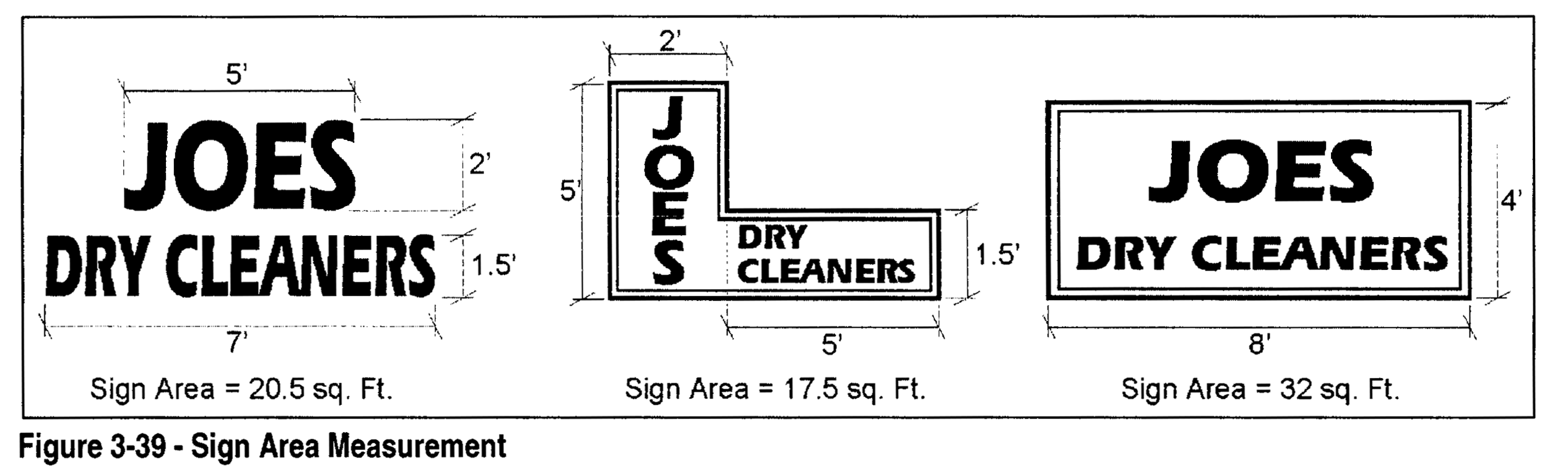
Surface area. The surface area of a sign shall be calculated by enclosing the extreme limits of all framing, emblem, logo, representation, writing, or other display within a single continuous perimeter composed of squares or rectangles with no more than eight lines. See Figure 3-39.
2.
Sign structure. Supporting bracing or framework that is clearly incidental to the display itself shall not be computed as sign area.
3.
Multi-faced signs. The sign area for a sign with more than one face shall be computed by adding together the area of all sign faces, except that if the two sides are of equal size and within five degrees of parallel, the area of one sign face shall be considered to be the area of the sign.
4.
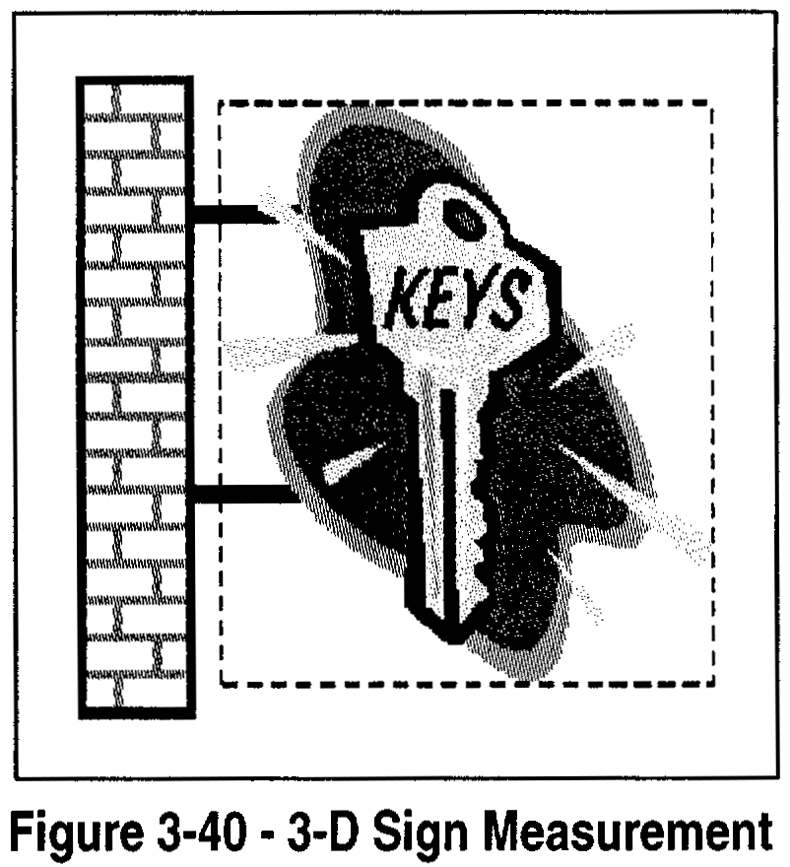
Three-dimensional objects. Where a sign consists of one or more three-dimensional objects (e.g., balls, cubes, clusters of objects, sculpture, or statue-like trademarks), the sign area shall be measured as their maximum projection upon a vertical plane. See Figure 3-40.
5.
Time and/or temperature device. The area of any time and/or temperature device incorporated into a sign shall not be included in the calculation of total sign area. The cumulative area of time and/or temperature signs shall not exceed ten square feet
6.
Sign lighting. Permanently installed illuminated panels, visible tubing, and strings of lights outlining all or a portion of a structure, other than lighting that is primarily for indirectly illuminating architectural features, signs, or landscaping, shall be deemed "signs" subject to this Chapter and shall be counted as part of the allowed sign area. Each line of tubing or lights shall be deemed to have a minimum width of at least six inches for the purpose of area calculation.
B.
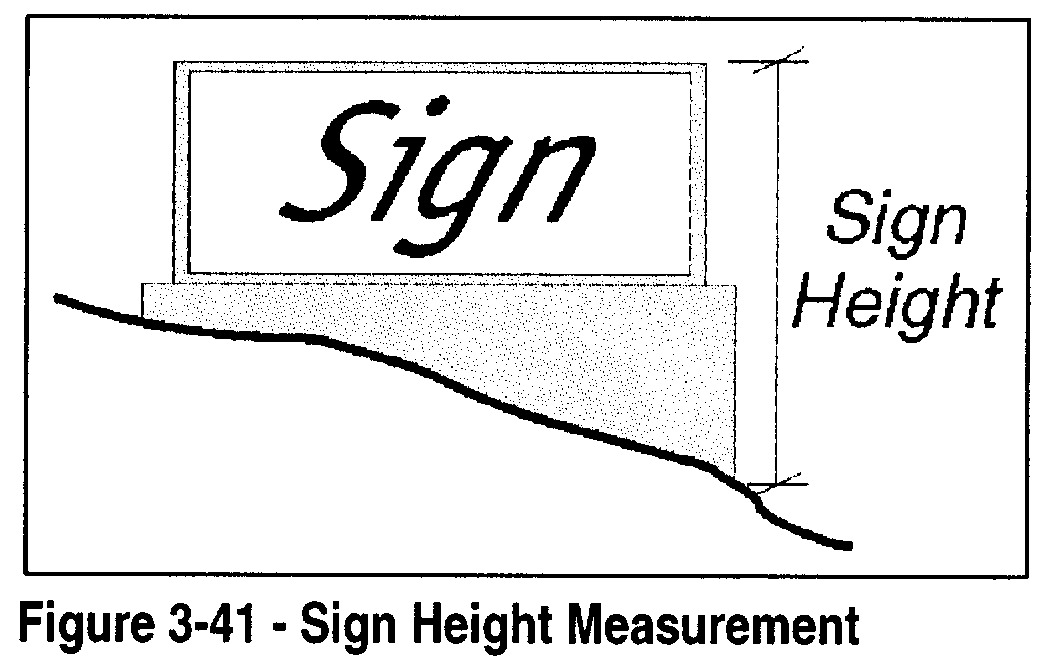
Sign height measurement. The height of a sign shall be computed as the vertical distance from the lowest point of the base of the sign at normal grade, to the top of the highest attached component of the sign. See Figure 3-41.
1.
Normal grade. Normal grade shall be construed to be the lower of either the:
a.
Existing grade before construction; or
b.
Newly established grade after construction, exclusive of any berming, filling, mounding, or excavating solely for the purpose of locating the sign.
2.
Where normal grade cannot be determined. In cases in which the normal grade cannot reasonably be determined, sign height shall be computed on the assumptions that the elevation of the normal grade at the base of the sign is equal to the elevation of the nearest point of the crown of a public street or the grade of the land at the principal entrance to the principal structure on the parcel, whichever is lower.
C.
Sign height limitations. Each sign shall comply with the sign height requirements of 106.38.060 (Zoning District Sign Standards) for the applicable zoning district or 106.38.070 (Standards for Specific Sign Types) as applicable.
D.
Sign location requirements. Each sign shall be located in compliance with the following requirements, and all other applicable provisions of this Chapter, but in no case shall any sign be located so as to impede the normal flow of pedestrian and/or bicycle traffic.
1.
On-premises signs required. Each sign shall be located on the same site as the subject of the sign, except as otherwise allowed by this Chapter.
2.
Setback requirements. Each sign shall comply with the setback requirements of the applicable zoning district, except for an approved projecting sign, or a freestanding sign that is set back a minimum of five feet from the front and street side property lines.
3.
Placement on a building. No sign shall be placed so as to interfere with the operation of a door or window. Signs should not be located so that they cover prominent architectural features of the building.
E.
Signs within a public right-of-way.
1.
No sign shall be allowed in the public right-of-way except for the following:
a.
A projecting sign in compliance with Section 106.38.070.G (Projecting and suspended signs);
b.
Public signs erected by or on behalf of a governmental agency to convey public information, identify public property, post legal notices, or direct or regulate pedestrian or vehicular traffic;
c.
Transit stop signs installed on behalf of a public or contracted private transit company;
d.
Informational signs of a public utility regarding its lines, pipes, poles, or other facilities; or
e.
Emergency warning signs erected by a governmental agency, a public utility company, or a contractor doing authorized work within the public right-of-way.
2.
Any sign installed or placed within the public right-of-way other than in compliance with this Section shall be forfeited to the public and be subject to confiscation.
3.
In addition to other remedies identified in Municipal Code Chapter 50 (Neighborhood Enhancement Code), the City shall have the right to recover from the owner, or person placing the sign, the full costs related to the removal and disposal of the sign.
4.
A sign permit shall not be required for City signs placed within the public right-of-way.
F.
Sign design, construction, and maintenance. All signs shall be designed, constructed, and continuously maintained in compliance with the following standards:
1.
Compliance with applicable provisions. All signs shall comply with the applicable provisions of the uniform codes of the City, any other applicable City ordinances, resolutions, or regulations, and this Chapter.
2.
Permanent materials and attachment. Except for banners, flags, temporary signs, and window signs conforming with the requirements of this Chapter, all signs shall be constructed of permanent materials and shall be permanently attached to the ground, a building, or another structure by direct attachment to a rigid wall, frame, or structure.
G.
Design criteria for signs. The following design criteria shall be used in reviewing the design of individual signs. Substantial conformance with each of the following design criteria shall be required before a sign permit or Building Permit can be approved.
1.
Color. Colors on signs and structural members should be harmonious with one another and relate to the dominant colors of the other structures on the site. Contrasting colors may be utilized if the overall effect of the sign is still compatible with the structure colors and prevailing colors in the surrounding neighborhood (where a theme can be identified).
2.
Design and construction.
a.
All permanent signs shall be designed by professionals (e.g., architects, building designers, landscape architects, interior designers, or those whose principal business is the design, manufacture, or sale of signs), or others who are capable of producing professional results.
b.
All permanent signs shall be constructed by persons whose principal business is building construction or a related trade including sign manufacturing and installation businesses, or others capable of producing professional results. The intent is to ensure public safety, achieve signs of careful construction, neat and readable copy, and durability so as to reduce maintenance costs and to prevent dilapidation.
3.
Materials and structure.
a.
Sign materials (including framing and supports) shall be representative of the type and scale of materials used on the site of the sign. Sign materials shall match those used on the structure and on other signs.
b.
No sign shall include reflective material.
c.
Materials for permanent signs shall be durable and capable of withstanding weathering over the life of the sign with reasonable maintenance.
d.
The size of the structural members (e.g., columns, crossbeams, and braces) shall be proportional to the sign panel they are supporting. In general, fewer larger supporting members are preferable to many smaller supports.
e.
The use of individual letters incorporated into the building design is encouraged, rather than a sign with background and framing other than the structure wall.
4.
Street address. The review authority may require that a sign include the street address of the site, where it determines that public safety and emergency vehicle response would be more effectively served than if the street address were displayed solely on one or more structures on the site.
H.
Copy design guidelines. The City does not regulate the message content (copy) of signs; however, the following are principles of copy design and layout that can enhance the readability and attractiveness of signs. Copy design and layout consistent with these principles is encouraged, but not required.
1.
Sign copy should relate only to the name and/or nature of the business or commercial center.
2.
Permanent signs that advertise continuous sales, special prices, or include phone numbers, etc. should be avoided.
3.
Information should be conveyed briefly or by logo, symbol, or other graphic manner. The intent should be to increase the readability of the sign and thereby enhance the identity of the business.
4.
The area of letters or symbols should not exceed 40 percent of the background area in commercial districts or 60 percent in residential districts.
5.
Freestanding signs should contain the street address of the parcel or the range of addresses for a multi-tenant center.
I.
Sign lighting. Sign lighting shall be designed to minimize light and glare on surrounding rights-of-way and properties.
1.
External light sources shall be directed and shielded so that they do not produce glare off the site, on any object other than the sign.
2.
Sign lighting shall not blink, flash, flutter, or change light intensity, brightness, or color.
3.
Colored lights shall not be used at a location or in a manner so as to be confused or construed as traffic control devices.
4.
Neither the direct nor reflected light from primary light sources shall create hazards for pedestrians or bicyclists, or operators of motor vehicles.
5.
For energy conservation, light sources shall be hard-wired florescent or compact florescent lamps, or other lighting techn-ology that is of equal or greater energy efficiency. Incandescent lamps shall be prohibited.
6.
The maximum allowable level of sign illumination shall not exceed the amounts in the following table. If the lighting system consists of or includes other than florescent tubes, the luminance level produced by the system shall not exceed the luminance level produced by a fluorescent system using the above criteria. Compliance shall be confirmed by calculations that compare the allowable fluorescent luminance with the proposed alternate luminance based upon a report from a qualified electrical engineer, and approved by the Director.
J.
Sign maintenance.
1.
Each sign and supporting hardware, including temporary signs, shall be maintained in good repair and functioning properly at all times.
2.
Any repair to a sign shall be of materials and design of equal or better quality as the original sign.
3.
A sign that is not properly maintained and is dilapidated shall be deemed a public nuisance, and may be abated in compliance with the Municipal Code.
4.
When an existing sign is removed or replaced, all brackets, poles, and other supports that are no longer required shall be removed.
K.
Sign removal. When a business, activity, or entity that is the subject of an on-site sign leaves the site, the sign shall be removed within 10 days thereafter.
(Ord. No. 2008-15, § 1, 12-11-2008)
Sec. 106.38.060. - Zoning District Sign Standards
Each sign shall comply with the sign type, area, height, and other restrictions provided by this Section, in addition to the provisions of Section 106.38.070 (Standards for Specific Sign Types).
A.
Setback requirement for freestanding signs. A freestanding sign shall be set back a minimum of five feet from a dedicated public right-of-way, except where this Zoning Code requires a different setback for a specific sign type.
B.
Residential zone sign standards. Each sign in the residential zoning districts shall comply with the requirements in Table 3-11, except for signs that are allowed by standards for a specific land use in Chapter 106.42.
TABLE 3-11 SIGN STANDARDS FOR RESIDENTIAL ZONES
C.
Commercial and industrial zone sign standards. Each sign in the commercial and industrial zoning districts shall comply with the requirements in Table 3-12, except for service station signs which are subject to Section 106.38.070.H (Service station signs).
TABLE 3-12 SIGN HEIGHT AND AREA STANDARDS FOR COMMERCIAL AND INDUSTRIAL ZONING DISTRICTS
Notes:
(1)
Sign height may be increased by one foot for each foot the setback of the sign is increased, to a maximum sign height of 25 ft.
D.
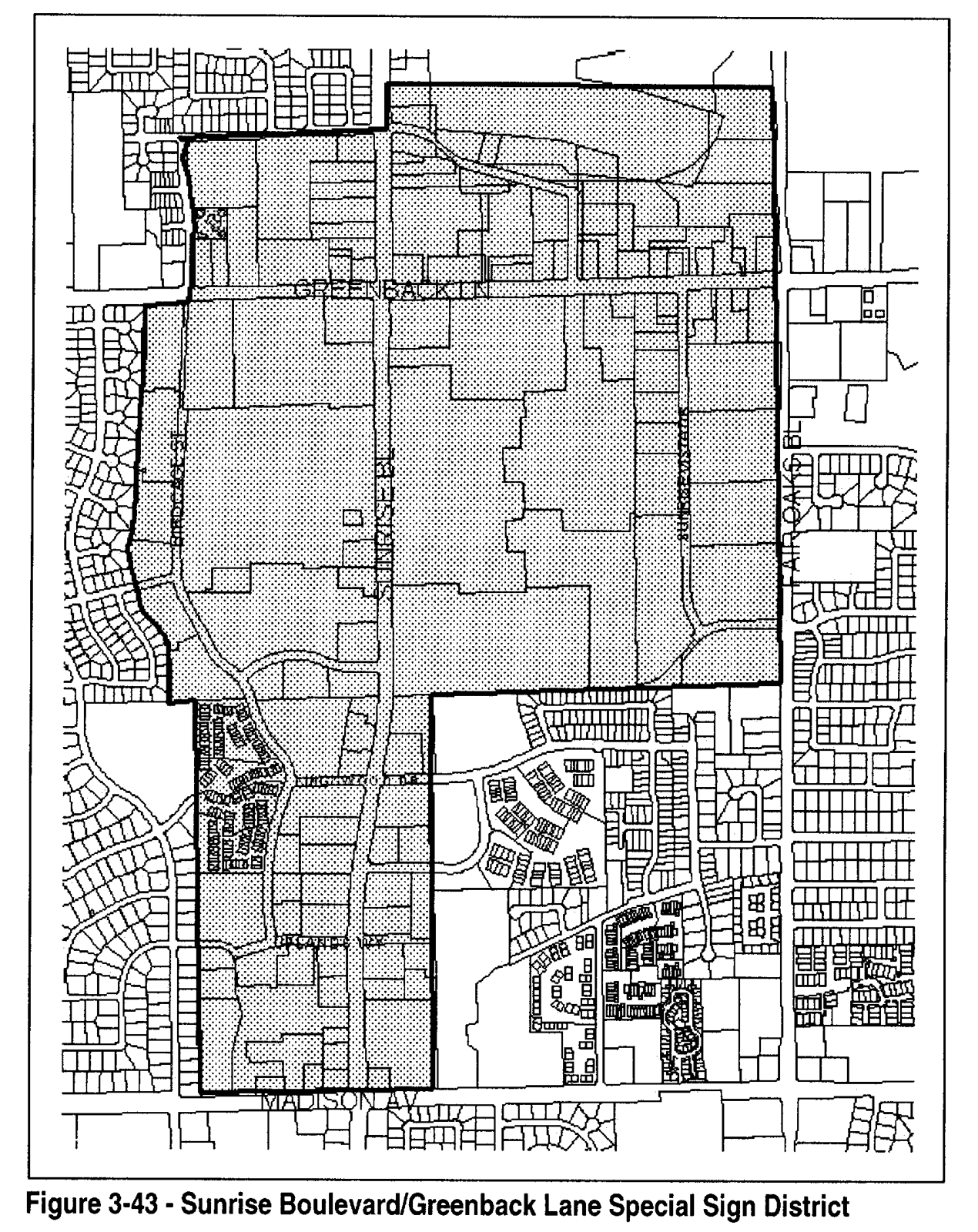
Signage within Sunrise Boulevard/Greenback Lane Special Sign District. Within the area identified in Figure 3-43, signs shall comply with the following requirements, instead of those in Subsection C.
1.
Allowable sign types and sign area.
a.
Monument signs are allowed with a total sign area of one square foot per foot of public street frontage with a maximum area of 100 square feet; and
b.
Wall signage is allowed with a total of one square foot for each linear foot of primary building frontage in the BP zone; two square feet for each linear foot of primary building frontage elsewhere. Buildings whose primary frontage is 300 feet or greater from the public right-of-way shall be allowed three square feet of wall signage for each linear foot of primary frontage.
2.
Setback requirements. Monument signs shall be set back as follows:
a.
Two feet adjoining any property zoned for any commercial or industrial zone; and
b.
Ten feet adjoining any property in a residential, recreation, or open space zone.
3.
Height limits. A monument sign shall not exceed a maximum height of 10 feet, and may be increased one foot for each foot of increased sign setback, to a maximum height of 12 feet.
4.
Landscaping. Two feet of landscaping is required in every direction from the exterior portions of any part of the monument sign.
(Ord. No. 2008-15, § 1, 12-11-2008; Ord. No. 2013-011, § 3, 11-14-2013; Ord. No. 2020-02, § 1(Exh. A), 3-12-2020; Ord. No. 2022-001, § 3(Exh. A), 3-10-2022; Ord. No. 2024-006, § 1(Exh. A), 9-25-2024)
Sec. 106.38.070. - Standards for Specific Sign Types
Each proposed sign shall comply with the standards of this Section applicable to the specific sign type. Each sign type listed in this Section shall be included in the calculation of the total sign area allowed on a parcel by Section 106.38.060 (Zoning District Sign Standards), unless this Section explicitly provides otherwise. Each sign shall also comply with the sign area, height, and other requirements of Section 106.38.060 (Zoning District Sign Standards), and all other applicable provisions of this Chapter.
A.
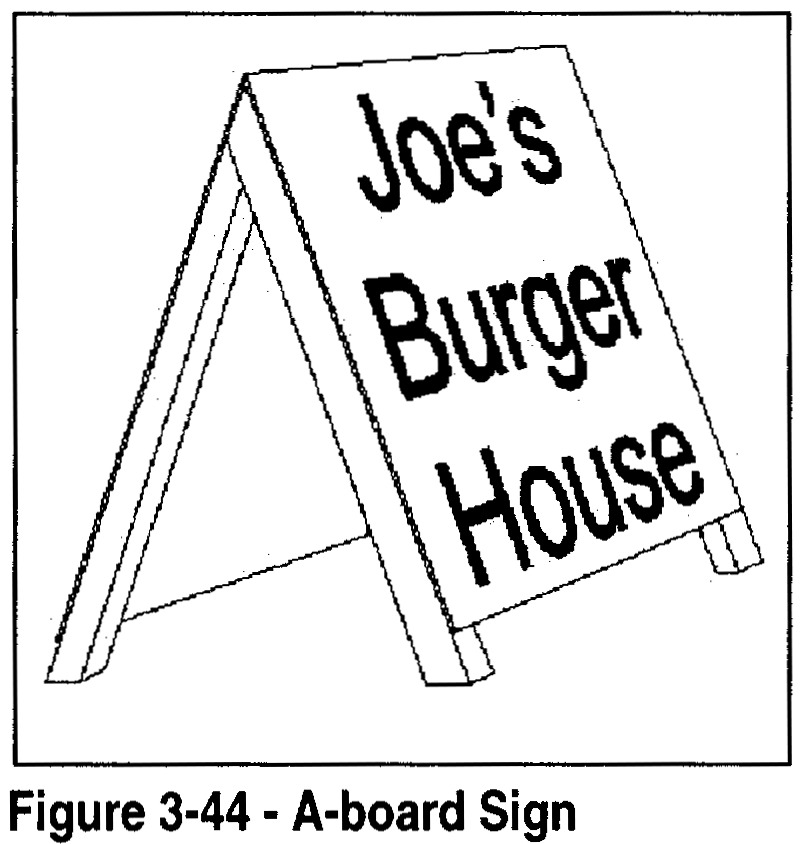
A-board and other portable sidewalk signs. Each parcel may display one A-board or other similar portable sign in compliance with the following standards:
1.
Limitation on location. An A-board sign may be approved on private property within a commercial or industrial zoning district, only on a site where:
a.
The review authority determines that a property owner has taken advantage of all permanent signs allowed by this Chapter, and site visibility remains seriously impaired; and
b.
The structure to which directions are being provided is located more than 150 feet from a predominant public street frontage, the site is developed with all other signs allowed by this Chapter, and the business entry and the other exterior signs allowed for the site by this Chapter are not visible from the predominant public street. The "predominant public street" is the major vehicular route that provides access to the site and surrounding area.
2.
Maximum number. No more than one A-board sign per street frontage shall be permitted per parcel.
3.
Sign size. Each sign shall not exceed a width of 30 inches. Sign height shall be limited to 48 inches. Sign height shall be measured perpendicular from the placement surface to the highest point of the A-board sign.
4.
Sign placement. An A-board sign shall be placed only on private property within the boundaries of the applicable business' street frontage, and shall be positioned so that it will not:
a.
Obstruct required ADA sidewalk clearance;
b.
Impede any line of sight for motorists or bicyclists at public street intersections, as recommended by the City Engineer; or
c.
Interfere with people exiting and entering parked cars.
5.
Design and construction standards. The review authority shall approve an A-board sign only if it first determines that the design and appearance of the sign, including any graphics and/or text, will reflect attractive, professional design, and that the sign will be durable and stable when in place.
6.
Stabilization. The sign shall be stabilized to withstand wind gusts or shall be removed during windy conditions.
7.
Daily removal. The sign shall be removed at the close of business each day.
8.
Maintenance. The sign shall be continuously maintained in good condition with no peeling paint or other deterioration.
B.
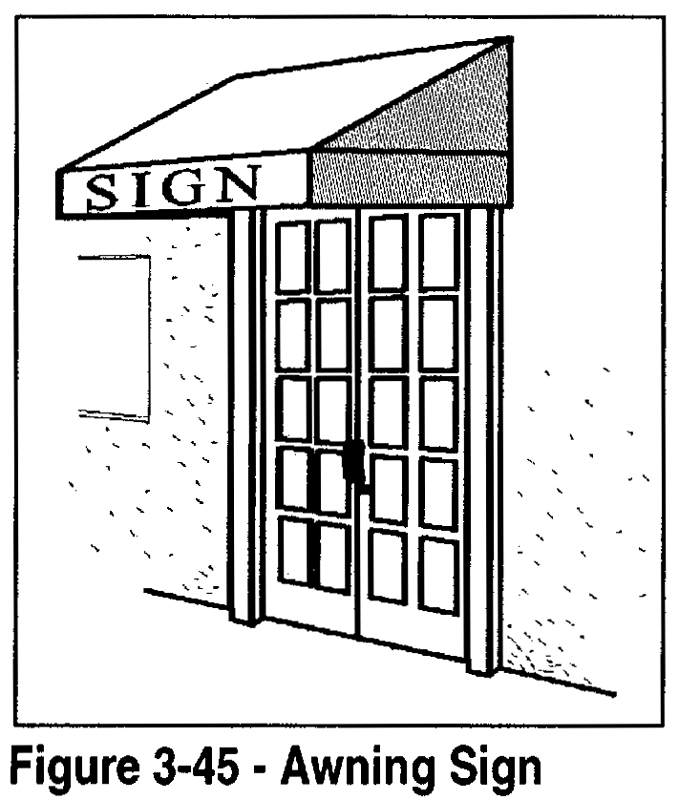
Awning signs. The following standards apply to awning signs (Figure 3-45) in all zoning districts where allowed by Section 106.38.060 (Zoning District Sign Standards):
1.
Signs on awnings are limited to ground level or second story occupancies only.
2.
Awnings shall not be internally illuminated. Direct exterior lighting may be allowed. Translucent awning materials are prohibited.
C.
Directional/directory signs on-site. The following standards apply to directory and directional signs in all zoning districts:
1.
Maximum sign area. A sign shall not exceed ten square feet; except the Director may authorize larger signs based upon special site/project characteristics.
2.
Maximum number. The maximum number of freestanding directional signs shall be one per driveway and one per service entrance. The maximum number of wall mounted directory signs shall be one per building frontage. Additional signs may be permitted if a health and safety need is demonstrated to the satisfaction of the Director. Directional signs no more than 30 inches in height and 4 square feet shall not be included when calculating the total number of signs.
3.
Setback requirements. A directional/directory shall be set back a minimum of five feet from a public right-of-way, plus one additional foot per foot of sign height over five feet, up to a maximum setback of 25 feet.
4.
Safety requirements. A sign shall not project over public property, vehicular easements, or rights-of-way, and shall not obstruct traffic safety visibility area, as determined by the review authority.
D.
Electronic message display signs. The following standards apply to electronic signs in all zoning districts where freestanding signs are allowed by Section 106.38.060 (Zoning District Sign Standards):
1.
Permit required. Minor Use Permit approval is required.
2.
Exemptions. The following types of electronic message display signage are exempt from these requirements:
a.
Window signs up to four square feet are exempt from this Chapter.
b.
Warning signs typically used at a construction site or for traffic/road diversion.
c.
Signs used for a special event in conjunction with a Temporary Use Permit.
d.
Sign displays advertising gas station pricing.
e.
Electronic message display signs that only function for time and temperature. Time and temperature displays legally installed prior to November 1, 2015 may be allowed to display messages in accordance with these regulations without the issuance of a Minor Use Permit.
3.
Where allowed. An electronic message display sign may be approved within a commercial zoning district or within a residential zoning district. Electronic displays located within a residential zoning district must be located at least 100 feet away from a residential building. The measurement shall be from the sign face to the nearest portion of any residential structure.
4.
Maximum sign area. The electronic portion of a monument sign shall comprise no more than 50 percent of the total sign area.
5.
Design criteria. An electronic message display sign shall be integrated into a monument sign that contains architectural detailing that is compatible with the building including consistent use of colors and materials. The electronic message display sign shall not appear "stuck-on" to a monument sign.
6.
Maximum number. Each site may have one electronic message display sign.
7.
Operational standards. An electronic message display sign shall operate subject to the following:
a.
Sign shall display static messages only. The sign shall not be animated, have movement, or the appearance or optical illusion of movement in or any part of the sign structure, design, or pictorial segment of the sign. Each static message shall not include flashing or scintillating lighting, or varying light intensity.
b.
Each message on a sign within a commercial zoning district must be displayed for a minimum of 12 seconds and each message on a sign within a residential zoning district must be displayed for a minimum of one hour.
c.
Sign may only display messages related to a use that is located on the same site or within the same center.
d.
Electronic message display sign within a commercial zoning district may be full color. An electronic message display sign within a residential zoning district shall operate only in one color.
e.
The electronic message display sign shall have a light sensing device that will adjust the brightness of the sign as ambient light conditions change throughout the day.
f.
The electronic message display sign shall have a device that renders the sign to dark upon malfunction.
g.
Signage should not be designed to emulate traffic safety signage.
8.
Other requirements. An electronic message display sign shall comply with Section 106.38.050 (General Requirements for All Signs).
9.
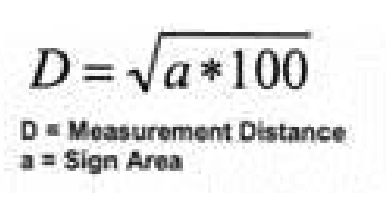
Certification required. The applicant shall provide written certification that the sign will operate with a maximum of 0.3-foot candle over ambient lighting. The measurement shall be taken at least 30 minutes past sunset, using a foot candle meter accurate to at least two decimals to record the ambient light reading for the area. This is done while the message center is off or displaying all back copy. All measurements shall be taken perpendicular to the face of the sign at the distance determined by the following formula:
10.
Exceptions. The review authority shall have the right to grant an exception to these provisions pertaining to height, location, sign area, shape, and number of signs for commercial projects in compliance with Section 106.62.80 (Exceptions to Sign Regulations).
E.
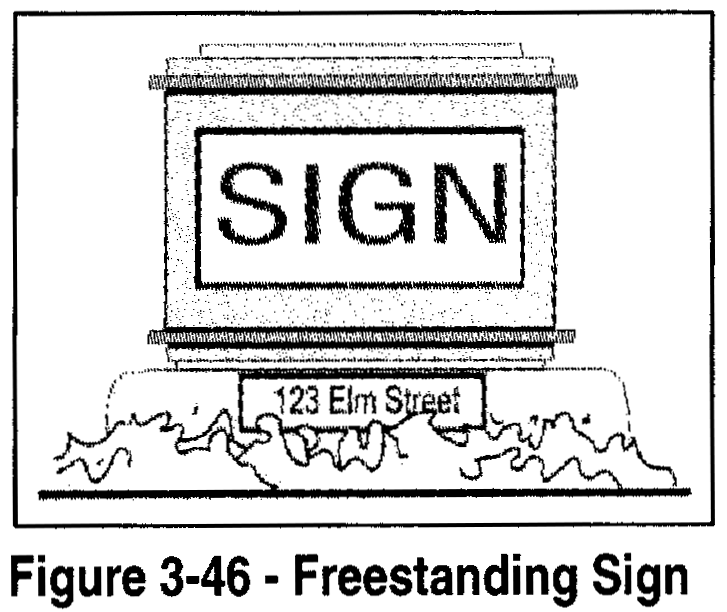
Freestanding signs. The following standards apply to freestanding signs (Figure 3-46) in all zoning districts where allowed by Section 106.38.060 (Zoning District Sign Standards):
1.
Separation. Multiple signs shall be separated by a minimum of 75 feet to ensure adequate visibility for all signs. The review authority may waive this requirement where the locations of existing signs on adjacent properties would make the 75-foot separation impractical, or there is no other alternative.
2.
Safety requirements. A sign shall not project over public property, vehicular easements, or rights-of-way, and shall not obstruct a traffic safety sight area, as determined by the review authority.
3.
Street address. To assist emergency response personnel in locating the site, freestanding signs should contain an illuminated street address plate. Numbers shall be a minimum of six inches in height. Street address numbers not exceeding six inches in height shall not be included in calculations of allowed sign area.
4.
Maximum number. The maximum number of freestanding signs allowed on a site shall be limited to one per street frontage of less than 300 feet; and one additional sign for each additional 300 feet of frontage or fraction.
5.
Setback requirements. A freestanding sign shall be set back a minimum of five feet from a public right-of-way, plus one additional foot per foot of sign height over five feet, up to a maximum setback of 25 feet; except in the AC zoning district, where no additional setback is required for the maximum allowed height of 30 feet, and in the Sunrise Boulevard/Greenback Lane Special Sign District, in compliance with Section 106.38.060.D.
6.
Landscaping. A freestanding sign shall be designed and constructed with accent landscaping at the base of sign to the approval of the review authority. Accent landscaping must comply with the water efficient landscape ordinance, but plants are not restricted to the approved plant list.
F.
Freeway-oriented signs. A freeway-oriented sign may be approved in compliance with the following requirements:
1.
Permit requirement. Use Permit approval is required for a freeway-oriented sign.
2.
Where allowed. A freeway-oriented sign may be approved only on a parcel abutting the Interstate 80 right-of-way within a commercial zoning district.
3.
Required findings. The approval of a Use Permit for a freeway-oriented sign shall require that the Commission first find that the use or site cannot be adequately identified by other signs permitted within the applicable zoning district, in addition to the other findings required for Use Permit approval by Section 106.62.050 (Use Permit and Minor Use Permit).
4.
Height limit. No freeway-oriented sign shall exceed a maximum height of 30 feet, unless the Use Permit allows greater height, as follows:
a.
Criteria for approval. A sign with a height greater than 30 feet may be approved only if the Commission determines that the applicant has demonstrated that an overcrossing of Interstate 80, or its ramps, or trees or vegetation will significantly obstruct the visibility of the proposed sign from the eastbound or westbound lanes of Interstate 80.
b.
Procedure for determining allowed height. The Commission shall approve no sign height over 30 feet more than the minimum necessary for the message area of the sign to clear the identified visual obstruction. The determination of maximum height by the Commission shall be based on the following procedure, which shall occur prior to the public hearing on the Use Permit.
(1)
The applicant shall arrange for a boom truck with a sign target to be on the site at the location of the proposed sign, with a tape measure attached to the top of the target so that an accurate ground reading of height can be determined.
(2)
City staff will go to the site, pick up the applicant or applicant's representative, and drive Interstate 80 east and west of the target on the site, to visually verify that the target is set at the minimum height necessary to clear the visual obstruction. Staff will then record the height to the top of the target.
(3)
City staff will report their findings to the Commission in the staff report on the Use Permit.
G.
Murals. A mural placed on the wall of a structure may be allowed in any commercial or industrial zoning district or on a masonry fence in any zone facing an arterial street subject to Design Review, and as follows:
1.
A mural without text visible from a public right-of-way may be approved in addition to (not counted as part of) the sign area allowed by Section 106.38.060 (Zoning District Sign Standards); a mural with text shall comply with the sign area limitations applicable to the site.
2.
Murals that illustrate the local setting and history as sources of inspiration are encouraged.
3.
The approval of a mural shall require that the review authority first find that the size, colors, and placement of the mural are visually compatible with the structure architecture, and that the mural will serve to enhance the aesthetics of the City.
4.
The mural shall be provided a graffiti-resistant coating at the time of installation.
5.
The mural shall be completed within 60 days from the start of installation. The director may grant a one-time extension of up to 30 days upon written request. Murals not completed with the allotted time may be subject to enforcement actions, including removal, fines, and penalties.
H.
Off-site signs. New billboards are prohibited within the City in compliance with Section 106.38.040 (Prohibited Signs), except that the City may initiate the replacement or relocation of an existing billboard, provided that the replacement or relocation shall require the approval of an agreement by the Council. A governmental agency may place an off-site sign for the purpose of announcing events and transmitting community information to the general public. Allowed off-site signs are exempt from the standards listed in Section 106.38.060 (Zoning District Standards);
I.
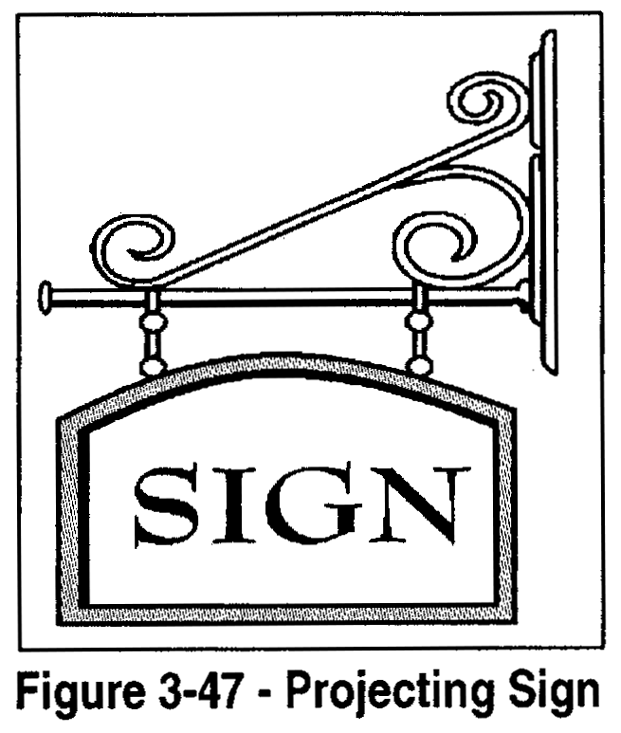
Projecting and suspended signs. The following standards apply to projecting signs (Figure 3-47) in all zoning districts where allowed by Section 106.38.060 (Zoning District Sign Standards):
1.
The maximum projection of a sign from a structure wall over a public right-of-way shall not exceed 36 inches over a sidewalk. Larger projections from the structure wall over private property may be approved by the review authority. Any projection over a public right-of way shall require an Encroachment Permit.
2.
The top of a projecting sign shall not exceed the lesser of 14 feet, eave height, parapet height, or sill height of a second floor window. No portion of the sign shall project above the eave line of a sloped roof or the top of the parapet on a flat roof.
3.
A projecting sign shall maintain a minimum clearance of eight feet from the bottom of the sign to the finished grade below.
4.
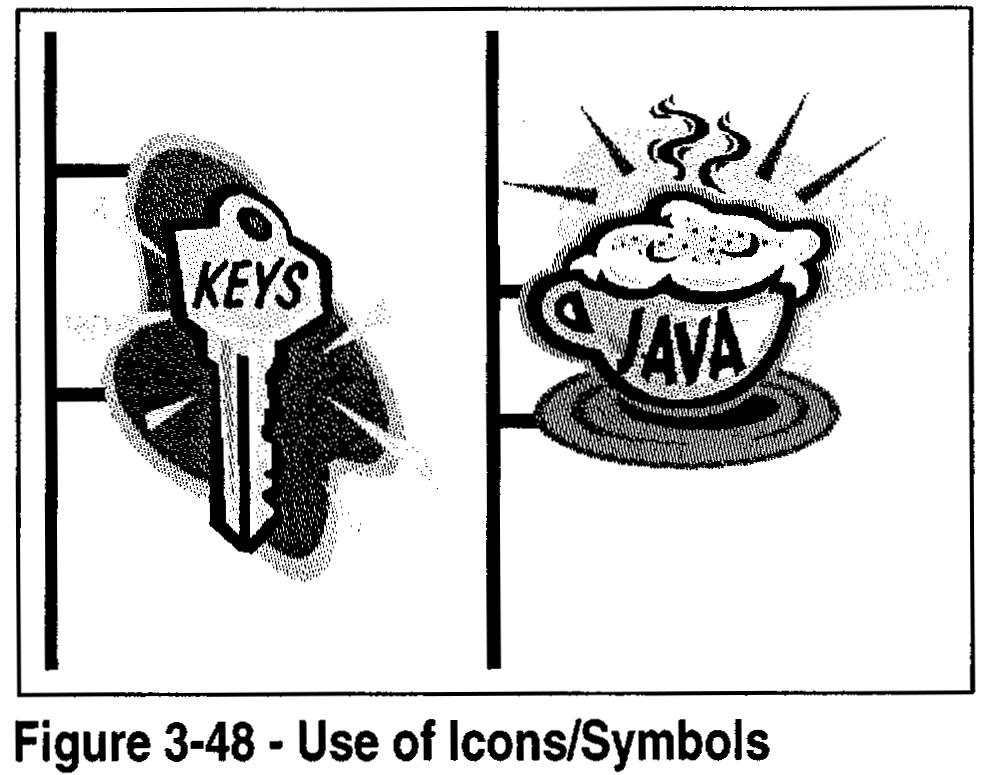
Icon signs using shapes or symbols uniquely suited to the business, creative shapes, and three- dimensional signs are encouraged. See Figure 3-48.
5.
Each sign shall be graphically designed for pedestrians, with a maximum area of nine square feet on each sign face, regardless of the length of the building frontage.
6.
Sign supports shall be well-designed and compatible with the design of the sign.
J.
Service station signs. The following standards apply to signs on service station sites, where service stations are allowed by Article 2 (Zoning Districts and Allowable Land Uses):
1.
On-site signs, excluding exempt signs Subsection H.3 below, are limited to 125 square feet for a primary service station, and 75 square feet for a secondary service station. All signs shall be designed to be compatible with the character of the surrounding neighborhood. Ancillary food markets or other services are included in these sign limits. Freestanding directory signs are prohibited.
2.
No more than one freestanding sign is permitted on a service station site, with a maximum area of 36 square feet; except that where price signs are included on the freestanding sign, the area shall not exceed 52 square feet. The base of a freestanding sign is not included in allowable area. The maximum height of a freestanding shall be ten feet. The height of the sign may be increased one foot for each foot the setback of the sign is increased, provided that the maximum height of the sign does not exceed 16 feet.
3.
Signs of instructive nature, information or otherwise required by other enforcement agencies are exempt from these sign area limitations. The following signs are specifically exempt, but not necessarily limited to: telephone booth, gas pump use instructions, instructions for recreational vehicle waste dump station, brake and smog certification, restroom identification, no smoking, propane tank identification, gas pump identification, air and water, drive to forward pump, price signs, special, oil price, service available, and gas pump identification cashier, odd-even sign, hours of operation, required gallon to liter conversion, approved flag identification system, full- and self-service signs at each island not exceeding four square feet, and traffic directory signs as approved by enforcement agencies for necessary traffic control and direction provided that they do not exceed four square feet each and do not exceed 30 inches in height in front or side street yard and no symbol, name, or other message is on the signs.
K.
Temporary signs. Temporary signs are allowed within the commercial and industrial zoning districts as follows:
1.
Banners and pennants. Temporary banners and pennants on private property may be allowed with temporary use permit approval, and shall comply with the following requirements:
a.
The use of a banner or pennants may be allowed only for a licensed business one-time per year not to exceed 30 days each year. Each business is also allowed the additional one-time use of a banner for the first 30 days after the commencement of the business.
b.
The application for a temporary sign permit for banners or pennants shall include the dates proposed by the applicant for scheduled banner use.
c.
Banner must be mounted to a building. If site has visibility restrictions than alternate location can be authorized through the Temporary Use Permit.
d.
All structures used to hold or display temporary signs must be removed when not in use.
2.
Subdivision directional signs, off-site. Off-site signs providing directions to a new subdivision may be allowed with sign permit approval, and shall comply with the following standards:
a.
A maximum of two off-site signs may be located on private property (not within any public right-of- way).
b.
The total area of each sign shall not exceed 32 square feet;
c.
The height of each sign shall not exceed eight feet;
d.
The signs shall not be illuminated;
e.
The signs may be displayed only during the two years following date of recordation of the final map, or until all of the units have been sold, whichever first occurs; and
f.
The signs shall not affect pedestrian or vehicular safety.
3.
Subdivision signs, on-site. On-site subdivision identification signs may be allowed with sign permit roval, in compliance with the following standards:
a.
A maximum of four on-site signs may be located within the project boundaries; provided, no more than one sign for each street frontage is allowed, and multiple signs shall be separated by a minimum of 75 feet.
b.
The area of each sign shall not exceed 24 square feet;
c.
Sign height shall not exceed six feet;
d.
The signs shall not be illuminated; and
e.
The signs may be displayed only during the two years following date of recordation of the final map, or until all of the units have been sold, whichever first occurs.
L.
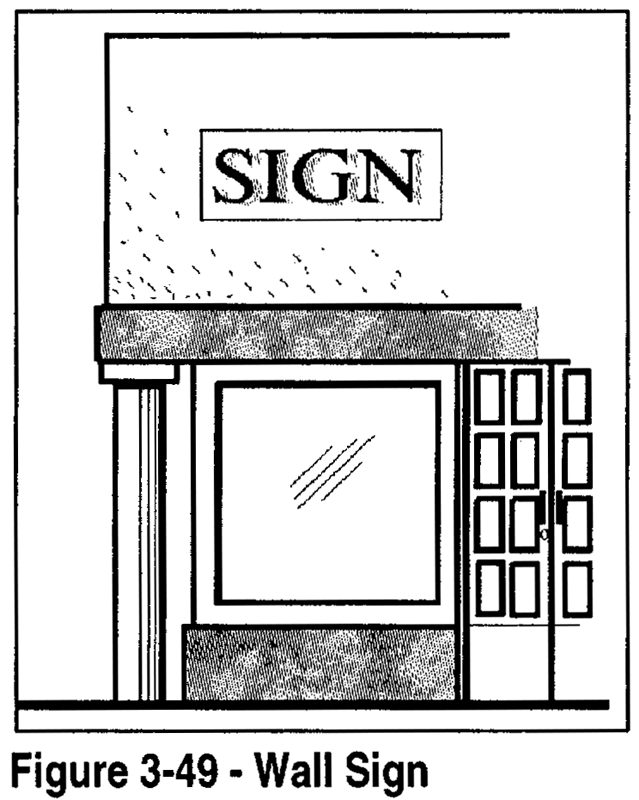
Wall signs. The following standards apply to wall signs (see Figure 3-49) in all zoning districts where allowed by Section 106.38.060 (Zoning District Sign Standards):
1.
Sign location. A wall sign may be located on any primary or secondary structure frontage.
2.
Projection from wall surface. A wall sign shall not project more than 18 inches from the surface to which it is attached.
M.
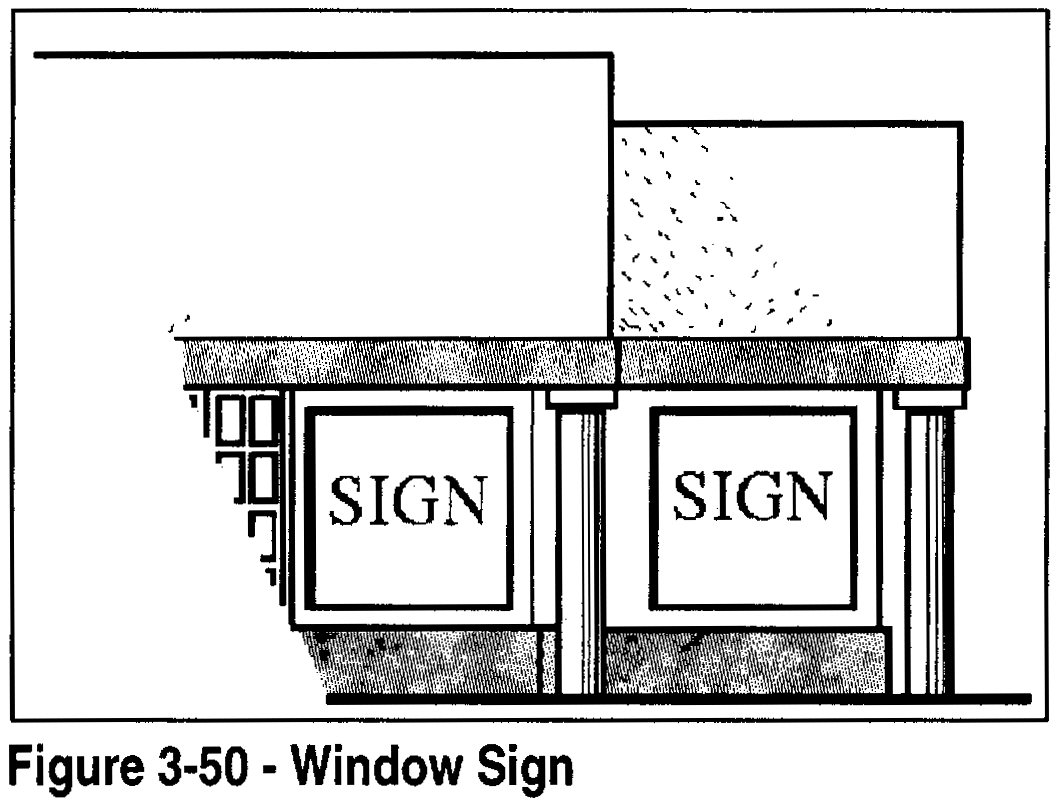
Window signs. The following standards apply to window signs (see Figure 3-50) where allowed by Section 106.38.060 (Zoning District Sign Standards):
1.
Sign location. Window signs shall be allowed only on windows located on the ground level and second story of a structure frontage.
2.
Maximum sign area. Window signs are allowed in addition to the total sign area allowed by Section 106.38.060 (Zoning District Sign Standards), provided that window signs shall not occupy more than 25 percent of the combined total window area. The entire part of the window that is painted shall be included in calculating the sign area.
3.
Sign materials. Window signs shall consist of individual letters, logos, or symbols applied to, stenciled on, or etched into the glass surface; however, neon signs with transparent backgrounds may be hung inside the window glass.
(Ord. No. 2008-15, § 1, 12-11-2008; Ord. No. 2015-006, § 3, 10-22-2015; Ord. No. 2015-010, § 1, 12-10-2015; Ord. No. 2026-004, § 1(Exh. A), 6-10-2026)
Sec. 106.38.080. - Nonconforming Signs
A nonconforming sign is any permanent or temporary sign that was legally established and maintained in compliance with the provisions of all applicable laws in effect at the time of original installation but that does not now comply with the provisions of this Zoning Code.
A.
General requirements. A nonconforming sign shall not be:
1.
Changed to another nonconforming sign;
2.
Structurally altered to extend its useful life;
3.
Enlarged;
4.
Re-established after a business is discontinued for 12 months; or
5.
Re-established after damage or destruction to 50 percent or more of the value of the sign, or its components, as determined by the Building Official.
B.
Maintenance and changes. Sign copy and face changes, nonstructural modifications, and nonstructural maintenance (e.g., painting, rust removal) are allowed without a sign permit up to a maximum of 25 percent of the existing total area of the sign. Face changes not including copy, and any nonstructural modifications exceeding 25 percent of the existing total area of the sign, and any structural changes shall comply with all applicable standards of this Chapter.
Sec. 106.38.090. - Judicial Review
Any permit issued or denied in compliance with this Chapter shall be subject to expedited judicial review to the extent provided by the time limits identified in Code of Civil Procedure Section 1094.8 et seq.

