
Citrus Heights City Zoning Code
CHAPTER 106
31 - DESIGN STANDARDS
Sec. 106.31.010.- Purpose
The design standards provided in this Chapter are intended to assist in preserving and rehabilitating existing structures within the City. These standards are also intended to provide for infill development of high architectural quality that is compatible with existing development, to promote the conservation and reuse of existing structures, and to preserve neighborhood character.
Sec. 106.31.020. - Applicability
These design guidelines will be used in the review of projects (additions, remodeling, relocation, new construction, or a subdivision map) that require Design Review (Section 106.62.040).
A.
The design elements of each project (including site design, architecture, landscaping, signs, and parking design) will be reviewed on a comprehensive basis.
B.
The Design Review process may include the interpretation of these design guidelines with some flexibility in their application to specific projects, as not all design criteria may be workable or appropriate for each project. In some circumstances, one guideline may be relaxed to facilitate compliance with another guideline determined by the review authority to be more important in the particular case. The overall objective is to ensure substantial compliance with the design guidelines and the intent of this Chapter.
C.
The graphics included in these guidelines are intended to be illustrative, but not prescriptive.
Sec. 106.31.030. - Residential Project Design
A.
Guidelines for all residential development. The following guidelines apply to all multi-unit residential development, single dwellings developed as part of a new land division or subdivision, second story additions to existing dwellings, garages, carports, and garage conversions, and any residential accessory structure located between a front property line and a primary structure.
1.
General principles. New residential development should be compatible in scale, siting, detailing, and overall character with adjacent buildings and those in the immediate neighborhood, unless the review authority determines that proposed development represents a desirable improvement over existing character. This is crucial when a new or remodeled house is proposed to be substantially larger than others in the neighborhood. When new homes are developed adjacent to older ones, the height and bulk of the new construction can have a negative impact on adjacent, smaller scale buildings.
2.
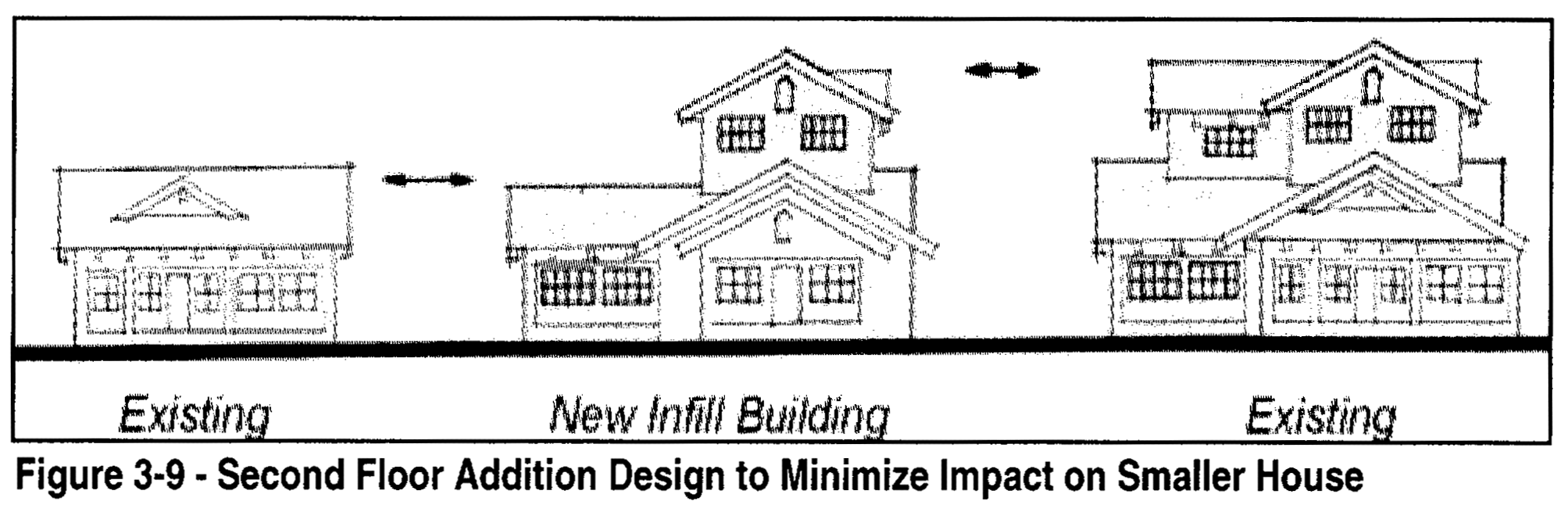
Visual impacts from building height. The height of new buildings should be consistent with asurrounding residential structures. Where greater height is desired, a second story addition to an existing structure, and/or a new two-story structure should be designed to set back upper floors from the edge of the first story to reduce their visual impact on adjacent smaller homes. See Figure 3-9.
3.
Outdoor living areas. New structures are encouraged to include balconies, verandas, porches, and courtyards.
4.
Exterior finish materials. Exterior finish materials should be durable and require low maintenance. The use of combined materials (such as stucco and wood siding) can provide visual interest and texture; however, all sides of each single dwelling or multi-unit structure should employ the same materials, design details, and window treatment. A residential building should have a carefully designed and detailed facade facing the street, and at the same time should not use bland, featureless stucco or other undetailed materials on the other exterior building walls.
5.
Windows, privacy. A new two-story residence or second story residential addition should be designed to respect the privacy of adjacent homes and apartments through appropriate building orientation, window placement, and building height, so that windows do not overlook and significantly impair the privacy of the indoor or outdoor living space of adjacent units. Where one or more windows are proposed 10 feet or less from a side property line, or within 10 feet of another dwelling, the windows should be located and/or screened to provide privacy for the residents of both structures. In some cases, glass block or translucent glass may be appropriate to provide light, but also provide privacy between buildings.
6.
Garages, carports.
a.
Garages and carports should be of the same architectural style and use the same exterior materials as the primary structures on the site. When attached to a primary dwelling, the design of a garage or carport must be integrated with that of the house, and appear to have been designed together with the house, as determined by the review authority.
b.
The use of detached garages is encouraged.
c.
Whether attached or detached, the face of a garage shall be oriented or designed so as to not be the dominant visual element of the streetscape.
7.
Grading. Grading for residential development should be minimized, and proposed development should be designed to accommodate and maintain the natural topography to the greatest extent feasible.
8.
Solar access. A new two-story residence or second story residential addition should be designed to minimize impact on solar access for adjacent units.
B.
New residential subdivisions. The following guidelines apply to new residential subdivisions, and address how new residential subdivisions should relate to their surroundings.
1.
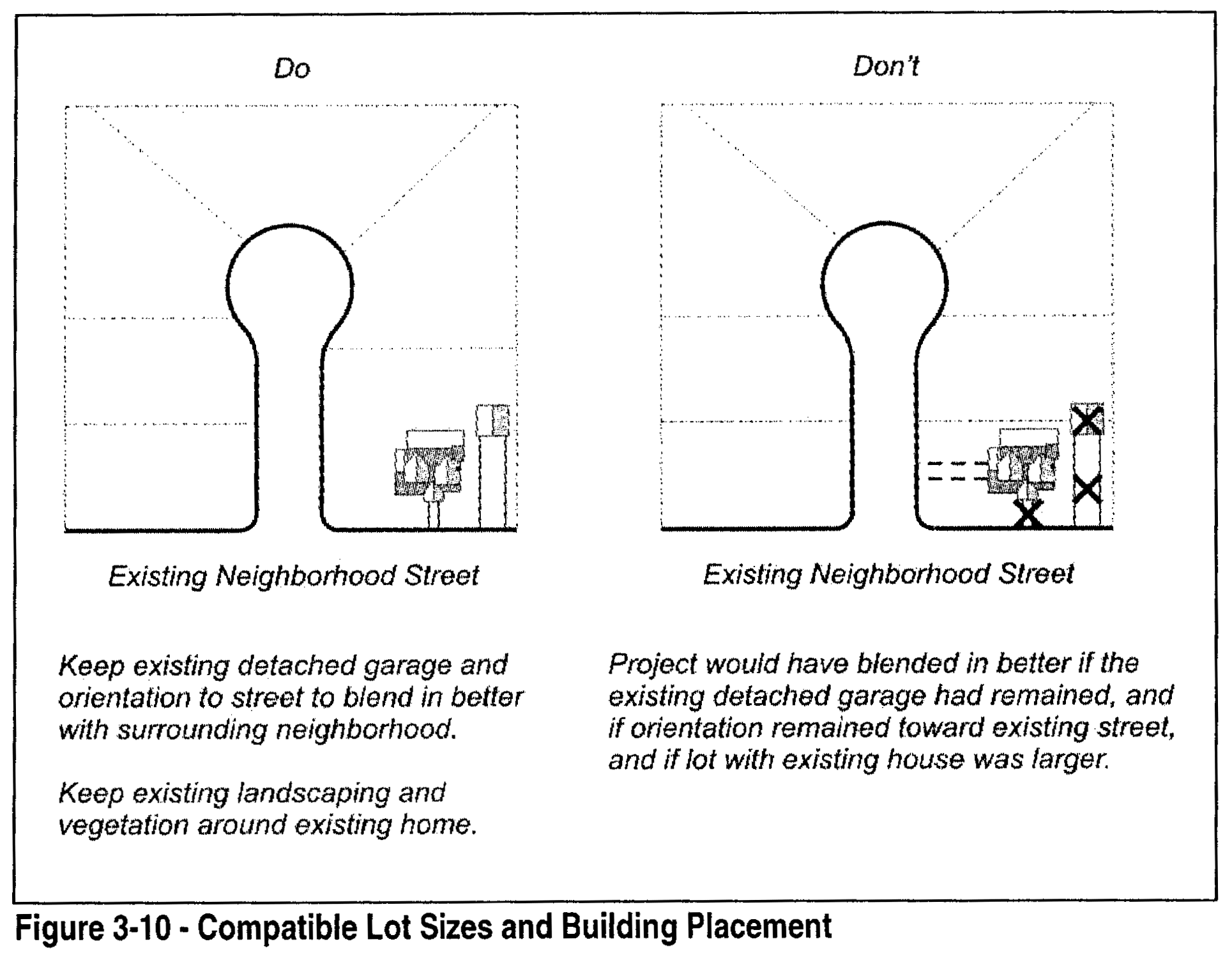
Neighborhood compatibility. Each new residential project should be designed with consideration of the surrounding neighborhood. Parcels proposed at the edge of a new subdivision, which abut residential parcels in an adjoining residential neighborhood, should be of a size and orientation determined by the review authority to be compatible with the adjacent existing parcels, as shown in Figure 3-10.
2.
Integrated open space and natural features. New subdivisions adjacent to planned or existing parks, other public open spaces and natural features (e.g., creeks, riparian areas), or the landscaped grounds of schools or other public facilities should maximize visibility and pedestrian access to these areas. Where these facilities are not already planned, the subdivision should be designed to provide usable public open spaces in the form of parks, linear bicycle and pedestrian trails, squares, community gardens and greens, as appropriate.
Existing significant natural features shall be incorporated into the design of a proposed subdivision, recognizing that their inclusion may require reduction in the number of residential units in the subdivision.
3.
Gated projects. Gated residential projects, and other residential developments designed to appear as continuous walled-off areas, disconnected and isolated from the rest of the community, are discouraged. While walls and fences may be useful for security, sound attenuation and privacy, these objectives can often be met by creative design that controls the height and length of walls, develops breaks and variations in relief, and uses landscaping, along with natural topographical changes, for screening.
4.
Street layout. New public streets and sidewalks should be aligned with, and be connected to those of adjacent developments to interconnect the community.
a.
Pedestrian orientation. Subdivision design should emphasize pedestrian connectivity within each project, to adjacent neighborhoods, nearby schools and parks, and to transit stops within ¼-mile of planned residential areas. All streets and walkways should be designed to provide safe and pleasant conditions for pedestrians, including the disabled, and cyclists. Light or utility poles, guy wires, transformer or relay boxes, gate/door swing radii, bus benches or shelters, or permanent traffic or informational signals may be sited adjacent to, but shall not encroach upon, sidewalks or other marked pedestrian or bicycle pathways.
b.
Block length. The length of block faces between intersecting streets should be as short as possible, ideally between 400 to 800 feet, to provide pedestrian connectivity.
c.
Street width and design speed. Streets within neighborhoods should be no wider than needed to accommodate parking and two low-speed travel lanes. Streets in new subdivisions should be designed to accommodate traffic speeds of 25 miles per hour or less, with most streets in a subdivision designed for lower speeds.
d.
Street frontage, parcel access. Each proposed parcel must be designed to provide the minimum width required by the applicable zoning district at the front property line.
(1)
Parcels without street frontage, and accessed by easements or designed as flag lots, are not allowed unless the review authority determines that no more appropriate design is feasible.
(2)
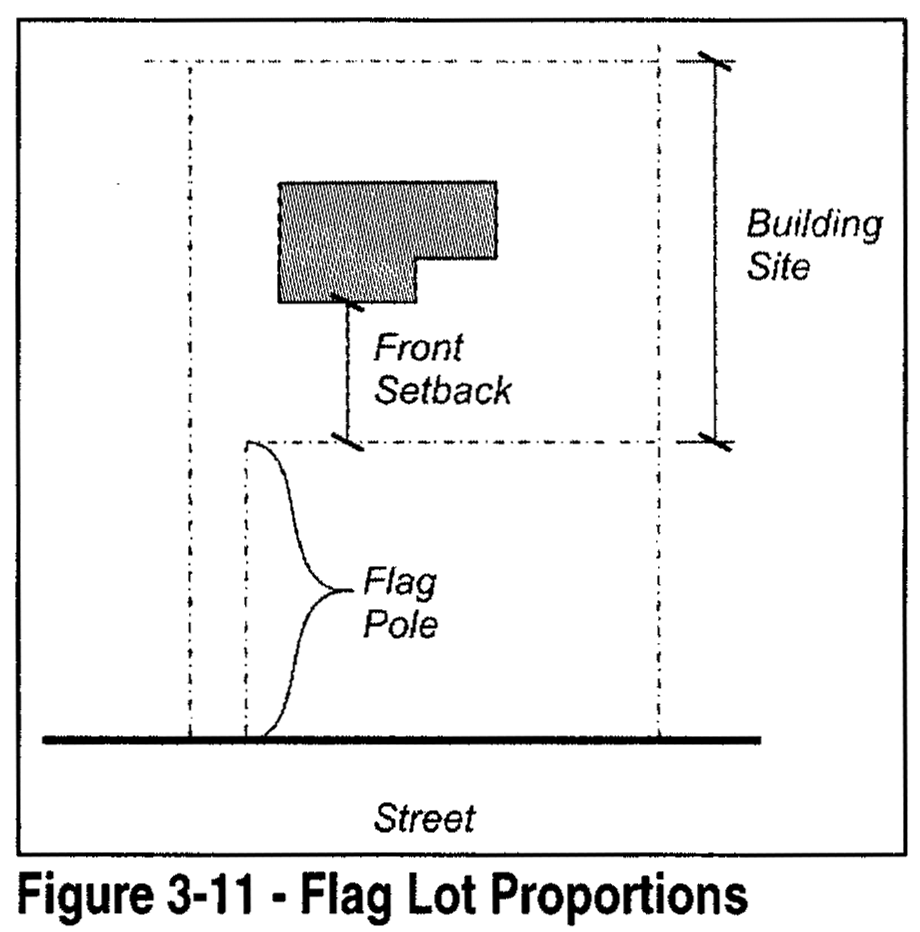
Where the review authority determines that a flag lot or access easement is appropriate, the easement or lot "flag pole" should be no longer than 1.5 times the depth of the building site being accessed. Neither a flag pole or an easement that provides parcel access shall be counted when determining compliance with the minimum lot area requirements of the applicable zoning district.
(3)
If a parcel is approved with access to a public street via an easement over another parcel that fronts on the street, both parcels shall be served by a single driveway.
e.
Parkway/planting strips. Sidewalks should be separated from curbs by parkway strips of at least five feet in width, where feasible. Parkways should be planted with canopy trees at an interval appropriate to the species of the selected street tree that will produce a continuously shaded sidewalk. Parkways should also be planted with non-turf ground covers or other plant materials that will withstand pedestrian traffic. Turf is not permitted in parkways.
f.
Access to open areas. Single-loaded streets (those with residential development on one side and open space on the other) should be used to provide public access to, and visibility of natural open spaces, public parks, and neighborhood schools, as well as a means for buffering homes from parks and schools.
Where single-loaded streets are not feasible or desirable, other methods that provide similar access and visibility may be used, including private streets, bike and pedestrian paths, or the placement of private common open space or recreation facilities adjacent to the public open space.
g.
Cul-de-sac streets. The use of cul-de-sac streets should be limited because they contribute to traffic congestion on through streets elsewhere in the neighborhood and community, and typically produce irregular lots that inefficiently use the property being subdivided.
(1)
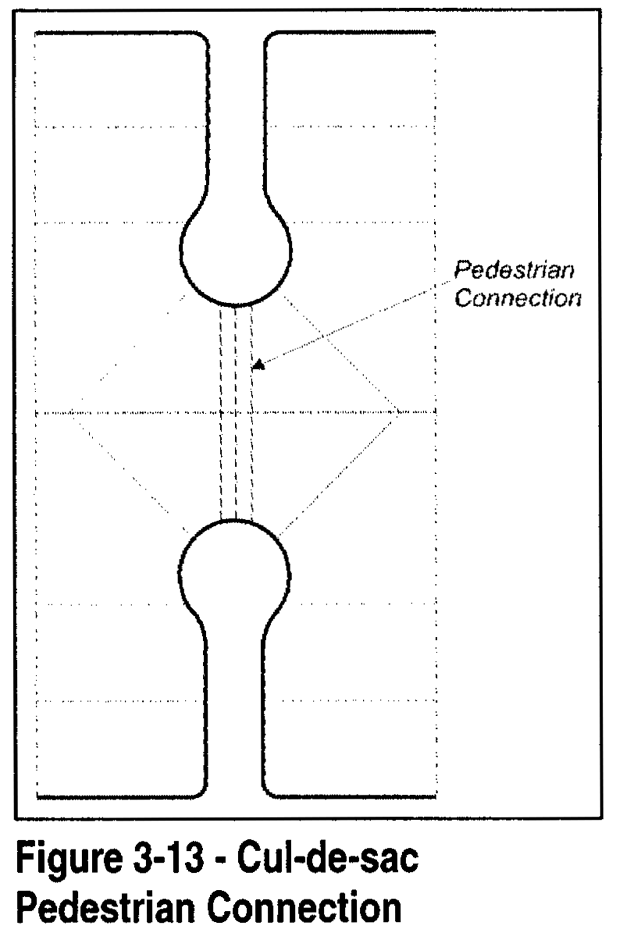
If the review authority determines that cul-de-sacs are necessary, the end of each cul-de-sac should provide a pedestrian walkway and bikeway between private parcels to link with an adjacent cul-de-sac, street, and/or park, school, or open space area.
(2)
A pedestrian way linking cul-de-sacs shall be lined with fences or walls of durable, easily maintained materials, designed to protect the privacy and security of adjacent lots while creating attractive walking space for pedestrians.
h.
Dwelling unit. A proposed residential subdivision of five or more lots should be designed so that at least 20 percent of the houses are one-story, to increase buyer choices, and provide opportunities to create more compatible transitions with existing one-story adjacent development.
i.
Solar access. New residential subdivisions should be designed to maximize solar access for new homes to encourage the use of passive solar, photovoltaic solar, etc.
C.
Multi-unit housing and apartments. The higher densities of multi-unit housing, and other housing projects that concentrate dwellings tend to generate larger parking areas and provide less private open space. If not properly designed, parking can dominate a multi-unit site, and open space may only be provided as "left over," unusable areas, unrelated to other project features. New multi-unit projects that are surrounded by high walls, parking lots and/or rows of carports along a street are inappropriate in the City and should be avoided. These guidelines address the problems associated with higher density developments through appropriate site planning, parking layout, circulation patterns, building design, and landscaping.
1.
Site planning. Site planning project should create a pleasant, comfortable, safe, and distinct place for residents, without the project "turning its back" on the surrounding neighborhood.
a.
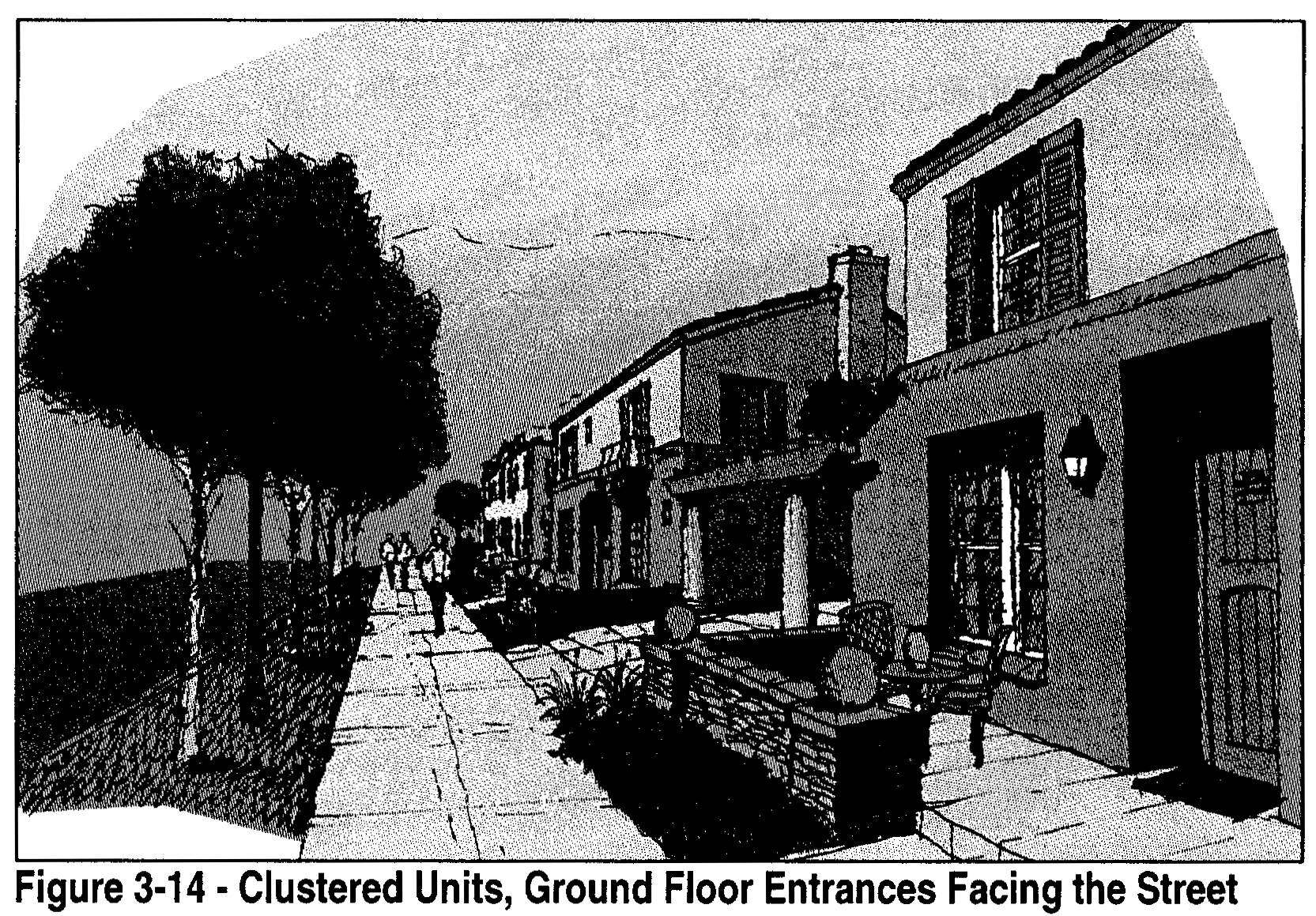
Lower density multi-unit projects should be designed as "walk-up" rather than "stacked" units, with each unit adjacent to a street having its primary pedestrian entrance from the street sidewalk. Higher density projects should be designed either with ground floor units having individual sidewalk entrances, or as courtyard projects with at least one significant pedestrian entrance from the street sidewalk. Where individual units have access to the street sidewalk, private "front yard" outdoor space may be differentiated from the public right-of-way by a porch, or small yard enclosed by a low fence. See Figure 3-14.
b.
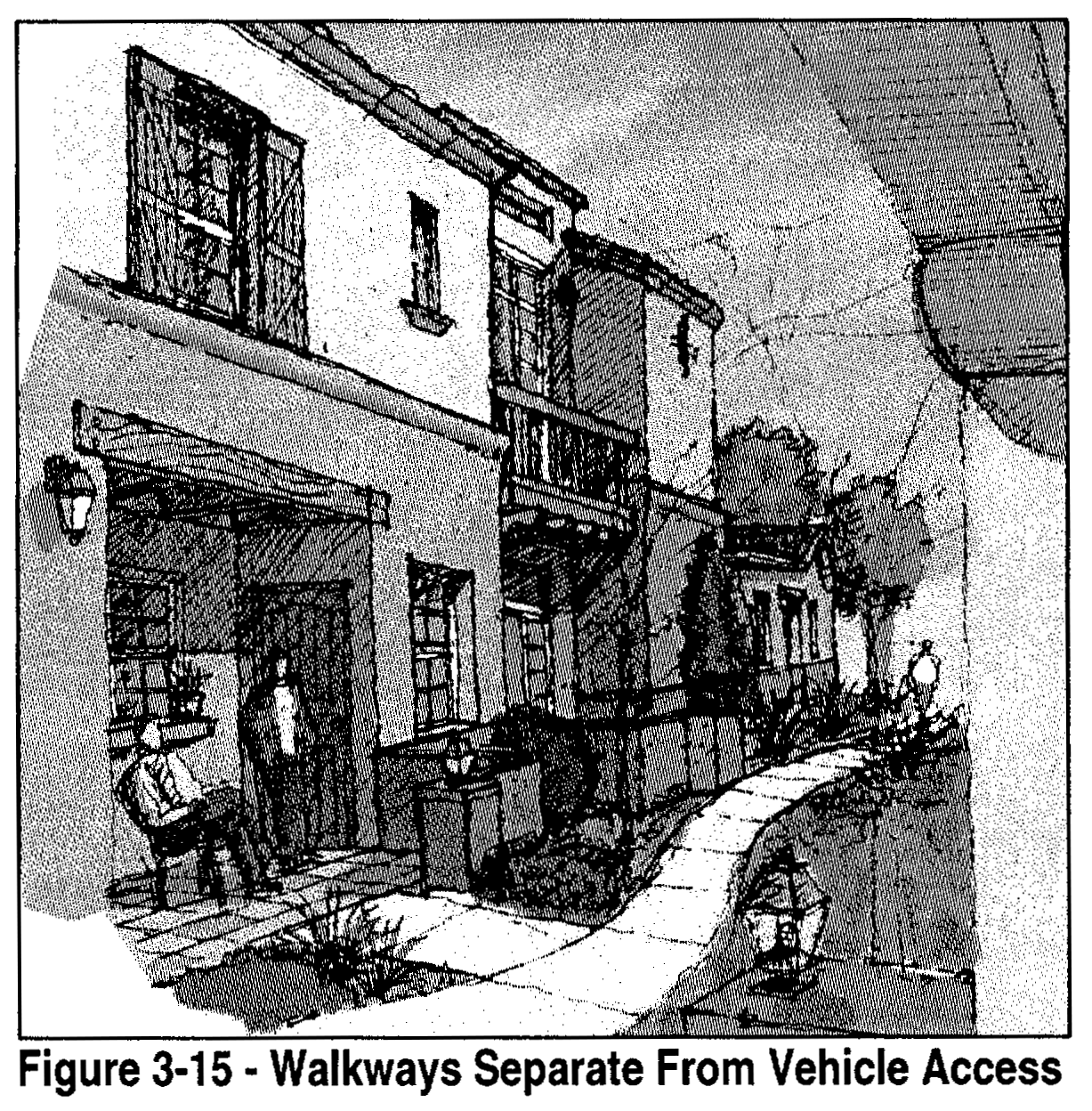
Residential units and activity areas not adjacent to a street should be accessible via pedestrian walkways and bikeways separate from vehicle parking areas and driveways. See Figure 3-15.
c.
Residential units should be oriented to maximize solar access to encourage the use of passive solar, photovoltaic solar, etc.
2.
Parking and driveways.
a.
Long, monotonous parking drives and large, undivided parking lots are discouraged.
b.
The main vehicle access into a multi-unit site should be through an attractive entry drive. Colored and textured paving treatment is encouraged outside of the public street right-of-way, and within the project.
c.
Parking areas should be visible from the residential units to the extent possible.
d.
Safe and protected bicycle parking should be located convenient to each dwelling unit.
e.
Parking areas should be separated from each other by buildings within the project, or by landscape or natural open space areas at least 30 feet wide.
f.
Large scale multi-unit projects (i.e., more than 20 units) with internal streets should have the streets designed as if they were pleasant public streets, with comprehensive streetscapes including sidewalks, and planting strips between curb and sidewalk with canopy trees. Planting strips shall be at least five feet in width, where feasible. Planting strips should be planted with canopy trees at an interval appropriate to the species of the selected street tree that will produce a continuously shaded sidewalk. Planting strips should also be planted with non-turf ground covers or other plant materials that will withstand pedestrian traffic. Turf is not permitted in planting strips.
3.
Multi-unit and apartment project architecture. The exterior design, height and bulk of multi-unit projects should not negatively impact adjacent lower density residential areas.
a.
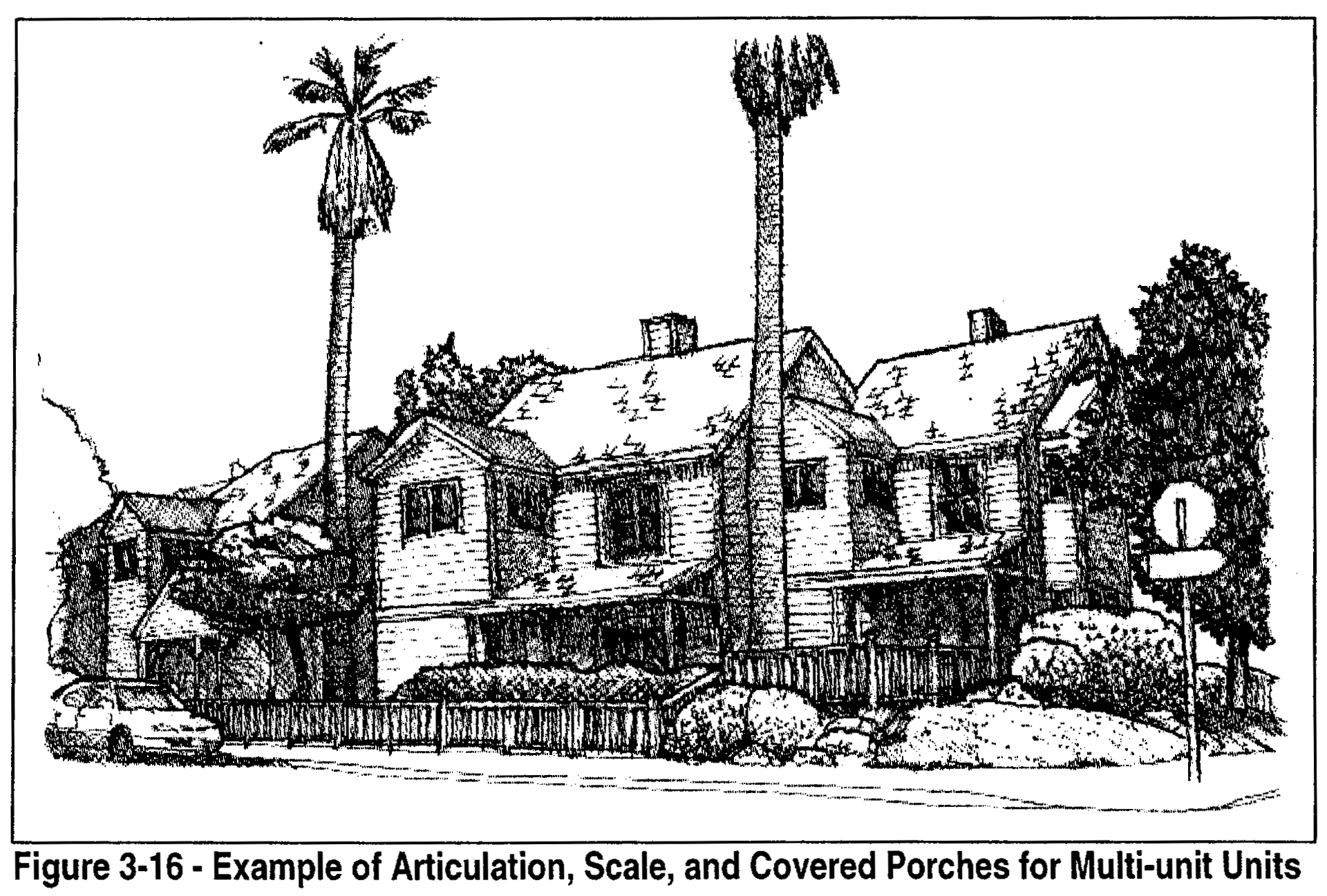
Facade and roof articulation. A structure with three or more attached units should incorporate wall and roof articulation to reduce apparent scale. Changes in wall planes and roof heights, and elements such as balconies, porches, arcades, dormers, and cross gables can avoid the barracks-like quality of long flat walls and roofs. Secondary hipped or gabled roofs covering the entire mass of a building are preferable to mansard roofs or segments of pitched roof applied at the structure's edge. Structures (including garages and carports) exceeding 150 feet in length are discouraged.
b.
Scale. Because multi-family projects are usually taller than one story, their bulk can impose on surrounding uses. The larger scale of these projects should be considered within the context of their surroundings. Structures with greater height may require additional setbacks at the ground floor level and/or upper levels (stepped-down) along the street frontage so they do not shade adjacent properties or visually dominate the neighborhood. Large projects should be broken up into groups of structures, and large single structures should be avoided.
c.
Balconies, porches, and patios. The use of balconies, porches, and patios as part of multi-family structures is encouraged for both practical and aesthetic value. These elements should be used to break up large wall masses, offset floor setbacks, and add human scale to structures. Individual unit entrances within a multi-unit project should have individual covered porches. See Figure 3-16.
d.
Dwelling unit access. The use of balconies and corridors to provide access to units should be limited. To the extent possible, main entrances to individual units should be from street sidewalks. Distinctive architectural elements and materials should be used to highlight primary entrances.
Building entrances should be located so that clear lines of sight are provided to adjacent public sidewalks, or internal walkways and parking areas, as applicable.
e.
Exterior stairways. A stairway that provides access to an upper level of a multi-unit structure should be integrated into the building design. Where an exterior stairway is necessary, it should provide residents and visitors protection from weather, and should be of low maintenance, durable materials, and located so as to be visible from the street and/or public areas of the site.
f.
Accessory structures. Accessory structures should be designed as an integral part of a project. Their materials, color, and details should be the same as the principal structures on the site.
g.
Walls and fences. Walls and fences should comply with the design standards in Section 106.31.070.G (Walls and Fences), and shall comply with the standards in Section 106.30.050 (Fences and Walls).
D.
Small lot housing product project design. The design of small lot housing developments requires careful consideration to ensure privacy, safety, open space and quality of life are considered. The goals of these guidelines are to create high quality indoor and outdoor living environments, enhance the public realm, provide increased opportunities for home ownership, provide solutions for infill housing, and prioritize livability over density.
1.
Relationship to street frontage. Small lot developments should be oriented towards the street.
a.
Homes fronting a public street should have a primary entrance and main windows facing the street. (See 1 on Figure 3-17.)
b.
For homes not fronting a public street, a primary entrance should face the vehicular access and/or a paseo (for alley loaded products). (See 2 on Figure 3-17.)
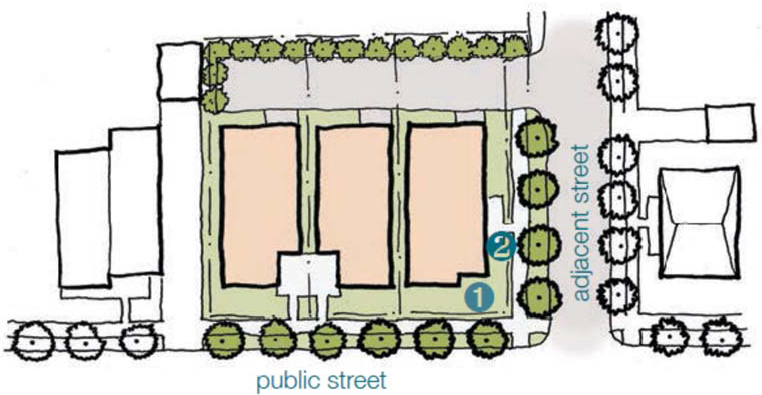
Figure 3-17 - Project Oriented Towards the Street
2.
Small lot housing product layout and circulation.
a.
Pedestrian circulation should be provided to each unit through clearly delineated sidewalks or paths.
b.
When multiple units share a common driveway that is lined with garages, provide distinguishable pedestrian paths to connect parking areas to individual entries.
c.
Minimum drive aisle width shall be 20 feet for alleys or drive aisles. Private street width shall be determined by the review authority.
3.
Parking. Parking should not dominate the site.
a.
Locate parking to the rear of dwellings where homes front the public street.
b.
Allow for a pedestrian access path separate from driveway wherever possible.
c.
Parking spaces shall be located at least six feet from any habitable space measured in any direction from the edge of a parking space (including vertical angle measurement).
d.
Driveways shall be designed to be either greater than 20 feet long or less than six feet long.
e.
Paving materials of driveways should contribute to the sense of place of the development. Use of decorative paving or design treatments is encouraged. Decorative paving and landscaping should break up parking and access areas.
4.
Building design. Building design and architecture is essential to small lot developments. Building design should distinguish individual units while also creating cohesiveness throughout the development.
a.
Primary entryways shall be something other than a garage door. Individual residences should be clearly distinguishable by incorporating transitions such as stoops, landscaping, canopies or other design features.
b.
Employ architectural details to enhance scale and interest by breaking up the façade into distinct planes that are offset from the main building façade.
c.
Design balconies or other patio areas to maximize their use as open space. Avoid tacked on looking balconies with limited purpose and maximize privacy between balconies
d.
Use of varying materials, massing, colors, and design details shall be incorporated within a proposed development.
e.
Exterior finish materials should be durable and require low maintenance. The use of combined materials (such as stucco and wood siding) can provide visual interest and texture; however, all sides of each dwelling should employ the same materials, design details, and window treatment. No residential structure should have a carefully designed and detailed facade facing the street, and use bland, featureless stucco or other simple materials on the other exterior building walls. Each residential structure should look like the same building from all sides.
f.
The use of quality materials, windows, and features with horizontal and vertical relief are required to add interest and character to the design of garage doors and to coordinate their design with the architecture of the primary residence.
5.
Landscaping and open space.
a.
Use fences and shrubbery less than three feet tall adjacent to public sidewalks and internal pathways to clearly distinguish private space while maintaining visibility and street orientation. Solid wood fences are discouraged.
b.
Landscaping should not be an afterthought to project design. Landscaping should accent project features and breakup hardscape.
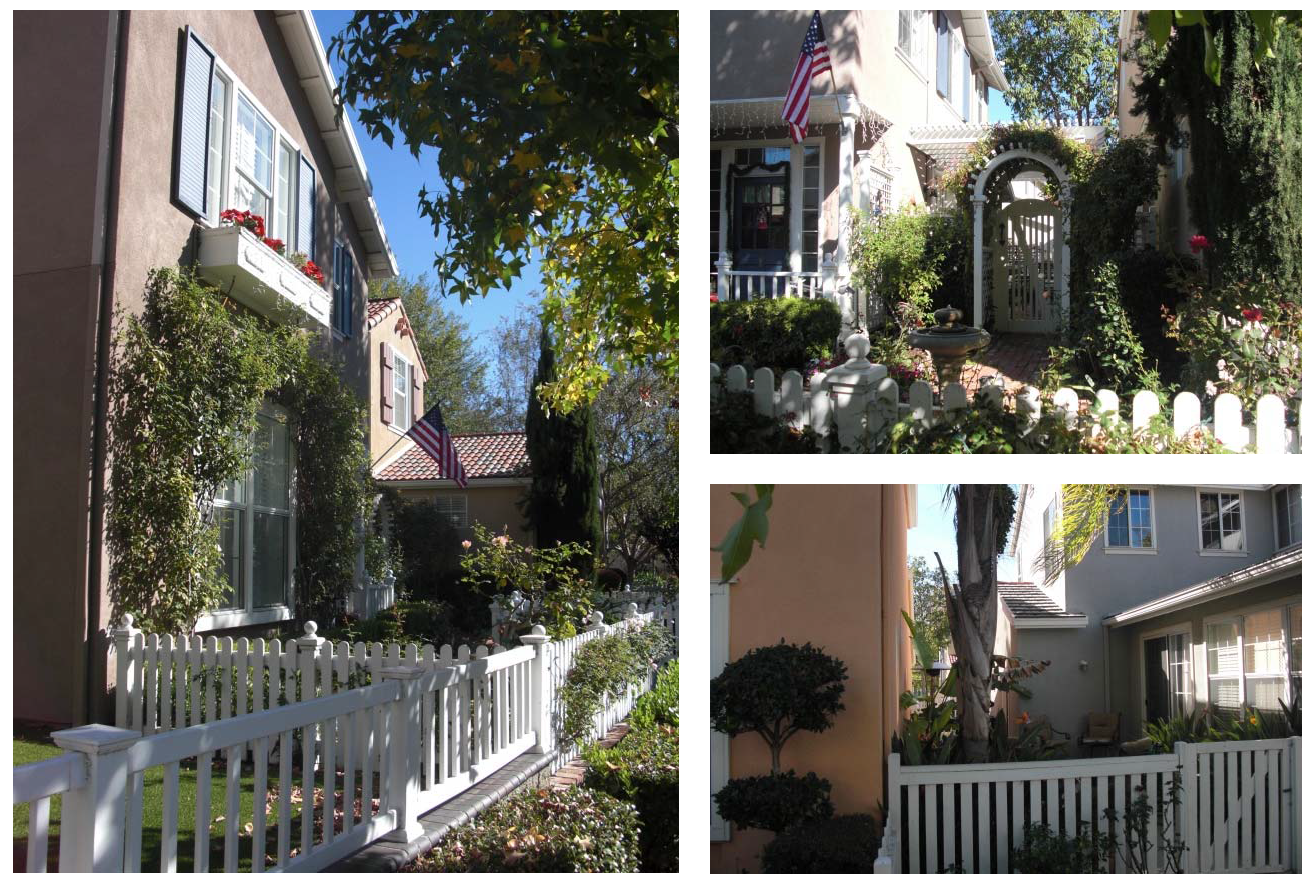
Figure 3-18 - Use of Landscaping and Low Fences to Distinguish Private Areas from
Public Areas
6.
Privacy. Careful design is required to ensure privacy between both new structures and existing structures surrounding the site.
a.
Windows and balconies from separate dwellings should not face or overlook each other.
b.
Minimize the number of windows overlooking neighboring interior private yards.
c.
Use translucent glass, landscaping, or other screening methods to create privacy.
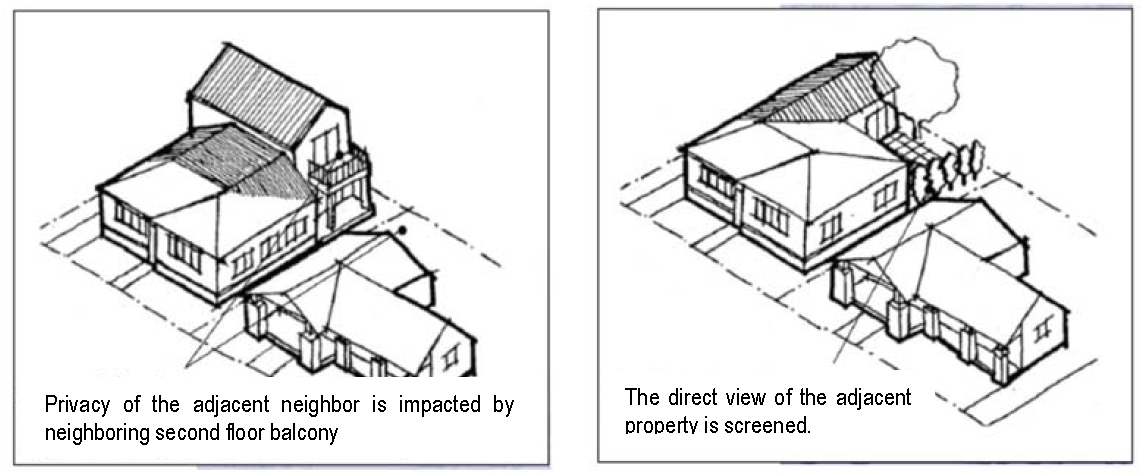
Figure 3-19 - Privacy Screening
7.
Mechanical equipment, utilities, garbage and screening. The location of mechanical equipment, garbage cans, and utilities should be considered early in the plan development. The location of unsightly equipment and infrastructure should be screened by fencing or landscaping or incorporated into the building design.
a.
Incorporate mechanical equipment into the design of the building to the greatest extent possible.
b.
Screen all trash and recycling enclosures from public view by landscaping and locate enclosures to minimize visual conflicts with units, common open spaces, or adjacent properties.
c.
For developments where individual trash totes are provided identify a location for screened storage when not in use and a location on site for trash pickup.
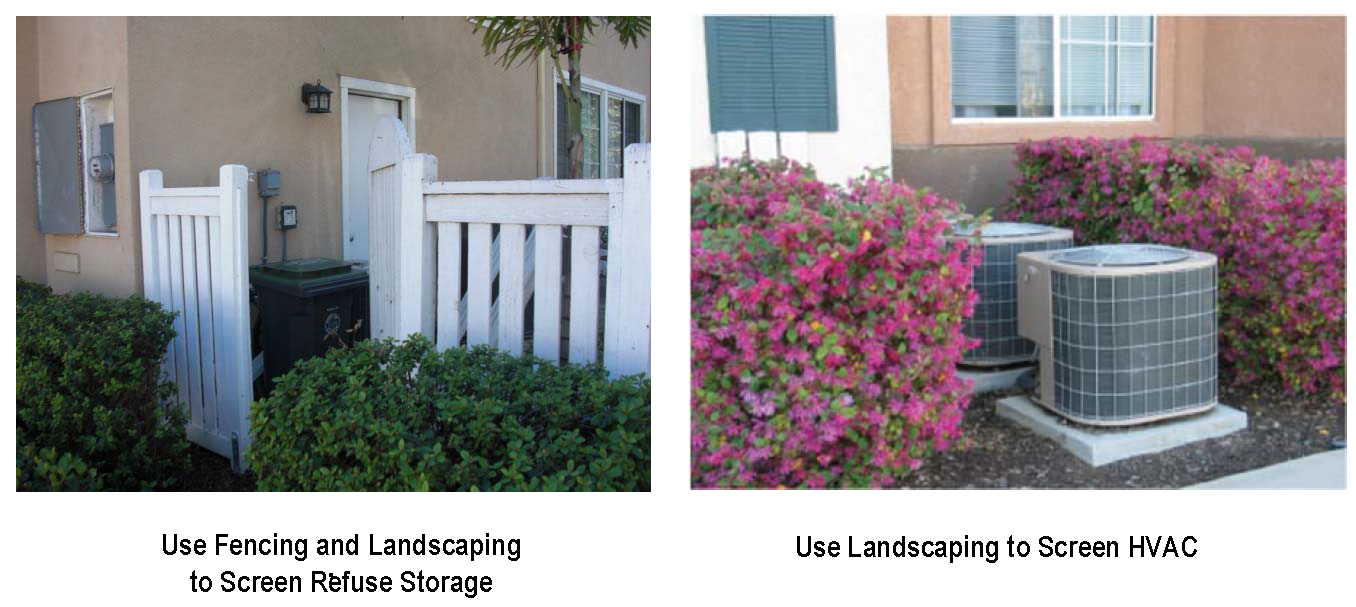
Figure 3-20 - Screening of Garbage and HVAC via Landscaping and Fencing
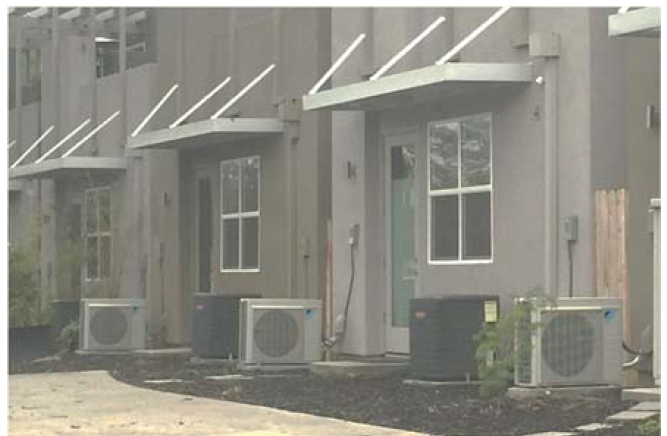
Figure 3-21 - Do Not Leave HVAC and Other Equipment Unscreened
8.
Fencing. Fencing should be designed to avoid areas that appear "walled off." Six feet tall wood fences, particularly along corner parcels should be avoided.
a.
Fencing should be designed to create semi-private open spaces for individual units. The use of solid fences is discouraged. Open fencing or shorter fencing is encouraged to create semi-private side yards.
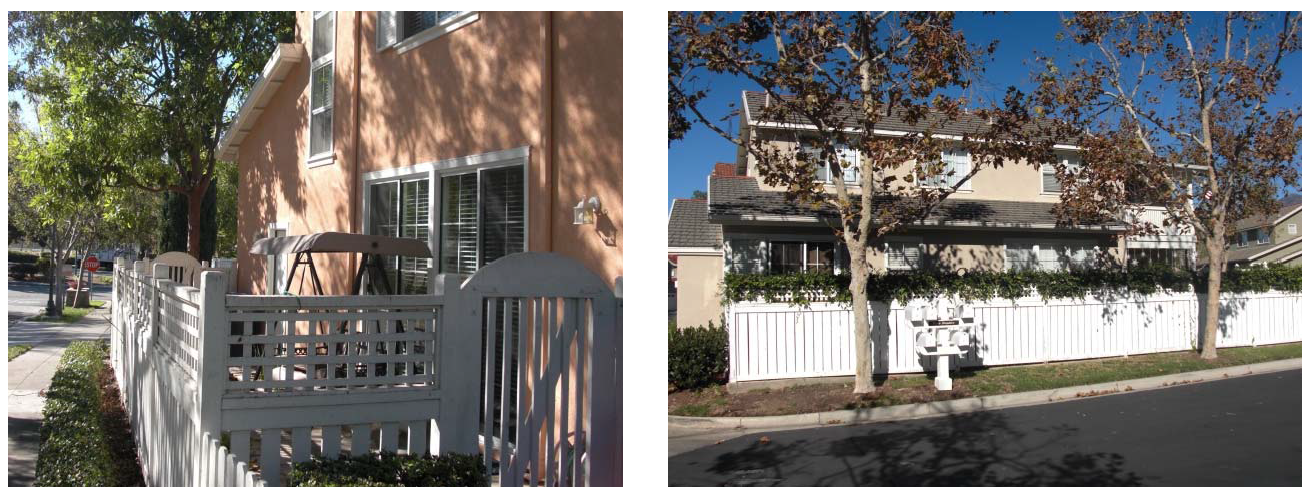
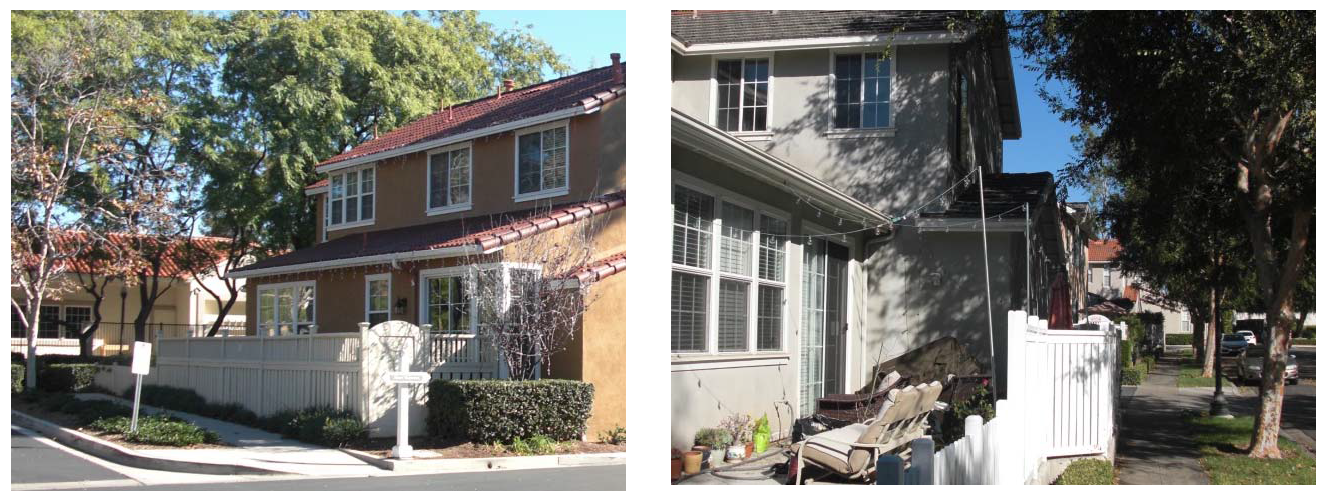
Figure 3-22 - Semi-Private Fencing Concepts
(Ord. No. 2008-15, § 1, 12-11-2008; Ord. No. 2013-011, § 3, 11-14-2013; Ord. No. 2015-010, § 1, 12-10-2015; Ord. No. 2018-005, § 1(Exh. 1), 10-11-2018; Ord. No. 2022-001, § 3(Exh. A), 3-10-2022)
Sec. 106.31.040. - Commercial Project Design
A.
Purpose. The City's commercial areas present special urban design challenges. The present character of these areas reflects both the architectural styles of nonresidential, automobile-oriented development that were predominant when many of the structures were built, and various modernization and renovation efforts thereafter. This Section provides guidelines for new and renovated commercial structures.
B.
Applicability. The standards in this Section apply to all retail, office, service commercial, and other commercial development within the City. Large-scale commercial development (including buildings of 50,000 square feet or larger, and retail centers with five or more shops) is also subject to the standards in Section 106.31.050 (Large Scale Retail and Retail Center Design).
C.
Overall design objectives for commercial projects. The design of each project should work toward improving the visual character and quality of the City, and achieve the following objectives.
1.
Consider residential neighborhoods adjacent to the commercial area and demonstrate sensitivity to the design context of the surrounding area.
2.
Avoid "boxy" structures with large, flat wall planes by articulating building forms and elevations to create interesting roof lines, building shapes, and patterns of shade and shadow.
3.
Incorporate pedestrian connections within and to the site that are safe, convenient, and direct for both internal and external circulation.
4.
Provide landscaping as a project amenity, and to help screen parking, equipment and storage areas.
5.
Provide logical and safe access to the site, and design parking and internal circulation areas to avoid awkward or cramped turning movements. In general, on-site access driveways should be located away from street intersections to minimize conflicts with turning movements from traffic on adjacent streets.
6.
Consider the need for signs and their appropriate scale and locations early in the design process, so that they are not an afterthought.
7.
Locate outdoor equipment, trash receptacles, storage, and loading areas in the least conspicuous part of the site.
8.
Grading for commercial development should be minimized, and proposed development should be designed to accommodate and maintain the natural topography to the greatest extent feasible.
D.
General architectural design guidelines.
1.
Architectural style. No particular architectural style or design theme is required in the City, but the compatibility of new projects with existing structures should be a priority, to maintain desired community character. "Canned" or "trademark" building designs used by franchised businesses in other cities are discouraged in Citrus Heights, as they collectively have the effect of making the commercial areas of the City look like anywhere in California. Corporate or franchise colors should be used as accent only.
2.
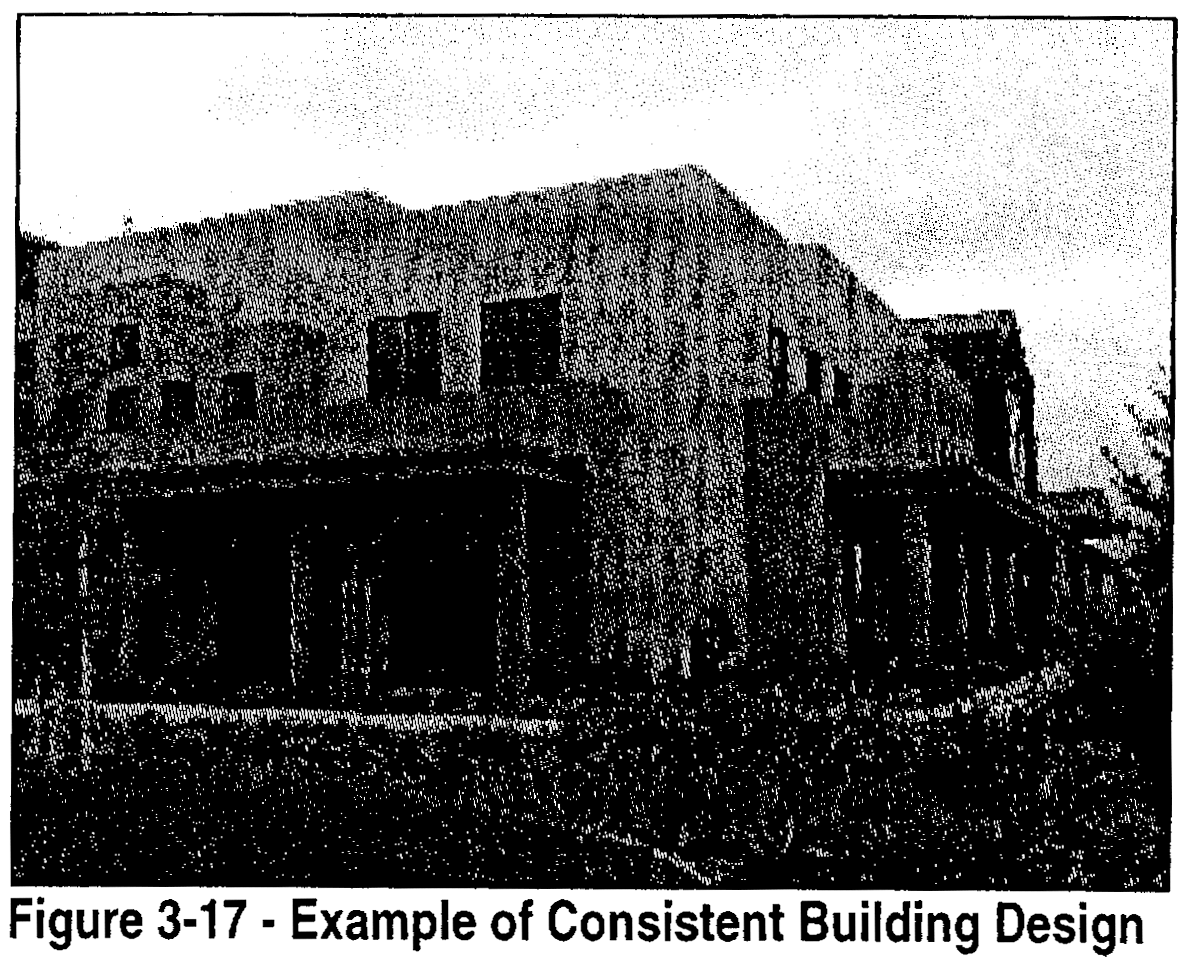
Design consistency. Building designs should demonstrate a consistent use of colors, materials, and detailing throughout all elevations of the building. An elevation that does not directly face a street need not have the same appearance as one facing the street, but its design should relate to the other building facades. See Figure 3-17.
3.
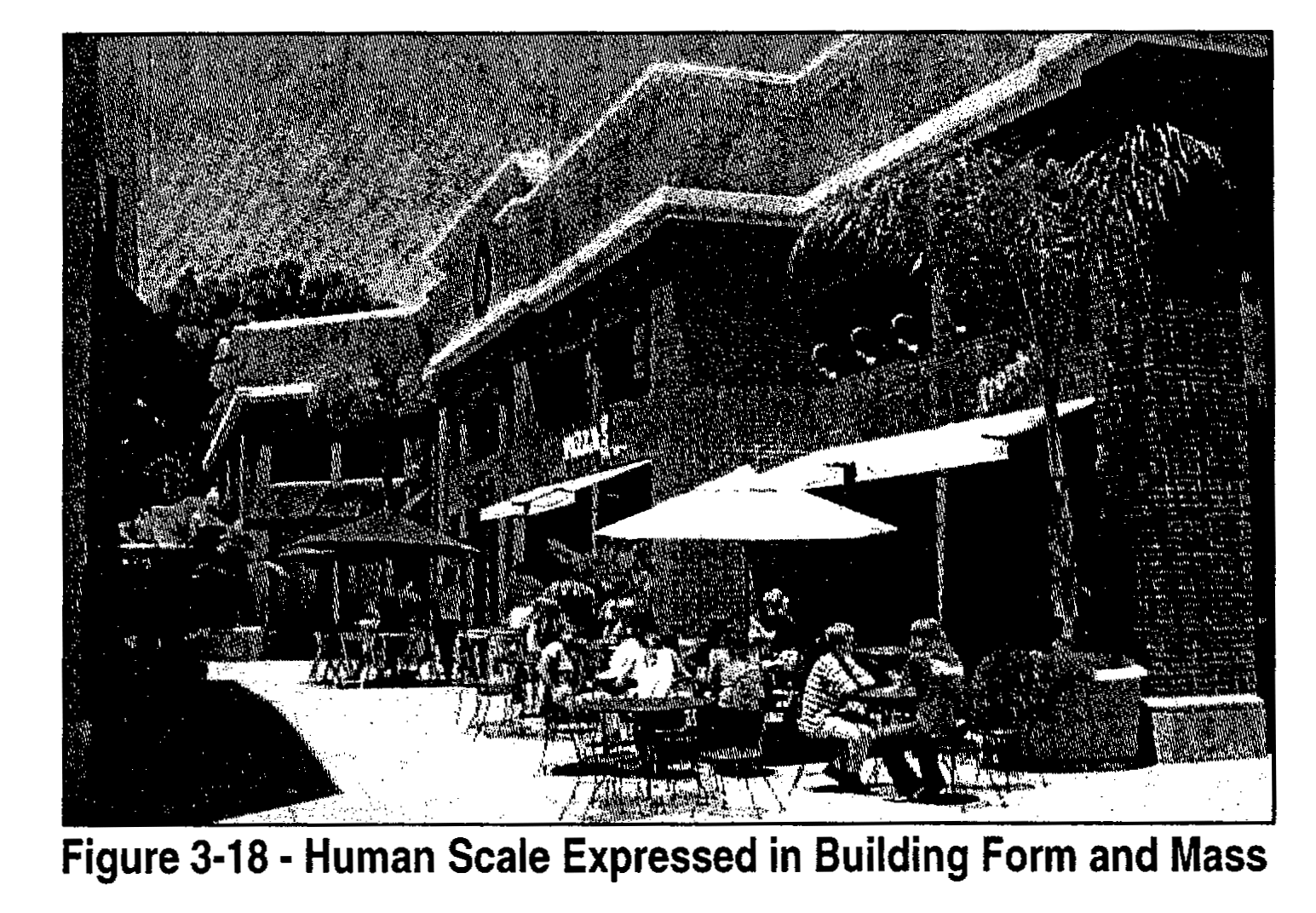
Form and mass. Building design should provide a sense of human scale and proportion. Horizontal and vertical wall articulation should be expressed through the use of wall offsets, recessed windows and entries, awnings, full roofs with overhangs, second floor setbacks, or covered arcades. See Figure 3-18.
4.
Rooflines. Roof design contributes strongly to the image of a structure as having quality and permanence.
a.
A structure with a pitched roof, or pitched roofs over key building elements can sometimes project a more small town image and reinforce the pedestrian orientation that is prominent in many parts of Citrus Heights. Structures with flat roofs and parapets require special attention to the wall-to-parapet juncture, and cornice details.
b.
Pitched roofs may be gable, hip, or shed-style, but should either be full pitched or should appear so from the street. Any flat portions (i.e., equipment wells) should be relatively small and not visible from streets or other public areas. On larger structures, pitched roofs should be multi-planed to avoid large, monotonous expanses.
c.
Flat roofs should be used only with a continuous screening parapet topped with coping, or a cornice. Green or vegetated roofs are permitted with complimentary architectural design. Mansards should be used only if they maintain the same roof pitch as surrounding structures and are both high and deep enough to create the illusion of being a true roof. Steeply-pitched mansard roofs are discouraged.
5.
Awnings. Awnings should be retained and/or incorporated where feasible and compatible with the storefront.
a.
Where a commercial building facade is divided into bays (sections defined by vertical architectural elements, such as masonry piers), awnings should be placed within the vertical elements rather than overlapping them.
b.
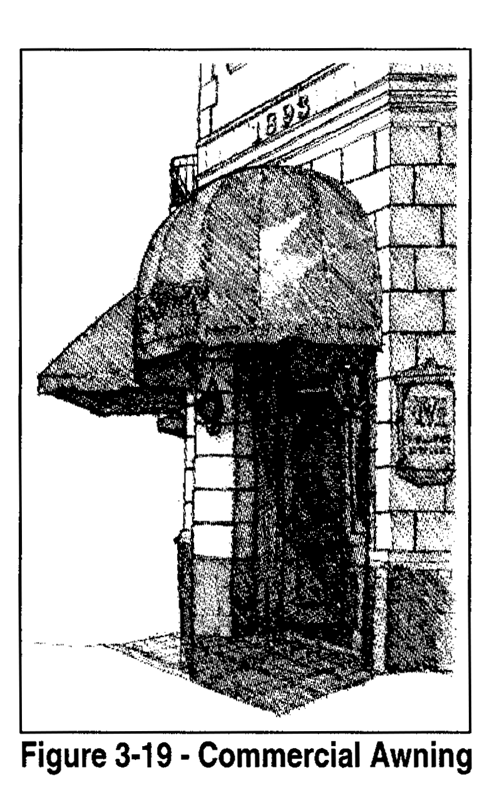
Awning shape should relate to the window or door opening the awning covers. Barrel-shaped awnings should be used over arched windows while square awnings should be used over rectangular windows. See Figure 3-19.
c.
Awnings shall not be internally illuminated.
d.
Canvas or standing seam metal are the preferred materials for awnings. Plastic, vinyl, or other glossy materials are not appropriate.
e.
A single building face with multiple tenants should use consistent awning design and color on each building floor, unless the building architecture differentiates the separate tenant spaces.
6.
Parapets. Parapet walls should be treated as an integral part of the building design, with architectural detailing consistent with the rest of the facade, and should not appear as unrelated elements intended only to screen the roof behind them.
7.
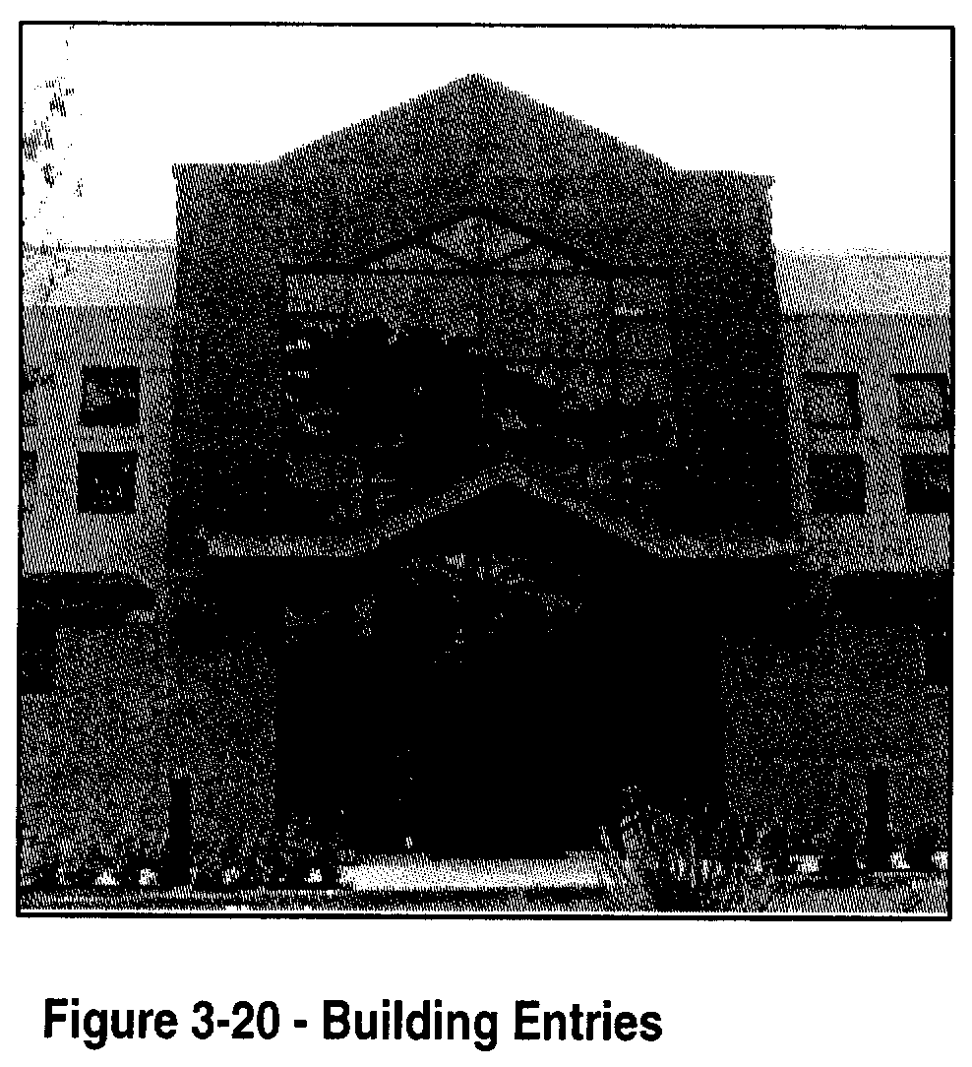
Entries. Building entries should be important and obvious elements in the design of a facade. See Figure 3-20.
a.
Each entry should be protected from the elements and should create an architectural focal point for the building.
b.
Wall recesses, roof overhangs, canopies, arches, columns, signs, and similar architectural features should be integral elements of the building's entry design, and used to call attention to its importance.
8.
Additions to existing structures and centers. The design of a proposed addition should follow the same general scale, proportion, massing, and detailing of the original structure, and not be in stark contrast to the original structure. Incorporating the main characteristics of the existing structure may include: extending architectural lines from the existing structure to the addition; repeating bay, window, and entrance spacing and cornice details; roof design and ground-level details; use of the same or complementary colors and materials; and including similar architectural details (such as window/door trim, lighting fixtures, tile/brick decoration). New building pads should not significantly block views of interior commercial buildings from the street, or significantly block views from interior commercial buildings to the street.
9.
Building materials. Building materials shall be carefully chosen to enhance the consistency of the architectural theme and design.
a.
Materials should be used honestly. Artificial or decorative facade treatments, where one or more unrelated materials appear "stuck-on" to a building (such as artificial columns or posts), should be avoided. While authentic materials such as brick, stone, and wood are preferred, artificial products that effectively imitate real materials may be appropriate in limited situations. If artificial stone-like materials are used, they should look like local natural materials.
b.
Exterior finish materials should be chosen and applied so that they do not appear "thin" and otherwise artificial, as in the case of "brick" veneer applied to a single building face so that it is obviously only ¼-inch thick when viewed from the side. Veneers should turn corners, avoiding exposed edges.
c.
Downspouts and drain pipes should preferably be placed within building walls. If they must be placed on a building exterior, they shall be integrated with the architectural design, colors, and finish materials of the building.
d.
Bulkheads should be constructed of a durable material other than stucco, such as tile, brick, rock, or pre-cast concrete.
10.
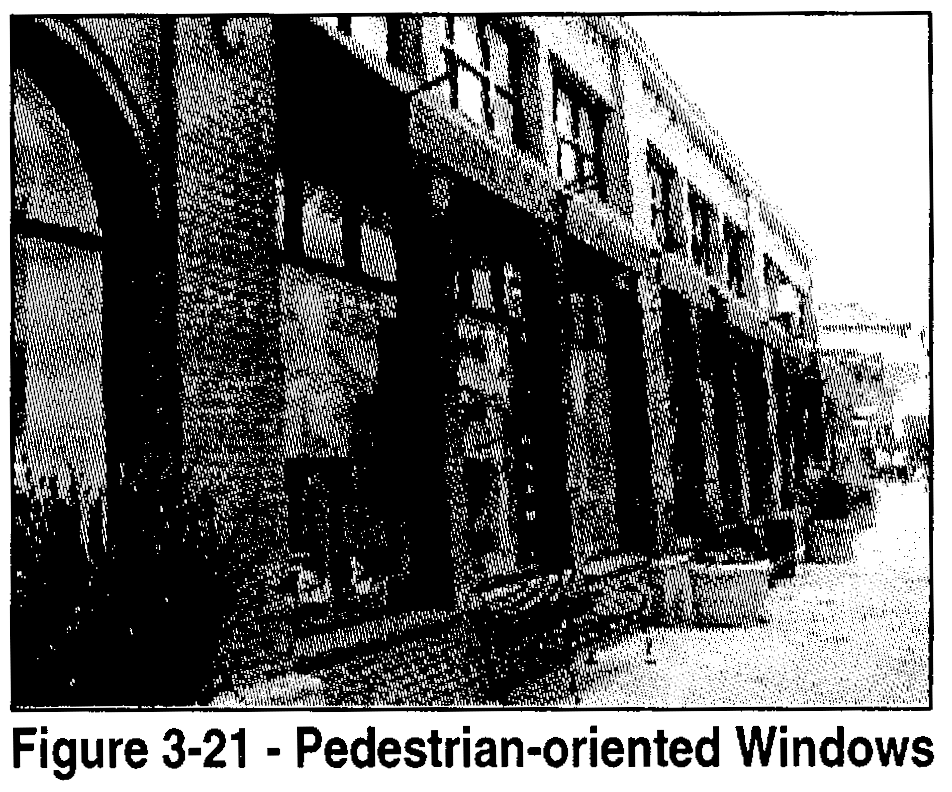
Windows. Existing windows should be maintained, and not "walled-in" or darkened to provide more interior wall or storage space. Ground floor windows are highly encouraged. These should ideally provide pedestrians with views into the building, but even display windows can improve the pedestrian experience of the building at the street or sidewalk level. See Figure 3-21.
11.
Colors. Colors should be compatible with the colors of existing buildings in the surrounding area but need not duplicate existing colors.
a.
Large areas of bright, intense colors should generally be avoided. While more subdued colors usually work best for large facade areas, brighter accent colors may be appropriate for trim, windows, doors, and other key architectural elements. Bold stripes of color are not a substitute for architectural detailing.
b.
The transition between base and accent colors should relate to changes in building materials or the change of building surface planes. Colors should generally not meet or change without some physical change or definition to the surface plane.
12.
Corporate identification. Colors or logos identified with an individual company should be employed as building accent features, and not used as the main or dominant architectural feature of any wall.
13.
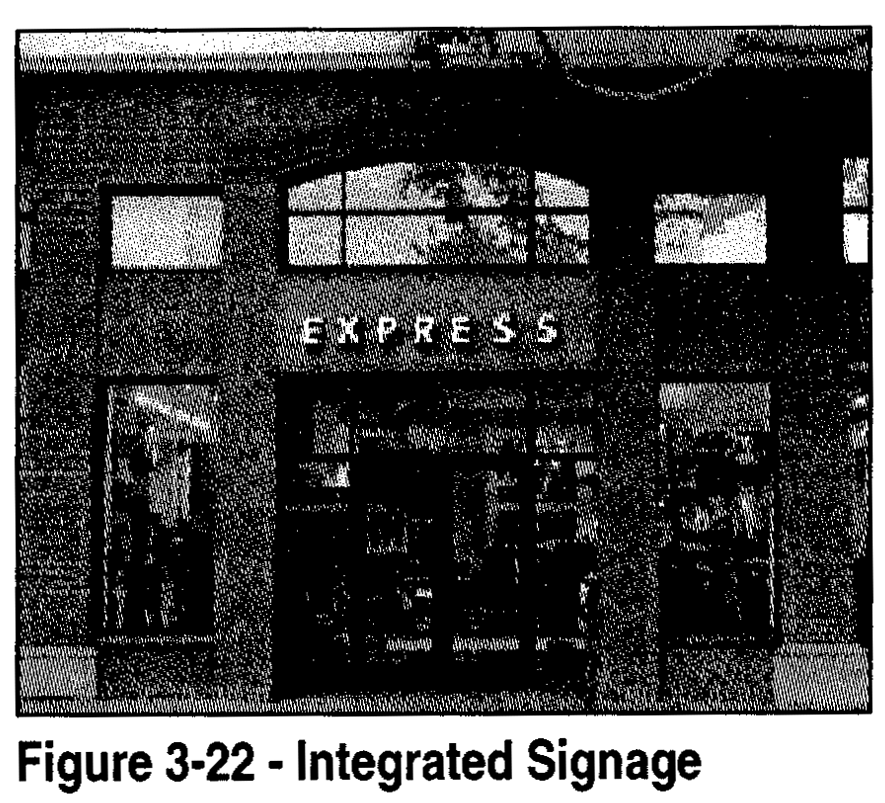
Signs. Each structure should be designed with specific consideration for adequate signing, including provisions for sign placement, sign scale in relation to building scale, and readability. The colors, placement, and materials of all signs should be integrated with the architecture and facade details of the structure. See Figure 3-22. Sign permits (see Chapter 106.38 (Signs) shall be required for color schemes, architectural features, and other design details that are:
a.
Primarily designed to advertise or to provide information in the nature of advertising, to direct or attract attention to a person, institution, business, product, or service;
b.
Used as the main or dominant feature of a building, building surface, or structure; and
c.
Determined by the Director to not demonstrate sensitivity to the design context of the building or surrounding area.
14.
Equipment screening. The attractive appearance of a building can be ruined by mechanical equipment (for example, heating, ventilation, and air conditioning) in highly visible locations on the roof, or on the ground adjacent to the structure.
a.
Mechanical and utility service equipment (e.g., compressors, air conditioners, pumps, heating and ventilating equipment, generators, solar collectors, satellite dishes, communications equipment, transformers, gas meters, etc.) and any other type of mechanical equipment should be located within the building or in an equipment room with an exterior entrance. If located outside the building, equipment should be screened from public streets and neighboring properties, and should be insulated as necessary to prevent noise generated by the equipment from being audible off the property. Screening methods may include landscaping placing components below grade, screen walls or a combination of these methods approved by the Director.
b.
Roof-mounted mechanical equipment and vents should be screened by a building parapet or other effective roof design.
c.
All ground-level screening shall be provided graffiti-resistant finishes.
E.
Site planning. Project site planning should comply with the following guidelines:
1.
Building and parking location.
a.
Buildings should generally be oriented parallel to streets. A site with multiple buildings should be planned to provide adequate visibility of each building from the street.
b.
The orientation of the building and its entrances should respond to the pedestrian or vehicular nature of the street. A building with high pedestrian use, or on a street where the City is working to create a pedestrian orientation, should face and be directly accessible from the sidewalk.
A building in a part of the City that is more suburban and auto-oriented in character should not face a large parking lot located between the building and the street, but should instead face major on-site open space and streetscape elements provided for pedestrian use. In the case of new commercial structures located on major arterials, it may also be appropriate to provide landscaped setbacks between buildings and streets.
c.
The City encourages shared parking arrangements. Parking areas on adjoining parcels should be connected to allow continuous vehicle, bicycle, and pedestrian access. Pedestrian linkages between parcels should be located separately from vehicle connections where possible and, in all cases, clearly differentiated from vehicle ways. Driveways should be consolidated and shared between properties and parking areas to the greatest extent feasible.
d.
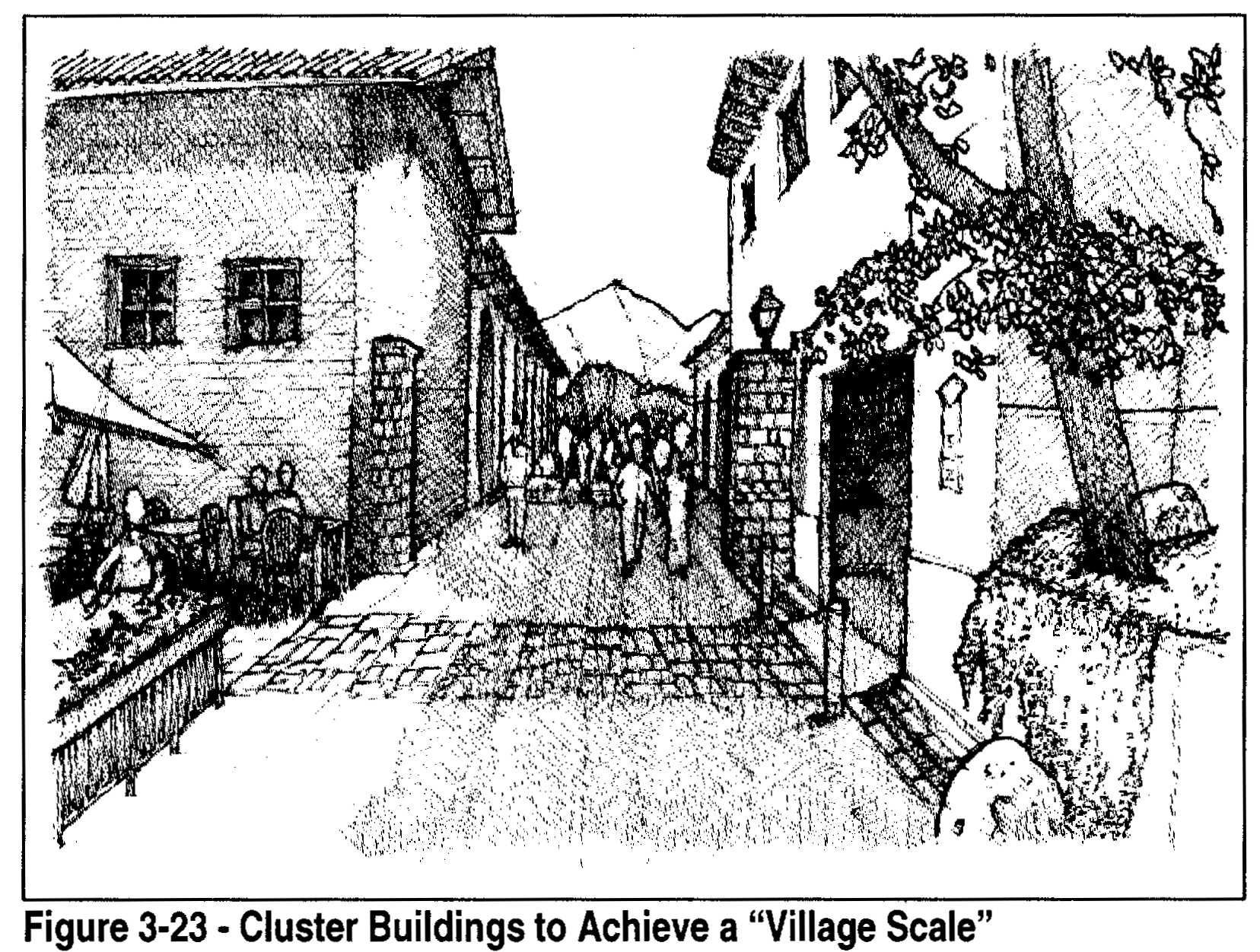
Multiple buildings in a single project should be designed to create a visual and functional relationship with one another. Whenever possible, multiple buildings should be clustered to achieve a "village" scale, with plazas and pedestrian areas, and without long rows of buildings. When clustering is impractical, a visual link should be established between buildings through the use of arcades, trellises, colonnades, landscaping and trees, or enhanced paving.
e.
The location of open space areas should be accessible from the majority of structures, and should be oriented to take advantage of sun or shade, as appropriate.
f.
The visual impact of parking lots should be minimized by locating these facilities to a portion of the site least visible from the street and by providing adequate screening and parking lot landscaping.
g.
Driveways should be consolidated.
h.
Parking areas should be connected to building entrances by means of enhanced (patterned or stamped) paving.
i.
Handicapped access should be provided into the property from the nearest point of public transit, and enhanced paving should be used to improve accessibility.
j.
Loading facilities should not be located at the front of buildings where they will interfere with customer and employee traffic and be difficult to adequately screen. These facilities are usually more appropriate at the rear of buildings; however, loading areas should not look like an afterthought. They should be screened from street and off-site views to the maximum extent feasible, and shall be architecturally integrated with the design of the building.
Special attention must be given to the design of loading facilities adjacent to residential uses. Techniques such as block walls, enhanced building setbacks with landscaping, and careful attention to the location and shielding of lighting can help minimize adverse impacts to residents. It is sometimes preferable to require that tenant spaces within a commercial project receive and ship products through the "front door," rather than subject adjacent residential uses to the noise and night time glare associated with loading facilities.
2.
Pedestrian and bicycle features.
a.
Pedestrian connections. Safe and direct pedestrian routes should be provided from public sidewalks, through parking areas, and along building facades to primary entrances.
(1)
Clearly demarcated and direct pedestrian routes should extend from peripheral public sidewalks and transit stops to the internal sidewalks that front commercial buildings, at least once in each 200 linear feet of sidewalk adjacent to the project.
(2)
Pedestrian connections should be provided to existing centers on adjoining sites.
b.
Bordering and internal sidewalks.
(1)
Sidewalks of at least five feet are required, and eight feet in width are encouraged along all sides of the lot that abut a public street.
(2)
Sidewalks must be provided along the full length of the building along any facade with a customer entrance, and along any facade abutting a parking area.
(a)
Sidewalks must be located at least six feet from the facade to provide area for landscaping, except where the facade incorporates pedestrian-oriented features such as pedestrian entrances or ground floor windows.
(b)
Sidewalks should be eight feet wide, exclusive of any area planned for outdoor display or storage.
(c)
The sidewalks should have wells for canopy trees at 30-foot intervals along the sidewalk edge adjacent to parking areas or vehicle access ways, so that the combination of building wall, sidewalk, and trees provide an enhanced pedestrian experience.
(3)
Pedestrian walkways within the site should be provided covered for weather protection within 15 feet of all customer entrances, which should also cover nearby short-term bicycle parking.
(4)
Light or utility poles, guy wires, transformer or relay boxes, gate/door swing radii, bus benches or shelters, or permanent traffic or informational signs may be sited adjacent to, but shall not encroach upon, sidewalks or other marked pedestrian or bicycle pathways.
c.
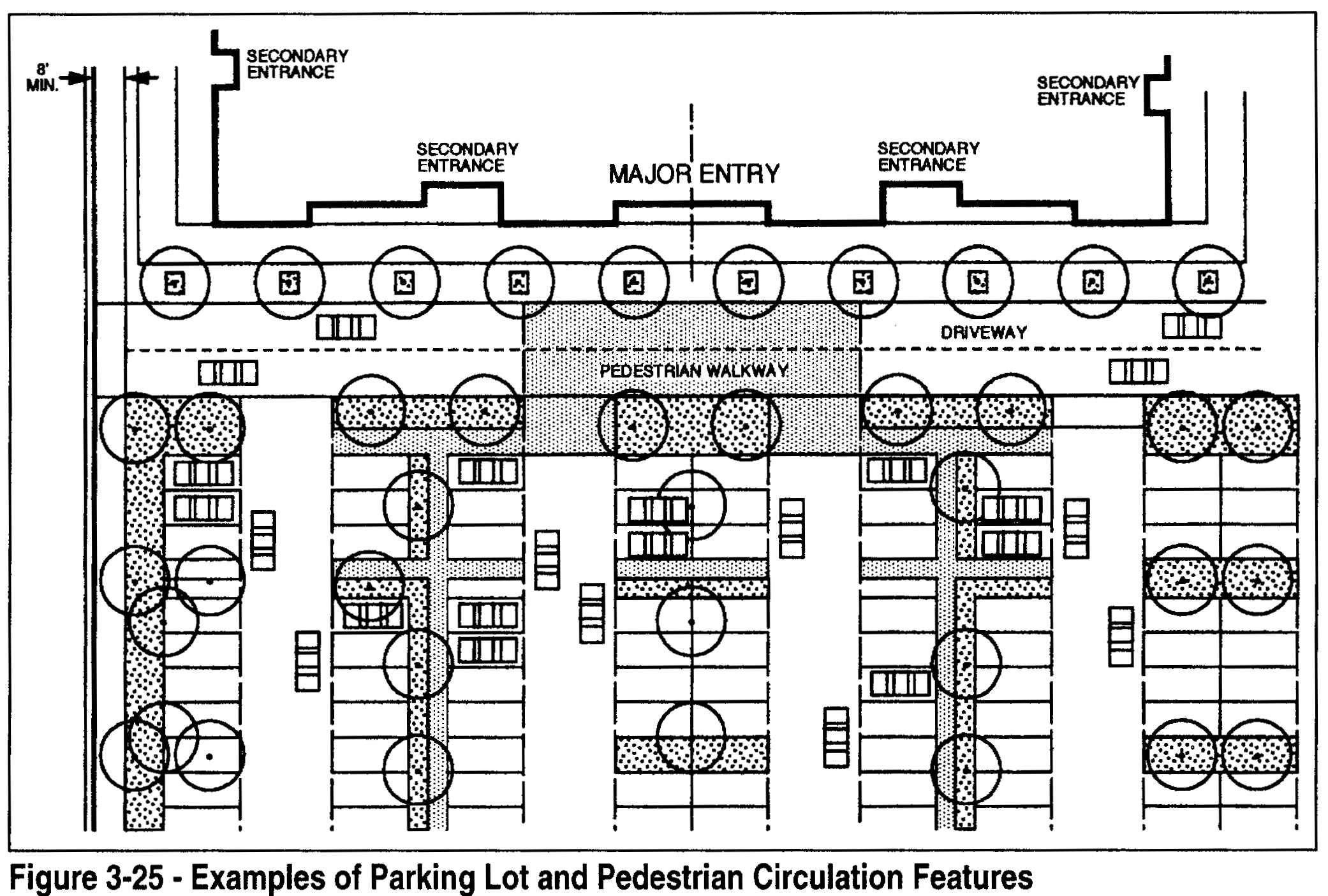
Pedestrian walkway identification. Pedestrian walkways within the site must be distinguished from driving surfaces through the use of special pavers, bricks, or colored/textured concrete to enhance pedestrian safety and the attractiveness of the walkways. Pedestrian circulation in parking areas should be parallel to traffic flow toward building entrances. Sidewalk landings should be provided and extended between parking spaces where needed to connect pedestrians to walkways.
d.
Sitting and activity areas. Site planning should include an outdoor use area or focal point adjacent to major building entrances as appropriate to the scale of the development. The area should provide public amenities, examples of which include water features, benches, landscaped areas, public square, etc. A project with two or more structures should group the buildings to define this space.
3.
Landscaping. Landscaped areas should be planned as an integral part of the overall project and not simply located in "left over" areas of the site.
a.
Landscaping should be used to help define outdoor spaces, soften a structure's appearance, screen parking, loading, storage, and equipment areas, manage stormwater, and recharge groundwater.
b.
The use of on-site pedestrian amenities (such as benches, shelters, drinking fountains, lighting, and trash receptacles) is encouraged. These elements should be provided in conjunction with on-site open spaces and be integrated into the site plan as primary features.
c.
Landscaping should be designed to minimize pollutants and improve water quality, including post- construction stormwater Best Management Practices such as grassy swales, detention basins with low flow swales, and approved underground vaults.
F.
Outdoor lighting. The design, size, and placement of outdoor lighting fixtures on buildings and in parking lots should be complementary to the architectural style of the buildings. More, smaller-scale parking lot lights instead of fewer, overly tall and large parking lot lights should be installed. Outdoor light fixtures mounted on building walls should relate to the height of pedestrians and not exceed eight to ten feet. All lighting fixtures shall comply with the requirements of Chapter 106.35 (Outdoor Lighting).
G.
Solar access. Commercial structures should be oriented to maximize solar access to encourage the use of passive solar, photovoltaic solar, etc. Solar equipment shall be screened by a parapet or other building feature or incorporated into the building architectural design.
(Ord. No. 2008-15, § 1, 12-11-2008; Ord. No. 2015-010, § 1, 12-10-2015)
Sec. 106.31.050. - Large-Scale Retail and Retail Center Design
A.
Purpose. The design guidelines in this Section are intended to produce large scale (i.e., "big box") retail stores and retail centers with more pedestrian orientation and scale than conventional projects of this type elsewhere.
B.
Applicability. The standards in this Section apply to large-scale commercial development (including buildings of 50,000 square feet or larger, and retail centers with five or more shops). These guidelines apply to large-scale retail projects in addition to those for commercial uses in Section 106.31.040.
C.
Site planning. Project site planning should emphasize pedestrian-oriented features, even though most customer trips to these facilities may be by auto.
1.
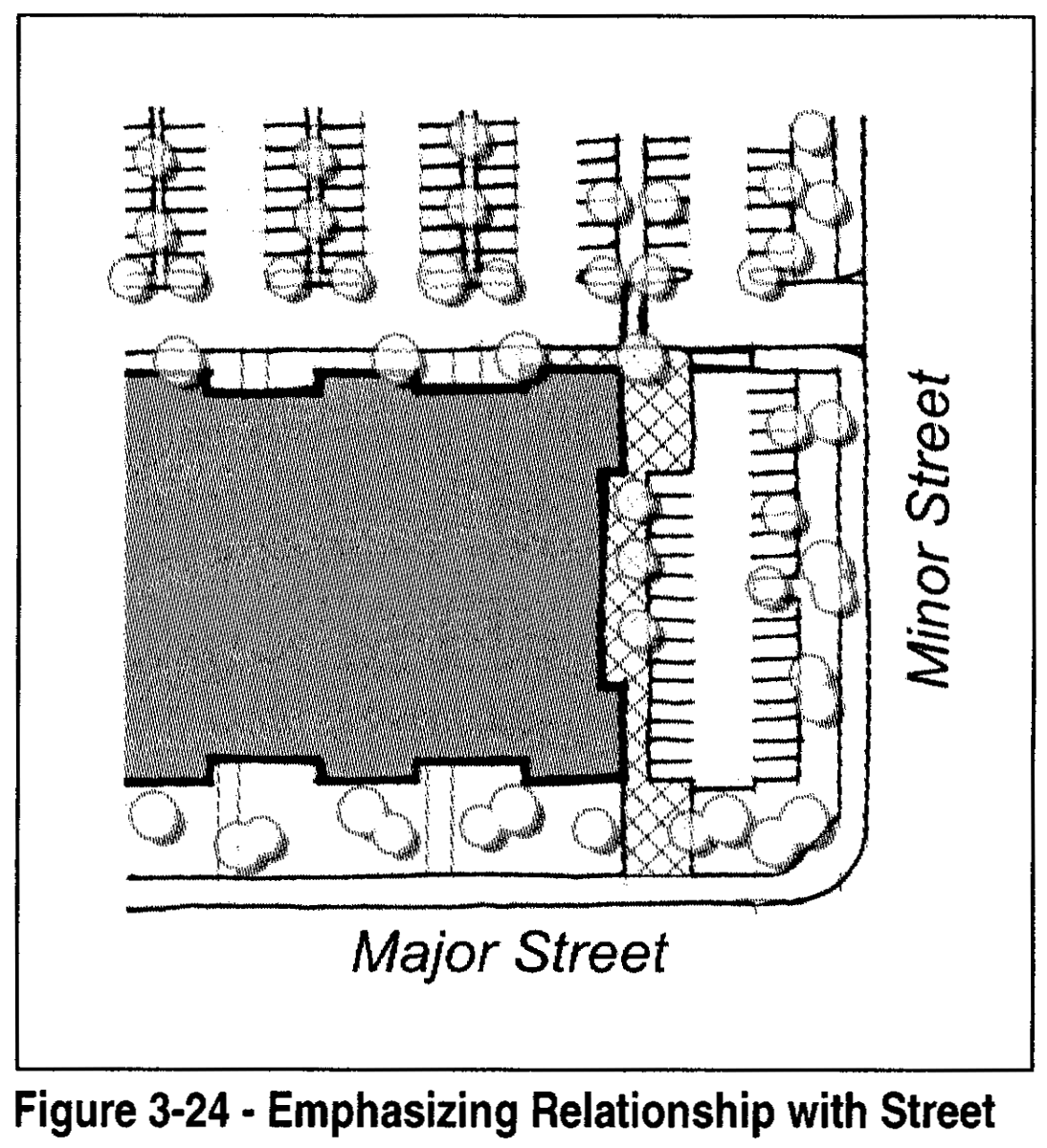
The layout of buildings and parking on the site should emphasize a strong relationship to adjoining streets, and encourage pedestrian circulation and access between the buildings and the street. Buildings should be placed near the street frontage on streets with slower traffic speeds and a pedestrian orientation, but may be located farther from a wide street with higher traffic speeds. The placement of buildings should also consider solar orientation, and the shading of outdoor pedestrian areas.
2.
Site planning should include an outdoor use area or focal point adjacent to major building entrances. The area should provide public amenities such as a water feature, benches, landscaped areas, public square, etc. A project with two or more structures should group the buildings to define this space.
D.
Parking areas. Parking lots should be designed to be equally pedestrian and vehicular oriented, as follows:
1.
Location and design of parking. Parking should not be the dominant visual element of a site. Large, expansive paved areas between the building and the street are to be avoided in favor of smaller multiple lots separated by landscaping or buildings, or located to the sides and rear of buildings.
2.
Landscaping. Parking areas should include substantial landscaping to soften the appearance of the adjacent large structures, and make walking around the site a more pleasant experience for pedestrians. Planting sites should provide adequate "uncompacted" soil area for root growth to support the mature size of the species/size of tree selected.
3.
Pedestrian routes. Safe and direct pedestrian routes should be provided through parking areas to primary entrances, and designed as noted under Subsection E.
4.
Shopping carts. Parking areas shall include an adequate number of shopping cart corrals where carts can be dropped-off without obstructing vehicle, bicycle, or pedestrian traffic movement, or being left in landscape planter areas. Cart corrals should be both attractive and durable, and their design will be a specific consideration in Design Review.
E.
Pedestrian circulation and amenities. It is the nature of large retail uses that most customers arrive by car and make purchases that could not be carried home by foot or bike. Nevertheless, the large parking lots in these projects cause much of the customer's experience to be as a pedestrian, often walking long distances from car, to entrance and back. Safe accommodation for pedestrians is essential and must be an integral part of site design.
1.
Sidewalks of at least five feet are required, and eight feet in width are encouraged along all sides of the lot that abut a public street.
2.
Sidewalks must be provided along the full length of the building along any facade with a customer entrance, and along any facade abutting a parking area.
a.
Sidewalks must be located at least six feet from the facade to provide area for landscaping, except where the facade incorporates pedestrian-oriented features such as pedestrian entrances or ground floor windows.
b.
Sidewalks should be eight feet wide, exclusive of any area planned for outdoor display or storage.
c.
The sidewalks should have wells for canopy trees at 30-foot intervals along the sidewalk edge adjacent to parking areas or vehicle access ways, so that the combination of building wall, sidewalk, and trees provide an enhanced pedestrian experience.
3.
Pedestrian walkways within the site should be provided covered for weather protection within 15 feet of all customer entrances, which should also cover nearby short-term bicycle parking.
4.
Pedestrian walkways within the site must be distinguished from driving surfaces through the use of special pavers, bricks, or colored/textured concrete to enhance pedestrian safety and the attractiveness of the walkways. Pedestrian circulation in parking areas should be parallel to traffic flow toward building entrances. Sidewalk landings should be provided and extended between parking spaces where needed to connect pedestrians to walkways.
5.
Wheel stops shall comply with the requirements in Section 106.36.080.I.3 (Wheel stops/curbing).
6.
Light or utility poles, guy wires, transformer or relay boxes, gate/door swing radii, bus benches or shelters, or permanent traffic or informational signs may be sited adjacent to, but shall not encroach upon, sidewalks or other marked pedestrian or bicycle pathways.
7.
Clearly demarcated and direct pedestrian routes should extend from peripheral public sidewalks and transit stops to the sidewalks that front commercial outlets, and along driveways. Pedestrian connections to commercial development on adjoining sites should also be provided.
F.
Building design. Building design shall be site-specific. Building details should relate to the scale of pedestrians as well as passing motorists. The tendency of many "big-box" retail chains is to replicate a corporate or generic aesthetic, often treating the building elevations much like large, scale-less billboards. The lack of human scale and absence of architectural character or local connection serve to emphasize a disconnection between the chain store and the community. The City discourages these conventional approaches to large-scale retail design.
1.
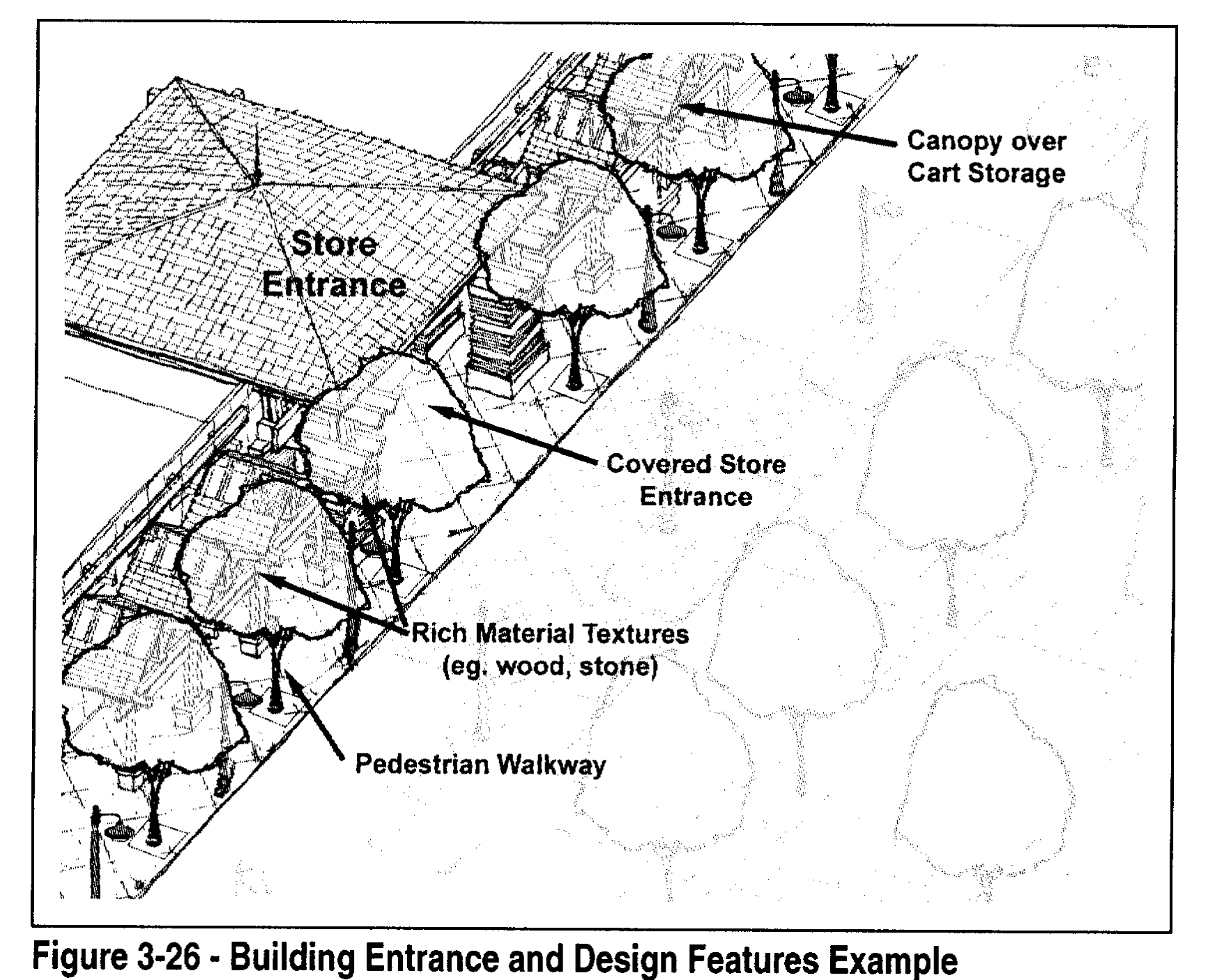
Entrances. Each side of a principal building facing a public street should have a customer entrance. Customer entrances must be clearly defined and highly visible, with features such as canopies or porticos, arcades, arches, wing walls, and integral planters.
2.
Exterior wall materials. Predominant exterior building materials must be of high quality. Examples include brick, wood, stone, tinted/textured stucco, and tile accents.
a.
Building walls should incorporate the same quality and level of detail of ornamentation on each elevation visible from a public right-of-way.
b.
Building facade details and materials should be authentic, and integrated into building design, and should not be or appear as artificial "glued/tacked-on" features, such as trellises that do not support plant materials, encouraging the perception of low quality.
3.
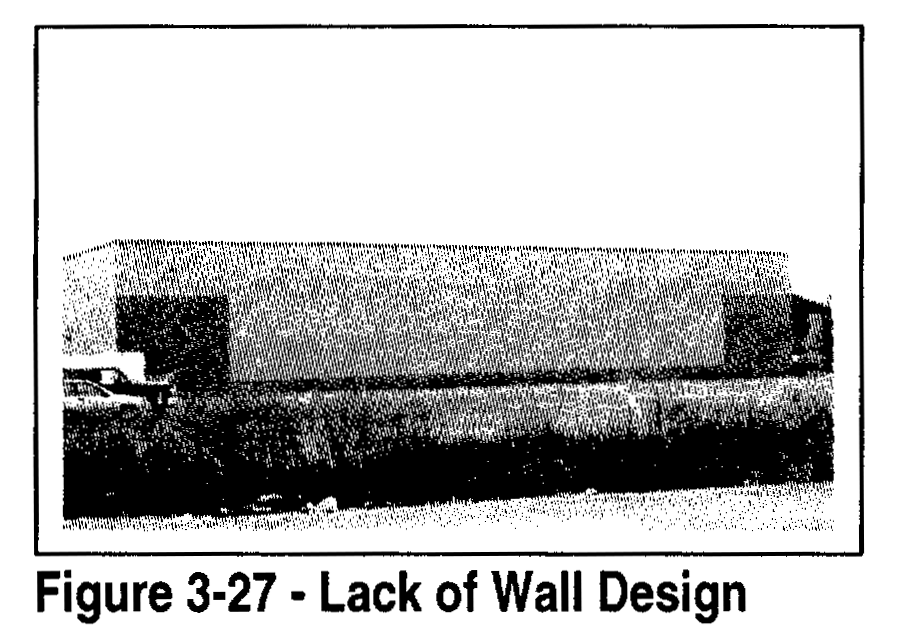
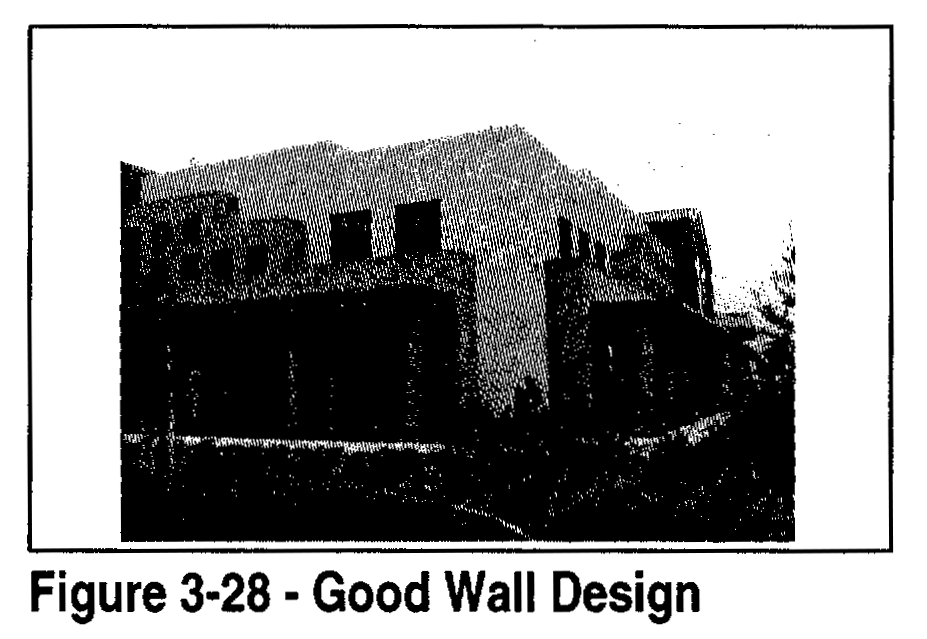
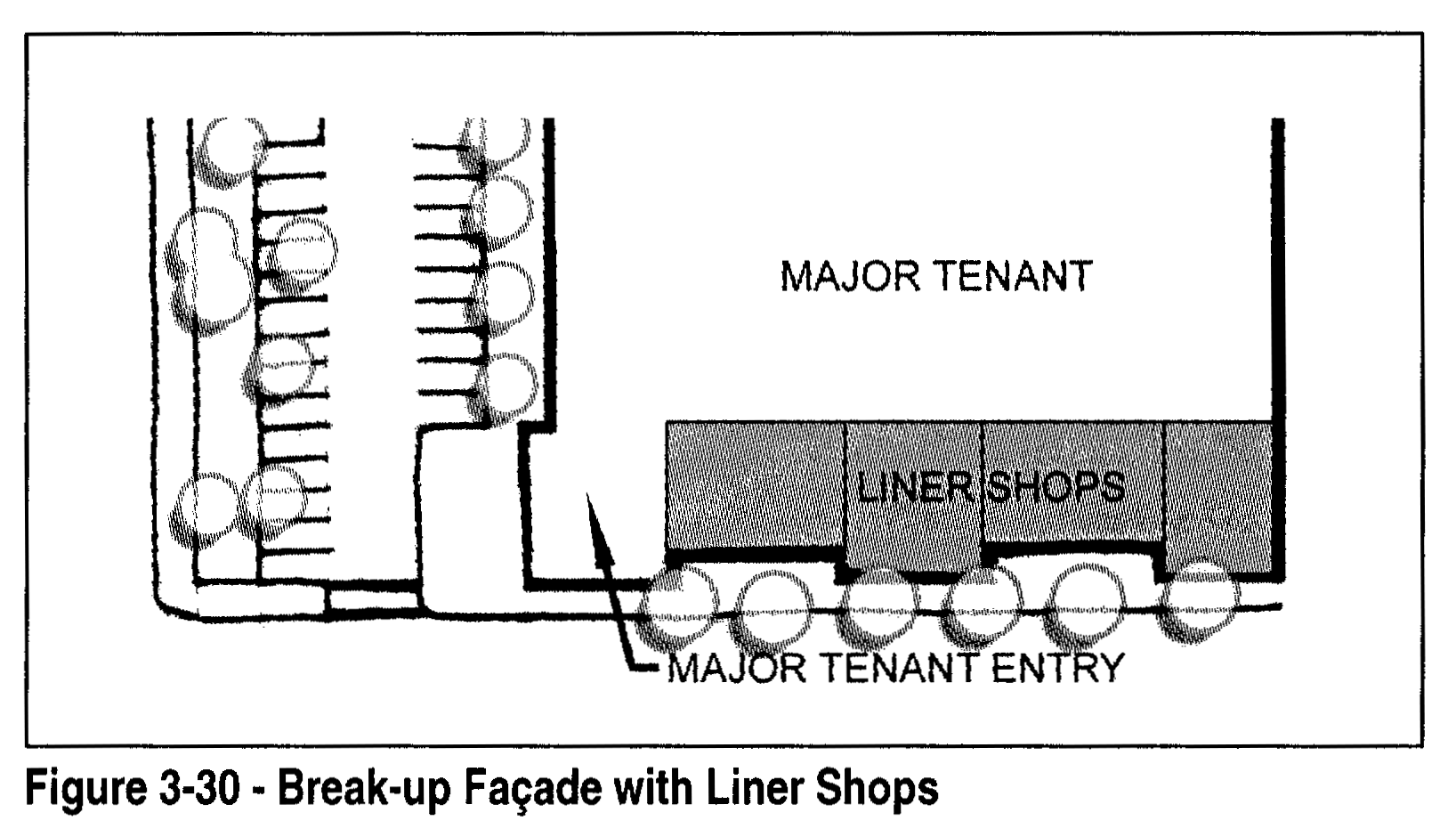
Wall design. All building walls should be designed to break up the appearance of a box-like structure, especially when visible from public roadways or residential areas. See Figures 3-27 and 3-28.
a.
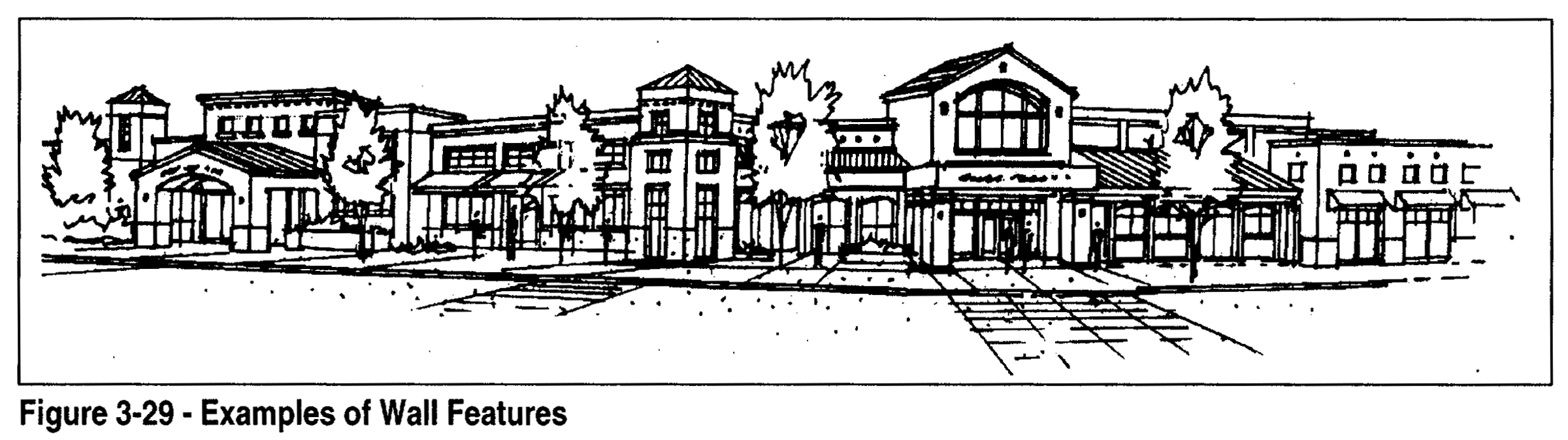
Facade articulation. Include extensive facade articulation in the form of horizontal and vertical design elements to provide variations in wall plane and surface relief, including providing a variety of surface textures, recesses and projections along wall planes. Facades greater than 100 feet in length should incorporate recesses or projections at least 20 feet deep along at least 30 percent of the length of the facade. Ideally, these recesses or projections should accommodate secondary uses/liner shops, and/or reflect the different internal functions of the store.
b.
Ground floor windows. Ground floor windows are highly encouraged. These should ideally provide pedestrians with views into the building, but even display windows can improve the pedestrian experience of the building at the street or sidewalk level.
c.
Design details. A variety of building and wall features should be used, in ways that avoid a cluttered appearance. These may include varying colors, reveals, an external wainscot or bulkhead at the building base to reduce apparent bulk, cornices and parapet details, and moldings. The features should employ a variety of materials as appropriate for the architectural style.
Bulkheads should be constructed of a durable material other than stucco, such as tile, brick, rock, or pre-cast concrete. Windows, awnings, and arcades must total at least 60 percent of the facade length facing a street.
4.
Vertical wall articulation. The height of building walls facing streets or on-site pedestrian areas should be varied so that the vertical mass is divided into distinct, human-scaled elements.
a.
Except on a pedestrian-oriented public street where buildings are at the back of the sidewalk, structures over 20 feet in height (typical for structures of two stories or more) should step-back the building mass at least five feet for the portions of the structure above 14 feet (or the height where an actual second story begins) to provide visual variation.
b.
The facade of the areas stepped-back above the actual or apparent first floor should include detailed building articulation with windows, eaves, and decorative details such as tiles, wood trim, etc. as appropriate. It is also important that the facade below the step-back have a substantial structural appearance, and not simply appear as an awning "tacked-on" to the building.
c.
Building facades that are tall for no functional reason, have little surface articulation or relief, and are simply intended to provide high, visible surfaces for tenant signage are not appropriate.
5.
Roof lines. The roof lines should also be varied to break up the mass of the building. Pitched roofs with roof overhangs proportional to the scale of the adjoining building wall are encouraged. Major roof- mounted equipment shall not be visible from off the site. Parapets and decorative cornices should be utilized to conceal flat roofs and to screen any roof-mounted mechanical equipment. The height of mechanical equipment shall not exceed that of the parapets or other roof features intended to screen the equipment. Enclosures, blinds, or other architectural treatment may be necessary to screen roof equipment visible from residences or public areas. Green roofs or vegetated rooftops are permitted.
6.
Location of secondary uses. Secondary uses or departments including pharmacies, photo finishing/development, snack bars, dry cleaning, offices, storage, etc., should be oriented to the outside of the building by projecting them outward or recessing them inward. This includes providing the individual uses with separate entrances and windows facing the outside of the building. The intent is to break up the appearance of the large, primary building with more human-scale elements. Food courts/bars should provide indoor and sheltered outdoor eating areas with tables, chairs, umbrellas, etc.
7.
Design continuity. Large-scale retail projects shall incorporate elements to visually unify the buildings and signage without creating monotony. Buildings on separate pads should maintain the overall architectural character of the site; at the same time architectural variety is encouraged.
G.
Loading areas. Loading docks, trash collection areas, outdoor storage, and similar facilities should be incorporated into the overall design of the building and landscaped, so that the visual and acoustic impacts of these functions are fully contained, and out of view from adjacent properties and streets. Any screening materials must be of the same quality and appearance as those used on the building itself, and shall be provided graffiti-resistant finishes.
H.
Landscaping. Landscaping that complements and is in scale with the building should be provided adjacent to structures. Landscaping should include evergreen trees, shrubs and ornamental landscaping (and berms where appropriate) with all landscape areas having a minimum width of six feet. Landscaping should be used to create a focal point near front building entrances. Sidewalks and other walkways should also be integrated with landscape areas around building base and in parking lot areas. Trees should be planted in notable clusters within larger planting areas, and not exclusively in lines along building facades.
I.
Outdoor lighting. The design, size, and placement of outdoor lighting fixtures on buildings and in parking lots should be in keeping with the architectural style of the buildings. More, smaller-scale parking lot lights instead of fewer, overly tall and large parking lot lights should be installed. Outdoor light fixtures mounted on building walls should relate to the height of pedestrians and not exceed eight to ten feet. All light fixtures should be directed downward and shielded so that the light source itself is not visible.
J.
Signs.
1.
Guidelines.
a.
The signs provided in conjunction with a large-scale retail project should comply with the following guidelines.
b.
Proposed large-scale retail projects shall include a comprehensive program that effectively integrates signage into the project design.
c.
Signs for these projects, and the buildings themselves, should not be designed to be freeway-oriented.
d.
Along with typical auto-oriented wall and freestanding signage, permanent, pedestrian-oriented window, awning, projecting, and suspended signs should also be provided, that do not obstruct or create a safety hazard for pedestrians or cyclists.
2.
Sign Permit requirements. Sign permits (see Chapter 106.38 (Signs) shall be required for color schemes, architectural features, and other design details that are:
a.
Primarily designed to advertise or to provide information in the nature of advertising, to direct or attract attention to a person, institution, business, product, or service;
b.
Used as the main or dominant feature of a building, building surface, or structure; and
c.
Determined by the Director to not demonstrate sensitivity to the design context of the building or surrounding area.
(Ord. No. 2015-010, § 1, 12-10-2015)
Sec. 106.31.060. - Specific Commercial Uses
The following design standards apply to the specific commercial uses identified:
A.
Service stations. A service station (with or without a car wash) is an intensive auto-oriented use with large areas of pavement that requires particular design attention to be an attractive neighbor.
1.
Site planning. Service station site plans should incorporate the following features:
a.
The site should be designed to accommodate anticipated car and truck (including fuel delivery truck) circulation patterns and minimize paving.
b.
Driveway cuts should be limited to two per site, unless otherwise allowed by the City Engineer for valid circulation reasons.
c.
Service and wash bays should not face streets or residential properties. The visibility of service and wash bays otherwise should be minimized.
d.
Fuel pump islands and canopies should be screened by the main building structure. The retail market/office building should be placed at the street frontage with a pedestrian entrance from, and display windows along the sidewalk, to encourage pedestrian use.
2.
Building design. Service station buildings should be designed to comply with the following guidelines:
a.
Site specific architectural design is encouraged. Corporate or franchise "stock" design solutions are discouraged.
b.
Each structure on the site should be architecturally consistent and related to an overall architectural theme.
c.
High quality building materials are encouraged. Reflective, glossy, and florescent surfaces are discouraged.
d.
The roof design of all structures, including pump canopies, should incorporate pitched roof treatments with a low to moderate pitch. Flat or mansard roofs are discouraged unless they are consistent with an established and attractive architectural theme in the site vicinity.
e.
Fuel pump canopies should not be internally illuminated. Light fixtures shall be completely recessed into the canopy so that the light source is concealed.
f.
Each pump island should include stacking for at least two vehicles (40 feet) on-site, or at least at one end of the pump island.
(Ord. No. 2008-15, § 1, 12-11-2008)
Sec. 106.31.070. - Industrial Project Design
A.
General design objectives. The following guidelines address the overall approach to industrial project design favored by the City:
1.
A variety of building and parking setbacks should be provided to avoid long monotonous building facades and to create diversity within the project.
2.
Building setbacks should be provided proportionate to the scale of the structure and in consideration of existing adjacent development. Larger structures require more setback area for a balance of scale and so as not to impose visually on neighboring uses.
3.
The placement of structures to create plazas, courts, or gardens is encouraged. Setback areas can often be used to provide space for patio and outdoor eating areas.
4.
The main elements of preferred business park/industrial site design include the following:
a.
Easily identifiable site access;
b.
Service areas located at the sides and rear of buildings;
c.
Convenient access, visitor parking and on-site circulation;
d.
Screening of outdoor storage, work areas, and equipment;
e.
Emphasis on the main building entry and landscaping;
f.
Placement of buildings to provide plazas and courtyards;
g.
Landscaped open space; and
h.
Multiple buildings on the same site clustered to create a campus-like setting that takes advantage of shared open space and pedestrian amenities.
B.
Architectural design. The inherently utilitarian nature of industrial buildings need not prevent the design of attractive industrial areas within the city.
1.
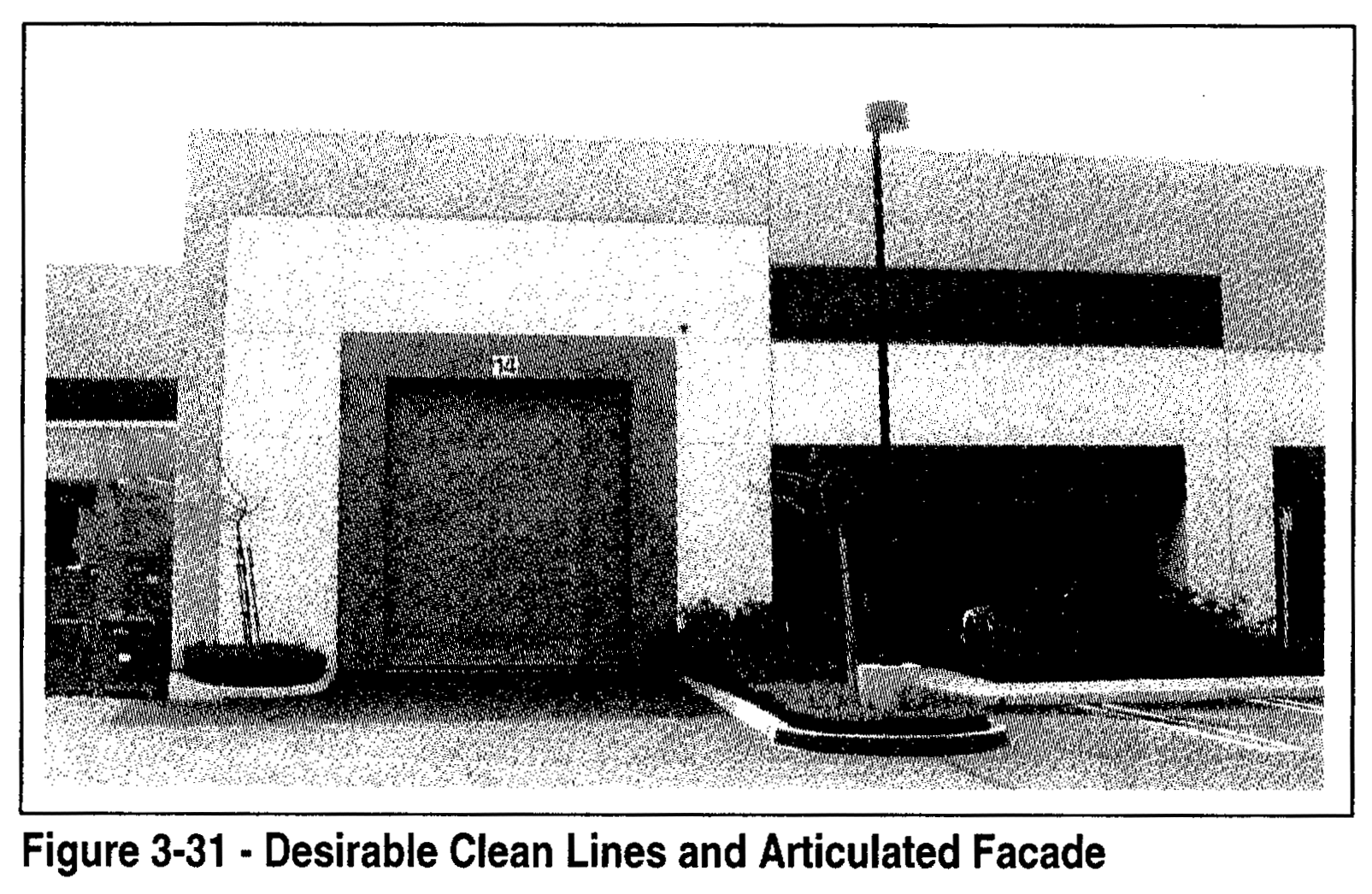
Architectural style. The architectural style of business park and industrial buildings should incorporate clean simple lines. Buildings should project an image of high quality through the use of appropriate durable materials and well landscaped settings. See Figure 3-31.
2.
Mass and scale of structures. As a category of structure type, typically bland industrial buildings often present unattractive, unadorned, "box-like" forms. A variety of design techniques should be used to help overcome this situation and to produce a cohesive design statement.
a.
Provide articulated facades with offsets and recessed entries.
b.
Entries to structures should have a quality appearance while being architecturally tied into the overall building composition and scale.
c.
Alteration of colors, textures, and materials should be used to produce diversity and enhance architectural forms.
d.
A compatible variety of siding materials (i.e., metal, masonry, concrete texturing, cement or plaster) should be used to produce effects of texture and relief that provide architectural interest.
3.
Undesirable elements. Undesirable design elements to be avoided include:
a.
Large blank, unarticulated wall surfaces;
b.
Exposed, untreated precision block walls;
c.
Chain link fence and barbed wire;
d.
False fronts;
e.
Steeply pitched Mansard roofs;
f.
Materials with high maintenance (such as stained wood, shingles or light gauge metal siding);
g.
Mirror window glazing;
h.
Loading bays or doors facing a street; and
i.
Exposed roof drains and downspouts, except where integrated with the colors, materials, and other details of the building architecture.
C.
Parking and vehicle circulation. Parking lots should not be the dominant visual elements of a site. Large expansive paved areas located between the street and the building are to be avoided in favor of smaller multiple lots separated by landscaping and buildings and located to the sides and rear of buildings whenever possible.
1.
Site access and internal circulation should be designed in a straightforward manner that emphasizes safety and efficiency. The circulation system should be designed to reduce conflicts between vehicular and pedestrian traffic.
2.
Entrances and exits to and from parking and loading facilities should be clearly marked with appropriate directional signage where multiple access points are provided.
3.
Parking lots adjacent to and visible from public streets must be adequately screened from view through the use of rolling earth berms, low screen walls, changes in elevation, landscaping or combinations of these features.
D.
Pedestrian circulation.
1.
Clearly demarcated and direct pedestrian routes should extend from peripheral public sidewalks and transit stops to the sidewalks that front on-site buildings, and along driveways.
2.
Pedestrian walkways must be distinguished from driving surfaces through the use of special pavers, bricks, or colored/textured concrete to enhance pedestrian safety and the attractiveness of the walkways. Pedestrian circulation in parking areas should be parallel to traffic flow toward building entrances. Sidewalk landings should be provided and extended between parking spaces where needed to connect pedestrians to walkways.
3.
Wheel stops shall comply with the requirements in Section 106.36.080.I (Wheel stops/curbing).
E.
Loading facilities. Loading bays are key elements of the function of many industrial buildings, but can be problematic in creating an overall building design that is attractive from the public view.
1.
To alleviate the unsightly appearance of loading facilities, these areas should not be located at the front of buildings where it is difficult to adequately screen them from view. Loading facilities are generally more appropriate at the rear of a building where they are more functional and can be more effectively screened.
2.
When site features prevent the placement of loading facilities at the rear of the building, loading docks and doors may be at the side of the building but must be screened from view by a combination of screen walls, ornamental landscaping and/or portions of the building. Gates should be located so as not to allow views from the public right-of-way into loading areas.
3.
Rolling shutter doors located on the inside of the building are the preferred method for providing large loading doors while keeping a clean, uncluttered appearance from the exterior.
4.
Loading areas must be designed so that trucks will not need to back-in from the public street onto the site.
F.
Landscaping. Landscaping should be used on industrial sites to define areas such as entrances to buildings and parking lots, define the edges of various land uses, provide transition between neighboring properties (buffering), provide screening for outdoor storage, loading and equipment areas, manage stormwater, and recharge groundwater.
1.
Landscaping should be in scale with adjacent buildings and be of appropriate size at maturity to accomplish its intended purpose.
2.
Landscaping around the entire base of buildings is recommended to soften the edge between the parking lot and the structure and the view of the structure from the public right-of-way. Landscaping should be accented at building entrances to provide a focal point.
3.
Use berming at the edge of the building in conjunction with landscaping to reduce the apparent height of the structure and its mass, especially along street frontages.
4.
Development in areas with native vegetation or located within riparian, viewshed or other unique natural environments are encouraged to use landscape designs and material that are sensitive to and compatible with existing vegetation.
5.
Tree planting areas must be adequate to support the mature size of the species selected.
G.
Walls and fences. The fact that industrial uses often require large outdoor areas for production activities, parking, or storage necessitates the thoughtful design of surrounding walls and fences because they can become significant visual elements on the site. Fences and walls shall also comply with the requirements of Section 106.30.050 (Fences and Walls).
1.
If walls are not required for a specific screening or security purpose they should not be used. The intent is to keep walls as low as possible while still performing their screening and security functions.
2.
Where walls are used at property frontages, or screen walls are used to conceal storage and equipment areas, they should be designed to blend with the site's architecture. Landscaping should be used in combination with such walls whenever possible.
3.
Long expanses of fence or wall surfaces should be offset and architecturally designed to prevent monotony. Landscape pockets should be provided along the wall. See Figure 3-32.
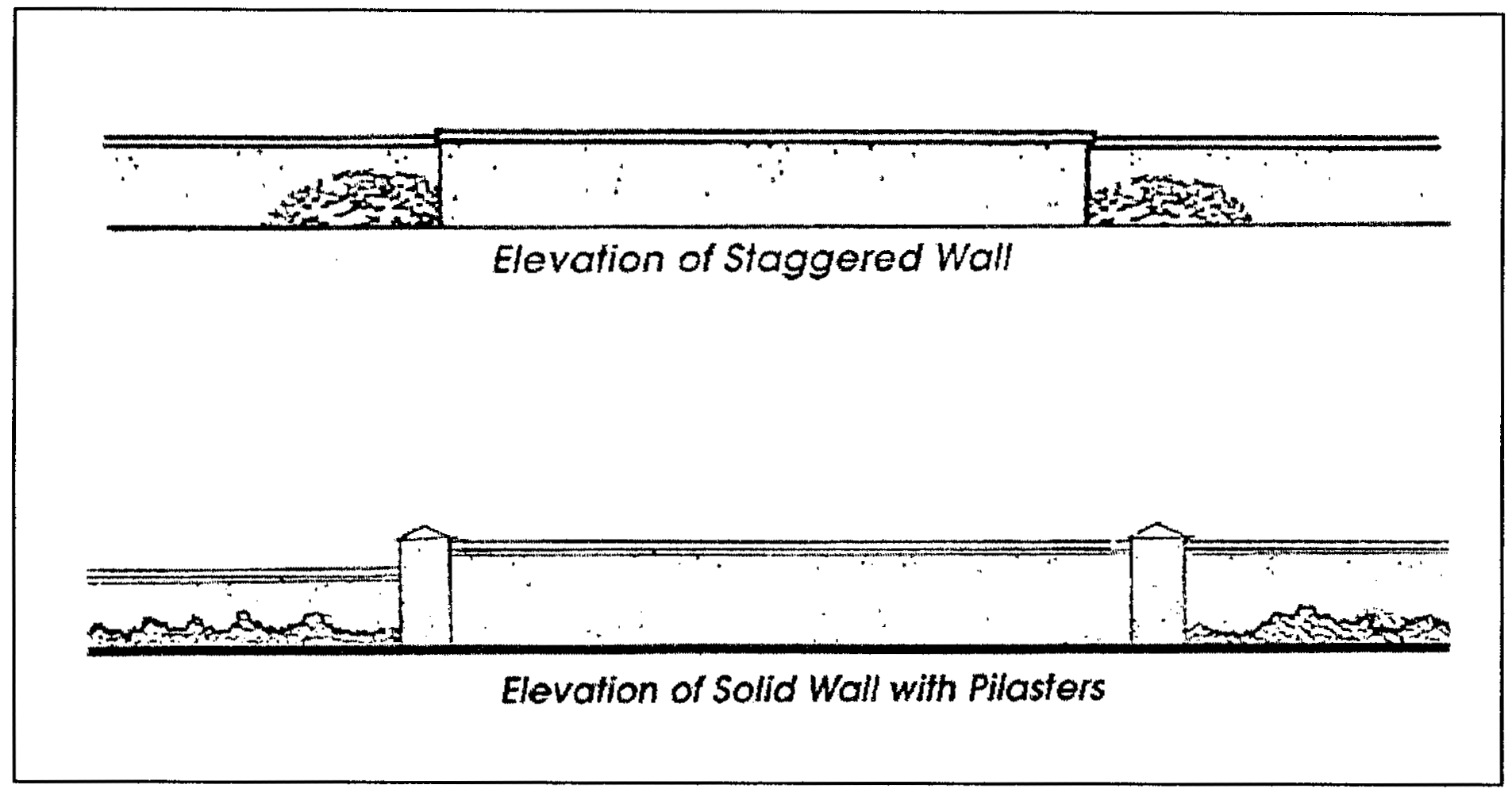
Figure 3-32 Example of Wall Articulation
4.
With taller walls over five feet in height, it may be more appropriate to have a stepped design which allows for the creation of a planter area between wall components. The use of trailing vines or groundcovers in these planters is encouraged.
5.
When security fencing is required, it should be a combination of solid columns, or short solid wall segments, and wrought iron grill work, rather than the entire fence being a single material.
H.
Screening. The nature of some industrial uses and their sites may inevitably result in unsightly features. In these cases, screening features must be carefully designed so that their appearance is not equally unattractive.
1.
Exterior storage and loading areas should be confined to portions of the site least visible to public view where screening needs are minimized.
2.
Where screening is required, a combination of elements should be used including solid masonry walls, berms, and landscaping. Chain link fencing with wood or metal slatting is an acceptable screening material only for areas not visible from a public street or parking lot.
3.
Where permanent screening is required between a manufacturing zone and a residential zone, a decorative, solid masonry screening wall is required. Evergreen landscaping should be placed adjacent to the wall.
4.
Screening that includes a fence or wall shall also comply with Section 106.30.050 (Fences and Walls).
I.
Roofs. Roof design contributes strongly to the image of a structure as having quality and permanence.
1.
Unless roofing materials are a part of the design element (for example, tiles, concrete or metal roofing elements), the ridge line elevation should not exceed the parapet elevation.
2.
Piecemeal mansard roofs (used on a portion of the building perimeter only) should be avoided. Mansard roofs should wrap around the entire perimeter of the structure.
3.
Rooftop equipment must be screened.
J.
Metal buildings. All metal buildings should be designed to have architectural interest and articulation as is encouraged with conventionally built structures.
1.
In addition to architectural metal panels, exterior surfaces should include either stucco, plaster, glass, stone, brick, or decorative masonry. Stock, "off-the-shelf" metal buildings are highly discouraged as main structures.
2.
Metal buildings should employ a variety of building forms, shapes, colors, materials and other architectural treatments to add visual interest and variety to the building. Architectural treatments should emphasize the primary entrance to the building.
3.
All exterior surfaces of metal buildings that have a risk of being struck and damaged by vehicles or machinery should be protected with landscaped areas, raised concrete curbs, and/or traffic barriers.
K.
Signs. Every structure should be designed with a specific concept for adequate signing. Provisions for sign placement, sign scale in relation to building scale, and the readability of the sign should be considered in developing the overall project's signing concept.
1.
The design of each sign should be compatible with the design of the structure and site design relative to color, material, and placement.
2.
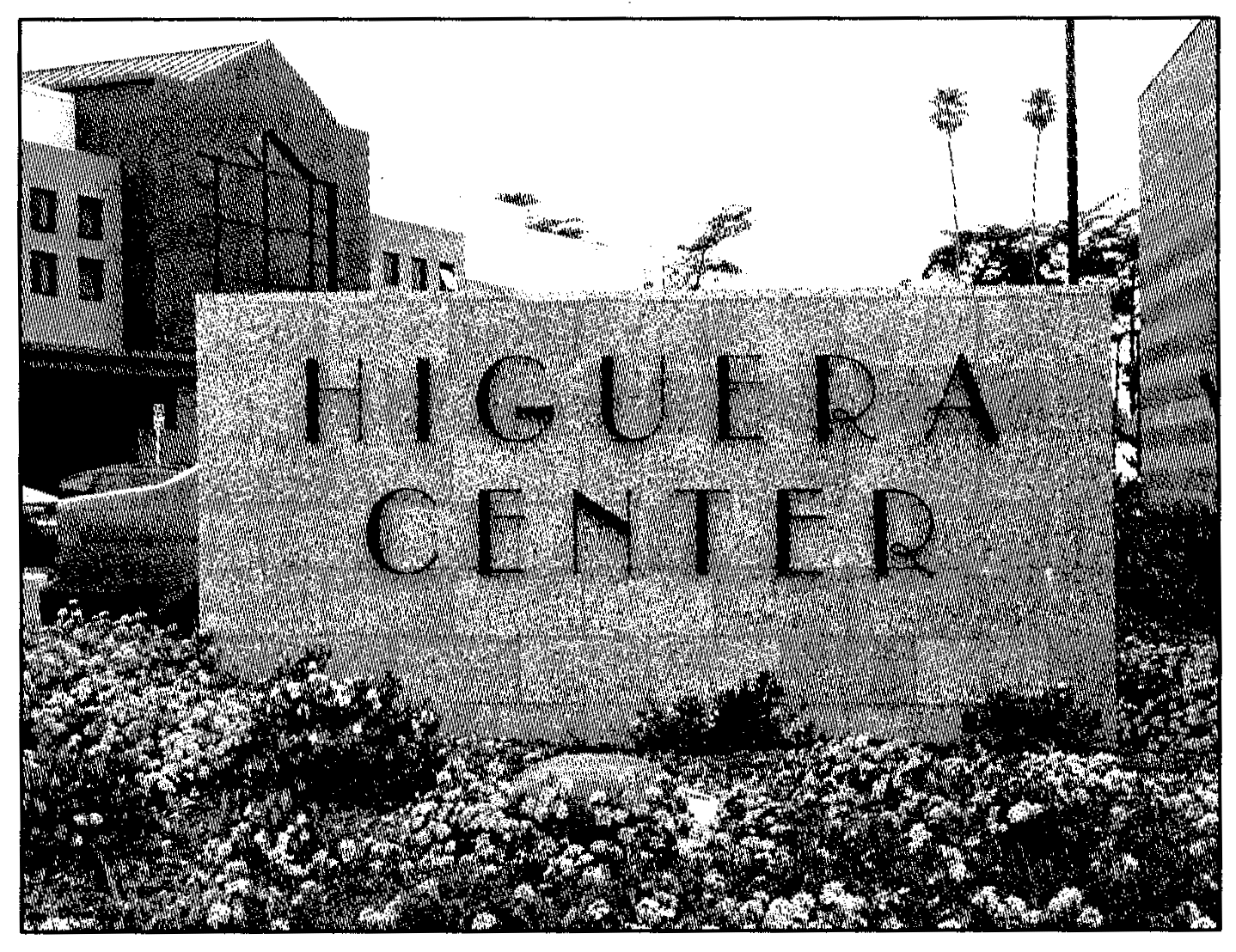
Monument signs are preferred for business identification. Where several tenants occupy the same site, individual wall mounted signs are appropriate in combination with a monument sign identifying the business park complex and address. See Figure 3-33.
3.
The use of carved wood, or backlit individually cut letter signs is encouraged.
4.
The industrial site should be appropriately signed to give directions to loading and receiving areas, visitor parking and other special areas.
(Ord. No. 2008-15, § 1, 12-11-2008; Ord. No. 2015-010, § 1, 12-10-2015)

