
Citrus Heights City Zoning Code
CHAPTER 106
36 - PARKING AND LOADING
Sec. 106.36.010.- Purpose
The requirements of this Chapter are intended to ensure that sufficient but not excessive off-street parking facilities are provided for all uses, and that parking facilities are properly designed, attractive, and located to be unobtrusive while meeting the needs of the specific use. The City discourages providing parking in excess of that required by this Chapter.
Sec. 106.36.020. - Applicability
Each land use and structure shall provide off-street parking and loading areas in compliance with this Chapter. This Chapter shall also apply to changes to, or expansion of a land use or structure. A land use shall not be commenced and a structure shall not be occupied until the improvements required by this Chapter are completed and approved by the Director.
Sec. 106.36.030. - General Parking Regulations
A.
Timing of installation. A new or altered structure shall not be occupied, and a new land use not requiring a structure shall not be established, until all off-street parking and loading facilities required by this Chapter are in place and approved by the City.
B.
Permanent facilities required. Each required parking and loading space shall be permanently available, marked, and maintained for parking or loading purposes for the use it is intended to serve. The approval of a Temporary Use Permit (Section 106.62.030) may allow the temporary use of a parking or loading space for other purposes.
C.
Unrestricted facilities required. An owner, lessee, tenant, or other person who controls the operation of a site with required parking or loading spaces shall not prevent, prohibit, or restrict authorized persons from using the spaces without the prior approval of the Director.
D.
Truck or trailer parking. The parking of a motor vehicle used for commercial or industrial purposes and rated more than one ton capacity and trailers used for commercial or industrial purposes shall not be parked or stored in any residential zone except when loading, unloading, or rendering service.
E.
State-mandated exemptions. Per Government Code 65863.2, parking is not required for any residential, commercial, or other development project within ½ mile of public transit (see Section 106.80.020 for definition of "public transit"). These rules do not apply to requirements for ADA parking spaces, EV charging spaces, or existing grandfathered contracts with the city to provide public parking.
F.
Residential parking and storage. No front or street side setback shall be used for the accumulation, placement or storage of automobiles, other motor vehicles, recreational vehicles, trailers, building materials, scrap, junk or machinery except as allowed in section 106.30.100 (D)2).
(Ord. No. 2008-15, § 1, 12-11-2008; Ord. No. 2022-001, § 3(Exh. A), 3-10-2022; Ord. No. 2023-003, § 4(Exh. A), 5-11-2023; Ord. No. 2024-006, § 1(Exh. A), 9-25-2024)
Sec. 106.36.040. - Number of Parking Spaces Required
Each land use shall be provided the number of off-street parking spaces required by this Section. See Section 106.36.060 for off-street parking requirements for bicycles and motorcycles.
A.
Parking requirements by land use.
1.
Minimum number required. Each land use shall provide the number of off-street parking spaces required by Table 3-7, except where a greater number of spaces are required through Minor Use Permit or Use Permit approval. Regardless of the requirements of Table 3-7, each nonresidential land use shall provide a minimum of five off-street spaces, except where the review authority determines that the number of spaces required by Table 3-7 is sufficient.
2.
Use not listed. A land use not specifically listed by Table 3-7 shall provide parking as required by the Director. The Director shall use the requirements in Table 3-7 as a guide in determining the number of off-street parking spaces required.
3.
Measurement of floor area. In any case where Table 3-7 establishes a parking requirement based on floor area in square feet (for example: 1 space per 1,000 sf of floor area), the floor area shall be construed to mean gross interior floor area.
4.
Use with accessory components. The review authority may require a single use with accessory components to provide parking for each component, where the review authority determines that separate vehicle trips will likely be generated by each component. For example, a hotel with a meeting room may be required to provide the parking spaces required by Table 3-7 for a hotel (i.e., the guest rooms), and for a meeting room.
5.
Bench or bleacher seating. Where fixed seating is provided as benches, bleachers, pews, or similar seating, a seat shall be defined as 24 inches of bench space for the purpose of calculating the number of required parking spaces as provided in Table 3-7.
B.
Expansion of structure, change in use. When a structure is enlarged, or when a change in its use requires more off-street parking than the previous use, additional parking spaces shall be provided in compliance with this Chapter except where the number of additional spaces required is 10 percent or less of the number of existing spaces. See also Subsection E. (Nonconforming parking).
C.
Multi-tenant sites. A site with multiple tenants shall provide the aggregate number of parking spaces required for each separate use; except where the site is developed as an integrated center with shared parking and no spaces reserved for a particular use, parking shall be provided as required by Table 3-7 for a retail complex. When a multi-tenant center includes one or more uses that will need more parking than retail uses (for example, a fitness center, restaurant, or theater) additional parking shall be required for the high parking demand use unless a parking reduction is approved in compliance with 106.36.070 (Reduction of Parking Requirements).
D.
Excessive parking. The City discourages providing more off-street parking than required by this Chapter, to avoid the inefficient use of land, unnecessary pavement, and excessive storm water runoff from paved surfaces. An off-street parking lot that exceeds the amount required by Table 3-7 by 20 percent or more shall require Minor Use Permit approval, a determination by the review authority that information provided by the applicant documents a year round need for the additional parking, and the provision of additional landscaping and pedestrian amenities to the satisfaction of the review authority.
E.
Nonconforming parking. A structure with nonconforming off-street parking may be physically changed or undergo a change in use subject to the following provisions:
1.
Residential uses. No additional parking spaces shall be required, provided the change does not increase the number of dwelling units, nor eliminate the only portion of the site that can be used for the required or existing parking or access.
2.
Nonresidential uses. The number of existing parking spaces shall be maintained on the site and additional parking shall be provided in compliance with this Chapter for any additional floor area. If the use of the structure is changed to one that requires more parking than the previous use, the difference between the parking spaces required for the previous use and the new use shall be provided.
TABLE 3-7 PARKING REQUIREMENTS BY LAND USE
(Ord. No. 2008-15, § 1, 12-11-2008; Ord. No. 2013-011, § 3, 11-14-2013; Ord. No. 2017-002, § 3(Exh. A-1), 7-13-2017)
Sec. 106.36.050. - Disabled/Handicapped Parking Requirements
Parking spaces for the disabled shall be provided in compliance with the Uniform Building Code (UBC), the Federal Accessibility Guidelines, and/or California Code of Regulations Title 24, as applicable. These spaces shall count toward fulfilling the off-street parking requirements of this Chapter. See also Section 106.36.070.I (Parking lot re-striping to accommodate disabled parking).
Sec. 106.36.060. - Bicycle and Motorcycle Parking
A.
Bicycle Parking. Each multi-unit project and nonresidential land use shall provide bicycle parking in compliance with this Section. Each required bicycle parking space shall remain available for use by cyclists at all times.
1.
Number of bicycle spaces required. Multi-unit, retail commercial, and office uses shall provide bicycle parking spaces equal to a minimum of one bicycle space for every 20 motor vehicle spaces, up to 100 spaces. For each additional 100 spaces, one bicycle space shall be required.
2.
Bicycle parking space location. Bicycle spaces shall be conveniently located near the primary entrance of each structure they are intended to serve.
3.
Bicycle parking design and devices. Each bicycle parking space shall include a stationary parking device to adequately secure the bicycle, shall be a minimum of two feet in width and six feet in length, installed and maintained in compliance with City standards. Overhead clearance shall be a minimum of seven feet.
B.
Motorcycle parking. A parking lot with 50 or more motor vehicle parking spaces shall provide motorcycle parking spaces conveniently located near the primary entrance of a structure, accessed by the same aisles that provide access to the motor vehicle parking spaces in the parking lot.
1.
Number of spaces required. A minimum of one motorcycle parking space shall be provided for each 50 motor vehicle spaces or fraction thereof. Required motorcycle spaces may be substituted for up to 10 percent of required vehicle spaces.
2.
Space dimensions. A motorcycle parking space shall have minimum dimensions of four feet by seven feet.
Sec. 106.36.070. - Reduction of Parking Requirements
A.
Shared on-site parking. Where two or more adjacent nonresidential uses have distinct and differing peak parking usage periods, (e.g., a theater and a bank), a reduction in the required number of parking spaces may be allowed through Minor Use Permit approval. Approval shall also require a recorded covenant running with the land, recorded by the owner of the parking facility, guaranteeing that the required parking will be maintained exclusively for the use or activity served, for a time period determined by the Minor Use Permit.
B.
Reduction of parking for a use with low parking demand. The review authority for the overall project may reduce the number of parking spaces required by Section 106.36.040 (Number of Parking Spaces Required) for the re-use of an existing building by up to 15 percent, based on quantitative information provided by the applicant that documents the need for fewer spaces (e.g., sales receipts, documentation of customer frequency, information on parking standards required for the proposed land use by other cities, etc.).
C.
Reduced parking for restricted senior housing projects.
1.
Extent of reduction. The review authority may reduce the number of parking spaces required by Section 106.36.040 (Number of Parking Spaces Required) for senior housing projects, for persons aged 55 and over, based on quantitative information provided by the applicant that documents the need for fewer spaces for these types of residential development projects.
2.
Change of use, removal of senior restriction.
a.
Notification to the City. The owner/operator of a senior housing project that was granted reduced parking on the basis of senior occupancy shall immediately notify the Director of any change of site occupancy or operations that allows other than seniors to reside on the site.
b.
Effect of removal of senior restriction. Upon notification that a restriction to occupancy by seniors has been removed, the Director shall determine a reasonable time in which one of the following shall occur:
(1)
Substitute parking is provided that is acceptable to the Director; or
(2)
The size or capacity of the use is reduced in proportion to the parking spaces lost.
D.
Reduced parking for mixed use projects. The residential component of a horizontal mixed use project shall provide the parking required by Table 3-7 for multi-unit dwellings, minus the guest spaces required by Table 3-7. A vertical mixed use project shall require the same number of spaces as a horizontal mixed use project, reduced by 30 percent.
E.
Parking reduction based on alternative facilities or programs. A proponent of an office, commercial or industrial project may provide alternative facilities or programs which serve to reduce parking demand in return for a reduction in vehicle parking requirements. Vehicle parking requirements may be reduced in accordance with the following provisions by the Director:
1.
Shower/locker facilities. A project with 100 or more employees may reduce its parking requirement by providing shower and clothing locker facilities for bicycle commuting employees. Maximum reduction: two percent of required parking.
2.
Secure bicycle parking. Developments which provide secure bicycle parking facilities may reduce their parking requirement by one vehicle space for every three additional bicycle spaces provided. Maximum reduction: two percent of required parking.
3.
Preferred carpool/vanpool parking spaces. Office or industrial developments which guarantee preferred parking spaces (e.g., covered, shaded, or near building entrance) to employees who participate regularly in a carpool or vanpool may reduce their parking requirement by one vehicle space for every one space which is marked and reserved for carpools/vanpools at a preferred location. Maximum reduction: two percent of required parking.
4.
Transit access. Developments which are located within 500 feet of an operational transit stop may reduce their parking requirement by one vehicle space for every 30 spaces provided. Maximum reduction: five percent of required parking.
F.
Parking Variances. Parking reductions exceeding the maximums in this Section, or modifications of improvement requirements, may be authorized by Variance in compliance with Subsection 106.62.060.F.2 (Findings for off-street parking Variance).
G.
Off-site parking. With Minor Use Permit approval, required parking may be located in a common or shared parking facility up to 300 feet away from the site of the proposed use in compliance with the following requirements.
1.
Evaluation of proposal. In considering a request for shared off-site parking, the review authority shall consider how the distance between the parking area and the proposed use may affect whether the off-site facility will satisfy the parking needs of the proposed use.
2.
Guarantee of continued availability. Required parking spaces that are approved off-site shall be committed by a recordable covenant, lease, or other agreement, acceptable to the City Attorney. The parties to the covenant, lease, or agreement shall include the owners, and if applicable, the lessees of the off-site parking spaces and the owners, and if applicable, the lessees of the subject site, with covenants reflecting the conditions of approval and the approved off-site parking plan.
3.
Loss of off-site spaces.
a.
Notification to the City. The owner/operator of a business that uses approved off-site spaces to satisfy its parking requirements shall immediately notify the Director of a change of ownership or use of the property for which the spaces are required, and of termination or default of the agreement between the parties.
b.
Effect of termination of agreement. Upon notification that a lease for required off-site parking has terminated, the Director shall determine a reasonable time in which one of the following shall occur:
(1)
Substitute parking is provided that is acceptable to the Director; or
(2)
The size or capacity of the use is reduced in proportion to the parking spaces lost.
H.
Valet parking. The Commission may modify the parking configuration required by this Chapter (e.g., to allow tandem parking) in the case of a use proposed to have permanent valet parking.
I.
Parking lot re-striping to accommodate disabled parking. A site shall not be considered to have nonconforming parking if the number of off-street spaces provided is reduced to less than required by this Chapter solely because the lot is re-striped to comply with disabled parking requirements.
(Ord. No. 2008-15, § 1, 12-11-2008; Ord. No. 2020-007, § 1(Exh. A), 9-10-2020)
Sec. 106.36.080. - Parking Design and Development Standards
Required parking areas shall be designed and constructed in compliance with this Section.
A.
Location of parking. Off-street parking areas shall be located as follows:
1.
Required single-family residential parking. Residential parking shall be located on the same site as each residential unit served; except for a mixed use project developed in compliance with Section 106.42.130 (Mixed-use projects).
a.
Required parking may be located within the required front and interior side setback provided the required parking occurs on an approved driveway at least 20 feet in length and is perpendicular to the street. Alternate locations may be approved by the director provided the design of the driveway is aesthetically pleasing, compatible with the surroundings and will not create a pedestrian or vehicular hazard.
2.
Multi-unit residential. Required parking shall not occupy any required front setback, or a side or rear setback.
3.
Nonresidential parking. Nonresidential parking shall be located on the same site as the use served, or within 300 feet of the parcel when off-site parking is approved in compliance with Section 106.36.070.G (Off-site parking), with reasonable access to and from the use for which the spaces are required.
B.
Additional residential parking standards.
1.
Parking within a front setback shall be limited to the required driveway plus 12 feet abutting and parallel to the driveway. The additional 12 feet of width shall be located adjacent to the interior side property line of a corner lot. Alternate locations for the additional pavement may be approved by the director and city engineer. The total approved parking surface width in the front of the lot shall not exceed 50 percent of the lot frontage. The director and city engineer may grant an exception for exceeding the allowed limits for lots located on a collector or arterial street, where the owner proposes a circular driveway. This subsection does not apply to front setback areas that were paved to a greater extent than allowed by this section, prior to October 5, 2006.
2.
Temporary (overnight) parking is allowed within required setback areas only on an approved, paved driveway, in compliance with Section 106.36.090 (Parking Design and Development Standards). The following parking restrictions apply to all residential zones:
3.
Acceptable parking surfaces include concrete, asphalt, decomposed granite, inlaid brick or stone, or parking strips composed of the above mentioned materials. Other pervious material may be accepted per approval of director.
4.
Parking may not occur within any required clear vision triangle (Section 106.30.060, Figure 3-4) area on a corner lot.
5.
Recreational vehicle and trailer parking. The following standards apply to the parking and storage:
a.
All portions of the vehicle must be located entirely within the property boundaries, and do not extend into the public right-of-way.
b.
Storage of a recreational vehicle, trailer, boat, and/or other mobile equipment is not allowed within the front or street side yard setback unless located on required parking spaces or on an approved paved parking surfaces per Section 106.36.080(B)(3). When located within any side or rear yard, a recreational vehicle and/or boat must maintain a three-foot-wide continuous fire accessway from the front of the property. The use of any recreational vehicle for residential occupancy is prohibited except on property zoned for mobile home parks or camping.
C.
Access to parking. Access to parking shall be provided as follows for all parking areas other than for individual single dwellings, and duplexes. Site design shall minimize the amount of paved surfaces and driveway lengths and widths while providing for safe and suitable access for vehicular circulation.
1.
Direction of travel. Parking areas shall provide suitable maneuvering area so that vehicles exit to a street in a forward direction. Parking lots shall be designed to prevent access at any point other than at designated access drives. Single dwellings and duplexes are exempt from this requirement.
2.
Stacking area for non-residential parking. A commercial or industrial use shall have access driveways that are not intersected by a parking aisle, parking space, or another access driveway for a minimum distance of 20 feet from the street right-of-way, to provide a stacking area for vehicles entering and exiting the parking area. The City Engineer may require a greater distance for uses with high traffic volumes or located along heavily traveled arterials. See Figure 3-37.
3.
Clear height above parking. A minimum unobstructed clearance height of 14 feet shall be maintained above areas accessible to vehicles within nonresidential uses.
D.
Access to adjacent sites. The City may require the design of a parking area to provide vehicle and pedestrian connections to parking areas on adjacent properties or to connect with adjoining public walkways, to provide for convenience, safety, and efficient circulation. A joint access agreement running with the land shall be recorded by the owners of the abutting properties, as approved by the Director, to guarantee the continued availability of the shared access between the properties.
E.
Parking stall and aisle design.
1.
Minimum dimensions.
a.
Parking spaces. Each parking space, shall be a minimum of nine feet wide and 19 feet long. Compact car spaces with minimum dimensions of eight feet by 16 feet may be allowed within a parking lot interior, up to a maximum of 25 percent of the total number of spaces. Compact spaces shall be dispersed throughout the parking lot. Parallel parking spaces shall have minimum dimensions of nine feet wide and 24 feet long.
b.
Parking lot aisles. Each parking lot aisle shall comply with the minimum dimension requirements in Table 3-8.
TABLE 3-8 MINIMUM PARKING LOT AISLE DIMENSIONS
2.
General configuration. Tandem parking, or the parking of vehicles inline shall be prohibited in multi-unit residential and commercial zoning districts.
3.
Employee parking. Where Table 3-7 requires employee parking, the spaces shall be identified by the employer as "employee parking" and shall be located as far away as possible from the main entrance.
4.
90-degree single-loaded parking aisles. A parking lot aisle that provides access to parking spaces on one side only may be reduced to a width of 22 feet provided a landscaped planter at least five feet in width, or a two-foot planter with a walkway, is installed adjacent to the aisle.
5.
Dead-end aisles. Dead-end aisles are discouraged. When used, 90 degree angle stalls with adequate turning space are required, as approved by the Engineering Division.
F.
Landscaping. Landscaping shall be provided in compliance with Section 106.34.
G.
Lighting. See Chapter 106.35 (Outdoor Lighting).
H.
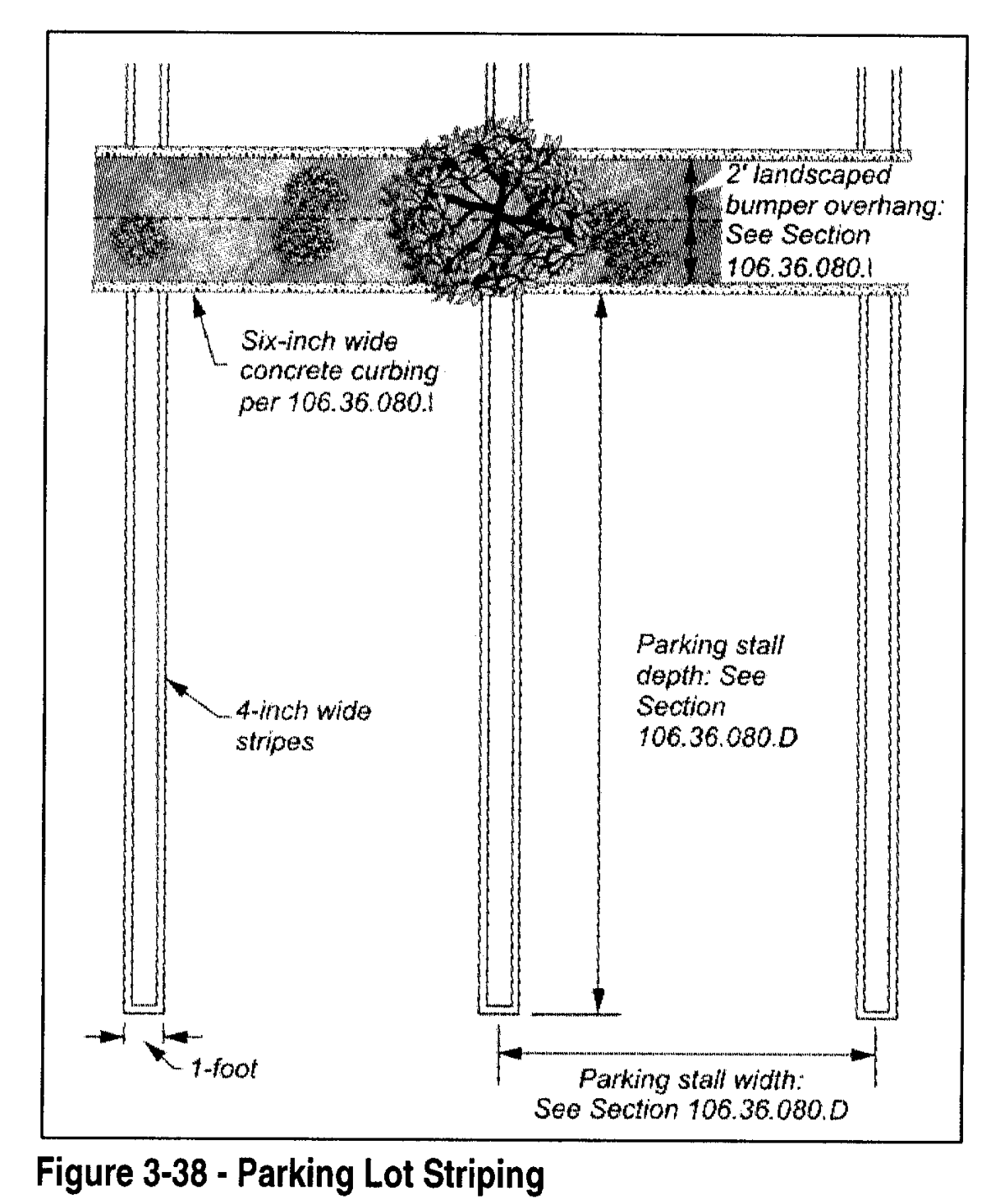
Striping and identification. Parking spaces shall be clearly outlined with double stripes painted on the parking surface (see Figure 3-38). Car pool spaces shall be clearly identified for car pool use only. The re-striping of a parking space or lot shall require the approval of a re-striping plan by the Director.
I.
Surfacing. Parking spaces and maneuvering areas shall be paved and permanently maintained with asphalt, concrete or other all-weather surfacing approved by the Director.
J.
Wheel stops/curbing. Continuous concrete curbing at least four inches high and six inches wide shall be provided for parking spaces located adjacent to fences, walls, property lines, landscaped areas (except stormwater swales), and structures, and walkways that are less than six feet in width.
In addition to curbing, wheel stops shall be employed for any parking stall adjacent to a walkway that is less than six feet in width and has parking adjacent to it on one side. If parking adjoins both sides of the walkway, wheel stops shall be provided if the width of the walkway is less than nine feet.
1.
Individual wheel stops may be provided in lieu of continuous curbing when parking is adjacent to a landscaped area to which drainage is directed.
2.
When provided, wheel stops shall be placed to allow for 30 inches of vehicle overhang area within the dimension of the parking space. Wheel stops shall be placed 30 inches from the curb.
3.
Parking spaces may be designed to allow vehicle overhang of a landscape area only where the width of the landscape area is increased two additional feet over the width required by Section 106.34.040.D (Parking areas). The same overhang allowance shall apply where parking spaces directly abut a pedestrian walkway. The overhang allowance shall not be considered as part of the design width of the walkway.
In parking areas adjacent to vegetated stormwater swales or infiltration basins, curb stops alone may be used or cuts may be provided in the concrete curbing to allow water to enter the stormwater treatment planting area.
K.
Drainage facilities. Drainage facilities shall be provided in all public parking areas adequate to handle the drainage requirements of the site, to alleviate the creation of flooding and drainage problems for the site or any surrounding property.
1.
New parking lots and significantly redeveloped sites with existing parking shall be required to install Best Management Practices (BMPs) for their storm water discharge.
2.
Post BMPs may include vegetated swales, rain gardens, storm water basins with a low flow channel to cleanse the runoff, an underground stormwater vault, or other low-impact design solutions approved by the City. Low-impact design solutions are preferred to underground vaults.
3.
Stormwater vaults and basins will require an access agreement for the City to conduct periodic inspections of the post BMP system.
(Ord. No. 2015-010, § 1, 12-10-2015; Ord. No. 2017-002, § 3(Exh. A-1), 7-13-2017; Ord. No. 2022-001, § 3(Exh. A), 3-10-2022; Ord. No. 2024-006, § 1(Exh. A), 9-25-2024)
Sec. 106.36.090. - Loading Space Requirements
All retail and wholesale stores, warehouses, supply houses, buildings devoted to manufacturing, hotels, hospitals or other buildings where large amounts of goods are received or shipped shall provide adequate space to handle the volume and frequency of truck traffic to the building or shopping center, as required by the review authority.
A.
Number of spaces required. The minimum number of spaces shall be determined in compliance with the estimated volume of truck traffic and loading requirements as approved by the Director.
B.
Space design. Each required loading space shall be not less than 10 feet wide, 35 feet long and 14 feet high, exclusive of driveways. Loading docks shall not face the public right-of-way unless adequate screening is provided as required by the review authority.

