
Coachella City Zoning Code
CHAPTER 17
16 - U-E URBAN EMPLOYMENT ZONE2
Editor's note— Ord. No. 1204, § 3(Exh. A.1), adopted July 26, 2023, repealed the former Ch. 17.16, §§ 17.16.010—17.16.030, and enacted a new Ch. 17.16 as set out herein. The former Ch. 17.16 pertained to R-S Residential Single-Family Zone and derived from Prior code §§ 030.01—030.03; Ord. 909, adopted 2004; Ord. No. 1021, § 2, adopted July 28, 2010; Ord. No. 1026, § 6, adopted Jan. 12, 2011; Ord. No. 1075, §§ 3, 4, adopted June 10, 2015.
17.16.010 - Intent and purpose.
This zone is intended to provide for the establishment of a range of employment uses such as office and research and development in a mixed, campus setting. The employment uses are supported by retail, service, and similar uses. Residential uses are allowed in residential-only buildings or in a mixed-use configuration with ground-floor retail. Also allowed are higher education uses (such as a college or university) designed in an urban setting. This zone implements the Urban Employment Center land use designation in the General Plan.
(Ord. No. 1204, § 3(Exh. A.1), 7-26-23)
17.16.020 - Permitted uses.
The following uses are permitted in the U-E (Urban Employment) zone, subject to all provisions of this chapter:
A.
Primary Uses.
1.
Office uses of all types, including, but not limited to the following:
a.
Medical and dental offices.
b.
Administrative, business, executive and editorial.
c.
Professional offices.
d.
Financial, insurance, real estate offices, including banks and related institutions.
e.
General offices.
2.
Research and development.
3.
Neighborhood retail uses per Chapter 17.24 (C-N Neighborhood Commercial zone).
4.
Restaurants per Chapter 17.24 (C-N Neighborhood Commercial zone).
5.
Artisan manufacturing/flex space.
6.
Multi-family dwellings (five plus units), except that no new residential uses are permitted in the area bounded by Avenue 53, Tyler Street, Avenue 54, and Shady Lane.
7.
Public utility facilities (city-initiated).
8.
Child nurseries, day care centers.
9.
For sites identified to accommodate the lower-income regional housing need allocation, multi-family uses shall be a use by right and permitted without discretionary action for developments in which at least twenty (20) percent of the units are affordable to lower income households and shall meet all requirements pursuant to Government Code Section 65583.2, subdivisions (h) and (i), including but not limited to requiring minimum densities of twenty (20) units per acre, allowing one hundred (100) percent residential use and require that residential use occupy fifty (50) percent of the total floor area of a mixed-use project. For more information on eligible sites, please see the sites inventory listing at https://www.coachella.org/departments/community-development.
B.
Accessory Uses. The following buildings, structures, and uses are permitted when clearly incidental and accessory to the primary permitted use.
1.
Accessory structures, non-habitable, including arcades (shade structures), parking garages, garden greenhouses, community gardens, recreation rooms or pool bathhouses and swimming pools.
2.
Accessory dwelling units and junior accessory dwelling units, per Section 17.60.010.H. (Accessory dwelling units), except that no new residential uses are permitted in the area bounded by Avenue 53, Tyler Street, Avenue 54, and Shady Lane.
3.
Permitted Signs. Per Chapter 17.56 (Signs).
C.
Conditional Uses. The following uses are permitted in the U-E (Urban Employment) zone subject to obtaining a conditional use permit in accordance with the provisions of Section 17.74.010:
1.
Bars and cocktail lounges
2.
College/university.
3.
Community gardens.
4.
Hotels/motels.
5.
Light industrial uses as permitted in the M-S (Manufacturing Service) zone, and as stand-alone uses operating indoors. Such uses in existence and permitted at the time of adoption of this code amendment shall be allowed to continue as a permitted use without obtaining a conditional use permit.
6.
Microbrewery and taprooms.
7.
Towing and Impound Uses. Such uses as standalone uses shall not exceed one percent of the U-E zone.
D.
Consistency with the Jacqueline Cochran Regional Airport Land Use Compatibility Plan.
1.
If a project is located in the Jacqueline Cochran Airport Compatibility zones, densities, intensities, and prohibited uses shall be consistent with criteria in the airport land use compatibility plan for the Jacqueline Cochran Regional Airport, including applicable countywide criteria as may exist at the time of project review.
(Ord. No. 1204, § 3(Exh. A.1), 7-26-23; Ord. No. 1220, § 2(Exh. A), 2-26-25; Ord. No. 1225, § 1, 9-10-25)
17.16.030 - Property development standards.
The following standards of development shall apply in the U-E (Urban Employment) zone:
A.
Residential Density and Non-Residential Intensity.
1.
Minimum Density. Thirty (30) dwelling units/acre.
2.
Maximum Density. Sixty-five (65) dwelling units/acre.
3.
Maximum non-residential FAR. 2.0.
B.
Lot Area Requirements.
1.
Developments with stand-alone commercial or light industrial uses or mixed uses shall have a minimum site area of twenty thousand (20,000) square feet.
2.
Stand-alone multiple-family residential developments shall have a minimum site area of ten thousand (10,000) square feet.
C.
Yard Requirements.
1.
Front Yard. Where one or both adjoining zones are residential, a yard shall be provided which is equal in depth to the average of the required front yards of the adjoining zones.
2.
Side Yard. Where a parcel in the U-E (Urban Employment) zone adjoins a street or residential zone, there shall be a side yard of not less than ten (10) feet on the side or sides adjoining said street or residential zone. In the case of a reversed corner lot, the side yard adjoining the street shall be not less than the required front yard of the adjoining key lot to the rear.
3.
Rear Yard. Where a parcel in the U-E (Urban Employment) zone adjoins a residential zone, there shall be a rear yard of not less than ten (10) feet adjoining that residential zone. This shall not apply where there exists a public alley separating the two zones.
4.
Permitted Encroachments in Required Yards. The yards required in subsections 1—3 of this section may be used as part of an automobile parking area, provided however that a minimum three-foot wide screen planting strip shall be maintained adjacent to the street right-of-way lines.
D.
Height Limits.
1.
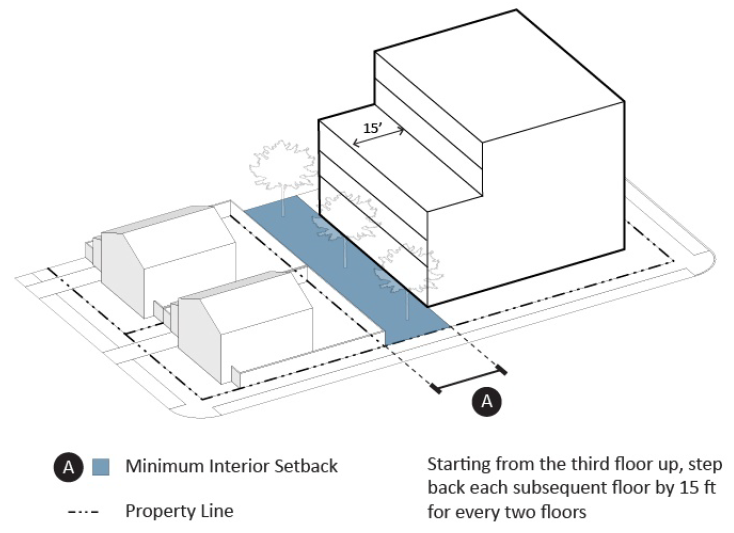
The maximum height of all buildings shall be five stories, or seventy-five (75) feet, whichever is less, except that for properties adjacent to a single-family zone, starting from the third floor up, each subsequent floor shall be stepped back by fifteen (15) feet for every two floors. See diagram below:
2.
The maximum height of all accessory structures shall be one story, or fifteen (15) feet, whichever is less. Accessory structures exceeding fifteen (15) feet may be approved up to thirty-five (35) feet subject to Architectural Review by the Planning Commission.
3.
The maximum height of accessory dwelling units shall be per Section 17.60.010.H. (Accessory Dwelling Units)
E.
Distance Between Buildings.
1.
Between two main buildings: Twenty (20) feet.
2.
Between a main building and an accessory structure, or between two accessory structures: Fifteen (15) feet.
F.
Usable Open Space.
1.
Greater than twenty-five thousand (25,000) square feet non-residential portion of developments shall provide three percent of the gross building area as usable open space. Common open space may be utilized for employees or publicly accessible open space. If the open space is over one thousand (1,000) square feet and provided as publicly accessible, up to fifty (50) percent may count toward the required residential common open space (if in a mixed-use project).
2.
Multifamily developments shall provide a minimum of one hundred fifty (150) square feet total per unit, minimum one hundred twenty (120) square feet of private open space required for ground-level units and sixty (60) square feet of private open space for upper-level units. The remaining area shall be provided as common open space. Portions of spaces required under the yard and distance between buildings provisions of this section may be included in the calculation of usable open space, provided they are integrated with and clearly usable as part of a larger area.
3.
Usable Open Space Standards:
a.
Usable open space may be provided as private outdoor living areas, balconies, decks, or as common recreational-leisure areas. Except in the case of balconies, such areas shall be landscaped.
b.
Usable open space, when provided as common recreational leisure area, may extend into the required front yard to within five feet of the front lot line, subject to the following provisions:
i.
No more than forty (40) percent of the required front yard may be so used.
ii.
No permanent structures, except swimming pools and those structures required by law, shall be permitted in the required front yard.
iii.
Such areas shall be screened from the street and adjacent properties by landscaping and/or decorative fencing of a maximum height of forty-two (42) inches, except where a greater height is required by law.
iv.
The remaining portion of the required front yard, except for access drives and walks, shall be landscaped and maintained.
G.
Off-Street Parking. Off-street parking shall be provided for each dwelling unit or commercial use subject to the requirements of Section 17.54.010 of this title.
H.
All new multi-family residential development shall be designed pursuant to the City of Coachella Multi-Family Objective Design Standards.
I.
Architectural Review. All development in the U-E (Urban Employment) zone is subject to architectural review as set forth in Section 17.72.010 of this title.
J.
Consistency with the Jacqueline Cochran Regional Airport Land Use Compatibility Plan.
1.
If a project is located in the Jacqueline Cochran Airport Compatibility zones, densities, intensities, and prohibited uses shall be consistent with criteria in the airport land use compatibility plan for the Jacqueline Cochran Regional Airport, including applicable Countywide criteria as may exist at the time of project review.
K.
Other Property Development Standards.
1.
All uses shall be conducted entirely within a completely enclosed building, except for off-street parking and loading facilities, and certain uses permitted subject to a conditional use permit.
(Ord. No. 1204, § 3(Exh. A.1), 7-26-23)

