
Coachella City Zoning Code
CHAPTER 17
20 - OBJECTIVE DESIGN STANDARDS FOR MULTI-FAMILY RESIDENTIAL
17.20.010 - Multi-family site design standards.
A.
Applicability. The development and design standards provided in this subsection shall apply to G-N General Neighborhood, U-N Urban Neighborhood, and applies to multi-family residential buildings in the DT-PV Downtown Pueblo Viejo zone, DT-PV Transition zone, and the U-E Urban Employment, and Neighborhood Commercial Zone District. The following development and design standards shall be used in determining a project's consistency with the purpose of this Code of Ordinances and with the policies of the General Plan related to site design. The standards shall apply to all new multi-family residential building construction. Review of projects under this subsection is ministerial and shall be consistent with Chapter 17.72, Architectural Review procedures and requirements.
B.
Public Realm Standards. The public realm standards apply to street rights-of-way and any necessary easement. The public realm standards define the function and character of the perimeter rights-of-way that provide pedestrian circulation, access, amenities and a buffer transition between roadways and multi-family buildings.
1.
Street Types. The street type standards address the full range of roadway conditions where adjacent multi-family uses may occur citywide. The intent of the standards is to establish the minimum requirements for pedestrian and resident comfort, safety, and access while ensuring that all multi-family or mixed-use development is economically viable. The standards consider the relationship between motor vehicle traffic volume, speed, and traffic lane geometry and provide the appropriate minimum width of the public realm that is necessary to create a livable and vibrant environment. The standards provide three options with different public realm geometry between the curb and building façades in response to different Coachella existing or planned roadway conditions.
a.
Street Type A. These streets generally are narrower and have lower traffic volumes, less than fifteen thousand (15,000) Average Daily Trips (ADT). Multi-family buildings on sites that front Urban Residential with Parking, Urban Street 2-Lane, and Urban Street 4-Lane typologies as designated in the Coachella General Plan Chapter 05 Mobility Element shall comply with these standards.
b.
Street Type B. These streets generally are wider and have higher traffic volumes greater than fifteen thousand (15,000) ADT. Multi-family buildings on sites that front Major Arterial, Primary Arterial, or Collector Street typologies as designated in the Coachella General Plan Chapter 05 Mobility Element shall comply with these standards.
c.
Street Type C. These private street standards apply to sites that include internal site multi-modal access streets that have very low volumes less than five thousand (5,000) ADT. Multi-family sites that include private roadways shall comply with these standards.
2.
Public Realm Summary Table. The summary Table 1 provides an at-a-glance summary of all street types and standards that apply. Complete description of the standards intent, setback, and zones for each are provided on the following pages.
3.
Street Type A Standards.
a.
Public Realm Setback. All new multi-family development on sites that front Urban Residential with Parking, Urban Street Two-Lane, and Urban Street Four-Lane shall comply with a fifteen-foot minimum first floor setback measured from the back-of-curb to the public realm-line on public streets. No first-floor building façade shall be located beyond the public realm-line as specified in Figure 17.20.010.1.
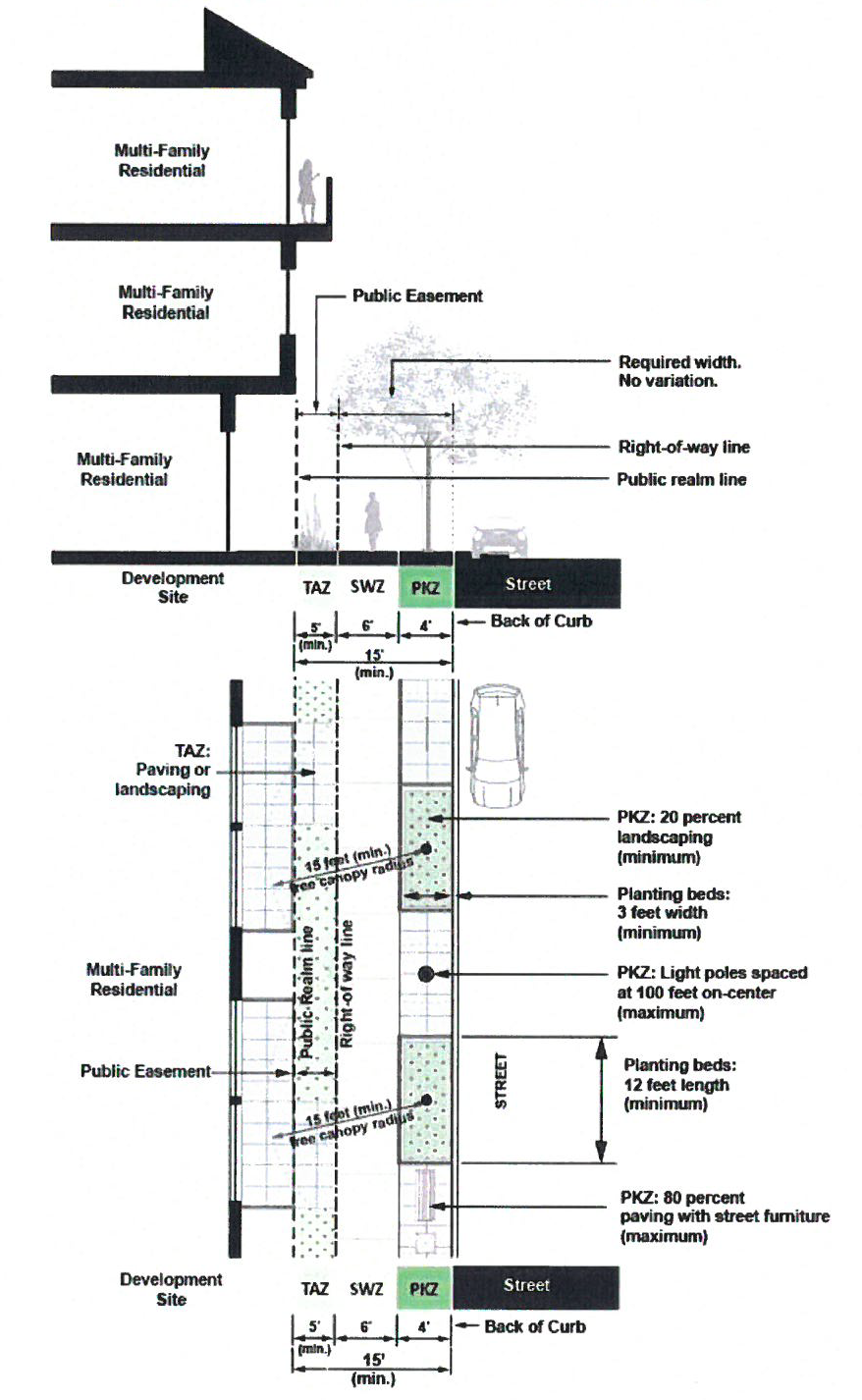
FIGURE 17.20.010.1
STREET TYPE A PUBLIC REALM STANDARDS
i.
Public easement—A 5-foot public realm easement shall be provided.
ii.
Structural exemptions—One-foot wide (maximum) building at-grade projections, columns, posts, or pilasters are permitted in the Transition Area Zone (TAZ) required public realm easement. A minimum of four-foot width between the building structure and the Sidewalk Zone (SWZ) shall be provided.
iii.
Weather protection— awnings and canopies that extend a maximum of five feet over the public realm are permitted. A minimum vertical clearance of eight feet measured from the public realm finished grade to the bottom of the awning or canopy structural components shall be provided.
4.
Street Type A Public Realm Zones. The intent of the multi-family public realm standards is to foster a safe, direct, and comfortable pedestrian access to first floor residential entries, internal driveways, common spaces, and paseos and encourage first floor street-oriented residential activity and visibility. Three distinct and contiguous sidewalk zones comprise the public realm.
a.
Parkway Zone (PKZ). There shall be a required four-foot PKZ width measured from the back-of-curb to the Sidewalk Zone (SWZ).
i.
Landscaping—All PKZ shall be landscaped a minimum of twenty (20) percent of the total multi-family development site frontage(s). All landscaping shall be selected, installed, irrigated, and maintained per 8.44.220 California Model Water Efficient Landscape Ordinance (MWELO) requirements and according to City approved landscape plans. Turf grass shall be prohibited. A combination of decomposed granite mulching and drought tolerant native and desert-adaptable shrubs, succulents, groundcover, and ornamental trees shall be permitted. Street trees shall be spaced a maximum of twenty-five (25) feet on-center and have a minimum canopy radius of fifteen (15) feet and shall cover a minimum of twenty (20) percent of paved areas at maturity. Landscape beds and tree wells shall have a minimum dimension of four feet in width and twelve (12) feet in length. Live plant materials shall constitute a minimum of twenty-five (25) percent of all surface area coverage at installation. A permanent underground irrigation system shall be installed. Spray irrigation shall be prohibited.
ii.
Street furniture—Benches, transit shelters, tables, chairs, trash receptacles, public art, bike racks are not required but shall be permitted.
iii.
Illumination—Sidewalk light poles and fixtures are not required but shall be permitted.
iv.
Paving—Poured in place concrete, stone, concrete or brick unit pavers are permitted. A maximum of eighty (80) percent paving of the PKZ shall be permitted. Cast iron tree grates shall be permitted and shall be included in any paving calculation.
v.
Utilities—Transmission line poles, sidewalk and roadway light poles and fixtures, utility boxes and vaults, and traffic control devices, are permitted in the parkway zone. All applicable utility standards of Coachella Code Chapter 16.32, Design and Development Standards, shall apply.
vi.
Signs—Temporary or permanent roadway or wayfinding signs shall be permitted. Advertising or development identification signs shall be prohibited. All signs shall comply with Coachella Chapter 5.48, Outdoor Advertising Sign Standards, and all applicable traffic federal and local sign standards, as specified in Figure 17.20.XXX.1 [sic].
b.
Sidewalk Zone (SWZ). There shall be a required six-foot SWZ width measured between the Parkway Zone to the Transition Area Zone.
i.
Accessibility—The required SWZ width shall remain clear of all obstructions to maintain universal access. Steps and rough textured surface treatments are prohibited within the SWZ.
ii.
Street furniture—Permanent or temporary street furniture shall be prohibited.
iii.
Paving—The SWZ shall consist of poured in place scored concrete or concrete, brick, or stone unit pavers. Stamped concrete is prohibited.
iv.
Landscaping—Plant material in beds or pots shall be prohibited. Any landscape material planted in the TAZ or PKZ shall not project into the SWZ at a height less than eight feet above finished SWZ grade.
v.
Signs—Temporary or permanent signs shall be prohibited.
vi.
Walls and fences—Temporary or permanent fences or enclosures shall be prohibited.
vii.
Illumination—Sidewalk-oriented light poles and fixtures shall be prohibited.
viii.
Utilities—Fire hydrants, transmission line poles, utility boxes, and traffic control devices shall be prohibited. Below grade utility lines and vaults shall be permitted.
c.
Transition Area Zone (TAZ). There shall be a minimum five-foot TAZ width measured from the SWZ to the public realm-line.
i.
Landscaping—The TAZ shall be landscaped a minimum of twenty (20) percent of the total site frontage(s). All landscaping shall be selected, installed, irrigated, and maintained per 8.44.220 California MWELO requirements. Landscaping and trees shall comply with the 2022 Coachella Grapefruit Boulevard Standards (CGBS) Sections 5.106.12 through 5.106.12.3. A combination of decomposed granite mulching and drought tolerant native and desert-adaptable shrubs, succulents, ground cover, and ornamental trees shall be permitted. No planting bed shall be less than three feet in width. Live plant materials shall constitute a minimum of twenty-five (25) percent of all surface area coverage at installation. A permanent underground irrigation system shall be installed. Spray irrigation shall be prohibited.
ii.
Street furniture—Permanent or temporary seating shall be permitted in the TAZ.
iii.
Paving—Permitted paved surfaces shall consist of brick, concrete, or stone unit pavers, concrete banding, or scored or brushed concrete with integral color pigment that is complementary but distinguished from the SWZ paving. Stamped concrete shall be prohibited. Steps that provide access to above-grade front door entrances are permitted.
iv.
Illumination—Building wall washing uplighting and landscape accent light poles and fixtures less than eighteen (18) inches in height shall be permitted. Sidewalk light poles and fixtures are permitted.
v.
Walls and fences—Retaining or landscape planter concrete or masonry walls or wrought iron fences forty-two (42) inches or less in height are permitted. Walls and fences shall include a landscaped setback of a minimum two feet width from the SWZ.
vi.
Utilities—Ground or façade mounted utilities shall be screened. Below grade utility vaults or lines shall be permitted in the TAZ.
vii.
Parking—Below grade parking structures shall be permitted in the TAZ.
5.
Street Type B Standards.
a.
Public Realm Setback. All new development in multi-family sites that front Major Arterial, Primary Arterial, or Collector street shall comply with a twenty-foot minimum first floor setback measured from the back-of-curb to the public realm-line on public streets. No first-floor building façade shall be located beyond the public realm-line as specified in Figure 17.20.010.2.
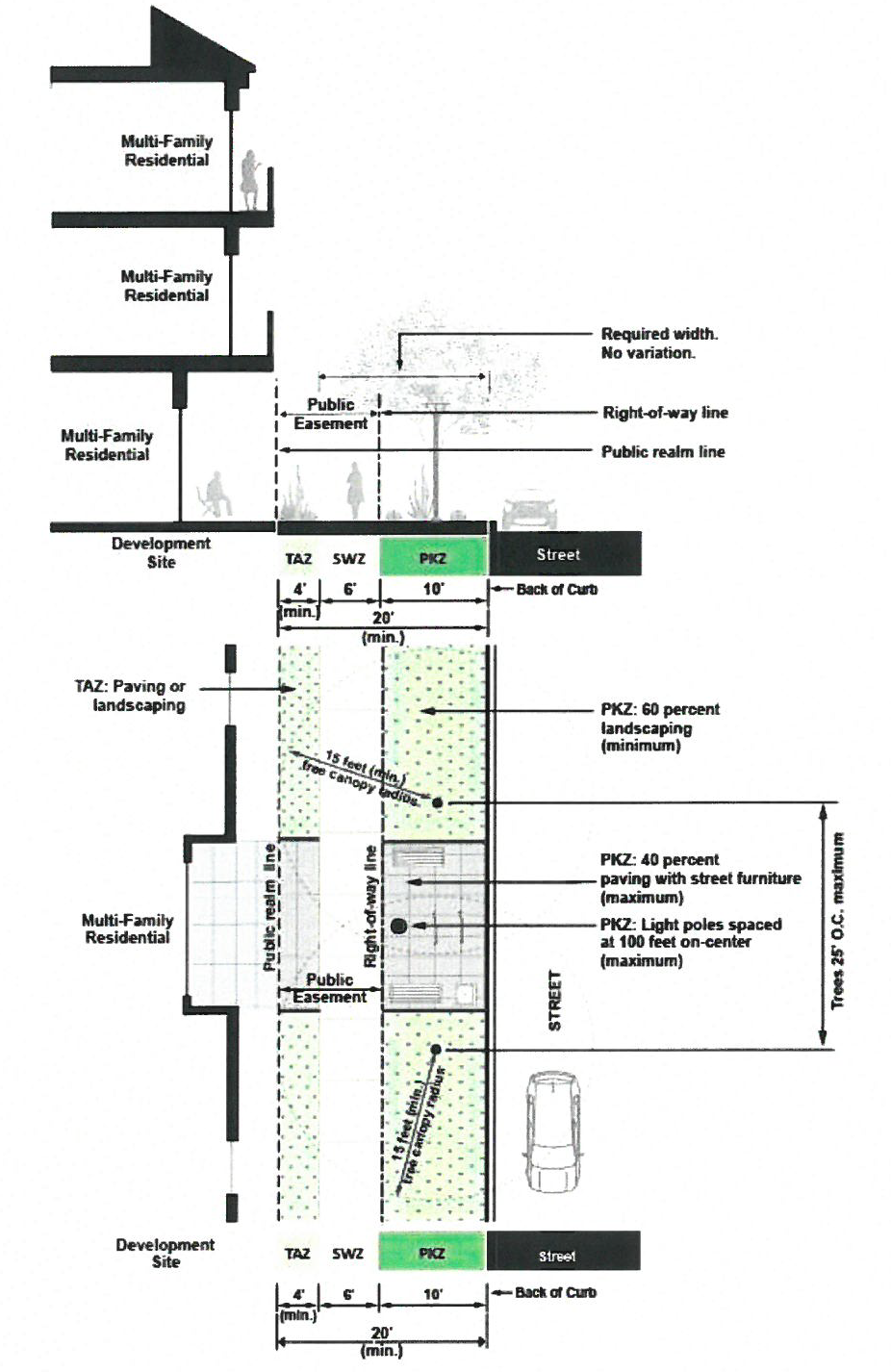
FIGURE 17.20.010.2
STREET TYPE B PUBLIC REALM STANDARDS
i.
Public easement—A ten-foot easement shall be provided.
ii.
Structural exemptions—One-foot wide building at-grade projections, columns, posts, or pilasters are permitted in the Transition Area Zone (TAZ) required public realm easement. A minimum of three-foot width between the building structure and the Sidewalk Zone (SWZ) shall be provided.
iii.
Weather protection—Awnings and canopies that extend a maximum of five feet over the public realm are permitted. A minimum vertical clearance of eight feet measured from the public realm finished grade to the bottom of the awning or canopy structural components shall be provided.
6.
Street Type B Public Realm Zones. The intent of the Street Type B public realm is to foster safe and comfortable pedestrian access to multi-family sites that front busier streets with traffic volumes greater than fifteen thousand (15,000) ADT by providing a more robust landscaped buffer between the roadway and the sidewalk. Three distinct and contiguous sidewalk zones comprise the public realm.
a.
Parkway Zone (PKZ). There shall be a required ten-foot parkway zone width measured from the back-of-curb to the SWZ.
i.
Landscaping—The PKZ shall be landscaped a minimum of sixty (60) percent of the total multi-family development site frontage(s). All landscaping shall be selected, installed, irrigated, and maintained per 8.44.220 California MWELO requirements and according to City approved landscape plans. Turf grass shall be prohibited. A combination of decomposed granite mulching and drought tolerant native and desert-adaptable shrubs, succulents, groundcover, and ornamental trees shall be permitted. Street trees shall be spaced a maximum of twenty-five (25) feet on-center and have a minimum canopy radius of fifteen (15) feet at maturity. Landscape beds and tree wells shall have a minimum dimension of four feet in width and twelve (12) feet in length. Live plant materials shall constitute a minimum of twenty-five (25) percent of all surface area coverage at installation. A permanent underground irrigation system shall be installed. Spray irrigation shall be prohibited.
ii.
Street furniture—Benches, transit shelters, tables, chairs, trash receptacles, public art, bike racks shall be permitted.
iii.
Illumination—Sidewalk light poles and fixtures are permitted.
iv.
Paving—Poured in place concrete, brick, concrete, or stone unit pavers are permitted. A maximum of forty (40) percent paving of the PKZ shall be permitted. Cast iron tree grates shall be permitted and shall be included in any paving calculation.
v.
Utilities—Transmission line poles, sidewalk and roadway light poles and fixtures, utility boxes and vaults, and traffic control devices, are permitted in the parkway zone.
iv.
Signs—Temporary or permanent roadway or wayfinding signs shall be permitted. Advertising or development identification signs shall be prohibited.
b.
Sidewalk Zone (SWZ). There shall be a required six-foot sidewalk zone width measured between the Parkway Zone to the Transition Area Zone. There shall be no variation in location or width of the SWZ. Serpentine or curved sidewalk alignment is prohibited.
i.
Accessibility—The required sidewalk zone width shall remain clear of all obstructions to maintain universal access. Steps are prohibited within the sidewalk zone.
ii.
Paving—The SWZ shall consist of poured in place scored concrete or concrete, brick, or stone unit pavers. Stamped concrete is prohibited.
iii.
Street furniture—Permanent or temporary street furniture shall be prohibited.
iv.
Landscaping—Plant material in beds or pots shall be prohibited. Any landscape material planted in the TAZ or PKZ shall not project into the SWZ at a height less than eight feet above finished SWZ grade.
v.
Signs—Temporary or permanent signs shall be prohibited.
vi.
Walls and fences—Temporary or permanent fences or enclosures shall be prohibited.
vii.
Illumination—Sidewalk-oriented light poles and fixtures shall be prohibited.
viii.
Utilities—Fire hydrants, transmission line poles, utility boxes, and traffic control devices shall be prohibited. Below grade utility lines and vaults shall be permitted.
c.
Transition Area Zone (TAZ). There shall be a minimum four-foot Transition area Zone width measured from the Sidewalk Zone to the public realm-line.
i.
Landscaping—Landscaping shall consist of a minimum of fifty (50) percent of the total site frontage(s) excluding any frontage that includes an arcade. All landscaping shall be selected, installed, irrigated, and maintained per 8.44.220 California MWELO requirements Landscaping and trees shall comply with the 2022 Coachella Grapefruit Boulevard Standards (CGBS) Sections 5.106.12 through 5.106.12.3. A combination of decomposed granite mulching and drought tolerant native and desert-adaptable shrubs, succulents, groundcover, and ornamental trees shall be permitted. No planting bed shall be less than three feet in width. Live plant materials shall constitute a minimum of twenty-five (25) percent of all surface area coverage at installation. A permanent underground irrigation system shall be installed. Spray irrigation shall be prohibited.
ii.
Street furniture—Permanent or temporary seating shall be permitted in the TAZ.
iii.
Paving—To increase the width of the SWZ, permitted paved surfaces shall consist of brick, concrete, or stone unit pavers, concrete banding, or scored or brushed concrete with integral color pigment that is complementary but distinguished from the SWZ paving. Stamped concrete shall be prohibited. Steps that provide access to above-grade front door entrances are permitted.
iv.
Illumination—Building wall washing uplighting and landscape accent light poles and fixtures less than eighteen (18) inches in height shall be permitted. Sidewalk light poles and fixtures are permitted.
v.
Walls and fences—Retaining or landscape planter concrete or masonry walls or wrought iron fences seventy-two (72) inches or less in height are permitted. Walls and fences shall include a landscaped setback of a minimum two feet width from the SWZ.
vi.
Utilities—Ground or façade mounted utilities shall be screened. Below grade utility vaults or lines shall be permitted in the TAZ.
vii.
Parking—Below grade parking structures shall be permitted in the TAZ.
7.
Street Type C Standards.
a.
Private Street Standards. The intent of private street standards is to foster a low speed, multi-modal access where driving, walking and cycling space can be integrated. All new development sites that include private roadways shall comply with a forty-eight-foot minimum right-of-way width measured between the fronting build-to lines. No portion of any building façade shall be located beyond the build-to line as specified in Figure 17.20.010.3.
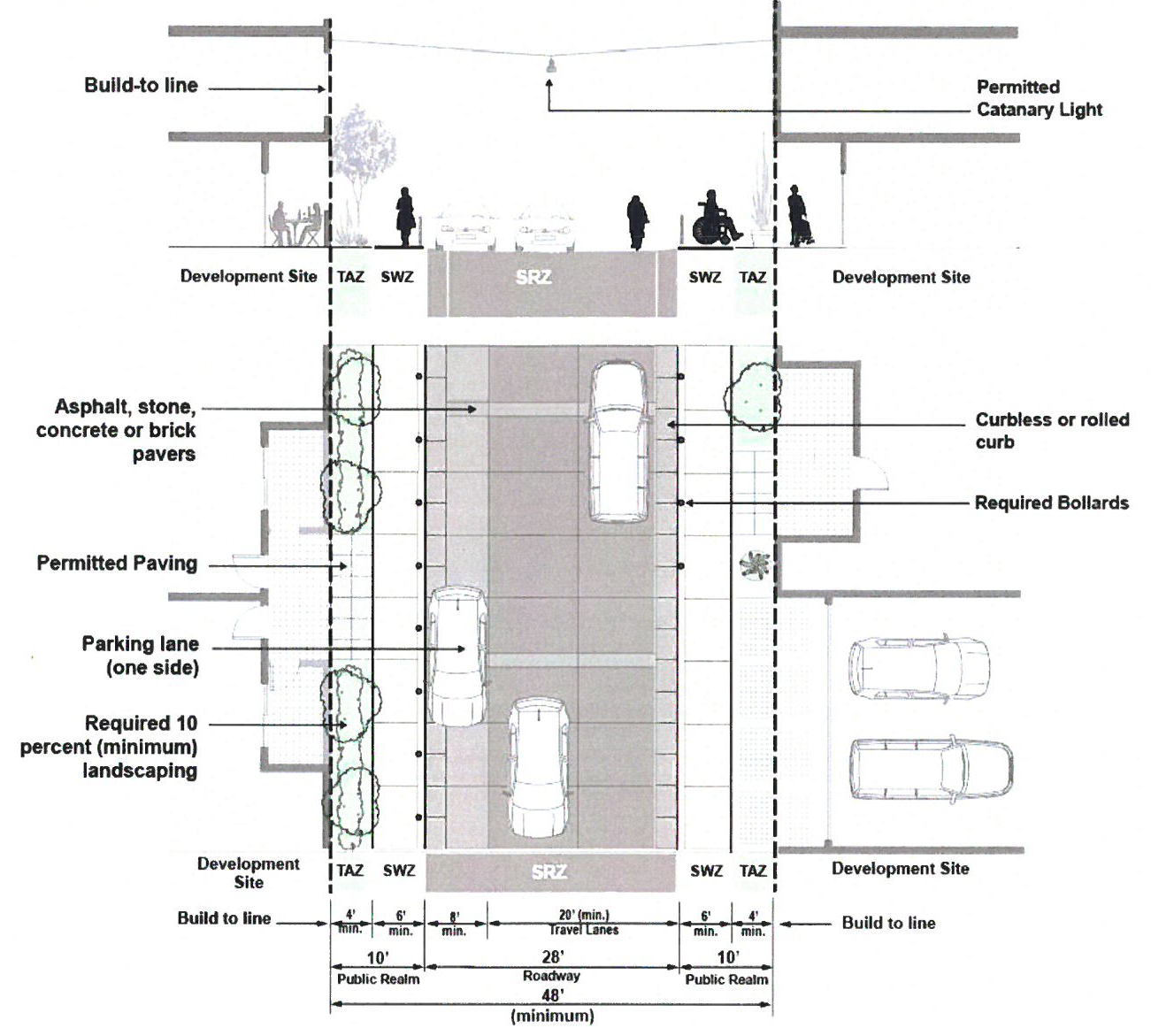
FIGURE 17.20.010.3
STREET TYPE C STANDARDS
i.
Public access—An access easement for walking and biking shall be provided for private property internal streets. Access shall be maintained twenty-four (24) hours per day and all days of the year. No walking and biking ingress or egress from public streets shall be gated.
ii.
Amenity—The streets shall be designed as a component of an integrated system of common open spaces and paseos of the site while providing essential auto and delivery access to access parking garages and first floor residential entries. The design of the streets shall be unified, consistently utilizing the same paving, landscaping, illumination, and street furniture elements of paseos and common open spaces.
iii.
Speed limit—A maximum fifteen-mile per hour speed limit shall be required for all internal private streets. Speed humps, tabled intersections, or other Fire Department approved traffic calming measures shall be provided to ensure low speeds.
8.
Street Type C Private Street Zones. Three integrated and blended street zones comprise the private streets.
a.
Shared Roadway Zone (SRZ). Motor vehicle traffic shall be permitted to include either one-way or two-way traffic patterns. A twenty-foot minimum width multi-modal roadway shall be provided.
i.
Fire access—All roadways shall comply with fire apparatus access standards of the California Fire Code and the Riverside County Fire Department.
ii.
Surface treatment—Paving shall be asphalt, stone, brick or concrete unit pavers or poured in place concrete with integral color pigment. Stamped concrete shall be prohibited.
iii.
Curb free—Streets shall be integrated with the Pedestrian Refuge Zone. Curbless or rolled curbs shall be permitted.
iv.
Illumination—Cantenary street lighting shall be permitted. Emergency and maintenance vehicle height clearances shall be maintained.
v.
Parking—One-sided parallel curbside parking (8-foot maximum width) in addition to the minimum twenty-foot width shall be permitted. Angled or head-in parking shall be prohibited.
b.
Sidewalk Zone (SWZ). Two SWZ zones shall be provided. The zones are intended to provide a pedestrian-protected area free of motor vehicle traffic. A 6-foot width measured from the back-of-curb to the Transition area Zone shall be provided.
i.
Universal accessibility—The zone shall include a five-foot (minimum) wide clear width that is free of all obstructions to maintain American Disabilities Act (ADA) access. Steps or ramps are prohibited within the zone.
ii.
Physical separation—Cast iron or concrete bollards shall be provided to protect pedestrians from the shared street within a one-foot zone from the back of the curb. Bollards shall be spaced a maximum of ten (10) feet on-center. Traffic or wayfinding poles shall be permitted within this zone between the bollards.
iii.
Paving—Paving shall be brick or concrete unit pavers or poured in place concrete with integral color pigments. Concrete banding and scoring pattern shall differentiate the SWZ from the SRZ. Differentiated stone, brick or concrete paving, differentiated concrete banding and scoring patterns shall be provided at parking garage and intersection conflict points.
iv.
Street furniture—Benches, tables, chairs, trash receptacles, and bike racks are prohibited in the zone.
v.
Landscaping—Shrubs, groundcover, and street trees are prohibited in the zone. Any landscaping planted in the adjacent Transition Area Zone shall not project into the SRZ at a height less than eight feet above finished SRZ grade.
vi.
Utilities—Transmission line poles, utility boxes and vaults are prohibited in the zone.
c.
Transition Area Zone (TAZ). There shall be a minimum four-foot transition area zone width measured from the SWZ to the build-to line.
i.
Landscaping—The TAZ shall be comprised of a minimum of ten (10) percent of the total building frontage(s). All landscaping shall be selected, installed, irrigated, and maintained per 8.44.220 California MWELO requirements. A combination of decomposed granite mulching and drought tolerant native and desert-adaptable shrubs, succulents, groundcover, and ornamental trees shall be permitted. Landscape planting beds shall have a minimum width of three feet. Any landscape material shall not project into the SWZ or SRZ at a height less than eight feet above finished SRZ grade.
ii.
Paving—Stone, brick or concrete unit pavers or poured in place concrete with integral color pigments is permitted in the TAZ. Steps are permitted to above grade first floor entrances.
iii.
Street furniture—Permanent or temporary seating shall be permitted in the transition area zone.
iv.
Walls—Retaining walls or landscape planting walls less than forty-two (42) inches in height shall be permitted.
v.
Utilities—Ground or façade mounted utilities shall be screened. Below grade utility vaults or lines are permitted.
vi.
Parking—Auto parking along driveway aprons shall be prohibited.
C.
Public Realm Transition Standards. The intent of the standards is to address all potential first floor residential or commercial building conditions and establish requirements for any required building setback behind the public realm line along Street Type A and Street Type B. The standards prescribe at-grade and above grade conditions for first floor uses and conditions for upper floor projections.
1.
First Floor Transition Area Use. All multi-family or multi-family mixed use development fronting either Street Type A and Street Type B shall comply with the following standards for the use of any site frontage area between the building facade and the public realm line.
a.
Motor Vehicle Parking and Service Access. Driveways shall be limited to the minimum width and length necessary to provide direct and efficient motor vehicle ingress to and egress from off-street parking, loading, or service parking spaces located behind a build-to-line. Ride-share drop-off and pick-up short-term parking spaces are permitted within the setback.
b.
Utilities. Public utilities vaults and transmission lines shall be fully screened or subterranean.
c.
Residential Unit Private Space Enclosures. Patio walls that are forty-two (42) inches or less in height above the finished grade of the adjacent public realm are permitted for Street Type A frontages; patio walls that are sixty (60) inches or less in height above the finished grade of the adjacent public realm are permitted along Street Type B frontages.
d.
Steps, Stoops, or Terraces. Shall be prohibited along first floor commercial tenant storefront frontages. Thirty-inch (minimum) and forty-eight-inch (maximum) height terraces, steps and stoops are permitted for first floor residential units. At-grade or above-grade individual residential entrances shall comply with all Multifamily Building Design Standards of this ordinance.
e.
Parking Garages. Subterranean parking garages, including below grade equipment, service, utility, and storage areas that extend to the property line are permitted.
f.
Landscaping. Any area between the public realm line and the building shall be landscaped a minimum of sixty (60) percent of the total multi-family building frontage where at-grade ground floor residential units are provided. All landscaping shall comply with the site landscaping standards of this ordinance.
g.
Exemptions. First floor residential units subject to California Building Code accessibility requirements shall all be exempt from the steps, stoops, or terrace standards and landscape standards. The landscape minimum area standards do not apply to building frontages where interior vertical circulation stairs and elevators; common areas, or lobbies occur.
2.
At-Grade First Floor Residential Use. The intent of the standards is to provide adequate privacy separation between the first-floor unit interior living space and the public realm. All buildings with a first-floor residential units that are at-grade with the adjacent public realm shall comply with the following standards as specified in Figure 17.20.010.4
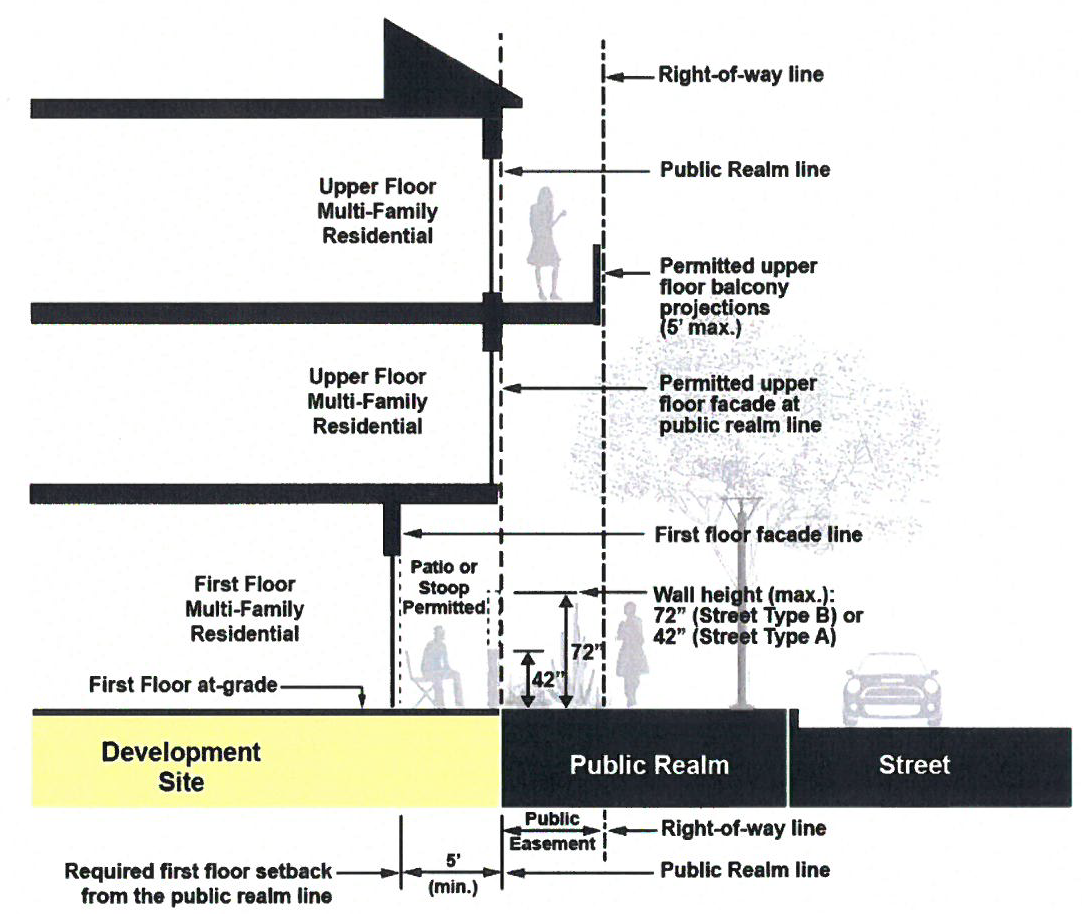
FIGURE 17.20.010.4
PUBLIC REALM TRANSITION STANDARDS AT-GRADE FIRST FLOOR RESIDENTIAL USE SETBACK
a.
Public Realm Line Setback. A minimum five-foot first floor setback from the public realm line shall be provided for residential units.
b.
Private First Floor Residential Use. Residential front door stoops or enclosed patios shall be permitted within the five-foot minimum setback.
c.
Projections. Upper floors of multi-family buildings are permitted to project over any first-floor setback to the public realm line. Upper floor residential balconies are permitted to project to the right-of-way (property line) or five feet, whichever is less.
3.
Above-Grade First Floor Residential Use. The intent of the standards is to provide a privacy grade separation between the first-floor units and the public realm. Buildings shall comply with all the above-grade standards as specified in Figure 17.20.010.5
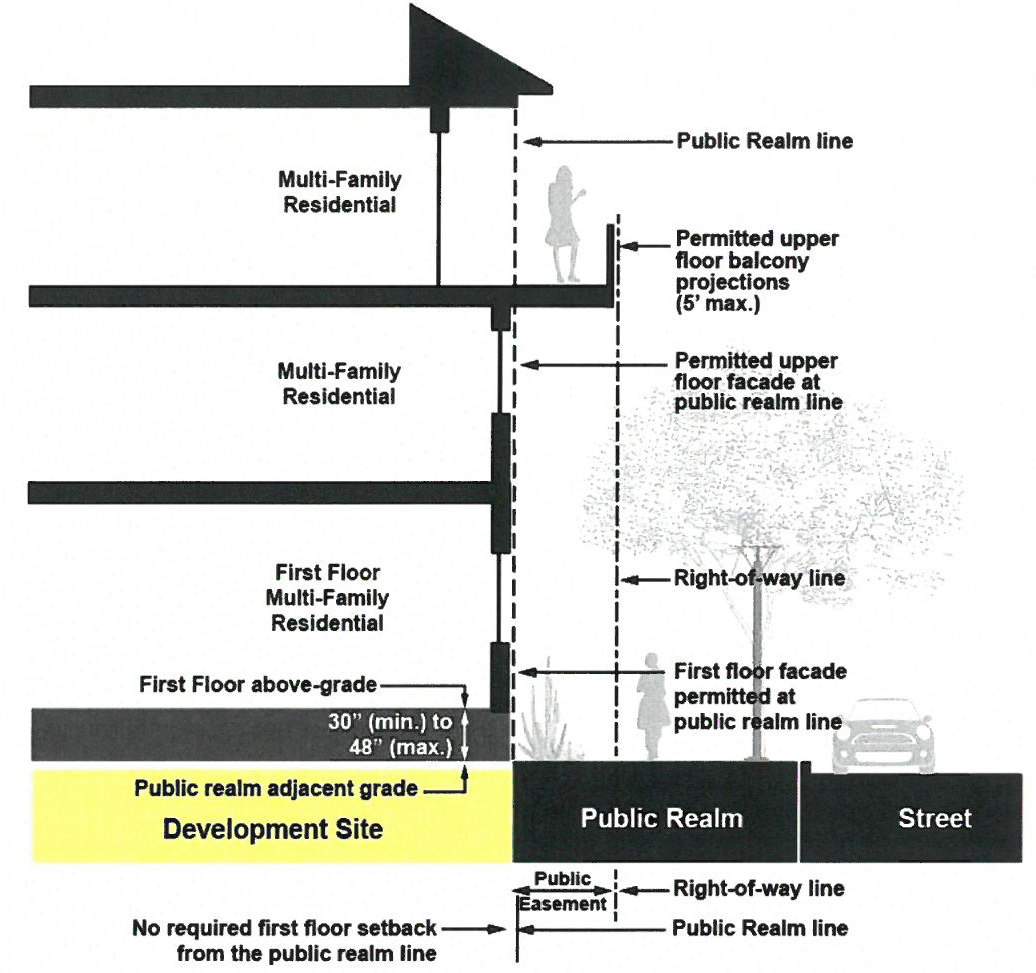
FIGURE 17.20.010.5
PUBLIC REALM TRANSITION STANDARDS ABOVE-GRADE FIRST FLOOR RESIDENTIAL USE
a.
Public Realm Line Zero Setback. Where residential units are constructed at the public realm line, the finished first floor shall be a minimum of thirty (30) inches and a maximum of forty-eight (48) inches above the adjacent public realm grade.
b.
Private First Floor Residential Outdoor Use. Where provided, first floor balconies shall be permitted to project a maximum of eighteen (18) inches beyond the public realm line. Terraces shall not project beyond the public realm line.
c.
Projections. Upper floors of multi-family buildings are permitted to project over any first-floor setback to the public realm line. Upper floor residential balconies are permitted to project to the right-of-way (property line) or five feet, whichever is less.
4.
At-Grade Commercial Use. The intent of the standards is to permit direct first floor access between first floor commercial uses and the public realm. All mixed-use buildings with an at-grade first floor commercial use that are adjacent public realm shall comply with the following standards as specified in Figure 17.20.010.6
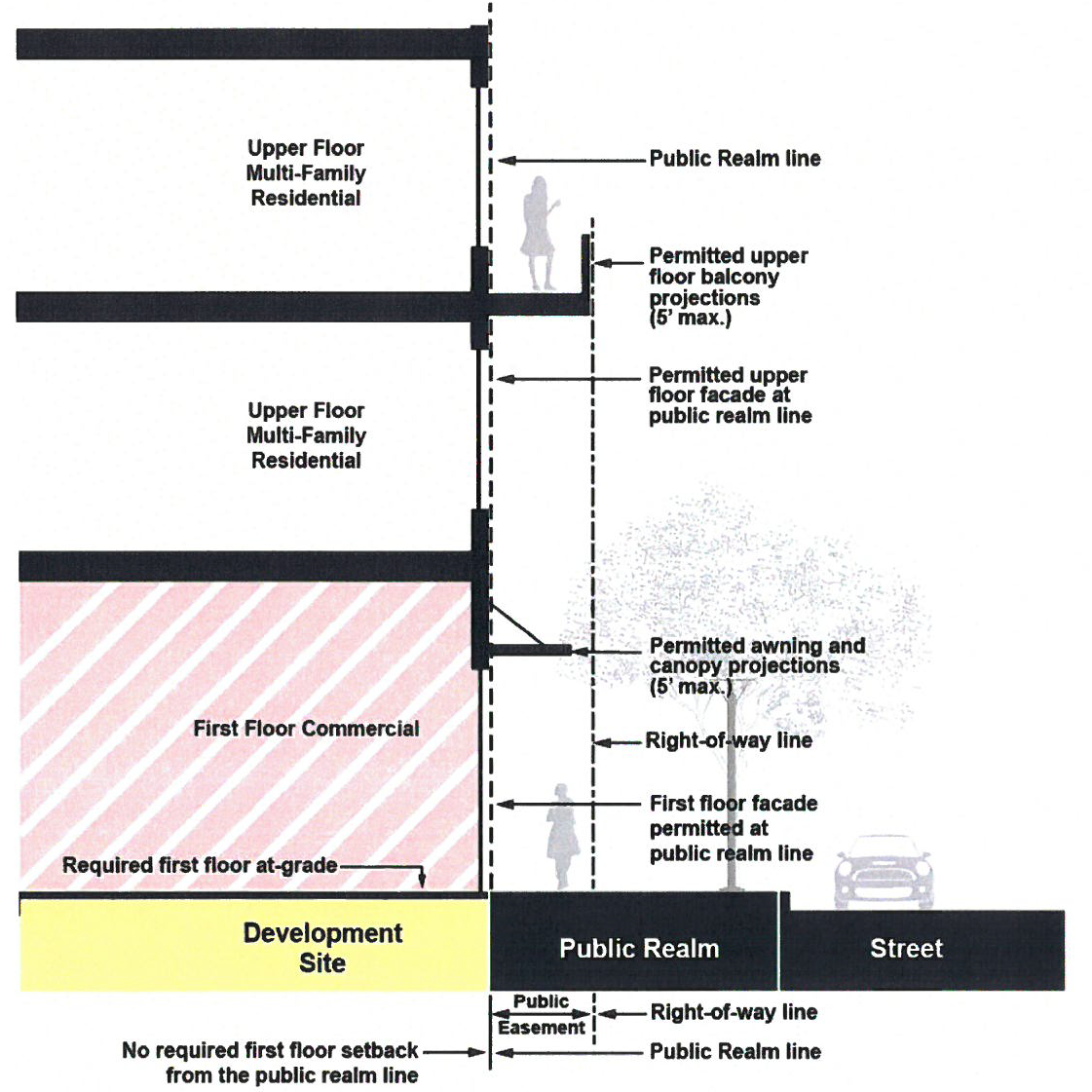
FIGURE 17.20.010.6
PUBLIC REALM TRANSITION STANDARDS MIXED USE BUILDINGS WITH FIRST FLOOR COMMERCIAL
USE
a.
Public Realm Setback. Mixed use multi-family development with a first-floor commercial component setbacks shall not be required.
b.
Projections. Upper floors of multi-family buildings are permitted to project over any first-floor setback to the public realm line. Upper floor residential balconies and first floor or upper floor canopies or awnings are permitted to project to the right-of-way (property line) or five feet, whichever is less.
D.
Site Landscaping Standards. Landscaping shall be provided to unify multiple buildings on development sites, enhance the enjoyment and beauty of public and private spaces, provide visual screening for existing adjacent uses, and aid in energy conservation by providing shade from the sun and shelter from the wind. The following standards shall apply to the landscape materials, placement, layout and installation for all multifamily zones, and mixed-use zones where multi-family building occur. All landscaping shall comply with any other applicable landscaping requirements identified in Chapter 17.60, Development Standards.
1.
Desert Appropriate Landscaping Standards. All landscaping shall be selected, installed, irrigated, and maintained per any applicable 8.44.220 Coachella Model Water Efficient Landscape ordinance requirements and City approved landscape plans.
a.
Landscape Design. A combination of decomposed granite mulching and drought tolerant native and desert-adaptable shrubs, succulents, groundcover, and ornamental trees shall be provided for all required landscaped areas. Turf grass installation shall be prohibited throughout with the exception of active recreation areas. Live plant materials shall constitute a minimum of twenty-five (25) percent of all surface area coverage at installation.
b.
Required irrigation. A permanent underground irrigation system shall be installed. Spray irrigation shall be permitted for recreation turf areas only.
2.
Minimum Common Area Landscaping Standards. No less than twenty (20) percent of the total required usable common open space for multifamily residential development shall be comprised of landscaped beds, planters, or pots.
a.
Planters and Pots Requirements. Planters and pots shall have a minimum length, width, diameter, and depth of thirty-six (36) inches.
b.
Minimum Planting Bed Dimensions. Beds shall be a minimum of four feet in width and twelve (12) feet in length.
c.
Required Landscape Areas. Landscaping is required in the setback area for individual residential units on the ground floor, except for where a walkway, ramp, stoop, or stairs are directly adjacent to the public realm. Landscaping shall be of an appropriate height to screen the residential unit walls and stoops.
E.
Site Outdoor Illumination Standards. Minimum illumination requirements of multi-family and mixed development sites and adjacent public realm shall be provided to ensure nighttime safety for residents and other users. Lighting shall be permitted to animate gathering areas and extend hours of the day that residents use sidewalks and common spaces. No lighting shall create any unnecessary nuisance for site residents and adjoining property occupants.
1.
General Provisions. All exterior lighting shall be designed, located and installed in order to prevent over-lighting, energy waste, glare, light trespass and unintentional sky glow. Lighting shall be permitted to highlight building and landscape features and provide Illumination for mixed use business operations.
a.
Luminaires and Poles. Multifamily residential sites and building façades shall comply with the following standards.
i.
Sky glow limitations— all parking lot and common area light fixtures shall be fully shielded, and dark sky rated.
ii.
Maximum Illumination Impact—The extent of light coverage of all site light installations shall not exceed a two-footcandle maximum illuminance impact on any fronting residential or commercial sites.
iii.
Energy efficiency—All non-essential exterior mixed use commercial and multi-family residential lighting shall be turned off after business hours and/or when not in use. All commercial lights shall be on a timer.
iv.
Security—Sensor activated lights are to be used for security purpose lighting only. Security luminaires shall not be triggered by activity off the development site, including the fronting public realm.
v.
Glare restrictions—Awning or canopy lights shall be fully recessed or fully shielded so as to ensure that no light source is visible from or causes glare on the public realm or adjacent properties.
vi.
Exceptions—Luminaries and poles used for resident recreation area courts, pools, and play areas shall be exempt from the height and illumination restrictions provided all other provisions of this section are met and the light is used only while the recreation area is in use.
2.
Site Open Space, Public Realm, Roadway, and Exterior Building Lighting. All parking lots, accessible common areas, and private residential open space area lighting shall comply with all location requirements identified in the public realm standards of this subsection and the following additional location, height and illumination standards as follows:
a.
Public Realm and Development Site Common Area Lighting. Pedestrian-oriented lighting shall have a maximum light pole and luminaire height of 15 feet. Sidewalk lighting shall have an average of two footcandles and a minimum of one footcandle and a maximum of five footcandles.
b.
Landscape and Building Facade Accent Lighting. Glare-free direct accent light fixtures with an illumination ratio of less than 30:1 shall be permitted to highlight façade articulation, artwork, and landscape specimen plantings.
c.
Parking Lot, Private Roadway, and Driveway Lighting. Parking area lights shall be greater in number, lower in height, and lower in light level, as opposed to fewer in number, higher in height, and higher in light level. The light pole and luminaire height shall be no greater than eighteen (18) feet above the parking lot finished grade. Parking lot lighting shall not exceed an overall average illumination of one and one-half footcandles. Lighting shall have a minimum one footcandle and a maximum of four footcandles. Private roadway and driveway catenary or pole mounted luminaires shall be LED, unless otherwise determined City of Coachella Public Works. Streetlights shall meet all City of Coachella Public Works illumination and standard specifications and procedures for installation height, number, and location.
F.
Site and Public Realm Utilities Standards. Utilities required for the function and operation of any multi-family development shall be integrated into sites, facades, and roofs to ensure that they do not detract from the visual quality of a public realm or building facades, or pose health or safety hazards to residents, visitors, and employees. All development shall comply with any utility service provider requirements for access, maintenance, and service; and any applicable Engineering Department standards and specifications for installation. For all multi-family and mixed-use buildings and sites, the following standards shall be met.
1.
Underground Utilities. New and existing utilities service connections including wires, cable, and pipelines and equipment shall be placed entirely below ground when located within a multi-family or mixed development site undergoing new development or redevelopment, and/or along the length of the front yard property line in the adjoining half-street, except when the following conditions are met:
a.
Feasibility. Where undergrounding of utilities within a site is not feasible due to utility or infrastructure conflicts, topographic conditions, or site limitations. The Engineering Department Director shall have the authority to waive, limit, or modify the requirement for such improvements.
b.
Exemptions. Fire hydrants and Fire Department connections as required by the International Fire Code, and any traffic control devices as required by the Engineering Department shall be exempted from all requirements of this ordinance.
2.
Site At-Grade Utilities. Utility facilities that cannot feasibly be installed underground shall be located and screened with landscaping or walls consistent with the standards of this ordinance to minimize their impact.
a.
Required screening. All exterior mechanical and electrical equipment, which includes, but is not limited to façade mounted or ground mounted Heating, Venting, and Cooling (HVAC) units, gas and electric utility meters, telecommunication equipment, backflow preventions, assemblies, irrigation control valves boxes, and electrical transformers shall be screened.
i.
Panels and meter locations—Exterior utility panels and meters shall be located on building side yard or rear yard facades.
ii.
Wall or vegetative screening requirements—Walls, landscaping, or the combination of these screens shall have a minimum of seventy-five (75) percent opacity and shall be a equal or exceed the height of the screened utilities. Screening walls shall utilize the same design elements, colors and materials of the building.
iii.
Accessibility—All screening shall not prohibit access for maintenance and emergency service or repair. Access standards identified by utility providers shall be met.
3.
Roof-mounted Utilities. Exposed mechanical equipment shall be visually screened by a seventy-five (75) percent (minimum) opaque or solid, non-reflective visual barrier. The design and materials of the visual barrier shall comply with the following requirements:
a.
Architectural Screening. Screening be comprised of parapets, screen walls, trellis systems, or mechanical penthouses and shall include common design elements and finish materials of the building facades. Screening shall be as high and wide or higher and wider than the equipment it screens.
4.
Antennas. All telecommunication antennas, including but not limited to dishes, towers, and wires shall be installed and maintained in compliance with applicable requirements of the building code and standards of the Coachella Municipal Code Chapter 17.68, Antennas.
G.
Site Freestanding Walls, Fences, and Gates Standards. The standards shall be applied for at-grade visual screening between multifamily buildings, the public realm, parking lots, and adjacent development; first floor residential unit privacy patio walls; and private residential or commercial common areas. No freestanding wall, fence or gate shall preclude direct and convenient access for residents, visitors, or employees to building lobbies, or individual unit front doors from the public realm.
1.
General Requirements. All walls and fences shall be installed and maintained in compliance with all applicable standards for residential single family zone fences of Chapter 17.60.
a.
Emergency Access. All wall fences shall not restrict access for fire department vehicles. All development shall comply with fire vehicle accessibility standards of the California Building Code, the Coachella Chapter 15.24, Fire Code, and shall be approved by the fire code official. The fire official shall have the authority to waive, limit, or modify the standards and requirements of this ordinance.
b.
Swimming Pool Enclosure Fences. All fences required to enclosure swimming pools, hot tubs, spas, and associated facilities shall be exempt from these standards and shall comply with all California Building Code requirements and standards.
c.
Location. All freestanding walls, gates or fences shall be located a minimum of two feet behind any public realm line.
d.
Materials. Walls shall be constructed of either masonry units that are clad in true stucco or Exterior Insulation Finishing Systems (EIFS), or decorative perforated breeze-block Concrete Masonry Units (CMU Blocks). Wrought iron fences are permitted when used in combination with evergreen landscaping that meets the seventy-five (75) percent minimum opacity standard. Fences and gates constructed of chain link, wood, and vinyl are not permitted along public realm or common area frontages.
2.
Parking Lot Screening Walls. All parking lots that front a public realm or common open space shall be screened by walls or a combination of walls, earth berming, and an evergreen hedge of equal height and opacity to the parking screen wall. All freestanding at-grade parking lot screening walls shall be a minimum of forty-two (42) inches in height and shall have a minimum of seventy-five (75) percent opacity.
H.
Site Solid Waste Container Enclosures Standards. Enclosures are necessary to ensure that garbage and recycling areas are properly located and screened from view from the public realm. Where possible solid waste containers should be located in a designated trash room of a building. Solid waste enclosures shall comply with the following standards:
1.
Placement. Containers shall be placed behind the front façade of the primary building and outside of any easements and rights-of-way, unless expressly permitted by the City of Coachella. Containers and their screening enclosures shall be permitted to reduce the number of required parking stalls and maneuvering space. Required parking shall not be reduced without submittal and approval of an approved site plan.
a.
Collection Vehicle Access. A twenty-foot-wide unobstructed vehicular service drive must be maintained as measured from the truck collection side of an enclosure or container placement area. Containers and enclosures located perpendicular to or along a service drive must have no less than a thirty-degree angle to the drive aisle.
b.
Collection Vehicle Clearance. A minimum twenty-four-foot height clearance must be maintained along the fifteen (15) feet of vehicular path closest to the servicing side of the solid waste container or enclosure to enable overhead lifting of the container for servicing. The remaining length of the unobstructed vehicular path must maintain a minimum sixteen-foot height clearance. A minimum twenty-four-foot height clearance over containers must be maintained to allow overhead lifting of the container for servicing.
2.
Container Screening. All containers shall be screened from view of adjacent streets, public open space, and directly adjacent side and rear yard properties. The enclosure shall be compatible in design, material, and color to the primary multifamily or mixed-use building(s) on the site.
a.
Concealed Service Area Placement. Containers shall be screened from view by buildings, freestanding screening walls, and/or combined within irrigated evergreen vegetated screen equal or greater in height of the enclosure. The containers should be located in a service area is an area at the rear or side of the building and designated for discreet service functions including deliveries, loading of goods, staging, solid waste collection and compaction, and similar activities supporting operations of the multi-family site.
b.
Enclosure Wall Design Standards. Enclosures shall be a minimum of seven feet in height, twelve (12) feet in width and length. Enclosures must be constructed of cast-in-place concrete or concrete masonry block. Wood, vinyl, wrought iron or chain link fences, cementitious or metal panels materials shall be prohibited. EIFS cladding shall be prohibited. Gates shall be provided that are solid, heavy-gauge metal or of a heavy-gauge metal frame clad with a heavy gauge sheet metal or other suitable, opaque material compatible to the primary multi-family structure. Five-foot-high bollards shall be placed one-foot from all sides of the structure. All screening walls must be continually maintained in a state of good repair. Living vegetative screens must be installed and maintained in compliance with the landscape standards of this ordinance.
(Ord. No. 1206, § 2(Exh.), 9-13-23)
17.20.015 - Multi-family building design standards.
A.
Applicability. The building design standards provided in this subsection shall apply to G-N General Neighborhood, U-N Urban Neighborhood, and applies to multi-family residential buildings in the DT-PV Downtown Pueblo Viejo zone, DT-PV Transition zone, and the U-E Urban Employment, and Neighborhood Commercial Zone District. The following design standards shall be used in determining a project's consistency with the purpose of this Code of Ordinances and with the policies of the General Plan related to building design. The standards shall apply to all new multi-family residential building construction. Review of projects under this subsection is ministerial and shall be consistent with Chapter 17.72, Architectural Review procedures and requirements.
1.
Building Modulation. The design of the building façade and roof shall be modulated to reduce the building's scale—the perceived size and presence in relation to its existing or planned setting; and building massing—the overall volume of the structure. For all multifamily and mixed-use development, applicants shall select one of the four building modulation options.
a.
Development Standards. The selected option shall comply with the site's development standards based upon the zone in which it is located, as identified in Tables 2-4 and 2-5 of this ordinance, including permitted minimum and maximum density, lot area requirements, yard requirements, encroachments for colonnades and arcades, height limits, stepbacks, distance between buildings, usable open space standards, and parking standards.
b.
Street Type. Standards for building modulation shall apply only to building façades fronting Street Type A, Street Type B, and Street Type C.
c.
Common Area Façades. Standards for building modulation shall apply to façades that front usable open space common areas.
d.
Sites with Multiple Buildings. Sites may be composed of multiple buildings utilizing one or more options.
2.
Modulation Options. For all multifamily and mixed-use development, applicants shall select one of three options. All of the standards and requirements for building modulation shall be met.
a.
Option 1. The standard shall be applied only to multifamily and mixed-use buildings where:
i.
Minimum density—Twenty (20) dwelling units per acre,
ii.
Zone—General Neighborhood (G-N), Urban Neighborhood (U-N), and Urban Employment (UE) zones.
b.
Option 2. The standard shall be applied only to multifamily and mixed-use buildings where:
i.
Maximum density—Less than twenty (20) dwelling units per acre.
ii.
Zone—General Neighborhood (G-N) and Downtown Transition (DT-PV Transition) zones.
c.
Option 3. The standard shall be applied to multifamily and mixed-use buildings for:
i.
All multifamily residential buildings.
ii.
All multifamily and mixed-use zones.
3.
Option 1 Standards. The standards are intended to result in buildings with complex, varied, asymmetrical form and massing.
a.
Vertical Modulation. Building façade modulation shall be achieved by providing asymmetrically arranged, irregularly stepped variations in building façade height and width. The number and arrangement of façades for all buildings greater than two stories in height shall be modulated as identified in Figure 17.20.015.7.
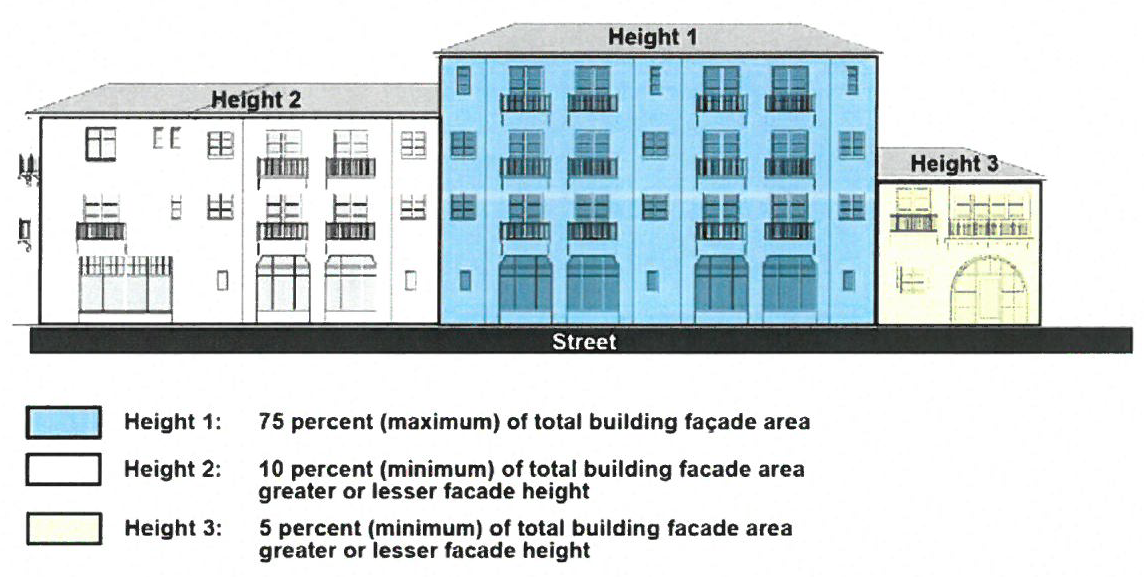
FIGURE 17.20.015.7
OPTION 1 STANDARDS VERTICAL MODULATION
i.
Variation—Buildings three floors in height shall include a minimum of two façade heights. Buildings four floors in height shall include a minimum of three façade heights.
ii.
Arrangement—The primary façade height shall comprise more than seventy-five (75) percent of the total building façade. A second façade shall be provided that comprises a minimum of twenty (20) percent of the total façade area. A third façade height shall be provided that comprises a minimum of five percent of the total façade area/
iii.
Prohibited—Façades vertically modulated with a uniform base, middle, and top utilizing projecting belt course or cornices or uniform stepping of floors.
b.
Horizontal Modulation. Building horizontal façade modulation shall be achieved by providing a combination and variation in location, width, and depth of façade recesses and projections. For all buildings greater than two stories in height, façades shall be modulated horizontally as identified in Figure 17.20.015.8.
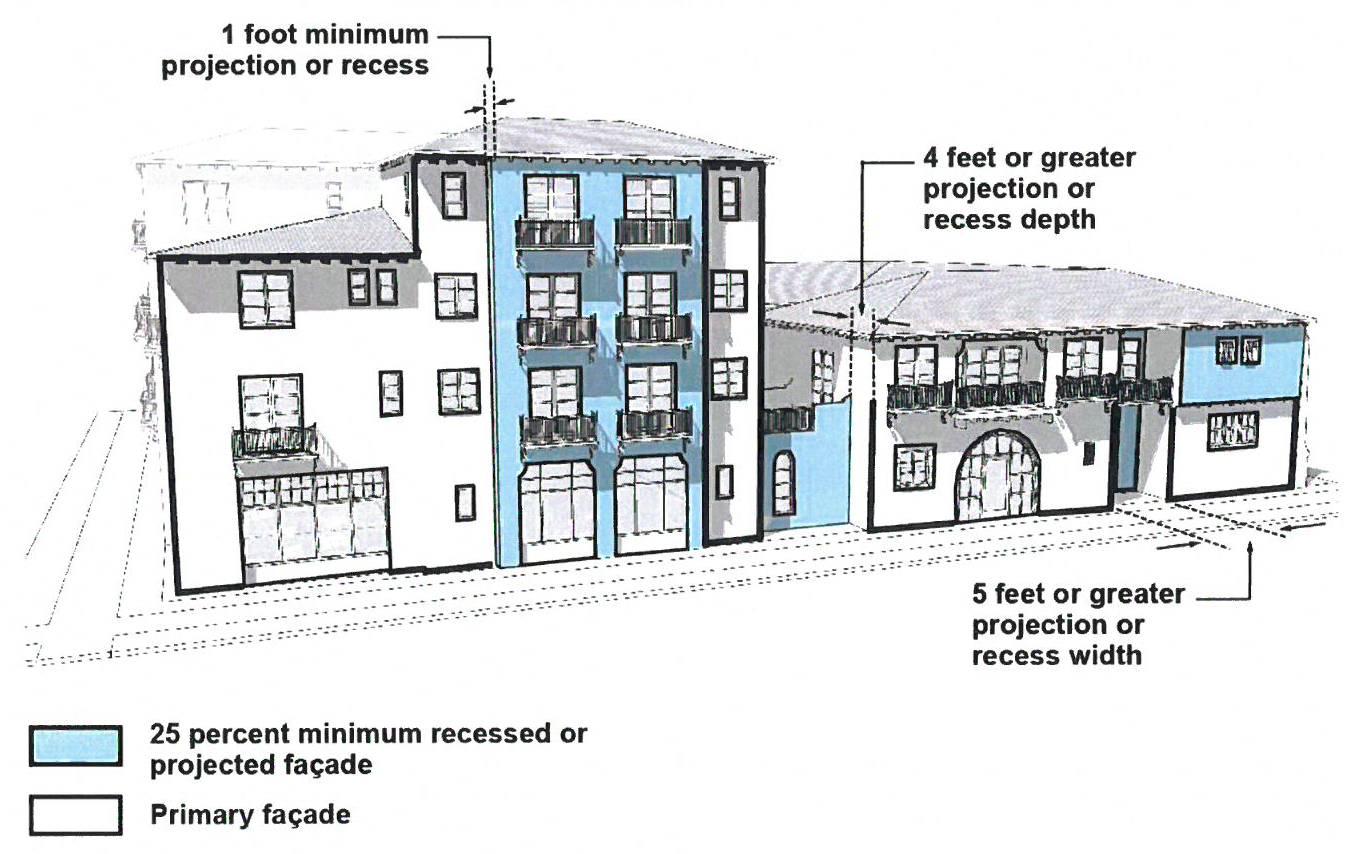
FIGURE 17.20.015.8
OPTION 1 STANDARDS HORIZONTAL MODULATION
i.
Variation—Façades recesses or projections shall include a minimum of two different heights. Heights shall vary ten (10) feet (minimum). No more than twenty-five (25) percent of any façade shall include projections or recesses that are equal in height.
ii.
Arrangement—A minimum of twenty-five (25) percent of the total façade area shall be recessed or projected from the primary façade.
iii.
Width—Recesses or projections shall be a minimum of ten (10) feet in width. No more than four façade projections or recesses shall be of equal width.
iv.
Depth—Recesses and projections shall be four-foot or greater in depth, measured from the primary façade of the building. A minimum of ten (10) percent of recessed or projected façade area shall be ten (10) feet or greater in depth.
v.
Articulation—Recessed or projecting balconies, bays, oriels, exterior walkways, stairs, and terraces shall be layered and integrated into the façade modulation as an essential component of all façade compositions.
However, projecting, or recessed balconies, bays, and oriel architectural articulation shall be excluded as part of the calculation of required recessed or projected façade modulation area.
c.
Roof Form and Materials. Roof volume and massing shall contribute to and complement façade horizontal and vertical modulation. All buildings shall create a varied building silhouette by providing a variety of primary and secondary roof forms that are comprised of different widths, heights, and sizes as illustrated in Figure 17.20.015.9.
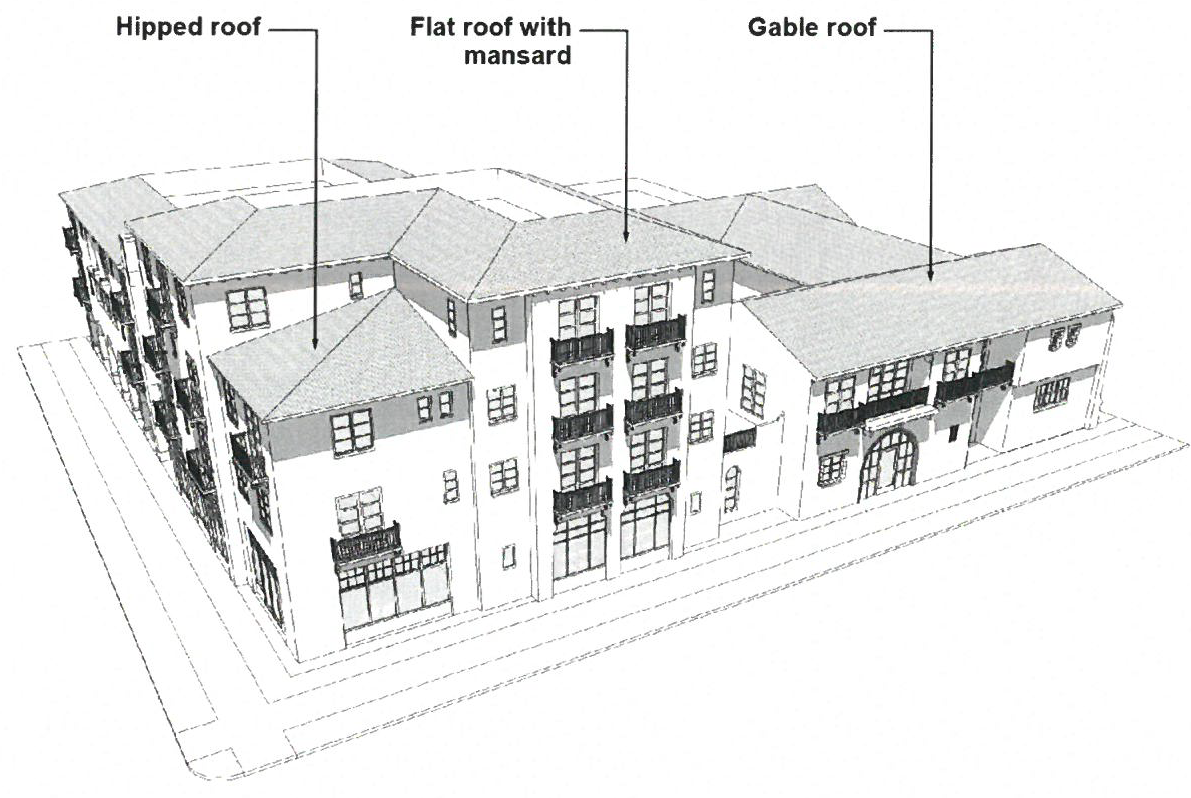
FIGURE 17.20.015.9
OPTION 1 STANDARDS ROOF FORM
i.
Required sloped roof forms—Hipped or gabled roofs forms with a minimum slope of 3:12 and a maximum slope of 4:12 shall be required for a minimum of sixty (60) percent of all roof area.
ii.
Permitted flat roof forms—Parapet and mansard-screened flat roofs are permitted. Mansard roofs shall have a minimum 3:12 and a maximum 4:12 slope. Flat roofs with mansards or parapet wall enclosures shall not comprise more than forty (40) percent of total roof area.
iii.
Roof Materials—All sloped roofs shall consist of long-lasting, durable clay or concrete tiles. Standing seam metal, asphalt, or wood shingle or shake roofs shall be prohibited.
iv.
Rooftop Amenities—Rooftop private terrace or occupied outdoor common space, and stair and elevator penthouse structures shall be permitted and shall be exempt from the required flat roof area requirements.
d.
Façade Colors. All façade surfaces shall be painted. Paint color and finish shall be muted and flat to imitate colors found naturally in desert soil, trees, rocks, and other organic materials of the Coachella Valley. Paint hues and tones shall be limited to warm white shades and rich warm colors containing some brown, ranging from neutral tan to deep brown.
i.
Primary color and secondary façade colors—Shall be limited to a maximum of two paint colors. A primary color shall comprise a minimum of eighty (80) percent of total of all façades. A secondary color shall comprise a maximum of twenty (20) percent of any façade fronting a public realm.
ii.
Windows, doors, and trim colors—Limited to a maximum of three paint colors. Building windows shall be limited to shades of blue, black, or warm colors containing deep brown.
iii.
Exemptions—All approved murals or other public artwork painted on façades shall be exempt from all façade color standards.
e.
Façade Materials. Façades shall be clad with durable and long-lasting materials that cannot be degraded by desert sun and high temperatures. Façades are permitted to be comprised of a single cladding material. No more than two façade materials shall be utilized for any façade.
i.
Primary and secondary façade materials—Where two materials are utilized, a primary material shall clad a minimum of eighty (80) percent of the total building façade area. A secondary material shall comprise no more than twenty (20) percent of any public realm fronting façade.
ii.
Prohibited façade materials—Wood siding, cementitious siding, metal panel, glazed spandrel curtain wall, un-clad poured in-place concrete or concrete masonry block, and stacked stone veneer siding, panels, or sheets.
f.
Fenestration. The arrangement, location, and character of door and window openings shall provide depth, shade, and shadow and contribute to a varied façade composition.
i.
Arrangement—Door and window locations shall be vertically and horizontally offset in an asymmetrical pattern. For façades greater than two floors in height, a maximum of fifty (50) percent of any façade area shall be arranged in a vertically stacked windows and door pattern.
ii.
Recess depth—No window shall be flush with any building façade. Individual or combined window and door system shall be recessed a minimum of four inches from the façade. The recess shall be measured from the outer face of the window glazing or door surface to the outer surface of the façade cladding.
iii.
Projection depth—Projecting sills, lintels, and trim shall not be required for any window or door. Where provided, sills, lintels, and trim shall project a maximum of two inches beyond the façade cladding surface.
iv.
Shading—Upper floor door and window shading is permitted. Awnings or canopies that project no more than four feet beyond the façade are permitted. For mixed use multifamily buildings with commercial first floor use, first floor awnings and canopies are permitted. All public realm and setback standards of this ordinance for projections shall be met.
4.
Option 2 Standards. All Option 2 building design standards shall apply to buildings two floors or less in height. All buildings shall comply with the following standards.
a.
Vertical Modulation. Building vertical façade modulation shall be required. For any vertically modulated buildings greater than one story in height, façades shall be modulated vertically as identified in Figure 17.20.015.10.
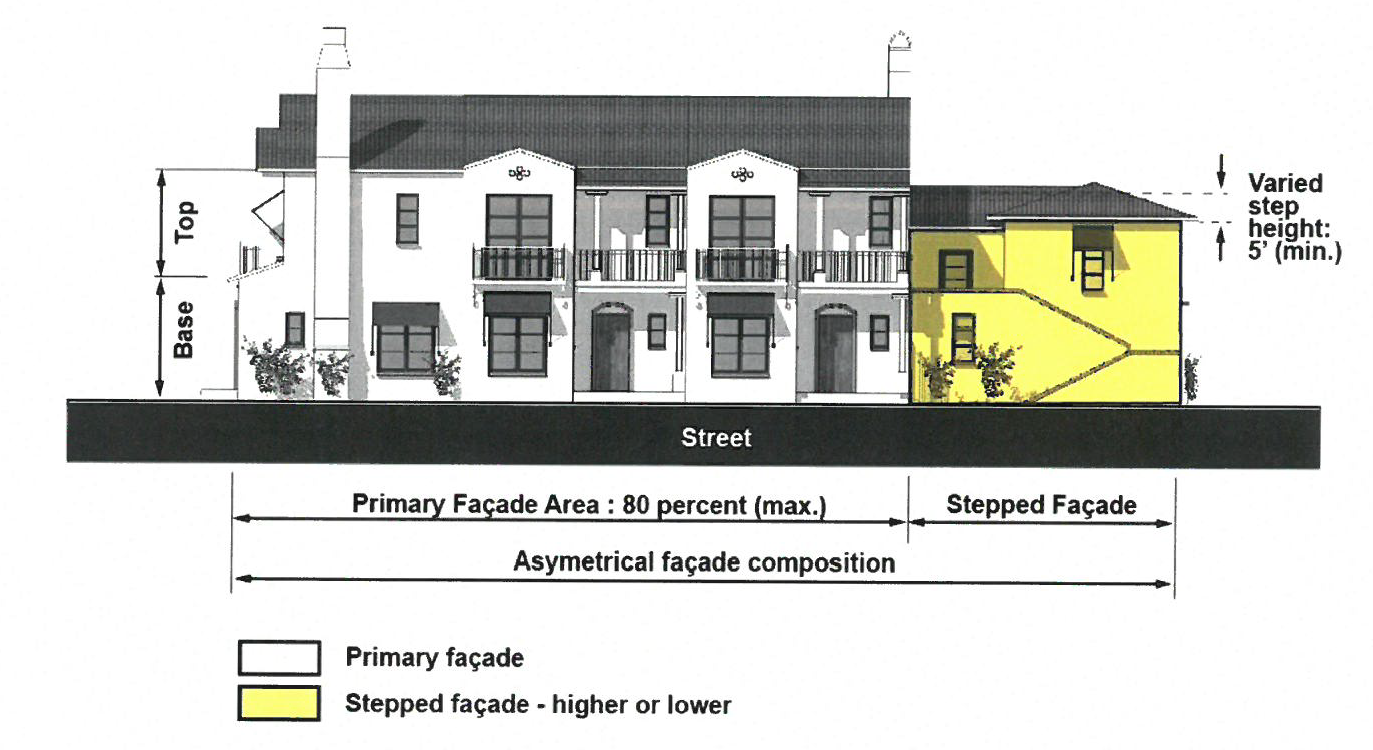
FIGURE 71.20.015.10
OPTION 2 STANDARDS VERTICAL MODULATION
i.
Façade height variation—Changes in façade height is not required for building two floors or less in height. Any variation in building façade height shall be asymmetrical. Where façade height variation is provided, a maximum of eighty (80) percent of the total primary façade area shall be of a uniform height. Stepped façade height shall be a minimum of five feet higher or lower than the primary façade height.
ii.
Vertical differentiation—Buildings two floors or greater are not required to provide façade differentiation between lower (base) and upper (top) floors. Use of functional and/or decorative horizontal belt courses that extend the entire length of the façade is prohibited.
iii.
Prohibited—Façades vertically modulated utilizing façade material and color changes to differentiate any portion of the base (first floor) from the top (second floor).
b.
Horizontal Modulation. Building horizontal façade modulation shall be achieved by providing façade recesses and/or projections. For all buildings greater than one story in height, façades shall be articulated horizontally as identified in Figure 17.20.015.11.
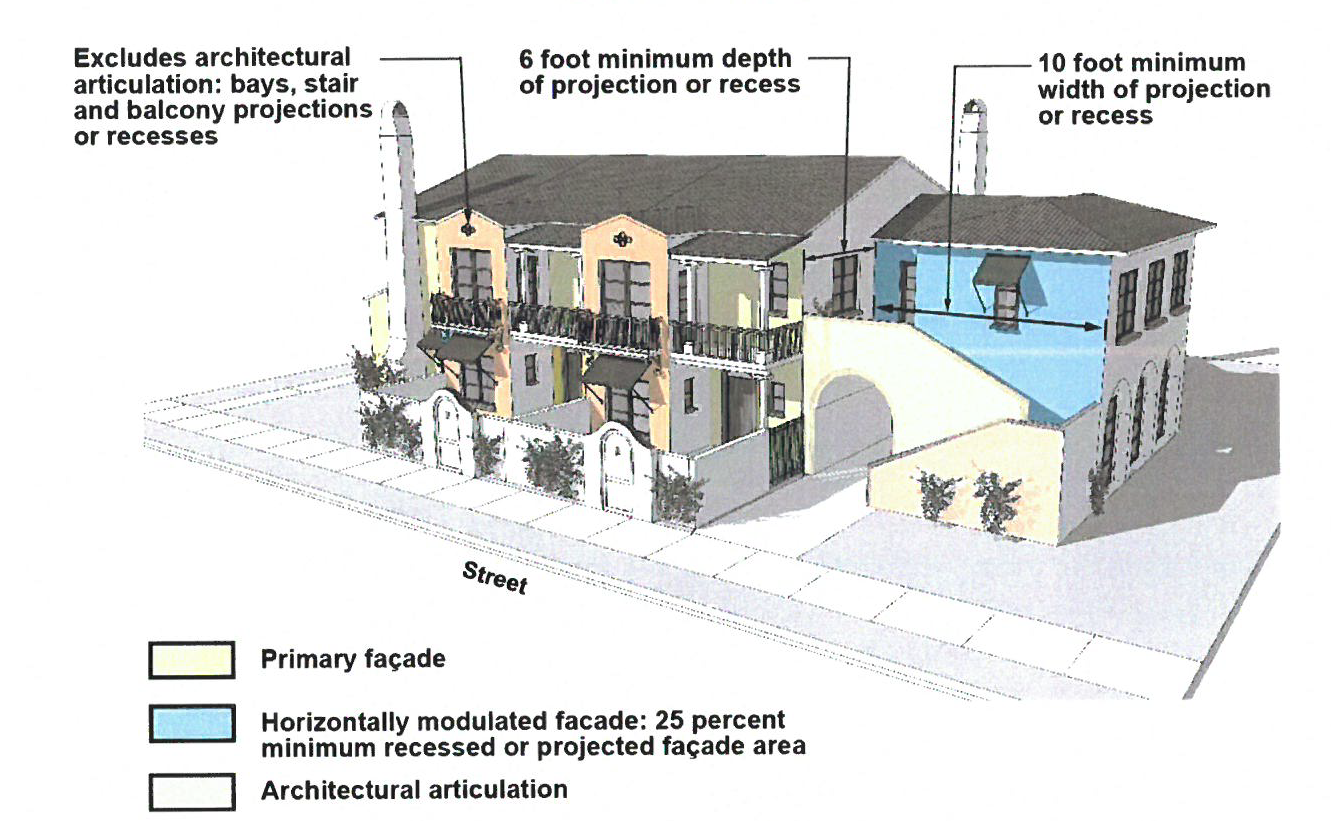
FIGURE 17.20.015.11
OPTION 2 STANDARDS VERTICAL MODULATION
i.
Arrangement—A minimum of twenty-five (25) percent of the total façade area shall be recessed or projected from the primary façade. Horizontal modulation variation in location, width, and depth is not required. Recessed or projecting balconies, exterior walkways, stairs, and stepback terraces shall be integrated as an essential component of all façade compositions.
ii.
Width—Recesses or projections shall be a minimum of ten (10) feet in width
iii.
Depth—Recesses and projections shall be six feet or greater in depth, measured from the primary façade of the building.
iv.
Articulation—Recessed or projecting balconies, bays, oriels, exterior walkways, stairs, and terraces shall be layered and integrated into the façade modulation as essential components of all façade compositions.
However, projecting or recessed balconies, bays, and oriel architectural articulation shall be excluded as part of the calculation of required recessed or projected façade modulation area.
c.
Roof Form and Materials. Roofs shall contribute to and complement façade variations in volume and massing. A variety of roof widths, heights, sizes, and forms are permitted but are not required. No roof overhang shall project more than one foot beyond any building façade or balcony. Any rooftop mechanical equipment shall comply with all rooftop screening standards of this ordinance.
i.
Roof forms—Sloped roof forms shall comprise a minimum of eighty (80) percent of the total roof area. Hipped or gabled roof forms with a minimum slope of 3:12 and a maximum slope of 4:12 shall be required. A maximum of twenty (20) percent of the total roof area shall be permitted to include flat roofs screened by mansards that have a minimum 3:12 and a maximum 4:12 roof slope.
ii.
Roof Materials—All sloped roofs shall consist of long-lasting, durable clay or concrete tiles. Standing seam metal, asphalt or wood shingle or shake roofs shall be prohibited.
d.
Façade Colors. All façade surfaces shall be painted. Paint color and finish shall be muted and flat to imitate colors found naturally in desert soil, trees, rocks, and other organic materials of the Coachella Valley. Paint hues and tones shall be limited to warm white shades and rich warm colors containing some brown, ranging from neutral tan to deep brown.
i.
Primary color and secondary façade colors—Utilization of a single façade color shall be permitted. A maximum of two paint colors shall be permitted. A primary color shall comprise a minimum of eighty (80) percent of total of all façades. A secondary color shall comprise a maximum of twenty (20) percent of any façade fronting a public realm.
ii.
Windows, doors, and trim colors—Limited to a maximum of three paint colors. Building windows shall be limited to shades of blue, black, or warm colors containing deep brown.
e.
Façade Materials. Façades shall be clad with durable and long-lasting materials that cannot be degraded by desert sun and high temperatures. Façades are permitted to be comprised of a single cladding material. No more than two façade materials shall be utilized for any façade.
i.
Primary façade materials—Where two materials are utilized, a primary material shall clad a minimum of eighty (80) percent of the total building façade area. A secondary material shall comprise no more than twenty (20) percent of any public realm fronting façade.
ii.
Permitted secondary materials include cast in place or precast concrete, decorative tiles, painted metal, treated or painted wood exposed structural beams, columns, and posts for balconies, trellises, or arcades.
iii.
Prohibited façade materials—Wood siding, cementitious siding, metal panel, glazed spandrel curtain wall, un-clad poured in-place concrete or concrete masonry block, stacked stone veneer siding, panels, or sheets; moulded simulated stucco (EIFS) cornices, belt, courses, door and widow trim, sills, and lintels.
f.
Balconies. Private balconies shall be provided for a minimum of twenty-five (25) percent of all residential units fronting the public realm.
i.
Articulation—Balconies are permitted to be recessed or projected from the building's primary or horizontally modulated façade.
ii.
Minimum depth—Balconies shall project or recess a minimum of six feet from the building's primary or horizontally modulated façade.
iii.
Shading—Balconies are permitted but not required to include a projecting roof structure above.
g.
Fenestration. The building façade shall be articulated to create visual interest and provide weather protection. The arrangement, location and of character of door, window openings shall be "punched in" to provide depth, shade, and shadow.
i.
Openings—A minimum of twenty (20) percent of all façades shall include window or door openings.
ii.
Recess depth—No window shall be flush with any building façade. All window and door openings shall be recessed a minimum of four inches. The recess shall be measured from the outer face of the window or door glazing to the outer edge of the primary façade cladding surface.
iii.
Projection depth—Projecting sills, lintels, and trim shall not be required for any window or door. Where provided, sills, lintels, and trim shall project a maximum of one inch beyond the façade cladding surface.
h.
Architectural Accents. Functional, structural or ornamental embellishment consistent with the architectural vernacular of the building is permitted. Architectural accents shall be used to reinforce vertical and horizontal modulation and provide visual interest to blank walls. The following design features shall be permitted to provide façade articulation and modulation:
i.
Awnings and canopies—Upper floor awnings or canopies are permitted over windows, doors, or balconies. Materials and colors of all canopies or awnings shall be complimentary with the overall building color palette. Interior-illuminated vinyl awnings are prohibited. Any integrated light fixture within a canopy or awning shall direct light downward toward the sidewalk or façade.
5.
Option 3 Standards. The standards are intended to result in simple horizontally emphasized, streamlined building form, volume, and massing.
a.
Vertical Modulation. Vertical modulation is not required for buildings two floors or less in height. Buildings shall be vertically modulated identified in Figure 17.20.015.12.
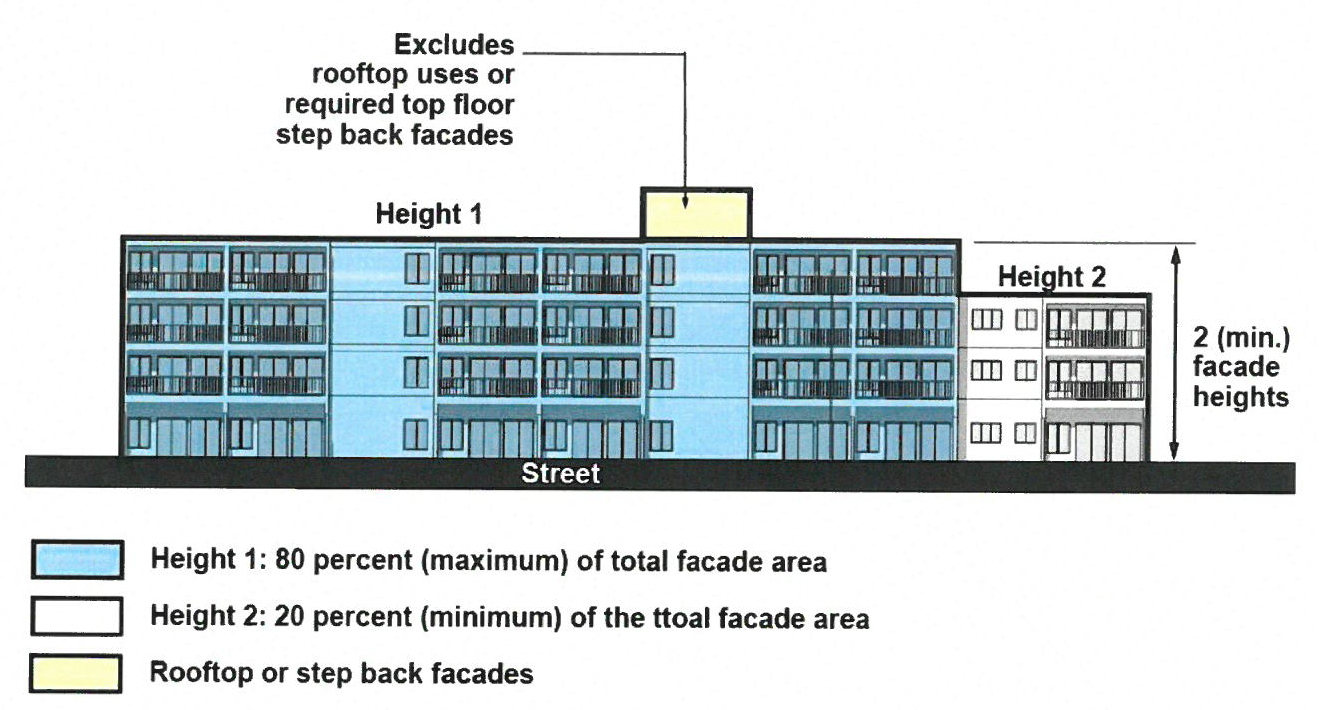
FIGURE 17.20.015.12
OPTION 3 STANDARDS VERTICAL MODULATION FOUR FLOOR BUILDINGS
i.
Variation—A minimum of two and a maximum of three building heights shall be required for all building façades. For sloped sites of more than five percent, a maximum of four façade height shall be permitted.
ii.
Arrangement—The primary façade shall not comprise more than eighty (80) percent of the total façade area.
iii.
Exemptions—Any required stair and elevator penthouse structure, rooftop mechanical, solar array screen walls, or rooftop common area structures shall not be included in the vertical modulation calculations.
c.
Horizontal Modulation. Building horizontal façade modulation shall be achieved by providing a uniform and consistent modulation in location, width, and depth of façade recesses and/or projections. For all buildings greater than two stories in height, façades shall be articulated horizontally as identified in Figure 17.20.015.13.
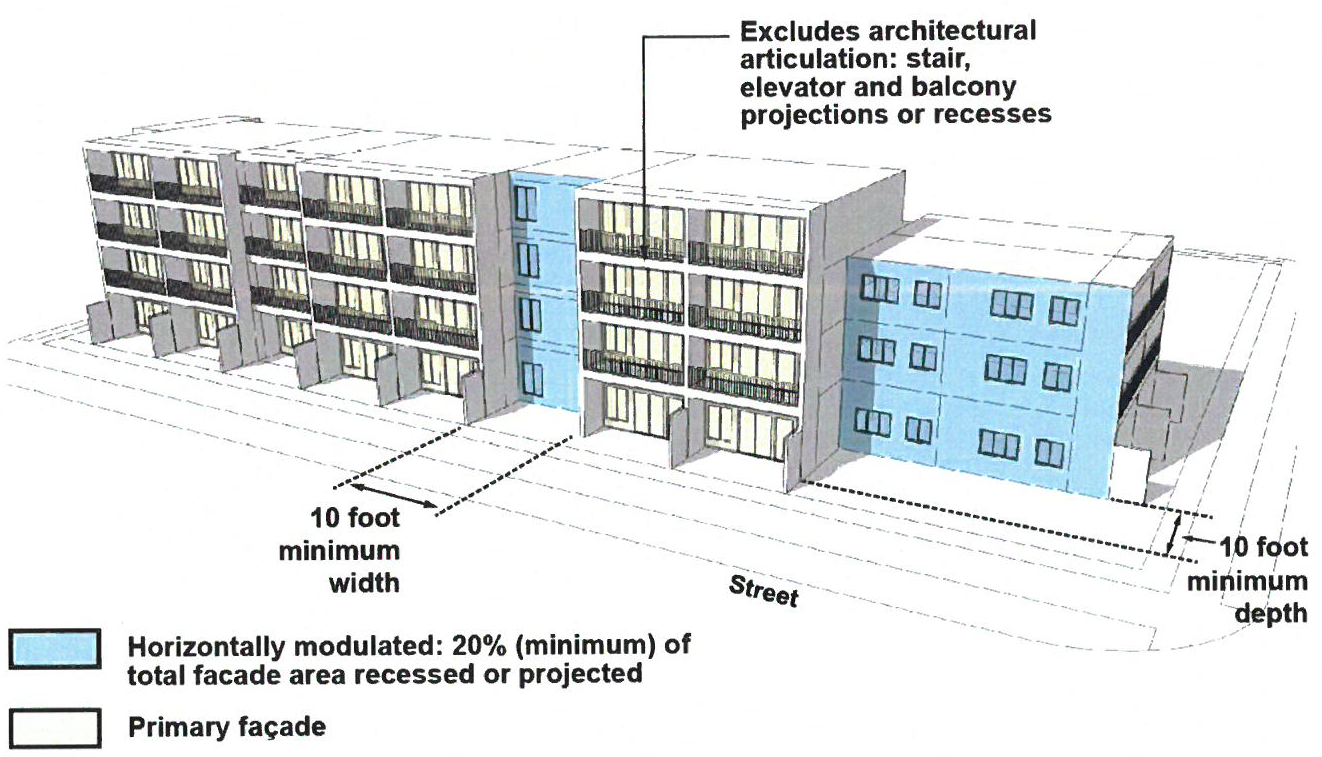
FIGURE 17.20.015.13
OPTION 3 STANDARDS HORIZONTAL MODULATION
i.
Variation—A minimum of twenty (20) percent of the total façade area of buildings shall be recessed or projected from the primary façade.
ii.
Width—Recesses or projections shall be a minimum of ten (10) feet in width.
iii.
Depth—Recesses and projections shall be a minimum of ten (10) feet and a maximum of thirty (30) feet in depth, measured from the primary façade of the building.
iv.
Articulation—Recessed or projecting balconies shall be integrated into the façade composition. However, recessed or projected stair and elevator vertical circulation, or balconies shall not be included as part of the calculation of required recessed.
d.
Roof Forms. Roofs shall contribute to and complement façade simple horizontal volume and massing. Stepping variation of roof height shall be minimized.
i.
Flat Roof Forms—All roofs shall be flat. Roofs shall permit minimal sloping to meet drainage requirements. All roofs shall have a uniform height for a minimum of eighty (80) percent of the building area. Parapets no greater than four feet in height are permitted. All roofs shall overhang a minimum of six-foot bond the building's primary façade.
ii.
Accent Roof Forms—Raised, angled shed, or lowered roofs shall be limited to roofs over the lobbies, stair and elevator vertical circulation, and rooftop common areas.
iii.
Prohibited—Hipped, gable, and mansard sloped roof forms.
e.
Façade Colors. Façades are not required to be painted. Painted façades are permitted to be painted a single paint color. Façades painted more than one color shall comply with the following standards.
i.
Primary and secondary colors—Façades shall be limited to a maximum of four paint colors. A primary color shall be used for a minimum of sixty (60) percent of all façades. The primary color shall be limited to warm white shades or rich, warm colors containing some brown (ranging from neutral tan to light brown). Primary paint color and finish shall be muted and flat to imitate colors found naturally in desert soil and rocks of the Coachella Valley. A secondary color(s) shall comprise a maximum of forty (40) percent of all façades. Secondary façades are permitted to utilize all the tints, tones, and hues of the full color spectrum.
ii.
Window and door colors—Windows and doors shall be limited to one paint color. Building windows shall be limited to shades of white or black or warm colors containing deep brown.
f.
Façade Materials. Façades shall be clad with durable and long-lasting materials that cannot be degraded by desert sun and high temperatures. Façades are permitted to be comprised of a single cladding material. No more than three façade materials shall be utilized for any façade.
i.
Primary façade material—The primary material shall be limited to metal panel, stucco or simulated stucco (EIFS), cast in place or precast concrete, or concrete masonry block, or masonry brick materials applied to a minimum of seventy-five (75) percent of the total façade area.
ii.
Secondary materials—Cast in place or precast concrete, decorative tiles, stone veneer, metal panels and glazed curtain walls are permitted.
iii.
Prohibited façade materials—Wood siding, cementitious siding; treated or painted wood exposed structural beams, columns, and posts for balconies, or trellises; moulded simulated stucco (EIFS) door and widow trim, sills, and lintels.
g.
Balconies. Balconies shall be required for all upper floor residential units.
i.
Articulation—Balconies are permitted to be recessed or projected from the building's primary façade.
ii.
Minimum depth—Balconies shall project or recess a minimum of six feet from the building's primary façade.
iii.
Minimum area—Sixty (60) square feet.
iv.
Shading—All balconies shall be required to include a projecting roof for top floors or a balcony structure above for lower floors.
h.
Fenestration. The building façade shall be articulated to create visual interest and provide weather protection. The arrangement, location and of character of door, window openings shall be "punched in" to provide depth, shade, and shadow. Door and window locations shall contribute to a symmetrical building form. Buildings following Option 3 shall comply with the following standards:
i.
Required openings—Façades shall be comprised of a minimum of fifty (50) percent openings for all façades fronting a public realm or common open space, excluding façades that contain stair or elevator vertical circulation.
ii.
Recess depth—No window shall be flush with any building façade. All window and door openings shall be recessed a minimum of two inches. The recess shall be measured from the outer face of the window or door glazing to the outer edge of the primary façade cladding surface.
iii.
Projection depth—Projecting sills, lintels, and trim shall not be required for any window or door. Where provided, sills, lintels, and trim shall project a maximum of one inch beyond the façade cladding surface.
B.
Residential Entry Standards. First floor residential entries shall be located to foster street-oriented pedestrian activity. Residential entrances of all multi-family or mixed-use buildings shall comply with the following standards.
1.
Lobby Entries. Primary common entrances for tenants, guests, and interior first floor common areas and staff offices shall be located at the first floor and shall be directly accessible from the Street Type A or Street Type B public realm, usable open space common area adjacent to the public realm, or a required front yard setback.
a.
At-grade Entrances. All multi-family and mixed-use zone lobby entrances shall be at-grade with the adjacent public realm sidewalk.
b.
Visibility. Lobby entrances shall have direct sight lines and continuous and unobstructed pedestrian access from the public realm.
c.
Prohibited Orientation. Lobby primary entries are prohibited from alleys, driveways, parking lots, or parking structures. Secondary entries are permitted from driveways, parking lots, or parking structures.
2.
Individual Residential Unit Entries. First floor residential unit entries are permitted fronting Street Type A, Street Type B, and Street Type C, driveways, and parking lots. Individual entrances shall be accessed from the adjacent public realm, usable common open space, or required setback as specified in Figure 17.20.015.14.
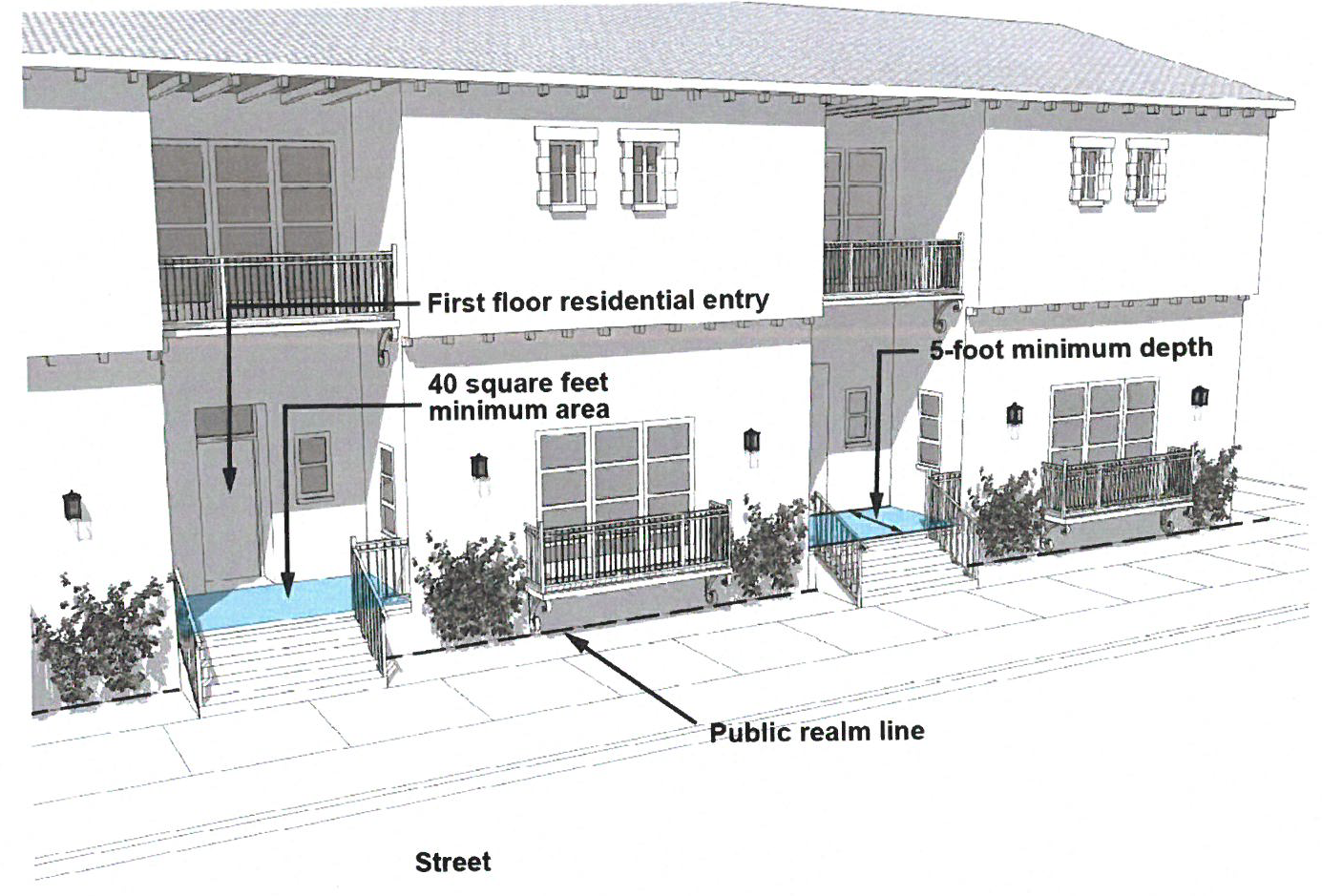
FIGURE 17.20.015.14
INDIVIDUAL RESIDENTIAL ENTRIES STANDARDS
a.
Universal Access. All multi-family and mixed use building first floor individual entries shall comply with all current California Building Code minimum requirements for multi-family or mixed-use building means of egress for exterior doors.
b.
Front Door Setbacks. All first-floor entrances shall be set back a minimum of 5 feet behind the public realm line.
c.
Minimum Dimensions. Entry landing or stoops not including stairs, shall be a minimum of forty (40) square feet. Individual residential entries accessed directly from the public realm and shall have a minimum walkway, ramp, and/or stairs width of six feet for single unit entries. Landings or stoops shall be a minimum of one foot wider than the entry doorway width.
C.
First Floor Transparency Standards. First floor commercial façades shall be designed to generate passive surveillance 'eyes on the street' visibility by engaging the public realm and providing transparency between the pedestrian realm and first floor uses. This standard applies only to portions of at-grade first floor façades that contain occupied commercial uses fronting the public realm. All multi-family mixed use development shall comply with the following standards as specified in Figure [17.20.015.15].
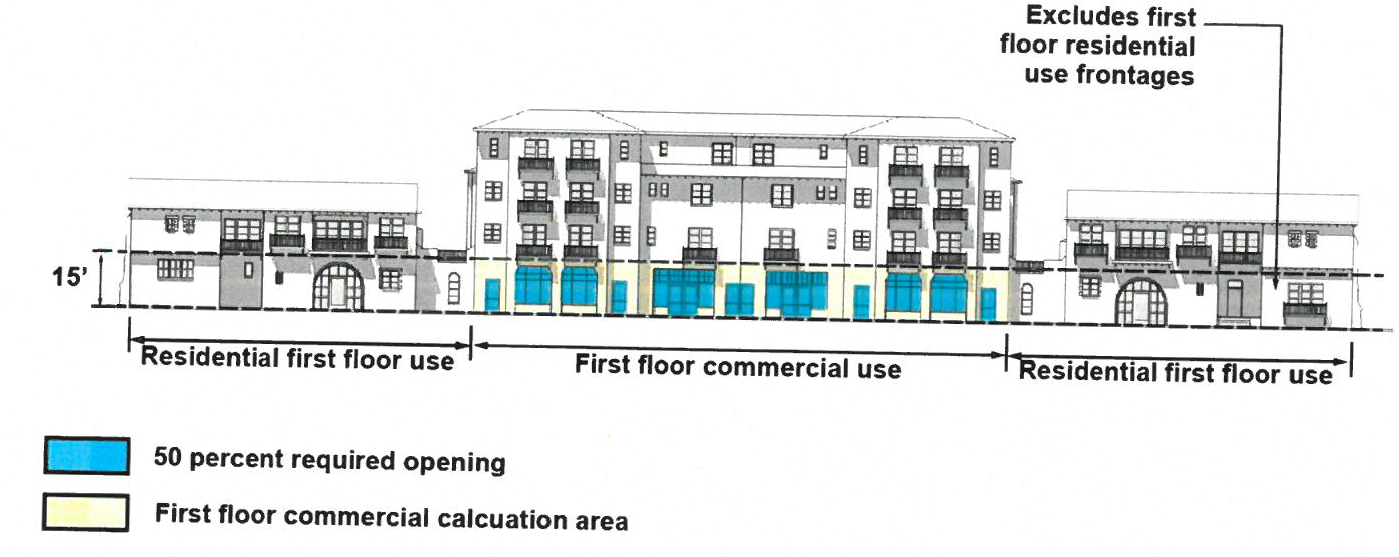
FIGURE 17.20.015.15
FIRST FLOOR TRANSPARENCY STANDARDS
1.
Calculation. The first-floor façade opening area shall include the area the primary façade measured vertically between the finished floor elevation and fifteen (15) feet above the first finished floor elevation multiplied by the horizontal length of the interior occupied use.
a.
Openings. A minimum of fifty (50) percent of first floor façades shall include transparent glazed doors and window openings.
b.
Window and Door Systems. All window and door components including the frame, jamb, head, sill, mullions, muntins, and glazing shall comprise an opening. Any decorative window or door trim around the window or door frame shall not be included as part of the opening calculation.
c.
Prohibited Glazing. No dark-tinted or opaque glazing for any required wall opening along first floor public realm façades is permitted. Dark-tinted and opaque windows shall be defined as having less than a minimum visible transmittance of fifty (50) percent, including any tint, treatment, or application on glazing.
d.
Exceptions. The first-floor façade opening calculation requirements does not apply to façades where perpendicular recessed or projected wall area occur; and where internal vertical stair and elevator circulation stairs and elevators, loading, and storage, or parking facilities occur.
(Ord. No. 1206, § 2(Exh.), 9-13-23)

