
Cocoa City Zoning Code
ARTICLE XII
OFF-STREET PARKING AND LOADING REGULATIONS3
Editor's note— Section 1(A) of Ord. No. 8-96, adopted Nov. 12, 1996, repealed Art. XII in its entirety. Formerly, Art XII consisted of §§ 1—3, which pertained to off-street parking and loading regulations and derived from § 6 of Ord. No. 1618-7, adopted May 25, 1976; § 1 of Ord. No. 1618-11, adopted May 10, 1977; § 1 of Ord. No. 37-82, adopted Dec. 14, 1982; § 1 of Ord. No. 20-84, adopted July 10, 1984; and § 9 of Ord. No. 7-88, adopted Mar. 8, 1988. Section 2 of Ord. No. 8-96 provided for a new Art. XII as herein set out.
Sec. 1. - Off-street parking and loading regulations.
(a)
Intent. The general intent of this article is to promote the public health, safety, welfare, economic order, aesthetics, and quality of life, but more specifically; To provide standards for the safe ingress/egress to parking areas; to provide for the temporary storage of vehicles on-site for patrons, workers, or residents; to promote a pleasing community appearance; to provide for on-site traffic flow and safety; to provide for the protection of residential areas from visual effects, noise and solar heat or excess stormwater runoff, to protect the value of land and buildings; to improve the optimal utilization of undeveloped and redeveloped tracts of land; and to prevent safety hazards along roadways and provide for free-flowing traffic on streets.
(b)
Applicability. This article and the design standards set forth herein shall apply to all new development and redevelopment within the City of Cocoa.
(c)
Definitions.
(1)
Off-street parking. A minimum rectangular parking area measuring ten (10) feet by twenty (20) feet, exclusive of access drives and aisles. The length of a space can be reduced to eighteen (18) feet if the space abuts a grass landscape strip measuring at least five (5) feet wide or a sidewalk measuring at least six (6) feet wide. Parallel curb parking spaces shall measure a minimum of nine (9) feet by twenty-two (22) feet. Compact parking spaces shall measure a minimum eight and one-half (8½) by sixteen (16) feet. Compact parking spaces may comprise up to twenty-five percent (25%) of the total provided parking spaces.
Motorcycle parking may comprise up to five percent (5%) of the total required parking spaces. Motorcycle parking spaces shall measure a minimum of four (4) feet by nine (9) feet. An equivalency factor of one (1) automobile space to four (4) motorcycle spaces shall be utilized in calculating the total permitted motorcycle spaces. Motorcycle parking spaces may be situated in tandem. A tandem space shall mean a space where one (1) motorcycle is parked behind another. No more than two (2) motorcycle spaces shall be in tandem.
(2)
Parking garage. A parking garage is any structure that consists of a building structure used for parking of vehicles on one (1) or more levels.
(3)
Parking lot. A parking lot is a designated area used for the parking of vehicles for a specific business, industry, service facility, residential complex, mixed use building or activity center. Parking lots shall be constructed on property other than public rights-of-way.
(4)
Parking space, off-street. An off-street parking space is a minimum paved area used for the parking of a single vehicle, exclusive of access drives or aisles. Truck loading and unloading space shall not be included in such area.
(5)
RV/ trailer parking space. A parking space designed to accommodate a recreational vehicle (motorhome, fifth wheel, camper, pop-up, boat or other water craft on a trailer, etc.) by itself or with a towing vehicle and measuring at least ten (10) feet by forty (40) feet long.
(6)
Paved surface. A paved surface is a hard surface consisting of concrete, bituminous asphalt, or similar surfacing material as approved by the city engineer.
(7)
Stacking space. An area of ten (10) feet by twenty (20) feet minimum to allow for vehicles waiting for service.
(d)
Requirements for off-street parking. There shall be provided at the time of the erection of any main building or structure or at the time any main building or structure is enlarged or increased in capacity by adding dwelling units, guests rooms, floor area, seats, or change of use which changes parking generating factors, minimum off-street parking spaces with adequate provisions for ingress or egress in accordance with the following requirements:
(1)
Adult congregate living facilities (ACLF) One (1) space for each employee on the largest working shift plus two (2) spaces for each three (3) living units. An intermediate care ACLF shall provide parking as required for a nursing home.
(2)
Art galleries. One (1) space per five hundred (500) square feet of gross floor area.
(3)
ATMs (automatic teller machine). One (1) parking spaces plus one (1) handicapped parking space per walk-up ATM not provided as an accessory use.
(4)
Auditoriums or other places of assembly. One (1) space for each two (2) seats of seating places or one (1) space for each sixty (60) square feet of floor area in the total main assembly hall, whichever is greater. One-half (½) of total parking area must be paved; the other half may be hard stabilized surface with grass, curbing, and landscaping.
(5)
Automotive impounding yards. One (1) customer parking space per ten (10) impounded vehicle storage spaces, plus one (1) space per employee.
(6)
Automotive service stations, automotive repair facilities, truck stops/large vehicle services stations and automotive body shops. Two (2) spaces for each service bay and one (1) space for each employee per maximum shift. Service bays shall not be counted as a parking space towards this requirement.
(7)
Bakeries—Retail. One (1) space per six hundred (600) square feet of gross floor area.
(8)
Beauty salons, barber shops, nail salons, tattoo parlors, massage and day spas. Two (2) spaces per station.
(9)
Bed and breakfasts. One (1) space for each guest room plus two (2) spaces for the residence.
(10)
Business, retail or commercial building. One (1) space for each six hundred (600) square feet of gross floor area excluding storage area, and subject to section (d)(47), parking area ratio.
(11)
Carwash establishments. When associated with a gas station or convenience store, one (1) parking space per wash unit or bay and one (1) space per vacuum shall be required; an automatic, independent carwash establishment shall provide the following parking spaces: Two (2) spaces per automated wash facility, plus one (1) space per employee on the largest working shift and one (1) space per vacuum. A self-service carwash (coin-operated type) shall provide the following parking spaces: One (1) space per vacuum, one (1) space per bay, plus one (1) parking space per employee. Wash bays shall not be counted as parking spaces. Plus two (2) stacking spaces per wash bay.
(12)
Adult/Child care centers (day care). One (1) employee space for each three hundred (300) square feet of gross floor area, plus a minimum of two (2) drop-off spaces per one thousand (1,000) square feet of floor area.
(13)
Places of worship. One (1) space per four (4) seats or seating places, or one (1) space per each one hundred fifty (150) square feet of floor area in the main assembly hall, whichever is greater. One-half (½) of the total parking area must be paved; the other half may be a hard, stabilized surface with grass.
(14)
Clubs and lodges. One (1) parking space for each three (3) seats or seating places, or one (1) space for each one hundred (100) square feet of floor area of the largest area of assembly within the building, whichever is greater. One-half (½) of total parking area must be paved; the other half may be hard, stabilized surface with grass.
(15)
Bars, nightclubs and cocktail lounges. One (1) space for each one hundred (100) square feet of floor area excluding accessory storage area.
(16)
Communications broadcasting studios/facilities. One (1) space per six hundred (600) square feet of gross floor area, excluding storage areas.
(17)
Community center buildings. One (1) space per three hundred (300) square feet of gross floor area, plus one (1) bicycle space per one thousand (1,000) square feet of floor area.
(18)
Convenience stores. One (1) space per five hundred (500) gross square feet plus two (2) employee spaces. When associated with a service station, pump island spaces may count up to twenty-five percent (25%) of the motor vehicle parking requirement.
(19)
Domestic violence shelters. One (1) parking space shall be provided for each six hundred (600) square feet of living area, plus one (1) space per employee on the largest working shift.
(20)
Education facilities. Faculty and staff: one (1) space for each member; high schools - one (1) space for every ten (10) students above grade ten (10); Vocational schools - one (1) space for every two (2) students; community colleges - one (1) space for every two (2) students.
(21)
Financial institutions and brokerage houses. One (1) space per each six hundred (600) square feet of gross floor area, excluding storage areas, and subject to section (d)(47), parking area ratio.
(22)
Funeral homes and mortuaries. One (1) space for each three (3) seats or seating places excluding areas needed for funeral vehicles. One-half (½) of the total parking area must be paved, the other half may be hard surface with grass.
(23)
Furniture, carpet and major appliance stores. One (1) space for each eight hundred (800) square feet of gross floor area.
(24)
Homeless shelter facilities. One (1) space for each employee on the largest working shift plus one (1) space per thirty (30) persons sheltered.
(25)
Hospitals. (1) space for each two (2) patient beds, plus one (1) space for every one and one-half (1½) employees on the largest working shift, one (1) space per doctor on the largest working shift, and two (2) spaces for emergency room bed. Employee parking must be available for each shift at least sixty (60) minutes prior to the beginning of the shift.
(26)
Hotels, motels and rooming houses. One (1) space for each sleeping unit plus one (1) space for the owner or manager, and one (1) space for each three (3) employees. If restaurant facilities or cocktail lounges are included fifty percent (50%) of the required parking for a restaurant shall be provided.
(27)
Libraries and museums. One (1) space per each eight hundred (800) square feet of gross floor area.
(28)
Manufacturing industrial uses and industrial assemblies. One (1) space for each two (2) employees on the largest working shift, plus one (1) space for each company vehicle.
(29)
Marinas (commercial). One (1) space for each two (2) slips in wet storage, one (1) space for each four (4) spaces in dry storage, and one (1) space for each five hundred (500) square feet of sales area.
(30)
Medical and dental clinics, doctor and dentist offices, animal hospitals or veterinary clinics. One (1) space per each two hundred fifty (250) square feet of building area excluding accessory storage, and subject to section (d)(47), parking area ratio.
(31)
Mixed-use buildings. See section 2(d)(38), residential uses.
(32)
Motor vehicle sales (car, trucks, boats). One (1) space per five hundred (500) square feet of enclosed floor space; one (1) space per two thousand (2,000) square feet of outdoor display area; one and one-half (1½) spaces per employee; and one and one-half (1½) spaces per service bay. The required employee parking space must be identified as "employee parking only."
(33)
Nursing and convalescent homes and sanitariums. One (1) space for each three (3) beds, plus one (1) space for every one and one-half (1½) employees on the largest working shift, exclusive of spaces required for doctors (doctor spaces shall be provided in accordance with subsection (30) above.
(34)
Office and professional buildings and studios. One (1) space for each six hundred (600) square feet of gross floor area excluding accessory storage area, and subject to section (d)(47), parking area ratio.
(35)
Police/fire stations. One (1) space per employee on the largest working shift, plus two (2) additional spaces for the public.
(36)
Recovery homes/halfway houses. One (1) space per employee on the largest working shift plus one (1) space per four (4) on-site clients or bed spaces. If clients are not permitted to have vehicles on site, one (1) space per six hundred (600) square feet of gross floor area is required in addition to employee parking.
(37)
Recreation centers/facilities. If the proposed recreational use includes stadium/bleacher seating, there shall be one (1) space per four (4) spectator seats required in addition to the required parking set forth in this subsection below. One (1) seat equals two and one-half (2½) feet of bench length.
a.
Health clubs, gymnasiums or other recreational facilities. The cumulative total of each of the following:
1.
One (1) space per three hundred (300) square feet of gross floor area;
2.
One (1) space per two (2) employees on the largest working shift;
3.
One (1) space per three (3) seats in a lounge or restaurant area;
4.
Five (5) spaces per racquetball/handball court;
5.
One and one-half (1½) per nautilus machine;
6.
Additional parking must be provided for other uses if listed below.
b.
Tennis courts. Two (2) spaces per court.
c.
Tournament tennis stadiums. One (1) space per four (4) spectator seats.
d.
Batting cages. One (1) space per cage.
e.
Go-cart tracks. Ten (10) spaces per track.
f.
Miniature golf. Twelve (12) spaces per course plus one (1) per employee on the largest working shift.
g.
Baseball/softball fields. Ten (10) spaces per field, plus one (1) space per four (4) spectator seats (one (1) seat equals two and one-half (2½) feet of bench length).
h.
Swimming pools. One (1) space per forty (40) square feet of swimming pool surface area.
i.
Volleyball courts. Ten (10) spaces per court.
j.
Shuffleboard courts. Two (2) spaces per court.
k.
Gymnasiums. One (1) space per three (3) seats.
l.
Golf courses. Forty-five (45) spaces per nine (9) holes.
m.
Golf driving ranges (as a primary use). One (1) space per tee box.
n.
Watercraft launch facilities. Five (5) trailer parking spaces per launch site.
o.
Active park areas. Four (4) spaces per acre up to ten (10) acres, two (2) spaces per acre from ten (10) to fifty (50) acres, one (1) space per acre for every acre over fifty (50) acres.
p.
Passive park areas. One (1) space per acre up to ten (10) acres, one (1) space per every five (5) acres thereafter.
q.
Recreation buildings. One (1) space per five hundred (500) square feet of gross floor area.
r.
Football/soccer field not associated with a stadium. Forty (40) spaces of which one-half (½) must be paved and the other one-half (½) may be hard surfaced with grass, curbing and landscaping.
s.
Stadiums. One (1) space per each three (3) seats.
(38)
Residential uses.
a.
Single-family: Two (2) spaces per dwelling unit.
b.
Duplex: Two (2) spaces per dwelling unit.
c.
Townhouse: Two (2) spaces per dwelling unit; for townhouse developments with shared or common parking - one and one-half (1½) spaces per dwelling unit.
d.
Multi-family:
i.
Efficiency unit - One (1) space per dwelling unit.
ii.
One (1) bedroom unit - One and one-half (1½) spaces per dwelling unit.
iii.
Two (2) or more bedroom unit - Two (2) spaces per dwelling unit.
e.
Mixed-use buildings with a multi-family residential component: One and one-half (1½) spaces per dwelling unit plus the number of spaces required by this subsection (d) based on the non-residential use. The non-residential component of a mixed-use building may provide up to fifty percent (50%) of the required parking off-site. Off-site parking spaces shall be within five hundred (500) feet of the mixed-use building. On-street parking may be used in providing off-site parking spaces within the Central Business District Zoning District with approval of the community development director.
f.
Multi-family in Cocoa Village Overlay: One (1) space per dwelling unit. Multi-family developments with twenty (20) units or more shall provide an additional ten percent (10%) parking spaces for guests.
(39)
Restaurants. Free-standing, traditional restaurants shall provide One (1) space per each three (3) seats or seating places. Traditional restaurants within a multi-use or mixed-use building shall provide one (1) space per each four (4) seats or seating places; one (1) space per employee on the largest working shift. Restaurants with no seating shall provide one (1) space per employee on the largest working shift. If a pickup area is provided, three (3) additional spaces shall be provided. Fast-food restaurants shall provide one (1) space per two hundred(200) square feet, plus five (5) stacking spaces for drive-through. Traditional and fast-food restaurants shall be subject to section (d)(47), parking area ratio.
Open-air seating shall be calculated at 50% of the above rates. Approved sidewalk cafes located on public right-of-way are exempt from parking requirements.
(40)
RV parks. One (1) space for each RV unit and one and one-half (11/2) parking spaces per site with at least one (1) parking space other than the RV space at the site.
(41)
Storage facilities. One (1) space for every one thousand (1,000) gross square feet of floor area. Self-service storage facilities shall have one (1) parking space for the office manager, one (1) parking space for each six hundred (600) square feet of office space, one (1) parking space for each fifty (50) storage units, and one (1) parking space for each five hundred (5,000) square feet of major recreational equipment storage area.
(42)
Theaters. One (1) space per three (3) seats, plus one (1) space for each employee for the maximum shift.
(43)
Warehouse and packing facilities. One (1) space per one thousand two hundred (1,200) square feet of gross floor area, one (1) space per each two (2) employees on the largest working shift, one (1) space for each company vehicle.
(44)
Parking uses not listed. The following standards shall apply when no specific parking space standards or similar requirements pertaining to parking is available concerning the use of property/building:
a.
Where a specific use is not listed, the parking requirements of a similar use shall apply. The community development director shall determine the required parking upon submittal of a developmental plan indicating the proposed uses(s).
b.
Where there is no use of a similar nature as determined by the planning and zoning administrator, the community development director shall determine the required parking necessary, after considering all the parking generating factors involved for the use.
(45)
Central Business District including the Cocoa Village Overlay. The Central Business District, as defined in the City of Cocoa Code, shall have the following special parking requirements:
a.
Whenever there is a change of use or use intensity which changes parking generating factors in a building existing as of August 10, 2004 and the gross floor area of the existing building remains unchanged, no additional parking or loading spaces will be required; however, increases in residential dwelling units shall meet the parking requirements outlined above for specific uses.
b.
The demolition or removal of a building existing as of August 10, 2004 and replacement of that building without the provision of additional parking will be permitted as long as the new building does not eliminate any existing parking or loading spaces and the square footage is increased by no more than one hundred (100) square feet over the original building square footage.
c.
When there is an increase of the gross floor area of a building existing as of August 10, 2004 by more than one-hundred (100) square feet or construction of a new building having a greater gross floor area, then parking and loading spaces shall meet the parking requirements outlined above for specific uses.
(46)
Handicapped parking.
a.
Required parking. Parking spaces for the physically handicapped shall be located as close as possible to walkways and entrances. Signs and pavement striping and marking shall be provided, indicating the handicap parking spaces(s). Handicap parking spaces shall be provided according to the table below. All parking spaces, ramps, and sidewalks shall be designed in conformance with Florida Statutes, Chapter 316.
b.
If five (5) or fewer regular parking spaces are required, then the required handicapped accessible parking space shall be in addition to the amount of required parking spaces. If more than five (5) parking spaces are required, then the required number of accessible parking spaces shall be inclusive in the total number of required parking spaces.
c.
Additional accessible parking spaces shall be required for facilities that provide medical care and other services for persons with mobility impairments in accordance with state and federal "Americans with Disabilities Act" standards.
(47)
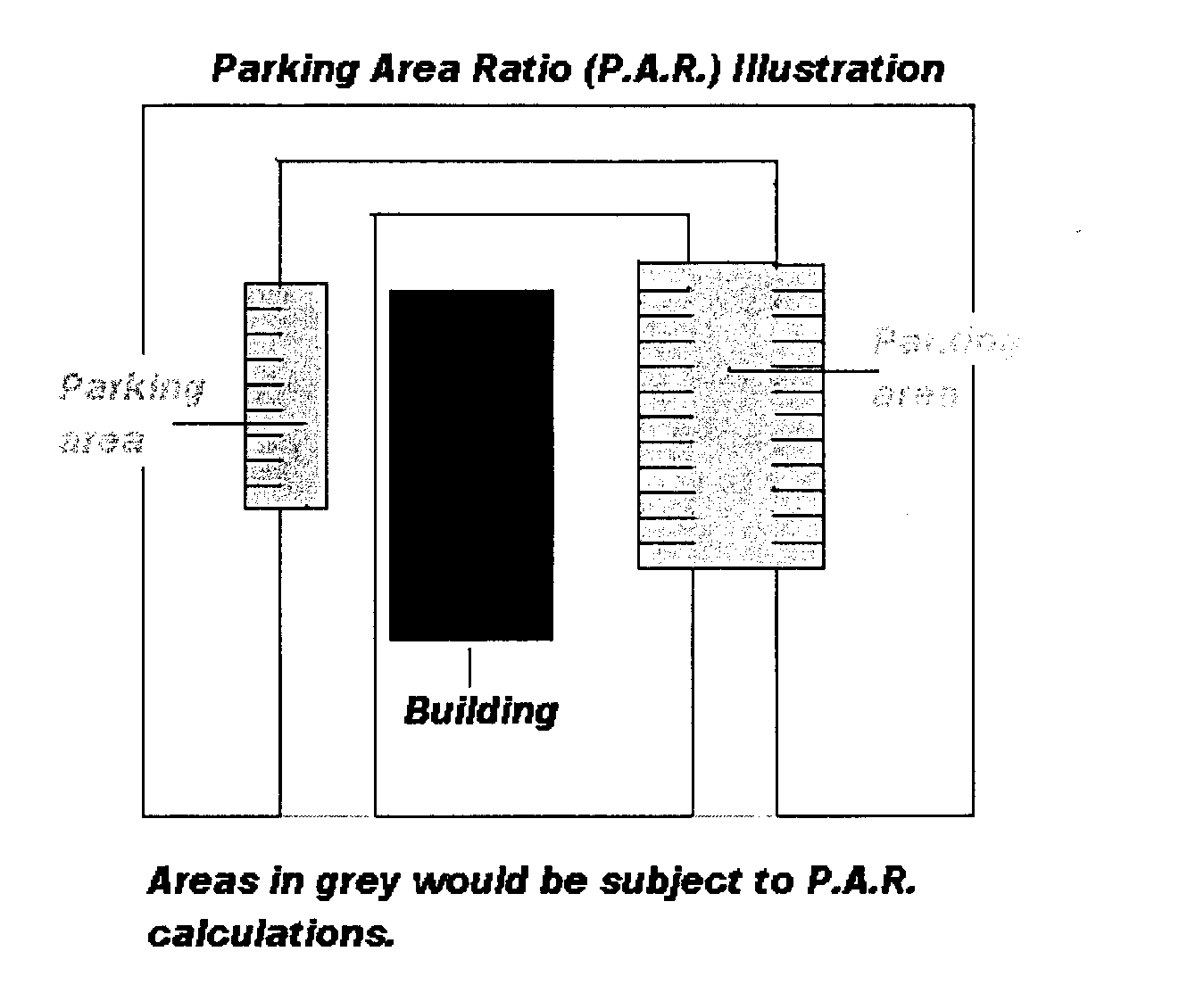
Parking area ratio (P.A.R.). The maximum site area that may be dedicated to parking spaces and associated drive aisles for the uses set forth in the table below shall be limited to the identified P.A.R. ratio based on the building square footage and according to the following formula:
Formula: Square footage of use × P.A.R. = Total area permitted to be dedicated to parking spaces and drive aisles.
Only drive aisles abutting parking spaces shall count towards maximum area. Drivethru aisles and stacking spaces shall not count towards maximum area. (See illustration below.)
Proposed parking areas in excess of the P.A.R. shall be of a hard stabilized pervious or semi-pervious surface approved by the city engineer and community development director.
(48)
Bicycle parking.
(a)
Bicycle parking areas shall consist of a rack or other facility that shall:
(1)
Be designed to allow each bicycle to be supported by its frame;
(2)
Be designed to allow the frame and wheels of each bicycle to be secured against theft;
(3)
Be designed to avoid damage to the bicycles;
(4)
Be anchored to resist removal and solidly constructed to resist damage by rust, corrosion, and vandalism;
(5)
Accommodate a range of bicycle shapes and sizes and to facilitate easy locking without interfering with adjacent bicycles;
(6)
Be located to prevent damage to bicycles by cars;
(7)
Be consistent with the surroundings in color and design and be incorporated whenever possible into building or street furniture design;
(8)
Be located in convenient, highly-visible, active, well-lighted areas;
(9)
Be located so as not to interfere with pedestrian movements;
(10)
Be located as near the principal entrance of the building as practicable;
(11)
Be located so as to conveniently access the pedestrian system.
(b)
Except as required for the uses in the table below, one (1) designated bicycle parking area with bike rack shall be provided for every ten thousand (10,000) square feet of commercial or office building space. Each bike rack shall be designed to provide parking for at least five (5) bicycles at one time.
(Ord. No. 8-96, § 2, 3-12-96; Ord. No. 32-04, § 2, 2-10-04; Ord. No. 12-2011, § 2, 9-13-2011; Ord. No. 06-2020, § 2, 7-8-2020)
Sec. 2. - Procedure for calculating the required number of spaces.
(a)
Methodology. This section provides the methodology for calculating parking spaces.
(1)
Any fractional portion shall be counted as one (1) additional required space. The fractional proportion shall be based on increments of square footage, based on the gross floor area.
(2)
When subtracting out storage area, the maximum allowable area shall be limited to ten percent (10%).
(3)
If a parking lot serves two (2) or more uses where the operating hours of the uses do not overlap, the total required number of parking spaces may be reduced. In no case, however, shall the number of spaces required be less than the sum of the largest number of spaces required. The planning and zoning division shall determine the conditions of overlapping requirements and the amount of reduction in the required number of spaces permitted in accordance with this subsection.
(4)
Parking spaces which are covered or are located within parking structures, garages, or shelter shall be considered as regular parking spaces for purposes of determining the size dimensions and total number.
(5)
The sum of parking provided for each individual use listed in section 1(d) of this article shall be the total amount of parking required except as provided for as listed above.
(b)
[Reserved.]
(Ord. No. 8-96, § 2, 3-12-96)
Sec. 3. - Minimum standards for the design of off-street parking areas.
This section provides minimum standards for the required design of areas including parking lots, drive aisles, setbacks, yard areas and other off-street and vehicular use areas. Parking or additional parking required as a result of new construction, a change in use of an existing structure, or modification of a nonconforming site requires that Code complying landscape improvements be shown on a site plan.
(a)
Intent. The intent and purpose of this section is:
(1)
To improve the appearance of required setbacks and yard areas as well as parking lots and other vehicular use areas which will help to protect and preserve the appearance, character and value of the surrounding area and thereby promote the general welfare and aesthetic qualities of the city;
(2)
To create buffer areas between properties of different zoning classifications and to reduce nuisances of incompatibilities between abutting land uses; and
(3)
To establish minimum criteria for off-street parking areas by providing for the safety and general welfare.
(b)
In no case shall any parking space or drive be located within five (5) feet of any property line or within ten (10) feet of any right-of-way line, except as provided in subsection (o).
(c)
Parking space for all dwellings shall be located on-site. Parking spaces in all commercial districts (excluding the Central Business District) shall be located on-site except as provided for in section l(d)(38), off-street parking and loading regulations, and section 5, location of off-street parking lots, of this article.
(d)
Minimum spaces required and use areas. Required off-street parking areas for four (4) or more vehicles serving uses other than single-family dwellings shall have individual spaces marked, and shall be so designed, maintained, and regulated in such a manner that no parking or maneuvering incidental to parking shall be on any area, public street, sidewalk, or alley, and so that any vehicle may be parked and unparked without moving another.
(e)
Plan required. A plan showing off-street parking, to be developed with or without building improvements, shall be submitted and approved by the city engineer and planning and zoning division of the city before a permit is issued for the construction of, or use of the building, structure or accessory, or separate parking facility being considered. This plan shall show the location, and accurately designate the number of required spaces, their size, access aisle, driveways, and their relation to the plan and required landscaping.
(f)
Access and accessibility. Each parking space shall be directly accessible from an aisle or driveway leading to a street or alley. Access aisles and/or driveways shall be of sufficient size to permit convenient ingress and egress. Each parking space, with the exception of parking spaces for one- and two-family units and motorcycle tandem spaces, shall be accessible without driving over or through any other parking space. No parking space or loading space shall be located in such manner as to block entry or exit to a building, or ramped curb for handicapped access, and in this respect a clearance shall be provided adjacent to an entrance or exit door equal to the width of the door or three (3) feet, whichever is the greater. No parking space shall be permitted which would require backing into the right-of-way except from single-family and two-family driveways, and mixed use buildings within the CBD, which may allow for parking to back out onto a city right-of-way with the approval of the community development director and public works director.
(g)
Paved parking required. All off-street parking, loading areas, maneuvering space and associated driveway aisles shall be paved with an asphalt, concrete or other surfacing approved by the city engineer, afford adequate drainage, and meet reasonably acceptable engineering specifications. All individual spaces shall be marked and designed, maintained and regulated in such a manner that no parking or maneuvering incidental to parking shall be on any public street, sidewalk, or alley, and so that any vehicle may be parked and unparked without moving another. When approved by both the city engineer and community development director, paving may be reduced using the following conditions and determinants:
a.
Whether total paving would have a detrimental effect upon existing unpaved roads or water quality.
b.
Whether operations or activities (churches, equipment storage yards, etc.) are such that the use of certain portions of the parking and/or loading areas would only be used on an intermittent basis.
c.
Where paving has been reduced or waived, a stabilized surface acceptable to the city engineer and community development director shall be provided for the entire required parking area.
d.
Where allowed by section 1(d), requirements for off-street parking, of this article.
(h)
Light. If lighting is provided, it shall be positioned to reflect away from residential areas and from any public street or highway and meet the standards of the zoning code.
(i)
Aisle widths. Off-street parking areas shall be designed so that there is an unrestricted flow and circulation of traffic within the parking lot as well as the site ingress/egress points. One-way traffic lanes shall be clearly marked on the paved surface to show the flow of traffic. "Pull through" parking design shall be permitted when necessary to serve special type vehicles such as truck trailers, boat trailers and similar vehicles. The following table shall govern the minimum width of traffic lanes within the parking area:
(j)
Curbing shall be required along the perimeter of paved areas to protect from vehicular encroachment. When curbing is used as a wheel stop abutting a sidewalk, grassed, or landscaped area, the dimension of the parking space depth requirement may be reduced by two (2) feet. Curbing shall be standard (not Miami type). When curb parking abuts a sidewalk, the sidewalk width shall be increased by two (2) feet to allow for vehicle overhang.
(k)
Parking areas abutting a residential district shall be adequately screened by an opaque screen not less than six (6) feet in height and located back of the building setback line.
(l)
Whenever an off-street parking area is designed to provide parking of vehicles in six (6) rows or more, interior landscape curbed areas shall be provided the length of the parking rows to prevent cross traffic flow and traffic hazards. Such planted landscaping between rows shall not be less than eight (8) feet in width measured back of curb to back of curb. Parking rows shall be limited to two hundred (200) feet in length. Parking rows in excess of two hundred (200) feet shall be divided with a landscape island a minimum eight (8) feet in width and sixteen (16) feet in length and shall contain one (1) shade tree.
(m)
Off-street parking located within the Form-based Overlay zoning district shall comply with the on-site location requirements in accordance with the most recently adopted Regulating Plan.
(n)
For vertically mixed-use buildings located on parcels with a Mixed Use (MU) Future Land Use designation, parking bays shall be situated such that no parking space is closer to the primary roadway than the building frontage. Nor more than fifty percent (50%) of the primary roadway frontage shall be utilized for parking. The community development director may waive this requirements if it is determined that, due to the physical constraints of the property, it would be unfeasible.
(o)
Paved parking areas for single family and duplex homes may be a maximum of forty percent (40%) of the front yard, as such front yard is defined in Article V herein. Driveway access shall comply with the requirements of Appendix A, Article XIII, Section 4.
(Ord. No. 8-96, § 2, 3-12-96; Ord. No. 14-97, § 1, 8-12-97; Ord. No. 12-01, § 1, 8-28-01; Ord. No. 12-2011, § 2, 9-13-2011; Ord. No. 22-2014, § 2, 10-28-14)
Sec. 4. - Off-street loading area requirements.
(a)
General. For every building, or part thereof, erected and occupied for manufacturing, storage, warehouse, goods display, department store, wholesale store, market, hotel, hospital, mortuary, laundry, dry cleaning, or other uses similarly involving the receipt or distribution of vehicles, materials or merchandise, there shall be provided and maintained on the lot adequate space for standing, loading and unloading service vehicles in order to avoid undue interferences with public use of the streets, alleys, or any required access aisles for off-street parking areas.
(b)
Plans. Plans and specifications showing required loading and unloading spaces and the means of ingress and egress and internal circulation shall be submitted as part of the site plan for the construction or enlargement of a use, building, or structure or at the time such spaces are added or altered.
(c)
Loading area requirements. Loading and unloading spaces(s), unless adequately provided for within a building, shall be a minimum area fourteen (14) feet wide by twenty-five (25) feet in length, with a fifteen-foot height clearance. Loading spaces for individual businesses over thirty thousand (30,000) square feet shall be fourteen (14) feet wide by fifty (50) feet in length with a fifteen-foot height clearance. Loading areas shall be paved and be provided as required below:
(d)
Specifications for loading facilities.
(1)
Off-street loading facilities that make it necessary to back directly into a public street shall be prohibited. All maneuvering of trucks and other vehicles shall take place on the site and not within a public right-of-way. Such loading spaces shall be accessible by normal methods and shall not infringe or interfere with any required parking space or drive aisle.
(2)
Required off-street parking spaces shall not be included in the count of required off-street loading spaces.
(3)
In the case of mixed uses on one (1) lot or parcel, the total requirement for off-street loading facilities shall be the sum of the various uses computed together. More loading spaces may be required in order to allow the site to function properly if it is apparent loading spaces will be in use concurrently. On-street loading zone within five hundred (500) feet of the mixed use building may count toward required loading facilities.
(4)
Off-street loading facilities shall comply with all applicable parking area design standards set forth in subsection (3) above.
(Ord. No. 8-96, § 2, 3-12-96; Ord. No. 12-2011, § 2, 9-13-2011)
Sec. 5. - Location of off-site parking lots.
(a)
Parking spaces for all dwellings shall be located on the same property with the main building to be served where feasible, unless otherwise stipulated elsewhere in this article, except that one-half (½) the total number of required spaces for multiple-family dwellings, townhouses, and mobile homes may be located in a common parking facility not more than two hundred (200) feet distance from the nearest boundary of the site. When off-site parking is allowed, the owner shall submit to the city clerk a restrictive covenant in recordable form reserving the off-street parking site for off-street parking for the building for as long as the parking shall be required.
(b)
Off-street parking requirements for commercial and industrially zoned buildings or facilities shall be located on site. However, parking can be located off-site for commercial and industrially zoned areas as otherwise provided in this Article and as follows:
(1)
It must conform with all provisions of this section pertaining to on-site parking where applicable;
(2)
The boundary of the parking facility must commence within five hundred (500) feet of the building site; and
(3)
The owner shall submit to the city clerk a restrictive covenant in recordable form or a written lease agreement, reserving the off-street parking for the building for as long as the parking shall be required. If the restrictive covenant or lease agreement terminates or expires prior to the use requiring off-street parking, owner shall submit to the city clerk evidence that additional parking has been secured pursuant to this article.
(Ord. No. 8-96, § 2, 3-12-96; Ord. No. 12-2011, § 2, 9-13-2011)
Sec. 6. - Parking lots in residential districts.
(a)
When, in its opinion, the best interest of the community will be served thereby, the city council, after public hearing, and a review and recommendation by the planning and zoning board, may permit temporarily or permanently the use of land in a residential district for a parking lot where the land abuts or is across the street from a district other than a residential district, provided that the following standards are satisfied:
(1)
The lot is to be used only for the parking of passenger vehicles of employees, customers, or guests of the person or firm controlling and operating the lot, who shall be responsible for its maintenance.
(2)
No charges shall be made for parking on the lot.
(3)
The lot is not to be used for sales, repair work or servicing of any kind.
(4)
Entrance to and exit from the lot are to be located so as to cause the least adverse impact to the residential district.
(5)
All parking is to be kept back of the building setback line unless otherwise specifically authorized by the city council. The required yard area shall be landscaped with shrubs and trees as required and located back of the setback line.
(6)
The parking lot and that portion of the driveway back of the building line is to be adequately screened from the street and from adjoining property in a residential district by an opaque screen not less than six (6) feet high.
(7)
No advertising sign or materials are to be located on the lot.
(8)
The parking lot shall conform with all applicable design standards.
(b)
The city council may apply other conditions to the design of the parking lot in order to protect the character of the residential district.
(c)
A courtesy notice shall be mailed by first class, U.S. mail, to all property owners within a radius of five hundred (500) feet of the subject property. The mailed notice shall comply with the public notice requirements as specified in article XVII, section 2 and a similar fee required for a zoning change will be charged.
(Ord. No. 8-96, § 2, 3-12-96)

