
Cocoa City Zoning Code
ARTICLE XIII
SUPPLEMENTARY DISTRICT REGULATIONS
Sec. 1. - Site plan approval process and procedures for development or change of use or any use approved as a special exception as well as mobile home parks or mobile home cooperatives.
(A)
PURPOSE. The purpose of these provisions is to provide for planned developments which will be more compatible and harmonious with surrounding and adjacent areas. It is intended that such review will aid in the reduction of tragic congestion and other adverse conditions, and will permit maximum flexibility in evaluating each plan on its own merits while encouraging variety and innovation within the intent and purpose of these regulations.
(B)
SITE PLAN APPROVAL REQUIRED. Except for single family homes or a single duplex unit, any development, change of use, any use approved as a special exception, mobile home parks, and mobile home cooperatives shall require a site plan approval prior to the issuance of any building permit.
(C)
APPLICATION; ABANDONMENT. Applications for site plan review shall be on a form prepared by the City Manager or designee and available at the office of the community development department. A completed application shall be signed by all owners, or their agent, of the property subject to the application and notarized. In a case of corporate ownership, the authorized signature shall be accompanied by a notation of the signer's office in the corporation, and embossed with the corporate seal. A site plan application shall be deemed abandoned when an applicant fails to actively pursue the application for a period of one hundred eighty (180) days. One (1) extension of time for a period not to exceed ninety (90) days may be granted by the City Manager or designee for good cause shown upon written request for extension being submitted to the City Manager or designee prior to the site plan application being abandoned.
(1)
Small scale site plans. The site plan submittal requirements of this subsection (C)(1), shall apply to any multi-family structure or combination of structures containing less than twenty-five (25) units and less than forty-five thousand (45,000) square feet, or any non multi-family structure or combination of structures of less than forty-five thousand (45,000) square feet. Notwithstanding, any site plan containing a structure greater than fifty (50) feet in height shall be subject to the site plan submittal requirements of subsection (C)(2).
a.
The site plan shall, at a minimum, include:
1.
General vicinity map or location map with principal road, city limits and other pertinent orientation information.
2.
Complete legal description of the overall site and individual phase site if applicable.
3.
Name, address, and telephone number of owner(s) of property, of applicant, and of party responsible for preparation and drawing of site plan.
4.
Title block, north arrow, date, and name of the project shall be on each sheet submitted.
5.
Area of site in square feet and acres.
6.
Area of lot covered by a structure.
7.
Height and number of floors of structure and total floor area.
8.
Floor area ratio.
b.
In addition to the requirements stated in (1)a., the following specific site plan requirements shall be provided:
1.
Location of all existing and proposed easements, right-of-way lines, wetlands, flood zones, open water bodies, buildings, utilities, trash receptacles and screening, street lighting fixtures, and fences or walls including height and type.
2.
Existing zoning and future land use category.
3.
Depiction of abutting aprons and right of way improvements.
4.
Landscape plan in accordance to the application.
5.
Drainage plan in accordance to the application.
6.
Location of proposed parking and circulation plan, points of ingress to and egress from the site, and dimension of parking areas.
7.
Indicate any previously approved variances, special exceptions, waivers, rezonings or any other action taken upon the subject property.
(2)
Large scale site plans. The site plan submittal requirements of this subsection (C)(2) shall apply to any site plan containing a structure greater than fifty (50) feet in height or to any structure or combination of structures that do not satisfy the criteria of subsection (C)(1).
a.
The site plan shall, at a minimum, include:
1.
General vicinity map or location map with principal roads, city limits and other pertinent orientation information.
2.
Complete legal description of the overall site and individual phase site if applicable.
3.
Name, address, and telephone number of owner(s) of property, of applicant, and of party responsible for preparation and drawing of site plan.
4.
Title block, north arrow, date, and name of the development shall be on each sheet submitted.
5.
Area of site in square feet and acres.
6.
Area of lot covered by a structure.
7.
Height with number of floors of structure and total floor area.
8.
Floor area ratio.
b.
In addition to the requirements stated in (2)a., the following specific site plan requirements shall be provided:
1.
Site plan signed and sealed by a Florida registered engineer, surveyor or architect.
2.
Location of all existing and proposed right-of-way lines, easements, wetlands, flood zones, open water bodies, soil types, designated species, impervious surface, buildings, utilities, trash receptacles and screening, street lighting fixtures, and fences or walls including height and type.
3.
Existing zoning and future land use category.
4.
Depiction of abutting properties indicating zoning, existing use, aprons, and right of way improvements.
5.
Location of any existing fire hydrants within five hundred (500) feet of the site.
6.
Landscape plan in accordance to the application.
7.
Drainage plan in accordance to the application.
8.
Location of proposed parking and circulation plan, points of ingress to and egress from the site, and dimension of parking areas.
9.
Location and availability of capacity for potable water and wastewater facilities to serve the proposed site, including a description of any required improvements or extensions of existing off-site facilities.
10.
Lands to be dedicated or transferred to a public or private entity and the purposes for which lands will be held and used.
11.
Indicate any previously approved variances, special exceptions, waivers, rezonings or any other action taken upon the subject property.
(D)
DETERMINATION OF SUFFICIENT APPLICATION. All applications are to be filed with supporting documentation pursuant to article XIII, section 1, of the City Code to the community development department. The City of Cocoa will promptly review the application for sufficiency. At such time, the applicant will be notified in writing whether the application has been found sufficient or not, and if not what the deficiencies are. Once deemed sufficient, the complete review process shall begin. All site plans shall be required to meet all current applicable code requirements.
(E)
ACTION ON APPLICATIONS FOR SMALL SCALE SITE PLANS UNDER SECTION I(C)(1).
(1)
The City Manager or designee shall route the sufficient application to the appropriate city staff and any outside reviewing agencies necessary, and review the site plan for compliance with the city code and comprehensive plan.
(2)
After review, except as provided in subsection (G), the City Manager or designee shall issue a decision approving, approving with conditions, or denying the application based upon the comments of city staff and the requirements of the City Code and comprehensive plan.
(3)
If the City Manager or designee elects to grant conditional approval of a site plan subject to any conditions or contingencies, the applicant shall have ninety (90) days from the date of conditional site plan approval to satisfy any such conditions and/or contingencies. If all conditions and/or contingencies are satisfied, the final site plan approval date shall be the date the City Manager or designee certifies by notation on all city site plan copies that all conditions and/or contingencies are satisfied. If the conditions and/or contingencies are not satisfied before the expiration of the 90-day period, the conditional approval shall be automatically withdrawn and the application shall stand as denied. The 90-day compliance period may be extended at the discretion of the City Manager or designee, upon written request of the applicant prior to the expiration of the 90-day compliance period, and where the applicant demonstrates unusual circumstances or undue hardship.
(4)
The applicant may be asked to attend an informal meeting with the city staff to review comments prior to final determination.
(F)
ACTION ON APPLICATIONS FOR LARGE SCALE SITE PLANS UNDER SECTION 1(C)(2).
(1)
The City Manager or designee shall route a completed application to the appropriate city staff and any outside reviewing agencies necessary, and review the site plan for compliance with the City Code and comprehensive plan.
(2)
After review, except as provided in subsection (G), the City Manager or designee shall issue a written recommendation to the planning and zoning board approving, approving with conditions, or denying the application based upon the comments of city staff and the requirements of the City Code and comprehensive plan.
(3)
Except as provided in subsection (G), during a public meeting of the planning and zoning board, said board shall approve, approve with conditions, or deny the site plan based upon the requirements of the City Code and comprehensive plan.
(4)
If the planning and zoning board elects to grant conditional approval of a site plan subject to any conditions or contingencies, the applicant shall have ninety (90) days from the date of conditional site plan approval to satisfy any such conditions and/or contingencies. If all conditions and/or contingencies are satisfied, the final site plan approval date shall be the date the City Manager or designee certifies by notation on all city site plan copies, that all conditions and/or contingencies are satisfied. If the conditions and/or contingencies are not satisfied before the expiration of the 90-day period the conditional approval shall be automatically withdrawn and the application shall stand as denied. The 90-day compliance period may be extended at the discretion of the City Manager or designee, upon written request of the applicant prior to the expiration of the 90-day compliance period, and where the applicant demonstrates unusual circumstances or undue hardship.
(G)
ACTION ON APPLICATIONS FOR LARGE SCALE OR SMALL SCALE SITE PLANS REQUIRING A SUBDIVISION.
(1)
For all small scale site plans under Section 1(C)(1) and large scale site plans under Sections 1(C)(2) that will be processed concurrently with a subdivision plat application, the City Manager or designee shall route a completed application to the appropriate city staff and any outside reviewing agencies necessary, and review the site plan for compliance with the City Code and comprehensive plan.
(2)
After review, the City Manager or designee shall issue a written recommendation to the planning and zoning board approving, approving with conditions, or denying the application based upon the comments of city staff and the requirements of the City Code and comprehensive plan.
(3)
During a public meeting of the planning and zoning board, said board shall issue a written recommendation to the City Council approving, approving with conditions, or denying the site plan based upon the requirements of the City Code and comprehensive plan.
(4)
During a public meeting of the City Council, said board shall approve, approve with conditions, or deny the site plan based upon the requirements of the City Code and comprehensive plan.
(5)
If the City Council elects to grant conditional approval of a site plan subject to any conditions or contingencies, the applicant shall have ninety (90) days from the date of conditional site plan approval to satisfy any such conditions and/or contingencies. If all conditions and/or contingencies are satisfied, the final site plan approval date shall be the date the City Manager or designee certifies by notation on all city site plan copies, that all conditions and/or contingencies are satisfied. If the conditions and/or contingencies are not satisfied before the expiration of the 90-day period the conditional approval shall be automatically withdrawn and the application shall stand as denied. The 90-day compliance period may be extended at the discretion of the City Council, upon written request of the applicant prior to the expiration of the 90-day compliance period, and where the applicant demonstrates unusual circumstances or undue hardship.
(H)
MINOR SITE PLAN AMENDMENTS. If any site plan application is amending a previously approved site plan or existing development by twenty-five percent (25%) or less, being that any structural or impervious surface area is increased by twenty-five percent (25%) or less of the existing amount of structure or impervious surface area, then the site plan shall be exempt from the following code requirements:
(1)
Planning and zoning board and City Council review and approval, provided the site plan was originally approved by the planning and zoning board or City Council. Rather, the City Manager or designee shall approve or deny the site plan amendment pursuant to subsection (E).
(2)
Size of existing parking spaces (provided that new spaces and handicap space(s) requirements are met).
(3)
Specific site plan requirements of subsections (C)(1)b., and (C)(2)b., may be omitted from being shown on the site plan by the City Manager or designee.
(I)
APPEAL OF CITY MANAGER OR PLANNING AND ZONING BOARD DECISION.
(1)
Any party adversely affected by a final site plan determination of the City Manager or designee may appeal such determination to the planning and zoning board. Parties seeking appellate review shall submit a request for appeal in writing to the city clerk within thirty (30) days of the City Manager or designee's determination. The city clerk shall schedule the planning and zoning board's consideration of the appeal for the next available regular planning and zoning board meeting and shall provide the party seeking appellate review with written notice of the date, time and location of said meeting. The planning and zoning board's consideration of the site plan determination being appealed shall be de novo. The planning and zoning board shall hear and consider the evidence and testimony of any interested party and shall either affirm or reverse, wholly or in part, the determination of the City Manager or designee. Failure of any adversely affected party to appeal to the planning and zoning board pursuant to this section shall be deemed a waiver of that party's right to judicial review.
(2)
Any party adversely affected by a final site plan determination of the planning and zoning board, except determinations made under subsection (I)(1) above, may appeal such determination to the city council. Parties seeking appellate review shall submit a request for appeal to the city clerk within thirty (30) days of the planning and zoning board's determination. The city clerk shall schedule the city council's consideration of the appeal for the next available regular city council meeting and shall provide the party seeking appellate review with written notice of the date, time and location of said meeting. The city council's consideration of the site plan determination being appealed shall be de novo. The city council shall hear and consider evidence and testimony of any interested party and shall either affirm or reverse, wholly or in part, the determination of the planning and zoning board. Failure of any adversely affected party to appeal to the city council pursuant to this section shall be deemed a waiver of that party's right to judicial review.
(J)
SITE PLAN APPLICATION APPROVED.
(1)
Site plan approval shall not relieve the applicant from any other requirement or provision of the city code.
(2)
The applicant may be issued a building permit if the City Manager or designee, planning and zoning board, or City Council has approved the site plan pursuant to this section.
(3)
The city may accept an application for a building permit prior to the approval of the site plan for the purposes of conducting a courtesy concurrent review.
(4)
No building permits shall be issued until the site plan and all conditions of approval for site plan have been met and the building official has approved the construction drawings.
(K)
DURATION OF SITE PLAN APPROVAL. Unless a greater time period is specifically approved during the original site plan approval process, an approved site plan shall be valid for one (1) year from the date of said approval. The City Manager or designee may grant one (1) administrative extension for up to one hundred eighty (180) days based on good cause shown provided a written request for extension is submitted prior to the expiration of the site plan.
(Ord. No. 9-87, § 4, 5-12-87; Ord. No. 7-88, § 4(a) — (d), 3-8-88; Ord. No. 17-89, § 2(a), 12-22-89; Ord. No. 10-92, §§ 1, 2, 9-8-92; Ord. No. 1-98, § 1, 1-13-98; Ord. No. 30-2007, § 2, 1-8-08; Ord. No. 06-2024, § 3, 6-4-2024)
Sec. 1A. - Site plan voluntarily submitted with a request for change of zoning.
An applicant for a change of zoning may voluntarily submit a site plan or subdivision concept plan in support of such change of zoning. Such site plan, or subdivision plan, if presented at either the public hearing conducted by the planning and zoning board or the city council, shall be deemed to have been relied on by both such bodies in reaching its decision concerning the change of zoning. Said site plan or subdivision concept plan shall be deemed to be binding on the lot, parcel, or tract of land affected by said site plan or subdivision concept plan, and any change of zoning shall be deemed to be granted in reliance on said site plan or subdivision concept plan, even though said site plan or subdivision concept plan imposes greater or stricter standards on said lot, parcel, or tract of land than does other provisions of this Code for the other lots, tracts, or parcels of land in like land use classifications. Such greater or stricter standards shall be deemed appropriate when unique or peculiar site and locational characteristics are evident and shall be deemed to exist when such site plan or subdivision concept plan is relied upon by the planning and zoning board and the city council. A site plan or subdivision concept plan voluntarily submitted will be deemed binding on an applicant, his assigns, heirs and successors in title or possession to the lot, tract, or parcel of land, and shall comply with the following:
(A)
The site plan or subdivision concept plan may be submitted with application for rezoning, or may be presented at any time subsequent thereto and at least ten (10) working days prior to the hearing before the planning and zoning board on the rezoning.
(B)
The site plan or subdivision concept plan shall be drawn to scale indicating property lines, rights-of-way, curb-cuts, driveways, parking areas, landscaping, buffers and the location of buildings, pursuant to the requirements of article XIII of Appendix A, Zoning, Code of the City of Cocoa. Subdivision concept plans need not show parking areas, landscaping, and the location of buildings, but shall show lot dimensions, lay-out and indicate overall density.
(C)
Minor deviations from the approved plans which result from a more detailed study of drainage, topography, traffic flow or engineering requirements may be allowed by the city manager or the city manager's designee. If such deviation is determined by the city manager or the city manager's designee to constitute a substantial change from the approved site plan, a new public hearing shall be required.
(D)
The provisions of this section are supplemental to and shall not alter the requirements of article XIII of Appendix A, Zoning, Code of the City of Cocoa or of Chapter 18 of the Code of the City of Cocoa, or any other provision of the Code of the City of Cocoa concerning site plan or subdivision plan approval or procedure therefor.
(Ord. No. 3-89, § 1, 2-14-89)
Sec. 2. - Designation of lesser maximum density.
(A)
PURPOSE. To allow the designation of a maximum density limitation less than the maximum density limitations, specified in article XI, schedule of district regulations, section RU-2-15 or section 6—RU-2-25, in certain cases[, is] in the best interest of the general public health, safety and welfare and minimizes the impact of proposed land use on surrounding property and community facilities or is in accordance with the density established by an adopted land use plan.
(B)
PROCEDURE. Any person, firm or corporation owning an interest in real property that files an application for a change in land use classification to RU-2-15 or RU-2-25 or other land use classification permitting multi-family dwellings may, at his option, request such change with a maximum density limitation of less than that permitted in that particular land use classification. Said request shall designate an exact lesser maximum density limitation in terms of a specified number of dwelling units per gross acre. Said request may be specified in the application for the change in land use classification or at any time prior to final action by the city council of the City of Cocoa on said application including site plan approval.
(C)
FINAL APPROVAL. Upon final approval by the city council of a change in land use classification with a requested designation of a lesser maximum density limitation, such a designation shall become a binding condition on the use of said land and the designation shall be noted on the official zoning map of Cocoa. In such an event, the maximum density specified in the specific district involved shall be rendered inapplicable to said land and the lesser maximum density limitation designation shall control.
Sec. 3. - Transitional zoning.
(A)
LOTS IN TWO DISTRICTS. Where a district boundary line as established in this ordinance or as shown on the zoning map divided a lot which was in single ownership and of record at the time of this ordinance, the use thereon and the other district requirements applying to the least restricted portion of such lot under this ordinance shall be considered as extending to the entire lot, provided the more restricted portion of such lot is entirely within seventy-five (75) feet of said dividing district boundary line. The use so extended shall be deemed to be conforming.
(B)
LOTS IN RESIDENCE ZONE ABUTTING TO BUSINESS OR INDUSTRIAL ZONE. The first residentially zoned lot having a side yard adjacent to any commercial or industrial district may be utilized in accordance with the use requirements of the next least restricted residential zone provided that the area, height, and other restrictions of the zone district in which it is located are met.
(C)
LOTS IN CORE-COMMERCIAL AND COMMERCIAL-PARKWAY DISTRICTS ABUTTING TO RESIDENTIAL ZONING DISTRICT. In addition to all other requirements imposed by these regulations, the development of lots in the Core-Commercial and Commercial-Parkway Districts which abut to a residential zoning district whether at the front, side or rear yard shall be subject to the additional buffer requirements established herein, except as otherwise noted.
Calculation of Required Buffer Area
(1)
Identify proposed Core-Commercial or Commercial-Parkway District use as follows:
Class A. Multiple-family dwellings, churches, schools, parks and green areas, recreational and cultural facilities.
Class B. Professional offices, dental clinics, medical offices, laboratories, financial institutions, business services, personal services establishments, child care centers.
Class C. Hotel/motel uses, retail commercial, restaurants, public and private automobile parking, commercial recreation, research, design and development activities, public and private clubs, package stores and bar or lounge.
Class D. Service stations, sewer lift stations, plant nurseries and greenhouses, retail stores using outside display areas, new and used motor vehicle sales and rentals, veterinary hospitals and clinics, mortuaries and funeral homes, and security mobile homes.
(2)
Identify land use on adjacent site:
Class 1. Single-family use
Class 2. Multiple-family use
(3)
Buffer requirement. Buffers are required for all developments in the Core-Commercial and Commercial-Parkway zoning districts on lots which abut a residential zoning district based upon the relative impact of such development on the adjacent land use in order to separate different intensities of land use and to protect the residential areas from the potentially adverse impacts of adjacent nonresidential development. The type and amount of required buffer is calculated and designed to ameliorate negative impacts of proposed Core-Commercial and Commercial-Parkway districts uses of different types. Buffers shall be located on the outer perimeter of a lot or parcel, extending to the lot or parcel boundary line. Private streets and drives may cross buffer areas, but buffer areas shall not be used for required parking.
(4)
Table of Required Buffer Standards:
(5)
Definitions:
Structure means a wall, fence or berm, not less than six (6) feet in height. All walls shall be of masonry construction; fences shall be of solid wood; berms shall be landscaped.
Tree means and refers to varieties suitable for growth in a sub-tropical climate and not less than ten (10) feet in height and two (2) inches in diameter at the time of planting.
(6)
Restrictions on Use of Buffer Area. Required buffer areas shall be maintained as open space and shall be planted and landscaped. No principal, accessory or special exception use or structure nor shall parking or loading be permitted in required buffer areas. The required buffer area may be used for pedestrian walkways and driveways, but not more than ten percent (10%) of such buffer area shall be paved or covered by an impervious surface. Lighting in such areas shall be subject to site plan review and shall be located, directed and designed so as to be compatible with the adjacent residential development and to avoid the creation of nuisance conditions.
(7)
Relation to Required Setback. The buffer requirements established herein are in addition to required setback and minimum yard requirements of the Core-Commercial and Commercial-Parkway districts; provided, however, that where the buffer required by this section is greater than a required front, side or rear setback for a proposed use, the buffer requirement shall supersede the applicable front, side or rear setback requirement with respect to such proposed use.
(Ord. No. 7-88, § 4(e), 3-8-88)
Sec. 4. - Access control.
In order to promote the safety of [the] motorist and the pedestrian and to minimize traffic congestion and conflict by reducing the magnitude of and the points of contact, the following regulations shall apply:
(A)
A point of access, that is, a driveway or other opening for vehicles onto a public street, shall not exceed twenty-six (26) feet in width, except as otherwise provided in this section.
(B)
The maximum number of points of access permitted onto any one (1) street shall be as follows:
(C)
In lieu of any two (2) openings permitted on any one (1) street there may be permitted a single point of access up to thirty-five (35) feet in width, however, service stations shall be permitted two (2) openings not to exceed thirty-five (35) feet each in width, along any abutting public street, provided that such property abuts such street for a distance of not less than one hundred twenty (120) feet.
(D)
Except in single-family residential districts, there shall be minimum distance of twelve (12) feet between any two (2) openings onto the same street. In single-family residential districts, no one shall be permitted to have an opening onto a street within two (2) feet of his property line.
(E)
No point of access shall be allowed within thirty-five (35) feet of the intersection of the right-of-way lines of any public streets.
(F)
No curbs shall be cut or altered, and no point of access or opening for vehicles onto a public street shall be established, without a permit issued by the city engineer.
(G)
Projects for which a site plan is required, such as plaza developments, compound uses and shopping centers, shall be considered on an individual basis and may be deviate from these requirements in the interest of traffic safety after recommendation by the planning department.
Sec. 5. - Visual screens (fences, walls, hedges).
(a)
Applicability. This section shall apply to the erection, construction, installation, maintenance or replacement of any fence or wall.
(b)
Definitions. For the purpose of this section, the following words or phrases shall have the meaning provided below, unless the context clearly indicates otherwise:
Fence shall mean a vertical or horizontal barrier of nonliving materials erected to enclose or screen from view areas of land.
Wall shall mean a vertical or horizontal opaque barrier of stone, brick, or concrete block.
(c)
Permit required. No fence or wall shall be erected, constructed, installed or replaced, unless specifically excepted herein, without first obtaining a building permit. Any application for a fence or wall permit shall include a certified boundary survey or other accurate and drawn to scale plan, which at a minimum includes the following:
(1)
Location of all property lines;
(2)
Exact location and dimension of the proposed fence or wall;
(3)
The location, dimension, and set-backs for all structures and easements located upon the property; and
(4)
The type of construction to be used for the fence or wall.
(d)
General Requirements. The general standards to be applied to fences and walls are provided in the table below.
(e)
Special Requirements.
(1)
Business with outdoor operation. Any portion of a business located outside of an enclosed building or structure actually used for welding, woodworking, motor vehicle repair, motor vehicle body repair, construction materials and equipment storage, motor vehicle storage, junkyard or any business of a similar nature shall be screened so that said activities cannot be seen from any right-of-way or abutting property.
(2)
City-owned properties. City-owned properties shall be exempt from the requirements of this section, however, chain link fencing, when used, shall be dark green, brown or black plastic or vinyl coated material only.
(3)
Farm animals. Fences within front yard setback areas may be permitted at a maximum height of six (6) feet only when farm animals are permitted and actually kept on the property.
(4)
Outdoor recreational facility. An outdoor recreational facility, whether private or public, shall include but is not limited to, the following uses; play grounds, tennis courts, golf courses and driving ranges, sports athletic fields, and batting cages. Such outdoor recreational facilities may use chain link fencing, provided when used, the fencing shall be dark green, brown or black plastic or vinyl coated material only to surround the play field or area. Wind screen fabric may be secured to such fencing provided the same is secured tightly to the fencing, is uniform in color, and is not ripped or torn. The height of such fencing may be permitted at a height greater than allowed under the general requirements, provided it is deemed necessary by the city manager, or the manager's designee, for the protection of both players, spectators and passers-by.
(5)
Publicly owned conservation area property. Any publicly owned property which is specifically set aside for conservation purposes may be fenced with chain link fencing, provided when used, the fencing shall be dark green, brown or black plastic or vinyl coated material only.
(6)
Public easements, utility easements and public rights-of-way. No fence or wall may be constructed on or into any public easement or public right-of-way, unless otherwise provided herein. A fence may be constructed on or into a public easement or utility easement provided:
(A)
The applicant agrees in writing, on the applicants behalf and behalf of any successors or assignees, to be solely responsible for the cost of removal and replacement of such fence in the event that access to the public easement or utility easement is required; and
(B)
Further agrees to hold harmless the city and any utility company and their respective employees, agents, officials, and independent contractors, in both their official and individual capacities, if the fence is removed or destroyed in the act of installing, removing, repairing or maintaining the easement property or any utility system located within the easement; and
(C)
Where permitted, a suitable gate or opening shall be provided which enables access to the easement property.
(7)
Temporary construction fence or wall. A temporary construction fence or wall may be permitted during site construction, as provided by the Florida Building Code and other sections of the City Code. Such fence or wall shall be removed within two (2) weeks after issuance of a certificate of occupancy, certificate of completion or expiration/termination of the building permit.
(8)
Special events. Fences and walls required under the City's Special Events ordinance or policy shall be permitted and provided as required by such ordinance or policy.
(9)
Trash enclosures. Trash enclosures shall be permitted and regulated under section 9-29, City Code, as may be amended.
(10)
Hazardous obstructions. The city manager shall be authorized to order the immediate removal or reduction in height of any fence or wall or any other structure which constitutes a hazardous obstruction. Hazardous obstruction, under this section, shall mean any fence, wall or other structure which impedes the vision of motor vehicle operators and pedestrians. The city manager should consider traffic patterns, posted speed limits, width of the pavement, distance from the pavement to the object, dimensions of the object, and adjacentland uses when deciding if the object is hazardous and should be removed or reduced in height. Notice to the property owner of the need to remove or reduce the hazardous object, as well as appeal and collection procedures shall be as provided in section 9-2 of the City Code, as may be amended from time to time.
(11)
Electrified fencing. Electrified fencing shall be permitted in the M-2 zone subject to the following conditions:
(A)
The fence shall not be located adjacent to any land with a non-industrial zoning designation, including unincorporated non-industrial land of Brevard County. For purposes of this subsection electrified fencing separated from non-industrial land by a developed right of way with a designation of "collector" or higher shall not be considered adjacent to the non-industrial land.
(B)
Electrified fences shall be constructed or installed in conformance with the specifications set forth in International Electrotechnical Commission (IEC) Standard No. 60335-2-76.
1)
The energizer for electric fences must be driven by a commercial storage battery not exceeding 12 volts DC;
2)
The electric charge produced by the fence upon contact shall not exceed energizer characteristics set forth in paragraph 22.108 and depicted in Figure 102 of the aforementioned IEC Standard.
(C)
A non-electrified painted fence shall be a minimum of six (6) feet in height and shall be separated from the electrified fence by no greater than six (6) inches. The non-electrified fence shall be the perimeter fence to ensure no inadvertent contact with the electrified fence from the exterior of the property. The color of the non-electrified fence shall be black or green and shall blend into the surrounding area;
(D)
Warning signs shall be prominently displayed at all entrances to the property, and on the non-electrified fence that surrounds the electrified fencing at an interval of not less than 100 feet;
(E)
A site plan showing compliance with the above specified conditions shall be submitted simultaneously with a building permit application prior to the issuance of permits for the electrified fencing;
(F)
All fencing shall be maintained free of corrosion and damage.
(G)
Property owner or operator shall provide a means of emergency access for public safety reasons as approved by the Fire Chief. This may include but is not limited to a Knox Box.
(f)
Waivers. Unless other provided, a waiver of the requirements of this section may be applied for through the board of adjustment in accordance with appendix A, article XVII, section 8 of this Code. In addition to the standard criteria to be considered by the board of adjustment in reviewing an application for waiver, the board shall also consider the following:
(1)
Safety concerning the subject property, adjacent properties, streets, alleyways and water bodies.
(2)
Visual impact on adjacent properties, streets, alleyways, and water bodies.
(3)
Design in relation to other structures on the same lot, adjacent properties and the neighborhood.
(4)
Impact on ingress and egress, if applicable.
(5)
Screening, buffering or separation of any nuisance or hazardous feature.
(6)
Compatibility with adjacent properties.
(g)
Maintenance. All fences and walls shall be maintained in a structurally sound, clean, and aesthetically attractive manner, and in a condition equal to that which was originally approved at the time the building permit was issued. Specifically:
(1)
A fence or wall shall be maintained in a vertical position, and shall not be permitted to sag or lean from vertical, unless the fence or wall is specifically designed and permitted to be maintained at such an angle.
(2)
Deteriorated or rotten material shall be replaced.
(3)
Each support post or footer shall be solidly attached to the ground.
(4)
Each fence stringer shall be securely fastened to the support posts and face of the fence.
(5)
Each fence board shall be securely fastened to the support post and fence stringers.
(6)
All fence or wall surfaces shall be painted, stained, treated or otherwise maintained so as to present a uniform and rust-free appearance; however, this is not intended to prohibit the maintenance of fences in which deteriorated sections of the fence are replaced with new materials, which will take time to "age" or "weather" to replicate the appearance of the original fence.
(h)
Nonconformities.
(1)
Legal nonconforming status. Any preexisting nonconforming fence or wall lawfully existing on February 24, 2004 shall be exempt from the provisions hereof; provided however that no such preexisting nonconforming fence or wall shall be extended in further violation; and provided further, that any replacement and maintenance thereof shall be in compliance with the provisions of this section.
(2)
Full compliance deadline. Any preexisting nonconforming fence or wall lawfully existing on February 24, 2004 shall be brought into full compliance with the requirements of this section by February 24, 2014.
(Ord. No. 1618-8, § 3, 10-12-76; Ord. No. 16-91, § 1, 10-8-91; Ord. No. 17-94, § 1, 7-26-94; Ord. No. 10-96, §§ 1—4, 3-12-96; Ord. No. 2-03, § 2, 7-22-03; Ord. No. 10-04, §§ 2, 3, 4-27-04; Ord. No. 08-2008, § 2, 4-22-08; Ord. No. 03-2009, § 2, 2-24-2009; Ord. No. 19-2023, § 2, 9-12-2023)
Sec. 6. - Accessory structures.
(A)
No accessory structures shall be erected in any required front or side yard, and shall not cover more than thirty percent (30%) of any required rear yard. Except as provided in subsection (B) of this Section, accessory structures may be erected in the required rear yard, but no accessory structure shall be erected within five (5) feet of the rear lot line. Accessory structures shall not exceed twenty-four (24) feet in height. Accessory buildings must be constructed simultaneously with, or following, the construction of the main building, and shall not be used until after the principal structure has been fully erected. Erection of tents as accessory structures is prohibited. No occupation or business may be conducted in an accessory building, except for those occupations or home-based businesses which comply with F.S. § 559.995. No point of sale transactions may be conducted in an accessory building or structure. No accessory building which contains living quarters shall be built on any lot in any residential district, except quarters for persons other than the immediate family who are employed on the premises. Accessory structures shall not be erected so as to obstruct any ingress or egress to or from the main structure, such as windows or exterior doors.
(B)
Accessory structures erected on through shall conform to main structure setbacks for rear yards. Accessory structures erected on corner lots shall conform to the main structure setbacks for the side yard adjacent to the roadway.
(C)
One (1) accessory structure may be erected on a lot of at least two (2) acres in the Rural Residential Zoning Classification (RR-1) prior to building of the principal structure. The accessory building shall be constructed for use by the property owner only and shall not be used for any commercial venture (i.e., commercial boarding of horses or horses for hire); also, it shall not be used for purposes of human occupancy. Setbacks shall be as follows if built prior to the principal structure:
Front setback: One hundred fifty (150) feet.
Side interior lot setback: Fifty (50) feet.
Side corner lot setback: One hundred (100) feet.
Rear setback: Fifty (50) feet.
Within two (2) years of the issuance of the building permit for the said accessory structure a building permit for the principal structure shall be issued.
(Ord. No. 23-84, § 1, 7-24-84; Ord. No. 08-2023, § 2, 7-25-2023)
Sec. 7. - Yard encroachments.
Every part of a required yard shall be open and unobstructed from the ground to the sky except as hereinafter provided or as otherwise permitted in this ordinance:
(A)
Sills or belt courses may project not over eighteen (18) inches into a required yard.
(B)
Movable awnings may not project over five (5) feet into a required yard and where the yard is less than ten (10) feet in width, the projection shall not exceed more than one-half (½) the width of the yard.
(C)
Chimneys, fireplaces or pilasters may not project over two (2) feet into a required yard.
(D)
Fire escapes, stairways and balconies which are unroofed and unenclosed may project not over five (5) feet into a required rear yard, or not over three (3) feet into a required side yard of a multiple dwelling, hotel or motel.
(E)
Hoods, canopies, eaves or marquees may not project over four (4) feet into a required yard. There are no required front or side yards in the central business district where said structures may extend over sidewalks.
(F)
Fences, walls and hedges shall be permitted in required yards subject to the provisions established herein.
(G)
Parking spaces shall be permitted in required yards subject to the off-street parking provisions established herein.
Sec. 8. - Erection of more than one (1) principal structure on a lot.
In any district, more than one (1) structure housing a permitted or permissible principal use may be erected on a single lot, provided that yard and other requirements of this ordinance shall be met for each structure as though it were on an individual lot.
Sec. 9. - Air conditioning units in residential districts.
In all residential districts, the exhaust or mechanical part of any air conditioning or heating unit, other than window units, shall be subject to side yard requirements except if such unit faces a street or an alley and is located fifteen (15) feet or more from an adjoining property.
Sec. 10. - Utility poles.
In residential or multifamily use districts, utility poles and lines shall be placed in rear yard areas reserved for utility uses by easements granted for that purpose. However, in any use district having alleys, the utility poles shall be placed in the alley.
Sec. 10.1. - Street lights.
Any new residential development consisting of more than one (1) dwelling or any nonresidential development shall be required to install street lights every three-hundred (300) feet, unless it can be demonstrated that street lighting exists at the time a site plan or subdivision plat is filed. The lights will be standard Florida Power and Light lighting fixtures and will be located in the city right-of-way. There shall be one (1) light at every three-hundred (300) foot interval along the property lines. Internal lights shall be provided at such intervals to provide adequate sight and security on internal drives, parking lots, or other public places. All intersections and access aisles shall contain street lights.
(Ord. No. 9-87, § 3, 5-12-87)
Sec. 11. - Exceptions to height regulations.
The height limitations contained in the schedule of district regulations do not apply to spires, belfries, cupolas, antennae, water tanks, ventilators, chimneys or other appurtenances usually required to be placed above the roof level and not intended for human occupancy.
Sec. 12. - Structures to have access.
Every building hereafter erected or moved shall be on a lot adjacent to a public street or with access to an approved private street, and all structures shall be so located on lots as to provide safe and convenient access for servicing, fire protection, and required off-street parking. All lots upon which structures are built shall have a minimum width of twenty-five (25) feet facing a public right-of-way or an approved private right-of-way.
Sec. 13. - Minimum width of courts.
The minimum width of a court shall be thirty (30) feet for one-story buildings, forty (40) feet for two-story buildings, fifty (50) feet for three-story buildings and sixty (60) feet for four-story buildings. For every five (5) feet of height over sixty (60) feet the width of such a court shall be increased by two (2) feet, provided that open unenclosed porches may project into a required court not more than twenty-five per cent (25%) of the width of such court. Where a roadway is provided in the court, the width allowed for such roadway shall be in addition to that required hereby.
Sec. 14. - Parking and storage or use of major recreational equipment.
Major recreational equipment may be parked or stored in a residential district within required front, side and rear yards, providing that:
(A)
Major recreational equipment stored forward of the front building line shall:
(1)
Be a maximum of twenty-two (22) feet in length overall.
(2)
Be parked within the established paved driveway.
(3)
Not be allowed to extend into public rights-of-way, including streets and sidewalks.
(B)
Such equipment shall not be stored within the required street side setback on corner lots.
(C)
Such equipment may be parked anywhere on residential premises for a period not to exceed twenty-four (24) hours during loading or unloading.
(D)
Such equipment shall not be used for living, sleeping or housekeeping purposes when parked or stored on a residential lot or any location not approved for such use.
(Ord. No. 1618-11, § 4, 5-10-77)
Sec. 15. - Vehicular use areas.
All areas within commercial and industrial districts used for the display or parking of any and all types of vehicles, boats or heavy construction equipment, and all land upon which vehicles traverse the property as a function of the primary use including, but not limited to, drives, parking, service and display areas, shall be paved according to city specifications.
Sec. 16. - Swimming pools.
Swimming pools shall not be considered as an accessory use but shall conform to the requirements of an accessory structure, if not otherwise exempted. All such pools shall be installed to city requirements and a city permit shall be required and approved by the building official prior to construction or installation. Commercial swimming pools are prohibited in residential districts. Swimming pools may be built adjacent to or within the principal structure if it is determined through analysis by a certified engineer that such construction shall not be harmful to the principal structure.
In the rear yard, a seven and one-half (7½) foot setback from the rear lot line is required except on waterfront lots, the vertical wall of any swimming pool may not be built closer than fifteen (15) feet to the rear lot line unless it is determined through analysis by a certified engineer that such construction shall not be harmful to the seawall. The analysis to determine swimming pool setbacks on a waterfront lot shall consist of an engineering report containing, but not limited to, a soils investigation, a scaled reproducible drawing of all lot lines, pool boundaries and location of seawall, and calculations concerning interrelationship of pool and seawall such as stress, structural ties, etc. Also included shall be a certified statement declaring that all construction and required maintenance shall be at the expense of the owner and will create no damage to adjacent property owners or existing construction of structures. With respect to any portion of a swimming pool to which access may be obtained from outside a residence, building or similar structure, there shall always be an enclosure of a permanent nature, not less than four (4) feet high, said enclosure to be so constructed so as to prevent access by persons through such enclosure; and if any part of the enclosure be constructed to permit access through a gate or door or similar entranceway, said gate, door or similar entranceway shall be provided with a means of locking the same to prevent access to the same extent as the remainder of the enclosure.
This provision for enclosure may include walls, fencing of a mesh type or of wood, or of screen wire or of any other material of like nature, but said enclosure shall not be constructed so as to provide footholds that would permit the enclosure easily to be climbed over.
Mesh type or woven wire type swimming pool enclosures shall conform to the setbacks established above. These provisions for swimming pool enclosures and for mesh type or woven wire enclosures are exceptions to the general requirements as to fences and walls.
Anything to the contrary notwithstanding, no construction shall be permitted upon any public easement or easement reserved for utility purposes.
(Ord. No. 03-2017, § 2, 3-14-2017)
Cross reference— Swimming pools regulated generally, § 6-142 et seq.
Sec. 17. - Home based businesses.
(A)
Home based businesses shall be permitted in accordance with F.S. § 559.955 and other applicable law including any applicable provisions of the City Code.
(B)
This section does not supersede or repeal:
(1)
Any current or future declaration or declaration of condominium adopted pursuant to chapter 718, cooperative document adopted pursuant to chapter 719, or declaration or declaration of covenant adopted pursuant to chapter 720.
(2)
Any provision of the City Code related to transient public lodging establishments, as defined in F.S. § 509.013(4)(a)1. that are not otherwise preempted under F.S. ch. 509.
(Ord. No. 19-96, § 1, 11-12-96; Ord. No. 16-2008, § 8, 7-22-08; Ord. No. 11-2021, § 2, 2-22-2022)
Editor's note— Ord. No. 11-2021, § 2, adopted Feb. 22, 2022, changed the title ;s 17 from "home occupations" to read as herein set out.
Sec. 18. - Use of mobile homes as security measure.
Notwithstanding any other provisions of the ordinance, a mobile home may be placed and occupied as a security measure on public or private property to protect such property, providing a special exception for such use is available in the zone and is issued by the board of adjustment as provided in the article XVII. All ordinances applicable to mobile homes and the particular location not in conflict herewith shall be met.
(Ord. No. 1-78, § 3, 1-10-78)
Cross reference— Use of mobile home as construction office, § 13-1.
Sec. 19. - Storm water retention facilities.
(1)
All structures or areas impervious to water or designed to allow storm water to runoff, which are developed, constructed, repaired or altered within the City of Cocoa shall be provided with facilities to retain the runoff of water resulting from a ten-year storm experience within the limits of the property, provided soil and topographical conditions allow such facilities.
(2)
The first one (1) inch of rainfall runoff from such areas shall be treated by soil percolation.
(3)
Facilities shall be provided to transport the overflow from the retainage and percolation areas to the city's storm drainage system.
(Ord. No. 5-78, § 1, 4-18-78)
Cross reference— Flood damage prevention generally, § 6-219 et seq.; storm drainage in subdivisions, § 18-121.
Sec. 20. - Alcoholic beverages.
(A)
BARS AND LOUNGES AS SPECIAL EXCEPTION. The sale of alcoholic beverages in a bar or cocktail lounge may be allowed as a special exception by the board of adjustment provided all other requirements for a special exception are met and this use is in conjunction with and subordinate to a permitted principal use as a club, lodge, marina, golf course stadium or other similar recreational use.
(B)
HOTELS AND MOTELS; ALCOHOLIC BEVERAGE SALES AS ACCESSORY USE. Providing a hotel or motel has at least sixty (60) rooms, the sale of alcoholic beverages for on-premise consumption shall be allowed as an accessory use and, in such cases, the provisions of paragraph (D) of this section shall not apply.
(C)
RESTAURANTS; ALCOHOLIC BEVERAGE SALES AS ACCESSORY USE. Providing a restaurant meets the following requirements, the sale of alcoholic beverages for on-premise consumption shall be allowed as an accessory use and in such cases, the provisions of paragraph (E) of this section shall not apply:
(1)
The restaurant must have seating accommodations at tables for at least forty (40) persons, excluding seats or stools in a bar or lounge area. For purposes of satisfying this requirement, any restaurant seeking an exemption under subsection (C) shall obtain written confirmation and approval from the fire inspector that such restaurant is lawfully providing seating at tables for at least forty (40) people.
(2)
The facility must contain a kitchen to prepare and serve meals when open for business.
(D)
CITY OWNED FACILITIES. With the approval of the City Manager, the sale and on-premises consumption of alcoholic beverages at City owned facilities used for public purposes shall be permitted without regard to the minimum distance required of this section.
(E)
RESTRICTIONS AS TO LOCATION.
(1)
No license for the on-premises sale and consumption of alcoholic beverages containing more than one percent (1%) alcohol by weight shall be granted or permission given where the proposed premises is within three hundred (300) feet of an established school, church or residential zone; nor shall a church or school be granted a license or permitted to begin operations where the proposed church or school is within three hundred (300) feet of an established premises which is licensed for the sale and on-premise consumption of alcoholic beverages containing more than one percent (1%)alcohol by weight.
(2)
Such distances shall be measured by a straight line from the nearest point of the building or portion of a building which is the proposed premises, to the nearest point of the building or portion of a building which is the established premises. Said distance shall be verified by a survey prepared by a Florida registered land surveyor, paid for by the property owner or applicant of the proposed premises, and provided to the Community Development Department for review.
(3)
An "established premises" will be recognized only if the business, church or school to be operated has obtained and passed all certificate of occupancy inspection for its premises and use.
(4)
There shall be no required minimum distance between premises selling alcoholic beverages and the building line of a school, church or residential zone when the premises is located in the CBD [district], located within a shopping center building of twenty thousand (20,000) square feet or more, or is licensed strictly for off-premise consumption, such as grocery stores, convenience stores, liquor stores, etc.
(5)
A variance may be granted from the three hundred (300) foot rule if the applicant shows the premises (1) was historically used as an establishment licensed for the on-premise consumption of alcoholic beverages, a church or a school, and (2) meets the criteria provided in Appendix A, Article XVII, Section 3 of this Code.
(Ord. No. 2-79, § 10, 3-6-79; Ord. No. 13-05, § 3, 5-10-05)
Cross reference— Proximity of beverage establishments to churches and schools, § 4-4.
Sec. 21. - Television dish receivers and antennae.
(a)
RESIDENTIAL REQUIREMENTS.
(1)
Maximum diameter of dish—Fifteen (15) feet.
(2)
Maximum height of dish—Twenty (20) feet.
(3)
The dish receiver shall meet setback requirements as regulated by article XIII, section 6, Accessory structures.
(4)
Said dish receiver or antenna may not be mounted on the roof of the principal structure, and must be detached from the principal structure.
(5)
Said dish receiver or antenna must be capable of being placed in a "stowed position." It must be able to withstand winds of one hundred twenty (120) miles per hour as regulated in The Southern Standard Building Code, section 1205, (Basic Windload Pressures and Pounds Per Square Foot), as adopted by the City of Cocoa.
(6)
For mobile home developments; section 3, RM-3 (Planned Residential Development for Mobile Home Parks) and section 4, RM-4 (Single-Family Mobile Home Cooperative), there shall be a limitation of one (1) dish receiver or antenna per park. A site plan shall be submitted as to location of the dish accompanying the application for special exception.
(7)
There shall be a limitation of one (1) television dish/antenna per lot for single-family residential districts and one (1) per site for multiple-family residential districts.
(b)
COMMERCIAL REQUIREMENTS.
(1)
The dish receiver or antennae may be mounted on the principal structure. Prior to the issuance of a building permit, three (3) complete, certified drawings of the proposed location must be submitted by a licensed State of Florida Engineer to the building department for construction review. Ground mounts shall be a minimum of five (5) feet from all property lines. No parking spaces shall be eliminated by the installation of any dish receiver and/or antennae.
(2)
Said dish receiver or antenna must be capable of being placed in a "stowed position." It must also be able to withstand winds exceeding one hundred twenty (120) miles per hour as regulated in The Southern Standard Building Code, section 1205, (Basic Windload Pressures and Pounds Per Square Foot), as adopted by the City of Cocoa.
(3)
If in the judgment of the building official the proposed location is deemed hazardous or creates an unsafe condition, the building official shall have the authority to reject such location.
(Ord. No. 3-85, § 22, 1-8-85)
Note— See the editor's note following Art. XIII, § 22.
Sec. 22. - Landscape requirements.
(A)
OBJECTIVES.
(1)
To improve, protect and preserve the appearance, character, and value of the surrounding neighborhoods and thereby promote the general welfare and aesthetic qualities of the city.
(2)
To create buffer areas between properties of different zoning classifications so as to reduce nuisances of incompatibilities between abutting land uses.
(3)
To ensure the regeneration of oxygen.
(4)
To provide for unpaved areas in order to retain storm water lost in run-off.
(5)
To channelize vehicular and pedestrian movement within off-street paved areas into safer and more logical patterns.
(6)
To preserve and protect the existing tree stock while encouraging replacement of deteriorating vegetation.
(B)
DEFINITIONS. [For the purpose of this section, certain words or terms used herein shall be interpreted as follows:]
Accessway: A paved area intended to provide ingress and egress of vehicular traffic from a public right-of-way to an off-street parking or loading area.
Bona fide agricultural purposes: Bona fide agricultural purposes means good faith commercial or domestic agricultural use of the land. In determining whether the proposed agricultural uses of the land is bona fide, the following factors, though nonexclusive, shall be taken into consideration:
(a)
The length of time the land will be utilized.
(b)
Size of land, as it relates to specific agricultural use.
(c)
Whether such land is under lease and if so, the effective length, terms and conditions of the lease.
(d)
The manifested intent of the landowner to sell or convert the land for or to nonagricultural purposes.
(e)
The proximity of the property to existing urban or metropolitan development.
(f)
The productivity of land in its present use.
(g)
Whether the property has qualified as a bond fide agricultural purpose within the meaning of Florida Statutes.
Development: The word "development" shall mean and refer to any proposed material change in the use of the character of the land, including, but not limited to, the placement of any structure or site improvement on the land. When appropriate to the context, development may refer to the act of issuing any building permit. A property shall be considered "developed" at that point in time when the building and site have received all required final inspection approvals.
Encroachment: The protrusion of a vehicle outside of a parking space, display area or accessway into landscaped area. (See Figure No. 1)
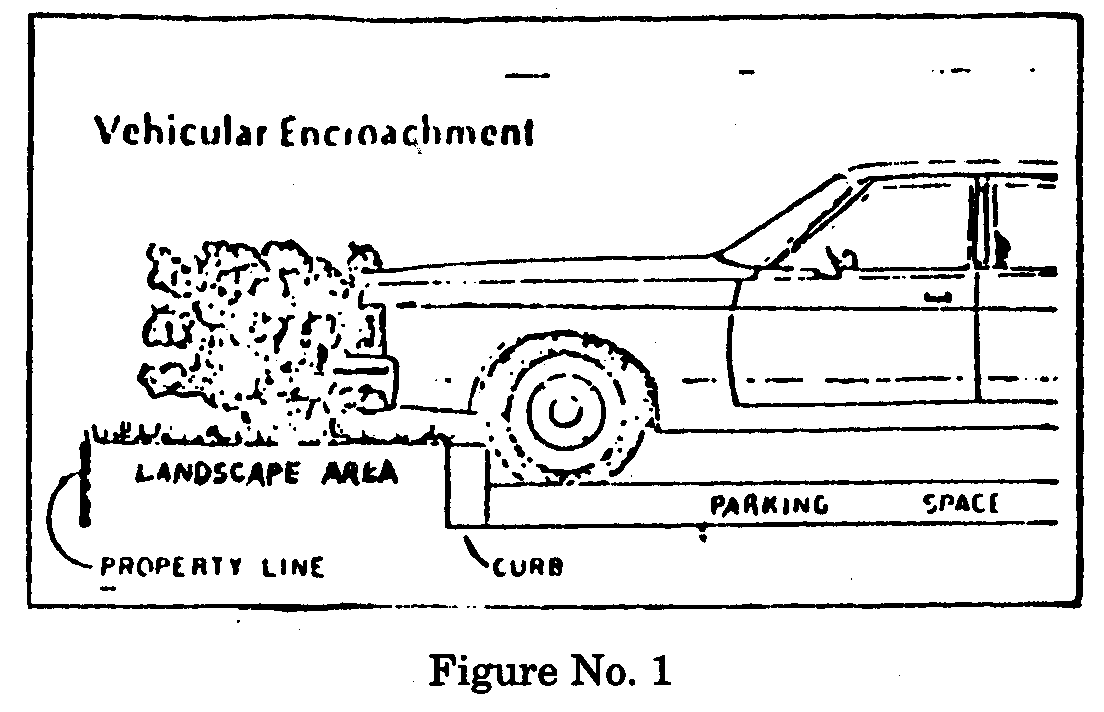
Enforcement official: The community services director, or his or her assigned designee.
Hazardous: Means a tree existing on a developed parcel of land or within the right-of-way, that due to its shape, location or growth pattern, which cannot be corrected by pruning or other reasonable preservation and/or preventative procedures, may cause or reasonably be expected to cause damage to persons or property and/or presents a potential threat to the health, safety, and welfare of the general public, as determined by the city arborist or an arborist certified by the International Society of Arboriculture.
Land clearing: The act of removing or destroying trees, ground cover, and other vegetation by manual, mechanical, or chemical means. Routine lawn mowing, sod replacement, planting of landscape material, shrub pruning, and shrub removal shall not be considered land clearing, provided no grade change occurs. Removal of understory by bush hog, forestry mulcher, or other means shall not be considered routine mowing.
Landscaping: Landscaping shall consist of, but not limited to, the following or combination thereof: Material such as, but not limited to, grass, ground cover, shrubs, vines, hedges, trees, or palms; and nonliving durable material commonly used in landscaping, such as, but not limited to, rocks, pebbles, sand, walls or fences, but excluding paved surfaces.
Landscape dividing strips: Landscape areas containing ground cover, shrubs, and trees or other landscaping used to partition parking areas into individual bays. (See Figure No. 2)
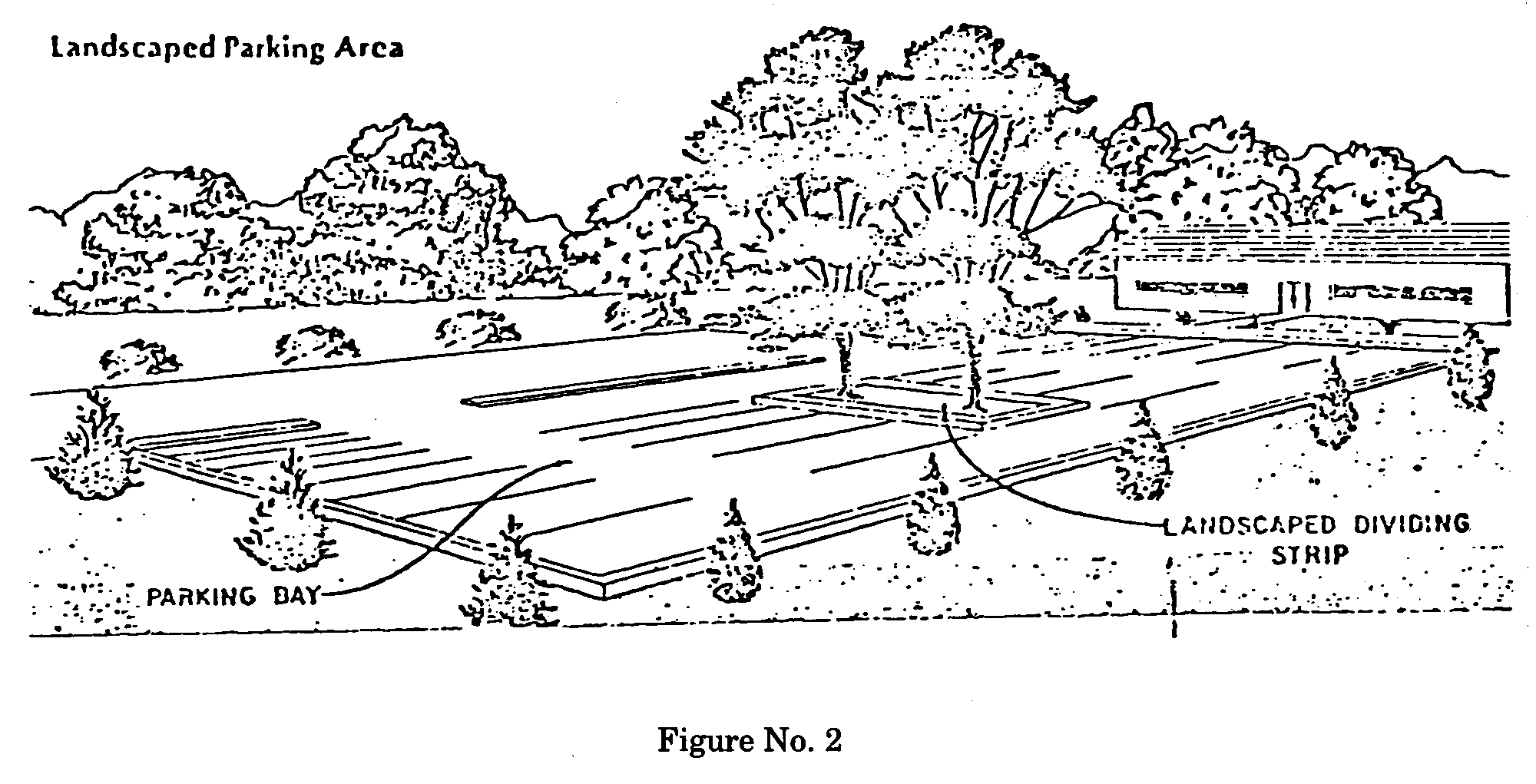
Lot: A parcel of land shown on a recorded plat with Brevard County Clerk of the Circuit Court or any piece of land described by deed in the Official Record Book of Brevard County.
Parking area: Any vehicular use area in which five (5) or more parking spaces are required.
Person: This shall include any individual, partnership, corporation, association or other legal entity, and shall include the plural, as well as the singular.
Removal: The term "removal" shall include remove, removing, actual displacement, effective displacement through damaging, or significant pruning.
Right-of-way: Land dedicated, deeded, used, or to be used for a street, alley, walkway, boulevard, public utilities, drainage facility, access for ingress/egress, or other purpose by the public, certain designated individuals, or governing bodies.
Specimen tree: Any hardwood tree not included on the list of exempt trees in subsection (E)(7) herein having a trunk diameter twenty-four (24) inches or greater as measured diameter at breast height (d.b.h) or four and one-half (4 ½) feet above actual grade. Specimen trees shall not include dead, hazardous or diseased trees.
Single-family or duplex lot: A lot zoned for a single-family or two-family unit structure, or a nonconforming use of such nature.
Site: That parcel of land, lot, or lots for which a tree removal permit is sought.
Tree: A woody or fibrous perennial plant with an upright trunk which normally grows, or is capable of growing, to an overall height of a minimum height of fifteen (15) feet in the central coastal area of Florida, and having a trunk diameter of six (6) inches or greater as measured diameter at breast height (d.b.h.) or four and one-half (4½) feet above actual grade. For purposes of subsection (E), palm trees shall be considered a tree only to the extent that it has a trunk diameter of twelve (12) inches or greater as measured at breast height (d.b.h.) and is a palm tree species which normally grows, or is capable of growing, to an overall height of a minimum of fifteen (15) feet or greater in the central coastal area of Florida.
(C)
LANDSCAPING REQUIREMENTS FOR CERTAIN YARD AREAS AND OFF-STREET PARKING AND OTHER VEHICULAR USE AREAS. All areas used for display or parking of any and all types of vehicles, boats, or heavy construction equipment and all land upon which vehicles travel or are parked as a function of the primary use including, but not limited to, the following: Apartment buildings, condominiums, shopping centers, service stations, convenience and food stores, financial institutions, restaurants and similar uses, and any other use deemed appropriate by the enforcement official, shall conform to the minimum landscaping requirements hereinafter provided. Excluded are areas used for single and two-family uses, except within a Planned Unit Development.
(1)
Installation. All landscaping shall be installed in a sound and workmanship like manner and according to accepted good planting procedures with the quality of plant materials hereinafter described. The enforcement official of the City of Cocoa shall inspect all landscaping and no certificate of occupancy or similar authorization will be issued unless the landscaping meets the requirements herein provided.
(2)
Maintenance. The owner shall be responsible for the maintenance of all landscaping which shall be so maintained as to present a neat and orderly appearance and shall be kept free from refuse and debris. All landscaped areas shall be provided with a readily available water supply with at least one (1) outlet located within one hundred (100) feet of all plant material to be maintained. It shall be the duty of the property owner (person) to provide proper maintenance of the landscape plantings installed to comply with this ordinance at all times. This includes, but is not limited to, the replacement of plants damaged by insects, diseases, vehicular traffic, acts of God, or vandalism, that are beyond a reasonable expectation of recovery. Necessary replacements shall be made within ninety (90) days of notification by the enforcement official.
(3)
Plant material.
(a)
Quality: Plant materials used in conformance with the provisions of this ordinance, shall conform to the Standards for Florida No. 1 or better as given in "Grades and Standards for Nursery Plants," Part I, 1963, and Part II, State of Florida Department of Agriculture, Tallahassee, or equal thereto. Grass sod shall be clean and reasonably free of weeds and noxious pests or diseases.
(b)
Trees: Shall be self-supporting wood plants of a species which have a minimum crown spread of fifteen (15) feet and a minimum height of fifteen (15) feet at maturity. Trees shall be of a species which can be maintained at maturity with a minimum of five (5) feet of clear trunk as measured from the average grade level. Trees which can meet the height requirement at maturity but not the crown requirement may be grouped so as to create the equivalent of a fifteen (15) foot crown spread. Palms shall be considered trees, but shall not be used for more than thirty-five percent (35%) of the total number of trees required for any area. Tree species shall be a minimum of six (6) feet overall height immediately after planting. Trees of species whose roots are known to cause damage to public roadways or other public works shall not be planted closer than twenty (20) feet to such public works.
(c)
Shrubs and hedges: Shrubs shall be a minimum of two (2) feet in height when measured immediately after planting. Hedges, where required, shall be planted and maintained so as to form a continuous, unbroken, visual screen within a maximum of two (2) years after planting.
(d)
Vines: Vines shall be a minimum of thirty (30) inches in height immediately after planting and may be used in conjunction with fences, screens, or walls to meet physical barrier requirements as specified.
(e)
Ground covers: Ground cover plantings used in lieu of grass shall be placed in such a manner as to present a finished appearance and shall be used in conjunction with a decorative mulch such as, pine or cypress bark or other materials of a similar nature.
(f)
Lawn grass: Grass areas shall be planted with a species common to the area. Grass areas may be sodded, plugged, sprigged, or seeded except that solid sod shall be used in swales or other areas subject to erosion.
(g)
Existing plant material: In instances where healthy plant material exists on a site prior to its development, in part or in whole, for purposes of off-street parking or other vehicular use areas, the department charged with the issuance of building permits may adjust the application of the above mentioned standards to allow credit for such plant material, if such an adjustment is in keeping with the intent of this ordinance.
(4)
Required landscaping adjacent to public rights-of-way. On a building site or an open lot which serves as an off-street parking area or other vehicular use area, there shall be provided landscaping between such areas and such right-of-way as follows:
(a)
A landscaped strip of land at least five (5) feet in width shall be provided between the abutting right-of-way and the off-street parking area or other vehicular use area which is exposed to an abutting right-of-way. Such landscaping shall include one (1) tree for each fifty (50) lineal feet or fraction thereof. Such trees shall be located between the abutting right-of-way and off-street parking area or other vehicular use area and shall be planted in a planting area of at least twenty-five (25) square feet, with a dimension of at least five (5) feet. A hedge, wall or other durable landscape barrier of at least two (2) feet in height shall be placed along the perimeter of such landscaped strip. If such durable barrier is on nonliving material, one (1) shrub or vine shall be planted abutting such barrier for each ten (10) feet thereof. Such shrubs or vines shall be placed along the street side of the barrier unless they are of sufficient height at the time of planting to be readily visible over the top of such barrier. The remainder of the required landscape areas shall be landscaped with grass, ground cover or other landscape treatment excluding paving.
(b)
Necessary and approved accessways through the landscaped area may be subtracted from the lineal dimension used to determine the number of trees required.
(5)
Perimeter landscaping adjacent to abutting commercial properties. One (1) tree shall be provided between the common lot line and the off-street parking area or other vehicular use areas, for each fifty (50) lineal feet of lot depth or fractional part thereof. Each tree shall be planted in at least a twenty-five (25) square foot planting area with a minimum dimension of at least five (5) feet. Each such planting area shall be landscape material, excluding paving and in addition to the required tree.
(6)
Interior parking area landscaping. Off-street parking areas and other vehicular use areas shall have at least ten (10) square feet of interior landscaping for each parking space excluding those spaces abutting a perimeter for which landscaping is required by other parts of this section. Such interior landscaping shall maintain the following standards:
(a)
Each separate landscape area shall contain a minimum of fifty (50) square feet.
(b)
Each separate landscaped area shall contain at least one (1) tree with the remaining area adequately landscaped with shrubs, ground cover or other authorized landscaping material.
(c)
Each landscaped area shall be located in such a manner as to divide and break up the expanse of paving and at strategic points to guide traffic flow and direction.
(d)
The total number of trees shall not be less than one (1) for each one hundred (100) square feet or fraction thereof of required interior landscaped area.
(e)
The front of a vehicle may encroach upon any interior landscaped area when said area is at least five (5) feet in depth and protected by curbing. Three (3) feet of such landscaped area may be part of the required depth of each abutting parking space.
(f)
Continuous perforated curb, or other acceptable solid structural form (i.e., timbers) approved by the enforcement official shall be constructed in place around all landscape areas, except where internal swale systems are used.
(7)
Visibility at intersections. Landscaping shall not obstruct the visibility of automobiles at intersections. Hedges and plantings at points of ingress and egress to a public right-of-way shall not exceed four (4) feet in height (See Figure No. 3).
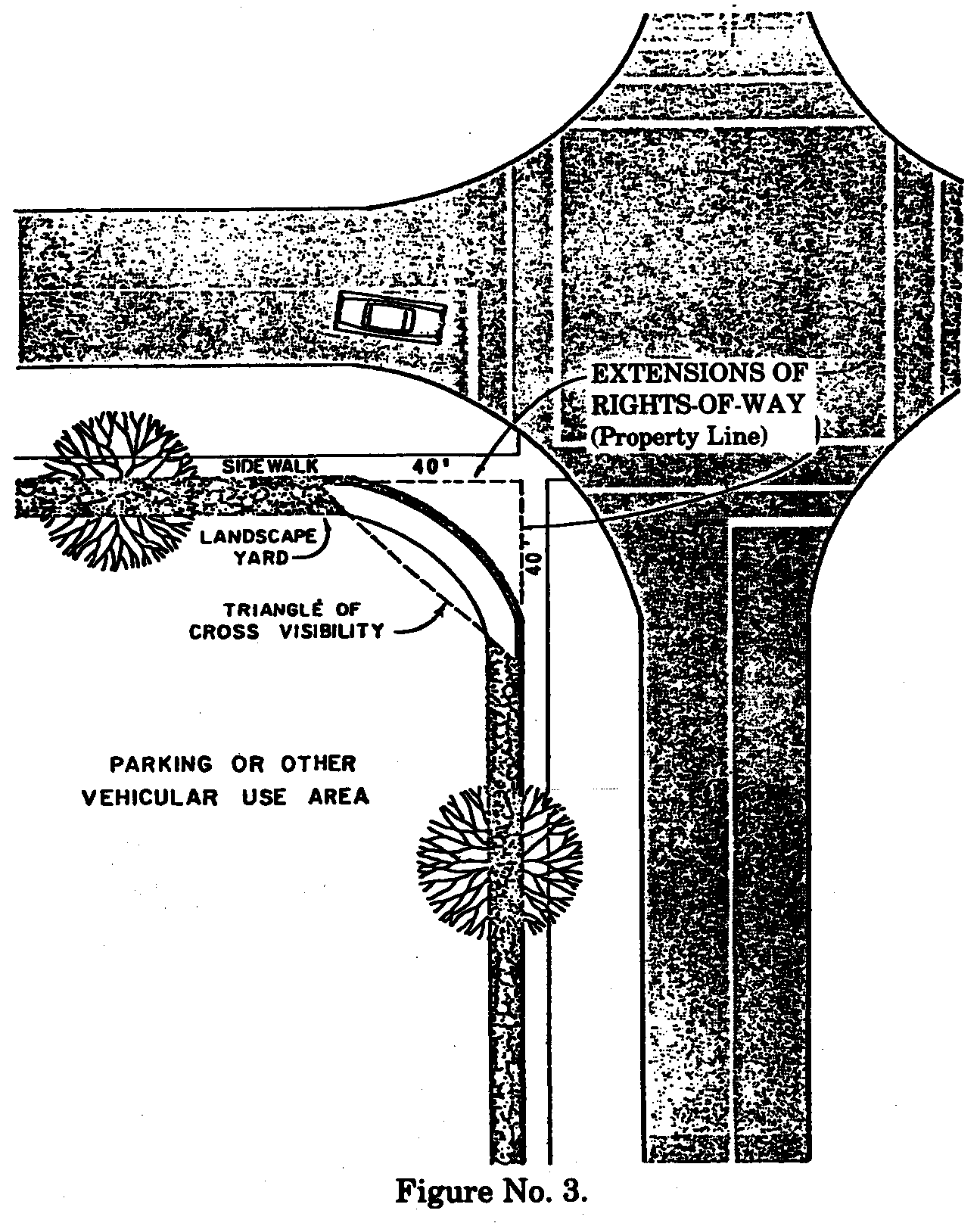
(D)
MINIMUM TREE PLANTING REQUIREMENTS. No certificate of occupancy shall be issued on the types of construction indicated below unless the underlying parcel has at least the required minimum number of approved trees:
(1)
Any new single-family or duplex dwelling unit on a lot of less than seventy-five thousand (7,500) square feet: not fewer than two (2) trees on each lot. Each tree shall be at least eight (8) feet tall with a three-inch d.b.h. minimum and a two-foot spread. Palm trees shall have at least six (6) feet of clear trunk.
(2)
Any new single-family or duplex dwelling unit on a lot equal to seventy-five thousand (7,500) square feet or greater: not fewer than two (2) trees plus one (1) additional tree for each four thousand (4,000) square feet or fraction thereof over seventy-five thousand (7,500) square feet on each lot. Each tree shall be at least eight (8) feet tall with a three-inch d.b.h. minimum and a two-foot spread. Palm trees shall have at least six (6) feet of clear trunk.
(3)
Any commercial, industrial, multifamily or other structure requiring small-scale or large-scale site plan approval under the city land development regulations: no fewer than six (6) trees per acre. However, this minimum tree planting requirement shall not apply to commercial or industrial developments on parcels that are two (2) acres or less.
The minimum tree planting requirements of this subsection shall not be eligible for arbor mitigation fund fees in lieu of replacement.
(E)
TREE PROTECTION AND PRESERVATION.
(1)
The provisions of this subsection (E) shall apply to the following:
(a)
All vacant and undeveloped property.
(b)
The open space areas of all developed property, except single-family or duplex lots.
(c)
All public or private rights-of-way.
(2)
The provisions of this subsection (E) shall not apply to the following:
(a)
Single-family or duplex lots.
(b)
Land clearing and tree removal activities authorized and preempted by state or federal law, which include, but are not limited to:
1.
Removal of trees on residential property which pose an unacceptable risk to persons or property in accordance with F.S. § 163.045, for which no replacement trees will be required provided that the property owner possesses the documentation required by state law. For purposes of this subsection, "residential property" and "unacceptable risk" shall be defined as provided in F.S. § 163.045, as may be amended. The term "residential property" for purposes of this subsection does not include multi-family residential property, common areas owned by a homeowners' or condominium association, vacant land zoned or designated residential or mixed-use (e.g., PUD, CBD, CN) on the city's official zoning map or future land use map, public rights-of-way, or land subject to particular landscaping, tree planting or preservation requirements pursuant to an executed development agreement, landscape easement granted to the city, or conservation easement.
2.
Removal of trees by an electric utility to clear trees away from power lines in order to ensure the safe transmission of electricity to customers, as provided by Florida Statutes and Electric Tariff Rules, including the preemption under F.S. § 163.3209.
(3)
General requirements.
(a)
Except as provided in subsections (E)(2) and (E)(4)(c), no tree shall be removed without first obtaining a tree removal permit and no land shall be cleared without first obtaining a land clearing permit.
(b)
All new applications for subdivision plats and site plans shall be accompanied by a tree removal and/or land clearing application at the time of initial submittal of the plans so that due consideration may be given to protection of trees during the subdivision and/or site plan design process. If a site plan is not required (i.e., parking lot), a landscape plan must be submitted before permits are issued.
(c)
No permit shall be issued for building or paving unless the site plan and/or landscape plan comply with these provisions. No certificate of occupancy shall be issued until the landscaping is complete and it shall be unlawful to occupy the premises unless the landscape plan has been approved, complied with, and received a final inspection from the enforcement official.
(4)
Permit requirements.
(a)
Application contents. Each application for a tree removal and land clearing permit shall state the reasons for requested removal of the tree(s) and vegetation and be accompanied by a tree inventory, consisting of a scaled drawing with a scale of one (1) inch equals fifty (50) feet or less, indicating:
1.
Property boundaries and, if trees are proposed for removal from the right-of-way, the right-of-way boundaries.
2.
The location of all individual trees, including the tree's common or scientific name, and measured diameter at breast height (d.b.h.) of trees on the property, except that individual trees within the building envelope (structure and seven and one-half (7 ½) feet around the perimeter), within the portion of any wetland that will not be disturbed, or within an existing conservation easement may be omitted.
3.
Identification of all trees proposed for removal.
4.
Identification of trees to be preserved and replacement tree credit requested for the preserved tree, if any. Replacement tree credit requested for preserved trees shall be based upon the values provided in Table 1.
5.
The location of existing and proposed improvements, if any, including existing and proposed buildings and structures, proposed additions to existing buildings and structures, impervious surfaces (e.g. pool decks, drives, parking areas), stormwater retention areas, utilities, and other such improvements.
6.
A replacement plan consistent with subsection (E)(5), indicating the means of compensating for the tree(s) to be removed and including the species and size of any replacement tree(s).
7.
The number of caliper inches and type of replacement trees that cannot be planted on site and statement regarding the reasons that such replacements cannot be made on site, if any. Where the applicant requests to make a contribution to the Arbor Mitigation Fund to offset all or a portion of the required tree replacements, the amount which must be contributed to the Fund shall be based upon the values provided in Table 3. The calculation of the contribution shall be provided in the application.
8.
If grade changes are proposed on the site, a grading plan drawn to scale shall be provided. In addition, a written statement shall be provided by a landscape architect or other competent professional indicating the probability of whether the grade change will result in the death of tree(s) intended to be preserved. Said statement shall immediately be brought to the attention of the city arborist at the time the application is filed and attached to the application.
9.
A protection plan describing how preserved tree(s) shall be preserved on the site and adjacent properties during construction, tree removal and grading. This plan must address protection of the root system, crown, and stems of the trees, a means of supplying water and essential elements to the root system, and the proposed location of tree protection barriers.
10.
An application requesting approval for land clearing without removal of trees must only include the property boundaries, identification of the area to be cleared drawn to scale, a statement of the reasons for removal of the vegetation in accordance with subsection (E)(6) below, and the seeding or mulching plan if required.
11.
Landscaping plans shall include the location and dimension of all required buffers; location and dimension of all required internal landscaping; location, size and description of all landscape materials; location of sprinklers and/or outlet locations; location and area of off-street parking and vehicular use areas; location of all structures; and property boundaries.
Upon request, the enforcement official may permit an applicant to omit certain portions of the tree removal or land clearing application and inventory where compliance with the requirements set forth herein would be unnecessarily burdensome and would not be needed for the city to evaluate the application. Such applications may include those unrelated to new development of buildings, structures or infrastructure on the subject land and limited only to the removal of one (1) or more isolated and specific trees on already-developed land.
(b)
Trees that may be removed by permit. The enforcement official may grant permission for removal if it meets any or all of the following guidelines:
1.
Is determined to be hazardous or dangerous condition as to endanger the public health, safety, or welfare as determined by an arborist certified by the International Society of Arboriculture with a Tree Risk Assessment Qualification.
2.
Is severely diseased or severely injured as determined by an arborist certified by the International Society of Arboriculture with a Tree Risk Assessment Qualification.
3.
The trunk of the tree is located closer than seven and one-half (7½) feet to the foundation of an existing or proposed structure, and it is not feasible to relocate the structure.
4.
The trunk of the tree is located closer than ten (10) feet from the foundation of an existing or proposed structure and the tree is considered having an aggressive root system or the natural mature height is greater than thirty (30) feet and it is not feasible to relocate the structure.
5.
Where the tree(s) are not proposed for removal in conjunction with application for a subdivision and/or site plan, trees that shall be replaced or mitigated elsewhere on the property or on another property in accordance with the standards established below in subsection (E)(5), provided that the tree(s) are not specimen trees.
6.
Where the tree(s) are proposed for removal in conjunction with application for a subdivision and/or site plan, trees that shall be replaced or mitigated elsewhere on the property or on another property in accordance with the standards established below in subsection (E)(5).
(c)
The following tree removal activities are exempt from the permit requirements of this section:
1.
Removal by the city or other governmental agency on public property or within the right-of-way.
2.
Removal of dead trees.
3.
Removal of species listed below in subsection (E)(8)a.—j.
4.
Emergency removal of a hazardous or seriously damaged tree, to mitigate an imminent threat to the health, safety, and welfare of the property owner or the general public. Prior to emergency removal, the imminent threat should be documented to include but not be limited to (1) photographs of the tree(s) including any areas that may be damaged, diseased, or infested (2) approximate measurements including tree height, spread, d.b.h., and (3) distance to structure(s) or other immovable target(s) if felled.
5.
Tree removal activities authorized and preempted by state or federal law as provided in subsection (E)(2)(b).
6.
Bona fide agricultural activity or commercial plant nursery site.
7.
Trees planted specifically for silvicultural purposes provided the property owner can provide documentation to the city evidencing that: (i) the property is a silvicultural site recognized or inspected by the Florida Forest Service; and (ii) trees of typical harvestable size and type exist on the property which are capable of being harvested for income and that the property has, or intends to, generate income from the harvested trees.
(d)
Duration of permit. A tree removal or land clearing permit shall expire ninety (90) days from the date of issuance for permits that are not issued in conjunction with an approved subdivision plat or site plan. Two (2) extensions of thirty (30) days each may be authorized by the building official, provided appropriate justification warrants, such as unusual weather, seasonal situations or inability to obtain permits from other agencies. Trees not removed during the life of the permit may not be removed without the issuance of a new permit based upon a new application.
(5)
Tree replacement.
(a)
As a condition of granting a tree removal permit, the applicant shall be required to replace trees being removed at its sole cost.
(b)
Tree species. Whenever possible and practicable, trees should be replaced with the same species as those removed or, to encourage lower maintenance and water conservation and the planting of the right trees in the right place, trees listed on the UF/IFAS Florida-Friendly Plant Selection and Landscape Design List. When palm trees are removed. they are required to be replaced as provided in Table 2 only when the tree has a trunk diameter of twelve (12) inches or greater as measured at breast height (d.b.h.) and is a palm tree species which normally grows. or is capable of growing. to an overall height of a minimum of fifteen (15) feet or greater in the central coastal area of Florida. When palm trees are used as a replacement tree, they must be capable of having a mature height taller than twelve (12) feet and cannot constitute more than thirty-five (35) percent of the total replacement inches required.
(c)
Trees removed by the city. Except where tree board recommendation or approval is required in subsection (H)(l)(d) below, specimen trees removed by the city on public property or within the right-of-way and that are not within the building envelope (structure and seven and one-half (7 ½) feet around the perimeter) shall be replaced with either a tree of the same species or a tree of a different species that is more suitable for the location as determined by the city arborist or an arborist certified by the International Society of Arboriculture. The replacement trees shall be planted in a location deemed most appropriate by the director of public works or his or her designee.
(d)
Replacement credit for trees preserved. To encourage the retention of existing trees in the city. the following credits shall be applied to reduce the number of replacement trees required by this section, excluding wetland areas that are to remain undisturbed and existing conservation areas:
TABLE 1.
(e)
Size and number of replacement trees. Where replacement tree(s) are required, the appropriate number of trees shall be planted as provided in Table 2, less any replacement credit for preserved trees. Further, trees removed within the building envelope (structure and seven and one-half (7 ½) feet around the perimeter) shall not be required to be replaced. The replacement trees shall further have a minimum d.b.h., depending upon the diameter of the tree removed, as described in the table below.
TABLE 2—Tree Replacement Standards
(f)
Arbor Mitigation Fund Alternative. An Arbor Mitigation Fund is established by the city to provide an option to make a fee payment to the city in lieu of providing the required replacement trees on site. The Arbor Mitigation Fund shall be a part of the city general fund, but is reserved exclusively for the design, acquisition, installation and maintenance of trees on public property or, in certain circumstances private property, the funding of studies related to the city's tree canopy, the operation and maintenance of a public tree nursery, or expenses related to compliance with the city's Tree City USA designation, including public education and outreach and arbor day celebration expenses. Before approving planting trees on private property, the enforcement official must find that the trees will provide aesthetic benefits to many of the same citizens who would have benefitted from the installation of the trees on public property. The private property owner must be willing to sign a tree maintenance agreement with the city.
The arbor mitigation alternative may only be utilized as a last resort after all other design alternatives to provide required replacement trees and to preserve existing trees have been considered. The applicant must demonstrate that there is insufficient room on the site for required replacement trees due to:
1.
Existing or proposed trees;
2.
Existing or proposed structures, required parking, access driveways, stormwater retention areas, or utilities;
3.
Land condition (e.g., topography, soil type);
4.
Insufficient area for the tree to establish.
The arbor mitigation contribution shall be determined by the values established in Table 3.
TABLE 3.
(g)
Maintenance of replacement trees. All replacement trees shall be maintained in a healthy, living condition. Any such trees which die or become diseased or damaged within two (2) years of planting shall be replaced by the applicant. The city shall retain perpetual jurisdiction to ensure compliance with this requirement.
(h)
Waiver. Except as provided herein. the planning and zoning board may grant a waiver to provisions of this subsection in accordance with the criteria and procedures established in Article XVII Section 8 of the Zoning Ordinance related to Waivers from certain Code provisions. Any applications for a waiver related to the contribution amount to the Arbor Mitigation Fund shall be solely determined by the City Council after considering whether the applicant demonstrates that the literal interpretation of this section will deny the applicant reasonable use of the property or where such waiver can be demonstrated to be consistent with the purpose and intent of this section.
(6)
Land clearing. The clearing of land includes the removal of trees and natural vegetation. The clearing of land is contrary to this ordinance except under the following conditions:
(a)
Clearing of trails and transect lines.
(b)
Clearing within a dedicated public or private easement or right-of-way for the purpose of construction, maintenance, or improvement of roadways, utilities, or drainage systems.
(c)
Clearing of land for bona fide agricultural purposes.
(d)
Clearing of land for which there exists an approved site plan or building permit and accompanying landscape plan.
(e)
Other land clearing as approved by the city council
All land to remain bare for a period greater than sixty (60) days shall be seeded and/or mulched so as to prevent erosion and sedimentation.
(7)
Tree protection during construction. During construction, protective barriers shall be placed so as to prevent the destruction or damaging of trees. Trees destroyed or receiving major damage shall be removed and replaced before occupancy or use unless approval has been granted under permit.
(8)
Tree exemptions. The following tree species are exempted from these regulations:
(a)
Schinus terebinthifolius (Brazilian Pepper).
(b)
Melaleuca quinquenervia (Melaleuca, Cajeput).
(c)
Metopium toxiferum (Poison Wood).
(d)
Casvarina equisetfolia
Casvarina lepidophilia
Casvarina cumminghamiana (Australian Pine).
(e)
Casvarina glauca (Brazilian Oak).
(f)
Melaleuca leucadendra (Punk Tree).
(g)
Enterlobium cyclocarpum (Ear Pod Tree).
(h)
Morus Rubra (American Mulberry).
(i)
Melia azedarach (Chinaberry).
(j)
Citrus trees.
(k)
All other undesirable trees, as specified in the Florida Exotic Pest Plant Council (FEPPC) Invasive Plant List.
(9)
Nuisances declared. Any tree or trees that may be declared a nuisance or a threat to the health, safety, or welfare of the citizenry of the city and may be so deemed by the enforcement official. If declared a nuisance, the enforcement official shall, as provided in section 6-903 of the Code, cause notice to be served upon the owner to remove said trees. If necessary, the enforcement official may proceed to remove or abate the nuisance in the manner provided in section 6-903 of the Code.
(F)
VARIANCES. Reserved.
(G)
PENALTIES. Any person who violates this ordinance or causes such to be violated, shall be subject to action before the code enforcement board of the city. In addition to all other remedies set forth in the City Code or any applicable agreement between the city and a property owner, one (1) or more of the following civil fines shall apply to violations of this section:
(1)
Failure to obtain a permit under subsection (E)(3): Fine of two hundred fifty dollars ($250.00) for each day the person fails to obtain an after-the-fact tree removal permit after the time provided to comply by the code enforcement board or, if at least one specimen tree has been removed, five hundred dollars ($500.00) for each day the person fails to obtain an after-the-fact tree removal permit after the time provided to comply by the code enforcement board, or five hundred dollars ($500.00) per quarter acre of land cleared for each day the person fails to obtain an after-the-fact land clearing permit after the time provided to comply by the code enforcement board, whichever is greater. Fines imposed for repeat violations shall be as provided in F.S. Ch. 162, as may be amended. If the trees were removed or land was cleared in anticipation of a development project on the property, the City's Code Enforcement Board may, in its discretion, allow for up to one (1) year for the developer to obtain approval of an after-the-fact tree removal permit in conjunction with approval of a site plan, site plan amendment, or subdivision preliminary plat approval. In order to obtain an after-the-fact tree removal permit, a tree survey shall be required as provided in this section based on best available evidence of the trees that existed on the property prior to removal, such as aerial photographs. Restoration, replacement, and/or mitigation shall be required in order to obtain an after-the-fact tree removal or land clearing permit as provided in this section, in addition to the aggravating penalties provided in subsections (G)(2), (3), (4), and/or (5) below.
(2)
Notwithstanding the penalties in subsection (G)(1) for failure to obtain a permit, for each individual tree removed without a permit: A fine of one hundred dollars ($100.00) per caliper inch, not to exceed five thousand dollars ($5,000.00) per tree. Violations of this section are considered irreparable and irreversible in nature. To the extent that a tree survey prepared during the course of applying for an after-the-fact tree removal permit reveals further inches removed, the City's Code Enforcement Board retains jurisdiction to adjust the fine.
(3)
Notwithstanding the penalties in subsection (G)(1) for failure to obtain a permit, for each individual specimen tree removed without a permit: A fine of one hundred fifty dollars ($150.00) per caliper inch, not to exceed five thousand dollars ($5,000.00) per tree. Violations of this section are considered irreparable and irreversible in nature. To the extent that a tree survey prepared during the course of applying for an after-the-fact tree removal permit reveals further inches removed, the City's Code Enforcement Board retains jurisdiction to adjust the fine.
(4)
Notwithstanding the penalties in subsection (G)(1) for failure to obtain a permit, for each individual tree removed without a permit with inches removed unknown: A fine of five thousand dollars ($5,000.00) per tree. This subsection shall apply if trees are removed in a manner making it impossible to determine the number of inches removed, such as where all stumps of the trees are removed. Violations of this section are considered irreparable and irreversible in nature.
(5)
Notwithstanding the penalties in subsection (G)(1) for failure to obtain a permit, land clearing without a permit: A fine of five thousand dollars ($5,000.00) per each quarter acre cleared. This subsection may also be utilized if the number of trees removed cannot be determined. Violations of this section are considered irreparable and irreversible in nature.
(6)
Notwithstanding the penalties in subsection (G)(1) for failure to obtain a permit, failure to abide by a cease and desist order issued under this section: Fine of five hundred dollars ($500.00) per day.
(H)
TREE BOARD. A tree board is hereby established which shall consist of the members of the city planning and zoning board, and who shall serve by appointment of the city council of the City of Cocoa, Florida.
(1)
Duties and responsibilities.
(a)
The tree board may investigate, develop, and advise the city council regarding policies and standards relating to the care, preservation, planting, replanting, removal, or disposition of trees and shrubs in parks, along streets, and in all other public areas.
(b)
The tree board, when requested by the City Council of the City of Cocoa, shall consider, investigate, make findings of fact, report, and make recommendations upon any special matter of questions coming within the scope of its duties.
(c)
No oak tree located on city public right-of-way or city owned property shall be removed or significantly pruned prior to review and recommendation by the tree board and approved by the city council, subject to the following exceptions:
(1)
The emergency removal of a hazardous or seriously damaged oak tree, to mitigate an imminent threat to the health, safety, and welfare of the property owner or the general public. Prior to emergency removal, the imminent threat should be documented to include but not be limited to (1) photographs of the tree(s) including any areas that may be damaged, diseased, or infested (2) approximate measurements including tree height, spread, d.b.h., and (3) distance to structure(s) or other immovable target(s) if felled.
(2)
Oak trees that are dead.
(3)
Volunteer oak trees less than four (4) inches in diameter at four and one-half (4½) feet in height.
(4)
Oak trees that are part of a previously approved site plan or city council-approved construction, roadway, utility or drainage project.
(5)
Pruning of less than thirty (30) percent of the canopy.
(d)
Where an oak tree located on city public right-of-way or city owned property is removed for any reason, the tree board shall either:
(1)
Include with its recommendation to the city council regarding removal of the oak tree, a recommendation on both the location and species of a replacement tree; or
(2)
Approve the location and species of a replacement tree following removal of the oak tree when an exception as provided in subsection (H)(1)(c)(1) through (5) applies.
(Ord. No. 32-84, §§ 1—7, 10-23-84; Ord. No. 2-95, § 1, 2-14-95; Ord. No. 4-97, § 1, 3-11-97; Ord. No. 4-01, § 1, 2-13-01; Ord. No. 3-03, § 1, 2-25-03; Ord. No. 03-2017, § 2, 3-14-2017; Ord. No. 12-2018, § 2, 12-12-2018; Ord. No. 12-2020, § 2, 8-26-2020; Ord. No. 20-2023, § 2, 10-24-2023; Ord. No. 18-2024, § 2, 12-10-2024)
Editor's note— Ord. No. 32-84, §§ 1—7, adopted Oct. 23, 1984, in its caption stated that it was "amending the zoning code," but did not specify manner of amendment. The provisions of said Ord. No. 32-84 have been treated as superseding the landscape requirements enacted by Ord. No. 6-83, adopted March 3, 1983, and formerly codified as § 21 of this article. Inclusion of Ord. No. 32-84, §§ 1—7, herein as § 22 of Art. XIII has been at the discretion of the editor.
Sec. 23. - Reserved.
Editor's note— Ord. No. 22-97, § 2, adopted Oct. 28, 1997, repealed former Art. XIII, § 23 of the zoning ordinance, which pertained to adult establishments and derived from Ord. No. 7-86, § 4, adopted April 8, 1986; Ord. No. 18-94, § 3, adopted Aug. 23, 1994; and Ord. No. 6-95, § 3, adopted April 11, 1995.
Sec. 24. - Bed and breakfast establishments.
Bed and breakfast establishments are subject to the following provisions:
(A)
No bed and breakfast establishment guest room area shall occupy more than twenty-five percent (25%) of the gross habitable floor area of the principal building.
(B)
The lodging rooms or lodging unit shall be located within the existing principal building or in the existing accessory building or buildings.
(C)
A principal building shall be listed on the Florida Master Site File or proof of application for listing shall be presented simultaneously with the special exception request for a bed and breakfast establishment.
(D)
No external alterations shall be made to the principal or accessory building, or the building site, which would change the residential character thereof.
(E)
Any interior modifications to any principal or accessory building shall be described in the building permit application, and shall not damage the historic character of the structure, woodwork, stairways, fireplaces, windows and doors, cornices, festoons, moldings, chair rails or light fixtures, of the principal or accessory building.
(F)
The owner of the principal residence shall be permitted to install a non-illuminated nameplate attached to the main entrance of the principal building. The nameplate shall not exceed three (3) square feet in area. In addition, the owner of the principal residence shall be permitted to install one (1) non-illuminated sign on his property indicating the bed and breakfast establishment, which sign shall be compatible with the style and architecture of the principal residence. The maximum size of the sign shall not exceed twelve (12) square feet, and shall be no higher than five (5) feet.
(G)
Individual rooms that are rented shall not contain cooking facilities.
(H)
The only meal to be provided to guests shall be breakfast, and it shall only be served to guests lodging in the facility.
(I)
Guests may rent for a period of time no less than one (1) day and no longer than twenty-one (21) consecutive days.
(J)
A local business tax receipt must be obtained prior to operating a bed and breakfast establishment.
(K)
Parking facilities must be on-site and shall be reviewed for adequacy, safety and compatibility with the surrounding neighborhood.
(L)
The bed and breakfast establishment must be virtually indistinguishable from other homes in the surrounding area, so as not to detract from the residential character of the neighborhood.
(Ord. No. 16-90, § 7, 6-12-90; Ord. No. 16-2008, § 8, 7-22-08)
Sec. 25. - Housing bonus.
In order to encourage the creation of new affordable housing within the City of Cocoa and in order to preserve and augment the residential character of the RU-2-10 Single-Family and Multifamily Dwelling District within the Redevelopment Area, there is hereby created a Housing Bonus Program to provide a transferable floor area bonus for the development of new affordable housing within the Redevelopment Area. This Floor Area Bonus may be generated in the RU-2-10 Single-Family and Multifamily Dwelling District, and may be used in the CBD, Central Business District, as follows:
(A)
DEFINITIONS. For the purposes of this subsection, the following definitions apply:
(1)
Administering corporation: A qualified not-for-profit corporation selected to administer affordable housing units under this program, and which meets the requirements of subsection (C) (1)b. hereof.
(2)
Concurrent benefitted development: A development within the CBD, Central Business District, that uses a housing bonus generated under this section concurrently with the development of the qualifying affordable housing.
(3)
HUD: The United States Department of Housing and Urban Development.
(4)
Low income household: A household earning no more than fifty percent (50%) of the median income for the Standard Metropolitan Statistical Area, adjusted for family size.
(5)
Nehemiah Units: Low income housing units that receive assistance under the federal Nehemiah Housing Opportunity Grants Program of Title VI of the Housing and Community Development Act of 1987, 42 U.S.C. § 3535(d).
(6)
Substantial rehabilitation: Rehabilitation of a single-family housing unit within the RU-2-10 district such that the cost of rehabilitation exceeds fifty percent (50%) of the sales price of the unit after rehabilitation or rehabilitation of a vacant uninhabitable unit.
(B)
AMOUNT OF BONUS. For each newly constructed unit of qualifying affordable housing as defined in subsection (C) below, the developer shall be entitled to an increase of ten thousand (10,000) square feet of floor area bonus for new construction within the CBD. For each substantial rehabilitation of qualifying affordable housing defined in subsection (C) below, the developer shall be entitled to and increase of five thousand (5,000) square feet of floor area bonus for new construction within the CBD. Such bonus is transferable.
(C)
QUALIFYING AFFORDABLE HOUSING.
(1)
Qualifying affordable housing shall be newly constructed single-family housing or substantial rehabilitation of housing complying in all respects with this zoning ordinance and with the Cocoa Building Code, made available for purchase by a qualifying low income household, and subject to the following restrictions:
a.
Such housing units must be available for purchase and must actually be purchased by a low income household at a monthly cost including property taxes and utilities not exceeding thirty percent (30%) of the purchasing household's monthly income.
b.
Such housing units must be administered by an administering corporation that is a qualified not-for-profit community development corporation. To be eligible, the administering corporation must be a charitable organization recognized or qualified for recognition under section 501(c)(3) of the United States Internal Revenue Code, and must either (i) have a board of directors not less than one-third the voting membership of which is composed of residents of the RU-2-10 district who are themselves members of low income households; or (ii) have a demonstrated commitment and proven ability to develop homes for eligible low income households. The city manager shall issue a certificate of qualification to an administering corporation which submits documentation supporting its eligibility as set forth in this subsection.
c.
The purchaser of such affordable housing unit must, at the time of purchase, grant to the administering corporation a note and second mortgage interest in the housing unit, payable upon resale, in the amount of fifteen thousand dollars ($15,000.00) (i) which note shall not bear interest and may be forgiven at the rate of one thousand five hundred dollars ($1,500.00) per year and retired after ten (10) years and (ii) which second mortgage shall (a) provide for a twenty-year term; (b) contain a right of first refusal at a price equal to a bona fide written offer of a third-party to purchase the unit; and (c) contain an agreement to pay to the administering corporation one-half of any profit upon resale of the unit, including a sale upon exercise of said right of first refusal. In the event the purchaser secures a purchase mortgage loan under the Florida Homeownership Assistance Program pursuant to section 420.5088, Florida Statutes (1989), as may be amended, or should the administering corporation be selected as a sponsor under the aforesaid program, the second mortgage interest set forth in this subsection may be denoted as a third mortgage interest in the housing unit.
d.
It shall be the obligation of the administering corporation to exercise the right of first refusal and second mortgage interest to ensure that upon resale of the housing unit, the resale purchaser is also a low income household, or, if unable to exercise the right of first refusal, to apply funds received upon satisfaction of such second mortgage interest to the development or preservation of other affordable housing units within the RU-2-10 district. Any such funds not so applied within five (5) years of receipt by the administering corporation shall be remitted to the City of Cocoa.
(2)
A Nehemiah Unit constructed within the RU-2-10 district shall also be considered a qualifying affordable housing unit.
(D)
PROCEDURE FOR ISSUANCE OF HOUSING BONUS.
(1)
Permit application: The owner of a lot of record in the RU-2-10 district seeking approval for a housing bonus for the construction of a qualifying affordable housing unit shall apply for a building permit for the construction of the qualifying housing unit pursuant to article XV, and shall include in such application an application for the housing bonus.
a.
In the case of a qualifying housing unit that is not a Nehemiah Unit, this application must include (i) a designation of the administering corporation, which may also be the owner-applicant, to administer the housing unit, (ii) the certificate of qualification of the administering corporation as provided in subsection (C)(1)b. hereof, (iii) an affidavit setting forth any changes related to the eligibility of the administering corporation since the issuance of the certificate of qualification, and (iv) an agreement executed by the applicant and the administering corporation by which the administering corporation agrees: (a) to accept the right of first refusal and second mortgage interest specified in subsection (C)(1)c. hereof; (b) to exercise such right of first refusal as necessary to ensure that upon resale of the housing unit, the purchaser shall be a qualifying low income household, or to apply the proceeds from the resale as required by subsection (C)(1)d. hereof; and (c) in the event that the administering corporation is unable to fulfill its obligations or in the event that the administering corporation is dissolved, to assign the right of first refusal and second mortgage interest to another qualifying not-for-profit corporation upon the same terms and conditions set forth in this section, or, in the absence of such other qualifying not-for-profit corporation, to assign the right of first refusal and second mortgage interest to the City of Cocoa.
b.
In the case of qualifying housing units that are Nehemiah Units, the applicant shall submit a copy of the grant agreement issued by HUD pursuant to 24 C.F.R. section 280.303.
(2)
Permit: Upon satisfaction of these conditions in accordance with the requirements of this section, the community services director shall approve the application for the housing bonus, and in the event that the permit application is otherwise complete and in accordance with applicable laws and requirements, the building official shall issue a building permit. In the event the applicant seeks to apply the bonus to a concurrent benefitted development in the central business district, the community services director shall apply such bonus and the building official shall approve an application for a building permit for the benefitted construction in the central business district at the same time, providing such application is otherwise complete and in accordance with applicable laws and requirements.
(3)
Certificate:
a.
In the case of qualifying housing units that are not Nehemiah Units, after issuance of a building permit, the administering corporation shall locate a purchaser for the unit by one (1) of two (2) methods: (i) the administering corporation shall advertise the availability of the housing unit for purchase by a qualifying low income household on three (3) consecutive days, including a Sunday, in a newspaper of general circulation in the City of Cocoa. A prospective purchaser shall be selected at random from the responses to such advertisement. If the first prospective purchaser shall fail to qualify as an eligible low income household, or shall otherwise be ineligible to purchase the housing unit, further applications shall be chosen at random from the responses to the advertisements until a qualifying purchaser is selected; or (ii) the administering corporation shall sell the unit to an eligible low income household selected by it that has previously donated or that has agreed to donate at least five hundred (500) hours of voluntary labor to the administering corporation toward development of qualified affordable housing. Upon completion of the housing unit, issuance of a certificate of occupancy for the housing unit, and closing of the sale of the housing unit in accordance with the terms and conditions set forth in this section, including the grant of a right of first refusal and presentation of proof of recording of title and the right of first refusal, the community services director shall issue a certificate for the amount of housing bonus earned; or, in the case of a concurrent benefitted development within the central business district, the building official shall issue a certificate of occupancy for the concurrent benefitted development upon satisfaction of all other requirements.
b.
In the case of qualifying housing units that are Nehemiah Units, the housing bonus certificate or occupancy for concurrent benefitted development shall issue upon disbursement of the assistance proceeds by HUD pursuant to 24 C.F.R. section 280.322. In no event shall a certificate of occupancy issue to a concurrent benefitted development prior to the completion of the requirements of this subsection.
(Ord. No. 22-90, § 7, 9-24-90; Ord. No. 03-2017, § 2, 3-14-2017)
Editor's note— Provisions designated as Art. XIII, § 24 by § 7 of Ord. No. 22-90, adopted Sept. 24, 1990, have been redesignated as Art. XIII, § 25 at the discretion of the editor in order to avoid duplicative section numbering.
Sec. 26. - City uses of city owned property.
Notwithstanding any other provision in Appendix A-Zoning to the contrary, any use of land by the City of Cocoa for public purposes shall be considered a principal use in all zoning districts, providing the land is owned by the city, the use is not specifically enumerated as a special exception in a particular zoning district, and the use is consistent with the city's comprehensive plan.
(Ord. No. 8-97, § 1, 5-13-97)
Sec. 27. - Telecommunication towers and antennas.
(1)
PURPOSE. The purpose of this section is to establish general guidelines for the siting of wireless communications towers and antennas. The goals of this section are to: (1) protect residential areas and land uses from potential adverse impacts of towers and antennas; (2) encourage the location of towers in non-residential areas; (3) minimize the total number of towers throughout the community; (4) strongly encourage the joint use of new and existing tower sites as a primary option rather than construction of additional single-use towers; (5) encourage users of towers and antennas to locate them, to the extent possible, in areas where the adverse impact on the community is minimal; (6) encourage users of towers and antennas to configure them in a way that minimizes the adverse visual impact of the towers and antennas through careful design, siting, landscape screening, and innovative camouflaging techniques; (7) enhance the ability of the providers of telecommunications services to provide such services to the community quickly, effectively, and efficiently; (8) consider the public health and safety of communication towers; and (9) avoid potential damage to adjacent properties from tower failure through engineering and careful siting of tower structures. In furtherance of these goals, the City of Cocoa shall give due consideration to the regulations of this section, the City of Cocoa's comprehensive plan, zoning map and regulations, existing land uses, and environmentally sensitive areas when reviewing and approving sites for the location of towers and antennas.
(2)
DEFINITIONS. As used in this section, the following terms shall have the meanings set forth below:
(a)
Alternative tower structure means man-made trees, clock towers, bell steeples, light poles and similar alternative-design mounting structures that camouflage or conceal the presence of antennas or towers.
(b)
Antenna means any exterior transmitting or receiving device mounted on a tower, building or structure and used in communications that radiate or capture electromagnetic waves, digital signals, analog signals, radio frequencies (excluding radar signals), wireless telecommunications signals or other communication signals.
(c)
Backhaul network means the lines that connect a provider's towers/cell sites to one (1) or more cellular telephone switching offices, and/or long distance providers, or the public switched telephone network.
(d)
FAA means the Federal Aviation Administration.
(e)
FCC means the Federal Communications Commission.
(f)
Height means, when referring to a tower or other structure, the distance measured from the finished grade of the parcel to the highest point on the tower or other structure, including the base pad and any antenna.
(g)
Nonconforming towers and nonconforming antennas means any tower or antenna not satisfying the requirements of this section and for which a building permit, special exception, or other development order has been properly issued by the city prior to the effective date of this section, or any amendments thereto, including permitted towers or antennas that have not yet been constructed so long as such approval is current and not expired.
(h)
Tower means any structure that is designed and constructed primarily for the purpose of supporting one (1) or more antennas for telephone, radio and similar communication purposes, including self-supporting lattice towers, guyed towers, or monopole towers. The term includes radio and television transmission towers, microwave towers, common-carrier towers, cellular telephone towers, alternative tower structures, and the like. The term includes the structure and any support and appurtenances thereto.
(3)
APPLICABILITY.
(a)
New towers and antennas. All new towers or antennas in Cocoa shall be subject to these regulations, except as provided in paragraphs (3)(b) through (d), inclusive.
(b)
Amateur radio station operators/receive only antennas. This section shall not govern any tower, or the installation of any antenna, that is under seventy (70) feet in height and is owned and operated by a federally-licensed amateur radio station operator or is used exclusively for receive only antennas.
(c)
Nonconforming towers or antennas. Nonconforming towers and nonconforming antennas shall not be required to meet the requirements of this section, other than the requirements of paragraphs (4)(f) and (4)(g).
(d)
AM array. For purposes of implementing this section, an AM array, consisting of one (1) or more tower units and supporting ground system which functions as one (1) AM broadcasting antenna, shall be considered one (1) tower. Measurements for setbacks and separation distances shall be measured from the outer perimeter of the towers included in the AM array. Additional tower units may be added within the perimeter of the AM array by right.
(4)
GENERAL REQUIREMENTS.
(a)
Principal or accessory use. Antennas and towers may be considered either principal or accessory uses. A different existing use of an existing structure on the same lot shall not preclude the installation of an antenna or tower on such lot.
(b)
Lot size. For purposes of determining whether the installation of a tower or antenna complies with zoning district development regulations including, but not limited to, setback requirements, lot-coverage requirements, and other such requirements, the dimensions of the entire lot shall control, even though the antennas or towers may be located on leased parcels within such lot.
(c)
Inventory of existing sites. Each applicant for a tower shall provide to the city's community development department an inventory of its existing towers, or sites approved for towers, that are either within the jurisdiction of the City of Cocoa or within one (1) mile of the border thereof, including specific information about the location, height, and design of each tower. The city's community development department may share such information with other applicants applying for administrative approvals or special exceptions under this section or other organizations seeking to locate towers within the jurisdiction of Cocoa, provided, however that the city's community development department is not, by sharing such information, in any way representing or warranting that such sites are available or suitable.
(d)
Aesthetics. Towers and antennas shall meet the following requirements:
1.
Towers shall either maintain a galvanized steel finish or, subject to any applicable standards of the FAA, be painted a neutral color so as to reduce visual obtrusiveness.
2.
At a tower site, the design of the buildings and related structures shall, to the extent possible, use materials, colors, textures, screening, and landscaping that will blend them into the natural setting and surrounding buildings.
3.
If an antenna is installed on a structure other than a tower, the antenna and supporting electrical and mechanical equipment must be of a neutral color that is identical to, or closely compatible with, the color of the supporting structure so as to make the antenna and related equipment as visually unobtrusive as possible.
(e)
Lighting. Towers shall not be artificially lighted, unless required by the FAA or other applicable authority. If lighting is required, the lighting alternatives and design chosen must cause the least disturbance to the surrounding views.
(f)
State or federal requirements. All towers must meet or exceed current standards and regulations of the FAA, the FCC, and any other agency of the state or federal government with the authority to regulate towers and antennas. If such standards and regulations are changed, then the owners of the towers and antennas governed by this section shall bring such towers and antennas into compliance with such revised standards and regulations within such time provided by the FAA, the FCC, or any other state or federal agency, unless a different compliance schedule is mandated by the controlling state or federal agency. Failure to bring towers and antennas into compliance with such revised standards and regulations shall constitute grounds for the removal of the tower or antenna at the owner's expense.
(g)
Building codes; safety standards. To ensure the structural integrity of towers, the owner of a tower shall ensure that it is maintained in compliance with standards contained in applicable state or local building codes and the applicable standards for towers that are published by the Electronic Industries Association, as amended from time to time. If, upon inspection, the City of Cocoa concludes that a tower fails to comply with such codes and standards and constitutes a danger to persons or property, then upon notice being provided to the owner of the tower, the owner shall have thirty (30) days to bring such tower into compliance with such standards. Failure to bring such tower into compliance within said thirty (30) days shall constitute grounds for the removal of the tower or antenna at the owner's expense.
(h)
Measurement. For purposes of measurement, tower setbacks and separation distances shall be calculated and applied to facilities located in Cocoa irrespective of municipal and county jurisdictional boundaries.
(i)
Not essential services. Towers and antennas shall be regulated and permitted pursuant to this section and shall not be regulated or permitted as essential services, public utilities, or private utilities.
(j)
Franchises. Owners and/or operators of towers or antennas shall certify that all franchises required by law for the construction and/or operation of a wireless communication system in Cocoa have been obtained and shall file a copy of all required franchises with the city's community development department.
(k)
Public notice. For purposes of this section, any special exception request, variance request, or appeal of an administratively approved use may require public notice to all abutting property owners and all property owners of properties that are located within the corresponding separation distance listed in paragraph (7)(b)5.(ii). Table 2 of this section, in addition to any notice otherwise required by local and state law.
(l)
Signs. No signs shall be allowed on an antenna or tower, except for a reasonably sized sign relating to a bona fide hazard or safety concern directly relating to the antenna or tower.
(m)
Buildings and support equipment. Buildings and support equipment associated with antennas or towers shall comply with the requirements of paragraph (8) of this section.
(n)
Multiple antenna/tower plan. Cocoa encourages the users of towers and antennas to submit a single application for approval of multiple towers and/or antenna sites. Applications for approval of multiple sites shall be given priority in the review process.
(5)
PERMITTED USES.
(a)
General. The uses listed in this section are deemed to be permitted uses and shall not require administrative approval or a special exception.
(b)
Permitted uses. The following uses are specifically permitted:
1.
Antennas or towers located on property owned, leased, or otherwise controlled by the City of Cocoa provided a license or lease authorizing such antenna or tower has been approved by the city council of Cocoa in accordance with this section.
(6)
ADMINISTRATIVELY APPROVED USES BY CITY MANAGER OR DESIGNEE.
(a)
General. The following provisions shall govern the issuance of administrative approvals by the city manager or designee for towers and antennas.
1.
The city manager or designee may administratively approve the uses listed in this section.
2.
Each applicant for administrative approval shall apply for site plan approval, providing the applicant submits the information set forth in paragraphs (7)(b)1. and (7)(b)3. of this section and a nonrefundable fee of one hundred dollars ($100.00).
3.
The city manager or designee shall review the application for administrative approval and determine if the proposed use complies with paragraphs (4), (7)(b)4. and (7)(b)5. of this section.
4.
The city manager or designee shall respond to each fully completed application within sixty (60) days after receiving it by either approving or denying the application. If the city manager or designee fails to respond to the applicant within said sixty (60) days, then the application shall be deemed to be approved. Nothing in this provision shall be construed as allowing the applicant to have approval for an incomplete application.
5.
In connection with any such administrative approval, the city manager or designee may, in order to encourage shared use, administratively waive any zoning district setback requirements in paragraph (7)(b)4. or separation distances between towers in paragraph (7)(b)5. of this section by up to fifty percent (50%).
6.
In connection with any such administrative approval, the city manager or designee may, in order to encourage the use of monopoles, administratively allow the reconstruction of an existing tower to monopole construction.
7.
If an administrative approval is denied, the applicant shall file an application for a special exception pursuant to paragraph 7 of this section prior to filing any appeal that may be available under this section.
(b)
List of administratively approved uses. The following uses may be approved by the city manager or designee after conducting an administrative review:
1.
Locating antennas on existing structures or towers consistent with the terms of subparagraphs a. and b. below:
a.
Antennas on existing structures. Any antenna which is not attached to a tower may be approved by the city manager or designee as an accessory use to any commercial, industrial, professional, institutional, or multi-family structure of eight (8) or more dwelling units, provided:
(i)
The antenna does not extend more than thirty (30) feet above the highest point of the structure;
(ii)
The antenna complies with all applicable FCC and FAA regulations; and
(iii)
The antenna complies with all applicable building codes.
b.
Antennas on existing towers. An antenna which is attached to an existing tower may be approved by the city manager or designee and, to minimize adverse visual impacts associated with the proliferation and clustering of towers, collocation of antennas by more than one (1) carrier on existing towers shall take precedence over the construction of new towers, provided such collocation is accomplished in a manner consistent with the following:
(i)
A tower which is modified or reconstructed to accommodate the collocation of an additional antenna shall be of the same tower type as the existing tower, unless the city manager or designee allows reconstruction as a monopole.
(ii)
Height.
(a)
An existing tower may be modified or rebuilt to a taller height, not to exceed thirty (30) feet over the tower's existing height, to accommodate the collocation of an additional antenna.
(b)
The height change referred to in subparagraph (ii)(a) may only occur one (1) time per communication tower.
(c)
The additional height referred to in subparagraph (ii)(a) shall not require an additional distance separation as set forth in paragraph (7) of this section. The tower's premodification height shall be used to calculate such distance separations.
(iii)
Onsite location.
(a)
A tower which is being rebuilt to accommodate the collocation of an additional antenna may be moved onsite within fifty (50) feet of its existing location.
(b)
After the tower is rebuilt to accommodate collocation, only one (1) tower may remain on the site.
(c)
A relocated onsite tower shall continue to be measured from the original tower location for purposes of calculating separation distances between towers pursuant to paragraph (7)(b)5. of this section. The relocation of a tower hereunder shall in no way be deemed to cause a violation of paragraph (7)(b)5. of this section shall only be permitted when approved by the city manager or designee.
2.
Installing a cable microcell network through the use of multiple low-powered transmitters/receivers attached to existing wireline systems, such as conventional cable or telephone wires, or similar technology that does not require the use of towers.
3.
Rebuilding damaged or destroyed nonconforming towers or antennas pursuant to paragraph (10)(c) of this section.
(7)
SPECIAL EXCEPTIONS.
(a)
General. The following provisions which shall govern the issuance of special exceptions for towers:
1.
A tower shall only permitted by special exception on a site with an M-1 zoning district designation. However, if the applicant demonstrates the unavailability, unsuitability, or inappropriateness of a site listed in paragraph (5), permitted uses, a site in paragraph (6), administratively approved uses by city manager or designee, and an M-1 site, the board of adjustment may authorize by special exception the construction of a tower or the placement of an antenna on a site not zoned M-1 pursuant to this paragraph (7)(c).
2.
Applications for special exceptions under this paragraph shall be subject to any applicable procedures and requirements of the city's ordinances, except as modified in this section.
3.
In granting a special exception, the board of adjustment may impose conditions to the extent the board of adjustment concludes such conditions are reasonably necessary to minimize any adverse effect of the proposed tower or antenna on adjoining properties consistent with the city's comprehensive plan and this section.
4.
Any information of an engineering nature that the applicant submits, whether civil, mechanical, structural, or electrical, shall be certified by a licensed professional engineer.
5.
An applicant for a special exception shall submit the information described in this section and a non-refundable fee as established by the city council to reimburse Cocoa for the costs of reviewing the application.
(b)
Towers.
1.
Information required. In addition to any information required for applications for special exceptions pursuant to the city's ordinances, applicants for a special exception for a tower shall submit the following information, unless the city manager or designee deems the information unnecessary under special circumstances:
(i)
A scaled site plan, certified by a licensed engineer and/or surveyor of the State of Florida, clearly indicating the location, type and height of the proposed tower, on-site land uses and zoning, adjacent land uses and zoning (including when adjacent to other municipalities). Comprehensive plan classification of the site and all properties within the applicable separation distances set forth in paragraph (7)(b)5. of this section, adjacent roadways, proposed means of access, setbacks from property lines, elevation drawings of the proposed tower and any other structures, topography, parking, and other information deemed by the city manager or designee to be necessary to assess compliance with this section.
(ii)
Legal description of the parent tract and leased parcel (if applicable).
(iii)
The setback distance between the proposed tower and the nearest residential unit, platted residentially zoned properties, and unplatted residentially zoned properties.
(iv)
The separation distance from other towers described in the inventory of existing sites submitted pursuant to paragraph (4)(c) of this section shall be shown on an updated site plan or map. The applicant shall also identify the type of construction of the existing tower(s) and the owner/operator of the existing tower(s), if known.
(v)
A landscape plan showing specific landscape materials and size.
(vi)
Method of fencing, and finished color and, if applicable, the method of camouflage and illumination.
(vii)
A description of compliance with paragraphs (4)(c), (d), (e),(f),(g), (j), (l), and (m), (7)(b)4., 7(b)5. of this section and all applicable federal, state or local laws.
(viii)
A notarized statement by the applicant as to whether construction of the tower will accommodate collocation of additional antennas for future users.
(ix)
Identification of the entities providing the backhaul network for the tower(s) described in the application and other cellular sites owned or operated by the applicant in the municipality.
(x)
A description of the suitability of the use of existing towers or other structures not requiring the use of towers or structures to provide the services to be provided through the use of the proposed new tower.
(xi)
A description of the feasible location(s) of future towers or antennas within Cocoa based upon existing physical, engineering, technological or geographical limitations in the event the proposed tower is erected.
2.
Factors considered in granting special exceptions for towers. In addition to any standards for consideration of special exception applications pursuant to the city's ordinances, the board of adjustment shall consider the following factors in determining whether to issue a special exception, although the board of adjustment may waive or reduce the burden on the applicant of one (1) or more of these criteria if the board of adjustment concludes that the goals of this section are better served thereby:
(i)
Height of the proposed tower;
(ii)
Proximity of the tower to residential structures and residential district boundaries;
(iii)
Nature of uses on adjacent and nearby properties with preference being given to sites adjacent to non-residential uses and sites not near parks, recreational areas, historic areas and redevelopment areas;
(iv)
Surrounding topography;
(v)
Surrounding tree coverage and foliage;
(vi)
Design of the tower, with particular reference to design characteristics that have the effect of reducing or eliminating visual obtrusiveness;
(vii)
Proposed ingress and egress; and
(viii)
Availability of suitable existing towers, other structures, or alternative technologies not requiring the use of towers or structures as discussed in paragraph (7)(b)3. of this section.
3.
Availability of suitable existing towers, other structures, or alternative technology. No new tower shall be permitted unless the applicant demonstrates to the reasonable satisfaction of the board of adjustment that no existing tower or structure that does not require the use of towers or structures can accommodate the applicant's proposed antenna. An applicant shall submit information requested by the board of adjustment related to the availability of suitable existing towers or other structures. Evidence submitted to demonstrate that no existing tower or structure can accommodate the applicant's proposed antenna may consist of any of the following:
(i)
No existing towers or structures are located within the geographic area which meet applicant's engineering requirements.
(ii)
Existing towers or structures are not of sufficient height to meet applicant's engineering requirements.
(iii)
Existing towers or structures do not have sufficient structural strength to support applicant's proposed antenna and related equipment.
(iv)
The applicant's proposed antenna would cause electromagnetic interference with the antenna on the existing towers or structures, or the antenna on the existing towers or structures would cause interference with the applicant's proposed antenna.
(v)
The fees, costs, or contractual provisions required by the owner in order to share an existing tower or structure or to adapt an existing tower or structure for sharing are unreasonable. Costs exceeding new tower development are presumed to be unreasonable.
(vi)
The applicant demonstrates that there are other limiting factors that render existing towers and structures unsuitable.
(vii)
The applicant demonstrates that technology that does not require the use of towers or structures, such as a cable microcell network using multiple low-powered transmitters/receivers attached to a wireline system, is unsuitable. Costs that exceed new tower or antenna development shall not be presumed to render the technology unsuitable.
4.
Setbacks. The following setback requirement shall apply to all towers for which a special exception is required; provided, however, that the board of adjustment may reduce the standard setback requirement if the goals of this section would be better served thereby:
(i)
Guys and accessory buildings must satisfy the minimum zoning district setback requirements.
5.
Separation. The following separation requirements shall apply to all towers and antennas for which a special exception is required; provided, however, that the board of adjustment may reduce the standard separation requirements if the goals of this section would be better served thereby.
(i)
Separation from off-site uses/designated areas.
(a)
Tower separation shall be measured from the base of the tower to the lot line of the off-site uses and/or designated areas as specified in Table 1. except as otherwise provided in Table 1.
(b)
Separation requirements for towers shall comply with the minimum standards established in Table 1.
TABLE 1
1 Includes modular homes and mobile homes used for living purposes.
2 Separation measured from base of tower to closest building setback line.
(ii)
Separation distances between towers.
(a)
Except for property zoned M-1, industrial, or any other industrial designation, separation distances between towers shall be applicable for and measured between the proposed tower and preexisting towers. The separation distances shall be measured by drawing or following a straight line between the base of the existing tower and the proposed base, pursuant to a site plan, of the proposed tower. The separation distances (listed in linear feet) shall be as shown in Table 2.
TABLE 2
Existing Towers - Types
6.
Security fencing. Towers shall be enclosed by security fencing not less than six (6) feet in height and shall also be equipped with an appropriate anti-climbing device; provided however, that the board of adjustment may waive such requirements, if the goals of this section are better served thereby and the public health, safety, and welfare is not adversely affected by such waiver.
7.
Landscaping. In addition to any other applicable landscaping requirements in the city's ordinances, the following requirements shall also govern the landscaping surrounding towers for which a special exception is required; provided, however, that the board of adjustment may waive such requirements if the goals of this section would be better served thereby.
(i)
Tower facilities shall be landscaped with a buffer of plant materials that effectively screens the view of the tower compound from property used for residences. The required buffer shall consist of a landscaped strip at least five (5) feet wide outside the perimeter of the compound.
(ii)
In locations where the visual impact of the tower would be minimal, the landscaping requirement may be reduced or waived by the board of adjustment if the goals of this section would be better served thereby.
(iii)
Existing mature tree growth and natural land forms on the site shall be preserved to the maximum extent possible. In some cases, such as towers sited on large, wooded lots, natural growth around the property perimeter may be sufficient buffer.
(c)
It is the intent of this subsection (c) to comply with the Telecommunications Act of 1996, section 704, codified at 47 U.S.C. section 332 (c)(7) which precludes the city from prohibiting or having the effect of prohibiting the provision of personal wireless services. It is not the intent of this subsection to allow the applicant to select a site in one (1) of the zoning districts listed below without having first exhausted the possibility of locating a site in the M-1 zoning district or a site listed in paragraph 5, permitted uses, and paragraph 6, administratively approved uses by city manager or designee, of this section 26. The prioritization procedure of this subsection (c) shall only apply if the applicant proves to the board of adjustment that a site listed in paragraph 5, a site listed in paragraph 6 and an M-1 site is unavailable, unsuitable, or inappropriate. The board of adjustment may approve a special exception on a case-by-case basis for a tower on a site zoned under one (1) of the following zoning districts, listed in the order of first priority to last priority:
1.
Any other industrial zoning district;
2.
CW (wholesale commercial);
3.
CG (general commercial);
4.
CP (commercial parkway); or
5.
CC (core commercial).
If a request is made for a site and facility lower than the first priority, the applicant shall prove the unavailability, unsuitability, or inappropriateness of all of the higher priority sites demonstrating the following:
1.
Existing towers or alternative tower structures located within the City of Cocoa required to meet the applicant's engineering requirements:
a.
Are not sufficient height to meet the applicant's engineering requirements; or
b.
Do not have sufficient structural strength to support the applicant's proposed antenna and related equipment; or
c.
Do not have sufficient space to allow applicant's antenna and related equipment to function effectively and reasonably in parity with other similar equipment; or
d.
Are unavailable for lease under a reasonable leasing agreement; or
e.
Would result in electromagnetic interference with or by the antenna; or
f.
Have limiting factors, including significant adverse economic reasons, that render the existing tower or alternative tower structure unsuitable.
2.
All new higher priority sites:
a.
Would create a greater visual impact on surrounding properties than the proposed alternative site; or
b.
Would be less implementing of the goals, objectives, intent, priorities, preferences, or purposes of the city's comprehensive plan, land development regulations, or this section, than the proposed alternative site; or
c.
Have other limiting factors, including significant adverse economic reasons, that make the higher priority sites less suitable.
3.
Applications for second priority through fifth priority shall demonstrate the tower or antenna is the least visually impacting, as measured by the following factors:
a.
Type of tower, with monopoles being given preference and narrow lattice being given preference over wide lattice or guyed towers;
b.
Type of antenna, with narrow profile antenna arrays being given preference near residential districts and districts highly visible from rights-of-way;
c.
Nature of uses on the site, with preference being given to the use of sites which are already developed with non-single family dwellings and which are currently visually impacted by tall structures, utility facilities, light poles, or other impacts;
d.
Nature of uses on adjacent and nearby properties, with preference being given to sites adjacent to non-residential uses and sites not near parks, recreational areas, historical areas, and redevelopment areas;
e.
The view of the tower from nearby arterial and collector roads, with preferences being given to sites where much of the tower is obscured from the view of drivers on the roads or is located outside of a normal line of vision (approximately thirty (30) degrees left and right of straight ahead);
f.
On-site and surrounding tree coverage and foliage, with preference being given to sites which can provide heavy vegetative screening of a tower.
4.
Applications for second priority through fifth priority shall demonstrate that by locating the tower or antenna on the higher priority site, that site would prohibit or have the effect of prohibiting the provision of the applicant's wireless telecommunications service within the boundaries of the City of Cocoa.
(8)
BUILDINGS OR OTHER EQUIPMENT STORAGE.
(a)
Antennas mounted on structures or rooftops. The equipment cabinet or structure used in association with antennas shall comply with the following:
1.
The cabinet or structure shall not contain more than five hundred (500) square feet of gross floor area or be more than eight (8) feet in height. In addition, for buildings and structures which are less than sixty-five (65) feet in height, the related unmanned equipment structure, if over three hundred (300) square feet of gross floor area or six (6) feet in height, shall be located on the ground and shall not be located on the roof of the structure.
2.
If the equipment structure is located on the roof of a building, the area of the equipment structure and other equipment and structures shall not occupy more than twenty percent (20%) of the roof area.
3.
Equipment storage buildings or cabinets shall comply with all applicable building codes.
(b)
Antennas mounted on utility poles or light poles. The equipment cabinet or structure used in association with antennas shall be located in accordance with the following:
1.
In residential districts, the equipment cabinet or structure may be located:
(i)
In a front or side yard provided the cabinet or structure is no greater than six (6) feet in height or three hundred (300) square feet of gross floor area and the cabinet/structure is located a minimum of twenty-five (25) feet from all lot lines. The cabinet/structure shall be screened by an evergreen hedge with an ultimate height of at least forty-two (42) inches and a planted height of at least thirty-six (36) inches.
(ii)
In a rear yard, provided the cabinet or structure is no greater than eight (8) feet in height or three hundred (300) square feet in gross floor area. The cabinet/structure shall be screened by an evergreen hedge with an ultimate height of eight (8) feet and a planted height of at least thirty-six (36) inches.
(iii)
No barb wire in residential district.
2.
In commercial or industrial districts the equipment cabinet or structure shall be no greater than eight (8) feet in height or five hundred (500) square feet in gross floor area. The structure or cabinet shall be screened by an evergreen hedge with an ultimate height of eight (8) feet and a planted height of at least thirty-six (36) inches. In all other instances, structures or cabinets shall be screened from view of all residential properties which abut or are directly across the street from the structure or cabinet by a solid fence eight (8) feet in height or an evergreen hedge with an ultimate height of eight (8) feet and a planted height of at least thirty-six (36) inches.
(c)
Antennas located on towers. The related unmanned equipment structure shall not contain more than five hundred (500) square feet of gross floor area or be more than eight (8) feet in height, and shall be located in accordance with the minimum yard requirements of the zoning district in which located.
(d)
Modification of building size requirements. The requirements of paragraphs (8)(a) through (c) of this section may be modified by the building official in the case of administratively approved uses or by the board of adjustment through means of a variance in the case of uses permitted by special exception.
(9)
REMOVAL OF ABANDONED ANTENNAS AND TOWERS. Any antenna or tower that is not operated for a continuous period of twelve (12) months shall be considered abandoned, and the owner of such antenna or tower shall remove the same within ninety (90) days of receipt of notice from the City of Cocoa notifying the owner of such abandonment. Failure to remove an abandoned antenna or tower within said ninety (90) day [period] shall be grounds to remove the tower or antenna at the owner's expense. If there are two (2) or more users of a single tower, then this provision shall not become effective until all users ceasing using the tower.
(10)
NONCONFORMING USES.
(a)
No expansion of nonconforming use. Towers or antennas that are constructed, and antennas that are installed, in accordance with the provisions of this section shall not be deemed to constitute the expansion of a nonconforming use or structure when placed upon such existing nonconforming structure, use, or lot.
(b)
Preexisting towers. Nonconforming towers or antennas shall be allowed to continue their usage as they presently exist. Routine maintenance shall be permitted on such nonconforming towers or antennas. New construction other than routine maintenance on a nonconforming tower or antenna shall comply with the requirements of this section.
(c)
Rebuilding damaged or destroyed nonconforming towers or antennas. Notwithstanding paragraph (9), bona fide nonconforming towers or antennas that are damaged or destroyed may be rebuilt provided an administrative approval [section (6)(a)] without having to meet the separation requirements specified in paragraphs (7)(b)4. and (7)(b)5. of this section is obtained. The type, height, and location of the tower onsite shall be of the same type and intensity as the original facility approval. Building permits to rebuild the facility shall comply with the then applicable building codes and shall be obtained within one hundred eighty (180) days from the date the facility is damaged or destroyed. If no permit is obtained or if said permit expires, the tower or antenna shall be deemed abandoned as specified in paragraph (9).
(d)
To accommodate collocation, nonconforming towers may add additional antennas (belonging to the same carrier or other carrier) subject to administrative review pursuant to paragraph (6) of this section.
(e)
Nothing in this section shall be deemed to prevent the strengthening or restoring to a safe condition of any nonconforming tower or antenna or part thereof declared to be unsafe by the building official or any other city official authorized to protect the public, health, safety, and welfare.
(Ord. No. 4-98, § 1, 1-27-98)
Editor's note— Provisions designated as Art. XIII, § 26, of Ord. No. 4-98, § 1, adopted Jan. 27, 1998, have been redesignated as Art. XIII, § 27 at the discretion of the editor in order to avoid duplicative section numbering.
Sec. 28. - Sales or rental of new and/or used automotive vehicles, agricultural equipment, major recreational equipment, minor recreational vehicles, and mobile homes, with accessory uses.
This section provides the minimum standards for the design and operation of businesses which provide for the sale or rental of new and/or used automotive vehicles, agricultural equipment, major recreational equipment, minor recreational vehicles, and mobile homes and any accessory use thereof.
A.
Intent and Purpose. The intent and purpose of this section is to improve the health, safety, and welfare of the citizens of the City of Cocoa by requiring businesses, which provide for the sale or rental of new or used automotive vehicles, agricultural equipment, major recreational equipment, minor recreational vehicles, and mobile homes to provide enhanced site design and improvements.
B.
Applicability. Except as otherwise provided in this section, these regulations shall apply to any business or use operating within the City's limits and which provides for the sale or rental of new or used automotive vehicles, agricultural equipment, major recreational equipment, minor recreational vehicles, and mobile homes and any accessory use thereof.
C.
Definitions. For the purpose of this section the following terms or words used herein shall have the following meanings:
Lawfully existing shall mean a business or use regulated under this section which had a valid city local business tax receipt, Brevard County local business tax receipt, Florida Department of Motor Vehicles motor vehicle dealer's license, a building certificate of occupancy, and any other applicable licenses and/or approvals for a particular site as of the effective date of Ordinance 2-2003, July 22, 2003.
Outside display area shall mean an open or partially open area, other than a street, entrance or exit way, drive-isle or driveway, required customer or employee parking, or required setback or landscaped area, which may be used for the display, sale or rental of new or used automotive vehicles, agricultural equipment, major recreational equipment, minor recreational vehicle, and mobile homes, and where no repair work is done except for minor incidental service of the automotive vehicles, agricultural equipment, major recreational equipment, minor recreational vehicle, and mobile homes displayed, sold or rented on or from the premises.
D.
Dimensional requirements. All businesses or uses regulated under this section shall have a minimum lot area of one (1) acre, except for businesses only selling or renting minor recreational vehicles or motorcycles, the minimum lot area shall be one-third (1/3) of an acre. Any business or use regulated under this section which was lawfully existing as of July 22, 2003 and which was granted nonconforming status when Ordinance 02-2003 was adopted, shall be considered a legally nonconforming use, unless the nonconforming status was terminated subsequent to the adoption of Ordinance 02-2003. In which case, the business shall not be considered a legally nonconforming use under the City Code.
Notwithstanding the aforesaid, the dimensional requirements set forth in this subsection (D) shall not apply to businesses or uses that either fully store all vehicles for sale or rent within a showroom that is completely enclosed or limit the outdoor display of minor recreational vehicles to business hours only and to one (1) designated on-site paved area that (1) does not to exceed 200 square feet; (2) does not interfere with ingress and egress to and from the subject property; (3) is not located within a right of way; (4) is located within twenty-five (25) feet of the entrance of the business; and (5) does not reduce onsite parking below the minimum requirements set forth in the City Code or violate any site plan condition approved by the City.
E.
Fencing. Where fencing is provided or required, the following shall apply:
1.
Fencing shall be set-back a minimum of five (5) feet from any public right-of-way boundary line. Such fence, so as not to interfere with the landscaped strip required by Appendix A, Article XIII, Section 22 of the code, shall be constructed behind said landscaped strip (from the perspective of looking from the right-of-way toward the property).
2.
Fencing located in front and/or side corner yards, that is visible from public rights-of-way, shall be ornamental and constructed of aluminum, steel, vinyl, or PVC materials, as approved by the Community Development Director.
3.
Fencing located in a side or rear yard behind the front building line may include as an alternative to the requirements of Appendix A, Article XIII, Section 5, black vinyl coated chain link fabric, provided the yard does not abut a residentially zoned district, or is a double frontage yard, as defined by the code.
4.
Where a side or rear yard abuts a residentially zoned district, the business or use shall conform with the requirements of Appendix A, Article XIII, Section 5(F).
5.
There shall be no use of barbed wire or associated hangers except for industrially zoned properties.
6.
Fencing maintenance is required according to City Code, Appendix A, Article XIII, Section 5(G).
7.
Any lawfully existing business or use with existing lawfully erected or constructed fencing, not in compliance with this subsection as of July 22, 2003, shall conform to the following requirements:
a.
Remove all barbed wire and associated wire hangers from fencing which is located adjacent to residential zoned properties and/or forward of the front or side (in the case of a corner lot) building plane, except for properties zoned industrial.
b.
Fencing maintenance is required according to City Code, Appendix A, Article XIII, Section 5(G).
c.
Notwithstanding the foregoing, any existing chain link fence requiring replacement, due to damage or lack of maintenance, of at least fifty percent (50%) of such fence shall cause the removal of the entire chain link fence from the property, or such fence shall be brought into compliance with this subsection (E).
F.
Junk. Disabled, junked or wrecked automotive vehicles, agricultural equipment, major recreational equipment, minor recreational vehicles, mobile homes, and used or discarded parts or equipment thereof, may be temporarily stored on-site for a period of time not to exceed thirty (30) days, provided they are fully screened from view from public rights-of-way and adjacent properties through the use of privacy fences or other opaque screening techniques.
G.
Loading and unloading of vehicles. Loading and unloading of vehicles and equipment regulated hereunder is permitted only in accordance with this subsection. It shall be the duty of the owners and operators of the business or use, and it shall also be the duty of any agents and employees present on the premises, to insure that the activities of a common carrier, operator, or other person controlling such loading or unloading activities do not violate the provisions of this subsection.
1.
Loading and unloading of vehicles and equipment is limited to the hours of 7:00 a.m. to 10:00 p.m. if adjacent to residentially-zoned properties.
2.
All loading and unloading shall occur on private property (on- or off-site). Shared loading and unloading areas are permitted for the purposes of meeting this requirement.
H.
Parking and vehicle/equipment storage. All businesses or uses regulated under this section shall comply with the off-street parking requirements provided in Appendix A, Article XII, except as may be provided below:
1.
Any lawfully existing business or use as of July 22, 2003 may calculated required parking as follows: one (1) space per three thousand six hundred (3,600) square feet of outside display area and one (1) space per employee.
2.
All outside display areas shall be paved in accordance with city specifications, except as provided in subsection M. for permitted special sales events. Any lawfully existing business or use as of July 22, 2003 however, may provide unpaved storage areas as long as the storage areas are completely screened from view from both public rights-of-way and residentially zoned districts.
3.
All primary site ingress and egress ways shall be open and available to customers during normal business hours.
4.
All parking areas designated for employees and customers are to be marked and set-apart from the outside display area or accessory storage or repair area.
5.
Each automotive vehicle, agricultural equipment, major recreational equipment, minor recreational vehicle, and mobile homes for display, sale or rental shall be parked within the confines of designated display and/or sales area, and shall not be parked within any right-of-way, unless use of State of Florida right-of-way is permitted by the Florida Department of Transportation. All lawfully existing businesses or uses shall file with the community services director for the City of Cocoa a scaled drawing demonstrating where such areas are to be located upon their site. Such scaled drawing is to be received no later than sixty (60) days from the effective date of this section.
6.
Elevated and nonmoving single automotive vehicle display structures, up to five (5) feet in height shall be permitted, provided there shall only be one (1) such structure for any site having less than one (1) acre and no more than two (2) such structures for any site exceeding one (1) acre. The elevated automotive vehicle display structure shall be located so as to not create any traffic safety or visibility problems. Construction equipment or similar hoisting devices shall not be used for the provision of an elevated display area.
7.
Unless otherwise provided above, all lawfully existing businesses or uses shall comply with this subsection.
I.
Repair of vehicles. The repair of vehicles shall comply with the following requirements:
1.
All repair activities, except for minor incidental servicing such as battery replacement, windshield wiper replacement, and fan belt replacement, shall occur within a fully enclosed structure.
2.
Outdoor hoists, lifts, and/or pits are prohibited. A lawfully existing business or use which utilized outdoor hoists, lifts, and/or pits as of the July 22, 2003 may continue to use these devises provided the same are adequately screened from public rights-of-way or adjacent residentially zoned districts, through the use of permanent buildings or structures, opaque fencing or opaque landscaping.
3.
All painting shall occur within a fully enclosed paint booth as required or regulated by local, state and/or federal regulations.
4.
If body work is performed, opaque and permanent screening such as permanent buildings or structures, fencing or landscaping shall be provided so that vehicles awaiting body work repair shall not be visible from surrounding properties and public rights-of-way.
J.
Signage. Signage shall be limited to attached and freestanding signs that are in conformance with Chapter 3 of the City Code, entitled Advertising and Signs, except as provided below.
1.
Pennant strips or streamers. One (1) noncommercial pennant strip or streamer shall be permitted for each twenty-five (25) feet of major thoroughfare frontage; provided, a minimum separation of fifty (50) feet is maintained between pennant strips.
The following are examples of noncommercial pennant strips or streamers:

2.
Flags or banners. One (1) noncommercial flag or banner, which does not exceed fifteen (15) square feet in area; provided, a minimum separation of fifty (50) feet is maintained between any such flags or banners.
The following are examples of noncommercial flags under this section:
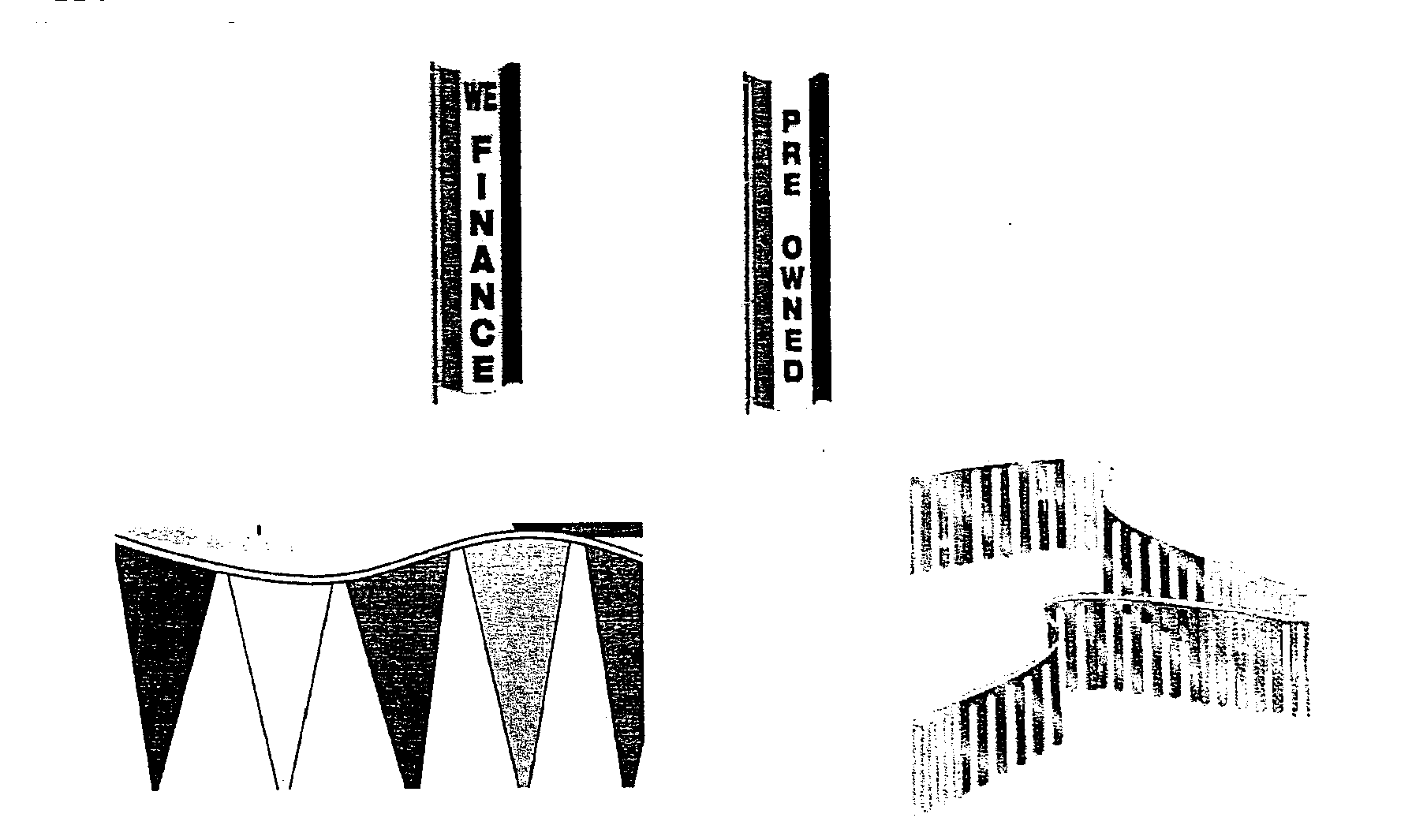
The following are examples of noncommercial banners under this section:

3.
Use of vehicles. Automotive vehicles, agricultural equipment, major recreational equipment, minor recreational vehicles, and mobile homes being displayed, sold or rented shall not be allowed to be left unattended with the vehicle's hood, doors or trunk open, except for as provided herein. Four (4) automotive vehicles may be left unattended with each of the vehicles' hoods open for the sole purpose of displaying a single letter within each of the four (4) engine compartments. When read together such letters would spell a word, such as "SALE" or "RENT". Each business or use regulated hereunder shall be limited to one (1) set of four (4) cars. The following is an example of the "under hood signs";
4.
Interstate signs. One (1) interstate sign per lot of record shall be permitted subject to the following:
a.
The interstate sign shall be a freestanding or monument sign.
b.
The interstate sign shall be located within 500 feet of Interstate 95.
c.
The interstate sign shall not be a billboard, as defined in Chapter 3 of this Code.
d.
Minimum lot area shall be five (5) acres.
e.
The interstate sign shall not be erected within one thousand five hundred (1,500) feet of any residential zoning district.
f.
The interstate sign shall be no greater than forty-five (45) feet in height when measured from the crown of the roadway abutting the lot on which the sign is to be located.
g.
The interstate sign face shall be perpendicular to the interstate right-of-way.
h.
The interstate sign shall have no more than two (2) sign faces.
i.
No portion of the interstate sign shall be located closer than twenty-five (25) feet to any property line.
j.
The interstate sign shall not exceed three hundred (300) square feet per sign face.
k.
For interstate signs located within twenty-five (25) feet of a public or private roadway or aisle, curbing, landscaping and lighting shall be required for all portions of the sign's base.
5.
Maintenance of pennant strips, flags, or banners. All pennant strips, flags or banners allowed under this subsection must be maintained in good condition. Pennant strips, flags or banners which are faded, torn, frayed, stained, or otherwise not in good condition shall be prohibited.
6.
Other sign devices prohibited. Unless otherwise provided in this section or required by federal, state or local law, streamers, balloons, spinners, floaters, or other flying or inflatable devices, signs, or similar objects which are designed to attract the public's attention are prohibited and shall not be displayed outdoors upon the property, structure, or automotive vehicles.
7.
Lawfully existing businesses. Any lawfully existing business or use shall conform to these provisions.
K.
Structures. All structures shall have a permanent foundation, roof, and walls. Any business or use regulated under this section which was lawfully existing and which had a non-permanent structure shall be exempt from this requirement, provided; (1) the existing structure is not increased in size, nor (2) additional non-permanent structures be added to the property.
L.
Outdoor sales. No other outdoor sales and display of any materials, products or goods shall be permitted.
M.
Special sales event permit. Each business or use regulated under this section may obtain from the community services director or the director's designee a special sales event permit. No business or use shall be entitled to more than six (6) separate seven-consecutive day sales events per calendar year. Only one (1) special sales event permit may be issued within any thirty (30) day period, except that two (2) seven-consecutive day sales events may be combined to create a fourteen (14) consecutive day special sales event. In the alternative, one (1) thirty-consecutive day sales event may be allowed in place of all other special sales events during the calendar year.
Beginning on the date provided in the permit, the use of streamers, balloons, spinners, floaters, or other flying or inflatable devices, signs, or similar objects which are designed to attract the public's attention shall be permitted, provided, however, the use of construction equipment is still prohibited. Vehicles on display shall be permitted to be placed on non-paved surfaces during the permitted special sales event period only. Under no circumstances shall vehicles be permitted in the public right of way.
This section provides the minimum standards for the design and operation of businesses which provide for the sale or rental of new and/or used automotive vehicles, agricultural equipment, major recreational equipment, and mobile homes and any accessory use thereof.
(Ord. No. 2-03, § 3, 7-22-03; Ord. No. 24-06, §§ 2, 3, 6-13-06; Ord. No. 08-2008, § 3, 4-22-08; Ord. No. 16-2008, § 8, 7-22-08; Ord. No. 02-2017, § 2, 2-14-2017)
Sec. 29. - Design standards for large retail projects.
(A)
Intent and Purpose. These design standards are intended to create safer, more efficient, and pedestrian-friendly projects with human scale orientation by accomplishing the following objectives:
(1)
To require large retail buildings to be constructed with definition and good architectural design including, but not limited to, clearly defined entryways, articulated roof lines to prevent monotony, pedestrian amenity areas, and concealment of unsightly mechanical structures from public view;
(2)
To require pedestrian-oriented design which effectively resolves the incompatibility between pedestrians and motorists, while providing inter-connectivity between buildings, parking areas, and other internal/external components;
(3)
To require parking lot design which meets vehicular needs, while providing a safer, more efficient, and comfortable pedestrian flow;
(4)
To require adequate landscaping that allows large buildings and their components to blend with their surroundings, while providing screening and shade for the public benefit; and
(5)
To require enhanced lighting and signage design, to avoid forms of nuisance and intrusiveness into adjacent areas, while enhancing public safety.
(B)
Development Standards. The following standards shall be required for all large retail projects and are in addition and supplementary to all other applicable federal, state, and local laws or regulations. Where this section conflicts with any other applicable law or regulation the more stringent provisions shall apply, unless by operation of law the less stringent provision must prevail.
(1)
Facades. No uninterrupted and/or unadorned length of any portion of the facade shall exceed one hundred (100) linear feet (this measurement shall not apply to the backs of buildings that are not visible to the public). Interruptions of such continuous lengths of the facade shall include wall plane projections and/or recesses of not less than five (5) feet in off-set and twenty (20) feet in length, and one (1) or more of the following or similar architectural features shall be required on each wall plane: pilasters, columns, canopies/porticos, arcades, colonnades, and/or parapets. At least one (1) architectural feature shall be required on each wall plane.
All facades shall include patterns at intervals of no more than thirty (30) feet either horizontally or vertically. Such patterns shall include windows, color changes, texture changes or material module changes, and/or surface modeling changes such as offsets, reveals, or ribs of no less than twelve (12) inches in width.
(2)
Materials. Buildings shall be finished on all sides with permanent finished materials of consistent quality. Major exterior surfaces of all primary structures shall be face brick, architectural concrete, glass, stucco, synthetic stucco, decorative block, or stone. Pre-cast panels and concrete block and other materials may be acceptable if incorporated in a building design that is compatible with other development throughout the district. The determination if pre-cast panels and concrete block and other materials are acceptable shall be in the sole discretion of the community development director or the director's designee. A wall surface may use wood, vinyl, or metal, as accent material, provided they are appropriately integrated into the overall building design.
(3)
Entryways. All facades which include at least one (1) customer entrance shall be clearly defined and include at least two (2) of the following or similar features: canopies/porticos, overhangs, recesses/projections, arcades, raised above-the-doorway cornice parapets, peaked roof forms, arches, outdoor patios, display windows, integrated architectural details such as tile work, moldings, planters or wing walls, and/or landscaped sitting areas.
(4)
Service areas. Service areas which include areas designated for loading and unloading of goods, and refuse collection shall be buffered from rights-of-way and residentially zoned areas. Buffering shall consist of planting a minimum of one (1) canopy tree every thirty (30) feet on the exterior of a minimum six (6) foot high wall. All other applicable codes must be met in addition to this requirement.
(5)
Roofs. Flat roof lengths, longer than one hundred (100) feet in length shall be concealed or addressed utilizing at least one (1) of the following options:
(a)
Concealment of flat roof lines, rooftop equipment and heating, ventilating, and air conditioning (HVAC) units from any facade view by adjacent land uses of lesser intensity and public rights-of-way by constructing a parapet. The parapet design shall incorporate a three-dimensional cornice treatment; or
(b)
Two (2) or more sloping roof planes that extend a minimum of three (3) feet above the eave.
(6)
Pedestrian circulation. Large retail projects shall encourage pedestrian-oriented ingress and egress through design features that enhance pedestrian safety, efficiency, and connectivity with a clear definition between vehicular areas and pedestrian walkways.
(a)
Sidewalks. Pedestrian connectivity between the building facade and each grouping of parking spaces, public sidewalks, out parcel buildings, and transit stops shall be clearly indicated through the use of landscaped areas and sidewalks. Along each facade with customer entrances there shall be a sidewalk along the full length of the facade. However, where customer entrances are provided at the corner of a building, a sidewalk shall only be required along the full length of one (1) facade. All facades with multiple customer entrances shall include a covered sidewalk connecting all entryways.
Sidewalks remote from the building shall be a minimum of five (5) feet in width and provide a minimum of three (3) feet of green/landscaped area between the edge of sidewalk and the vehicle use area.
(b)
Pedestrian amenity area. Large retail projects shall include design features such as pedestrian amenity areas that include landscaped sitting areas with design components such as covered seating elements and/or other amenities in shaded areas. One (1) pedestrian amenity area shall be required for each retail project with a building area between sixty thousand (60,000) and one hundred thousand (100,000) square feet. For each retail project with a building area greater than one hundred thousand (100,000) square feet, an amenity area shall be provided for each customer entrance. The amenity areas should be placed in areas which have the highest pedestrian traffic.
(7)
Parking areas. Parking lots and access aisle-ways shall be designed utilizing the following standards:
(a)
Parking lot design. Vast unbroken parking lots are prohibited. Parking areas shall be designed so that no more than one hundred (100) spaces (one hundred fifty (150) spaces for uses that require three hundred and one (301) or more parking spaces according to the City of Cocoa Code) of the total required spaces are part of a clearly defined grouping of spaces. Such groups shall be broken into individual areas and/or clearly separated by landscaped or weather-protected pedestrian walkways, significant landscape or geographic features and/or by design components of the proposed building(s). The design of these separators shall consider pedestrian movements, conflict points with vehicles, site distance and angles, security site lighting and safety within the parking lot area. Separations shall be no less than eight (8) feet in width for medians (landscaped strips between parking stalls where parked vehicles will be located nose to nose) and five (5) feet in width for islands (landscaped strips between parking stalls where the cars are side to side) at any point. A pedestrian access way shall be provided to every customer entrance. The parking lot shall be designed with traffic calming features along the fire lanes fronting the building facades. Parking lots shall be designed to reduce vehicle movement along the fire lane. Design features may include cross driveways, ninety (90) degree parking space design, and consideration of site access points. At least twenty percent (20%) of the required parking spaces shall be placed in the rear or side areas of the proposed development.
(b)
Parking spaces. The number of parking spaces shall be determined in accordance with the City of Cocoa Code. Each parking space in excess of the minimum shall require an additional landscaped area of ten (10) square feet to be placed within the internal parking area, and/or right-of-way buffer.
(8)
Landscaping. The following landscaping standards shall be incorporated into the design of all large retail projects.
(a)
Foundation. Foundation landscaping shall be required for at least fifty percent (50%) of the facade length and located between the drive aisle and the first vertical wall of the building facade. A minimum of twenty-five percent (25%) of the required foundation landscaping shall be placed between the required sidewalk and the first vertical wall of the building facade. The foundation landscaping shall be in planters or planting beds that extend a minimum of eighteen (18) inches from the building.
(b)
Facade. All facades which do not include at least one (1) customer entrance shall be screened from public view with no less than a ten (10) foot wide buffer, including foundation landscaping (as defined above in this section) along the entire length of the ten-foot buffer. In addition, and at a minimum there shall be one (1) canopy tree every thirty (30) feet.
(c)
Parking areas. Every fifteen (15) spaces shall be designed with a minimum four-hundred (400) square feet of landscaping to be placed in medians or islands, which shall exclude foundation and perimeter buffer landscaping. Landscaping shall include at least one (1) canopy tree, one (1) accent tree and six (6) shrubs. No median or island shall be less than five (5) feet in width. No row of parking spaces shall have more than fifteen (15) spaces without landscaping interruption. Grouping of landscaped islands is encouraged to promote the healthy growth of larger trees. Alternative designs are subject to approval by the community development director or the director's designee.
(d)
Perimeter buffer. A perimeter buffer shall be required along the full length of all streets serving a large retail development. The buffer shall be a minimum of fifteen (15) feet in width and comprised of retained natural vegetation, or planted with native plant species.
(e)
Plant quality, installation, and maintenance.
1.
All plant materials shall be of a species adaptive to the East Central Florida region and shall conform to standards for "Florida No. 1" or better, as stated in Grades and Standards for Nursery Plants, Part I (1973) and Part II (1975), State of Florida, Department of Agriculture, as may be amended hereafter. Grass sold shall be clean and reasonably free of noxious pests or diseases.
2.
Installation of all landscaping shall be in a sound workmanship-like manner according to accepted good planting procedures. Prohibited species of trees shall be those species whose roots are known to cause damage to public roadways or other public improvements.
3.
Maintenance of landscaping shall be the responsibility of the owner, tenant or agent, jointly and severally. Said landscaping shall be maintained in a good condition so as to present a healthy, neat and orderly appearance. All landscaped areas must be equipped with an irrigation system. All landscaped areas shall be kept free of weeds, refuse and debris.
4.
If at any time after issuance of a certificate of occupancy or other form of approval, the landscaping of a development to which this article is applicable is found to be in nonconformance, the code enforcement department shall issue notice to the owner that action is required to comply with this section and shall describe what action is required to comply. The owner, tenant, or agent shall have thirty (30) days to restore the landscaping as required. If the landscaping is not restored within the allotted time, such person shall be in violation of this ordinance, the punishment for which shall be as provided pursuant to the City of Cocoa Code of Ordinances.
If after due process the landowner fails to comply with the order of the city, the city council may order the city manager to enter a contract for city council approval for purposes of undertaking required maintenance and bill the property owner or lessee for the costs incurred.
(9)
Signage. Signage shall be designed as part of a complete development system. The location(s) and design shall be reviewed and approved as part of the overall site plan. The predominant sign material shall include architectural or split faced block, brick, glass, wood, stucco, artificial stucco, or stone and be compatible with the principal building design.
This section does not apply to site directional signage, traffic control signage, or building signage. Building signage shall comply with the City of Cocoa Code.
(10)
Outdoor display and sales. Any permanent display areas not within the building but which is attached to or incorporated into the building design and which face a public right-of-way shall be shielded from view by a wall made from materials listed in section 29(B)(2) above and incorporated into the overall design of the building. The wall must extend a minimum of four (4) feet in height. As an alternative, in lieu of a solid wall, continuous uninterrupted landscaping of the display area with a minimum height of four (4) feet may be utilized, provided the landscaping provides and maintains at least eighty percent (80%) opacity within two (2) years of planting.
(11)
Lighting:
(a)
All outdoor light fixtures emitting two thousand fifty (2,050) or more lumens shall be shielded as follows:
1.
Within thirty (30) feet of the property boundary must be full-cutoff fixtures; and
2.
All other outdoor lighting fixtures must be semi-cutoff or full-cutoff fixtures.
(12)
Compliance. In addition to the application requirements of the City of Cocoa Code, a colored facade rendering shall be submitted at time of application submission to ensure that the development standards required herein are adhered to.
(Ord. No. 17-03, § 3, 6-24-03)
Sec. 30. - Temporary storage units.
(a)
Residential zoning districts. Temporary storage units are permitted in residential zoning districts without a permit provided the following criteria are met:
(1)
A maximum of one (1) temporary storage unit is permitted per lot;
(2)
The maximum size of the temporary storage unit is ten (10) feet wide, twenty-four (24) feet long, and nine (9) feet high;
(3)
The maximum time a temporary storage unit is permitted to remain on the lot is thirty (30) consecutive days with a maximum of two (2) placements permitted per year;
(4)
The temporary storage unit shall not be placed in any right-of-way, retention area, septic field or easement and shall not create a site obstruction for any vehicular or pedestrian traffic;
(5)
The temporary storage unit shall not be used for the storage of live animals, hazardous or flammable materials, or human habitation;
(6)
Advertising is prohibited on the temporary storage unit with the exception of the name and phone number of the vendor of the unit, provided the copy area is limited to twenty-five (25) square feet per side with a maximum copy area of fifty (50) square feet per unit; and
(7)
Written notice provided to the city by the vendor or owner, on forms provided by the city, identifying the location and time of placement and removal of the temporary storage unit.
(b)
Commercial zoning districts. Temporary storage units are permitted in commercial zoning districts without a permit provided the following criteria are met:
(1)
The maximum time a temporary storage unit is permitted to remain on the lot is thirty (30) consecutive days with a maximum of two (2) placements permitted per year;
(2)
The temporary storage unit shall not be placed in any right-of-way or easement and shall not create a site obstruction for any vehicular or pedestrian traffic;
(3)
The temporary storage unit shall not be used for the storage of live animals, hazardous or flammable materials, or human habitation;
(4)
Advertising is prohibited on the temporary storage unit with the exception of the name and phone number of the vendor of the unit, provided the copy area is limited to twenty-five (25) square feet per side with a maximum copy area of fifty (50) square feet per unit;
(5)
Written notice is provided to the city by the vendor or owner, on forms provided by the city, identifying the location and time of placement of the temporary storage unit; and
(6)
The temporary storage units shall not be stacked on top of one another.
(c)
Exemptions. The above regulations shall not apply to temporary storage units that are:
(1)
Placed for construction purposes and in connection with a valid building permit, in accordance with section 553.73(8), Florida Statutes; or
(2)
During any period of declared emergency by federal, state or local official action.
(d)
Removal. In the event of a tropical storm or hurricane watch issued by the National Weather Service, the city shall have the right to order the supplier to remove the temporary storage unit by providing the supplier seventy-two (72) hours notice of removal. In the event of a tropical storm or hurricane warning issued by the National Weather Service, the temporary storage unit shall be immediately removed by the supplier after the warning being issued. In such situations, the city shall have the right to enter the property and remove the temporary storage unit if the supplier does not remove the temporary storage unit as required by this subsection. The supplier shall be liable for all removal costs incurred by the city and failure to pay said costs, upon demand by the city, shall constitute a code violation and shall result in a lien being imposed pursuant to chapter 162, Florida Statutes, in the amount of said costs.
(e)
Extensions of time. For good cause shown by the owner of the property at which the temporary storage unit will be supplied, the time periods set forth in subparagraphs a(3) and b(1) may be extended by the city manager; provided an extension granted by the city manager shall not extend beyond ninety (90) days and where the temporary storage unit is placed or located behind the front building line, not within any required yard setback, and in a location that is least noticeable from surrounding properties and rights of way.
(f)
Penalties. Any violation of this section shall constitute a code violation and shall be punished as provided in chapter 6.3 of this Code.
(Ord. No. 3-04, § 3, 2-10-04)
Sec. 31. - Reserved.
Editor's note— Ord. No. 05-2020, § 2, adopted July 8, 2020, repealed § 31, which pertained to medical marijuana treatment center dispensing facilities and derived from Ord. No. 1-2017, § 2, adopted Jan. 9, 2018.
Sec. 32. - Mobile vending.
(A)
PURPOSE AND INTENT. The purpose and intent of this section is to establish land use and zoning regulations for real property upon which a mobile vendor is authorized to operate within the jurisdictional limits of the city. This section is neither intended to prohibit mobile food dispensing vehicles from operating within the entirety of the city nor regulate the licensing, registration, permitting and fees of mobile food dispensing vehicles preempted by the state under F.S. § 509.102.
(B)
DEFINITIONS. As used in this section, the following words and phrases shall have the following meanings, unless the context clearly indicates that a difference meaning is intended:
Accessory shall mean clearly incidental or subordinate to and customary in connection with the principal building or use on a developed site and which is located on the same lot or parcel with such principal building or use.
City manager shall mean the city manager or designee thereof.
Food shall mean all substances commonly used for human consumption as food, beverage, confectionery or condiments, whether simple, mixed or compound, and all substances or ingredients used in preparation thereof.
Mobile food dispensing vehicle shall have the same meaning as that term is defined in F.S. § 509.102(1), and upon the effective date of this section means any vehicle that is a public food service establishment and that is self-propelled or otherwise moveable from place to place and includes self-contained utilities, including, but not limited to, gas, water, electricity, or liquid waste disposal.
Mobile vendor shall mean any person that sells or offers for sale services or goods from a mobile vending unit within the city, including operators of mobile food dispensing vehicles. References in this section to mobile vendors shall include operators of mobile food dispensing vehicles unless expressly stated otherwise.
Mobile vending unit includes:
(1)
A motorized vehicle from which a mobile vendor offers for sale or sells goods or services to the public; or
(2)
A mobile food dispensing vehicle; or
(3)
A "sidewalk vending cart" defined as a pushcart-type vehicle propelled by human power which has been specifically designed or used for purposes of offering for sale or selling goods or services to the public, but not including, by way of example, racks, wheelbarrows, dollies, grocery carts, baby carriages, tables, chairs, benches, cabinets, or other furniture and boxes, buckets, tubs, or other containers or devices which normally rest on the ground, whether or not wheels have been attached; or
(4)
A trailer that is pulled by a motorized vehicle and has no power to move on its own from which a mobile vendor offers for sale or sells goods or services to the public; or
(5)
Any other mobile device approved by the city manager from which a mobile vendor offers for sale or sells goods or services to the public.
Public road shall mean any public right-of-way for cars and trucks in the city.
Public special event shall mean any organized, temporary public or private celebration or gathering of people including, by way of example, events relating to athletic contests, carnivals, fairs, cook-offs, entertainment, dancing, music concert, dramatic productions, art exhibitions, parades, city organized events, and fundraisers (such as religious, charitable, patriotic or philanthropic events), including the sale of merchandise, food or alcohol, or any combination of the foregoing, which is permitted pursuant to section 2-402 of the City Code.
Private special event shall mean any organized, temporary public or private celebration or gathering of people, held entirely on privately owned property and related to the primary use of the property, including, by way of example, events relating to athletic contests, carnivals, fairs, cook-offs, entertainment, dancing, music concert, dramatic productions, art exhibitions, parades, promotional events, and fundraisers (such as religious, charitable, patriotic or philanthropic events), including the sale of merchandise, food or alcohol, or any combination of the foregoing.
(C)
GENERAL REQUIREMENTS. Mobile vendors, except for those operating on real property authorized in this section and in compliance with the requirements of this section, are prohibited and unlawful in the city. Mobile vendors shall be permitted under the following conditions:
(1)
All mobile vendors, except mobile food dispensing vehicles, shall obtain a local business tax receipt if required by chapter 12 of the City Code.
(2)
Mobile vendors providing services via a mobile vending unit by appointment at a customer's place of business or residence shall be permitted in the city, which shall include:
a.
Mobile pet grooming, car detailing, and similar services; and
b.
Mobile caterers who are hired for private catering purposes to serve guests of a catered event, so long as:
i.
The mobile caterer is parked entirely on private property;
ii.
Service is limited to the guests of the catered event only; and
iii.
No payment transaction shall occur for individual orders taken by the mobile caterer.
(3)
Mobile vendors providing services or selling goods via a mobile vending unit at a public special event shall be authorized to operate in the city pursuant to the issued special event permit.
(4)
Mobile vendors providing services or selling goods via a mobile vending unit on private property shall not be permitted unless the property owner obtains a site plan authorizing accessory mobile vending sales on the property as provided in subsection (G) herein. In no case shall a mobile vendor be permitted to operate on the same parcel of real property for more than sixty (60) total consecutive or nonconsecutive days per calendar year.
(5)
Property owners desiring to authorize one (1) or more mobile vendors to locate on their real property shall be required to obtain a site plan authorizing accessory mobile vending sales as provided in subsection (G) herein. In no case shall a property owner allow a specific mobile vendor to locate on their real property for more than a total of sixty (60) consecutive or nonconsecutive days per calendar year. Property owners may be required to obtain a local business tax receipt if renting space to the mobile vendor pursuant to the requirements of chapter 12 of the City Code.
(D)
AUTHORIZED LOCATIONS. Mobile vending is prohibited on municipally owned property, sidewalks, rights-of-way, easements and in alleys, except during city organized events or as authorized by a public special event permit. Subject to the terms and conditions set forth in this section, mobile vendors shall be allowed to operate within the jurisdictional limits of the city in the following authorized areas:
(1)
All zoning districts in the city where the mobile vendor provides services via a mobile vending unit by appointment at a customer's place of business or residence.
(2)
Private real property zoned commercial (C-N, C-G, C-W, CP, and commercial/mixed-use PUD); industrial (M-1, M-2); or institutional (INST) on the city's official zoning map as an accessory mobile vending sales use authorized on a site plan issued pursuant to subsection (G).
(3)
Accessory mobile vending sales shall be allowed on private real property which is zoned core commercial (C-C) on the city's official zoning map pursuant to a site plan obtained as provided in subsection (G), provided that no such mobile vendor shall be allowed to operate on such property during a public special event unless said mobile vendor is contractually affiliated with the city-approved public special event.
(4)
Accessory mobile vending sales uses shall be allowed on private real property which is zoned residential on the city's official zoning map pursuant to a site plan obtained as provided in subsection (G) only if the principal use of the property is not residential.
(5)
Accessory mobile vending sales uses are specifically prohibited in the CBD and CBD/CVO districts. Site plans authorizing accessory mobile vending sales uses in the CBD and CBD/CVO districts shall not be issued. This subsection does not preclude mobile vendors from operating in the CBD and CBD/CVO pursuant to an issued special event permit.
(6)
Within a clearly delineated area on city property or a public right-of-way which has been specifically and temporarily set aside for a mobile vending unit to operate during a public special event or city organized event which is open to the general public, provided the event has been lawfully permitted by the city and any mobile vendor has been contractually arranged by the event organizer to be part of the event.
(E)
CONDITIONS OF LAND USE AND OPERATIONAL STANDARDS. The following land use and operational standards shall apply to all mobile vendors operating within the city, except for mobile vendors providing services via a mobile vending unit by appointment at a customer's place of business or residence:
(1)
When the mobile vendor will be operating on private property, a notarized affidavit signed by the property owner shall be obtained and kept within the mobile vending unit indicating that the vehicle has permission to operate and vend on the property. The affidavit must also indicate that the property owner acknowledges the following requirements:
a.
The property owner shall comply with all ordinances regarding solid waste disposal and must provide the mobile vending unit access to solid waste collection on the subject property;
b.
The property owner shall ensure that the property will be continuously maintained in a neat, clean, and orderly manner.
c.
The property owner shall require that the mobile vending unit meet all applicable federal, state and local statutes, regulations, laws, ordinances, rules and codes including, but not limited to, applicable land use and zoning requirements regarding the subject property, including site plan requirements; and
d.
The property owner shall acknowledge that the property owner understands the regulations governing all mobile vendors in subsection (E) and the regulations specifically governing mobile food dispensing vehicles in subsection (F) of this section and will be held responsible, along with the mobile vendor, for any code violations.
(2)
The subject property must be a developed site which has, at a minimum, a paved parking surface with defined parking spaces. The property may have an existing building, with or without a current occupant.
(3)
No more than one (1) mobile vending unit shall be parked or in operation on a single property at any given time, except during public or private special events and city organized events.
(4)
Except during a public special event and city organized events, hours of operation shall be limited between 8:00 a.m. and 10:00 p.m. The person in charge of the mobile vending unit when in operation on the developed site must be present at all times during hours of operation.
(5)
Mobile vending units and all materials associated with such vehicles must be physically moved at least daily and cannot remain on the subject property outside the approved hours of operation unless for a public or private special event. Except for public or private special events, overnight parking of mobile vending unit is prohibited unless located within an enclosed garage or on property zoned for an authorized open storage use and said storage complies with the requirements of the City Code.
(6)
A mobile vending unit may not be located on a private parking area unless the area will continue to provide the required off-street parking spaces and circulation for existing uses on the property as determined by city staff.
(7)
The wheels of a mobile vending unit must not be removed.
(8)
No signs or signage, other than that which can be contained on the mobile vending unit and (1) one sandwich board sign, of no more than twelve (12) square feet in area, shall be permitted, which may not be placed in such a manner as to interfere with pedestrian facilities or the right-of-way. Signs may not extend above the mobile vending unit.
(9)
All merchandise must be located on the mobile vending unit.
(10)
No mobile vending unit may be located within ten (10) feet of any building or structure.
(11)
No mobile vending unit may be located within fifty (50) feet of any flammable combustible liquid or gas storage and dispensing structure.
(12)
A mobile vending unit shall not be located on private property upon which uncorrected code violations exist, or which is under citation for code violations.
(13)
Mobile vending units shall not sell alcohol unless specifically approved as part of a public special event or other permit approved by the city. The alcohol-related restrictions of chapter 4 of the City Code are applicable unless otherwise authorized by the City Code, or, expressly waived by the city.
(14)
The operation of a mobile vending unit must not obstruct or interfere with vehicular or pedestrian traffic, building access, fire lanes, crosswalks, driveways, fire hydrants, loading areas, stormwater drainage systems, or landscape buffers associated with the principal use. Specifically, mobile vending units must not enter or park upon any "no parking" area, loading zone, driveway, handicapped parking space, or designated public safety lane (e.g., fire lanes) or within twenty (20) feet of a crosswalk or within fifteen (15) feet of a fire hydrant or storm drainage structure.
(15)
Mobile vending units must not enter or park upon playgrounds, playing fields and courts, sidewalks, footpaths or bicycle paths except where permitted by a public special event permit.
(16)
Amplified music or other sounds from any mobile vending unit or from audio equipment installed on the developed site by the property owner or person in charge of the mobile vending unit for purposes of vending, attracting or encouraging the congregation of customers shall be prohibited.
(17)
Mobile vending units shall maintain an appropriate number and size of operable fire extinguishers.
(18)
Police and fire departments, or any authorized representative thereof, shall have the right at any time to suspend operations or request the mobile vendor to relocate when the vendor is causing or contributing to an imminent public safety hazard.
(19)
The operation of a mobile vending unit shall not create or cause nuisance conditions to include, but not be limited to, displaying flags or unauthorized signage, loud noises, visual glare, flashing or animated lights, shouting or amplified music or sound, excessive fumes or smoke, environmental hazards, and any vehicular or pedestrian hazard.
(20)
The grounds around the mobile vending unit and within the vending space shall be kept free of litter, trash, paper and waste at all times. Waste containers shall be provided and all trash shall be taken with the vehicle when the vendor leaves or, with the permission of the property owner, placed inside a commercial dumpster in use and located on the site. Waste containers shall be weighted or otherwise secured in an upright position. The mobile vendor is responsible for containing and properly disposing of all solid waste and wastewater pursuant to local and state rules, regulations and laws.
(21)
Any canopies, awnings or any other attachments must be supported entirely by the mobile vending unit and may not touch the ground.
(22)
It is prohibited and unlawful for a mobile vending unit to fail to comply with all state and city traffic and parking, and stopping and standing laws, codes, ordinances, rules and regulations.
(23)
The mobile vendor may not use any flashing or blinking lights or strobe lights. The mobile vendor may provide localized lighting on or in the mobile vending unit for the purpose of illuminating the customer ordering area to ensure customer safety, for the purpose of food preparation, and for the purpose of menu illumination.
(24)
The mobile vending unit must be self-contained and may not connect to city water or power during operation while located on public right-of-way.
(25)
All mobile vendors must ensure that individuals with disabilities have comparable access to mobile vending units. If existing designs cannot be modified to be accessible to people with disabilities, the method of providing service must be modified to become accessible. No object shall block any pedestrian pathway or ADA access.
(26)
The mobile vendor must comply with the noise provisions of the City Code. Portable generators must be securely affixed to the unit during operation. Generators may not exceed a rating of sixty (60) dBA pursuant to industry standard measurements. Idling of a mobile vending unit is prohibited while preparing or serving food. Exhaust from a generator and all mobile vending operations, including food preparation, must be directed away from the service window and adjacent sidewalk.
(F)
CONDITIONS OF LAND USE AND OPERATIONAL STANDARDS FOR MOBILE FOOD DISPENSING VEHICLES. In addition to the requirements of subsection (E) of this section, mobile food dispensing vehicles shall comply with the following land use and operational standards when operating within the city:
(1)
A copy of the appropriate license(s) issued from the Florida Department of Business and Professional Regulation (Division of Hotels and Restaurants) shall be maintained on the mobile food dispensing vehicle at all times when the vehicle is in operation on real property located within the city, and shall be made available for inspection upon request by the city's law or code enforcement officers.
(2)
Outdoor dining areas including, but not limited to, tables, chairs, booths, bar stools, benches, and standup counters shall only be permitted if expressly authorized in a site plan or a special event permit.
(3)
Mobile vendors are prohibited from serving food from a free-standing barbeque grill or fryer.
(4)
Selling or dispensing of food to customers in a moving vehicle or otherwise engaging in drive-up sales is prohibited from a mobile food dispensing vehicle.
(5)
Mobile food dispensing vehicles must not discharge waste, fat, oil, grease or such other similar substances from the vehicle. All such substances related to or generated from the vehicle shall be taken with the vehicle when vehicle leaves the subject property.
(6)
Mobile food dispensing vehicles must comply, as applicable, with the standards specified by Chapter 5K-4.002, Florida Administrative Code, and the U.S. Food and Drug Administrative 2001 Food Code, as such codes may be amended from time to time.
(G)
SITE PLAN APPROVAL FOR ACCESSORY MOBILE VENDING SALES USE. When the mobile vending unit will be operating on private property, the vehicle must be parked when in operation within an area on the property specifically authorized for a mobile vending unit on the property owner's city-approved master site plan. If the property owner does not have specific site plan approval for a mobile vending unit on the master site plan, the property owner shall be required to obtain supplemental site plan approval by the city manager before the mobile vending unit may operate on the subject property. For purposes of obtaining supplemental site plan approval, the property owner shall submit a site plan or detailed sketch depicting the proposed location of the mobile vending unit operations; all parking spaces, entrances and exits to and from the site; and distances from any buildings or structures, sidewalks, rights-of-way, fire hydrants, fire lanes and landscaped areas, and such other information or documentation deemed by the city manager to be reasonably necessary to authorize a mobile vending unit on the subject property in a manner that is compatible with the existing uses on the subject property and the surrounding area and protects the public health, safety and welfare of the citizens of the city. The mobile vending unit area must be on a paved surface and not exceed an area of six hundred (600) square feet unless the city manager determines more area is required and the subject property clearly has ample space to support a larger sales area. The approved area must not adversely affect existing uses on the subject property or the flow of pedestrian and vehicular traffic on the developed site. There must be an adequate number of parking spaces available for the general public visiting the developed site. Supplemental site plan approval granted by the city manager under this subsection is subject to being suspended or revoked pursuant to subsection (H) or at such time the master site plan is revoked or modified by the planning and zoning board or city council.
(H)
PENALTIES.
(1)
Owners and operators of mobile vending units, and property owners on which such units operate, shall be joint and severally liable for any violations of this section. The penalty provisions set forth in section 1-8 of the City Code shall apply to violations of this section.
(2)
In addition to the penalties authorized by subsection (1), the city manager may also suspend or revoke the property owner's site plan approval for accessory mobile vending use and/or special event permit, as may be applicable, upon a finding that a mobile vending unit was operating on the subject property in violation of this section. Prior to suspending or revoking the applicable site plan approval and/or special event permit, the city manager shall:
(i)
Afford the property owner notice of the violation(s) and a reasonable, informal opportunity to be heard regarding the violation(s);
(ii)
Consider the property owner's past record of compliance with this section and related laws: and
(iii)
Consider the degree of risk to public health, safety, and welfare arising from the alleged violation(s) in evidence.
(3)
The city manager's decision under subsection (2) shall be rendered in writing and shall be deemed final.
(4)
Any site plan approval or special event permit suspended or revoked pursuant to this subsection shall immediately be void and of no further use and effect to any person. If revoked, the property owner shall be prohibited from seeking subsequent site plan approval for accessory outdoor sales or a special event permit for the subject property for a period of one (1) year from the date of the revocation.
(Ord. No. 10-2020, § 2, 8-26-2020)
Sec. 33. - Kava and Kratom.
(A)
PURPOSE AND INTENT. The purpose and intent of this section is to establish distancing requirements between schools, religious institutions, and public parks or playgrounds and establishments which engage in the sale of and/or allow the on-site consumption of Kava beverages and/or Kratom.
(B)
DEFINITIONS. As used in this section, the following words and phrases shall have the following meanings, unless the context clearly indicates that a different meaning is intended:
Kava shall mean any product derived from the rootstock of the Kava plant (Piper methysticum) (also known as intoxicating pepper).
Kava beverages shall mean beverages meant for human consumption containing any form of Kava. Kava beverages shall include beverages made purely from Kava as well as beverages made from a combination of Kava and other ingredients, including but not limited to infusions, teas, fermented drinks, or lattes.
Kratom shall mean any product, including but not limited to food products, food ingredients, dietary ingredients, dietary supplements, or beverages, intended for human consumption which contains any part of the leaf of the Kratom plant, Mitragyna speciosa, or an extract, synthetic alkaloid, or synthetically derived compound of the Kratom plant which is manufactured as a powder, capsule, pill, beverage, or other consumable form.
(C)
DISTANCING REQUIREMENTS. Notwithstanding any other provision of this chapter or any provision of the City of Cocoa zoning regulations, no person shall cause or permit the operation of any establishment selling any form of Kava beverage or any form of Kratom within five hundred (500) feet of a preexisting religious institution; public or private elementary, middle, or secondary school; or public park or playground. A "preexisting" religious institution, public or private elementary, middle, or secondary school, or public park or playground shall mean one existing prior to the existence of the establishment selling or proposing to sell Kava beverages or any form of Kratom. The distance between the establishment proposing to sell or selling any form of Kava beverage or any form of Kratom and a religious institution; public or private elementary, middle, or secondary school; or public park or playground shall be measured by drawing a straight line between the closest property lines of the respective properties used for such purposes.
(Ord. No. 25-2023, § 2, 12-19-2023

