
Cocoa City Zoning Code
ARTICLE V
- DEFINITIONS
For the purpose of this ordinance, certain terms or words used herein shall be interpreted as follows:
The word person includes a firm, association, organization, partnership, trust, company, or corporation as well as an individual.
The present tense includes the future tense, the singular number includes the plural, and the plural number includes the singular.
The word shall is mandatory, the word may is permissive. The words used or occupied include the words intended, designed, or arranged to be used or occupied.
ACCESSORY USE OR STRUCTURE. A "customary accessory structure or use" is one which (refer to article XIII, section 6):
(a)
Is subordinate to and serves the principal structure or principal use; and
(b)
Is subordinate in area, extent, or purpose to the principal structure or principal use served; and
(c)
Contributes to the comfort, convenience, or necessity of occupants of the principal structure or principal uses served; and
(d)
Is located on the same zoning lot as the principal structure or principal use served, with the single exception of such accessory off-street parking facilities as are permitted to locate elsewhere than on the same zoning lot with the structure or use served.
ADULT BOOKSTORE. A place that sells, lends, rents or offers to sell, lend or rent for any form of consideration, adult material that comprises more than ten percent (10%) of the retail value or more than twenty-five percent (25%) of the individual items on the premises as stock in trade on any one (1) or more of the following categories: (1) New publications, (2) used publications, (3) new merchandise, (4) used merchandise.
An adult bookstore includes a business with only a portion or section of its area set aside or devoted to materials set forth in the definition of adult material below provided, however, that if the business can prove that it derives no more than ten percent (10%) of its gross income from the commercial use of such materials and that such materials are out of the reach of customers and accessible only by employees, such business shall not be classified as an adult bookstore.
ADULT CONGREGATE LIVING FACILITY (ACLF). A structure in which the owner or operators are subject to licensing and approval by the State Department of Health and Rehabilitative Services, whether operated on a profit or nonprofit basis. Such facilities may provide lodging, food and one (1) or more personal services for unrelated adults and shall not be regulated or operated by or associated with any jail, prison or correctional facility or system. Such facilities shall have more than six (6) clients and must be licensed by the State Department of Health and Rehabilitative Services as an adult congregate living facility. A facility not licensed by the State Department of Health and Rehabilitative Services must be approved by the county division of health and social services. The facility may require local business tax receipts from the city.
ADULT DANCING ESTABLISHMENT. A commercial establishment that permits, suffers or allows dancers to display or expose specified anatomical areas or to engage in straddle dancing shall be deemed an adult establishment.
ADULT ESTABLISHMENT. An adult motion picture theater, a massage establishment, an adult bookstore or an adult dancing establishment.
ADULT MATERIAL. Any one (1) or more of the following:
(a)
Books, magazines, periodicals or printed matter, films, motion pictures, photographs or reproductions of photographs, video recordings, slides or other visual representations, recordings, novelties and devices, which have as their primary or dominant theme matter depicting, illustrating, describing or relating to specified sexual activities or specified anatomical areas; or
(b)
Instruments, devices or paraphernalia which are designed for use in connection with specified sexual activities.
ADULT MOTION PICTURE THEATER. An area designated and used to permit patrons for any form of consideration to view film or video material which has as its primary or dominant theme depicting, illustrating or relating to specified sexual activities. Included within this definition is any hotel, motel, boarding house, rooming house, or other establishment which advertises the presentation of such material.
ALLEY. Any public or private right-of-way set aside for secondary public travel and servicing which is less than thirty (30) feet in width, which is not generally used for general traffic circulation, and is not otherwise officially designated as a street.
APARTMENT. See Dwelling, multiple-family.
AUTOMOTIVE LAUNDRY. A building or portion thereof, containing facilities for washing more than two (2) automobiles, using production line methods with chain conveyor, blower, steam cleaning device or other mechanical and/or nonmechanical self-service devices.
AUTOMOTIVE REPAIR FACILITIES. This term shall include all mechanical engine overhaul or repair, and body work and painting of automotive vehicles.
AUTOMOTIVE VEHICLES. Any self-propelled vehicle or conveyance designed and used for the purpose of transporting or moving persons, animals, freight, merchandise or any substance. The phrase shall include passenger cars, trucks, truck tractors, buses, motorcycles, scooters with engines over fifty (50) ccs, and station wagons, but shall not include tractors, major recreational equipment, minor recreational vehicle, construction equipment, or machinery or any device used for performing a job except as stated above.
AWNING. A detachable, roof-like cover, supported by the walls of a building, for protection from sun or weather (refer to article XIII, section 7).
AUTOMOBILE AND TRAILER SALES AREAS. An open, partially open, or enclosed area other than a street, used for the display, sale or rental of new or used automobiles or trailers, and where no repair work is done except minor incidental repair of automobiles or trailers to be displayed, sold or rented on or from the premises.
BAR. A retail establishment selling alcoholic beverages for consumption on the premises or an establishment, commonly known as a "bottle club," in the business of furnishing premises where alcoholic beverages may be consumed.
BED AND BREAKFAST ESTABLISHMENT. An accessory use by special exception subordinate and incidental to the principal residential use of the building. Such an establishment is a privately-owned, owner-operated, owner-occupied residence, with one (1) to five (5) guest rooms available to the general public.
BONUS. An increase in floor area on a site in the Central Business District as a result of the construction of a qualifying affordable housing unit within the RU-2-10 district.
BUFFER AREA. The land area, including structures, fencing and landscaping thereon, required at the perimeter of lots in the Core-Commercial District where such lots are adjacent to residential zoning districts in order to minimize or eliminate potential conflicts between adjacent land uses.
BUILDABLE AREA. The portion of a lot remaining after required yards have been provided.
BUILDING OFFICIAL. The official charged with the administration and enforcement of this ordinance as provided for in article XV.
BUILDING OR STRUCTURE. Any structure constructed or used for residence, business, industry or other private or public purposes or accessory thereto, including tents, lunch wagons, dining cars, trailers, mobile homes, sheds, garages, carports, animal kennels.
BUILDING, HEIGHT OF. The vertical dimension of a structure as measured from the established average sidewalk or street grade or finished grade at the building line, whichever is the highest, to (a) the highest point of a flat roof; (b) the deck line of a mansard roof; (c) the peak of gable, hip or gambrel roofs; or (d) the highest ceiling point of heated and/or air conditioned habitable space in a building with residential uses on the top floor. Stair and elevator access to a roof deck shall not be considered habitable.
BUSINESS SERVICES. An establishment primarily engaged in rendering services to business establishments on a fee or contract basis, such as advertising and mailing; building maintenance; employment service; management and consulting services; protective services, drafting and print shops, and reproduction services.
CANOPY (MARQUEE). A roof-like structure serving the purpose of protecting pedestrians from rain, snow, sun, or hail, which structure projects from a building. Such structure shall be open on three (3) sides and, if ground-supported, supports shall be confined in number and cross section area to the minimum necessary for actual support of the canopy.
CHILD CARE CENTER. Any building wherein care for more than four (4) children in a twenty-four-hour period, excluding the family, is rendered. The term includes nursery schools and kindergartens.
CLINIC, ANIMAL. A building used by a group of professional medical persons for the healing arts or treatment of small animals on an out-patient or nonboarding basis only, without runs.
CLINIC, PERSONS. A building used by a group of professional medical persons for the healing arts or treatment of persons on an out-patient or nonboarding basis only.
CLUBHOUSE. A building owned or rented by a nonprofit association made up of bona fide members paying dues, the use of which is restricted to said members and their guests.
COMMERCIAL VEHICLES AND HEAVY EQUIPMENT. Commercial, industrial or agricultural vehicles, equipment or machinery, whether or not the vehicle, equipment or machinery is licensed or otherwise authorized to travel upon the roads of the state, specifically including, but not limited to: semi-trailers; tractors for semi-trailers; trucks; step-vans; box trucks; construction equipment; cement mixers; compressors; forklifts; buses; tow trucks; dump trucks; trucks with roll-back beds; trailers; any other similar vehicles, equipment and machinery classified as commercial by the manufacturer; and pickup trucks, passenger vans, and cargo vans used for commercial purposes.
CONTRACTOR. Contractors and builders engaged in the construction, demolition, installation, or repair of buildings or structures, either residential, commercial, or industrial structures, as well as heavy construction contractors engaged in activities such as paving, highway construction and utility construction.
CONVENIENCE STORE. A store selling at retail items such as food and drinks, books, magazines, newspapers, notions and sundries; which store is open to the public for extended periods of time for the customer's convenience before or after normal shopping hours. Convenience stores may also sell at retail gasoline or other volatile fuel provided that the sale of fuel is incidental to the sale of other items and does not constitute the primary business of the store and provided that all other specific district regulations of the zoning ordinance are met. Convenience stores are sometimes referred to as "7-11," "Step Savers," "Jiffy Stores," or "Zippy Marts." A convenience store shall be in a freestanding, single-occupancy structure.
COURT. An unoccupied open space on the same lot with the principal building and fully enclosed on at least three (3) adjacent sides by walls of the principal building.
COURTESY NOTICE. A notice of a public hearing, not required by law, mailed at the city's discretion to property owners within three hundred (300) feet of property which is the subject of said public hearing.
CRAFT BREWERIES. Entities that utilize the fermentation process to produce beer beverages.
DEVELOPMENT: The construction or reconstruction, or the repair or alteration exceeding fifty percent (50%) of the replacement cost which is to be based on current Southern Standard Building Code Congress International (SBCCI) building valuation, which may change from time to time, as used by the building official, of any building, improvement, or structures located on any land, including development of any existing building, improvement or structure.
DISTRICT. A zone within the city so designated on the official zoning map (synonymous with "zone").
DWELLING, MOBILE HOME. A detached residential dwelling unit, over eight (8) feet in width, designed for transportation after fabrication on streets or highways on its own wheels or on flatbed or other trailers, and arriving at the site where it is to be occupied as a dwelling unit complete and ready for occupancy except for minor and incidental unpacking and assembly operations, location on jacks or other temporary or permanent foundations, connections to utilities, and the like. A travel trailer is not to be considered as a mobile home.
DWELLING, MULTIPLE-FAMILY. A residential building designed for three (3) or more families, with the number of families in residence not exceeding the number of dwelling units provided.
DWELLING, SINGLE-FAMILY. A detached residential dwelling unit other than a mobile home, designed for and occupied by one (1) family only.
DWELLING, TWO-FAMILY (DUPLEX). A detached residential building designed, arranged, or used exclusively by two (2) families, living independently of each other.
DWELLING UNIT OR LIVING UNIT. A building or portion thereof providing complete housekeeping facilities for one (1) person or one (1) family.
EASEMENT. A right, distinct from the ownership of the land, to cross property with facilities such as, but not limited to sewer lines, water lines and transmission lines, or the right, distinct from the ownership of the land, to reserve and hold an area for drainage or access purposes.
EFFICIENCY APARTMENT. A dwelling unit in which the kitchen, living, sleeping and dining facilities are located within one (1) room.
ELECTRONIC COMMUNICATION TRANSMISSION FACILITIES AND EXCHANGES. A standardized, unmanned structure not exceeding three hundred (300) square feet of building area. Square footage requirements for lots shall not apply except that such use shall not be in conjunction with another principal use. The structure shall comply with the front setback provisions of the zone classification; however, side and rear setbacks may be reduced to seven and one-half (7½) feet. A landscaped buffer planted on its perimeter shall be required to appropriately screen the facility. A building permit shall be required for the structure and the structure shall adhere to all applicable codes.
EMERGENCY SHELTERS FOR CHILDREN. A licensed or approved governmental, non-profit, or non-governmental facility where temporary room or board (or just room) and immediate, necessary and very short-term care is provided for children alleged or adjudicated to be dependent and who, because of their condition or surroundings, must be removed from the supervision and care of their legal parent(s), relative(s) or guardian to insure their welfare. The maximum number of children sheltered shall not exceed fifteen (15) at any time and no one (1) child may be sheltered at said facility for more than forty-eight (48) continuous hours. The number of children permitted to be sheltered shall be limited by the number of rooms and beds available. However, at no time shall more than two (2) children be housed in a single room. For example, an emergency shelter with five (5) rooms and ten (10) beds shall be limited to provide shelter and care for no more than ten (10) children at a given time.
FACADE. The front of a building and/or any of its sides facing and which are predominantly visible from a public right-of-way, public park, open space, or recreational area or facing an adjacent residential land use or zoning district.
FAMILY. Family is a single individual, doing his own cooking, and living upon the premises as a separate housekeeping unit, or a collective body of persons doing their own cooking and living together upon the premises as a separate housekeeping unit in a domestic relationship based upon birth, marriage, or other domestic bond, as distinguished from a group occupying a boardinghouse, lodging house, club, fraternity or hotel.
FENCES. An artificial barrier, wall or divider constructed in order to provide privacy, protection or decoration.
FLOOR AREA; LIVING AREA. The sum of the gross horizontal area, the several floors of a dwelling unit or units exclusive of porches, balconies and garages measured from the exterior faces of the exterior walls or from the centerlines of walls or partitions separating dwelling units.
For the uses other than residential, the gross floor area shall be measured from the exterior faces of the exterior walls or from the centerline of walls or partitions separating such uses and shall include all floors, lofts, balconies, mezzanines, cellars, basements and similar areas devoted to such uses.
The gross floor area shall not include floors used for parking space when such parking appertains to a residential, commercial, or office use in the same structure.
FLOOR AREA RATION (FAR). The total floor area in square feet of a principal structure on any lot divided by the gross area of the lot in square feet.
FRONT BUILDING LINE. A line extending from side lot line to side lot line and commencing at the front-most portion of the lot's principal structure, not necessarily coinciding with the front yard setback where an irregular lot requires greater setback than minimum to meet the lot width requirements.
GARAGE (PRIVATE). An enclosed structure accessory to a main structure secure from intrusion, protected from the elements, for the purpose of storing automotive vehicles and in which no occupation or business for profits is carried on.
GARAGE (PUBLIC). A building or portion thereof designed, intended and used exclusively for the care, repair or equipment of self-propelled motor vehicles. This definition shall not include private garage.
GYM AND FITNESS FACILITY. A privately-owned, indoor establishment offering individuals or groups the ability to engage in exercise or sport related activities for the purpose of physical fitness, health, and recreation, whether or not on a membership basis. This use may include indoor gymnasiums, gymnastics centers, dojos, exercise or dance studios, yoga studios, or similar facilities where individuals may engage in regular physical activities including exercise, sports, or recreation. This use may also include incidental accessory uses such as food and beverage sales, game courts, locker rooms, training facilities, and/or saunas. This term does not include indoor playgrounds or play areas primarily designed for children.
HALF-WAY HOUSE. A residential group treatment home specifically designed for therapeutic and rehabilitative purposes.
HEDGE. A row of bushes or small trees planted close together in such a manner as to form a boundary or barrier.
HOSPITAL, ANIMAL. A building used by a group of professional medical persons for the healing arts or treatments of animals primarily on an in-patient or boarding basis and shall have outside runs.
HOSPITAL, PERSONS. A building used by a group of professional medical persons for the healing arts or treatment of persons on a, generally, in-patient or boarding basis.
JUNKYARD. An open area where any waste, used or second-hand materials are bought, sold, exchanged, stored, baled, packed, disassembled or handled including, but not limited to, scrap iron and other metals, paper, rags, rubber tires, and bottles. A "junkyard" includes an auto wrecking yard or the storage or keeping of one (1) or more inoperative motor vehicles unless where otherwise specifically permitted but does not include uses established entirely within enclosed buildings.
LARGE RETAIL PROJECT. Any new commercial retail project, whose total gross building area equals or exceeds sixty thousand (60,000) square feet, specifically mercantile uses, and/or shopping center uses. For the purpose of determining building area, multiple buildings located on a single lot and closer than twenty (20) feet together shall be considered one (1) building.
LIGHT FIXTURE, FULL-CUTOFF. A light fixture designed such that no light is projected at or above a ninety (90) degree plane running through the lowest point on the fixture where the light is emitted; and less than ten percent (10%) of the rated lumens are projected between ninety degrees (90°) and eighty degrees (80°).
LIGHT FIXTURE, OUTDOOR. An outdoor illuminating device, reflective surface, lamp and other device, either permanently installed or portable, which is used for illumination or advertisement. Such device shall include, but is not limited to, a searchlight, spotlight and floodlight for:
1.
Buildings and structures;
2.
Recreational areas;
3.
Parking lot lighting;
4.
Landscape lighting;
5.
Billboards and other signs;
6.
Street lighting;
7.
Product display lighting;
8.
Building overhangs and open canopies.
LIGHT FIXTURE, SEMI-CUTOFF. A fixture that projects no more than five percent (5%) of the rated lumens above a ninety (90) degree plane running through the lowest point on the fixture where the light is emitted; and less than twenty percent (20%) of the rated lumens are projected between ninety degrees (90%) and eighty degrees (80°).
LIGHT MANUFACTURING USES (INCLUDING INCIDENTAL). This shall include light assembly and fabrication that is predominantly for retail sales on premises. This use shall be compatible with the general character of the area and the surrounding uses. Off-street parking and loading requirements shall be adhered to as indicated in article XII, section 1, (b), (8) of the Zoning Code. Such light manufacturing uses shall not create any nuisance in the form of noise, dust, smoke, or odor and shall be subject to the Performance Standards as outlined in article XXV. This definition shall apply to the Central Business District only, given the special character of the area.
LIGHT SOURCE. A complete lighting unit consisting of a lamp and all necessary mechanical, electrical and decorative parts, such as reflectors (mirrored enclosures surrounding the lamp), refractors (glass or plastic enclosures surrounding the lamp) and lenses, designed to direct light rays.
LIVING AREA. See Floor Area.
LOADING SPACE, OFF-STREET. Space logically and conveniently located for bulk pickups and deliveries, scaled to delivery vehicles expected to be used, and accessible to such vehicles when required off-street parking spaces are filled. Required off-street loading space is not to be included as off-street parking space in computation of required off-street parking space (refer to article XII).
LOT. For purposes of this ordinance, a lot is a parcel of land of at least sufficient size to meet minimum zoning requirements for use, coverage, and area, and to provide such yards and other open spaces as are herein required. Such lot shall have frontage on an improved public street, or on an approved private street, and may consist of:
(a)
A single lot of record;
(b)
A portion of a lot of record;
(c)
A combination of complete lots of record, and portions of lots of record, or of portions of lots of record;
(d)
A parcel of land described by metes and bounds; provided that in no case of division of combination shall any residual lot or parcel be created which does not meet the requirements of this ordinance.
LOT COVERAGE. The percentage of the lot or parcel of land that is covered or occupied by all principal and accessory structures. Fences, driveways, swimming pools, pavers, and decks less than thirty (30) inches in height shall not be included in the computing of lot coverage.
LOT FRONTAGE. The front of a lot shall be construed to be the portion nearest the street. For the purposes of determining yard requirements on corner lots and through lots, all sides of a lot adjacent to streets shall be considered frontage, and yards shall be provided as indicated under "yards" in this section.
LOT MEASUREMENTS.
(a)
"Depth of a lot" shall be considered to be the distance between the midpoints of straight lines connecting the foremost points of the side lot lines in front and the rearmost points of the side lots in the rear.
(b)
"Width of a lot" shall be considered to be the distance between straight lines connecting front and rear lot lines at each side of the lot, measured across the rear of the required front yard; provided however, that width between side lot lines at their foremost points (where they intersect with the street line) shall not be less than eighty percent (80%) of the required lot width except in the case of lots on the turning circle of culs-de-sac, where the eighty percent (80%) requirement shall not apply. There must be a minimum of fifty (50) feet on the turning circle of culs-de-sac.
LOT OF RECORD. A lot which is part of a subdivision recorded in the office of the county clerk, county recorder, or a lot or parcel described by metes and bounds, the description of which has been so recorded.
LOT TYPES. The diagram (Figure 1) which follows illustrates terminology used in this
reference to corner lots, interior lots, reversed frontage lots and through lots.
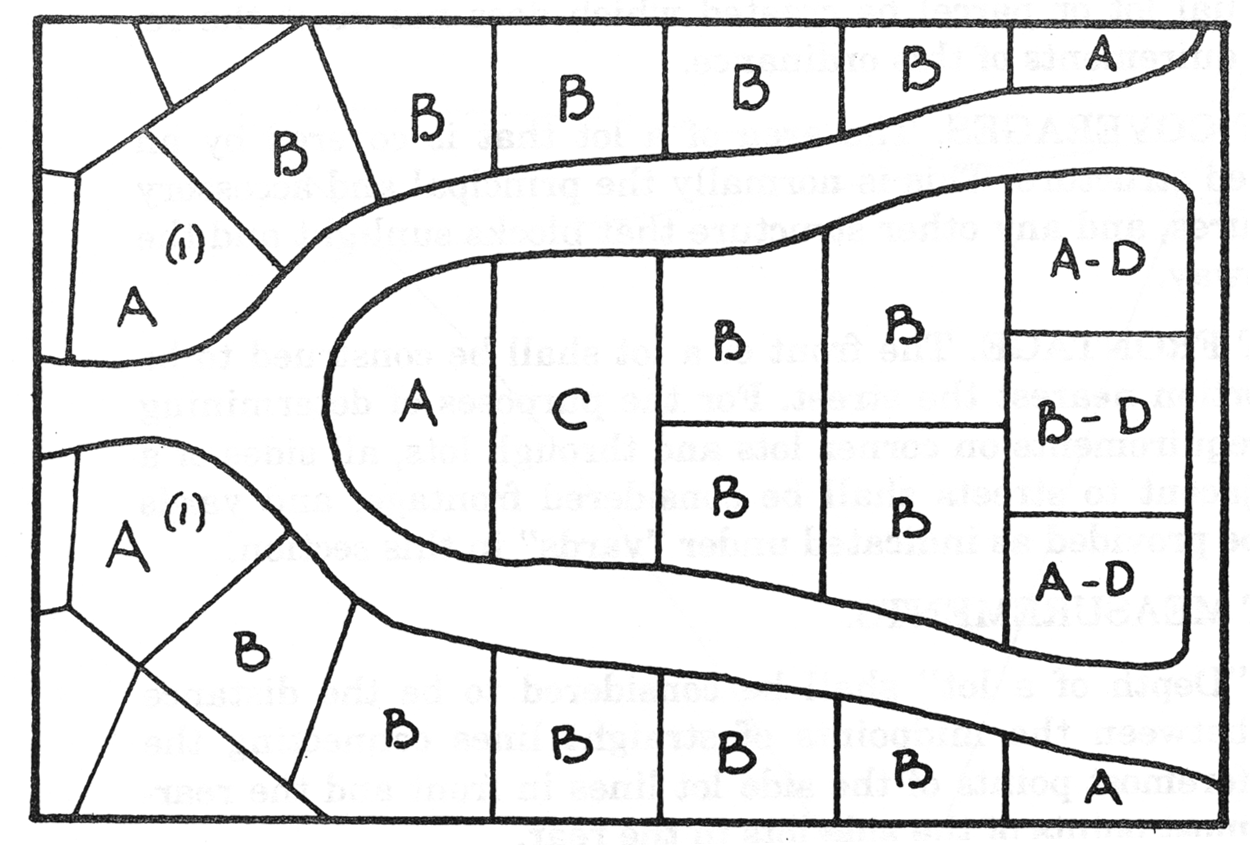
Figure 1
In the diagram:
A=
Corner lot, defined as a lot located at the intersection of two (2) or more streets. A lot abutting on a curved street or streets shall be considered a corner lot if straight lines drawn from the foremost points of the side lot lines to the foremost point of the lot meet at an interior angle of less than one hundred thirty-five degrees (135°). See lots marked A(1) in the diagram.
B=
Interior lot, defined as a lot other than a corner lot with only one (1) frontage on a street.
C=
Through lot, defined as a lot other than a corner lot with frontage on more than one (1) street. Through lots abutting two (2) streets may be referred to as double frontage lots.
D=
Reversed frontage lot, defined as a lot on which the frontage is at right angles or approximately right angles (interior angle less than one hundred thirty-five degrees (135°)) to the general pattern in the area. A reversed frontage lot may also be a corner lot (A—D in the diagram), or a through lot (C).
LIVING UNIT. See dwelling unit.
LOUNGE OR COCKTAIL LOUNGE. A retail establishment selling alcoholic beverages for consumption on the premises or an establishment, commonly known as a "bottle club," in the business of furnishing premises where alcoholic beverages may be consumed.
MAJOR RECREATIONAL EQUIPMENT. Boats (excluding kayaks and canoes) and boat trailers, travel trailers, pick-up campers or coaches (designed to be mounted on automotive vehicles), motorized dwellings, tent trailers, golf carts, and the like, and cases or boxes used for transporting recreational equipment, whether occupied by such equipment or not (refer to article XIII, section 14).
MARINA. A place for docking pleasure boats or providing services to pleasure boats and the occupants thereof, including minor servicing and repair to boats while in the water, sale of fuel and supplies, and provision of food, beverages, and entertainment as accessory uses. A yacht club shall be considered as a marina, but a hotel, motel or similar use, where docking of boats and provision of services thereto is incidental to other activities, shall not be considered a marina, or boat docks accessory to a multiple dwelling where no boat-related services are rendered.
MASSAGE ESTABLISHMENT. A site, premises or business where any employee or owner manipulates the tissues of the body of another person, for any form of consideration. Excluded from this definition are licensed health care facilities and providers and establishments licensed or exempted from licensing by Florida Statutes, Chapter 480.
MEDICAL MARIJUANA TREATMENT CENTER DISPENSING FACILITY. A facility of a medical marijuana treatment center, as that term is defined in s. 29, Art. X of the Florida State Constitution, which dispenses marijuana, products containing marijuana, related supplies or educational materials to qualifying patients or their personal caregivers, as defined in s. 29, Art. X of the Florida State Constitution and section 381.986, Florida Statutes, but shall not include facilities growing, cultivating or processing marijuana or derivative products.
MINIMUM BUILDING SETBACK LINE. A line parallel to the front, side and/or rear lot line and set back from the lot line a sufficient distance as specified in this ordinance, to provide the required minimum yard space.
MINOR RECREATIONAL VEHICLE. Small, self-propelled, open motorized vehicles intended for use by not more than two (2) people and typically used off-road, such as dirt bikes and all-terrain vehicles (ATVs), but may also be used on-road such as scooters, mopeds, and motorcycles with engines fifty (50) ccs and under. Minor recreational vehicles shall also include kayaks and canoes. Minor recreational vehicles shall not include electric personal assistive mobility devices or electric powered wheel chairs.
MORTUARY OR FUNERAL HOME. An establishment with facilities for the preparation of the dead for burial or cremation; for the viewing of the body and funeral services but not actual cremation.
NONCONFORMITY. Any lot, use of land, use of structure, use of structure and premises or characteristics of any use which was lawful at the time of enactment of this ordinance but which does not conform with the provisions of the district in which it is located (refer to article X).
NURSING (CONVALESCENT) HOME. A home for the aged, chronically ill or incurable persons in which three (3) or more persons not of the immediate family are received, kept or provided with food and shelter or care for compensation; but not including hospitals, clinics or similar institutions devoted primarily to the diagnosis and treatment of the sick or injured.
OCCUPIED. The use of a structure or land for any purpose, including occupancy for residential, business, industrial, manufacturing, storage, and public use.
PACKAGE STORE. A retail establishment selling alcoholic beverages for consumption off the premises and not limiting such beverage sales to beer and wine.
PACKAGE STORE, BEER AND WINE. A retail establishment selling alcoholic beverages for consumption off the premises but limiting such beverages to beer and wine.
PATIO OR TERRACE. An open unoccupied space adjacent to the principal building on one (1) or two (2) sides prepared with a hard, semihard, or improved surface, and unenclosed for the purpose of outdoor living.
PERMITTEE. The person in possession or having beneficial use of property.
PREMISE. A tract of land with a structure thereon.
PRINCIPAL USE OF STRUCTURE. A building in which is conducted the principal use of the lot on which it is situated. In a residential district any dwelling shall be deemed to be the principal building on the lot on which the same is situated. An attached carport, shed, garage, or any other structure with one (1) or more walls or a part of one (1) wall being a part of the principal building and structurally dependent, totally or in part, on the principal building shall comprise a part of the principal building and be subject to all regulations applied to the principal building.
A detached and structurally independent carport, garage, or other structure shall conform to the requirements of an accessory building. A detached and structurally independent garage, carport or other structure conforming as an accessory building may be attached to the principal building by an open breezeway.
PRIVATE CLUB. The term "private club" shall pertain to and include associations and organizations of fraternal or social character.
PUBLIC USE. Any use of land or structures owned and operated by a municipality, county, state or the federal government or any agency thereof and for a public service or purpose.
RESTAURANT. Any building or structure or portion thereof, in which food is prepared and served for pay to any person not residing on the premises.
SCREENED STRUCTURE OR SCREENED ENCLOSURE. A structural frame designed to be covered with metal, fiberglass or other approved insect screening. The insect screening shall have at least fifty percent (50%) open area per square inch. The framing and overhead supports of such screened structure or screened enclosure shall be solely for the purpose of supporting such screening.
SELF-SERVICE STORAGE FACILITIES. A fully enclosed building or buildings having individual compartmentalized units, stalls or lockers with privately controlled access points which are to be rented only as storage space for customer's goods, wares or personal property. The term is synonymous with mini-warehouses, mini-storage, self-storage facilities and self-storage warehouses.
SEMIPUBLIC USE. Any use of land or buildings owned and operated by an individual, firm, corporation, lodge, or club, either as a profit or nonprofit activity, for a public service or purpose. This shall include privately owned utilities, transportation, recreation, and cultural activities and services.
SENIOR/ELDERLY ONLY HOUSING. A multi-family housing project intended for, and solely occupied by, persons sixty-two (62) years of age or older.
SERVICE STATIONS OR FILLING STATIONS. Buildings and premises where gasoline or other volatile fuel, oil, grease, batteries, tires and automotive accessories may be supplied and dispensed at retail, and where in addition, the following services may be rendered and sales made, and no other:
(a)
Sale and servicing of spark plugs, batteries, and distributor parts;
(b)
Tire servicing and repair, but not recapping or regrooving;
(c)
Replacement of mufflers and tail pipes, water hose, fan belts, brake fluid, light bulbs, fuses, floor mats, seat covers, windshield wipers and wiper blades, grease retainers, wheel bearings, mirrors, and the like;
(d)
Radiator cleaning and flushing;
(e)
Washing and polishing, and sale of automotive washing and polishing materials;
(f)
Greasing and lubrication;
(g)
Providing and repairing fuel pumps, oil pumps and lines;
(h)
Minor servicing and repair of carburetors;
(i)
Emergency wiring repairs;
(j)
Adjusting and repairing brakes;
(k)
Sales of cold drinks, packaged foods, tobacco, and similar convenience goods for service station customers, as accessory and incidental to principal operation;
(l)
Provision of road maps and other aforementioned material to customers;
(m)
Provision of restroom facilities;
(n)
The rental of motorbikes and moving or travel trailers; provided that no more than two (2) such vehicles be placed on display and that the remainder be stored out of public view.
Uses permissible at a service station do not include major mechanical and body work, straightening of body parts, painting, welding, storage of automobiles not in operating condition or other work involving noise, glare, fumes, smoke or other characteristics to an extent greater than normally found in service stations. A service station is not a repair garage nor a body shop. In addition, convenience stores shall not be included in this definition.
SPECIAL EXCEPTION. A special exception is a use that would not be appropriate generally or without restriction throughout the zoning division or district but which, if controlled as to number, area, location, or relation to the neighborhood would promote the public health, safety, welfare, morals, order, comfort, convenience, appearance, prosperity or general welfare. Such uses may be permitted in such zoning district as special exceptions (refer to article XVII section 2).
SPECIFIED ANATOMICAL AREAS. Means:
(a)
Less than completely and opaquely covered;
(i)
Human genitals or pubic region;
(ii)
The cleavage of the human buttocks;
(iii)
That portion of the human female breast below the top of the areola (the colored ring around the nipple). This definition shall include the lower portion of the breast but shall not be interpreted to include any portion or the cleavage of the breast exhibited by a dress, blouse, shirt or other usual wearing apparel provided the areola is not exposed. Use of apparel or other material which substantially covers only the areola and nipple will not be interpreted as usual wearing apparel.
SPECIFIED SEXUAL ACTIVITY. Means:
(a)
Human genitals in a state of sexual stimulation, arousal or tumescence;
(b)
Acts of human anilingus, bestiality, buggery, cunnilingus, coprophagy, coprophilia, fellation, flagellation, masochism, masturbation, necrophilia, pederasty, pedophilia, sadism, sadomasochism, sapphism, sexual intercourse, sodomy, urolagnia, zooerasty, or other obscene acts;
(c)
Fondling or other erotic touching of human genitals, pubic region, buttock, anus or female breast; and
(d)
Excretory functions as part of or in connection with any of the activities set forth in (a) through (c) above.
STRADDLE DANCING (also known as lap dancing or face dancing). The use by a dancer, whether clothed or not, of any part of his or her body to massage, rub, stroke, knead, caress, fondle or otherwise physically stimulate the genital or pubic area of a patron or the placing of the genital or pubic area of a dancer in contact with or in close proximity to the face of a patron.
STREET. A street, for the purpose of this section, shall be a public or private right-of-way set aside for public travel which is thirty (30) feet or more in width.
(a)
Street right-of-way line: The property line which bounds the right-of-way set aside for use as a street.
(b)
Street centerline: The midpoint between the street right-of-way lines.
STRUCTURAL ALTERATION. Any change except for repair or replacement in the supporting members of a structure, such as bearing walls or partitions, columns, beams, or girders, or any change in the roof or in the exterior walls.
STRUCTURE. Structure shall mean anything constructed, erected, or placed, which requires a permanent location on the ground, or in the ground, or attached to something having a permanent location on or in the ground; provided, however, that fences six (6) feet or under shall not be considered structures.
SWIMMING POOL. Any portable pool or permanent structure containing a body of water eighteen (18) inches or more in depth and two hundred fifty (250) square feet or more of water surface area, intended for recreational purposes, including a wading pool, but not including an ornamental reflecting pool or fish pond or other type of pool regardless of size, unless it is located and designed so as to create a hazard or be used for swimming or wading (refer to article XIII, section 15).
TELEVISION DISH RECEIVERS AND ANTENNAE. That portion of the outside antenna system (satellite dish antenna) for television receiving apparatus or equipment which is electrically connected to the receiver.
TEMPORARY STORAGE UNIT. Portable storage containers typically utilized temporarily for the storage of equipment, furniture, clothing, merchandise or other personal or business belongings as part of the process of moving and/or as part of an intent to store items offsite at a commercial storage location.
TERRACE. See Patio.
TOURIST AND TRANSIENT LIVING ACCOMMODATIONS. Any place where tourists, transients, travelers, or persons desiring temporary residence may be provided with sleeping, sanitary or cooking facilities.
(a)
Hotel and motel. A building designed or used to provide lodging or boarding and lodging to the public for transients, tourists or persons of short-term residence in which there are six (6) or more guest rooms with limited or no kitchen facilities offered. Said building being open to the general traveling public as opposed to the customary purpose and use of a boarding or lodging house, apartment building or multiple-family dwelling.
TOWNHOUSE. A dwelling unit which is one of a group of such units separated by adjoining fire walls, or fire walls separated by a space of no more than six (6) inches, constructed upon a separate lot and serviced with separate utilities.
TOTAL FLOOR AREA OR GROSS FLOOR AREA. The areas of all floors of a building, including finished attics, finished basements and all covered areas, including porches, sheds, carports, and garages.
TRANSPORTATION TERMINALS. A transportation terminal includes both passenger transportation terminals and freight transportation terminals. Transportation terminals are facilities where passengers or freight are assembled and dispersed during transportation and must include facilities. buildings. and equipment used for the transportation or movement of people or goods. Passenger transportation facilities allow passengers to access modes of transportation such as buses, ferries, or trains, for example, and include ancillary services such as ticketing. food and security services. Freight transportation terminals shall include facilities such as berths. loading bays, freight yards. storage facilities. and warehouses to move and disperse goods. Facilities used primarily for short term or long term parking of vehicles shall not be considered transportation terminals.
USED. The word "used" shall include the words "arranged," "designed," and "intended to be used."
VACANT. A building or parcel of land which is neither occupied nor used or is in a nonoperative state for a period of six (6) months.
VARIANCE. A variance is a variation of the terms of the zoning ordinance where such variance will not be contrary to the public interest and where, owing to conditions peculiar to the property or lot of record and not the result of the actions of the applicant, prior to filing of application, a literal enforcement of the ordinance would result in unnecessary and undue hardship (refer to article XVII, section 3).
WAREHOUSING/DISTRIBUTION. An activity involving the storage of goods or materials before or after manufacture and before final sales or use, and includes transshipment of such goods or materials (loading and unloading) but excludes manufacturing and processing.
YARD. A required open space other than a court unoccupied and unobstructed by any structure or portion of a structure from thirty (30) inches above the general ground level of the graded lot upward; provided, however, that fences, walls, poles, posts, and other customary yard accessories, ornaments, and furniture may be permitted in any yard subject to height limitations and requirements limiting obstruction of visibility.
YARD, FRONT. A yard extending between side lot lines across the front of a lot adjoining a public street. In the case of through lots, unless the prevailing front yard pattern on adjoining lots indicates otherwise, front yards shall be provided on all frontages. Where one (1) of the front yards that would normally be required on a through lot is not in keeping with the prevailing yard pattern, the administrative official may waive the requirement for the normal front yard and substitute therefor a special yard requirement which shall not exceed the average of the yards provided on adjacent lots.
In the case of corner lots which do not have reversed frontage, a front yard of the required depth shall be provided in accordance with the prevailing yard pattern and a second front yard of half the depth required generally for front yards in the district shall be provided on the other frontage.
In the case of reversed frontage corner lots, a front yard of the required depth shall be provided on either frontage, and a second front yard of half the depth required generally for front yards in the district shall be provided on the other frontage.
In the case of corner lots with more than two (2) frontages, the administrative official shall determine the front yard requirements, subject to the following limitations:
(1)
At least one (1) front yard shall be provided having the full depth required generally in the district.
(2)
No other front yard on such lot shall have less than half the full depth required generally.
Depth of required front yards shall be measured at right angles to a straight line joining the foremost points of the side lot lines. The foremost point of the side lot line, in the case of rounded property corners at street intersections, shall be assumed to be the point at which the side and front lot lines would have met without such rounding. Front and rear front yard lines shall be parallel.
YARD, REAR. A yard extending across the full width of the lot and lying between the rear lot line of the lot and the principal building, and measured perpendicular from and along a line parallel with the rear lot line.
YARD, SIDE. A yard lying between the side lot line and the nearest line of the principal building and extending from the interior front yard line to the interior rear yard line, or, in the absence of either of such yards to the front or rear lot lines. Side yard width shall be measured perpendicular from and along a line parallel with the side lot line and shall be the shortest distance between a side lot line and the side of the principal building or any projection thereof.
YARD, SPECIAL. A yard behind any required yard adjacent to a public street, required to perform the same functions as a side or rear yard, but adjacent to a lot line so placed or oriented that neither the term "side yard" nor the term "rear yard" clearly applies. In such cases the administrative official shall require a yard with minimum dimensions as generally required for a side yard or a rear yard in the district, determining which shall apply by the relation of the portion of the lot on which the yard is to be located to the adjoining lot or lots, with due regard to the orientation and location of structures and buildable areas thereon. The following diagram (Figure 2) illustrates location and methods of measuring yards on rectangular and nonrectangular lots.
The illustration here assumes front yard depths required at thirty (30) feet (half-depth
front yards fifteen (15) feet) side yard widths ten (10) feet, and rear yard depths
ten (10) feet. Note that an "A," a special yard is shown, indicating treatment where
usual side or rear yard terminology would be difficult to apply but purpose of the
yard is clear.
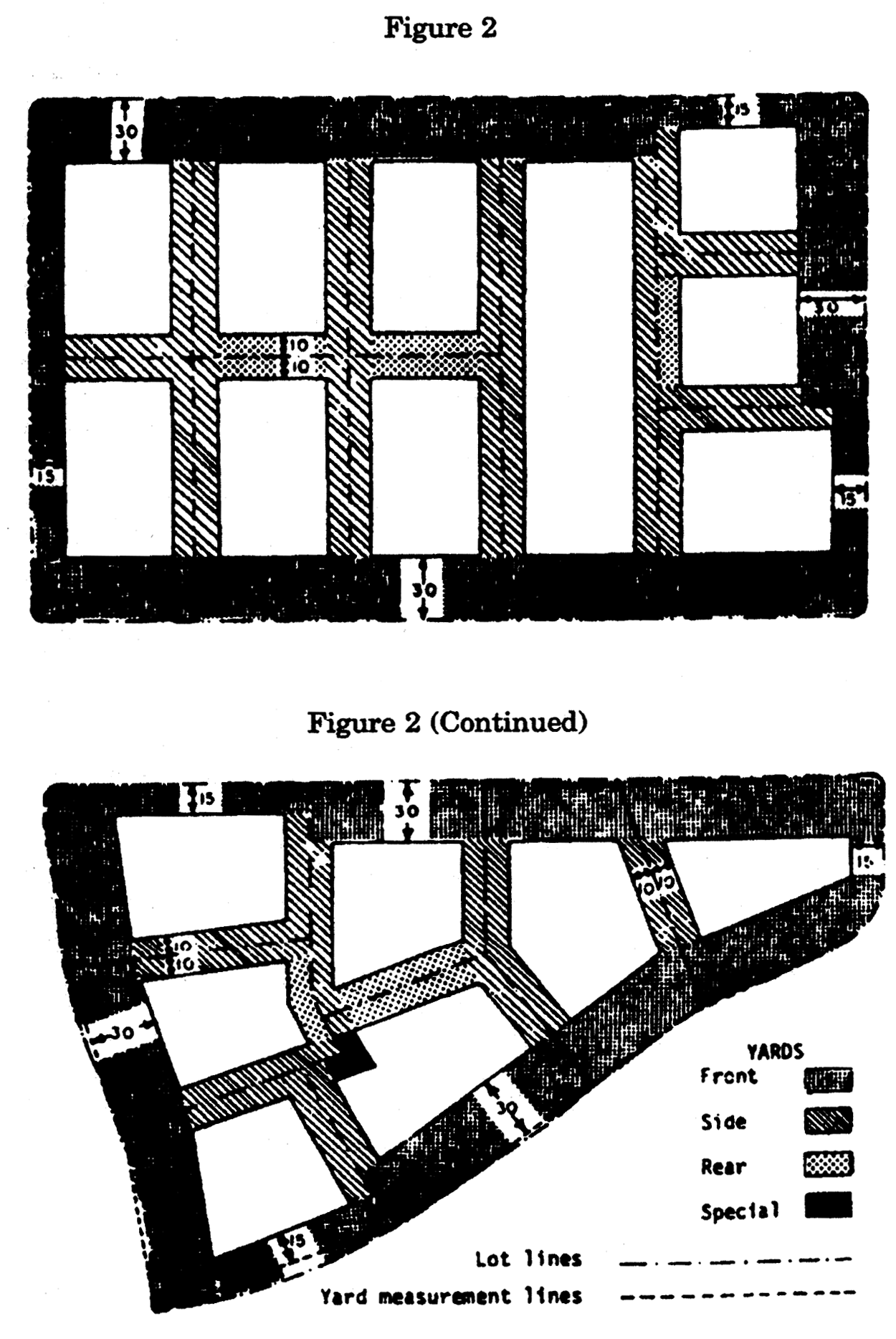
Figure 2
(Ord. No. 1618-8, §§ 1, 2, 10-12-76; Ord. No. 1618-11, § 2, 5-10-77; Ord. No. 17-78, § 2, 11-28-78; Ord. No. 2-79, § 1, 3-6-79; Ord. No. 17-80, § 1, 11-11-80; Ord. No. 11-81, § 2, 4-28-81; Ord. No. 8-82, §§ 1, 2, 1-12-82; Ord. No. 19-83, § 1, 12-27-83; Ord. No. 19-84, § 1, 7-10-84; Ord. No. 3-85, § 1, 1-8-85; Ord. No. 4-85, § 1, 2-12-85; Ord. No. 7-86, § 2, 4-8-86; Ord. No. 2-88, § 1, 2-9-88; Ord. No. 7-88, § 1, 2-8-88; Ord. No. 5-89, § 1, 5-9-89; Ord. No. 17-89, § 1, 12-22-89; Ord. No. 16-90, § 1, 6-12-90; Ord. No. 22-90, § 1, 9-24-90; Ord. No. 4-93, §§ 1, 2, 4-27-93; Ord. No. 13-94, § 4, 6-14-94; Ord. No. 26-98, § 1, 9-22-98; Ord. No. 2-2001, § 1, 1-23-01; Ord. No. 17-03, § 2, 6-24-03; Ord. No. 3-04, § 2, 2-10-04; Ord. No. 12-06, §§ 2, 3, 3-14-06; Ord. No. 18-2007, § 2, 5-8-07; Ord. No. 20-2007, § 2, 6-5-07; Ord. No. 06-2007, §§ 2, 3, 3-13-07; Ord. No. 08-2008, § 2, 4-22-08; Ord. No. 16-2008, § 8, 7-22-08; Ord. No. 03-2016, § 2, 3-22-2016; Ord. No. 12-2017, § 2, 1-9-2018; Ord. No. 06-2020, 2, 7-8-2020; Ord. No. 16-2020, § 2, 10-27-2020; Ord. No. 02-2023, § 2, 5-23-2023; Ord. No. 19-2024, § 2, 12-10-2024)

