
Colton City Zoning Code
CHAPTER 18
23 - M-U MIXED-USE—DOWNTOWN ZONE
18.23.010 - Intent and Purpose.
The Mixed-Use Downtown Zone (M-U/D) integrates civic, public, commercial, office, and residential uses. Supporting convenience retail and personal service commercial uses are permitted to serve the needs of local residents, employees, and visitors. Higher-density residential uses are encouraged to add vibrancy and presence. Long-established, low-density residential areas containing homes dating to Colton's early years are encouraged to retain their density and character.
Live/work development approaches are permitted as well where they contribute to the function and character of Downtown. All development within this zone should reflect attractive, pedestrian-oriented design that complements the area's historic character. Public and shared parking facilities are encouraged.
(Ord. No. O-12-16, § 3(Exh. C), 8-2-2016)
18.23.030 - Permitted Uses.
Refer to Table F in Section 18.06.060 F.
(Ord. No. O-12-16, § 3(Exh. C), 8-2-2016)
18.23.050 - Property Development Standards.
The following property development standards, set out in Table 18.23.050-1, shall apply to all land and buildings in the M-U Mixed-Use Downtown Zone.
18.23.050-1 Property Development Standards
| Building Placement | Table 1 | |
|---|---|---|
| A. Minimum Lot Size | Two thousand square feet | 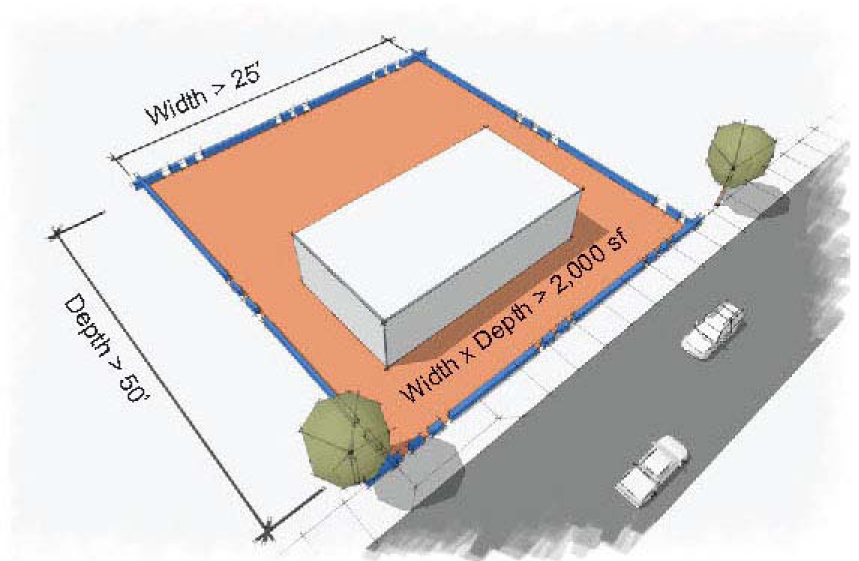 Minimum Lot Dimensions
|
| B. Minimum Lot Width | Twenty-five feet 1 | |
| C. Minimum Lot Depth | fifty feet 1 | |
| Stand Alone Residential Maximum Density | Residential: 30.0 dwelling units/acre. 2 | |
| Mixed-Use/Commercial Maximum Intensity | 3.0 Floor Area Ratio (FAR) for non-residential components. | |
| Building Height | Three stories or forty-five feet. Up to four stories or fifty-five feet with CUP. 1 | 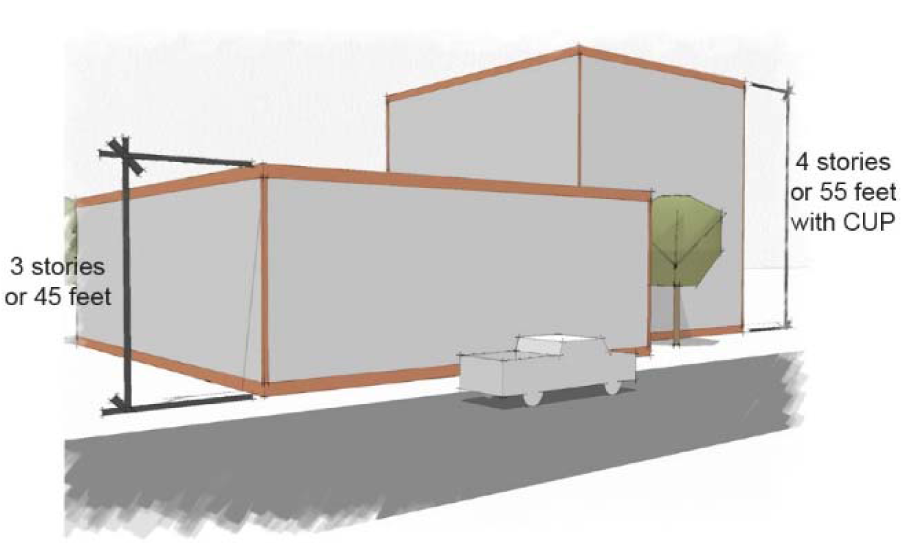 Building Height
|
| Street Setback | H Street and La Cadena Drive: Zero feet to ten feet maximum. Setback area shall include plaza, courtyard, outdoor dining, or enhanced pedestrian connections. | |
| 7th Street, 9th Street, 10th Street, G Street, and Valley Boulevard: Maximum ten feet landscaped to building; Minimum fifteen feet landscaped to parking area. | 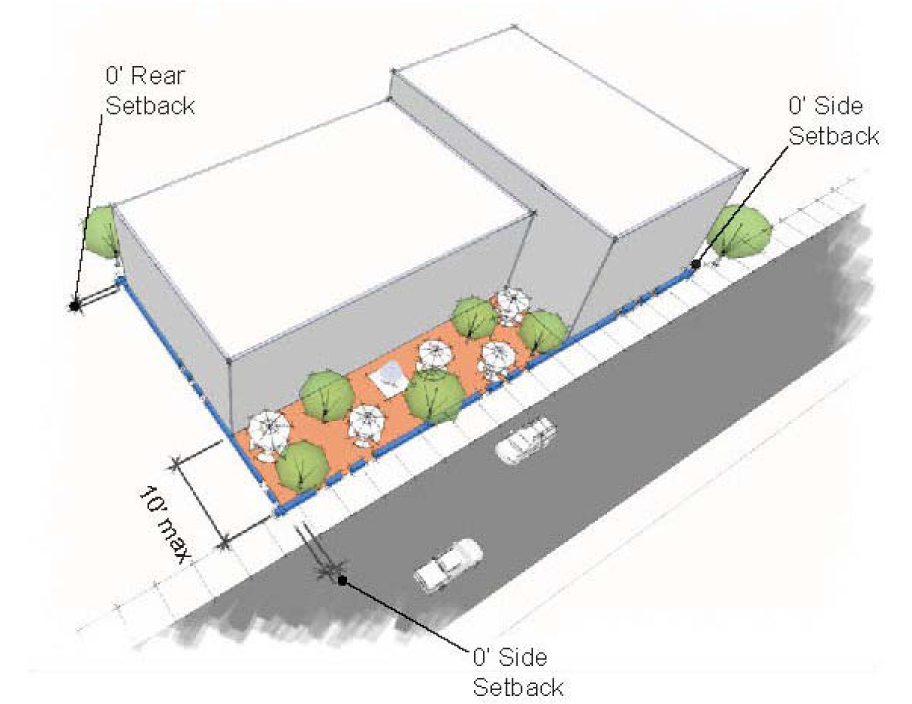 Setbacks: H Street and La Cadena Drive
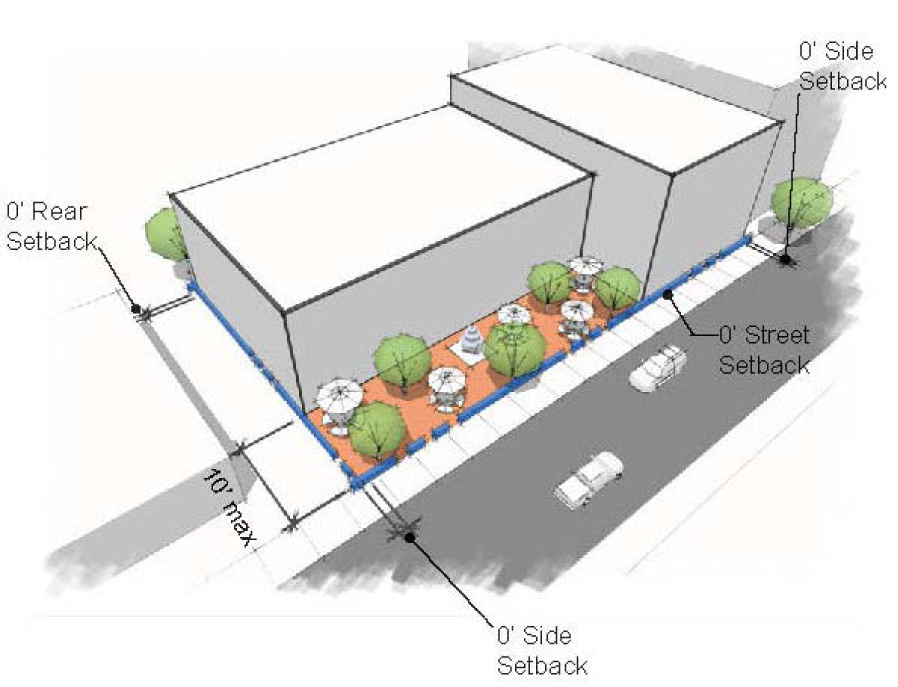 Setbacks: 7th Street, 9th Street, 10th Street, G Street, and Valley Boulevard
| |
| Side Setbacks | There shall be no side setback required for interior lots. | |
| Rear Setbacks | There shall be no rear setback required for interior lots. | 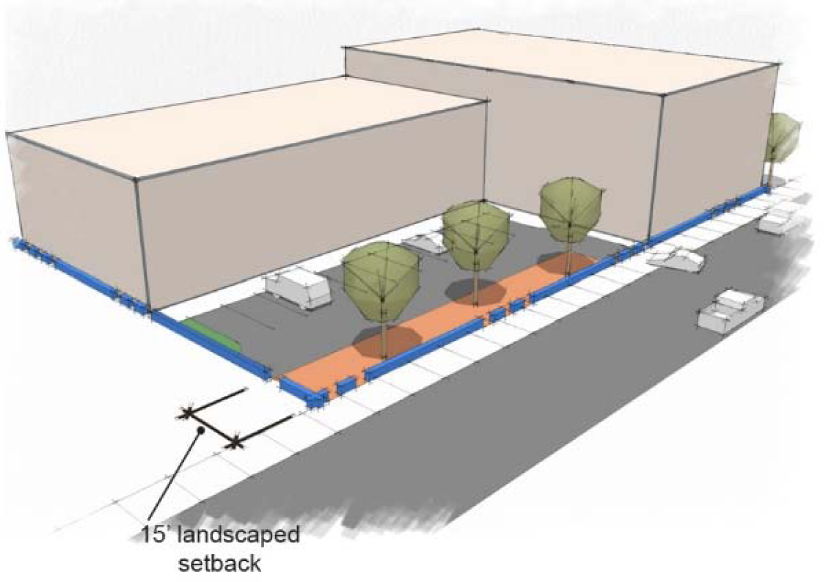 Setbacks with Landscaping: 7th Street, 9th Street, 10th Street, G Street, and Valley
Boulevard
Setbacks with Landscaping: 7th Street, 9th Street, 10th Street, G Street, and Valley
Boulevard
|
| Ground Floor Transparency | The ground floor building facade facing a street frontage line, where the ground floor use is non- residential, shall consist of a minimum forty-five percent area of glass doors, windows, or other transparent materials. | 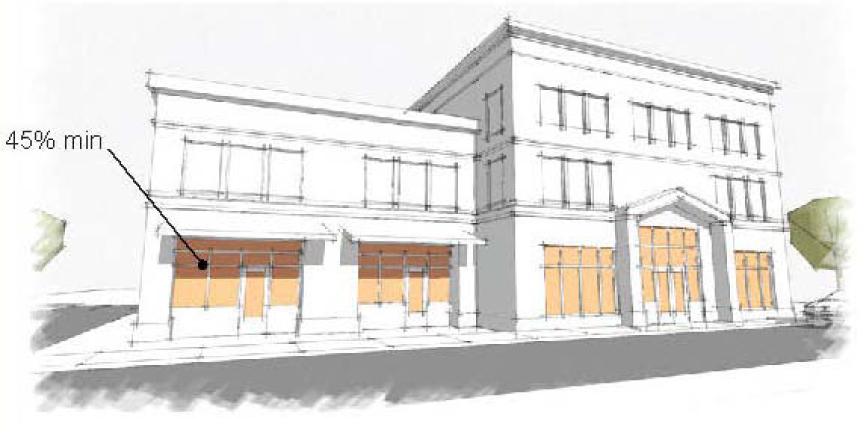 Ground Floor Transparency
|
| Good Neighbor |
Where the side of a lot abuts a residential zone, the minimum side setback shall be
ten feet.
Where the rear of a lot abuts a residential zone, the minimum rear setback shall be fifteen feet. Those portions of a building that abut a residential zone, where the proposed structure is over thirty-five feet tall, shall be setback a minimum of twenty feet from that property line. Where vehicular access is taken from the side or rear of a lot, the building shall be setback a minimum of twenty-five feet from that side. | 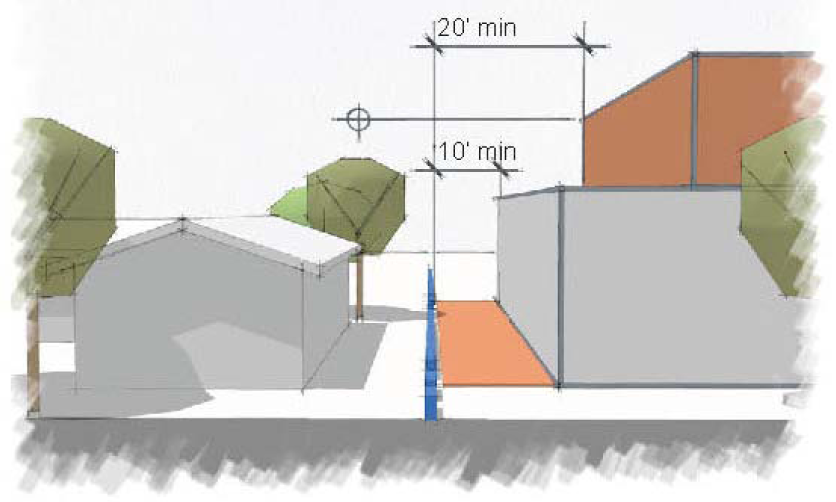 Setbacks Adjacent to Residential Zones
|
1.
For buildings with ground floor commercial uses, the required floor-to-ceiling height at the ground floor level for buildings facing public frontage lines shall be a minimum of twelve feet.
2.
For projects developed exclusively for senior residents as income-subsidized housing, densities of up to sixty dwelling units per acre are allowed with approval of a Conditional Use Permit.
(Ord. No. O-12-16, § 3(Exh. C), 8-2-2016)
18.23.060 - Residential Open Space.
In the form of private and common area, all M-U Mixed-Use Downtown residential developments shall provide a minimum of twenty-five square feet of Residential Open Space each Dwelling Unit.
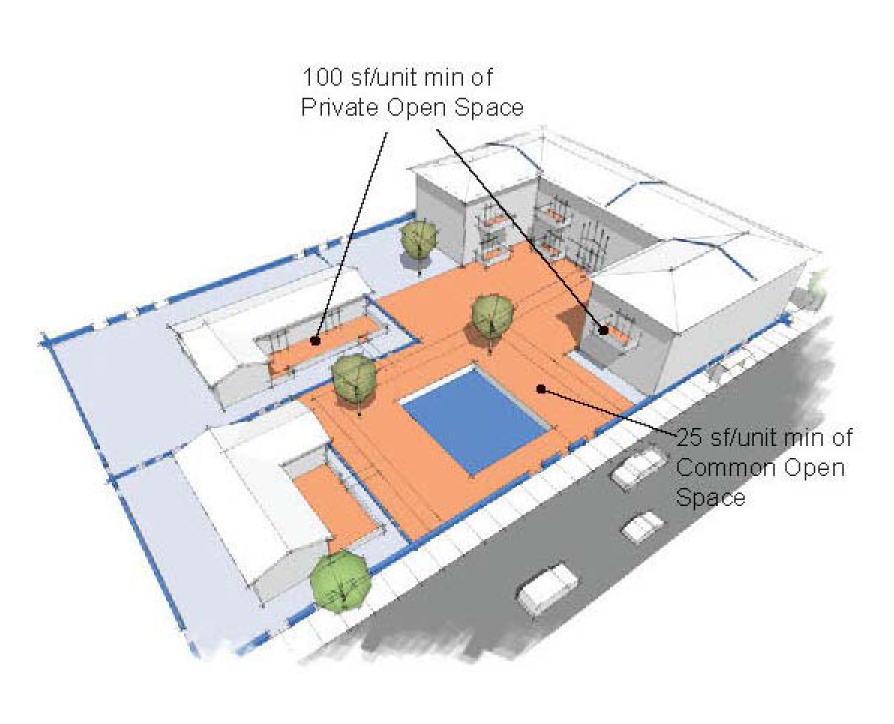
Residential Open Space
A.
A minimum of one hundred square feet of required Residential Open Space shall be in the form of private open space, with a minimum dimension of eight feet. Private open space may be provided in the form of patios, porches, balconies, or recessed areas open on at least one side.
B.
Common Residential Open Space shall be provided at a minimum of twenty-five square feet per unit. Common Residential Open Space areas shall have a minimum dimension of ten feet. When common open space is designed for public/private use, a minimum of twenty square feet per unit is required. These Common Residential Open Space areas may be provided in the form of pools, playgrounds, recreation fields, or recreation buildings, but no less than fifty percent of the Common Residential Open Space area shall be outdoor, landscaped Common Residential Open Space.
C.
Provide sidewalk connections from homes to public sidewalks, and between homes and Residential Open Space.
D.
Residential Open Space credit may be considered for park and/or common areas located within two hundred feet of the project site, subject to review and approval by the Development Services Director.
(Ord. No. O-12-16, § 3(Exh. C), 8-2-2016)
18.23.070 - Parking Requirements.
A.
Specific Requirements.
1.
The following number of parking spaces shall be required to serve the uses or buildings listed, as established in Table 18.23.070-1 (M-U Downtown Zone Parking Requirements). All uses must provide the sum of the requirements for each individual use.
2.
"Square feet" means "gross square feet" and refers to the sum gross square feet of the floor area of a building and its accessory buildings unless otherwise specified. For a mixed-use building, "square feet" means "gross square feet" and refers to the sum gross square feet of the publicly accessible floor area of a building and its accessory buildings.
3.
Residential parking requirements for dens, studies, or other similar rooms that may be used as bedrooms shall be defined and calculated based upon the Building Code.
4.
When the calculation of the required number of off-street parking spaces results in a fraction of a space, the total number of spaces shall be rounded up to the nearest whole number.
Table 18.23.070-1 M-U—Downtown Zone Parking Requirements
B.
General Requirements. The general requirements for off-street parking shall be as outlined in Chapter 18.36 of this Code.
C.
Tandem Parking. For lots less than ten thousand square feet in area, mixed-use developments, and/or multifamily residential projects, tandem parking spaces may be used for residential parking, and receive parking credit when serving the same residential unit subject to approval by the Development Services Director. Tandem parking spaces shall be a minimum of eleven feet wide and twenty feet deep per space.
D.
Shared Parking. In addition to the shared parking requirements outlined in Section 18.36.040 of this Code, the use of shared parking agreements for mixed-use residential, retail, and office is encouraged within the Mixed-Use Downtown Zone. Developments incorporating shared parking strategies and/or joint use agreements may receive up to a ten percent reduction in the total number of parking spaces required for the proposed mix of uses subject to approval by the Development Services Director.
E.
Off-site parking may be permitted for nonresidential projects subject to the approval of a Conditional Use Permit, based on the approval process outlined in Section 18.58.060 of this code. In addition to the findings in Section 18.58.060, the following criteria shall apply:
1.
All off-site parking facilities shall be located within one thousand feet of the property where the use in question is located, unless a binding agreement is provided to provide transportation access from the parking facility to the use in question on a regular basis.
2.
Public transit service shall be available within one-half mile of the use in question.
F.
On-street parking spaces adjacent to a project site may be counted toward meeting minimum on-site parking requirements where no parking restrictions are in place, subject to the review and approval of the Development Services Director.
G.
Bicycle Parking. Provide facilities for the temporary storage of bicycles as outlined in Chapter 18.36 of this Code.
(Ord. No. O-12-16, § 3(Exh. C), 8-2-2016; Ord. No. O-01-21, § 10, 2-16-2021)
18.23.080 - Landscaping.
A.
Landscaping shall be provided for the development of any lot with a minimum landscaping coverage of fifteen percent of the lot area not occupied by building footprint. The landscaping shall provide a mixture of shrubs, trees, groundcover, flowers and lawns throughout the entire front yard area, side yard areas, parkways and throughout open spaces not occupied by access ways, parking areas and sidewalks. One tree per three parking spaces shall be provided and planted throughout the landscaped areas. Twenty-five percent of the trees shall be of twenty-four inch box size, another twenty- five percent of thirty-six inch box size, and the remainder may be a minimum of fifteen-gallon size. Landscape and irrigation plans shall be prepared by a licensed Landscape Architect or Engineer and submitted to the Development Services Director along with the general building plans for review and approval.
B.
The required landscaping shall be maintained in a neat, clean, safe, orderly, and healthful condition.
C.
The landscaped areas shall be provided with a suitable permanent method for watering or sprinkling of plants. Wherever possible, the watering system shall utilize the least amount of water. Sprinklers used to satisfy the requirements of this provision shall be so spaced as to assure complete coverage of the landscaped areas.
(Ord. No. O-12-16, § 3(Exh. C), 8-2-2016)
18.23.090 - Trash, Recycling, and Storage Areas.
A.
Residential.
1.
Trash and recycling areas for multiple-family dwellings and live/work units shall provide a minimum fifty-gallon capacity container per dwelling unit. Where commercial trash containers are used, there shall be a minimum of one such container for every fifteen dwelling units.
2.
All outside trash and recycling collection areas shall be enclosed or screened with a six-foot-high wall with gates and shall be located to allow for convenient pickup and disposal. The location and design shall also incorporate access separate from pedestrian access.
3.
All trash and recycling containers shall be provided with lids.
4.
For multiple-family dwellings and live/work units, at least sixty cubic feet of enclosed accessory storage space shall be provided for each dwelling unit. Said space may be located in the Dwelling Unit, integrated into a balcony space, or in a garage or carport; provided, that it does not interfere with parking a vehicle.
5.
Recycling. Separate adequate capacity trash containers shall be provided for recycling.
B.
Non-Residential.
1.
Trash containers shall be provided with a sufficient capacity to contain all refuse generated by the use.
2.
All outside trash and recycling collection areas shall be enclosed or screened with a six-foot-high wall with gates and shall be located to allow for convenient pickup and disposal.
3.
All trash and recycling containers shall be provided with lids.
4.
The design of the trash enclosure shall follow City specifications on trash enclosures.
5.
Separate, adequate capacity trash containers shall be provided for recycling.
(Ord. No. O-12-16, § 3(Exh. C), 8-2-2016)
18.23.100 - Mechanical Equipment.
A.
All heating, ventilating, and air conditioning equipment, including ducts, meters, plumbing lines, and tanks, shall be architecturally screened from public view with the use of masonry walls when mounted at grade, or with the use of parapet walls when mounted on flat and pitched roofs.
B.
Plumbing vent pipes, all heater flues, and all roof penetrations shall be gathered and concealed from view in the same manner and shall be painted to match the roof color.
(Ord. No. O-12-16, § 3(Exh. C), 8-2-2016)
18.23.110 - Architectural Compatibility.
The exterior design of structures shall be compatible with the surrounding architecture in order to preserve neighborhood integrity and promote architectural consistency within the City.
(Ord. No. O-12-16, § 3(Exh. C), 8-2-2016)
18.23.120 - Architectural and Site Plan Review.
Architectural and Site Plan Review for all development in the M-U/D Mixed-Use Downtown zone shall be submitted to the appropriate decision-making body for review and approval pursuant to Chapter 18.58. The decision-making body shall consider the following criteria:
A.
The project is located within one-half mile walking distance of transit stops, shops, services, and public schools.
B.
The project features high-quality market rate and/or affordable housing. Mixed income housing is encouraged.
C.
The project will provide for, or contribute to, a mix of complementary uses.
D.
The project will provide for, or contribute to, a range of housing types and densities within the community.
E.
The project design includes pedestrian-friendly spaces such as plazas, squares, courtyards, and other amenities.
F.
The project design includes comfortable and accessible open spaces.
(Ord. No. O-12-16, § 3(Exh. C), 8-2-2016)
18.23.130 - Colton Downtown Design Manual Reference.
The Colton Downtown Design Manual is a companion document to complement the Downtown Development Code, and has been prepared to establish an achievable vision, shape future development, and implement an action plan for Downtown Colton. Any future development plans within the Downtown must be consistent with the Colton Downtown Design Manual.
(Ord. No. O-12-16, § 3(Exh. C), 8-2-2016)

