


Colton City Zoning Code
CHAPTER 18
48 - SPECIAL PROVISIONS
18.48.010 - Therapeutic Services.
A.
Therapeutic Services shall be subject to the following:
1.
Therapeutic services shall not share a tenant space with other uses except where the Development Services Director determines the multiple use are similar and related, such as day spas or beauty salons.
2.
Limited to tenant spaces providing bathroom facilities exclusive to the business and not shared with other tenant spaces.
3.
Therapeutic services, meeting the definition of massage services, Shall also comply with regulations in Title 5 of the Municipal Code.
(Ord. No. O-11-20, § 10, 10-20-2020)
18.48.020 - Amusement Arcade.
A.
1.
An "Amusement Arcade," hereafter called Arcade, Shall be defined as:
a.
A Business operating five or more coin-operated machines within an Enclosed Building, which includes, but is not limited to, video games, pinball machines, and other similar electronic and mechanical games of skill and chance;
b.
Any Business operating less than five such game machines, unless such operation is Incidental to an established Business which generated more than fifty percent of its total gross revenues from Business operations other than game machines.
2.
Businesses operating less than five machines and excluded by subsection (A)(1)(b) of this section Shall require no special Permit or Approval by the Planning Department.
3.
Hours Permitted. It is unlawful to keep open to the public or to conduct the activity or practices defined in this section on any Day of the week between the hours of twelve midnight and ten a.m.
B.
Arcades Shall be Permitted in all Commercial and Industrial Zones except the Neighborhood Commercial Zone (C-1). Said Arcades Shall be subject to the Following conditions:
1.
All Amusement Arcades Shall be entirely within an Enclosed Building.
2.
The minimum distance between an Amusement Arcade and a School Shall be one thousand feet.
3.
On Days when the public Schools are in full operation, Amusement Arcade Operators Shall not Permit Persons under the age of eighteen Years to enter or remain in areas within the Business Establishment Designated for Amusement Arcades prior to two-thirty p.m. on such School Days.
4.
No Amusement Arcade in which coin-operated game machines constitute the source of more than fifty percent of the total gross revenues of the Business enterprise with which it is situated, or in which such game machines are the sole or primary Business occupation, Shall be open between ten p.m. of any one Day and six a.m. of the Following Day, except for Friday and Saturday of each week, when the hours of operation May continue until twelve-thirty a.m. of the next succeeding Day. Amusement Arcades operated Incidental to a bona fide food serving Establishment Shall be operated only during the hours which food is actually being served, and Amusement Arcades operated Incidental to any other primary Business Shall be operated only during the hours the primary Business is carried on.
5.
Adult supervision Shall be provided at all times within areas Designated for Amusement Arcades.
6.
For any Amusement Arcade within shopping center, all partitioning Walls Shall consist of soundproof Materials to abate Noise transmission to neighboring Businesses.
7.
Male and female restrooms Shall be provided on site.
(Ord. 0-14-92 § 1 (Exh. A) (part), 1992)
18.48.030 - Automobile Service Stations.
Automobile Service stations Shall meet the Following conditions:
A.
A Conditional Use Permit Shall be required for all new service stations and the redevelopment of existing service stations.
B.
Site Area. Each new service station site Shall be located on a Lot having an area of not less than twenty thousand square feet. This requirement and other Property Development standards Shall not apply to the redevelopment of existing service stations.
C.
Site Dimensions. The minimum Lot Width and depth dimensions Shall be one hundred twenty feet.
D.
Setbacks. There Shall be a minimum Setback for any Building of twenty feet from any Property line, except where the Lot Line of the Property involved abuts a public Alley and a five-foot masonry Wall is erected, or a Building is constructed adjacent to such Alley. Gasoline pumps, or other facilities for providing Vehicles with fuel, and pump islands on which they are placed Shall be set back fifteen feet from any Property line.
E.
Access. Each developed site Shall have not more than two accessways to any one Street, with a minimum of five feet of full height Curb from adjoining residential Property lines, and a width not exceeding thirty-five feet.
F.
Hours of Operation. Service stations which abut residentially zoned Property Shall close between twelve and six a.m.; and all Business activities such as lubrications and mechanical work except for services and Emergency repairs Shall be confined to the hours between 6:00 a.m. and 10:00 p.m.
G.
Utilities. Utility service to all Structures Shall be installed underground.
H.
Existing Nonconforming Service Stations. Service stations in existence prior to the effective date of the Ordinance codified in this title which become damaged or partially destroyed, or which Shall be added to or structurally altered to any extent, May not be occupied or Used except in conformity with the provisions herein.
I.
Walls. A three-foot-high solid masonry Wall or equivalent landscape feature Shall be constructed along all interior Property lines. The Wall Shall be increased in height to not less than five feet nor more than six feet when the site is adjacent to a School, Church, Park, Club, Hospital, or Residential Zone or Use. The Commission May require additional Walls, as determined necessary for proper Development of the site.
J.
Restrooms. Male and female restrooms Shall be provided on site. All restroom entrances Shall be screened from view of adjacent Properties and Streets rights-of-way by some form of decorative Wall or similar device.
K.
Architectural Treatment. It is the policy to require a higher than typical quality of architectural treatment for service stations. Applicants are encouraged to submit designs which are in keeping with the overall character and quality of the neighborhood and community. The architectural treatment of each station will be reviewed carefully and Approved only when the appearance of the station is considered suitable to the City. Customer pump areas Shall be roofed. Ridges and Eaves may, under some conditions, be at different levels.
L.
Equipment Rentals. The outside storage of Rental trailers and similar equipment May be Permitted, provided they are completely screened from public view and the Use is specifically authorized through a Conditional Use Permit. Additional Lot Area over the minimum, in the amount of two hundred square feet per Rental unit, Shall be provided.
M.
Lighting. All lighting elements on the exterior and interior of the Structure Shall be shielded from horizontal view, except for Sign lights or those especially designed for illumination of the Parking Lots.
N.
Closed, Vacant and Inoperative Service Stations. All service stations which May have been closed, Vacant or inoperative for a period of ninety Days Shall be abated by rehabilitation, Demolition or repair of all Structures which Shall include, but not be limited to, all Buildings, pump islands, all underground storage tanks, pumps, mechanical equipment, wells, cesspools, septic tanks, foundations, all paving and any other Materials originally placed in connection therewith on or at any depth beneath the surface of the Real Property.
(Ord. 0-14-92 § 1 (Exh. A) (part), 1992)
18.48.035 - Boarding, Lodging, or Rooming Houses.
The Following regulations Shall apply to all Boarding, Lodging, or Rooming Houses in the City:
1.
All Boarding, Lodging, or Rooming Houses Shall meet the requirements of Title 18, this section and require the Approval of a Conditional Use Permit issued in accordance with the provisions of Section 18.58.060, and a City Business License prior to establishing the boarding, lodging or roaming house Use.
2.
Boarding, Lodging, or Rooming Houses Shall comply with the parking requirements of Chapter 18.36 of the Colton Municipal Code, and as set forth in Chapter 18.10, 18.12, 18.14, and 18.16 of the Colton Municipal Code.
3.
No more than one Federal, state or youth authority parolee Shall be allowed to live in a Boarding, Lodging, or Rooming House.
4.
The Application submitted for Approval of a boarding, lodging or roaming house Shall identify whether any boarders are currently Federal, state or youth authority parolees. Owners and/or Operators of Approved Boarding, Lodging or Rooming Houses Shall update the information required by this section anytime a Person that is Federal, state or youth authority parolee is provided accommodation in the Approved Boarding, Lodging or Rooming House.
5.
All boarding, lodging and roaming houses Shall require boarders to Sign a "Crime Free Lease Addendum" to their lease or Rental Agreement. A sample crime free Lease addendum Shall be provided by the City as an Attachment to the planning Permit Application. The "Crime Free Lease Addendum" Shall provide that any criminal Violations perpetrated by boarders Shall be grounds for termination of the Written or oral lease, sublease or agreement.
6.
Boarding, Lodging, or Rooming Houses Shall be in compliance with all requirements of this section and this title prior to the issuance of Conditional Use Permit authorizing the Use and at all times after issuance of a planning Permit. Violation of any Local, state or Federal Laws by individual boarders while on the Premises Shall be grounds for revocation of the Permit, including, but not limited to Violations of California Penal Code, Section 3003.5.
7.
No Boarding, Lodging, or Rooming House Shall be maintained as a Nuisance.
8.
Violations of any of the provisions in this section Shall be grounds for revocation of the Conditional Use Permit authorizing the Boarding, Lodging, or Rooming House Use. The revocation procedures pertaining to revocations of Conditional Use Permits Shall be followed.
9.
Boarding, Lodging, or Rooming Houses existing prior to the effective date of the Ordinance creating this section Shall be required to comply with the requirements of this section within six Months of the effective date.
10.
The Owner/Operator of any Boarding, Lodging, or Rooming House Shall notify, in writing, all boarders and Occupants of the identity of any: (1) Federal, state or youth authority parolee; or (2) Person who is required to register pursuant to Penal Code Section 290, who is residing at such Boarding, Lodging, or Rooming House.
(Ord. No. O-01-10, § 13, 3-2-2010)
18.48.040 - Condominiums, Community Apartments and Stock Cooperatives.
Condominiums, community Apartments and stock cooperatives require Conditional Use Permit Approval and Shall meet the requirements of this section:
A.
Copies of the conditions, covenants and restrictions (CC&R's) that will apply to the proposed Development Shall be submitted and include the Following provisions:
1.
Insure payment of any invoice by the City for electrical, water and/or sewer service charges, Garbage, trash or Rubbish charges, in such manner that either the Board of Governors, Condominium Owners or management-agent Shall guarantee payment to the City;
2.
Guarantee Access and entry to the Development, all Buildings and Structures for any authorized Fire Official, Building Official, or any other official charged with carrying out the Laws of the City, state or Federal government;
3.
Insure that each residential unit in the Development Shall be Used as a residence for a Single-Family and for no other purpose;
4.
Insure that no Sign of any kind May be displayed advertising any service, Business, or other commercial Project or venture, in any residential Condominium or community Apartment;
5.
That the names of the officers and members of the Board of Governors Shall be filed annually with the City Clerk during the Month of July;
6.
A request pursuant to Vehicle Code Section 21107.5 that traffic regulations May be enforced by the City on the private Streets located therein.
B.
The Off-Street parking requirements for residential Condominiums and community Apartments Shall be as required for any residential Project.
C.
Interior private Streets May be Permitted, but Shall have a minimum width of pavement between standard concrete Curb as follows:
1.
Forty feet where parking is Permitted on both sides;
2.
Twenty-eight feet where parking is Permitted on one side only;
3
Twenty feet where parking is prohibited on both sides;
4.
Where a private drive serves only garages, and the Driveway is posted to prohibit all other parking, the Driveway May be constructed to the standard twenty-foot Alley specifications. All private Streets Shall be irrevocably offered for dedication and May be refused or withheld by the City.
D.
Condominiums, community Apartments and stock cooperatives Shall have a minimum of eight units.
E.
No existing Building Shall be Approved for conversion to a Condominium Project unless it meets the standards set forth in Title 16 of this Code.
(Ord. 0-14-92 § 1 (Exh. A) (part), 1992)
18.48.050 - Fortunetelling.*
The practice of Fortunetelling and Occult Arts May be Permitted in the C-2 General Commercial Zone only, subject to a Conditional Use Permit and the Following conditions:
A.
Every Person who engages in and is licensed for the practice of Fortunetelling Shall obtain a current Business License for said Establishment, and submit for a background investigation, to include fingerprinting, by the Colton Police Department, to determine whether the Applicant has been convicted of any crime involving moral turpitude, or has been convicted of any felony offense, with an investigation filing Fee of five hundred dollars, plus the Fees for fingerprinting processing.
B.
Hours Permitted. It is unlawful to keep open to the public or to conduct the activity or practices defined in this section on any Day of the week between the hours of twelve midnight and ten a.m.
C.
Inspection. The City's Police Chief, Fire Chief and Building Official and their authorized Representatives, Shall have the right to enter the Fortunetelling Establishment from time to time during regular Business hours for the purpose of making reasonable inspections to observe and enforce compliance with applicable Building, fire or electrical regulations and the provisions of this section.
(Ord. 0-14-92 § 1 (Exh. A) (part), 1992)
* As to Fortunetelling generally, see Ch. 9.28.
18.48.060 - Manufactured Housing and Mobilehomes.
A.
A single manufactured housing unit may be approved through an Architectural and Site Plan Review application, subject to the following:
1.
The proposed unit is found to be keeping with the overall character and quality of the neighborhood and community.
2.
The subject property is zoned V-L, R-1, or M-U/N.
3.
No more than one manufactured housing unit allowed on any property.
4.
The proposed unit shall be occupied only as a single-family dwelling.
5.
The proposed unit shall be subject to all provisions of these chapters applicable to residential structures.
6.
The proposed unit shall be attached to a permanent concrete base foundation system in compliance with all applicable Building regulations.
7.
The proposed unit shall be converted with an exterior material customarily used on conventional dwellings and approved by the Committee. The exterior covering material shall extend to the ground.
8.
The proposed unit shall have a roof with a pitch of not less than two-inch vertical rise for each twelve inches of horizontal run and consisting of shingles or other material customarily used for conventional dwellings and approved by the Building Official.
9.
The proposed unit shall have eaves no less than twelve inches deep and provided a porch at its main entry.
B.
Mobilehome parks may be permitted in the R-2 and R-3/R-4 zones with conditional use permit approval. A conditional use permit shall not be required for the installation of a mobilehome within a space previously approved within an established mobilehome park.
(Ord. 0-14-92 § 1 (Exh. A) (part), 1992)
(Ord. No. O-12-18, § 38, 12-18-2018)
18.48.061 - Mobile Nonresidential Units.
For Nonresidential Uses. Mobile units may be temporarily used on property with a permitted nonresidential use. The following conditions must be satisfied before an approval can be granted:
1.
The proposed use for the mobile unit shall be accessory to a use permitted in the zone in which it is to be located.
2.
All requirements of this chapter for development in the zone in which the mobile unit is to be located shall be satisfied.
3.
The mobile unit shall be compatible in appearance with the surrounding Structures and Improvements.
4.
Approval shall be limited to a one-Year period, with a possible one-Year extension, at the discretion of the Director.
(Ord. No. O-12-18, § 39, 12-18-2018)
18.48.070 - Metal Buildings.
All metal Buildings designed for commercial or industrial purposes Shall be located in an established Industrial Zone. The Following Design Guidelines Must be considered before an Approval can be granted.
A.
Environment. All metal Buildings Shall be architecturally compatible with the surrounding Buildings as to shape, exterior Materials and details, size, shape and location of windows and doors, distance between Buildings and orientation to Streets.
B.
Building Form.
1.
Single uninterrupted Wall planes Shall be softened with the Use of staggering vertical Walls, roof overhangs, pilasters and deep reveals at construction joints.
2.
Large rectangular forms Shall be softened with curved corners.
3.
Contrasting colors, patterns, textures and finishes Shall be Used to add variety and interest to the metal Structures.
4.
Other Materials such as masonry, brick, concrete or wood can be combined attractively to define scale.
C.
Windows and Doors. Recessed openings Shall be Used to provide contrast by varying patterns of shades sunlight and depth.
D.
Roofs.
1.
A variety of roof shapes and forms Shall be utilized to add character and diversity.
2.
Appearance of roofs Shall be improved with the Use of steeper roof Slopes and integrated fascias, darker colors, concealed fasteners, and other treatments.
3.
Mechanical equipment Shall be screened with Parapet Walls, mechanical recesses, or other means.
E.
Landscaping.
1.
Landscaping Shall consist of a balanced mix of trees, shrubs and groundcover to provide comfort and shade for parking and open areas.
2.
Landscaping at Public Streets Shall be provided with a fifteen-foot wide strip and allow for mounding shrubbery and groundcover that soften and enhance the view of the site.
(Ord. 0-14-92 § 1 (Exh. A) (part), 1992)
18.48.080 - Public utilities and services.
The provisions of this title Shall not be construed as to limit or interfere with the construction, installation, operation and maintenance of any Use coming under the jurisdiction of the California Public Utilities Commission, which Uses are related to public Utility purposes, of water and Gas pipes, mains and conduits, electric light and power transmission and distribution lines, telegraph and telephone lines, sewers and sewer mains and Incidental appurtenances. The location of said lines, mains and conduits is subject to Planning Commission review and Approval.
(Ord. 0-14-92 § 1 (Exh. A) (part), 1992)
18.48.090 - Satellite Dish Antennas.
A.
Findings. The City Council finds that the installation of Satellite Dish Antennas, unless controlled, affects the aesthetic and safety values of the City. Therefore, the installation of these Antennas and equipment is regulated to result in design and locations which are safe and which are least visible from the public Right-of-Way in the vicinity and do not burden adjacent Property Owners with adverse visual impacts.
B.
Intent and Purpose. The intent and purpose of this section is to regulate the installation of Satellite Dish Antennas through the design review Building processes to protect the environment, the character of the existing neighborhoods or of the community as a whole, and the health, safety, and general welfare of the public.
C.
Permitted Uses.
1.
Satellite Dish Antennas Shall be Permitted Uses in the R-1, R-2 and R-3 Zones and require planning review and a Building Permit before installation in the case where the Antenna is ground-mounted and the entire apparatus does not exceed fifteen feet from the ground, when the Antenna is to be located in the side or Rear Yard and conforms to the side or Rear Yard residential Setbacks for Accessory buildings, when the Antenna is not visible from the public Right-of-Way, and when the Antenna is provided with a Screening cover.
2.
Satellite Dish Antennas located in any Commercial, Industrial, Public Facility, or any Multiple-Family Zone or that are proposed in an R-1, R-2 or R-3 Zone located in the Front Yard, a Corner Lot, or roof-mounted, will be required to receive Approval from the Director of Community Development. The Director May issue a denial if the proposed location infringes on an adjacent Property Owner or does not meet certain conditions to maintain aesthetics in the area. Such Application Shall be filed with the Community Development Department and Shall include a map showing location of the proposed Antenna, height and width of Antenna, Setback distances and description of the type of mount to be Used, and landscape plans showing location of existing trees, other natural features and proposed Landscaping features, including Fence, Wall or other Screening, and an Application Fee set by City Council Resolution.
D.
General Provisions.
1.
Only one satellite dish will be allowed for a Single-Family residential Lot or Apartment Project.
2.
The support Structures for Satellite Dish Antennas in all zones, except R-1, R-2 and R-3 Zones where Antenna is to be located in a side or Rear Yard, Shall be screened from view from adjacent Properties and public Right-of-Way, by Use of Walls, Fences and/or Landscaping. Such Screening will be required to be flush with the base of the dish so as not to interfere with the Antenna's normal reception.
3.
No advertising or text Shall be Permitted on a Satellite Dish Antenna.
4.
All Satellite Dish Antennas, including the construction and installation thereof, Shall conform to the Uniform Building Code and Electrical Code regulations and requirements.
5.
When Attached to a main Structure, the Satellite Dish Antenna Shall not exceed the maximum Building Height in the respective zone.
6.
The Satellite Dish Antenna Shall not encroach into any required Setback, nor Shall it be in any required Open Space, private recreation area or required Parking Space.
7.
Outdoor wires necessary for the operation of the Antenna Shall be placed underground or Attached flush against a Building surface.
8.
Satellite Dish Antennas Shall be limited to current manufacturer's colors which are generally black, silver, off-white and white.
9.
Satellite Dish Antennas outside of Residential Zones May be located on rooftops with Approval of the Director of Community Development only if ground-mounting is inappropriate or inaccessible. If allowed, roof-mounted Antennas Shall be screened with such Screening designed as an integral Part of the Building, to have the same color as the Building.
10.
The Community Development Director May issue a Permit for those sites incapable of receiving signals from an Antenna if installed pursuant to these regulations. The Applicant Shall submit documentation that such installation is necessary for the reception of usable satellite signals.
11.
Any Person not satisfied with a determination by the Director Shall have the right to Appeal to the Planning Commission. Such Appeal Shall be made in writing and delivered to the Office of the Director within seven calendar Days, after the mailing of the Notice of the Director's Decision.
(Ord. 0-14-92 § 1 (Exh. A) (part), 1992)
18.48.100 - Residential, Community or Group Care Facilities.
A.
Findings and Purpose. The City Council finds that Residential, Community or Group Care Facilities provide a cost-effective, humane and noninstitutional environment for elderly Persons, Persons suffering from chronic illnesses, Persons suffering from mental or physical impairments, and Persons recovering from drug/or alcohol addiction. The City Council also finds that the public health, safety and welfare of all Residents of the City is best served when such facilities are licensed by the California Department of Social Services, the California Department of Alcohol and Drug Programs, or other appropriate agency or Department of the State of California or the County of San Bernardino, to ensure compliance with applicable regulations and standards designed to promote and maintain successful programs, but that in fact not all such facilities are so licensed.
The City Council further finds that it is in the best interest of the public health, safety and welfare to preserve and protect the integrity of residential neighborhoods, in accordance with the goals and policies of the General Plan. Thus, the purpose of this chapter is to provide reasonable accommodations for the needs of Persons with disabilities seeking a humane and noninstitutional environment, while at the same time ensuring necessary safeguards to protect the integrity of residential neighborhoods.
B.
Use Regulations. In any zoning District where residential Uses are Permitted, a residential or group care Facility or a congregate residence May be Permitted. All Residential, Community or Group Care Facilities and congregate residences Shall be subject to all zoning, Subdivision, housing and Building regulations and codes applicable to that District, in addition to any Building or housing regulations and codes expressly applicable to Residential, Community or Group Care Facilities or congregate residence, particularly Building and fire safety requirements.
C.
Residential, Community or Group Care Facilities—Six or Fewer Residents—Regulations.
1.
Licensed. Residential, Community or Group Care Facilities consisting of six or fewer Residents, not including any provider or provider's Family or staff, Shall be exempt from the provisions of this chapter provided the Facility is licensed by the appropriate state or County agency or Department.
2.
Unlicensed. Residential, Community or Group Care Facilities for six or fewer Residents which are not required to be licensed by a state or County agency or Department Shall be allowed in all residential Districts, subject to the Approval of a Conditional Use Permit issued in accordance with the provisions of Section 18.58.060, and in accordance with the findings specified in Subsection F of this section.
D.
Residential, Community or Group Care Facilities—Licensed and Unlicensed—Regulations. Licensed Residential, Community or Group Care Facilities for seven or more Residents and Residential, Community or Group Care Facilities which are not required to be licensed by a state or County agency or Department Shall be allowed in all Residential Zones of the City, subject to the Approval of a Conditional Use Permit issued pursuant to Section 18.58.060, and in accordance with the findings specified in Subsection F of this section. All such facilities Must comply with the Following requirements:
1.
Applicable requirements of the Uniform Building, Housing and Fire Codes;
2.
Parking Spaces Must be maintained in accordance with the requirements of Chapter 18.36; and
3.
No Sign which calls attention to the fact that the Property is a residential or group care Facility May be posted.
E.
Reserved.
F.
Findings. In keeping with the intent of this section to provide reasonable accommodations for the needs of Persons with disabilities to obtain housing, while at the same time fulfilling its obligation to protect the integrity and residential character of the City's neighborhoods, the City Council finds that the Following findings Must be made by the Planning Commission and City Council in determining whether to recommend Approval or denial of a Conditional Use Permit request or determining whether to approve or deny a Conditional Use Permit request.
1.
Based upon individualized inquiry and evidence, that the proposed Tenancy will not constitute a direct threat to the health or safety of other individuals and will not result in substantial physical damage to the Property of others.
2.
The proposed Use of Property complies with all applicable zoning Development standards applicable to other Properties in the same zone.
(Ord. 0-15-99 § 3, 1999)
(Ord. No. O-01-10, §§ 14, 15, 3-2-2010)
18.48.110 - Temporary outdoor displays and Sales.
A.
No Person, Business or organization Shall conduct, operate, maintain, organize or advertise a temporary outdoor display or Sale without first obtaining a temporary outdoor displays and Sales Permit as provided by this section. Temporary outdoor displays and Sales Permit Applications Shall be reviewed by the City Manager or his or her Designee and issued prior to the commencement of the temporary outdoor display or Sale.
B.
Applications for a temporary outdoor display and Sales Permit Shall be made on forms prescribed by the City and Shall include a Site Plan indicating the proposed location of the display area. Such Applications Shall be filed not less ten Working Days prior to the outdoor temporary display or Sale and Shall be filed with the City Manager or his or her Designee.
C.
The City Manager Shall issue the Permit, conditioned upon the Applicant's Written agreement to comply with any and all terms of this section, including but not limited to the Following conditions:
1.
Outdoor Sales Shall only be Permitted as an extension of an existing Business and Shall be conducted entirely on the site on which the Business is located.
2.
The display area Shall not occupy more than ten percent of the number of required Parking Spaces for the Applicant's Business.
3.
The display Shall not encroach upon required Driveways or public rights-of-way, impede Emergency Vehicle Access or prevent Access to any other Business.
4.
Sales area Shall not Block required Building exits and Shall maintain at least four-feet wide aisles.
5.
No Part of the display area Shall be located within one hundred feet of an adjoining Residential Zoned Property.
6.
No more than four temporary outdoor displays and Sales Shall be Permitted in one calendar Year, per Business unit, limited to seven Days per display and Sale, that Shall not exceed twenty-eight Days accumulated total.
7.
All Sign usage Shall be subject to Chapter 18.50 of this title.
8.
A Permit Fee established by Resolution of the City Council Shall be paid for each outdoor display and Sales Permit.
9.
Temporary Structures such as, but not limited to tents or Building, Shall be subject to Approval of the Fire Chief or his or her Designee.
D.
The City Manager or his or her Designee May also condition the issuance of the Permit by imposing reasonable requirements concerning the time, place and manner of the outdoor temporary display or Sale and any requirements necessary to protect the safety of Persons and Property, and maintain traffic control. If the City Manager or his or her Designee denies the Permit, he or she Shall set forth the reasons for the denial. The City Manager's or his or her Designee's Decision Shall be final unless Appealed.
E.
The Chief of Police, Fire Chief, Community Development Director or their Designees May conduct, at any time, on-site inspections of temporary outdoor displays and Sales Permitted pursuant to this section for compliance with the imposed requirements. In addition to any and all regulations or conditions that May be imposed pursuant to this Code, Applicants Must also comply with all Fire Code regulations and requirements as set forth in this Code, including payment for inspection costs by the Fire Chief or Designee. The Chief of Police or the Fire Chief, or his or her Designee, reserve the right to:
1.
Require immediate correction of hazards, dangerous conditions or deficiencies that have been deemed to place the public health or safety at risk for harm or injury; and
2.
Revoke the temporary outdoor display and Sales Permit immediately if substantial Violation or noncompliance with the previously-submitted plans is deemed to place the public health or safety at risk for harm or injury.
F.
A temporary outdoor display and Sales Permit May be revoked if the City Manager or his or her Designee or Community Development Director finds that one or more of the Following conditions exists:
1.
The temporary outdoor display and Sales Permit was obtained in a fraudulent manner.
2.
The Applicant fails, neglects or refuses to fulfill any of the conditions imposed upon the granting of the Permit.
3.
The Applicant violates or attempts to violate any Law of the state, or the provisions of this section, or any other Law, Ordinance or policy of the City.
4.
Failure to comply with Notice to correct hazards, dangerous conditions or other deficiencies that are deemed to place the public health or safety at risk for harm or injury.
All revocations Shall be in writing and Shall set forth the basis for the revocation. The Permit Shall be reinstated as soon as the conditions constituting the revocation have abated. When any Permit is revoked pursuant to this section, the Permit Shall be reinstated as soon as the conditions constituting the revocation have abated.
G.
Any Applicant May Appeal the final Decision of the City Manager or his or her Designee or the revocation of a Permit granted pursuant to this section to the City Council within two Days thereafter. Appeals Shall be filed with the City Clerk, either by personal service, fax, or first class mail (postage prepaid). Any such Appeal Shall set forth the reasons for the Appeal and Shall be accompanied by an Appeal filing Fee. The Appeal filing Fee Shall be established by the City Council by Resolution. Failure of any Person to receive Written Notice Shall not invalidate same. The City Council Shall act upon the Appeal at the next regularly scheduled Council Meeting held more than five Working Days and less than ten Working Days after the filing of the Appeal. If no such meeting is scheduled, or if a regularly scheduled meeting is not held within such times, the Mayor May call a special City Council meeting to consider and act upon such Appeal within ten Working Days after the filing of such Appeal. The Decision of the City Council regarding such an Appeal Shall be final.
H.
Any Person who willfully fails to comply with the requirements of this section, or of any conditions Attached hereunder, or who falsifies any information on any Application hereunder is guilty of a misdemeanor punishable as set forth by state Law and is subject to administrative penalties and fines as set forth in Title 8 of this Code. Any temporary outdoor display or Sale otherwise in accordance with this section Shall be a Public Nuisance which May be enjoined or abated as allowed by Law. The City retains any and all civic remedies, including the right of civil injunction for the prevention of the Violations and for the recovery of money damages therefor.
(Ord. 0-19-02 § 1, 2003)
18.48.120 - Parking Vehicles for Certain Purposes Prohibited.
A.
The City Council of the City of Colton hereby finds and determines as follows:
1.
The purpose of this section is to regulate the circumstances under which Persons May park their Vehicles in a manner that is not Permitted by Title 18 of this Code. This section is not intended to restrict any form of advertising that Vehicle Owners May place on or upon their Vehicles. The City Council finds that the regulations imposed by this section are intended to promote public safety and traffic flow by reducing visual distractions that are likely to cause traffic accidents. Moreover, the restrictions are intended to improve the visual appearance and discourage blighting of Properties in the City by eliminating unlicensed Vehicles Sales on unimproved Lots and Lots have not been developed with paving, drainage Improvements, and other Improvements and amenities that are normally required of Approved Vehicle dealerships.
2.
The parking of Vehicles on Property that is not zoned for such Use causes adverse impacts to the Residents and Businesses in the City, including but not limited to, the leaking of gasoline and other motor fuels and oils into the ground and groundwater on unimproved Properties and Properties that have not been developed with sufficient infrastructure to handle such Use of Property and promoting unfair competition in the Sale of Vehicles. The regulations will directly advance the City's interests in public safety, efficient traffic flow, aesthetics and economic fairness by prohibiting Vehicle Sales on Properties that are not zoned for such activities and Properties that developed the appropriate infrastructure and amenities to safely accommodate such Sales.
3.
These regulations are reasonably tailored to serve the City's substantial interests in public safety, efficient traffic flow, aesthetics and economic fairness because they do not restrict the ability of any Persons to advertise that their Vehicle is for Sale in Lots that are appropriately zoned nor do they restrict the ability of Persons to have Signs in or on their Vehicles advertising the Vehicle's availability or other commercial interests. These regulations are merely designed to restrict parking of Vehicles for the purpose of Sale on Lots that are not zoned for such activities and are ill-equipped to handle such intensity of Use, regardless of whether the Vehicle contains advertising or not.
B.
No Person Shall park any Vehicle upon any Private Property for the principle purpose of displaying such Vehicle thereon for Sale, hire, lease, or Rental unless the Property is duly zoned and Permitted by the City to allow that type of Business at that location and no Person Shall allow the parking of any Vehicle upon any Private Property for the principal purpose of displaying such Vehicle thereon for Sale, hire, lease or Rental without having first obtained the necessary Permits and Approval from the City.
C.
This section Shall not prohibit a Person from parking a Vehicle on Property on which such Person resides, for purposes of Sale, hire, lease or Rental, provided such Vehicle is registered to such Person and is otherwise Permitted by Title 18 of this Code.
D.
For the purposes of this section, the term "Vehicle" Shall include both "Motor Vehicle" and "Vehicle" as defined in California Vehicle Code Sections 415 and 670.
E.
Nothing in this section Shall be construed to prohibit the placement of any Sign, advertising or Notice on or upon any Vehicle.
(Ord. 0-19-03 § 2, 2003)
18.48.130 - Animal daycare and boarding.
As stated in Section 18.06.060—Uses Permitted in each Zone, animal day care and animal boarding may be a permitted "by right" or conditionally permitted use depending on the Zone. The following special provisions shall apply to both permitted and conditionally permitted uses:
A.
Operating an Animal Day Care or Animal Boarding. Shall mean that portion of a lot upon which such animals receive food and/or water and/or shelter and may be permitted only on a lot as a matter of right or with a Conditional Use Permit as identified in Section 18.06.060—Uses Permitted in each Zone and as permitted herein.
B.
Property Maintenance, kennels, drainage areas, feces and other biohazards. Animals shall be kept in areas that are clean and sanitary during all hours of operation. Kennels should be made out of material that can be sanitized repeatedly more than once a day. The animal shelters should be placed away from drainage areas. A plan for mass disposal of feces and other biohazards that come with animals shall be provided to the City's Animal Control Officer as part of the Conditional Use Permit application.
C.
Animal day care and animal boarding shall be in conformance with all requirements in Title 7—Animals of the Colton Municipal Code including but not limited to dog licensing requirements, number of dogs and cats allowed in dwelling, proper care of animals and noisy animals.
D.
Application shall include, in addition to regular application information, statements as to the area of the lot on which the proposed animal day care or animal boarding is requested, the amount of contiguous square feet of land which is unimproved as described hereinabove, the type of animals to be kept, maximum number of animals to be kept, and what type of structures and improvements, a plan for mitigation of excessive barking and noises complaints information related to the subject property or proposed animal day care or animal boarding use.
E.
No animal, as described hereinabove, shall be kept closer than 20 feet from the right-of-way line of any existing public right-of-way which is adjacent to the lot on which the animal is kept, or closer than 20 feet from the right-of-way line of a public right-of-way proposed by the City's General Plan to be adjacent to said lot whichever distance is the greater.
(Ord. No. O-01-21, § 11, 2-16-2021)
18.48.132 - Reserved.
Editor's note— Ord. No. O-04-19, § 3, adopted May 7, 2019, repealed former § 18.48.132 in its entirety which pertained to Residential Indoor Marijuana Cultivation (RIMC) Permits and derived from Ord. No. O-02-17, § 4, adopted April 4, 2017.
18.48.134 - Warehouse, Truck and Trailer Storage/Parking and Business Park.
Purpose: In response to community concerns on the environmental, operational, aesthetic, proximity to residential zones and noise concerns, this special provision includes new standards for the following specified industrial uses listed herein.
• Business Park
• Truck and Trailer Storage and Parking
• Warehouses, General
• Warehouse Logistics and Distribution
Section 18.06.060—Uses Permitted of this Code requires a Conditional Use Permit or prohibits the uses in specified zones. The following special standards shall apply when conditionally permitted in addition to development standards listed in each zone and/or other local, state or federal codes applicable to such uses:
A.
Proximity to Residential Zone.
1.
Within 800 feet of a Residential zone, limit operations, including loading, unloading, staging and storage of trucks and trailers to between the hours of 7:00 a.m. and 7:00 p.m. Monday through Friday, between the hours of 8:00 a.m. and 5:00 p.m. Saturdays, and shall be prohibited on Sundays and state and federal holidays unless a noise study prepared by a qualified professional can demonstrate that noise related to operations during these house will not exceed the City's adopted noise standards within adjacent Residential zone.
B.
Building Placement.
1.
Any warehouse greater than 108,900 square feet in size, the building loading dock shall be located a minimum of three-hundred (300) feet away measured from the property line of the sensitive receptor to the nearest dock door which does not exclusively serve electric trucks. (setback measurements shall use a straight line method).
2.
Each project located within 1,000 feet of a Sensitive Receptor or Residential Zone shall provide design analysis to minimize impacts on Sensitive Receptors and residential uses of entrance and exit points to the site.
C.
Architectural Design:
1.
All buildings and structures shall incorporate enhanced architectural treatments on all sides visible from public view. Enhanced architectural treatments include combinations of accent building materials, windows/spandrel glass, reveals, metal eyebrow accents, cornices, etc.
2.
"Cool pavement" materials shall be utilized to reduce heat island effects.
3.
Site plan drawings shall identify the type of climate control and air filtration systems in warehouse facilities to promote worker well-being.
4.
Signage for directional guidance for vehicles entering and existing the facility shall be provided on-site, including directional guidance to the nearest truck route.
5.
Each project shall provide on-site signage for directional guidance to trucks entering and exiting the facility to minimize potential impacts on Sensitive Receptors.
D.
Screening Standards:
1.
Industrial uses shall be screened from Sensitive Receptors, public right-of- way, and residential zones using appropriate wall design, incorporating landscaping and/or increased wall heights.
2.
Loading areas, docks, truck wells and internal circulation routes shall be oriented away (or fully screened) from residential neighborhoods, schools, parks, day care centers, nursing homes, hospitals or other public places and from public rights-of-way to the extent feasible to the satisfaction of the Approving Authority.
3.
All items stored outside, including trucks and trailers within parking areas and courts, shall be completely screened from public view, by a combination of buildings and/or solid screen walls of either decorative concrete masonry block or decorative concrete tilt-up walls. Screen walls shall not be located within any required front yard or street side building or landscape setback area.
4.
All items stored outside, including trucks and trailers within parking areas, shall not exceed eight (8) feet in height unless a taller wall (with approval of Variance) is provided to effectively screen along street frontages.
5.
A combination of eight (8) foot tall metal or masonry fencing and a five (5) foot wide landscape planter may be provided in lieu of solid fencing along the side of the side and rear property lines in areas where the site is not visible to the public. A combination of trees and shrubs shall be provided to ensure adequate screening.
6.
Anti-graffiti coating or equivalent measure to prevent graffiti shall be provided for all solid screen walls facing a public right-of-way.
E.
Stormwater: Underground stormwater chambers shall be provided to avoid the need for aboveground basins. Alternatively, aboveground basins may be permitted if the depth of the basin does not require fencing and can be planted with shrubs and groundcover so as to appear as part of the landscaped area of the site.
F.
Parking Requirements:
1.
All passenger vehicle parking lots, drive aisles or truck courts, and outdoor storage areas shall be paved with "cool pavement" materials; no areas shall remain unfinished and all areas of a developed site shall be finished with a permanent surface or permanent landscaping materials and irrigation.
2.
Sufficient space, including additional overflow areas, shall be provided to accommodate all maneuvering, queuing, stacking, loading, unloading, and parking of vehicles on-site to avoid queuing, stacking, loading, unloading, and parking of vehicles off-site on adjacent streets.
3.
The facility site plan shall base truck vehicle space specifications, loading, parking and stacking specifications, and maneuvering standards on the Surface Transportation Act (STAA) and California Standard design vehicle.
G.
Landscape Standards:
1.
All outdoor storage uses (including truck storage) shall incorporate a minimum of fifteen (15) foot deep landscaped setbacks along all public street frontages with a combination of trees, shrubs, and groundcover. Parking of motor vehicles is not permitted within the required setback area.
2.
All outdoor storage uses shall provide a minimum ten (10) foot wide landscape planter at the base of any buildings and screening walls that are visible from and face street frontages. Planting within any setback, planter or landscape buffer areas shall consist of a combination of 15-inch, 24-inch and 36-inch box trees, shrubs, and groundcover vegetation to soften the edge of the building or screen wall, and shall be consistent with subsections 18.24.130, 18.26.130, and 12.28.130 - Landscaping.
3.
Trees shall be planted every twenty (20) linear feet within all landscaped planters on-site. Two (2) rows of trees shall be provided within all landscape setbacks adjacent to public streets. A minimum of fifty percent (50%) of the trees on-site shall consist of evergreen broadleaf tree species to ensure year-round coverage.
4.
A preliminary landscape plan shall be required when submitting a Planning application, showing general location of the trees, shrubs, and ground cover. The landscaping areas should be lushly landscaped with adequate number and placement of landscaping including but not limited to trees, shrubs, bushes, groundcover, and rocks/boulders. The proposed landscape plan should ensure a unified and cohesive design theme while considering appropriateness to climatic conditions, soil conditions, and concern for maintenance and water conservation.
H.
Noise.
1.
A Transportation Demand Management measures for industrial uses with over one hundred employees to reduce work-related vehicle trips shall be provided, prior to occupancy.
2.
Compliance with Title 18 - The City Noise Standards shall be met. The project shall not cause noise levels to exceed City Noise Standards within residential zones or other sensitive land uses for projects within 800 or 1,000 feet of a residential zone.
I.
Security Standards.
1.
All outdoor storage shall be secured and incorporate security cameras that are connected to the City's enforcement system to the satisfaction of the Police Chief.
J.
Operational Standards
1.
Warehousing and distribution facilities generating more than 50 truck trips per day, as determined by the most recent Institute of Traffic Engineers (ITE) Trip Generation Rate for the specific land use, shall prepare an Operations and Truck Route Plan shall be submitted for review and approval by the City Engineer as part of the Conditional Use Permit application.
i.
The plan shall describe the operational characteristics of the proposed use, including but not limited to, hours of operation, projected number of employees, types of items permitted to be stored (outdoors) at the site, and the proposed truck routing to and from the facility to the designated truck routes that avoids passing residential, educational, park and recreational use areas to the greatest extent feasible.
ii.
The plan shall also include physical and operational measures for preventing truck queuing, stopping, and parking on public streets.
2.
The operator of the warehouse, storage and/or trucking use shall be responsible for implementing and monitoring the Operations and Truck Route Plan during all operations, including but not limited to posting the plan and educating truck drivers on the approved routes.
3.
Drivers shall not sleep or reside within any vehicle on-site overnight or for any extended duration of time.
4.
Idling of trucks queued or operated onsite shall not exceed 5 minutes.
5.
All on-site equipment, such as forklifts and yard trucks, shall be electric with necessary electric charging stations provided.
6.
All facility or tenant-owned and operated fleet equipment with a gross vehicle weight rating greater than 14,000 pounds accessing the site shall meet or exceed 2010 model-year emissions equivalent engine standards are currently defined in the California Code of Regulations Title 13, Division 3, Chapter 1, Article 4.5, Section 2025.
7.
Operators shall address any parking, traffic, noise or safety issues within forty-eight hours of being notified by the city that an issue exists.
8.
Prior to the issuance of a Business Occupancy Permit or Business License for any new tenant or operator of a warehouse or truck, trailer storage facility, a new or revised Operations and Truck Route Plan prepared by a licensed traffic engineer associated with the new tenant shall be submitted for review and approval by the City Engineer, demonstrating that the proposed operations and project traffic associated with the new tenant or operator is the same or less than the project traffic and operations assume in the approved entitlements for the facility.
9.
Where transport by temperature-controlled trucks or trailers is proposed, on-site electrical hookups shall be provided at loading docks. Idling or use of auxiliary truck engine power to power climate-control equipment shall be prohibited.
K.
Air Quality
1.
Warehouses and distribution facilities generating 150 or more truck trips per day, as determined by the most recent Institute of Traffic Engineers (ITE) Trip Generation Rate for the specific land use or within 1000 feet of a sensitive receptor, shall prepare a Health Risk Assessment (HRA) in accordance with South Coast Air Quality Management District (SCAQMD) Guideline for the new development or substantial enlargement of industrial uses.
2.
Each project shall provide specific design criteria to minimize exposure to diesel emissions for residential neighborhoods, schools, parks, playgrounds, day care centers, nursing homes, hospitals, and other public places (Sensitive Receptors) situated in close proximity to the industrial uses.
3.
Each project shall provide and be in compliance with CEQA (California Environmental Quality Act), and prepare an SCAQMD URBEMIS (South Coast Air Quality Management District) and EMFAC (Emission Factor) computer models to identify the significance of air quality impacts on Sensitive Receptors.
(Ord. No. O-01-23, § 9, 2-21-2023)
18.48.140 - Alcoholic Beverage Sales.
Sales of Alcoholic Beverages Shall be Permitted by Conditional Use Permit, subject to the Following conditions:
A.
Alcoholic Beverage Sales Shall not be Permitted within five hundred feet of any Religious or Educational Institution, Day care center or public Park. This distance Shall be measured from the main entrance of the Business conducting alcohol beverage Sales and the closest public entrance to the Religious or Educational Institution, Day care center or public Park.
B.
The separation requirement in subsection A Shall not apply when the Business conducting alcohol beverage Sales and the Church, School or Park both are located within a Commercial or Industrial Zone or land Use classification.
(Ord. No. O-08-09, § 11, 1-19-2010)
18.48.150 - Accessory Dwelling Units.
(a)
Purpose. The purpose of this section is to allow and regulate accessory dwelling units (ADUs) and junior accessory dwelling units (JADUs) in compliance with California Government Code sections 65852.2 and 65852.22.
(b)
Effect of Conforming. An ADU or JADU that conforms to the standards in this section will not be:
(1)
Deemed to be inconsistent with the City's general plan and zoning designation for the lot on which the ADU or JADU is located.
(2)
Deemed to exceed the allowable density for the lot on which the ADU or JADU is located.
(3)
Considered in the application of any local ordinance, policy, or program to limit residential growth.
(4)
Required to correct a nonconforming zoning condition, as defined in subsection (c)(8) below. This does not prevent the City from enforcing compliance with applicable building standards in accordance with Health and Safety Code section 17980.12.
(c)
Definitions. As used in this section, terms are defined as follows:
(1)
"Accessory dwelling unit" or "ADU" means an attached or a detached residential dwelling unit that provides complete independent living facilities for one or more persons and is located on a lot with a proposed or existing primary residence. An accessory dwelling unit also includes the following:
(A)
An efficiency unit, as defined by section 17958.1 of the California Health and Safety Code; and
(B)
A manufactured home, as defined by section 18007 of the California Health and Safety Code.
(2)
"Accessory structure" means a structure that is accessory and incidental to a dwelling located on the same lot.
(3)
"Complete independent living facilities" means permanent provisions for living, sleeping, eating, cooking, and sanitation on the same parcel as the single-family or multifamily dwelling is or will be situated.
(4)
"Efficiency kitchen" means a kitchen that includes all of the following:
(A)
A cooking facility with appliances.
(B)
A food preparation counter and storage cabinets that are of a reasonable size in relation to the size of the JADU.
(5)
"Junior accessory dwelling unit" or "JADU" means a residential unit that satisfies all of the following:
(A)
It is no more than 500 square feet in size.
(B)
It is contained entirely within an existing or proposed single-family structure. An enclosed use within the residence, such as an attached garage, is considered to be a part of and contained within the single-family structure.
(C)
It includes its own separate sanitation facilities or shares sanitation facilities with the existing or proposed single-family structure.
(D)
If the unit does not include its own separate bathroom, then it contains an interior entrance to the main living area of the existing or proposed single-family structure in addition to an exterior entrance that is separate from the main entrance to the primary dwelling.
(E)
It includes an efficiency kitchen, as defined in subsection (c)(4) above.
(6)
"Livable space" means a space in a dwelling intended for human habitation, including living, sleeping, eating, cooking, or sanitation.
(7)
"Living area" means the interior habitable area of a dwelling unit, including basements and attics, but does not include a garage or any accessory structure.
(8)
"Nonconforming zoning condition" means a physical improvement on a property that does not conform with current zoning standards.
(9)
"Passageway" means a pathway that is unobstructed clear to the sky and extends from a street to one entrance of the ADU or JADU.
(10)
"Proposed dwelling" means a dwelling that is the subject of a permit application and that meets the requirements for permitting.
(11)
"Public transit" means a location, including, but not limited to, a bus stop or train station, where the public may access buses, trains, subways, and other forms of transportation that charge set fares, run on fixed routes, and are available to the public.
(12)
"Tandem parking" means that two or more automobiles are parked on a driveway or in any other location on a lot, lined up behind one another.
(d)
Approvals. The following approvals apply to ADUs and JADUs under this section:
(1)
Building-permit Only. If an ADU or JADU complies with each of the general requirements in subsection (e) below, it is allowed with only a building permit in the following scenarios:
(A)
Converted on Single-family Lot: One ADU as described in this subsection (d)(1)(A) and one JADU on a lot with a proposed or existing single-family dwelling on it, where the ADU or JADU:
(i)
Is either: Within the space of a proposed single-family dwelling; within the existing space of an existing single-family dwelling; or (in the case of an ADU only) within the existing space of an accessory structure, plus up to 150 additional square feet if the expansion is limited to accommodating ingress and egress; and
(ii)
Has exterior access that is independent of that for the single-family dwelling; and
(iii)
Has side and rear setbacks sufficient for fire and safety, as dictated by applicable building and fire codes; and
(iv)
The JADU complies with the requirements of Government Code Section 65852.22.
(B)
Limited Detached on Single-family Lot: One detached, new-construction ADU on a lot with a proposed or existing single-family dwelling (in addition to any JADU that might otherwise be established on the lot under subsection (d)(1)(A) above), if the detached ADU satisfies each of the following limitations:
(i)
The side- and rear-yard setbacks are at least four feet.
(ii)
The total floor area is 1,200 square feet or smaller.
(iii)
The peak height above grade does not exceed the applicable height limit in subsection (e)(2) below.
(C)
Converted on Multifamily Lot: One or more ADUs within portions of existing multifamily dwelling structures that are not used as livable space, including but not limited to storage rooms, boiler rooms, passageways, attics, basements, or garages, if each converted ADU complies with state building standards for dwellings. Under this subsection (d)(1)(C), at least one converted ADU is allowed within an existing multifamily dwelling, up to a quantity equal to 25 percent of the existing multifamily dwelling units.
(D)
Limited Detached on Multifamily Lot: No more than two detached ADUs on a lot with a proposed multifamily, or up to eight detached ADUs on a lot with an existing multifamily dwelling, if each detached ADU satisfies all of the following:
(i)
The side- and rear-yard setbacks are at least four feet. If the existing multifamily dwelling has a rear or side yard setback of less than four feet, the City will not require any modification to the multifamily dwelling as a condition of approving the ADU.
(ii)
The peak height above grade does not exceed the applicable height limit provided in subsection (e)(2) below.
(iii)
If the lot has an existing multifamily dwelling, the quantity of detached ADUs does not exceed the number of primary dwelling units on the lot.
(2)
ADU Permit.
(A)
Except as allowed under subsection (d)(1) above, no ADU may be created without a building permit and an ADU permit in compliance with the standards set forth in subsections (e) and (f) below.
(B)
The City may charge a fee to reimburse it for costs incurred in processing ADU permits, including the costs of adopting or amending the City's ADU ordinance. The ADU-permit processing fee is determined by the Development Services Director and approved by the City Council by resolution.
(3)
Process and Timing.
(A)
An ADU permit is considered and approved ministerially, without discretionary review or a hearing.
(B)
The City must approve or deny an application to create an ADU or JADU within 60 days from the date that the City receives a completed application. If the City has not approved or denied the completed application within 60 days, the application is deemed approved unless either:
(i)
The applicant requests a delay, in which case the 60-day time period is tolled for the period of the requested delay, or
(ii)
When an application to create an ADU or JADU is submitted with a permit application to create a new single-family or multifamily
(iii)
dwelling on the lot, the City may delay acting on the permit application for the ADU or JADU until the City acts on the permit application to create the new single-family or multifamily dwelling, but the application to create the ADU or JADU will still be considered ministerially without discretionary review or a hearing.
(C)
If the City denies an application to create an ADU or JADU, the City must provide the applicant with comments that include, among other things, a list of all the defective or deficient items and a description of how the application may be remedied by the applicant. Notice of the denial and corresponding comments must be provided to the applicant within the 60-day time period established by subsection (d)(3)(B) above.
(D)
A demolition permit for a detached garage that is to be replaced with an ADU is reviewed with the application for the ADU and issued at the same time.
(e)
General ADU and JADU Requirements. The following requirements apply to all ADUs and JADUs that are approved under subsections (d)(1) or (d)(2) above:
(1)
Zoning.
(A)
An ADU or JADU subject only to a building permit under subsection (d)(1) above may be created on a lot in a residential or mixed-use zone.
(B)
An ADU or JADU subject to an ADU permit under subsection (d)(2) above may be created on a lot that is zoned to allow single-family dwelling residential use or multifamily dwelling residential use.
(2)
Height.
(A)
Except as otherwise provided by subsections (e)(2)(B) and (e)(2)(C) below, a detached ADU created on a lot with an existing or proposed single-family or multifamily dwelling unit may not exceed 35 feet in height.
(B)
A detached ADU may be up to two stories with a maximum height of 30 feet if it is created on a lot with an existing or proposed single-family or multifamily dwelling unit that is located within one-half mile walking distance of a major transit stop or a high quality transit corridor, as those terms are defined in Section 21155 of the Public Resources Code, and the ADU may be up to two additional feet in height (for a maximum of 32 feet) if necessary to accommodate a roof pitch on the ADU that is aligned with the roof pitch of the primary dwelling unit.
(C)
A detached ADU created on a lot with an existing or proposed multifamily dwelling that has more than one story above grade may not exceed two stories or 30 feet in height.
(D)
An ADU that is attached to the primary dwelling may not exceed 35 feet in height or the height limitation imposed by the underlying zone that applies to the primary dwelling, whichever is lower. Notwithstanding the foregoing, ADUs subject to this subsection (e)(2)(D) may not exceed two stories.
(E)
For purposes of this subsection (e)(2), height is measured above existing legal grade to the peak of the structure.
(3)
Fire Sprinklers.
(A)
Fire sprinklers are required in an ADU if sprinklers are required in the primary residence.
(B)
The construction of an ADU does not trigger a requirement for fire sprinklers to be installed in the existing primary dwelling.
(4)
Rental Term. No ADU or JADU may be rented for a term that is shorter than 30 days. This prohibition applies regardless of when the ADU or JADU was created.
(5)
No Separate Conveyance. An ADU or JADU may be rented, but, except as otherwise provided in Government Code Section 65852.26, no ADU or JADU may be sold or otherwise conveyed separately from the lot and the primary dwelling (in the case of a single-family lot) or from the lot and all of the dwellings (in the case of a multifamily lot).
(6)
Septic System. If the ADU or JADU will connect to an onsite wastewater-treatment system, the owner must include with the application a percolation test completed within the last five years or, if the percolation test has been recertified, within the last 10 years.
(7)
Owner Occupancy.
(A)
An ADU that is permitted after January 1, 2020, but before January 1, 2025, is not subject to any owner-occupancy requirement.
(B)
Unless applicable law requires otherwise, all ADUs that are permitted on or after January 1, 2025 are subject to an owner-occupancy requirement. A natural person with legal or equitable title to the property must reside on the property as the person's legal domicile and permanent residence.
(C)
As required by state law, all JADUs are subject to an owner-occupancy requirement. A natural person with legal or equitable title to the property must reside on the property, in either the primary dwelling or JADU, as the person's legal domicile and permanent residence. However, the owner-occupancy requirement in this subsection (e)(7)(C) does not apply if the property is entirely owned by another governmental agency, land trust, or housing organization.
(8)
Deed Restriction. Prior to issuance of a building permit for an ADU or JADU, a deed restriction must be recorded against the title of the property in the County Recorder's office and a copy filed with the Director or designee. The deed restriction must run with the land and bind all future owners. The form of the deed restriction will be provided by the City and must provide that:
(A)
Except as otherwise provided in Government Code Section 65852.26, the ADU or JADU may not be sold separately from the primary dwelling.
(B)
The ADU or JADU is restricted to the approved size and to other attributes allowed by this section.
(C)
The deed restriction runs with the land and may be enforced against future property owners.
(D)
The deed restriction may be removed if the owner eliminates the ADU or JADU, as evidenced by, for example, removal of the kitchen facilities. To remove the deed restriction, an owner may make a written request of the Director, providing evidence that the ADU or JADU has in fact been eliminated. The Director may then determine whether the evidence supports the claim that the ADU or JADU has been eliminated. Appeal may be taken from the Director's determination consistent with other provisions of this Code. If the ADU or JADU is not entirely physically removed, but is only eliminated by virtue of having a necessary component of an ADU or JADU removed, the remaining structure and improvements must otherwise comply with applicable provisions of this Code.
(E)
The deed restriction is enforceable by the director or his or her designee for the benefit of the City. Failure of the property owner to comply with the deed restriction may result in legal action against the property owner, and the City is authorized to obtain any remedy available to it at law or equity, including, but not limited to, obtaining an injunction enjoining the use of the ADU or JADU in violation of the recorded restrictions or abatement of the illegal unit.
(9)
Income Reporting. In order to facilitate the City's obligation to identify adequate sites for housing in accordance with Government Code sections 65583.1 and 65852.2, the following requirements must be satisfied:
(A)
With the building-permit application, the applicant must provide the City with an estimate of the projected annualized rent that will be charged for the ADU or JADU.
(B)
Within 90 days after each yearly anniversary of the issuance of the building permit, the owner must report the actual rent charged for the ADU or JADU during the prior year. If the City does not receive the report within the 90-day period, the owner is in violation of this Code, and the City may send the owner a notice of violation and allow the owner another 30 days to submit the report. If the owner fails to submit the report within the 30-day period, the City may enforce this provision in accordance with applicable law.
(10)
Building and Safety.
(A)
Must comply with building code. Subject to subsection (e)(10)(B) below, all ADUs and JADUs must comply with all local building code requirements.
(B)
No change of occupancy. Construction of an ADU does not constitute a Group R occupancy change under the local building code, as described in Section 310 of the California Building Code, unless the Building Official makes a written finding based on substantial evidence in the record that the construction of the ADU could have a specific, adverse impact on public health and safety. Nothing in this subsection (e)(10)(B) prevents the City from changing the occupancy code of a space that was uninhabitable space or that was only permitted for nonresidential use and was subsequently converted for residential use in accordance with this section.
(f)
Specific ADU Requirements. The following requirements apply only to ADUs that require an ADU permit under subsection (d)(2) above.
(1)
Maximum Size.
(A)
The maximum size of a detached or attached ADU subject to this subsection (f) is 850 square feet for a studio or one-bedroom unit and 1,200 square feet for a unit with two or more bedrooms.
(B)
An attached ADU that is created on a lot with an existing primary dwelling is further limited to 75 percent of the floor area of the existing primary dwelling.
Application of other development standards in this subsection (f), such as FAR or lot coverage, might further limit the size of the ADU, but no application of the percent-based size limit in subsection (f)(1)(B) above or of an FAR, front setback, lot coverage limit, or open-space requirement may require the ADU to be less than 800 square feet.
(2)
Setbacks.
(A)
An ADU that is subject to this subsection (f) must conform to a 25-foot front-yard setback.
(B)
ADU that is subject to this subsection (f) must conform to 4-foot side- and rear-yard setbacks.
(C)
No setback is required for an ADU that is subject to this subsection (f) if the ADU is constructed in the same location and to the same dimensions as an existing structure.
(3)
Lot Coverage. No ADU subject to this subsection (f) may cause the total lot coverage of the lot to exceed 55 percent, subject to subsection (f)(1)(C) above.
(4)
Minimum Open Space. No ADU subject to this subsection (f) may cause the total percentage of open space of the lot to fall below 30 percent, subject to subsection (f)(1)(C) above.
(5)
Passageway. No passageway, as defined by subsection (c)(9) above, is required for an ADU.
(6)
Parking.
(A)
Generally. One off-street parking space is required for each ADU. The parking space may be provided in setback areas or as tandem parking, as defined by subsection (c)(12) above. Off-street parking shall be permitted in setback areas or through tandem parking, unless specific findings are made that parking in setback areas or tandem parking is not feasible based on specific site or regional topographical or fire and safety conditions.
(B)
The required parking space for the ADU must be located on the same lot as the ADU.
(C)
Access to all required parking for the ADU and primary dwelling must be from a public street, an alley, or a recorded access easement. For any lot served by a panhandle or easement access, the access must be a minimum 20 feet in width.
Curb cuts providing access from the public right-of-way to on-site parking spaces must be approved by the City Engineer in accordance with established, objective standards. A construction permit from the City Engineer shall be obtained for any new or widened curb cuts.
(A)
Required parking spaces or required maneuvering area must be free of any utility poles, support wires, guard rails, stand pipes or meters.
(B)
All required parking spaces must be kept clear for parking purposes only.
(C)
Exceptions. No parking under subsection (f)(6)(A) is required in the following situations:
(i)
The ADU is located within one-half mile walking distance of public transit, as defined in subsection (c)(11) above.
(ii)
The ADU is located within an architecturally and historically significant historic district.
(iii)
The ADU is part of the proposed or existing primary residence or an accessory structure under subsection (d)(1)(A) above.
(iv)
When on-street parking permits are required but not offered to the occupant of the ADU.
(v)
When there is an established car share vehicle stop located within one block of the ADU.
(vi)
When the permit application to create an ADU is submitted with an application to create a new single-family or new multifamily dwelling on the same lot, provided that the ADU or the lot satisfies any other criteria listed in subsections (f)(6)(C)(i) through (v) above.
(D)
No Replacement. When a garage, carport, or covered parking structure, or uncovered parking space is demolished in conjunction with the construction of an ADU or converted to an ADU, those off-street parking spaces are not required to be replaced.
(7)
Architectural Requirements.
(A)
The materials and colors of the exterior walls, roof, and windows and doors must match the appearance and architectural design of those of the primary dwelling.
(B)
The roof slope must match that of the dominant roof slope of the primary dwelling. The dominant roof slope is the slope shared by the largest portion of the roof.
(C)
The exterior lighting must be limited to down-lights or as otherwise required by the building or fire code.
(D)
The ADU must have an independent exterior entrance, apart from that of the primary dwelling.
(E)
The interior horizontal dimensions of an ADU must be at least 10 feet wide in every direction, with a minimum interior wall height of seven feet.
(F)
Windows and doors of the ADU may not have a direct line of sight to an adjoining residential property. Fencing, landscaping, or privacy glass may be used to provide screening and prevent a direct line of sight.
(G)
All windows and doors in an ADU are less than 30 feet from a property line that is not a public right-of-way line must either be (for windows) clerestory with the bottom of the glass at least six feet above the finished floor, or (for windows and for doors) utilize frosted or obscure glass.
(8)
Landscape Requirements. Evergreen landscape screening must be planted and maintained between the ADU and adjacent parcels as follows:
(A)
At least one 15-gallon size plant shall be provided for every five linear feet of exterior wall. Alternatively, at least one 24" box size plant shall be provided for every ten linear feet of exterior wall.
(B)
Plant specimens must be at least six feet tall when installed. As an alternative, a solid fence of at least 6 feet in height may be installed.
(C)
All landscaping must be drought-tolerant.
(D)
All landscaping must be from the City's approved plant list.
(9)
Historical Protections. An ADU that is on or within 600 feet of real property that is listed in the California Register of Historic Resources must be located so as to not be visible from any public right-of-way.
(g)
Fees. The following requirements apply to all ADUs that are approved under subsections (d)(1) or (d)(2) above.
(1)
Impact Fees. No impact fee is required for an ADU that is less than 750 square feet in size. For purposes of this subsection (g)(1), "impact fee" means a "fee" under the Mitigation Fee Act (Gov. Code § 66000(b)) and a fee under the Quimby Act (Gov. Code § 66477). "Impact fee" here does not include any connection fee or capacity charge for water or sewer service.
(A)
Any impact fee that is required for an ADU that is 750 square feet or larger in size must be charged proportionately in relation to the square footage of the primary dwelling unit. (E.g., the floor area of the ADU, divided by the floor area of the primary dwelling, times the typical fee amount charged for a new dwelling.)
(2)
Utility Fees.
(A)
If an ADU is constructed with a new single-family home, a separate utility connection directly between the ADU and the utility and payment of the normal connection fee and capacity charge for a new dwelling are required.
(B)
Except as described in subsection (g)(2)(A), converted ADUs on a single-family lot that are created under subsection (d)(1)(A) above are not required to have a new or separate utility connection directly between the ADU and the utility. Nor is a connection fee or capacity charge required.
(C)
Except as described in subsection (g)(2)(A), all ADUs that are not covered by subsection (g)(2)(B) require a new, separate utility connection directly between the ADU and the utility.
(i)
The connection is subject to a connection fee or capacity charge that is proportionate to the burden created by the ADU based on either the floor area or the number of drainage-fixture units (DFU) values, as defined by the Uniform Plumbing Code, upon the water or sewer system.
(ii)
The portion of the fee or charge that is charged by the City may not exceed the reasonable cost of providing this service.
(h)
Nonconforming Zoning Code Conditions, Building Code Violations, and Unpermitted Structures.
(1)
Generally. The City will not deny an ADU or JADU application due to a nonconforming zoning condition, building code violation, or unpermitted structure on the lot that does not present a threat to the public health and safety and that is not affected by the construction of the ADU or JADU.
(2)
Unpermitted ADUs and JADUs constructed before 2020.
(A)
Permit to Legalize. As required by state law, the City may not deny a permit to legalize an existing but unpermitted ADU or JADU that was constructed before January 1, 2020, if denial is based on either of the following grounds:
(i)
The ADU or JADU violates applicable building standards, or
(ii)
The ADU or JADU does not comply with the state ADU or JADU law (Government Code section 65852.2) or this ADU ordinance (section 18.48.150).
(B)
Exceptions:
(i)
Notwithstanding subsection (h)(2)(A), the City may deny a permit to legalize an existing but unpermitted ADU or JADU that was constructed before January 1, 2020, unless the City makes a finding that correcting a violation is necessary to comply with standards specified in California Health and Safety Code section 17920.3.
(ii)
Subsection (h)(2)(A) does not apply to a building that is deemed to be substandard in accordance with California Health and Safety Code section 17920.3.
(i)
Nonconforming ADUs and Discretionary Approval. Any proposed ADU or JADU that does not conform to the objective standards set forth in subsections (a) through (h) of this section may be allowed by the City with a conditional use permit, in accordance with the other provisions of this title.
(Ord. No. O-05-13, § 2(Exh. A(23)), 10-10-2013; Ord. No. O-03-15, § 15, 3-3-2015; Ord. No. O-04-17, § 2, 7-18-2017; Ord. No. O-08-20, § 2, 9-1-2020; Ord. No. O-10-23, § 2, 9-5-2023; Ord. No. O-01-25, § 4(Exh. A-1), 2-4-2025)
18.48.160 - Emergency Shelters.
Emergency Shelters shall be subject to the following provisions.
1.
Maximum Beds. The maximum number of beds/persons is twenty-five;
2.
Parking. Parking shall meet the requirements of Chapter 18.36 of this Code;
3.
Waiting/Intake Area. The shelter may have a waiting and intake area no larger than one hundred square feet combined;
4.
Distance Requirements. The distance between emergency shelters shall be a minimum of three hundred feet;
5.
Management Plan. A written management plan including provisions for the following:
a.
Color, security surveillance system with recording capability;
b.
On-site manager and security guard(s);
c.
Adequate external lighting shall be provided for security purposes. The lighting shall be stationary, directed away from adjacent properties and meet the requirements of Section 15.10 of this Code;
d.
Staff training;
e.
Neighborhood outreach;
f.
Screening of residents to ensure compatibility with services provided at the facility;
g.
Training, counseling, and treatment outreach programs for residents.
6.
Length of Stay. Length of stay shall not exceed six months within any twelve-month period for any individual resident.
(Ord. No. O-05-13, § 2(Exh. A(24)), 10-10-2013; Ord. No. O-06-14, § 5, 5-22-2014)
18.48.170 - Density Bonus.
A.
Purpose: The purpose of this Chapter is to provide incentives for the production of housing for very low-income, lower-income, moderate-income, special needs, and senior households in the City of Colton and to establish procedures for carrying out the legislative requirements and complying with California Government Code § 65915, et seq. In enacting this Chapter, it is the intent of the City to facilitate the development of affordable housing by positively impacting the economic feasibility of providing lower-income housing and implementing the goals, objectives, and policies of the City's Housing Element.
B.
Applicability: This Chapter shall apply to all zoning districts, including mixed use zoning districts, where residential developments of five or more dwelling units are proposed and where the applicant seeks and agrees to provide low, very low, senior or moderate income housing units in the threshold amounts specified in state density bonus law such that the resulting density is beyond that which is permitted by the applicable zoning. This chapter and state density bonus law shall apply only to the residential component of a mixed use project and shall not operate to increase the allowable density of the nonresidential component of any proposed project.
C.
Eligibility: The City shall grant one density bonus, with concessions or incentives, as specified in Section 18.59.040 (Density Bonuses and Incentives and Concessions Allowed), when the applicant for the residential development seeks and agrees to construct a residential development that satisfies the eligibility requirements pursuant to California Government Code §65915, et seq.
D.
General Requirements: The following general requirements apply to the application and determination of all incentives and bonuses:
1.
Rounding. All density calculations resulting in fractional units shall be rounded up to the next whole number.
2.
Relation to General Plan, Zoning. The granting of a density bonus, or a concession or incentive, shall not be interpreted, in and of itself, to require a General Plan Amendment, zoning change, or other discretionary approval.
3.
Density Bonus Excluded in Calculation. The density bonus shall not be included when calculating the total number of housing units that qualifies the housing development for a density bonus.
4.
Waived or Reduced Development Standards. The City shall not apply any development standard that would have the effect of physically precluding the construction of a housing development meeting the requirements of Section 18.59.020 (Eligibility) at the densities or with the incentives or concessions permitted by this Chapter.
a.
An applicant may submit to the City a proposal for the waiver or reduction of development standards, when standards would have the effect of physically precluding the proposed development, and may request a meeting with the City. Nothing in this subsection, however, shall be interpreted to require the City to waive or reduce development standards if:
i.
The waiver or reduction would have a specific adverse impact, as defined in paragraph (2) of subdivision (d) of California Government Code § 65589.5 upon health and safety or the physical environment and for which the City determines there is no feasible method to satisfactorily mitigate or avoid the specific adverse impact.
ii.
This would have an adverse impact on any real property that is listed in the California Register of Historical Resources or City of Colton's list of historic landmark properties.
iii.
The waiver or reduction would be contrary to state or federal law.
5.
Multiple Zoning Districts. If the site of a development proposal is located in two or more zoning districts, the number of dwelling units permitted in the development is the sum of the dwelling units permitted in each of the zoning districts based on the site acreage within each zoning district. The permitted number of dwelling units may be distributed within the development without regard to the zone boundaries.
6.
Land Donation. Nothing in this Chapter shall be construed to enlarge or diminish the authority of the City to require a developer to donate land as a condition of development.
7.
Affordability Agreement or Covenant Required.
a.
Prior to the award of a density bonus and any related incentives or concessions, the applicant shall enter into an agreement with the City to ensure the continued affordability of all target units.
b.
For all target units, the agreement shall specify the household income classification, number, location, size, and construction scheduling and shall require target units in a project and phases of a project to be constructed concurrently with the construction of non-target units. The agreement shall include such other provisions as necessary to establish compliance with the requirements of this Chapter.
8.
Reports. The applicant shall submit financial or other reports along with the application for the project to establish compliance with this Chapter.
E.
Density Bonuses and Incentives and Concessions Allowed:
1.
Density Bonus. A housing development that satisfies the eligibility requirements shall be entitled to density bonus pursuant to California Government Code § 65915, et seq.
2.
Number of Incentives or Concessions. In addition to the density bonus described in this Section, an applicant may request specific incentives or concessions. The applicant shall receive the number of incentives or concessions pursuant to California Government Code § 65915, et seq. The City shall grant the concession or incentive requested by the applicant unless it makes a written finding of either of the following:
a.
The concession or incentive is not required in order to provide for affordable housing costs, as defined in Health and Safety Code § 50052.5, or for rents for the targeted units to be set as specified in subdivision (c).
b.
The concession or incentive would have a specific adverse impact, as defined in paragraph (2) of subdivision (d) of California Government Code § 65589.5, upon public health and safety or the physical environment or on any real property that is listed in the California Register of Historical Resources, and/or City designated historic landmark, and for which there is no feasible method to satisfactorily mitigate or avoid the specific adverse impact without rendering the development unaffordable to low- and moderate-income households.
c.
The concession or incentive would be contrary to state or federal law.
3.
Available Incentives and Concessions.
a.
A reduction in the site development standards or a modification of this Title's requirements or architectural design requirements that exceed the minimum building standards approved by the California Building Standards Commission as provided in Part 2.5 (commencing with § 18901) of Division 13 of the Health and Safety Code, including but not limited to a reduction in setback and square footage requirements and in the ratio of vehicle parking spaces that would otherwise be required and that results in identifiable, financially sufficient, and actual cost reductions.
b.
Approval of Mixed-Use zoning in conjunction with the housing development if the nonresidential land uses will reduce the cost of the housing development and the nonresidential land uses are compatible with the housing development and existing or planned development in the area in which the housing development will be located.
c.
Other regulatory incentives or concessions proposed by the applicant or the City that result in identifiable, financially sufficient, and actual cost reductions.
d.
Priority processing of a housing development that qualifies for a density bonus based on income-restricted units.
4.
Additional Density Bonus and Incentives and Concessions for Donation of Land to the City.
a.
The provisions of pursuant to California Government Code § 65915, et seq. shall govern.
b.
Nothing in this subsection shall be construed to enlarge or diminish the authority of the City to require a developer to donate land as a condition of development.
5.
Additional Density Bonus or Incentives and Concessions for Development of Child-Care Facility.
a.
Housing developments meeting the requirements of Section 18.59.020 (Eligibility) and including a child-care facility that will be located on the premises of, as part of, or adjacent to the housing development shall receive additional density bonus of incentives pursuant to pursuant to California Government Code § 65915, et seq.
b.
Notwithstanding any other requirements of this Section, the City shall not be required to provide a density bonus or incentive or concession for a child-care facility if it makes a written finding, based upon substantial evidence, that the community has adequate child-care facilities.
F.
Condominium Conversion Incentives for Low-Income Housing Development.
1.
An applicant for approval to convert apartments to a condominium project may submit to the City a preliminary proposal pursuant to this subsection prior to the submittal of any formal requests for subdivision map approvals. The City shall, within ninety days of receipt of a written proposal, notify the applicant in writing of the manner in which it will comply with this subsection.
2.
The City shall grant one density bonus, with concessions or incentives, as specified in Section 18.59.040 (Density Bonuses and Incentives and Concessions Allowed), when the applicant for the residential development seeks and agrees to construct a residential development, excluding any units permitted by the density bonus awarded pursuant to this Chapter, that satisfies the eligibility requirements pursuant to California Government Code § 65915.5, et seq.
3.
For purposes of this subsection, "other incentives of equivalent financial value" shall not be construed to require the City to provide cash transfer payments or other monetary compensation but may include the reduction or waiver of requirements which the City might otherwise apply as conditions of conversion approval.
4.
Nothing in this subsection shall be construed to require the City to approve a proposal to convert apartments to condominiums.
5.
An applicant shall be ineligible for a density bonus or other incentives under this subsection if the apartments proposed for conversion constitute a housing development for which a density bonus or other incentive was previously provided.
G.
Location of Density Bonus Units: The location of density bonus units within the housing development may be at the discretion of the developer. However, the target units shall be dispersed throughout the housing development and when feasible shall contain, on average, the same number of bedrooms as the non-target units in the development, and shall be compatible with the design or use of the remaining units in terms of appearance, materials, and quality finish.
H.
Continued Availability:
1.
If a housing development provides lower- or very low-income target units to qualify for a density bonus, the target units must remain restricted to lower- or very low-income households for the minimum period required by California Government Code § 65915, et seq.
2.
In the case of a common interest housing development providing moderate-income target units to qualify for a density bonus, the initial occupant of the target unit must be a person or family of moderate income. Upon resale, the seller shall ensure that the target unit is sold for not more than affordable housing costs, as prescribed in State law and any applicable affordability agreement/covenant recorded against the target unit.
3.
Where there is a direct financial contribution to a housing development pursuant to Government Code § 65916, the City shall assure continued availability for the minimum period required by California Government Code § 65916.
I.
Process for Approval or Denial:
1.
Process for Approval. The density bonus and incentive(s) and concession(s) request shall be considered in conjunction with any necessary development entitlements for the project. The designated approving authority for density bonuses, incentives, and concessions shall be the Planning Commission. In approving the density bonus and any related incentives or concessions, the City and the applicant shall enter into a density bonus agreement.
2.
Approval of Density Bonus Required. The City shall grant the density bonus requested by the applicant provided it is consistent with the requirements of this Chapter and State law.
3.
Approval of Incentives or Concessions Required Unless Findings Made. The City shall grant the incentive(s) and concession(s) requested by the applicant unless the City makes a written finding, based upon substantial evidence, of any of the following:
a.
The incentive or concession is not required in order to provide for affordable housing costs or affordable rent for the target units.
b.
The incentive or concession would have a specific adverse impact, as defined in paragraph (2) of subdivision (d) of California Government Code § 65589.5, upon public health and safety or the physical environment or on any real property that is listed in the California Register of Historical Resources, and/or City designated historic landmark, and for which the City determines there is no feasible method to satisfactorily mitigate or avoid the specific adverse impact without rendering the development unaffordable to low- and moderate-income households.
c.
The concession or incentive would be contrary to state or federal law.
J.
Fees: Payment of the planning fee in an amount set by resolution of the City Council to reimburse the City for staff time spent reviewing and processing the state density bonus law application submitted pursuant to this Title.
(Ord. No. O-05-13, § 2(Exh. A(23)), 10-10-2013)
18.48.180 - Reasonable Accommodations.
A.
Purpose. It is the policy of the City of Colton to comply with the Federal Fair Housing Amendments Act of 1988 and the California Fair Employment and Housing Act to provide reasonable accommodation in the application of its zoning or building laws, policies or procedures for persons with disabilities seeking fair access to housing. The purpose of this section is to establish the process for making a request for reasonable accommodation. For purposes of this section, the term "disabled" or "disability" shall have the same meaning as that term is defined in the Federal Fair Housing Amendments Act of 1988 and the California Fair Employment and Housing Act.
B.
Application.
1.
Any person who requests reasonable accommodation, because of a disability, in the application of a zoning or building law, policy or procedure, which may act as a barrier to fair housing opportunities, may do so by filing a completed application with the Director of Development Services ("Director"). The Director shall promulgate application forms for this purpose.
2.
If the project for which the request is being made also requires some other approval, permit or entitlement, the applicant shall file the request together with the application for such approval, permit or entitlement.
C.
Required information. The applicant shall provide the following information:
1.
Applicant's name, address, and telephone number;
2.
Address of the property for which the request is being made;
3.
The current actual use of the property;
4.
A description of the accommodation requested including reference to the Code provision, policy or procedure from which modification is being requested;
5.
The basis for the claim that the applicant is considered disabled under the Federal Fair Housing Amendments Act of 1988 or the California Fair Employment Housing Act; and
6.
A detailed explanation of why the accommodation is reasonable and why the accommodation is necessary to afford the applicant an equal opportunity to use and enjoy a specific dwelling in the City.
D.
Notice of request for accommodation. Written notice of a request for reasonable accommodation shall be given as follows:
1.
In the event that there is no approval sought other than the request for reasonable accommodation, the notice shall be mailed to the owners of record of all properties which are immediately adjacent to the property which is the subject of the request.
2.
In the event that the request is being made in conjunction with some other approval, permit or entitlement, the notice shall be transmitted along with the notice of the other proceeding.
E.
Procedure.
1.
The Director shall review each application for reasonable accommodation and, within five days of receipt thereof, determine whether the application is complete. If the application is determined to be incomplete, the Director shall promptly give the applicant written notice of the additional information necessary to complete the application.
2.
Within thirty days of receipt of an application that has been determined to be complete, the Director shall complete a review of the application and, pursuant to the standards provided in this section, either approve, approve subject to conditions or deny the request. However, in the event that the applicant also seeks an approval, permit or other entitlement that is reviewed by the planning commission, then the planning commission shall review the application for reasonable accommodation.
3.
The Director shall give the applicant written notice of the Director's decision. Notice of the Director's decision shall also be given in the same manner as provided in Section 4. above.
4.
Within ten days of the date the notice is mailed, any person may appeal the Director's decision in the manner provided in Sections 18.58.030(F)(2) and 18.58.030(F)(3) of this Code.
5.
If no appeal is received within ten days, the decision shall become final.
F.
Grounds for accommodation. In making a determination about the reasonableness of a requested accommodation, the following factors shall be considered:
1.
Whether the accommodation is reasonable considering the nature of the applicant's disability, the surrounding land uses, and the rule, standard, policy, or practice from which relief is sought;
2.
Whether the accommodation is necessary to afford the applicant equal opportunity to enjoy and use a specific dwelling in the City;
3.
Whether the accommodation will have only incidental economic or monetary benefits to the applicant, and whether the primary purpose of the accommodation is to assist with real estate speculation or excess profit taking;
4.
Whether the accommodation will create a substantial adverse impact on surrounding land uses, or a public nuisance, that cannot be reasonably mitigated;
5.
Whether the accommodation is reasonably feasible considering the physical attributes of the property and structures;
6.
Whether there are alternative accommodations which may provide an equivalent level of benefit to the applicant, while minimizing adverse impacts on surrounding land uses and lessening the financial and/or administrative burden on the City;
7.
Whether the requested accommodation would impose an undue financial or administrative burden on the City; and
8.
Whether the requested accommodation would constitute a fundamental alteration of the zoning or building laws, policies or procedures of the City.
G.
Expiration of grants of reasonable accommodation. Any modification granted for an individual with a disability shall be a personal accommodation for the individual applicant and shall not run with the land, unless the Director determines that it would be impractical to require the property to be returned to its previous condition once the disabled person no longer occupies the property. Prior to the issuance of a building permit or any other applicable permit for such modification, the permittee shall execute a notarized statement that permits the City to inspect the affected property at least annually to verify compliance with this section and with any applicable conditions of approval. Prior to any transfer of interest in the property, the permittee shall notify the transferee of the existence of the accommodation, the personal status of the accommodation and the requirements that the tranferee must apply for a new accommodation as necessary. Except as otherwise provided by the Director, as set forth herein, once such transfer takes effect the accommodation shall have no further validity.
Fee.
Fees pursuant to adopted fee schedule.
(Ord. No. O-06-14, §§ 6, 7, 5-22-2014)
18.48.190 - Single-Family Compact Lots Subdivision.[5]
A.
Intent and Purpose.
1.
Provide a subdivision option for infill neighborhoods to create a high quality indoor and outdoor living environment for all residents.
2.
Provide fee-simple home ownership opportunities for a greater number of people, at a wide range of income levels.
3.
Design and configure housing to be compatible with existing neighborhoods context, especially sensitive areas such as downtown, and historical districts.
B.
Architectural and Site Plan Review. All proposed compact lot subdivision projects site plan and tentative subdivision maps are permitted through an Architectural and Site Plan Review with approval by the Planning Commission.
C.
Permitted Zones. Compact lots project is permitted in the R-2, R-3/R4, M-U/D and M-U/N zones.
D.
Development Standards.
1. Covered Porch May encroach into the required setback by 4 feet.
2. Side setbacks May be reduced to zero feet (on one side) provided setbacks between properties total to eight feet or six feet between side by side lots with minimum eight feet on opposite sides.
3. Front yard setback May be reduced to ten feet when fronting a minimum twenty-feet landscaped buffer/greenbelt.
E.
Guest Parking Spaces. Lots with no street frontage require one open guest space for every two dwelling units. Minimum dimension of ten feet in width and eighteen feet in depth.
Open Space/Green Belts Design. Each project will have its design challenges related to the site configuration and surrounding infill environment. The subdivision design will be reviewed on a case by case bases for inclusion of green belts and active and passive open space designs. The different types of green belts and open space May include but are not limited to three or more of the following design open space/green belt types:
Green Belt Front Door Access Ways
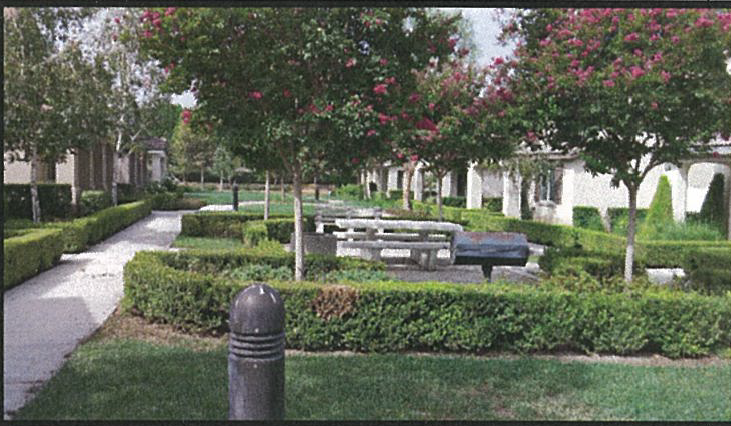
Small Parks and enhanced sidewalks
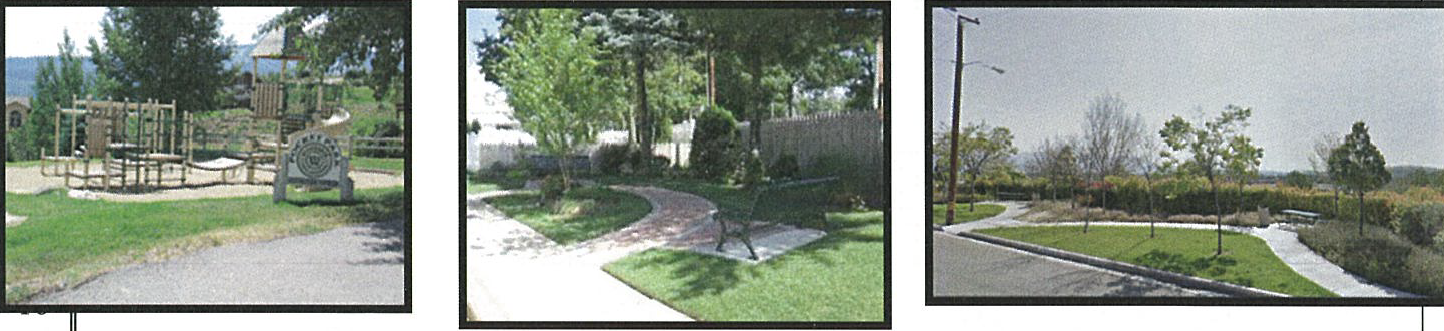
F.
Architecture Styles of Compact Homes.
1.
The City of Colton's heritage is rich with a variety of early American architecture styles. While it is the City of Colton's objective is to "Encourage the assemblage of Compact lots to create more cohesive development sites" (General Plan Land Use Policy LU-1.5), new homes should reflect an architectural style that is presently part of the City's historical resources inventory (this is not an exhaustive list, but meant to be a guideline to follow):
2.
Interior Lot or Project Perimeter Fencing: Preferred materials include decorative concrete block wall or vinyl fencing. If wood is going to be used as fence material or on the exterior of buildings, the Home Owners Association (HOA) Shall include a maintenance program to address regular maintenance schedule on all fences or exterior wood materials used for the development project. Wood fencing is not permitted material for project perimeter fencing.
G.
Compact Lot Infill Subdivision Design Options.
1.
Builders and designers should consider all possible subdivision configurations that take advantage of the site topography in providing sufficient open space/green belts, and consider how characteristics of the street and adjacent structures affect the overall form and orientation of the proposed development. When designing your compact lot subdivision, the following design criteria should be considered:
a)
Configure or design homes to front public streets, primary entryway, circulation walkways, and open spaces, rather than driveways.
b)
For homes not adjacent to the public street, provide pedestrian circulation in the form of private walkways or clearly delineated paths of travel from the sidewalk to their entryway.
c)
Maximize green space while minimizing the total amount of driveway space.
d)
Take advantage of existing topography and natural features to maintain appropriate grade levels consistent with surrounding structures.
e)
Homes fronting a public street should have the primary entrance and main windows facing the street.
f)
Pedestrian environment along the edge of the development should feature pleasant landscaping and trees.
g)
Enhanced paving should mark the pedestrian and vehicular entries of complexes to provide a sense of arrival.
h)
Design floor plan layouts in relation to lot shape, width, and depth to maximize usable outdoor spaces including space to store trash collection containers.
i)
Provide space for entry, front landing, and transitional landscaping (lush, drought resistant landscaping) between the public sidewalk and private entryway.
j)
Provide direct paths of travel for pedestrian destinations within the development.
k)
Vary building placement to increase variation in facades and more articulated building edges.
l)
While the homes are designed to be placed to provide adequate access to the garages for cars and with adequate side yards, the interior spaces are arranged so that windows and balconies do not directly face each other. This creates a better sense of privacy for homes that are closely spaced.
2.
Compact Lot Infill Subdivision Design Options.
Where rear driveways are used
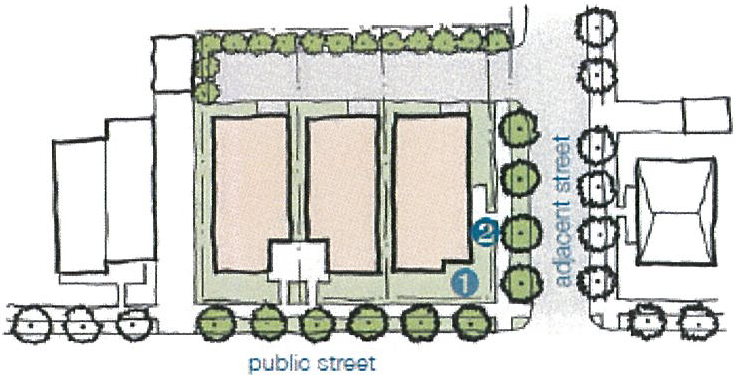
Where rear T-driveways are used
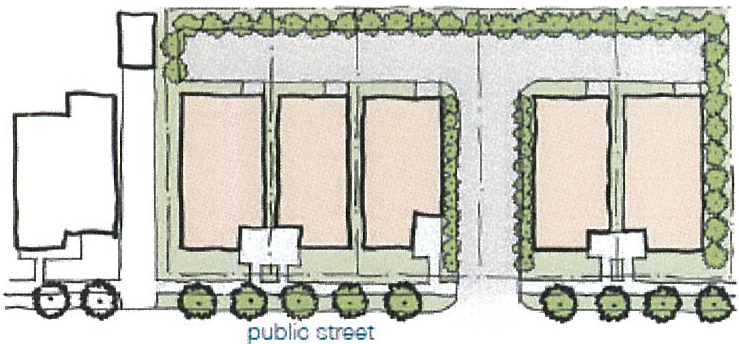
Where alternative T-driveway are used to separate rear units from the street and sidewalk
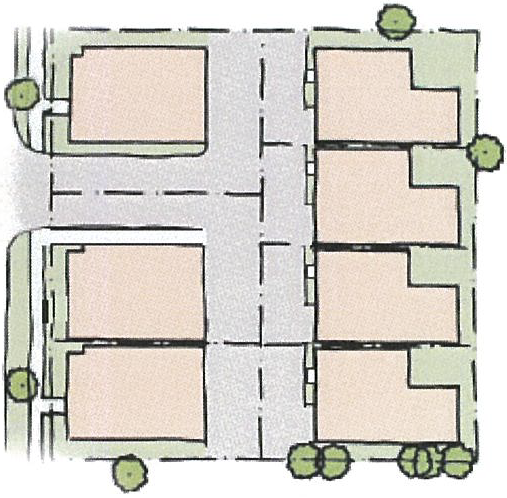
3.
Compact Lot Infill Subdivision Design Options (Continued).
Where L-driveways are used
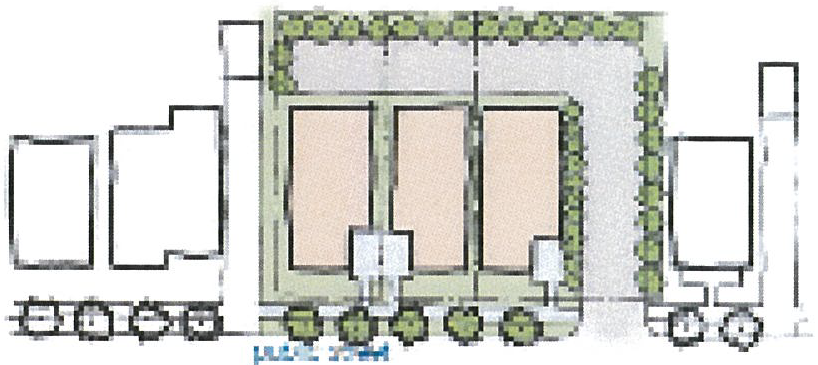
Where alternative L-driveways are used
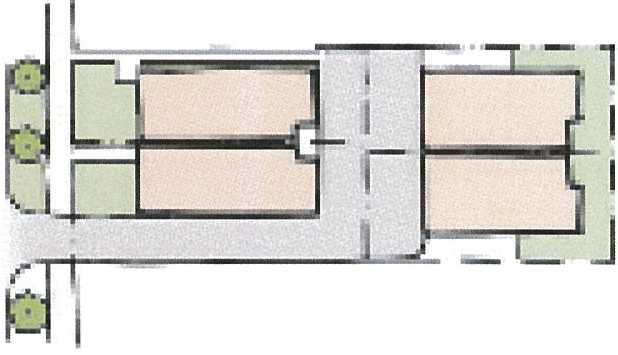
Where side access driveways are used
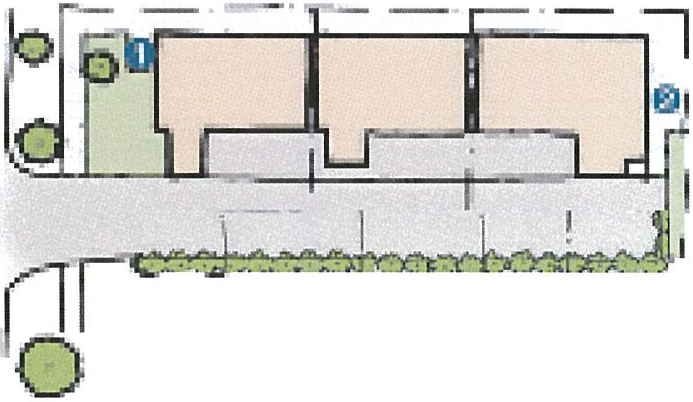
H.
Maintenance of Compact Lots Subdivision.
1.
A Homeowners Association with a Maintenance Agreement as part of the Covenants, Conditions and Restrictions (CC&Rs) Shall be required, composed of all property owners, to maintain all common areas such as trees, landscaping, trash, parking, community driveway, walkways, monthly service for private fire hydrant (if required), etc. Each owner and future property owners Shall automatically become members of the association and Shall be subject to a proportionate share of the maintenance.
2.
Each property owner Shall be responsible for the upkeep and maintenance of two car parking garage in compact lot subdivision. Garages must be usable and available for the parking of vehicles at all times and such language must be included in recorded Covenant and Agreement(s) related to maintenance and reciprocal private easements pertaining to said projects.
3.
Recorded Covenant and Agreement(s) will be required for all reciprocal private easements.
(Ord. No. O-03-15, § 15, 3-3-2015)
Editor's note— Ord. No. O-03-15, § 15, adopted Mar. 3, 2015, set out provisions intended for use as § 18.48.180. In as much as there were already provisions so designated, Ord. No. O-03-15, § 15, has been codified herein as § 18.48.190 at the discretion of the editor.
18.48.200 - Electric Vehicle Charging Facilities and Hydrogen Vehicle Fueling Facilities.
A.
Purpose. The purpose of this Section is to promote and encourage the development and use of zero-emission vehicle infrastructure by creating an expedited, streamlined permitting process that does not create unreasonable barriers to the installation of electric vehicle charging stations and hydrogen vehicle fueling stations while promoting public health and safety in a manner consistent with California Government Code Section 65850.7. This section does not discourage implementation of alternative fuels and energy systems within existing service stations as addressed by Section 18.48.030 (Automobile Service Stations).
B.
Applicability. This chapter applies to the permitting of all electric vehicle charging stations and hydrogen vehicle fueling stations in the City. Electric vehicle charging stations and hydrogen vehicle fueling stations legally established or permitted prior to the effective date of this ordinance are not subject to the requirements of this ordinance unless physical modifications or alterations are undertaken that materially change the size, type, or components of a charging station or hydrogen stations in such a way as to require a new permit.
C.
Definitions.
"A feasible method to satisfactorily mitigate or avoid the specific, adverse impact" includes, but is not limited to, any cost-effective method, condition, or mitigation imposed by the City on another similarly situated application in a prior successful application for a permit.
"Building official" — See Section 16.08.060.
"Electric Vehicle Charging Station," "Small Electric Vehicle Charging Station" and "Large Electric Vehicle Charging Station" — See Section 18.04.195
"Electronic submittal" means e-mail, fax any computer based electronic plan review software maintained, operated, and utilized by the City for receiving applications through the internet.
"Hydrogen Vehicle Fueling Station" — See Section 18.04.255
"Specific, adverse impact" means a significant, quantifiable, direct, and unavoidable impact, based on objective, identified, and written local, state or federal public health or safety standards, policies, or conditions as they existed on the date the application was deemed complete.
D.
Electric Vehicle Charging Station Requirements.
1.
An electric vehicle charging station shall meet the applicable safety and performance standards established by the California Electrical Code, the Society of Automotive Engineers, the National Electrical Manufacturers Association, and accredited testing laboratories such as Underwriters Laboratories, and, where applicable, rules of the Public Utilities Commission and the Colton Electric Utility or other applicable local electric utility company regarding safety and reliability.
2.
Installation of electric vehicle charging stations and associated wiring, bonding, disconnecting means and overcurrent protective devices shall meet the requirements of Article 625 and all applicable provisions of the California Electrical Code.
3.
Installation of electric vehicle charging stations shall be incorporated into the load calculations of all new or existing electrical services and shall meet the requirements of the California Electrical Code. Electric vehicle charging equipment shall be considered a continuous load.
4.
Anchorage of either floor-mounted or wall-mounted electric vehicle charging stations shall meet the requirements of the California Building or Residential Code as applicable per occupancy, and the provisions of the manufacturer's installation instructions. Mounting of charging stations shall not adversely affect building elements.
E.
Hydrogen Vehicle Fueling Station Requirements. A hydrogen vehicle fueling station shall meet all of the following standards, as applicable:
1.
Safety and performance standards established by the Society of Automotive Engineers and accredited nationally recognized testing laboratories.
2.
Any rules established by the State Air Resources Board, Energy Commission, or Department of Food and Agriculture regarding safety, reliability, weights, and measures.
3.
Guidance established by the Governor's Office of Business and Economic Development, as outlined in the "Hydrogen Station Permitting Guidebook."
F.
Expedited Permitting Process. The Building Official shall implement expedited, streamlined permitting processes for electric vehicle charging stations and hydrogen vehicle fueling stations and adopt checklists of all requirements with which electric vehicle charging stations and hydrogen vehicle fueling stations shall comply with in order to be eligible for expedited review. For electric vehicle charging stations, the expedited, streamlined permitting process and checklist may refer to the recommendations contained in the most current version of the "Plug-In Electric Vehicle Infrastructure Permitting Checklist" of the "Zero-Emission Vehicles in California: Community Readiness Guidebook" as published by the Governor's Office of Planning and Research. For hydrogen vehicle fueling stations, the expedited, streamlined permitting process and checklist may refer to the recommendations contained in the most current version of the "Hydrogen Station Permitting Handbook" as published by the Governor's Office of Business and Economic Development. The City's adopted checklists shall be published on the City's website.
G.
Permit application process.
1.
Prior to submitting an application for processing, the applicant shall verify that the installation of an electric vehicle charging station or hydrogen vehicle fueling station will not have specific, adverse impact to public health and safety and building occupants. Verification by the applicant includes but is not limited to: Electrical system capacity and loads; electrical system wiring, bonding and overcurrent protection; hydrogen system capacity, piping and overpressure protection; building infrastructure affected by charging station or hydrogen station equipment and associated conduits/piping/ducting; and areas of charging station or hydrogen station equipment and vehicle circulation or parking.
2.
A permit application that satisfies the information requirements in the City's adopted checklist shall be deemed complete and be promptly processed. A completed application does not authorize an applicant to energize, connect, fill or otherwise utilize an electric vehicle charging station or hydrogen vehicle fueling station until approval and all necessary permits are granted by the City.
3.
If the Building Official determines that the permit application is incomplete, he or she shall issue a written correction notice to the applicant, detailing all deficiencies in the application and any additional information required to be eligible for expedited permit issuance.
4.
For an electric vehicle charging station, the Building Official shall issue the notice not later than:
a.
Five business days after submission of the application, if the application is for at least 1, but not more than 25 electric vehicle charging stations at a single site.
b.
Ten business days after submission of the application, if the application is for more than 25 electric vehicle charging stations at a single site.
If the Building Official fails to issue a written correction notice to the applicant within the time prescribed, the application shall be deemed complete.
5.
A permit application for an electric vehicle charging station shall demonstrate compliance with Colton Electric Utility policies prior to approval.
6.
The Building Official shall allow for electronic submittal of permit applications covered by this chapter and associated supporting documentation. In accepting such permit applications, the Building Official shall also accept electronic signatures on all forms, applications, and other documentation in lieu of a wet signature by any applicant.
H.
Permit Review.
1.
The Building Official shall review all electric vehicle charging station and hydrogen vehicle fueling station applications to determine whether the charging station or hydrogen station meets all health and safety requirements of local, state and federal law. The requirements in this Section are declared to be limited to those standards necessary to ensure that the charging station or hydrogen station will not have an unmitigated specific adverse impact on public health and safety. Notwithstanding the expedited permit processing set forth in this chapter, the Building Official retains authority at all times to identify and address higher priority life-safety situations.
2.
Upon confirmation by the Building Official that the permit application and supporting documents meet the requirements of the City adopted checklist, and is consistent with all applicable laws and health and safety standards, the Building Official shall, consistent with Government Code Section 65850.7, as may be amended, approve the application and issue all necessary permits.
3.
If the Building Official makes a finding based on substantial evidence that the electric vehicle charging station or hydrogen vehicle fueling station could have a specific, adverse impact upon the public health or safety, the City may deny the permit and require the applicant to apply for a conditional use permit pursuant to Section 18.58.060 of the Colton Municipal Code. For an electric vehicle charging station, the Building Official shall issue the denial and finding not later than:
a.
Twenty business days after the application is deemed complete, if the application is for at least 1, but not more than 25 electric vehicle charging stations at a single site.
b.
Forty business days after the application is deemed complete, if the application is for more than 25 electric vehicle charging stations at a single site.
If the Building Official fails to issue to the applicant a written denial/finding and referral to the Planning Commission for a conditional use permit within the time prescribed, the application shall be deemed approved.
4.
The Building Official's decision may be appealed by the applicant to the Planning Commission by submitting a written request of review of such decision within five business days of such decision, requesting review of such decision by the Planning Commission. Such request shall be made in writing to the Development Services Department. Upon receipt of such request, the Development Services Department shall schedule the matter for Planning Commission review, and shall forward to the Planning Commission for its consideration all of the documents and materials submitted with the permit application, together with a report of the decision of the Building Official and the reasons therefor. The Planning Commission may act upon the application as if it were the initial consideration of the application. No public hearing shall be required for such action. If the Planning Commission finds that there is not substantial evidence of a specific, adverse impact upon the public health or safety, the Planning Commission shall order issuance of the permits for the charging station or hydrogen station. If the Planning Commission finds that there is substantial evidence of a specific, adverse impact upon the public health or safety, the Planning Commission shall order that the applicant apply for a conditional use permit pursuant to Section 18.58.060 of the Colton Municipal Code.
5.
Notwithstanding any provision of Section 18.58.060 to the contrary, an application for a conditional use permit to install an electric vehicle charging station or hydrogen vehicle fueling station shall not be denied unless the Planning Commission makes written findings based upon substantial evidence in the record that the proposed installation would have a specific, adverse impact upon the public health or safety, and there is no feasible method to satisfactorily mitigate or avoid the specific, adverse impact. The findings shall include the basis for the rejection of potential feasible alternatives. If denied, the Planning Commission's decision may be appealed by the applicant to the City Council in the manner provided by Section 18.58.100 of the Colton Municipal Code.
6.
Any conditions imposed by the Building Official, Planning Commission or the City Council shall be designed to mitigate the specific adverse impact(s) upon the public health or safety at the lowest cost possible.
7.
In the technical review of an electric vehicle charging station or hydrogen vehicle fueling station application, the Building Official, Planning Commission or City Council shall not condition the approval of any charging station or hydrogen station permit on the approval of such a station by an association, as that term is defined by California Civil Code Section 4080.
I.
Additional Objective Health and Safety Standards for Electric Vehicle Charging Stations and Hydrogen Vehicle Fueling Stations.
1.
For large electric vehicle charging stations and hydrogen fueling stations, the minimum lot size shall be 3.0 acres. Minimum street frontage for large electric vehicle charging stations and hydrogen fueling stations shall be 200 feet.
2.
Building Setbacks: Same as underlying zoning.
3.
Amenities: Amenities and other ancillary equipment and facilities that are not directly necessary for the charging of plug-in electric vehicles from an outside source, or the delivery, storage or dispensing of hydrogen to hydrogen fuel-cell vehicles, including but not limited to, canopies (with or without solar panels), patronage resting facilities, commercial sales kiosks or buildings, public restrooms, family amenities or pet amenities, are not subject to the expedited application and permitting requirements of this ordinance and but shall be subject to Administrative Architectural and Site Plan Review pursuant to Section 18.58.030 of the Colton Municipal Code.
4.
Building Height: Same as underlying zone.
5.
Security: All large electric vehicle charging stations and hydrogen fueling stations shall include a security plan subject to review and approval by Development Services and Police Department. The security plan may include, but is not limited to a security surveillance system, security personnel, or a perimeter wrought iron or tubular steel fence with visibility into the facility at a maximum height of 8 feet.
6.
Vehicle Types and Circulation/Parking: The applicant shall identify the vehicle types served by the station.
a.
Access/Internal Circulation/Egress from the Site. The applicant shall provide appropriate truck and other vehicle turning templates on plan subject to review and approval by the City Planning Division and Public Works Engineering/Traffic.
b.
Driveways, parking, and queuing areas shall comply with all Fire Codes, Traffic Engineering and Planning/Zoning requirements.
7.
All proposed signage for the station shall be subject to Chapter 18.50 — Signs.
J.
Fees. The City Council may establish by resolution fees that shall be charged for permits issued under this chapter.
(Ord. No. O-05-24, § 5, 6-4-2024)