
Columbus City Zoning Code
CHAPTER 3321
GENERAL SITE DEVELOPMENT STANDARDS
3321.01 - Dumpster area.
A.
A dumpster, when provided, shall be in a designated area that does not interfere with any aisle, driveway, parking space, loading space or other circulation area.
The location of a dumpster, if any, shall be shown on the site plan with proper loading and maneuvering space; and for the purpose of location, shall be treated as a structure. A dumpster shall be screened from view on all sides. Such area shall not be located in any required yard or setback and shall be maintained according to the requirements of the board of health.
B.
Recycling dumpsters, when provided for, by, or on the behalf of a solid waste authority pursuant to a comprehensive recycling program and operated by said solid waste authority, shall be excluded from the requirements contained in this Zoning Code, except that such dumpsters and dumpster areas shall be maintained according to the requirements of the board of health and shall not interfere with any aisle, driveway, loading space or other circulation area or be located in any required parking spot. The solid waste authority shall notify the Director of the location of each recycling dumpster and the materials to be collected as part of the comprehensive recycling program.
C.
Any development that receives City of Columbus dumpster service shall provide a concrete pad, screening, approach apron, and maneuvering space as determined by the Director of Public Service.
(Ord. No. 1537-2009, § 19, 5-3-2010)
3321.03 - Lighting.
Lighting shall conform to the following standards.
A.
Site lighting in commercial and institutional districts:
1.
Light fixtures shall not exceed 28 feet in height.
2.
Light fixtures located within 100 feet of a residentially zoned property shall not exceed 18 feet in height.
3.
Lights shall have fully shielded, recessed lamps directed away from abutting properties and directed downward to prevent glare and shine above the horizontal plane.
4.
Canopy lighting shall be recessed within the canopy or use an opaque shield around the sides of the light.
5.
Globe style fixtures shall be shielded to prevent upward lighting and shall not exceed 14 feet.
B.
Site lighting in manufacturing districts:
1.
Light fixtures located within 100 feet of a residentially zoned property shall not exceed 18 feet in height.
2.
Lights shall have fully shielded, recessed lamps directed away from abutting properties and directed downward to prevent glare and shine above the horizontal plane.
C.
Parking lot lighting:
1.
Any parking lot containing ten or more parking spaces, which is used during non-daylight hours, shall be illuminated during such hours to assist both motorists and pedestrians in avoiding accidents.
2.
For aesthetic compatibility, light fixtures in parking lots shall be of the same or similar type and color.
3.
Light fixtures shall be placed in parking lot islands or solid bases to protect both lights and vehicles from possible damage.
(Ord. No. 1537-2009, § 19, 5-3-2010; Ord. No. 0791-2011, § 2(Att. 2), 7-18-2011; Ord. No. 1791-2011, § 1, 12-12-2011)
3321.05 - Vision clearance.
A.
Minimum acceptable vision clearance standards for motorist and pedestrian safety at vehicular access points along streets are hereby established by restricting the placement, opacity, height and configuration of any fence, wall, planting or other obstruction in a required yard. Any person establishing a parking space that uses a driveway leading to a public street shall maintain vision clearance at the intersection of such driveway and street right-of-way line.
1.
Clear vision for driveways to parking lots. An owner shall maintain unobstructed vision clearance between the elevations of two and one-half to ten feet above the driveway grade within "clear vision triangles", which are two ten-foot, right-angle triangles formed by the intersection of a driveway pavement edge and street right-of-way line. See Figure 1.
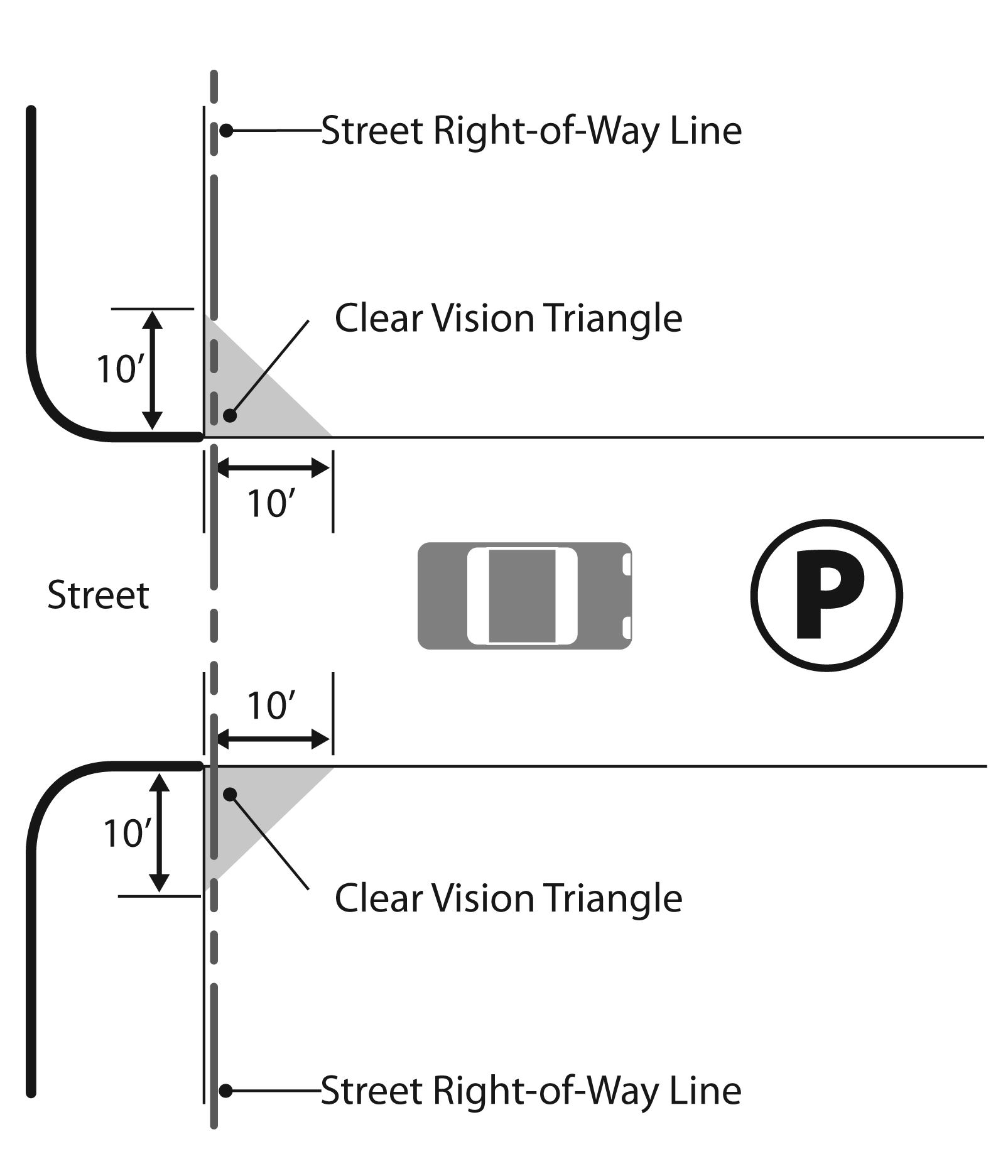
Figure 1.
2.
Clear vision for other driveways. An owner shall maintain vision clearance on each residential lot abutting a street and having access thereto or abutting a residential lot having such access to a street. No portion of a fence or wall exceeding two and one-half feet in height above the finished lot grade shall exceed 25 percent opacity when located in a required yard having vehicular access to a street or abutting a residential lot having such access to a street. Mature plantings with foliage between two and one-half and six feet above the finished lot grade shall extend no closer than 12 feet to the street right-of-way line. The percentage of opacity shall be determined by measurement of any typical square foot of the vertical surface of the fence or wall from a point perpendicular thereto. See Figures 2 and 3. A motor vehicle parked in a driveway shall extend no closer than ten feet to the street right-of-way line.
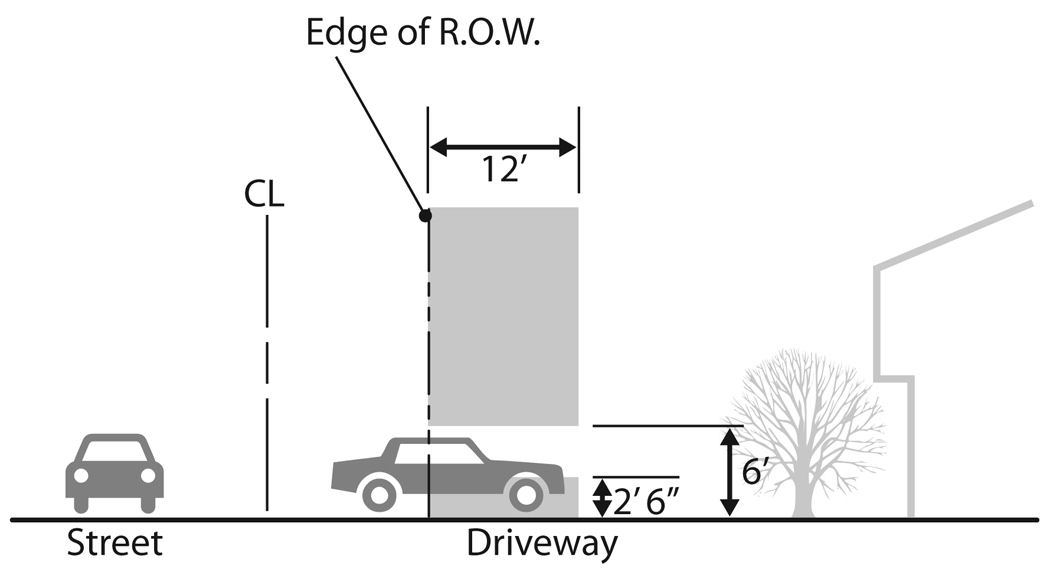
Figure 2.
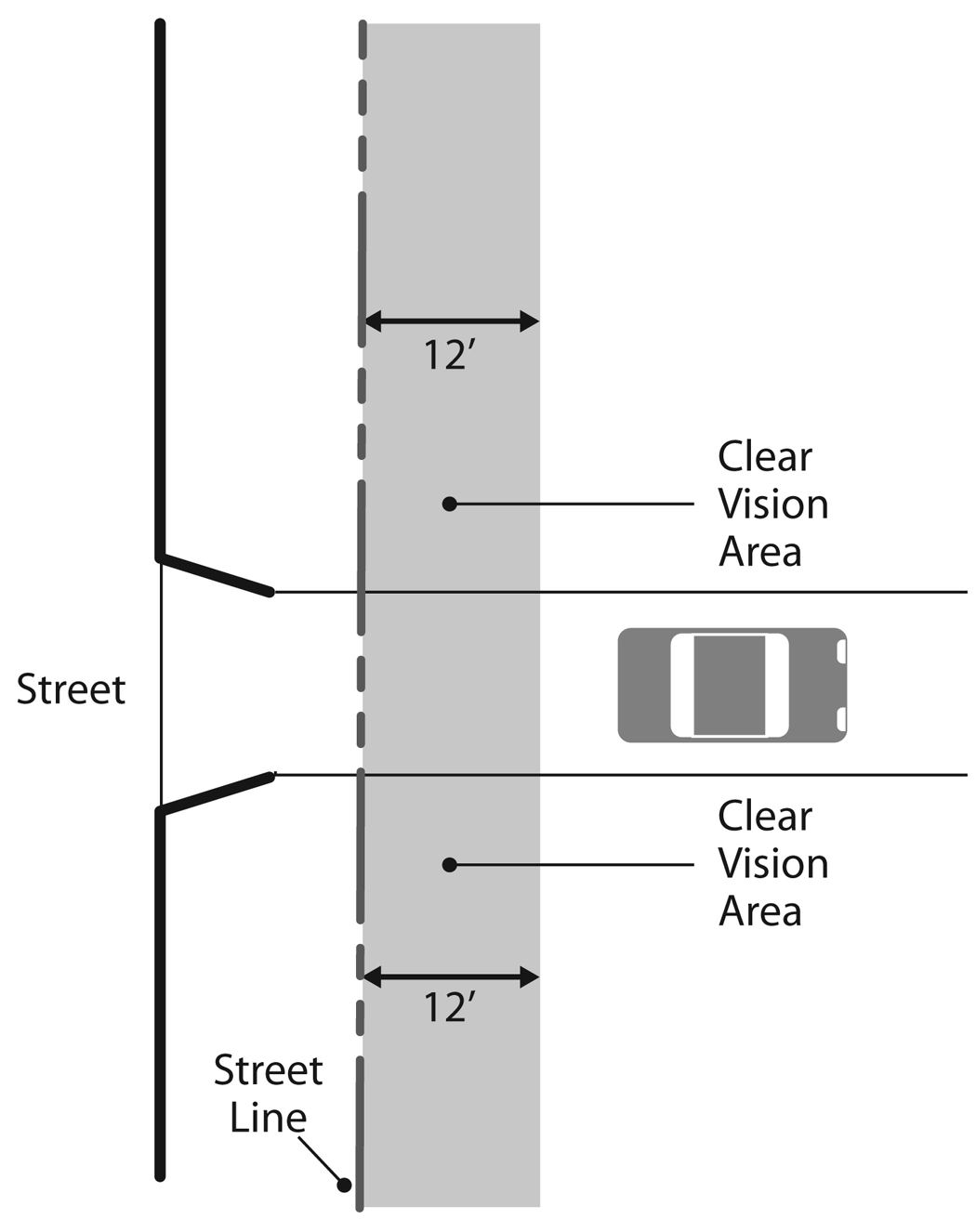
Figure 3.
B.
Minimum acceptable vision clearance standards for motorist and pedestrian safety at intersections are hereby established by restricting the placement, opacity, height and configuration of any fence, wall, planting, structure, or other obstruction.
1.
Vision clearance at intersections of streets and alleys. Property owners shall maintain unobstructed vision clearance at the intersections of streets and alleys. An owner shall maintain unobstructed vision clearance between the elevations of two and one-half to ten feet above the alley grade within "clear vision triangles", which are two ten-foot, right-angle triangles formed by the intersection of an alley right-of-way line and street right-of-way line. See Figure 4.
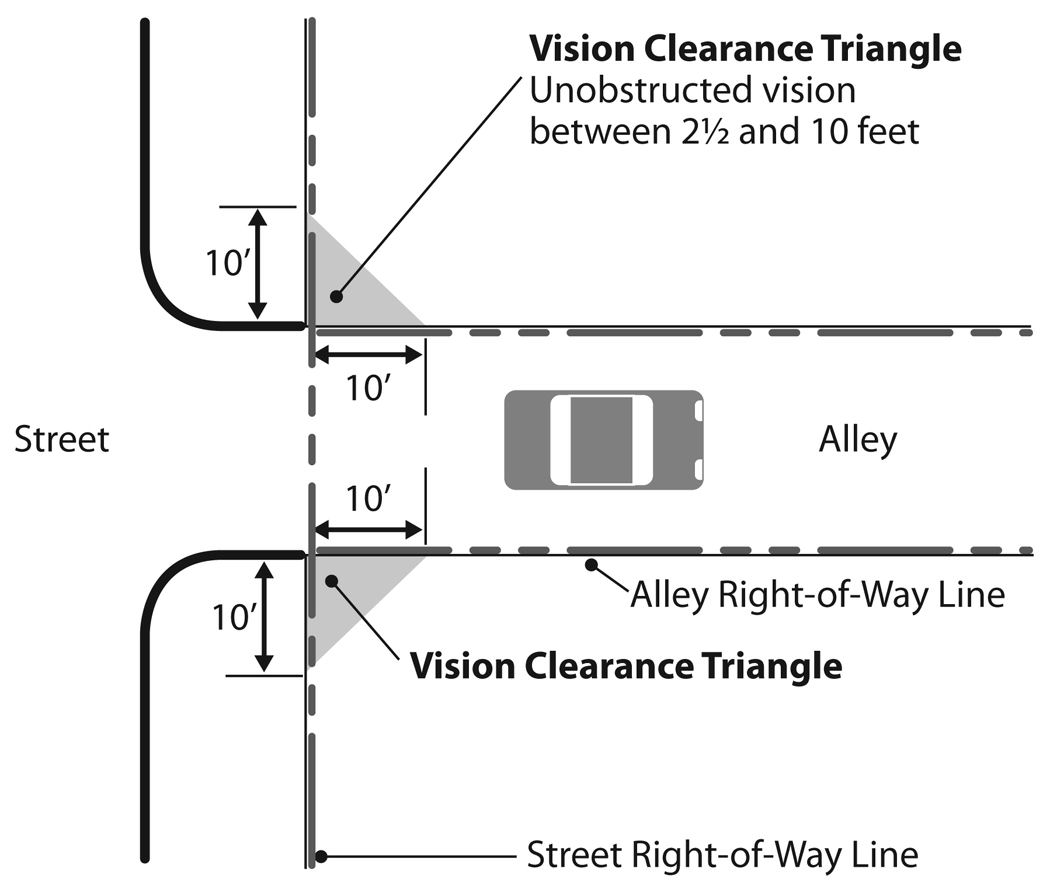
Figure 4.
2.
Clear Vision at Intersections. A clear vision triangle shall be maintained on each residential lot, including but not limited to, 1-, 2-, or 3-unit; apartment; planned unit development; or planned community development district lot adjacent to a street intersection. Within the clear vision triangle no fence, wall, planting or other obstruction shall exceed two and one-half (2-1/2) feet in height above the centerline grade of the intersecting streets. A "clear vision triangle" is that area of a corner lot bounded on two sides by the intersecting street lines (property lines) and on the third side by a line connecting two points, one located on each street line 30 feet from the point of intersection. See Figure 5.
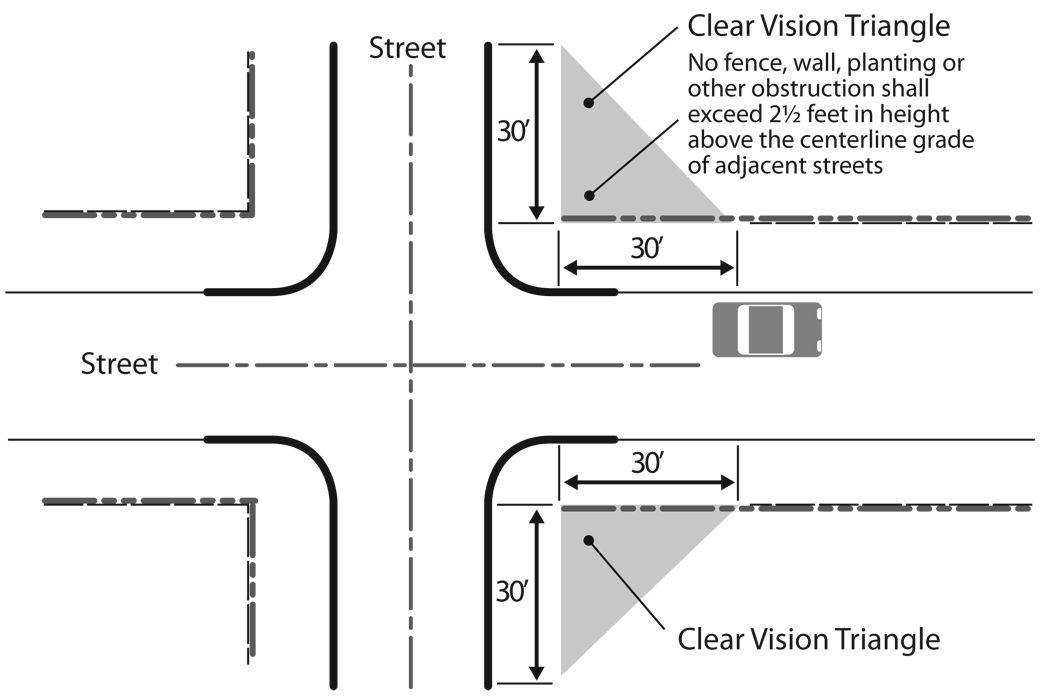
Figure 5.
(Ord. No. 1537-2009, § 19, 5-3-2010; Ord. No. 1871-2023, § 1, 7-31-2023)
3321.07 - Landscaping.
A.
Front yard landscaping: The lot area between a required building line and a street line shall be landscaped and shall not be paved except for paved areas approved by the city.
B.
Tree requirement on residential property: The purpose of the tree requirement is to reestablish plant cover over the built environment, reduce topsoil erosion and storm water runoff, mitigate the effects of sun and wind, offset carbon emissions, moderate temperatures, and conserve energy resources. On a residentially zoned lot, a minimum of one tree, subject to minimum size requirements in General Landscaping Standards, is required on-lot for every ten (10) dwelling units or fraction thereof. No other code-required trees may satisfy this requirement. A minimum of one tree is required on each lot containing one to ten dwelling units, a minimum of two trees are required on each lot containing 11 to 20 dwelling units, and so on.
(Ord. No. 0791-2011, § 2(Att. 2), 7-18-2011)
3321.09 - Screening.
Screening of nonresidential districts abutting residential districts: The purpose of screening is to provide, in conjunction with existing yard, setback, and separation standards, a minimum buffer between abutting land uses.
A.
Applicability: Screening in section 3321.09 applies to lots rezoned to a nonresidential classification after the effective date of this ordinance that abut, at the time of rezoning, property with a residential zoning classification. Screening must be installed within nine months of occupancy of the rezoned lot.
B.
A property with a nonresidential zoning classification abutting residentially zoned property shall provide screening that shall include a fence, wall, landscaped mound, densely planted planting strip, or combination thereof meeting the following standards:
1.
Screening shall be provided and maintained within 20 feet of all lot lines abutting residential zoning classifications.
2.
Trees used to satisfy this section shall be planted no closer than three feet to the property line, as measured from the trunk.
3.
Screening is not required between a required residential building line and a street line. However, if applicable, the screening requirements in the Off-Street Parking and Loading chapter shall prevail and may apply in advance of a building line.
C.
Height and opacity: For purposes of this section, required screening, and any portion thereof, shall be installed and maintained to a height of no less than five feet above the finished grade and to a year-round opacity of not less than 75 percent. When plant material is used for screening, compliance with height and opacity requirements shall be attained within three years of planting. Screening is not required within one foot above the finished grade.
(Ord. No. 0791-2011, § 2(Att. 2), 7-18-2011)
3321.11 - Screening of mechanical systems.
In commercial, institutional or manufacturing districts, all heating, ventilating, air conditioning and other building mechanical systems and equipment or other utility hardware on the roof of a building shall be screened to the height of the equipment to prevent the equipment from being visible from any adjacent public street or adjacent residential district. Decorative cornices may be used for screening. The color of the screening material shall match the building exterior or roof. Equipment directly related to the collection of solar energy shall be exempt from the above screening requirements.
Mechanical or other utility equipment on the ground shall be fully screened to the height of the equipment by wall, fence, landscape material or a combination thereof to prevent the equipment from being visible from any adjacent public street or adjacent residential district. Whenever live plants are installed, alone or in combination with other materials for the purposes of this section, the plants shall be selected to achieve the height equal to the height of the equipment, and a density not less than 75 percent opacity within three years of installation and shall comply with general landscaping standards of this chapter. Equipment directly related to the collection of solar energy shall be exempt from the above screening requirements.
(Ord. No. 0791-2011, § 2(Att. 2), 7-18-2011; Ord. No. 1501-2022, § 7, 6-13-2022)
3321.13 - General landscaping standards.
A.
Determining opacity: The percentage of opacity shall be determined by measurement of any typical square foot of the vertical plane from a point perpendicular thereto, exclusive of any area within one foot of the finished grade. Permissibly open area (e.g., vision clearance, driveways) shall not be included in an opacity determination.
B.
A landscaped earth mound shall have a maintainable slope of no greater than 3:1 (horizontal: vertical). Every one foot of vertical rise shall be constructed in three feet or more of horizontal space.
C.
Minimum size: When used to meet a required landscaping or screening provision, plants shall have a minimum size at the time of planting as follows:
1.
Two-inch caliper for a deciduous tree;
2.
One-and-one-half-inch caliper for an ornamental tree;
3.
Four-foot height for a conifer or evergreen tree;
4.
Two-foot height for a shrub, and;
5.
Number 2 size container for ornamental grasses.
D.
All plants shall be maintained in a healthy live state and shall be replaced as needed to comply with code. Landscaping and screening plants that die shall be replaced during the current or next planting season.
E.
Existing landscape vegetation or existing tree stands may be used as part or all of screening provided the height and opacity requirements are met.
(Ord. No. 0791-2011, § 2(Att. 2), 7-18-2011)

