
Columbus City Zoning Code
CHAPTER 3359
DOWNTOWN DISTRICT
3359.01 - Purpose.
The Downtown District is intended to foster a better downtown through excellence in urban design. The district encourages investment in the downtown by providing a high level of development flexibility consistent with the eclectic nature of the City's, mixed-use, high-density center. The regulatory framework for new development is augmented by Design Guidelines and related development plans. The following principles inform this code and associated guidelines:
A)
Downtown is the region's neighborhood, serving as the center of government, corporate business, professional sports, the arts, museums and entertainment - a variety of regional facilities are supported in the Downtown to meet these needs.
B)
Downtown is also evolving into its own neighborhood, with a growing amount of housing with supporting retail, personal services restaurants and parks in a walkable environment.
C)
Downtown is the place for regional scale public open spaces focusing on the Scioto River and integrating a variety of cultural and recreational facilities.
D)
Downtown's built environment will continue to be enhanced and energized with new buildings, additions to existing structures, rehabilitation/conservation of historic and contributing buildings and improvements in the public realm that together promote quality design, long lasting building construction and materials, and attention to detail - especially at the street level.
E)
Adaptive reuse of existing buildings is generally preferable to demolition and new construction.
F)
Downtown will support a multi-modal transportation system that embraces walking, biking and transit as successful, efficient and safe alternatives to the automobile.
G)
Downtown's environment and character will promote visual energy and excitement.
H)
Downtown will serve as an example of environmentally sustainable design and construction methods.
I)
The downtown commission will serve as a public forum regarding issues impacting the built environment in downtown.
(Ord. No. 1532-2013, § 1, 7-15-2013)
3359.03 - Downtown District Boundary.
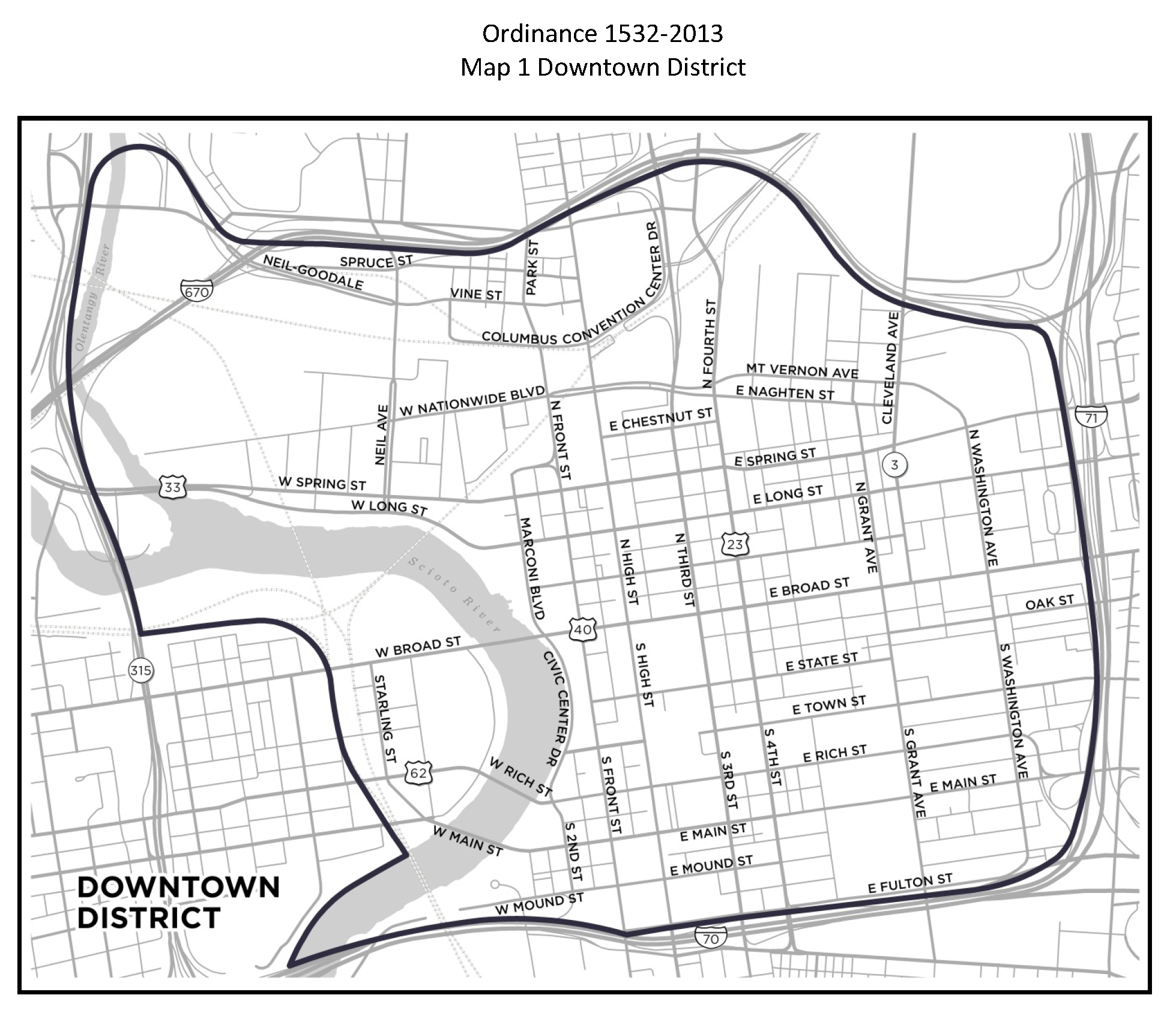
The downtown district is that area indicated on the official city zoning map and bounded as follows:
Beginning at the intersection of Interstate 70 and the western bank of the Scioto River; Thence northeasterly along the north/west bank of the Scioto River to the first railroad right-of-way; Thence northerly along said railroad right-of-way to the first intersecting railroad right-of-way; Thence westerly along said railroad right-of-way to the intersection of State Route 315; Thence northerly along State Route 315 to the northbound exit ramp to Goodale Boulevard; Thence following the exit ramp to the northernmost point of its arc; Thence easterly approximately 300' to the southbound ramp from State Route 315 to Interstate 670; Thence southeasterly along the ramp to Interstate 670; Thence easterly along Interstate 670 to the intersection of Interstate 71; Thence southerly along Interstate 71 to the intersection of Interstate 70; Thence westerly along Interstate 70 to the place of beginning.
(Ord. No. 1532-2013, § 1, 7-15-2013)
3359.05 - Downtown Commission.
A)
Creation, Membership, and Terms, The downtown commission is created consisting of between seven and nine members. All members shall work or reside downtown or have substantial involvement in downtown business, planning or development activities. Each member shall be appointed by the mayor and confirmed by city council, and serve staggered four-year terms. Appointments shall be made so as to include on the commission at all times at least one member who resides downtown; one member engaged as a developer or realtor with experience in the sale or management of downtown properties; one member who is an architect or landscape architect with experience in downtown scale projects; one member who is a professional with historic resources rehabilitation experience; and, one member who is a lawyer with land use law experience. A member may represent more than one required role. A member of the commission may be removed from service for missing four consecutive meetings or a total of five meetings in one calendar year. Members shall not receive compensation for commission service.
B)
Rules of Procedure. Annually the commission shall elect a chair and vice-chair. Also annually, the commission shall adopt rules of procedure (bylaws) providing for regular and special meetings. A majority of the appointed members shall constitute a quorum for the purpose of conducting business and a motion can only pass when approved by a majority of those present. All commission meetings shall be open to the public. A record of proceedings shall be maintained, available for inspection. Notice of all regular, special and rescheduled commission meetings shall be published in the city bulletin and or newspaper of general circulation as outlined in the bylaws.
C)
Duties. The duties of the downtown commission shall be as follows:
1)
Design Review. The downtown commission shall hear and decide applications for certificates of appropriateness. A "certificate of appropriateness" or "certificate" is issued by the commission to an applicant stating that the proposed construction, alteration or demolition of a structure, architectural feature or other improvement is in accordance with the standards of this Code and commission guidelines as approved by city council. The commission shall conduct such review for any projects requiring a certificate of appropriateness as provided in Section 3359.07, Certificate of Appropriateness - Required. Project review may include preliminary consideration of conceptual or interim proposals. Design review shall be based on the following considerations:
a.
Compliance with the provisions and standards of this chapter.
b.
Consistency with adopted design guidelines.
c.
Consistency with adopted public plans and policies.
d.
Other code and regulatory requirements as may be applicable.
In the granting of a certificate of appropriateness, the downtown commission may impose reasonable requirements and conditions regarding the location, dimensions, character, access, building materials, and other features of the proposed uses or structures to carry out the intent and purpose of this chapter and to otherwise safeguard the public safety and welfare.
2)
Public Plan Review. The downtown commission shall review and provide a recommendation to City Council regarding adoption of any public plan, including but not limited to area plans, streetscape plans, park plans, and major street parking and circulation plans within the downtown district.
3)
Design Guidelines Approval. The downtown commission shall develop and adopt design guidelines for use in reviewing applications that come before the commission. Such guidelines and any amendments thereto, shall be effective upon approval by city council.
4)
Downtown District Amendments. The downtown commission may, at any time, recommend that the department of development prepare amendments to this chapter. The commission shall also participate in informational meetings, hearings and other efforts to consider stakeholder input regarding potential code changes. Upon completion of such a review, the commission shall provide a recommendation to city council regarding appropriate and necessary amendments.
5)
Review of Public Art. The downtown commission shall consider proposals for the placement of public art, as defined in Chapter 3115, in the downtown district and provide a non-binding recommendation to the Columbus Art Commission.
D)
Appeals to the Commission. The downtown commission shall hear appeals from any person affected by an order, requirement, decision or determination made by the city in the administration or enforcement of this chapter, upon application and within such time as shall be set by rule of the commission. The commission may reverse, affirm, or modify the order, requirement, decision or determination appealed from and shall make such order, requirement, decision or determination, as in its opinion and consistent with this chapter ought to be made and to that end shall have the powers of the office from which the appeal is taken. The commission shall not entertain any appeal applied for more than 30 days after the date of the order, requirement, decision or determination appealed from or within such different time as may be specifically provided in Section 3359.05(E), Appeals of Commission Decisions.
E)
Appeals of Commission Decisions. Upon the request of any person directly affected by a commission decision of a certificate of appropriateness, will be forwarded to city council for reconsideration by the filing of a notice of appeal with the city clerk within 30 days after the date of the commission's decision.
(Ord. No. 1532-2013, § 1, 7-15-2013)
3359.07 - Certificate of appropriateness—Required.
The following activities within the downtown district require a certificate of appropriateness as defined in Subsection 3359.05(C)(1), Design Review.
A)
Any exterior construction activity requiring a building permit, including new construction, reconstruction, expansion, alteration and rehabilitation of structures.
B)
Site work requiring a permit, such as installation of parking lots, plazas and similar improvements.
C)
Any activity requiring a demolition permit (see also Section 3359.23, Demolitions).
D)
Any activity requiring a graphics permit (see also Section 3359.25, Graphics).
E)
Any activity requiring a certificate of zoning clearance.
F)
Encroachments into the public right-of-way.
G)
Location and design of public parks.
H)
Uses permitted only by certificate of appropriateness as outlined in Subsection 3359.17(C), Uses Permitted only by Certificate of Appropriateness.
Approval by the department of public service is required for encroachments and access points into the public right-of-way. A certificate of appropriateness for these actions does not constitute city approval.
Building activity that is exclusively interior to a building does not require a certificate of appropriateness. In such cases all other regulatory requirements remain in place, including review and approval by the building and zoning services department.
(Ord. No. 1532-2013, § 1, 7-15-2013)
3359.09 - Certificate of appropriateness—Application and issuance.
The following provisions apply to applications for and issuance of certificates of appropriateness as defined in Subsection 3359.05(C)(1), Design Review. The commission shall also adopt rules of procedure outlining in further detail the requirements for submission of applications and issuance of certificates of appropriateness. Such rules of procedure will be published and made available to applicants.
A)
Any person seeking a certificate of appropriateness in the downtown district shall file an application with commission staff using the city's application form prepared for such use. Applications must be accompanied by required support materials, such as site plans, elevations and other information intended to describe the proposal as outlined by the commission.
B)
Commission staff shall review each application to determine its completeness. The commission shall consider complete applications submitted by the established deadline at the next regularly scheduled meeting.
C)
At the public meeting the commission shall approve, approve with conditions or deny the application. Applicants may also request that the application be tabled until a future meeting.
D)
Applicants shall receive written notice of commission action. Applications that are approved or approved conditionally shall receive a certificate of appropriateness reflecting the approval and any associated conditions.
E)
Applicants may also request that the commission consider a conceptual proposal for which no certificate of appropriateness is sought and no official action is taken. Such requests shall comply with the rules of procedure established by the commission.
(Ord. No. 1532-2013, § 1, 7-15-2013)
3359.11 - Issuance of permit.
Within the boundaries of the downtown district the building and zoning services department shall issue no certificate of zoning clearance or permit for construction for projects requiring a certificate of appropriateness as listed in Section 3359.07, Certificate of Appropriateness—Required, and shall issue no demolition permit unless:
A)
The downtown commission or its designee has issued a certificate of appropriateness; or
B)
On appeal, as provided for in Subsection 3359.05(E), Appeals of commission decisions, the downtown commission's denial of a certificate of appropriateness has been reversed; or
C)
In cases of public emergency as outlined in Section 3359.23, Demolitions.
The building and zoning services department shall revoke any permit or approval issued prior to a required certificate of appropriateness. Any construction, alteration, work, action, or site improvement not in compliance with, or contrary to, that specifically approved in the certificate of appropriateness shall be a violation of this chapter.
When a certificate of appropriateness is required it shall be issued in conformance with all the provisions of this chapter.
(Ord. No. 1532-2013, § 1, 7-15-2013)
3359.13 - Staff approvals.
The commission shall provide in its guidelines or rules of procedure that the commission staff may administratively approve certain actions as defined by the commission. A certificate of appropriateness shall be issued to the applicant upon such an administrative approval. The commission shall publish the list of staff approvable work items annually. Staff or the applicant shall have the option of referring any application to the commission. Staff shall report all approvals to the commission at its regularly scheduled meetings. Staff denials of a certificate of appropriateness may be appealed to the commission. Such appeal must be filed within 30 days of issuance of the denial.
(Ord. No. 1532-2013, § 1, 7-15-2013)
3359.15 - Design guidelines.
A)
Guidelines Required. Design guidelines corresponding to the downtown district shall be developed and adopted for use by the downtown commission in reviewing applications for certificate of appropriateness. Topics to be addressed by said design guidelines include, but are not limited to: building setback, height and composition, pedestrian entrances and access, screening and landscaping, graphics, parking and vehicular access, plazas and common areas, and right-of-way encroachments. The design guidelines are intended to serve as a flexible policy framework for decisions by the downtown commission.
B)
Process to Amend Design Guidelines. From time to time, the commission may work with staff to develop proposed updates to the guidelines according to the following procedure:
1.
Upon completion, the availability of proposed updates for public review shall be published in the city bulletin and posted on the planning division website. The notice shall include the time and place of a public hearing regarding the guidelines as well as a deadline for submission of public comment.
2.
After incorporating any necessary revisions to the guidelines based on the public review process, the commission shall approve a final version, which shall be forwarded to city council for consideration.
(Ord. No. 1532-2013, § 1, 7-15-2013)
3359.17 - Permitted, prohibited and uses permitted only by certificate of appropriateness.
A)
Permitted Uses. A permitted use within the downtown district shall be any use permitted in any residential, institutional, commercial, manufacturing, or parking district, except uses listed in subsection (B) of this section and uses which are permitted only by certificate of appropriateness as listed in subsection (C) of this section.
B)
Prohibited Uses. The following uses are prohibited within the downtown district, including public rights-of-way:
1.
Adult uses (entertainment establishments and stores)
2.
Amusement park
3.
Animal hide storage or processing
4.
Billboards
5.
Cemetery
6.
Compost facility
7.
Drive-in outdoor movie theaters
8.
Free-standing communications towers, including but not limited to radio, television, and telephone
9.
Impound lots
10.
Indoor firing range
11.
Incinerators
12.
Landing field
13.
Manufacturing facilities, specific nature, as identified in Section 3389.083
14.
Material recycling
15.
Salvage dealers and salvage yards (including automobile, but not including architectural salvage
16.
Slaughterhouse or stockyard
C)
Uses Permitted Only by Certificate of Appropriateness. In granting a certificate of appropriateness to allow a use listed in this section, the commission shall consider whether such approval can be granted without substantial detriment to the public good, without substantial impairment of the general purpose and intent of the downtown district, and without significant incompatibility with the general character of the neighborhood. The commission shall evaluate such uses using adopted design guidelines and applicable provisions of Chapter 3389, Special Permit Uses. The commission may impose such requirements and conditions regarding the location, character, and other features of the proposed uses or structures as the commission deems necessary to carry out the intent and purpose of the downtown district and to otherwise safeguard the public safety and welfare.
The following uses are permitted provided a certificate of appropriateness is granted by the downtown commission. For those uses listed in Chapter 3389, Special Permit Uses, a certificate of appropriateness serves in lieu of a special permit.
1.
Pickup unit (drive-thru window)
2.
Automobile sales
3.
Retail filling station or service station
4.
Automobile repair shop or installation facility
5.
Manufacturing use permitted in M, M-1, or M-2 Manufacturing District - unless otherwise addressed in this chapter
6.
Skywalk
7.
Animal kennel or shelter
8.
Helipad
9.
Portable building unless associated with an approved construction project
10.
Uses listed in Chapter 3389, Special Permit Uses, not otherwise addressed in this chapter.
(Ord. No. 1532-2013, § 1, 7-15-2013)
3359.19 - Encroachment.
Approval by the department of public service is required for encroachments and access points into the public right-of-way. If approved by the department of public service, portions of a building or structure may extend under, over or into the public right-of-way, subject also to the provisions of Subsection 3359.05(C)(1), Design review. A certificate of appropriateness issued by the downtown commission for these encroachments does not constitute approval by the department of public service.
(Ord. No. 1532-2013, § 1, 7-15-2013)
3359.21 - Property maintenance.
No owner of a property or structure shall by willful action or willful neglect, fail to provide sufficient and reasonable care, maintenance and upkeep to such property or structure, including the maintenance and upkeep to areas within the public right-of-way, that are, by virtue of other codes and ordinances, the responsibility of the property owner to maintain. For the purposes of this section, maintenance and upkeep shall include, but not be limited to keeping exterior surfaces free from debris, garbage, noxious weeds, and free from hazardous objects or conditions such as holes, broken concrete, broken glass, dead or dying trees or landscaping or any other condition that constitutes a violation of City Code. Maintenance shall also mean the continuing compliance with all the conditions and standards of the Zoning Code, including any special conditions of a permit or design review approval given by the downtown commission. The downtown commission may by resolution present evidence of code violations to the director who shall initiate appropriate action thereon.
(Ord. No. 1532-2013, § 1, 7-15-2013; Ord. No. 2328-2021, § 25, 9-20-2021)
3359.23 - Demolition.
Except in cases of public emergency as determined by the city's chief building official or by court order, no permit for the demolition of a structure in the downtown district shall be granted without the approval of the commission via a certificate of appropriateness. No certificate of appropriateness will be issued unless:
1)
A replacement use has been reviewed and approved by the downtown commission, and historic resources commission if applicable; or
2)
If no replacement structure or use is proposed, a plan detailing how the property will be maintained has been reviewed and approved by the downtown commission, and historic resources commission if applicable.
In instances where buildings proposed for demolition are of historic significance the commission may condition issuance of a certificate of appropriateness for demolition upon the filing of a completed building permit application for a replacement use or structure. Historic significance is demonstrated by listing on the Columbus or National Registers of Historic Properties/Places or eligibility for such listing as determined by the city's historic preservation officer.
In cases where the commission has issued a certificate of appropriateness for demolition of a historically or architecturally contributing building, the commission may require the applicant to document the building prior to its demolition. Such documentation standards should be established in consultation with the historic preservation officer. Three copies of the completed documentation shall be provided to the historic preservation office.
(Ord. No. 1532-2013, § 1, 7-15-2013)
3359.25 - Graphics.
(A)
Within the downtown district, graphics which require a permit as determined by Chapter 3375, General Provisions (Graphics), also require a certificate of appropriateness and, excepting the provisions of division (B) of this section, are subject to the provisions of Subsection 3359.05(C)(1), Design review. Such graphics are also subject to the provisions of Chapter 3375, General provisions (graphics) and Chapter 3381, Implementation (graphics). Nonconforming graphics are defined and regulated by the provisions of Section 3381.08, nonconforming graphics. Whenever there is a conflict between the Graphics Code and the provisions of this chapter, the latter shall prevail.
(B)
The use of ad murals in downtown was initiated to enliven the built environment and create visual interest through their placement on underutilized secondary building surfaces, such as blank walls. For purposes of this section, ad murals are defined as off-premises graphics composed of paint, vinyl, plastic, or other similar materials and are applied to a building wall surface either directly or by means of an approved mounting system. Applications for ad murals meeting all of the following conditions may be administratively approved by downtown commission staff per Section 3359.13:
1.
The proposed location, including specific building façade, has previously received a certificate of appropriateness from the downtown commission for placement of an ad mural on or after August 14, 2013. The location is not listed on the Columbus Register of Historic Properties, either individually or as part of a district.
2.
The dimensions of the proposed ad mural are no larger in any direction than those most recently granted a certificate of appropriateness by the downtown commission for the same location, provided however that temporary physical extensions or 3-dimensional objects may be approved when integral to the design of a particular ad mural.
3.
The ad mural does not incorporate electronic changeable copy or other electronic display.
4.
The total surface area dedicated to text and trademarked logos of the replacement ad mural copy is no more than fifteen percent of the total area of the mural surface. This percentage is determined by drawing a right-angle box around proposed text and calculating the total area, rather than the area of individual letters.
5.
The attachment system and lighting remain the same as those previously approved by the downtown commission, commission staff, or the department of building and zoning services for that location.
Applications not meeting the above requirements shall be considered by the downtown commission.
(C)
The downtown commission may approve a location for an ad mural associated with a temporary event. In such cases, approval does not qualify that location for staff approvals as outlined in division (B) of this section unless designated as such by the commission.
(D)
A certificate of appropriateness, as required by division (A) of this section, shall be issued to the applicant upon an administrative approval issued pursuant to this section. Such issued certificates of appropriateness are valid for one year from the date of issuance. The department of development may institute a fee to cover the administrative costs associated with processing ad mural applications associated with this section.
(Ord. No. 1532-2013, § 1, 7-15-2013; Ord. No. 0707-2017, § 1, 3-27-2017)
3359.27 - Parking overlay.
The purpose of the parking overlay is to ensure that when off-street parking is provided it is appropriate to the site and surrounding area and activities.
There are no requirements for off-street parking within the downtown district. However, the design elements of Chapter 3312, Off-street parking and loading, and the provisions of Subsection 3359.05(C)(1), Design review, apply. Whenever there is a conflict between the Chapter 3312, Off-street parking and loading, and the provisions of this chapter, the latter shall prevail.
Parking facility surfaces shall comply with the provisions of Section 3312.43.
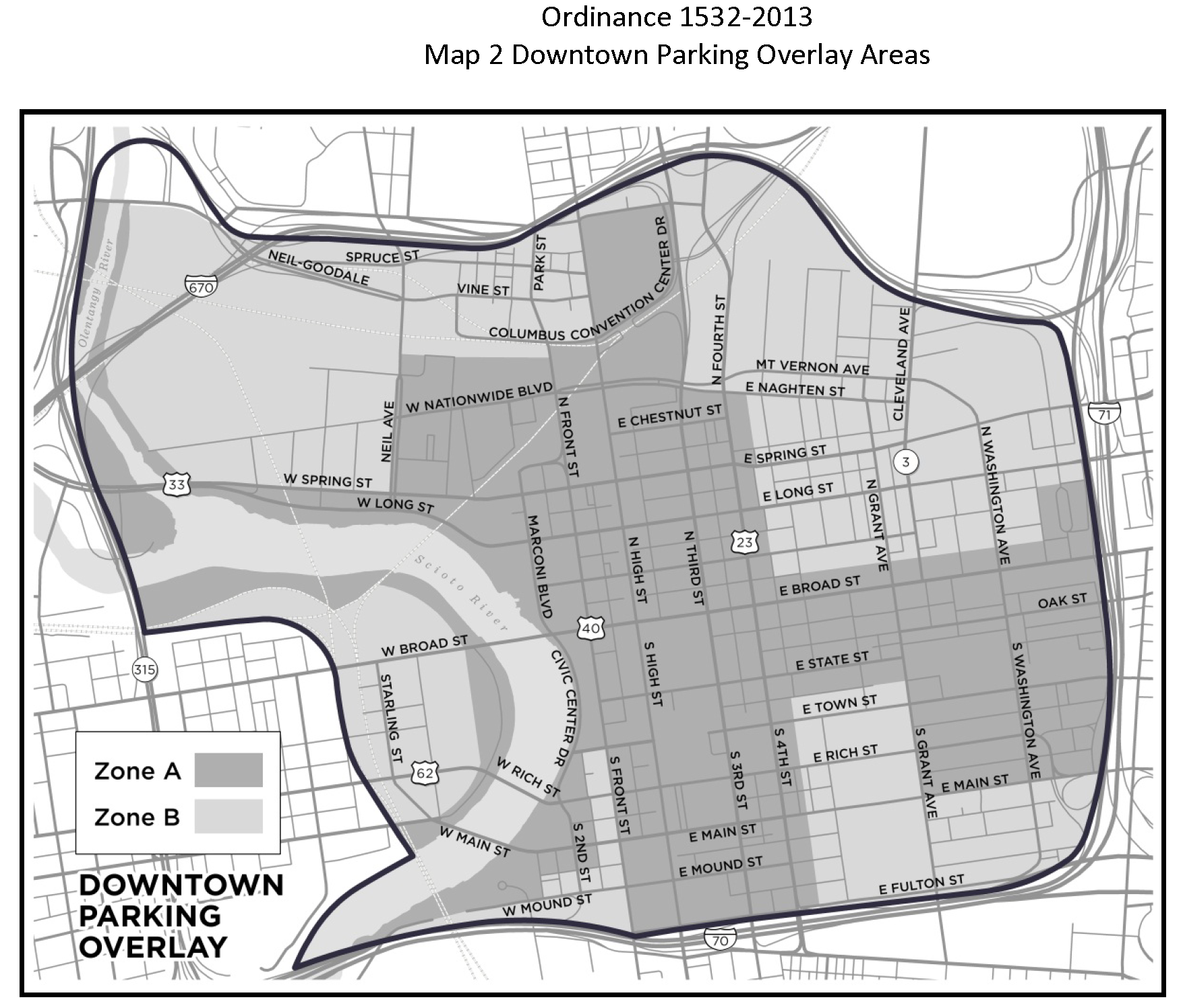
In order to address the development and design goals for the downtown, two parking zones are hereby established and are subject to the provisions and standards of this overlay as applicable to each zone.
A)
Affected Areas: The provisions of the parking overlay shall apply to parking facilities within parking zones as indicated on the official city zoning map and as illustrated on Map 2 (Downtown Parking Overlay Areas).
B)
Design Review: All parking facilities are subject to the provisions of Subsection 3359.05(C)(1), Design review.
C)
Parking Zone A:
1.
Parking structures are permitted.
2.
Accessory surface parking is permitted. Accessory surface parking means automobile parking as a subordinate use, and of a nature incidental to but supportive of the principle use (building). Accessory lots shall be located within 1,320 feet of the principal use (building) to which it is accessory.
3.
Except for exceptions defined herein, non-accessory surface parking is not permitted. Non-accessory surface parking means automobile parking as a principle rather than a subordinate land use and is not accessory parking.
4.
Surface parking facilities shall not be permitted under the provisions of Section 3389.131 special permit uses, temporary parking lot.
5.
Non-accessory surface parking lots located within Parking Zone A, established prior to January 15, 1999, shall be considered non-conforming uses and as such have specific rights under Chapter 3391, Nonconformities.
D)
Parking Zone B:
1.
Parking structures are permitted.
2.
Accessory surface parking is permitted. Accessory surface parking means automobile parking as a subordinate use, and of a nature incidental to but supportive of the principle use (building).
3.
Non-accessory surface parking is permitted. Non-accessory surface parking means automobile parking as a principle rather than a subordinate land use and is not accessory parking.
4.
Non-accessory surface parking facilities shall not be permitted under the provisions of Section 3389.131, Special permit uses, temporary parking lot.
E)
Maintenance: Any parking lot landscaping provided shall be maintained in good order. All plant material should be watered, fertilized, pruned, kept free from weeds and litter, and replaced if diseased, injured, or dead, consistent with horticultural best practices.
(Ord. No. 1532-2013, § 1, 7-15-2013)
3359.29 - Historic properties and districts.
A number of historic properties and districts listed on the Columbus Register of Historic Properties (Chapter 3117) are located within the downtown. In addition to being subject to the provisions of the downtown district, these sites fall under the jurisdiction of the historic resources commission (Chapter 3117). In such cases, downtown commission action, including administrative review of an application, shall take place after review and action by the historic resources commission or historic preservation office in instances of administrative review. Such action shall be conveyed to the downtown commission in writing by staff. This section is not intended to prohibit coordinated and parallel consideration of proposals, particularly conceptual review.
(Ord. No. 1532-2013, § 1, 7-15-2013)
3359.31 - Public art.
The Columbus Art Commission (Chapter 3115) has statutory authority over the design and placement of all works of art to be acquired by the city, placed on land owned or leased by the city, or placed anywhere in the public right-of-way. The downtown commission shall review and offer a non-binding recommendation regarding the placement of public art in the downtown district. Advisory recommendations shall be forwarded by staff in writing to the Columbus Art Commission for their consideration.
(Ord. No. 1532-2013, § 1, 7-15-2013)

