
Columbus City Zoning Code
CHAPTER 3312
OFF-STREET PARKING AND LOADING
3312.01 - Purpose.
The purpose of this chapter is to regulate parking, loading and maneuvering; to ensure the provision of the appropriate number of off-street parking spaces for each use; to enact standards for parking, stacking, and loading; to assure maintenance of existing parking; to prohibit inappropriate parking; and in areas with no minimum vehicular parking requirements, to ensure that if off-street parking is provided, said parking complies with applicable standards. These standards are designed to provide for the parking and loading needs of occupants, customers, visitors or others involved in the use or occupancy of any building or parking lot; to balance needs associated with different transportation modes, including automobile, pedestrian, transit and bicycle; ensure that off-street parking, loading, stacking and access demands will not adversely affect other nearby land uses and surrounding neighborhoods; require appropriate landscaping and buffering of off-street parking lots for pedestrian safety and traffic separation, visually break up large expanses of pavement, visually screen off-street parking lots, loading and stacking areas; and encourage the incorporation of environmentally sustainable design elements; all to enhance convenience and to protect the public health, safety and general welfare.
This chapter regulates parking, stacking, and loading designed for either principal or accessory uses. The standards in this chapter are those that will be reviewed by the director before issuing a certificate of zoning clearance. Other parking or parking lot requirements may be regulated by the Department of Public Service and the Department of Public Utilities.
(Ord. No. 1537-2009, § 8, 5-3-2010; Ord. No. 1872-2023, § 1, 7-31-2023; Ord. No. 2111-2024, § 1(Att.), 7-29-2024)
3312.03 - Administrative requirements.
A.
Each owner of real property shall provide and continue to provide parking in compliance with code provisions in effect at the time such particular use commenced.
B.
Any person who initiates a new use, changes the intensity of, or expands an existing use on any lot shall provide off-street parking, stacking, loading and maneuvering in compliance with this chapter. For purposes of this chapter, "existing" means legally established prior to change or expansion and includes "former"; and "new" means subsequent to change or expansion and includes "proposed."
C.
The minimum and maximum number of parking, stacking and loading spaces required for a particular use is specified in this chapter. Exceptions to these requirements are as follows:
1.
Special Parking Areas. A lot which lies within a special parking area shall be subject to specifications for that area.
2.
Initiating a New Use, Changing the Intensity of or Expanding an Existing Use. A use of higher intensity requires more parking spaces than does a use of lower intensity. For purposes of comparison, "intensity" means the minimum requirements for parking spaces generated by a particular use. Any person who initiates a new use, or changes the intensity of, or expands an existing use, shall provide the number of parking spaces required by such use as set forth in this code or as required by rule or regulation, calculated as specified in items (a) through (g).
a.
Without expansion of an existing building, a new use of intensity equal to or lower than the existing use shall provide the required parking for the new use or, at the minimum, maintain the existing number of parking spaces; no additional parking spaces shall be required.
Example:
Existing medical office to new law office
Required spaces for existing medical office = 10
Required spaces for new law office = 7
Existing spaces = 5
Total parking spaces required for new use = 5
b.
With expansion of an existing building, a new use of intensity equal to or lower than the existing use shall provide the same number of parking spaces as the existing number of parking spaces, plus the additional parking spaces required for the expansion.
Example:
Existing medical office to new law office
Required spaces for existing medical office = 10
Required spaces for new law office = 7
Existing spaces = 5
Spaces required for building expansion = 4
Existing parking spaces = 5
Total required for new use (4 + 5) = 9
c.
Without expansion of an existing building, a new use of higher intensity than the existing use shall provide the same number of parking spaces as the existing use, plus additional parking spaces equal to the difference between that required for the higher and lower intensity uses.
Example:
Existing retail store to new restaurant
Required spaces for existing retail store = 8
Required spaces for new restaurant = 27
Existing spaces = 5
Difference between intensities (27 - 8) = 19
Total parking spaces required for new use (5 + 19) = 24
d.
With expansion of an existing building where the number of existing parking spaces is less than the number required for the existing use and is also less than that required for the new use, a new use of higher intensity than the existing use shall provide the same number of parking spaces as the existing use, plus additional parking spaces equal to the difference between that required for the higher and lower intensity uses, plus that number required for the expansion.
Example:
Existing retail store to new restaurant
Required spaces for existing retail store = 8
Required spaces for new restaurant = 27
Existing spaces = 5
Spaces required for building expansion = 12
Difference between intensities (27 -8) = 19
Total parking spaces required for new use (5 + 12 + 19) = 36
e.
With expansion of an existing building where the number of existing parking spaces is less than that required for the existing use but is more than that required for the new use, a new use shall provide the number of parking spaces required for the new use plus that required for the expansion.
Example:
Existing medical office to new law office
Required spaces for existing medical office = 10
Required spaces for new law office = 7
Existing spaces = 9
Spaces required for building expansion = 4
Total parking spaces required for new use (7 + 4) = 11
f.
With expansion of an existing building where the number of existing parking spaces exceeds both that required for the existing use and that required for the new use, a new use shall provide the number of parking spaces required for the new use plus that required for the expansion.
Example:
Existing retail store to new restaurant
Required spaces for existing retail store = 8
Required spaces for new restaurant = 27
Existing spaces = 29
Spaces required for building expansion = 12
Total parking spaces required for new use (27 + 12) = 39
g.
Without expansion of an existing building where the number of existing parking spaces exceeds the maximum number of allowable parking spaces for the new use, the maximum for the new use shall be equal to the existing number of parking spaces.
Example:
Existing retail store to new law office
Required spaces for existing retail store = 20 min. and 25 max.
Required spaces for new law office = 12 min. and 20 max.
Existing spaces = 28
Maximum for the new use = existing spaces = 28
D.
Parking spaces shall be provided on the same lot as the use they are intended to serve with the following exceptions: For a commercial, institutional or manufacturing use, the parking may be provided on a lot that is:
1.
Located within 750 feet of the use to be served; and
2.
Owned or leased by the operator of the commercial, institutional, or manufacturing use and located in an appropriate zoning district with a limited overlay or CPD text having conditions which limit its use to parking reserved for the duration of that use to be served.
E.
Revision of an approved parking lot; including, but not limited to reduction, enlargement, restriping or remarking of any parking lot in a manner that differs from the existing site plan; shall require a new site plan and a certificate of zoning clearance prior to such change.
F.
Off-street parking and loading spaces required for any use not specifically listed herein shall be the same as that required for a similar type use as determined by the director.
G.
A parking lot comprised of parcels within different taxing districts which cannot be combined shall be deemed one lot, subject to the minimum overall dimensions of aisles, drive-up stacking areas, driveways, parking spaces, and loading spaces being provided. The required parking shall be calculated for the overall development and not for each individual parcel and all parcels shall be covered by the same zoning clearance.
(Ord. No. 1537-2009, § 8, 5-3-2010; Ord. No. 1872-2023, § 1, 7-31-2023)
3312.05 - Special parking area.
Special parking areas may be created, which are subjected to different requirements as a means of achieving specific development or traffic objectives. A special parking area may be designated by ordinance of council enacting a new section in this chapter.
(Ord. No. 1537-2009, § 8, 5-3-2010)
3312.051 - Short North Special Parking Area.
A.
Any parcel located within the geographic boundaries of the Short North Parking Area that has been rezoned to a 2024 Zoning Code district designation is thereby excluded from the Short North Parking Area and will not be indicated on the Digital Zoning Map as being in the Short North Parking Area.
B.
The Short North Special Parking Area is that area indicated on the official zoning map and bounded as follows:
On the north by the centerline of Fifth Avenue, on the east by the centerline of the first set of railroad tracks east of North Fourth Street, on the south by the centerline of Interstate 670, and on the west by the centerline of first alley or street east of Neil Avenue, said western boundary being more particularly described, following centerlines, as follows:
Beginning at the intersection of Hunter Avenue and West Goodale Street; Thence northerly along Hunter Avenue to West Poplar Avenue;
Thence westerly along West Poplar Avenue to the first alley east of Neil Avenue; Thence northerly along the first alley east of Neil Avenue to Collins Avenue; Thence easterly along Collins Avenue to Highland Street;
Thence northerly along Highland Street to Division Alley;
Thence westerly and northerly along Division Alley to West Second Avenue; Thence westerly along West Second Avenue to Sunside Alley;
Thence northerly along Sunside Alley to West Third Avenue, Thence westerly along West Third Avenue to Sunside Alley,
Thence northerly along Sunside Alley to the first nameless alley south of West Fourth Avenue;
Thence westerly and northerly along the first nameless alley south of West Fourth Avenue to West Fourth Avenue;
Thence westerly along West Fourth Avenue to Forsythe Avenue; Thence northerly along Forsythe Avenue to West Fifth Avenue.
C.
Non-residential, off-street vehicle parking requirements in the Short North Special Parking area shall be One-Half (1/2) of the off-street parking as required in this chapter, except as follows:
Art Gallery - No off-street parking shall be required; Extended Stay Hotel - 1 space per unit;
Retail, Office, and Medical Office, 2,500 square feet or less - No off-street parking shall be required; Two-, Three-, and Multi-Unit Dwellings - 1 per unit;
Single-Unit Dwellings - No off-street parking shall be required for single-unit dwellings when located as a single unit on its own parcel that was subdivided prior to the effective date of this ordinance. For single-unit dwellings that do not meet the requirements in the preceding sentence, 1 space per unit shall be required.
No other off-street parking reductions, including any provided by any commercial overlay, shall apply.
Loading spaces and any required bicycle parking shall be as required in this chapter. Where there is no feasible means to locate bicycle parking spaces in a usable location on the subject parcel, the bicycle parking requirement may be satisfied by payment of a fee in lieu of providing the required bicycle parking spaces, as determined by the Department of Public Service.
In the Short North Special Parking area, no further reduction or variance to the number of required off-street parking spaces shall be granted by a variance by the Board of Zoning Adjustment or City Council.
D.
The Director of the Department of Public Service shall promulgate rules and regulations for the administration of the Short North Special Parking Area and shall have the authority to collect a fee in lieu of providing the required number of off-street vehicle and bicycle parking spaces as set out in these rules and regulations.
E.
Upon the submission of an application for zoning clearance, the Director of the Department of Public Service, or designee, shall determine the cost of the payment in lieu of providing the required number of off-street vehicle and bicycle parking spaces in the Short North Special Parking area.
F.
Payments shall be dedicated for the establishment, operation, and maintenance of facilities and programs to address and/or mitigate parking demands and deficiencies within the boundaries of the Short North Special Parking Area.
(Ord. No. 0506-2017, § 2, 3-27-2017; Ord. No. 2019-2021, § 1, 7-26-2021; Ord. No. 1872-2023, § 1, 7-31-2023; Ord. No. 2111-2024, § 1(Att.), 7-29-2024)
3312.053 - East Franklinton Special Parking Area.
A.
Any parcel located within the geographic boundaries of the East Franklinton Parking Area that has been rezoned to a 2024 Zoning Code district designation is thereby excluded from the East Franklinton Parking Area and will not be indicated on the Digital Zoning Map as being in the East Franklinton Parking Area.
B.
The East Franklinton Special Parking Area is that area indicated on the official zoning map and bounded as follows:
Beginning at the point where the eastern right-of-way boundary of State Route 315 intersects with the northern right-of-way boundary of I-70;
Thence easterly to the intersection of the northern right-of-way boundary of I-70 and the northern bank of the Scioto River;
Thence easterly along the northern bank of the Scioto River to its intersection with the western boundary of the Downtown District;
Thence northerly along the western boundary of the Downtown District;
Thence westerly along the southern boundary of the Downtown District until it intersects with the eastern boundary of State Route 315;
Thence southerly until the place of the beginning.
C.
Non-residential, off-street vehicle parking requirements in the East Franklinton Special Parking Area shall be One-Half (1/2) of the off-street parking as required in this chapter, except as follows:
Art Gallery - No off-street parking shall be required;
Eating and Drinking Establishment without a pickup unit, 1,500 square feet or less - No off-street parking shall be required;
Retail, Office, and Medical Office, 2,500 square feet or less - No off-street parking shall be required Extended Stay Hotel - 1 space per unit;
Single-Unit Dwellings - No off-street parking shall be required for single-unit dwellings when located as a single unit on its own parcel that was subdivided prior to the effective date of this ordinance. For single-unit dwellings that do not meet the requirements in the preceding sentence, 1 space per unit shall be required;
Two-Unit Dwelling - 1 Space Three-Unit Dwelling - 2 Spaces. Four-Unit Dwelling - 3 Spaces
Multi-Unit Dwellings above Four-Units - 1 space per dwelling unit.
No other off-street parking reductions, including any provided by any commercial overlay, shall apply.
D.
Loading spaces and any required bicycle parking shall be as required in this chapter. Where there is no feasible means to locate bicycle parking spaces in a usable location on the subject parcel, the bicycle parking requirement may be satisfied by payment of a fee in lieu of providing the required bicycle parking spaces, as determined by the Department of Public Service, or designee.
E.
In the East Franklinton Special Parking Area, no further reduction or variance to the number of required off-street parking spaces shall be granted by the East Franklinton Review Board, the Board of Zoning Adjustment or City Council.
F.
The Director of the Department of Public Service shall promulgate rules and regulations for the administration of the East Franklinton Special Parking Area and shall have the authority to collect a fee in lieu of providing the required number of off-street vehicle and bicycle parking spaces as set out in these rules and regulations.
G.
Upon the submission of an application for zoning clearance, the Director of the Department of Public Service, or designee, shall determine the cost of the fee in lieu of providing the required number of off-street vehicle and bicycle parking spaces in the East Franklinton Special Parking Area.
H.
Fees in lieu shall be dedicated for the establishment, operation, and maintenance of facilities and programs to address and/or mitigate parking demands and deficiencies within the boundaries of the East Franklinton Special Parking Area.
(Ord. No. 0998-2021, § 1, 6-21-2021; Ord. No. 1872-2023, § 1, 7-31-2023; Ord. No. 2111-2024, § 1(Att.), 7-29-2024)
3312.07 - Downtown special parking area.
Downtown parking shall be as prescribed in the downtown district zoning chapter.
(Ord. No. 1537-2009, § 8, 5-3-2010; Ord. No. 1872-2023, § 1, 7-31-2023)
3312.09 - Aisle.
An aisle is that portion of the circulation area within a parking lot, excluding the driveway, which provides accessibility to parking, stacking or loading spaces.
An aisle to serve adjacent loading spaces shall have a minimum width of 15 feet. No part of the loading space may be included in this calculation.
The minimum width permissible for an aisle to serve adjacent parking spaces shall depend on the smallest angle of parking as measured between the centerline of the aisle and the centerline of the adjacent parking space as illustrated in the figures below:
Figure 1. Angle of a parking space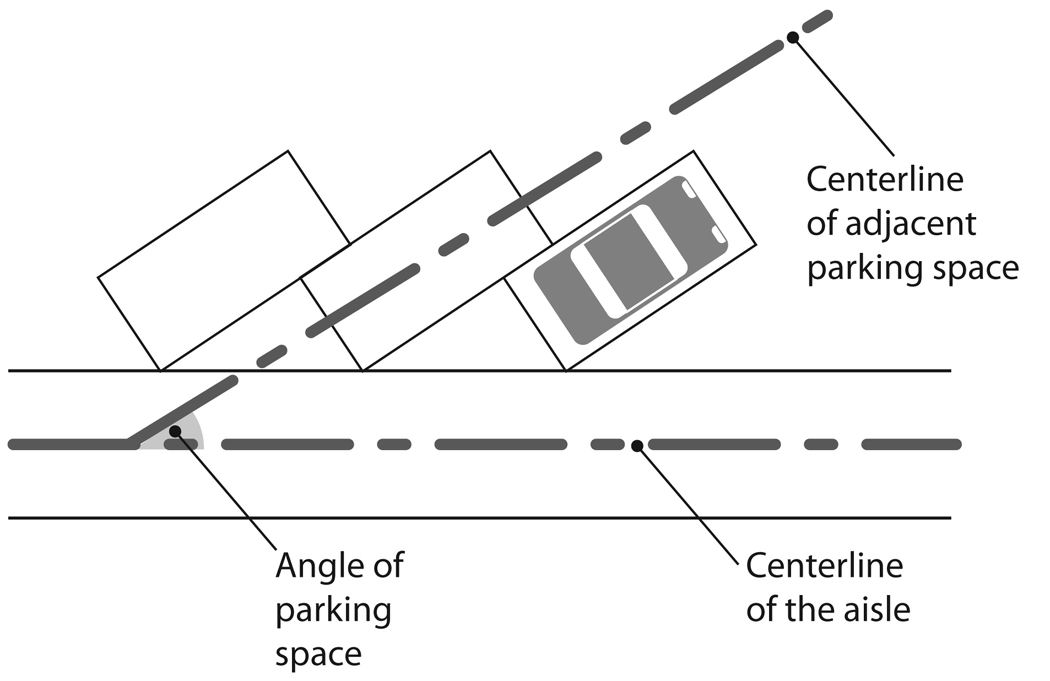
Figure 2. Table of parking angles.
Figure 2a. Angle of parking 80° or more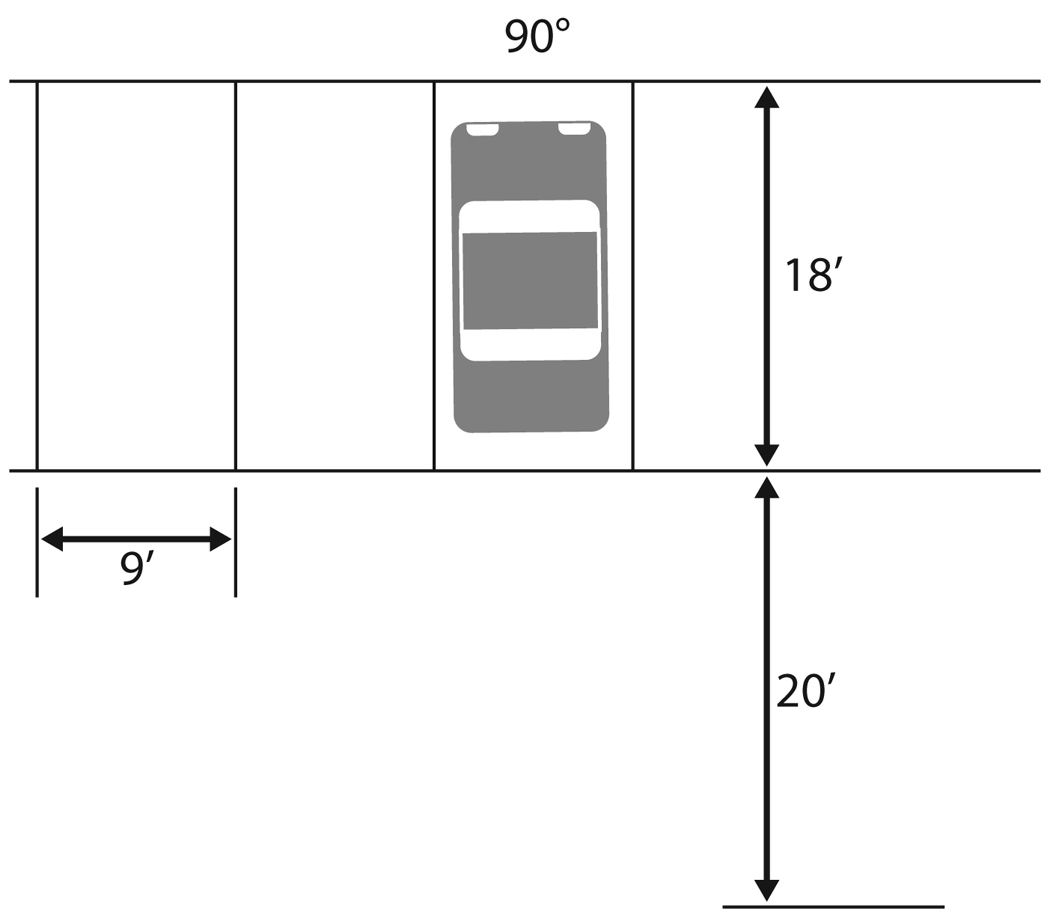
Figure 2b. Angle of parking less than 80° but 50° or more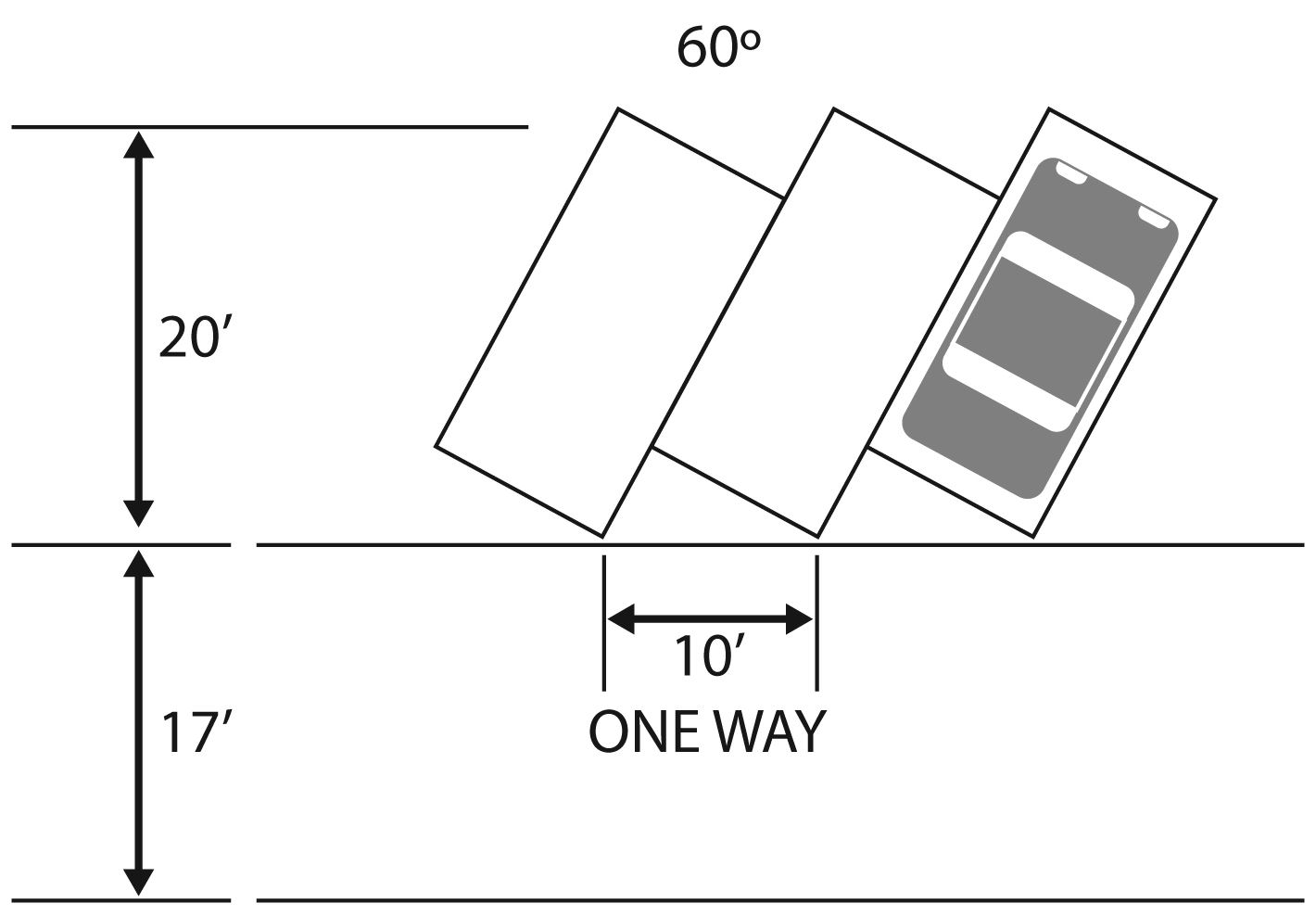
Figure 2c. Angle of parking less than 50° but 30° or more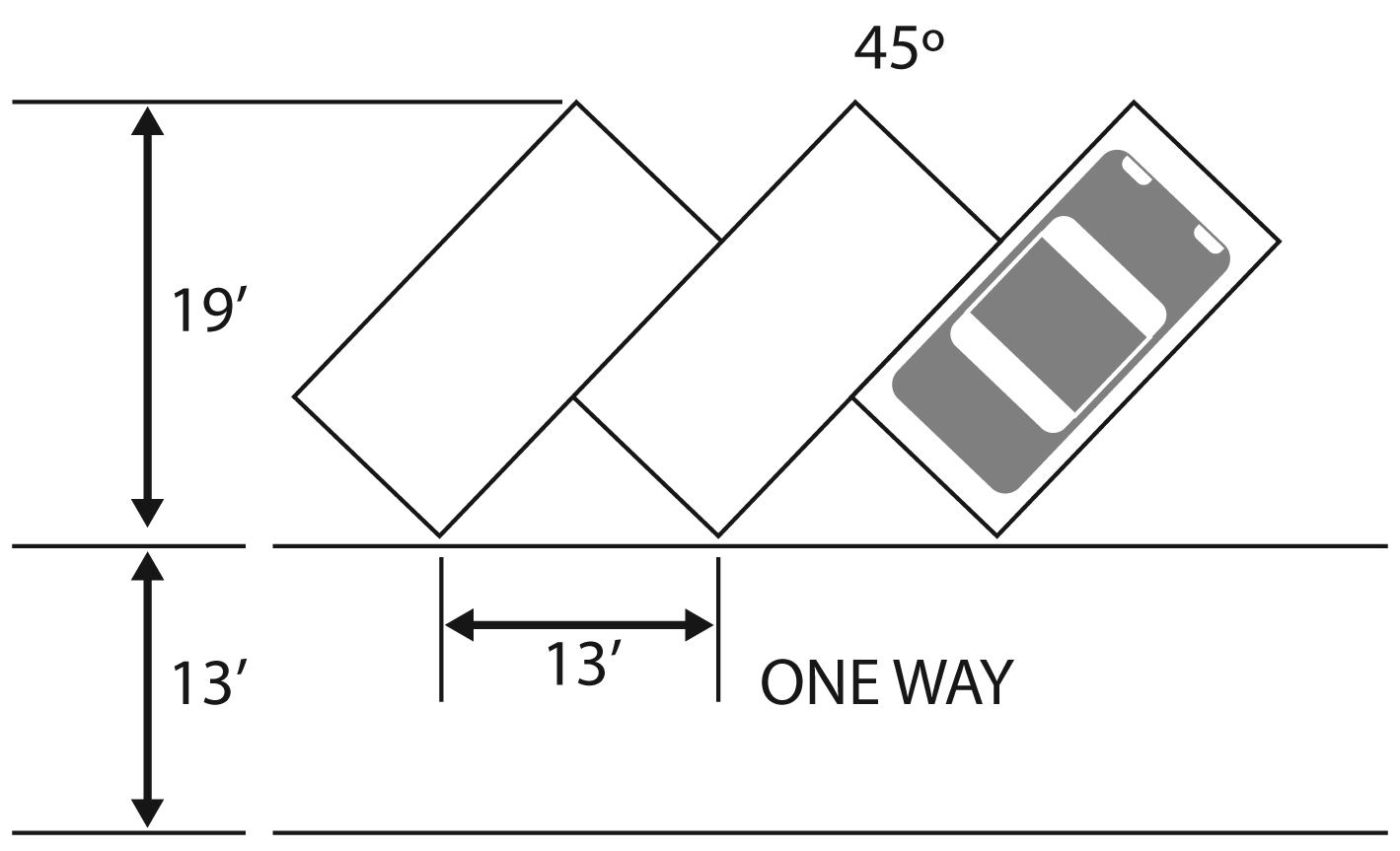
Figure 2d. Angle of parking less than 30° but 0° or more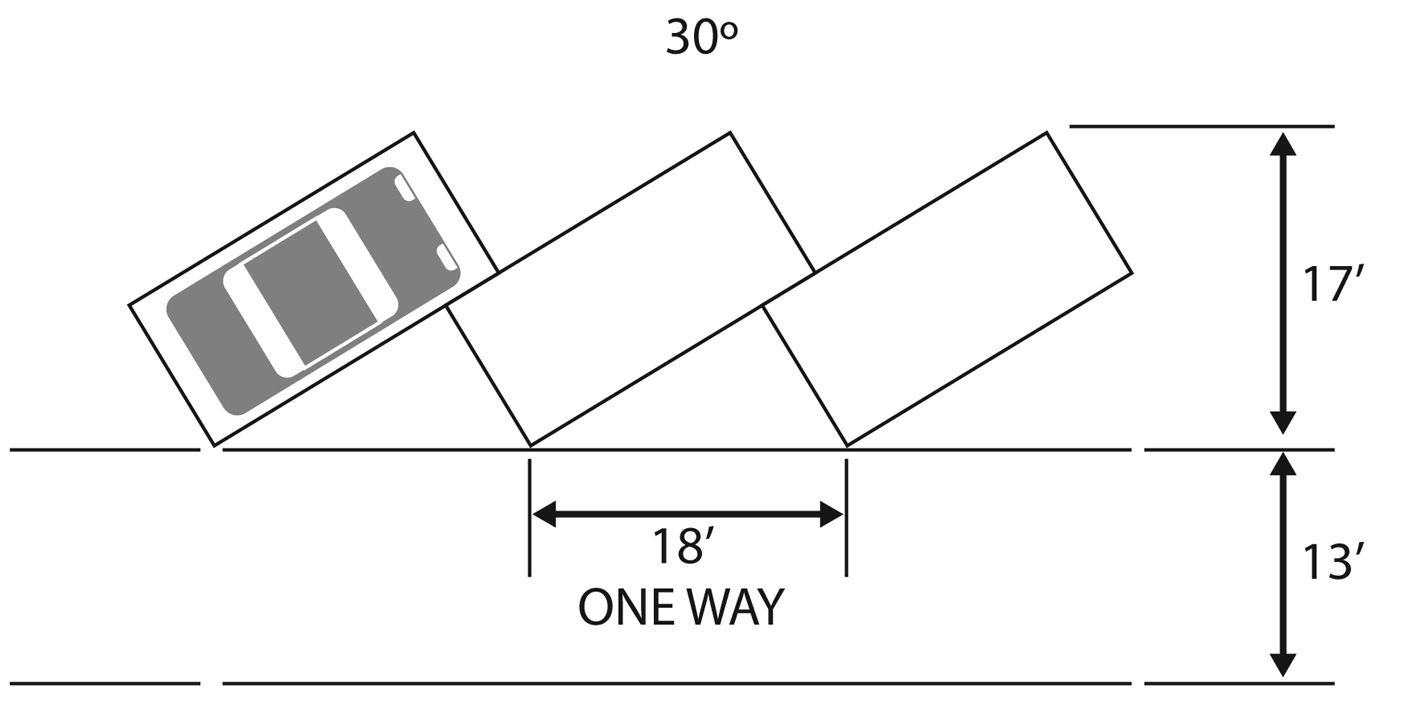
Figure 2e. Angle of parking 0° or parallel parking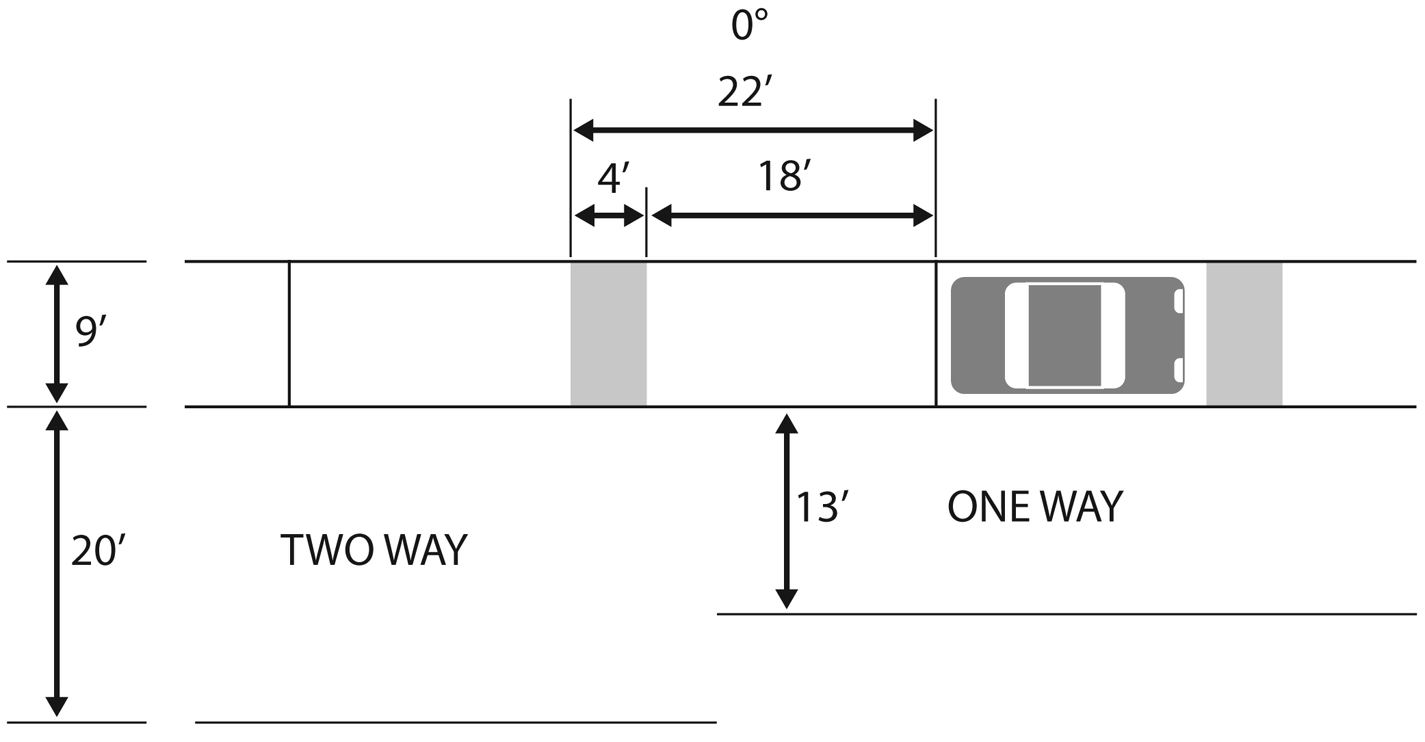
(Ord. No. 1537-2009, § 8, 5-3-2010; Ord. No. 1872-2023, § 1, 7-31-2023)
3312.11 - Drive-up stacking area.
Any use having drive-up service shall provide a motor vehicle stacking area on-site to minimize off-site traffic congestion while waiting for service.
For each drive-up unit associated with a use, an owner shall provide stacking spaces, each the size of a regular automobile parking space. The area required for these four to 25 stacking spaces is exclusive of any required parking space, loading space, driveway, aisle or required yard and is dependent on the total number of drive-up units as follows:
Sites with stacking shall include at least one exclusive by-pass lane with a minimum width of ten feet or include an aisle, driveway or other circulation area in the parking lot design to allow vehicles to by-pass the stacking area. For sites that utilize an order station in advance of a drive-up unit, a minimum of 50% of the required stacking spaces shall be provided in advance of the order station. The provisions of the sentence above shall not prohibit additional stacking spaces beyond the minimum requirement being provided between the order station and drive-up unit.
A drive-up unit may project up to one foot into the stacking area.
(Ord. No. 1537-2009, § 8, 5-3-2010; Ord. No. 1872-2023, § 1, 7-31-2023)
_____
3312.13 - Driveway.
A driveway is any access corridor leading from a public right-of-way to a parking lot, aisle, parking circulation area, garage, off-street parking space, or loading space. The Department of Public Service shall limit points of driveway access from residentially zoned lots abutting both an improved alley and street.
Each driveway shall be located, designed, and maintained in a manner that provides for the safety of motorists and pedestrians.
A.
A driveway serving a residential parking area containing one to eight parking spaces shall have a minimum width of ten feet and a maximum width of 20 feet measured at the street right-of-way line.
B.
All other driveways shall have a minimum width of 20 feet for any two-way traffic flow and 13 feet for any one-way traffic flow with a maximum width of 35 feet measured at the street right-of-way line or driveway throat, whichever is lesser.
C.
The minimum and maximum driveway widths as described in 3312.13A and 3312.13B may be varied with the consent of the Department of Public Service in consultation with the Division of Fire.
D.
A driveway serving a parking lot shall be designed so that vehicles entering or exiting a parking lot will be traveling in a forward motion.
(Ord. No. 1537-2009, § 8, 5-3-2010; Ord. No. 1872-2023, § 1, 7-31-2023)
3312.15 - Dumpster area.
Dumpsters shall comply with the provisions of general site development standards chapter.
(Ord. No. 1537-2009, § 8, 5-3-2010)
3312.17 - Parking lot signs.
Signs in a parking lot, including ingress/egress signs, shall comply with the provisions of the Graphics Code.
(Ord. No. 1537-2009, § 8, 5-3-2010)
3312.19 - Lighting.
Lighting shall comply with the provisions of the general site development standards chapter.
(Ord. No. 1537-2009, § 8, 5-3-2010)
3312.21 - Landscaping and screening.
This section shall not apply to parcels with a 2024 Zoning Code district designation.
Landscaping and screening may be combined with storm water control measures as approved by the Director of Public Utilities, providing the requirements of this section are fulfilled. The applicant should consider the use of low-impact development strategies for managing storm water runoff and alternative pavements for reducing glare and mitigating the heat island effect from parking lot surfaces. Appropriate native plant species are recommended for landscaping and screening requirements.
Applicability. Interior landscaping, parking setback landscaping, and perimeter screening required by this section shall be indicated on the original site plan filed to obtain a certificate of zoning clearance for any newly created or newly expanded parking lot. In the case of expansion, the landscaping and screening regulations apply to new portions of a parking lot. Landscaping and screening shall be installed upon development of a parking lot or parking lot expansion.
A.
Interior landscaping. The interior of any parking lot containing ten parking spaces or more and not in a parking structure shall be landscaped. Interior landscaping shall be provided at a minimum ratio of one shade tree for every ten parking spaces or fraction thereof. Interior shade trees shall conform to the following standards:
1.
Trees shall be a minimum of two inches in caliper at the time of planting.
2.
Trees shall be planted in landscaped islands or peninsulas containing a minimum soil area of 145 square feet per tree, allowing for flexible arrangement but designed in such a way that each tree is surrounded by a minimum radius of four feet of soil area. All trees shall be planted in a suitable soil volume, in a normal surface planting environment free from construction debris, with average soil depths greater than or equal to three feet. Islands and peninsulas shall be curbed and covered with live vegetation, decorative gravel, or mulch. Curbs on landscaped islands or peninsulas may contain openings to receive storm water runoff if islands or peninsulas are part of bioretention or other storm water control measure approved by the Director of Public Utilities.
3.
Space devoted to interior landscaping shall be in addition to any required front, side or rear yard or any required screening area. Landscaped islands, shade trees, and peninsulas do not need to be uniformly spaced, but shall be contained within and dispersed proportionally throughout the interior of the parking lot or lots.
4.
Planting beds for parking lot shade trees shall be arranged and constructed with suitable curbing materials so as to minimize damage to tree trunks and roots from vehicles, pedestrians and parking lot maintenance.
B.
Parking setback and perimeter landscaping. Landscaping in the parking setback area shall be required to buffer automobile and pedestrian areas and uses; to provide headlight screening; to provide adequate visibility and safety; and to avoid the illegal use of said area for parking. Landscaping in the perimeter shall be required to visually buffer residentially zoned property from parking lots.
1.
The lot area between the right-of-way and the parking setback line shall be landscaped with plant material and shall not be paved except for approved walkways, bikeways, driveways, graphics, and other approved amenities and site elements, such as, but not limited to, electric vehicle charging stations or bike racks. Vision clearance at driveways shall be maintained.
2.
Plant species shall be installed and maintained per the following standards: Shade trees shall be a minimum of two inches in caliper at the time of planting, ornamental trees shall be a minimum of one and one-half inches in caliper at the time of planting, shrubs shall be a minimum of 24 inches in height at the time of planting.
3.
Perimeter parking lot screening is required when any part of a parking lot is located within 80 feet of residentially zoned property. In such instances, the parking lot shall be screened on the perimeter affecting any residentially zoned property. For purposes of this section, "parking lot" shall include any driveway thereto. Screening is not required for those portions of parking lot perimeters used for vehicular access or in required vision clearance.
4.
In addition, any portion of a parking lot abutting any public street shall be screened for headlights on the perimeter adjacent to the public street regardless of the orientation of the parking spaces.
C.
Screening indicated on site plan. Setback and perimeter screening required by this section shall be indicated on the original site plan filed to obtain a certificate of zoning clearance for any parking lot. Parking lot screening shall be provided to reduce headlight glare and to visually screen a parking lot from residentially zoned property within 80 feet thereof. Such parking lot screening shall be installed in accordance with the site plan and this section.
D.
Parking lot screening.
1.
Parking lot screening shall conform to the following standards:
a.
For headlight screening, screening shall be provided in a landscaped area at least four feet in width and shall consist of an opaque fence (except a chain link fence), landscaped earth mound of 1:3 (vertical: horizontal) slope, wall, planting or combination thereof installed, repaired, replaced and maintained to a total height of no less than three feet above the parking lot grade and to an opacity of not less than 75 percent.
b.
For buffering residentially zoned property, screening shall be provided in a landscaped area at least four feet in width and shall consist of an opaque fence (except a chain link fence), landscaped earth mound of 1:3 (vertical: horizontal) slope, wall, planting or combination thereof installed, repaired, replaced and maintained to a total height of no less than five feet above the parking lot grade and to a year-round opacity of not less than 75 percent.
c.
If a parking lot perimeter is both abutting a street and within 80 feet of residentially zoned property, screening along that perimeter shall comply with three foot high headlight screening as provided in section 3312.21D(1)(a), above.
2.
Screening shall be installed and maintained in a neat and orderly manner.
3.
Screening shall be reasonably uniform in height and opacity along its entire length, provided, however, that screening is not required within one foot of the ground.
4.
The percentage of opacity shall be determined by measurement of any square foot of the vertical surface of the screening from a point perpendicular thereto. Permissibly open area shall not be included in the opacity determination.
5.
When screening consisting of live plants is installed, alone or in combination with other materials, the plants shall:
a.
Be selected for dense branching or foliage adequate to shade residences and adjacent rights-of-way from headlight glare;
b.
Be selected to achieve the height and density specified in D(1) above within three years of installation;
c.
Be a minimum height of two feet at the time of installation; and
d.
Be maintained in a healthy, live state and replaced as needed to comply with the original site plan and the specifications and standards herein set forth.
e.
Exemptions. No screening shall be required for a parking lot effectively screened to this section's standards and specifications by a densely planted planting strip of at least 75 percent opacity; or existing natural or artificial barriers; providing the existing barrier has opacity of not less than 75 percent, as measured above. A parking lot need not be screened from the use it serves.
E.
All plants shall be maintained in a healthy, live state and replaced as needed to comply with the original site plan and the specifications and standards herein set forth. Dead plants shall be replaced within the next growing season.
(Ord. No. 1537-2009, § 8, 5-3-2010; Ord. No. 1501-2022, § 5, 6-13-2022; Ord. No. 1872-2023, § 1, 7-31-2023; Ord. No. 2111-2024, § 1(Att.), 7-29-2024)
3312.23 - Maintenance.
The owner or operator of property designed or used for parking, circulation, driveways, and or loading shall maintain such area in good condition so that it is safe, clean, dust-free, and free of any hazard, nuisance or other unsafe condition. Striping for parking spaces shall be maintained in good condition.
(Ord. No. 1537-2009, § 8, 5-3-2010; Ord. No. 1872-2023, § 1, 7-31-2023)
3312.25 - Maneuvering.
Every parking and loading space shall have sufficient access and maneuvering area. Sufficient access and maneuvering area is equivalent to the minimum aisle widths presented in C.C. 3312.09, Aisle. The maneuvering area for a parking space may occur anywhere on a lot except in the area between the street right-of-way line and the parking setback line. The maneuvering area may include an aisle, circulation area, or improved alley.
Exceptions: For single-unit and two-unit dwellings, and multi-unit dwellings with individual garage/driveway arrangements, the maneuvering area may include a driveway, street, or another parking space.
The Department of Public Service may waive the requirement for maneuvering area only for a parking lot that has and continues to have an operator on duty during all hours of operation.
(Ord. No. 1537-2009, § 8, 5-3-2010; Ord. No. 1872-2023, § 1, 7-31-2023)
3312.27 - Parking setback line.
A parking setback line establishes how close parking, vehicle display, loading or maneuvering may be located to a street right-of-way line. This line shall be located a minimum distance from a street right-of-way line and be related to a building line as follows:
1.
On unimproved frontage the parking setback line shall coincide with the required building setback line.
2.
Where a required building setback line is 25 feet or greater, the parking setback line shall be 25 feet from the street right-of-way line.
3.
Where a required building setback line is less than 25 feet, the parking setback line shall follow the building setback line or the established parking setback, whichever is less, but in no case shall the parking setback line be less than ten feet from the street right-of-way line.
4.
In C-1, C-2, C-3, C-4, and C-5 Commercial Districts, and M-Manufacturing Districts where there are only commercial district uses developed, the parking setback line shall be established ten feet from the street right-of-way line without respect to the building line.
5.
Exception: Where a parking setback line is specifically established by Council ordinance, zoning district, overlay, or subdivision plat, the parking setback line shall conform to that requirement.
(Ord. No. 1537-2009, § 8, 5-3-2010; Ord. No. 1872-2023, § 1, 7-31-2023)
3312.29 - Parking space.
A parking space shall be a rectangular area of not less than nine feet by 18 feet, exclusive of any driveway or other circulation area; shall be accessible from a street, alley, or maneuvering area; and shall be designed for parking a motor vehicle.
(Ord. No. 1537-2009, § 8, 5-3-2010; Ord. No. 1872-2023, § 1, 7-31-2023)
3312.30 - Parking in a driveway.
For single-unit and two-unit dwellings, and multiple units with individual garage/driveway arrangements, one off-street parking space may be stacked behind each off-street parking space and such stacked spaces may be located between the parking setback line and the street right-of-way line. Stacked parking may be located in a driveway behind a code compliant parking space and not in any other part of a required yard. Stacked parking may be included in and calculated as required parking only for a residential use with an attached one-car garage. Required vision clearance shall be maintained.
(Ord. No. 1872-2023, § 1, 7-31-2023)
3312.31 - Parking space for ADA compliance.
The Department of Public Service may maintain a striping and signage policy for ADA parking spaces that meets or exceeds the requirements of the Ohio Building Code. Parking spaces for ADA compliance shall meet the requirements of the Ohio Building Code and any departmental policy. Each such space may be included in the computation of required space as specified in this chapter.
(Ord. No. 1537-2009, § 8, 5-3-2010; Ord. No. 1872-2023, § 1, 7-31-2023)
3312.33 - Parking space for a small car.
Excess parking over and above the minimum required by this chapter may be designed to accommodate small cars. The design and placement of each space shall be reviewed and approved by the Department of Public Service prior to approval by this department.
(Ord. No. 1537-2009, § 8, 5-3-2010; Ord. No. 1872-2023, § 1, 7-31-2023)
3312.35 - Parking or keeping of recreational and commercial vehicles in residential districts.
A.
In residential districts, no required off-street parking space, no parking space in front of the setback line, no unimproved surface, and no required front, side or rear yard area shall be used for the parking or storage of a boat, trailer, trailer or tow dolly, camping trailer, or other recreational vehicle.
B.
No commercial vehicle shall be stored or parked on a residentially zoned lot. However, infrequent, short-term parking of a commercial or commercial-type vehicle for conveying tools and materials to premises where labor using such tools and materials is being performed, delivering goods to a residence, or moving furniture to or from a residence, all only during the time such parking is actually necessary, is hereby excepted from this section.
For purposes of this section, "commercial vehicle" includes, but is not necessarily limited to: a bus, cement truck, commercial tree-trimming equipment, construction equipment, dump truck, garbage truck, panel truck, semi-tractor, semi-trailer, stake bed truck, step van, tank truck, tar truck, or other commercial-type vehicle licensed by the Ohio State Bureau of Motor Vehicles as a commercial vehicle or truck.
(Ord. No. 1537-2009, § 8, 5-3-2010; Ord. No. 1872-2023, § 1, 7-31-2023)
3312.37 - Parking or keeping inoperable motor vehicle.
No person shall use any premises in any zoning district for the purpose of parking or keeping an inoperable motor vehicle except when ancillary to a specifically permitted use that allows and has provided for the same on an approved site plan in a Commercial or a Manufacturing Zoning District. As used in this section, "keeping an inoperable motor vehicle" means and includes storing, maintaining, collecting, depositing, reserving, allowing to stand, or permitting to remain, one or more inoperable motor vehicles at any place other than in an enclosed garage.
For purposes of this section, a motor vehicle shall be deemed inoperable when any of the following conditions exist: one or more wheels are missing; one or more tires are missing; two or more tires are flat; one or more windows are missing or broken; the windshield is shattered or missing; parts necessary for the operation of the vehicle are missing; or a license with a distinctive number and valid for the current year is not displayed thereon.
(Ord. No. 1537-2009, § 8, 5-3-2010; Ord. No. 1872-2023, § 1, 7-31-2023)
3312.39 - Striping and marking.
A.
Parking space striping is required and shall be maintained in good condition. Each parking space and aisle shall be clearly designated and marked to assure approved utilization of the space, direction of traffic flow and general safety. When a parking space is designated for disabled or small car use, it shall be clearly marked.
B.
Staff shall approve a plan for restriping an existing parking lot in a manner that differs from the existing site plan, without the approval of the Board of Zoning Adjustment, even though fewer parking spaces are provided than this chapter requires only if: (1) such lot is being restriped solely to add disabled parking spaces required by the Americans with Disabilities Act Accessibility Guidelines; and (2) the owner and applicant affirm by sworn affidavit that no additional undeveloped land is available by ownership or lease upon which to meet this chapter's requirements.
(Ord. No. 1537-2009, § 8, 5-3-2010; Ord. No. 2019-2021, § 1, 7-26-2021)
3312.41 - Pedestrian access and circulation.
Access and circulation standards are as follows, all sidewalks and crosswalks internal to a development shall have a minimum width of four (4) feet:
A.
A pedestrian sidewalk or walkway shall be provided along the front of a commercial building that contains multiple tenants.
B.
Pedestrian sidewalks or striped crosswalks shall be provided from buildings to public sidewalk systems.
C.
The Department of Public Service may waive this requirement for utility buildings, self-storage buildings or for other buildings where pedestrian access may be prohibited, where unsafe conditions may be created by encouraging pedestrian traffic, or where pedestrian sidewalks or striped crosswalks serve no purpose for any residents, tenants, patrons or employees on a site.
D.
The Department of Public Service may require that pedestrian sidewalks be provided on both sides of a driveway or aisle connecting to a public street to avoid circuitous pedestrian routes or to promote safe pedestrian circulation within a site.
(Ord. No. 1537-2009, § 8, 5-3-2010; Ord. No. 1872-2023, § 1, 7-31-2023)
3312.43 - Improved surface required.
The surface of any parking area; including but not limited to a parking, loading or stacking space; circulation area; aisle or driveway shall be designed to control storm water runoff and be improved with Portland cement, asphaltic concrete or other approved hard surface other than gravel or loose fill. Applicants are encouraged to consider use of permeable surfaces as a means of reducing storm water runoff. Applicants may also consider lighter color finishes for surface materials, which reflect solar energy and minimize heat islands. Hard surface materials other than concrete and asphalt may be permitted and are subject to additional review and prior approval by relevant departments and divisions. This section applies to any parking, loading, stacking, driveway, or maneuvering area regardless of whether such area is required.
Exception: The director may waive the hard surface requirement for a use located in a manufacturing district when the proposed parking space or parking area is located at least 400 feet from any residential district.
(Ord. No. 1537-2009, § 8, 5-3-2010; Ord. No. 1872-2023, § 1, 7-31-2023)
3312.45 - Wheel stop device.
Whenever a parking lot extends to a property line, sidewalk, planter strip or building; a wheel stop device consisting of blocks, a permanent curb, expanded sidewalk or other suitable restraint shall be installed to prevent any part of a parked motor vehicle from extending beyond the property line, overhanging a pedestrian circulation way or sidewalk, or damaging any structure or landscaping.
The minimum height of a wheel stop device shall be five inches and the minimum distance from a wheel stop device to a property line or protected area shall be two and one-half feet. An internal, non-public raised sidewalk may function as a wheel stop device if the sidewalk is at least six feet wide.
(Ord. No. 1537-2009, § 8, 5-3-2010)
3312.47 - Calculation methods.
Whenever there is more than one type of use on a lot or parcel, the area allocated for each specific use shall be clearly shown on the site plan.
Each separate use shall meet its own specific requirements as set forth in this chapter.
The total number of parking spaces required shall be the sum of all the requirements for each separate primary and accessory use on the premises, except for shopping centers and commercial centers as required by this chapter. See the parking requirements table in C.C. 3312.49.
Parking spaces not located in a special parking area created pursuant to C.C. 3312.05 and that are restricted or otherwise dedicated to and provided with equipment solely for the purpose of charging electric vehicles shall count towards the total number of required off-street parking spaces on a space for space basis, but shall not count towards a maximum number of off-street parking spaces, where required. Such parking spaces shall meet all other code requirements.
Whenever the total sum computed for required off-street parking or loading spaces includes a fraction, the nearest higher whole number shall be required.
For purposes of off-street parking, stacking and loading requirements "gross floor area" shall include all of the area on each floor whether or not such area is enclosed by walls, exclusive of interior areas used for off-street parking, stacking or loading facilities.
(Ord. No. 1537-2009, § 8, 5-3-2010; Ord. No. 1171-2019, § 1, 5-20-2019)
3312.49 - Required parking.
The number of off-street parking spaces required for various uses shall be no less than as set forth in the parking requirements tables.
Bicycles.
A.
Bicycle parking design standards. The Department of Public Service shall review and approve required bicycle parking as part of overall site plan review.
B.
Bicycle parking in the form of bicycle racks shall be provided per Table 1 where indicated as required in Section C below, or as approved by the Department of Public Service, and calculated based upon the number of required vehicle parking spaces before any reductions or variances are granted.
Table 1. Bicycle parking requirements table
Each bicycle rack shall, at a minimum, provide space for two bicycles.
C.
Parking requirements tables.
NOTE: sf = square feet of gross floor area
Table 2. Parking requirements for residential uses
Table 3. Parking requirements for retail and other commercial uses
*These uses require a minimum of two bicycle parking spaces.
Table 4. Parking requirements for institutional, educational and athletic uses
Table 5. Parking requirements for industrial and manufacturing uses
(Ord. No. 1537-2009, § 8, 5-3-2010; Ord. No. 2019-2021, § 1, 7-26-2021; Ord. No. 1872-2023, § 1, 7-31-2023)
3312.51 - Loading space.
A loading space shall consist of a rectangular area adequate for loading and unloading and be accessible from a maneuvering area.
1.
Location. All loading spaces and maneuvering areas shall be located on the same lot as the use they are intended to serve.
2.
Size. A required loading space shall have a clearance height of not less than 15 feet and shall have minimum dimensions of not less than 12 feet in width and 50 feet in length, exclusive of any driveway, aisle, or other circulation area.
(Ord. No. 1537-2009, § 8, 5-3-2010)
3312.53 - Minimum number of loading spaces required.
Loading spaces, if required by this section, shall be indicated on the original site plan filed to obtain a certificate of zoning clearance for any newly created or expanded parking lot. Loading spaces, if required, shall be installed upon development of a parking lot or parking lot expansion.
A.
Each use of a business, institutional, personal or professional service nature including but not limited to a business office, hotel, motel, recreational or entertainment type shall provide loading spaces based on gross floor area as follows:
1.
50,000 square feet or more; one space.
2.
Over 250,000 square feet; one space for each 250,000 square feet or portion thereof.
B.
Each commercial or industrial type use involving the retail or wholesale exchange, sale, storage, processing, or manufacturing of merchandise or personal property of any type, including eating and drinking establishments, which is permitted in any commercial or manufacturing district, shall provide loading spaces based on gross floor area as follows:
1.
Under 10,000 square feet; none.
2.
10,000 square feet or more but less than 75,000 square feet; one space.
3.
75,000 square feet or more but less than 150,000 square feet; two spaces.
4.
150,000 square feet or more but less than 300,000 square feet; three spaces.
5.
Over 300,000 square feet; one space for each 100,000 square feet or portion thereof.
The loading space requirements for buildings with multiple uses or tenants shall be determined based on the aggregate total of gross floor area of all uses or tenants.
(Ord. No. 1537-2009, § 8, 5-3-2010; Ord. No. 1872-2023, § 1, 7-31-2023)
3312.55 - Electric vehicle parking requirements purpose and applicability.
A.
Purpose. The requirements of Sections 3312.55 to 3312.58 are intended to provide equitable electric vehicle charging access distributed throughout the City to support electric vehicle adoption, improve air quality, and achieve City climate and equity goals.
B.
Applicability. The requirements of Sections 3312.55 through 3312.58 shall apply only to applications for certificate of zoning clearance for newly constructed parking lots or parking structures received on or after the effective date of January 1, 2024. For parcels with a 2024 Zoning Code district designation, vehicular parking is not required; however, if vehicular parking is provided then the requirements provided for in Sections 3312.55 through 3312.58 must be followed.
C.
Exemptions. The following building types and structures are exempt from the requirements of Sections 3312.55 through 3312.58:
1.
Very Low Income Housing, where 50% or more of the units are constructed to serve tenants with incomes 50% or below the Area Median Income.
2.
Permanent Supportive Housing, as defined by the U.S. Department of Housing and Urban Development.
3.
Transitional Housing, as defined by the U.S. Department of Housing and Urban Development.
4.
Parking lots or structures that do not meet the minimum parking space requirement as noted in Sections 3312.57 or 3312.58 below.
(Ord. No. 1617-2022, § 1, 7-25-2022; Ord. No. 1871-2023, § 1, 7-31-2023; Ord. No. 2111-2024, § 1(Att.), 7-29-2024)
3312.56 - Electric vehicle parking administrative requirements.
A.
General Requirements.
1.
An Electric Vehicle (EV) is defined as a motor vehicle that uses one or more electric motors for propulsion. Onboard batteries provide electricity for propulsion, which can be charged using Electric Vehicle Supply Equipment (EVSE).
2.
For EVSE Installed pursuant to this Chapter, the owner or their designee shall provide to the City on an annual basis such standard utilization data as may be required by rules promulgated under this chapter.
3.
Electric Vehicle parking spaces shall meet all performance standards of Chapter 3312.
4.
EV Readiness requirements are categorized in three levels as follows:
a.
EV Capable: These parking spaces provide dedicated conduit from the planned location of a breaker or sub panel expansion to the EV Capable parking spaces.
b.
EV Ready: These parking spaces provide dedicated electrical panel capacity, conduit, and wiring installed with termination at an outlet to the EV Ready parking space.
c.
Electric Vehicle Supply Equipment (EVSE Installed): These parking spaces provide dedicated panel capacity, conduit, and EVSE Installed, as defined by rules promulgated under this chapter.
B.
Technical Specifications, Rules. The Director of the Department of Building and Zoning Services shall promulgate rules and regulations for the administration of the Technical Specifications of Sections 3312.55 through 3312.58 which may change over time due to changing technologies for EVSE in electric-powered vehicles, as well as any other rules reasonably necessary for the effective implementation of EV Ready parking such as are not in conflict with applicable provisions of Columbus City Code.
C.
Number of Spaces Required.
1.
The parking requirements of this Chapter are intended to provide minimum standards. For parcels with a minimum vehicular parking requirement, the EV parking requirements are based on a percentage of the minimum required parking spaces per a project's approved zoning after approval of any variance thereto. If the project includes parking above the minimum requirements of this Zoning Code, such additional parking shall be exempt from the minimum EV Capable, EV Ready, or EVSE Installed requirements herein. For parcels with no minimum vehicular parking requirements, including those with 2024 Zoning Code district designations, EV parking requirements are based on the number of provided parking spaces.
2.
Where the calculation of percent served results in a fractional parking space, it shall be rounded up to the next whole number.
3.
The total number of EV Capable or EV Ready spaces required shall decrease by the total number of EVSE Installed spaces that exceed the minimum required percentages for EVSE Installed provided in Sections 3312.57 and 3312.58 below.
4.
These standards are subject to variance as provided for in Chapter 3307.
5.
For existing parking lots, the removal or displacement of parking spaces due to the installation of EV charging stations and associated equipment, are permitted without a parking space reduction variance so long as the minimum number of required parking spaces is not reduced by more than one parking space, or 2% of the total number of required spaces, whichever is greater (standard rounding rules apply).
D.
Design.
1.
Charging equipment must be mounted on the wall or on a structure adjacent to the EV parking space.
2.
No charging devices may be placed within the dimensions of a space.
3.
When cords and connectors are not in use, retraction devices or locations for storage shall be located sufficiently above the pedestrian surface and the parking lot as to reduce conflicts with pedestrians and vehicle maneuvering.
4.
Cords, cables, and connector equipment shall not extend across the path of travel in any sidewalk.
5.
Equipment mounted on structures such as pedestals, lighting posts, bollards, or other devices shall be located in a manner that does not impede pedestrian, bicycle, or transit travel.
6.
Upon a showing of good cause, alternative designs may be approved by the Director or their designee.
7.
Per rules adopted by the Director, screening shall be required for charging stations and/or related mechanical equipment such as transformers in excess of 60 inches in height and 30 square feet consistent with screening requirements in Section 3321.11 Screening of mechanical systems.
E.
Accessibility.
1.
A minimum of one (1) EVSE Installed space must be located adjacent to an Americans with Disabilities Act (ADA) Accessibility designated space to provide access to the charging station.
2.
The EVSE Installed accessible spaces must comply with ADA Guidelines referenced in Section 3312.31 Parking space for ADA compliance.
3.
The EVSE Installed accessible spaces shall have all relevant parts located within accessible reach, and in a barrier-free access aisle for the user to move freely between the EVSE and the EV.
F.
Enforcement. The owner shall retain exclusive authority to enact and enforce reasonable rules governing access to and use of EVSE Installed parking space(s) not in the public right of way. Any EVSE Installed parking space that the owner designates as exclusively for EV charging, in whole or in part, shall include signage in compliance with the Federal Highway Administration Manual on Uniform Traffic Control Devices for Streets and Highways (FHWA MUTCD) standards applicable to EV charging, as such manual may be amended, or re-issued, by its successor in interest. All other EVSE Installed parking spaces shall include signage denoting the availability of EV charging and shall be substantially similar in design to FHWA MUTCD standards applicable to EV charging. EV parking spaces shall not be required to be exclusively reserved for EV vehicles. Owners shall have the right to enforce EV parking restrictions and reserve the use of EV spaces for residents, employees, and patrons, unless otherwise required by local, state, or federal rules, regulations, or laws.
(Ord. No. 1617-2022, § 2, 7-25-2022; Ord. No. 1872-2023, § 1, 7-31-2023; Ord. No. 2111-2024, § 1(Att.), 7-29-2024)
3312.57 - EV parking minimum requirements effective January 1, 2024.
The following table lists the EV parking requirements for land use categories effective January 1, 2024. Parcels within Special Parking Districts are included.
* Projects with less than the stated number of parking spaces shall be exempt from the EV Capable, EV Ready, and EVSE Installed requirements. For parcels with no minimum vehicular parking requirements, including those with 2024 Zoning Code district designations, EV parking requirements are based on the number of provided parking spaces.
**EVSE installation subject to availability of specific city funding to cover the purchase and installation costs for compliance.
(Ord. No. 1617-2022, § 3, 7-25-2022; Ord. No. 2111-2024, § 1(Att.), 7-29-2024)
3312.58 - EV parking minimum requirements effective January 1, 2028.
The following table lists the EV parking requirements for land use categories effective January 1, 2028. Parcels within Special Parking Districts are included.
* Projects with less than the stated number of parking spaces shall be exempt from the EV Capable, EV Ready, and EVSE Installed requirements. For parcels with no minimum vehicular parking requirements, including those with 2024 Zoning Code district designations, EV parking requirements are based on the number of provided parking spaces.
**EVSE installation subject to availability of specific city funding to cover the purchase and installation costs for compliance.
(Ord. No. 1617-2022, § 4, 7-25-2022; Ord. No. 2111-2024, § 1(Att.), 7-29-2024)

