
Davie City Zoning Code
ARTICLE III
USE REGULATIONS3
Editor's note— Ord.. No. 2012-028, § 2(Exh. A), adopted Dec. 5, 2012, moved §§ 12-32.100—12-32.528 from Art. III to Art. XIII, to be renumbered as set out therein (§§ 12-434—12-438.28).
DIVISION 3. - STANDARDS FOR SPECIFIC USES[4]
Editor's note— Ord. No. 2014-2, § 2(Exh. A), adopted Jan. 15, 2014, changed the title of Div. 3 from "Detailed Use Regulations" to "Standards for Specific Uses."
Sec. 12-30. - Reserved.
Editor's note— Ord. No. 2012-28, § 2(Exh. A), adopted Dec. 5, 2012, repealed § 12-30, which pertained to purpose and derived from Ord. No. 90-4, § 7, adopted Feb. 21, 1990.
Sec. 12-31. - Reserved.
Editor's note— Ord. No. 2012-28, § 2(Exh. A), adopted Dec. 5, 2012, repealed § 12-31, which pertained to key to table of permitted uses and derived from Ord. No. 90-4, § 7, adopted Feb. 21, 1990; and Ord. No. 91-33, adopted Sept. 4, 1991.
Sec. 12-32. - Permitted uses.
The tables set forth in this section indicate the permitted uses for each district. Where possible, the tables identify uses which have specific standards, such as minimum lot sizes or special setback requirements. All uses, however, are subject to the general and specific provisions of this article. The meaning of the table notations is as follows:
P = Permitted use in the district
N = Not a permitted use in the district
* = Permitted subject to the specific standards set forth in section 12-34.
The Town Administrator or his or her designee shall have the discretion to permit uses which are not specifically listed but which are similar in nature to those expressly permitted.
(A)
Residential Districts:
(B)
Commercial, Office and Business Districts:
(C)
Business Park and Industrial:
(D)
Recreational, Community Facilities and Utilities Districts:
(Ord. No. 91-33, 9-4-91; Ord. No. 92-3, § 1, 1-2-92; Ord. No. 92-17, § 1, 5-6-92; Ord. No. 92-26, § 1, 7-1-92; Ord. No. 96-4, § 3, 2-21-96; Ord. No. 96-24, § 1, 6-5-96; Ord. No. 96-36, § 1, 8-21-96; Ord. No. 97-9, § 1, 1-22-97; Ord. No. 97-12, § 2, 2-5-97; Ord. No. 97-71, § 1, 12-10-97; Ord. No. 98-33, § 1, 7-15-98; Ord. No. 2000-15, § 1, 5-17-00; Ord. No. 2000-29, § 4, 7-19-00; Ord. No. 2002-006, § 1, 3-6-02; Ord. No. 2002-038, § 1, 12-4-02; Ord. No. 2003-10, § 1, 5-7-03; Ord. No. 2003-038, § 1, 9-17-03; Ord. No. 2004-012, § 1, 4-21-04; Ord. No. 2006-013, § 1, 5-3-06; Ord. No. 2007-013, § 2, 6-20-07; Ord. No. 2010-32, § 2, 11-17-10; Ord. No. 2011-2, § 4, 1-5-11; Ord. No. 2012-1, § 2(Exh. A), 1-18-12; Ord. No. 2012-15, § 2(Exh. A), 8-1-12; Ord. No. 2012-28, § 2(Exh. A), 12-5-12; Ord. No. 2013-10, § 2(Exh. A), 4-17-13; Ord. No. 2013-21, § 2(Exh. A), 9-18-13; Ord. No. 2014-2, § 2(Exh. A), 1-15-14; Ord. No. 2014-23, § 2(Exh. A), 12-2-14; Ord. No. 2015-017, § 2(Exh. A), 6-10-15; Ord. No. 2016-014, § 2(Exh. A), 7-27-16; Ord. No. 2017-031, § 2(Exh. A), 11-1-17; Ord. No. O2018-009, § 2(Exh. A), 4-4-18; Ord. No. O2019-028, § 2(Exh. A), 11-6-19; Ord. No. O2020-016, § 2(Exh. A), 6-10-20; Ord. No. O2021-030, § 2(Exh. A), 11-3-21; Ord. No. O2023-016, § 2(Exh. A), 9-20-23; Ord. No. O2024-015, § 2(Exh. A), 5-15-24)
Sec. 12-33. - General regulations.
(A)
Accessory uses and structures:
(1)
Authorization. Except as otherwise provided in the chapter, accessory uses and structures are permitted in any zoning district when such uses or structures are:
(a)
Subordinate to and serve the principal building or principal use.
(b)
Subordinate in area, extent and purpose to the principal building or principal use served.
(c)
Designed and intended to contribute to the comfort, convenience or necessity of the occupants of the principal building or principal use served.
(d)
Located on the same lot as the principal building or principal use served or on a collection of contiguous parcels approved by the town as single development.
(2)
Standards applicable to all accessory uses and structures.
(a)
With the exception of fences and walls, accessory uses and structures shall not be established on a lot prior to the issuance of all permits required for the development of the principal use to which it is accessory.
(b)
All accessory uses and structures shall comply with the standards of this chapter that are applicable to the principal use unless specifically exempted.
(c)
In single-family residential districts, accessory buildings shall be limited to one (1) story and shall not exceed the height of the principal building.
(d)
In single-family residential districts, the total building coverage of detached garages, storage sheds and similar accessory utility buildings is limited to twenty-five (25) percent of the building coverage of the principal building or six hundred (600) square feet, which ever is lower.
(e)
With the exception of a "guest cottage" meeting the standards of this chapter, no accessory structure within a residential zoning district shall be designed to allow overnight habitation.
(3)
Reserved.
(4)
Reserved.
(5)
Reserved.
(6)
Reserved.
(7)
Reserved.
(8)
Reserved.
(9)
Reserved.
(10)
Reserved.
(11)
Portable storage units.
(a)
For purposes of this paragraph (11), "portable storage unit" means a container no larger than eight (8) feet wide, sixteen (16) feet long and eight (8) feet high which is designed for temporary storage associated with a single family residential use, which is not permanently affixed to the ground and which easily transported by truck.
(b)
Portable storage units shall be allowed only as follows:
a.
Location: Limited to lots having a single family detached dwelling with an approved certificate of occupancy. Portable storage units shall be placed only in a driveway or other paved surface within the lot while maintaining all required clear sight triangles. Upon a showing of good cause, the town administrator or designee may approve, in writing, an alternate location which does not negatively impact trees or required landscaping or obstruct the free, convenient, and normal use of any easement.
b.
Number: Maximum of one (1) portable storage unit per lot.
c.
Term: Maximum thirty (30) calendar days per calendar year, whether consecutive or non-consecutive.
d.
Display of ownership: If rented or leased, the portable storage unit shall display the name, address and phone number of the rental or leasing company.
e.
Maintenance and prohibition of hazardous materials: The landowner shall be responsible for ensuring that the portable storage unit is in good condition, free from graffiti and evidence of deterioration, weathering, discolorations, rust, ripping, tearing, or other holes or breaks. When not in use, the portable storage unit shall be kept locked. The owner and operator of any site on which a portable storage unit is placed shall also be responsible that no hazardous substances shall be stored or kept within the portable storage unit which exceed those allowed within a single family residential dwelling.
f.
Removal: Notwithstanding the time limitations set forth herein, the town administrator or designee may direct the removal of portable storage units upon the declaration of a hurricane warning or similar event.
(c)
All other portable storage units. Placement of a portable storage unit other than as set forth in paragraph (b), above, shall require site plan approval pursuant to Article XII or a temporary use permit pursuant to Article X, Division 6.
(d)
Homeowners associations. Landowners considering placement of a portable storage unit are encouraged to ensure compliance with the requirements of any applicable homeowner association.
(12)
Generators (Permanent Emergency Power System).
(a)
All districts:
i.
Generators shall meet the minimum yard requirements of the zoning district except as otherwise provided in section 12-88.
ii.
Generators shall comply with section 12-115 of the Land Development Code screening of outdoor equipment.
iii.
Generators shall comply with noise ordinance as established in chapter 15 of the Code of Ordinances.
(b)
All non-residential and multi-family districts:
i.
Generators shall be considered a site plan modification and shall follow procedures established in section 12-374, Modification of site plan.
ii.
Generators shall not be located within the required landscape buffer and/or required open-space.
iii.
Generators shall not be located within any required parking space.
(13)
Under-ground containers for natural gas (Liquefied Petroleum).
(a)
All districts:
i.
Container shall be located within the open space of the property at least ten (10) feet from any habitable building (whether such building is on the same lot or an adjacent lot), at least five (5) feet from any lot line, and at least ten (10) feet from the nearest line defining the buildable area of any adjacent lot.
ii.
Container and filling connection shall be setback a minimum of five-foot from driveway or parking area.
iii.
Container lid or top of container shall be at grade level.
(14)
Rooftop solar systems.
(a)
Rooftop solar systems (including collector panels and all related equipment) are a permitted accessory to any otherwise legal building, provided that such system is designed primarily to provide power to the building to which it is attached. Except within the Western Theme District and the Thematic Historic District, rooftop solar systems shall not be considered in conflict with any town design standard or guideline and shall not require zoning review when proposed to be attached to an existing building.
(b)
A rooftop solar system shall not project above the roof line of a pitched roof or more than five (5) feet above a flat roof.
(c)
While cooperation among property owners is encouraged, town approval of a rooftop solar system does not limit the ability of neighboring properties to erect buildings, structures or landscaping which may create shadows or otherwise obstruct the function of a rooftop solar system.
(B)
Blasting:
(1)
Adoption of Broward County Blasting Ordinance. Broward County Ordinance No. 79-63, as adopted and amended, including any and all revisions made subsequent to this date, including policy statements, is hereby adopted as if set forth herein, and the whole of the ordinance and amendments or revisions are hereby declared to be a part of this Code of Ordinances.
(2)
Definitions. All terms used in this article, unless otherwise defined, shall be construed to be the common definition.
Blaster. A person employed by a user who detonates or otherwise effects the explosion of an explosive or who is in immediate personal charge and supervision of one (1) or more other persons engaged in such activity.
Blasting agent. Any material or mixture, consisting of a fuel and oxidizer, intended for blasting, not otherwise classified as an explosive, in which none of the ingredients is classified as an explosive; provided, that the finished product, as mixed and packaged for use or shipment, cannot be detonated by means of a No. 8 test blasting cap when unconfined. Materials or mixtures classified as nitro carbo nitrates by department of transportation regulations shall be included in this definition.
Explosives. Any mixture, compound or material capable of producing an explosion, including, but not limited to, dynamite, nitroglycerin, trinitrotoluene, blasting caps and detonators, but not including fireworks.
User. The person who, as ultimate consumer of an explosive, purchases same from a dealer or manufacturer/distributor, or acquires the possession of any explosive by any other means. A user shall be licensed in the name of one or more individuals who shall be licensed in accordance with the procedures outlined in section 12-19 of Broward County Ordinance No. 79-63. No sales will be made to users unless authorized by a licenses individual.
(3)
Blasting prohibited; exceptions:
(a)
It shall be unlawful to blast in the Town of Davie except as required for drainage canals and utility systems. Such activities shall be in strict conformance with the provisions of subsection (4) below. Blasting and use of explosives may not be used in conjunction with excavation activities.
(b)
It shall be unlawful to blast in the Town of Davie when such blasting would result in a monthly averaged vector sum particle velocity of four-tenths (0.4) inch per second as defined in section 12-38 of Broward County Ordinance 79-63. However, the maximum vector sum particle velocity that shall be allowed is 0.50 inch per second, or less, as any amendments to Broward County Ordinance 79-63 may reflect. The vector sum particle velocity shall be measured on the ground at the nearest building or structure not owned by the user or, when measured at a distance of five thousand two hundred eighty (5,280) feet from the blast, when the nearest structure not owned by the user is more distance than one (1) mile from the blast. Deviation from the maximum vector sum particle velocity of 0.50 inch per second shall be accepted by the development services director upon certification by the seismologist and verification by the special inspector that a higher particle velocity will not exceed guidelines set forth for thresholds of damage per the U.S. Bureau of Mines.
(4)
Permit for blasting:
(a)
The town may grant a permit for blasting only after an application therefor has been submitted accompanied by the following:
1.
A location sketch and a plot plan to show the property owned by the applicant with reference to contiguous streets, highways and platted areas, showing thereon the proposed land development, with cross-sections to show elevations prior to development as well as approximate elevations after development. The plans, maps, elevations and cross-sections required by this section shall be made and sealed by a surveyor or engineer registered as such by the State of Florida.
2.
An opinion letter from a person qualified and experienced in local geology that blasting is required on the property owned by the applicant in order for excavation and development to occur. The opinion letter shall be accompanied by appropriate geologic tests.
3.
A preliminary report of the type of blasting to be performed, including the type and amount of explosives for each blast or delay series, delay interval, arrangements and spacing of charges, and names and qualifications of persons in charge of loading and firing and persons responsible for maintaining instrument readings and persons responsible for response to complaints.
4.
After the initial blasting has occurred on the site, the owner shall submit to the town a report as to the conformance of the actual blasting indicated in item 3. above. If there are changes in the proposed blasting report due to the geology of the site, the owner shall submit to the town a new blasting report.
5.
The town may require, at the option of the director of development services, that the owner engage the services of a special inspector, approved by the town and familiar with blasting procedures, to supervise and observe the blasting operations. The special inspector shall verify through the placement of seismographs at predetermined location, or where required by resident, the monthly average vector sum particle velocity as well as the maximum vector sum particle velocity for all blasts performed under each permit issued by the town. The special inspector's fee shall be paid for by the owner.
(b)
A permit granted pursuant to the above shall be subject to limitations and conditions as:
1.
Days and hours when blasting may be performed.
2.
The duration of the permit.
3.
Verification that the applicant possesses public liability insurance. Proof of insurance shall be submitted to the town prior to the start of blasting operations, in an amount not less than one hundred thousand dollars ($100,000.00) per person and five hundred thousand dollars ($500,000.00) per occurrence. An excess umbrella policy shall be provided in an amount not less than one million dollars ($1,000,000.00). The amount of insurance necessary shall be determined by the following formula:
I= U
0.4 (Bm + Bn)
4.
The plan provided by the owner shall be used in determining the variables to be used in the above formula. Title insurance to be carried by the owner shall be calculated by using the following formula:
5.
The development services department shall be notified a minimum of forty-eight (48) hours prior to commencement of blasting.
6.
Verification that the blasting activity has not resulted in a monthly averaged vector sum particle velocity in excess of four-tenths (0.4) inch per second, as defined in section 12-38 of Broward County Ordinance No. 79-63, when measured at the closest structure not owned by the user or, when measured at a distance of five thousand two hundred eighty (5,280) feet from the blast, when the nearest structure not owned by title user is more distant than one (1) mile from the blast.
7.
A preblast survey shall be conducted by the owner on those properties which, in the opinion of the special inspector, would be directly affected by the blasting.
(5)
Violations. Violations include failure to perform any requirement set forth in this article or in the event of any of the following circumstances occur:
(a)
Noncompliance with any condition placed upon the permit.
(b)
In the event that instrument readings verify blasting activities not in accordance with this article.
(c)
Violation by the applicant or designee of any provision of any explosives law or regulation; or in the event that false information was given or misrepresentation was made to obtain the permit.
(6)
Penalties for violations. The director of development services is hereby authorized to penalize permittees for violations. The penalty for violation shall be made in the following manner:
(a)
Upon initial violation, the permit holder shall be formally notified of the violation and shall be required to immediately conform with the provisions of this article.
(b)
Upon a second infraction of this article, the permit holder shall be fined in the amount of five hundred dollars ($500.00).
(c)
A third violation shall result in the immediate suspension of the permit and, upon review by the approving authority, revocation if warranted.
(C)
Boats as Residences; Boathouses and Boat Slips:
(1)
No boat or vessel shall be used or maintained for sleeping or living purposes or as a place of residence except if located in a marina approved pursuant to these regulations.
(2)
The following regulations shall apply to boathouses and boat slips in residential districts:
(a)
Height of Boathouses: No boathouse shall be erected or altered to a height exceeding fifteen (15) feet.
(b)
Setback of Boathouses: No boathouse shall be built less than five (5) feet from the established bulkhead or waterway line or less than fifteen (15) feet from any side plot line.
(c)
Accessory Building Attached to Boathouses: No accessory building to a boathouse which is attached thereto and a part thereof shall be erected or altered less than twenty (20) feet away from the waterway line or established bulkhead line.
(d)
Detached Accessory Building to Boathouse: No detached building accessory to a boathouse shall be erected or altered less than thirty (30) feet away from the waterway line or established bulkhead line.
(e)
Area of Boathouses:
1.
No boathouse or similar structure shall exceed twenty (20) feet in width measured on a line parallel to the waterway line, nor exceed twenty (20) feet in depth measured at right angles to the waterway line.
2.
No boathouse, boat slip, or other similar structure nor accessory building, attached or detached shall be erected or altered less than fifteen (15) feet away from any other residentially zoned property.
3.
Boathouses, boat slips and/or buildings accessory thereof, singly and collectively, shall not occupy more than twenty-five (25) percent of the area of the plot.
(D)
Canopies: In all non-residential districts, no canopy shall be erected which has a minimum slope of less than three (3) inches in twelve (12) inches or a maximum slope of more than twelve (12) inches in four (4) inches.
(E)
Clearing and Grubbing: Prior to the clearing and/or grubbing of land, a permit shall be obtained, pursuant to the requirements of chapter 26, article IV. In addition, prior to said clearing and grubbing permit being issued, a valid site plan must be approved for said parcel of land, except in cases further enumerated within chapter 26.
(F)
Commercial Business in Private Garage: No commercial business concerned with motor vehicles shall be conducted in a private residential or community garage. Space in a private residential or community garage shall not be leased for storage or use by a commercial vehicle.
(G)
Parking of certain commercial and non-commercial vehicles and equipment in residential districts. Commercial vehicles and construction equipment must not be parked, stored or maintained within a residentially zoned district, whether on private property, public property, swale areas or public or private road rights-of-way, except as provided in this paragraph (G):
(1)
Definitions.
(a)
Commercial vehicle means any vehicle whatsoever designed, intended or used for profit or for hire, including, but not limited to, cars, vans, trucks, trailers, farm tractors, farm trailers, tow trucks, tractor-trailers, semitrailers, buses and trailers of any nature.
(b)
Construction equipment means any equipment used in land clearing and development, building, construction, utility construction or road construction.
(c)
Agricultural equipment means any farm or grove implements principally operated in agricultural or horticultural pursuits, including farm tractors and farm trailers not otherwise comprehended within the term commercial vehicle.
(d)
Vehicle class refers to the following vehicle classes, a system commonly used by the U.S. Department of Transportation Federal Highway Administration. The referenced weight refers to Gross Vehicle Weight Rating (GVWR) or the maximum weight of the vehicle, including vehicle weight plus fluids, passengers, and cargo, as specified by the manufacturer.
Class 1: <6,000 lbs. (Example: sedan or sport-utility vehicle)
Class 2: 6,001—10,000 lbs. (Example: utility van)
Class 3: 10,001—14,000 lbs. (Example: mini bus)
Class 4: 14,001—16,000 lbs. (Example: step van)
Class 5: 16,001—19,500 lbs. (Example: bucket truck)
Class 6: 19,501—26,000 lbs. (Example: school bus)
Class 7: 26,001—33,000 lbs. (Example: city transit bus)
Class 8: >33,000 lbs. (Example: refuse truck)
(2)
Commercial vehicle restrictions on residential lots. A commercial vehicle may be parked or stored on a lot within a residential zoning district only as follows:
(a)
The commercial vehicle is regularly used by a resident of the lot on which the vehicle is located.
(b)
The commercial vehicle displays no signage other than as may be required by law.
(c)
The commercial vehicle is not a trailer, box truck, panel truck or step van and is not equipped with a hydraulic lift, boom, hoist or tow equipment of any kind.
(d)
A maximum of one (1) Class 1 or Class 2 commercial vehicle may be parked on a paved surface within the front or side yard of a lot or within a completely enclosed garage.
(e)
Exceptions. This paragraph (2) is not intended to prohibit the following:
1.
The parking or storage of Class 1 or 2 government vehicles regularly used by a resident of the lot on which the vehicle is located.
2.
The parking or storage of non-commercial trailers used for personal or recreational purposes, provided that such trailer(s) are registered to a resident of the residential lot. In all residential districts other than RR, A-1, AG and R-1, such non-commercial trailers must be parked within a carport or garage or parked within side or rear yard and concealed from public view by a building, dense shrubbery, fencing or similar screening.
3.
The parking or storing of agricultural equipment used for noncommercial purposes.
4.
The parking or storing of agricultural equipment within an A-1, AG, or R-1 district, or any residential parcel that is considered a "farm" as defined in section 12-503.
(3)
Commercial vehicle restrictions on public or private rights-of-way within residential zoning districts. Where not otherwise prohibited, a commercial vehicle may be parked within a public or private right-of-way within a residential zoning district between the hours of 6:00 a.m. and 10:00 p.m. while rendering services to adjacent or nearby properties, provided that any commercial vehicles or construction equipment parked or stored for more than seven (7) consecutive days shall be considered a violation of this paragraph (G) unless an adjacent or nearby landowner has active development permits supporting the need for such vehicles and equipment.
(H)
Commercial Vehicle Parking Restricted in Certain District:
(1)
Commercial vehicles, other than those accessory to a permitted use, shall not be parked, stored or maintained on any property located in a B-1, B-2, UC or B-3 district.
(2)
"Commercial vehicle" shall mean any vehicle whatsoever designed, intended or used for conducting business or for profit or hire, including, but not limited to, vans, trucks, tractor-trailers, farm tractors, tow trucks, semitrailers, buses and trailers of any nature.
(3)
Accessory to a permitted use shall mean a use customarily and, in fact, incidental to and subordinate to the main use of the premises not otherwise prohibited in that district.
(I)
Reserved.
(J)
Docks and Wharves:
(1)
Dockage space and facilities for mooring pleasure boats, yachts and noncommercial watercraft shall be permitted in any residential district on any waterway as an accessory use to a residential occupancy of a plot.
(2)
No dock shall project more than five (5) feet into any waterway beyond the waterway line or established bulkhead line nor extend closer than fifteen (15) feet to the side plot line of any other residentially zoned property under separate ownership.
(K)
Errors and Violations.
(1)
The issuance or granting of a permit or approval of plans and/or specifications shall not be deemed or construed to be a permit for, or an approval of, any violation of any of the provisions of this chapter. No permit presuming to give the authority to violate or cancel the provisions of this chapter shall be valid except insofar as the work or use which it authorizes is lawful.
(2)
The issuance of a permit upon plans and specifications shall not prevent the enforcing officer from the thereafter requiring the correction of errors in said plans and specifications or from preventing building operations being carried on thereunder when in violation of this chapter or any regulation of the town.
(L)
Excavations Prohibited; Exception.
(1)
(a)
It shall be unlawful for any person, firm, corporation or association to operate or undertake an excavation in the town, except as otherwise provided for in this chapter.
(b)
It shall be unlawful to remove any materials, including sand, gravel, rock or topsoil, from the premises except surplus not required for grading of the premises. Such surplus materials in excess of two hundred fifty (250) cubic yards may be removed from the premises only after issuance of a special permit has been approved by the town council.
(c)
The council may, after a public hearing as outlines in Division 2 of Article X, grant a special permit for removal of surplus materials only after an application has been submitted accompanied by the following:
1.
A plot plan to show the property owned by the applicant with reference to streets, highways and contiguously platted areas, showing thereon the proposed land development with cross-sections to show approximate elevation thereof after development as well as prior to development.
2.
The plans, maps, elevations and cross-sections required by this section shall be made by a surveyor or engineer registered as such by the State of Florida.
3.
A permit fee as set by the council by means of a resolution enacted by a majority of the council, at a public hearing, with proper legal advertising.
(2)
The engineering department may issue a construction permit for the excavation of earth materials in accordance with the provisions of this section on an existing single-family lot or pursuant to an approved site plan.
(M)
Reserved.
(N)
Reserved.
(O)
Fences, Walls and Hedges.
(1)
Except as provided in subparagraph (3) of this section, no fence or wall shall be erected or maintained along or adjacent to a plot line for residentially zoned property to a height exceeding six (6) feet, except that where the plot line is adjacent to a nonresidentially zoned property, there shall be an eight-foot limit on the height of a fence or wall along such plot line. The limitations on fence height in this paragraph, other than those referenced to in subparagraph (3) shall not apply to the RR, AG, and A-1 district, except as provided for in sections 12-286 and 12-288.
(2)
No fence or wall shall be erected, placed or maintained along a plot line of any nonresidentially zoned property adjacent to residentially zoned property to a height exceeding eight (8) feet.
(3)
In any residential district no opaque fence, wall or hedge shall be erected, constructed, maintained or grown to a height exceeding two (2) feet above the street grade nearest thereto, within twenty-five (25) feet of the intersection of any street lines or of the street lines produced.
(4)
Fence height shall be measured from the finished grade of the property upon which the fence is to be installed.
(5)
Property in a business or industrially zoned district that directly abuts residentially zoned property or district or lot designated for residential use by the Davie Land Use Plan shall be separated by a continuous unpierced masonry wall six (6) feet high, finished on both sides with two (2) coats of cement stucco, painted to match buildings. Walls shall not extend closer to a street than the required depth or width of yard on the business or industrially zoned property. Such wall or fence shall not be necessary during such time as the business or industrial property is vacant land.
(6)
All yards used for storage within industrial use areas shall be enclosed with a continuous wall of masonry or pre-cast concrete, no less than eight (8) feet and no more than ten (10) feet high to screen the contents of such yard from the view of the surrounding property.
(7)
Drawings submitted for site plan review may contain an alternate method of physical separation consisting of a landscaped berm, wall or fence or a combination of same, arranged to conceal direct view of the service entrances of commercial buildings and located completely on the commercial property and may be recommended at the discretion of the planning and zoning board.
(8)
Required planting of buffer yards shall be placed along the outboard view of a wall or fence.
(9)
All masonry screen walls erected in the town shall be finished on both sides with two (2) coats of cement stucco or be constructed of pre-cast concrete, and painted on both sides.
(10)
As to "E" District Zoning, fences already built on lakefront property consistent with a validly issued permit from the town are conforming provided it complies with all applicable Codes and Ordinances. As to any other fences desired by a lakefront lot property owner in the "E" District Zoning, the town may issue a fencing permit to a lakefront lot property owner which is above the minimum size required and has within the lot excess lot area which is considered open space provided the fence has unlocked latch gated access to the open space on two sides through the lot so that the residents of the "E" District development have access to the open space contained within the lot. However, a lot owner is not entitled to build a fence which in any way fences, encroaches upon or blocks any recreation trail and/or equestrian trail and/or other trail and/or path. Nothing in this section is meant to or shall be construed to take away from other lot owners within the "E" District developments their rights concerning the open space, and the lot property owner obtaining a fencing permit does so with the knowledge and understanding of the interest or potential interest of other lot owners within the residential development concerning open space. Any owner must submit an approval from their respective Homeowner's Association with an application for a fencing permit under this subsection. Nothing in this chapter diminishes a property owner obligation to fully comply with F.S. Ch. 515.
a.
Long Lakes Estates. As to any other fences desired by a property owner whose property is contiguous to the bridle path or a canal, the town may issue a fencing permit to that property owner to the bridle path or to the canal, respectively, which lot is above the minimum size required and has within the lot excess lot area provided the fence has unlocked latch gated access to the open space on two sizes through the lot. Any owner must submit an approval from the Long Lakes Estates Homeowners' Association with an application for a fencing permit under this subsection. Nothing in this subsection diminishes a property owner's obligation to fully comply with F.S. Ch. 515.
(11)
In the AG, A-1, and R-1 zoning districts, walls and fences shall be governed by the provisions of sections 12-287 and 12-288.
(P)
Filling of Lakes and Ponds Prohibited, Exception.
(1)
It shall be unlawful for any person, firm, corporation or association to fill any lake, pond or other water body in the town, without first obtaining a permit for such activity.
(2)
The filling of any lake, pond or other water body with material obtained from off-premises in excess of three thousand (3,000) cubic yards shall be permitted only after issuance of a special permit has been approved by the town council.
(3)
The filling of a pond not to exceed three thousand (3,000) cubic yards which is wholly contained on a single lot or parcel shall not necessitate the approval of a special permit by the town council.
(4)
An application for such special permit shall be accompanied by the following:
a.
A plot plan to show the property owned by the applicant with reference to streets, highways, and contiguous platted areas showing thereon the proposed land development with cross-sections to show approximate elevation thereof after development as well as prior to development.
b.
The plans, maps, elevations and cross-sections required by this section shall be made by a surveyor or engineer registered as such by the State of Florida.
c.
A permit fee as set by the Council by means of a resolution enacted by a majority of the Council, at a public hearing, with proper legal advertising.
d.
A statement describing the scope of work to be accomplished, the type of material to be used as fill, the source of fill material including location of same, proposed haul route(s), and any other pertinent information deemed necessary by staff to adequately review the special permit request.
(Q)
General Provisions Pertaining to All Business Districts.
(1)
Parking garages shall cover no more than forty (40) percent of the lot area. In no event shall a parking garage violate any yard regulations.
(2)
Landscaped berms of earth created to conceal parking, acting as a visual/noise buffer, or to achieve landscape effects, may be included as landscaped open spaces if they are created in a manner that will not cause drainage problems on the property or on neighboring properties. The use of such berms is encouraged.
(3)
Reserved.
(4)
Reserved.
(5)
Reserved.
(6)
Access to commercial/office facilities shall be restricted to strategic locations that represent the safest and most expedient method of directing traffic off the street into parking areas. Traffic signals may be required, if such devices are justified. Turning, deceleration and/or acceleration lanes may be required on all street types regardless of size in order to keep the traffic moving smoothly at the designated roadway design speed.
(7)
Off-street loading/unloading facilities should be located in areas that will create the least adverse impact on adjacent land uses, particularly residential, in terms of noise, air and visual pollution.
(8)
A service drive shall provide vehicles with access to the loading/unloading areas, designed to facilitate smooth, efficient operations. Loading/unloading operations shall not commence before 6:00 a.m. nor continue past 9:00 p.m. on any day of the week.
(9)
The parking, storing and maintenance of trucks, vehicles, etc., associated with the normal operations of commercial facilities shall not be allowed in off-street parking areas designated for public use.
(10)
Reserved.
(11)
Reserved.
(12)
Permanent, free-standing and unoccupied kiosks may be approved by town council in any of the Commercial, Office and Business Districts, provided that they are used only for financial or retail services which are otherwise permitted within the particular zoning district, specifically excluding the sale of food and beverages. Kiosks shall have a footprint of no more than one hundred (100) square feet, shall not permit customer access to the interior, and shall be consistent with the architecture of existing structures on site. No kiosk shall be located closer than one thousand (1,000) feet from another kiosk, nor shall more than two (2) kiosks be located in any one (1) shopping center. A drive-through kiosk is permitted, provided that the site plan provides sufficient traffic circulation and vehicle stacking as determined by the town engineer.
(R)
Reserved.
(S)
Reserved.
(1)
All setback areas, yards, walkways, driveways and parking areas shall be maintained and kept in a neat and clean condition, free of refuse and debris.
(2)
All landscaped areas shall be maintained in a live, healthy and growing condition, properly watered and trimmed. Any planting of grass, shrubs or trees which become dead or badly damaged shall be replaced with similar sound, healthy plant material.
(T)
Moving of Buildings. No building or structure shall be moved from one plot or premises to another unless such building or structure shall thereupon be made to conform with all provisions of this chapter relative to building or structures hereafter erected upon the plat or premises to which such building or structure shall have been moved.
(U)
Nuisances. For the purposes of this section, the term "nuisance" is defined to mean any condition or use of premises or of building exteriors that is detrimental to the property of others or that causes or tends to cause substantial diminution in the value of other property in the neighborhood in which such premises are located within any district. This includes, but is not limited to, keeping, allowing or maintaining anything on the premises in any district that shall in any way be offensive or noxious by reason of the emission of odors, gases, dust, smoke, vibration or noise (including the barking of dogs or any noises or odors emanating from any animal, fish or fowl); the keeping or the deposition (depositing) on or the scattering over the premises of any junk, trash, debris, construction materials not being actively used for construction, abandoned, discarded or unused objects or equipment, including, but not limited to, automobiles, boats, trucks or buses, furniture, stoves, refrigerators, freezers, trailers, cans or containers; the failure to keep or maintain all lands, lots and other premises in any district clean, sanitary and free from weeds or overgrowth; the keeping, maintaining, propagation, existence or permitting of any thing by any person or entity by which the life or health of any person or persons may be threatened or impaired or by which or through which, directly or indirectly, disease may be caused or the environment of any person or place rendered unclean or unsanitary by the act of another or others. The purpose of this section is to generally define, prohibit, abate, suppress and prevent all things detrimental to the health, morals, comfort, safety, convenience and welfare of the inhabitants of any district.
(1)
No farm operation which has been in operation for one (1) year or more since its established date of operation and which was not a nuisance at the time of its established date of operation shall be a public or private nuisance if the farm conforms to generally accepted agricultural and management practices, except that the following conditions shall constitute evidence of a nuisance:
a.
The presence of untreated or improperly treated human waster, garbage, offal, dead animals, dangerous waste materials, or gases which are harmful to human or animal life.
b.
The presence of improperly built or improperly maintained septic tanks, water closets, or privies.
c.
The keeping of diseased animals which are dangerous to human health, unless such animals are kept in accordance with a current state or federal disease control program.
d.
The presence of unsanitary places where animals are slaughtered, which may give rise to diseases which are harmful to human or animal life.
(2)
No farm operation shall become a public or private nuisance as a result of a change in ownership, a change in the type of farm product being produced, a change in conditions in or around the locality of the farm, or a change brought about to comply with Best Management Practices adopted by local, state, or federal agencies if such farm has been in operation for one (1) year or more since its established date of operation and if it was not a nuisance at the time of its established date of operation.
(V)
Open Space Requirements. No yard or other form of open space provided around any building or use for the purpose of complying with the provisions of these regulations shall be considered as a provisions for the open space for any other building or use.
(W)
Outstanding Permit.
(1)
Where, at the effective date of the ordinance from which this chapter was derived, there are outstanding valid building permits authorizing the construction of buildings, structures, additions or alterations, the use or construction of which does not conform to the requirements of this chapter, such permits shall be void unless actual construction work, excluding grading or excavating, is underway within sixty (60) days of the effective date of the ordinance from which this chapter was derived.
(2)
Where, at the effective date of the ordinance from which this chapter was derived, there are outstanding valid permits authorizing the use of land or building without construction work, and where such use is not permissible under the terms hereof, such permit shall be void unless the use is actually in operation on that date.
(X)
Outdoor Activities Restricted; exceptions.
(1)
All activities conducted within B-1, B-2, B-3, UC, O, FB, CC, C1, RO, B-2M, CR, M-1 or within any of the Special Planning Areas set forth in Article XIII, including, but not limited to, sale, display, preparation and storage, shall be conducted within a completely enclosed building, provided that the following shall be permitted outside of an enclosed building if otherwise allowed in the particular zoning district:
a.
Automobile parking lots, including display and parking lots associated with permitted automobile, truck, recreational vehicle and/or boat dealerships.
b.
Nonresidential agricultural uses.
c.
Outdoor restaurant seating associated with a permitted restaurant.
d.
In the CR, Commercial Recreation District only, commercial recreational activities may be permitted outdoors.
e.
Temporary outdoor sales events directly associated with an approved business on the parcel, having a duration of no more than eighteen (18) hours per event and occurring no more than four (4) times per calendar year per parcel. This paragraph is not intended to apply to those seasonal sales uses which require a temporary use permit pursuant to section 12-318.
f.
Outdoor uses specifically authorized by a special event permit pursuant to chapter 20 of the Town Code.
(2)
Within the M-2 and M-3 districts, outdoor storage of goods and materials is permitted provided that the outside storage area is enclosed by a wall meeting the standards of section 12-33(O) or section 12-34(HH), as applicable. Exception: A wall is not required for storage of boats and related machinery and equipment associated with an approved yacht manufacturing or repair facility or marina.
(Y)
Reserved.
(Z)
Public Water and Sewer. It is the specific intent of these regulations that the availability of public water and sewer is a necessary condition for any development proposed within any district except as otherwise provided in Article XI.
(AA)
Reduction of Required Area. No lot, yard, setback, clearance, parking area or other space shall be reduced in area or dimension so as to make said area or dimension less than the minimum required by this chapter, and if already less than the minimum required by this chapter for a new building or use, said area or dimension shall not be further reduced. No part of a required yard, setback, clearance, parking area or other space provided about or for any building, structure or use for the purpose of complying with the provisions of this chapter shall be included as part of a yard, setback, clearance, parking area or other space required under this chapter for another building, structure or use, unless specifically permitted under this chapter.
(BB)
Replatted Lots. No resubdivision of platted lots shall be permitted except by an approved and recorded amended plat. In any such resubdivision no lot shall be created of lesser size than the minimum lot required in the district within which such land is located.
(CC)
Setbacks from Major Streets. Where a lot existing at the time of passage of these regulations has frontage upon a street, the required setbacks for any proposed building, structure or sign shall be measured from the right-of-way line of such street.
(DD)
Storage on Residential Property. No land which is zoned in a residential district shall be used for the storage of building materials or construction equipment except when incidental to construction operations for which a building permit is in effect.
(EE)
Street Frontages Required. Every principal building or buildings shall be built upon a lot with frontage upon a street, as specified in the applicable zoning districts. In the AG, A-1, and R-1 zoning district common driveways shall be permitted in accordance with section 12-292.
(FF)
Tents. No tent shall be erected, used or maintained for living quarters except for camping or recreational activities.
(GG)
Use of Residentially Zoned Property for Access. No land which is residentially zoned shall be used for driveway or vehicular access purposes to any land which is nonresidentially zoned or used for any purpose not permitted in a residential district.
(HH)
Uses of Premises Without Buildings. Where a plot is to be occupied for a permitted use without buildings, the side yards and front yard required for such plot shall be provided and maintained unless otherwise stipulated in this chapter, except that side yards and rear yards shall not be required on plots used for private garden purposes without buildings or structures nor on plots used for public recreation areas.
(II)
Reserved.
(JJ)
Dumpster enclosures design standards. Dumpster enclosures are encouraged to be designed into principal building(s). Outside enclosures shall be constructed of concrete walls six (6) feet to eight (8) feet in height. The height of each outside enclosure shall be six (6) inches greater than the highest part of any garbage receptacle therein. The exterior faces of the walls shall be consistent with the architecture of the principal building. The interior faces of the walls shall be finished with stucco and painted a neutral color. Outside enclosure location shall be exclusive of all required landscape buffers, and shall not be located in such a manner that service vehicles will block any intersection during the emptying process. Enclosures shall have gates designed to meet the Crime Prevention Through Environmental Design (CPTED) guidelines. (See Figure 1)
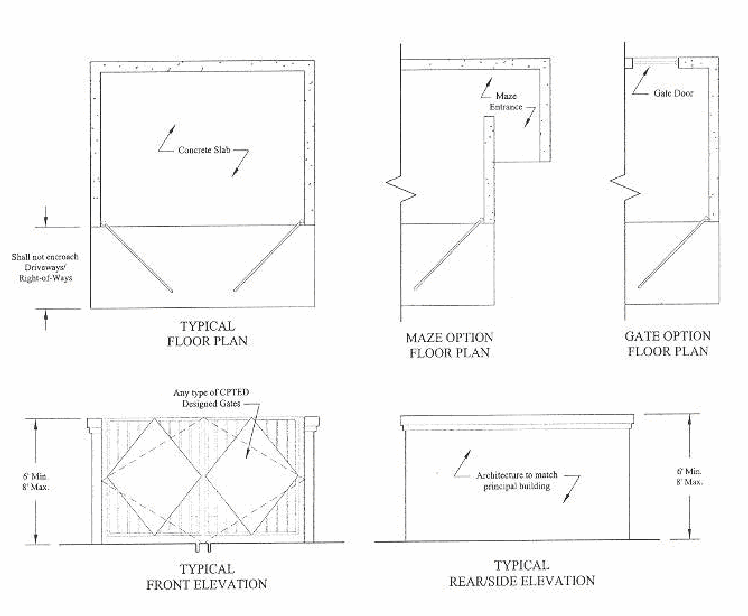
Figure 1: Dumpster Details
(KK)
Textile Recycling, Textile Recycling Collection Bins.
(1)
Purpose and Intent. Unlike other recyclables, such as bottles, cans and paper, textiles have not typically been collected through regularly scheduled household pick-ups but instead have been collected through donations to thrift stores (both for-profit and not-for-profit) or to charitable organizations, often by way of unsupervised textile recycling collection bins placed throughout the community. If not properly regulated, textile recycling operations and textile recycling collection bins can conflict with parking, traffic circulation, tree preservation, can lead to nuisance situations such as abandoned property and graffiti. When properly regulated, textile recycling collection bins can provide a cost-effective and convenient method of textile recycling, thereby reducing waste. The purpose of this paragraph (KK) is to set forth the conditions under which textile recycling collection bins may be placed on public and private property and to provide minimum standards as to how they are operated and maintained, as necessary to protect the public health, safety and welfare.
(2)
Definitions. For purposes of this paragraph (KK), textile recycling collection bin means a self-service container designed to allow members of the general public deposit used textile items such as shoes, clothing, linens and draperies.
For purposes of this paragraph (KK), textile recycling collection means the gathering and transportation of deposited textile items such as shoes, clothing, linens and draperies either for the purpose of resale or re-use for other purposes.
(3)
In general.
a.
Authorized textile recycling collection bins. No person shall place or maintain a textile recycling collection bin within the Town of Davie except in conformance with this paragraph (KK) and as authorized through a franchise agreement in accordance with the Town Charter.
b.
Collection from stationary vehicles. Collection of textiles for recycling from a stationary vehicle, truck, wagon, trailer or similar vehicle is prohibited within the Town of Davie except as authorized through a franchise agreement in accordance with the Town Charter. This is not intended to prohibit textile recycling collections taken directly from homes, businesses or institutions, whether through regularly scheduled or pick-ups or through pick-ups based on special request of the donor.
(4)
Placement, operation and maintenance of textile recycling collection bins. Unless otherwise provided by the town through a franchise agreement, textile recycling collection bins (bins) shall be governed as follows:
a.
Bins shall be placed only on:
(i)
Town-owned property, excluding public rights-of-way, on parcels approved by the town the either though a franchise agreement or by resolution; or
(ii)
Developed parcels zoned and approved for commercial retail, industrial, institutional or education use, with the written permission of the property owner.
b.
Bins shall be placed in a manner which does not to impair traffic, pedestrian or emergency service vehicle movement within the site and which does not negatively affect protected trees or utility services. The placement of textile recycling collection bins shall not require site plan approval unless such placement would be inconsistent with site plan conditions imposed by the town council.
c.
Bins shall be no larger than seven (7) feet in any dimension.
d.
Bins shall be placed no less than five hundred (500) feet from any other Bin unless located at least two hundred (200) feet from any public street right-of-way and not readily visible from any residential use. In no case shall more than four (4) Bins be placed on a single parcel.
e.
Bins shall not be located within twenty-five (25) feet of any a public street right-of-way.
f.
Bins shall be constructed of steel with a rust-resistant coating and weigh at least five hundred (500) pounds empty.
g.
Each bin shall provide the name, address and telephone number of the franchisee in weather-resistant lettering no smaller than one (1) inch high and provide other information as may be required by Florida Statutes. Bins shall contain no advertising other than as related to the franchised textile recycling collection organization or business.
h.
Bins shall be painted a uniform, approved color, maintained in good appearance, and be emptied no less than once per fourteen (14) days.
i.
The franchisee shall be responsible for ensuring that the area within twenty (20) feet of any bin shall be kept free of trash, debris and discarded items.
(5)
Implementation. The provisions of this subsection 12-33(KK) shall take effect on February 5, 2015. Bins, stationary vehicles, trucks, wagons, trailers or similar vehicles placed, operated or maintained in violation of subsection 12-33(KK)(3) prior to February 5, 2015, shall be removed or brought into compliance no later than March 21, 2015.
(LL)
Emergency Temporary Housing.
(1)
Housing Emergency Declaration.
(a)
Activation. Upon declaration of a state of emergency by the town council, and during the pendency thereof, the town council, as a part of the original declaration or at any time during the duration of a declared state of emergency, may declare a state of housing emergency for all or any part of the Town of Davie.
(b)
Areas Embraced. Housing Emergency Declaration must define the boundaries of all areas subject to the terms of this section. The areas embraced may include the entire area of the town, or any part thereof.
(c)
Termination.
1.
A Housing Emergency Declaration survives the termination of the Declaration of Emergency, and shall be in effect for a period established by resolution of the town council, not to exceed one (1) year per Housing Emergency Declaration.
2.
Partial Termination. Through the adoption of a resolution, the town council members may amend the Housing Emergency Declaration to either expand or contract the areas embraced. The expansion or contraction of the areas embraced shall be supported by findings regarding the status of the housing stock in the area being considered.
(d)
Effect of a Housing Emergency Declaration. Upon the activation of a Housing Emergency, the provisions of this section shall become applicable in all the areas embraced by the Housing Emergency Declaration.
(2)
Temporary Housing Units.
(a)
Definitions:
(1)
Essential Services: Services necessary to a basic standard of living and the general welfare of society. Services may include, but not limited to, the following: electrical services, gas services, water and wastewater treatment services.
(2)
Pre-Fabricated Dwelling: A unit that is factory built or built on site from modular parts and generally does not have wheels.
(3)
Recreational Vehicle: As defined in F.S. § 320.01(1)(b), which is hereby adopted in its entirety and as may be amended from time to time.
(4)
Temporary Housing: Temporary accommodations for individuals or families whose homes are made uninhabitable by an emergency or a major disaster that meets the physical accessibility needs of the household and includes essential utilities, access to areas for food preparation, and bath facilities in a context that allows a family to live together with a reasonable amount of privacy for a period generally up to eighteen (18) months.
(5)
Temporary Housing Unit: Manufactured housing, recreational vehicle, travel trailer, or pre-fabricated dwelling.
(b)
Single-Family or Two-Family Residential Parcels. Upon the activation of a Housing Emergency Declaration and subject to the conditions contained in this section, temporary housing units may be used as temporary housing by individuals who have been displaced from a single-family detached dwelling unit or a two-family (duplex) dwelling unit.
(1)
A permit for a temporary housing unit must be obtained through the Town of Davie Building Division.
(2)
Maximum of one (1) temporary housing unit for each housing unit legally established on the property will be allowed on an existing home site provided:
a.
The home located on the site has been declared uninhabitable by the town's building official or his/her designee.
b.
The water service and wastewater service must be properly connected to a functioning water service and sanitary sewer system or septic system in accordance with the codes in effect at the time. However, if connection to a functioning service is not feasible, other water and wastewater services may be utilized subject to the town's building division approval.
c.
Development standards of this chapter normally applicable to single family detached dwellings and two-family (duplex) dwellings, such as minimum yards, parking and open space, shall not be applicable to temporary housing units, provided that the temporary housing unit cannot extend into any adjacent public right-of-way, easement, or onto any adjacent property.
(3)
An application for a building permit to repair the residential structure shall be submitted no later than sixty (60) days after issuance of the temporary housing permit.
(4)
The temporary housing unit must be removed from the property no later than thirty (30) days from the date of the issuance of the certificate of occupancy, or a certificate of completion for the repaired residential structure. In no case shall a temporary housing unit be maintained on a lot for more than ninety (90) days after the expiration of the Emergency Housing Declaration under which the temporary housing unit was established.
(5)
The Town of Davie Building Division has the right to revoke the temporary housing permit in the event there exists unsafe or unsanitary conditions on the property, or in the event the owner does not comply with the provisions of this section.
(MM)
Mobile food vendors.
(1)
Purpose and intent. This section, 12-33(MM), is intended to regulate the impacts of mobile food dispensing vehicles and mobile food establishments at the location where food or beverages are actually sold or distributed. Except as otherwise provided herein, section 12-33(MM) is not intended to regulate commissaries or the parking, storage or transport of mobile food vehicles or equipment. The provisions of this section, 12-33(MM), are intended to supersede any provisions to the contrary in section 12-33(X) concerning outdoor uses.
(2)
Definitions. For purposes of this section, 12-33(MM), the following words, terms and phrases shall have the following meanings:
Commercial food service means the sale or dispensing of food or beverages to the general public by way of a mobile food dispensing vehicle.
Mobile food dispensing vehicle means any vehicle that is a public food service establishment regulated pursuant to Chapter 61C-4, Florida Administrative Code, and that is self-propelled or otherwise movable from place to place, and includes self-contained utilities, including, but not limited to, gas, water, electricity, or liquid waste disposal.
Mobile food establishment means any food establishment regulated pursuant to Chapter 5K-4, Florida Administrative Code, that is self-propelled or otherwise moveable from place to place such as a truck, trailer, or similar self-propelled conveyance or non-permanent kiosk or table where pre-packaged food and beverage products are sold.
Private event catering means a situation in which a mobile food dispensing vehicle is invited by the owner or lessee of a specific parcel of land to provide on-site food and beverage service for the patrons of the principal use of such parcel during a defined event, where such event does not involve the sale or distribution of food and beverages to the general public.
(3)
Mobile food establishments.
a.
Mobile food establishments shall display all required state license and registration tags and comply with all state licensing requirements.
b.
Mobile food establishments shall not sell or distribute alcoholic beverages or retail items unrelated to the sale of pre-packaged food and beverages.
c.
Mobile food establishments may sell or distribute pre-packaged food and beverages on:
1.
Private property within zoning districts B-1, B-2, B-3, UC, O, CC, C-1, RO, B-2M, BP, TS, M-1, M-2, M-3, M-3 County and M-4 County; and
2.
Any private property which is actively under construction or development pursuant to an active town development permit.
d.
No mobile food establishment shall sell or distribute food or beverages within public or private rights-of-way.
e.
No mobile food establishment shall visit the same parcel more than two (2) times per day or operate from a single parcel for more than one (1) hour in total per day.
f.
A mobile food vendor shall only operate from a non-permanent structure, such as a kiosk, booth or table, where the town has approved a temporary use permit, special permit or site plan specifically authorizing such mobile food vendor use on private property.
(4)
Mobile food dispensing vehicles. Mobile food dispensing vehicles may conduct commercial food service as set forth in paragraph a, below.
a.
Permitted locations and conditions.
b.
Restrictions on operations. All mobile food dispensing vehicles:
1.
Shall display all required state license and registration tags and comply with all state licensing requirements.
2.
Shall conduct business only between the hours of 7:00 a.m. and 9:00 p.m.
3.
Shall provide sufficient trash receptacles for patrons and properly collect and dispose of any trash resulting from the mobile food vendor operation.
4.
Shall not conduct business within any public or private right-of-way.
5.
Shall not conduct business in any manner that disrupts the proper flow of vehicular or pedestrian access.
6.
Shall not sell, provide or distribute alcoholic beverages.
7.
Shall not conduct retail sales or other business activity unrelated to the provision of food and non-alcoholic beverages.
8.
Shall not operate closer than two hundred fifty (250) feet of the nearest property zoned or used exclusively for residential purposes.
9.
Shall not operate within one thousand two hundred (1,200) feet of the nearest property line of any K-12 school.
10.
Shall not operate on land without the written authorization of the landowner or legal tenant of the land. Failure of a mobile food vendor to produce written authorization of the landowner or legal tenant when requested by town police or code compliance inspectors shall constitute a violation of this paragraph.
11.
Shall not remain on the site of operation between the hours of 10:00 p.m. and 6:00 a.m.
c.
Landowner responsibilities.
1.
No property owner shall allow a mobile food dispensing vehicle to operate in violation of the standards set forth in section 12-33(MM)(4).
2.
No property owner shall allow more than one (1) mobile food dispensing vehicle to operate on a parcel of land at the same time.
3.
No property owner shall allow mobile food dispensing vehicle operations to occur on a parcel of land for more than three (3) consecutive days, nor more than twelve (12) days total per parcel, per calendar year.
(5)
Exceptions.
a.
Town-sponsored events. The town administrator or designee shall be authorized to waive or modify any of the standards set forth in section 12-33(MM)(3) or (4), above, as may be necessary to allow mobile food venders to serve the public by operating on town property or town right-of-way as part of a town-sponsored event. For purposes of this paragraph, events conducted on town property pursuant to a lease or operating agreement with the town shall be considered "town-sponsored events," provided that such events are otherwise consistent with such lease or operating agreement.
b.
The provisions of section 12-33(MM)(4)c.2 and 3 shall not apply to parcels having a future land use designation of commercial recreation and zoned CR, provided that mobile food dispensing vehicles are operated only as an accessory to a permitted commercial recreational use.
c.
Private event catering. Despite any provision to the contrary in section 12-33(MM)(4)a, a mobile food dispensing vehicle may provide private event catering services on private property, including the property of a home or property owner's association, provided that:
1.
The mobile food dispensing vehicle complies with all of the operational standards set forth in section 12-33(MM)(4)b.
2.
The property owner or legal tenant of the property has specifically contracted or arranged for the mobile food dispensing vehicle to provide event catering.
3.
The mobile catering service is conducted only between the hours of 7:00 a.m. and 10:00 p.m.
4.
Mobile catering service is conducted on any single parcel of land no more frequently than one (1) day per calendar month.
(NN)
Floating solar facilities. Floating solar facilities, whether as a primary or accessory use, shall be considered a permitted use in any zoning district. For purposes of this paragraph, floating solar facilities means a solar facility as defined in section 163.3205(2), Florida Statutes, which is located on wastewater treatment ponds, abandoned limerock mine areas, stormwater treatment ponds, reclaimed water ponds, or other water storage reservoirs.
(OO)
Family restroom facilities. Non-residential buildings, such as, but not limited to, offices, retail centers, manufacturing facilities, schools and places of public assembly, constructed after August 17, 2022 which provide male- and female-specific restroom facilities, whether or not required by the Florida Building Code, must provide at least one (1) "family" restroom for every two (2) male- and female-specific restrooms provided. Town council shall have the authority to waive or modify this requirement based on the particular design or purpose of the proposed non-residential building.
(Ord. No. 90-4, § 7, 2-21-90; Ord. No. 90-65, § 1, 12-5-90; Ord. No. 91-40, § 1, 10-16-91; Ord. No. 92-17, § 2, 5-6-92; Ord. No. 95-16, § 1, 3-15-95; Ord. No. 96-19, § 1, 5-1-96; Ord. No. 96-21, §§ 1, 2, 5-1-96; Ord. No. 97-12, § 3, 2-5-97; Ord. No. 97-28, § 1, 5-21-97; Ord. No. 2000-15, § 2, 5-17-00; Ord. No. 2000-29, § 5, 7-19-00; Ord. No. 2001-031, § 1, 6-20-01; Ord. No. 2001-47, § 2, 11-7-01; Ord. No. 2002-030, § 1, 9-4-02; Ord. No. 2002-35, § 1, 10-16-02; Ord. No. 2003-037, § 1, 9-17-03; Ord. No. 2007-007, § 2, 5-16-07; Ord. No. 2007-013, § 3, 6-20-07; Ord. No. 2007-016, § 2, 7-18-07; Ord. No. 2007-39, § 1, 12-19-07; Ord. No. 2008-034, § 2, 9-17-08; Ord. No. 2010-19, § 2, 9-7-10; Ord. No. 2012-28, § 2(Exh. A), 12-5-12; Ord. No. 2013-10, § 2(Exh. A), 4-17-13; Ord. No. 2013-21, § 2(Exh. A), 9-18-13; Ord. No. 2015-002, § 2(Exh. A), 2-4-15; Ord. No. 2015-007, § 2, 3-4-15; Ord. No. O2018-009, § 2(Exh. A), 4-4-18; Ord. No. O2019-004, § 2(Exh. A), 1-23-19; Ord. No. O2019-012, § 2(Exh. A), 6-5-19; Ord. No. O2020-002, § 2(Exh. A), 2-5-20; Ord. No. O2021-010, § 2(Exh. A), 5-19-21; Ord. No. O2021-030, § 2(Exh. A), 11-3-21; Ord. No. O2022-013, § 2(Exh. A), 8-17-22; Ord. No. O2023-001, § 2(Exh. A), 1-4-23; Ord. No. O2023-011, § 2(Exh. A), 7-26-23; Ord. No. O2025-014, § 2(Exh. A), 5-7-25)
Sec. 12-34. - Standards for specific uses.
In addition to compliance with other regulations imposed by this chapter, the following standards are required of the specific uses enumerated below:
(A)
Location of designated sexually-oriented business uses. Sexually-oriented business uses shall be permitted only in the following districts: B-3 (Planned Business Center), UC (Urban Commercial) and M-3 Planned Industrial Park, subject to the requirements listed in subsection (1).
(1)
No sexually-oriented business uses are permitted on a parcel of land located:
a.
Within one thousand (1,000) feet of any parcel of land which is designated in a residential single-family, residential multi-family, or mobile home district";
b.
Within one thousand (1,000) feet of any parcel of land upon which a place of public assembly, religious institution, child care center, school (pre-school and grades kindergarten through twelfth grade), public park or playground is located.
c.
Within one thousand (1,000) feet of any parcel of land wherein a public library, college/university or federal, state, county, or municipal government building is located.
d.
Within one thousand (1,000) feet of any parcel of land upon which another sexually-oriented business use is located.
(2)
For purposes of this section, distance shall be by airline measurement from property line to property line, using the closest property lines of the parcels of land involved.
(3)
Sexually-oriented business uses. The following uses are declared to be sexually-oriented business uses as defined by this chapter:
a.
Adult arcades.
b.
Adult bookstores/adult novelty.
c.
Adult cabaret.
d.
Adult motels.
e.
Adult motion picture theaters.
f.
Semi-nude model studios.
g.
Adult sexual encounter establishments.
(4)
Where a sexually-oriented use is located in conformity with the provisions of this chapter, the subsequent location of a residential use, place of public assembly, religious institution, child care center, school, public park or playground, library, college/university or government within one thousand (1,000) feet of such sexually-oriented use shall not be construed to cause such sexually-oriented business use to be in violation of this chapter.
(B)
Agricultural use.
(1)
Animal shelter. Aviaries, roofed hutches, dog houses and dog runs shall be located a minimum of forty (40) feet from any property line within the RR, AG, A-1, R-1, R-2, MH, CC, RO, O, B-1, B-2, and B-3 districts, and shall meet the minimum yard requirements for all other districts. Aviaries are not permitted in the R-3, R-4 or R-5 districts.
(2)
Number and types of animals.
(a)
The number and types of animals shall not be restricted on farms as defined by section 12-503, subject to restrictions on the keeping or raising of pigs or hogs as set in section 12-34(B)(5).
(b)
In the RR, AG, A-1, RO, O, CC, B-1, B-2, B-3, M-1, M-2, and M-3 districts, the keeping of livestock is allowed on a lot of 35,000 square feet or greater, up to the following amounts:
1.
Up to eight (8) livestock in total, no more than four (4) of which may be cattle and horses, provided that any offspring shall not be counted for one (1) year.
2.
Up to ten (10) rabbits and twenty-five (25) poultry, provided that all such rabbits and poultry are kept in a completely penned area and provided that up to three (3) poultry can be considered pets in all residential zoning designations.
(c)
In the R-1 district, the keeping of livestock is allowed on a lot of 35,000 square feet or greater, up to the following amounts:
1.
Up to 4 livestock in total for each 35,000 square feet of lot area, made up of cattle or horses only (no other types of livestock), provided that any offspring shall not be counted for 1 year.
2.
Up to 10 rabbits and 5 poultry, provided that all such rabbits and poultry are kept in a completely penned area and provided that up to 3 poultry can be considered pets.
(3)
Plant nursery. In the RR, AG, and A-1 districts, retail sales shall be limited to agricultural products grown, kept, or raised on site, and shall be limited to a maximum of twenty-five (25) percent of the allowable building space on the site. The limitation on the size of building space shall not apply to farms used for an agricultural purpose in these districts.
(4)
Agricultural uses such as cultivation of crops, groves, thoroughbred and pleasure horses, cattle ranches are permitted in the CC, B-1, B-2, B-3, M-1, M-2, M-3 and RO districts provided the land is free of commercial or industrial structures and such agricultural uses are discontinued upon conversion of the property to another use.
(5)
Swine and Vietnamese potbellied pigs. The raising, breeding or keeping of swine of any type except for one (1) Vietnamese potbellied pig kept as a household pet, shall be presumed to be a nuisance and shall be prohibited in all zoning districts.
(6)
Livestock in residential districts. Raising of horses, cattle, goats, sheep, poultry and rabbits is not permitted in any residential zoning district, except for RR, AG, A-1, and R-1, and except as provided in chapter 12, article III, division 5, Nonconforming uses and structures of this Code for nonconforming uses on farms existing on the date this chapter is adopted by the town council.
(7)
Limited agricultural activities. Nothing in this section (12-34(B)) is intended to prohibit the continuation of "limited agricultural activities" where such activities were a lawful use on November 5, 2003 (the effective date of Ordinance 2003-044). For purposes of this paragraph, "limited agricultural activities" means agricultural activity, whether for pleasure or profit, conducted on land not designated as a farm pursuant to F.S. § 193.461. No maintenance of "limited agricultural activities" shall be deemed to be a nuisance if said activities were not a nuisance on November 5, 2003 and the "limited agricultural activities" conducted on the property conform to the best management practices of Central Broward Water Control District as to the particular type of agricultural activity, regardless of any change that may occur in the type of limited agricultural activity being conducted, a change in development conditions in vicinity or a change in the ownership of the property on which the limited agricultural activity is situated.
(8)
State preemption of certain agricultural regulations. Nothing in this section (12-34(B)) is intended to regulate aspects of agricultural uses which are preempted to the State of Florida, including, but not limited to, the following:
(a)
F.S. § 823.14, "the Florida Right to Farm Act," which prohibits a local government from the adoption of any ordinance, regulation, rule, or policy to prohibit, restrict, regulate, or otherwise limit an activity of a bona fide farm operation on land classified as agricultural land pursuant to F.S. § 193.461, where such activity is regulated through implemented best-management practices or interim measures developed by the department of environmental protection, the department of agricultural and consumer services, or water management districts and adopted under [F.S.] chapter 120 as part of a statewide or regional program.
(b)
F.S. § 586.10, which preempts local government regulation of honeybee colonies.
(c)
F.S. § 570.85, which preempts municipal regulation of agritourism activity on land classified as agricultural land pursuant to F.S. § 193.461.
(d)
F.S. § 604.50, which preempts municipal regulation of nonresidential farm buildings, farm fences and farm signs.
(9)
Hobby farm determination and recognition program.
(a)
In general. The town shall maintain an ongoing Hobby Farm Determination and Recognition Program to help to identify and protect agricultural uses and lifestyles on lands which are not identified as a farm pursuant to F.S. 193.461.
(b)
Applications. Applications may be submitted by any eligible landowner on forms provided by the town administrator or designee, along with such fee as may be adopted by resolution of the town council to offset the cost of review.
(c)
Criteria. The following shall be the minimum criteria for determination of a hobby farm:
1.
Agricultural uses must be a permitted use in the particular zoning district (whether "by-right" or as a legal non-conforming use).
2.
The application shall demonstrate that there are identifiable farm products, as defined in section 12-503.
3.
Fifty (50) percent or more of the gross area of the parcel must be dedicated to hobby farm or other agricultural purposes.
4.
There shall be no unresolved code compliance cases related to the hobby farm activities at the time of application and no outstanding liens concerning previous code compliance cases.
5.
The applicant shall provide proof of membership or involvement with agricultural associations, such as the Farm Bureau, the Nursery and Growers Association, breed societies or other organizations which may be specific to various forms of agriculture.
(d)
Hobby farm determinations. The town administrator or designee shall be responsible for administration of the program and making final, written determinations on all applications (approval, approval with conditions or denial) based on the criteria set forth in paragraph (c) above.
(e)
Hobby farm benefits.
1.
Certificates and promotional signs. Each approved hobby farm shall receive a town certificate and a sign suitable to identify the property as a hobby farm. Sign posting is not required but may be posted at the discretion of the landowner.
2.
Not to be determined a nuisance. No designated hobby farm shall be deemed to be a nuisance if the uses conducted on the property conform to any conditions of the hobby farm determination and any best management practices of Central Broward Water Control District as to the particular type of agricultural activity.
3.
Upon the sale of a property having a hobby farm determination, such hobby farm determination may be administratively transferred by the town administrator or designee without need to repeat the application and approval process.
(f)
Administration of prior "farm determinations." Any property which was issued a "farm determination" by the Town of Davie prior to January 1, 2017 (pursuant to section 12-34(KK), now repealed) shall be automatically considered a hobby farm pursuant to paragraph (9) and shall be automatically entitled to the benefits set forth in paragraph (e) above without need to re-apply for approval under the current program.
(g)
Revocation. The town administrator shall be authorized to revoke any hobby farm certificate for violation of any of the criteria set forth in paragraph (c), provided that no such revocation shall occur without at least sixty (60) days prior written notice to the property owner providing an opportunity to cure the violation.
(C)
Reserved.
(D)
Auction houses. An auction house for the sale of art, goods, antiques, jewelry, rugs and the like shall be permitted in the B-2, B-3, and B-P zoning districts subject to adequate off-street parking provisions. Auctions for the sale of livestock or farm animals shall be prohibited. The minimum required parking ratio shall be one (1) space for each four (4) fixed seats, plus one (1) space for each forty (40) square feet of non-fixed seating area, plus one (1) space for each two hundred (200) square feet of gross floor area not accounted for in fixed or non-fixed seating area.
(E)
Child care, day nursery, day care, and pediatric extended care facilities.
(1)
Development review procedures.
(a)
Traffic review required. In addition to any other application requirements, the applicant shall submit a traffic study which shall include: an analysis of traffic impact on the surrounding areas during the a.m. and p.m. peak hours; site circulation, pick-up and drop-off locations and the need for traffic control devices. The scope and methodology of the traffic analysis must be approved by the town administrator or his or her designee prior to the submittal of the application.
(b)
Town council approval required. Town council approval is required for any new child care, day nursery, day care facility, or pediatric extended care facility, whether the facility is new construction or a change of occupancy to an existing building or site.
(2)
Development and use standards.
(a)
Fencing. A fence or wall a minimum of five (5) and a maximum of six (6) feet in height shall be provided around the perimeter of the site with lockable gates at all pedestrian and vehicular access points. Fencing must be decorative, picket style except that chain-link may be provided around recreation/play areas and around electrical or mechanical equipment.
(b)
Paving, marking and accessibility. All internal walks, roads, driveways, and parking areas shall be paved.
(c)
Site access and internal circulation. Site access shall consist of at least one (1) primary access road and a secondary means of access to be used in the event that the primary road is blocked. At a minimum, the following requirements shall apply to site access design:
1.
Vehicular and pedestrian traffic shall not cross each other within the site unless approved safety devices are provided where vehicular and pedestrian traffic cross.
2.
Parking aisles shall not be utilized for vehicular stacking of pick-up and drop-off areas.
(3)
Setbacks. Building setbacks from the property line shall, at a minimum, be twenty-five (25) feet. When a child care, day nursery, day care or pediatric extended care site abuts a property zoned for residential use, the minimum building setback from the property line adjacent to the residentially-zoned parcel shall be seventy-five (75) feet.
(4)
Outdoor play areas.
a.
The minimum amount of outdoor play area shall be twenty-five (25) square feet times the maximum number of children allowed by the Broward County child care license or the state pediatric extended care facility license, as applicable.
b.
Required outdoor play areas shall be located on the same lot and shall not require children to cross public streets. Play areas within twenty-five (25) feet of a street right-of-way shall be protected by a concrete knee wall, bollards or similar structural barrier as determined by the town engineer.
(5)
Multiple story buildings. Child care, day nursery, day care, and pediatric extended care facilities shall be located only on the ground floor of a building.
(6)
In the NCF district, child care, day nursery, day care facilities shall be limited to a total of twenty-five (25) children.
(F)
Commerce Center (CC) District—Limitations of uses.
(1)
A maximum of twenty (20) percent of the gross floor area of a CC development may be used for one (1) or more of the following uses:
(a)
Personal services, such as barber shops, beauty salons, dry cleaners subject to limitations below, photographic studio, shoe repairs, health clubs.
(b)
Restaurants, nightclubs, lounges with entertainment or consumption of alcoholic beverages on-premises.
(c)
Florists.
(d)
Gift shops.
(e)
Newsstands, bookstores.
(f)
Office supplies, sales and service, including printing, and excluding furniture sales.
(g)
Child care center, day nursery.
(2)
All exterior loading doors shall remain fully closed except during loading and unloading activities. All exterior loading doors shall be completely screened from public view from all property lines.
(3)
The minimum parcel size for development of a hotel or motel complex shall be five (5) acres.
(4)
Any machinery utilizing motor(s) larger than twenty (20) horsepower shall be operated within a fully enclosed building.
(5)
The minimum parcel size for development of an automobile sales facility shall be five (5) acres. The sales and display of trucks may be permitted as a secondary product to the automobile sales facility; provided, however, the trucks sold and displayed consist of no more than two (2) axles and consume no more than fifty (50) percent of display/sales area. An automobile service facility, including auto body and paint shop, may be included within the development, provided the facility is wholly internalized within the development and is clearly ancillary to the automobile sales facility. No independent signage, except directional sign(s) within the development itself, shall be permitted for the automobile service facility.
(6)
Fences, walls and screening: see attached.
(a)
Fences and walls may be erected within the Commerce Center District to a maximum height of eight (8) feet.
(b)
The service entrances of buildings shall be screened from direct view through the use of a wall, fence or landscaped berm as recommended at the discretion of the planning and zoning board.
(7)
Other than as set forth in paragraph (5), above, no outdoor storage of goods or materials is permitted and no fabrication of any kind shall be conducted outside of an enclosed building.
(G)
Reserved.
(H)
Dry cleaning establishments. Dry cleaning establishments are subject to the following limitations and requirements:
(1)
Service shall be rendered directly to customers who bring in and pick up the articles to be dry cleaned.
(2)
The entire cleaning and drying process shall be carried on within completely enclosed units and shall be in compliance with all applicable environmental regulations governing the use and storage of dry cleaning materials.
(I)
Equestrian facilities. An equestrian facility (as defined in section 12-305) shall provide for stables, paddocks and trails, and may also provide pasture land and exercise areas. Equestrian facilities may be included within a minimum 35-acre development. The maximum number of stalls shall be limited to one (1) stall per two (2) dwelling units within the residential community. The facility shall be designed as an integral component of the residential community and internalized within the overall development plan as depicted on the site plan. Additionally, the site plan shall include an alternate development proposal, in conformance with district regulations.
The use of the facility shall be available to the residents of the community on a priority basis and may be open to the public for boarding only. Activities within the equestrian facility shall be limited to use by residents and boarders only. The owners/operators of the equestrian facility shall be members of the homeowners' association governing the overall development.
(J)
Family day care homes.
(1)
A family day care home may care for a maximum of five (5) children under age five from more than one (1) unrelated family and a maximum of five (5) elementary school-age siblings of the preschool-age children in care after school hours. The maximum number of five (5) preschool children includes children living in the home and preschool-age children received for day care who are not related to the resident care giver. This section will require licensure only in those instances where two (2) or more unrelated children are received for day care, in addition to the caregiver's own children, not to exceed five (5) preschool-age children. The total number of children in the home may not exceed ten (10) under this paragraph.
(2)
A family day care home may care for a maximum of five (5) preschool-age children from more than one (1) unrelated family, a maximum of three (3) elementary school-age siblings of the preschool-age children in care after school hours, and a maximum of two (2) elementary school-age children unrelated to the preschool-age children in care after school hours. The maximum number of five (5) preschool-age children includes preschool children in the home and preschool-age children received for day care who are not related to the resident caregiver. The total number of children in the home may not exceed ten (10) under this paragraph.
(3)
A family day care home may care for a maximum number of seven (7) elementary school-age children from more than one (1) unrelated family in care after school hours. Preschool-age children shall not be in care in the home. The total number of elementary school-age children in the home may not exceed seven (7) under this paragraph.
(4)
If a resident caregiver serves more children than is permitted under paragraphs (1), (2), or (3), above, the resident caregiver is required to be licensed as a child care facility pursuant to F.S. § 402.302(4).
(5)
Maximum ratios apply when school is not in session, which includes summer care.
(6)
A family day care home shall meet the minimum standards for the licensing of family day care homes as specified in the Broward County Family Day Care Home Licensing Ordinance (Broward County Ordinance No. 90-33 or as amended.).
(7)
Applicants requesting home business taxes for family day care homes shall submit a copy of a duly authorized license for such home from the Social Services Division of the Department of Public Services of Broward County, Florida prior to issuance of the business tax.
(K)
Freeway business uses.
(1)
The following uses, when permitted in a FB development, shall be internalized within the development and shall not constitute a freestanding, single use structure:
(a)
Bars, lounges.
(b)
Food markets.
(c)
Nursery, day care facility.
(d)
Real estate office.
(e)
Fast food restaurant.
(2)
Gasoline pump islands in the FB District shall be fully screened, in accordance with the following sketch:
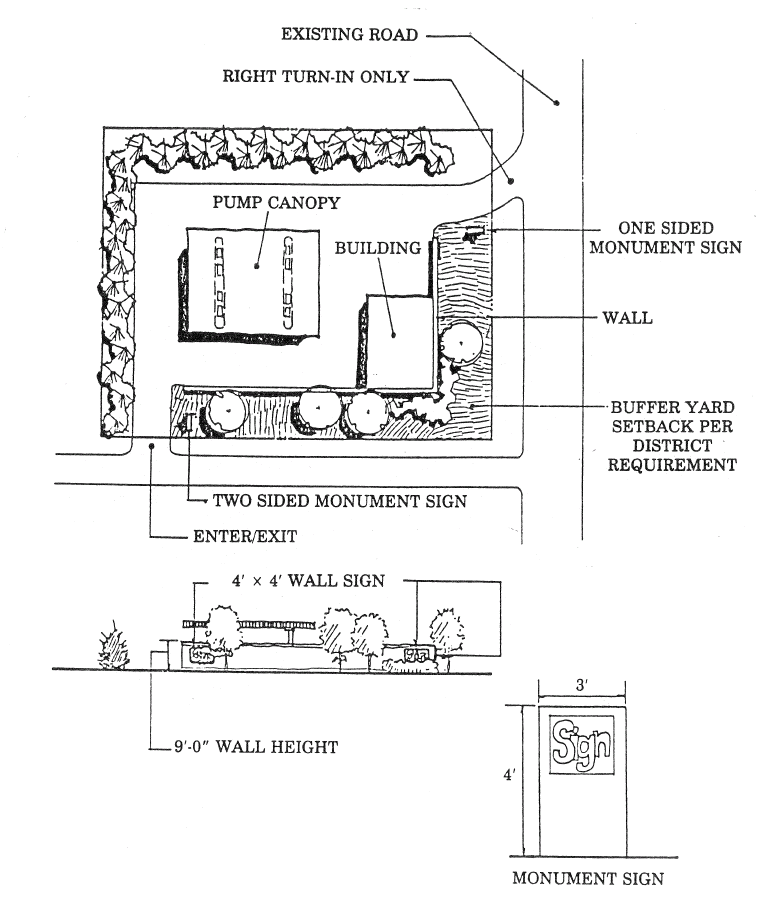
(3)
Parking lots in the FB District shall be for on-site use only and shall not be used to satisfy off-site parking requirements except as otherwise provided herein.
(L)
Heavy commercial activities. Major vehicle, boat and truck repair, and electrical, plumbing, sheet metal, cabinet and carpenter shops may not be located closer than one hundred (100) feet to property land use planned, zoned, and/or occupied for residential purposes.
(M)
Reserved.
(N)
Home occupation.
(1)
Defined. A home occupation is an occupation, business, profession or trade, including a cottage food operation, which operates in whole or in part from a residential dwelling unit on residential property.
(2)
Home occupations shall be limited as follows:
(a)
As viewed from the street, the residential lot and residential dwelling shall remain consistent with the residential character of surrounding residential lots and any external modifications made to a residential dwelling to accommodate a home occupation must conform to the residential character and architectural aesthetics of the neighborhood.
(b)
Retail transactions shall be conducted only within the residential dwelling; provided that incidental business activities and uses may be conducted throughout the residential lot.
(c)
The employees of the home occupation who work at the residential dwelling must also reside in the residential dwelling, except that up to a total of two (2) employees or independent contractors who do not reside at the residential dwelling may work at the business. The business may have additional remote employees that do not work at the residential property.
(d)
Parking on the residential property shall meet the requirements for the particular type of residential dwelling unit as required by Article VII, Parking, and the need for parking generated by the business shall not be greater in volume than would normally be expected by a similar residence where no home occupation is conducted.
(e)
Parking of commercial vehicles, trailers and equipment on the residential property shall meet the requirements of section 12-33(G).
(f)
Vehicles and trailers used in connection with the home occupation must be parked in legal parking spaces that are not located within a public or private right-of-way, on or over a sidewalk, or on any unimproved surfaces within the residential lot.
(O)
Hotels and motels. The minimum parcel size for development of a hotel or motel complex shall be three (3) acres in the B-3 and CR districts. Hotels and motels, and restaurants clearly accessory to and a part of a hotel or motel, are permitted in the CC district on a minimum parcel size of five (5) acres. The minimum floor area for a hotel or motel room shall be four hundred (400) square feet.
(P)
Recreational vehicles, mobile homes, and mobile home communities.
(1)
The following regulations shall apply to mobile homes:
(a)
A mobile home shall not be considered to be permissible as an accessory building.
(b)
No person shall park, store or occupy a mobile home for living purposes, except:
1.
In an approved mobile home park.
2.
On property which is zoned agricultural or rural ranches and is used principally as agricultural. Application shall be made for a special permit. The plot must be otherwise vacant of living quarters and contain a minimum of ten (10) acres. The mobile home must provide a minimum front, side and rear yard setback consistent with the requirement for residential uses in the A-1 Agricultural District and must only be used as living quarters or shelter for a watchman. Upon the affirmative vote of a majority of the members of the council, after due notice and public hearing, a special permit may be granted. Such special permit shall be effective for a period of not less than one (1) year nor more than three (3) years as determined by the town council. The length of time of the special permit shall be determined based upon the prior existence of the mobile home and whether it had been maintained in accordance with the special permit and applicable building and zoning regulations. The special use permit may be renewed by application to the council no sooner than sixty (60) days prior to the expiration of the permit. A temporary use permit may be approved after taking into consideration the public health, safety and general welfare, subject to appropriate conditions and safeguards. Any special permit issued pursuant to this paragraph may be revoked by the town council upon their determination that any condition upon which the original special permit was based no longer exists.
3.
For security purposes, on lands which have been acquired by Broward County pursuant to its environmentally sensitive lands program, or have otherwise been acquired by Broward County for open space purposes. Any such open space lands that are conveyed out of the name of Broward County shall cease to be included in the exception provided for in this subsection. Placement of a mobile home in accordance with this section is subject to site plan review. This subsection shall not exempt Broward County from compliance with all other provisions of the Town Code.
(c)
Except as hereinbefore provided, no mobile home shall be parked or stored on residentially zoned property except in a garage or other accessory building.
(d)
In the event a special permit is granted pursuant to subsection (1)(b)2 above, the front, side and rear yards for such mobile homes shall be the same as those provided for residential uses in the A-1 Agricultural District.
(2)
The following regulations shall apply to mobile homes in mobile home communities, parks or subdivisions:
(a)
The activities of mobile home community or subdivision offices, maintenance, laundry facilities and storage and garage uses shall be conducted within a completely enclosed building(s). Outdoor dead storage areas shall be completely enclosed by an eight-foot solid fence or wall and shall not be located closer than twenty (20) feet to community or subdivision boundary property lines.
(b)
Setbacks and yards:
1.
No accessory building or structure shall be placed in any required yard.
2.
No accessory or service building or structure used in connection with a mobile home community shall be located less than twenty (20) feet from any mobile home lot.
3.
No part of any mobile home or any addition or appurtenance thereto shall be placed within twenty (20) feet of any mobile home community or subdivision boundary.
4.
Setbacks and yards for communities zoned MH shall be those established pursuant to the approved site or subdivision plan.
(c)
The mobility of the mobile home shall be maintained. Each mobile home shall be kept currently licensed each year as provided under F.S. § 320.081. Every mobile home shall have its undercarriage screened from view by the use of decorative block or other similar materials.
(3)
The following regulation shall apply to the use of recreational vehicles:
(a)
No person shall occupy a recreational vehicle as temporary living quarters in districts B-1, B-2 and B-3. For the purpose of this paragraph, a recreational vehicle shall mean a vehicle that is primarily designed as temporary living quarters for recreational, camping, or travel use, which either has its own motive power or is mounted on or drawn by another vehicle.
(Q)
Reserved.
(R)
Mini-warehouse/self-storage facilities. Self-storage facilities shall be constructed and maintained in a separate, freestanding structure and there shall be no direct access to individual storage units from the exterior of the building.
(S)
Noxious uses prohibited. All uses which result in noxious odors, fumes, dust, dirt, noise, smoke or vibrations, or which the town council may determine to result in the generation of any hazards presenting a threat to public health, safety or general welfare shall be prohibited in all zoning districts. The use of outdoor loud speakers and other similar outdoor paging devices generating excessive noise shall be prohibited.
(T)
Reserved.
(U)
Reserved.
(V)
Residential Office (RO) District.
(1)
Buildings constructed in the RO district for non-residential uses or for a mix of residential and non-residential uses shall be limited as follows:
(a)
Drive-thru windows are prohibited.
(b)
Each building shall be designed to resemble a residential structure. At a minimum, each building shall have a peak roof (e.g., hip or gable), front-facing windows and prominent front entry doors with covered entrance.
(2)
Residential development within the RO district is limited to single-family detached dwellings and semi-detached (duplex) dwellings at a maximum density of five (5) dwelling units per gross acre.
(3)
Semi-detached (duplex) dwellings developed within the RO district and arranged on fee simple lots shall be exempt from the standards of section 12-81.3, provided that the overall development meets the minimum open space ratio of thirty (30) percent, and provided that each fee simple lot includes:
(a)
A minimum front yard of twenty-five (25) feet.
(b)
A minimum side yard of ten (10) feet on one (1) side.
(c)
A minimum rear yard of twenty (20) feet.
(d)
A maximum building height of twenty-five (25) feet.
(W)
Family community residences, transitional community residences, and recovery communities.
(1)
Definitions.
(a)
Community residence is a residential living arrangement for three (3) to ten (10) unrelated individuals with disabilities (except that up to fourteen (14) individuals may be allowed when licensed as a "community residential home" pursuant to Florida Statutes § 419.01) living as a single functional family in a single dwelling unit who need the mutual support furnished by other residents of the dwelling unit as well as the support services, if any, provided by any staff of the community residence. Residents may be self-governing or supervised by a sponsoring entity or its staff, which provide habilitative or rehabilitative services related to the residents' disabilities. A community residence emulates a biological family to foster normalization of its residents, integrate them into the surrounding community, and use neighbors as role models. Supportive inter-relationships between residents are an essential component. Its primary purpose is to provide shelter; foster and facilitate life skills; and meet the physical, emotional, and social needs of the residents in a mutually supportive family-like environment. Medical treatment is incidental as in any home, but does not include detoxification which is more than incidental.
A community residence is a residential use of property for purposes of all town regulations. The term does not include any other group living arrangement for unrelated individuals who are not disabled nor any recovery community, special residential facility, institutional or medical use, shelter, lodging or boarding house, extended-stay hotel, nursing home, vacation rental, or other use as defined in this Code. Upon termination, revocation, or suspension of its license, certification, or Oxford House Charter, a community residence must cease operations within sixty (60) calendar days, and the operator of the community residence must return residents to their families or relocate them to a safe and secure living environment.
Community residences include, but are not limited to, those residences that comport with this definition that are licensed by the Florida Agency for Persons with Disabilities, the Florida Department of Elder Affairs, the Florida Agency for Health Care Administration, and the Florida Department of Children and Families, pursuant to Florida Statutes Chapter 419, Community Residential Homes; and level 1 or 2 Recovery Residences certified by the State's designated credentialing entity established under Florida Statutes § 397.487, Substance Abuse Services.
A "community residence" occupied by three (3) to ten (10) unrelated individuals with disabilities can be a "family community residence" or a "transitional community residence" as defined herein:
(b)
Family community residence is a community residence that provides a relatively permanent living arrangement which, in practice and/or under its rules, charter, or other governing document, does not limit how long a resident may live there. The intent is for residents to live in the family community residence on a long-term basis of at least one (1) year. Typical uses can include, but not are limited to, the following uses:
1.
"Community residential home" licensed under Florida Statutes Chapter 419;
2.
Assisted living facility for the elderly or other people with disabilities licensed under Florida Statute § 429.02(5);
3.
Adult family-care home licensed under Florida Statute § 429.60;
4.
Intermediate care facility for people with developmental disabilities licensed under Florida Statute § 400.96);
5.
Housing licensed under Florida Statute Chapter 394;
6.
Recovery residences certified under Florida Statute Chapter 397, currently administered by the Florida Association of Recovery Residences, typically Levels 1 and 2 certified homes, where residency is characteristically at least one year; and
7.
Oxford House or other similar self-governed long-term housing for people in recovery from substance use disorder, and with no limit on tenancy in practice or in its charter or rules.
(c)
Transitional community residence is a community residence that provides a relatively temporary living arrangement for unrelated people with disabilities with a limit on length of tenancy typically less than a year which may be measured in weeks or months as determined either in practice or by the rules, charter, or other governing document of the transitional community residence. Typical uses can include, but not are limited to, the following uses:
1.
Halfway houses for people with disabilities that emulate a family, including, but not limited to, people with mental illness, substance use disorder, or physical disabilities;
2.
"Community residential home" licensed under Florida Statute Chapter 419;
3.
Housing licensed under Florida Statute Chapter 394 with only outpatient treatment;
4.
Recovery residences certified under Florida Statute Chapter 397, currently administered by the Florida Association of Recovery Residences, where residency is typically less than one (1) year;
5.
The separate community housing component for people with substance use disorder who may be undergoing detoxification or treatment at another location such as a day or night residential treatment center licensed under Florida Statute § 397.311.
(d)
Disability is a physical or mental impairment that substantially limits one (1) or more of an individual's major life activities, impairs an individual's ability to live independently, having a record of such an impairment, or being regarded as having such an impairment. People with disabilities do not include individuals who are currently using alcohol, illegal drugs, or using legal drugs to which they are addicted nor individuals who constitute a direct threat to the health and safety of others. People with disabilities include, but are not limited to:
1.
An elderly person with disabilities as defined in F.S. § 429.65(9).
2.
A person with physically disabilities as defined in F.S. § 760.22(7)(a).
3.
A person with developmental disabled disabilities as defined in F.S. § 393.063(11).
4.
A person with mental illness as defined in F.S. § 394.455(3).
5.
A person in recovery from a substance use disorder, also known as a drug and/or alcohol addiction, as defined in F.S. § 397.311(46).
(e)
Recovery community is multiple dwelling units in multi-family housing, attached single-family dwellings, or a group of detached single-family dwellings that are not held out to the general public for rent or occupancy, that provide a mutually supportive drug-free and alcohol-free living arrangement for people in recovery from a substance use disorder which, taken together, do not emulate a single biological family and are under the auspices of a single entity or group of related entities. A recovery community provides no more treatment than the sort of incidental treatment expected in residence. Recovery communities include land uses for which the operator is eligible to apply for certification from the State of Florida, pursuant to Florida Statute Chapter 397, or state license. The term does not include any other group living arrangements for people who are not disabled nor any community residence, special residential facility, institutional or medical use, shelter, lodging or boarding house, extended stay hotel, nursing home, vacation rental, or other use defined or used in this Code.
The Town of Davie's building and fire codes shall classify a each dwelling unit in a recovery residence located in multi-family structures as a multi-family dwelling unit. The Town of Davie's building and fire codes shall classify each dwelling unit in a recovery residence located in attached single-family dwellings as an attached single-family dwelling. The Town of Davie's building and fire codes shall classify each of the detached single-family dwellings a recovery community occupies as a single-family dwelling unit.
(2)
Development standards.
(a)
Family community residences. Except as required by state law, a proposed family community residence shall be allowed when it meets all of the following standards:
1.
It is located within a residential dwelling unit; and
2.
It is located at least six hundred sixty (660) linear feet or seven (7) lots, whichever is greater, from the closest existing family or transitional community residence, recovery community, or special residential facility, as measured from the nearest lot line of the proposed family community residence to the nearest lot line of the closest existing family or transitional community residence, recovery community, or special residential facility, and
3.
The proposed family community residence or its operator has been issued or shows it has applied for:
i.
The license or certification that the State of Florida requires to operate the proposed family community residence; or
ii.
Provisional certification from the Florida Association of Recovery Residences and then permanent certification within one hundred fifty (150) days of the date on which provisional certification was granted; or
iii.
A "conditional" Oxford House Charter within thirty (30) days of the date on which the first individual occupies the Oxford House and a "permanent" Oxford House Charter within one hundred eighty (180) days after the "conditional" charter was issued; and
4.
No more than ten (10) individuals will occupy the community residence.
5.
Per state law, community residences for people with developmental disabilities located in a "planned residential community" as defined by Section 419.001(1)(d) of the Florida Statutes, are exempt from the spacing requirements between community residences and/or recovery communities established in this section.
6.
A family community residence which does not comply with all of the standards of this paragraph (W) may be approved only by way of a special permit issued pursuant to section 12-308.1.
(b)
Transitional community residences. Except as required by state law, a proposed transitional community residence shall be allowed only when it meets all of the following standards:
1.
It is located within a zoning district in which "multi-family dwellings" are a permitted use.
2.
It is located at least six hundred sixty (660) linear feet or seven (7) lots, whichever is greater, from the closest existing family or transitional community residence, recovery community, or special residential facility as measured from the nearest lot line of the proposed transitional community residence to the nearest lot line of the closest existing family or transitional community residence, recovery community, or special residential facility, and
3.
The transitional community residence or its operator has been issued or shows it has applied for:
i.
The license or certification that the State of Florida requires to operate the proposed community residence; or
ii.
Provisional certification from the Florida Association of Recovery Residences and then permanent certification within one hundred fifty (150) days of the date on which provisional certification was granted.
4.
No more than ten (10) individuals will occupy the transitional community residence.
5.
A transitional community residence which does not comply with all of the standards of this paragraph (W) may be approved only by way of a special permit issued pursuant to section 12-308.1.
(c)
Recovery communities. Except as required by state law, a proposed recovery community shall be allowed only when it meets all of the following standards:
1.
It is located within a zoning district in which "multi-family dwellings" or "special residential facilities" are a permitted use.
2.
The proposed recovery community is located at least one thousand two hundred (1,200) feet or ten (10) lots, whichever is greater, from the closest recovery community, family or transitional community residence, or special residential facility as measured from the nearest property line of the proposed recovery community to the nearest property line of the closest existing recovery community, family or transitional community residence, or special residential facility; and
3.
The operator or applicant has received provisional certification from the State of Florida's designated licensing or certification entity as established by Florida Statute § 397.487 or subsequent state statute. Permanent annual certification must be issued within one hundred eighty (180) days of the date on which provisional certification was granted.
4.
A recovery community residence which does not comply with all of the standards of this paragraph (W) may be approved only by way of a special permit issued pursuant to section 12-308.1.
(3)
Density calculations.
(a)
Each family community residence and each transitional community residence is considered one (1) dwelling unit.
(b)
In a recovery community, each apartment, detached single-family house, and each townhouse unit is considered one (1) dwelling unit.
(4)
Zoning approval procedures; revocation.
(a)
Zoning approval required. No community residence or recovery community shall commence operations within the town without first obtaining zoning approval. The applicant for proposed community residence or recovery community must submit an application on forms provided by the town administrator, or designee, along with any fee as established by town resolution.
(b)
Revocation of zoning approval. Regardless of whether zoning approval is granted administratively or through a special permit issued in accordance with section 12-308.1, town zoning approval for a community residence or recovery community shall be revoked when the operator fails to provide evidence of permanent licensure, certification, or Oxford House Charter within one hundred eighty (180) days of the date on which provisional certification or licensure or conditional Oxford House Charter was issued. An operator that has not received licensure, certification, or Oxford House Charter; or where a license or certification was denied or revoked, shall not be allowed to operate in Davie and zoning approval shall become null and void upon termination of such license, certification, or Oxford House Charter. An operator must notify the town administrator, or designee, that its license, certification, or Oxford House Charter has been revoked within five (5) calendar days of the operator being notified of such revocation. Such an operator shall cease operation and vacate the premises within sixty (60) calendar days and shall safely return residents to their families or relocate them to a safe and secure living environment. Within five (5) days of the suspension of any license, certification or Oxford House Charter, the operator of a community residence or recovery community shall notify the town administrator, or designee, of such suspension and any time limits provided to correct deficiencies.
(c)
Existing uses. A lawfully established community residence or recovery community that conformed to the zoning requirements in effect at the time of its initial establishment shall not be considered in conflict with this subsection (W), provided that each community residence and recovery community must possess any currently required state license or certification required by state law or this paragraph (W). Failure to obtain such state license or certification by March 1, 2024 shall constitute a violation of this paragraph (W).
(X)
Restaurants.
(1)
CC Districts. In the CC district lunch counters, cafeterias and restaurants for occupants and employees of the CC development are permitted; however, such facility is restricted to occupants and employees only and is not available to the public.
(2)
B-1 Districts. Permitted restaurants in the B-1 district shall not include live entertainment or dancing.
(3)
Fast food restaurants. The location of fast food restaurants shall be subject to the following:
(a)
There shall be a minimum of one hundred (100) feet, shortest airline measurement, between the nearest points on any lot to be occupied for fast food restaurant purposes and any lot which is occupied, zoned or land use plan designated residential.
(b)
The applicant for such use shall furnish a certified survey from a land surveyor registered in the State of Florida, indicating the distance between the proposed establishment and any applicable above uses.
(4)
Dog-friendly restaurants.
(a)
Authority; intent and purpose. This division is enacted pursuant to the authority granted to local governments by F.S. § 509.233, granting the town the authority to provide exemptions from section 6-501.115, U.S. Food and Drug Administration Food Code, as adopted and incorporated by the State of Florida Division of Hotels and Restaurants in Chapter 61C-4.010(6), Florida Administrative Code, as amended from time to time, and which prohibits the presence of live animals in public food service establishments. The purpose of this division is to allow patrons' dogs within certain designated outdoor portions of public food service establishments, with permits, consistent with the F.S. § 509.233. No dog shall be in a public food service establishment unless allowed by state law and the public food service establishment has received and maintains an unexpired permit pursuant to this division allowing dogs in designated outdoor seating areas of the public food service establishment.
(b)
Definitions. The following words, terms and phrases, when used in this division, shall have the meanings ascribed to them in this section, except where the context clearly indicates a different meaning:
Dog-friendly restaurant shall mean a public food service establishment which has received a permit under this division.
Employee or employees shall include, but is not limited to, the owner or owners of the public food service establishment.
Public food service establishment, which is also licensed as such an establishment pursuant to F.S. Ch. 509, Part I, shall mean any restaurant, restaurant general, fast food restaurant or outdoor seating area, as may also be defined in section 12-503, Definitions, where food or drink is prepared, served, or sold for immediate consumption on or in the vicinity of the premises; called for or taken out by customers; or prepared prior to being delivered to another location for consumption.
(c)
Application requirements. Public food service establishments shall apply for and receive a permit from the planning and zoning division before patrons' dogs are allowed on the premises. The town administrator or his/her designee shall establish a reasonable fee to cover the costs associated with processing the permit application and subsequent permit renewals. As hereby provided, permits expire annually on October 1 unless renewed prior. The application for a permit shall require such information from the applicant as is deemed reasonably necessary to enforce the provisions of this division, but shall require, at a minimum, the following information:
1.
The name, location, State of Florida Division of Hotels and Restaurants DBPR License number, and mailing address of the public food service establishment.
2.
The names, mailing addresses, and telephone contact information of the (1) permit applicant, (2) business, and (3) property owners, if different.
3.
A diagram and description of the outdoor seating area to be designated as available to patrons' dogs, including dimensions of the designated outdoor seating area; a depiction of the number and placement of tables, chairs, and restaurant equipment, if any; the entryways and exits to the designated outdoor seating area; the boundaries of the designated outdoor seating area and of other areas of outdoor dining not available for patrons' dogs; any fences or other barriers; surrounding property lines and public rights-of-way, including sidewalks and common pathways; and such other information reasonably required by the planning and zoning division. The diagram or plan shall be accurate and to scale but need not be prepared by a licensed professional.
4.
A description of the days of the week and hours of operation that patrons' dogs will be permitted in the designated outdoor seating area.
5.
Prior to the issuance of a permit, the applicant shall furnish the planning and zoning division with a signed and notarized statement that the permittee shall hold harmless and indemnify the town from any claims for damages to property or injury to persons which may be occasioned by any activity carried on under the terms of the permit.
(d)
Regulations. Public food service establishments that receive a permit for a designated outdoor area pursuant to this division shall require that:
1.
All public food service establishment employees shall wash their hands promptly after touching, petting or otherwise handling dogs. Employees shall be prohibited from touching, petting, or otherwise handling dogs while serving food or beverages or handling tableware or before entering other parts of the public food service establishment.
2.
Patrons in a designated outdoor seating area shall be advised that they should wash their hands before eating. Waterless hand sanitizer shall be provided at all tables in the designated outdoor seating area.
3.
Employees and patrons shall be instructed that they shall not allow dogs to come into contact with serving dishes, utensils, tableware, linens, paper products or any other items involved in food service operations.
4.
Patrons shall keep their dogs on a leash at all times and shall keep their dogs under reasonable control. Any dogs that by manner of their disposition or behavior in the designated outdoor seating area which consists of loud and regular barking, aggressive behavior towards other patrons or their dogs, inappropriate tendencies or similar nuisance-like acts may be requested to leave said premises by the restaurant permittee or its designee at any time. If said patron fails to act upon a request to leave, there may be further enforcement undertaken as by a trespass order and notice to appear in the county court with those legal consequences found in Town Code section 1-9.
5.
Dogs shall not be allowed on chairs, tables, or other furnishings.
6.
All table and chair surfaces shall be cleaned and sanitized with an approved product between seating of patrons. Spilled food and drink shall be removed from the floor or ground between seating of patrons.
7.
Accidents involving dog waste shall be cleaned immediately and the area sanitized with an approved product. A kit with appropriate materials for this purpose shall be kept near the designated outdoor seating area at all times when the outside seating area of the restaurant is open for business.
8.
A sign or signs reminding employees of the applicable rules shall be posted on premises in a conspicuous manner and in such a location as determined by planning and zoning division.
9.
A sign or signs reminding patrons of the applicable rules shall be posted on premises in a conspicuous manner and place as determined by the planning and zoning division.
10.
A sign or signs shall be posted in a conspicuous manner and place as determined by the planning and zoning division that places the public on notice that the designated outdoor seating area is available for the use of patrons and patrons' dogs.
11.
Dogs shall not be permitted to travel through indoor or non-designated outdoor portions of the public food service establishment, and ingress and egress to the designated outdoor seating portions of the public food service establishment must not require entrance into or passage through any indoor area of the food establishment.
12.
Permits shall be conspicuously displayed in the designated approved outdoor seating area.
(e)
Permit expiration and revocation.
1.
A permit issued pursuant to this paragraph (5) shall expire automatically upon the sale of the public food service establishment and shall not be transferred to a subsequent owner. The subsequent owner shall be required to reapply for a permit if the subsequent owner wishes to continue to accommodate and allow patrons' dogs in a designated outdoor seating area.
2.
Reserved.
3.
A permit issued pursuant to this division may be revoked by the town administrator or his/her designee if the public food service establishment fails to comply with any condition of approval, fails to comply with approved diagrams, fails to maintain any required state or local license, or is found to be in violation of any part of this division or other Town Code. Notice of the permit revocation shall be given to the permit holder fifteen (15) days prior to such revocation, under these grounds for revocation or termination. Notwithstanding the foregoing, if the grounds for permit revocation are a failure to maintain any required state or local license, or the required insurance policy described in this division, the permit revocation may take effect immediately by the town administrator or his/her designee.
4.
If a public food service establishment's permit is revoked, no new permit may be approved for the establishment for a period of no less than sixty (60) days following the date of permit revocation providing that all issues continued within the revocation have been satisfied.
5.
The conditions for revocation and termination of a permit shall include a permittee allowing outstanding fees or fines to remain unpaid for a period no less than thirty (30) days.
6.
Zoning violations associated with any existing outdoor seating area shall be grounds for the denial of a "dog-friendly restaurant" permit under this division.
(f)
Complaints, reporting and enforcement.
1.
Complaints may be made in writing to the planning and zoning division, which shall accept, document, and forward to the town's code compliance division for investigation; the code compliance division shall respond to all complaints within forty-eight (48) hours after their receipt from the planning and zoning division; the code compliance division shall schedule a code enforcement hearing for verified code violations; the code compliance division shall timely report to the state division of hotels and restaurants all complaints and their code enforcement responses to such complaints.
2.
The town shall provide the state division of hotels and restaurants with a copy of all approved applications and permits.
3.
Violations of this division may be enforced in the manner provided as set forth in chapter 6 of this Code.
4.
The patron in charge of the dog or the designated person in charge of the public food service establishment or both may be issued civil citations for each violation of this division.
5.
Nothing shall preclude the town from seeking any other legal remedy available for the enforcement of the Code provisions in this division and the Town Code.
(g)
Exemption for service animals. A service animal is not a pet. According to the 2009 FDA Food Code, as adopted by the Florida Division of Hotels and Restaurants, a service animal is an animal individually trained to provide assistance to an individual with a disability. Service animals are not governed by any permit issued under this division. All types of service animals are permitted in restaurants as long as the service animal is controlled by its handler. The service animal is only permitted in areas that are not used for food preparation and that are usually open for customers, such as inside and outside dining areas, sales areas and waiting areas.
(Y)
Motor fuel pump. The location of a motor fuel pump as a primary or an accessory use shall be subject to the following limitations and restrictions:
(1)
Street frontage and area. A lot shall not have less than one hundred fifty (150) feet street frontage with an area of not less than forty-three thousand five hundred sixty (43,560) square feet.
(2)
Separation. There shall be a minimum distance of two hundred fifty (250) feet, shortest airline measurement, between the nearest points on any lot to be occupied for fuel pump islands and any lot which is occupied by a detached place of public assembly, playground, playfield, hospital, school K to 12, zoned, or land use plan designated residential. The application shall furnish a certified survey from a land surveyor registered in the State of Florida, indicating the distance between the proposed facility and any applicable above uses.
(3)
Clearances required. Motor fuel pumps shall be located not less than twenty-five (25) feet from any street line or property line, or other fuel pump islands.
(4)
Driveways. Driveways providing ingress and egress from a property to public streets shall be no wider than thirty-five (35) feet.
(5)
Signs. Signage may be permitted pursuant to regulations applicable to the site and contained in Division 1 of Article VIII of this chapter.
(Z)
Special residential facilities.
(1)
Definitions.
(a)
A special residential facility is a facility that provides long-term care, accommodations, meal service, and one (1) or more assistive care services to persons not related to the owner or administrator by blood or marriage. Special residential facilities include, but are not limited to, assisted living facilities and nursing homes, but special residential facilities do not include family or transitional community residences, recovery communities, a group living arrangement that is an alternative to incarceration for people who pose a direct threat to the health or safety of others, a group living arrangement for people undergoing treatment in a program at the same site, or a facility for the treatment of substance use disorder where treatment is the primary purpose and use, whether the facility provides only services or includes a residential component on site.
(b)
A special residential facility, Category 1, is a special residential facility for up to six (6) individuals.
(c)
A special residential facility, Category 2, is a special residential facility for seven (7) to fourteen (14) individuals.
(d)
A special residential facility, Category 3, is a special residential facility for more than fourteen (14) individuals.
(2)
Development standards.
(a)
Density calculations.
1.
Each Category 1 special residential facility is considered one (1) dwelling unit.
2.
Each Category 2 special residential facility is considered two (2) dwelling units.
3.
For a Category 3 special residential facility, each sleeping room shall be counted as one-half (0.5) dwelling units. A sleeping room shall be designed to accommodate no more than two (2) individuals.
(b)
Administration of bonus sleeping rooms. As otherwise allowed by Article 5 of the Broward County Administrative Rules Document, the town council may allocate bonus sleeping rooms to a particular parcel of land by resolution where the landowner has filed a plat or plat note amendment indicating the intent to develop a special residential facility. The bonus sleeping rooms allocated by town resolution shall remain with the particular parcel of land until any of the following occur:
1.
The landowner abandons the special residential facility project and releases the bonus sleeping rooms in writing.
2.
The plat or replat associated with the special residential facility is not recorded within eighteen (18) months after county approval, or in the case of a plat note amendment, the plat note amendment is not approved by the county within eighteen (18) months of town approval.
3.
The finding of adequacy for the plat associated with the special residential facility expires.
The town council shall have the discretion to reassign any unused bonus sleeping rooms to subsequent applications based on the date of application.
(c)
Minimum requirements for development and operation.
1.
In general. Special residential facilities must meet the requirements of this paragraph (c) except as otherwise provided in Chapter 419, Florida Statutes, or any other applicable provision of the Florida Statutes.
2.
Distance separation. In all zoning districts other than CF, the proposed special residential facility must be located at least one thousand two hundred (1,200) linear feet or ten (10) lots, whichever is greater, from the closest existing family or transitional community residence, recovery community, or special residential facility as measured from the nearest lot line of the proposed special residential facility to the nearest lot line of the closest existing family.
(d)
Vehicular access. Primary vehicular access to a Category 3 special residential facility shall be directly from an arterial road or expressway (e.g., not a local or collector street). Town council may approve secondary or emergency access to a collector street provided that such access does not result in travel on local roads through residential areas.
(3)
Life safety requirements for special residential facilities.
(a)
Intent and purpose. The intent and purpose of this section is to protect the life, safety, and welfare of special residential facility residents within the Town of Davie. South Florida is susceptible to hurricanes and other natural disasters which require certain precautions to be taken to safeguard the special residential facility residents within the town.
(b)
Definition. For this section, 12-34(Z)(3), the definition of special residential facility shall mean facilities that are not nursing homes and are not assisted living facilities.
(c)
The town council of the Town of Davie determines and declares that, to protect the life, safety, and welfare of the special residential facility residents within Davie, certain life safety requirements must be met.
(d)
Special residential facilities within the Town of Davie must provide the following essential equipment to protect the health and welfare of their residents:
1.
A stand by generator, with an automatic transfer switch, that is large enough to provide day to day electricity for the entire facility, which shall be turned on in the event that power is lost; and
2.
A supply of fuel to sustain continuous operation of the generator for at least four (4) consecutive days during a power outage; and
3.
Obtain the services needed to properly inspect and test the generator, to ensure the safe and sufficient operation of the generator, which shall at a minimum include bi-annual load bank testing; and
4.
Maintain an inspection log, which shall be kept on-site, when the generator is inspected and tested, as well as the results of the inspection and test; and
5.
An emergency management plan, which shall cover all natural disasters, and be approved by the Town of Davie Fire and Life Safety Division and updated yearly; and
6.
Provide the Town of Davie Fire, and Life Safety Division with the current contact information for the property owner, special residential facility business owner and the individual responsible for management and supervising the operation of the special residential facility.
(e)
Special residential facilities must comply with the requirements in paragraph (d) no later than April 1, 2018.
(f)
In the event that the generator fails or breaks during a hurricane or natural disaster, the special residential facility must fix the generator within seventy-two (72) hours after the state of emergency has been lifted or relocate the special residential facility residents to a licensed facility with power.
(g)
Special residential facilities shall be exempt from the stand by generator requirement of paragraph (d) where all of the requirements of this paragraph (g) have been met.
No later than April 1 of each year, the special residential facility has provided to the Town of Davie Fire and Life Safety Division an Annual Emergency Relocation Plan demonstrating the following:
1.
A sworn affidavit, from the owner or designated representative of the special residential facility, stating that all of the special residential facility residents and domesticated animals shall be relocated within forty-eight (48) hours after a hurricane warning or other natural disaster is issued, for the Town of Davie, as predicted by the National Hurricane Center or National Weather Service or within forty-eight (48) hours after an evacuation order is issued for Broward County, whichever comes first, and will not be re-occupied until the state of emergency has been lifted and until power is restored to the special residential facility; and
2.
A sworn affidavit, from the owner or designated representative of the special residential facility, stating that all of the special residential facility residents and domesticated animals shall be relocated prior to any power outage planned or anticipated to last longer than four (4) hours, regardless of the reason for the power outage.
3.
A sworn affidavit, from the owner or designated representative of the special residential facility, stating that all of the special residential facility residents and domesticated animals shall be relocated in any situation in which an unplanned or unanticipated power outage has continued for more than four (4) hours.
4.
The means for transporting all of the special residential facility residents and domesticated animals to the relocation facility; and
5.
The location of the facility where the special residential facility residents and domesticated animals are being relocated to; and
6.
The contact information of the facility where the special residential facility residents and domesticated animals are being relocated to; and
7.
Written approval from the facility accepting the special residential facility residents and domesticated animals that there is sufficient room to accommodate; and
8.
Proof that the relocation facility is licensed; and
9.
Proof that the facility accepting the special residential facility residents and domesticated animals has the essential equipment requirements as set forth in paragraph (d). Special residential facilities shall be exempt from this subsection if the facility where the relocation is taking place is outside of the hurricane warning zone or other natural disaster as predicted by the National Hurricane Center or the National Weather Service.
10.
The Town of Davie Fire and Life Safety Division has provided a written determination that the proposed Annual Emergency Relocation Plan meets the minimum standards of this section.
(h)
This section shall give authority to the Town of Davie Fire and Life Safety Division to enter the property of a special residential facility, at a reasonable hour but without prior notice, as may be needed to inspect a required generator or to ensure that residents have been relocated pursuant to an approved Annual Emergency Relocation Plan.
1.
This section shall give the authority to the Town of Davie Fire, and Life Safety Division to request the inspection log for the generator testing. The special residential facility shall immediately provide the requested inspection log.
2.
Upon the failure of a generator test, the special residential facility must notify the Town of Davie Fire, and Life Safety Division and conduct a positive test within ten (10) days.
3.
Upon the denial of an emergency management plan, the special residential facility must submit a new emergency management plan to the Town of Davie Fire, and Life Safety Division within ten (10) days.
4.
Any special residential facility being built or having modifications done to the facility that require approval by the town council of the Town of Davie, must delineate the location where the generator shall be placed and must have the generator installed prior to occupancy.
5.
Failure to comply with any of the aforementioned requirements shall be in violation of this section and the maximum penalty shall not exceed five hundred dollars ($500.00) a day.
(AA)
Unified control of development. All land included for the purpose of development in the S, B-3, M-3, U, PCF, SC, UC, FB, or BP districts shall be owned or under the control of the petitioner for such zoning designation, whether that petitioner be an individual, partnership, or corporations. A master plan is required, as stated in section 12-375, at the time of rezoning.
(BB)
Utilities activities.
(1)
Where uses allowed under the U district are located within residential areas, any required building shall be designed to harmonize with the character of the residential area.
(2)
All lift stations and storage or processing tanks shall be landscaped with trees or shrubs which shall naturally screen same from the sight of contiguous residences. Such landscaping is in addition to landscaping required elsewhere in this Code and shall be provided adjacent to said structure or on the adjacent property line, or as otherwise approved by the council. Required landscaping shall be reflected on the approved conceptual master land use plan.
(CC)
Vehicle sales and rental.
(1)
Zoning district limitations and use criteria.
(a)
B-3 Zoning District.
(1)
Moving truck, maximum two (2) axles, and moving trailer, maximum two (2) axles, rental, accessory. In the B-3 district, limited truck and trailer rental, limited to five (5) vehicles per lot, shall be permitted as an accessory use to an auto service station, subject to site plan approval.
(2)
Automobile sales, new and used. The minimum lot area for automobile sales shall be three (3) acres, excluding truck and trailer rental as accessory.
(3)
Truck sales, maximum two (2) axles, new and used. The minimum lot area for truck sales, shall be three (3) acres.
(4)
Motorcycle shop.
(a)
A special permit approval is required as stated in section 12-308, said mailing shall be measured at the boundaries of the overall parcel. The use must meet all the following criteria:
1.
Outside display of motorcycles shall be clearly indicated on a site plan approved as part of the special permit.
2.
All repair and installation work shall be conducted within a building with solid wall and roof.
3.
Reserved.
4.
Reserved.
5.
Reserved.
6.
Said use shall be separated from adjacent residential districts with a minimum eight (8) foot high concrete wall and ten (10) foot landscape buffer with landscape requirements as stated in section 12-111(D).
7.
Said use shall be a minimum of one thousand (1,000) linear feet, measured property line to property line, from any other motorcycle shop.
8.
Said use shall be located a minimum of five hundred (500) feet from any residential use, as measured from the tenant bay, lease line, or property line, whichever is more restrictive.
(b)
UC Zoning District.
(1)
In the UC Zoning District, vehicle sales and rental shall be prohibited.
(2)
Motorcycle shops shall meet the requirements set forth in section 12-34(CC)(1)(a)(4).
(c)
BP, CC and C1 Zoning Districts.
(1)
Automobile sales, new with used allowed as an accessory use. The sale and display of trucks shall be permitted as an accessory product to the automobile sales facility; provided, however, the trucks sold and displayed consist of no more than two (2) axles and consume no more than fifty (50) percent of sales/display area.
(2)
The minimum lot area for automobile sales shall be three (3) acres, excluding moving truck and trailer rental as accessory.
(3)
Motorcycle shops shall meet the requirements set forth in section 12-34(CC)(1)(a)(4).
(d)
M-1, M-2, M-3 Zoning Districts.
(1)
Automobile sales, new and used.
(2)
Truck and trailer rental.
(3)
Truck sales, new and used.
(4)
Mobile home, manufactured housing, recreational vehicle sales and rental, and horse trailers, new and used.
(5)
Boat sales and rentals, new and used.
(6)
Moving truck, maximum two (2) axles, and moving trailer, maximum two (2) axles, rental, accessory. In the M-1, M-2 and M-3 district, limited truck and trailer rental, limited to five (5) vehicles per lot, shall be permitted as an accessory use to an auto service station and subject to site plan approval.
(7)
The minimum lot area for vehicle sales and rental uses shall be three (3) acres, excluding moving truck and trailer rental as accessory.
(8)
Motorcycle shops shall meet the requirements set forth in section 12-34(CC)(1)(a)(4) except that a special permit is not required.
(2)
Additional development standards for vehicle sales and rental establishments.
(a)
Accessory repairs and part sales. Repair facilities and sales of parts may be provided as an accessory use. Repair facilities and paint and body shops shall by located at least five hundred (500) feet from any residential use or residential land use plan designation or zoning district boundary. Service bay doors shall not be oriented toward any adjacent property in a residential district, or oriented toward any adjacent public street. There shall be no outdoor repair of vehicles. No outside storage of dissembled vehicles, or parts thereof, shall be permitted on site.
(b)
Sales office. The minimum size of all sales offices shall be two thousand (2,000) square feet in the B-3, CC, C-1 and BP districts and one thousand (1,000) square feet in the M-1, M-2 and M-3 districts. No mobile home, recreational vehicle, or other vehicle shall be used as sales offices, storage space or for sleeping purposes.
(c)
Car wash. If any accessory car wash facility is installed on site, it shall use a water recycling system.
(d)
Loudspeakers. No outdoor speakers or public address systems that are audible from the exterior of the site shall be permitted.
(e)
Unloading space. The development shall include an area on site to unload vehicles from car carriers. This area shall be a minimum of fifteen (15) feet wide and sixty (60) feet long, shall have sufficient maneuvering area adjacent to it, shall be located out of the vehicular traffic circulation and shall not be adjacent to any residential use or residential land use plan designation or zoning district boundary. The unloading area shall be located a minimum of two hundred fifty (250) feet from any from any residential use or residential land use plan designation or zoning district boundary.
(f)
Parking. Motor vehicle display, sales, rental and storage shall be permitted subject to the following:
(1)
Storage. Motor vehicle dealerships may store vehicles outdoors on an improved parking surface without reference to parking stall, backup distances, parking stall striping or wheel stops. For outdoor motor vehicle sales and display parking, signs and stall striping are not required. Parking for vehicle storage, sales, or display shall not be counted toward meeting the number of required off-street parking spaces to be provided for customers and employees.
(2)
Display. If a specialized vehicular area is utilized for display of vehicles, there shall be a barrier separating it from customer parking. This barrier may be in the form of a landscape strip, curbing, removable bollards or other suitable barrier approved by the department services director.
(3)
Vehicles. No vehicles shall be parked with its hood or trunk open. Motor vehicles on display shall not be elevated above two (2) feet.
(4)
Customer parking. Customer parking shall be marked with an above grade sign and shall be physically separated from the motor vehicle sales, storage and display space.
(5)
Security. When the facility is not open, the parking area shall be locked and gated.
(g)
Operating condition. No vehicles, other than for customers and employee parking, shall be stored or displayed on the site except those which are intended for sale and are in running condition. Motorcycles, auto, truck, boat, mobile home, and recreational vehicles shall be maintained in a safe operating condition at all times. If in a used condition, they shall have a current valid license plate.
(h)
Reserved.
(i)
Landscaping. A minimum landscape buffer of fifty (50) feet shall be required for all vehicle sales and rental adjacent to any residential use or residential land use plan designation or zoning district boundary. Such landscape buffer shall consist of shall contain one (1) fourteen- to sixteen-foot canopy tree for each thirty (30) linear feet or fraction thereof of property line, one (1) accent tree shall be required every fifty (50) linear feet or fraction thereof of property line, and a continuous row of hedges shall be installed. In addition, a minimum eight-foot high wall shall be provided when adjacent to any residential use or residential land use plan designation or zoning district boundary.
(DD)
Reserved.
(EE)
Yacht manufacturing and repair. Shall include the construction, customizing, outfitting, repair and storage of large boats not to exceed one hundred eighty (180) feet in length. In addition, accessory uses that are directly associated with the manufacturing of yachts are permitted. Examples include: offices, engine sales, yacht brokerage, cleaning and detailing, etc.
(1)
Height. The maximum height of all yacht manufacturing and repair structures shall not exceed fifty-five (55) feet. All other structures for related uses shall not exceed forty (40) feet in height.
(2)
Open space and natural resource protection.
(a)
Based on the use always being adjacent to the water, open water may be used to satisfy the open space requirements.
(b)
Article IV, District Performance Standards and Capacity Analysis, requirements do not apply to this use, based on the jurisdictional requirements of the Department of Planning and Environmental Protection (DPEP) and the Army Corps of Engineers regulating development along the North New River Canal. All manufacturing and repair work shall follow the "Best Management Practices for Marine Facilities" published by Broward County.
(3)
Hours of Operation. Yacht manufacturing and repair shall be conducted after 6:00 a.m. and before 8:00 p.m., Monday through Sunday.
(FF)
Adult arcade amusement center.
Intent. It is the intent of this section to regulate adult arcade amusement centers that mimic the look and feel of gambling venues but are operated in accordance with Florida State Statute Chapter 849 (Gambling). Regulation of these venues ensure that they are permitted in the appropriate compatible designation within the town and that appropriate police powers are establish to ensure reduction in any secondary effects.
(1)
Zoning district limitations and uses. An adult arcade amusement center is permitted in the B-3 zoning district only with a special permit issued in accordance with Article X.
(2)
Additional Development Standards for Adult Arcade Amusement Centers.
(a)
Location. No special permit shall be granted for an adult arcade amusement center that will be conducted within twenty-five hundred (2,500) feet of another establishment, a public or private school, day-care, house of worship, a public library or a public park. The required twenty-five hundred (2,500) foot minimum separation shall be measured from the nearest point of one (1) establishment to the nearest point of the other establishment in a straight line. This subsection hereof does not apply to a duly licensed adult arcade amusement center in existence before a public or private school, house of worship, a public library or a public park moved within twenty-five hundred (2,500) feet of such adult arcade amusement center. Such use shall not be located within the same plaza or center as any other adult arcade amusement center regardless of separation distances.
(b)
Hours of operations. Such amusement centers shall be prohibited from being open past 11:00 p.m. and prior to 9:00 a.m.
(c)
Signage. The use of any imagery referencing gambling, such as, but not limited to, slot machines, poker wheels, etc., shall not be permitted when visible from the exterior of the tenant space, including, but not limited to, wall signage and window signage. The use of strip lighting is expressly prohibited.
(d)
Parking. Parking requirements for adult arcade amusement center shall be the same as for "game room, arcade" as referenced in section 12-208, entitled "requirements for off-street parking."
(3)
Special permit criteria.
(a)
The special permit required by this section shall not be transferable to any other person, and the business shall be conducted only at the location for which the permit is issued.
(b)
The person operating or conducting the business shall inform the planning and zoning division as to changes in the information required in this section.
(c)
A permit shall not be issued if a person with an interest in the business, or an employee of the business, has been convicted of a violation of a federal or state statute or any local ordinance pertaining to gambling or any other crime involving moral turpitude within five (5) years preceding the application.
(d)
The applicant shall be twenty-one (21) years of age or more.
(4)
Business tax and registration.
(a)
As a prerequisite to the issuance of a business tax, an inspection shall be made of the premises by the building official, the fire marshal, and the chief of police, or their designee, each of whom must approve the issuance of such business tax.
(b)
Registration for each coin-operated amusement device is required at the time of application for a business tax. For each machine registered, a numbered metal tag or plastic decal shall be issued to the applicant for each machine so covered. Application for machine registration stickers must disclose the location where the machine is to be operated, manufacturer of the machine, the manufacturer's serial number, and the software version, if any. The registration stickers are not transferable person to person, place to place, or machine to machine. No machine should be eligible for a registration sticker if its operation involves any materials elements of chance, unless:
• The applicant submits with the application, satisfactory proof that the applicant has registered with the Department of Justice pursuant to 15 United States Code 1171, and
• The applicant submits with the application, the records required under federal law to be maintained by those who register under 15 United States Code 1171, and certifies the machine bears the permanent marking required by the federal law.
(c)
The applicant shall keep the registered machines, the records of acquisition, location and disposition required by the federal law, records of prize awards open to police inspection at any time.
(5)
Applications. No person shall operate or conduct an adult arcade amusement center for use by the general public in the town for money or other reward without first obtaining a business tax. A person wishing such a license shall make an application therefore in writing, which application shall set forth the following:
(a)
The name under which the business is to be conducted;
(b)
The location at which the business is to be carried on;
(c)
The name, address, and principal occupation of every person with an interest in the business;
(d)
The number of coin-operated machines to be exhibited;
(e)
The serial numbers, manufacturer, and name of each machine;
(f)
Whether the applicant has been ever engaged in operating an amusement arcade and when, where and how long in each place within five (5) years preceding the date of application.
(6)
Operations.
(a)
An adult who is twenty-one (21) years of age or older shall be on the adult arcade amusement center premises and shall supervise the operation thereof at all times during all hours of operation.
(b)
No alcoholic beverages including beer and wine shall be consumed on the premises of an adult arcade amusement center.
(c)
No person under the age of eighteen (18) years is permitted on premises of an adult arcade amusement center before 4:00 p.m. on any day the public or private schools are in session, unless such person is accompanied by his or her parent or legal guardian.
(d)
The violation of any of the provision of this section shall be sufficient reason for the town council to revoke the special permit issued for the business. However, a violation of any of the provisions of this section is not a criminal violation.
(7)
Peace Disturbances: Gambling: Intoxicated Persons, Minors. No license or owner of any adult arcade amusement center, or any servant, agent or employee of such a licensee or owner, shall permit upon the premises housing a mechanical amusement device arcade any of the following:
(a)
Disorderly persons;
(b)
Gambling, or the use, possession or presence of gambling paraphernalia;
(c)
Intoxicated persons to loiter on the premises;
(d)
Loud noise or music to emerge from the licensed premises, which noise or music is disturbing to the surrounding area; and
(e)
Any licensee or owner, or any servant, agent or employee thereof, shall be presumptively deemed to have permitted the conduct enumerated in subsection (5) hereof if it occurs on the premises housing an adult arcade amusement center.
(GG)
Tattoo establishments.
(1)
In general.
(a)
Nothing in this paragraph (GG) is intended to regulate tattooing conducted as part of a state-licensed medical or dental practice.
(b)
All activities associated with a tattoo establishment shall be conducted within a permanent building. Temporary and mobile tattoo facilities are prohibited.
(c)
All tattoo establishments and tattoo artists are required to maintain any state-required license(s). Failure to maintain state-required license(s) for a tattoo establishment or a tattoo artist shall be considered a nuisance pursuant to section 12-33(U) of the Town Code.
(2)
Except as provided in paragraph (3) below, tattoo establishments shall only be allowed pursuant to a special permit issued in accordance with article X of this chapter, only within the B-3 zoning district, and only where such establishment is the sole occupant of a freestanding building and not a tenant within a multi-tenant building.
(3)
A tattoo establishment shall be allowed in the B-2 or B-3 district as follows:
(a)
The premises where the tattoo services are performed are also licensed as a cosmetology salon pursuant to F.S. Ch. 477, and employs at least four (4) licensed cosmetologists pursuant to F.S. Ch. 477.
(b)
Tattoo establishments authorized pursuant to paragraph (3)(a), above, shall operate only between the hours of 8:00 a.m. and 10:00 p.m.
(HH)
Recycling, scrap metal processing and automobile wrecking yards, as defined in section 12-503, is permitted only within the M-3 district, only where such use was lawfully established pursuant to Hacienda Village or Broward County codes, and pursuant to the following:
(1)
All processes, and/or operations related to vehicle recycling, scraping of metal from vehicles, vehicle dismantling and crushing, and fluid recycling and reclamation shall be fully enclosed in a building that complies section 12-34(HH).
(2)
Building(s) used for dismantling, crushing, shredding, fluid reclamation and recycling, and other material recycling operations shall have visual screening beginning no more than twenty (20) feet above the finished floor of the building and continuing to the roof. When buildings are constructed within twenty (20) feet of a perimeter wall, the screening material on the building side closest to the wall shall begin at the height of the wall and continue to the roof. The screening material may be solid or perforated, as long as the activities within the building are not visible as viewed from outside the perimeter wall of the facility. The building(s) shall be designed incorporating the following: Scale and Massing: If pre-cast concrete panels are used, they shall have patterns and reveals. The South Florida climate shall shape and orientate building(s), nature of roofs and overhangs, and the location and size of windows. Building(s) shall not have a monolithic appearance. Building facades shall have vertical and horizontal elements.
(3)
The design shall use varied roof types, window designs, ornamentation, and colors.
(4)
Outside storage shall be limited to non-stacked, non-totaled vehicles, unless an additional ten (10) foot wide landscape buffer interior to the perimeter wall with fourteen (14)—sixteen (16) foot high canopy trees planted for each forty (40) linear feet of property line is provided. Canopy trees shall be staggered from other required perimeter trees. No dismantling of cars through the use of machinery other than hand dismantling shall occur in outside storage. Outside storage of vehicles shall be designed in an organized manner, with the cars aligned in rows.
(5)
Perimeter Walls: A minimum eight (8) foot maximum 10 foot high wall shall be constructed around the entire perimeter of the site except at points of access to and from the property. When located on a public road right-of-way, the perimeter wall shall be setback a minimum of ten (10) feet from property lines and landscaped on the outside of the wall pursuant to section 12-111(D). The wall shall be solid concrete, masonry or pre-cast wall. When adjacent to a public street, walls shall include additional landscaping or decorative architectural features such as:
(a)
Forty (40) to eighty (80) foot long wall segments staggered into the property a minimum of five (5) feet;
(b)
Vines covering the walls;
(c)
Trees adjacent to the inside of the wall;
(d)
Alternating wall segments constructed of iron or aluminum fencing of equal height to the adjoining wall, with additional landscaping designed to obtain an opaque screen to the on-site activities; and,
(e)
Enclosed buildings constructed with no setback inside the perimeter wall shall incorporate the perimeter wall as a building wall and shall provide windows through the perimeter wall. The location of the perimeter wall shall not be placed in the traffic sight triangles per the Town of Davie Code of Ordinances.
(6)
Site Landscaping: Landscaping shall conform to section 12-111, Landscaping standards for lots and sites as amended herein.
(7)
Site Environmental Monitoring: The site must be provided with environmental monitoring facilities as required by Broward County, the Florida Department of Environmental Protection, and the U.S. EPA.
(8)
Facilities must obtain and maintain DEP Green Yards Certification.
(9)
All toxic chemicals, automobile fluids and petroleum waste must be safely contained and properly disposed.
(10)
Threshold for Compliance: No facilities shall continue as non-conforming for more than fifteen (15) years after the effective date of the ordinance from which this section is derived, except when granted an approved special use permit by the town.
(11)
Noise. Shall be in conformance with the noise standards in chapter 15 of the Town Code.
(II)
Animal hospital.
(1)
Animal hospital and/or clinic facility may be permitted, subject to the following limitations:
(a)
There shall be adequate soundproofing in any area where animals are contained or treated.
(b)
There shall be no overnight boarding, except in conjunction with medical needs associated with animal hospitals or clinic activities. Exterior runs, cages or exercise areas on a minimum parcel size of three (3) acres may be permitted subject to the following limitations:
1.
Setbacks for exterior runs, cages, or exercise areas for all animals shall be at least fifty (50) feet from all property lines.
2.
That the construction of exterior runs, cages, or exercise areas for small animals such as dogs and cats, incorporate concrete block walls to minimize noise and other disturbances to adjoining properties. Exterior exercise areas for large animals such as horses and cattle shall be enclosed by a fence a minimum of five (5) feet in height.
3.
That the property provides a landscape buffer pursuant to section 12-111(D)(3) of this chapter.
(c)
Kennel facilities as an ancillary use of the animal hospital or clinic facility may be permitted subject to the limitations as specified in subsection (JJ) below.
(JJ)
Animal kennel.
(1)
Animal kennel facilities which received site plan approval prior to January 1, 2012 shall be considered a permitted use, subject to the following limitations:
(a)
Facilities shall preclude livestock animals.
(b)
There shall be adequate soundproofing in any area where animals are contained or treated. After January 1, 2012, no development permit for construction, reconstruction or enlargement of a kennel building shall be approved without a statement from an acoustical engineer that the design is sufficient to prevent the sound of dog barking from crossing any property line of an adjacent residential property.
(c)
There shall be a minimum parcel size of three (3) acres.
(d)
All activities shall be conducted indoors, except that exterior runs, cages or exercise areas may be permitted pursuant to a special permit issued in accordance with article X; and provided that a site plan submitted with the special permit request reflects the following:
1.
Setbacks for exterior runs, cages or exercise areas of at least fifty (50) feet from all property lines.
2.
That the construction of exterior runs, cages or exercise areas incorporate concrete block walls to minimize noise and other disturbance to adjoining properties.
3.
That the property provides a landscape buffer, pursuant to section 12-111(D)(3) of this chapter.
(e)
Any new construction or enlargement of kennel spaces, outdoor runs or play areas shall require a special permit pursuant to paragraph (2), below.
(2)
Other than as set forth in paragraph (1), above, new animal kennel facilities shall be permitted only pursuant to a special permit pursuant to article X.
(KK)
Reserved.
(LL)
Places of public assembly.
(a)
Definitions:
(1)
Place of public assembly is defined in section 12-503.
(2)
Freestanding place of public assembly shall mean a structure used for public assembly which does not share common walls or a roof with another building or establishment.
(3)
Attached place of public assembly shall mean a structure used for public assembly which shares common walls or a roof with another building.
(b)
Minimum lot size for freestanding places of public assembly: two (2) acres.
(c)
Maximum lot size for freestanding places of public assembly: ten (10) acres.
(d)
Minimum distance requirement: No freestanding place of public assembly shall be located closer than two thousand five hundred (2,500) feet from any other freestanding place of public assembly, measured from the nearest point on the nearest property line of one (1) place of public assembly to the nearest point of the nearest property line of another place of public assembly in a straight line.
(e)
Maximum area for attached places of public assembly: Attached places of public assembly shall be limited to eight thousand five hundred (8,500) square feet of gross floor area and shall make up no more than twenty-five (25) percent of any mixed-use building.
(f)
Accessory uses permitted for a freestanding place of public assembly. All accessory uses to a freestanding place of public assembly shall be subject to the locational requirements for places of public assembly as set forth in the paragraph (LL). The following accessory uses shall be permitted as part of a freestanding place of public assembly if the use is incidental to and serves to support the functions of such public assembly use:
(1)
Meeting rooms and educational classrooms.
(2)
Day-care centers.
(3)
Offices.
(4)
Indoor or outdoor recreational facilities incidental to the public assembly use, not used for commercial purposes, of a size appropriate to the scale of the public assembly use.
(5)
K-12 schools that are not larger than the public assembly use.
(g)
Accessory uses permitted for an attached place of public assembly. The following accessory uses shall be permitted as part of an attached place of public assembly if the use is incidental to and serves to support the functions of such public assembly use:
(1)
Meeting rooms and educational classrooms, excluding K-12 schools.
(2)
Offices.
(3)
Indoor recreational facilities incidental to the public assembly use, not used for commercial purposes, of a size appropriate to the scale of the public assembly use.
(MM)
Education K-12.
1.
Applicability. The provisions of this subsection (MM) shall not apply within the RAC-AV district or to the establishment of any private school pursuant to Sec. 1002.42(1), Florida Statutes. The provisions of paragraph 2, below shall apply to all new K-12 schools proposed after September 1, 2012, and to all existing K-12 schools existing as of September 1, 2012, wherever new classroom buildings are proposed, wherever existing space is converted to classroom space, or wherever new driveway connections are proposed to a public street. The provisions of paragraph 3 shall apply to all new K-12 schools proposed after September 1, 2012, except where the school is subject to the state requirement for educational facilities.
2.
Development review procedures.
(a)
Traffic review required. In addition to any other application requirements, the applicant for any kindergarten through 12th grade school shall submit a traffic study for the proposed school which shall include: an analysis of school traffic on the surrounding areas during the a.m. and p.m. peak hours; site circulation; school bus driveways, pick-up and drop-off locations; parent pick-up and drop-off locations and the need for traffic control devices and school zones. The scope and methodology of the traffic analysis must be approved by the town administrator or his or her designee prior to the submittal of the application.
(b)
Town council approval required. Town council approval is required for any new kindergarten through 12th grade school, whether the school is new construction or a change of occupancy to an existing building or site.
3.
Development and use standards.
(a)
Fencing. A fence or wall a minimum of five (5) and a maximum of six (6) feet in height shall be provided around the perimeter of the school site with lockable gates at all pedestrian and vehicular access points. Fencing must be decorative, picket style except that chain-link may be provided around recreation/play areas and around electrical or mechanical equipment.
(b)
Paving, marking and accessibility. All internal walks, roads, driveways, and parking areas shall be paved.
(c)
Covered walkways. All buildings intended for occupancy by students shall be connected by paved walks under continuous roof cover. The design of the roof cover shall be compatible with the architecture of the buildings.
(d)
Internal access. Accessible walkways shall be provided, and shall connect building entrance(s) to accessible parking areas, public streets, sidewalks, loading and drop-off zones, playgrounds and other facilities within the school site. All such walkways shall have positive drainage.
(e)
Site access and internal circulation. Site access shall consist of at least one (1) primary access road and a secondary means of access to be used in the event that the primary road is blocked. At a minimum, the following requirements shall apply to site access design:
(1)
In order to ensure student access to recreation/play areas without crossing vehicle traffic, driveways shall not completely encircle a building intended for occupancy by students. Vehicular and pedestrian traffic shall not cross each other within the site unless approved safety devices are provided where vehicular and pedestrian traffic cross. Driveways should be designed so that bus driveways and parent vehicle pick-up areas are separated.
(2)
Decorative bollards shall be used for the protection of pedestrians and structures from vehicles.
(3)
Parking aisles shall not be utilized for vehicular stacking of pick-up and drop-off areas.
(f)
Bus driveways. The site plan shall identify the internal driveways necessary to accommodate busses. Bus driveways shall be a minimum of twenty-four (24) feet in width and shall be designed so as not to require busses to back up to complete pick-up or drop-off operations or allow other vehicles to back up into a bus driveway.
(g)
Lighting.
(1)
Exterior security lighting shall be provided for the following areas of the school site, to ensure safety when the facility is occupied after dark: vehicle, bus and service drives; loading areas; parking areas; building perimeters; and covered and connector walks between buildings and parking areas.
(2)
Parking areas, covered and connector walks, and parking area entrances/exits shall be illuminated to the minimum number of average maintained horizontal footcandles, measured at the surface with a uniformity ratio of 2:1, as follows:
a.
Parking areas: one (1) footcandle.
b.
Covered and connector walks: one (1) footcandle.
c.
Parking area entrances/exits: two (2) footcandles.
(3)
Building exteriors, perimeters, and entrances shall be illuminated to the minimum number of average maintained horizontal footcandles, measured at the surface with a uniformity ratio of 2:1, as follows:
a.
Building entrances: five (5) footcandles.
b.
Building perimeters: one (1) footcandle.
(h)
Setbacks. Building setbacks from the property line shall, at a minimum, be twenty-five (25) feet. When a school site abuts a property zoned for residential use, the minimum building setback from the property line adjacent to the residentially-zoned parcel shall be seventy-five (75) feet.
(i)
Recreation and play areas. Playgrounds, play equipment and athletic fields shall comply with the following minimum requirements:
(1)
Kindergarten play areas shall be fenced separately from other play areas and shall be directly accessed from the kindergarten classrooms.
(2)
Direct access from the related school buildings shall be provided to play areas and athletic fields without crossing vehicular traffic on public roads.
(j)
Locational standards.
(1)
Where a K-12 school will be located within one thousand two hundred (1,200) feet of the intersection of an existing or planned arterial or collector road (or any combination of same) such intersection must be fully signalized in all directions and include pedestrian crossing signals. Such facilities must be in place prior to issuance of a certificate of occupancy for a K-12 school.
(2)
Buildings, recreational areas, playgrounds and other areas used by students shall not be located within a high-voltage power transmission line right-of-way.
(NN)
Adult education, public or non-profit. Despite any provision to the contrary in section 12-32, non-profit adult education uses shall be considered a permitted use in the TOC-N, TOC-M, TOC-S, RAC-RTE, RAC-RTW, RAC-TC, WT, B-2, UC, B-3, O, FB, CC, and C-1 districts provided that the landowner enters into an agreement with the Town of Davie providing for annual compensation to the Town of Davie for the loss of revenue that would otherwise occur pursuant to the tax exempt status of the educational use. The agreement shall be on a form acceptable to the town attorney and provide for an annual payment to the Town of Davie between October 1 and December 31 of each year equal to the "Municipal/Assessed SOH Value" of the land and buildings multiplied by the town's most current millage rate adopted pursuant to F.S. § 200.065. The agreement shall also include authorization for the town to create a lien on property if payment is not timely made.
(OO)
Pawnshops. After April 1, 2013, no pawnshop shall be established except within a freestanding building (a building which does not share common walls or a roof with another building or establishment), where such freestanding building is at least twenty-five hundred (2,500) feet from an existing pawnshop business, educational use or public assembly use, as measured in a straight line from the property line of the pawnshop parcel to the nearest property line of a parcel encompassing another pawnshop, an educational use or a public assembly use.
(PP)
Student rental housing.
(1)
Student rental housing developments shall maintain an on-site management office which shall at a minimum be open Monday through Friday from 9:00 a.m. through 5:00 p.m.
(QQ)
B-2M District uses.
(1)
In the B-2M district, marinas are permitted pursuant to site plan approval provided that:
(a)
The following uses are prohibited: Commercial seafood offloading operations, liveaboards, fuel sales, boat or personal watercraft rental, salvage operations, boat manufacturing or manufacturing of any kind, hull repair and engine repair.
(b)
Any retail sales shall be incidental to the marina use itself.
(c)
Boats need not be screened but all other outdoor storage areas shall be enclosed by an opaque fence or wall at least six (6) feet in height.
(d)
Boats stored outside of an enclosed building shall be in operable condition. Work on boats shall be limited to cleaning and installation of non-structural, non-mechanical furnishings and components, such as radios, radar, GPS and similar electronic equipment, and the installation of televisions and other small appliances, window coverings, carpeting and furniture. Work shall not involve painting or refinishing of any aspect of a vessel, installation of wood flooring or wood paneling or fiberglass installations or repair of any kind.
(e)
Reserved.
(f)
Residential buildings lawfully established prior to September 1, 2014, shall be considered conforming uses and may be modified or expanded consistent with the development standards for the B-2M zoning district.
(g)
After September 1, 2014, new residential dwelling units may only be approved by way of a special permit pursuant to article X of this chapter.
(RR)
Airports.
(1)
Definitions. For purposes of this subsection (RR), the following terms shall have the meanings set forth below:
(a)
Airport. A facility used to facilitate the take-off and landing of aircraft, which may include accessory uses and structures such as administrative offices, runways, taxiways, communication and visual guidance systems and areas for the storage and maintenance of aircraft.
(b)
Airport, general aviation. An airport encompassing all facets of civil aviation except air carriers holding a certificate of public convenience and necessity from the Federal Aviation Administration and large aircraft commercial operators or regularly scheduled commercial operators.
(c)
Airport, private. An airport, publicly or privately owned, which is not a general aviation airport or agricultural airport as defined in this subsection (RR), which is not open or available for use by the public but which may be made available to others by invitation of the owner or manager.
(d)
Airport, agricultural. An airport on a parcel determined to be a farm pursuant to F.S. § 193.461, restricted to the use of the landowner and the invited guests of the landowner, for the sole purpose of supporting a bona fide agricultural use on the same parcel, such as, but not limited to, aerial application of pesticide.
(e)
Heliport/helistop. A facility used to facilitate the take-off and landing of helicopters, which may include accessory uses and structures such as administrative offices and areas for the storage and maintenance of aircraft.
(2)
General provisions.
(a)
All airports, as defined in section 12-503, whether for public or private use, shall comply with the provisions of this section. Airports of any type which are not specifically indicated as a permitted use in this subsection (RR) are hereby prohibited.
(b)
This section is not intended to regulate the use of remote-controlled or unmanned aircraft for non-commercial purposes or any incidental use of aircraft by a public agency for purposes of ensuring public safety or providing emergency medical response.
(c)
In addition to any Town Code requirements, all airports shall be required to comply with applicable state and federal requirements relating to registration, site approval, licensing and inspection.
(d)
No airport shall be established in any manner which would adversely impact airspace at any existing public, private or military airport.
(3)
General aviation airports. General aviation airports shall be prohibited within the municipal boundaries of the Town of Davie.
(4)
Heliport/helistop. A heliport/helistop shall only be permitted as set forth in this paragraph.
(a)
In the RAC-AV district, a heliport/helistop is permitted on a minimum five (5) acre lot as an accessory use to a hospital which is subject to a "certificate of need" pursuant to F.S. ch. 408, where such facility is for the exclusive use of the hospital facility.
(b)
In the CF district, a heliport/helistop may be permitted as an accessory use to a public emergency service agency by way of a special permit pursuant to Article X of this chapter, on a minimum five (5) acre lot.
(5)
Agricultural airport. Allowed only in the AG zoning district on a minimum thirty (30) acre lot.
(6)
Private airport. Private airports shall be prohibited within the municipal boundaries of the Town of Davie.
(SS)
Micro-brewery, micro-distillery.
1.
Any portion of a building used in the brewing or distillation process shall be set back at least two hundred (200) feet from lots zoned or used for residential purposes.
2.
No outdoor storage is permitted.
3.
A micro-brewery or micro-distillery may include an accessory tasting room to allow patrons to sample beverages produced on-site, provided that any sale or consumption of alcoholic beverages shall be subject to all applicable town requirements, including, but not limited to, distance separation requirements and limits on hours of operation.
4.
A micro-brewery or micro-distillery may be conducted in combination with another use on the same parcel, such as a restaurant or bar, provided that all such uses are a permitted within the particular zoning district.
5.
A micro-brewery or micro-distillery which is a part of a restaurant and produces less than fifteen thousand (15,000) gallons of alcoholic beverages per year) shall not be subject to the distance separation requirement set forth in paragraph 1, above.
(TT)
Addiction treatment centers.
(1)
For purposes of this paragraph (TT), the term "addiction treatment center" means any outpatient service (not involving overnight stays), providing diagnostic or therapeutic services for alcoholism, drug abuse, or similar conditions. A doctor's office, medical clinic or hospital having a floor area of more than five thousand (5,000) square feet, which provides therapeutic services for alcoholism, drug abuse, or similar conditions as part of a larger practice shall not be considered to be an addiction treatment center.
(2)
An addiction treatment center shall be located only within a freestanding building and shall be separated a minimum of one thousand (1,000) feet from any other addiction treatment center, as measured building to building.
(3)
An addiction treatment center shall be located at least one thousand (1,000) feet from any lot line of a property zoned for residential use, or the lot line of any place of public assembly, K-12 school or day care facility.
(UU)
Pharmacies and medical marijuana dispensing facilities.
(1)
Purpose and intent. The purpose of this subsection (UU) is to regulate new pharmacies and medical marijuana dispensing facilities. The purpose of this subsection is not to deny the residents of the Town of Davie medical marijuana as now allowed by Florida law, but to promote compliance with state laws and to ensure compatibility with the community, surrounding businesses, and to protect the health, safety, and welfare of the public. Note that pain clinics are regulated by chapter 10, article IV and synthetic cannabinoids and synthetic stimulants are regulated in chapter 16, article VII of the Town Code.
(2)
Definitions:
(a)
Applicant. An individual or business entity desiring to operate a pharmacy or medical marijuana dispensing facility within the Town of Davie limits.
(b)
Medical marijuana. All part of any plant(s) of the genus cannabis, whether growing or not, the seeds thereof; the resin extracted from any part of the plant(s); and every compound, manufacture, salt derivative, mixture, or preparation of the plant(s) or seed or resin that is dispensed only from a dispensing organization for medical use by an eligible patient as defined in § 499.0295, Florida Statutes. Medical marijuana includes any strain of marijuana or cannabis, in any form that is authorized from time to time by state law to be dispensed or sold in the State of Florida.
(c)
Medical marijuana dispensing facility. A retail establishment, licensed by the Florida Department of Health as a "medical marijuana treatment facility," "medical marijuana treatment center," "dispensing organization," "dispensing organization facility" or similar use, that sells and dispenses medical marijuana, but does not engage in any other activity related to the preparation, wholesale storage, distribution, transfer, cultivation, or processing of any form of marijuana or marijuana product, and does not allow on-site consumption of marijuana.
(d)
Pharmacy. Pharmacy has the meaning given to it by Florida Statute § 465.003(11)(a) but specifically excludes medical marijuana dispensing facility.
(e)
Premises. The building, within which a pharmacy or medical marijuana dispensing facility is permitted to operate by the Town of Davie, including the property on which the building is located, and all parking areas on the property.
(3)
Requirements for pharmacies and medical marijuana dispensing facilities.
(a)
Permitted uses. Pharmacies and medical marijuana dispensing facilities shall only be permitted in the zoning districts specified in sections 12-32 and 12-437.4 of the Town Code.
(b)
Distance requirements. No pharmacy or medical marijuana dispensing facility shall be located closer than 1.000 linear feet from the nearest school K-12, as defined in section 12-503. No pharmacy or medical marijuana dispensing facility shall be located closer than 2,000 linear feet from the nearest pharmacy or medical marijuana dispensing facility. The applicant must submit a survey sealed by a Florida licensed and registered land surveyor. The survey shall indicate a separation distance measured in a straight line from the furthest extent of the proposed principal building housing the pharmacy or medical marijuana dispensing facility to the nearest property line of the nearest school K-12, pharmacy and medical marijuana dispensing facility. In lieu of a survey, the applicant may furnish a map acceptable to the town administrator or designee, provided that such map is scalable and utilizes the current parcel boundaries as provided by the Broward County Property Appraiser.
(c)
Freestanding building. Pharmacies and medical marijuana dispensing facilities, specifically excluding those located within a RAC-AV district, shall only be permitted within a freestanding building, one that does not share common walls or a roof with another building or establishment.
(d)
Demonstration of compliance with state and local requirements. Prior to issuance of any town zoning or development approval, the applicant must provide a copy of any relevant state license and otherwise demonstrate compliance with all requirements of the State of Florida and this chapter.
(e)
Public consumption of marijuana prohibited. Nothing in this paragraph (UU) shall be deemed to permit the public consumption of any form of marijuana. Further, it shall be unlawful for any person to smoke, ingest or consume marijuana, medical marijuana, cannabis, or low-THC cannabis as defined in Florida Statutes, in any form in any public building, public right-of-way, or public space within the town.
(4)
Nonconformities. Despite any provision to the contrary in article III, division 5, the requirements of paragraph (3), above, are not intended to apply to any pharmacy which was lawfully established at a particular location prior to May 6, 2020. A new pharmacy or medical marijuana dispensing facility may take over an existing pharmacy location, pursuant to this nonconformity section.
(VV)
Reserved.
(WW)
Reserved.
(XX)
Reserved.
(YY)
Guest cottage. If permitted pursuant to section 12-32, a guest cottage, as defined in section 12-503, may be constructed and maintained as follows:
(1)
A maximum of one (1) guest cottage is permitted per single-family residential lot.
(2)
A guest cottage shall be structurally independent of other buildings on the lot and no part of a garage, shed, gazebo or similar accessory building shall include a guest cottage.
(3)
A guest cottage shall not exceed the height of the principal dwelling and shall not exceed four hundred (400) square feet in gross floor area, exclusive of any patios, decks or screen porches.
(4)
A guest cottage shall not include a kitchen or otherwise be designed to contain facilities for food storage or food processing and shall not include major kitchen appliances such as stoves, ovens, refrigerators, dishwashers, washing machines or clothes dryers.
(5)
A guest cottage shall not be used, offered, sold leased or rented such that it constitutes a dwelling unit separate from the principal dwelling on the lot.
(ZZ)
Paraphernalia.
Establishments engaged in the sale of paraphernalia shall only be allowed pursuant to a special permit issued in accordance with article X of this chapter, only within the B-3 zoning district, and only where such establishment is the sole occupant of a freestanding building and not a tenant within a multi-tenant building. For purposes of this paragraph (ZZ), "paraphernalia" shall include any of the following: water pipes, chambered pipes, metal, acrylic, glass, stone, plastic or ceramic pipes, roach clips, carburetion devices, and similar devices used for drug ingestion or smoking marijuana or tobacco.
(Ord. No. 90-4, § 7, 2-21-90; Ord. No. 90-29, § 1, 7-2-90; Ord. No. 90-30, § 1, 7-2-90; Ord. No. 91-33, 9-4-91; Ord. No. 95-25, § 1, 6-21-95; Ord. No. 95-32, § 1, 8-9-95; Ord. No. 96-4, §§ 4—6, 2-21-96; Ord. No. 97-9, § 2, 1-22-97; Ord. No. 97-12, § 3, 2-5-97; Ord. No. 97-36, § 1, 7-2-97; Ord. No. 97-71, § 2, 12-10-97; Ord. 2000-15, § 3, 5-17-00; Ord. No. 2001-030, § 1, 6-20-01; Ord. No. 2001-051, § 1, 12-19-01; Ord. No. 2001-053, § 1, 12-19-01; Ord. No. 2003-10, § 2, 5-7-03; Ord. No. 2003-031, § 1, 9-3-03; Ord. No. 2003-038, § 2, 9-17-03; Ord. No. 2003-046, 11-19-03; Ord. No. 2006-001, § 3, 1-4-06; Ord. No. 2006-013, § 1, 5-3-06; Ord. No. 2007-007, § 2, 5-16-07; Ord. No. 2007-013, § 4, 6-20-07; Ord. No. 2010-32, § 2, 11-17-10; Ord. No. 2011-1, § 2, 1-5-11; Ord. No. 2011-9, § 2, 1-19-11; Ord. No. 2011-23, § 2(Exh. A), 7-27-11; Ord. No. 2012-1, § 2(Exh. A), 1-18-12; Ord. No. 2012-15, § 2(Exh. A), 8-1-12; Ord. No. 2012-28, § 2(Exh. A), 12-5-12; Ord. No. 2013-10, § 2(Exh. A), 4-17-13; Ord. No. 2013-21, § 2(Exh. A), 9-18-13; Ord. No. 2014-2, § 2(Exh. A), 1-15-14; Ord. No. 2014-23, § 2(Exh. A), 12-2-14; Ord. No. 2015-017, § 2(Exh. A), 6-10-15; Ord. No. 2016-014, § 2(Exh. A), 7-27-16; Ord. No. 2016-020, § 4(Exh. C), 8-17-16; Ord. No. 2017-033, § 2(Exh. A), 11-1-17; Ord. No. 2018-006, § 3(Exh. A), 3-21-18; Ord. No. O2018-009, § 2(Exh. A), 4-4-18; Ord. No. O2018-014, § 2(Exh. A), 4-4-18; Ord. No. O2019-004, § 2(Exh. A), 1-23-19; Ord. No. O2019-012, § 2(Exh. A), 6-5-19; Ord. No. O2019-022, 9-5-19; Ord. No. O2019-028, § 2(Exh. A), 11-6-19; Ord. No. O2020-002, § 2(Exh. A), 2-5-20; Ord. No. O2020-016, § 2(Exh. A), 6-10-20; Ord. No. O2021-005, § 2(Exh. A), 2-3-21; Ord. No. O2021-030, § 2(Exh. A), 11-3-21; Ord. No. O2022-013, § 2(Exh. A), 8-17-22; Ord. No. O2023-011, § 2(Exh. B), 7-26-23; Ord. No. O2023-016, § 2(Exh. A), 9-20-23; Ord. No. O2024-015, § 2(Exh. A), 5-15-24; Ord. No. O2024-026, § 2(Exh. A), 9-18-24; Ord. No. O2025-014, § 2(Exh. A), 5-7-25; Ord. No. O2025-015, § 2(Exh. A), 5-7-25)
Sec. 12-35. - Generally.
Special uses are those uses which have some special impact or uniqueness such that their effect on the surrounding environment cannot be determined in advance of the use being proposed for a particular location. A request for such use shall take the form of an application for special permit, processed in accordance with the regulations contained in article X.
(Ord. No. 90-4, § 7, 2-21-90)
Sec. 12-36. - General purpose.
The purpose of this division is to regulate nonconforming uses, buildings and structures within the town toward the eventual conformance with existing regulations.
(Ord. No. 90-4, § 7, 2-21-90)
Sec. 12-37. - Reserved.
Editor's note— Ord. No. O2019-004, § 2(Exh. A), adopted January 23, 2019, repealed § 12-37. Former § 12-37 pertaining to nonconforming uses of land and derived from Ord. No. 90-4, adopted February 21, 1990.
Sec. 12-38. - Nonconforming lots.
(A)
A principal building and customary accessory buildings may be erected on a single lot, tract or parcel of land, notwithstanding the lot area and frontage requirements, if:
(1)
The erection of such building(s) was permissible prior to the adoption of these regulations; and
(2)
The single lot, tract or parcel of land was shown on a recorded map, plat, drawing or survey prior to the adoption of these regulations; or
The single lot, tract or parcel of land was shown on a plat, drawing or survey, which was registered with the Department of Business Regulation, Division of Florida Land Sales, prior to the effective date of the adoption of these regulations; and
(3)
The single lot, tract or parcel of land is not adjacent other lots under common ownership as of September 1, 2010, capable of combining to make a conforming lot.
(B)
If a single lot, tract or parcel of land complies with the above paragraphs (A)(1) and (2), but not (3), and is adjacent to lot(s) in common ownership, it shall not be considered nonconforming provided that no additional dwellings are erected on such group of lots.
(C)
If a single lot, tract or parcel of land complies with the above paragraphs (A)(1) and (2), includes a principle building that was lawfully constructed prior to September 1, 2010, it shall not be considered nonconforming.
(Ord. No. 90-4, § 7, 2-21-90; Ord. No. 97-12, § 3, 2-5-97; Ord. No. 2010-19, § 2, 9-7-10)
Sec. 12-39. - Nonconforming buildings and structures.
Except as otherwise provided in this chapter, a building or structure which was lawfully constructed prior to the effective date of this chapter, as amended, but which does not conform to the current requirements of this chapter, such as, but not limited to, minimum yards, maximum building height, minimum floor area or maximum lot coverage, shall not be considered in conflict with this chapter provided that the use of such building or structure remains otherwise lawful, provided that:
(1)
No such building or structure shall be enlarged upon or altered in any way that increases a nonconformity. Such building or structure or portion thereof may be altered to decrease its nonconformity except as may be hereafter provided. Such nonconforming buildings or structures shall not be used as a basis for adding other buildings, structures or uses prohibited elsewhere in the same district.
(2)
Should such building or structure be destroyed by any means to an extent of more than fifty (50) percent of its assessed value at the time of destruction, as determined by the Broward County Property Appraiser, it shall not be reconstructed except in conformity with the provisions of this chapter.
(3)
Should such structure or building be moved for any reason for any distance whatever, it shall thereafter conform to the property development regulations for the district in which it is located after it is moved.
(Ord. No. 90-4, § 7, 2-21-90; Ord. No. O2019-004, § 2(Exh. A), 1-23-19)
Sec. 12-40. - Nonconforming uses of buildings, structures and premises.
Except as otherwise provided in this chapter, the use of any building, structure, premises or any combination of these which was lawfully commenced and conducted prior to the effective date of this chapter, as amended, but is no longer a permitted use in the particular zoning district may continue provided that:
(1)
No existing building or structure devoted to a use not permitted by this chapter shall be enlarged, extended, constructed, reconstructed, moved or structurally altered except in changing the use of the structure to a use permitted in the district in which it is located.
(2)
Such nonconforming use may be extended throughout any part of a building or structure which was manifestly arranged or designed for such use at the time of adoption or amendment of these regulations, but such use shall not be extended to occupy any land outside such building or structure.
(3)
Where a nonconforming use is superseded by a permitted use in accordance with the current provisions of this chapter, the nonconforming use shall not thereafter be resumed.
(4)
When a nonconforming use is discontinued or abandoned for ninety (90) consecutive days or for a total of one hundred and eighty (180) days within any two (2) year period, the use of the associated building, structure, premises or any combination of these shall thereafter be required to conform to the current provisions of this chapter.
(5)
Where a building used for a nonconforming use is destroyed by any means to an extent of more than fifty (50) percent of its assessed value at the time of destruction, as determined by the Broward County Property Appraiser, the nonconforming use shall cease.
(6)
Nothing in this section 12-40 shall be deemed to prohibit the restoration of the structural portions of a nonconforming structure and premises in combination when damaged by fire, explosion or act of God, provided all of the following conditions apply:
(A)
The structure is part of a unified residential premises of no less than ten (10) acres.
(B)
The structure will be constructed to the configuration existing immediately prior to the time the structure was damaged.
(C)
Restoration can be completed within one (1) year of damage unless extended by the town council.
(D)
Damage to structures in the unified residential premises does not exceed fifty (50) percent of the assessed value of the unified residential premises at the time of damage.
(E)
The owner can establish that at the time of damage, the structure was a legal nonconforming use.
(F)
The unified residential premises shall, as part of the restoration, have all garbage containers and signs brought into compliance with current town ordinances to the extent possible so as to not prohibit restoration to a configuration which is materially the same as the configuration existing immediately prior to the time the structure was damaged.
(G)
For purposes of this section, "unified residential premises" shall mean a parcel or tract of land under unified ownership, used for residential purposes and consisting of no less than one hundred sixty (160) residential units.
(7)
The casual, temporary or illegal use of a building, structure, premises or any combination of these shall not be sufficient to establish the existence of a nonconforming use or to create any rights in the continuance of such a use.
(Ord. No. 90-4, § 7, 2-21-90; Ord. No. 99-6, § 1, 2-3-99; Ord. No. O2019-004, § 2(Exh. A), 1-23-19)
Sec. 12-41. - Reserved.
Editor's note— Ord. No. O2019-004, § 2(Exh. A), adopted January 23, 2019, repealed § 12-41. Former § 12-41 pertaining to alterations, construction, repairs and maintenance and change and derived from Ord. No. 90-4, adopted February 21, 1990.

