
Davie City Zoning Code
ARTICLE VIII
SIGNS, LIGHTING
DIVISION 1. - SIGNS[9]
Editor's note— Ord. No. 2018-004, § 2(Exh. A), adopted March 21, 2018, repealed div. 1, §§ 12-237—12-246 and enacted a new div. 1 as set out herein. Former div. 1 pertained to similar subject matter and derived from Ord. No. 2010-5, adopted February 17, 2010; Ord. No. 2004-024, adopted August 4, 2004; Ord. No. 2011-26, adopted August 17, 2011; Ord. No. 2012-2, adopted January 18, 2012 Ord. No. 2013-12, adopted June 5, 2013; Ord. No. 2014-23, adopted December 2, 2014; Ord. No. 2015-017, adopted June 10, 2015; Ord. No. 2016-014, adopted July 27, 2016
Sec. 12-230. - Scope, purpose and severability.
(A)
Scope.
(1)
The provisions of this division shall govern the number, size, location, and character of all signs which may be permitted either as a main or accessory use under the terms of this division. No signs shall be permitted on a plot or parcel either as a main or accessory use except in accordance with the provisions of this division.
(2)
This division does not regulate government signs on property owned by the Town of Davie or the State of Florida and does not regulate traffic control devices.
(3)
The town specifically finds that these sign regulations are narrowly tailored to achieve the compelling and substantial governmental interests of traffic safety and aesthetics, and that there is no other way for the town to further these interests.
(B)
Purpose.
(1)
Florida Constitution. Article II, Section 7 of the Florida Constitution provides that "[i]t shall be the policy of the state to conserve and protect its natural resources and scenic beauty..." A beautiful environment preserves and enhances the desirability of the town as a place to live and to do business. Implementing the Florida Constitution is a compelling governmental interest.
(2)
Florida Statutes. Florida law requires municipalities to adopt comprehensive plans and implement them through land development regulations and approval of development orders that are consistent with the comprehensive plan. See F.S. Chapter 163, Part II. Florida law specifically requires that the town adopt sign regulations. See F.S. § 163.3202(2)(f). Complying with state law is a compelling governmental interest.
(3)
Town comprehensive plan goals, objectives and policies. The town's state-mandated comprehensive plan includes the following policies in regard to sign regulation:
(a)
Policy 3-1 of the future land use element provides that, among other things, the land development regulations must contain minimum criteria for signage that shall be applied at the time of development approval.
(b)
Policy 20-4 of the future land use element provides that the land development regulations shall address the size, quantity, location and character of on-premises and off-premises signs to promote community aesthetics and protect the health, safety and welfare of town residents and to address nonconforming signs.
(4)
Case law. In accordance with the U.S. Supreme Court's cases on sign regulation, the regulations in this division are not intended to regulate or censor speech based on its content or viewpoint, but rather to regulate the secondary effects of speech that may adversely affect the town's substantial and compelling governmental interests in preserving scenic beauty and community aesthetics, and in vehicular and pedestrian safety in conformance with the First Amendment. These cases and their holdings include, but are not limited to:
(a)
Reed v. Town of Gilbert, 135 S. Ct. 2218 (2015) on the topic on noncommercial temporary signs;
(b)
Metromedia, Inc. v. City of San Diego, 453 U.S. 490 (1981) on the topic of commercial signs and off-premise signs;
(c)
City of Ladue v. Gilleo, 512 U.S. 43 (1994) on the topic of political protest signs in residential areas;
(d)
Linmark Assocs., Inc. v. Township of Willingboro, 431 U.S. 85 (1977) on the topic of real estate signs in residential areas;
(e)
Burson v. Freeman, 504 U.S. 191 (1992) on the topic of election signs near polling places;
(f)
Central Hudson Gas & Electric Corp. v. Public Service Commission, 447 U.S. 557 (1980) on the topic of commercial speech; and
(g)
City Council v. Taxpayers for Vincent, 466 U.S. 789 (1984) on the topic of signs on Public Property or a Public Place.
(5)
Impact of sign clutter. Excessive signage and sign clutter impair the legibility of the environment, and undermines the effectiveness of governmental signs, traffic control devices and other required signs (such as building, unit or house number signs, street identification signs, and building identity signs) that are essential to identifying locations for the delivery of emergency services and other compelling governmental purposes. The intent of these sign regulations is to enhance the visual environment of the town, ensure that town residents and visitors can safely navigate through the town to their intended destinations, and promote the continued well-being of the town. It is therefore the purpose of this division to promote aesthetics and the public health, safety and general welfare, and assure the adequate provision of light and air within the town through reasonable, consistent and nondiscriminatory standards for the posting, displaying, erection, use, and maintenance of signs and sign structures that are no more restrictive than necessary to achieve these governmental interests.
(6)
Specific legislative intent. More specifically, this division is intended to:
(a)
Encourage the effective use of signs as a means of communication in the town;
(b)
Maintain and enhance the scenic beauty of the aesthetic environment and the town's ability to attract sources of economic development and growth;
(c)
Ensure pedestrian safety and traffic safety;
(d)
Minimize the possible adverse effect of signs on nearby public places, public rights-of-way and private rights-of-way;
(e)
Foster the integration of signs with architectural and landscape designs;
(f)
Lessen the visual clutter that may otherwise be caused by the proliferation, improper placement, illumination, animation, excessive height, and excessive sign area which compete for the attention of pedestrian and vehicular traffic and are not necessary to aid in wayfinding;
(g)
Allow signs that are compatible with their surroundings and aid orientation, while precluding the placement of signs that contribute to sign clutter or that conceal or obstruct adjacent land uses or signs;
(h)
Encourage and allow signs that are appropriate to the zoning district in which they are located and consistent with the land uses, activities and functions to which they pertain;
(i)
Curtail the size and number of signs to the minimum reasonably necessary to identify a residential or business location, and the nature of such use, and to allow smooth navigation to these locations;
(j)
Establish dimensional limits and placement criteria for signs that are legible and proportional to the size of the parcel and structure on which the sign is to be placed, or to which it pertains;
(k)
Regulate signs so that they are effective in performing the function of identifying and safely directing pedestrian and vehicular traffic to a destination;
(l)
Preclude signs from conflicting with the principal use of the parcel and adjoining parcels;
(m)
Regulate signs in a manner so as to not interfere with, obstruct the vision of, or distract motorists, bicyclists or pedestrians;
(n)
Except to the extent expressly preempted by state, Broward County or federal law, ensure that signs are constructed, installed and maintained in a safe and satisfactory manner, and protect the public from unsafe signs;
(o)
Preserve, conserve, protect, and enhance the aesthetic quality and scenic beauty of all zoning districts of the town;
(p)
Allow traffic control devices consistent with national standards without regulation in this division, because they promote highway safety and efficiency by providing for the orderly movement of road users on streets and highways, and by notifying road users of regulations and providing nationally consistent warnings and guidance needed for the safe, uniform and efficient operation of all modes of travel, while regulating private signs to ensure that their size, location and other attributes do not impair the effectiveness of such traffic control devices;
(q)
Protect property values by precluding, to the maximum extent possible, signs that create a nuisance to the occupancy or use of other properties as a result of their size, height, illumination, brightness, or movement;
(r)
Protect property values by ensuring that the size, number and appearance of signs are in harmony with buildings, neighborhoods, structures, and conforming signs in the area;
(s)
Regulate the appearance and design of signs in a manner that promotes and enhances the beautification of the town and that complements the natural surroundings in recognition of the town's reliance on its natural surroundings and beautification efforts as a source of economic advantage as an attractive place to live and work;
(t)
Classify and categorize signs by type and zoning district;
(u)
Not regulate signs more than necessary to accomplish the compelling and important governmental objectives described herein;
(v)
Enable the fair and consistent enforcement of these sign regulations;
(w)
Permit, regulate and encourage the use of signs with a scale, graphic character, and type of lighting compatible with buildings and uses in the area, so as to support and complement the goals, objectives and policies set forth in the Town's Comprehensive Plan;
(x)
Establish regulations of the design, erection and maintenance of signs for the purpose of ensuring equitable access to graphic communication, while maintaining a harmonious and aesthetically pleasing visual environment within the town, recognizing that signs form an integral part of architectural building and site design and require equal attention in their design, placement and construction.
(C)
Severability.
(1)
Generally. If any part, section, subsection, paragraph, subparagraph, sentence, phrase, clause, term, or word of this division is declared unconstitutional by the final and valid judgment or decree of any court of competent jurisdiction, this declaration of unconstitutionality or invalidity shall not affect any other part, section, subsection, paragraph, subparagraph, sentence, phrase, clause, term, or word of this division.
(2)
Severability of provisions pertaining to prohibited signs. This paragraph (3) shall not be interpreted to limit the effect of paragraph (1) above, or any other applicable severability provisions in the Code of Ordinances or any adopting ordinance. The town council specifically intends that severability shall be applied to section 12-236 "Prohibited Signs," so that each of the prohibited sign types listed in that section shall continue to be prohibited irrespective of whether another sign prohibition is declared unconstitutional or invalid.
(3)
Severability of prohibition on off-premises signs. This paragraph (4) shall not be interpreted to limit the effect of paragraph (1) above, or any other applicable severability provisions in the code of ordinances or any adopting ordinance. If any or all of these sign regulations or any other provision of the Town Code is declared unconstitutional or invalid by the final and valid judgment of any court of competent jurisdiction, the town council specifically intends that the declaration shall not affect the prohibition on off-premises signs in section 12-236.
(Ord. No. 2018-004, § 2(Exh. A), 3-21-18)
Sec. 12-231. - Substitution of noncommercial speech for commercial speech.
Notwithstanding any provisions of this division to the contrary, to the extent that this division permits a sign containing commercial content, it shall permit a noncommercial sign to the same extent. The noncommercial message may occupy the entire sign area or any portion thereof, and may substitute for or be combined with the commercial message. The sign message may be changed from commercial to noncommercial, or from one (1) noncommercial message to another, as frequently as desired by the sign's owner, provided that the sign is not prohibited and the sign continues to comply with all requirements of this division.
(Ord. No. 2018-004, § 2(Exh. A), 3-21-18)
Sec. 12-232. - Definitions.
For purposes of this division, the following words, terms and phrases shall have the meanings set forth below.
Approved vehicular access point. Each point on the approved site plan where the project boundary intersects with the edge of a public or private street designed to provide regular vehicular access to the development, specifically excluding the access point leading to one (1) single family lot.
Copy. The colors, graphics, logos, text or other messages on a sign surface, whether permanently affixed or in changeable letter form.
Erect. In terms of signage, to build, construct, attach, hang, place, suspend or affix, and shall also include the painting of wall signs.
Facade. The elevational surface of a building.
Flag. A piece of fabric with a color or pattern that represents a government, or other noncommercial organization or idea.
Height, sign. The vertical distance measured from the crown of the nearest street right-of-way providing vehicular access to the highest point of the sign or sign structure.
Logo. A symbol representing a whole word or phrase including trademarks and corporate or business identity symbols.
Noncommercial copy. Any message which does not promote a business or the sale of any product, service or activity. Examples include messages regarding political, social or environmental matters.
Public place. Any and all property, buildings, rights-of-way or portions thereof, owned by the Town of Davie.
Right-of-way, private. That area privately owned but dedicated and/or used for street purposes, including but not limited to roadways, swales, bike paths, and sidewalks, by the residents of the community. This definition excludes parking lots and their access roads.
Right-of-way, public. All that area dedicated to public use or otherwise owned by a public agency for public street purposes and shall include, but not be limited to, any public streets, roadways, swales, bike paths, and sidewalks.
Sign. Any object, device, display, structure, supporting structure, or part thereof situated outdoors or indoors that is used to advertise, identify, display, direct or attract attention to an object, person, institution, organization, business, religious group, product, service, event or location by any means, including words, letters, figures, designs, symbols, fixtures, colors, illumination or projected images. The following are not considered signs for purposes of regulation by this division: merchandise and pictures or models of products or services incorporated in a window display, works of art that in no way identify a product, signs which are not visible from any nearby public property, public place, public right-of-way or private right-of-way.
Sign area. Sign area shall be computed by means of the smallest square, circle, rectangle, triangle, or combination of shapes that will encompass the outer limits of the writing, representation, emblem, logo or other display, together with any material or color forming an integral part of the background of the display or area used to differentiate the sign from the backdrop against which it is placed. Sign area shall not include any supporting framework, bracing, or wall when such structure otherwise meets the regulations of this division and is incidental to the display itself. Signs comprised of individual elements attached to a building wall shall be measured as one (1) unit. When the faces of a double-faced sign are parallel or have an interior angle of fifteen (15) degrees or less, only one (1) side shall be counted in computing sign area. If the two (2) faces of such double-faced sign are of unequal area, the larger sign face shall be considered the area of the sign. Where the Code establishes a maximum combined sign area requirement for a sign type, it shall mean the sum of the sign areas of all of the signs of that type on a parcel.
Sign, animated. A sign which uses motion or the appearance of motion to attract attention, whether such motion is created by mechanical means, electrical means, natural wind pressure, variations in lighting or the emission of visible smoke or vapors.
Sign, awning. A sign located on an awning (an awning being a rooflike cover attached to a building and extending over a door, window or walkway.
Sign, balloon. A device filled with lighter-than-air gas which is tethered to a particular parcel of land in order to attract attention to an object, person, institution, organization, business, religious group, product, service, event or location.
Sign, banner. A sign in which characters, letters, symbols or illustrations are applied to a flexible material such as vinyl, plastic or fabric without a frame.
Sign, building. A sign located on any part of a building façade.
Sign, building address number. A sign depicting the town-assigned street number of a building.
Sign, fascia. A sign that is located on the fascia of the building.
Sign, fence. A sign that is located, placed upon or attached to a fence.
Sign, ground-mounted. A self-supporting sign resting on or supported by means of poles, standards, or any other type of base on the ground and not supported by or attached to a building.
Sign, horizontal rooftop. A sign painted on or attached to a rooftop surface such that the sign surface is substantially horizontal to the rooftop and oriented for viewing by aircraft.
Sign, inflatable. A device filled with air or a lighter-than-air gas and located on or above a premises in order to attract attention to an object, person, institution, organization, business, religious group, product, service, event or location.
Sign, noncommercial. A sign that does not contain copy that advertises the availability of any commercial merchandise, service or institution. On residential property, a sign which advertises the sale or lease of a residential building or residential dwelling unit located on the same premises, or which advertises any other reasonable and customary activity associated with a residential use, shall be considered a noncommercial sign. Regardless of the message conveyed, a noncommercial sign shall not be considered an off-premises sign.
Sign, off-premises. A sign that is not located on the same property as the establishment that the sign's message pertains to, or where the product, service or activity is not present, or where the message does not pertain to the use of their site.
Sign, off-premises directional. A temporary sign placed in a public right-of-way for the purpose of directing persons to an event which is to take place within a residential zoning district.
Sign, portable. A permanent sign mounted on a frame and/or chassis which is designed for easy and repeated relocation.
Sign, projected. Any image projected onto any surface or into the sky for the purpose of drawing attention to any object, person, institution, organization, business, religious group, product, service, event or location.
Sign, projecting. A sign attached to a building in which the sign face(s) is perpendicular to such building.
Sign, roof. Any sign erected upon, against or above the lowest roofline of any building or structure. For purposes of this division, a mansard shall not be considered part of a roof.
Sign, sandwich. A sign that is movable and not secured or attached directly or indirectly to the ground, a structure or a building.
Sign, structure. Any device or material that is specifically designed to support a sign in a stationary position, including decorative (roof-like) covers but specifically excluding buildings and fences.
Sign, temporary. A sign that is moveable and not permanently affixed or attached to the ground in the manner required by this division for permanent signs. Where not otherwise specified in this division, the maximum time for which a temporary sign may be displayed is ninety (90) days.
Sign, under-canopy. A sign suspended beneath a canopy or awning, or overhangs which are designed to provide sheltered pedestrian walkways along business storefronts.
Sign, vehicle. A temporary or permanent sign attached to a motor vehicle, trailer or similar conveyance, which parked or stationed within fifty (50) feet of any public right-of-way for the purpose of directing persons from the public right-of-way to a product, service, business, or other activity on the same parcel as such motor vehicle, trailer or similar conveyance.
Sign, wall. A sign mounted parallel to a building façade, specifically excluding mansard signs, awning signs, undercanopy signs and window signs.
Sign, window. A type of temporary sign which is painted, applied or installed on a window or suspended within the frame of a window for purposes of viewing from outside the premises.
(Ord. No. 2018-004, § 2(Exh. A), 3-21-18; Ord. No. O2021-006, § 2(Exh. A), 2-3-21)
Sec. 12-233. - Sign permit required; exceptions.
(A)
Sign permit required. Except as otherwise provided in this section, no permanent or temporary sign shall be erected, posted, painted or otherwise established, nor shall any existing permanent or temporary sign be altered, relocated or maintained within the Town of Davie except pursuant to a sign permit issued by the town in accordance with this division.
(B)
Exceptions. A sign permit is not required for the following:
(1)
Signs and sign structures erected or required to be erected by a governmental agency.
(2)
Flags otherwise meeting the requirements of section 12-237.
(3)
Change of copy on a lawfully established sign which is otherwise in compliance with this division and which does not involve changes in the method of lighting or illumination, changes to the dimensions of the sign or modification or replacement of sign cabinets. This exception shall not be applicable to signs located in special districts governed by section 12-239(A).
(4)
Temporary signs otherwise meeting the standards of this division.
(5)
A-frame signs otherwise meeting the standards of this division.
(6)
Window signs otherwise meeting the standards of this division.
(7)
Signs placed on bus benches and bus shelters pursuant to a town franchise agreement.
(8)
Farm signs, to the extent that such signs are exempt from municipal regulation pursuant to Sec. 604.50, Florida Statutes.
(9)
Signs associated with the retail sale of gasoline, to the extent that municipal regulation of such signs is preempted by Sec. 553.79(20)(a).
(10)
To the extent that this subsection (B) allows a sign displaying commercial content to be exempt from the requirement to obtain a sign permit, it shall allow a sign with the same size, length of display, appearance, location, display area, and other physical characteristics to be exempt from permitting if it displays noncommercial content.
(Ord. No. 2018-004, § 2(Exh. A), 3-21-18)
Sec. 12-234. - Sign permit application procedure.
(A)
Application forms and fees. Applications for sign permit shall be submitted to the town on forms provided by the town administrator, along with such fees as may be established by resolution of the town council to defray the cost of review. At a minimum, each application shall include such drawings and specifications as may be necessary to clearly indicate the sign location, type of materials and construction, method of illumination and sign copy. The town administrator or designee shall maintain a checklist of the required drawings and specifications.
(B)
Application completeness. Upon the submission of an application, the town shall have ten (10) days to determine whether it is complete. If the town finds that the application is not complete, the town shall provide the applicant with written notice of the deficiencies within the ten (10) day period. Upon resubmission of the application, the town shall have five (5) additional days to determine whether the applicant's revisions are sufficient to complete the application. If they are not, the town will again inform the applicant of any remaining deficiencies in writing. This process shall continue until the applicant has submitted a complete application, or demands that the application be reviewed "as is."
(C)
Compliance review and decision. The town shall approve or deny the sign permit based on whether it complies with the requirements of this division. The town shall approve or deny the sign permit within thirty (30) days after receipt of a complete application. If denied, the town shall prepare a written notice of its decision, outlining the reasons for denial and describing the applicant's appeal rights.
(D)
Appeals. The applicant may file a written notice of appeal to the town council within thirty (30) days after the date of receipt of the town's written notice. The town council shall hold a public hearing at the next available council meeting that is at least twenty five (25) days after the date of receiving the written notice of appeal, at which time the town council shall determine whether the application satisfies all Code requirements. If the town council does not approve the application, then the applicant may seek relief in the Circuit Court for Broward County, as provided by law.
(E)
Completion, inspection and use. All signs shall be constructed in accordance with the Building Code, including obtaining all required permits. No sign shall be approved for use unless it has been inspected by the town and found to be in compliance with all the requirements of this division and applicable codes.
(Ord. No. 2018-004, § 2(Exh. A), 3-21-18)
Sec. 12-235. - Required signs.
(A)
Building address and unit number signs are required so that persons can safely identify and navigate to their intended destination and also to identify locations in the event of an emergency. Sign area required by this section is not subject to the sign area limits of sections 12-237 or 12-238.
(1)
Single-family, duplex and townhomes.
(a)
Building address number signs shall be at least three (3) inches in height and shall be either:
1.
Attached to that portion of the structure facing the street on which the property is addressed so that there is an unobstructed view of the house numbers; or
2.
Located on a mailbox facing the street on which the property is addressed.
(2)
Multi-family and nonresidential uses. Building address number signs at least four (4) inches in height shall be provided at each building. Each separate unit within a building shall be identified by a unit number sign at least two (2) inches in height.
(3)
Additional nonresidential signage. Each public entrance of each separately leasable unit shall include a building address number sign a minimum of four (4) inches in height. Each rear service entrance of each separately leasable unit shall include an address or unit number sign a minimum of four (4) inches in height and the name of the establishment, a minimum of two (2) inches in height.
(4)
Community buildings. Buildings owned and/or operated by community Associations shall provide at the main building entrance a building address number sign at least four (4) inches in height.
(Ord. No. 2018-004, § 2(Exh. A), 3-21-18)
Sec. 12-236. - Prohibited signs.
(A)
Signs prohibited by type. The following types of signs are prohibited except as expressly provided elsewhere in this division.
(1)
Signs that do not comply with the provisions of this division.
(2)
Animated or digital signs, except as otherwise provided in section 12-247.
(3)
Signs that may be confused with a traffic control device.
(4)
Signs painted directly onto a wall or other building surface, except as otherwise provided in section 12-239.
(5)
Signs painted or mounted upon rocks or trees.
(6)
Roof signs.
(7)
Horizontal rooftop signs.
(8)
Projected signs.
(9)
Searchlights.
(10)
Portable signs.
(11)
Vehicle signs.
(12)
Off-premises signs except as otherwise provided in sections 12-244 and 12-247.
(13)
Changeable copy signs.
(14)
Balloon signs and inflatable signs, except when located on the roof of a building for a maximum of sixty (60) days after issuance of a business tax receipt for a new business.
(15)
No sign of any character, including any sign advertising the exact nature and kind of business conducted on the premises, shall be permitted for the exhibition, by posting, painting or in any other manner displaying, of any statement, word, character or illustration of any obscene, indecent or immoral nature.
(B)
Signs prohibited by location.
(1)
Signs that obstruct any window, door, fire escape, stairway, ladder or opening intended to provide light, air, ingress or egress for any building as required by law or as intended in the original design of the building.
(2)
Signs attached to a stand pipe or similar apparatus intended for public safety.
(3)
Signs which may obscure or interfere with the approved architectural elements of a building. For example, a sign shall not extend across windows, decorative stucco bands, arches, columns, cornices or similar architecturally distinct features.
(4)
Signs located within any of the following:
a.
Private right-of-way.
b.
Public right-of-way.
c.
Lands owned by a governmental water management entity, except as provided in section 12-243.
(5)
Signs located on or within public property except as provided in section 12-243.
(Ord. No. 2018-004, § 2(Exh. A), 3-21-18; Ord. No. O2025-020, § 2(Exh. A), 5-21-25)
Sec. 12-237. - Allocation of sign area; permanent signs.
(A)
Residential zoning districts. The following standards apply to all permanent signs within residential zoning districts. Signs with the same physical and locational characteristics as those permitted below may devote all or part of their sign faces to noncommercial content.
(B)
Nonresidential zoning districts. The following standards apply to all permanent signs within nonresidential zoning districts. Signs with the same physical and locational characteristics as those permitted below may devote all or part of their sign faces to noncommercial content.
(C)
Noncommercial signs in residential zoning districts.
(D)
Noncommercial signs in nonresidential zoning districts.
(E)
Building entrance signs. Each building may display one (1) building entrance sign, either a ground-mounted sign or a building sign, no larger than six (6) square feet in area, placed no higher than fifteen (15) feet above grade and located within ten (10) feet of the main entrance.
(F)
Signs on accessory buildings and canopies. Any accessory building or canopy associated with a permitted primary use, such as but not limited to a canopy over fuel pumps, shall be allocated building signage at one-half the rate for building signage provided in paragraphs (B) and (D) above.
(G)
Flags.
(1)
In general. Flags shall only be displayed on flag poles which are otherwise in compliance with the standards of this paragraph (G). All flag poles shall meet the requirements of this paragraph (G), whether ground-mounted or attached to a building. Other than for single-family lot, flag pole locations must be as indicated on an approved site plan.
(2)
Maximum height.
(a)
Flag poles in nonresidential zoning districts shall not exceed the allowed height of the zoning district or seventy (70) feet, whichever is less.
(b)
Flag poles in residential zoning districts shall not exceed the height of the zoning district.
(3)
Maximum number and size.
(a)
The dimensions of any flag shall be proportional to the flag pole height. The hoist side of the flag shall not exceed twenty (20) percent of the vertical height of the pole. In addition, flags are subject to the following dimensional limitations:
(b)
Each property shall be allowed a maximum of one (1) flag pole per acre but no less than one (1) flag pole per property. A maximum of two (2) flags shall be allowed per flag pole. References to flagpole height in this subsection refer to vertical flagpoles. References to the number of flags and flag poles and flag dimensions refer to both vertical flagpoles and mast-arm flagpoles (i.e., extending horizontally or at an angle from a building).
(c)
Setback. A vertical flag pole must be set back from all property boundaries a distance that is at least equal to the height of the pole.
(d)
Condition of flags and flag poles. Flags and flag poles shall be maintained in good repair. Flag poles with broken halyards shall not be used, and torn or frayed flags shall not be displayed.
(4)
Exception for wireless telecommunication facilities. The provisions of this paragraph (G) are not applicable to any flag attached to a telecommunication facility for the purpose of creating a "concealed telecommunication facility" pursuant to article XV of this chapter.
(H)
Sign area allocation based on street frontage.
* If a site has more than one (1) street frontage, the street frontage on which the sign will be located shall be used to determine maximum sign area. Where more than one (1) ground-mounted sign may be permitted for a particular development, the maximum size of any sign may be increased by up to forty (40) percent, provided there is a corresponding reduction in sign area of the remaining ground-mounted sign(s). For example, a development with eight hundred (800) feet of street right-of-way frontage and two (2) access points may provide one (1) ground-mounted sign of up to one hundred sixty-eight (168) square feet, provided the other ground-mounted sign consists of no more than seventy-two (72) square feet.
(I)
Sign height for State Road 84 frontage. The maximum height for ground-mounted signs on parcels with frontage along State Road 84 shall be twenty (20) feet.
(J)
Conflicting standards. Where applicable, signs must comply with stricter or different requirements of town approvals, including without limitation development orders, development permits, uniform sign plans, planned development design standards and overlay districts. Where such signs conform to a town approval but fail to conform to this division, they are nonconforming and are regulated as provided in section 12-245.
(Ord. No. 2018-004, § 2(Exh. A), 3-21-18)
Sec. 12-238. - Allocation of sign area; temporary signs.
(A)
Non-commercial signs.
Notes:
[1]
Parcels less than one (1) acre are allowed sixteen (16) sq. ft.
[2]
Sign shall be displayed no more than one hundred twenty (120) consecutive days in any calendar year.
[3]
Additional temporary signage shall be allowed for the ninety (90) days prior to and seven (7) calendar days following any federal, State of Florida, Broward County, or town election, not to exceed:
1.
Three (3) square feet per sign, but not to exceed a cumulative total of twelve (12) additional square feet per frontage (street or waterway) in residential districts;
2.
Twelve (12) square feet per sign, but not to exceed a cumulative total of twenty-one (21) square feet per frontage (street or waterway) in commercial zoning districts.
(Ord. No. 2018-004, § 2(Exh. A), 3-21-18)
Sec. 12-239. - Placement and design of permanent signs.
(A)
Special district provisions.
(1)
Western Theme District. Signs within the Western Theme District, as defined in article XIII, division 1, shall be subject to the Western Theme Design Manual and shall comply with the following standards.
(a)
Ground-mounted signs shall not be subject to the distance separation requirement set forth in paragraph (C)(5) below but shall:
1.
Not be permitted on lots with less than fifty (50) feet of public street right-of-way frontage.
2.
Not exceed a height of six (6) feet.
3.
Not exceed thirty-two (32) square feet in sign area with a minimum dimension of two (2) feet.
(b)
Building signs within the Western Theme District shall not be subject to the prohibition on painted wall signs as set forth in section 12-236.
(c)
Construction and materials.
1.
Sign faces and sign frames shall be constructed of wood or simulated wood.
2.
Sign faces shall not include mirrors, metallic paints or other highly reflective materials.
(d)
Sign illumination. Sign illumination shall be limited to the following (as more particularly defined in section 12-241):
1.
Reverse channel letter sign with "halo lighting."
2.
Shielded spotlight.
(2)
Signage in scenic corridors. All signs within a scenic corridor, as defined in section 12-283, shall comply with the following standards.
(a)
Sign faces shall be made of natural materials or substances derived from natural materials, including, but not limited to, wood, stucco, stone, brick and clay tile.
(b)
For permanent ground-mounted signs, the maximum sign area for shall be twenty-four (24) square feet, the maximum height shall be four and one-half (4½) feet and the minimum setback from the property line shall be ten (10) feet.
(c)
Permanent ground-mounted signs shall include a planting bed at the sign base of at least four (4) feet in depth. The planting bed shall contain one hundred (100) percent native shrubs and supplemental native ground cover.
(3)
Griffin Road Corridor District. (See section 12-436.17)
(4)
Regional Activity Center.
(A)
Conflict with other provisions. Where a parcel of land lies within both a Regional Activity Center zoning district and the Western Theme District, the provisions of the Western Theme District shall control.
(B)
Single-occupant and multi-tenant buildings that have no parking in between the building and street, with parking facilities and storefronts/public entrances oriented to interior parking facilities, shall be allowed wall signage for both the facade oriented to the street, and the facade oriented towards the interior/parking facility. Each such facade shall be permitted two (2) square feet of combined wall, fascia, awning, and canopy signage for each lineal footage of tenant storefront length along each such facade.
(C)
Ground-mounted signs are not permitted for any building or establishment that is situated within thirty (30) feet of a street line.
(D)
Signs should be integrated with the building facade on all primary frontage street ground floor uses.
(E)
Whenever possible, signs located on buildings within the same block face shall be placed at the same height in order to create a unified sign band
(B)
Design and lighting of signs in shopping centers and office and industrial parks.
(1)
Comprehensive sign plan. Each shopping center, office park and industrial park is encouraged to have a comprehensive sign plan and to ensure that each tenant is allocated a reasonable amount of sign area and setting forth a limited number of sign colors and sign styles to ensure compatibility among tenants and compatibility with the overall architectural style of the development (as approved by the town).
(2)
Lighting and illumination. Within each shopping center, office park and industrial park, all building signs, as referenced in paragraph (E) below, shall utilize a consistent form of lighting/illumination throughout the development by utilizing one (1) of the lighting/illumination standards as set forth in section 12-241. The town administrator or designee may allow exceptions in the case of ground-mounted, single tenant buildings or anchor stores where the storefront is accentuated by height or other architectural detailing so that the use of different lighting/illumination does not disrupt the visual continuity of the center.
(C)
Location of ground mounted signs.
(1)
All ground mounted signs and associated sign structures shall be located within the parcel boundaries of the principal use to which it pertains. Signs located in private easements shall require permission of the easement holder.
(2)
Setbacks.
(a)
Unless otherwise specified in this division, ground mounted signs shall not be subject to the minimum yard requirements of article 5.
(b)
A ground mounted sign shall not be located closer to any property line or any street right-of-way line than the height of such ground mounted sign, as measured from the furthest horizontal extent of the ground mounted sign. For example, a ground mounted sign which is twelve (12) feet in height must be set back from a property line by at least twelve (12) feet.
(c)
A new ground mounted sign shall be located no closer to any building or any other ground mounted sign than the height of such new ground mounted sign.
(3)
Bufferyards. Unless otherwise specified in this division, ground mounted signs may be placed within a required landscape area or bufferyard, where such landscape area or bufferyard is adjacent to a public street right-of-way.
(4)
Sight distance. Ground mounted signs shall meet the minimum sight distance at points of access as set forth in section 12-113.
(5)
Separation of ground mounted signs. A ground sign larger than thirty-two (32) square feet shall be separated at least two hundred (200) feet from any other ground mounted sign within the same center or complex when said sign is visible from a public street right-of-way.
(D)
Design of ground mounted signs.
(1)
Base. Ground mounted signs shall be designed so that the minimum combined horizontal dimension of the support structure casings, where parallel to the sign faces, are at least one-third (⅓) the maximum horizontal dimension of the sign faces. The base or support structure casings shall be either encased by, or constructed of, stuccoed concrete brick, stone, painted aluminum, or wood, as appropriate to match or compliment the sign face background or frame material and texture.
(2)
Landscaping. Ground mounted signs thirty-two (32) square feet or more in area shall include a landscaped area with ground cover plants in area no less in area than the area of the sign. When earthen berms are used as part of said landscaping, the earthen berms shall maintain a side slope of no greater than three to one (3:1) with a maximum berm height of three (3) feet above adjacent surrounding grade.
(E)
Building signs: Signs mounted on buildings shall comply with the standards of this paragraph (E). The overall sign area shall be limited to the amount allocated for "Building Signs" in section 12-237 but may be installed in any combination of the types of signs set forth in this paragraph (E).
(1)
Wall signs. Wall signs shall either be mounted parallel to a building façade, extending no more than twelve (12) inches from such façade, or perpendicular to a building façade, extending no more than twenty-four (24) inches from such building façade.
(2)
Mansard signs: Where a mansard is otherwise shown as an architectural feature on an approved site plan, mansard signs shall be allowed as follows:
(a)
The mansard sign shall be placed parallel to the building façade and any angle irons or other supports should not be readily visible.
(b)
The height of a mansard sign shall not be greater than one-half (½) the vertical distance between the top and bottom of the mansard upon which it is affixed.
(c)
The mansard sign shall not extend above the highest point nor below the lowest point of the mansard to which it is affixed.
(3)
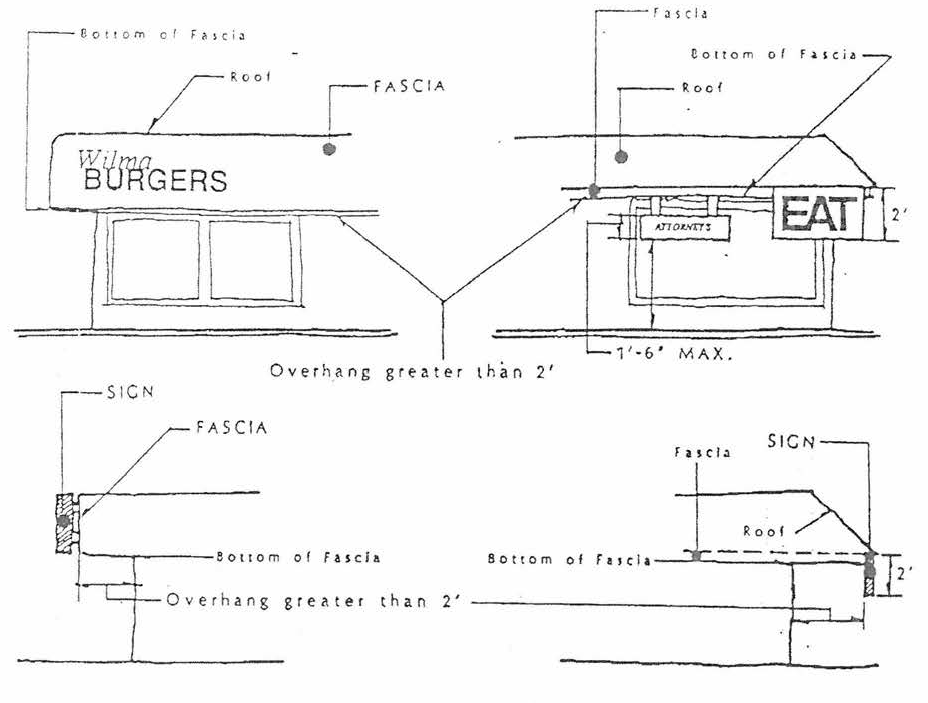
Fascia signs: A fascia sign measuring a maximum two (2) feet in height may be placed upon a building fascia which measures less than two (2) feet in height. Said sign shall not be placed to extend above the top edge of the fascia overhang and shall be placed below the lowest roof line. Alternatively, a sign meeting the dimensional requirements of a fascia sign but not exceeding two (2) feet in height may be placed below the fascia.
Fascia Signs
(4)
Awning signs. Where an awning is otherwise shown as an architectural feature on an approved site plan, awning signs shall be allowed provided that no sign shall extend above or below such awning.
(5)
Undercanopy signs. Where an awning, canopy, arcade or similar feature architectural feature designed to create a sheltered pedestrian walkway is shown on an approved site plan, undercanopy signs shall be permitted as set forth below.
(a)
Undercanopy signs shall be limited in size to a maximum of four (4) square feet in area.
(b)
Undercanopy signs shall not be counted towards the maximum permitted sign area.
(c)
Undercanopy signs shall be limited to one (1) such sign per business.
(F)
Fences. A sign otherwise permitted by this division may be mounted upon a fence or wall provided that the sign area is no more than four (4) square feet.
(G)
Internal message boards. Parcels within the RAC-AV zoning district may erect internal message boards with the following limitations:
(1)
The parcel shall be five (5) or more acres in size.
(2)
Where more than two (2) internal message boards are proposed, such signs shall follow a consistent design theme as adopted in the Master Site Plan and Design Standards required by section 12-32.417.
(3)
No internal message board shall be more than two hundred (200) square feet per sign face.
(4)
Internal message board sign faces shall not be visible from any public street right-of-way.
(5)
If visible from an internal drive, such drive shall have a design speed of no more than twenty-five (25) miles per hour.
(6)
Despite any provision of this division to the contrary, an internal message board may include changeable copy and digital light displays, including full motion displays. Messages shall be limited to information concerning onsite, not-for-profit programs, parking and travel information and public safety information.
(H)
External message boards. Parcels within the RAC-TC zoning districts may erect external message boards with the following limitations:
(1)
The parcel shall be five (5) or more acres in size and shall be owned and managed by a governmental entity.
(2)
No external message board shall be more than two hundred (200) square feet per sign face nor more than fifteen (15) feet in height.
(3)
Despite any provision of this division to the contrary, an external message board may include changeable copy and digital light displays, including full motion displays, provided that the text changes no more than once every six (6) seconds. Messages shall be limited to information concerning onsite, not-for-profit programs, parking and travel information and public safety information.
(Ord. No. 2018-004, § 2(Exh. A), 3-21-18; Ord. No. O2019-019, § 2(Exh. A), 8-21-19; Ord. No. O2022-014, § 2(Exh. A), 8-17-22)
Sec. 12-240. - Design and placement of certain temporary signs.
(A)
Allocation of area. The temporary signs identified in this section (12-240) shall be considered a separate allocation of signage and shall not count against the amount of signage allocated by sections 12-237 and 12-238.
(B)
Banner signs in non-residential zoning districts.
(1)
Maximum area per building: Ten percent of the "building sign area" allocated pursuant to section 12-237(A).
(2)
Maximum area per sign: one-half foot per foot of building façade or thirty-two (32) square feet, whichever is less.
(3)
Location: Must be securely attached to a solid wall or building elevation such that no part of the sign moves freely with wind pressure.
(4)
Duration: Maximum thirty (30) days per building façade per calendar year.
(C)
Window signs in non-residential zoning districts. Up to ten (10) percent of any window may be covered with window signs provided that no such sign is larger than twenty (20) square feet.
(D)
A-frame signs in non-residential zoning districts.
(1)
Maximum area per sign: Eight (8) square feet.
(2)
Location: Limited to paved walkways on private property as shown on an approved site plan, no further than one hundred (100) feet from the main entrance of the building to which it pertains.
(3)
Duration: Shall be displayed only while the use to which it pertains is open.
(E)
Public institution recognition. Despite any provision in this division to the contrary, public and non-profit educational institutions in any zoning district shall be allowed to display banner signs on fences where such banner signs are no more than fifty (50) percent opaque, with lettering of a single color on a uniform background color, with no individual banner sign exceeding thirty-two (32) square feet. Such banner signs shall not be considered off-premises signs provided that the purpose is to support the on-site institution or its related organizations.
(F)
Off-premises directional signs.
(1)
Purpose. Because residential areas generally lack the permanent signage, traffic signals and other visual cues available in commercial areas, off-premises direction signs can be useful in directing individuals to events occurring within residential areas while avoiding unnecessary trips through other neighborhoods.
(2)
In general. Despite any provision in this division to the contrary, the owner or tenant of a parcel of property within a Town of Davie residential district, including the agent of such owner or tenant, may display one or more temporary off-premises directional signs as set forth in this section (12-[2]40(F)).
(3)
Maximum area per sign: Four (4) square feet.
(4)
Maximum number of signs: Three (3) per event.
(5)
Maximum sign height: Three (3) feet.
(6)
Location and manner: Signs shall be staked to the ground within a landscaped swale or median of a public right-of-way and placed no further than two thousand five hundred (2,500) feet (airline measurement) from the boundary of the parcel to which it pertains. Signs shall include the address of the parcel to which it pertains. Signs shall not be staked deeper than twelve (12) inches and shall be removable without tools.
(7)
Duration: Signs shall be displayed not more than twenty-four (24) hours prior to the event and not more than twenty-four (24) hours after the conclusion of the event. In no case shall an off-premises direction sign be displayed for more than three (3) consecutive days. Removal of signs shall be the responsibility of the landowner or agent as described in (2) above, provided that signs not meeting the requirements of this paragraph (F) shall also be subject to removal by the town pursuant to section 12-243.
(G)
Construction screening during redevelopment period. A parcel of land which is undergoing construction or redevelopment pursuant to an approved, unexpired site plan issued pursuant to section 12-368, and has at least one active, unexpired Town of Davie Building or Engineering Permit, may display temporary signage as follows:
(1)
The temporary signage is attached to or otherwise part of an opaque or semi-opaque "construction screen," no more than eight (8) feet in height, designed to screen the view of redevelopment activity occurring on the property from adjacent public rights-of-way. While the construction screen may extend the full length of any side of the property, the maximum amount of sign copy that may be displayed on any side of a construction screen is fifty (50) percent.
(2)
Any construction screen displaying more than three hundred (300) square feet of signage must also display town-approved decorative artwork as determined by the town administrator, or designee. The town administrator, or designee, shall provide specifications for town-approved, royalty free, decorative artwork at no cost to each qualified applicant.
(3)
All temporary signage erected in accordance with this paragraph (G) must be removed within thirty (30) days of substantial completion of the development or redevelopment indicated in the approved site plan. In no case shall signage erected in accordance with this paragraph (G) remain in place for more than twenty-four (24) months.
(Ord. No. 2018-004, § 2(Exh. A), 3-21-18; Ord. No. O2024-007, § 2(Exh. A), 2-21-24)
Sec. 12-241. - Sign lighting and illumination.
(A)
The following shall be the only allowable methods of sign lighting and illumination within the town:
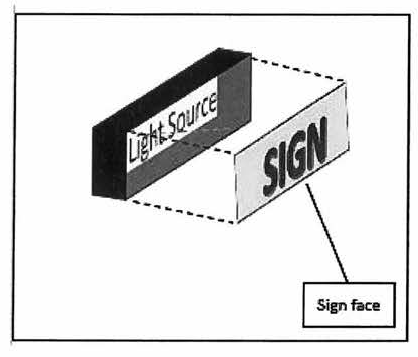
(1)
Cabinet sign with internal light source.
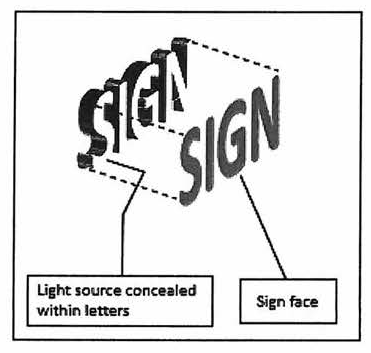
(2)
Channel letter sign with Internal light source.
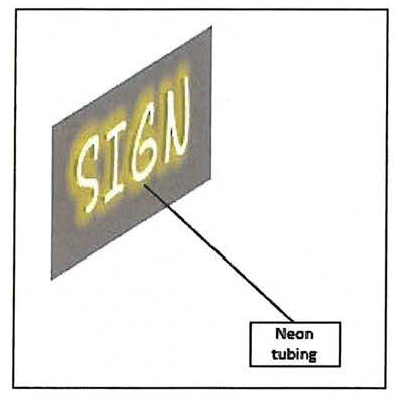
(3)
Neon tubing formed into sign copy.
(4)
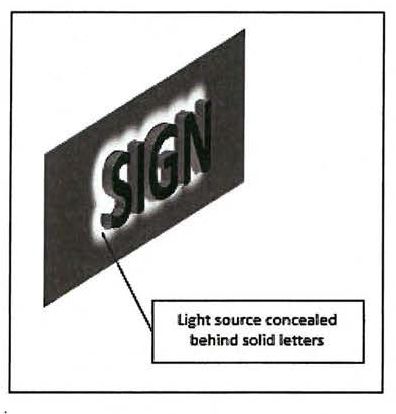
Reverse channel letter sign with "halo lighting".
(5)
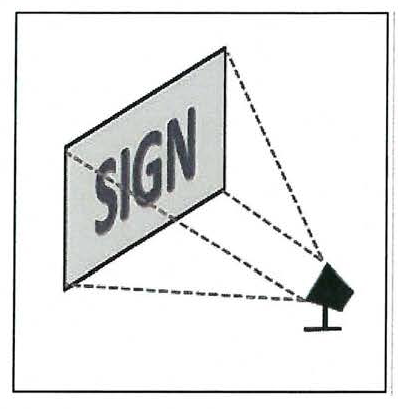
Shielded spotlight.
(B)
Allowable sign lighting and illumination for permanent signs by zoning district:
(C)
Temporary signs. Lighting and illumination of temporary signs in all zoning districts shall be limited to the type specified in paragraph (A)(5) above.
(D)
Light source. With the exception of neon tubing as set forth in paragraph (A)(3) above, the light source shall not be visible from adjoining properties or public rights-of-way and light emitters shall not be arranged in such a manner as to create sign copy.
(E)
Neon tubing. Neon tubing as set forth in paragraph (A)(3) above shall only be permitted in the form of a window sign in accordance with the standards of section 12-240.
(Ord. No. 2018-004, § 2(Exh. A), 3-21-18)
Sec. 12-242. - Sign maintenance.
(A)
All signs shall be maintained as originally permitted and constructed, in good order with no missing, crooked, misplaced, faded, or damaged letters or other symbols or materials.
(B)
No person shall have any sign that is in a dangerous or defective condition on any premises he or she owns or controls. Within ten (10) days of receiving notice of lack of maintenance, all signs shall be maintained in a safe presentable and good structural condition, including the replacement of defective parts, repainting, cleaning and other acts required for the maintenance of said sign.
(C)
Maintenance of area surrounding sign. All ground-mounted signs and the premises surrounding the same shall be maintained by the owner thereof in a clean, sanitary and inoffensive condition, and free and clear of all obnoxious substances.
(Ord. No. 2018-004, § 2(Exh. A), 3-21-18)
Sec. 12-243. - Signs on rights-of-way and public property.
(A)
No signs shall be allowed a private right-of-way, a public right-of-way, or lands owned by a governmental water management entity, except noncommercial signs erected by or on behalf of a governmental entity or public utility.
(B)
No signs shall be allowed on public property or a public place, except those placed by or at the direction of the town, or as may be required by this division.
(C)
In addition to any other enforcement powers and remedies which may be available to the town, any sign located within a public right-of-way or on public property which is not in compliance with this division shall be considered forfeited to the public and subject to confiscation by the town.
(Ord. No. 2018-004, § 2(Exh. A), 3-21-18)
Sec. 12-244. - Off-premises signs.
(A)
Except as provided in section 12-247 of this Code, it shall be unlawful to erect, construct or reconstruct an off-premises sign in any area of the town except that up to ten (10) new off-premises signs may be erected within the Town of Davie, provided that the town council has determined that at least a minimum of five (5) percent of the gross revenues from the advertising on said off-premises signs, which under no circumstances shall be less than eight thousand dollars ($8,000.00) per year per sign, are directed to nonprofit corporations serving the residents of the Town of Davie, which funds will assist in funding such nonprofit corporation projects serving the interest of the citizens of the Town of Davie, subject to the town council certifying that any potential site upon which these off-premises signs may be erected and the proposed off-premises signs meet the following requirements:
(1)
The off-premises sign is limited in size to fourteen (14) feet by forty-eight (48) feet and is supported by a single pole;
(2)
The off-premises sign structure under the sign includes a statement that revenues from the sign are used to help a specific non-profit corporation which shall be named in the statement in lettering no less than eighteen (18) inches tall;
(3)
The off-premises sign is not located within a residential zoning designation, nor is it within one hundred (100) feet of a residential zoning district as measured from the nearest portion of the off-premises sign;
(4)
The off-premises sign site is located adjacent to the I-595 or I-75 corridors or the Florida Turnpike;
(5)
The off-premises sign is not located within one thousand five hundred (1,500) feet of a site previously certified by the town council; and
(6)
Any additional reasonable regulations, including the posting of bonds if deemed necessary by the town council.
(B)
The town council shall have the right to reject any proposed site notwithstanding the site's compliance with subsections (1) through (6) above. A permit for these off-premises signs shall be issued by the Town of Davie upon submission to the town building department of the following:
(1)
Certification that the town council has determined that the site and the proposed off-premises sign comply with the requirements of this section (12-244);
(2)
An executed agreement by a company providing outdoor advertising substantially in the form provided in Ordinance 1996-30, together with the requisite evidence that the company has entered into an agreement with a nonprofit corporation to assure that at least five (5) percent of the gross revenues from the advertising on said off-premises signs, which under no circumstances shall be less than eight thousand dollars ($8,000.00) per year per sign, are directed to said nonprofit corporation to assist in funding such nonprofit corporation's projects exclusively serving the residents of the Town of Davie;
(3)
A lease for the proposed site upon which the off-premises sign is to be erected;
(4)
Plan reflecting that the off-premises sign is no more than sixty (60) feet above the crown of any adjacent, limited-access arterial roadway; and
(5)
Plans reflecting that the off-premises sign placement within the site conforms with the requirements of Chapter 479, Florida Statutes, all other applicable federal, state and county regulations, and municipal regulations, not in conflict with the provisions of this section (12-244).
(C)
A certified public accountant serving as an outside auditor to the permit holder shall, at the permit holder's expense, provide to the town on an annual basis a statement verifying revenues from each permitted sign for purposes of verification of the gross revenues. The town's finance department shall thereafter be authorized to inquire of the certified public accountant as to the statement and to review the work papers of the certified public accountant and verify the findings. For purposes of this section (12-244), gross revenues shall not include monies received for payment of sales tax.
(D)
Certification of any site shall terminate one hundred eighty (180) days after certification if a building permit for the sign has not been issued within the one-hundred-eighty-day period. In the event a permittee uses all sites allowable under its agreement with the town, the certification of all additional sites shall then immediately expire.
(E)
Any off-premises sign previously certified by the town council and constructed pursuant to a valid building permit are deemed authorized and, in the event of damage or destruction, may be reconstructed to it previously permitted condition.
(Ord. No. 2018-004, § 2(Exh. A), 3-21-18; Ord. No. O2025-021, § 2(Exh. A), 5-21-25)
Editor's note— The provisions allowing ten (10) new off-premises signs were originally adopted by Ordinance 1996-30 and became effective on June 19, 1996. All ten (10) signs authorized by Ordinance 1996-30 have been constructed.
Sec. 12-245. - Nonconforming signs.
(A)
Nonconforming signs other than off-premises signs.
(1)
In general. Signs, other than off-premises signs, lawfully existing at the time of the adoption of this division may be continued for an amortization period not to exceed five (5) years although their size, location or other physical attributes do not conform to this division.
All such signs lawfully existing at the time of the adoption of this division shall be considered legal nonconforming signs during their five-year amortization period. However, all legal nonconforming signs shall be deemed to have exhausted their economic life after said amortization period. The amortization period shall begin at the time of the adoption of this division. Nonconforming signs, after this amortization period, shall either be made to conform to the terms and requirements of this division or shall be removed by the owner, owner's agent or person having beneficial use of the property. Nonconforming signs, during the amortization period, shall be kept in good repair, but the cost of maintenance shall not be considered grounds for their continued use beyond the amortization period.
(2)
Limitations of nonconforming signs. A nonconforming sign which continues to exist beyond the amortization period set forth in paragraph (1), above shall be governed as follows:
a.
The sign shall not be structurally altered in any way, other than to create a conforming sign. This shall specifically prohibit the introduction of any new sign components or methods of sign illumination.
b.
If damaged or destroyed, the sign shall not be reconstructed.
c.
The sign shall not undergo a change of sign copy, except for lawfully established changeable copy signs.
(B)
Nonconforming off-premises signs.
(1)
Although off-premises signs are currently prohibited, a number of off-premises signs were previously constructed lawfully within the town. This subsection provides for the legal status of the lawfully established off-premises signs and regulates the manner in which they may be maintained.
Off-premises signs lawfully established pursuant to a building permit prior to January 1, 2010, and which met all Town Code requirements in effect at the time of sign construction shall be considered conforming to this division provided that the sign is not modified other than as related to changes of copy consistent with the original, approved design. For example, and not by way of limitation, an off-premises sign originally designed as a static message sign with external illumination, shall not be modified to allow automatically rotating messages, digital messages or new methods of sign illumination. This paragraph is not intended to prohibit normal repair and maintenance or the replacement of sign lighting and other components consistent with the original, approved sign.
(2)
External message board signs lawfully established in the RAC-AV district prior to May 1, 2022, which met all Town Code requirements in effect at the time of sign construction, shall be considered conforming to this division and may be repaired and refurbished without limitation, including complete replacement of sign components, provided that such signs are operated in a manner consistent with Section 12-239(H)(3).
(Ord. No. 2018-004, § 2(Exh. A), 3-21-18; Ord. No. O2022-014, § 2(Exh. A), 8-17-22)
Sec. 12-246. - Sign variances.
The town council may consider a variance to any of the provisions of sections 12-235 through 12-243 pursuant to the procedures set forth in section 12-309 of the Town Code.
(Ord. No. 2018-004, § 2(Exh. A), 3-21-18)
Sec. 12-247. - Off-premises digital signs.
(A)
Notwithstanding any other provision of this Code, and in addition to any other off-premises sign approved by the town council, up to two (2) off-premises digital signs with up to two (2) sign faces per sign may be erected within the Town of Davie, subject to the town council certifying that any potential site upon which these off-premises signs may be erected and the proposed off-premises signs meet the following requirements:
(1)
The off-premises sign is limited in size to fourteen (14) feet by forty-eight (48) feet and is supported by a single pole;
(2)
The off-premises sign is not located within a residential zoning designation, nor is it within five hundred (500) feet of a residential zoning district on the same side of the highway as measured from the nearest portion of the off-premises sign;
(3)
The off-premises sign site is located adjacent to the 1-75 corridor;
(4)
The off-premises sign is not located within ten thousand (10,000) feet of each other along the 1-75 corridor on the same side of the highway, nor within one thousand five hundred (1,500) feet of any other off-premises sign site on the same side of the highway previously certified by the town council pursuant to section 12-244;
(5)
The off-premises sign will benefit the town and its residents, including, but not limited to, providing to the town the right to display public safety messages during declared emergencies as well as the right to display community public interest messages, the details of both rights and any other benefits to be specified in the proposal for the sign;
(6)
The static display time for each message is at least seven and a half (7.5) seconds for a total of no more than eight (8) messages per minute; and
(7)
Any additional reasonable regulations, including the posting of bonds if deemed necessary by the town council.
(B)
If the town council determines that a digital sign on a proposed site will cause substantial negative impacts to nearby properties, the town council shall have the right to reject any proposed site notwithstanding the site's compliance with subsections (1) through (5) above. A permit for these off-premises signs shall be issued by the Town of Davie upon submission to the town building department of the following:
(1)
Certification that the town council has determined that the site and the proposed off-premises sign comply with the requirements of this section (12-247);
(2)
A deed or lease for the proposed site upon which the off-premises sign is to be erected;
(3)
Plan reflecting that the off-premises sign is no more than sixty five (65) feet above the crown of any adjacent, limited-access arterial roadway; and
(4)
Plans reflecting that the off-premises sign placement within the site conforms with the requirements of Chapter 479, Florida Statutes, all other applicable federal, state and county regulations, and municipal regulations, not in conflict with the provisions of this section (12-247).
(C)
Certification of any site shall terminate one hundred eighty (180) days after certification if a building permit for the sign has not been issued within the one hundred eighty-day period. In the event a permittee uses all sites allowable under its agreement with the town, the certification of all additional sites shall then immediately expire.
(Ord. No. O2025-022, § 2(Exh. A), 5-21-25)
Sec. 12-260. - Lighting standards.
(A)
Outdoor Activity Areas. All paved parking facilities and paved exterior site areas to be developed in the future, exclusive of driveways, and walkways of single-family, duplex, and triplex lots, shall be illuminated according to the standards contained herein and in section 12-262.
(1)
For the purposes of this section, exterior parking facilities shall include the parking surface of open parking lots and access thereto, and parking areas and other unenclosed areas at grade level for which the parking facilities are a requirement. Garage parking facilities shall include underground, multilevel parking garages, and enclosed grade level parking facilities.
(2)
Intensity of Illumination:
(a)
For exterior parking facilities, the intensity of illumination shall provide an average maintained illumination of not less than one (1) footcandle, and shall be well distributed in the pavement areas; however, at no point shall illumination be less than one-half (0.5) footcandle of light measured at grade level. The maximum to minimum footcandle level shall not exceed a twelve to one (12:1) ratio and the average to minimum footcandle level shall not exceed a four to one (4:1) ratio.
(b)
Garage parking facilities shall provide an average intensity of illumination of not less than fifty (50) footcandles at the entrance, ten (10) footcandles in traffic lanes and five (5) footcandles in storage areas.
(c)
Reserved.
(d)
The current edition of the "IESNA Lighting Handbook," published by the Illuminating Engineering Society of North America, 120 Wall Street, 17th Floor, New York, NY 10005-4001, is the standard to be used by the architect or engineer as a guide for the design and testing of parking facility lighting. The standards contained therein shall apply unless standards developed and adopted by this section or by the night sky regulations found in section 12-262 or subsequent amendments are more restrictive, in which case the more restrictive standards shall apply.
(3)
All required illumination shall be controlled by automatic devices:
(a)
For business uses with exterior or garage parking facilities, the required illumination shall be provided at least thirty (30) minutes after the closing time of any establishment served by the parking facility.
(b)
Any parking facility that serves a residential use must maintain the minimum levels of illumination established by this section through the use of natural or artificial light twenty-four (24) hours per day.
(4)
In order to minimize offensiveness to persons on neighboring property and to eliminate distractions to and temporary blinding of drivers of vehicles passing illuminated property, all artificial parking lot or site area lighting shall be fully shielded in a manner that will limit spillover of lighting onto adjacent property and public rights-of-way. Spillover, measured at the property line, shall not exceed the following footcandle levels vertical or horizontal illumination onto adjacent properties, light measured at grade level:
(B)
Maximum height of pole-mounted lights.
(1)
Pole-mounted exterior lighting. Except as set forth in paragraph (2) below, no pole-mounted light, whether required by this chapter or for any other purpose, shall exceed a height of twenty-five (25) feet, measured from grade to the top of the luminary.
(2)
Exceptions.
(a)
The town council may authorize pole-mounted lighting up to thirty-five (35) feet in height for industrial uses where light poles will be located at least two hundred fifty (250) feet from the nearest property line of a parcel used exclusively for residential use.
(b)
The provisions of paragraph (B)(1) do not apply to any non-residential sports field lighting or to any pole-mounted lighting located within a public right-of-way.
(C)
Architectural strip lighting.
(1)
Definition. For purposes of this subsection, "architectural strip lighting" means strings or strips of lights attached to a building by any means for the purpose of accentuating the architectural features of a building or structure.
(2)
Architectural strip lighting prohibited. Except as set forth in paragraph 3, architectural strip lighting is prohibited.
(3)
Exceptions. This paragraph (C) does not apply to the following:
(a)
Decorative holiday lighting attached to residential dwelling by the individual owner of tenant of such dwelling.
(b)
Lighting on town-owned property or within public right-of-way.
(Ord. No. 90-4, § 7, 2-21-90; Ord. No. 96-047, § 1, 11-20-96; Ord. No. 2009-6, § 1, 2-4-09; Ord. No. 2011-26, § 2(Exh. A), 8-17-11; Ord. No. O2021-030, § 2(Exh. A), 11-3-21; Ord. No. O2025-014, § 2(Exh. A), 5-7-25)
Sec. 12-261. - Street lighting.
(A)
System Required: A street lighting system shall be provided as part of the improvements in any new land development project. Town council may waive this requirement within interior roadways of developments for those areas governed by the Rural Lifestyle Regulations based on the need to maintain rural lifestyle conditions. Installation of all underground facilities must be completed before the streets are paved. In addition, all lighting within areas governed by the Rural Lifestyle Regulations shall comply with section 12-297 and section 12-262.
(B)
Design and Construction Standards: All street lighting as required by this article shall conform to the following standards of design and construction:
(1)
All designs for lighting shall be approved by the town engineer, who will follow, as a minimum, the Illuminating Engineering Society of North America (IESNA) "Standard Practice for Street and Highway Lighting," 1953, for Type III Distribution (latest edition). Lighting systems that will be dedicated to the Town shall utilize LED or similar high efficiency luminaries with long a minimum five (5) year warranty.
(2)
Wiring for street lighting shall be underground except in areas where primary distribution conductors are overhead. Subject to the approval of the town engineer, the primary poles may be used for streetlights and associated wiring.
(3)
Developers shall be required to install street lights with a maintained minimum of one-half (0.5) footcandle of light measured at grade level. The maximum to minimum footcandle level shall not exceed a twelve to one (12:1) ratio and the average to minimum footcandle level shall not exceed a four to one (4:1) ratio. Street lights installed before November 20, 1996, shall not be considered in conflict with this section.
(C)
Enforcement of Article:
(1)
No building permit shall be issued in any new land development project unless the engineering drawings therefore contain adequate provisions for street lighting.
(2)
No certificate of occupancy shall be issued to any structure until the street lighting is completed and operable and in compliance with the night sky regulations found in section 12-262 or a commitment acceptable to the town has been provided to ensure the timely completion of the lighting.
(3)
The specific design standards of this section may be waived by the town council where a waiver would not be detrimental to the public health, safety or welfare of the citizens of the town.
(Ord. No. 90-4, § 7, 2-21-90; Ord. No. 2002-35, § 1, 10-16-02; Ord. No. 2009-6, § 2, 2-4-09; Ord. No. 2016-014, § 2(Exh. A), 7-27-16)
Sec. 12-262. - Night sky regulations.
A.
Intent and Purpose. The intent of this section is to minimize light pollution for the enjoyment and use of property and the night environment by the residents of the Town of Davie. It is also the intent of this section to encourage lighting practices and systems which will: minimize glare, light trespass and overlighting; conserve energy and resources while maintaining night-time safety, utility, security, and productivity; and curtail the degradation of the night time visual environment.
B.
Applicability. All outdoor lighting shall be installed in conformance with the provisions of this section (12-262) as follows.
1.
New Developments. For all proposed new developments, buildings, and structures that require a site plan relating to actual construction, all outdoor lighting systems shall meet the requirements of this section (12-262).
2.
Buildings and Major Additions. After February 4, 2009, all building additions or modifications of fifty (50) percent or more in terms of additional dwelling units, gross floor area, or parking spaces, either with a single addition or with cumulative additions, shall include lighting systems that meet the requirements of this section (12-262) for the entire property, including any previously installed lighting.
3.
Modifications. Cumulative modification or replacement of outdoor lighting constituting twenty-five (25) percent or more of the light fixtures for the parcel, regardless of the actual amount of lighting already on a non-conforming site, shall constitute a major addition for purposes of this section.
4.
Existing lighting. Lighting systems lawfully installed prior to February 4, 2009 shall not be required to comply with the standards of section 12-262, paragraphs F, G and H until such time as new development is approved pursuant to paragraphs 1, 2 or 3, above.
5.
Minor Additions. Additions or modifications of less than fifty (50) percent to existing uses, as defined in paragraphs 2 and 3, above, and that require a site plan relating to actual construction or a site plan modification, shall require the submission of a complete inventory and site plan detailing all existing and any proposed new outdoor lighting. Any new lighting proposed on the site shall meet the requirements of this section with regard to shielding and lamp type. The total outdoor light output after the modifications are complete shall not exceed that on the site before the modification, or that permitted by this Code, whichever is larger.
6.
The Town of Davie will coordinate with other governmental entities as needed to facilitate bringing into compliance any roadway lighting and any other improvements.
C.
Permanent Exemptions.
1.
Permanent Exemptions.
a.
Federal and State Facilities. Outdoor light fixtures on, in or in connection with facilities and land owned or operated by the government of the United States of America or the State of Florida are exempt from the requirements of this section but voluntary compliance with the intent and provisions of this division is encouraged.
b.
Emergency Lighting. Lights used by police, firefighting, or medical personnel, or at their direction, are exempt from all requirements of this section for as long as the emergency exits.
c.
Holiday Decorations. Residential and commercial seasonal decorations using typical unshielded low-wattage incandescent lamps shall be permitted from Thanksgiving thru January 15. Holiday lights are encouraged to be turned off in residential areas by 11:00 p.m. and after the business closes in commercial and industrial areas.
d.
Flag poles.
e.
Underwater lighting used for the illumination of swimming pools, fountains and other water features is exempt from the lamp type and shielding standards of this section though it must conform to all other provisions of this Code.
f.
Lighting of radio, communication and navigation towers is exempt; provided that the owner or occupant demonstrates that the Federal Aviation Administration (FAA) regulations can only be met through the use of lighting that does not comply with this Code.
g.
Airport Lighting. Lighting related to airport operations is exempt provided the owner or occupant demonstrates that the Federal Aviation Administration (FAA) regulations can only be met through the use of lighting that does not comply with this ordinance.
h.
Parcels located within the zoning district of RAC-AV are exempt (see sections Article XIII, Division 10).
i.
Parcels located within the Western Theme District are exempt unless, at a minimum, a cutoff lighting fixture can be achieved.
j.
Lighting of signs governed by Article VIII, Division 1, Signs.
k.
Sports field lighting.
D.
Temporary Exemptions.
1.
Information Required. Any individual may submit a written request to the Planning and Zoning Division for a temporary exemption from the requirements of this section. The fee for the temporary exemption shall be that fee prescribed in the Planning and Zoning Division fee schedule, as amended from time to time. The request for temporary exemption shall contain the following information:
a.
Name, address and telephone number of the applicant;
b.
Location of the outdoor light fixtures for which the exemption is requested;
c.
Specific exemption(s) requested;
d.
Use of the outdoor light fixtures involved;
e.
Duration of the requested exemption(s);
f.
Type of outdoor light fixture to be used, character of the shielding, if any;
g.
Previous temporary exemptions, if any;
h.
Such other data and information as may be required by the Planning and Zoning Division.
The planning and zoning division shall have ten (10) business days from the date of receipt of the request for an exemption to approve or disapprove the request. The applicant will be notified of the decision in writing.
2.
Duration of Approval. The exemption shall be valid for not more than thirty (30) consecutive days from the date of issuance of approval. Exemptions are renewable for a period of not more than thirty (30) consecutive days. Requests for renewal of a temporary exemption shall be processed in the same manner as the original request. No outdoor light fixtures shall be exempted from this division for more than sixty (60) days during any twelve (12) month period.
3.
Disapproval and Appeal. If the request for temporary exemption is disapproved by the Planning and Zoning Division, the applicant may appeal the decision to the town council. Appeals shall be submitted in writing within ten (10) working days from the date of notification of disapproval. The appeal fee shall be that fee prescribed in the Planning and Zoning Division fee schedule.
E.
Prohibitions.
1.
Laser Source Light. The use of laser source light or any similar high intensity light for outdoor advertising or entertainment is prohibited.
2.
Searchlights. The operations of searchlights for advertising purposes is prohibited.
F.
Lamp Type and Shielding Requirements per Fixture.
1.
Shielding Standards. All nonexempt outdoor lighting fixtures, with the exception of those parcels located within the Rural Lifestyle or the Griffin Corridor Districts, shall be full cutoff fixtures with the light source fully-shielded to prevent glare. For parcels located within the Rural Lifestyle, or the Griffin Corridor Districts all lighting fixtures shall be at a minimum cutoff where a minimum amount of light is directed at a horizontal plane. All light fixtures shall be designed to minimize stray light trespassing across property boundaries and all illumination shall be controlled by automatic devices.
a.
All lighting for commercial and industrial areas shall be extinguished between 11:00 p.m. and sunrise or when the business is closed, whichever is later. If for security reasons it is necessary to have some lighting, the use of motion sensors is strongly recommended or the installation of a dimmer to generate less light at night provided:
i.
It is located in such a manner as to prevent glare and lighting on properties of others or into a public rights-of-way.
ii.
The luminaire is set to only go on when activated and to go off within five minutes after activation has ceased.
iii.
The luminaire shall not be triggered by activity off the property.
b.
Canopy lights, such as for motor fuel pump lighting shall be full cutoff so as to ensure that no light source is visible from or cause glare on public rights of way or adjacent properties.
c.
Area lights. All area lights shall be full cutoff type luminaires.
d.
Any lamp installed on a residential property must be fully shielded such that the lamp itself is not directly visible from any other residential property.
2.
Landscape Lighting for Multi-Family and Commercial Buildings. Landscape lighting for commercial buildings is the only non-exempt lighting that may utilize uplight. However, the maximum initial illuminance value for this specific application, must adhere to the U.S. Green Building Council's latest version of LEED for New Construction and Major Renovation - Sustainable Site Credit 8 which limits the amount of uplight footcandles per the lighting zone the project is in.
3.
Landscape Lighting for Residential Applications. See D. Special Exemptions.
4.
Lamp Source. Preferred lamp sources for parking lots, pedestrian zones, and street lights are Pulse-Start Metal Hallide or LED. Lamp sources for Architectural features may be any lamp type deemed appropriate by the lighting designer or otherwise allowed by Code, as long as it is in accordance with this and other sections of the Code.
G.
Compliance Review.
1.
The applicant for a site plan or site plan modification required by the Town of Davie involving outdoor light fixtures (except as exempted above) shall submit an illumination plan. That plan shall be certified by a registered architect or registered engineer as providing illumination in accordance with the applicable standards set forth in this division. Subsequent construction must comply with the approved lighting plan.
The illumination plan shall contain but not be limited to the following:
a.
The location of the site where the outdoor light fixtures will be installed, both proposed and any already existing on the site;
b.
Plans indicating the location on the premises, and the type of outdoor light fixtures;
c.
A description of the outdoor light fixtures including but not limited to manufacturer's catalog cuts, photometric study, and drawings.
2.
The above required plan and descriptions shall be sufficiently complete to enable town staff to readily determine whether the work will comply with the requirements of this section. If such plan and descriptions cannot enable this ready determination, by reason of the nature or configuration of the devices, fixtures or lamps proposed, the applicant shall submit further evidence of compliance enabling such determination.
3.
The lighting installation shall not be placed in permanent use until a letter of compliance from a registered professional engineer has been provided stating that the installation has been field checked and meets the requirements as stated above.
4.
Should any outdoor light fixture, or the type source therein, be changed after site plan approval relating to actual construction or a site plan modification approval has been issued, a site plan modification must be submitted for approval, together with adequate information to assure compliance with this section, which must be received prior to substitution.
H.
Hours of Operation.
1.
Lighting located within residential (or with a residential component), mixed use, commercial, community facility or industrial areas are encouraged to be turned off between 11:00 p.m. and sunrise or when the business closes, whichever is later, except as indicated in section 12-260(4)(a) and as follows:
a.
On premises advertising signs may be illuminated while the business facility is open to the public;
b.
Outside illumination of sales, commercial, assembly, repair, and industrial areas may be lit when such areas are actually in use.
c.
Lighting exempted from this requirement under C. and D.
I.
Alternative Compliance. This subsection is not intended to prevent the use of any design, material or method of installation not specifically proscribed by this section, provided any such alternate has been approved. The town administrator or his/her designee may approve any such proposed alternate provided it:
1.
Provides at least approximate equivalence to the applicable specific requirement of this section.
2.
Is otherwise satisfactory and complies with the intent described for this section.
(Ord. No. 2009-6, § 3, 2-4-09; Ord. No. O2018-009, § 2(Exh. A), 4-4-18)

